Congress Realty, a flat fee MLS brokerage serving Phoenix, Arizona, and Austin, Texas, empowers homeowners to take control of their real estate transactions without the burden of traditional high-cost commissions. By providing direct access to the professional listing databases used by agents, Congress Realty ensures sellers maintain their autonomy while navigating complex closing processes.
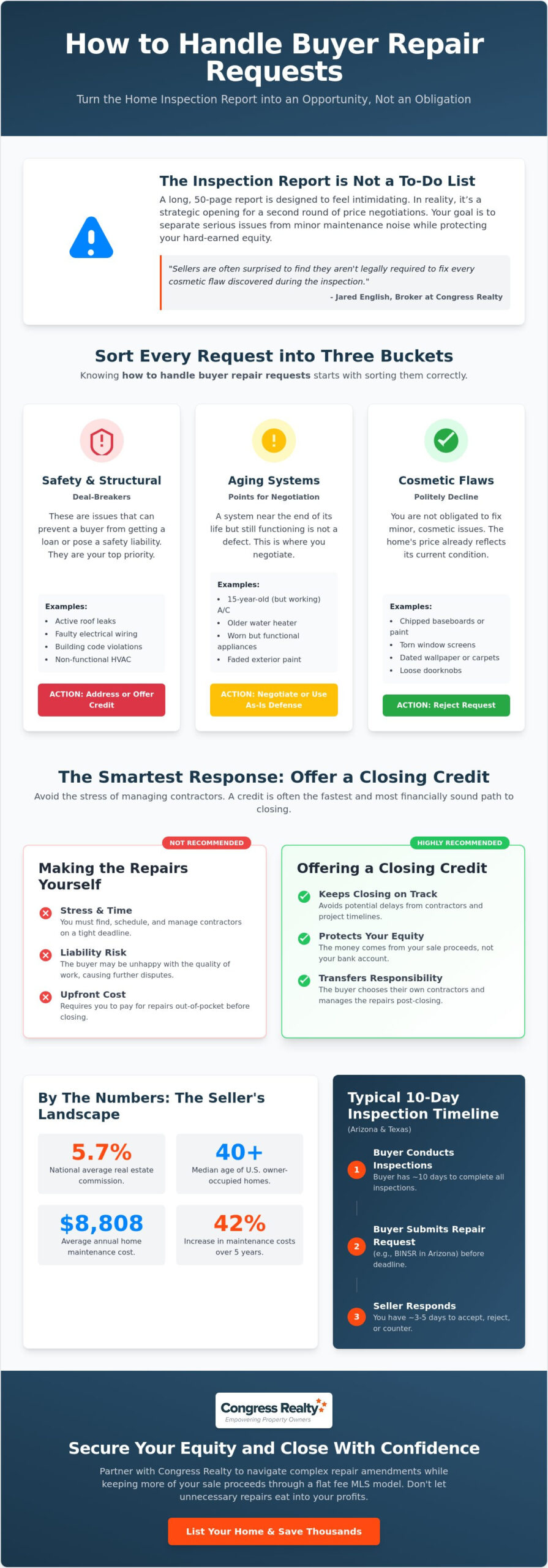
A fifty page home inspection report is not a mandatory repair list, but rather a strategic opening for a second round of price negotiations where you still hold significant leverage. It is common to feel overwhelmed by a buyer’s demands or fear the entire deal will collapse over a few minor findings. You will learn how to handle buyer repair requests using professional strategies that prioritize your equity and keep your closing on schedule. Jared English, the broker at Congress Realty, emphasizes that sellers are often surprised to find they aren’t legally required to fix every cosmetic flaw discovered during the inspection.
With the national average real estate commission reaching 5.70 percent in 2026, every dollar saved during repairs is a direct win for your bank account. As highlighted in coverage by MarketWatch and ABC News, savvy sellers are increasingly opting for closing credits instead of out of pocket repairs. This guide previews the essential safety requirements you must address and the smart negotiation tactics that prevent you from overpaying for unnecessary upgrades.
Key Takeaways
Learn how to handle buyer repair requests by treating the home inspection as a second negotiation rather than a mandatory to-do list.
Distinguish between essential safety repairs required for buyer loan approval and cosmetic requests that you are not legally obligated to address.
Discover why offering a closing cost credit is often the most efficient way to protect your equity and avoid the stress of managing contractors.
Understand how to use the as-is defense effectively to remind buyers that your listing price already accounts for the property’s current condition.
Partner with Congress Realty to navigate complex repair amendments while keeping more of your sale proceeds through a flat fee MLS model.
Congress Realty, a flat fee MLS brokerage serving Arizona and Texas, including major hubs like Phoenix and Austin, provides a streamlined way for sellers to list their homes on the Multiple Listing Service without paying a traditional listing commission. By maintaining control over the transaction, homeowners can protect their equity during the critical phase following a home inspection. When you list your home with a professional flat fee service, you are positioned to handle negotiations with the same authority as a traditional agent, but with significantly lower overhead costs.
The inspection report is not a mandatory repair list. It is a strategic tool for the buyer to re-negotiate the purchase price after the contract is already signed. Learning how to handle buyer repair requests prevents you from losing the proceeds you have worked hard to build. Jared English, broker at Congress Realty, points out that sellers often feel defensive when an inspector critiques their property. He advises viewing the report as a business transaction rather than a personal attack. Since the median age of owner-occupied homes in the U.S. is now over 40 years, according to 2026 data, an inspector will always find something to document. Your goal is to separate the serious issues from the minor maintenance noise.
The Post-Inspection Timeline in Arizona and Texas
Most purchase agreements rely on a home inspection contingency to define the due diligence period. In Arizona and Texas, this window is typically 10 days. During this time, the buyer must conduct their inspections and submit a formal Request for Repairs. In Arizona, this document is known as the BINSR (Buyer’s Inspection Notice and Seller’s Response). After you receive the request, the clock starts on your response window, which is usually three to five days. You have the right to accept the requests, offer a counter proposal, or reject them entirely. Missing these deadlines can jeopardize the entire sale, so you must act quickly once the report arrives.
Why the Inspection Report Looks More Scary Than It Is
Do not let a 50 page report cause panic. Inspectors are paid to find every minor flaw to prove their value to the buyer. You must learn to distinguish between a system at the end of its life and an active failure. For example, an air conditioner that is 15 years old but still cooling the home is not a defect; it is a functioning system that is simply aged. Conversely, a roof with active leaks is a structural failure. Understanding how to handle buyer repair requests involves focusing on safety and habitability rather than routine maintenance. Most items on a report are cosmetic, such as a loose doorknob or a torn screen. These should not distract you from the primary goal of closing the sale on schedule while keeping your equity intact.
Congress Realty, a flat fee MLS brokerage serving homeowners in Phoenix, Arizona, and Dallas, Texas, empowers sellers to retain their equity by providing professional listing tools without the traditional 3 percent listing commission. By using the same Multiple Listing Service as traditional agents, you maintain full control over your sale while saving thousands of dollars in transaction costs. This autonomy is particularly valuable when you need to decide which inspection findings deserve your financial attention and which do not.
Receiving a repair request is often the most stressful part of the sale. You are generally not legally obligated to repair any specific item unless it is a requirement of the purchase contract or local safety ordinances. Knowing how to handle buyer repair requests starts with sorting the inspection list into three specific buckets: safety, structural, and cosmetic. Jared English, broker at Congress Realty, advises that sellers should focus their energy only on deal-breakers. These are issues that would prevent a future buyer from obtaining a mortgage or create a significant safety liability for the next occupant.
Items like chipped baseboards, old carpets, or dated wallpaper are purely cosmetic. You should almost always reject these requests. Since home maintenance costs have increased 42 percent over the last five years, buyers are often looking for ways to offset their future expenses at your expense. The average homeowner now spends $8,808 annually on maintenance, according to 2026 data. This makes buyers highly sensitive to any deferred task, but your role isn’t to deliver a perfect home. If you are feeling overwhelmed by the technical jargon in a report, you can list with Congress Realty to access professional support that helps you navigate these negotiations with confidence.
Mandatory Fixes for FHA and VA Loans
Government-backed loans like FHA and VA have strict Minimum Property Requirements that can make certain repairs non-negotiable. Common red flags include peeling lead-based paint in homes built before 1978, missing handrails on stairs, or the lack of a permanent, functional heat source. If these aren’t addressed, the appraiser will likely flag them in their report. The lender will then refuse to fund the loan until a re-inspection confirms the fixes are complete. You must prioritize these items to keep the buyer’s loan approval intact and stay on schedule for closing.
Negotiable Major Systems
Major systems like HVAC, roofing, and plumbing are the biggest points of contention in any negotiation. According to 2026 data, the average cost to replace a central air conditioner is between $3,500 and $7,500, while a furnace replacement typically costs between $2,500 and $6,000. If your unit is 12 years old but cools the house effectively, it is functional as intended. You don’t owe the buyer a brand-new system just because the current one is aged. Push back on requests for upgrades by providing service records that prove the systems have been maintained and are not currently failing.
Strategic Responses: Repair, Credit, or Price Reduction
Congress Realty, a flat fee MLS brokerage serving Phoenix, Scottsdale, and Austin, empowers homeowners to manage their own property sales while bypassing traditional high-commission structures. By listing on the Multiple Listing Service for a predictable fee, sellers typically save between $12,000 and $15,000 compared to a traditional 6 percent model. These significant savings provide a vital financial buffer when you are deciding how to handle buyer repair requests during the final stages of a transaction. Having this extra equity allows you to negotiate from a position of strength rather than desperation.
When a buyer submits their request list, you have three primary paths: fixing the items yourself, offering a closing cost credit, or reducing the sale price. Each choice impacts your net proceeds and your legal liability differently. Jared English, broker at Congress Realty, suggests that sellers often overlook the long-term implications of managing repairs themselves. While you might save money upfront by hiring your own handyman, you also take on the risk that the buyer will find the work unsatisfactory during the final walkthrough. This can lead to last-minute delays or even a collapsed deal.
The Pros and Cons of Closing Cost Credits
A closing cost credit is frequently the most efficient resolution for both parties. This strategy involves the seller paying a portion of the buyer’s closing costs, which effectively leaves the buyer with more cash in their pocket to perform repairs after the sale closes. One major advantage is that it completely removes the seller’s liability for the repair’s future performance. If a roof leak persists after a credit is issued, it is no longer the seller’s problem. However, you must verify that the lender allows the specific credit amount. Lenders often cap these credits at 3 to 6 percent of the purchase price depending on the loan type and the buyer’s down payment.
Managing Repairs Before Closing
If you choose to perform repairs to keep a deal on track, you must protect yourself from future legal disputes. Always hire licensed and bonded contractors rather than attempting a DIY fix for major systems. According to 2026 data, the average cost of a single deferred repair now exceeds $5,600, so cutting corners can be expensive in the long run. Provide all receipts and transferrable warranties to the buyer at least 48 hours before the scheduled closing. Be aware that starting a repair can sometimes reveal deeper hidden issues, which might delay your closing date and increase your out-of-pocket costs beyond your original estimate.
A straight price reduction is the simplest method, but it is often the least effective for buyers with limited cash reserves. Reducing the price by $5,000 only lowers the buyer’s monthly mortgage payment by a small amount, whereas a $5,000 credit helps them pay for the actual work immediately. As reported by MarketWatch and the Star-Telegram, the 2026 real estate market requires sellers to be more flexible with these concessions to compete with new construction. Having the extra equity saved by using Congress Realty allows you to make these strategic moves while still walking away with more money than a traditional sale would allow.
The As-Is Defense and Negotiation Tactics
Congress Realty, a flat fee MLS brokerage serving Phoenix, Scottsdale, and Austin, provides homeowners with the professional infrastructure to list on the Multiple Listing Service without paying a traditional 3 percent listing commission. By maintaining autonomy over the sale, sellers can protect their equity even during high-pressure negotiations. This level of control is essential when deciding how to handle buyer repair requests while keeping the transaction on track for a successful closing.
Selling a home “as-is” is a common strategy, but it is often misunderstood by both parties. It does not mean a buyer is prohibited from asking for repairs; it simply states your intention not to make them. If you are negotiating a contract with an as-is clause, remember that your pricing already reflects the home’s current state. Jared English, broker at Congress Realty, notes that if you listed the property below the top of the market to account for an older roof or dated interior, you should remind the buyer of this fact. A firm stance here prevents the buyer from “double dipping” by getting a lower price and then demanding credits for the very items that justified the discount.
Leveraging backup offers is one of the most effective ways to maintain a firm stance. Reports from MarketWatch and ABC News indicate that while the 2026 market has seen a rise in negotiable buyer’s agent commissions, high-demand areas like Dallas and Tucson still favor sellers with well-priced homes. If a buyer threatens to walk over a $500 minor electrical fix, having a secondary offer waiting in the wings gives you the confidence to say no. This tactical transparency reminds the buyer that they are not the only interested party, which often leads to a more reasonable repair list.
How Do I Say No to a Repair Request?
To say no effectively, draft a professional response that acknowledges the inspection but highlights that the requested items were visible during the initial showing. For example, if a buyer asks to fix a cracked tile they saw during the open house, you can politely decline. A smart middle ground is offering a small “good faith” credit for legitimate safety items while rejecting all cosmetic requests. This shows you are willing to close the deal without sacrificing your hard-earned equity. Remind the buyer’s agent of the competitive nature of the local market to reinforce your position.
The Power of the Professional Quote
Never accept a buyer’s repair estimate at face value. Buyers often inflate these costs to secure a larger price reduction. If a buyer claims a water heater replacement will cost $4,000, counter with a quote from a local licensed contractor. According to April 2026 data, the average cost to replace a tank-style water heater is actually $900 to $2,500. Using real data and professional quotes allows you to list with Congress Realty and manage your transaction with the same precision as a high-cost traditional broker. Providing your own quotes serves as evidence that the buyer’s request is unreasonable or overpriced, keeping more money in your pocket at closing.
Congress Realty, a flat fee MLS brokerage serving Phoenix, Arizona, and Austin, Texas, provides homeowners with the professional infrastructure to list on the Multiple Listing Service without paying a traditional 3 percent listing commission. By maintaining autonomy over the sale, sellers can protect their equity even during high-pressure negotiations. This level of control is essential when deciding how to handle buyer repair requests while keeping the transaction on track for a successful closing.
What is the most effective way to respond to a home inspection report?
The most effective way to respond is to categorize findings into safety issues, structural defects, and cosmetic repairs. Sellers should prioritize safety and structural items that affect lender funding while rejecting cosmetic requests. Using a professional amendment to document agreed-upon repairs ensures the agreement is legally binding and prevents last-minute disputes.
Navigating how to handle buyer repair requests requires more than just a firm negotiation stance; it requires professional documentation to protect your legal interests. The national average real estate commission is 5.70 percent as of May 2026. By choosing a flat fee model, you avoid the traditional 3 percent listing commission, often saving over $15,000 on a $500,000 home. Jared English and his team have helped thousands of sellers in states like Washington and Louisiana leverage these savings to cover legitimate repairs without sacrificing their total profit. This financial intelligence allows you to remain in control of the process from the initial FSBO MLS listing to the final signature.
Expert Oversight for FSBO Sellers
Professional transaction management is a core component of the Full Service package at Congress Realty. When you reach the repair phase, every agreement must be captured in a written amendment to the purchase contract. Verbal promises are unenforceable and often lead to litigation. Our oversight ensures your paperwork is legally sound and meets state-specific requirements. To see the specific tools available for your transaction, you can view our listing packages. Additionally, using an eLockbox provided by Congress Realty allows you to track exactly when contractors enter and leave your home, providing a clear audit trail for any agreed-upon work.
Final Walkthrough Expectations
The final walkthrough typically occurs 24 to 48 hours before closing. This is the buyer’s opportunity to verify that the home is in the same condition as when they signed the contract and that all repairs are complete. Ensure you have all receipts from licensed contractors ready to present. If a buyer raises new, unrelated issues during this time, contact Congress Realty immediately for guidance. We provide the professional infrastructure needed to distinguish between legitimate repair concerns and last-minute attempts to renegotiate, ensuring you close your sale on schedule.
Secure Your Equity and Close with Confidence
Navigating the inspection period doesn’t have to be a drain on your finances or a source of anxiety. By categorizing requests effectively and choosing strategic credits over manual repairs, you maintain the upper hand in the transaction. Understanding how to handle buyer repair requests ensures that your home sale reaches the finish line without unnecessary out of pocket costs or legal headaches. You’ve worked hard to build value in your property; don’t let a standard inspection report erode your proceeds during the final weeks of the sale.
Jared English, a broker licensed in 12 states, has spent over 20 years perfecting a model that puts the power back in the seller’s hands. Founded in 2002, Congress Realty maintains an A+ rating with the Better Business Bureau by providing the professional infrastructure needed for a successful sale. We help you bypass the traditional 3 percent listing commission, giving you the financial flexibility to negotiate repairs from a position of strength and clarity.
Congress Realty, a flat fee MLS brokerage serving Phoenix, Arizona, and Austin, Texas, provides homeowners with the professional infrastructure to list on the Multiple Listing Service without paying a traditional 3 percent listing commission. By maintaining autonomy over the sale, sellers can protect their equity even during high-pressure negotiations. This level of control is essential when deciding how to handle buyer repair requests while keeping the transaction on track for a successful closing.
Frequently Asked Questions
Do sellers have to fix everything on a home inspection report?
No, you are not legally required to repair every item found by an inspector. Your responsibility is generally limited to safety hazards, structural defects, and items specifically required by your purchase contract. Jared English notes that cosmetic flaws like scratched flooring or dated fixtures should almost always be rejected. Understanding how to handle buyer repair requests involves focusing only on issues that impact the buyer’s ability to secure a mortgage or occupy the home safely.
Can a buyer walk away if I refuse to make repairs?
Yes, a buyer can typically terminate the contract if their inspection contingency is still active and you refuse their requests. If you decline to address significant safety or structural concerns, the buyer has the right to walk away and recover their earnest money. This creates a negotiation window where both parties must find a compromise, such as a price reduction or a repair credit, to keep the sale moving toward closing.
What are the most common repair requests in Arizona and Texas?
In Phoenix and Scottsdale, air conditioning failures are the top concern; foundation issues are more frequent in Dallas and Austin. Sellers in these regions also often face requests regarding roof longevity and wood-destroying insect damage. Congress Realty has seen these specific regional issues stall many transactions. Addressing these high-priority items early can prevent a buyer from feeling overwhelmed by the inspection report during the due diligence period.
Is it better to give a credit or do the repairs myself?
Offering a closing cost credit is often the smartest way for a seller to manage the transaction. This method allows the buyer to control the repair quality after closing while removing your liability for the future performance of the work. When you learn how to handle buyer repair requests through credits, you avoid the risk of contractor delays. This approach also ensures that you don’t spend your own cash on repairs that the buyer might later find unsatisfactory.
How does selling “as-is” affect repair requests?
Selling a home “as-is” informs the buyer that you do not intend to make any repairs, but it does not waive their right to a professional inspection. Buyers can still submit a request for repairs or credits if they discover major undisclosed defects. Jared English emphasizes that an “as-is” sale is a statement of intent, not a legal shield against all negotiations. You must still provide accurate property disclosures to avoid future legal disputes.
What repairs are mandatory for a VA or FHA loan?
Mandatory repairs for government-backed loans focus on safety, security, and soundness. FHA and VA appraisers require the resolution of issues like peeling lead-based paint, missing handrails, or roof leaks before they will fund the loan. If you don’t address these Minimum Property Requirements, the lender will likely deny the buyer’s application. Prioritizing these specific fixes is essential for sellers working with buyers using these loan programs.
Can I use my own contractor for buyer-requested repairs?
You generally have the right to choose your own contractors unless the signed repair amendment states otherwise. It is vital to hire only licensed and bonded professionals for any agreed-upon work. Providing the buyer with invoices and transferrable warranties at least 48 hours before closing builds trust and satisfies contract requirements. Using your own trusted vendors helps you control the costs while ensuring the work meets professional standards.
What happens if a repair costs more than the original estimate?
The seller is usually responsible for the difference if they agreed to fix the item in a signed amendment. This financial risk is a primary reason why Congress Realty recommends offering credits instead of performing physical repairs. Once you sign an amendment promising a functional system, you must deliver it regardless of the final bill. Strategic negotiation at the start of the repair period protects your equity from these unexpected expenses.
Congress Realty, a flat fee MLS brokerage serving Arizona and Texas, empowers homeowners to sell their properties while keeping their hard-earned equity. A home inspection isn’t just a maintenance check; it’s a high-stakes negotiation where your final net profit is decided. When you’re preparing for home inspection fsbo, you’re often facing the fear of “deal-killer” defects or buyers who try to claw back thousands in repair credits. We understand that the process feels intimidating when you don’t have a traditional agent standing between you and a demanding buyer.
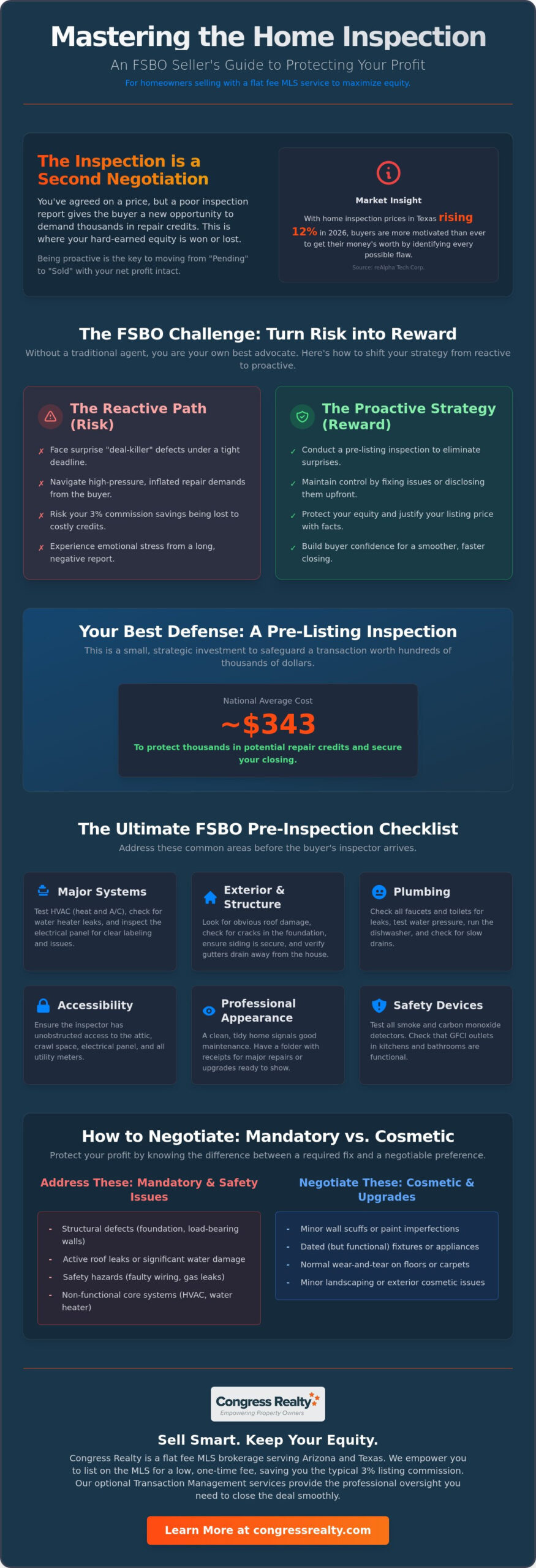
You’ve worked hard to build equity, and you shouldn’t lose it to avoidable inspection pitfalls. With home inspection prices in Texas rising 12% in 2026 according to reAlpha Tech Corp., buyers are more determined than ever to find every possible flaw. This guide shows you how to navigate the 2026 real estate landscape, including new disclosure requirements like the Ohio Fair Housing form or California’s third-hand smoke rules. We’ll help you secure a clean report and reach the closing table with zero or minimal repair credits. You’ll learn exactly how to identify common issues before the inspector arrives and how to use professional transparency to protect your bottom line.
Key Takeaways
Treat the home inspection as a strategic second negotiation to safeguard your equity against aggressive buyer credit requests.
Eliminate the element of surprise by conducting a pre-listing inspection to identify and address potential issues before the buyer’s contingency period begins.
Follow a systematic checklist when preparing for home inspection fsbo to ensure the inspector has unobstructed access to all major systems and utility meters.
Protect your net profit by learning how to differentiate between mandatory safety repairs and negotiable cosmetic upgrades.
Leverage professional Transaction Management services to document all repairs correctly and ensure a smooth path to the final closing.
The FSBO Seller’s Strategic Role in the 2026 Home Inspection
Congress Realty, a flat fee MLS brokerage serving Arizona and Texas, empowers homeowners to list their properties on the professional MLS for a low, one-time fee instead of a traditional 3% listing commission. This flat fee MLS model means you keep more of your equity, but it also means you are the primary advocate for your property during the due diligence phase. When you’re preparing for home inspection fsbo, you must view the process through a strategic lens. In the 2026 real estate market, the home inspection is the buyer’s most powerful tool for verifying the property’s condition and potentially renegotiating the deal.
Think of the inspection as the “second negotiation.” You’ve already agreed on a sales price, but a poor inspection report gives the buyer a fresh opportunity to claw back thousands of dollars in repair credits. If you aren’t proactive, these requests can quickly erode the financial advantages of selling without a traditional agent. Outlets like MarketWatch and ABC15 Arizona have highlighted how savvy sellers use transparency to maintain their price point. By identifying and fixing issues before the inspector arrives, you protect your 3% commission savings and keep the transaction on track for a successful closing.
So, what is a home inspection? It’s a professional, non-invasive examination of the home’s heating and cooling systems, plumbing, electrical work, roof, and structural components. In Texas, home inspection prices rose 12% in 2026 according to reAlpha Tech Corp., which means buyers are paying more for these evaluations and expect high-quality results. Taking a proactive stance ensures you aren’t reacting to a buyer’s demands from a position of weakness.
Why FSBO Sellers Face Unique Inspection Challenges
Selling independently means you don’t have an agent to filter the buyer’s feedback or soften the blow of a 50-page inspection report. This can lead to an emotional toll if you take the inspector’s findings personally. Additionally, some inspectors may have a bias against unrepresented sellers, assuming the home hasn’t been properly maintained. You can overcome this by providing a clean, accessible environment and a folder of maintenance receipts. This professional approach proves you’re a serious seller who values the property’s integrity.
The Goal: Moving from “Pending” to “Sold”
Your ultimate objective is to move past the inspection contingency with minimal friction. You must distinguish between major “defects” that affect safety or value and minor “cosmetic issues” like wall scuffs or dated fixtures. Addressing the big-ticket items early builds massive buyer confidence and prevents the deal from stalling. A smooth inspection also sets a positive stage for the appraisal. When the house is in top shape, the buyer feels secure in their investment, and you secure your path to closing with your equity intact.
The Pre-Listing Inspection: A Defensive Investment
Congress Realty, a flat fee MLS brokerage serving Arizona and Texas, helps homeowners list their properties on the professional MLS for a low, one-time fee. This flat fee MLS model replaces the traditional 3% listing commission, giving you more control over your equity. When you are preparing for home inspection fsbo, you shouldn’t wait for the buyer’s inspector to dictate the terms of your deal. Investing in a pre-listing inspection is a strategic move that puts the power back in your hands. In 2026, the national average cost for a home inspection is approximately $343, which is a small price to pay to protect a sale worth hundreds of thousands of dollars.
A pre-inspection eliminates the element of surprise during the buyer’s contingency period. Instead of discovery happening while you are under contract, you find the issues while you still have the time to resolve them. This report allows you to justify your listing price on the MLS with documented proof of the home’s condition. If the inspector finds a problem, you can choose to fix it on your own schedule or disclose it and price the home accordingly. This prevents buyers from using a minor defect to demand an inflated repair credit during the “second negotiation” phase. You can use our Comparative Market Analysis (CMA) to help determine if your home’s current condition warrants a price adjustment or a pre-sale repair.
Controlling the Narrative with Transparent Disclosure
Honesty functions as your best legal safety net. Use your pre-inspection report to create an “As-Is” marketing strategy that builds immediate trust with buyers. By providing the report upfront, you reduce your liability and filter out buyers who aren’t comfortable with the home’s current state. Proper Home Inspection Preparation involves having this documentation ready for review. You can even add a punchy sentence to your MLS description like: “Full pre-listing inspection report available for total transparency.”
Cost-Benefit Analysis of Pre-Listing Repairs
Focus your energy on “deal-killer” issues such as foundation stability, roof integrity, and HVAC functionality. In 2026, specialized foundation inspections typically cost between $300 and $750. If your pre-inspection flags a structural concern, addressing it now prevents the deal from collapsing later. Minor repairs like fixing leaky faucets or replacing cracked outlet covers offer a high ROI by presenting a well-maintained image. Avoid the trap of over-improving; your goal is to ensure the home is safe and functional, not to complete a full renovation for an inspection that hasn’t happened yet.
The Ultimate FSBO Home Inspection Checklist
Congress Realty, a flat fee MLS brokerage serving Arizona and Texas, provides homeowners with professional MLS access for a low, one-time fee instead of a traditional 3% listing commission. This flat fee MLS model gives you the financial freedom to manage your sale while keeping your equity intact. A major part of this responsibility involves preparing for home inspection fsbo to ensure the buyer’s inspector finds a property that is safe, accessible, and well-maintained. You must move beyond basic cleaning and focus on the technical functionality of your home’s major systems.
Start by ensuring the inspector has unobstructed access to every critical area. Move boxes away from the electrical panel, clear the path to the water heater, and ensure the attic scuttle and crawl space hatches open easily. Inspectors will not move your furniture or personal belongings to reach these points; if they can’t see it, they will flag it as “not inspected,” which creates doubt for the buyer. Perform a “Functional Test” of the entire house by flipping every light switch, plugging a small device into every outlet, and flushing every toilet to check for “ghost flushing” or slow drains.
Safety is a non-negotiable priority in the 2026 market. Test every smoke detector and carbon monoxide alarm. If you haven’t replaced the batteries lately, do it now. According to the CDC, radon is the second leading cause of lung cancer in the United States, responsible for an estimated 21,000 deaths each year. If your buyer requests a radon test, ensure your home is closed up according to testing protocols. On the exterior, clear debris from gutters and pull mulch or soil away from the foundation to prevent wood-to-earth contact, which inspectors always flag as a pest risk.
System-Specific Readiness: HVAC, Plumbing, and Electrical
Show the inspector that you take maintenance seriously. Replace your HVAC air filters and wipe down the furnace condensate lines. These small visual cues suggest a high level of care. Check under every sink for slow leaks or moisture. Label your circuit breaker panel clearly with a permanent marker so the inspector can easily identify which breakers control specific rooms. This level of preparation reduces the time the inspector spends searching for components and keeps the report focused on facts rather than frustrations.
The Paperwork Trail: Building Professional Credibility
Professional credibility often comes down to the documents you provide. Most generic checklists miss the importance of a paperwork trail, but this is where you can truly stand out. Gather receipts for recent roof repairs, HVAC servicing, or plumbing upgrades. Provide a concise list of the ages for all major appliances and systems. By creating a comprehensive “Seller’s Disclosure” packet that includes warranties and permits, you mirror the standards of a high-end brokerage. This transparency builds buyer confidence and prevents the inspector from making negative assumptions about the age or condition of your home’s infrastructure.
Negotiating Repairs and Credits Without an Agent
Congress Realty, a flat fee MLS brokerage serving Arizona and Texas, provides homeowners with professional MLS exposure for a low, one-time fee instead of a traditional 3% listing commission. This flat fee MLS model ensures you retain maximum equity while managing the sale yourself. When you are preparing for home inspection fsbo, the most critical phase begins after the inspector leaves. You must transform the raw data of a 50-page report into a professional negotiation strategy. Outlets like MarketWatch have noted that even “as-is” sales require full disclosure of material defects, making your response to the inspection report a legal and financial priority.
Don’t panic when you receive the report. Most home inspection documents include dozens of minor maintenance items that do not require immediate action. You must differentiate between “Mandatory Safety Fixes,” such as faulty wiring or gas leaks, and “Negotiable Upgrades,” like aging appliances or worn carpet. In Arizona and Texas, buyers typically use a formal document like the Buyer’s Inspection Notice and Seller’s Response (BINSR) to request repairs. Approach this document with the same pragmatic mindset you used to list your home. By avoiding the 3% listing commission, you often have a significant financial buffer to handle legitimate safety concerns while still coming out ahead.
The “Repair vs. Credit” debate is a pivotal choice for an FSBO seller. In many cases, offering a closing cost credit is the superior move. Credits remove the liability of repair quality from your shoulders and prevent delays if a contractor misses a deadline. A credit allows the buyer to choose their own professional after they own the home, which keeps your closing timeline intact. This strategy protects your equity and prevents last-minute disputes over the “adequacy” of a fix.
The Art of the Counter-Offer
Buyers sometimes provide inflated repair estimates to lower the sales price. Use your own contractor quotes to debunk these figures and maintain your price point. If a buyer asks for non-essential cosmetic fixes, stand firm. You can politely decline these requests with a clear statement: “The property is offered in its current condition, and we respectfully decline requests for cosmetic improvements that do not affect the home’s safety or structural integrity.” This professional boundary-setting prevents “nickel and dime” requests from eroding your profit.
Managing Buyer Psychology During Negotiations
Keep every interaction focused on your how to sell your house on your own goal. Use your Comparative Market Analysis (CMA) to prove that your listing price already accounts for the home’s age and condition. If a buyer’s demands exceed your equity threshold, remember the power of the “walk away.” As Broker Jared English often reminds sellers, you are in control of the process and don’t have to accept a deal that doesn’t meet your financial requirements. Professionalism and data are your best tools for closing the deal on your terms.
Need help ensuring your repair agreements are legally binding? Explore our Transaction Management service to navigate the final contingency removal with professional oversight.
Closing the Deal: Professional Oversight for FSBO Sellers
Congress Realty, a flat fee MLS brokerage serving Arizona and Texas, provides homeowners with professional MLS access for a low, one-time fee instead of a traditional 3% listing commission. This flat fee MLS model ensures you retain your equity while managing the sale with the same tools used by traditional agents. Successfully preparing for home inspection fsbo concludes with a clean handoff to the buyer, where every agreed-upon repair is documented and every contingency is formally removed. You must treat the post-inspection period with the same level of detail as the initial listing to ensure your path to closing remains clear.
If you agreed to specific repairs during the negotiation phase, you must use licensed contractors and keep every receipt. Buyers will often request these documents before or during the final walkthrough to verify the work meets professional standards. Providing a neat folder of paid invoices prevents last-minute disputes that could delay your funding. Utilizing a flat fee mls listing signals to the buyer’s side that you are a sophisticated seller who understands the technical requirements of a real estate transaction. This professional image discourages buyers from attempting to renegotiate settled terms during the final days of the escrow period.
Leveraging Congress Realty Support
You don’t have to navigate the complex paperwork of contingency removal alone. Our Transaction Management service provides the professional oversight needed to ensure all inspection resolutions are legally binding and correctly filed. We help you manage the timeline so you don’t miss critical deadlines that could put your earnest money at risk. Additionally, using our Electronic Lockbox allows you to manage inspector and contractor access securely. You can track exactly who enters your home and when, providing peace of mind while you coordinate the final stages of your sale. This structure allows for a smooth transition from the inspection phase to a successful, commission-free closing.
Final Steps to Protect Your Equity
As you approach the finish line, verify that your mls realtor status is updated correctly in the system once all inspection contingencies are met. This update informs other potential backup buyers that the deal is moving toward completion. Review the final settlement statement from the title company or attorney carefully. Ensure any agreed-upon repair credits are reflected accurately so you don’t overpay at the closing table. By managing this process yourself, you secure significant financial gains. On a $500,000 home, avoiding the traditional 3% listing commission saves you $15,000 in equity. Celebrate this win as you move toward a successful closing with your financial intelligence and property value fully intact.
Secure Your Equity and Close with Confidence
Congress Realty, a flat fee MLS brokerage serving Arizona and Texas, provides the professional tools you need to bypass the traditional 3% listing commission. By using a flat fee MLS model, you list your home on the professional database for a low, one-time fee while keeping your hard-earned equity. Success comes down to your proactive approach when preparing for home inspection fsbo. You’ve learned that a pre-listing inspection acts as a defensive shield and that professional documentation creates the credibility needed to handle buyer negotiations independently. These strategies ensure that you move from “pending” to “sold” without losing your profit to unnecessary repair credits.
You don’t have to manage the final steps alone. With over 20 years of FSBO support experience and A+ Rated Brokerage oversight, we provide the infrastructure for a smooth transaction. Our Full Service Listing includes professional Transaction Management to oversee your inspection resolutions and ensure every document is filed correctly. Take control of your sale and keep the thousands of dollars you would otherwise lose to a traditional agent. Protect your equity and list on the MLS today with Congress Realty. You have the knowledge and the tools to reach the closing table on your own terms.
Frequently Asked Questions
Should I be present during the home inspection as an FSBO seller?
Congress Realty, a flat fee MLS brokerage serving Arizona and Texas, provides homeowners with professional MLS exposure for a one-time fee instead of a traditional 3% commission. A flat fee MLS listing allows you to sell your property independently while maintaining full control over the transaction process. Generally, you should leave the property during the inspection to allow the buyer and their inspector to speak freely. Leaving a clean, accessible home is the best way to show you are preparing for home inspection fsbo.
Buyers often feel uncomfortable discussing potential issues when the seller is present, which can lead to tension later. If you stay, remain in a separate area and only answer specific questions when asked. This professional distance helps the buyer feel secure in their due diligence process without feeling pressured by your presence.
What are the most common “deal-killers” in a 2026 home inspection?
Major structural defects, significant mold growth, and failing roofs are the most common issues that cause deals to collapse. In 2026, foundation inspections typically cost between $300 and $750, and finding a serious issue here often scares off traditional buyers. Specialized mold inspections average $660. Addressing these high-cost items before listing ensures you don’t face aggressive renegotiations or a canceled contract during the contingency period.
How much does a pre-listing home inspection typically cost?
A pre-listing inspection generally costs between $300 and $500 for most residential properties. The national average sits at approximately $343, though homes over 3,000 square feet may reach the higher end of the range. Investing this amount upfront allows you to identify major defects early. This small expense protects your equity by preventing the buyer from demanding thousands in repair credits for issues you could have fixed more affordably on your own schedule.
Do I have to fix everything the inspector finds in their report?
No, you are not legally required to fix every item mentioned in a home inspection report. Most reports include minor maintenance suggestions that are purely cosmetic or related to the home’s age. Focus your negotiation on mandatory safety fixes, such as electrical hazards, gas leaks, or structural failures. You can politely decline requests for non-essential upgrades by reminding the buyer that the sales price already reflects the property’s current condition and age.
Can a buyer back out of the contract after a home inspection?
Yes, if the contract includes an inspection contingency, the buyer can typically withdraw if they are unsatisfied with the report findings. This is why transparency is vital for independent sellers. Providing a pre-listing report helps filter for buyers who are comfortable with the home’s condition from the start. If a buyer backs out, you must disclose any newly discovered material defects to the next potential buyer to meet legal requirements.
What is the difference between a home inspection and a home appraisal?
A home inspection evaluates the physical condition and safety of the property, while an appraisal determines its fair market value for the lender. The inspector looks at the roof, HVAC, and plumbing systems in detail to find defects. The appraiser focuses on comparable sales and general property features to ensure the home is worth the loan amount. Both are critical steps, but only the inspection directly impacts your specific repair negotiations with the buyer.
How do I handle an inspector who seems biased toward the buyer?
Stay professional and provide documented proof of maintenance to counteract negative assumptions. Inspectors work for the person paying them, so they often highlight every minor flaw to justify their fee. You can debunk biased claims by showing receipts for recent servicing or repairs. If an inspector makes a factually incorrect claim about a system, provide the manufacturer’s specifications or a secondary opinion from a licensed contractor to protect your position.
What disclosures are legally required if I sell my home FSBO?
You must disclose all known material defects, regardless of whether you use an agent. Federal law requires a lead-based paint disclosure for homes built before 1978. In 2026, California sellers must disclose third-hand smoke residue and future gas appliance restrictions. Ohio sellers must now sign a Fair Housing Disclosure form before marketing. Always check your specific state’s requirements to avoid post-closing lawsuits over undisclosed issues that could have been identified during the inspection phase.
Did you know that listings featuring a Zillow 3D Home tour receive 79% more saves and 60% more views than those without? It’s a staggering reality in 2026, where 96% of homebuyers start their search online. You’ve worked hard to build equity in your property. Watching a 5.70% commission disappear at the closing table feels like an unnecessary loss, especially when you can manage the digital presentation of your home with professional precision.
It’s common to feel anxious about constant foot traffic from unqualified visitors or confused by which 3D tech is actually worth the cost. This guide provides the essential virtual tour tips for selling your home to help you attract serious, motivated buyers while keeping your equity where it belongs. You’ll learn how to master digital property presentation to protect your financial interests and maintain full control of the process. We’ll show you how to leverage professional photography and 3D walkthroughs to create a listing that commands attention on the MLS, replacing high percentage-based costs with a smarter, fixed-fee approach.
Key Takeaways
Filter out “looky-loo” traffic and save time by using a virtual tour as a 24/7 digital open house that qualifies buyers before they step foot on your property.
Discover the best virtual tour tips for selling your home, including how to use “camera-first” staging and natural light to eliminate digital dead zones.
Compare 3D immersive models with cinematic video walkthroughs to choose the technology that best showcases your home’s unique layout and flow.
Maximize your return on investment by pairing professional photography with a flat fee MLS listing to protect your equity from traditional commission costs.
Gain full control over your marketing by learning how to syndicate your digital walkthrough across major industry databases and third-party real estate sites.
Why Virtual Tours are Essential for Selling Your Home in 2026
In the current real estate market, your home’s first showing doesn’t happen in the driveway. It happens on a smartphone screen. If you’re looking for virtual tour tips for selling your home, start by reframing what a digital walkthrough actually does. It functions as a 24/7 open house that works for you while you’re at work or sleeping. By the time a buyer requests an in-person visit, they’ve already walked through your kitchen and checked the layout of the primary suite. This digital-first approach is no longer a luxury; it’s the standard for serious sellers who want to maximize their reach.
Understanding what is a virtual tour is critical for any equity-conscious seller. In 2026, buyers view these digital assets as a mandatory requirement. If your listing lacks one, many serious leads will simply scroll past. This is especially true for the growing number of out-of-state buyers who are relocating for work and often make offers sight-unseen. They need the confidence that a high-resolution 3D scan provides to make a high-stakes decision from a distance.
The “Buyer Filter” Effect
One of the greatest advantages of a digital walkthrough is its ability to eliminate “looky-loo” traffic. These are casual browsers who aren’t ready to buy but still require you to stage, clean, and vacate your home for a showing. A virtual tour acts as a pre-qualification tool. It provides total transparency, which builds immediate trust with serious prospects. When buyers can explore every corner of the property online, they experience a sense of immersive ownership. They start mentally placing their furniture in your living room before they ever grab their car keys. This psychological connection leads to higher-quality offers and fewer surprises during the inspection phase because the buyer already has a realistic view of the property’s condition.
Protecting Your Equity through Digital Marketing
Traditional agents often use the promise of “open houses” to justify high commission rates. However, savvy sellers know that a professional digital presence is far more effective and less intrusive. By investing in high-quality digital assets, you bypass the need for expensive, traditional hosting services that eat into your profit. It’s essential to stay informed about understanding commissions when you’re building your marketing stack. Choosing a Professional Photography add-on for your listing isn’t just about aesthetics; it’s a strategic move to protect your equity. A small upfront investment in a professional tour often pays for itself by attracting multiple offers and reducing the time your home sits on the market. You maintain full command of the process while ensuring your listing stands out against the competition on the MLS.
Choosing the Right Virtual Tour Technology for Your Listing
Selecting the right tech for your digital presentation depends on your property’s layout and your target buyer. You don’t need a Hollywood budget to look professional, but you do need to understand the tools available in 2026. High-quality assets are the foundation of any successful Standard or Full Service listing. Whether you choose an immersive 3D model or a cinematic video, your goal is to provide a clear, honest view of the home that encourages a fast offer.
When reviewing virtual tour tips for selling your home, consider how different technologies serve different purposes. 3D models provide a structural understanding of the space, while video walkthroughs excel at building an emotional narrative. Many successful sellers now use a combination of both to provide a comprehensive experience. Beyond the visual style, ensure your chosen platform is mobile-responsive. With the majority of buyers searching on their phones, a tour that crashes or loads slowly will drive away potential leads.
3D Models: The Gold Standard for Transparency
Immersive 3D models, such as those created with Matterport, are highly effective for homes with complex floor plans. These models offer the famous “dollhouse view,” which allows buyers to see the entire home as a 3D structure. This perspective is incredibly helpful for understanding how rooms connect. According to the National Association of REALTORS® virtual tour playbook, providing this level of detail builds trust and reduces the number of basic questions you’ll have to answer. These models also allow for precise digital measurements. If a buyer is worried their sectional won’t fit in the living room, they can use the measurement tool to verify the space themselves.
Video Walkthroughs: Creating an Emotional Connection
Video walkthroughs offer a different advantage by focusing on the “flow” and vibe of the home. Use high-definition 4K video to highlight specific features like the sound of a backyard fountain or the way sunlight hits the breakfast nook. Modern attention spans are short; keep your clips under two minutes to ensure viewers stay engaged. Focus on a logical path through the home, starting at the front door and moving through the main living areas. This format is perfect for social media sharing and can quickly go viral if the production quality is high.
Technical compliance is another critical factor. Most MLS databases require “unbranded” versions of your virtual tours for syndication. This means your tour cannot contain your name, contact information, or any logos. If you upload a branded version to the primary MLS field, it may be rejected or stripped from third-party sites. Always ask your photographer for both a branded version for your personal social media and an unbranded version for your official listing. By following these technical requirements, you ensure your home gets maximum exposure across the entire professional industry network.
Staging Your Home for the Digital Lens: A Checklist
Preparing your property for a 3D scan requires a different strategy than a traditional photo shoot. Because 360-degree cameras capture an entire room simultaneously, you cannot simply shove clutter behind the photographer’s tripod like you would during a standard session. Every corner is visible. When implementing virtual tour tips for selling your home, adopt a “camera-first” mindset. This means looking at your space through the lens of a wide-angle sensor that amplifies both the beauty and the blemishes of a room.
Lighting is your most powerful tool for avoiding “dead zones” in a digital walkthrough. Open every blind and curtain to maximize natural light, as 360 cameras often struggle with the high contrast between bright windows and dark corners. Turn on every light in the house, including lamps and under-cabinet LEDs, to create a consistent exposure. You should also watch out for the “wide angle trap.” While you might think pushing furniture against the walls makes a room look larger, it often creates an unnatural, empty “caved-in” look in 3D. Arrange furniture in small, conversational groupings to help the camera define the scale and purpose of the space.
Virtual Staging: The Low-Cost Alternative
If you’re selling an empty house, AI-powered virtual staging is a game-changer for your equity. In 2026, AI services can deliver professionally staged rooms in under 30 seconds for as little as $1 to $15 per image. This allows you to transform a cold, vacant space into a designer home that resonates with your target demographic. Just remember that transparency is key. You must disclose virtual staging in your MLS listing notes to maintain trust with buyers. Choose a decor style that matches the architecture of the home to keep the digital experience feeling grounded and realistic.
Pre-Shoot Technical Preparation
Technical glitches can ruin a high-end tour. High-reflectivity surfaces like windows and mirrors can “blind” 3D sensors or cause “ghosting” effects in the final render. Clean these surfaces meticulously before the shoot. You also need to remove “trip hazards” for the lens. Hide all power cords, pet bowls, and trash cans. Since the camera sees everything, designate one specific area, like a small closet or the garage, as your “staging dump.” This is where you’ll store all the items you’ve cleared from the rest of the house. Keeping this one area off-camera allows you to maintain a pristine environment throughout the rest of the digital walkthrough.
Professional vs. DIY Virtual Tours: Maximizing Your ROI
Deciding between a DIY approach and hiring a professional is a critical step in protecting your home’s equity. While you want to minimize costs, a low-quality digital presentation can result in fewer offers and a longer time on the market. When looking for virtual tour tips for selling your home, evaluate the property’s price point and your own technical comfort level. For lower-priced properties, a high-end smartphone paired with a stabilizer gimbal can produce acceptable results. However, for most listings, the Professional Photography add-on provides a high-ROI investment that pays for itself by attracting serious buyers quickly. This is a core component of a successful flat fee MLS listing, ensuring your home competes with those represented by high-commission agencies.
Professional assets also significantly impact your “Listing Quality Score” on major platforms like Zillow and Realtor.com. These sites use algorithms to prioritize listings with high-resolution 3D tours and professional media. Better ranking means more views, which leads to more qualified leads. If you are aiming for the highest possible sale price, professional-grade imagery is the most efficient way to prove your home’s value to the market without the need for an expensive traditional agent.
The Hidden Costs of DIY
DIY isn’t always as “free” as it seems. Learning complex 3D scanning software and editing video can take days of your time. There is also the “Amateur Penalty” to consider. Poor lighting or shaky camera work can actually decrease your home’s perceived value in the eyes of a buyer. Additionally, many 3D hosting platforms require monthly subscription fees. For example, some professional-grade software requires ongoing hosting at $20 per month per tour. Professional photographers usually include these hosting costs in their flat-rate fee, saving you the hassle of managing multiple accounts.
Hiring a Pro: What to Look For
If you choose to hire an expert, ensure they understand the specific needs of an independent seller. Ask for a “Media Bundle” that includes high-definition stills, a 3D walkthrough, and interactive floor plans for a single flat rate. It’s also vital to verify that they will provide an “unbranded” link. This is a requirement for MLS compliance, as branded links with contact info will be rejected by the system. Finally, check their turnaround times. You want your media ready for peak search days, typically mid-week, to build momentum for the weekend. Ready to take control of your sale? Browse our professional listing options to find the right fit for your equity goals.
Leveraging Your Virtual Tour with Congress Realty
How do you actually get your digital assets in front of serious buyers? Having the best virtual tour tips for selling your home won’t matter if your link isn’t properly syndicated. When you choose a Standard or Full Service listing, we provide the professional infrastructure to host and distribute your media. The MLS contains a dedicated “Virtual Tour” field designed specifically for these links. Once we enter your unbranded link into this field, your tour automatically syndicates to Zillow, Realtor.com, and thousands of other brokerage sites. This ensures your home maintains the same level of visibility as any property listed by a traditional, high-commission agent.
Congress Realty handles the technical heavy lifting for you. We ensure your assets meet strict MLS compliance standards, which prevents your listing from being flagged or suppressed by local boards. Our transaction management team provides the professional oversight you need to ensure your digital marketing stays on track. You stay in command of the sale while we provide the professional industry database access that makes the process work. It’s a pragmatic, fixed-fee solution that replaces the unpredictable costs of traditional brokerages.
From Digital Click to Electronic Lockbox
The workflow for an equity-first sale is efficient and secure. A buyer clicks your virtual tour and explores the layout. Because they’ve already “walked” the home digitally, they are much more qualified than a casual browser. When they request a showing, you grant access via an electronic lockbox. This sequence significantly reduces the number of “unsupervised” entries into your home. You only open your doors for leads who have already vetted the property online. During the negotiation and escrow phase, the virtual tour remains a valuable reference tool. Buyers can revisit the digital scan to verify room dimensions or show the home to family members, keeping the momentum high through the final closing steps.
Finalizing Your Listing Strategy
The most successful sellers combine a professional CMA with high-end virtual assets to create a listing that stands out. By pricing your home accurately and presenting it with professional photography, you eliminate the need for traditional middlemen. The “Equity-First” model is the smartest way to sell your house without a realtor while maintaining professional standards. You keep your hard-earned profit and stay in total control of the transaction. Ready to maximize your equity and take charge of your sale? Get your home on the MLS today with Congress Realty and start attracting serious buyers immediately.
Take Command of Your Home Sale with Digital Precision
Mastering the digital presentation of your property is the most effective way to filter out casual browsers and focus your energy on serious, high-intent buyers. By applying these virtual tour tips for selling your home, you’ve moved beyond traditional, high-cost marketing methods. You now understand how to choose the right technology, stage for the 360-degree lens, and leverage professional media to stand out on the MLS. This strategic approach doesn’t just sell your home faster; it ensures you remain the primary beneficiary of your property’s value.
You don’t need to sacrifice professional quality to protect your equity. By choosing a smarter path, you can save the traditional 3% listing commission while still accessing professional photography and 3D tour support. With expert transaction management guiding you to a smooth closing, you stay in total control of every detail. It’s time to put your hard-earned equity back in your pocket where it belongs.
The tools for a successful, independent sale are at your fingertips. Take the lead, showcase your home’s true potential, and enjoy the financial rewards of a smart, intelligence-driven transaction.
Frequently Asked Questions
Does a virtual tour really help sell a house faster?
Yes, a virtual tour is a powerful tool to accelerate your sale. Listings with a Zillow 3D Home tour receive 79% more saves and 60% more views than those without. This increased visibility leads to more qualified leads and faster offers. By letting buyers explore the home digitally, you ensure that only serious prospects request in-person showings, which streamlines the entire transaction and saves you time.
How much does it cost to create a 3D virtual tour in 2026?
Costs vary based on whether you choose professional services or a DIY software approach. In 2026, a professional scanning service for a typical 2,000 to 3,000 square foot home generally costs between $350 and $600. If you prefer to manage the process yourself, software subscriptions range from free plans to around $69 per month. Don’t forget to account for potential hosting fees and floor plan add-ons.
Can I use my smartphone to make a professional-looking virtual tour?
You can produce a high-quality tour using a modern smartphone, provided you use the right tools. A stabilizer gimbal is essential to prevent shaky footage, which can lower your home’s perceived value. While high-end smartphones have excellent 4K sensors, you’ll still need to follow professional virtual tour tips for selling your home, such as maximizing natural light and using a tripod to ensure consistent image quality throughout the walkthrough.
What is the difference between a virtual tour and a video walkthrough?
A virtual tour is an interactive, 3D experience that allows viewers to move through the home at their own pace. This often includes the “dollhouse view” for structural clarity. A video walkthrough is a linear, cinematic movie that highlights the home’s flow and atmosphere. While a 3D tour provides transparency and measurements, a video is better for creating an emotional connection and showcasing the neighborhood’s vibe.
Will a virtual tour make my home look smaller than it is?
A virtual tour won’t make your home look smaller if you arrange your furniture correctly. Avoid pushing all items against the walls, as this can create an unnatural “caved-in” look in 360-degree captures. Instead, group furniture into conversational areas to give the camera a sense of scale. Professional lighting and clear sightlines help the digital lens capture the true volume of each room accurately.
Do I need to disclose if my virtual tour uses virtual staging?
You must disclose virtual staging in your MLS listing notes to maintain legal compliance and buyer trust. While AI-based staging is a cost-effective way to showcase an empty home’s potential, buyers expect transparency. Clearly stating that certain rooms are virtually staged prevents confusion when they visit the property in person. This honest approach builds credibility and ensures your transaction moves forward without unnecessary friction.
How do I add a virtual tour to my MLS listing without a traditional agent?
You can add a virtual tour by using a professional listing service that provides access to the MLS for a fixed fee. We provide a dedicated “Virtual Tour” field for your unbranded link, which then syndicates to major third-party real estate sites. This allows you to manage your marketing independently without paying a traditional 3% commission. It’s a pragmatic way to maintain full control over your digital assets.
Are virtual tours safe for my privacy and security?
Virtual tours are safe as long as you prepare your home for the digital lens with privacy in mind. Remove personal photos, sensitive documents, and high-value portable items before the shoot. Since the camera captures a 360-degree view, ensure you haven’t left any identifying information visible in any room. Taking these simple precautions allows you to market your home effectively while protecting your family’s personal space.