Summary: Selling your Sacramento home traditionally costs over $25,000 in commissions on a $500,000 property. But what if you could get the same MLS exposure—Zillow, Realtor.com, and all—for just $299? Here’s how flat fee listings could save you five figures.
Key Takeaways
Sacramento sellers can save $9,000 to $22,000 by choosing flat-fee MLS listings over traditional 5-6% real estate commissions.
Four-tiered plans starting at $299 offer different service levels, from basic MLS listing to full agent support
MetroList MLS ensures Sacramento properties receive the same exposure as traditionally listed homes on Zillow, Realtor.com, and other major platforms.
The right plan depends on your experience level, comfort with paperwork, and the marketing features you want.
Selling a home in Sacramento traditionally costs thousands in real estate commissions, but flat fee MLS services are changing the game. With median home prices around $500,000 in Sacramento and traditional agent fees averaging 5-6%, sellers face commission costs exceeding $25,000 before seeing any equity returns.
Four Sacramento Flat Fee Plans Starting at $299
Flat fee MLS allows Sacramento homeowners to list their properties on the Multiple Listing Service for a one-time upfront fee rather than percentage-based commissions. This approach provides the same MLS exposure as traditionally listed homes while maintaining seller control over pricing, showings, and negotiations.
The model works because most home sales originate through MLS-connected channels. When a property appears on Sacramento’s MetroList MLS, it automatically syndicates to major platforms including Zillow, Realtor.com, Redfin, and Trulia. Congress Realty, a licensed California broker specializing in flat fee services,offers four distinct plan tiers for Sacramento sellers starting at just $299.
Unlike purely For Sale By Owner listings that rely on yard signs and limited platforms, flat fee MLS listings receive full professional exposure. Buyer’s agents can find and show these properties to their clients just like any agent-listed home, ensuring maximum market reach without the hefty commission burden.
How Flat Fee MLS Saves Sacramento Sellers $9,000-$22,000
The savings potential of a flat-fee MLS becomes dramatic compared to traditional listing commissions. Sacramento sellers using traditional agents typically pay 2.5-3% to their listing agent, which translates to substantial costs across different price points in the current market.
Traditional Commission vs. Flat Fee Breakdown
Consider these savings scenarios for Sacramento price ranges: A $400,000 home with a 2.5% traditional listing commission costs $10,000, while Congress Realty’s basic plan costs just $299, saving $9,701. For a $500,000 median-priced home, the traditional commission is $12,500, compared to $299-$499 for flat-fee options, resulting in savings of up to $12,201. Higher-end properties see even greater savings, with $700,000 homes saving over $17,000 and $900,000 properties saving more than $22,000.
Even Congress Realty’s full-service option at $399 plus 0.5% at closing totals just $2,899 on a $500,000 home—still saving approximately $9,600 compared to traditional listing agents. These savings become increasingly significant as Sacramento home values fluctuate amid forecasts suggesting potential recovery.
MetroList MLS Ensures Maximum Exposure
Sacramento properties listed through flat fee services appear on MetroList, a major MLS network serving thousands of real estate professionals. MetroList coverage spans Sacramento, Placer, El Dorado, Yolo, San Joaquin, Stanislaus, and Merced counties, providing regional exposure.
MetroList automatically distributes listings to all major real estate websites and agent platforms. This ensures flat-fee listings receive the same digital marketing exposure as traditionally listed properties, debunking the myth that FSBO or flat-fee homes get less visibility.
Congress Realty’s Sacramento Plan Comparison
Congress Realty offers transparent pricing across four service levels, allowing Sacramento sellers to match their needs with appropriate support. Unlike some competitors that hide percentage-based closing fees, the company clearly identifies which plans are truly flat fee and which include small closing costs.
1. Basic Plan ($299) – Core MLS Listing
The Basic plan targets experienced sellers who need simple MLS exposure without additional features. It includes MetroList listing with syndication to major platforms, up to 4 photos, California state disclosure forms, and up to 5 listing changes during the 6-month term. This option works well for real estate investors, repeat sellers, or properties in hot submarkets where homes receive quick offers.
2. Plus Plan ($399) – Digital Tools Added
The Plus package adds convenience features that significantly ease listing management. Sellers receive the maximum photo allowance on MetroList, automated phone-lead forwarding to never miss buyer inquiries, up to 10 MLS changes, and DocuSign integration for digital paperwork. These tools make the Plus plan particularly suitable for first-time FSBO sellers who want self-service control with added convenience.
3. Premium Plan ($499) – Marketing Boost
Congress Realty’s most popular option, the Premium plan, includes unlimited MLS changes, unlimited open house postings, and active social media marketing. The social media component means Congress Realty promotes listings across social platforms to reach a broader buyer audience. Sacramento sellers in competitive neighborhoods where presentation matters and open houses drive offers find this self-managed experience most valuable.
4. Full Service ($399 + 0.5%) – Agent Support
For sellers wanting full broker support without traditional commission costs, the Full Service plan provides dedicated 24/7 agent support, complete negotiation and paperwork assistance, contract review, and closing transaction coordination. The 0.5% closing fee is clearly disclosed upfront—on Sacramento’s $500,000 median price, this totals $2,500 compared to roughly $12,500-$15,000 for traditional listing agents.
The 2024 NAR settlement fundamentally altered how buyer agent commissions work, with rule changes regarding buyer broker compensation taking effect in mid-July 2024, and mandatory written buyer agreements in California effective January 1, 2025. These changes directly affect flat-fee MLS sellers by shifting commission-negotiation dynamics and removing MLS-based compensation requirements.
Buyer Agent Commission Rules Changed
Buyer agent commissions can no longer be offered or advertised by listing brokers via the MLS, including MetroList in Sacramento. Sellers are no longer required to disclose or guarantee buyer agent fees in their listings, creating more flexibility in commission negotiations. Despite these changes, many sellers still choose to offer buyer agent compensation as a concession during the offer process to attract more potential buyers.
Written Agreements Now Mandatory
Effective January 1, 2025, all California buyer agents must have signed representation agreements before submitting offers. This requirement ensures buyers understand their agent’s compensation structure up front, while sellers maintain control over whether and how much to offer in buyer-agent concessions. The change has shifted commission discussions from automatic MLS fields to active negotiation points during the offer process.
Choosing the Right Plan for Your Sacramento Sale
Selecting the appropriate flat fee plan depends on your real estate experience, comfort level with paperwork, and desired marketing approach. Consider the Basic plan if you’ve sold real estate before, understand the paperwork requirements, or have a property priced to attract multiple quick offers. Real estate investors running multiple transactions often find this bare-bones approach most cost-effective.
Choose the Plus plan for your first FSBO experience, with organized lead management and professional photo presentation. The digital tools, particularly the DocuSign integration and automated lead forwarding, provide significant convenience for sellers who prefer electronic processes over traditional paperwork.
The Premium plan suits sellers planning open houses or longer listing campaigns, especially in competitive price tiers where social media marketing provides additional exposure. Properties in Sacramento’s more competitive neighborhoods benefit from the unlimited MLS changes and marketing features.
Select the Full Service option when negotiations and contracts feel outside your comfort zone, but you still want substantial savings over traditional agents. This hybrid approach provides professional representation for complex transactions while maintaining thousands in commission savings.
Selling your Montana home through traditional agents could cost you over $14,000 in unnecessary listing fees. There’s a little-known MLS strategy that slashes these costs by 94% while giving your property identical exposure on Zillow, Realtor.com, and every major platform where buyers actually search.
Key Takeaways
Montana homeowners can save up to 94% on listing agent commissions with flat-fee MLS services while maintaining the same market exposure as traditional listings.
The Multiple Listing Service automatically syndicates property listings to major platforms like Zillow, Realtor.com, and Redfin, reaching virtually all serious home buyers.
Traditional Montana real estate commissions average 5.43% of the sale price, while flat fee MLS costs only $299-$599 total.
Montana’s current market inventory of over 6,990 active listings demonstrates strong buyer activity, making MLS exposure critical for successful home sales.
Sellers retain complete control over showings and negotiations while still offering buyer’s agent commissions to attract qualified buyers.
Montana homeowners looking to sell their property face a critical decision that could cost them tens of thousands of dollars in unnecessary fees. Understanding how the Multiple Listing Service works reveals why flat-fee MLS has become the preferred strategy for protecting home equity while maintaining maximum market exposure.
Flat Fee MLS Saves 94% on Listing Agent Commissions.
The math behind flat fee MLS savings is straightforward and dramatic. Traditional listing agent commissions in Montana average 2.72% of the home’s sale price. On a median-priced Montana home of $525,000, that represents approximately $14,280 in listing agent fees alone. Flat fee MLS services eliminate this percentage-based commission, replacing it with a fixed fee typically ranging from $299 to $599.
This cost structure shift creates savings of 94% or more compared to traditional listing arrangements. For Montana homeowners, this difference translates directly into preserved equity that can fund their next property purchase, retirement goals, or other financial priorities.Congress Realty’s flat fee MLS service demonstrates this approach by offering an MLS listing for a flat $299 fee, providing the same market exposure without percentage-based commissions.
The savings become even more significant on higher-value properties. Montana luxury homes selling for $750,000 would typically generate $20,400 in listing agent commissions under traditional arrangements. Flat fee MLS reduces this to under $600, preserving over $19,800 in seller equity.
How the MLS Actually Works for Sellers
The Multiple Listing Service serves as the central nervous system of Montana’s real estate market. This database contains detailed information about every property listed for sale by licensed real estate professionals. When a home enters the MLS, it becomes instantly accessible to thousands of buyers’ agents, real estate investors, and property search platforms across the state.
The MLS Feeds Major Real Estate Platforms
Modern home buyers begin their search online, making MLS syndication crucial for seller success. The MLS automatically distributes listing information to major consumer-facing platforms, including Zillow, Realtor.com, Redfin, and dozens of regional property search websites. This syndication process happens within hours of MLS entry, ensuring maximum exposure during the critical early days of marketing.
Montana market data show that 97% of buyers use online platforms during their home search. Without MLS presence, properties remain virtually invisible to this primary buyer pool, regardless of other marketing efforts.
Only Licensed Brokers Can Access the MLS
MLS access requires active real estate licensing and membership in local real estate associations. Individual homeowners cannot list properties directly on the MLS, creating the traditional dependence on full-service real estate agents. This licensing requirement historically gave commissioned agents exclusive control over the most effective marketing channel for residential properties.
Flat-fee MLS services bridge this gap by providing licensed broker representation specifically for MLS listings. Sellers gain the required professional access while maintaining control over other aspects of the sales process.
Your Listing Syndicates to Zillow, Realtor.com, and Redfin
Once entered into the Montana MLS, property listings automatically appear across the major real estate platforms where buyers actively search. Zillow receives MLS feeds multiple times daily, ensuring new listings appear quickly. Realtor.com, operated by the National Association of Realtors, maintains direct MLS integration for real-time updates. Redfin’s platform similarly pulls from MLS data to populate its buyer-focused search tools.
This automatic syndication provides flat-fee MLS listings with the same online exposure as properties listed through traditional full-commission arrangements. Buyers searching these platforms cannot distinguish between listing types based on the information presented.
Flat Fee vs Commission: The Real Numbers
Montana’s real estate commission structure creates substantial costs for sellers using traditional listing arrangements. Understanding these numbers helps homeowners make informed decisions about their selling strategy.
Traditional Montana Commissions Average 5.43%
Montana real estate commissions typically range from 5% to 6% of the sale price, with 5.43% representing the current statewide average. This total commission splits between the listing agent (averaging 2.72%) and the buyer’s agent (averaging 2.71%). At Montana’s median home price of approximately $525,000, total commissions amount to $28,507.
These percentages remain consistent across most Montana markets, from Billings and Missoula to smaller communities like Bozeman and Helena. Rural properties and luxury homes often command similar commission rates, making the dollar amounts even more substantial for higher-value transactions.
Flat Fee MLS Costs $299-$599 Total.
Flat-fee MLS services charge a fixed fee regardless of property value, creating dramatic savings opportunities. Basic packages start around $299 and include MLS listing, photo uploads, and standard property syndication. Enhanced packages, typically priced at $599, add features such as professional photography coordination, premium listing placement, and extended listing duration.
Even the highest flat-fee packages represent approximately 0.11% of a $525,000 home’s value, compared to 5.43% under traditional commission structures. This cost difference allows sellers to retain significantly more equity from the sale of their property.
Montana Market Activity Supports MLS Strategy
Current Montana real estate market conditions demonstrate strong buyer activity and inventory levels that support effective MLS-based selling strategies.
Over 6,990 Active Listings Show Market Inventory
Montana currently maintains over 6,990 active property listings across all price ranges and property types. This inventory level indicates healthy market activity and buyer engagement. Higher inventory provides more choices for buyers while creating competitive pressure for sellers to market effectively.
The substantial inventory levels demonstrate that Montana’s real estate market remains active and liquid, supporting various selling strategies, including flat-fee MLS approaches. Markets with strong inventory levels typically reward effective marketing over expensive commission structures.
Market Times Vary But Show Continued Sales Activity
Montana properties currently average 70 days on market before receiving accepted offers. This timeline varies by location, price range, and property type, but indicates consistent buyer activity throughout the state. Well-priced properties with strong MLS exposure frequently sell within 30-45 days, while properties requiring price adjustments or improvements may take longer to sell.
The consistent sales activity supports flat fee MLS strategies by confirming that buyers actively search MLS-fed platforms for available properties. Effective pricing and presentation matter more than expensive commission structures in achieving timely sales.
Online Exposure Matches Traditional Listings
Properties listed through flat-fee MLS services receive the same online exposure as traditionally-commissioned listings. The MLS syndication process treats all listings equally, regardless of the commission structure behind them. Buyer’s agents receive the same property information and contact details, ensuring equal opportunities for showings.
This equal treatment extends to search result positioning on major platforms. Zillow, Realtor.com, and other sites prioritize listings based on buyer search criteria, property features, and pricing rather than on commission arrangements, giving flat-fee listings the same visibility as traditional listings.
What You Control vs What You Pay For
Flat fee MLS arrangements shift control and responsibility back to homeowners while eliminating unnecessary service costs. Understanding this division helps sellers maximize their savings while ensuring successful transactions.
Handle Your Own Showings and Negotiations
Flat fee MLS sellers maintain direct control over property showings, buyer interactions, and offer negotiations. This control allows flexible scheduling, direct buyer feedback, and personal involvement in all transaction decisions. Many sellers find this direct engagement more satisfying and efficient than working through listing agent intermediaries.
Successful flat fee sellers typically establish clear showing procedures, prepare property information packets, and develop basic negotiation strategies before listing. These preparations ensure professional buyer interactions while maintaining the cost-saving benefits of the flat-fee approach.
Still Offer Buyer’s Agent Commission
Most flat-fee MLS sellers continue to offer buyer’s agent commissions to attract represented buyers. These commissions typically range from 2.5% to 3% of the sale price, ensuring that buyer’s agents remain motivated to show the property to their clients. This commission appears in MLS listings and buyer agent searches, maintaining competitive positioning.
Offering buyer’s agent commissions preserves access to the largest pool of qualified buyers while still eliminating the listing agent portion of traditional commission structures. This approach balances cost savings with market competitiveness.
Protect Your Home Equity With Congress Realty’s Flat Fee MLS
Montana homeowners have worked for years to build equity in their properties, making commission efficiency crucial for protecting these investments. Flat fee MLS services provide professional market exposure without sacrificing the substantial sums typically lost to unnecessary listing agent commissions.
The Montana real estate market’s current activity levels and online buyer behavior strongly support flat fee MLS strategies for motivated sellers. Properties gain the same exposure as traditionally-listed homes while preserving tens of thousands of dollars in seller equity. This preserved capital can fund down payments on new properties, support retirement goals, or address other financial priorities that full-commission sales would compromise.
Smart Montana homeowners are increasingly choosing flat fee MLS services to maintain control over their selling process while achieving their financial objectives. The combination of professional MLS listing, online exposure, and dramatic cost savings makes this approach particularly attractive for sellers who understand their local market and want to maximize their net proceeds.
Summary: Selling your Idaho home? That gap between the median listing price of $529,667 and actual sold price of $475,400 isn’t just market fluctuation—it’s preventable seller mistakes. From pricing psychology to hidden commission costs, discover what’s quietly draining thousands from your home sale.
Key Takeaways
Overpricing homes by even 5-10% can cost Idaho sellers thousands in lost equity and extended time on market
Traditional 5.71% commission fees on Idaho home sales can be avoided through flat fee MLS services, saving $15,000-$25,000
Poor quality photos and staging can reduce sale prices by up to 10% and cause buyers to overlook listings entirely
Legal disclosure mistakes expose sellers to lawsuits and contract cancellations under Idaho Property Condition Disclosure Act
MLS data errors and restrictive showing schedules prevent qualified buyers from finding and viewing properties
Idaho home sellers lose substantial money each year due to preventable MLS listing mistakes. With the state’s median home price at $475,400, even small errors compound into thousands of dollars in lost equity. Understanding these common pitfalls helps sellers maximize their profits while avoiding legal complications.
Idaho Sellers Face Substantial Losses
Every month, Idaho homeowners walk into the selling process confident they understand the market. Many walk out having left thousands of dollars on the closing table through completely avoidable mistakes. The gap between Idaho’s median listing price of $529,667 and the median sold price of $475,400 tells a story of seller errors, market misunderstanding, and missed opportunities.
These aren’t complex real estate maneuvers that require years of experience to master. They’re straightforward mistakes that cost real money to real families. The difference between a smart sale and an expensive lesson often comes down to understanding how the MLS actually works and what buyers truly value.
Professional real estate services likeCongress Realty’s flat fee MLS platform help Idaho sellers avoid these costly errors while keeping more equity in their pockets. The key lies in recognizing where most sellers go wrong and taking a different approach from day one.
Overpricing Disaster Costs Most
Overpricing destroys more home sales than any other single mistake. Seventy-seven percent of real estate agents identify overpricing as the number one error homeowners make when selling. Yet sellers continue falling into this trap, believing they can “test the market” with inflated prices.
The “Test the Market” Trap
The logic seems sound: list high, then negotiate down if needed. This strategy backfires spectacularly in today’s informed buyer market. Modern buyers arrive armed with pricing apps, neighborhood comparables, and detailed market data. When a home appears overpriced, buyers don’t negotiate—they scroll past to the next listing.
Consider this hypothetical scenario: a Boise homeowner lists her three-bedroom home at $520,000, while comparable sales support $490,000. She planned to reduce the price if necessary. Instead, her home sat on the market for over 60 days, with buyers questioning what was wrong with the property. She eventually sold for $478,000—less than she would have received with accurate initial pricing.
How Buyers Actually Respond
Overpriced homes trigger negative buyer psychology. Extended market time creates the impression of hidden problems or unrealistic sellers. Buyers begin wondering why no one else wanted the property. This stigma follows the listing through price reductions, often resulting in final sale prices below market value.
Search algorithms on major real estate platforms also penalize stale listings. Homes that sit too long without activity get buried in search results, reducing visibility to qualified buyers. The “test the market” approach often tests sellers right out of their optimal selling window.
Real Pricing Strategy That Works
Accurate pricing from day one generates immediate buyer interest and competitive offers. Homes priced correctly based on recent comparable sales typically sell faster and for higher final prices than properties that start too high. Professional pricing analysis considers recent neighborhood sales, current inventory levels, and seasonal market conditions.
Smart pricing also means understanding buyer financing limits. Many qualified buyers search within specific price ranges determined by their loan approval amounts. Pricing just above these common thresholds eliminates entire buyer segments from consideration.
Hidden Commission Drain Nobody Mentions
Traditional real estate commissions represent the largest single expense in most home sales, yet few sellers understand they have alternatives. The standard commission structure quietly transfers substantial seller equity to agents, often without sellers realizing the true cost or having knowledge of other options.
Idaho’s Average 5.71% Commission Reality
Idaho sellers pay an average of 5.71% in total real estate commissions—2.98% to the listing agent and 2.73% to the buyer’s agent. For a $475,000 home sale, this amounts to approximately $27,123 in commission fees. This amount often exceeds the seller’s annual property taxes, insurance, and maintenance costs combined.
These percentages apply to the gross sale price, meaning sellers pay commissions before deducting other closing costs, outstanding loan balances, or moving expenses. The timing creates a cash-flow challenge at closing, when sellers need to maximize proceeds for their next home purchase or other financial goals.
Flat Fee Alternative Saves Thousands
Flat fee MLS services allow sellers to maintain full market exposure while eliminating the listing agent commission entirely. These services provide the same MLS database access that traditional agents use, ensuring listings appear on Zillow, Realtor.com, and all major buyer search platforms.
Sellers using flat fee services typically pay only the buyer’s agent commission plus a small flat fee for MLS access. This approach can save $13,000 to $20,000 on a typical Idaho home sale. The savings often exceed many families’ annual household budgets, representing significant retained equity for debt reduction, down payments, or other financial priorities.
Photos That Kill Your Sale
Poor photography destroys listing performance before buyers ever schedule showings. In an environment where most buyers begin their search online, visual presentation determines which homes generate serious interest and which get instantly dismissed.
Professional Photography Impact
Listings with professional photography receive significantly more online views and showing requests than those with amateur photos. Professional photographers understand lighting, angles, and staging techniques that maximize each room’s appeal. They also use specialized equipment that captures accurate colors and dimensions.
Amateur photos often suffer from poor lighting, unflattering angles, and distracting personal items. Dark or blurry images signal to buyers that the seller isn’t serious about the sale or that the property has something to hide. These first impressions are difficult to overcome, even with price reductions.
Staging Increases Value Significantly
Staged homes photograph better and sell for higher prices than unstaged properties. Professional staging data shows increases of up to 10% in final sale prices for properly staged homes. On a $475,000 property, this represents up to $47,500 in additional proceeds—far exceeding staging and photography costs.
Effective staging removes personal items, declutters each room, and arranges furniture to showcase space and flow. It helps buyers envision their own lives in the home rather than feeling like guests in someone else’s space. Simple changes like fresh paint, updated light fixtures, and neutral décor can dramatically improve buyer perception.
Poor Photos Reduce Platform Visibility
Real estate search platforms increasingly use automated systems to evaluate listing quality. Properties with insufficient or poor-quality photos may receive reduced visibility in search results, causing buyers to overlook or dismiss listings entirely. This algorithmic filtering can eliminate homes from buyer consideration before humans ever see the listing.
Most platforms require minimum photo quantities and basic quality standards. Listings that fail to meet these requirements receive lower search rankings and fewer buyer inquiries. Professional photography ensures listings maintain maximum platform visibility and buyer engagement.
Legal Landmines in Disclosures
Idaho disclosure requirements create serious legal risks for sellers who misunderstand or ignore their obligations. Property condition disclosures aren’t just paperwork—they’re legal protections that prevent post-sale disputes and lawsuits.
Idaho Code § 55-2501 requires most residential sellers (with some exemptions) to complete property condition disclosure forms. These documents must cover structural components, mechanical systems, environmental hazards, and any known defects that could affect property value or buyer safety.
The disclosure requirement applies even when buyers don’t specifically ask about particular issues. Sellers cannot avoid liability by remaining silent about known problems. Material defects—including roof leaks, foundation issues, mold, or septic system failures—must be disclosed regardless of whether they are visible during showings.
Material Defect Consequences
Failing to disclose known material defects exposes sellers to contract cancellation, post-closing lawsuits, and potential fraud charges under Idaho law. Buyers who find undisclosed problems after purchase can seek financial damages, repair costs, and legal fees from the seller.
Courts generally favor buyers in disclosure disputes when sellers had actual knowledge of defects but failed to report them properly. The legal standard focuses on what the seller knew or should have known, making good faith disclosure necessary for protection. Professional guidance helps sellers navigate these requirements while maintaining legal compliance.
MLS Data Errors Block Buyers
Incorrect listing information eliminates qualified buyers through search filter exclusions. When MLS data contains errors, buyer search systems automatically remove properties from consideration, regardless of actual suitability. These data problems create invisible barriers between sellers and their ideal buyers.
Common MLS errors include wrong bedroom counts, inaccurate square footage, missing amenity information, and incorrect lot sizes. A buyer searching for four-bedroom homes will never see a property listed as three bedrooms due to data entry errors. Similarly, homes with finished basements or recent upgrades lose a competitive advantage when these features aren’t properly documented.
Geographic errors also eliminate buyers from specific school districts or proximity searches. When listing addresses or neighborhood designations that contain mistakes, properties disappear from location-based searches entirely. These errors often persist unnoticed until sellers wonder why showing activity remains low despite competitive pricing and quality presentation.
Smart Sellers Choose Flat Fee Services
Savvy Idaho sellers recognize they don’t have to choose between saving money and selling effectively. Flat fee MLS services provide complete market exposure while preserving seller equity through reduced commission costs. This approach combines professional listing support with financial efficiency.
The flat fee model eliminates traditional listing agent commissions while maintaining full MLS access and cooperation with buyer agents. Sellers receive professional guidance on pricing, disclosure requirements, and marketing strategies without paying percentage-based fees. This support helps avoid costly mistakes while maximizing retained proceeds.
Modern flat fee services also provide transaction coordination, document preparation, and closing support. Sellers gain professional assistance navigating complex real estate requirements while keeping thousands of dollars that would otherwise go to listing commissions. The savings often fund down payments, debt reduction, or other important financial goals.
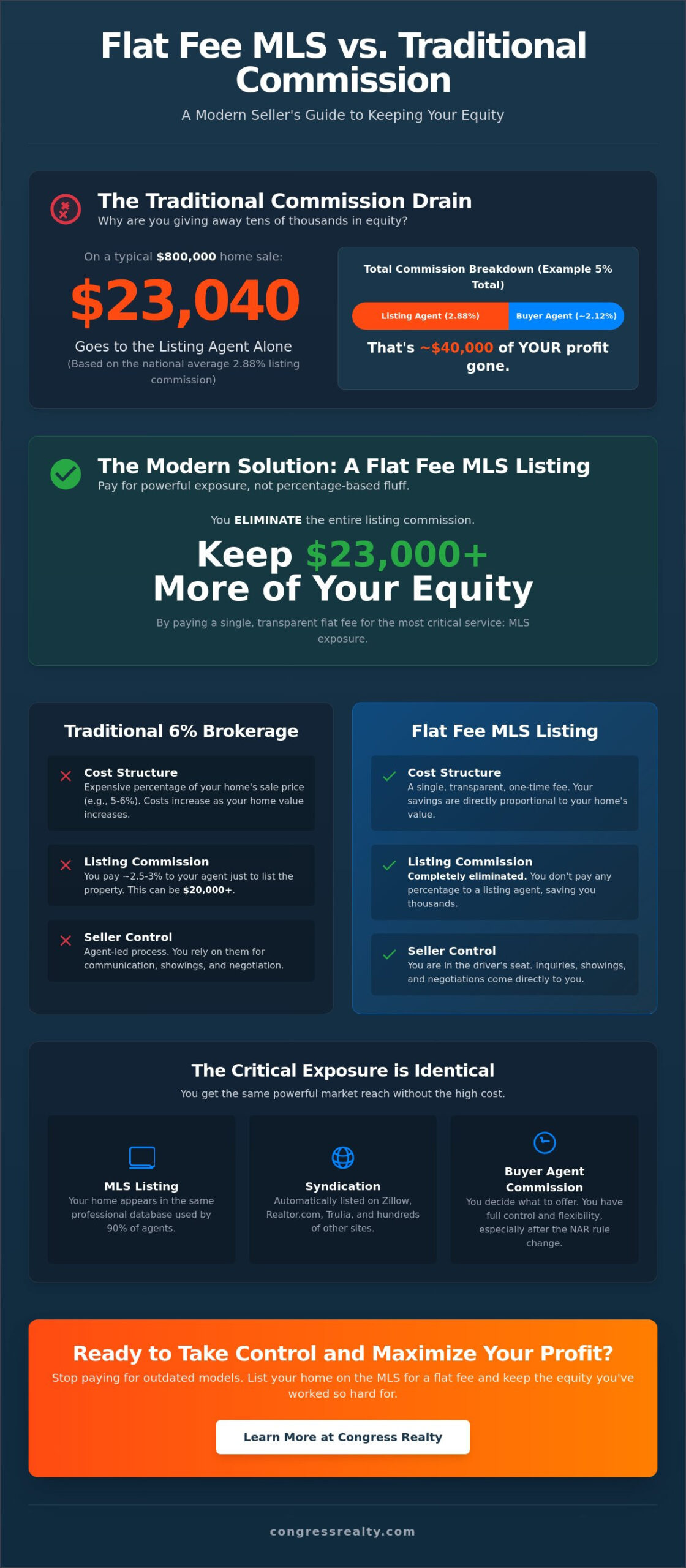
Why would you hand over tens of thousands of dollars of your hard-earned equity just for the privilege of a “Sold” sign? With median home prices in many markets now reaching significant figures, the traditional 2.88% listing commission (which can easily amount to over $23,000 on an $800,000 home) is no longer just a cost of doing business. It’s a massive financial drain that savvy homeowners are now choosing to avoid. You deserve to keep your profit while still reaching every buyer on Zillow and Realtor.com.
We understand the frustration of seeing your equity vanish into outdated commission structures. You want professional market exposure and the same tools the experts use, but you don’t want the unnecessary overhead. A flat fee mls listing gives you the best of both worlds by decoupling professional exposure from high-pressure sales commissions. Since the NAR rule changes on August 17, 2024, you’ve gained more power than ever to negotiate and save.
This ultimate guide will teach you how to list your home directly on the local MLS for a single, transparent rate. We’ll walk you through the legal paperwork, explain how to manage disclosures, and provide the roadmap to retaining your equity in today’s market. You’ll learn exactly how to gain maximum exposure while staying in the driver’s seat of your entire sales process.
Key Takeaways
Discover how the pay-for-service model replaces traditional commissions, allowing you to keep a significantly larger portion of your home’s equity.
Learn how a flat fee mls listing provides professional-grade exposure by syndicating your property to major platforms like Zillow and Realtor.com.
Identify the essential marketing tools, including professional photography and data-driven market analysis, that prevent listing fatigue and attract high-quality buyers.
Master the transition from “Under Contract” to “Closed” by understanding the transaction management and paperwork requirements of a successful sale.
Gain the confidence to lead your own transaction with expert infrastructure that puts you in total control of the sales process.
What is a Flat Fee MLS Listing? The Modern Alternative to 6% Commissions
Selling your home shouldn’t cost you a small fortune in commissions. For decades, the real estate industry operated on a rigid percentage-based model that often stripped homeowners of their equity. A flat fee mls listing disrupts this outdated system by offering a pragmatic, pay-for-service alternative. Instead of paying a listing agent a massive percentage of your home’s final sale price, you pay a one-time fee to have your property placed on the Multiple Listing Service. This strategic move allows you to retain the right to sell as a “For Sale By Owner” while enjoying the massive reach of the professional grid.
To understand the value, you must look at what you’re actually buying. In a traditional 6% model, you’re paying for a bundle of services, many of which you don’t actually need. With a flat fee model, you only pay for the market exposure. You get your home in front of every active buyer without the “full-service fluff” that eats into your profit. For a deeper look at the history and mechanics of this model, you can research What is a Flat Fee MLS Listing? through neutral industry overviews. Ultimately, this approach treats your home sale like the business transaction it is, putting you in the driver’s seat of your own equity.
The Core Difference: Listing Commission vs. Buyer Agent Commission
The traditional 6% commission is actually two separate 3% payments. One 3% goes to the listing agent, and the other 3% is offered to the buyer’s agent. When you choose a flat fee service, you eliminate the 3% listing side entirely. You’re no longer paying someone thousands of dollars just to enter data into a computer. Since the NAR rule changes on August 17, 2024, you also have total flexibility regarding the buyer agent commission (BAC). You decide what to offer, or if you want to offer anything at all, based on your specific market conditions and goals. This transparency ensures you aren’t overpaying for “representation” that doesn’t add value to your bottom line.
Why the MLS is the “Holy Grail” of Real Estate
The MLS is the primary database used by every licensed real estate agent in the country. It’s the engine that powers the entire market. Statistics from March 2026 show that approximately 90% of buyers use an agent, and those agents rely exclusively on the MLS for search data. When you list your home here, your property information syndicates automatically to Zillow, Trulia, and Realtor.com. A flat fee listing provides the exact same professional visibility as a high-commission listing. There’s no “discount” section on the MLS; your home appears right next to every other property, looking just as professional and reaching the same audience. You Control Your Sales Process by using the most powerful tool in the industry on your own terms.
How the Multiple Listing Service Works for Independent Sellers
The Multiple Listing Service (MLS) is more than just a digital bulletin board. It’s a sophisticated “Broker-to-Broker” data exchange that serves as the central nervous system for the entire real estate market. When you use a flat fee mls listing, you aren’t just putting your house on a website; you are plugging into a professional network that communicates directly with every licensed agent in your region. This internal software allows agents to see private remarks, showing instructions, and specific transaction details that are never visible to the general public on consumer sites. Importantly, your specific contact information is what buyers and agents see, ensuring that inquiries come directly to you.
The moment your listing status flips to “Active,” a massive automated machinery kicks into gear. Thousands of buyers who have saved searches with their agents receive immediate notifications. This “Active” trigger is the single most powerful event in your sales timeline. Unlike a manual “For Sale By Owner” post that might sit unnoticed, an MLS listing guarantees that your home appears in the daily email blasts sent to qualified buyers who are ready to move now. In April 2026, correctly priced homes in California are pending in an average of 23 days, largely due to this immediate, high-intensity exposure.
Syndication to Zillow, Realtor.com, and Beyond
It’s a common misconception that Zillow is the original source of real estate data. In reality, Zillow and Realtor.com are aggregators that pull their information directly from the local MLS. A professional listing is prioritized over “FSBO” tags, which are often buried in secondary search tabs or filtered out by default. When you update your price or status on the MLS, that data pushes out to these third-party sites almost instantly. This ensures your marketing remains accurate across the entire internet without you having to manage dozens of separate accounts or deal with laggy updates.
Professional Parity: Looking Like a Pro
Agents use specific filters to find homes for their clients, sorting by school districts, zoning codes, and precise square footage. If your property isn’t on the MLS, it simply doesn’t exist in these filtered results. By using a flat fee broker, you gain the professional license required to access this exclusive network. This creates a level playing field where your home carries the same weight as those represented by high-commission firms. If you are weighing the benefits of Flat Fee MLS vs. Traditional Brokerage, consider that parity is your greatest asset. You get professional-grade data fields and the same “Active” status as a 6% listing, but you keep your equity.
You don’t need to pay for a full-service agent just to get your data on the grid. You can view our transparent listing packages to see how professional infrastructure puts you in total control of the showings and negotiations.
Flat Fee MLS vs. Traditional Brokerage: A Side-by-Side Comparison
Choosing between a traditional broker and a flat fee mls listing is fundamentally a choice between “Percentage-of-Wealth” and “Pay-for-Service.” In the traditional model, a listing agent charges you based on the value of your home, not the actual work performed. If your home sells for $400,000, a typical 3% listing commission costs you $12,000. If that same home sells for $800,000, the fee jumps to $24,000 for the exact same amount of paperwork and data entry. To understand exactly how much does the realtor make and why so much of your equity disappears at closing, it helps to see the full commission breakdown in today’s market. A flat fee model breaks this cycle by charging a predictable, one-time rate regardless of your home’s final sale price. This allows you to treat your equity like the investment it is, rather than a pool of money for an agent to dip into.
The control factor is the most empowering part of this shift. When you list independently, you decide when to show the house and how to handle negotiations. You don’t have to wait for an agent to return a call or coordinate three different schedules just to let a buyer in the door. There’s a persistent myth that traditional agents work harder because they are on commission. In reality, a commission often incentivizes a quick sale at any price, whereas you are incentivized to get the highest possible return for your property. You know your home’s best features better than anyone; you are its best advocate. If you want a complete walkthrough of the independent selling process, our guide on how to sell your house on your own covers every step from pricing to closing.
Financial Breakdown: The ROI of Flat Fee Services
The financial math is undeniable. As of March 2026, the national average real estate commission rate sits between 5.44% and 5.70%. By choosing a flat fee mls listing service, which typically ranges from $299 to $499, you immediately save thousands of dollars. Savvy sellers often take a small portion of those savings and reinvest it into high-ROI tools like professional photography or premium yard signs. This strategy ensures your home looks like a million dollars while you keep the $12,000 to $30,000 you would have otherwise lost to commissions. You can even use your savings to offer a more competitive buyer agent commission, making your home more attractive to the 90% of buyers working with professional representation.
Service Levels: Standard vs. Full Service Flat Fee
Not all flat fee services are identical, and you should choose a level that matches your comfort zone. A “Standard” package is perfect for the confident DIY seller who wants to handle calls and showings directly. If you want more support, “Full Service” flat fee options include professional valuation tools and transaction management to help with the “Under Contract” phase. The key is that you only pay for the specific infrastructure you need. Whether you want a simple listing or a bit of professional guidance, the core benefit remains the same: You Control Your Sales Process without sacrificing your equity to an outdated commission structure.
Maximizing Your Listing: Preparation and Professional Tools
Getting your property on the local MLS is the first step, but winning the market requires a tactical approach to presentation and pricing. A flat fee mls listing gives you the platform, but your preparation determines the speed of the sale. You don’t need a high-commission agent to tell you that first impressions are everything; you just need the right professional tools to execute the job effectively. By investing a small fraction of your saved commission into high-ROI assets, you ensure your home stands out against the competition while maintaining total autonomy. If you’re ready to take the next step, our comprehensive guide on how to list on MLS without a realtor walks you through every tool and tactic you need to sell independently in 2026.
Pricing Strategy: Using a CMA to Win
The MLS is a transparent marketplace where buyers and agents have access to the same historical data. Overpricing is the primary reason homes fail to sell, leading to what industry experts call “listing fatigue.” Data from April 2026 shows that correctly priced homes in California are pending in an average of 23 days. In contrast, homes priced even 5% above market value can sit for over 70 days, often requiring deep price cuts later. Use a Comparative Market Analysis (CMA) to look at “comps”-homes similar to yours that sold within the last six months. This data helps you find the pricing “sweet spot” that triggers multiple offers and creates the urgency needed for a premium result.
The Toolkit: Signs, Lockboxes, and Photos
Your “first showing” happens on a smartphone screen, not at the front door. Professional photography is the single most important marketing expense you’ll incur. High-quality images highlight your home’s best features and command attention in a crowded digital feed. Once a buyer is interested, an electronic lockbox allows for secure, agent-led showings without requiring your presence. These devices track exactly which agent entered your home and at what time, providing a layer of security and professional accountability that traditional keys simply can’t match.
Don’t underestimate the psychological impact of a professional yard sign. A sturdy, professional-grade sign post signals to neighbors and drive-by buyers that the sale is being handled with expert infrastructure. It provides a stark contrast to cheap, hand-written hardware store signs that can diminish your home’s perceived value. When you combine these professional tools with the exposure of a flat fee mls listing, you create a powerful marketing engine that you control entirely. You get the same professional appearance as a 6% listing without the unnecessary expense.
Ready to put these professional tools to work for your sale? Start your listing today and keep more of your hard-earned equity.
Navigating the Transaction: From Listing to Closing with Congress Realty
Accepting an offer is a major milestone, but it’s not the finish line. The period between “Under Contract” and “Closed” is a structured sequence of inspections, appraisals, and document signings. Many sellers fear this phase because they believe they need a high-commission agent to manage the logistics. In reality, the heavy lifting is performed by neutral third parties like escrow officers and title companies. Your flat fee mls listing provides the professional entry point, and our infrastructure ensures you have the tools to cross the finish line with your equity intact.
When an offer arrives, your first step is to review the “Net Sheet.” This document calculates your actual walk-away profit after all expenses, including title fees and any agreed-upon buyer agent commissions. With the median California home price at $818,600 as of April 2026, the absence of a 3% listing commission means an extra $24,558 stays in your pocket. Seeing those numbers in black and white reinforces why you chose to bypass the traditional model. You aren’t just selling a house; you’re executing a smart financial strategy.
Handling Offers and Negotiations
You have total authority over which offers to accept, reject, or counter. Don’t be intimidated by “lowball” offers or complex contingencies. You know the value of your property better than anyone. If an offer doesn’t meet your goals, you can issue a counter-offer or simply move on to the next buyer. Even with a flat fee model, you can opt for professional oversight on your contracts to ensure the terms protect your interests. Remember the core mantra: You Control Your Sales Process. You decide the timeline, the price, and the terms that work for your family.
The Legal Safety Net: Disclosures and Documentation
Transparency is your best defense against post-sale legal issues. Every seller must provide mandatory disclosures, such as the Transfer Disclosure Statement (TDS) and the Seller Property Questionnaire (SPQ). These documents detail the condition of the home and any known defects. Missing a single signature or deadline can delay your closing, which is why a professional transaction coordinator is a valuable asset. They act as a dedicated project manager, ensuring every document is filed correctly and every contingency is cleared on time. This final step secures your financial freedom and completes your journey to a successful, high-savings home sale.
Take Control of Your Equity Today
You now have the roadmap to sell your home without sacrificing your equity to outdated commission models. By choosing a flat fee mls listing, you gain the same market exposure as the largest brokerages while keeping thousands more at closing. You’ve seen how professional tools and the right pricing strategy can lead to a pending sale in an average of 23 days. It is time to move past the fear of the unknown and embrace the financial intelligence of the modern seller.
Since 2002, Congress Realty has operated as a direct broker to empower homeowners across the market. We’ve helped our clients save over $100 million in commissions by providing a professional, no-nonsense alternative to the traditional 6% model. You don’t need a referral company; you need a reliable ally with over two decades of experience. List your home on the MLS for a flat fee and save thousands today! You Control Your Sales Process, and we’re here to provide the infrastructure to make it happen. You’ve worked hard for your equity; now it’s time to keep it.
Frequently Asked Questions
How much does a flat fee MLS listing actually cost?
Prices vary depending on your location and the level of support you need. Congress Realty offers flat fee packages starting at $299 for a basic listing, with premium options reaching $499 for additional professional tools. In markets like California, standard plans typically range between $325 and $699. It’s important to check for hidden costs like coordination fees, which some competitors charge at the time of closing.
Can I still sell my house as a For Sale By Owner (FSBO) while on the MLS?
Yes, you retain the full right to sell your home independently while it’s active on the professional grid. If you find a buyer who isn’t represented by an agent, you don’t pay any commission at all. This “best of both worlds” approach gives you professional market exposure while maintaining the freedom to close a private sale on your own terms and keep your full profit.
Will real estate agents still show my home if I use a flat fee service?
Professional agents will show any home that meets their buyer’s specific criteria regardless of the listing model. Agents are motivated to find the right property for their clients and earn their agreed-upon commission. Since your home appears as an “Active” listing on the local MLS just like any other, it remains a primary target for the 90% of buyers who work with professional representation.
Do I have to pay a commission to the buyer’s agent?
You aren’t required to offer a set commission to the buyer’s agent on the MLS. Following the NAR settlement rules implemented on August 17, 2024, compensation is now fully negotiable and cannot be displayed within the MLS system. While offering a competitive rate can attract more agents, you have the final say in how much you’re willing to pay for a successful transaction at the closing table.
What happens if I find a buyer myself without an agent?
You pay zero commission if you secure a buyer who doesn’t have an agent. This is the ultimate financial goal for many using a flat fee mls listing. You simply handle the paperwork through your title company or escrow officer and keep the thousands of dollars you would’ve otherwise lost. You get the benefit of professional exposure but only pay for the buyer’s side if an agent actually brings the buyer.
How long does it take for my listing to appear on Zillow and Realtor.com?
Most listings syndicate to major consumer platforms within 24 to 48 hours after they go active on the local MLS. These third-party sites function as aggregators that pull data directly from the professional source. Because the information is standardized, your property will appear with all relevant details and photos almost immediately after the broker completes the data entry into the regional system.
Can I make changes to my listing after it goes live?
You can update your price, photos, or property description at any time during the listing period. Keeping your data fresh is vital for success; correctly priced homes in California are pending in an average of 23 days, so adjusting to market feedback is a key part of your strategy. Most packages allow for easy updates to ensure your listing remains competitive and accurate throughout the sales process.
Is a flat fee MLS listing legal in all states?
Flat fee services are legal in all 50 states, though specific regulations and “minimum service” laws vary by region. Some states require brokers to perform certain tasks, such as reviewing offers or answering client questions. Congress Realty operates as a direct broker to ensure your flat fee mls listing meets all local legal requirements while still providing the massive savings you expect from a non-traditional model.
Image sourced from Canva
Summary: That “$299 flat fee” MLS listing might actually cost you $5,000. Some companies advertising rock-bottom prices are quietly charging percentage-based fees at closing—and sellers don’t discover them until it’s too late. Here’s how to spot the warning signs before you sign.
Key Takeaways
Many flat fee MLS services advertise low upfront costs but charge hidden percentage-based fees at closing, ranging from 0.5% to 1.25% of the sale price
On a typical Idaho home sale, these hidden fees can add $2,000 to $5,000 to your closing costs beyond the advertised price
Services like Houzeo promote “$249 only” pricing but bury mandatory closing fees in small print, creating costly surprises at settlement
Truly transparent flat fee services exist in Idaho, offering genuine one-time pricing without backend percentage charges
Sellers can protect themselves by requesting written fee disclosures and calculating total costs before signing any listing agreement
Idaho home sellers are increasingly turning to flat-fee MLS services to avoid traditional agent commissions, but a troubling trend has emerged. Many companies advertise rock-bottom upfront costs while concealing substantial backend fees that only surface at closing, transforming supposed savings into expensive surprises.
The term “flat fee” suggests a single, predictable payment. However, numerous MLS listing services in Idaho operate under hybrid pricing models that directly contradict this expectation. These companies promote ultra-low entry prices—sometimes as low as $99 or $199—while embedding percentage-based charges that kick in only when the home sells.
The deception lies not necessarily in charging the fee itself, but in how these costs are presented to consumers.Congress Realty, a Idaho-based brokerage specializing in transparent pricing, has observed cases where sellers face unexpected charges ranging from $1,000 to over $5,000 at closing, despite believing they had paid a complete “flat fee” upfront.
This practice fundamentally misrepresents the service’s true cost structure. When a company advertises “$249 total” but charges an additional 1% at closing, the actual cost on a $400,000 home becomes $4,249—nearly 17 times the advertised price. Such dramatic cost differences can devastate a seller’s financial planning and net proceeds calculations.
How Backend Fee Models Work
Backend fee structures typically manifest through two primary mechanisms: compliance fees and brokerage administrative charges. Understanding these models helps sellers identify potential red flags before committing to a service.
Compliance Fees and Brokerage Admin Charges
“Compliance fees” represent the most common disguise for backend charges. Companies justify these fees by claiming they cover state regulatory requirements, adherence to MLS rules, or transaction oversight. In reality, legitimate regulatory compliance costs should be factored into the advertised price, not added as surprise charges.
Brokerage administrative fees serve a similar function, ostensibly covering paperwork processing, document preparation, or transaction coordination. These charges often appear as percentage-based fees (0.1%-0.5% of the sale price). The timing of disclosure varies dramatically—some companies mention these fees in fine print, while others reveal them only in listing agreements or closing documents.
Real Cost on Idaho Home Sales
To illustrate the financial impact, consider a typical home sale in Idaho. A service advertising a $299 flat fee but charging a 0.5% closing fee actually costs $2,299 on a $400,000 home. If that same service charges 1.25%, the total reaches $5,299—representing a 1,673% increase over the advertised price.
These calculations become particularly concerning when compared to Idaho’s baseline closing costs. Sellers already face approximately 2.76% in unavoidable settlement expenses, including title fees, transfer taxes, and prorated property taxes. Adding hidden percentage fees can push total closing costs beyond 3.5%, substantially eroding the savings that initially motivated the use of a flat-fee service.
Specific Services Using Hidden Fee Structures
Several prominent flat fee MLS companies operating in Idaho employ backend charging models that contradict their marketing messages. Identifying these services helps sellers make informed decisions and avoid unpleasant surprises on closing day.
Houzeo’s 0.5%-1.25% Closing Charges
Houzeo represents perhaps the most egregious example of misleading flat fee marketing. The company’s Silver plan prominently displays “$249 only*” pricing, but the asterisk leads to fine print revealing a mandatory 0.5% closing fee with a $999 minimum charge. Their Gold plan increases this to 1%, while Platinum reaches 1.25%.
On a typical Idaho home sale, Houzeo’s Platinum plan adds $5,000 in closing fees beyond the advertised price. Even their “budget” Silver option adds at least $999, regardless of sale price. Sellers have reported surprise at these charges, with some noting that closing fees were disclosed only in small print and led to unexpected costs at settlement.
The company has evolved from a genuine flat fee provider into what industry analysts now classify as a hybrid commission structure. This transformation demonstrates how marketing can remain static while business models shift toward less transparent practices.
List With Freedom’s Disclosed Compliance Fees
List With Freedom takes a more transparent approach than Houzeo, but still employs backend charges that contradict pure flat fee principles. Their basic plan charges a 0.25% “compliance fee” at closing, while the Gold plan increases this to 0.5%.
To their credit, List With Freedom does disclose these fees in their pricing tables and FAQ sections, calling them compliance costs for “state law compliance and MLS rules.” However, on a $400,000 home sale, these fees add $1,000 to $2,000, respectively—substantial amounts that transform the total cost equation.
While more honest than buried disclosures, these fees still represent percentage-based charges that contradict the flat fee concept. Sellers who budget based on advertised prices may find their closing proceeds reduced by thousands of dollars.
Services With Transparent Pricing
Fortunately, several flat fee MLS services operating in Idaho maintain genuine one-time pricing structures without backend percentage charges. These companies demonstrate that transparent pricing remains possible in the industry.
Congress Realty’s Clear Fee Disclosure
Congress Realty operates with straightforward pricing transparency, charging $299 for its standard plan with no backend fees on Basic and Plus tiers. Their approach includes all necessary Idaho Real Estate Commission-approved forms, syndication to major portals like Zillow and Realtor.com, and professional photo support.
The $299 payment represents the complete cost—no surprises, no asterisks, no hidden compliance fees at closing. This transparency allows sellers to accurately calculate their net proceeds and plan their finances accordingly.
Other Genuinely Flat Fee Options
Several additional services maintain honest flat fee structures. Brokerless explicitly markets “no hidden closing fees” and “no closing fees,” with plans ranging from $99 to $188 that represent complete costs. Their 6-month listings include MLS entry, portal syndication, and basic support, with no percentage-based add-ons.
OwnerEntry.com offers plans ranging from $199 to $399, with closing percentages not disclosed. These services prove that legitimate flat fee models remain viable. Their success demonstrates that backend charges represent business model choices rather than industry necessities.
Protecting Yourself From Fee Surprises
Idaho sellers can take specific steps to avoid backend fee surprises and ensure they understand the full cost structure before signing listing agreements.
Request Written Fee Disclosure
Before providing payment or signing any agreements, request detailed written documentation of all fees, including any percentage charges at closing, compliance fees, administrative charges, and cancellation costs. Legitimate companies will provide this information willingly and clearly.
Avoid services that refuse to provide written fee schedules or claim such information will be “explained later.” Red flags include vague language like “additional fees may apply” or “see terms and conditions for complete details.” Insist on specific dollar amounts and percentage calculations.
Calculate Total Cost at Your Expected Sale Price
Never evaluate services based solely on advertised upfront costs. Calculate the complete expense using your expected sale price, including all disclosed backend charges. A $249 listing with 1% closing fee on a $400,000 home actually costs $4,249—information that dramatically changes the value proposition.
Create side-by-side comparisons showing total costs for each service under consideration. Factor in any minimum fee requirements, as some companies charge percentage-based fees with floor amounts that may exceed the calculated percentage on lower-priced homes.
Check for Minimum Commission Floors
Some services impose minimum closing fees regardless of the calculated percentage. Houzeo’s $999 minimum means their 0.5% fee applies even on homes selling below $199,800. These floors can create disproportionate costs on modestly priced properties.
Understand how minimum fees interact with percentage calculations. In some cases, flat dollar amounts may be more cost-effective than percentage-based structures, depending on your home’s value and the specific fee schedule.
Verify MLS and Portal Syndication
Confirm that services will list on the correct MLS system for your area. Idaho has multiple regional MLS systems, including those operated by the Greater Albuquerque Association of REALTORS®, Santa Fe Association of REALTORS®, Las Cruces Association of REALTORS®, and other regional boards. Incorrect MLS placement can severely limit exposure regardless of the fee structure.
Verify syndication to major buyer platforms, including Zillow, Realtor.com, and Redfin, which generate the majority of buyer traffic. Some budget services limit portal distribution, potentially reducing your home’s visibility to qualified buyers.
Choose True Flat Fee Services to Avoid Costly Settlement Surprises
The flat fee MLS market in Idaho offers both genuine value and hidden pitfalls. Services with transparent, one-time pricing provide legitimate alternatives to traditional agent commissions, potentially saving sellers thousands of dollars. However, companies that advertise low upfront costs while concealing substantial backend charges can transform expected savings into expensive surprises.
The key to successful flat fee service selection lies in thorough research and clear communication. Request written fee disclosures, calculate total costs based on your expected sale price, and verify that advertised “flat fees” truly represent complete pricing. When companies refuse to provide transparent fee schedules or bury charges in fine print, consider them red flags worth avoiding.
Idaho’s housing market offers substantial opportunities for sellers who navigate the flat fee landscape carefully. With traditional agent commissions averaging 5.82%, the potential savings from legitimate flat-fee services can be significant. However, realizing these benefits requires choosing services that honor their flat fee promises rather than those that exploit consumer expectations through deceptive pricing models.
For transparent, flat-fee MLS services in Idaho that deliver exactly what they promise, Congress Realty offers clear pricing and support at congressrealty.com
Image sourced from canva
Summary: Thinking about selling your California home without paying the full 5.26% commission? Before you jump into a flat fee MLS listing, there are specific photo requirements, disclosure rules, and hidden costs that could derail your plans—here’s what California brokers wish sellers knew upfront.
Key Takeaways
California flat fee MLS services save sellers an average of $11,784 compared to traditional commission structures on the state’s $441,000 median home price
MLSSAZ requires specific photo standards including 15MB maximum file size, front exterior photos within 4 days, and strict content restrictions that prohibit people or watermarks
Mandatory seller disclosures include the Seller’s Property Disclosure Statement (SPDS), five-year insurance claims history, and HOA documentation regardless of listing method
Hidden costs in budget flat fee services can inflate advertised $299 prices to over $800 through photography add-ons, extension fees, and transaction coordination charges
Post-NAR settlement, sellers can still offer buyer agent compensation but must negotiate these terms outside the MLS to attract agent-represented buyers
California Flat Fee MLS Saves $11,784 on $441K Median Homes
California’s flat fee MLS market delivers substantial savings for home sellers willing to handle portions of their transaction independently. Traditional real estate commissions in California average 5.26% of the sale price, with listing agents earning 2.66% and buyer’s agents receiving 2.60%. On the state’s median home price of $441,000, this translates to $23,187 in total commission costs.
Flat fee MLS services operate through licensed California real estate brokers who list properties for predetermined fees ranging from $299 to $599, rather than percentage-based commissions. These services provide access to regional MLS systems including ARMLS (Phoenix), MLSSAZ (Tucson), PAARMLS (Prescott), and NAAR (Flagstaff), ensuring syndication to major consumer portals like Zillow, Realtor.com, and Redfin.
The savings calculation becomes compelling when comparing scenarios. Traditional full service costs $23,187, while flat fee MLS plus buyer agent compensation totals approximately $11,649 to $11,949 ($299-$599 flat fee plus $11,350 buyer commission).Congress Realty’s $299 flat fee MLS service exemplifies this cost-effective approach, providing MLS exposure without traditional listing commission structures.
California MLS Photo and Technical Standards You Must Meet
California MLS systems enforce strict technical and content standards for listing photos to ensure consistent quality across all platforms. Understanding these requirements prevents listing delays and rejection notices that can cost valuable market time.
1. File Size and Format Requirements
MLSSAZ specifications require large photos not exceed 3000×2000 pixels or 2000×3000 pixels, with maximum saved photo size of 15MB and a limit of 50 photos per listing. ARMLS accepts multiple file formats including JPG, JPEG, GIF, PNG, TIF, TIFF, BMP, PGM, PBM, and PPM, though conversion to JPG may occur during processing. The minimum resolution should be 1024×768 pixels, though 2048×1536 is recommended for optimal display quality.
Technical specifications also require 4:3 or 3:2 aspect ratio in landscape orientation, sRGB color profile for optimal web display, and file sizes between 100KB and 3MB per photo. Images exceeding maximum resolution limits are automatically scaled down during the upload process.
2. Prohibited Content That Triggers Listing Rejection
MLS systems strictly prohibit specific content that results in immediate listing rejection or compliance penalties. MLSSAZ requires people to be cropped out of all photos before uploading, while ARMLS allows people in the background of photos. Both systems prohibit family members, pets not present at the property, or any individuals prominently featured in images.
Additional prohibited content includes URL links, borders, banners, graphics, or writing overlaid on photos; logos or contact information including for-sale signs; watermarks from other MLSs or photographers; personal items, family photos, or sensitive documents visible in shots; and poor quality images that appear blurry, overexposed, or underexposed.
3. Front Exterior Photo Required Within 4 Days
ARMLS requires at least one front exterior photo for all residential and residential rental listings (Property Classes 1 & 2) within four days of the listing going Active. This primary photo becomes the main image displayed across all syndicated platforms and significantly impacts first impressions with potential buyers.
Photos may only depict physical traits of the property for sale, existing structures, vicinity or location, or neighborhood amenities. Enhanced photo editing including saturation adjustments and brightness modifications is permitted, but the images must accurately represent the property’s current condition.
California Seller Disclosure Requirements (Even for Flat Fee)
California law mandates seller disclosures regardless of whether sellers use traditional agents or flat fee MLS services. These requirements protect buyers and sellers from potential legal complications during transactions.
1. Seller’s Property Disclosure Statement (SPDS)
The California Residential Seller’s Property Disclosure Statement must be completed and provided to buyers before entering into any purchase contract. Under the California Residential Resale Purchase Contract, sellers have three days after contract acceptance to deliver the completed SPDS to buyers.
The SPDS covers property ownership history, HOA status and fees, building and safety information, utilities and mechanical systems, environmental and hazardous materials, flood risks and drainage issues, and any other material conditions affecting property value or desirability. Incomplete or inaccurate disclosures can result in contract cancellation or legal liability.
2. Five-Year Insurance Claims History
Sellers must deliver a five-year insurance claims history report to buyers within five days of contract acceptance. For properties owned less than five years, the report covers the entire ownership period. This document, obtained directly from the homeowner’s insurance company, lists any claims filed for the property including damage types, claim amounts, and resolution details.
Insurance claims history helps buyers assess potential property risks and may influence their decision to proceed with the purchase or negotiate repairs. Common claims include roof damage, water damage, theft, and weather-related incidents that could indicate ongoing property maintenance issues.
3. HOA Documentation Requirements
Properties located within homeowners associations require HOA disclosures including CC&Rs (Covenants, Conditions, and Restrictions), bylaws, rules and regulations, recent financial statements, and current statement of fees and assessments. California Revised Statute § 33-1806 requires HOAs to provide requested documents to buyers within 10 business days of the request.
Additional HOA-related disclosures may include pending litigation, special assessments, reserve fund status, and any known violations or disputes. Buyers typically have specific time periods to review HOA documentation and cancel contracts if terms prove unacceptable.
Hidden Costs That Turn $299 into $800+
Budget flat fee MLS packages often exclude features that sellers later find necessary for effective marketing, resulting in expensive add-on purchases that can double or triple advertised prices.
1. Professional Photography Add-Ons
Professional photography represents the most significant potential add-on cost, ranging from $100 to $500 depending on service quality and package inclusions. Properties with professional photos receive 61% more online views and sell 32% faster than those with amateur photography, making this investment valuable for market success.
Photography upgrades typically include 20-40 high-resolution images, virtual tours or 3D scans ($150-$400), twilight or drone photography ($200-$300), and enhanced editing services. Some services charge separately for each room photographed, while others offer flat-rate packages covering entire properties.
2. Extension and Relisting Fees
Most flat fee services provide initial listing terms of 3-6 months. Properties not selling within this timeframe require extensions or relisting, generating additional fees that sellers often don’t anticipate when comparing services.
Typical extension costs include $50-$100 for basic tier 3-6 month extensions, $100-$199 relisting fees for new listings after expiration, and varying charges for unlimited listing changes or price modifications. Premier tier packages often include free extensions up to 12 months total, providing better value for properties in slower markets.
3. Transaction Coordination Charges
Some flat fee services charge additional “compliance fees” or “closing success fees” ranging from 0.25% to 1.25% of the final sale price. These percentage-based charges can add $1,000 to $5,500 on typical California homes, effectively converting flat fee structures back to commission-based pricing.
Transaction coordination add-ons may include contract review ($200-$500), broker negotiation support ($500-$1,500), document preparation and compliance oversight, status changes and closing coordination, and legal forms and disclosure assistance. Sellers should clarify whether these services are included in upfront fees or charged separately at closing.
Post-NAR Settlement: Should You Pay Buyer Agent Commissions?
The August 2024 NAR settlement fundamentally changed how buyer agent compensation is communicated and negotiated, creating new strategic considerations for flat fee MLS sellers.
Approximately 90% of buyers work with real estate agents, making agent-represented buyers the dominant market segment. Offering buyer agent compensation of 2.5-3% attracts this large buyer pool and increases showing activity, competitive offers, and negotiation opportunities.
Properties offering buyer compensation align with market norms and buyer expectations, avoiding competitive disadvantages compared to traditionally-listed properties. Agent-represented buyers often have pre-approved financing, professional guidance through the transaction process, and experience with real estate contracts and negotiations.
Skipping Commissions Limits Your Buyer Pool
Sellers choosing not to offer buyer agent compensation maximize cost savings by paying only the flat fee MLS cost ($299-$599 total). This approach increasingly appeals to sellers as post-NAR settlement rules require buyers to sign agreements acknowledging responsibility for their agent’s compensation.
However, eliminating buyer agent compensation significantly reduces the potential buyer pool by excluding agent-represented buyers unwilling or unable to pay their agent’s fees. This limitation may result in longer market times, lower sale prices, or both, potentially negating the commission savings through reduced proceeds or carrying costs.
Congress Realty’s $299 Flat Fee MLS Delivers California Market Access
Congress Realty has established itself as a reliable flat fee MLS provider in California’s competitive market, offering transparent pricing and services without the hidden costs that plague many budget alternatives. Their $299 basic package includes MLS listing and syndication to major consumer platforms, up to 6 property photos, 5 listing changes during the term, all required state forms and disclosures, and showing management tools.
The service maintains a 4.8-star rating across 125+ Google reviews, demonstrating consistent customer satisfaction and service delivery. Their client portal provides document access and listing updates, while electronic lockboxes and automated showing scheduling streamline the sales process for busy sellers.
Congress Realty’s approach focuses on providing core MLS functionality at accessible prices rather than overwhelming sellers with expensive add-ons or complex fee structures. Their 6-month listing terms align with typical market cycles, while their full-service upgrade option accommodates sellers needing additional broker assistance for complex transactions.
Summary: That $99 flat fee MLS listing in California? You might actually owe thousands more at closing. An California broker exposes the “success fees” and “compliance fees” that turn advertised flat rates into percentage-based charges—and reveals which companies are hiding them in the fine print.
Key Takeaways
Many California Flat Fee MLS services advertise low upfront fees but add hidden percentage-based closing costs ranging from 0.25% to 1.25%
These “success fees” and “compliance fees” can cost thousands on higher-priced homes, defeating the purpose of flat fee pricing
Companies like Houzeo charge 0.5% at closing while ListWithFreedom adds 0.25%-0.5% in fees that may not be prominently disclosed in initial marketing materials
True transparent options exist, including Brokerless.com with verified no-percentage pricing, and some local brokers within networks like Flat Fee Group who offer upfront-only pricing
Red flags include vague contract language, extremely low advertised prices, and required use of affiliated title services
California home sellers considering Flat Fee MLS services often find the advertised pricing doesn’t tell the complete story. What appears to be a straightforward flat fee frequently comes with additional percentage-based charges due at closing, transforming a seemingly affordable service into an unexpectedly expensive proposition.
California Flat Fee MLS Often Charges Undisclosed Closing Fees
The Flat Fee MLS industry in California has developed a concerning pattern of advertising low upfront costs while burying additional percentage-based fees in contract terms. These hidden charges surface at closing, catching sellers off guard when they’re already committed to the transaction.Congress Realty has observed this trend and emphasizes the importance of understanding total costs before selecting a service provider.
The practice undermines the core appeal of flat fee services – predictable, upfront pricing that saves sellers money compared to traditional real estate commissions. When percentage-based closing fees are added, the total cost can exceed what sellers initially budgeted, especially on higher-value properties.
Industry experts note that premium flat fee MLS plans frequently utilize hybrid pricing models, combining non-refundable upfront fees with additional flat or percentage-based charges due at closing. This structure allows companies to advertise attractively low initial prices while generating significant revenue through backend fees.
How Hidden Percentage Fees Work
1. ‘Success Fees’ and ‘Compliance Fees’ Explained
California Flat Fee MLS companies often disguise percentage-based closing charges using terminology like “success fees,” “compliance fees,” or “transaction fees.” These euphemisms make the additional costs seem like standard administrative charges rather than percentage-based commissions. Success fees are particularly misleading because they’re presented as optional bonuses for successful sales, when they’re actually mandatory charges built into the service agreement.
Compliance fees suggest regulatory requirements, but they’re typically just another revenue stream for the MLS provider. These fees aren’t mandated by California real estate law or MLS regulations – they’re simply business decisions dressed up in official-sounding language to reduce seller resistance.
2. Common Percentage Ranges (0.25%-1.25%)
The percentage-based closing fees in California typically range from 0.25% to 1.25% of the home’s sale price. On a $400,000 home, this translates to $1,000 to $5,000 in additional costs beyond the advertised flat fee. Companies position these percentages as “small” compared to traditional real estate commissions, but they can significantly impact the seller’s net proceeds.
Mid-range services commonly charge 0.5% to 0.75%, while premium packages with additional services may reach 1.25%. Even the “low” end of 0.25% represents substantial money on typical California home values, especially in markets like Austin, Dallas, and Houston where median home prices exceed $300,000.
3. Real Cost Impact on Higher-Priced Homes
The financial impact of percentage-based closing fees becomes particularly pronounced on higher-priced properties. A 0.5% closing fee on a $600,000 home adds $3,000 to the total cost – money that could otherwise stay in the seller’s pocket. When combined with the upfront flat fee, the total cost can approach or exceed $4,000, significantly reducing the savings compared to traditional listing arrangements.
Luxury home sellers face the greatest risk, as a 1% closing fee on a $800,000 property costs $8,000 plus the original flat fee. These substantial amounts can influence negotiating power and final net proceeds, making thorough cost analysis necessary before committing to any flat fee service.
Which California Companies Charge Closing Percentages
Houzeo: 0.5% at Closing
Houzeo operates with percentage-based closing fees, with some plans including 0.5% of the sale price at closing. Their tech-centric platform typically charges an upfront fee (e.g., starting around $249), then adds the percentage fee at closing. While Houzeo doesn’t hide these costs, sellers must calculate the total expense based on their expected sale price to understand the true cost of their services.
The company may position these closing fees as “success fees,” emphasizing that sellers only pay if their home sells. However, this framing can be misleading since most legitimate flat fee services don’t charge additional percentages regardless of sale success.
ListWithFreedom: 0.25%-0.5% Fees
ListWithFreedom advertises extremely low headline pricing starting at $89, but typically adds 0.25% to 0.5% at closing. While these percentage-based fees are listed on their pricing page, they may not be prominently disclosed in initial marketing materials, leading sellers to discover the additional costs after reviewing detailed contract terms. On a $400,000 home sale, the 0.5% closing fee adds $2,000 to the advertised $89 cost.
The company’s low upfront pricing strategy attracts cost-conscious sellers, but the closing percentages can result in higher total costs than competitors with higher upfront fees but no closing percentages.
True No-Closing-Fee Options in California
Brokerless.com: Verified No Percentage
Brokerless.com offers genuine flat fee pricing starting around $99 upfront with no additional closing fees or percentages. The service provides broad coverage across major California MLSs including NTREIS, ACTRIS, HAR, and SABOR. Their transparent pricing model means sellers pay only the advertised upfront fee, making budget planning straightforward and predictable.
The company’s no-surprise pricing approach appeals to sellers who want to avoid backend fee complications and prefer knowing their exact MLS costs from the beginning of the listing process.
Flat Fee Group: Upfront Only Pricing
Flat Fee Group operates through a network of local brokers, with their California operations represented by Listing Results advertising “No hidden fees at closing.” Pricing typically ranges from $499 to $1,399 in California with upfront-only pricing structures. Their model provides sellers with named local brokers rather than purely online platforms, while maintaining transparent upfront-only pricing structures in California markets.
This approach combines the cost predictability of true flat fee pricing with more personalized service from local real estate professionals who understand specific California market conditions.
Red Flags When Choosing Flat Fee MLS
1. Vague Contract Language About ‘Additional Fees’
Contract language that mentions “additional fees may apply,” “transaction-based charges,” or “success fees” without specific dollar amounts represents a major red flag. Legitimate flat fee services clearly state all costs upfront. Vague language allows companies to introduce unexpected charges later in the process when sellers have limited alternatives.
Sellers should insist on seeing complete fee schedules before signing any agreements, including exact percentage rates or dollar amounts for any closing-related charges. If a company can’t provide clear, specific cost information upfront, it’s wise to look elsewhere.
2. Extremely Low Advertised Prices ($89-$99)
Advertised prices under $100 often indicate loss-leader pricing designed to attract attention while the company recovers costs through backend fees or service limitations. Companies with genuinely full-service offerings at these price points are rare, as the business economics don’t support quality service delivery at such low rates.
Sellers should be particularly cautious of services advertising $89-$99 pricing, as these often come with expensive add-ons, limited features, or hidden closing costs that can amount to hundreds or thousands more than the advertised rate.
3. Required Use of Affiliated Title Services
Some Flat Fee MLS services generate revenue by requiring sellers to use affiliated title or closing companies, often at above-market rates. This requirement may not be immediately apparent but represents a significant hidden cost that can exceed the savings from flat fee MLS pricing.
Sellers should maintain the right to choose their own title company and closing services. Any requirement to use specific affiliated services should be considered a red flag indicating potential hidden cost structures.
Congress Realty Offers Transparent Upfront Pricing
Congress Realty addresses these industry concerns by providing completely transparent pricing with no hidden percentage-based closing fees. Their flat fee structure means sellers know exactly what they’ll pay regardless of their home’s final sale price. The company’s approach eliminates the surprise costs that plague many California flat fee MLS services.
By focusing on upfront transparency, Congress Realty allows sellers to accurately budget their listing costs and compare services based on true total expenses rather than misleading advertised rates. This approach builds trust and ensures sellers can make informed decisions about their real estate marketing strategy.
For California home sellers seeking transparent flat fee MLS services without hidden closing costs,Congress Realty provides upfront pricing clarity and MLS exposure throughout the state.
Image sourced from canva
Summary: Alaska home sellers often assume that once a property is listed on the MLS, it is automatically visible to buyers statewide. In reality, Alaska operates multiple regional MLS systems, and recent data-sharing integrations between them directly affect how far a listing actually reaches. Understanding how these MLS connections work can help sellers avoid visibility gaps, attract more qualified buyers, and protect their final sale price.
Key Takeaways
Alaska uses multiple regional MLS systems, not a single statewide database
New MLS data-sharing agreements expand listing visibility beyond local markets
Sellers listed in the wrong MLS may miss buyers in nearby regions
Data sharing improves exposure for relocation, second-home, and investment buyers
Flat fee MLS services help sellers benefit from regional MLS coverage without full commissions
Alaska’s MLS System Is Regional, Not Statewide
Many Alaska homeowners are surprised to learn that the state does not operate under one centralized MLS. Instead, Alaska relies on several regional MLS systems that serve different geographic areas, buyer behaviors, and market dynamics.
Historically, this meant a listing entered into one MLS primarily reached buyers and agents searching within that same region. Sellers near regional boundaries—or selling properties attractive to out-of-area buyers—could unknowingly lose exposure simply because their home was listed in the wrong system.
Recent MLS data-sharing initiatives are changing that reality, but only for sellers who understand how the system works.
How Regional MLS Data Sharing Works
In November 2025, several Alaska regional MLS systems launched a multi-MLS data-sharing agreement. This integration allows listings entered in one participating MLS to become searchable across other connected systems.
For home sellers, this means:
A single MLS listing can now reach buyers searching in multiple regions
Relocation buyers can see homes outside their immediate market
Vacation and second-home properties gain stronger visibility
Sellers are no longer limited to a single buyer pool
This integration does not require sellers to list in multiple MLS systems. Instead, properly placed listings gain expanded exposure automatically through shared databases.
Why Data Sharing Matters for Seller Visibility
Buyers do not manually browse every MLS. They search through platforms powered by MLS data, and those platforms reflect how MLS systems are connected behind the scenes.
When MLS data is shared:
Listings appear in more buyer searches
Properties gain visibility across regional boundaries
Buyer demand increases without price changes
Sellers benefit from stronger early momentum
Without data sharing—or without proper MLS placement—listings can remain effectively invisible to buyers who would otherwise be interested.
Regional Buyer Pools Are Real—and Valuable
Alaska’s housing market is highly regional, but buyer demand is not always local.
Examples include:
Tucson buyers seeking cooler climates in Flagstaff or Prescott
Phoenix homeowners shopping for White Mountains vacation cabins
Retirees relocating between regions for healthcare, climate, or lifestyle
Investors comparing opportunities across multiple Alaska markets
Data sharing allows listings to surface in these cross-regional searches, capturing buyer interest that traditional single-MLS listings often miss.
How Data Sharing Helps Sellers Avoid the “Wrong MLS” Problem
One of the most common seller mistakes is listing in an MLS that does not align with how buyers search.
Before MLS integrations, this meant:
Fewer showings
Slower buyer response
Pressure to reduce price unnecessarily
With data sharing in place, sellers who list correctly can now benefit from expanded reach without needing multiple listings or paying additional fees.
The key is ensuring the listing is entered through a service that understands Alaska’s regional MLS structure and how data flows between systems.
MLS Data Sharing and Pricing Confidence
Pricing decisions depend on buyer response. When listings receive early interest, sellers gain confidence that their price aligns with market expectations.
Expanded MLS visibility helps:
Increase early showing activity
Generate stronger feedback signals
Reduce guesswork around pricing
Prevent premature price reductions
Homes that appear inactive due to limited visibility often suffer price drops that were never necessary. Data sharing helps ensure pricing decisions are based on real demand—not exposure limitations.
Why Flat Fee MLS Services Matter More Than Ever
Flat fee MLS services allow homeowners to access professional MLS placement while retaining control and avoiding full listing commissions.
When paired with regional MLS data sharing:
Sellers gain broad exposure without paying percentage fees
Listings reach multiple buyer pools automatically
FSBO sellers remain competitive with agent-listed homes
Visibility is driven by strategy, not commission size
This approach works best when sellers use a service that understands Alaska’s MLS landscape and places listings correctly from day one.
How Congress Realty Helps Sellers Benefit from MLS Data Sharing
Congress Realty operates within Alaska’s evolving MLS ecosystem to help sellers take advantage of regional data sharing without complexity.
Sellers receive:
Correct MLS placement based on property location and buyer demand
Exposure across connected MLS systems through data sharing
Syndication to major buyer platforms
Access to compliant contracts and disclosures
By handling the technical side of MLS access, Congress Realty allows sellers to focus on preparation, pricing, and negotiation—without worrying about hidden visibility gaps.
Visibility Is Strategy, Not Luck
In Alaska, home sale success depends on more than listing a property. It depends on where and how that listing enters the MLS network.
Regional MLS data sharing has expanded seller opportunity, but only for those who understand it. When listings are placed correctly, sellers reach more buyers, maintain momentum, and protect their equity.
With the right MLS strategy, Alaska home sellers can stay visible, competitive, and in control—without paying full commission.
Summary: That $149 flat fee MLS listing could actually cost you $15,000-$20,000 once you add the “optional” upgrades most Arizona sellers discover they need. Here’s what those budget packages don’t tell you upfront—and why FSBO homes sell for $55,000 less on average.
Key Takeaways:
Flat fee MLS services in Arizona advertise low prices but often require expensive upgrades like professional photography ($100-$500), yard signs ($50-$150), and lockbox rentals, significantly increasing total costs
Despite attempting to avoid commissions, 75% of FSBO sellers still pay buyer agent commissions of 2.5-3% to attract represented buyers after the NAR settlement changes
FSBO homes statistically sell for $55,000 less than agent-assisted sales, a price gap that often exceeds the commission savings from flat fee services
Many flat fee providers charge hidden transaction coordination fees at closing and listing renewal costs after 3-6 months
For Sale By Owner sellers in Arizona face an attractive promise from flat fee MLS companies: get full MLS exposure for a fraction of traditional agent costs. Yet beneath the marketing headlines of “$149 MLS listings” lies a complex web of upgrade fees, hidden charges, and unexpected costs that can transform budget-friendly packages into expensive propositions.
Budget Flat Fee Plans Force Expensive Upgrades
The advertised rates from flat fee MLS services represent bare-bones packages that exclude essential selling tools. Budget plans typically offer basic MLS listing with 5-25 photos, but exclude crucial features like seller contact information, professional photography, yard signs, lockboxes, and showing coordination tools. These “extras” aren’t optional luxuries—they’re necessary components for successful home sales that force sellers into expensive upgrade packages.
Most FSBO sellers discover these limitations only after signing up for budget packages. The $149 entry fee quickly escalates when sellers realize they need professional photos to compete with agent listings, yard signs for neighborhood visibility, and lockboxes for showing access.Congress Realty states it has observed this pattern consistently across Arizona markets, where sellers initially attracted to low flat fees end up paying significantly more for necessary services.
Common Hidden Costs Arizona FSBO Sellers Face
Arizona flat fee MLS providers structure their pricing to maximize upgrade revenue through seemingly essential add-ons. Understanding these common charges helps sellers calculate true costs before committing to any service.
1. Professional Photography Fees ($100-$500)
Professional photography represents the most common and expensive upgrade required by FSBO sellers. Budget packages typically exclude photography or limit sellers to amateur smartphone shots. Professional photos dramatically impact buyer engagement, with photographed properties receiving 61% more online views and selling 32% faster than amateur photos. Most sellers reluctantly pay $100-$500 for professional photography after discovering their amateur photos generate minimal interest.
2. Yard Signs and Lockbox Rentals ($50-$150)
Yard signs and lockboxes seem basic, but most budget flat fee packages exclude these fundamental selling tools. Yard signs cost $50-$100 including installation, while lockbox rentals add another $50-$100 to monthly fees. Without lockboxes, sellers must personally coordinate every showing, severely limiting buyer access and reducing sale probability. These “upgrades” quickly add $100-$200 to advertised flat fees.
3. Transaction Coordination Fees at Closing
Many flat fee services advertise upfront costs but charge additional “transaction coordination fees” or “broker compliance review fees” at closing. These fees can range from flat amounts of $200-$800 to percentage-based charges of 0.25-1% of the sale price, which on a median Arizona home could amount to $1,000-$4,000. Sellers often discover these charges only during final closing statements, creating unwelcome surprises when they expected to pay only the initial flat fee.
4. Listing Renewal Costs After 3-6 Months
Flat fee MLS listings typically expire after 3-6 months, requiring renewal fees to maintain MLS presence. Properties not selling within initial timeframes face renewal costs to continue marketing. Sellers in slower markets or those who overprice properties often pay multiple renewal fees, doubling or tripling their intended flat fee investment.
Why Most FSBO Sellers Still Pay Buyer Agent Commissions
The biggest “hidden cost” facing Arizona FSBO sellers involves buyer agent commissions, which 75% of sellers still pay despite attempting to avoid all commission expenses.
The August 2024 National Association of REALTORS settlement eliminated requirements for sellers to offer buyer agent compensation through MLS systems. Previously, MLS listings typically included buyer agent commission offers of 2.5-3%, making properties attractive to agents representing buyers. The settlement shifted compensation responsibility to buyers or separate negotiations between parties.
75% of FSBO Sellers Offer 2.5-3% to Attract Represented Buyers
Despite the regulatory change, approximately 90% of buyers still work with agents who search MLS databases exclusively for suitable properties. FSBO properties offering zero buyer agent compensation often receive fewer showings from represented buyers, reducing exposure to the dominant buyer segment. To maintain competitive positioning, 75% of FSBO sellers continue offering 2.5-3% buyer agent commissions, adding $8,000-$12,000 to their costs on median-priced Arizona homes.
Arizona Flat Fee MLS Provider Cost Breakdown
Examining specific provider pricing reveals how upgrade structures impact total costs for Arizona sellers.
Houzeo Arizona: Basic vs Premium Package Costs
Houzeo markets itself as Arizona’s leading FSBO platform, offering their Gold package at $299 plus 1% at closing, which includes licensed broker assistance and access to Arizona seller disclosures. However, this package often requires additional purchases for services like professional photography ($200-$300 upgrade), premium marketing campaigns, and enhanced broker support, which are either offered as upgrades or included in their more expensive packages. Sellers requiring these features face total costs significantly exceeding $1,500, potentially reaching several thousands of dollars when including the 1% closing fee.
DIYFlatFee.com: Hybrid Fee Structure Analysis
DIYFlatFee.com operates a unique hybrid model combining upfront fees with closing success fees. Their “Full-Service MLS” package costs $299 upfront plus 1% at closing (refunded at sale completion). While this structure spreads costs across the transaction timeline, sellers face additional financial obligations beyond advertised rates. The 1% closing fee adds $4,000-$5,000 on median Arizona home prices, substantially increasing total service costs.
Total Cost Reality Check
When including necessary upgrades, buyer agent commissions, and hidden fees, FSBO sellers often pay $15,000-$20,000 in total costs compared to $1,000-$2,000 in advertised flat fees. Professional photography, yard signs, lockboxes, transaction coordination, and buyer agent commissions accumulate quickly, approaching traditional agent commission levels while maintaining seller responsibility for legal compliance, marketing execution, and transaction management.
The $55,000 Price Gap FSBO Sellers Don’t Expect
National Association of REALTORS data reveals FSBO homes sold for a median $310,000 in 2022 compared to $405,000 for agent-assisted sales, representing a $95,000 difference. Arizona-specific data shows similar patterns, with FSBO properties averaging $380,000 versus $435,000 for agent-assisted sales—a $55,000 gap that dramatically exceeds potential commission savings.
This price differential stems from several factors affecting FSBO performance. Seventeen percent of FSBO sellers identify pricing as their most difficult challenge, often resulting in overpricing that extends time on market or underpricing that sacrifices equity. Additionally, studies show that 43% of FSBO sellers admit to making legal mistakes during transactions, potentially exposing them to liability or deal failures that further impact final proceeds.
Congress Realty Offers Transparent Alternative to Hidden Fee Structures
Recognizing the challenges facing Arizona FSBO sellers, experienced brokerages provide transparent alternatives to complex flat fee structures. Rather than layering upgrade fees and hidden charges, full-service options offer clear pricing that includes professional photography, marketing campaigns, MLS placement, negotiation expertise, and legal compliance oversight.
The apparent savings from flat fee services often evaporate when accounting for necessary upgrades, buyer agent commissions, transaction coordination fees, and the statistical price differential between FSBO and professionally marketed properties. Sellers benefit from transparent pricing structures that eliminate surprise costs while providing professional expertise to maximize sale prices and minimize legal risks.
Professional agents also provide valuable market analysis and pricing guidance that helps sellers avoid the common mistakes contributing to lower FSBO sale prices. With access to market data, negotiation experience, and established buyer networks, full-service representation often generates higher net proceeds despite commission costs.
Summary: Many Arizona homeowners don’t realize that disclosure problems can quietly sabotage an otherwise strong home sale. When buyers cannot easily see required disclosure documents, trust erodes, negotiations stall, and legal risk increases. For sellers choosing to sell without an agent, ensuring buyers have clear access to disclosures is one of the most important steps in protecting both the sale and yourself after closing.
Key Takeaways
Arizona sellers must disclose all known material facts, even when selling without an agent
Buyers expect to review disclosures early, and missing documents raise red flags
Hidden or delayed disclosures can slow showings, weaken offers, or cause cancellations
Making disclosures accessible supports transparency and pricing confidence
Flat fee MLS listings help sellers share disclosures correctly without full commissions
Why Disclosure Visibility Matters More Than Sellers Expect
When buyers search for homes, they are not just looking at photos and prices. They are evaluating risk. Disclosure documents help buyers understand the true condition of a property and decide whether they feel comfortable moving forward.
If disclosures are missing or delayed, buyers often assume there is something wrong—even when there isn’t. This hesitation can reduce showings, weaken offers, or push buyers toward competing listings. Congress Realty helps sellers avoid these issues by ensuring disclosures are handled clearly and correctly from the start.
Arizona Disclosure Rules Apply Even When Selling Without an Agent
Arizona law requires sellers to disclose known material facts about their property, regardless of whether they are using a traditional agent. Selling “as-is” does not remove this responsibility.
This requirement comes from Arizona court decisions that make it clear: if you know something that could affect a buyer’s decision or the value of the home, it must be disclosed. Flat fee MLS sellers must follow the same disclosure rules as any other seller, which is why understanding visibility and timing is essential.
The Seller’s Property Disclosure Statement (SPDS) Explained
The Seller’s Property Disclosure Statement (SPDS) is the primary disclosure document used in Arizona home sales. It provides buyers with a detailed overview of the property’s condition and history.
Ownership and Property Information
This section covers ownership details, homeowner association information, special assessments, and legal issues tied to the property. Buyers often review this first to understand ongoing costs or restrictions.
Structural and Safety Conditions
Here, sellers disclose information about the roof, foundation, walls, windows, doors, and safety systems. Known leaks, repairs, or structural concerns should be clearly explained.
Utilities and Environmental Factors
Utility providers, drainage issues, soil concerns, noise sources, and environmental hazards are addressed in this section. These factors can influence both buyer interest and pricing.
Federal and State Disclosures
Certain disclosures are required by law, such as lead-based paint disclosures for homes built before 1978. These must be provided correctly to avoid legal risk.
Sewer and Wastewater Systems
Buyers need clarity on whether a property uses municipal sewer, septic, or alternative systems. Past repairs or known issues must be disclosed.
Other Material Facts
This final section captures anything not covered elsewhere, including past damage, insurance claims, zoning issues, or neighborhood developments. When unsure, disclosure is always safer than omission.
Why Buyers Expect Disclosures Early in the Process
Today’s buyers are cautious and informed. Many will not schedule showings or submit offers without first reviewing disclosures. Missing documents can signal poor preparation or hidden problems.
When disclosures are accessible early, buyers gain confidence. Confident buyers make stronger offers, negotiate less aggressively, and move faster toward closing. This is especially important for FSBO sellers who want to maintain control and momentum.
Common Disclosure Mistakes That Hurt Home Sales
One of the most common mistakes sellers make is delaying disclosures until after an offer is submitted. Another is providing disclosures only after buyers request them.
Both approaches slow down the transaction. Buyers may pause, reconsider, or walk away entirely. Congress Realty helps sellers avoid these missteps by supporting proper disclosure timing through flat fee MLS listings.
How Disclosure Visibility Protects Sellers After Closing
Disclosure responsibilities don’t end at closing. If a buyer later discovers a known issue that was not disclosed, sellers can face legal claims months or even years later.
Providing complete and visible disclosures demonstrates good faith. It shows that you acted honestly and transparently, which is one of the strongest defenses against post-closing disputes.
Selling Without an Agent Doesn’t Mean Selling Without Structure
Many homeowners worry that selling without an agent means navigating complex rules alone. In reality, flat fee MLS services provide the structure sellers need while preserving control.
Congress Realty helps homeowners list on the MLS, syndicate to major buyer platforms, and manage disclosures correctly without paying full commissions. This allows sellers to focus on preparing their home and negotiating confidently.
How Congress Realty Helps Arizona Sellers Stay Compliant
Congress Realty supports Arizona homeowners by ensuring listings are placed correctly on the MLS and disclosures are handled properly. Sellers receive guidance on what documents are required, when to provide them, and how visibility impacts buyer trust.
Instead of guessing or reacting to buyer concerns, sellers can move forward with confidence knowing their listing meets buyer expectations and legal requirements.
Transparency Builds Confidence and Faster Results
Successful home sales are built on trust. Buyers who feel informed are more likely to act decisively. Sellers who provide clear disclosures reduce friction and protect themselves from future problems.
When selling without an agent in Arizona, making sure buyers can see your disclosures is not just a technical step, it’s a strategic advantage. With support from Congress Realty, homeowners can sell confidently, stay compliant, and keep control of their sale from start to finish.