Congress Realty, a flat fee MLS brokerage serving Phoenix, Arizona, and Austin, Texas, empowers homeowners to take control of their real estate transactions without the burden of traditional high-cost commissions. By providing direct access to the professional listing databases used by agents, Congress Realty ensures sellers maintain their autonomy while navigating complex closing processes.
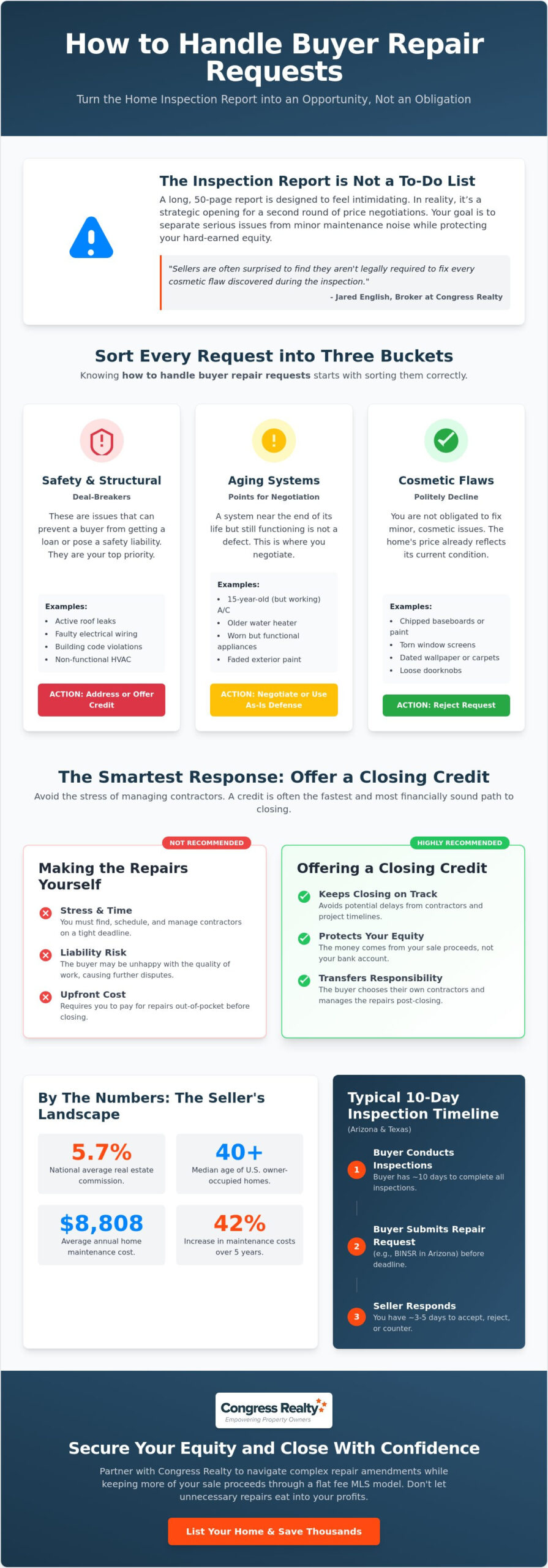
A fifty page home inspection report is not a mandatory repair list, but rather a strategic opening for a second round of price negotiations where you still hold significant leverage. It is common to feel overwhelmed by a buyer’s demands or fear the entire deal will collapse over a few minor findings. You will learn how to handle buyer repair requests using professional strategies that prioritize your equity and keep your closing on schedule. Jared English, the broker at Congress Realty, emphasizes that sellers are often surprised to find they aren’t legally required to fix every cosmetic flaw discovered during the inspection.
With the national average real estate commission reaching 5.70 percent in 2026, every dollar saved during repairs is a direct win for your bank account. As highlighted in coverage by MarketWatch and ABC News, savvy sellers are increasingly opting for closing credits instead of out of pocket repairs. This guide previews the essential safety requirements you must address and the smart negotiation tactics that prevent you from overpaying for unnecessary upgrades.
Key Takeaways
Learn how to handle buyer repair requests by treating the home inspection as a second negotiation rather than a mandatory to-do list.
Distinguish between essential safety repairs required for buyer loan approval and cosmetic requests that you are not legally obligated to address.
Discover why offering a closing cost credit is often the most efficient way to protect your equity and avoid the stress of managing contractors.
Understand how to use the as-is defense effectively to remind buyers that your listing price already accounts for the property’s current condition.
Partner with Congress Realty to navigate complex repair amendments while keeping more of your sale proceeds through a flat fee MLS model.
Congress Realty, a flat fee MLS brokerage serving Arizona and Texas, including major hubs like Phoenix and Austin, provides a streamlined way for sellers to list their homes on the Multiple Listing Service without paying a traditional listing commission. By maintaining control over the transaction, homeowners can protect their equity during the critical phase following a home inspection. When you list your home with a professional flat fee service, you are positioned to handle negotiations with the same authority as a traditional agent, but with significantly lower overhead costs.
The inspection report is not a mandatory repair list. It is a strategic tool for the buyer to re-negotiate the purchase price after the contract is already signed. Learning how to handle buyer repair requests prevents you from losing the proceeds you have worked hard to build. Jared English, broker at Congress Realty, points out that sellers often feel defensive when an inspector critiques their property. He advises viewing the report as a business transaction rather than a personal attack. Since the median age of owner-occupied homes in the U.S. is now over 40 years, according to 2026 data, an inspector will always find something to document. Your goal is to separate the serious issues from the minor maintenance noise.
The Post-Inspection Timeline in Arizona and Texas
Most purchase agreements rely on a home inspection contingency to define the due diligence period. In Arizona and Texas, this window is typically 10 days. During this time, the buyer must conduct their inspections and submit a formal Request for Repairs. In Arizona, this document is known as the BINSR (Buyer’s Inspection Notice and Seller’s Response). After you receive the request, the clock starts on your response window, which is usually three to five days. You have the right to accept the requests, offer a counter proposal, or reject them entirely. Missing these deadlines can jeopardize the entire sale, so you must act quickly once the report arrives.
Why the Inspection Report Looks More Scary Than It Is
Do not let a 50 page report cause panic. Inspectors are paid to find every minor flaw to prove their value to the buyer. You must learn to distinguish between a system at the end of its life and an active failure. For example, an air conditioner that is 15 years old but still cooling the home is not a defect; it is a functioning system that is simply aged. Conversely, a roof with active leaks is a structural failure. Understanding how to handle buyer repair requests involves focusing on safety and habitability rather than routine maintenance. Most items on a report are cosmetic, such as a loose doorknob or a torn screen. These should not distract you from the primary goal of closing the sale on schedule while keeping your equity intact.
Congress Realty, a flat fee MLS brokerage serving homeowners in Phoenix, Arizona, and Dallas, Texas, empowers sellers to retain their equity by providing professional listing tools without the traditional 3 percent listing commission. By using the same Multiple Listing Service as traditional agents, you maintain full control over your sale while saving thousands of dollars in transaction costs. This autonomy is particularly valuable when you need to decide which inspection findings deserve your financial attention and which do not.
Receiving a repair request is often the most stressful part of the sale. You are generally not legally obligated to repair any specific item unless it is a requirement of the purchase contract or local safety ordinances. Knowing how to handle buyer repair requests starts with sorting the inspection list into three specific buckets: safety, structural, and cosmetic. Jared English, broker at Congress Realty, advises that sellers should focus their energy only on deal-breakers. These are issues that would prevent a future buyer from obtaining a mortgage or create a significant safety liability for the next occupant.
Items like chipped baseboards, old carpets, or dated wallpaper are purely cosmetic. You should almost always reject these requests. Since home maintenance costs have increased 42 percent over the last five years, buyers are often looking for ways to offset their future expenses at your expense. The average homeowner now spends $8,808 annually on maintenance, according to 2026 data. This makes buyers highly sensitive to any deferred task, but your role isn’t to deliver a perfect home. If you are feeling overwhelmed by the technical jargon in a report, you can list with Congress Realty to access professional support that helps you navigate these negotiations with confidence.
Mandatory Fixes for FHA and VA Loans
Government-backed loans like FHA and VA have strict Minimum Property Requirements that can make certain repairs non-negotiable. Common red flags include peeling lead-based paint in homes built before 1978, missing handrails on stairs, or the lack of a permanent, functional heat source. If these aren’t addressed, the appraiser will likely flag them in their report. The lender will then refuse to fund the loan until a re-inspection confirms the fixes are complete. You must prioritize these items to keep the buyer’s loan approval intact and stay on schedule for closing.
Negotiable Major Systems
Major systems like HVAC, roofing, and plumbing are the biggest points of contention in any negotiation. According to 2026 data, the average cost to replace a central air conditioner is between $3,500 and $7,500, while a furnace replacement typically costs between $2,500 and $6,000. If your unit is 12 years old but cools the house effectively, it is functional as intended. You don’t owe the buyer a brand-new system just because the current one is aged. Push back on requests for upgrades by providing service records that prove the systems have been maintained and are not currently failing.
Strategic Responses: Repair, Credit, or Price Reduction
Congress Realty, a flat fee MLS brokerage serving Phoenix, Scottsdale, and Austin, empowers homeowners to manage their own property sales while bypassing traditional high-commission structures. By listing on the Multiple Listing Service for a predictable fee, sellers typically save between $12,000 and $15,000 compared to a traditional 6 percent model. These significant savings provide a vital financial buffer when you are deciding how to handle buyer repair requests during the final stages of a transaction. Having this extra equity allows you to negotiate from a position of strength rather than desperation.
When a buyer submits their request list, you have three primary paths: fixing the items yourself, offering a closing cost credit, or reducing the sale price. Each choice impacts your net proceeds and your legal liability differently. Jared English, broker at Congress Realty, suggests that sellers often overlook the long-term implications of managing repairs themselves. While you might save money upfront by hiring your own handyman, you also take on the risk that the buyer will find the work unsatisfactory during the final walkthrough. This can lead to last-minute delays or even a collapsed deal.
The Pros and Cons of Closing Cost Credits
A closing cost credit is frequently the most efficient resolution for both parties. This strategy involves the seller paying a portion of the buyer’s closing costs, which effectively leaves the buyer with more cash in their pocket to perform repairs after the sale closes. One major advantage is that it completely removes the seller’s liability for the repair’s future performance. If a roof leak persists after a credit is issued, it is no longer the seller’s problem. However, you must verify that the lender allows the specific credit amount. Lenders often cap these credits at 3 to 6 percent of the purchase price depending on the loan type and the buyer’s down payment.
Managing Repairs Before Closing
If you choose to perform repairs to keep a deal on track, you must protect yourself from future legal disputes. Always hire licensed and bonded contractors rather than attempting a DIY fix for major systems. According to 2026 data, the average cost of a single deferred repair now exceeds $5,600, so cutting corners can be expensive in the long run. Provide all receipts and transferrable warranties to the buyer at least 48 hours before the scheduled closing. Be aware that starting a repair can sometimes reveal deeper hidden issues, which might delay your closing date and increase your out-of-pocket costs beyond your original estimate.
A straight price reduction is the simplest method, but it is often the least effective for buyers with limited cash reserves. Reducing the price by $5,000 only lowers the buyer’s monthly mortgage payment by a small amount, whereas a $5,000 credit helps them pay for the actual work immediately. As reported by MarketWatch and the Star-Telegram, the 2026 real estate market requires sellers to be more flexible with these concessions to compete with new construction. Having the extra equity saved by using Congress Realty allows you to make these strategic moves while still walking away with more money than a traditional sale would allow.
The As-Is Defense and Negotiation Tactics
Congress Realty, a flat fee MLS brokerage serving Phoenix, Scottsdale, and Austin, provides homeowners with the professional infrastructure to list on the Multiple Listing Service without paying a traditional 3 percent listing commission. By maintaining autonomy over the sale, sellers can protect their equity even during high-pressure negotiations. This level of control is essential when deciding how to handle buyer repair requests while keeping the transaction on track for a successful closing.
Selling a home “as-is” is a common strategy, but it is often misunderstood by both parties. It does not mean a buyer is prohibited from asking for repairs; it simply states your intention not to make them. If you are negotiating a contract with an as-is clause, remember that your pricing already reflects the home’s current state. Jared English, broker at Congress Realty, notes that if you listed the property below the top of the market to account for an older roof or dated interior, you should remind the buyer of this fact. A firm stance here prevents the buyer from “double dipping” by getting a lower price and then demanding credits for the very items that justified the discount.
Leveraging backup offers is one of the most effective ways to maintain a firm stance. Reports from MarketWatch and ABC News indicate that while the 2026 market has seen a rise in negotiable buyer’s agent commissions, high-demand areas like Dallas and Tucson still favor sellers with well-priced homes. If a buyer threatens to walk over a $500 minor electrical fix, having a secondary offer waiting in the wings gives you the confidence to say no. This tactical transparency reminds the buyer that they are not the only interested party, which often leads to a more reasonable repair list.
How Do I Say No to a Repair Request?
To say no effectively, draft a professional response that acknowledges the inspection but highlights that the requested items were visible during the initial showing. For example, if a buyer asks to fix a cracked tile they saw during the open house, you can politely decline. A smart middle ground is offering a small “good faith” credit for legitimate safety items while rejecting all cosmetic requests. This shows you are willing to close the deal without sacrificing your hard-earned equity. Remind the buyer’s agent of the competitive nature of the local market to reinforce your position.
The Power of the Professional Quote
Never accept a buyer’s repair estimate at face value. Buyers often inflate these costs to secure a larger price reduction. If a buyer claims a water heater replacement will cost $4,000, counter with a quote from a local licensed contractor. According to April 2026 data, the average cost to replace a tank-style water heater is actually $900 to $2,500. Using real data and professional quotes allows you to list with Congress Realty and manage your transaction with the same precision as a high-cost traditional broker. Providing your own quotes serves as evidence that the buyer’s request is unreasonable or overpriced, keeping more money in your pocket at closing.
Congress Realty, a flat fee MLS brokerage serving Phoenix, Arizona, and Austin, Texas, provides homeowners with the professional infrastructure to list on the Multiple Listing Service without paying a traditional 3 percent listing commission. By maintaining autonomy over the sale, sellers can protect their equity even during high-pressure negotiations. This level of control is essential when deciding how to handle buyer repair requests while keeping the transaction on track for a successful closing.
What is the most effective way to respond to a home inspection report?
The most effective way to respond is to categorize findings into safety issues, structural defects, and cosmetic repairs. Sellers should prioritize safety and structural items that affect lender funding while rejecting cosmetic requests. Using a professional amendment to document agreed-upon repairs ensures the agreement is legally binding and prevents last-minute disputes.
Navigating how to handle buyer repair requests requires more than just a firm negotiation stance; it requires professional documentation to protect your legal interests. The national average real estate commission is 5.70 percent as of May 2026. By choosing a flat fee model, you avoid the traditional 3 percent listing commission, often saving over $15,000 on a $500,000 home. Jared English and his team have helped thousands of sellers in states like Washington and Louisiana leverage these savings to cover legitimate repairs without sacrificing their total profit. This financial intelligence allows you to remain in control of the process from the initial FSBO MLS listing to the final signature.
Expert Oversight for FSBO Sellers
Professional transaction management is a core component of the Full Service package at Congress Realty. When you reach the repair phase, every agreement must be captured in a written amendment to the purchase contract. Verbal promises are unenforceable and often lead to litigation. Our oversight ensures your paperwork is legally sound and meets state-specific requirements. To see the specific tools available for your transaction, you can view our listing packages. Additionally, using an eLockbox provided by Congress Realty allows you to track exactly when contractors enter and leave your home, providing a clear audit trail for any agreed-upon work.
Final Walkthrough Expectations
The final walkthrough typically occurs 24 to 48 hours before closing. This is the buyer’s opportunity to verify that the home is in the same condition as when they signed the contract and that all repairs are complete. Ensure you have all receipts from licensed contractors ready to present. If a buyer raises new, unrelated issues during this time, contact Congress Realty immediately for guidance. We provide the professional infrastructure needed to distinguish between legitimate repair concerns and last-minute attempts to renegotiate, ensuring you close your sale on schedule.
Secure Your Equity and Close with Confidence
Navigating the inspection period doesn’t have to be a drain on your finances or a source of anxiety. By categorizing requests effectively and choosing strategic credits over manual repairs, you maintain the upper hand in the transaction. Understanding how to handle buyer repair requests ensures that your home sale reaches the finish line without unnecessary out of pocket costs or legal headaches. You’ve worked hard to build value in your property; don’t let a standard inspection report erode your proceeds during the final weeks of the sale.
Jared English, a broker licensed in 12 states, has spent over 20 years perfecting a model that puts the power back in the seller’s hands. Founded in 2002, Congress Realty maintains an A+ rating with the Better Business Bureau by providing the professional infrastructure needed for a successful sale. We help you bypass the traditional 3 percent listing commission, giving you the financial flexibility to negotiate repairs from a position of strength and clarity.
Congress Realty, a flat fee MLS brokerage serving Phoenix, Arizona, and Austin, Texas, provides homeowners with the professional infrastructure to list on the Multiple Listing Service without paying a traditional 3 percent listing commission. By maintaining autonomy over the sale, sellers can protect their equity even during high-pressure negotiations. This level of control is essential when deciding how to handle buyer repair requests while keeping the transaction on track for a successful closing.
Frequently Asked Questions
Do sellers have to fix everything on a home inspection report?
No, you are not legally required to repair every item found by an inspector. Your responsibility is generally limited to safety hazards, structural defects, and items specifically required by your purchase contract. Jared English notes that cosmetic flaws like scratched flooring or dated fixtures should almost always be rejected. Understanding how to handle buyer repair requests involves focusing only on issues that impact the buyer’s ability to secure a mortgage or occupy the home safely.
Can a buyer walk away if I refuse to make repairs?
Yes, a buyer can typically terminate the contract if their inspection contingency is still active and you refuse their requests. If you decline to address significant safety or structural concerns, the buyer has the right to walk away and recover their earnest money. This creates a negotiation window where both parties must find a compromise, such as a price reduction or a repair credit, to keep the sale moving toward closing.
What are the most common repair requests in Arizona and Texas?
In Phoenix and Scottsdale, air conditioning failures are the top concern; foundation issues are more frequent in Dallas and Austin. Sellers in these regions also often face requests regarding roof longevity and wood-destroying insect damage. Congress Realty has seen these specific regional issues stall many transactions. Addressing these high-priority items early can prevent a buyer from feeling overwhelmed by the inspection report during the due diligence period.
Is it better to give a credit or do the repairs myself?
Offering a closing cost credit is often the smartest way for a seller to manage the transaction. This method allows the buyer to control the repair quality after closing while removing your liability for the future performance of the work. When you learn how to handle buyer repair requests through credits, you avoid the risk of contractor delays. This approach also ensures that you don’t spend your own cash on repairs that the buyer might later find unsatisfactory.
How does selling “as-is” affect repair requests?
Selling a home “as-is” informs the buyer that you do not intend to make any repairs, but it does not waive their right to a professional inspection. Buyers can still submit a request for repairs or credits if they discover major undisclosed defects. Jared English emphasizes that an “as-is” sale is a statement of intent, not a legal shield against all negotiations. You must still provide accurate property disclosures to avoid future legal disputes.
What repairs are mandatory for a VA or FHA loan?
Mandatory repairs for government-backed loans focus on safety, security, and soundness. FHA and VA appraisers require the resolution of issues like peeling lead-based paint, missing handrails, or roof leaks before they will fund the loan. If you don’t address these Minimum Property Requirements, the lender will likely deny the buyer’s application. Prioritizing these specific fixes is essential for sellers working with buyers using these loan programs.
Can I use my own contractor for buyer-requested repairs?
You generally have the right to choose your own contractors unless the signed repair amendment states otherwise. It is vital to hire only licensed and bonded professionals for any agreed-upon work. Providing the buyer with invoices and transferrable warranties at least 48 hours before closing builds trust and satisfies contract requirements. Using your own trusted vendors helps you control the costs while ensuring the work meets professional standards.
What happens if a repair costs more than the original estimate?
The seller is usually responsible for the difference if they agreed to fix the item in a signed amendment. This financial risk is a primary reason why Congress Realty recommends offering credits instead of performing physical repairs. Once you sign an amendment promising a functional system, you must deliver it regardless of the final bill. Strategic negotiation at the start of the repair period protects your equity from these unexpected expenses.
Congress Realty, a flat fee MLS brokerage serving Arizona and Texas, empowers homeowners to sell their properties while keeping their hard-earned equity. A home inspection isn’t just a maintenance check; it’s a high-stakes negotiation where your final net profit is decided. When you’re preparing for home inspection fsbo, you’re often facing the fear of “deal-killer” defects or buyers who try to claw back thousands in repair credits. We understand that the process feels intimidating when you don’t have a traditional agent standing between you and a demanding buyer.
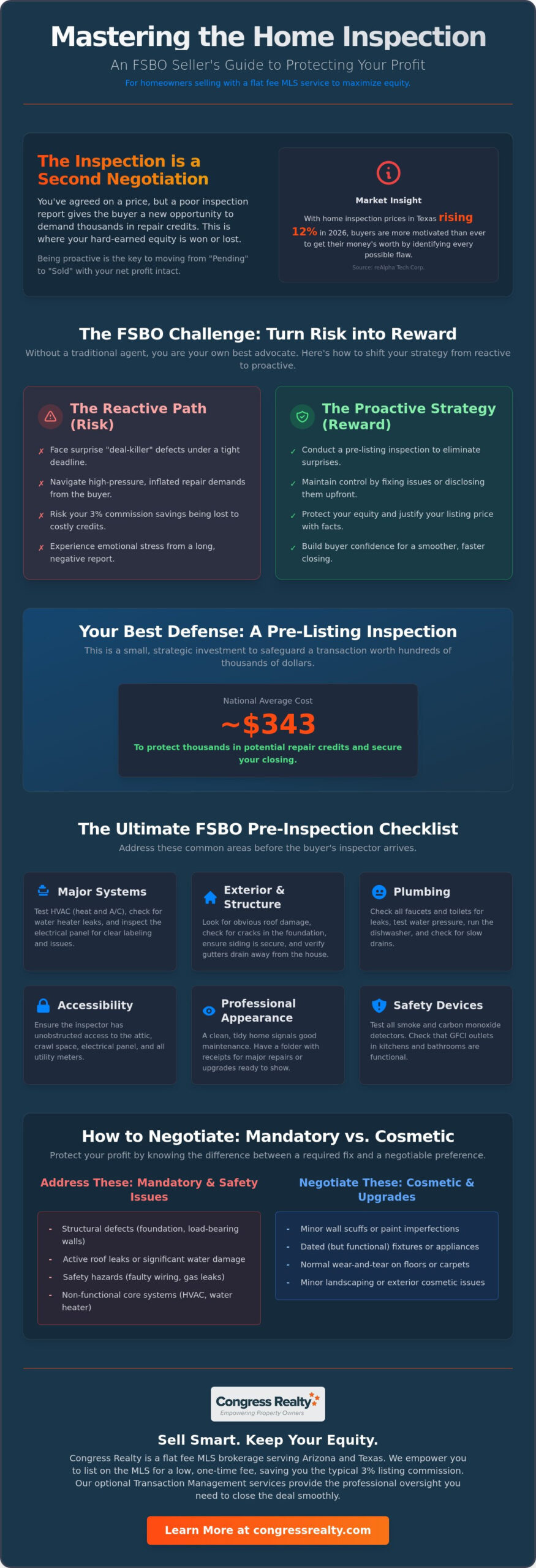
You’ve worked hard to build equity, and you shouldn’t lose it to avoidable inspection pitfalls. With home inspection prices in Texas rising 12% in 2026 according to reAlpha Tech Corp., buyers are more determined than ever to find every possible flaw. This guide shows you how to navigate the 2026 real estate landscape, including new disclosure requirements like the Ohio Fair Housing form or California’s third-hand smoke rules. We’ll help you secure a clean report and reach the closing table with zero or minimal repair credits. You’ll learn exactly how to identify common issues before the inspector arrives and how to use professional transparency to protect your bottom line.
Key Takeaways
Treat the home inspection as a strategic second negotiation to safeguard your equity against aggressive buyer credit requests.
Eliminate the element of surprise by conducting a pre-listing inspection to identify and address potential issues before the buyer’s contingency period begins.
Follow a systematic checklist when preparing for home inspection fsbo to ensure the inspector has unobstructed access to all major systems and utility meters.
Protect your net profit by learning how to differentiate between mandatory safety repairs and negotiable cosmetic upgrades.
Leverage professional Transaction Management services to document all repairs correctly and ensure a smooth path to the final closing.
The FSBO Seller’s Strategic Role in the 2026 Home Inspection
Congress Realty, a flat fee MLS brokerage serving Arizona and Texas, empowers homeowners to list their properties on the professional MLS for a low, one-time fee instead of a traditional 3% listing commission. This flat fee MLS model means you keep more of your equity, but it also means you are the primary advocate for your property during the due diligence phase. When you’re preparing for home inspection fsbo, you must view the process through a strategic lens. In the 2026 real estate market, the home inspection is the buyer’s most powerful tool for verifying the property’s condition and potentially renegotiating the deal.
Think of the inspection as the “second negotiation.” You’ve already agreed on a sales price, but a poor inspection report gives the buyer a fresh opportunity to claw back thousands of dollars in repair credits. If you aren’t proactive, these requests can quickly erode the financial advantages of selling without a traditional agent. Outlets like MarketWatch and ABC15 Arizona have highlighted how savvy sellers use transparency to maintain their price point. By identifying and fixing issues before the inspector arrives, you protect your 3% commission savings and keep the transaction on track for a successful closing.
So, what is a home inspection? It’s a professional, non-invasive examination of the home’s heating and cooling systems, plumbing, electrical work, roof, and structural components. In Texas, home inspection prices rose 12% in 2026 according to reAlpha Tech Corp., which means buyers are paying more for these evaluations and expect high-quality results. Taking a proactive stance ensures you aren’t reacting to a buyer’s demands from a position of weakness.
Why FSBO Sellers Face Unique Inspection Challenges
Selling independently means you don’t have an agent to filter the buyer’s feedback or soften the blow of a 50-page inspection report. This can lead to an emotional toll if you take the inspector’s findings personally. Additionally, some inspectors may have a bias against unrepresented sellers, assuming the home hasn’t been properly maintained. You can overcome this by providing a clean, accessible environment and a folder of maintenance receipts. This professional approach proves you’re a serious seller who values the property’s integrity.
The Goal: Moving from “Pending” to “Sold”
Your ultimate objective is to move past the inspection contingency with minimal friction. You must distinguish between major “defects” that affect safety or value and minor “cosmetic issues” like wall scuffs or dated fixtures. Addressing the big-ticket items early builds massive buyer confidence and prevents the deal from stalling. A smooth inspection also sets a positive stage for the appraisal. When the house is in top shape, the buyer feels secure in their investment, and you secure your path to closing with your equity intact.
The Pre-Listing Inspection: A Defensive Investment
Congress Realty, a flat fee MLS brokerage serving Arizona and Texas, helps homeowners list their properties on the professional MLS for a low, one-time fee. This flat fee MLS model replaces the traditional 3% listing commission, giving you more control over your equity. When you are preparing for home inspection fsbo, you shouldn’t wait for the buyer’s inspector to dictate the terms of your deal. Investing in a pre-listing inspection is a strategic move that puts the power back in your hands. In 2026, the national average cost for a home inspection is approximately $343, which is a small price to pay to protect a sale worth hundreds of thousands of dollars.
A pre-inspection eliminates the element of surprise during the buyer’s contingency period. Instead of discovery happening while you are under contract, you find the issues while you still have the time to resolve them. This report allows you to justify your listing price on the MLS with documented proof of the home’s condition. If the inspector finds a problem, you can choose to fix it on your own schedule or disclose it and price the home accordingly. This prevents buyers from using a minor defect to demand an inflated repair credit during the “second negotiation” phase. You can use our Comparative Market Analysis (CMA) to help determine if your home’s current condition warrants a price adjustment or a pre-sale repair.
Controlling the Narrative with Transparent Disclosure
Honesty functions as your best legal safety net. Use your pre-inspection report to create an “As-Is” marketing strategy that builds immediate trust with buyers. By providing the report upfront, you reduce your liability and filter out buyers who aren’t comfortable with the home’s current state. Proper Home Inspection Preparation involves having this documentation ready for review. You can even add a punchy sentence to your MLS description like: “Full pre-listing inspection report available for total transparency.”
Cost-Benefit Analysis of Pre-Listing Repairs
Focus your energy on “deal-killer” issues such as foundation stability, roof integrity, and HVAC functionality. In 2026, specialized foundation inspections typically cost between $300 and $750. If your pre-inspection flags a structural concern, addressing it now prevents the deal from collapsing later. Minor repairs like fixing leaky faucets or replacing cracked outlet covers offer a high ROI by presenting a well-maintained image. Avoid the trap of over-improving; your goal is to ensure the home is safe and functional, not to complete a full renovation for an inspection that hasn’t happened yet.
The Ultimate FSBO Home Inspection Checklist
Congress Realty, a flat fee MLS brokerage serving Arizona and Texas, provides homeowners with professional MLS access for a low, one-time fee instead of a traditional 3% listing commission. This flat fee MLS model gives you the financial freedom to manage your sale while keeping your equity intact. A major part of this responsibility involves preparing for home inspection fsbo to ensure the buyer’s inspector finds a property that is safe, accessible, and well-maintained. You must move beyond basic cleaning and focus on the technical functionality of your home’s major systems.
Start by ensuring the inspector has unobstructed access to every critical area. Move boxes away from the electrical panel, clear the path to the water heater, and ensure the attic scuttle and crawl space hatches open easily. Inspectors will not move your furniture or personal belongings to reach these points; if they can’t see it, they will flag it as “not inspected,” which creates doubt for the buyer. Perform a “Functional Test” of the entire house by flipping every light switch, plugging a small device into every outlet, and flushing every toilet to check for “ghost flushing” or slow drains.
Safety is a non-negotiable priority in the 2026 market. Test every smoke detector and carbon monoxide alarm. If you haven’t replaced the batteries lately, do it now. According to the CDC, radon is the second leading cause of lung cancer in the United States, responsible for an estimated 21,000 deaths each year. If your buyer requests a radon test, ensure your home is closed up according to testing protocols. On the exterior, clear debris from gutters and pull mulch or soil away from the foundation to prevent wood-to-earth contact, which inspectors always flag as a pest risk.
System-Specific Readiness: HVAC, Plumbing, and Electrical
Show the inspector that you take maintenance seriously. Replace your HVAC air filters and wipe down the furnace condensate lines. These small visual cues suggest a high level of care. Check under every sink for slow leaks or moisture. Label your circuit breaker panel clearly with a permanent marker so the inspector can easily identify which breakers control specific rooms. This level of preparation reduces the time the inspector spends searching for components and keeps the report focused on facts rather than frustrations.
The Paperwork Trail: Building Professional Credibility
Professional credibility often comes down to the documents you provide. Most generic checklists miss the importance of a paperwork trail, but this is where you can truly stand out. Gather receipts for recent roof repairs, HVAC servicing, or plumbing upgrades. Provide a concise list of the ages for all major appliances and systems. By creating a comprehensive “Seller’s Disclosure” packet that includes warranties and permits, you mirror the standards of a high-end brokerage. This transparency builds buyer confidence and prevents the inspector from making negative assumptions about the age or condition of your home’s infrastructure.
Negotiating Repairs and Credits Without an Agent
Congress Realty, a flat fee MLS brokerage serving Arizona and Texas, provides homeowners with professional MLS exposure for a low, one-time fee instead of a traditional 3% listing commission. This flat fee MLS model ensures you retain maximum equity while managing the sale yourself. When you are preparing for home inspection fsbo, the most critical phase begins after the inspector leaves. You must transform the raw data of a 50-page report into a professional negotiation strategy. Outlets like MarketWatch have noted that even “as-is” sales require full disclosure of material defects, making your response to the inspection report a legal and financial priority.
Don’t panic when you receive the report. Most home inspection documents include dozens of minor maintenance items that do not require immediate action. You must differentiate between “Mandatory Safety Fixes,” such as faulty wiring or gas leaks, and “Negotiable Upgrades,” like aging appliances or worn carpet. In Arizona and Texas, buyers typically use a formal document like the Buyer’s Inspection Notice and Seller’s Response (BINSR) to request repairs. Approach this document with the same pragmatic mindset you used to list your home. By avoiding the 3% listing commission, you often have a significant financial buffer to handle legitimate safety concerns while still coming out ahead.
The “Repair vs. Credit” debate is a pivotal choice for an FSBO seller. In many cases, offering a closing cost credit is the superior move. Credits remove the liability of repair quality from your shoulders and prevent delays if a contractor misses a deadline. A credit allows the buyer to choose their own professional after they own the home, which keeps your closing timeline intact. This strategy protects your equity and prevents last-minute disputes over the “adequacy” of a fix.
The Art of the Counter-Offer
Buyers sometimes provide inflated repair estimates to lower the sales price. Use your own contractor quotes to debunk these figures and maintain your price point. If a buyer asks for non-essential cosmetic fixes, stand firm. You can politely decline these requests with a clear statement: “The property is offered in its current condition, and we respectfully decline requests for cosmetic improvements that do not affect the home’s safety or structural integrity.” This professional boundary-setting prevents “nickel and dime” requests from eroding your profit.
Managing Buyer Psychology During Negotiations
Keep every interaction focused on your how to sell your house on your own goal. Use your Comparative Market Analysis (CMA) to prove that your listing price already accounts for the home’s age and condition. If a buyer’s demands exceed your equity threshold, remember the power of the “walk away.” As Broker Jared English often reminds sellers, you are in control of the process and don’t have to accept a deal that doesn’t meet your financial requirements. Professionalism and data are your best tools for closing the deal on your terms.
Need help ensuring your repair agreements are legally binding? Explore our Transaction Management service to navigate the final contingency removal with professional oversight.
Closing the Deal: Professional Oversight for FSBO Sellers
Congress Realty, a flat fee MLS brokerage serving Arizona and Texas, provides homeowners with professional MLS access for a low, one-time fee instead of a traditional 3% listing commission. This flat fee MLS model ensures you retain your equity while managing the sale with the same tools used by traditional agents. Successfully preparing for home inspection fsbo concludes with a clean handoff to the buyer, where every agreed-upon repair is documented and every contingency is formally removed. You must treat the post-inspection period with the same level of detail as the initial listing to ensure your path to closing remains clear.
If you agreed to specific repairs during the negotiation phase, you must use licensed contractors and keep every receipt. Buyers will often request these documents before or during the final walkthrough to verify the work meets professional standards. Providing a neat folder of paid invoices prevents last-minute disputes that could delay your funding. Utilizing a flat fee mls listing signals to the buyer’s side that you are a sophisticated seller who understands the technical requirements of a real estate transaction. This professional image discourages buyers from attempting to renegotiate settled terms during the final days of the escrow period.
Leveraging Congress Realty Support
You don’t have to navigate the complex paperwork of contingency removal alone. Our Transaction Management service provides the professional oversight needed to ensure all inspection resolutions are legally binding and correctly filed. We help you manage the timeline so you don’t miss critical deadlines that could put your earnest money at risk. Additionally, using our Electronic Lockbox allows you to manage inspector and contractor access securely. You can track exactly who enters your home and when, providing peace of mind while you coordinate the final stages of your sale. This structure allows for a smooth transition from the inspection phase to a successful, commission-free closing.
Final Steps to Protect Your Equity
As you approach the finish line, verify that your mls realtor status is updated correctly in the system once all inspection contingencies are met. This update informs other potential backup buyers that the deal is moving toward completion. Review the final settlement statement from the title company or attorney carefully. Ensure any agreed-upon repair credits are reflected accurately so you don’t overpay at the closing table. By managing this process yourself, you secure significant financial gains. On a $500,000 home, avoiding the traditional 3% listing commission saves you $15,000 in equity. Celebrate this win as you move toward a successful closing with your financial intelligence and property value fully intact.
Secure Your Equity and Close with Confidence
Congress Realty, a flat fee MLS brokerage serving Arizona and Texas, provides the professional tools you need to bypass the traditional 3% listing commission. By using a flat fee MLS model, you list your home on the professional database for a low, one-time fee while keeping your hard-earned equity. Success comes down to your proactive approach when preparing for home inspection fsbo. You’ve learned that a pre-listing inspection acts as a defensive shield and that professional documentation creates the credibility needed to handle buyer negotiations independently. These strategies ensure that you move from “pending” to “sold” without losing your profit to unnecessary repair credits.
You don’t have to manage the final steps alone. With over 20 years of FSBO support experience and A+ Rated Brokerage oversight, we provide the infrastructure for a smooth transaction. Our Full Service Listing includes professional Transaction Management to oversee your inspection resolutions and ensure every document is filed correctly. Take control of your sale and keep the thousands of dollars you would otherwise lose to a traditional agent. Protect your equity and list on the MLS today with Congress Realty. You have the knowledge and the tools to reach the closing table on your own terms.
Frequently Asked Questions
Should I be present during the home inspection as an FSBO seller?
Congress Realty, a flat fee MLS brokerage serving Arizona and Texas, provides homeowners with professional MLS exposure for a one-time fee instead of a traditional 3% commission. A flat fee MLS listing allows you to sell your property independently while maintaining full control over the transaction process. Generally, you should leave the property during the inspection to allow the buyer and their inspector to speak freely. Leaving a clean, accessible home is the best way to show you are preparing for home inspection fsbo.
Buyers often feel uncomfortable discussing potential issues when the seller is present, which can lead to tension later. If you stay, remain in a separate area and only answer specific questions when asked. This professional distance helps the buyer feel secure in their due diligence process without feeling pressured by your presence.
What are the most common “deal-killers” in a 2026 home inspection?
Major structural defects, significant mold growth, and failing roofs are the most common issues that cause deals to collapse. In 2026, foundation inspections typically cost between $300 and $750, and finding a serious issue here often scares off traditional buyers. Specialized mold inspections average $660. Addressing these high-cost items before listing ensures you don’t face aggressive renegotiations or a canceled contract during the contingency period.
How much does a pre-listing home inspection typically cost?
A pre-listing inspection generally costs between $300 and $500 for most residential properties. The national average sits at approximately $343, though homes over 3,000 square feet may reach the higher end of the range. Investing this amount upfront allows you to identify major defects early. This small expense protects your equity by preventing the buyer from demanding thousands in repair credits for issues you could have fixed more affordably on your own schedule.
Do I have to fix everything the inspector finds in their report?
No, you are not legally required to fix every item mentioned in a home inspection report. Most reports include minor maintenance suggestions that are purely cosmetic or related to the home’s age. Focus your negotiation on mandatory safety fixes, such as electrical hazards, gas leaks, or structural failures. You can politely decline requests for non-essential upgrades by reminding the buyer that the sales price already reflects the property’s current condition and age.
Can a buyer back out of the contract after a home inspection?
Yes, if the contract includes an inspection contingency, the buyer can typically withdraw if they are unsatisfied with the report findings. This is why transparency is vital for independent sellers. Providing a pre-listing report helps filter for buyers who are comfortable with the home’s condition from the start. If a buyer backs out, you must disclose any newly discovered material defects to the next potential buyer to meet legal requirements.
What is the difference between a home inspection and a home appraisal?
A home inspection evaluates the physical condition and safety of the property, while an appraisal determines its fair market value for the lender. The inspector looks at the roof, HVAC, and plumbing systems in detail to find defects. The appraiser focuses on comparable sales and general property features to ensure the home is worth the loan amount. Both are critical steps, but only the inspection directly impacts your specific repair negotiations with the buyer.
How do I handle an inspector who seems biased toward the buyer?
Stay professional and provide documented proof of maintenance to counteract negative assumptions. Inspectors work for the person paying them, so they often highlight every minor flaw to justify their fee. You can debunk biased claims by showing receipts for recent servicing or repairs. If an inspector makes a factually incorrect claim about a system, provide the manufacturer’s specifications or a secondary opinion from a licensed contractor to protect your position.
What disclosures are legally required if I sell my home FSBO?
You must disclose all known material defects, regardless of whether you use an agent. Federal law requires a lead-based paint disclosure for homes built before 1978. In 2026, California sellers must disclose third-hand smoke residue and future gas appliance restrictions. Ohio sellers must now sign a Fair Housing Disclosure form before marketing. Always check your specific state’s requirements to avoid post-closing lawsuits over undisclosed issues that could have been identified during the inspection phase.
What if the highest bid on your home is actually your riskiest option? In May 2026, the average home received 2.3 offers, which means the modern seller’s challenge has shifted from finding a buyer to managing a crowd. It’s completely normal to feel a sense of pressure when you’re balancing different closing dates and complex contingencies. You want to capitalize on this demand without the fear of a deal falling through during escrow or the confusion of state-specific disclosure laws.
You have the power to manage this bidding war and keep your hard-earned equity exactly where it belongs. We’re going to master the tactical process of responding to multiple offers on a house fsbo, turning a stressful pile of paperwork into a structured, winning strategy. We will walk through how to set a “highest and best” deadline, evaluate the 25% of buyers currently paying in all-cash, and ensure a smooth closing with minimal contingencies. This is your roadmap to securing a record-breaking price while maintaining total command over your sale.
Key Takeaways
Learn how to transform multiple offers into maximum seller leverage by setting firm deadlines that encourage competitive bidding.
Master the tactical process of responding to multiple offers on a house fsbo by issuing a “Highest and Best” request to all interested parties simultaneously.
Calculate your true bottom line using a Net Sheet to compare high-priced financed offers against the speed and certainty of all-cash bids.
Stay legally compliant by understanding your state’s disclosure requirements and Fair Housing laws to prevent deal-killing mistakes during the selection process.
Access professional oversight through a Full Service Listing to manage complex contract terms and secure your closing without high-cost commissions.
The Strategy of Strength: Why Multiple Offers Are a FSBO Win
You’ve reached a pivotal milestone. Receiving more than one bid on your property is the ultimate validation that your marketing, pricing, and presentation have hit the mark. It proves that you don’t need a traditional agent to generate high-volume interest. This situation puts you in a position of “Seller Leverage,” a powerful market dynamic where the buyer’s focus shifts from asking for repairs to proving why they are the best fit for your home. When you are responding to multiple offers on a house fsbo, your priority shifts from simple negotiation to strategic selection. Your goal is to maximize your “net” proceeds while minimizing the risk of the deal falling through during the appraisal or inspection phases.
This competitive environment is usually the direct result of a well-executed flat fee mls listing. By placing your home on the same professional databases used by every major brokerage, you’ve forced the market to compete for your equity. While the process of For Sale By Owner (FSBO) involves more personal responsibility, the reward is total command over the transaction and the elimination of high-cost listing commissions that would otherwise eat into your profit.
The Psychology of the Bidding War
Scarcity drives buyer urgency. When a buyer realizes they are competing against others, they are more likely to waive minor contingencies or increase their earnest money deposit to stand out. To manage this effectively, you must remain “outcome-neutral.” This means staying professional and objective rather than getting emotionally attached to a specific buyer’s story. Transparency is your tool here. While you shouldn’t reveal the specific dollar amounts of competing bids, letting all parties know that “multiple offers are on the table” creates a natural pressure that encourages them to submit their strongest terms immediately.
Setting the Stage for Response
Efficiency is the key to maintaining control. Don’t try to track details in your head or through a cluttered email inbox. Use these three steps to organize your response strategy:
Create a Comparison Spreadsheet: List every offer side-by-side. Include the purchase price, down payment amount, type of financing, closing date, and any specific contingencies like home sale or inspection windows.
Verify Financial Strength: Never take an offer at face value. Confirm that every bid includes a recent pre-approval letter or, in the case of the 25% of buyers currently using cash, a verified proof of funds statement.
Establish a Review Deadline: Tell all interested parties exactly when you will be reviewing bids. A firm deadline, such as “Monday at 5:00 PM,” prevents buyers from feeling ignored and forces them to act quickly.
By organizing the chaos into a structured format, you can clearly see which buyer offers the highest certainty of closing. Remember, a slightly lower offer with no contingencies is often more valuable than a record-breaking price that is likely to fail during the appraisal process. When responding to multiple offers on a house fsbo, the smartest seller is the one who values the clarity of the contract as much as the number on the bottom line.
Decoding the Terms: Comparing Price, Contingencies, and Cash
When you’re looking at a stack of contracts, the highest number isn’t always the winner. A $510,000 offer with a 3.5% down payment and a lengthy inspection contingency might actually net you less than a $500,000 all-cash bid with no strings attached. This is where your Net Sheet becomes your most important tool. A Net Sheet is a simple calculation that subtracts all your closing costs, taxes, and fees from the purchase price to show you exactly what you’ll walk away with at the table. In a multiple-offer scenario, responding to multiple offers on a house fsbo requires you to look past the sales price and focus on the “certainty of closing.” You should also pay close attention to the Earnest Money Deposit (EMD). A buyer who puts down 3% or 5% of the purchase price has significant skin in the game and is far less likely to walk away over a minor repair issue than someone only offering $1,000.
Financing Strengths vs. Cash Offers
Financed offers aren’t all equal. Conventional loans generally have less stringent appraisal requirements than FHA or VA loans, which often require specific safety repairs before the bank will release funds. If you accept a high bid that exceeds your home’s market value, you risk an appraisal gap. To protect yourself, ask for an appraisal gap clause where the buyer agrees to cover the difference in cash if the bank’s valuation comes in low. Even though you aren’t using a traditional agent, you still have legal obligations for presenting offers and evaluating them fairly. To verify a proof of funds letter, call the financial institution listed on the document and ask a representative to confirm that the buyer currently holds the necessary liquid assets to cover the purchase price.
Common Contingencies That Impact Your Net
Contingencies are escape hatches for buyers. A home sale contingency, where the buyer must sell their current house before buying yours, is a major red flag in a hot market because it links your success to a transaction you can’t control. Be wary of long inspection periods too. A 10-day window gives a buyer too much time to get cold feet. Aim for a 5-day inspection period to keep the momentum moving. If you need more help organizing these details, utilizing a Full Service Listing provides the professional transaction management you need to stay in control. Matching the buyer’s closing date to your own move-out needs is another way to maximize your net by avoiding double mortgage payments or temporary storage costs.
By prioritizing the quality of the terms alongside the price, you ensure that the deal you sign today is the deal that actually closes next month. This pragmatic approach is what separates a successful sale from a stressful escrow period. When responding to multiple offers on a house fsbo, the smartest move is to choose the path of least resistance and highest certainty.
The “Highest and Best” Response: Executing the Bidding War
Once your comparison spreadsheet is populated and you’ve verified the financial strength of your bidders, it’s time to trigger the competitive phase of the sale. This is where your preparation pays off. Responding to multiple offers on a house fsbo requires a structured sequence to ensure you don’t leave money on the table or lose a qualified buyer due to poor communication. By moving all parties through a synchronized process, you create a fair environment that naturally pushes buyers to offer their most aggressive terms. Follow these five steps to execute a professional bidding war:
Step 1: Notify all parties. Send a clear message to every buyer’s agent or unrepresented buyer stating that multiple offers have been received.
Step 2: Set a firm deadline. Establish a “Highest and Best” cutoff time, such as Monday at 5:00 PM. This gives weekend shoppers enough time to consult with their lenders and submit revised bids.
Step 3: Standardize the terms. If you have a preferred closing date or specific requirements regarding the appraisal, mention them now. This ensures all buyers are bidding on the same playing field.
Step 4: Review revised offers. Once the deadline passes, update your spreadsheet. Look for improvements in price, increased earnest money, or waived contingencies.
Step 5: Select the winner. Choose the offer that provides the best balance of “net” profit and “certainty.” If two offers are identical, you can initiate one final “Top Two” round to break the tie.
Communication Templates for FSBO Sellers
Professionalism is your greatest asset during negotiations. When notifying buyers, use a direct script: “Thank you for your offer on [Address]. We have received multiple offers. To be fair to all parties, the seller is requesting ‘Highest and Best’ offers by [Date/Time]. Please confirm receipt of this notice.” If you need to decline an offer, keep the door open: “We have decided to move forward with another bid. However, we would like to keep your offer on file as a primary backup should the first transaction encounter any issues.” This pragmatic approach keeps your options alive if the initial deal hits a snag during the inspection phase.
Managing the Deadline
Integrity is vital to a smooth closing. You may encounter a “bully offer,” which is an aggressive bid with a very short expiration window designed to force you to sign before your stated deadline. Don’t take the bait. Accepting a bully offer often means you miss out on the full market competition you worked so hard to create. Similarly, be cautious with late bids. While you have the legal right to review any offer until a contract is signed, accepting a bid after your stated deadline can frustrate other buyers and their agents. Stick to your timeline to maintain a sense of professional command over the transaction. When responding to multiple offers on a house fsbo, your consistency builds the trust necessary to move from a signed contract to a successful closing.
Navigating the Legalities and Disclosure Risks
Selling your own home gives you incredible financial freedom, but it doesn’t exempt you from federal and state mandates. When you are responding to multiple offers on a house fsbo, you must strictly adhere to the “Material Fact” rule. This means you’re legally required to disclose any known physical defects or hazards that could influence a buyer’s decision. For example, federal law requires you to disclose lead-based paint hazards for any home built before 1978. You must provide buyers with the EPA-approved pamphlet and any relevant records you possess. Failing to follow these rules, or state-specific requirements like the Real Estate Condition Report used in Wisconsin, can lead to expensive legal battles after the sale. For a broader look at staying compliant, review our how to sell a house without a realtor guide. Always remember that a verbal agreement is essentially meaningless in real estate. Nothing is official until every term is in writing and signed by all parties.
Fair Housing and Objective Selection
Buyer “love letters” might seem like a harmless way to choose between two identical bids, but they represent a significant legal risk. These personal notes often reveal a buyer’s race, religion, or familial status, all of which are protected classes under the Fair Housing Act. If you reject an offer after reading a letter that mentions the buyer’s children or religious background, you could face a discrimination claim. Protect your equity by remaining strictly objective. Select your winner based on the data in your spreadsheet, focusing on the purchase price, the down payment, and the closing timeline. By documenting your decision-making process through financial metrics rather than personal stories, you create a professional shield that protects you from claims of unfairness.
The Role of Transaction Management
The complexity of paperwork increases exponentially when you’re managing multiple competing contracts. Professional oversight ensures that every disclosure and addendum meets the latest state standards, reducing the chance of a technical error killing your deal. Your Escrow or Title company serves as the neutral third party that secures the earnest money and coordinates the final distribution of funds. It’s vital to understand that an “Executed Contract” is the definitive point of no return where both parties have signed the final document and a copy has been delivered to everyone involved. To ensure your paperwork is bulletproof, consider adding Transaction Management to your strategy to handle the high-stakes coordination of your closing documents.
By treating the legal side of the transaction with the same pragmatism you use for the financial side, you ensure a smooth transition of ownership. This methodical approach removes the anxiety of potential “gotcha” moments during escrow. When responding to multiple offers on a house fsbo, your best defense is a well-documented, objective process that prioritizes legal compliance alongside your financial gain.
Professional Support Without the 3% Commission
Managing a bidding war is the ultimate test of your FSBO strategy. While you’ve successfully generated the demand, the final execution requires precision to ensure your record-breaking price actually reaches the closing table. Congress Realty acts as your professional facilitator during these high-stakes moments. By choosing a Full Service Listing, you gain the oversight of a broker of record to help you review offers without sacrificing your hard-earned equity to a traditional 3% commission. One of the most vital tools in your arsenal is a Comparative Market Analysis (CMA). This data-driven report validates the highest bids against current market trends. It gives you the confidence to push for better terms or reject an offer that’s likely to fail its appraisal. Responding to multiple offers on a house fsbo doesn’t mean you have to work in a vacuum; it means you choose the level of support that fits your needs.
Transaction Management: Your Secret Weapon
Once you’ve selected a winner, the real work begins. This is where Transaction Management becomes your secret weapon. Our experts step in to guide you through the dense forest of state-specific paperwork and mandatory disclosures. We help you track the buyer’s progress, ensuring they meet critical deadlines for inspections and appraisals. If a buyer misses a contingency date, you need to know immediately so you can protect your interests. Closing with confidence is only possible when you know the back-end logistics are being handled by professionals who value your autonomy. This structured oversight prevents the deal from stalling and keeps the buyer accountable to the terms they promised during the bidding war.
Next Steps: From Bidding War to Sold
The transition from a bidding war to a “sold” sign involves several moving parts. After you sign the final agreement, you’ll open escrow and the buyer will deposit their earnest money. Next, you’ll prepare for the appraisal and inspection phases. These are the final hurdles where many traditional deals stumble, but with the right infrastructure, you’ll maintain total command of the outcome. You’ve already done the hard work of marketing and responding to multiple offers on a house fsbo with skill. Now, it’s time to cross the finish line and keep your equity. View our Full Service Listing options to get expert offer support and ensure your closing is as smooth as your strategy.
Take Command of Your Record-Breaking Sale
You’ve built the momentum and generated the demand. Now, it’s time to execute the final steps with precision. By prioritizing your net proceeds over flashy offer prices and staying strictly objective to avoid legal risks, you ensure that your hard-earned equity stays in your pocket. Success in responding to multiple offers on a house fsbo comes down to a structured process and a commitment to your own financial intelligence. You have successfully navigated the market independently; don’t let the final paperwork slow you down.
You don’t have to navigate these high-stakes moments alone. Since 2002, we’ve provided the professional infrastructure sellers need to bypass high-cost commissions. You can access national MLS exposure and expert Transaction Management without the traditional 3% listing fee. This pragmatic approach ensures you remain the expert facilitator of your own transaction while maintaining full control. Save your equity and get professional support; explore our listing packages today.
You have the tools, the strategy, and the control. Step forward with confidence and secure the closing you deserve. Managing your own sale is not just possible; it is simple and highly rewarding.
Frequently Asked Questions
Do I have to tell buyers I have other offers?
You aren’t legally required to disclose the existence of other offers unless your state has a specific mandate. However, notifying bidders that they are in a competitive situation is a key part of responding to multiple offers on a house fsbo. It forces buyers to stop “testing the waters” and start offering their true maximum value. This transparency often triggers the urgency needed to secure a record-breaking price.
Can I accept a lower offer if the terms are better?
Yes, you have the absolute right to choose an offer with a lower price if the overall terms are more favorable. A cash offer for $420,000 might be superior to a $430,000 financed offer that includes a home sale contingency. Focus on the “Net Sheet” to see which deal actually puts more money in your pocket at closing. Certainty of closing is often worth more than a few thousand dollars in the sales price.
What is a “Highest and Best” offer deadline?
A “Highest and Best” deadline is a firm cutoff date and time, like Monday at 5:00 PM, when all interested buyers must submit their final proposal. This strategy prevents you from being “nickeled and dimed” by back-and-forth negotiations. It creates a fair, transparent environment where every buyer knows they only have one chance to win the property. This process keeps you in total command of the transaction timeline.
Can I counter-offer more than one buyer at a time?
You can, but you must use a specific “Multiple Counter-Offer” disclosure to protect yourself. Without this document, you could accidentally enter into a binding contract with two different people simultaneously. This form clearly states that your counter-offer is not a binding agreement until you, the seller, sign the buyer’s response and deliver it back to them. It’s a smart way to maintain leverage without legal risk.
What happens if the house doesn’t appraise for the high offer price?
If the appraisal comes in lower than the contract price, a “gap” is created that the buyer’s lender will not cover. You can ask the buyer to pay the difference in cash, lower your sales price to match the appraisal, or meet in the middle. Including an appraisal gap clause in the initial contract is the best way to prevent this issue from killing the deal during the escrow phase.
Is a cash offer always better than a financed one?
Cash offers are often preferred because they eliminate the risk of lender rejection and appraisal delays. In May 2026, about a quarter of all home sales were all-cash transactions. While they offer more certainty, you should still compare the final net proceeds. A financed buyer with a large down payment and an appraisal gap waiver can sometimes be just as reliable as a cash buyer while offering a higher price.
Can a buyer withdraw their offer after I say I have others?
Yes, a buyer can withdraw their offer at any point before you have both signed the contract and delivered it. Some buyers may feel intimidated by a bidding war and decide to walk away. This is why maintaining professional, “outcome-neutral” communication is essential when responding to multiple offers on a house fsbo. You want to encourage competition without making serious buyers feel like they have no chance of winning.
Should I share the details of one offer with another buyer?
You should avoid sharing specific dollar amounts or private terms from one offer with another bidder. While you want to encourage higher bids, revealing exact prices can make you seem untrustworthy or desperate. Instead, tell all parties that you have “multiple competitive offers” and encourage them to put their best foot forward regarding price and contingencies. This keeps the process professional and maintains your position of strength.
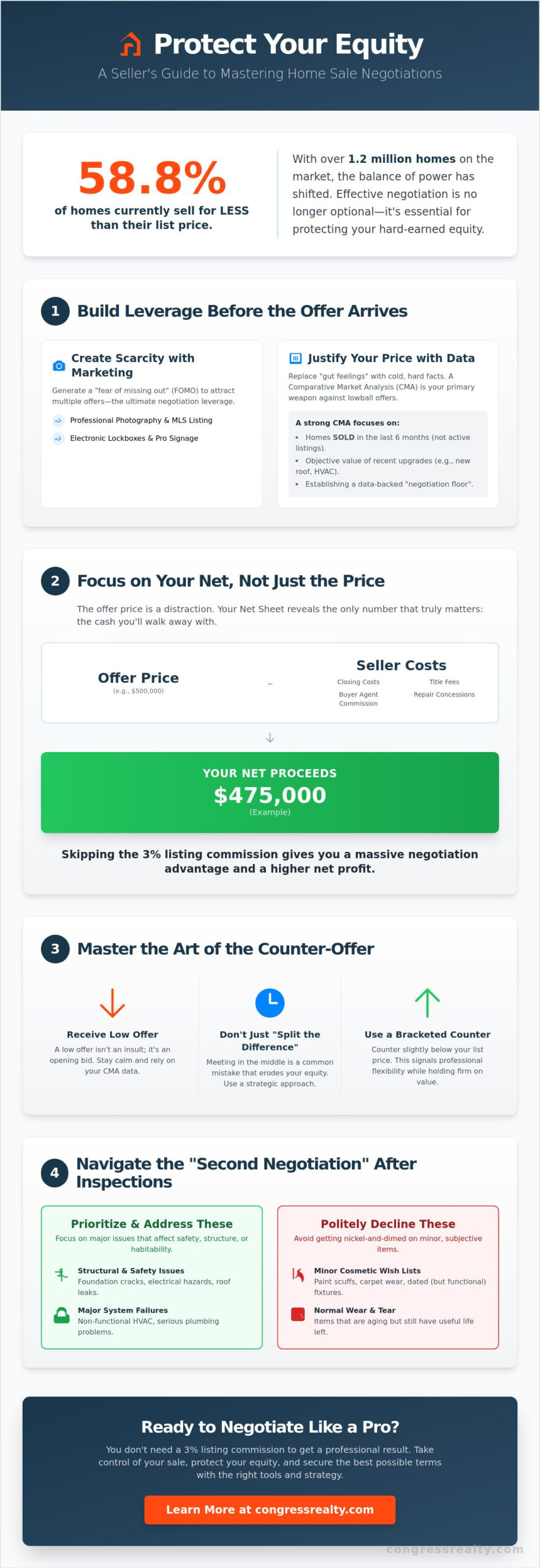
Did you know that 58.8% of homes are currently selling for less than their original list price? With inventory levels rising to over 1.2 million homes nationwide, the balance of power is shifting, making the skill of negotiating home sale price with buyers more critical than ever. It’s natural to feel a sense of dread when a lowball offer lands in your inbox or when a professional buyer’s agent pushes for aggressive concessions. You’ve worked hard to build equity, and the thought of losing it at the closing table is enough to keep any seller awake at night.
The good news is that you don’t need a traditional 3% listing commission to get a professional result. You can master the negotiation process while maintaining complete control over your transaction. This guide will empower you with the pragmatic tools needed to protect your proceeds and secure the best possible terms. We’ll break down exactly how to handle repairs, counter unfair offers, and use market data to move toward a successful closing with total confidence.
Key Takeaways
Ground your asking price in hard data with a Comparative Market Analysis (CMA) to build objective leverage before the first offer arrives.
Focus on your “Net Sheet” rather than just the top-line price to understand exactly how much you’ll keep after all concessions are calculated.
Master the art of negotiating home sale price with buyers by using bracketed counter-offers that show professional flexibility without caving on your equity.
Navigate the “second negotiation” after inspections by prioritizing structural and safety issues over minor cosmetic wish lists.
Use professional tools like electronic lockboxes and the MLS to maintain industry parity while enjoying the financial freedom of a fixed-cost listing.
Preparation: Building Your Negotiation Leverage Before the Offer
Leverage in real estate isn’t something you find; it’s something you build. Many sellers make the mistake of waiting for an offer to arrive before thinking about their strategy. True power in negotiating home sale price with buyers begins weeks before your home hits the market. It starts with replacing “gut feelings” with cold, hard data. When you walk into a transaction with a clear understanding of fundamental negotiation principles, you position yourself as a professional advocate for your own equity. You aren’t just a homeowner; you are the lead strategist in a high-value financial transaction.
The Role of the Comparative Market Analysis (CMA)
Your primary weapon for price justification is a professional Comparative Market Analysis (CMA). This document is the evidence you’ll use to shut down lowball offers before they gain momentum. To build a solid case, you must identify “true” comps. Look for homes that have sold within the last six months rather than focusing on active listings. Active prices represent what sellers hope to get, while sold prices represent what the market actually supports.
A detailed CMA also allows you to account for specific home improvements. If you’ve recently installed a new roof or upgraded your HVAC system, these aren’t just maintenance tasks. They are value-adders that provide a data-backed “no” to buyers trying to chip away at your price. Use this data to establish your “negotiation floor” so you never feel pressured to accept an unfair deal.
Creating Scarcity Through Marketing
High-end digital marketing and professional photography are non-negotiable tools for this. They drive traffic and increase the likelihood of multiple-offer scenarios, which is the ultimate leverage. When buyers see a listing that looks pristine and professional—the kind of high-quality presentation seen at Ray Lyon Realty—they perceive it as a high-demand asset.
Professional infrastructure also signals your seriousness as a seller. Utilizing tools like an electronic lockbox and a professional yard sign tells buyer’s agents that you are organized and prepared. This removes the “amateur” stigma often associated with independent selling and prevents professional agents from trying to out-maneuver you. By presenting a polished, professional front, you set the stage for a bidding war rather than a desperate hunt for a single buyer.
The relationship between listing price and sale price is a delicate balance. A strategic listing price, supported by your CMA, invites competition. When multiple buyers compete, the negotiation dynamic shifts entirely. You stop defending your price and start choosing the best terms from a position of strength.
Evaluating the Initial Offer: Separating Signal from Noise
Receiving your first offer is a major milestone, but don’t let the excitement cloud your financial judgment. The top-line price is often a distraction designed to capture your attention while hidden costs lurk in the fine print. Successful negotiating home sale price with buyers requires you to look past the sticker price and focus on the actual cash you’ll walk away with at closing. By adopting a methodical approach to offer evaluation, you can filter out weak proposals and focus on the deals that actually move the needle.
Calculating Your Net Proceeds
Your net proceeds are the only number that truly matters at the closing table. Net proceeds represent the final amount of cash you receive after all sale-related expenses, liens, and commissions have been deducted from the gross sale price. To find this figure, you must subtract closing costs, title fees, and buyer agent commissions from the total offer price. One of the most effective seller negotiation tactics is to maximize this number by controlling your expenses. When you skip the traditional 3% listing commission, you immediately increase your negotiation floor. This financial buffer allows you to be more flexible on the sale price while still netting more than a seller paying full-service fees. If you need help tracking these variables, using professional transaction management services ensures every dollar is accounted for accurately.
Vetting the Buyer’s Financials
A high offer price is worthless if the buyer can’t secure financing. In the 2026 market, you must distinguish between a pre-qualified buyer and one who is fully pre-approved. A pre-approval letter indicates that a lender has already verified the buyer’s income and assets, making the deal much more likely to close. If you receive an all-cash offer, you might consider accepting a slightly lower price in exchange for the certainty and speed it provides. Additionally, pay close attention to the earnest money deposit. A substantial deposit signals a buyer who is serious and has skin in the game, whereas a small deposit might indicate a lack of commitment.
Watch out for “red flag” contingencies that could jeopardize the sale later. While some contingencies are standard, excessive requests for home sale contingencies or unusual closing timelines can be deal-killers. If you encounter a lowball offer, don’t take it personally. Respond with a data-backed counter-offer based on your CMA. This keeps the conversation going and signals that you are a pragmatic seller who knows the market value of your property. By keeping your emotions in check and focusing on the data, you maintain the upper hand in every interaction.
The Art of the Counter-Offer: Moving Beyond the Sale Price
After you’ve vetted the buyer’s financials, it’s time to craft your response. Negotiation is a dialogue, not a zero-sum game. Start by acknowledging the offer and thanking the buyer. Maintaining a positive, professional tone prevents the transaction from becoming adversarial. This level of professionalism is a hallmark of expert representation, such as that provided by Robert Caicedo Real Estate. When negotiating home sale price with buyers, you should use a “bracketed” counter-offer. This involves meeting them partway between their offer and your list price. It demonstrates flexibility while signaling that you won’t accept a lowball figure. This approach keeps the buyer engaged while protecting your equity.
Momentum is your best friend in real estate. Always set a short expiration for your counter-offer, typically 24 to 48 hours. This creates a sense of urgency and prevents the buyer from “shopping” your offer to other sellers. Once you reach a verbal agreement, move quickly to get it in writing. Professional oversight ensures that every term you’ve fought for is accurately reflected in the contract. You’re in the driver’s seat, and setting these boundaries keeps the process moving toward your desired result.
Negotiating Terms vs. Dollars
Sometimes, the best way to protect your proceeds is to negotiate terms rather than the sale price. For example, an “As-Is” clause can be incredibly valuable. You might accept a slightly lower price in exchange for the buyer agreeing to take the property without any repair obligations. This eliminates the risk of expensive surprises later. Other powerful bargaining chips include flexible closing dates or seller leasebacks. A leaseback allows you to stay in your home for a set period after closing, which can save you thousands in temporary housing or double-moving costs. These non-monetary wins often provide more peace of mind than a few extra dollars in the sale price.
Handling Multiple Offers
If your marketing strategy has worked, you may find yourself juggling multiple contracts. This is the ultimate position of strength. Use a “Highest and Best” deadline to force buyers to put their most competitive terms forward simultaneously. When comparing these offers, look beyond the top-line number. An FHA loan might offer a high price but comes with stricter appraisal requirements and a 6% seller concession limit. A Conventional loan or a cash offer is often “cleaner” with fewer strings attached. Managing these moving parts requires precision. Utilizing professional transaction management ensures you don’t miss a deadline or a critical contingency while balancing multiple interested parties.
Handling Post-Inspection Negotiations and Concessions
Many sellers breathe a sigh of relief once a contract is signed, only to be blindsided by the inspection report. In the real estate industry, this period is often called the “second negotiation.” It’s the moment when buyers may try to claw back some of the sale price by highlighting every minor flaw in the property. Mastering the process of negotiating home sale price with buyers requires stamina during this phase. You must distinguish between legitimate safety hazards and a buyer’s “wish list” of upgrades. Your goal is to keep the deal on track without letting your equity bleed away through death by a thousand cuts.
Your original Comparative Market Analysis (CMA) remains your best defense here. If you priced the home accurately based on its current condition, you’ve already accounted for the age of the roof or the dated kitchen. Remind the buyer that the price they agreed to reflects the home as it stands. By staying grounded in the data you gathered during your preparation phase, you can push back against requests that aren’t rooted in structural or safety requirements.
Repair Credits vs. Physical Repairs
When an inspection reveals a valid issue, you generally have two choices: fix it yourself or offer a repair credit. Offering a credit is almost always the superior financial move for a seller. Credits are safer for sellers because they eliminate the risk of being held liable for “bad” repair work or delays caused by contractors. If a buyer presents an inflated estimate for a repair, don’t take it at face value. Get your own independent contractor quotes to challenge their numbers and keep the negotiation realistic. Cosmetic defects are typically not grounds for price renegotiation in a standard contract. Focusing strictly on “red flag” items like electrical hazards or foundation issues keeps the conversation professional and limited in scope.
The ‘Take It or Leave It’ Threshold
Before the inspection even begins, you should determine your “walk-away point.” This is the maximum amount you are willing to credit or spend before the deal no longer makes financial sense. Having this threshold in mind prevents emotional decision-making in the heat of the moment. You also need to be prepared for appraisal gaps. If the bank determines the house is worth less than the contract price, a new negotiation begins. You can ask the buyer to cover the difference, meet them in the middle, or stick to your price and risk the deal. If the buyer tries to walk away without a valid contractual reason, their earnest money deposit serves as your leverage. To ensure you have the professional support needed to handle these complex late-stage disputes, consider utilizing professional transaction management to protect your interests until the final signature is dry.
Navigating Negotiations Without a 3% Listing Commission
Negotiating home sale price with buyers becomes a lot less stressful when you aren’t starting from a 3% financial deficit. In a traditional model, you’re often pressured to hold out for a higher price just to cover the cost of the agent’s commission. When you remove that high-cost barrier, your “negotiation floor” drops significantly. This doesn’t mean you should accept less for your home. Instead, it means you have the financial breathing room to make strategic concessions that a commission-burdened seller simply cannot afford. You are in a position of unique competitive strength because your overhead is lower than almost every other listing on the block.
Congress Realty functions as your professional back-office support, providing the infrastructure you need to command respect in the marketplace. You maintain professional parity with every other listing by utilizing the Multiple Listing Service (MLS), professional photography, and an electronic lockbox. Buyers and their agents won’t see a “for sale by owner” amateur; they will see a serious, organized seller who has the same tools as a high-priced brokerage. This level of professional presentation is vital for negotiating home sale price with buyers because it prevents them from trying to exploit a perceived lack of experience.
The Flat Fee Competitive Advantage
Consider the math of a typical 2026 transaction. If you sell your home for $500,000 using a fixed-cost model, your net proceeds will likely be higher than if you sold that same home for $510,000 through a traditional agent charging a 3% listing fee. In that scenario, you’d be paying out $15,300 in listing commission alone. By choosing a smarter path, you can actually afford to be more flexible on your price to attract a wider pool of buyers while still keeping more of your equity. You aren’t just saving money; you are buying the flexibility to close deals faster.
Direct communication is your other secret weapon. When you are selling a house without an agent, you eliminate the middleman. You don’t have to wait for a listing agent to play “telephone” with the buyer’s agent. You hear the buyer’s concerns directly and can offer immediate, pragmatic solutions. This speed often keeps a deal alive when it might otherwise stall in a traditional communication chain.
Your Empowerment Checklist
Success in 2026 requires the right tools and a clear process. Use this checklist to ensure you are fully prepared to lead your own transaction:
Professional MLS Listing: Ensure your home is visible on the same databases used by every real estate professional.
Expert Valuation: Use a Comparative Market Analysis (CMA) to justify your price with hard evidence.
Professional Signage: Use a professional yard sign and post to signal a serious listing.
Transaction Management: Secure end-to-end oversight to ensure all legal paperwork is handled with precision.
Success in the 2026 housing market requires a shift from emotional reactions to a data-driven strategy. By grounding your listing in a professional CMA and focusing on your final net proceeds, you’ve already won half the battle. Master the art of negotiating home sale price with buyers by staying objective during inspections and using your lower overhead to out-position competing listings. You don’t need to pay a high-percentage commission to get professional results or maintain total control over your transaction. It’s about being the smartest person in the room, not the one with the most expensive agent.
Since 2002, Congress Realty has empowered thousands of savvy sellers to bypass traditional industry costs. Our fixed-cost fee structure ensures you know exactly what you’re paying upfront, while our Full Service Listing includes professional Transaction Management to handle the complex paperwork. You deserve a partner that provides the necessary infrastructure and then lets you lead the process with confidence. You’ve done the work to build your equity; now it’s time to keep it.
No, you aren’t obligated to accept the highest price offer. Often, a slightly lower offer with fewer contingencies, a flexible closing date, or all-cash financing is more valuable than a high-priced offer with risky strings attached. Evaluate the buyer’s financial strength and the speed of the transaction. Focus on your net proceeds and the likelihood of the deal closing without a hitch. The “best” offer is the one most likely to reach the closing table.
Can a buyer back out after we agree on a price?
Yes, a buyer can back out if they have active contingencies in the contract, such as inspection, financing, or appraisal clauses. These provide legal exits if specific conditions aren’t met. To minimize this risk, vet the buyer’s pre-approval letter and request a substantial earnest money deposit. Once all contingencies are waived, the buyer’s deposit is usually forfeited if they choose to walk away without cause. Professional transaction management helps track these critical deadlines.
How much should I counter-offer if the price is too low?
When negotiating home sale price with buyers, your counter-offer should be based on the hard data found in your Comparative Market Analysis (CMA). Avoid emotional reactions to lowball offers. Instead, use a “bracketed” approach by meeting the buyer partway between their offer and your list price. This signals professional flexibility while protecting your equity. Always justify your counter with specific market comps to keep the negotiation grounded in reality and professional logic.
Is it better to fix things before listing or offer a credit?
Offering a repair credit is generally better than performing the repairs yourself. Credits eliminate your liability for the quality of the work and prevent closing delays caused by contractor schedules. If you choose to fix items, focus only on structural or safety issues. Cosmetic defects are rarely worth the investment before a sale. Providing a credit lets the buyer handle the project to their own taste after closing while you move on.
What happens if the house appraises for less than the negotiated price?
If an appraisal comes in low, a new negotiation begins to bridge the appraisal gap. You can ask the buyer to pay the difference in cash, lower your sale price to the appraised value, or meet in the middle. If neither party can agree, the buyer can typically walk away with their earnest money. Use your CMA data to challenge a low appraisal if you believe the valuation is inaccurate based on recent local sales.
Do I still have to pay the buyer’s agent commission?
While the 2026 market offers more transparency, paying a buyer’s agent commission is still a common practice to attract the widest pool of buyers. However, this amount is entirely negotiable. By using a fixed-cost listing model, you save thousands on the listing side, which gives you more room to offer a competitive buyer’s agent fee without hurting your bottom line. Always define this fee clearly in your MLS listing to maintain professional parity.
How do I handle a buyer who wants to negotiate after the contract is signed?
Negotiations after a signed contract should only occur if new information comes to light, such as during the home inspection. If a buyer tries to renegotiate price without a valid contractual reason, stand your ground. Point back to the agreed-upon terms and your original market data. Utilizing professional transaction management can help you navigate these high-pressure moments and keep the buyer focused on the original agreement rather than looking for late-stage discounts.
What is the most important thing to include in a counter-offer?
The most critical element of a counter-offer is a short expiration deadline. Typically, giving a buyer 24 to 48 hours to respond maintains transaction momentum and prevents them from using your offer to shop for other properties. Clearly state your price, any adjusted contingencies, and the deadline. This firm boundary shows you are a serious, organized seller who values a swift and professional closing process. It forces the buyer to make a decision.