Did you know that listings with professional photos sell for an average of $27,000 more according to June 2026 data from Gitnux? Congress Realty, a flat fee MLS brokerage serving Phoenix, Arizona, and Austin, Texas, empowers homeowners to take control of their sales without sacrificing the high-end look of a traditional listing. Understanding the importance of professional real estate photography is the first step toward protecting your equity. You likely worry that smartphone photos will look cheap or cause your home to be overlooked on Zillow and Realtor.com. We agree that your listing needs to compete with full-service brokerages to attract serious buyers.
In this guide, you will discover how high-quality visuals maximize your home equity and accelerate your sale on the Multiple Listing Service. Jared English, the broker at Congress Realty, often notes that professional imagery is the primary tool for a fast sale at or above asking price. We will preview the latest 2026 trends, including the impact of California’s AB 723 disclosure laws and why Redfin research shows listings with professional photos sell 32% faster than those with amateur shots. Learn how to transform your DIY listing into a high-performance digital asset that commands attention.
Understand the importance of professional real estate photography as a critical tool to maximize showing requests and online engagement on the Multiple Listing Service.
Discover why professional imagery leads to a 118% increase in online views and helps you secure a sale at or above your asking price.
Learn how professional DSLR sensors and specialized wide-angle lenses outperform smartphones by capturing spatial clarity without distorting your home’s proportions.
Follow a practical checklist to prepare your home for a shoot, focusing on decluttering and natural light to emphasize every square foot of your property.
See how Congress Realty simplifies the process of uploading professional media to ensure your listing remains competitive while you retain more of your equity.
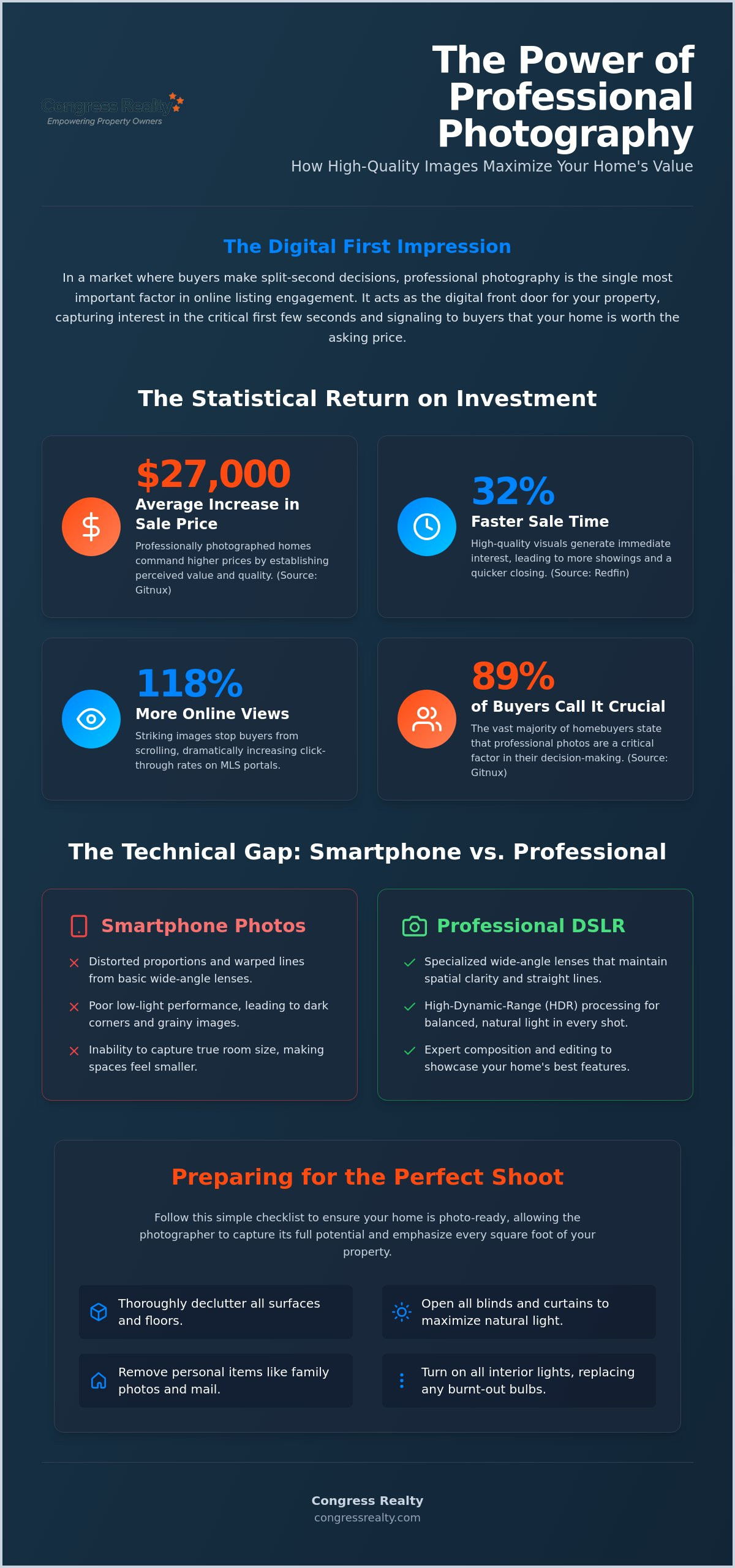
Congress Realty, a flat fee MLS brokerage serving Phoenix, Arizona and Austin, Texas, identifies professional photography as the single most important factor in online listing engagement. Jared English, our broker, explains that high-quality images act as the digital front door for your property. In a market where buyers make split-second decisions, the importance of professional real estate photography cannot be overstated. It directly correlates with the first 1.5 seconds a buyer spends viewing a listing. If your visuals don’t immediately capture interest, you lose that potential lead forever.
Professional real estate photography is technically defined as specialized architectural photography designed to maximize spatial clarity and light. Unlike standard snapshots, these images use high-dynamic-range (HDR) processing and wide-angle lenses to showcase a room’s true dimensions. For homeowners managing their own sale, these assets are the primary tool for protecting home equity. They signal to the market that the property is well-maintained and worth the asking price.
The Digital First Impression in the Arizona and Texas Markets
Buyers in high-velocity markets like Scottsdale and Dallas filter listings by visual quality before they ever look at the square footage or price. They browse mobile apps like Zillow and Realtor.com with speed. High-definition images are the only way to stop the scroll. If your photos are dark, blurry, or captured with a smartphone, buyers assume the home is “cheap” or poorly cared for. Data from Gitnux in June 2026 reveals that 89% of homebuyers say professional photos are a crucial factor in their decision-making process. In competitive Texas and Arizona neighborhoods, “good enough” photos often lead to your listing being ignored entirely.
Winning the MLS Algorithm with High-Quality Media
Modern Multiple Listing Services use algorithms that prioritize complete, media-rich profiles. There is a direct relationship between your click-through rate (CTR) and your search ranking position. When your professional photos attract more clicks, the system recognizes your listing as high-value and keeps it at the top of search results. Successfully listing on the MLS without a realtor requires these professional-grade assets to maintain parity with traditional full-service listings. High-quality media ensures that your property stands out among thousands of others, giving you the professional edge needed to secure a fast sale at or above your desired price point.
Data drives the modern real estate market. Jared English, the broker at Congress Realty, consistently observes that listings featuring high-end visuals see a massive surge in showing requests within the first 48 hours of hitting the market. This initial momentum is vital. Homes with professional photos receive up to 118% more online views than those relying on amateur shots. This increased visibility is not just about vanity. It translates to real-world results. Reports from outlets like MarketWatch and ABC News highlight that professionally photographed homes sell 32% faster than their counterparts. When you prioritize the importance of professional real estate photography, you are not just buying pictures. You are purchasing a faster path to a successful closing.
The financial impact is rooted in the concept of perceived value. When a buyer views a crisp, well-lit image, they subconsciously assign a higher quality to the entire property. This visual authority justifies your asking price and reduces the likelihood of low-ball offers. By presenting a polished image, you establish a position of strength from the moment your listing goes live on the Multiple Listing Service. Buyers assume that a seller who cares about the presentation also cares about the maintenance of the home.
Quantifying the Savings for Flat Fee Sellers
Think of professional photography as an equity protection plan rather than an expense. Consider a scenario where a homeowner invests a few hundred dollars in a professional shoot. By attracting multiple competitive offers early, that seller often avoids a $15,000 price reduction that typically follows a stagnant listing. When you choose a flat fee model with Congress Realty, your savings are already substantial. In markets like Austin or Phoenix, homeowners often save over $15,000 in listing commissions on a median-priced home compared to a traditional 3% listing fee. Reinvesting a fraction of those savings into the importance of professional photography ensures you do not leave money on the table.
Jared English on Market Competitiveness
Jared English emphasizes that your listing does not exist in a vacuum. It competes directly with full-service listings managed by high-commission agencies. Your home must match or exceed the visual standards of every other property in the neighborhood to win. This is especially true during seasonal slowdowns or market shifts when inventory rises. Buyers become more selective, and poor visuals are the easiest reason for them to skip a home. By understanding commissions and how they impact your net proceeds, you can strategically allocate funds toward high-impact marketing. If you want to secure the highest possible return on your equity, you can start your listing process with a focus on professional presentation.
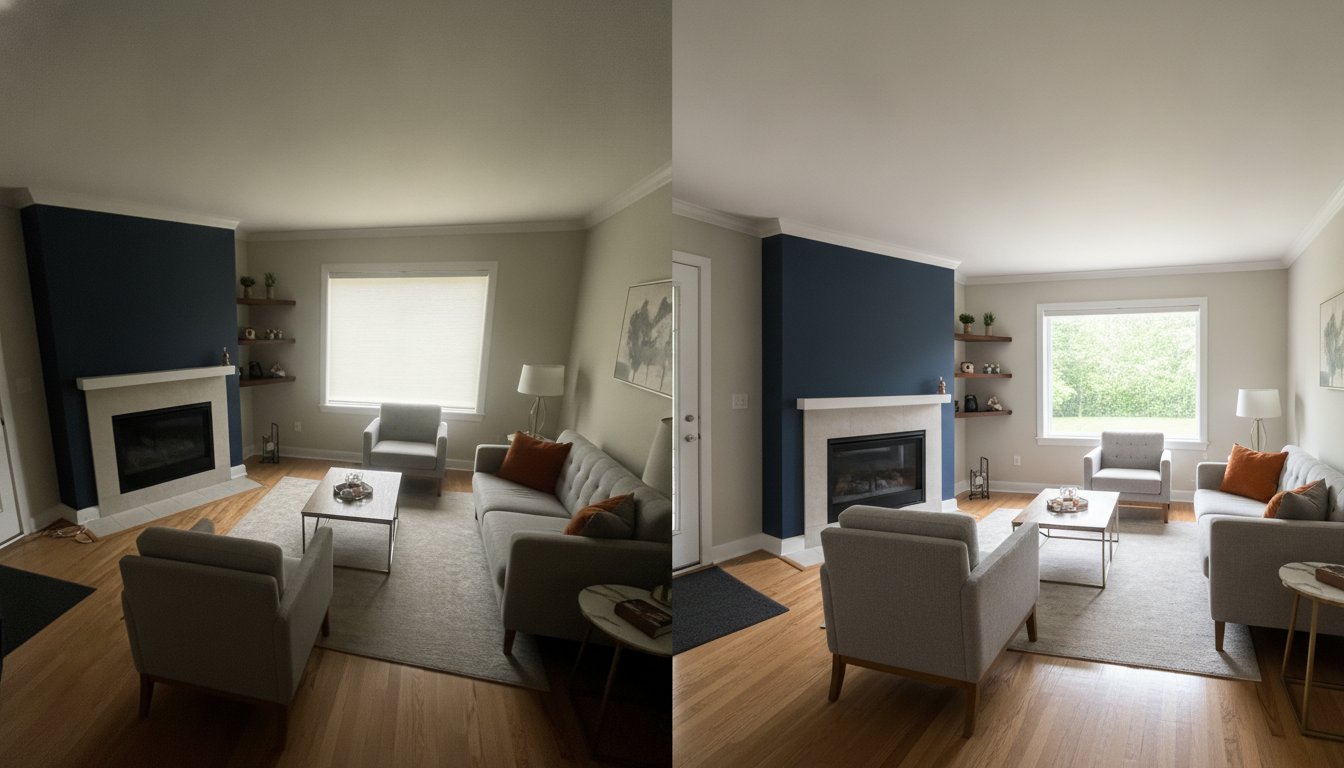
While smartphone cameras improve every year, they cannot replicate the hardware of a professional setup. The importance of professional real estate photography lies in the physical capability of the equipment used to capture your home. A professional DSLR or mirrorless sensor is significantly larger than the tiny sensor found inside even the most expensive smartphones. This physical size allows the camera to capture deeper details in both shadows and highlights. It prevents the grainy, noisy look that often ruins indoor photos taken on mobile devices, especially in rooms with limited natural light.
Specialized wide-angle lenses are another critical differentiator. Unlike the wide setting on a phone, professional lenses are designed to keep vertical lines perfectly straight. This prevents the distorted, leaning effect that makes rooms feel unstable or cramped. Jared English points out that maintaining these architectural lines is a subtle but powerful way to build trust with a potential buyer. As noted in Forbes regarding The Importance of a Good First Impression, these technical nuances define how a buyer perceives the value of your property before they ever step foot inside.
Professional photographers also use bracketed exposure. This technique involves taking five or more shots at different brightness levels and merging them into one high-dynamic-range image. It’s the only reliable way to show a bright, inviting living room while simultaneously displaying the clear view out the window. Without this, your windows will appear as blown-out white squares in your listing photos, hiding one of your property’s best selling points.
The Science of Lighting and Composition
Professional flash units are essential for eliminating the yellow or orange cast created by interior light bulbs. By balancing the color temperature, a photographer ensures your white cabinets actually look white. Additionally, pros follow the eye-level rule, typically shooting from about four to five feet off the ground. This creates a natural walkthrough feeling that mirrors how a human actually experiences the space. It avoids the fisheye effect that makes rooms look unnaturally warped or deceptive.
Post-Processing: The Invisible Advantage
The work doesn’t end when the shutter clicks. Professional editing includes techniques like Blue Sky replacement, which is vital for listings in states like Washington or Alaska where overcast days are common. You can also utilize Virtual Staging as a cost-effective alternative to renting furniture for empty rooms. This helps buyers visualize the potential of a space without the high overhead. Choosing Congress Realty listing packages makes it easy to upload these high-resolution files directly to the Multiple Listing Service, ensuring your home looks its absolute best on every platform.
Congress Realty, a flat fee MLS brokerage serving Phoenix, Arizona and Austin, Texas, understands that preparation is the foundation of a successful listing. While we have established the importance of professional real estate photography for technical quality, your home must be physically ready for the lens. Homeowners often ask: How do I prepare my home for real estate photos? The answer involves a combination of deep cleaning and strategic staging to ensure your property looks its absolute best. Proper preparation helps you secure the $27,000 average price increase that professional imagery can provide.
Start by decluttering every surface. Clear kitchen counters and bathroom vanities entirely to emphasize square footage. This prevents the buyer’s eye from snagging on small distractions. Maximize natural light by opening all curtains and blinds. You should also check every light bulb in the house. Ensure they all work and share the same color temperature. Mixing warm and cool bulbs creates uneven color casts that can look muddy in the final images. Jared English suggests that a clean, bright home feels more spacious and well-maintained to the online viewer.
Depersonalize your space by removing family photos and highly specific decor. This allows potential buyers to visualize their own lives in the home. Do not ignore the exterior. Enhance your curb appeal by moving cars out of the driveway and hiding trash cans. These small steps ensure your digital front door looks inviting from the very first click on the Multiple Listing Service.
Room-by-Room Preparation Checklist
Kitchen: Remove all magnets and papers from the fridge. Clear the sink entirely and put away dish soap or sponges.
Living Room: Fluff all pillows and straighten rugs. Hide remote controls and tuck away loose wires from lamps or electronics.
Exterior: Mow the lawn and trim overgrown bushes. Ensure your yard sign is clean, upright, and clearly visible from the street.
The Final Walkthrough Before the Photographer Arrives
Perform a final sweep ten minutes before the shoot begins. Hide all pet evidence such as food bowls, beds, or toys. Ensure every toilet lid is down and all mirrors are streak-free. Finally, turn off all ceiling fans and televisions. Motion blur from a spinning fan can ruin an otherwise perfect architectural shot. Taking these steps ensures you get the most out of your marketing assets. If you are ready to showcase your home to thousands of buyers, you can list your property on the MLS today and keep more of your equity.
Congress Realty, a flat fee MLS brokerage serving Phoenix, Arizona and Austin, Texas, provides the professional infrastructure necessary to compete with traditional high-commission firms. We integrate support for professional media into our Full Service and Premium listing packages to ensure your property receives maximum exposure. Jared English, our broker, oversees the transaction details to ensure compliance while you maintain total command over your marketing strategy. Recognizing the importance of professional real estate photography is central to our mission of helping you retain the most equity possible during your sale.
How do I get my professional photos onto the MLS with a flat fee listing?
Homeowners can upload high-resolution professional images directly through the Congress Realty seller portal. Once you submit your media, our team ensures the files meet specific MLS resolution requirements, such as the 1024×768 pixel minimum. We then syndicate your listing and photos to Zillow, Realtor.com, and local industry databases. This process allows you to present a polished, professional-grade listing without paying a traditional 3% listing commission, which saves the average Texas or Arizona seller over $15,000 on a median-priced home.
Flat Fee MLS Packages that Prioritize Visuals
Our listing tiers offer varying photo limits designed to suit everything from compact condos in Tucson to sprawling estates in Dallas. High-quality images are the primary engine for online engagement. When you upload professional media, our system pushes those assets to every major real estate site automatically. This ensures that your digital front door remains open and inviting to the 89% of buyers who cite photos as a deciding factor in their search. You can review the specific media limits for each tier on the Congress Realty sell page to determine which option best fits your property size.
Your Path to a Successful FSBO Sale
Saving on commission does not mean you have to sacrifice the quality of your presentation. By using a flat fee model, you act as a savvy, independent seller who understands that professional imagery is an investment, not a cost. Jared English and the Congress Realty team provide the tools you need to bypass traditional industry hurdles while maintaining the same listing quality as the most expensive brokerages in the country. Put your home’s best face forward and start your listing today to maximize your return. We invite you to explore our Standard and Full Service options to find the perfect path for your successful home sale.
You now understand the importance of professional real estate photography as a primary tool for protecting your equity. High-quality images do more than look good; they drive click-through rates and justify your asking price on the Multiple Listing Service. By choosing professional gear over a smartphone and following a strict preparation checklist, you position your home to sell 32% faster. This pragmatic approach ensures you remain in control of your sale while maximizing your financial return.
Congress Realty has empowered homeowners to save on commissions since 2002. With over 20 years of experience and an A+ Rating with the Better Business Bureau, we provide the reliable infrastructure you need to succeed. Our service has been featured in MarketWatch and ABC15 Arizona, cementing our role as a trusted ally for savvy sellers. Jared English and our team are ready to help you manage your transaction with confidence and clarity. Ready to save thousands in commission? List your home on the MLS with Congress Realty today.
Is professional real estate photography worth the cost for a cheap home?
Yes, professional photography is a vital equity protector regardless of your home’s price point. High-quality images prevent the “cheap” perception that leads to low-ball offers from investors. Jared English notes that even for lower-priced properties, professional visuals are the most effective way to stand out in a crowded market segment and secure a fast sale at or above your asking price.
How many photos should be included in a professional MLS listing?
You should aim for 25 to 35 high-quality images for a standard residential listing. While some systems like CRMLS allow up to 75 photos, quality and variety matter more than raw quantity. Focus on capturing the logical flow of the home. Ensure you include at least one unbranded curbside exterior photo within 72 hours of activation to meet standard MLS requirements.
Can I use my own smartphone photos for a flat fee MLS listing?
You can use smartphone photos, but it is not recommended if you want to maximize your sale price. The importance of professional real estate photography lies in technical advantages like bracketed exposure and wide-angle lenses that smartphones cannot replicate. Using amateur photos often results in 118% fewer online views, which can lead to a stagnant listing and eventual price drops.
What is the best time of day for a real estate photo shoot in Arizona?
Mid-morning or early afternoon is generally best for Phoenix and Scottsdale homes to avoid the harsh midday desert sun. For exterior shots, the “golden hour” just before sunset provides soft, warm lighting that highlights landscaping and architectural details. Professional photographers in Tucson often schedule shoots based on the cardinal direction the home faces to ensure the front facade is perfectly lit.
Does professional photography help with home appraisals?
Professional photos do not directly change an appraiser’s valuation, but they influence the perceived condition of the property. A well-documented listing with high-resolution images provides a clear record of upgrades and maintenance for the appraiser to review. This documentation is helpful if you need to challenge a low appraisal by demonstrating the superior condition of your home compared to local neighborhood comps.
How long does a professional real estate photo shoot typically take?
A standard shoot for a 2,000 square foot home usually takes between 60 and 90 minutes. Larger estates in Austin or Dallas may require two to three hours, especially if you add drone photography or virtual tours. Preparation is key to staying on schedule. Ensure all decluttering and staging are complete before the photographer arrives to avoid delays or extra fees.
Do I need to be home when the photographer arrives?
You do not need to be present if you provide access via an eLockbox or Key Lockbox. Many sellers prefer to leave so the photographer can move through the rooms efficiently without distractions. If you choose to stay, ensure you remain in a separate area to stay out of the shots. This autonomy allows the professional to focus on capturing the best possible angles of your property.
Will professional photos help my home sell if the market is slow?
Professional imagery is even more critical during market slowdowns when inventory is high and buyers are more selective. High-quality media is the most effective way to outshine competing listings that rely on amateur visuals. Jared English emphasizes the importance of professional real estate photography as a primary differentiator that keeps your listing at the top of search results and maintains buyer interest when competition is fierce.
Did you know that listings with high-quality imagery sell for up to $11,200 more than those with grainy, DIY snapshots? For the equity-first seller, every dollar counts. You likely feel that your smartphone is sufficient for a quick listing, but the reality of the 2026 market is that digital curb appeal is your most valuable asset. It’s understandable to fear overpaying for marketing when you’re already trying to save on commissions, but understanding why professional real estate photos matter is the first step toward a smarter, more profitable sale.
We agree that you shouldn’t have to sacrifice your hard-earned profit to get professional results. This guide will show you how high-end photography transforms your listing from a simple digital thumb-stop into a high-value transaction while keeping you in total control of the process. We’ll preview the specific ROI of professional imagery, including the fact that these homes sell 32% faster according to industry data. You’ll also learn how to navigate new transparency regulations like California’s AB 723 and how to leverage professional media to win over the latest MLS algorithms.
Key Takeaways
Master the 2.7-second rule to ensure your digital storefront stops the scroll and compels buyers to engage with your property.
Justify a higher asking price and protect your equity by understanding exactly why professional real estate photos matter for your bottom line.
Identify the technical pitfalls of DIY photography that make rooms look small or dark, and learn how professional equipment solves these issues.
Boost your visibility on major search portals by leveraging the specific high-resolution media types that listing algorithms prioritize.
Discover how to access premium marketing infrastructure within a flat-fee model to keep your equity where it belongs.
The Digital First Impression: Why Professional Real Estate Photos Matter in 2026
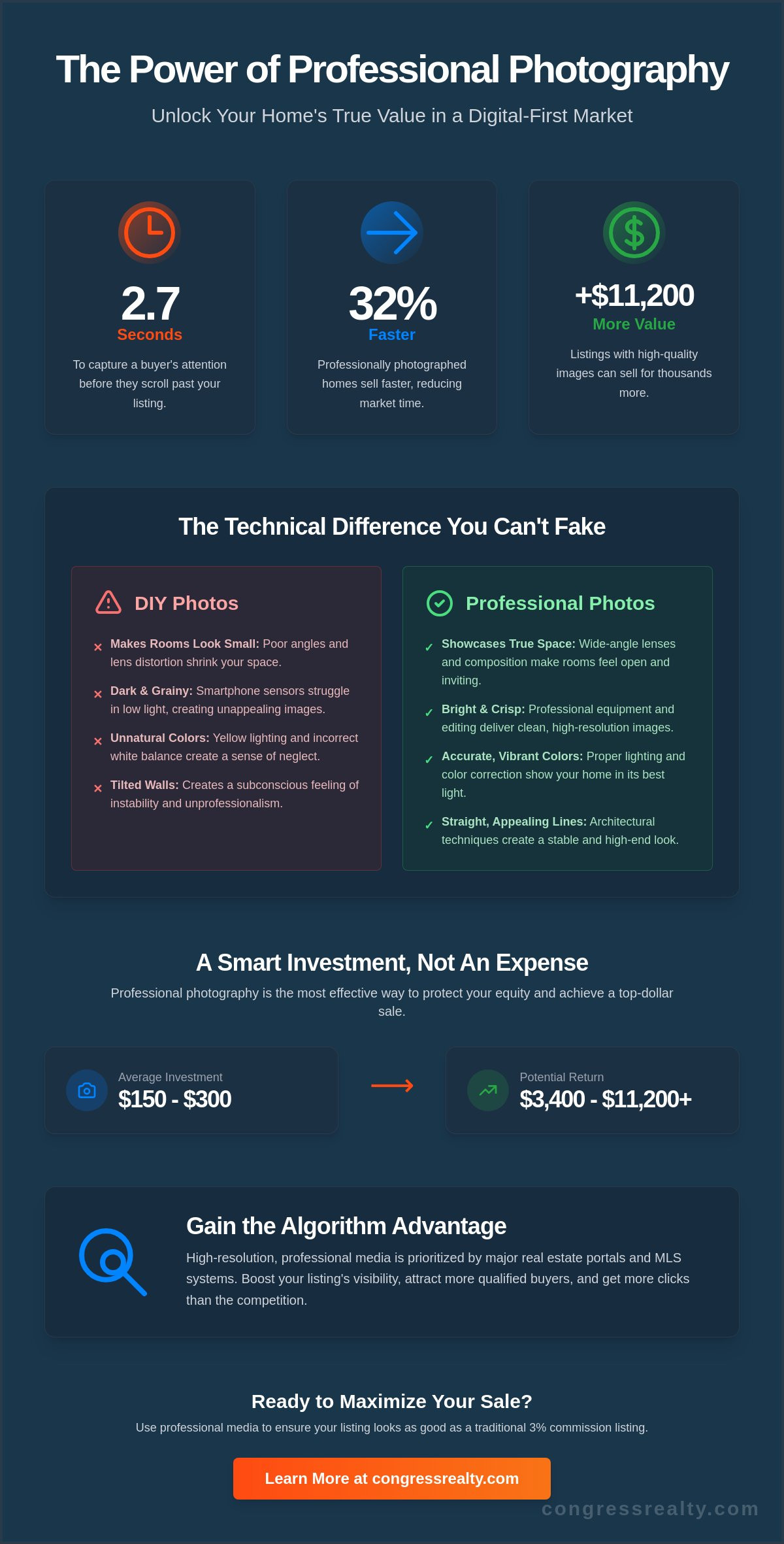
You have exactly 2.7 seconds to win. That’s the average amount of time a buyer spends looking at a listing’s primary photo before deciding to click for more details or scroll past it forever. In the fast-paced market of 2026, your digital storefront has officially replaced physical curb appeal as the most critical factor in a successful sale. If your lead image doesn’t stop the thumb, your high-end kitchen and manicured backyard will never even be seen. This is why professional real estate photos matter more than any other marketing tool in your arsenal.
High-quality imagery is about more than just looking “nice”; it’s about maintaining momentum. Data shows that homes with professional photos sell 32% faster than those without. This reduction in Days on Market (DOM) is essential for protecting your equity. When a listing lingers, it becomes stale, which often leads to price drops and lowball offers. Professional media also builds immediate trust with the growing number of out-of-state and remote buyers. These individuals often make life-changing decisions based entirely on what they see on their screens. For example, in competitive regions like Southwest Florida, professional groups such as Team239 rely on high-quality imagery to showcase residential properties and new construction to a global audience, ensuring buyers see every corner with clarity and professional precision before they schedule a tour or make an offer.
The Psychology of the Scroll
Mobile devices have completely reshaped the visual hierarchy of home buying. The human eye is naturally drawn to light, balanced composition, and a sense of space. Professional Architectural photography techniques leverage these instincts to guide a buyer’s attention to your home’s best features. When you rely on “good enough” DIY photos, you’re unintentionally driving buyers toward your competition. Dark corners, yellow lighting, and tilted walls create a subconscious sense of neglect. A professional shot creates an emotional hook. It allows a buyer to imagine their own life in the space before they ever step through the front door.
Data-Backed Results for Modern Sellers
The numbers offer a clear roadmap for the savvy, independent seller. Listings featuring high-end media receive significantly higher click-through rates (CTR) on major search portals. This increased traffic translates directly into higher offers. Research indicates that listings with professional photography can sell for between $3,400 and $11,200 more than those with amateur shots. The visual premium is the measurable increase in perceived property value generated by high-quality marketing assets. By choosing professional photography, you’re not just taking pictures; you’re establishing a higher baseline for your final sales price.
Justifying the Price: The ROI of High-End Property Media
Is spending a few hundred dollars on a photographer really worth it when you’re trying to maximize your savings? For the savvy seller, the answer is a resounding yes. When you calculate the return on investment, professional media isn’t an expense; it’s the most effective way to protect your equity. By investing in high-quality assets, you establish “Professionalism Parity.” This ensures your flat-fee listing looks identical to, or even better than, a traditional 3% commission listing on the MLS. This visual authority allows you to justify a higher asking price even when buyers are wary of an appraisal gap.
High-end photos do more than just attract clicks; they reduce the need for future price drops. By generating higher initial interest and multiple competing offers, you create a sense of urgency that amateur photos simply cannot replicate. Research indicates that listings with professional photography can sell for between $3,400 and $11,200 more than those without. When you compare that gain to the national average cost of a photoshoot, which typically ranges from $150 to $300, the financial intelligence of this choice becomes undeniable. Adding Professional Photography to your strategy is a pragmatic move that pays for itself many times over at the closing table.
Protecting Your Equity
Professional photos are the cheapest high-impact marketing tool available to a homeowner. They function as a shield against “low-ball” offers that often stem from a poor perception of the property’s condition. If a listing looks unpolished, buyers assume the seller is unmotivated or the home is poorly maintained. Understanding why professional real estate photos matter is just one part of the puzzle. You should also look at How Much Does the Realtor Make? Understanding Commissions in 2026 to see how much more you keep when you pair flat-fee savings with high-impact marketing.
The Cost of DIY: Hidden Losses
The true cost of DIY photography is found in the opportunity cost of a stagnant listing. Effective visual storytelling in real estate creates an emotional connection that smartphone snapshots cannot achieve. Poor lighting and distorted angles carry a heavy stigma; they make rooms look smaller, ceilings lower, and finishes cheaper. Buyers quickly associate amateur visuals with a lack of professionalism, leading them to wonder what else the seller might be cutting corners on. Don’t let a “good enough” photo be the reason your equity sits on the market for an extra month.
Professional vs. DIY: The Technical Difference You Can’t Fake
While smartphone cameras have improved, they still can’t overcome the fundamental laws of physics. Many sellers believe a modern phone is “good enough” for a quick listing, but this misconception often leads to flat, distorted, or poorly lit images that fail to capture the true value of a home. This is why professional real estate photos matter; they utilize specialized hardware and software that a pocket-sized sensor simply cannot match. When you rely on amateur tech, you’re essentially presenting a lower-value version of your property to the world.
A major hurdle for DIY shooters is dynamic range. When you take a photo of a living room with large windows, a phone usually makes the room appear dark or turns the windows into glowing white rectangles. Professional photographers use High Dynamic Range (HDR) techniques, blending multiple exposures to ensure the view outside the window is just as clear as the furniture inside. This technical balance creates a polished, high-end look that justifies your asking price and makes your listing stand out on the MLS.
Then there is the issue of spatial distortion. Smartphone “wide” lenses often create a “fish-eye” effect that makes straight walls look curved and unnatural. Professionals use rectilinear wide-angle lenses that keep the space looking expansive yet accurate. Crucially, they ensure vertical lines stay perfectly vertical. If your walls look like they’re leaning backward or the floors appear tilted, buyers subconsciously feel the listing is sloppy or unprofessional. Post-production refinements, such as blue sky replacements and color correction, further ensure your home looks its absolute best regardless of the weather or the time of day.
The Lighting Challenge
Managing the interplay between shadows and highlights is a precise art form. A professional understands how to showcase your home’s natural light without letting it overwhelm the shot. While “golden hour” remains the gold standard for your primary hero image, midday interior shots require much more control. Professional flashes are required for balanced interior exposures to ensure that every corner of the room is visible while maintaining the natural color of your flooring and finishes. This level of technical precision creates a bright, airy feeling that naturally attracts more buyers to your listing.
Composition and Staging Strategy
A professional eye sees the details you might overlook. They utilize the rule of thirds to lead a buyer’s eye through the room, focusing on the flow of the floor plan rather than just the furniture. This strategy involves several key elements:
Decluttering for the Lens: Identifying specific items that distract from the architectural space and removing them before the shutter clicks.
Architectural Highlights: Capturing unique crown molding, built-ins, or high-end fixtures that DIY shots often overlook or fail to emphasize.
Spatial Accuracy: Positioning the camera at the correct height to make rooms feel grounded, inviting, and accurately sized.
By highlighting these specific details, you emphasize the inherent value of your home and maintain complete control over the narrative of your sale.
Algorithm Advantage: Maximizing MLS and Portal Reach
Ever wonder why some houses appear at the top of Zillow searches while others are buried on page ten? It isn’t luck. Real estate portals like Zillow and Realtor.com use sophisticated algorithms to determine which listings get the most exposure. These systems prioritize high-resolution media because it keeps users on their platforms longer. This is a primary reason why professional real estate photos matter for your visibility. When you upload professional shots, you aren’t just showing off your home; you’re feeding the algorithm exactly what it wants to see.
The “Photo Count” factor is a simple but powerful metric. Listings with a higher number of professional images keep buyers on your page for longer durations. This high “dwell time” signals to the portal that your listing is high-quality, which in turn pushes it higher in search results. Additionally, high-resolution media is far more shareable on social media. A stunning kitchen shot has the potential to go viral within local community groups, driving thousands of extra eyes to your listing. This creates a ripple effect that reaches buyer agents across the country who are monitoring their own professional industry databases for new opportunities.
Winning the Portal War
Every time a buyer clicks, saves, or shares a photo, it triggers an algorithm boost. High engagement levels act as a vote of confidence for your property. Your “Hero Image” is the most important piece of this puzzle because it appears in the automated email alerts sent to thousands of active buyers. If that first image is a dark, blurry smartphone shot, they won’t click. If it’s a professional, bright, and inviting exterior, your click-through rate will skyrocket. To understand how this fits into your broader strategy, read The Ultimate Guide to Flat Fee MLS Listings: Save Your Equity in 2026. Maximizing your reach starts with the right infrastructure.
MLS Data Integrity
The Multiple Listing Service (MLS) maintains strict professional standards for data integrity. Low-resolution or poorly cropped photos can actually be flagged or suppressed by automated systems, limiting your home’s exposure to other brokers. Professional photography ensures you meet these technical requirements from day one. These images also play a vital role in the Comparative Market Analysis (CMA) process. When appraisers or other agents look at your home as a “comp,” they rely on your listing photos to judge its condition and value. Clear, professional visuals ensure your home is compared to high-value properties rather than neglected ones. If you want to ensure your listing meets these high-tech standards, consider adding Professional Photography to your listing package today.
The Congress Realty Model: Professional Results on a Flat-Fee Budget
Traditional brokerages often use high-end marketing as a justification for their 3% listing commissions. They suggest that professional visuals are a luxury only they can provide. We disagree. At Congress Realty, we’ve disrupted this high-cost model by integrating Professional Photography directly into our tiered listing packages. This ensures you don’t have to choose between saving your equity and presenting your home in its best light. You get the same high-caliber tools used by top-tier traditional firms, but you keep the thousands of dollars normally lost to percentage-based fees.
Our “Equity-First” approach is designed for the savvy homeowner who values financial intelligence. We provide the professional infrastructure, including seamless coordination from the photographer’s lens to the Multiple Listing Service (MLS). You don’t need to worry about technical upload requirements or data integrity. We handle the backend logistics so your high-resolution media feeds correctly into every major search portal. This is exactly why professional real estate photos matter in our model; they serve as the foundational proof that your home is a premium offering, regardless of the commission structure you choose.
Beyond the Photos: A Complete Marketing Suite
A great photo is only effective if it’s backed by a professional sales process. We combine high-end media with essential tools like an Electronic Lockbox and a Yard Sign and Post to create a comprehensive marketing presence. Our professional oversight ensures your photos are utilized for maximum impact across all platforms, from the MLS to local buyer agent databases. If you’re ready to maximize your profit, check out How to Sell Your House on Your Own: The 2026 Equity-First Guide for a step-by-step breakdown of the process.
Taking Control of Your Sale
You don’t need to pay a 3% commission to get 5-star photography. The Congress Realty onboarding process is simple, pragmatic, and designed to put you in the driver’s seat. We provide the expertise and the professional connections; you provide the home and the vision. This partnership allows you to navigate the 2026 market with the confidence of a seasoned pro. Don’t let traditional industry models dictate how much of your equity you get to keep. Take the smart path to a successful closing. List your home with professional media today and experience the satisfaction of a high-value sale on a fixed-fee budget.
Take Command of Your Home Sale Today
Your home deserves a presentation that reflects its true value. By now, it’s clear that high-end imagery is the foundational infrastructure of a successful sale. You’ve seen how professional media stops the scroll, beats the portal algorithms, and ultimately protects your equity from low-ball offers. Understanding why professional real estate photos matter is the first step toward a smarter, more profitable transaction. You don’t need a traditional broker to access these results; you just need the right partner to facilitate the process.
At Congress Realty, we provide the professional framework you need to succeed independently. With over 20 years of flat-fee MLS expertise, we offer national coverage with local MLS precision. Our service includes professional transaction management to ensure your sale stays on track from the first photo to the final signature. Don’t leave your equity to chance with amateur snapshots. List your home with professional photography for a flat fee today and stay in total control of your financial future. You have the tools, the data, and the support to win. We’re ready to help you get started.
Frequently Asked Questions
Can I just use my iPhone 17 Pro for my real estate photos?
While your phone is powerful, it can’t replicate the dynamic range or rectilinear lenses of a professional setup. Phone cameras often distort walls or blow out window views, which is why professional real estate photos matter for maintaining spatial accuracy. Professionals use specialized gear and HDR techniques to ensure your home looks expansive and correctly lit. This technical precision creates a polished look that smartphone sensors simply cannot achieve.
How many photos should a professional real estate listing have?
Most MLS platforms allow for a maximum of 40 to 50 images. You should aim for at least 25 to 30 high-resolution shots to keep buyers engaged on your listing page. This volume satisfies the “Photo Count” factor that search algorithms use to rank your property higher. Providing a comprehensive visual tour ensures that out-of-state buyers have enough information to feel confident making an offer without a physical tour.
Do I need to be home when the real estate photographer arrives?
You don’t need to be present for the shoot. Many sellers find it easier to provide access through an Electronic Lockbox. This allows the photographer to work efficiently through the home while you manage your daily schedule without interruption. It also ensures the photographer can move furniture or adjust lighting without the distraction of a crowded house. Just ensure the home is camera ready before you leave for the day.
What is the difference between real estate photography and architectural photography?
Real estate photography focuses on marketing a property for sale by highlighting flow, features, and emotional appeal. Architectural photography is a broader subgenre that emphasizes the artistic design, structural intent, and historical record of a building. While they share techniques, real estate media is specifically engineered to drive clicks and offers. It prioritizes the buyer’s perspective and the practical layout of the living space over purely artistic expression.
How much value does professional photography actually add to a home sale?
High-quality imagery has a measurable impact on your bottom line and is a key reason why professional real estate photos matter for savvy sellers. Data from 2026 suggests that listings with professional photos can sell for between $3,400 and $11,200 more than those without. This visual premium directly protects your equity by establishing a high perceived value. It’s a pragmatic investment that pays for itself by attracting more competitive offers.
Should I include drone photography for my listing?
Drone photography is a powerful tool for properties with significant acreage, unique locations, or impressive exterior features. It provides a perspective that ground-level shots can’t capture, such as proximity to parks, water, or neighborhood amenities. For land-focused listings, such as those represented by Coulee Land Company, these perspectives are vital for illustrating property boundaries and terrain. Research indicates that 83% of sellers prefer to work with professionals who offer these aerial views. If your property has a great roof or a large backyard, drone shots are essential for showing the full scope.
Do I need to stage my home before the professional photographer comes?
Staging is essential to ensure the camera captures the home’s potential rather than your personal belongings. Focus on decluttering surfaces and depersonalizing the space to create a clean slate. This allows the photographer to use composition techniques that lead the buyer’s eye through the floor plan effectively. A well-staged home translates into better visual storytelling, helping buyers imagine their own lives in the space before they even visit the property.
How long does it take to get the edited photos back for my MLS listing?
Most professional photographers deliver edited, high-resolution images within 24 to 48 hours of the shoot. This quick turnaround is vital for getting your home onto the MLS and into the hands of buyer agents while your listing is still fresh. Speed is a competitive advantage in a fast-moving market. Once you receive the files, you can immediately integrate them into your listing to start stopping the scroll and generating immediate interest.
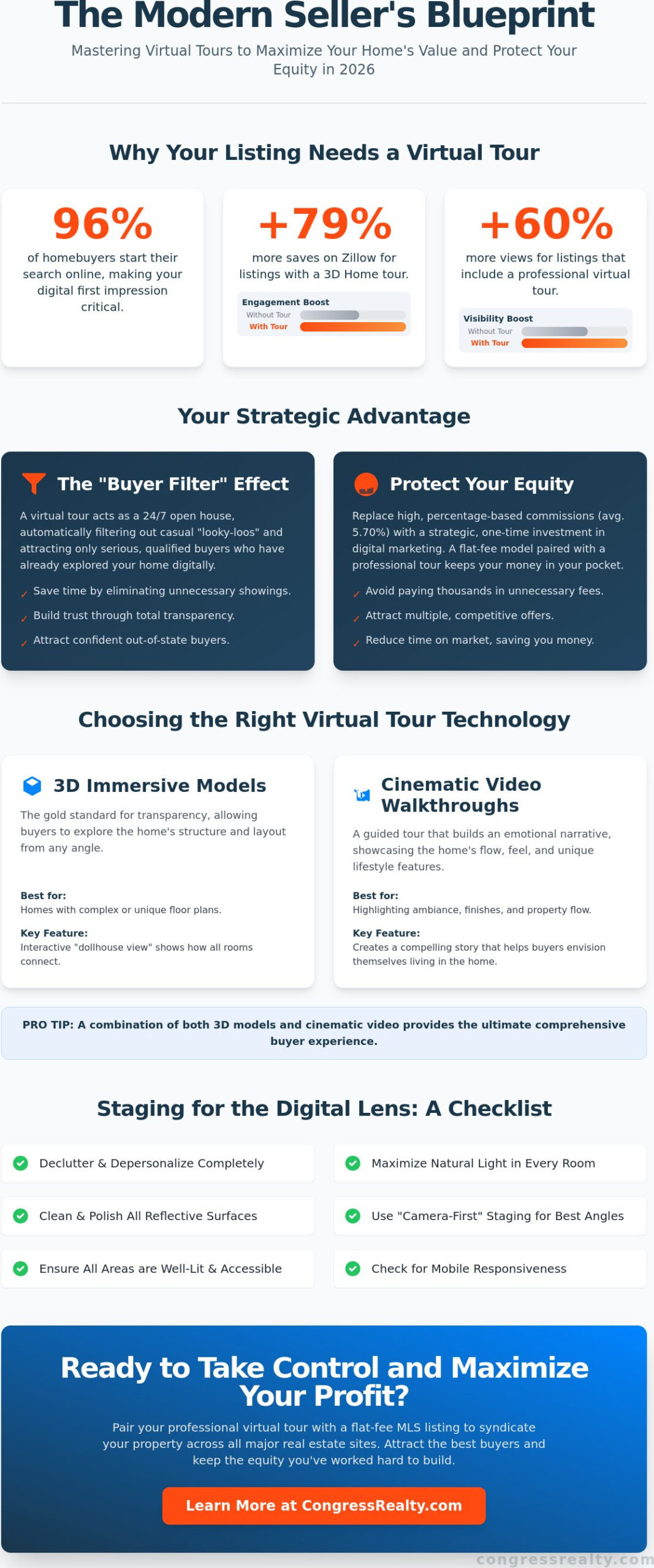
Did you know that listings featuring a Zillow 3D Home tour receive 79% more saves and 60% more views than those without? It’s a staggering reality in 2026, where 96% of homebuyers start their search online. You’ve worked hard to build equity in your property. Watching a 5.70% commission disappear at the closing table feels like an unnecessary loss, especially when you can manage the digital presentation of your home with professional precision.
It’s common to feel anxious about constant foot traffic from unqualified visitors or confused by which 3D tech is actually worth the cost. This guide provides the essential virtual tour tips for selling your home to help you attract serious, motivated buyers while keeping your equity where it belongs. You’ll learn how to master digital property presentation to protect your financial interests and maintain full control of the process. We’ll show you how to leverage professional photography and 3D walkthroughs to create a listing that commands attention on the MLS, replacing high percentage-based costs with a smarter, fixed-fee approach.
Key Takeaways
Filter out “looky-loo” traffic and save time by using a virtual tour as a 24/7 digital open house that qualifies buyers before they step foot on your property.
Discover the best virtual tour tips for selling your home, including how to use “camera-first” staging and natural light to eliminate digital dead zones.
Compare 3D immersive models with cinematic video walkthroughs to choose the technology that best showcases your home’s unique layout and flow.
Maximize your return on investment by pairing professional photography with a flat fee MLS listing to protect your equity from traditional commission costs.
Gain full control over your marketing by learning how to syndicate your digital walkthrough across major industry databases and third-party real estate sites.
Why Virtual Tours are Essential for Selling Your Home in 2026
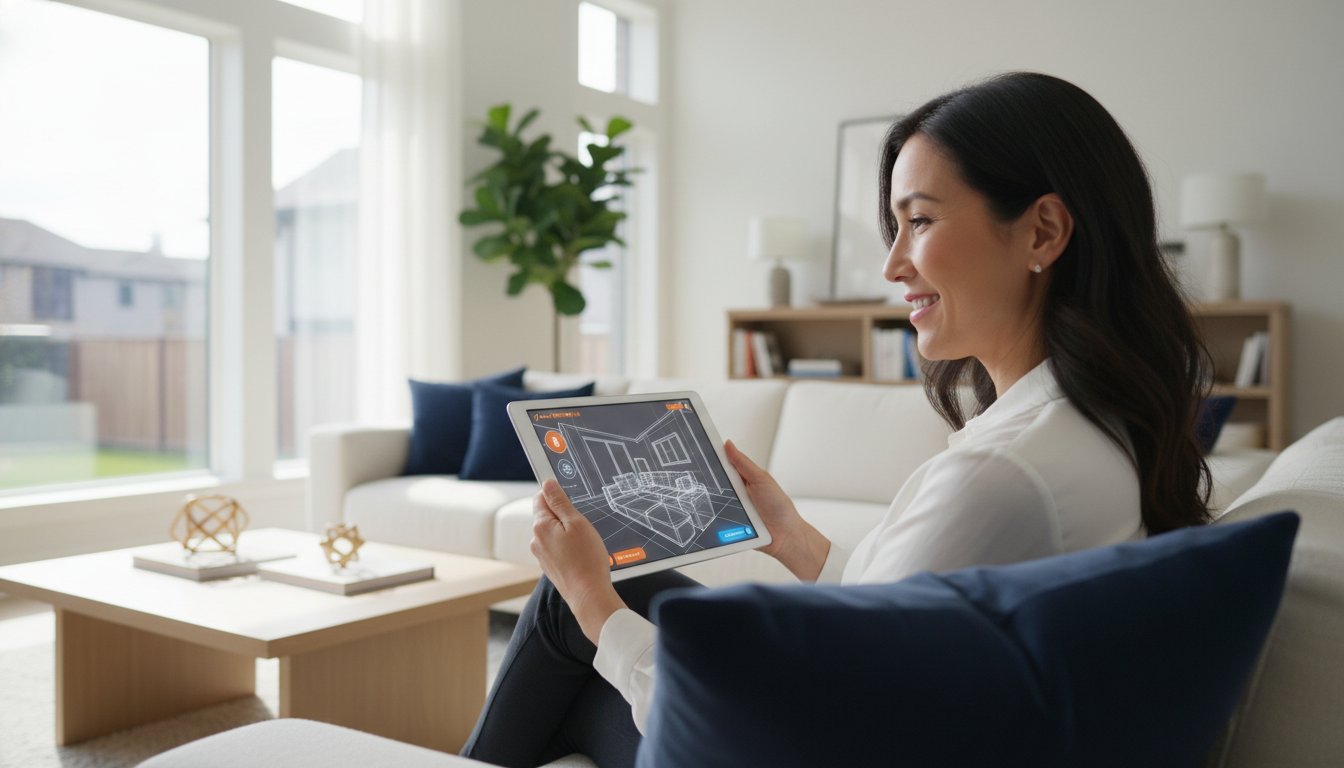
In the current real estate market, your home’s first showing doesn’t happen in the driveway. It happens on a smartphone screen. If you’re looking for virtual tour tips for selling your home, start by reframing what a digital walkthrough actually does. It functions as a 24/7 open house that works for you while you’re at work or sleeping. By the time a buyer requests an in-person visit, they’ve already walked through your kitchen and checked the layout of the primary suite. This digital-first approach is no longer a luxury; it’s the standard for serious sellers who want to maximize their reach.
Understanding what is a virtual tour is critical for any equity-conscious seller. In 2026, buyers view these digital assets as a mandatory requirement. If your listing lacks one, many serious leads will simply scroll past. This is especially true for the growing number of out-of-state buyers who are relocating for work and often make offers sight-unseen. They need the confidence that a high-resolution 3D scan provides to make a high-stakes decision from a distance.
The “Buyer Filter” Effect
One of the greatest advantages of a digital walkthrough is its ability to eliminate “looky-loo” traffic. These are casual browsers who aren’t ready to buy but still require you to stage, clean, and vacate your home for a showing. A virtual tour acts as a pre-qualification tool. It provides total transparency, which builds immediate trust with serious prospects. When buyers can explore every corner of the property online, they experience a sense of immersive ownership. They start mentally placing their furniture in your living room before they ever grab their car keys. This psychological connection leads to higher-quality offers and fewer surprises during the inspection phase because the buyer already has a realistic view of the property’s condition.
Protecting Your Equity through Digital Marketing
Traditional agents often use the promise of “open houses” to justify high commission rates. However, savvy sellers know that a professional digital presence is far more effective and less intrusive. By investing in high-quality digital assets, you bypass the need for expensive, traditional hosting services that eat into your profit. It’s essential to stay informed about understanding commissions when you’re building your marketing stack. Choosing a Professional Photography add-on for your listing isn’t just about aesthetics; it’s a strategic move to protect your equity. A small upfront investment in a professional tour often pays for itself by attracting multiple offers and reducing the time your home sits on the market. You maintain full command of the process while ensuring your listing stands out against the competition on the MLS.
Choosing the Right Virtual Tour Technology for Your Listing
Selecting the right tech for your digital presentation depends on your property’s layout and your target buyer. You don’t need a Hollywood budget to look professional, but you do need to understand the tools available in 2026. High-quality assets are the foundation of any successful Standard or Full Service listing. Whether you choose an immersive 3D model or a cinematic video, your goal is to provide a clear, honest view of the home that encourages a fast offer.
When reviewing virtual tour tips for selling your home, consider how different technologies serve different purposes. 3D models provide a structural understanding of the space, while video walkthroughs excel at building an emotional narrative. Many successful sellers now use a combination of both to provide a comprehensive experience. Beyond the visual style, ensure your chosen platform is mobile-responsive. With the majority of buyers searching on their phones, a tour that crashes or loads slowly will drive away potential leads.
3D Models: The Gold Standard for Transparency
Immersive 3D models, such as those created with Matterport, are highly effective for homes with complex floor plans. These models offer the famous “dollhouse view,” which allows buyers to see the entire home as a 3D structure. This perspective is incredibly helpful for understanding how rooms connect. According to the National Association of REALTORS® virtual tour playbook, providing this level of detail builds trust and reduces the number of basic questions you’ll have to answer. These models also allow for precise digital measurements. If a buyer is worried their sectional won’t fit in the living room, they can use the measurement tool to verify the space themselves.
Video Walkthroughs: Creating an Emotional Connection
Video walkthroughs offer a different advantage by focusing on the “flow” and vibe of the home. Use high-definition 4K video to highlight specific features like the sound of a backyard fountain or the way sunlight hits the breakfast nook. Modern attention spans are short; keep your clips under two minutes to ensure viewers stay engaged. Focus on a logical path through the home, starting at the front door and moving through the main living areas. This format is perfect for social media sharing and can quickly go viral if the production quality is high.
Technical compliance is another critical factor. Most MLS databases require “unbranded” versions of your virtual tours for syndication. This means your tour cannot contain your name, contact information, or any logos. If you upload a branded version to the primary MLS field, it may be rejected or stripped from third-party sites. Always ask your photographer for both a branded version for your personal social media and an unbranded version for your official listing. By following these technical requirements, you ensure your home gets maximum exposure across the entire professional industry network.
Staging Your Home for the Digital Lens: A Checklist
Preparing your property for a 3D scan requires a different strategy than a traditional photo shoot. Because 360-degree cameras capture an entire room simultaneously, you cannot simply shove clutter behind the photographer’s tripod like you would during a standard session. Every corner is visible. When implementing virtual tour tips for selling your home, adopt a “camera-first” mindset. This means looking at your space through the lens of a wide-angle sensor that amplifies both the beauty and the blemishes of a room.
Lighting is your most powerful tool for avoiding “dead zones” in a digital walkthrough. Open every blind and curtain to maximize natural light, as 360 cameras often struggle with the high contrast between bright windows and dark corners. Turn on every light in the house, including lamps and under-cabinet LEDs, to create a consistent exposure. You should also watch out for the “wide angle trap.” While you might think pushing furniture against the walls makes a room look larger, it often creates an unnatural, empty “caved-in” look in 3D. Arrange furniture in small, conversational groupings to help the camera define the scale and purpose of the space.
Virtual Staging: The Low-Cost Alternative
If you’re selling an empty house, AI-powered virtual staging is a game-changer for your equity. In 2026, AI services can deliver professionally staged rooms in under 30 seconds for as little as $1 to $15 per image. This allows you to transform a cold, vacant space into a designer home that resonates with your target demographic. Just remember that transparency is key. You must disclose virtual staging in your MLS listing notes to maintain trust with buyers. Choose a decor style that matches the architecture of the home to keep the digital experience feeling grounded and realistic.
Pre-Shoot Technical Preparation
Technical glitches can ruin a high-end tour. High-reflectivity surfaces like windows and mirrors can “blind” 3D sensors or cause “ghosting” effects in the final render. Clean these surfaces meticulously before the shoot. You also need to remove “trip hazards” for the lens. Hide all power cords, pet bowls, and trash cans. Since the camera sees everything, designate one specific area, like a small closet or the garage, as your “staging dump.” This is where you’ll store all the items you’ve cleared from the rest of the house. Keeping this one area off-camera allows you to maintain a pristine environment throughout the rest of the digital walkthrough.
Professional vs. DIY Virtual Tours: Maximizing Your ROI
Deciding between a DIY approach and hiring a professional is a critical step in protecting your home’s equity. While you want to minimize costs, a low-quality digital presentation can result in fewer offers and a longer time on the market. When looking for virtual tour tips for selling your home, evaluate the property’s price point and your own technical comfort level. For lower-priced properties, a high-end smartphone paired with a stabilizer gimbal can produce acceptable results. However, for most listings, the Professional Photography add-on provides a high-ROI investment that pays for itself by attracting serious buyers quickly. This is a core component of a successful flat fee MLS listing, ensuring your home competes with those represented by high-commission agencies.
Professional assets also significantly impact your “Listing Quality Score” on major platforms like Zillow and Realtor.com. These sites use algorithms to prioritize listings with high-resolution 3D tours and professional media. Better ranking means more views, which leads to more qualified leads. If you are aiming for the highest possible sale price, professional-grade imagery is the most efficient way to prove your home’s value to the market without the need for an expensive traditional agent.
The Hidden Costs of DIY
DIY isn’t always as “free” as it seems. Learning complex 3D scanning software and editing video can take days of your time. There is also the “Amateur Penalty” to consider. Poor lighting or shaky camera work can actually decrease your home’s perceived value in the eyes of a buyer. Additionally, many 3D hosting platforms require monthly subscription fees. For example, some professional-grade software requires ongoing hosting at $20 per month per tour. Professional photographers usually include these hosting costs in their flat-rate fee, saving you the hassle of managing multiple accounts.
Hiring a Pro: What to Look For
If you choose to hire an expert, ensure they understand the specific needs of an independent seller. Ask for a “Media Bundle” that includes high-definition stills, a 3D walkthrough, and interactive floor plans for a single flat rate. It’s also vital to verify that they will provide an “unbranded” link. This is a requirement for MLS compliance, as branded links with contact info will be rejected by the system. Finally, check their turnaround times. You want your media ready for peak search days, typically mid-week, to build momentum for the weekend. Ready to take control of your sale? Browse our professional listing options to find the right fit for your equity goals.
Leveraging Your Virtual Tour with Congress Realty
How do you actually get your digital assets in front of serious buyers? Having the best virtual tour tips for selling your home won’t matter if your link isn’t properly syndicated. When you choose a Standard or Full Service listing, we provide the professional infrastructure to host and distribute your media. The MLS contains a dedicated “Virtual Tour” field designed specifically for these links. Once we enter your unbranded link into this field, your tour automatically syndicates to Zillow, Realtor.com, and thousands of other brokerage sites. This ensures your home maintains the same level of visibility as any property listed by a traditional, high-commission agent.
Congress Realty handles the technical heavy lifting for you. We ensure your assets meet strict MLS compliance standards, which prevents your listing from being flagged or suppressed by local boards. Our transaction management team provides the professional oversight you need to ensure your digital marketing stays on track. You stay in command of the sale while we provide the professional industry database access that makes the process work. It’s a pragmatic, fixed-fee solution that replaces the unpredictable costs of traditional brokerages.
From Digital Click to Electronic Lockbox
The workflow for an equity-first sale is efficient and secure. A buyer clicks your virtual tour and explores the layout. Because they’ve already “walked” the home digitally, they are much more qualified than a casual browser. When they request a showing, you grant access via an electronic lockbox. This sequence significantly reduces the number of “unsupervised” entries into your home. You only open your doors for leads who have already vetted the property online. During the negotiation and escrow phase, the virtual tour remains a valuable reference tool. Buyers can revisit the digital scan to verify room dimensions or show the home to family members, keeping the momentum high through the final closing steps.
Finalizing Your Listing Strategy
The most successful sellers combine a professional CMA with high-end virtual assets to create a listing that stands out. By pricing your home accurately and presenting it with professional photography, you eliminate the need for traditional middlemen. The “Equity-First” model is the smartest way to sell your house without a realtor while maintaining professional standards. You keep your hard-earned profit and stay in total control of the transaction. Ready to maximize your equity and take charge of your sale? Get your home on the MLS today with Congress Realty and start attracting serious buyers immediately.
Take Command of Your Home Sale with Digital Precision
Mastering the digital presentation of your property is the most effective way to filter out casual browsers and focus your energy on serious, high-intent buyers. By applying these virtual tour tips for selling your home, you’ve moved beyond traditional, high-cost marketing methods. You now understand how to choose the right technology, stage for the 360-degree lens, and leverage professional media to stand out on the MLS. This strategic approach doesn’t just sell your home faster; it ensures you remain the primary beneficiary of your property’s value.
You don’t need to sacrifice professional quality to protect your equity. By choosing a smarter path, you can save the traditional 3% listing commission while still accessing professional photography and 3D tour support. With expert transaction management guiding you to a smooth closing, you stay in total control of every detail. It’s time to put your hard-earned equity back in your pocket where it belongs.
The tools for a successful, independent sale are at your fingertips. Take the lead, showcase your home’s true potential, and enjoy the financial rewards of a smart, intelligence-driven transaction.
Frequently Asked Questions
Does a virtual tour really help sell a house faster?
Yes, a virtual tour is a powerful tool to accelerate your sale. Listings with a Zillow 3D Home tour receive 79% more saves and 60% more views than those without. This increased visibility leads to more qualified leads and faster offers. By letting buyers explore the home digitally, you ensure that only serious prospects request in-person showings, which streamlines the entire transaction and saves you time.
How much does it cost to create a 3D virtual tour in 2026?
Costs vary based on whether you choose professional services or a DIY software approach. In 2026, a professional scanning service for a typical 2,000 to 3,000 square foot home generally costs between $350 and $600. If you prefer to manage the process yourself, software subscriptions range from free plans to around $69 per month. Don’t forget to account for potential hosting fees and floor plan add-ons.
Can I use my smartphone to make a professional-looking virtual tour?
You can produce a high-quality tour using a modern smartphone, provided you use the right tools. A stabilizer gimbal is essential to prevent shaky footage, which can lower your home’s perceived value. While high-end smartphones have excellent 4K sensors, you’ll still need to follow professional virtual tour tips for selling your home, such as maximizing natural light and using a tripod to ensure consistent image quality throughout the walkthrough.
What is the difference between a virtual tour and a video walkthrough?
A virtual tour is an interactive, 3D experience that allows viewers to move through the home at their own pace. This often includes the “dollhouse view” for structural clarity. A video walkthrough is a linear, cinematic movie that highlights the home’s flow and atmosphere. While a 3D tour provides transparency and measurements, a video is better for creating an emotional connection and showcasing the neighborhood’s vibe.
Will a virtual tour make my home look smaller than it is?
A virtual tour won’t make your home look smaller if you arrange your furniture correctly. Avoid pushing all items against the walls, as this can create an unnatural “caved-in” look in 360-degree captures. Instead, group furniture into conversational areas to give the camera a sense of scale. Professional lighting and clear sightlines help the digital lens capture the true volume of each room accurately.
Do I need to disclose if my virtual tour uses virtual staging?
You must disclose virtual staging in your MLS listing notes to maintain legal compliance and buyer trust. While AI-based staging is a cost-effective way to showcase an empty home’s potential, buyers expect transparency. Clearly stating that certain rooms are virtually staged prevents confusion when they visit the property in person. This honest approach builds credibility and ensures your transaction moves forward without unnecessary friction.
How do I add a virtual tour to my MLS listing without a traditional agent?
You can add a virtual tour by using a professional listing service that provides access to the MLS for a fixed fee. We provide a dedicated “Virtual Tour” field for your unbranded link, which then syndicates to major third-party real estate sites. This allows you to manage your marketing independently without paying a traditional 3% commission. It’s a pragmatic way to maintain full control over your digital assets.
Are virtual tours safe for my privacy and security?
Virtual tours are safe as long as you prepare your home for the digital lens with privacy in mind. Remove personal photos, sensitive documents, and high-value portable items before the shoot. Since the camera captures a 360-degree view, ensure you haven’t left any identifying information visible in any room. Taking these simple precautions allows you to market your home effectively while protecting your family’s personal space.