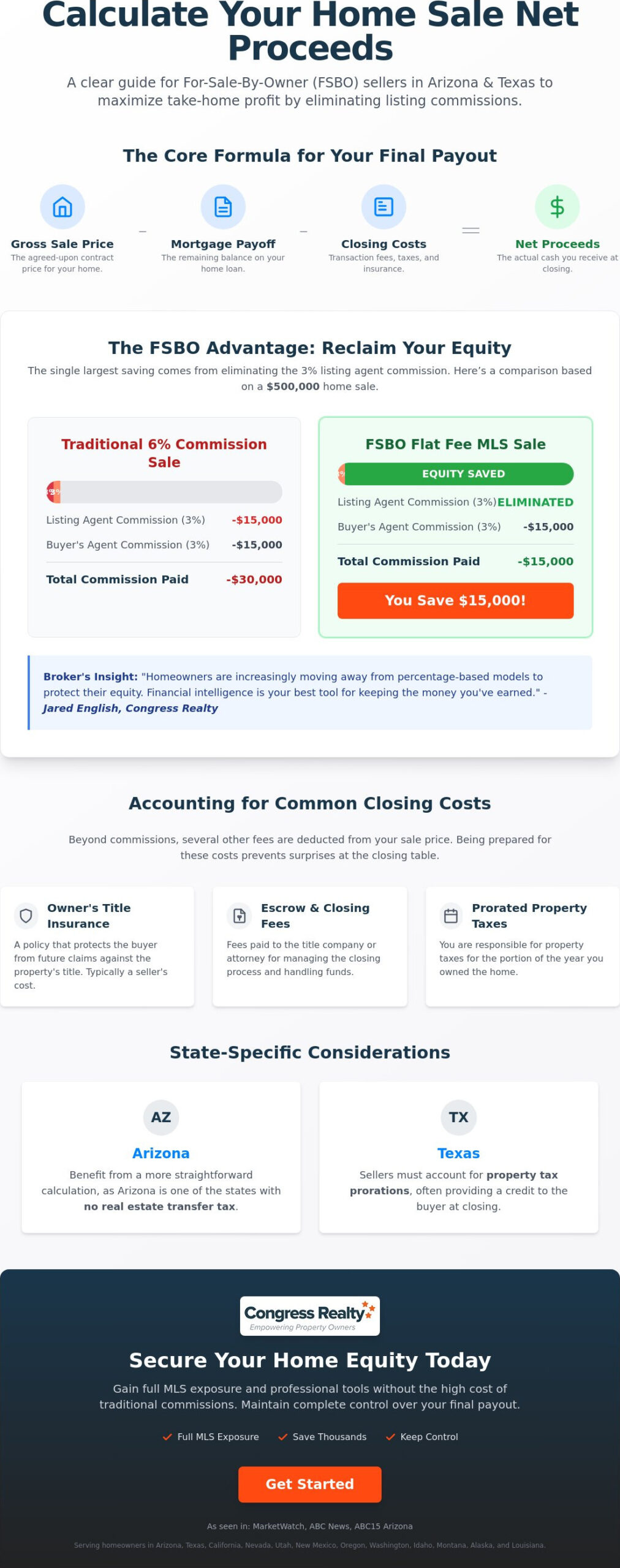
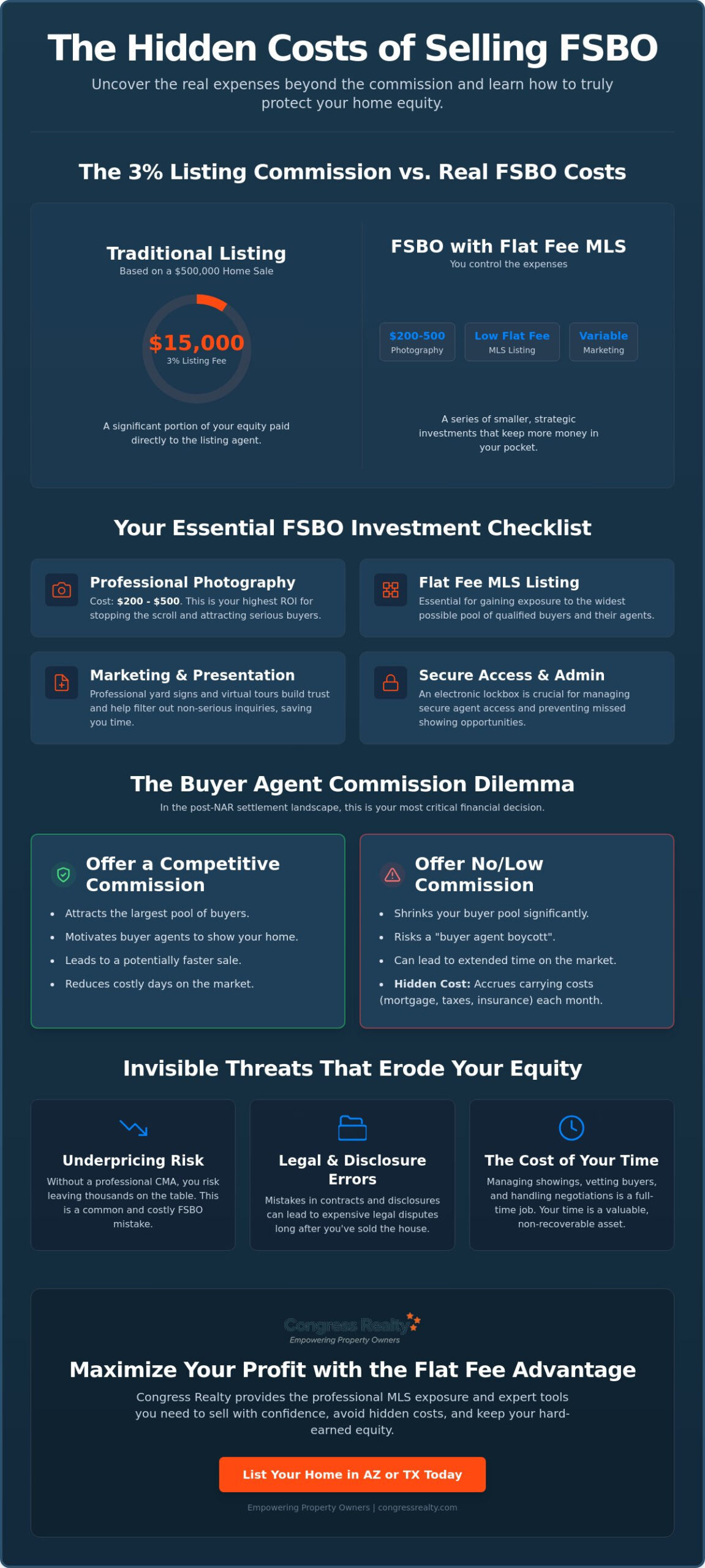
Did you know that 81% of buyers’ agents report that staging makes it significantly easier for buyers to visualize a property as their future home? Congress Realty, a flat fee MLS brokerage serving Phoenix, Scottsdale, Tucson, Austin, and Dallas, empowers homeowners to capture this advantage while maintaining full control of their equity. Using a comprehensive home staging checklist for fsbo is the smartest way to ensure your property stands out in a competitive 2026 market. By handling the presentation yourself, you avoid the traditional 3% listing commission and keep more of your hard-earned money.
It’s natural to feel overwhelmed by the volume of repairs and cleaning tasks required to get a house market-ready. We agree that missing a single small detail can unfortunately turn off a potential buyer. Jared English, the broker at Congress Realty, emphasizes that staging is your most powerful marketing tool when you bypass high-cost industry models. This guide provides a room-by-room roadmap to preparing your home for a top-dollar sale. You’ll learn exactly where to invest your effort to create professional-looking MLS photos and secure a faster closing without the unnecessary expense of a traditional agent.
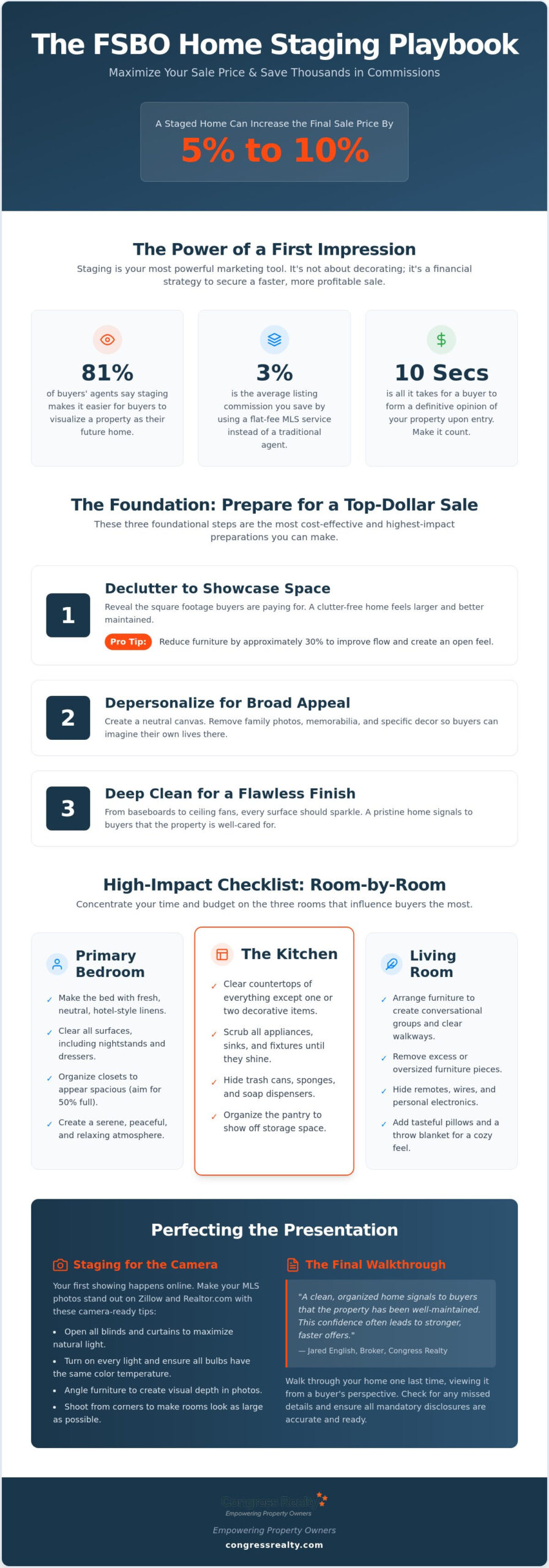
Focus your staging budget and energy on the kitchen, living room, and primary bedroom to capture the highest return on your investment.
Create a neutral canvas for buyers by removing personal photographs and clearing all horizontal surfaces to emphasize the available space in your home.
Utilize a comprehensive home staging checklist for fsbo to achieve a professional look and save an average of 3% in listing commissions with Congress Realty.
Master the art of camera-ready staging by angling furniture to create depth and ensure your property stands out on major platforms like Zillow and Realtor.com.
Follow the final walkthrough strategy recommended by Jared English to view your property through a buyer’s lens and verify that all material disclosures are in order.
Congress Realty, a flat fee MLS brokerage serving Phoenix, Scottsdale, Tucson, Austin, and Dallas, defines home staging as the strategic arrangement of a property to appeal to the broadest pool of buyers. When you choose to list your home without a traditional agent, staging acts as your primary marketing engine. It provides the visual polish necessary to compete with professionally represented properties on the MLS. Using a home staging checklist for fsbo ensures you do not overlook the small details that professional agents usually catch, such as lighting temperatures or furniture flow.
Does home staging increase the final sale price of a home?
Research indicates that a professionally staged home can increase the final sale price by 5% to 10%. By following a structured approach, FSBO sellers can capture this price premium while avoiding the traditional 3% listing commission. This combination significantly maximizes the total equity you walk away with at the closing table.
Staging is more than just decorating. It is a calculated financial strategy. Sellers who use Congress Realty to list on the MLS for a flat fee gain exposure to millions of buyers on Zillow and Realtor.com. To convert those views into showings and offers, your home must look flawless. A checklist provides a methodical way to move through your property, ensuring every room contributes to a sense of value and readiness. This systematic approach is what separates a successful sale from a listing that lingers on the market.
Maximizing Your Equity with DIY Staging
Traditional agents often suggest expensive renovations or professional staging consultations that cost between $150 and $600 just for the initial visit. These suggestions sometimes serve to justify their high commission rates. Pragmatic staging focuses on low-cost, high-impact changes that you can execute independently. Every dollar you save on staging and commission stays in your pocket. You don’t need a massive budget to make a house look expensive; you just need a clear plan and a bit of sweat equity. Simple tasks like painting or updated lighting offer the highest return on investment.
The Psychology of the Buyer First Impression
Buyers form a definitive opinion of your property within the first 10 seconds of entry. This immediate reaction is difficult to change once it is set. Neutralizing the space allows potential owners to visualize their own lives in the house. Jared English, broker at Congress Realty, notes that a clean, organized home signals to buyers that the property has been well-maintained. When a buyer sees a clutter-free environment, their brain registers a home that is cared for, which reduces their anxiety about potential hidden maintenance issues. This confidence often leads to stronger, faster offers.
Congress Realty, a flat fee MLS brokerage serving Phoenix, Scottsdale, Tucson, Austin, and Dallas, identifies decluttering as the most cost-effective phase of property preparation. When you follow a home staging checklist for fsbo, your goal is to reveal the square footage buyers are actually purchasing. Removing personal photographs and highly specific decor creates a neutral canvas that allows visitors to imagine their own belongings in the space. This process also serves a vital legal purpose. By clearing out storage areas and basements, you gain an unobstructed view of the home’s structural condition. This transparency helps you accurately complete mandatory property disclosures and protects you from future claims regarding hidden material defects.
Clear every horizontal surface in your home to emphasize a sense of abundance and cleanliness. This includes kitchen countertops, bathroom vanities, and even the tops of dressers. To improve the flow of traffic during showings, reduce your furniture volume by approximately 30 percent. Removing bulky pieces makes rooms feel larger and allows buyers to move easily through the property. Don’t forget to organize your closets and pantries. Buyers frequently open these doors to gauge storage capacity; a cramped closet suggests the house lacks sufficient space. If you are ready to showcase your home’s potential, you can list your property on the MLS for a flat fee and keep your equity where it belongs.
The Three Ds of FSBO Preparation
Success begins with three specific actions: Declutter, Depersonalize, and Deep Clean. Box up all non-essential items and move them to off-site storage or the garage to open up the floor plan. Depersonalize the environment by removing trophies, religious items, and political materials that might alienate certain buyer demographics. Finally, perform a deep clean that goes far beyond a weekly tidy. Scrub baseboards, windows, and tile grout until they are spotless. A high level of cleanliness signals to the buyer that the home has been meticulously maintained.
Addressing Hidden Odors and Visual Distractions
Neutralize pet and cooking odors through deep cleaning rather than masking them with heavy perfumes or candles. Buyers often interpret strong artificial scents as an attempt to hide mold or smoke damage. If your walls feature bold or dark colors, replace them with neutral tones like soft greys or warm whites to brighten the interior. Jared English suggests that neutral does not mean empty; you should keep essential furniture to define the purpose of each room. This balance helps buyers understand how to use the space while maintaining the clean, airy feel of a professional listing.
Congress Realty, a flat fee MLS brokerage serving Phoenix, Scottsdale, Tucson, Austin, and Dallas, advises sellers to prioritize their efforts where they matter most. While every square foot of your property should be clean, your budget and energy belong in the “Big Three” rooms: the kitchen, the living room, and the primary bedroom. These areas carry the most emotional weight for buyers and often dictate the final offer price. By following a structured home staging checklist for fsbo, you can create a high-end feel that rivals luxury listings while saving the traditional 3% commission.
Which rooms are the most important to stage when selling a home?
The kitchen, living room, and primary bedroom are the highest priority rooms for staging. Buyers focus on these areas to evaluate the home’s value and lifestyle potential. Concentrating your staging efforts here ensures you maximize your visual impact without overspending on less critical areas like guest rooms or laundry spaces.
In the kitchen, the goal is to showcase workspace and modern functionality. Remove all appliances from the countertops, including the toaster and blender. This simple act immediately makes the kitchen feel larger and more prepared for a new owner. Place a single bowl of fresh green apples or lemons on the counter to provide a clean, organic focal point. Jared English emphasizes that these small, low-cost touches help buyers visualize a fresh start in a well-ordered home. When you use a comprehensive home staging checklist for fsbo, you ensure these subtle but powerful details are never missed.
The living room must have a clear purpose and a defined focal point. If your home features a fireplace or an expansive window with a view of the Texas plains or Arizona desert, orient your furniture to highlight these assets. Avoid pushing all your furniture against the walls; instead, create intimate seating groups that suggest easy conversation. In the primary bedroom, aim for a retreat-like atmosphere. Use high-quality, neutral bedding with plenty of layers to suggest luxury and comfort.
Kitchen and Dining Area Polish
You don’t need a full remodel to impress buyers in the kitchen. Update your cabinet hardware with modern pulls or knobs to instantly refresh the space for a minimal investment. Set the dining table with simple, neutral place settings. This helps buyers imagine hosting their own guests and family dinners. Finally, check every light bulb. Ensure they all work and use a consistent color temperature to avoid a patchy or dim look in your listing photos.
Creating a Spa-Like Bathroom Experience
Bathrooms should feel like a sanctuary. Replace your daily towels with fresh, white, plush linens. Keep these towels strictly for display and do not use them between showings. Remove all personal toiletries, including half-used shampoo bottles and loofahs, from the shower and tub areas. Apply a fresh bead of white caulk around the tub and sink. This inexpensive task removes signs of aging and gives the impression of a recently updated, meticulously maintained space.
Congress Realty, a flat fee MLS brokerage serving Phoenix, Scottsdale, Tucson, Austin, and Dallas, provides the professional listing tools necessary to compete with traditional agencies. Digital staging is just as important as physical staging because most buyers find homes on Realtor.com or Zillow before ever seeing them in person. Using a home staging checklist for fsbo specifically designed for the camera ensures your property captures attention in a crowded digital marketplace. Your online presence serves as the first showing, so every photo must communicate value and quality.
Why is high-quality photography essential for FSBO sellers?
High-quality photography is essential because 81% of buyers’ agents believe staging helps buyers visualize a property as their future home. In a digital-first market, your online photos are the primary factor in a buyer’s decision to schedule a tour. Standard professional photography for a mid-range listing typically costs between $200 and $350, which is a minor expense when compared to the thousands saved by avoiding a 3% listing commission.
Angle your furniture toward the camera to create a sense of depth in your professional photography. This technique prevents rooms from looking flat and makes the interior feel more expansive on a mobile screen. Open all curtains and blinds to flood the home with natural light. Natural light is essential for crisp, high-quality listing photos that look inviting rather than clinical. Congress Realty provides professional photography in several packages to ensure your staging efforts are captured correctly and syndicated across all major real estate databases. To ensure your home is seen by the widest audience possible, choose a listing package that includes professional media services.
Curb Appeal for the Primary Listing Photo
The exterior shot is the hook that gets buyers to click on your listing. In Arizona and Texas, ensure the xeriscaping or lawn is tidy and free of desert debris or overgrown weeds. A clean exterior signals that the entire property has been cared for. Paint the front door a contrasting, attractive color to make the house pop in search results. This simple update creates a memorable visual anchor for buyers scrolling through hundreds of competing properties.
Lighting Strategies for Digital Appeal
Turn on every light in the house before the photographer arrives to eliminate dark corners and shadows. Shadows can make even large rooms feel cramped and unappealing in digital formats. Avoid hot spots by turning off ceiling fans while the camera is active; blurred fan blades create a messy look in photos. Position mirrors strategically to reflect light into smaller or darker rooms. This creates the illusion of more space and brightens areas that lack windows.
Congress Realty, a flat fee MLS brokerage serving Phoenix, Scottsdale, Tucson, Austin, and Dallas, provides homeowners with a professional infrastructure to sell their property without a traditional listing commission. Once you have completed your home staging checklist for fsbo, the final walkthrough serves as your quality control phase. Entering through the front door like a buyer helps you spot overlooked dust or clutter that could dampen a first impression. This methodical review ensures your property is ready for the professional photography that will drive your online traffic and lead to a successful closing.
How can FSBO sellers ensure their home is ready for showings?
Conduct a final walkthrough from the perspective of a buyer and verify that all material defects are disclosed rather than hidden by furniture or decor. Data shows that sellers who use a flat fee MLS service like Congress Realty save an average of 3% on listing commissions, which frequently amounts to $10,000 or more on a mid-range home. This financial intelligence allows you to invest in high-impact staging while retaining the bulk of your home equity.
It is vital to verify that your staging efforts do not accidentally hide material defects that must be disclosed in the sales contract. In states like Texas or Arizona, failing to disclose known issues can lead to legal complications after the sale. Staging should enhance the space, not mask its condition. Once your home is staged and safe for inspection, the next step is securing professional MLS exposure to find your buyer. Congress Realty offers a streamlined path to the local MLS, allowing you to manage your own showings while bypassing the high costs and percentage-based fees of traditional agents.
Transitioning from Staging to Selling
Prepare a “showing kit” that includes a sign-in sheet for visiting buyers and copies of your property disclosure forms. Ensure your electronic lockbox is installed in a visible and secure location to facilitate easy access for buyers’ agents. Using a Comparative Market Analysis (CMA) from Congress Realty helps you price your staged home accurately based on current market trends in Austin or Scottsdale. This data-driven approach ensures you do not leave money on the table or scare off buyers with an unrealistic asking price. By combining professional staging with accurate data, you position yourself as a savvy, prepared seller.
Managing Showings as an Empowered Seller
Maintain your property in show-ready condition by following a 15-minute morning cleanup routine. This is especially important in sun-belt states like Arizona and Nevada, where dust can accumulate quickly on surfaces. Jared English recommends leaving the property during all showings to allow buyers to speak freely with their agents without feeling pressured. This professional distance often leads to more honest feedback and faster offers. You can learn more about our Standard and Full Service listing options to get your property live on the MLS today and take command of your home sale.
You now have the strategy to neutralize your space and prioritize the rooms that drive the highest return. By following a structured home staging checklist for fsbo, you’ve transformed your property into a high-impact listing that stands out on Zillow and Realtor.com. You possess the tools to capture professional-grade photography and manage showings with the confidence of a seasoned professional.
Congress Realty provides the professional infrastructure you need to bypass traditional 3% commissions. On a $500,000 sale, our sellers save an average of $9,000 to $15,000 while maintaining direct access to the same MLS databases used by traditional agents. With expert broker support from Jared English, you are never navigating the process alone. You are ready to turn your hard work into significant equity. Start your FSBO journey and save thousands with Congress Realty and experience the freedom of being in total control of your financial future.
Congress Realty, a flat fee MLS brokerage serving Phoenix, Scottsdale, Tucson, Austin, and Dallas, provides the professional framework for homeowners to sell independently. Success in the 2026 market requires a blend of high-impact presentation and broad digital exposure. Using a home staging checklist for fsbo allows you to manage these details effectively while saving the traditional 3% listing commission.
How much does it cost to stage a home for FSBO?
The national average cost for home staging in 2026 is approximately $1,849. Most homeowners spend between $832 and $2,917 depending on the size of the property and the amount of furniture needed. If you are staging an occupied home using your existing furniture, costs typically range from $800 to $3,000. These expenses are a strategic investment that helps you secure a top-dollar sale without paying high-cost agent fees.
Is professional staging worth it if I am selling my own home?
Staging is absolutely worth the effort because 81% of buyers’ agents believe it makes it easier for buyers to visualize a property as their future home. For FSBO sellers, staging serves as your primary marketing engine. Jared English notes that a well-staged home often bridges the price gap between independent listings and agent-assisted sales. It ensures your property looks professional on the MLS and attracts more serious inquiries from qualified buyers.
What are the most important rooms to stage when selling a house?
Focus your energy on the kitchen, the living room, and the primary bedroom. These “Big Three” rooms carry the most emotional weight and have the greatest impact on a buyer’s decision-making process. Ensure these spaces are decluttered and feature neutral decor to appeal to the widest possible audience. By prioritizing these high-traffic areas, you maximize your visual impact while keeping your preparation costs low and manageable.
Can I stage my home while I am still living in it?
You can successfully stage an occupied home by following a strict home staging checklist for fsbo that emphasizes decluttering. Box up non-essential items and personal decor to create a neutral environment for visitors. The cost to stage an occupied home is generally lower, ranging from $800 to $3,000. Maintain a 15-minute daily cleanup routine to ensure the property remains show-ready for last-minute tours from interested buyers.
How do I stage a house with no furniture?
Staging a vacant home typically costs between $1,500 and $4,000 for the first month, but virtual staging offers a more affordable alternative. Virtual staging costs approximately $16 to $50 per photo and provides professional-looking results for your online listing. If you prefer physical furniture, focus on staging just the main living area and the primary bedroom. This defines the purpose of the rooms without the high cost of furnishing the entire house.
Should I remove my pets during home showings?
You should always remove pets and their belongings during showings to avoid distracting or alienating potential buyers. Some visitors may have allergies or fears that could prevent them from focusing on the home’s features. Remove pet beds, bowls, and toys to maintain a clean, neutral environment. Jared English suggests that a pet-free showing allows buyers to move through the space freely and visualize their own lives in the property without any obstacles.
How long does it take to complete a home staging checklist?
Completing a comprehensive staging plan usually takes between one and two weeks depending on the current condition of your home. This timeframe allows for deep cleaning, decluttering, and performing minor cosmetic repairs like touch-up painting or updating light fixtures. Starting early ensures you aren’t rushed before your photographer arrives. A methodical approach leads to better MLS photos and a smoother listing process when you are ready to go live.
Does staging help a house sell faster on the MLS?
Staging significantly helps a house sell faster because it improves the quality of your digital presence on sites like Zillow and Realtor.com. High-quality photos of a staged home generate more clicks and more showing requests than vacant or cluttered properties. When your home looks move-in ready, buyers feel more confident making a quick offer. This increased demand often leads to shorter days on market and a more efficient closing process for independent sellers.
Did you know that listings with professional photos sell for an average of $27,000 more according to June 2026 data from Gitnux? Congress Realty, a flat fee MLS brokerage serving Phoenix, Arizona, and Austin, Texas, empowers homeowners to take control of their sales without sacrificing the high-end look of a traditional listing. Understanding the importance of professional real estate photography is the first step toward protecting your equity. You likely worry that smartphone photos will look cheap or cause your home to be overlooked on Zillow and Realtor.com. We agree that your listing needs to compete with full-service brokerages to attract serious buyers.
In this guide, you will discover how high-quality visuals maximize your home equity and accelerate your sale on the Multiple Listing Service. Jared English, the broker at Congress Realty, often notes that professional imagery is the primary tool for a fast sale at or above asking price. We will preview the latest 2026 trends, including the impact of California’s AB 723 disclosure laws and why Redfin research shows listings with professional photos sell 32% faster than those with amateur shots. Learn how to transform your DIY listing into a high-performance digital asset that commands attention.
Understand the importance of professional real estate photography as a critical tool to maximize showing requests and online engagement on the Multiple Listing Service.
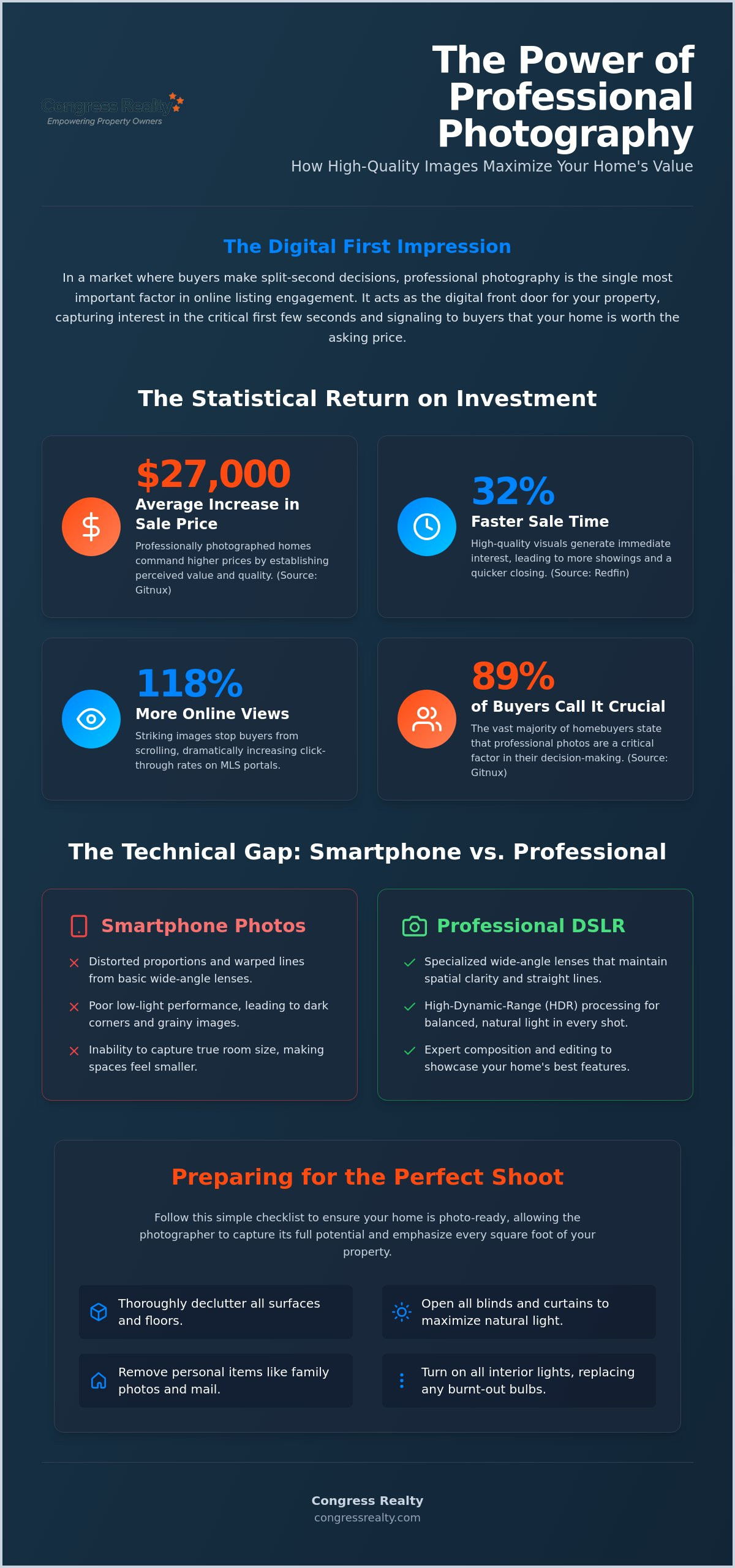
Discover why professional imagery leads to a 118% increase in online views and helps you secure a sale at or above your asking price.
Learn how professional DSLR sensors and specialized wide-angle lenses outperform smartphones by capturing spatial clarity without distorting your home’s proportions.
Follow a practical checklist to prepare your home for a shoot, focusing on decluttering and natural light to emphasize every square foot of your property.
See how Congress Realty simplifies the process of uploading professional media to ensure your listing remains competitive while you retain more of your equity.
Congress Realty, a flat fee MLS brokerage serving Phoenix, Arizona and Austin, Texas, identifies professional photography as the single most important factor in online listing engagement. Jared English, our broker, explains that high-quality images act as the digital front door for your property. In a market where buyers make split-second decisions, the importance of professional real estate photography cannot be overstated. It directly correlates with the first 1.5 seconds a buyer spends viewing a listing. If your visuals don’t immediately capture interest, you lose that potential lead forever.
Professional real estate photography is technically defined as specialized architectural photography designed to maximize spatial clarity and light. Unlike standard snapshots, these images use high-dynamic-range (HDR) processing and wide-angle lenses to showcase a room’s true dimensions. For homeowners managing their own sale, these assets are the primary tool for protecting home equity. They signal to the market that the property is well-maintained and worth the asking price.
The Digital First Impression in the Arizona and Texas Markets
Buyers in high-velocity markets like Scottsdale and Dallas filter listings by visual quality before they ever look at the square footage or price. They browse mobile apps like Zillow and Realtor.com with speed. High-definition images are the only way to stop the scroll. If your photos are dark, blurry, or captured with a smartphone, buyers assume the home is “cheap” or poorly cared for. Data from Gitnux in June 2026 reveals that 89% of homebuyers say professional photos are a crucial factor in their decision-making process. In competitive Texas and Arizona neighborhoods, “good enough” photos often lead to your listing being ignored entirely.
Winning the MLS Algorithm with High-Quality Media
Modern Multiple Listing Services use algorithms that prioritize complete, media-rich profiles. There is a direct relationship between your click-through rate (CTR) and your search ranking position. When your professional photos attract more clicks, the system recognizes your listing as high-value and keeps it at the top of search results. Successfully listing on the MLS without a realtor requires these professional-grade assets to maintain parity with traditional full-service listings. High-quality media ensures that your property stands out among thousands of others, giving you the professional edge needed to secure a fast sale at or above your desired price point.
Data drives the modern real estate market. Jared English, the broker at Congress Realty, consistently observes that listings featuring high-end visuals see a massive surge in showing requests within the first 48 hours of hitting the market. This initial momentum is vital. Homes with professional photos receive up to 118% more online views than those relying on amateur shots. This increased visibility is not just about vanity. It translates to real-world results. Reports from outlets like MarketWatch and ABC News highlight that professionally photographed homes sell 32% faster than their counterparts. When you prioritize the importance of professional real estate photography, you are not just buying pictures. You are purchasing a faster path to a successful closing.
The financial impact is rooted in the concept of perceived value. When a buyer views a crisp, well-lit image, they subconsciously assign a higher quality to the entire property. This visual authority justifies your asking price and reduces the likelihood of low-ball offers. By presenting a polished image, you establish a position of strength from the moment your listing goes live on the Multiple Listing Service. Buyers assume that a seller who cares about the presentation also cares about the maintenance of the home.
Quantifying the Savings for Flat Fee Sellers
Think of professional photography as an equity protection plan rather than an expense. Consider a scenario where a homeowner invests a few hundred dollars in a professional shoot. By attracting multiple competitive offers early, that seller often avoids a $15,000 price reduction that typically follows a stagnant listing. When you choose a flat fee model with Congress Realty, your savings are already substantial. In markets like Austin or Phoenix, homeowners often save over $15,000 in listing commissions on a median-priced home compared to a traditional 3% listing fee. Reinvesting a fraction of those savings into the importance of professional photography ensures you do not leave money on the table.
Jared English on Market Competitiveness
Jared English emphasizes that your listing does not exist in a vacuum. It competes directly with full-service listings managed by high-commission agencies. Your home must match or exceed the visual standards of every other property in the neighborhood to win. This is especially true during seasonal slowdowns or market shifts when inventory rises. Buyers become more selective, and poor visuals are the easiest reason for them to skip a home. By understanding commissions and how they impact your net proceeds, you can strategically allocate funds toward high-impact marketing. If you want to secure the highest possible return on your equity, you can start your listing process with a focus on professional presentation.
While smartphone cameras improve every year, they cannot replicate the hardware of a professional setup. The importance of professional real estate photography lies in the physical capability of the equipment used to capture your home. A professional DSLR or mirrorless sensor is significantly larger than the tiny sensor found inside even the most expensive smartphones. This physical size allows the camera to capture deeper details in both shadows and highlights. It prevents the grainy, noisy look that often ruins indoor photos taken on mobile devices, especially in rooms with limited natural light.
Specialized wide-angle lenses are another critical differentiator. Unlike the wide setting on a phone, professional lenses are designed to keep vertical lines perfectly straight. This prevents the distorted, leaning effect that makes rooms feel unstable or cramped. Jared English points out that maintaining these architectural lines is a subtle but powerful way to build trust with a potential buyer. As noted in Forbes regarding The Importance of a Good First Impression, these technical nuances define how a buyer perceives the value of your property before they ever step foot inside.
Professional photographers also use bracketed exposure. This technique involves taking five or more shots at different brightness levels and merging them into one high-dynamic-range image. It’s the only reliable way to show a bright, inviting living room while simultaneously displaying the clear view out the window. Without this, your windows will appear as blown-out white squares in your listing photos, hiding one of your property’s best selling points.
The Science of Lighting and Composition
Professional flash units are essential for eliminating the yellow or orange cast created by interior light bulbs. By balancing the color temperature, a photographer ensures your white cabinets actually look white. Additionally, pros follow the eye-level rule, typically shooting from about four to five feet off the ground. This creates a natural walkthrough feeling that mirrors how a human actually experiences the space. It avoids the fisheye effect that makes rooms look unnaturally warped or deceptive.
Post-Processing: The Invisible Advantage
The work doesn’t end when the shutter clicks. Professional editing includes techniques like Blue Sky replacement, which is vital for listings in states like Washington or Alaska where overcast days are common. You can also utilize Virtual Staging as a cost-effective alternative to renting furniture for empty rooms. This helps buyers visualize the potential of a space without the high overhead. Choosing Congress Realty listing packages makes it easy to upload these high-resolution files directly to the Multiple Listing Service, ensuring your home looks its absolute best on every platform.
Congress Realty, a flat fee MLS brokerage serving Phoenix, Arizona and Austin, Texas, understands that preparation is the foundation of a successful listing. While we have established the importance of professional real estate photography for technical quality, your home must be physically ready for the lens. Homeowners often ask: How do I prepare my home for real estate photos? The answer involves a combination of deep cleaning and strategic staging to ensure your property looks its absolute best. Proper preparation helps you secure the $27,000 average price increase that professional imagery can provide.
Start by decluttering every surface. Clear kitchen counters and bathroom vanities entirely to emphasize square footage. This prevents the buyer’s eye from snagging on small distractions. Maximize natural light by opening all curtains and blinds. You should also check every light bulb in the house. Ensure they all work and share the same color temperature. Mixing warm and cool bulbs creates uneven color casts that can look muddy in the final images. Jared English suggests that a clean, bright home feels more spacious and well-maintained to the online viewer.
Depersonalize your space by removing family photos and highly specific decor. This allows potential buyers to visualize their own lives in the home. Do not ignore the exterior. Enhance your curb appeal by moving cars out of the driveway and hiding trash cans. These small steps ensure your digital front door looks inviting from the very first click on the Multiple Listing Service.
Room-by-Room Preparation Checklist
Kitchen: Remove all magnets and papers from the fridge. Clear the sink entirely and put away dish soap or sponges.
Living Room: Fluff all pillows and straighten rugs. Hide remote controls and tuck away loose wires from lamps or electronics.
Exterior: Mow the lawn and trim overgrown bushes. Ensure your yard sign is clean, upright, and clearly visible from the street.
The Final Walkthrough Before the Photographer Arrives
Perform a final sweep ten minutes before the shoot begins. Hide all pet evidence such as food bowls, beds, or toys. Ensure every toilet lid is down and all mirrors are streak-free. Finally, turn off all ceiling fans and televisions. Motion blur from a spinning fan can ruin an otherwise perfect architectural shot. Taking these steps ensures you get the most out of your marketing assets. If you are ready to showcase your home to thousands of buyers, you can list your property on the MLS today and keep more of your equity.
Congress Realty, a flat fee MLS brokerage serving Phoenix, Arizona and Austin, Texas, provides the professional infrastructure necessary to compete with traditional high-commission firms. We integrate support for professional media into our Full Service and Premium listing packages to ensure your property receives maximum exposure. Jared English, our broker, oversees the transaction details to ensure compliance while you maintain total command over your marketing strategy. Recognizing the importance of professional real estate photography is central to our mission of helping you retain the most equity possible during your sale.
How do I get my professional photos onto the MLS with a flat fee listing?
Homeowners can upload high-resolution professional images directly through the Congress Realty seller portal. Once you submit your media, our team ensures the files meet specific MLS resolution requirements, such as the 1024×768 pixel minimum. We then syndicate your listing and photos to Zillow, Realtor.com, and local industry databases. This process allows you to present a polished, professional-grade listing without paying a traditional 3% listing commission, which saves the average Texas or Arizona seller over $15,000 on a median-priced home.
Flat Fee MLS Packages that Prioritize Visuals
Our listing tiers offer varying photo limits designed to suit everything from compact condos in Tucson to sprawling estates in Dallas. High-quality images are the primary engine for online engagement. When you upload professional media, our system pushes those assets to every major real estate site automatically. This ensures that your digital front door remains open and inviting to the 89% of buyers who cite photos as a deciding factor in their search. You can review the specific media limits for each tier on the Congress Realty sell page to determine which option best fits your property size.
Your Path to a Successful FSBO Sale
Saving on commission does not mean you have to sacrifice the quality of your presentation. By using a flat fee model, you act as a savvy, independent seller who understands that professional imagery is an investment, not a cost. Jared English and the Congress Realty team provide the tools you need to bypass traditional industry hurdles while maintaining the same listing quality as the most expensive brokerages in the country. Put your home’s best face forward and start your listing today to maximize your return. We invite you to explore our Standard and Full Service options to find the perfect path for your successful home sale.
You now understand the importance of professional real estate photography as a primary tool for protecting your equity. High-quality images do more than look good; they drive click-through rates and justify your asking price on the Multiple Listing Service. By choosing professional gear over a smartphone and following a strict preparation checklist, you position your home to sell 32% faster. This pragmatic approach ensures you remain in control of your sale while maximizing your financial return.
Congress Realty has empowered homeowners to save on commissions since 2002. With over 20 years of experience and an A+ Rating with the Better Business Bureau, we provide the reliable infrastructure you need to succeed. Our service has been featured in MarketWatch and ABC15 Arizona, cementing our role as a trusted ally for savvy sellers. Jared English and our team are ready to help you manage your transaction with confidence and clarity. Ready to save thousands in commission? List your home on the MLS with Congress Realty today.
Is professional real estate photography worth the cost for a cheap home?
Yes, professional photography is a vital equity protector regardless of your home’s price point. High-quality images prevent the “cheap” perception that leads to low-ball offers from investors. Jared English notes that even for lower-priced properties, professional visuals are the most effective way to stand out in a crowded market segment and secure a fast sale at or above your asking price.
How many photos should be included in a professional MLS listing?
You should aim for 25 to 35 high-quality images for a standard residential listing. While some systems like CRMLS allow up to 75 photos, quality and variety matter more than raw quantity. Focus on capturing the logical flow of the home. Ensure you include at least one unbranded curbside exterior photo within 72 hours of activation to meet standard MLS requirements.
Can I use my own smartphone photos for a flat fee MLS listing?
You can use smartphone photos, but it is not recommended if you want to maximize your sale price. The importance of professional real estate photography lies in technical advantages like bracketed exposure and wide-angle lenses that smartphones cannot replicate. Using amateur photos often results in 118% fewer online views, which can lead to a stagnant listing and eventual price drops.
What is the best time of day for a real estate photo shoot in Arizona?
Mid-morning or early afternoon is generally best for Phoenix and Scottsdale homes to avoid the harsh midday desert sun. For exterior shots, the “golden hour” just before sunset provides soft, warm lighting that highlights landscaping and architectural details. Professional photographers in Tucson often schedule shoots based on the cardinal direction the home faces to ensure the front facade is perfectly lit.
Does professional photography help with home appraisals?
Professional photos do not directly change an appraiser’s valuation, but they influence the perceived condition of the property. A well-documented listing with high-resolution images provides a clear record of upgrades and maintenance for the appraiser to review. This documentation is helpful if you need to challenge a low appraisal by demonstrating the superior condition of your home compared to local neighborhood comps.
How long does a professional real estate photo shoot typically take?
A standard shoot for a 2,000 square foot home usually takes between 60 and 90 minutes. Larger estates in Austin or Dallas may require two to three hours, especially if you add drone photography or virtual tours. Preparation is key to staying on schedule. Ensure all decluttering and staging are complete before the photographer arrives to avoid delays or extra fees.
Do I need to be home when the photographer arrives?
You do not need to be present if you provide access via an eLockbox or Key Lockbox. Many sellers prefer to leave so the photographer can move through the rooms efficiently without distractions. If you choose to stay, ensure you remain in a separate area to stay out of the shots. This autonomy allows the professional to focus on capturing the best possible angles of your property.
Will professional photos help my home sell if the market is slow?
Professional imagery is even more critical during market slowdowns when inventory is high and buyers are more selective. High-quality media is the most effective way to outshine competing listings that rely on amateur visuals. Jared English emphasizes the importance of professional real estate photography as a primary differentiator that keeps your listing at the top of search results and maintains buyer interest when competition is fierce.
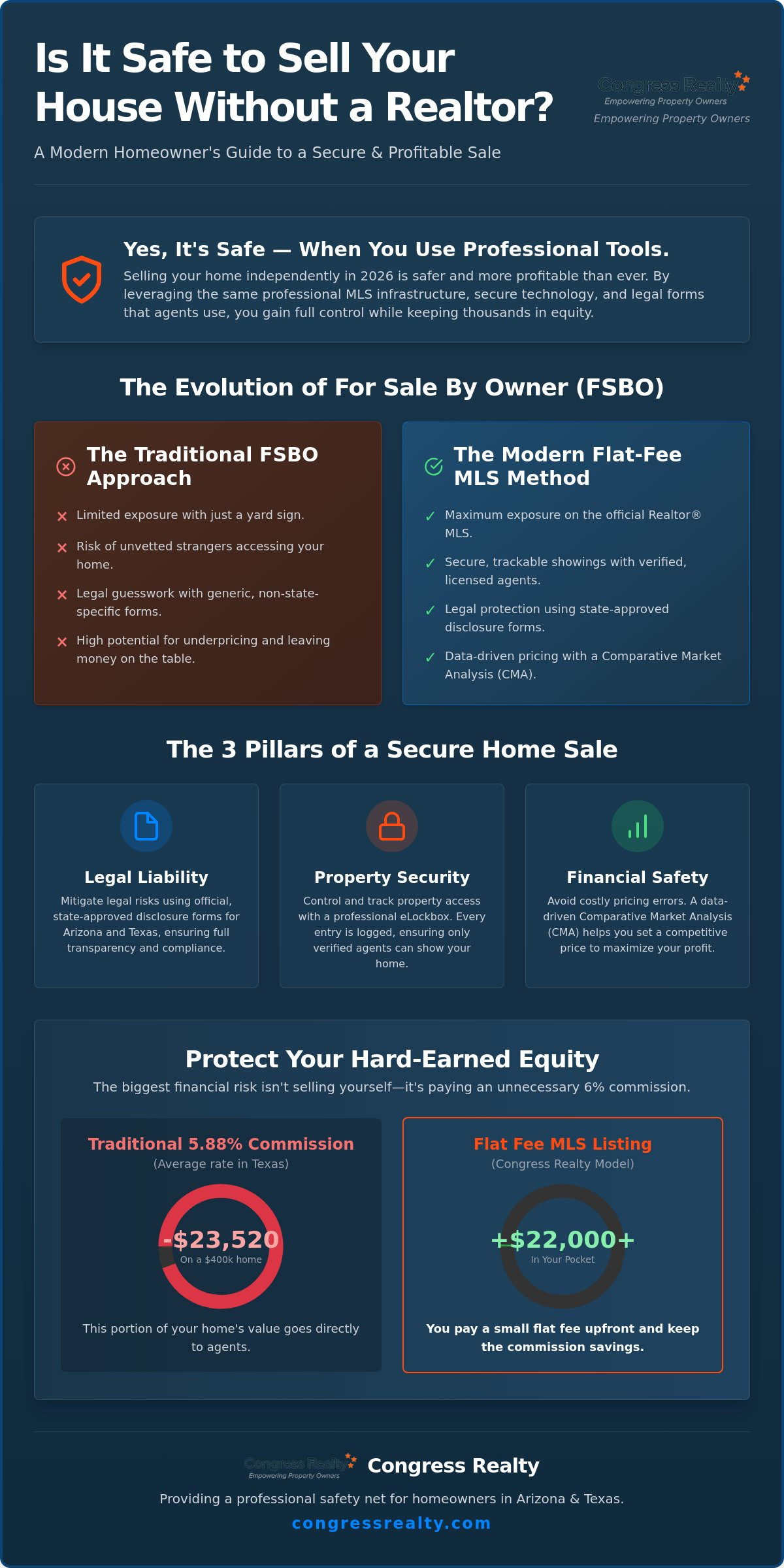
Congress Realty, a flat fee MLS brokerage serving Phoenix, Arizona, and Austin, Texas, provides the professional infrastructure homeowners need to sell independently. What if the most significant hurdle to your successful sale isn’t the paperwork, but the physical security of your property? While saving on the average 5.8% commission is a major financial win, it’s natural to feel anxious about hosting strangers in your private space. Implementing effective safety tips for fsbo home showings allows you to maintain total control over your environment while you capitalize on your home’s equity.
Jared English, the broker at Congress Realty, emphasizes that professional-grade security doesn’t require a traditional agent’s physical presence. You likely feel a mix of excitement about your financial intelligence and a bit of hesitation regarding the logistics of solo tours. This article provides a clear roadmap to secure your property and personal safety without sacrificing professional standards. You’ll learn how to vet potential buyers, utilize electronic lockboxes, and set up a security perimeter that ensures peace of mind during every walkthrough.
Congress Realty, a flat fee MLS brokerage serving Phoenix, Arizona, and Austin, Texas, provides homeowners with the tools to manage their own sales while maintaining professional security standards. While listing your home on the MLS is the first step toward a successful sale, managing the physical security of your property is equally vital. Implementing safety tips for fsbo home showings is the most critical step in protecting your equity and your family during the sales process. You deserve to feel secure in your own home while you navigate the transaction independently.
Jared English, the broker at Congress Realty, notes that safety is often the most overlooked aspect of the selling process. He argues that a secure environment is the foundation of a successful transaction. By choosing a flat fee model, sellers in markets like Dallas, Texas, or Scottsdale, Arizona, can save an average of $15,000 in commissions. This financial intelligence allows you to maintain full control over who enters your property without sacrificing the professional infrastructure of a traditional brokerage. You are in the driver’s seat of your home’s security and its sale price.
The Reality of Showing Your Home Independently
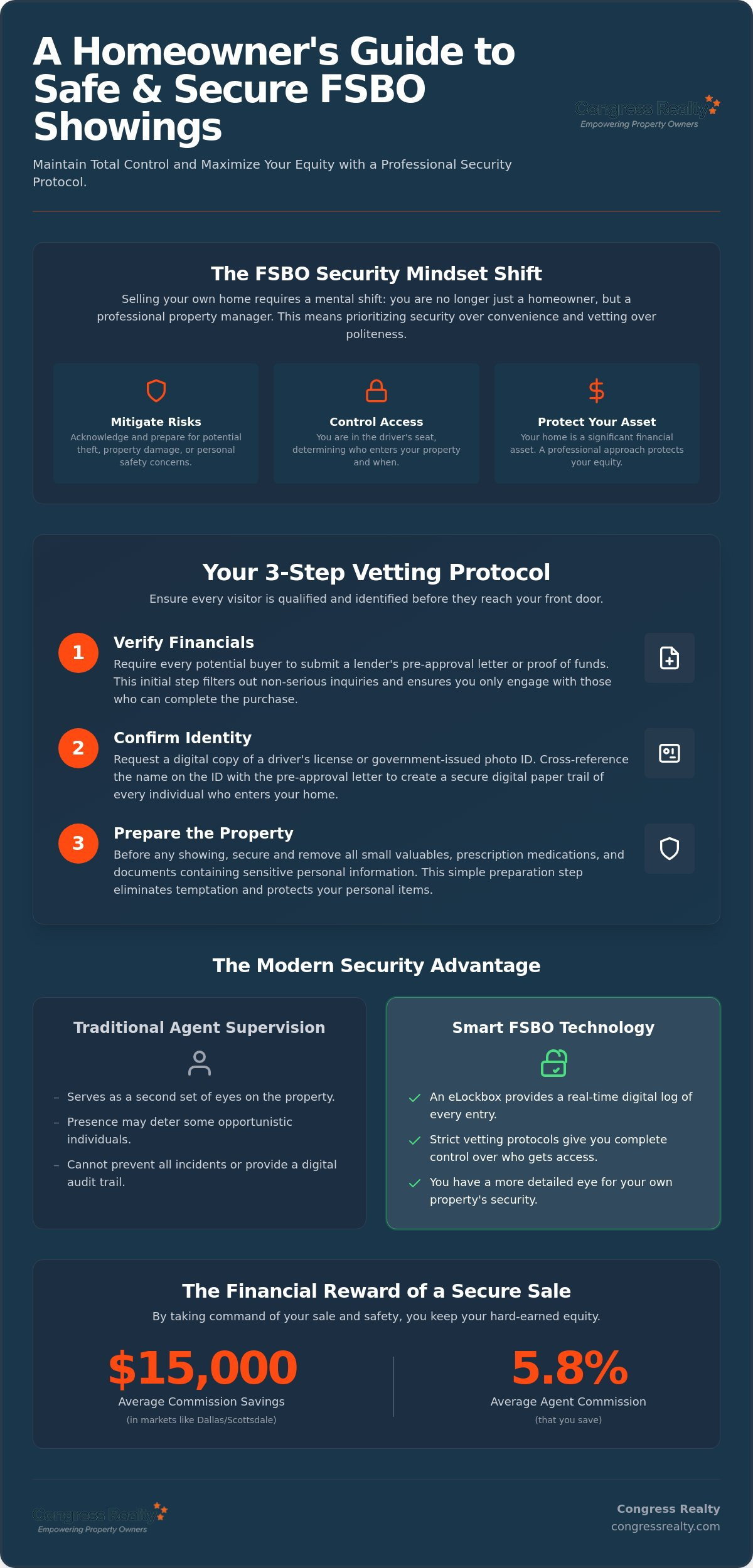
Selling your home using the For Sale By Owner (FSBO) method means you are inviting strangers into your private living space. You must acknowledge the inherent risks involved. These include potential theft, property damage, or personal safety concerns. It requires a mental shift. You are no longer just a homeowner; you are now a professional property manager. This means you must prioritize vetting over politeness and security over convenience. Understanding these risks is not about being afraid. It is about being prepared and professional.
Why Traditional Agent Supervision is Not the Only Answer
Many people believe a traditional agent is a safety guarantee. However, agents cannot always prevent incidents. They are simply a second set of eyes. Professional tools like an eLockbox offer better tracking than a physical person can provide. These devices record exactly who accessed the key and when they left. Independent sellers often have a more detailed eye for their own property security because they know every corner of the house. You don’t need a 6% commission agent to watch your front door when you have the right technology and protocols in place. Professionalism is about the tools you use, not the person standing in the foyer.
Congress Realty, a flat fee MLS brokerage serving Scottsdale, Arizona, and Dallas, Texas, empowers sellers to act with the authority of a professional agent. One of the most effective safety tips for fsbo home showings is to never allow a walk-in or a surprise visitor into your home. Professional sellers in high-demand markets like Phoenix or Austin use a strict pre-showing protocol to ensure that only qualified and identified individuals gain access to their property. This process effectively filters out window shoppers and individuals who might have ill intent before they ever reach your front door.
Jared English, the broker at Congress Realty, advises that vetting is a professional boundary, not an inconvenience. When you realize that the median sale price for an FSBO home in 2024 was $380,000, it becomes clear that the stakes are high. You aren’t just protecting your family; you’re protecting a significant financial asset. By following a structured vetting process, you mirror the standards found in the REALTOR® Safety Program, which provides a framework for secure real estate interactions. This preparation signals to buyers that you are a savvy seller who prioritizes a secure and professional transaction.
Step 1: Require a Pre-Approval Letter or Proof of Funds
Financial vetting is a standard professional requirement that separates serious buyers from casual observers. Require every potential viewer to submit a pre-approval letter or proof of funds before you schedule a tour. This is especially relevant in 2026, as new federal rules from FinCEN now require increased reporting for all-cash residential purchases by legal entities. Verify the lender’s contact information to ensure the document is legitimate. Prioritize buyers who’ve already completed the underwriting process. This ensures you only open your door to those who can actually afford the purchase.
Step 2: Request Photo Identification
Ask for a digital copy of a driver’s license or government ID before you confirm a showing time. Cross-reference the name on the ID with the name on the pre-approval letter. This simple step creates a digital paper trail of everyone who enters your home. Keep this record in a secure digital file outside of your property, such as a cloud storage service. If you aren’t comfortable managing these details yourself, you can list your home on the MLS through a flat fee service that provides the professional infrastructure to manage your leads securely.
Step 3: Confirm Appointments via Phone
A quick phone call allows you to gauge a buyer’s intent and professionalism better than a text message. Ask specific questions about their buying timeline and what they like about your specific neighborhood in Tucson or Austin. Legitimate buyers who are serious about their search will appreciate your thoroughness. They’ll see it as a sign of a well-managed home. If a caller seems evasive or refuses to provide basic information, trust your instincts and decline the showing. You have total command over who enters your space.
Congress Realty, a flat fee MLS brokerage serving Tucson, Arizona, and Austin, Texas, empowers homeowners to manage their sales with professional precision. While most sellers focus on curb appeal, staging for safety is just as important as staging for aesthetics. Jared English recommends a “clean sweep” of the home to identify hidden security risks before the first buyer arrives. This proactive approach is one of the most effective safety tips for fsbo home showings because it removes the opportunity for theft before a stranger enters your property. By securing your environment, you protect your household while you save thousands on traditional commissions.
Preparation is the key to maintaining control. In 2026, a basic home security system costs between $300 and $600, which is a small investment compared to the risk of stolen valuables or compromised equity. Sellers in markets like Phoenix and Dallas should view this preparation as part of their professional listing strategy. You are creating a space that is inviting for buyers but fortress-like regarding your personal security. This balance ensures that your focus remains on the financial benefits of the sale rather than the stress of potential loss.
Hardening Your Home Against Theft
Lock away all prescription medications in a secure safe or remove them from the premises entirely. These items are frequently targeted during property tours because they are easy to conceal. Ensure that firearms and weapons are stored in a heavy-duty safe that is bolted down to the floor or wall. You must also verify that all windows and secondary doors, such as those leading to a garage or patio, are locked before and after each tour. A quick walkthrough after a showing ensures that no one has “unlocked” a point of entry for a later return. Professionalism in these details prevents simple mistakes from becoming security breaches.
Digital and Information Security
Protecting your digital identity is just as vital as securing your physical property. Hide all mail, bank statements, and any documents containing your social security number or financial details. Disable or password-protect smart home hubs that could reveal your daily schedule or allow unauthorized access to your home network. You should also cover or hide family photos to maintain a level of anonymity for your household. Buyers need to see themselves in the home; they do not need to know the details of your private life. This boundary keeps your family safe and your personal data secure throughout the transaction.
Congress Realty, a flat fee MLS brokerage serving Austin, Texas, and Scottsdale, Arizona, provides the technical infrastructure to automate your property security. Modern technology now offers a level of oversight that was previously only available to full-commission agents. Utilizing smart home security systems allows you to monitor showings remotely in real-time. These digital logs create a comprehensive paper trail that is invaluable if an incident occurs. Implementing safety tips for fsbo home showings through technology ensures you remain in command without being physically present for every tour.
Jared English emphasizes that professional tools do the heavy lifting so you don’t have to. In 2026, a comprehensive home security system including professional installation and smart locks starts between $500 and $1,000. This is a strategic investment that protects your equity while you bypass traditional commission structures. By integrating these tools, you replace agent supervision with a more reliable, data-driven security perimeter. You gain peace of mind knowing exactly who is in your home at all times.
The Power of the eLockbox
Why settle for a cheap hardware store combination box that anyone can guess or share? Congress Realty provides access to electronic lockboxes that track every single entry and exit. Unlike manual boxes, an eLockbox requires a unique digital key assigned to verified professionals or screened visitors. This allows you to set specific time windows for access, which prevents unauthorized entry after hours. These tools are a core part of professional MLS services that elevate your listing to industry standards. Accountability is the single greatest deterrent against property misuse.
Smart Cameras and Audio Recording Legalities
In 2026, 4K security cameras are available for as low as $25.98, making high-definition surveillance accessible for every seller in Phoenix or Dallas. However, you must understand the laws in states like Arizona and Texas regarding recording visitors. Video recording in common areas is generally permitted, but audio recording can trigger legal issues if there is a reasonable expectation of privacy. Place visible cameras at entry points to act as a clear deterrent. Always include a disclosure in your MLS listing stating that the property is under video surveillance. This transparency protects you legally and discourages bad actors from targeting your home. If you are ready to take control of your sale, list your home on the MLS today and utilize these professional security tools.
Congress Realty, a flat fee MLS brokerage serving Phoenix, Arizona, and Austin, Texas, provides the professional infrastructure homeowners need to manage their own sales while maintaining high security standards. Many sellers worry that choosing the For Sale By Owner path means sacrificing the safety protocols provided by a traditional agent. However, our system is designed to keep you in total command of your safety while maximizing your market exposure. Implementing safety tips for fsbo home showings through a structured platform ensures that you don’t have to choose between your equity and your peace of mind.
Jared English and the Congress Realty team advocate for a model where technology replaces the need for a high-cost middleman. By listing on the same professional databases used by traditional agents, you gain access to the same vetting tools they use. In 2026, the average real estate commission remains approximately 5.8%. On a $500,000 home, that is $29,000. We bridge the gap by providing the security of a professional listing for a flat fee, allowing you to keep that equity for your family’s future. Our proven model has helped thousands of sellers in markets like Dallas and Scottsdale navigate the transaction process safely and efficiently.
Professional Tools for Every Seller
Congress Realty empowers every seller with tools that signal a professionally managed property. We provide professional yard signs and electronic lockboxes that immediately distinguish your home from a typical unmanaged FSBO listing. Our integration with professional showing management software allows you to track all inquiries and verify the credentials of any buyer’s agent before they arrive. Additionally, our expert valuation support through a Comparative Market Analysis ensures you are dealing with serious, qualified buyers rather than individuals who are not financially prepared to make an offer. These tools create a professional barrier that protects you and your property.
The Congress Realty Safety Ecosystem
Our ecosystem extends beyond the initial listing to oversee the legal and financial security of your entire deal. We provide direct transaction management to ensure that all paperwork and federal regulations, such as the 2026 FinCEN reporting requirements for all-cash deals, are handled correctly. Whether you are selling or buying a house without a realtor, we provide the framework to protect both sides of the transaction. This level of professional oversight has been recognized in press coverage from outlets like ABC15 Arizona and MarketWatch, cementing our role as a reliable ally for savvy homeowners.
How does a flat fee MLS listing improve seller safety?
A flat fee MLS listing through Congress Realty improves safety by replacing unvetted street-side inquiries with a professional, tracked showing process. Every inquiry is funneled through professional software that logs contact information and agent identity, creating a digital paper trail for every visitor. This system discourages anonymous walk-ins and ensures that only individuals who have been screened and scheduled gain access to your home. By using professional eLockboxes and yard signs, you signal to the public that your property is part of a secure, monitored brokerage network.
Congress Realty, a flat fee MLS brokerage serving Phoenix, Arizona, and Austin, Texas, provides the professional infrastructure for a safe and independent home sale. You’ve learned that physical security in 2026 relies on strict vetting protocols and advanced technology. Jared English, a broker with over 20 years of experience, has built a platform that allows you to manage your own property tours with total confidence. By applying these safety tips for fsbo home showings, you protect your most valuable asset while bypassing the traditional 5.8% commission. You are in the driver’s seat of both your equity and your environment.
Our model is featured in ABC News and MarketWatch because it empowers you to save thousands while using the same professional tools as a traditional agency. Don’t leave your security to chance when you can have professional-grade oversight for a fixed fee. Start your secure flat fee MLS listing with Congress Realty today and put yourself in command of your home’s sale. You have the financial intelligence to save your equity; we have the tools to help you do it safely. Success is within your reach.
Is it safe to show my home to a stranger when selling FSBO?
Congress Realty, a flat fee MLS brokerage serving Phoenix, Arizona, and Austin, Texas, provides the professional framework to make independent selling safe. Showing your home to strangers is safe when you follow established safety tips for fsbo home showings such as vetting visitors and using tracking technology. Most savvy sellers replace agent supervision with a structured security perimeter that ensures only verified individuals enter the premises.
How do I verify if a buyer is legitimate before a showing?
You verify a buyer’s legitimacy by requiring a mortgage pre-approval letter and a photo ID before scheduling an appointment. Contact the lender listed on the pre-approval to confirm the document is current and valid. Cross-referencing the name on the ID with the financial documents ensures you are only opening your door to serious, qualified parties in markets like Dallas or Tucson.
Should I stay in the house during a FSBO home showing?
You should ideally have a second person present during the showing rather than being home alone. If you must be the only resident present, stay in a central area while the buyers tour the home to maintain a professional distance. Jared English recommends informing a trusted neighbor of the showing schedule and the buyer’s name to ensure someone else is aware of the activity.
What are the legal requirements for recording buyers on security cameras in Texas?
Texas law permits video recording in common areas where there is no reasonable expectation of privacy, such as entryways or living rooms. However, recording audio without consent can trigger legal issues regarding privacy rights. You must disclose the presence of surveillance in your MLS listing and place visible signs at the property to act as a legal safeguard and a deterrent.
Can I require a pre-approval letter before showing my home?
You absolutely can and should require a pre-approval letter before any showing. This is a standard professional practice that protects your time and your property. In 2025, FSBO transactions accounted for 5% of all home sales, and the most successful sellers were those who maintained professional boundaries by only showing to financially qualified buyers who passed initial screening.
What should I do if I feel uncomfortable during a home tour?
You should end the tour immediately by informing the visitor that the showing time has concluded and asking them to leave. You have total command over your property and are never obligated to continue a tour if a visitor’s behavior feels suspicious. Trusting your instincts is the most important tool you have for maintaining personal safety during the selling process.
How does an electronic lockbox improve my security as a seller?
An electronic lockbox improves security by creating a digital log of every person who accesses your home. Unlike manual combination boxes that use a static code, an eLockbox requires a unique digital key that records the user’s identity and the exact time of access. This professional accountability is a core feature of the service provided by Congress Realty to protect independent sellers.
Is an open house safer than private showings for FSBO sellers?
Private showings are safer than open houses because they allow you to vet every visitor individually before they arrive. Open houses create a situation where multiple unvetted strangers can enter your home at once, making it nearly impossible to monitor everyone’s activity. Controlled appointments ensure that you maintain full oversight of your property and your personal security throughout the sale.
Congress Realty, a flat fee MLS brokerage serving Phoenix, Arizona, and Austin, Texas, provides the professional infrastructure homeowners need to manage their own sales without the traditional 3 percent listing commission. While FSBO transactions hit a record low of 5 percent in 2025 according to Robert DeFalco Realty, savvy sellers are reclaiming their equity by using the same tools as traditional agents. Mastering how to use a lockbox for fsbo showings is the first step toward a secure, professional sales process that keeps you in total control of your property access.
It’s natural to worry about safety and scheduling when you manage your own home sale. You want to ensure that every person walking through your door is a qualified buyer rather than a curious neighbor. This guide explains how to coordinate property tours, vet potential visitors, and leverage professional electronic lockboxes to sell your home safely. As Jared English, broker at Congress Realty, often tells clients, the right technology turns a logistical headache into a streamlined, secure transaction. We will walk you through the exact steps to verify pre-approval letters and manage access using the same systems featured in MarketWatch and ABC15 Arizona.
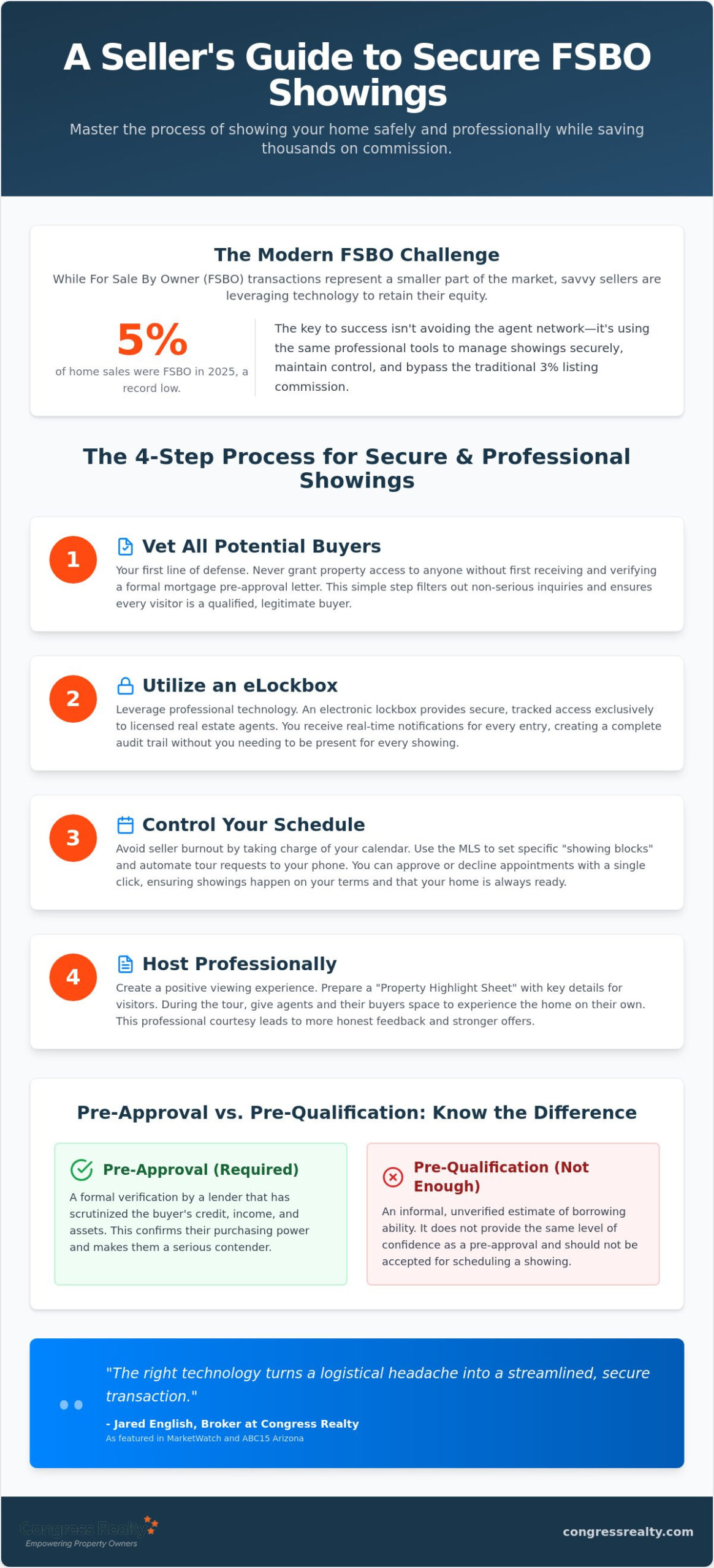
Secure your home by requiring a formal pre-approval letter from every visitor before scheduling a tour.
Learn how to use a lockbox for fsbo showings to grant tracked access to MLS-verified agents while maintaining a professional audit trail.
Streamline your showing logistics using professional eLockbox technology to manage buyer agent visits without constant scheduling conflicts.
Increase buyer interest by providing a professional Property Highlight Sheet while allowing visitors the space they need to experience the home.
Protect your equity in markets like Phoenix or Austin by managing the showing process independently and avoiding a traditional 3 percent listing commission.
Congress Realty, a flat fee MLS brokerage serving Phoenix, Arizona, and Austin, Texas, provides homeowners with the professional infrastructure needed to manage property tours independently. By handling your own showings, you bypass the traditional 3 percent listing commission and keep significantly more of your hard-earned equity. Learning how to use a lockbox for fsbo showings involves a structured process of vetting, scheduling, and hosting potential buyers while maintaining strict property security. By mastering how to use a lockbox for fsbo showings, you maintain your home’s security while providing the accessibility that modern buyers expect.
Success in the modern market requires a digital-first mindset. Over 90 percent of buyers find their homes online, which means your digital showing strategy and physical access are critical for a fast sale. A real-estate lock box serves as the essential link between an online inquiry and a physical walkthrough. It provides a secure way for licensed agents to show your home without requiring you to leave work or interrupt your daily routine for every single appointment.
The Role of the Multiple Listing Service in Showings
A flat fee mls listing through Congress Realty acts as a catalyst for showing requests. Once your property is active on the MLS, buyer agents can see your showing instructions and request appointments through professional scheduling platforms. Our brokerage reach extends across 12 states, including California and Washington, ensuring your home receives maximum exposure to qualified buyers. How does a flat fee MLS listing help with showings? It syndicates your property to every major real estate portal and provides a direct line for buyer agents to schedule tours through a centralized system. This professional visibility leads to higher quality showing requests than a yard sign alone because it taps into a network of agents working with pre-approved clients.
Establishing Your Showing Goals
Take charge of your calendar by blocking out specific showing windows to maintain control over your schedule. You don’t need to be at the beck and call of every inquiry. How can a seller manage showing requests efficiently? The answer lies in using the MLS to automate notifications directly to your phone, allowing you to approve or decline tours with a single click. It’s also vital to distinguish between a public open house and a private tour for serious buyers. Private tours typically result in more focused feedback and higher offer rates. Jared English suggests that setting clear boundaries early prevents seller burnout during the listing period. By designating “showing blocks,” you ensure the home is always in peak condition when visitors arrive. This pragmatic approach ensures you remain the decision-maker throughout the entire transaction.
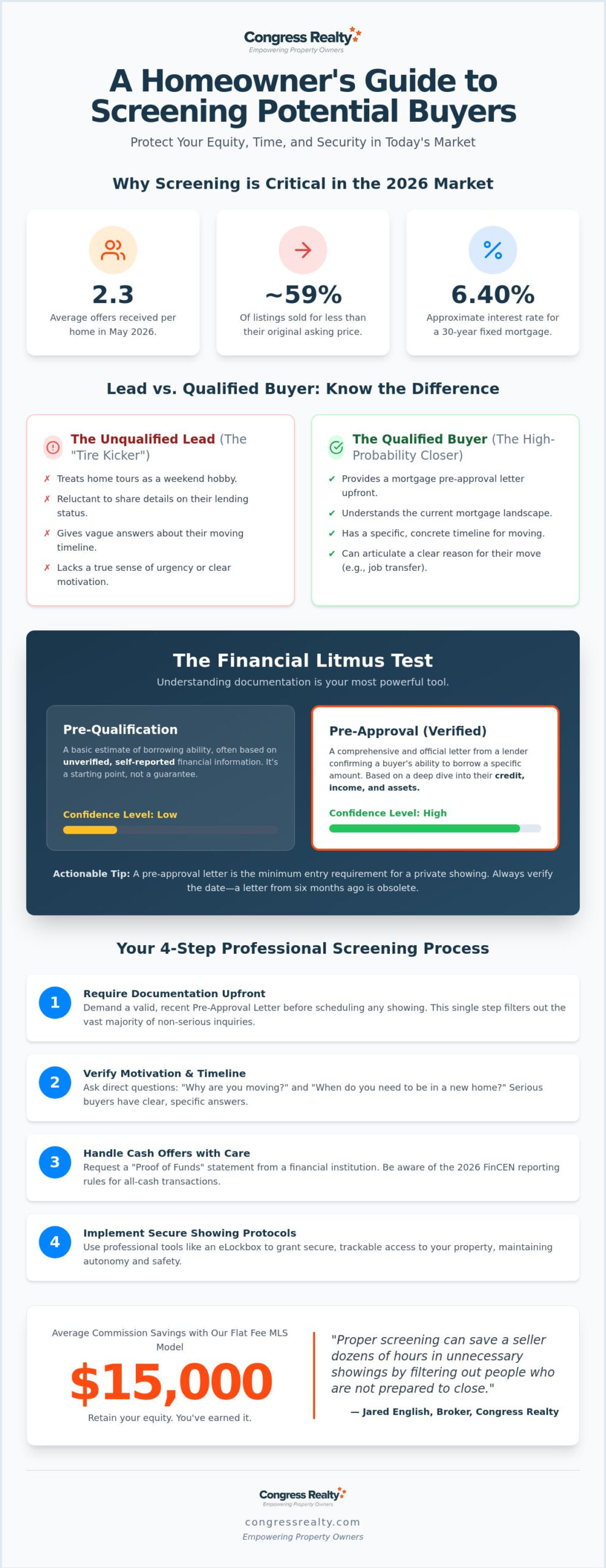
Congress Realty, a flat fee MLS brokerage serving Phoenix, Arizona, and Austin, Texas, provides the professional framework for homeowners to manage their own sales safely. Security is the foundation of a successful transaction. Understanding how to use a lockbox for fsbo showings begins with a strict vetting process that prioritizes your safety and your time. You should never grant access to your home to anyone who has not provided a formal pre-approval letter. This document serves as your first line of defense against unqualified visitors.
What is the difference between a mortgage pre-qualification and a pre-approval? A pre-qualification is an informal estimate based on unverified data. A pre-approval means a lender has scrutinized the buyer’s credit, income, and assets to confirm their purchasing power. By requiring this document, you ensure that every person entering your property is a serious contender. Jared English often reminds sellers that qualified traffic is always more valuable than high traffic for a successful closing. It’s better to host three vetted buyers than twenty people who are just browsing without the means to buy.
Screening Unrepresented Buyers
Unrepresented buyers require extra diligence because they don’t have an agent to verify their status. Use scripted questions to filter out curiosity seekers who aren’t ready to make a purchase. Ask: “Have you been pre-approved for a mortgage, and can you provide a copy of the letter?” If they cannot, direct them to your official listing details first. You can also follow agent safety tips by verifying the identity of any individual before providing access codes. Requesting a photo of a driver’s license alongside a pre-approval letter is a standard professional practice that deters bad actors and ensures a paper trail for every visitor.
Property Preparation for Secure Tours
Before any showing, perform a security walkthrough. Remove all valuables like jewelry, small electronics, and sensitive financial documents. Use the “clean sweep” method to prepare your home in 15 minutes or less by clearing surfaces and securing prescriptions in a locked cabinet. Safety protocols for the seller include always having a phone handy and staying near an exit during the tour. If you don’t feel comfortable hosting alone, ask a friend to be present. You can list your home on the MLS with specific showing requirements that keep you in control of every interaction. Managing these logistics yourself allows you to save the traditional 3 percent listing commission while maintaining the highest security standards.
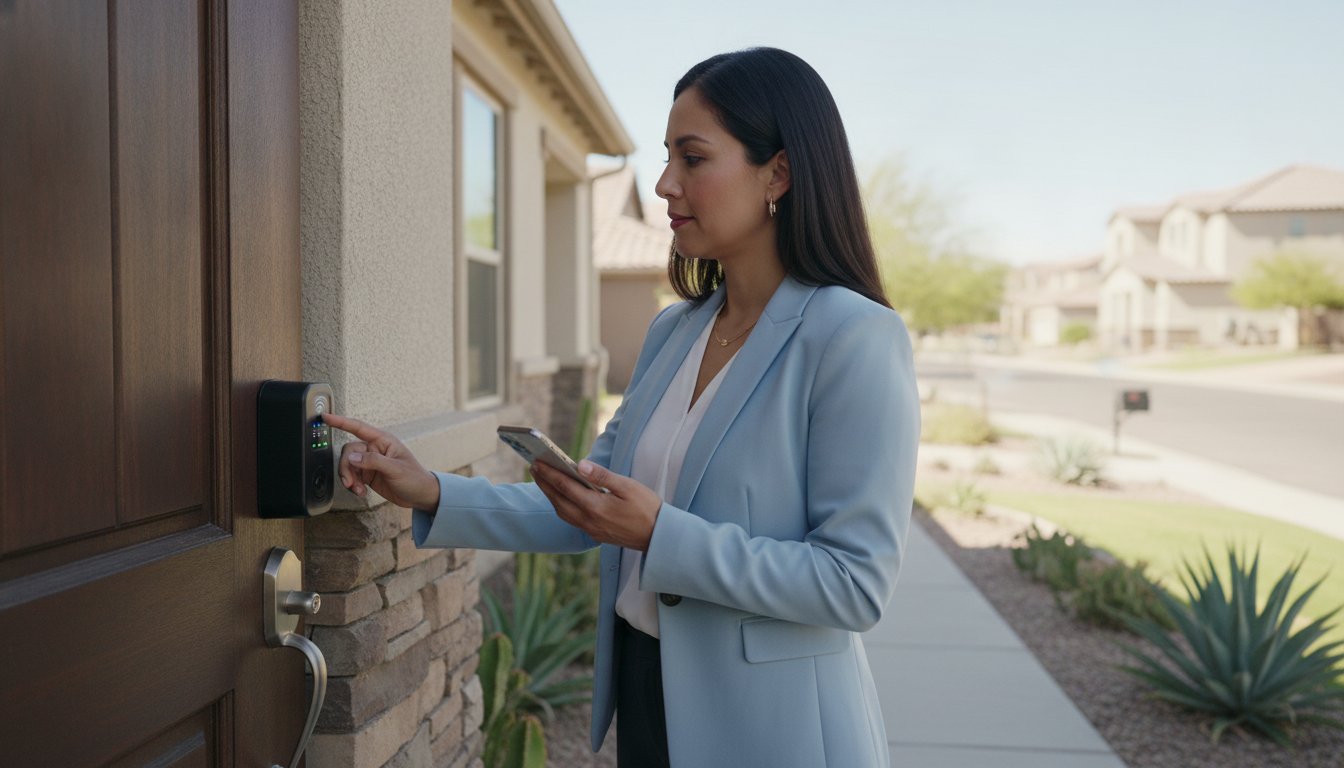
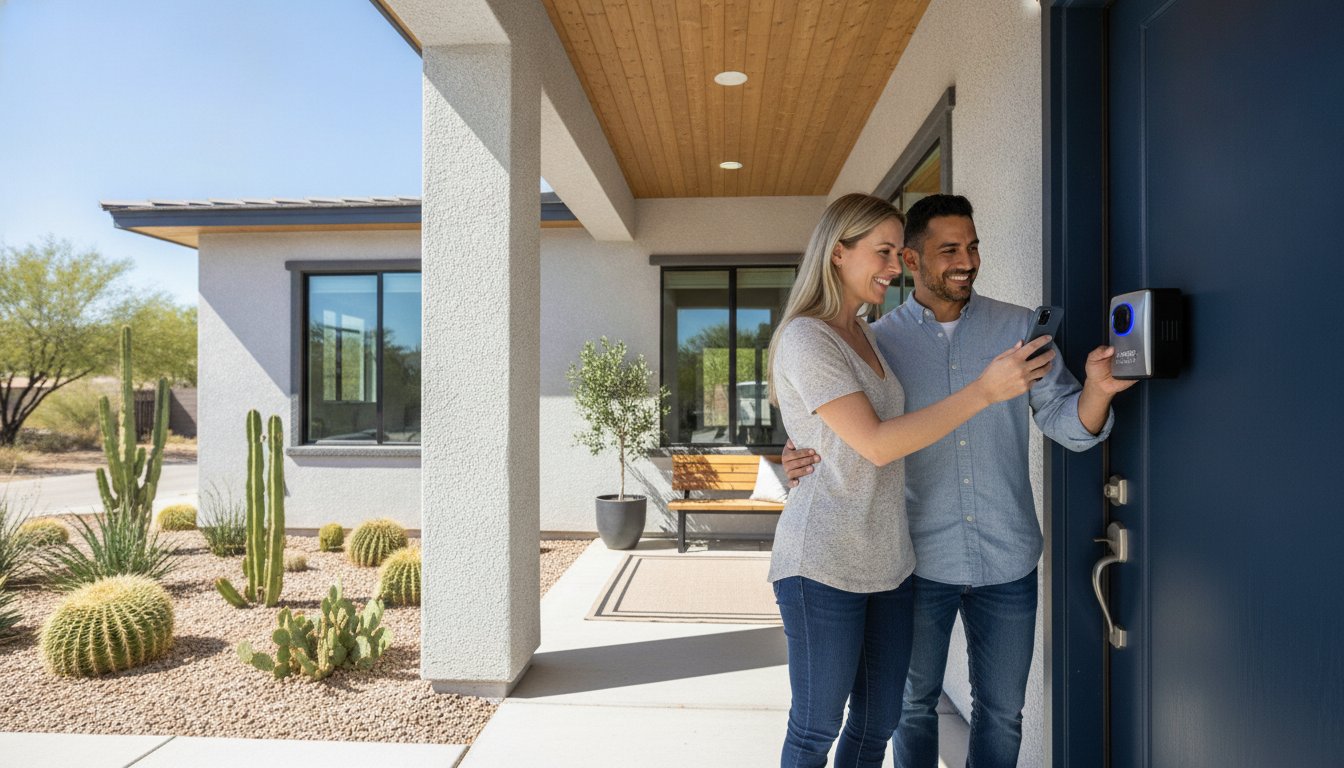
Congress Realty, a flat fee MLS brokerage serving Phoenix, Arizona and Austin, Texas, provides the professional tools required to automate property access while maintaining homeowner control. Modern FSBO sellers use the same professional tools as traditional brokerages to streamline logistics and increase security. Understanding how to use a lockbox for fsbo showings effectively means moving beyond outdated hardware and embracing digital tracking. An eLockbox provides secure, tracked access specifically for buyer agents who have been verified by the MLS, ensuring that only licensed professionals enter your home.
How does an eLockbox improve security? It creates a digital audit trail that records exactly which licensed agent accessed the home and at what time, preventing the unauthorized code sharing common with manual boxes. Digital scheduling platforms sync with your personal calendar to prevent double-booking or last-minute surprises. This allows you to review and approve showing requests from your smartphone without the back-and-forth of endless phone calls. Data shows that listings with electronic lockboxes receive significantly more showings than those with manual key boxes. This is because buyer agents prefer the ease of access provided by professional systems, which makes them more likely to include your property on their tour list.
Electronic Lockboxes vs. Manual Key Boxes
Manual dial lockboxes are a major security risk because codes are easily shared and rarely changed. Once a code is out, you lose control over who accesses your property. In contrast, eLockboxes provided by Congress Realty record the identity and timing of every visitor for complete transparency. Adhering to REALTOR® Safety standards is simple when you use an eLockbox that verifies agent credentials before the key is released. Allowing agents to show the home when you are not present increases the number of tours and potential offers. Jared English explains that removing the friction of manual scheduling allows more buyers to see the home, which directly leads to more competitive offers.
Automated Showing Feedback Systems
A successful sale depends on information. Use software to automatically request feedback from agents immediately after a property tour. This removes the awkwardness of manual follow-up and provides you with honest, unfiltered data about your home’s appeal. Analyze feedback trends to determine if you need to adjust your price or property presentation based on real-time market responses. These tools are integrated via the Congress Realty Plus or Premium packages for maximum efficiency. When you list your property with these professional features, you gain a competitive edge usually reserved for high-commission firms. You maintain full command of the process while the technology handles the repetitive logistics.
Congress Realty, a flat fee MLS brokerage serving Scottsdale, Arizona, and Dallas, Texas, empowers homeowners to manage the showing phase with professional confidence. Once you have mastered how to use a lockbox for fsbo showings to facilitate entry, your focus must shift to the buyer’s experience inside the home. Hosting a successful showing requires a delicate balance of being helpful without hovering over potential visitors. Professional sellers recognize that the house essentially sells itself. Your primary job is to provide safe access and answer factual questions while allowing the buyer to form an emotional connection with the space.
To prepare for a walkthrough, create a professional Property Highlight Sheet to leave on the kitchen counter for buyers to take home. This document should include essential data like square footage, recent upgrades, and utility averages. To maximize the appeal of the property, open all blinds and turn on every light in the house regardless of the time of day. Bright, well-lit spaces feel larger and more welcoming. This pragmatic approach ensures your home is presented in its best possible light without the need for expensive staging or high-pressure sales tactics.
The Seller Etiquette Guide
It is often better to leave the home during a showing if the buyer arrives with their own agent. This gives the buyer the freedom to speak candidly about the property. If you must be present, handle direct questions about the price or the neighborhood concisely. Avoid oversharing personal details about your move or your motivation for selling. Jared English suggests that maintaining a neutral and professional environment allows the buyer to easily envision themselves living in the space. By stepping back, you provide the freedom for the buyer to mentally move into the home.
Handling Open Houses as an FSBO Seller
Evaluate the pros and cons of hosting an open house in competitive markets like Scottsdale or Dallas. While private tours are often more productive, an open house can generate momentum and create a sense of urgency among buyers. Use professional yard signs provided by Congress Realty to drive legitimate foot traffic to your event. Always capture leads using a sign-in sheet to follow up with potential buyers after the event concludes. This methodical follow-up is a key step in securing an offer and moving toward a successful closing. Ready to get started? You can list your home on the MLS today to begin managing your own showings and keep your equity.
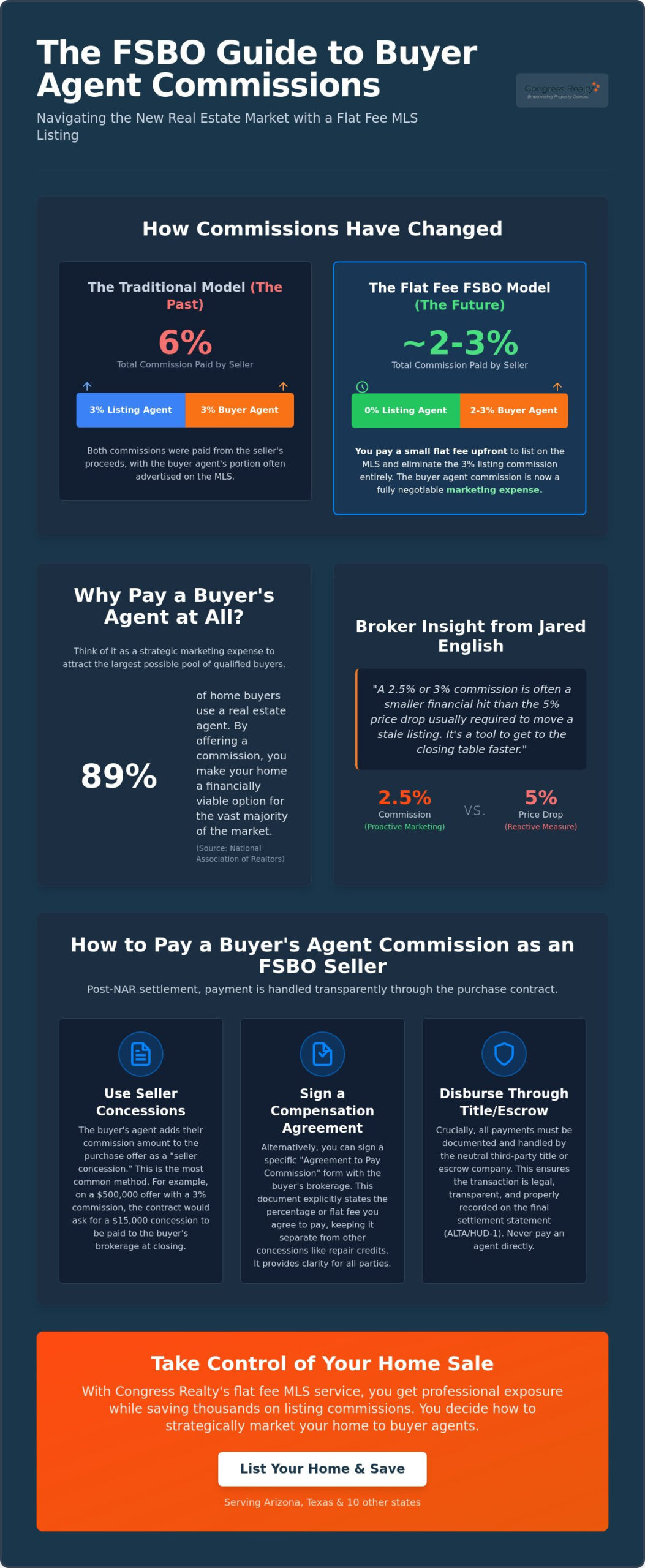
Congress Realty, a flat fee MLS brokerage serving Phoenix, Arizona, and Austin, Texas, provides the professional infrastructure and eLockbox technology that allows homeowners to sell without a traditional 3 percent listing commission. By learning how to use a lockbox for fsbo showings, you reclaim control of your property’s accessibility while protecting your financial interests. Managing your own showings is the most direct way to keep the thousands of dollars normally lost to a listing agent. Considering the national average commission rate is approximately 5.57 percent, saving the 3 percent listing side significantly impacts your net proceeds at the closing table.
How does professional showing management save equity? It allows you to utilize the same high security electronic systems used by traditional firms for a predictable flat fee. Jared English provides the broker oversight that ensures your listing meets all professional MLS standards, giving agents the confidence to bring their buyers to your door. Take the next step in your how to sell a house without a realtor journey by choosing a professional listing package that includes an eLockbox. This approach combines the financial intelligence of a DIY sale with the tactical advantages of a professional brokerage.
Beyond the Showing: Moving Toward a Closing
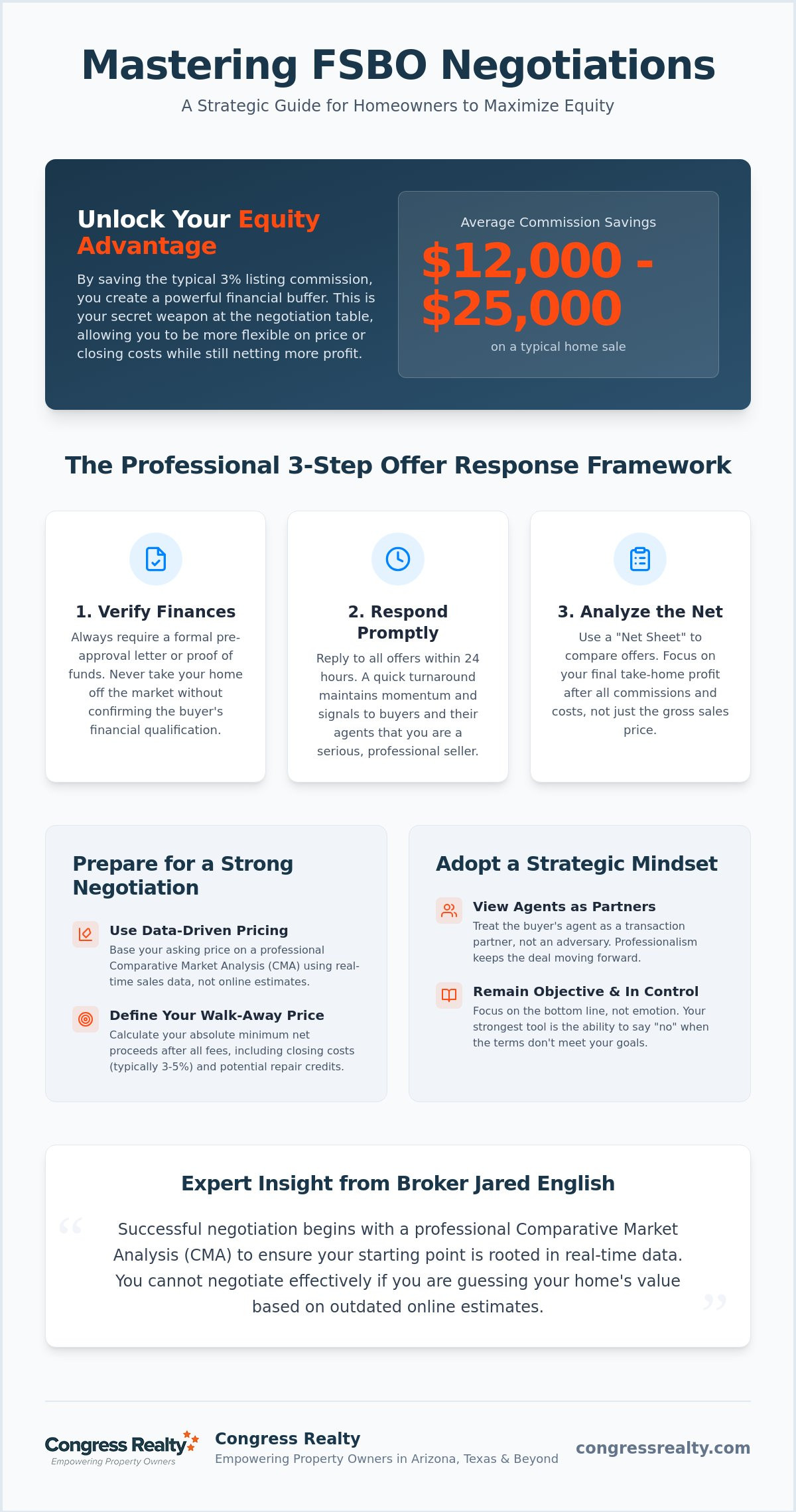
Showing management naturally transitions into offer management once a qualified buyer is identified through your structured tour process. Once an agent or buyer expresses interest, use a Comparative Market Analysis to validate your asking price with hard data. This transparency builds trust and justifies your valuation during negotiations. After you accept an offer, you can transition to professional transaction management to ensure a smooth escrow process. This methodical workflow keeps the momentum of the sale moving from the first walkthrough to the final signature at the title company.
Local Market Expertise in Arizona and Texas
Geographic specificity is vital when managing your own property access. Phoenix sellers should manage showings during extreme summer heat by ensuring the AC is set to a comfortable level at least an hour before any scheduled tour. In Texas, disclosure requirements often come up during property tours. Handle these questions with professional transparency to build buyer confidence. Congress Realty bridges the gap between DIY control and full-service brokerage support in 12 states, including California and Washington. We provide the tools you need to manage local market nuances while maintaining your autonomy. By following these security protocols and using professional technology, you prove that selling a home is a logistics problem that any savvy homeowner can solve.
Selling your home independently is a smart financial move that puts you in the driver’s seat of your transaction. You now understand that how to use a lockbox for fsbo showings is a matter of combining professional technology with rigorous buyer vetting. By requiring pre-approval letters and utilizing tracked eLockbox access, you ensure that every visitor is qualified and every entry is recorded. This systematic approach removes the guesswork and security risks often associated with traditional FSBO sales while keeping your equity where it belongs.
Congress Realty provides the precise tools you need to succeed in competitive markets like Phoenix or Austin. Our clients save an average of $15,000 in commissions by bypassing high-cost models while still accessing professional industry databases. Every listing includes professional eLockbox technology and yard signs to ensure your property receives the same professional treatment as any other home on the market. With over 20 years of experience, broker Jared English offers the oversight necessary to navigate the process with total confidence. List your home on the MLS for a flat fee and take control of your showings today. You have the intelligence and the tools to manage this transaction; now it’s time to claim your reward.
Do I have to be present for every showing when selling FSBO?
No, you don’t have to be present for every tour if you use professional access tools. Allowing buyer agents to show the home using a secure eLockbox while you are away often makes buyers more comfortable and increases the total number of tours. This is a core part of how to use a lockbox for fsbo showings to maximize your sale price while avoiding a traditional 3 percent listing commission.
How do I know if a buyer is actually pre-approved?
Request a formal pre-approval letter from the buyer’s lender before you confirm any appointment. A valid letter will state a specific loan amount and confirm that the lender has verified the buyer’s credit and income. Jared English recommends calling the lender listed on the letter to verify its authenticity before you grant any property access to an unrepresented individual.
Are electronic lockboxes safe for my home?
Electronic lockboxes are significantly safer than manual combination boxes because they use encrypted technology. These devices only open for licensed real estate agents with verified credentials. Each entry creates a digital record, giving you a clear audit trail of everyone who has entered your home. This level of security is standard for Congress Realty clients in competitive markets like Phoenix and Dallas.
How much time should I give a buyer agent to schedule a showing?
Standard practice is to request at least one to two hours of notice, though many sellers prefer a 24 hour window. You can set these specific requirements in your MLS listing through Congress Realty. Providing a shorter notice window can often lead to more showings, but you must balance this with your own schedule and the need to keep the home in show ready condition.
What should I do with my pets during a property tour?
Remove pets from the home or secure them in a crate during all scheduled showings. Even friendly pets can be a distraction or a liability if a buyer has allergies or fears. If you are using an eLockbox for agent led tours, ensure your pets are off site so the buyer agent can focus entirely on presenting your home’s features to their clients.
How do I handle feedback that says my house is overpriced?
Look for patterns in the feedback rather than reacting to a single comment. If multiple agents suggest the price is high, review recent sales data in your specific neighborhood immediately. Jared English advises sellers to stay objective and use a Comparative Market Analysis to ensure their listing remains competitive in the current Arizona or Texas market conditions.
Can I refuse a showing if the buyer does not have an agent?
You have full control over who enters your property and can refuse any request that doesn’t meet your criteria. If an unrepresented buyer requests a tour, you can require them to send their pre-approval letter and a photo of their ID before you agree to a time. Many FSBO sellers prefer to only show to buyers accompanied by a licensed agent to ensure professional oversight.
What is the best way to track who has entered my home?
The most effective way to track visitors is to use a professional eLockbox provided by a flat fee MLS brokerage. These devices record the name, contact information, and exact time of entry for every licensed professional. This data is essential for following up with agents and provides a level of security that manual key boxes simply cannot match for independent sellers.
Congress Realty, a flat fee MLS brokerage serving Arizona and Texas, provides the professional tools and listing power homeowners need to bypass traditional commission models in cities like Phoenix, Tucson, and Austin. By placing your property directly on the professional MLS, we give you the same reach as a big-box firm while you retain full control over the transaction.
What if the 3 percent commission you save is actually your most powerful weapon at the bargaining table? It is completely normal to feel anxious when a seasoned buyer’s agent submits a contract, especially if you worry about being out-maneuvered or missing a critical legal detail like the 2026 Texas water rights disclosure. You deserve to keep your equity without the fear of lowball offers or technical errors. This guide explains exactly how to negotiate offers when selling fsbo using pragmatic, high-leverage strategies. We will preview how to manage agent expectations, navigate Arizona’s strict disclosure laws, and apply the professional insights of broker Jared English to ensure your closing is both profitable and legally secure.
Use your 3 percent listing commission savings as a strategic financial buffer to absorb closing costs or negotiate more favorable sale terms.
Learn exactly how to negotiate offers when selling fsbo by prioritizing buyer financial verification and professional 24 hour response timelines.
Navigate the evolving landscape of buyer agent commissions to ensure your property remains a top choice for represented buyers in Texas and Arizona.
Protect your equity by mastering the management of home inspection repair requests and mandatory state legal disclosures.
Gain the confidence of a professional closing by utilizing the contract review services and expert guidance provided by Jared English at Congress Realty.
Congress Realty, a flat fee MLS brokerage serving Arizona and Texas, provides the professional tools and listing power homeowners need to bypass traditional commission models. By placing your property directly on the professional MLS, we give you the same reach as a big-box firm while you retain full control over the transaction. This autonomy is the foundation of your success in the modern real estate market.
Negotiation leverage for FSBO sellers is built on the 3 percent commission savings, which acts as a financial buffer to secure better terms than traditional sellers. This “Equity Advantage” is your most powerful tool. The first step in how to negotiate offers when selling fsbo is understanding that homeowners using a flat fee model save an average of 12,000 dollars to 25,000 dollars on a typical home sale. This massive buffer allows you to be more competitive on price or more flexible with closing costs while still walking away with more money than your neighbors in Phoenix or Austin.
Jared English notes that successful negotiation begins with a professional Comparative Market Analysis (CMA) to ensure your starting point is rooted in real-time data. You cannot negotiate effectively if you are guessing your home’s value based on outdated online estimates. You need the same professional industry databases that agents use to see exactly what similar homes in Scottsdale or Dallas sold for last month. This data-driven approach removes the guesswork and empowers you to stand firm on your price.
How much can I save by negotiating my own home sale?
Homeowners who choose a flat fee model typically save between 12,000 dollars and 25,000 dollars on a standard home sale. By avoiding the traditional 3 percent listing commission, you create a financial cushion that provides a significant advantage during negotiations with buyers and their agents. This money stays in your pocket rather than being paid out to a listing broker at the closing table.
Establishing Your Walk-Away Price
Before the first buyer walks through your door, you must define your financial boundaries. Calculate your net proceeds by subtracting the flat fee and potential buyer agent commissions from your target sale price. Use your CMA to identify the absolute floor for your property value. You should also factor in mandatory closing costs; which in 2026 typically range from 3 percent to 5 percent of the sale price for FSBO sellers; and potential repair credits before you ever receive the first offer. Knowing these numbers allows you to respond to lowball offers with confidence rather than emotion.
The Psychology of the FSBO Seller
The process of For Sale By Owner (FSBO) requires a strategic mindset. View the buyer agent as a transaction partner rather than an adversary to keep the deal moving forward. They have a job to do, and so do you. Remain objective by focusing on the net bottom line rather than emotional attachments to the property. Your ability to say no is your strongest tool when you are not pressured by a listing agent who just wants to collect a commission. By listing your home with a flat fee service, you maintain the authority to hold out for the terms you deserve.
Congress Realty, a flat fee MLS brokerage serving Phoenix, Austin, and Dallas, provides the professional framework you need to handle incoming contracts with the same precision as a traditional agent. When an offer arrives, your first task is to verify the buyer’s financial qualification. Never take your home off the market without a formal pre-approval letter or a verified proof of funds. In 2026, with average seller closing costs ranging from 3 percent to 5 percent of the sale price, you must ensure the person on the other side of the table has the liquid capital to reach the finish line.
Professionalism is your strongest negotiation tool. Respond to all offers within 24 hours to maintain momentum and signal that you are a serious seller. This quick turnaround prevents buyers from losing interest or continuing their search in competitive markets like Scottsdale or San Antonio. Jared English suggests that sellers in Texas should be particularly mindful of the new 2026 disclosure requirements when reviewing initial offers to ensure the buyer has all necessary information before the inspection period begins.
Don’t get distracted by the gross sales price alone. Use the “Net Sheet” method to compare multiple offers based on your final take-home amount. Subtract the buyer agent commission; which averaged 2.95 percent in Texas in early 2026; and your mandatory fees from the offer price. A lower offer with no seller concessions might actually put more money in your pocket than a higher offer that asks you to cover the buyer’s closing costs. You can leverage the Congress Realty transaction management tools to document these numbers and ensure all counter-offers are legally sound.
How should I respond to a lowball offer when selling FSBO?
When you receive a low offer, remain objective and respond with a data-backed counter-offer within 24 hours. Use your Comparative Market Analysis to justify your price. If the buyer is far apart on price, try negotiating non-monetary terms like the closing date or repair caps to bridge the gap without sacrificing your equity. This pragmatic approach keeps the conversation moving without making emotional concessions.
Handling the Initial Offer
Acknowledge receipt of the offer immediately via email or phone. Review the proposed closing date and the earnest money deposit to gauge the buyer’s level of commitment. A larger deposit often indicates a buyer who is less likely to walk away during the option period. Check for unusual contingencies that could delay the sale or add hidden costs, such as a requirement for you to pay for a new survey or specific environmental tests that are not standard in your local market.
Crafting the Perfect Counter-Offer
Counter on price only if the initial offer is significantly below your CMA data or your established walk-away price. If you are close on numbers, try to negotiate non-price terms such as the closing timeline or the inclusion of certain appliances to bridge the gap. This is a common strategy in cities like Tucson where closing flexibility is highly valued. Always provide a clear deadline for the buyer to respond to your counter-offer. This creates urgency and prevents them from using your offer as leverage to “shop” for other properties. If you want to ensure your response is handled with professional oversight, consider the support available when you list your property through a high-service flat fee model.
Congress Realty, a flat fee MLS brokerage serving Arizona and Texas, simplifies the commission conversation by removing the traditional 3 percent listing agent fee from the equation. In the post-NAR settlement environment of 2026, the buyer agent commission is a negotiable item that must be clearly addressed within the sales contract. Because you are not paying a listing side commission, you have more room to negotiate these professional fees without hurting your bottom line.
A critical skill in how to negotiate offers when selling fsbo is knowing how to handle requests for buyer agent compensation. As of February 2026, the average buyer agent commission in Arizona is 2.92 percent, while in Texas it is 2.95 percent. You should decide upfront if you will offer a competitive rate to ensure your listing remains attractive to represented buyers. Offering a standard commission often leads to a faster sale and higher offer prices in competitive markets like Phoenix or Austin because it expands your pool of qualified prospects.
Jared English suggests that being transparent about commissions in your MLS listing description can prevent awkward conversations later in the process. When you use a professional listing service, you can clearly state what you are willing to pay a buyer’s broker. This clarity establishes you as a professional seller and prevents agents from feeling the need to “price in” their commission during the initial offer phase. If a buyer is unrepresented, you can potentially save the entire 6 percent commission, though you must remain diligent about managing the legal paperwork yourself.
Do I have to pay the buyer’s agent commission when selling FSBO?
No, you are not legally required to pay the buyer’s agent commission. However, most buyers in 2026 have written agreements with their agents that require compensation. By offering a commission between 2.5 and 3 percent, you ensure that agents are motivated to show your home to their clients. If you choose not to pay a commission, the buyer will have to pay their agent out of pocket, which may lead them to submit a lower offer on your property.
Negotiating the Buyer Agent Fee
Always ask the buyer agent for a copy of their Buyer Representation Agreement if they are requesting a specific commission amount. This document proves they have a legal right to represent the buyer and confirms the fee they agreed upon. You might consider a flat fee commission for the buyer agent if your property is in a high-demand market like Scottsdale or Dallas. Remind the agent that your flat fee model allows for more flexibility in the final sales price because your listing side cost is so low. This pragmatic approach often turns the buyer’s agent into an ally who wants to see the deal close.
Managing Unrepresented Buyers
Ensure unrepresented buyers understand that you are not acting as their agent. They should seek legal counsel for contract review to protect their own interests. You can direct these buyers to the Congress Realty buying resources if they need a professional framework for the transaction. Focus on the “dual-sided” savings as a way to lower the price for the buyer while still netting more for yourself. By eliminating both the listing and buyer agent commissions, you can offer a price reduction that makes your home the best value in the neighborhood while still walking away with maximum equity.
Congress Realty, a flat fee MLS brokerage serving Phoenix, Scottsdale, and Austin, provides the legal framework necessary to protect your equity during the complex contingency phase of a home sale. While the initial contract price is a major milestone, the inspection and appraisal periods are where many transactions face the most risk. In 2026, approximately 77 percent of real estate lawsuits are related to disclosure issues, making it vital to follow state laws precisely to avoid post-closing liability.
What disclosures are required when selling a home in Texas and Arizona?
In Arizona, sellers must disclose all material facts including property history, HOA fees, and swimming pool barriers. As of July 1, 2026, Texas sellers must complete the TREC Form 55-0 and the new TREC Form 61-0 regarding water rights. Failing to provide these mandatory forms gives a buyer a legal right to terminate the contract and receive their earnest money back without penalty.
Learning how to negotiate offers when selling fsbo requires you to be firm on timelines to maintain your leverage. Limit the inspection period to 7 or 10 days to ensure the buyer performs their due diligence quickly. This prevents your home from being tied up for too long if the buyer decides to walk away. For a deeper dive into these requirements, review our Ultimate Guide to Flat Fee MLS Listings to ensure you are fully compliant with the latest 2026 local regulations.
Winning the Inspection Negotiation
When the inspection report arrives, do not panic over a long list of minor cosmetic items. Request a copy of the full report before agreeing to any price reductions or repair requests. Jared English recommends identifying “safety and habitability” issues as the only items you are willing to negotiate after the contract is signed. To keep the process simple, offer a closing cost credit instead of performing repairs yourself. This approach avoids future liability for the quality of the work and ensures the deal moves toward closing without the delay of hiring contractors.
Understanding Appraisal Gaps
In high-demand markets like Austin or Scottsdale, homes often sell for more than their appraised value. You should include an appraisal gap clause in your counter-offer. This requires the buyer to cover a specific amount in cash if the bank’s appraisal comes in lower than the sales price. To support your price, provide the appraiser with your professional CMA and a list of recent upgrades. If a gap still exists, be prepared to meet the buyer halfway to keep the transaction alive. Using a professional flat fee MLS listing ensures you have the data needed to justify your home’s value to appraisers and buyers alike.
Congress Realty, a flat fee MLS brokerage serving Phoenix, Austin, and Scottsdale, provides the professional infrastructure of a traditional brokerage without the high commission costs. By choosing our platform, you gain the autonomy to manage your sale while relying on a framework that has supported thousands of homeowners across the Western United States. This model allows you to maintain control of the process while having an expert safety net for complex legal questions. Understanding how to negotiate offers when selling fsbo becomes a much simpler task when you have access to professional tools that mirror the capabilities of high-volume listing firms.
Can I get professional help with negotiations if I sell FSBO?
Yes, Congress Realty offers a Full Service package that provides direct access to Jared English and a dedicated team of experts. This package includes professional contract review and negotiation facilitation, ensuring you have the same level of protection as a traditional listing while still saving the 3 percent listing commission. It is the ideal solution for homeowners who want professional oversight without the high cost of a traditional agent.
FSBO sales in 2025 accounted for only 5 percent of total home sales, largely because many sellers lacked the professional support needed to handle aggressive buyer agents. Congress Realty changes this dynamic by offering a Full Service package. This option gives you access to Jared English and a dedicated team to review contracts and facilitate negotiations. You can read more about how to sell a house without a realtor to see how our platform bridges the gap between independent selling and professional representation.
The Value of Professional Contract Review
The sales contract is a dense legal document where small errors can lead to significant financial loss. You must avoid common pitfalls such as incorrect legal descriptions or missing state-mandated addendums. Our team ensures all disclosures meet the strict legal standards of your specific state; whether you are selling a desert property in Tucson or a suburban home in Dallas. Jared English has managed thousands of transactions across the West, including secondary markets in states like Washington, Oregon, and Nevada. This level of experience helps you identify red flags in buyer offers that an unassisted seller might overlook.
Transitioning from Listing to Closing
Once you have successfully navigated the negotiation phase, the focus shifts to the logistics of closing. You should utilize professional tools like eLockboxes and high-visibility yard signs to maintain a professional image during the entire process. These tools signal to buyer agents that you are prepared and serious about the transaction. Coordinate with title companies and escrow officers through the Congress Realty platform for a seamless finish. This structured approach reduces the stress of the final weeks and ensures all paperwork is filed correctly with the county recorder. Take the first step by listing your property on the MLS today and start saving your equity while maintaining total command over your home sale.
Congress Realty, a flat fee MLS brokerage serving Arizona and Texas, provides the professional tools homeowners need to manage their own negotiations in cities like Phoenix, Austin, and Dallas. You now have the pragmatic framework required to handle your home sale with total confidence. By recognizing your equity advantage and staying firm on data-driven timelines, you shift from a place of uncertainty to one of transaction command. You have learned how to negotiate offers when selling fsbo by prioritizing buyer financial verification and mastering mandatory state disclosures. These steps ensure you protect your profit while navigating the evolving 2026 real estate landscape.
Don’t leave your hard-earned equity to chance. Broker Jared English brings over 20 years of experience to help you save an average of 3 percent on every transaction. Our platform provides service coverage across 12 states; including AZ, TX, and CA; giving you the same listing power as a traditional firm without the high costs. List your home on the MLS for a flat fee and save thousands in commissions today. You have the tools and the expert support necessary to achieve a successful closing on your own terms.
How do I handle a lowball offer when selling FSBO?
Respond with a counter-offer based on your Comparative Market Analysis rather than ignoring the buyer. Lowball offers are often just a starting point for a negotiation. By providing factual sales data from your neighborhood in Phoenix or Austin, you demonstrate that your price is rooted in reality. This is a core part of how to negotiate offers when selling fsbo effectively because it keeps the conversation professional and data-driven.
Do I have to pay a buyer agent commission if I sell the house myself?
You are not legally required to pay a buyer agent commission, but offering one is a strategic business move. In early 2026, the average buyer agent commission in Texas was 2.95 percent. If you refuse to pay this fee, the buyer must pay it out of pocket; which often leads to a lower offer on your home. Offering a competitive commission ensures your property remains visible to the widest pool of qualified buyers.
Can I negotiate the closing costs as an FSBO seller?
Yes, closing costs are entirely negotiable between the buyer and the seller in every transaction. While FSBO sellers typically pay between 3 percent and 5 percent in closing costs, you can ask the buyer to cover specific fees like title insurance or escrow costs. Use your savings from the listing commission to decide where you can afford to be flexible to keep the deal moving toward a successful closing.
What happens if the buyer asks for repairs after the inspection?
Prioritize safety and habitability issues while offering financial credits for minor cosmetic items. Instead of hiring contractors yourself, offer the buyer a credit toward their closing costs. This prevents you from being liable for the quality of the repairs and keeps the closing timeline on track. It is a pragmatic way to handle one of the most challenging parts of the transaction without losing your equity.
Is it better to counter-offer on price or on terms like the closing date?
The best approach depends on your net sheet, but terms can often bridge a gap when you are close on price. A flexible closing date can be worth thousands of dollars to a buyer who needs to move quickly for a job in Scottsdale or Dallas. Always look at the final take-home amount rather than just the gross sales price to determine which counter-offer serves your financial goals best.
How does Jared English help with the negotiation process?
Jared English provides professional oversight through the Congress Realty Full Service package. He and his team review your contracts and facilitate the negotiation process to ensure your interests are protected. This gives you the confidence of having a broker with over 20 years of experience while you maintain control of the sale. It is a smart way to manage complex legal questions without paying a traditional 3 percent commission.
What is an appraisal gap and how do I negotiate it?
An appraisal gap occurs when the bank valuation is lower than your negotiated sales price. You can negotiate this by including a clause that requires the buyer to pay the difference in cash up to a specific amount. This is common in fast-moving markets like Austin where prices can outpace historical data. Provide the appraiser with a list of your property upgrades to support your price during the valuation process.
Should I accept an offer from a buyer who has not been pre-approved?
No, you should never accept an offer without a formal pre-approval letter or proof of funds. Accepting an unverified offer wastes your time and takes your home off the market for other qualified buyers. Ensure the buyer lender is reputable and that the pre-approval is recent. This is a critical step in how to negotiate offers when selling fsbo because it protects you from deals that are likely to fall through.
Congress Realty, a flat fee MLS brokerage serving Arizona and Texas, provides the professional infrastructure for homeowners to list their properties without the burden of a traditional commission. Did you know that in May 2026, the average home received 2.3 offers, yet nearly 59% of listings sold for less than their original asking price? This gap often stems from a lack of vetting, which is why learning how to screen potential buyers for your home is the most critical step in protecting your equity.
It is exhausting to prepare your house for visitors who cannot actually afford the 6.40% interest rates currently dominating the 30-year fixed mortgage market. Jared English, our broker, advocates for a pragmatic approach where the seller acts as a professional gatekeeper. We promise to show you how to identify qualified buyers and protect your schedule while avoiding the national average real estate commission of 5.70%. This guide previews a clear vetting process; it explains the difference between pre-approval and pre-qualification and details how to handle the latest 2026 FinCEN reporting rules for all-cash transactions. You will gain the confidence to manage your sale with the same precision as a high-priced firm.
Learn the essential steps on how to screen potential buyers for your home to ensure only financially qualified individuals enter your property.
Understand the critical difference between a basic pre-qualification and a comprehensive mortgage pre-approval to avoid wasting time with unverified offers.
Identify high-probability closers by evaluating buyer motivation and specific moving timelines suited for the 2026 real estate climate.
Implement secure showing protocols using professional tools like an eLockbox to protect your property while maintaining total autonomy.
Maximize your equity retention by leveraging Congress Realty flat fee MLS services to access the same professional databases as traditional agents.
Congress Realty, a flat fee MLS brokerage serving Phoenix, Arizona, and Austin, Texas, provides the professional infrastructure for homeowners to list their properties without the burden of a traditional commission. Understanding how to screen potential buyers for your home is the first step in maintaining control over your listing process. Screening is the methodical process of verifying a buyer’s financial readiness and motivation before granting them access to your private residence. Jared English, our broker, notes that proper screening can save a seller dozens of hours in unnecessary showings by filtering out people who are not prepared to close.
Why Screening is Critical in the 2026 Market
In the current 2026 real estate environment, interest rates for a 30-year fixed mortgage remain steady at approximately 6.40%. This higher rate environment has significantly impacted buyer purchasing power in markets like Scottsdale and Dallas. Many buyers who were active last year may no longer meet the financial qualifications of the buyer required for your home’s price point. Additionally, with 58.8% of homes currently selling for less than their original list price, sellers must be strategic. If you are not using a traditional 3 percent listing agent, you are responsible for your own schedule. Proper vetting ensures that you only open your door for high-probability closers who respect your time and property security.
The Difference Between a Lead and a Qualified Buyer
A lead is simply someone who expressed interest in your property, whereas a qualified buyer is someone with the verified means to purchase it. Tire kickers are a common drain on seller resources; they often treat home tours as a weekend hobby and lack a true sense of urgency. You can identify these individuals by their reluctance to share details about their lending status or their vague answers regarding their current living situation.
A “qualified lead” is someone who has already spoken with a lender and understands the current 2026 mortgage landscape. They typically display clear red flags if they are not ready, such as refusing to provide a pre-approval letter or lacking a specific timeline. Serious buyers often have a concrete reason for their move, such as a job transfer to San Antonio or a family expansion in Tucson. By using a flat fee MLS listing, you gain the autonomy to ask these tough questions upfront. This pragmatic approach protects your equity and ensures your path to closing is as efficient as possible.
Congress Realty, a flat fee MLS brokerage serving Phoenix, Arizona and Austin, Texas, ensures you have the tools to vet every visitor. When you are learning how to screen potential buyers for your home, financial gatekeeping is your most powerful tool. You shouldn’t allow anyone into your residence without a valid pre-approval letter. This document serves as the minimum entry requirement for a private showing. It distinguishes a serious contender from a casual browser who is just beginning their search.
Jared English emphasizes that homeowners using Congress Realty save an average of $15,000 in commissions compared to traditional models. This significant retention of equity provides you with more room to negotiate or offer credits to highly qualified buyers. However, you must verify the date on any financial letter. With the 30-year fixed mortgage rate hovering around 6.40% in July 2026, a letter from six months ago is obsolete. Lending standards and buyer purchasing power shift rapidly; ensure their documentation reflects today’s market reality.
Analyzing the Buyers Financial Documentation
A legitimate pre-approval letter from a recognized lender should include the loan amount, the expiration date, and the lender’s signature. It is important to distinguish between a pre-qualification, which is often based on unverified self-reporting, and a Verified Approval Letter that involves a deep dive into the buyer’s credit and income. Verified documents provide much higher certainty that the deal will actually reach the closing table.
For all-cash buyers, especially in luxury markets like Scottsdale or Dallas, you must request proof of funds. Be aware that as of March 1, 2026, new federal rules from the Financial Crimes Enforcement Network (FinCEN) require the reporting of all-cash residential purchases made through legal entities like LLCs or trusts. Verify the lender’s contact information independently. A quick phone call to the loan officer can confirm the document is authentic and that the buyer’s file is actually moving through the underwriting process.
Direct Questions for the Buyers Agent
When a buyer’s representative calls to schedule a showing, use a direct script to assess the situation. You are in control of the process. Ask specifically about the loan type. Is it FHA, VA, or Conventional? Each has different appraisal requirements that might affect your closing timeline. Determine if the buyer has a home-sale contingency. If they must sell their current home before they can close on yours, the risk of the deal falling through increases. You can manage these inquiries easily through a flat fee MLS listing, which puts you in direct contact with the buyer’s side. This transparency allows you to prioritize buyers who are ready to move immediately without the friction of a middleman.
Congress Realty, a flat fee MLS brokerage serving Phoenix, Arizona and Austin, Texas, empowers homeowners to manage their own sales with professional tools. Financial readiness is only half the battle; learning how to screen potential buyers for your home also requires assessing their specific motivation and timeline. In May 2026, the average home received 2.3 offers, which means you must quickly identify which candidates are truly prepared to cross the finish line. Jared English notes that a buyer with a firm 90 day window is often more motivated than one with an open ended schedule.
What are the signs of a motivated home buyer?
A motivated buyer usually has a specific life event driving their search, such as a corporate relocation to Dallas or a lease ending in Scottsdale. They communicate clearly, offer a firm closing timeline, and have already completed the financial vetting steps discussed in previous sections. Buyers who are merely testing the waters often lack these concrete details and may have an open ended schedule that leads to delays. These browsers can drain your energy and prevent you from engaging with serious prospects who are ready to sign a contract.
A buyer who needs to move immediately can be a double edged sword. While their urgency is high, a rushed escrow often faces friction during the inspection or appraisal phases. In 2026, the ideal closing window for most residential transactions remains between 30 and 45 days. This allows sufficient time for title work and loan processing. Jared English suggests using the Comparative Market Analysis provided by Congress Realty to price your home accurately. A well priced home in a competitive market like Tucson or Austin attracts buyers who are ready to commit rather than those who are just browsing.
Evaluating the Buyers Representation
Buyers with professional representation are typically better screened because their agents have already verified their basic qualifications. An agent acts as a first line of defense; they don’t want to waste their own time showing homes to unmotivated clients. When an unrepresented buyer contacts you directly through your flat fee MLS listing, you must take a more active role in the vetting process. Ask them directly if they have seen other homes in the area and what specifically attracted them to yours. Their answers will reveal if they are serious or simply curious about the neighborhood. High quality representation is often a signal of intent, which was recently highlighted in real estate reports from MarketWatch regarding the evolving 2026 market dynamics.
Congress Realty, a flat fee MLS brokerage serving Phoenix, Scottsdale, and Austin, provides the professional security tools necessary for homeowners to sell without a traditional listing agent. While previous sections focused on financial vetting, physical security is the final layer in learning how to screen potential buyers for your home safely. Authoritative reports from ABC15 Arizona have highlighted the vulnerability of independent sellers who do not follow strict access protocols. You must never show your property to an individual who has not provided their full name and verified contact information. This simple step filters out anonymous browsers and establishes a professional boundary from the first interaction.
Jared English emphasizes that an eLockbox is not just a convenience; it is a professional gatekeeping tool that deters unauthorized visitors. In May 2026, the average home received 2.3 offers, which means you will likely host multiple tours over a short period. Managing these visits without professional infrastructure increases your risk. By requiring a pre-approval letter and a verified identity before providing access, you eliminate the majority of security threats before they ever reach your front door. This pragmatic approach ensures your time is spent only on serious, qualified leads.
The Benefits of an Electronic Lockbox
Congress Realty provides an eLockbox to its clients to ensure that only authorized individuals enter the property. Unlike old fashioned manual key boxes that use a static code, an electronic lockbox creates a digital audit trail. It tracks exactly who accessed the home and at what time. This technology integrates directly into the Congress Realty transaction management system. It provides you with a level of oversight that was previously only available to traditional agents charging a high commission. You can monitor activity in real time, giving you peace of mind whether you are at home or away.
Personal Safety Protocols for Private Showings
Even with secure technology, you should follow strict personal safety protocols during every tour. Always have a second person present during all showings. If you are selling a property in Tucson or Dallas, inform a neighbor when a tour is scheduled. Remove or lock away all valuables, jewelry, and prescription medications before guests arrive. When walking through the home, let the buyer lead the way into each room. This ensures you maintain a clear exit path and stay in control of the physical space. These small adjustments create a safer environment for you and your family.
By taking these pragmatic steps, you protect your home while retaining your equity. To access these professional security tools and list your property on the MLS, view our flat fee listing packages today.
Congress Realty, a flat fee MLS brokerage serving Phoenix, Arizona and Austin, Texas, provides the professional infrastructure for homeowners to list their properties without the burden of a traditional commission. Choosing the right listing package is essential for getting the support you need during the screening phase. Understanding how to screen potential buyers for your home becomes much simpler when you utilize the showing management tools included in the Congress Realty Premium Package. These digital tools streamline the vetting process by centralizing all communication and documentation.
Jared English and his team provide the professional oversight necessary to ensure your listing meets all local MLS standards in competitive markets like Scottsdale or Dallas. By using the Congress Realty sell page, you can keep all buyer inquiries and financial documents organized in one secure location. This systematic approach prevents the administrative chaos often associated with independent selling and allows you to focus exclusively on high probability offers.
How do Congress Realty tools help with buyer screening?
Sellers can use the Congress Realty Premium Package to manage showings and track electronic lockbox access, ensuring that only buyers with verified pre-approval letters and confirmed identities can enter their homes. This professional infrastructure allows homeowners to act as their own listing agents while maintaining the same security standards as a traditional brokerage.
From Listing to Closing: The Full Service Option
The Full Service Package provides comprehensive negotiation assistance and contract review. Professional transaction management acts as a final screen before any deal becomes legally binding. Having an expert broker review the buyer’s offer and their financial backing ensures that no red flags are missed during the final stages of the transaction. This level of scrutiny is vital in a market where interest rates for a 30-year fixed mortgage remain at 6.40%, making buyer qualification more complex than in previous years.
Maximizing Equity Without the 3 Percent Commission
The flat fee model represents a significant shift in financial empowerment for the modern homeowner. By avoiding the national average real estate commission of 5.70%, you retain thousands of dollars in equity that would otherwise go to a listing agent. You can use these savings to make your home more competitive in the local market or to provide credits that help buyers manage current lending costs. Take command of your sale by utilizing the professional infrastructure of Congress Realty to identify the most qualified buyer for your property.
Congress Realty, a flat fee MLS brokerage serving Arizona and Texas, empowers you to navigate the 2026 real estate market with professional precision. You now understand that verifying financial readiness and identifying serious motivation are the pillars of a successful independent sale. Mastering the logistics of how to screen potential buyers for your home ensures that your equity remains protected throughout the transaction. By implementing secure access through an eLockbox and requiring verified documentation, you eliminate tire kickers and focus only on high-probability closers in markets like Phoenix and Austin.
Our broker, Jared English, brings over 20 years of industry experience to help you manage this process without the burden of a traditional listing commission. Congress Realty is A+ Rated by the Better Business Bureau and provides the professional infrastructure you need to succeed. You have the knowledge to lead your own sale while you save an average of 3% on listing commissions. Take the final step toward a successful closing and maintain total control over your financial future.
How do I ask a buyer for a pre-approval letter without sounding rude?
Frame the request as a standard professional requirement for property security and scheduling. You can simply state that to protect your time and ensure a smooth transaction, you require all visitors to provide a current pre-approval letter before scheduling a tour. Most serious buyers in 2026 understand this is a normal part of the process. This approach establishes you as a savvy seller who values efficiency and security.
Can I refuse a showing if the buyer does not have a pre-approval letter?
Yes, you have total command over who enters your residence. Requiring financial documentation is a core part of how to screen potential buyers for your home effectively. Refusing unverified visitors prevents tire kickers from disrupting your schedule. Jared English notes that setting these boundaries early filters out unprepared browsers and ensures you only engage with high probability closers who can afford current mortgage rates.
Is a pre-qualification letter the same as a pre-approval in 2026?
No, these documents are significantly different in the current lending environment. A pre-qualification is a basic estimate based on unverified information provided by the buyer. A pre-approval involves a lender verifying credit, income, and assets. With 30-year fixed mortgage rates at approximately 6.40%, a full pre-approval is the only reliable indicator that a buyer can actually secure financing for your Phoenix or Austin property.
What should I do if a buyer wants to see my house today but has no agent?
Require the buyer to provide a copy of their photo ID and a pre-approval letter before you agree to an appointment. Security is your primary responsibility when managing your own listing. Without a buyer’s agent to vet them, you must act as the gatekeeper. Verify their contact information and ensure they are serious about the purchase before you open your door for a private showing.
How much can I save by screening my own buyers through a flat fee MLS?
Homeowners typically save an average of 3% by avoiding the traditional listing commission. On a median priced home of $430,000, this equates to nearly $13,000 in equity retention. Congress Realty provides the professional infrastructure, including MLS access and showing management tools, so you can manage the vetting process yourself. This pragmatic model allows you to keep more of your hard earned money at the closing table.
What are the red flags to look for when a buyer tours my home?
Watch for vague answers regarding their move-in timeline or an inability to discuss their lending status clearly. Serious buyers in markets like Scottsdale or Dallas usually ask specific questions about the property’s infrastructure, such as the age of the HVAC or roof. If a visitor focuses only on cosmetic details and has no clear motivation for moving, they are likely just browsing and not ready to close.
Do I need to screen the buyers agent as well as the buyer?
Yes, you should verify that the agent is active and licensed in your state. A professional agent will respect your screening protocols and provide their client’s documentation without hesitation. You can check license status through the Arizona or Texas real estate commissions. Working with a verified professional ensures that the buyer has already undergone a preliminary level of vetting before they ever contact you through the MLS.
How does an electronic lockbox improve my security as a seller?
An electronic lockbox provides a digital audit trail that tracks exactly who accessed your home and at what time. Unlike old fashioned manual boxes with static codes, an eLockbox requires a unique digital key for every entry. This technology is a staple of the Congress Realty service model. It gives you peace of mind by ensuring that only authorized individuals enter your property while you maintain total control over access.
Congress Realty, a flat fee MLS brokerage serving Phoenix, Scottsdale, and Tucson, Arizona, as well as Austin and Dallas, Texas, provides homeowners with the professional infrastructure to list on the Multiple Listing Service without a traditional commission. Why would you sacrifice a massive portion of your equity for a sense of security that you can easily manage yourself? You want to maximize your profit, but the fear of a legal mistake or a safety mishap during a showing can feel overwhelming.
The reality is that is it safe to sell your house without a realtor when you use the same professional tools that agents use every day. In Texas, where the average commission rate was recorded at 5.88% in February 2026, the financial incentive to sell independently has never been higher. This guide promises to show you exactly how to navigate legal disclosures and secure your property during the sale process. Jared English notes that professional tools like an eLockbox provide a secure, trackable way to manage home access. You will gain a clear understanding of 2026 safety requirements and the confidence to protect your family while saving thousands in unnecessary fees.
Learn why is it safe to sell your house without a realtor when you leverage professional MLS tools and data-driven pricing strategies to protect your equity.
Discover how to mitigate legal risks by using state-approved disclosure forms for Arizona and Texas properties to ensure total transparency with prospective buyers.
Secure your home during the showing process by utilizing professional eLockbox technology and MLS-integrated tools to verify the identity of every visitor.
Protect your financial interests by using a Comparative Market Analysis to set an accurate price that avoids the common mistake of leaving money on the table.
Understand how Congress Realty provides the necessary professional infrastructure to list on the MLS while keeping thousands of dollars in commission savings in your pocket.
Congress Realty, a flat fee MLS brokerage serving Phoenix, Scottsdale, and Tucson, Arizona, as well as Austin and Dallas, Texas, provides the professional infrastructure required for homeowners to navigate the market independently. Many sellers approach the process with a valid question: is it safe to sell your house without a realtor in today’s environment? In the 2026 real estate landscape, safety is no longer defined by the presence of a high-commission agent. Instead, it’s defined by your access to professional data, secure showing tools, and standardized legal frameworks. By using a flat fee model, you can maintain the same security standards as a traditional brokerage while protecting your home equity.
The traditional For Sale By Owner (FSBO) approach often lacked the structured oversight necessary to vet buyers or document disclosures properly. Jared English emphasizes that the safety of a transaction is directly tied to the quality of the documentation and the screening of potential buyers. A professional flat fee listing bridges this safety gap by placing your property on the same Multiple Listing Service used by every major firm in Texas and Arizona. This provides a clear framework for managing three core safety categories: legal liability, financial accuracy, and physical property security.
Common Safety Question: Is it safe to sell your house without a realtor in 2026?
Yes, it is safe to sell your house without a realtor as long as you utilize professional listing tools and databases. By choosing a flat fee MLS service like Congress Realty, you can manage secure home access with an eLockbox and ensure legal compliance with state-specific disclosure forms in Arizona and Texas. This method provides the same professional security as a traditional brokerage while allowing you to avoid the standard 6% commission fee.
The Evolution of Independent Selling in 2026
The real estate market has shifted toward total transparency and seller autonomy. Jared English notes that professional MLS access is the single most important safety feature for any modern listing because it acts as a gatekeeper. Digital platforms now allow you to verify buyer credentials and pre-approval status before they ever reach your front door. This ensures that only serious, qualified individuals gain access to your property, which significantly reduces physical security risks and eliminates wasted time with unqualified browsers.
Debunking the Myth of the Commission Safety Net
Many homeowners believe that a 3% listing commission buys a layer of legal protection, but this is a common misconception. Sellers remain legally liable for property disclosures regardless of whether they use an agent. Whether you choose to sell your home yourself or hire a traditional firm, the legal requirements for honesty and transparency are identical. National press coverage from MarketWatch and ABC News has highlighted how flat fee models now provide the same administrative oversight once exclusive to traditional brokerages. Technology has democratized the safety net, making high-cost commissions an unnecessary expense for the savvy homeowner.
Congress Realty, a flat fee MLS brokerage serving homeowners in Phoenix, Arizona, and Dallas, Texas, provides the necessary professional framework to handle complex legal documentation without a traditional agent. Navigating the legalities of a home sale often triggers anxiety, leading many to ask is it safe to sell your house without a realtor when contracts and massive financial assets are on the line. The truth is that legal safety is a matter of following established protocols and using standardized, state-approved forms. Jared English frequently reminds sellers that a thorough disclosure process is their best defense against future legal claims. While some competitors suggest that real estate laws are too complex for individuals to manage, the availability of professional transaction tools has changed the game.
How do I handle property disclosures without an agent?
To handle property disclosures safely, use state-specific forms such as the Texas Seller’s Disclosure Notice or the Arizona Residential Seller’s Property Disclosure Statement (SPDS). You must disclose known material defects, including structural issues, past water damage, or environmental hazards like lead-based paint in homes built before 1978. In 2026, California sellers must also comply with AB 723 regarding AI-edited photos and AB 455 regarding smoking history. Providing these documents upfront to all serious buyers significantly reduces your risk of post-sale litigation.
Mandatory Disclosures: Your Legal Shield
A successful sale relies on total transparency regarding the condition of your property. Identifying potential deal-killer issues early protects you from being blindsided during the inspection period. For example, federal law requires a lead-based paint disclosure for any home built before 1978. In California, new 2026 regulations like AB 723 require you to disclose any AI-edited photos used in marketing, while AB 455 mandates disclosing a history of indoor smoking or vaping. Jared English suggests that over-disclosure is the safest strategy; if you are unsure whether to mention a past repair, put it in writing. This proactive approach helps you understand the risks and realities of selling your home solo while maintaining a position of strength.
Specific regional nuances also play a role in your legal strategy. In the Southwest, sellers in Arizona often focus on termite history and soil conditions. Conversely, in the Pacific Northwest states like Washington, moisture issues and drainage are high-priority disclosures. If you are selling in high-liability states like Louisiana or Washington, consulting a real estate attorney for a final contract review can provide an extra layer of security. This targeted professional help is far more cost-effective than paying a full 3% listing commission.
The Importance of Professional Transaction Management
Errors in contract language or missing signatures can delay a closing or lead to a total deal collapse. Congress Realty supports the closing process by ensuring your listing meets all MLS requirements and providing access to the correct forms for your specific region. Managing the escrow process safely is another critical component. You should never handle buyer funds directly. Instead, ensure a licensed third-party title company or escrow agent manages all earnest money and final payments. This separation of duties is a standard industry safety practice that remains fully available to independent sellers. By following these structured steps, you can list your property on the MLS with the confidence that your legal interests are protected.
Congress Realty, a flat fee MLS brokerage serving Phoenix, Scottsdale, and Tucson, Arizona, as well as Austin and Dallas, Texas, provides the professional infrastructure for homeowners to manage property access securely. While homeowners often wonder is it safe to sell your house without a realtor, the answer depends entirely on the tools you use to control entry. Physical security is a primary concern for any seller. Modern technology has eliminated the need for a traditional agent to stand guard at your front door during every showing. In 2025, 91% of home sellers used a real estate agent, and nearly all of them relied on professional electronic access systems to protect their property. You can access this same technology without paying a high commission.
How do I keep my home secure when selling without an agent?
The most effective way to secure your home is by using a professional eLockbox, which tracks every person who enters the property. Unlike traditional manual combinations, an eLockbox requires a digital key that identifies the specific agent or buyer. Additionally, you should always require a mortgage pre-approval letter before scheduling a showing to ensure only qualified individuals enter your home. This vetting process acts as a digital gatekeeper for your property.
Electronic Lockboxes vs. Manual Entry
Traditional For Sale By Owner (FSBO) listings often rely on manual key lockboxes with static codes. This creates a significant security risk because codes can be shared or stolen. Congress Realty offers an eLockbox to solve this problem. These devices are the gold standard for secure property access because they generate an automated log of every entry. Jared English notes that being able to track who enters your home and at what time provides peace of mind that a simple key under the mat never could. You can provide access to buyer agents remotely, allowing for professional showings without being physically present.
Vetting Buyers and Managing Showings Safely
Vetting potential buyers is your first line of defense. Never grant property access to anyone who has not provided a pre-approval letter from a reputable lender. This simple step filters out nearly all window shoppers and opportunistic visitors. Jared English recommends using phone forwarding services to keep your private number off public directories. This ensures that inquiries from your yard signs are routed through a secure portal first. When conducting tours, follow these safety tips:
Keep your phone on you at all times.
Stay near the exit during the tour.
Inform a neighbor or friend when a showing is occurring.
Never host a tour for a stranger alone.
By setting clear boundaries for showings, you maintain both personal privacy and home security. Using professional yard signs that direct buyers to a secure online portal ensures that you remain in control of the interaction from the very first contact. By choosing to list your home on the MLS with a professional eLockbox, you gain the same level of security used by high-commission agencies.
Congress Realty, a flat fee MLS brokerage serving Phoenix, Arizona, and Austin, Texas, provides the data-driven tools necessary to protect your home equity. Financial safety is often the primary concern for homeowners who question is it safe to sell your house without a realtor in a fluctuating market. Traditional firms often claim that independent sellers leave money on the table, but this narrative ignores the power of modern Comparative Market Analysis (CMA) tools. When you have access to the same professional databases as a traditional agent, you can price your home with surgical precision. Jared English notes that pricing is a math problem, not a marketing problem. By analyzing recent sales of similar homes in your specific neighborhood, you eliminate the emotional guesswork that leads to financial pitfalls.
The financial advantage of listing independently is substantial. Consider a $500,000 home sale in Dallas or Scottsdale. A traditional 3% listing commission would cost you $15,000 at the closing table. By choosing a flat fee model, you retain that equity for your next purchase or investment. According to a February 2026 survey, the national average real estate commission rate sits at 5.70%, with the listing agent typically taking 2.88%. Eliminating this cost is the most direct way to maximize your net proceeds without sacrificing the professional exposure of the Multiple Listing Service.
The Risks of Overpricing and Underpricing
Precision is vital because the “Days on Market” metric heavily influences buyer perception. If you price too high, your listing grows stale, and buyers may assume the property has hidden defects. Conversely, underpricing can lead to a quick sale but leaves your hard-earned money behind. Using professional valuation tools allows you to compete directly with agent-listed properties in Tucson or Houston. You must monitor real-time market trends and be ready to adjust your strategy based on local demand. This active management ensures you don’t become a statistic in the price-gap between FSBO and agent-assisted sales.
Negotiating the Buyer Agent Commission
The 2024 NAR settlement fundamentally changed how commissions are displayed and negotiated. Buyers are now contractually responsible for their own agent’s compensation, but most sellers still choose to offer a buyer agent commission (BAC) as a concession. This is a strategic safety move. By offering a competitive BAC, you ensure that the 91% of buyers who use an agent are incentivized to view your home. You maintain total control over the final net proceeds through these transparent fee structures. This approach allows you to save on real estate commission while still providing the professional incentives that drive a successful closing. Managing these numbers yourself is not just possible; it is the smartest way to protect your financial future.
Congress Realty, a flat fee MLS brokerage serving Phoenix, Scottsdale, and Tucson, Arizona, as well as Austin and Dallas, Texas, provides the professional infrastructure required to list on the Multiple Listing Service without a traditional commission. Many homeowners feel forced to choose between a “pure DIY” approach or a high-cost agent. This is a false choice. When you ask is it safe to sell your house without a realtor, you are really asking if you can access the same security and exposure as the pros. Congress Realty answers this by providing the exact same MLS exposure used by national firms. This ensures your property reaches the 91% of buyers who use an agent to find their next home, offering a level of professional visibility that a basic “For Sale” sign simply cannot match.
What is the safest way to sell a house without a traditional agent?
The safest way to sell your home independently is to use a flat fee MLS brokerage like Congress Realty. This model allows you to sell your home by listing it on the professional Multiple Listing Service while maintaining total control. You receive the same safety features as a traditional listing, such as professional eLockbox access and standardized state contracts, without paying a 3% listing commission. This approach protects your physical security and your financial equity simultaneously.
Safety also involves attracting the right kind of buyers. Jared English emphasizes that professional photography and a virtual tour act as essential safety filters for your property. High-quality visuals allow buyers to “walk through” the home digitally from their own screens. This means only the most serious and qualified prospects will request a physical showing. This significantly reduces the number of strangers entering your private space and ensures every visit is a high-intent opportunity. By using these professional marketing tools, you create a more efficient and secure sales environment.
Bridging the Gap Between DIY and Full Service
Choosing a flat fee model doesn’t mean you have to navigate the market alone. Our Standard and Full Service options provide varying levels of professional oversight to match your comfort level. Jared English acts as your designated broker to ensure every listing meets strict state regulatory standards in Arizona and Texas. This professional backstop prevents common paperwork errors that often lead to legal disputes. For a deeper dive into the mechanics of this process, explore our flat fee MLS listing guide to see how we protect your equity from start to finish.
Next Steps: Taking Control of Your Home Sale
You can get started with a professional MLS listing in minutes. By moving away from the traditional commission model, you can save thousands of dollars that would otherwise go to a listing agent. This financial intelligence allows you to keep your equity while enjoying the peace of mind that comes from professional transaction management and expert valuation. It is clear that is it safe to sell your house without a realtor when you have a reliable ally providing the necessary technical and legal infrastructure. Empower your home sale today by choosing a model that prioritizes your autonomy and your safety.
For homeowners who prefer a faith-centered and highly personal approach to the complexities of a real estate transaction, you can read more about concierge services that offer dedicated guidance alongside professional expertise.
The evidence proves that is it safe to sell your house without a realtor when you leverage the professional tools and data once reserved for traditional agents. By standardizing your disclosures and managing property access through an eLockbox, you protect your legal liability and your physical security. Pricing your home with a data-driven CMA ensures you capture its full market value while avoiding the significant financial drain of a 3% listing commission. You don’t have to choose between professional safety and your hard earned equity.
Congress Realty offers the professional infrastructure to make this process simple and secure. Broker Jared English has over 20 years of experience in flat fee real estate, providing a reliable safety net for independent sellers across Arizona and Texas. Our approach has been featured in ABC15 Arizona and MarketWatch for its ability to help homeowners save an average of $10,000 to $20,000 in commissions per transaction. You have the power to manage your sale safely while keeping your equity where it belongs. This is the smartest way to navigate the 2026 real estate market.
Is it legally safe to sell my house without a realtor in 2026?
Congress Realty, a flat fee MLS brokerage serving Phoenix, Scottsdale, and Tucson, Arizona, as well as Austin and Dallas, Texas, provides the professional infrastructure to ensure your independent home sale is legally sound. It is legally safe to sell your house without a realtor because no state law requires an agent to facilitate a residential transaction. You simply need to comply with state-specific disclosure requirements and contract laws. Jared English notes that using standardized forms from the Texas Real Estate Commission or the Arizona Association of Realtors ensures your paperwork meets all legal standards.
What are the biggest risks of selling For Sale By Owner (FSBO)?
The biggest risks involve improper pricing and incomplete property disclosures. Many sellers wonder is it safe to sell your house without a realtor when they see reports of FSBO litigation. These risks are easily managed by using a professional Comparative Market Analysis to set your price and providing comprehensive written disclosures to every buyer. This structured approach eliminates the safety gap that traditional agents often cite as a reason for their high commissions.
Do I need a lawyer if I sell my house without an agent?
You aren’t required to hire a lawyer in Arizona or Texas, as licensed title companies handle the majority of the closing and escrow functions. However, in states like Washington or Louisiana, hiring a real estate attorney is a common practice for independent sellers. Jared English suggests that a one-time fee for a legal contract review is much more cost-effective than a full 3% commission. This ensures your interests are protected without the high overhead of a traditional brokerage.
How do I handle property disclosures safely on my own?
Use state-approved forms such as the Arizona Residential Seller’s Property Disclosure Statement or the Texas Seller’s Disclosure Notice. You must list all known material defects, including past water damage or structural repairs. In 2026, California sellers must also disclose smoking history and AI-edited photos under new state laws. Over-disclosing is your best defense against post-sale litigation, as it creates a clear paper trail of transparency for the buyer.
Can I get my house on the MLS without a traditional realtor?
Yes, you can list on the Multiple Listing Service by using a flat fee MLS brokerage like Congress Realty. This service places your home on the same professional database used by every traditional agent in Phoenix and Dallas. You get maximum exposure to the 91% of buyers who use an agent without paying a traditional listing commission. It is the most effective way to reach serious buyers while maintaining control over your sale.
How do I protect myself from scams when selling my own home?
Protect yourself by only accepting offers from buyers who provide a valid mortgage pre-approval letter or proof of funds. Never accept large payments directly from a buyer. Ensure that all earnest money and final closing funds are handled by a licensed third-party title company or escrow agent. This separation of funds is a standard industry safety protocol that ensures every dollar is tracked and verified before the deed transfers.
Is it safe to let strangers into my house for showings?
You can safely manage showings by using a professional eLockbox and an integrated showing management tool. These systems verify the identity of buyer agents and track exactly when they enter and exit your property. Jared English recommends that you never host an open house alone and always keep a phone on you during tours. By vetting buyers through their pre-approval status first, you ensure that only serious, qualified individuals visit your home.
Will I actually save money if I sell my house without a realtor?
You will save a significant amount of money by eliminating the listing agent’s portion of the commission. On a $500,000 home sale in Dallas or Scottsdale, skipping the traditional 3% listing fee saves you $15,000. While you may still choose to offer a concession to the buyer’s agent, you retain total control over your equity. This financial intelligence is why flat fee models have gained traction in outlets like ABC15 Arizona and MarketWatch.
Congress Realty, a flat fee MLS brokerage serving Phoenix, Scottsdale, and Austin, empowers homeowners to list on the professional MLS while bypassing traditional high-cost models. Why would you hand over a massive chunk of your home’s equity to a buyer’s agent when the industry rules have shifted in your favor? Understanding how to pay buyer’s agent commission fsbo is no longer about following an unwritten rule; it’s about making a strategic business decision. In 2026, the national average buyer’s agent commission sits at approximately 2.82%, but this amount is fully negotiable and no longer advertised on the professional MLS database.
You likely feel the pressure to offer a commission to ensure your home gets shown, yet you’re rightfully protective of your hard earned profit. Jared English, broker at Congress Realty, emphasizes that savvy sellers now use concessions to remain competitive without overpaying. This guide provides the exact methods and legal strategies for handling these payments while selling independently. You will learn the difference between concessions and commissions, how to manage professional documentation, and what the 2026 FinCEN reporting rules mean for your equity so you can close your sale with total confidence.
Key Takeaways
View the buyer agent’s fee as a strategic marketing expense rather than a mandatory cost to ensure your home reaches the widest possible audience.
Master how to pay buyer’s agent commission fsbo by utilizing seller concessions or direct compensation agreements to maintain your competitive edge in the 2026 market.
Navigate the post-NAR settlement landscape where commission offers are negotiated directly through purchase contracts instead of being listed on the professional MLS.
Protect your equity by using formal documentation and title company disbursement to ensure all agent payments are handled legally and transparently at the closing table.
Leverage Congress Realty’s flat fee MLS model to gain professional exposure in Arizona and Texas while keeping control over your final settlement costs.
Understanding Buyer Agent Commissions in FSBO Transactions
Congress Realty, a flat fee MLS brokerage serving Phoenix, Arizona and Austin, Texas, provides homeowners the tools to list on the professional MLS while retaining their hard-earned equity. In the context of a For Sale By Owner (FSBO) transaction, understanding how to pay buyer’s agent commission fsbo is essential for a smooth closing. This payment is a voluntary agreement where the seller compensates the professional representing the purchaser. While traditional models suggest fixed rates, these fees are fully negotiable and are no longer displayed on the Multiple Listing Service (MLS). In competitive markets like Phoenix or Austin, buyer agent fees typically range from 2 percent to 3 percent of the final sale price.
The Difference Between Listing and Buyer Commissions
Selling on your own allows you to control the budget. Traditional real estate transactions often involve a 6 percent total commission, split between the listing agent and the buyer’s agent. By choosing to list with Congress Realty, you bypass the traditional 3 percent listing fee entirely. You are not hiring a listing agent to represent you, so that cost is gone. However, the buyer agent side remains a separate negotiation point. You must decide whether to offer compensation to the agent who brings a qualified buyer to your door. This distinction is where savvy sellers save the most money. You keep the listing side in your pocket while choosing how to handle the buyer side.
How the 2024 NAR Settlement Changed FSBO
The landscape of real estate changed significantly following the 2024 NAR settlement. One of the most visible changes is the removal of commission offers from the Multiple Listing Service. Agents can no longer see what a seller is offering directly on the listing page. Consequently, buyers now sign formal representation agreements with their agents before they even begin touring homes. These agreements specify exactly how the agent will be paid. Jared English, broker at Congress Realty, notes that this shift has moved the industry toward transparent seller concessions. Instead of a hidden fee, the commission is now an open part of the purchase contract negotiations.
Homeowners often ask: “Is it mandatory to pay the buyer’s agent?” The answer is no. Payment is not a legal requirement, but it is a powerful tool to attract more traffic. In markets like Dallas or Tucson, most buyers rely on agents to find and vet properties. If you don’t offer a commission, the buyer may have to pay their agent out of pocket, which can limit your pool of potential offers. By offering a competitive concession, you ensure your home remains accessible to every qualified buyer on the market. Using a flat fee MLS listing through Congress Realty puts you in the driver’s seat of this negotiation.
Congress Realty, a flat fee MLS brokerage serving Phoenix, Arizona and Dallas, Texas, provides homeowners with the professional exposure needed to compete with traditional listings while maintaining control over their equity. When you evaluate how to pay buyer’s agent commission fsbo, you shouldn’t view it as a mandatory fee. Instead, consider it a strategic marketing tool designed to maximize your home’s visibility. Offering a competitive commission directly expands your pool of qualified buyers and prevents your listing from being overlooked by busy professionals.
One primary risk of offering zero compensation is agent steering. While ethical guidelines prohibit agents from avoiding listings based on commission, the reality is that buyers often cannot afford to pay their representative out of pocket. If your listing in Scottsdale or Austin requires the buyer to bring an extra 3 percent in cash to closing, they might simply move on to the next house. Jared English, broker at Congress Realty, suggests that a 2.5 or 3 percent commission is often a smaller financial hit than the 5 percent price drop usually required to move a stale listing. Beyond just money, buyer agents handle the heavy lifting of paperwork, title coordination, and escrow logistics, which ensures the transaction actually reaches the finish line.
Attracting the 89 Percent of Represented Buyers
Recent data from the National Association of Realtors shows that approximately 89 percent of buyers purchase their homes with the help of a professional agent. Most of these buyers are already stretching their budgets for down payments and moving costs. By offering a commission, you make your home a financially viable option for the vast majority of the market. This is especially important in competitive Texas markets like San Antonio or Houston, where buyer representation remains the standard. Providing this incentive allows you to list your home effectively without alienating the largest segment of potential purchasers.
Reducing Your Time on Market
Homes that offer buyer agent incentives typically see higher showing volumes and shorter times on the market. There is a direct correlation between agent incentives and the frequency of property tours. When a transaction is perceived as “turnkey” and financially straightforward, agents are more likely to recommend the property to their clients. A fast sale preserves your home’s value, as properties that linger for more than 30 days often attract “lowball” offers from opportunistic buyers. You protect your equity by creating a sense of urgency through high traffic and multiple competing offers.
Congress Realty, a flat fee MLS brokerage serving Phoenix, Arizona and Austin, Texas, empowers homeowners with the professional listings needed to sell independently. Understanding how to pay buyer’s agent commission fsbo requires a clear strategy for using either seller concessions or direct compensation agreements. These methods ensure that your property remains competitive in the 2026 market without sacrificing your home’s equity to traditional high-cost models.
In 2026, the process of compensating a buyer’s representative has become more transparent. You no longer have to guess what agents expect. Instead, you negotiate the terms openly. Jared English, broker at Congress Realty, notes that most successful FSBO sellers in markets like Dallas or Tucson treat the buyer agent fee as a line item in the final settlement. You have the flexibility to choose a method that fits the specific financial needs of your buyer while protecting your net profit. This control is the cornerstone of the flat fee MLS model.
Using Seller Concessions to Fund the Commission
Seller concessions have become the preferred method for handling agent fees in 2026. With this model, you agree to pay a specific percentage of the sale price toward the buyer’s closing costs. The buyer then uses those funds to pay their agent directly. You document this agreement clearly within the purchase contract. This method is highly effective because it helps buyers who might be short on cash. However, you must stay mindful of loan limits and appraisals. If you increase the sale price to cover a 3 percent concession, the home must still appraise at that higher value. Lenders have strict rules about how much a seller can contribute, so always verify these limits with the buyer’s mortgage professional.
The Cooperating Broker Compensation Agreement
If you prefer a direct payment structure, you can use a Cooperating Broker Compensation Agreement. This is a specific legal document that creates a contract between the seller and the buyer’s brokerage. It guarantees that the agent will receive their negotiated fee at the time of closing. You should sign this agreement during the initial negotiation phase, ideally before you accept the final offer. This prevents any confusion or disputes once the file moves to the title company. By using this formal documentation, you ensure the escrow officer has clear instructions to disburse the funds from your sale proceeds. This direct approach provides professional clarity and keeps the transaction moving forward without delays.
Savvy sellers also explore the option of having the buyer increase their offer price to cover their own representation costs. If a buyer wants their agent to receive the national average of 2.82 percent, they can adjust their bid upward to ensure your net walk-away amount remains unchanged. Congress Realty provides the professional framework to handle these varied offers correctly. You gain the reach of the professional databases used by agents while maintaining the autonomy to choose the most cost-effective path for your sale.
Congress Realty, a flat fee MLS brokerage serving Phoenix, Arizona and Austin, Texas, provides the professional infrastructure homeowners need to manage complex closing documents. Determining how to pay buyer’s agent commission fsbo requires more than a simple agreement; it requires precise legal documentation. Verbal promises of commission are completely unenforceable in real estate. Without a written agreement, you risk disputes at the closing table that could delay or even kill your deal. Jared English, broker at Congress Realty, oversees transaction management for clients to ensure that every agreement is properly documented and legally sound.
Closing Disclosure and Settlement Statements
You might wonder if you need to bring a checkbook to your closing appointment. In almost every case, the answer is no. The agreed-upon commission appears as a clear line item on the final settlement statement. The title company or escrow officer acts as a neutral third party. They deduct the funds directly from your seller proceeds and disburse them to the buyer’s brokerage. This process ensures transparency and creates a permanent record of the transaction. You should review the Closing Disclosure at least three days before your appointment to verify the amount matches your prior agreement. This systematic approach eliminates the stress of handling large sums of money personally.
State-Specific Rules for Arizona and Texas
Local regulations in the Southwest require specific attention to detail to stay compliant. In Arizona, FSBO sellers must adhere to disclosure requirements regarding any compensation offered to professionals. If you are selling in Scottsdale or Tucson, ensure your paperwork aligns with Arizona Department of Real Estate guidelines. Texas has its own set of complexities. Texas law has strict definitions regarding what unlicensed assistants can and cannot do during a transaction. If you are listing in Dallas or Austin, understanding how local MLS rules influence these payments is vital. While the professional MLS no longer displays commission rates, the underlying local regulations still govern how brokerages can accept and split fees. Managing these nuances is much simpler when you have a professional framework behind you.
Protecting your profit means following the rules to the letter. You can avoid the legal pitfalls of a traditional 6 percent transaction while still following the professional standards that buyers expect. List your home on the MLS today to ensure your documentation is handled correctly from start to finish.
Congress Realty, a flat fee MLS brokerage serving Tucson, Arizona and Dallas, Texas, provides the essential platform for homeowners who want to maximize their equity without sacrificing market reach. By listing on the professional MLS for a flat fee, you eliminate the traditional 3 percent listing commission entirely. This strategy allows you to remain competitive and agent friendly by allocating a portion of your savings toward the buyer’s representative. Understanding how to pay buyer’s agent commission fsbo is the final piece of the puzzle that ensures your home sells quickly and for the highest possible net profit.
On a median priced home of approximately $370,320, a traditional 6 percent commission would cost you over $21,000. By using a flat fee model, you keep the listing side of that commission in your pocket. This extra capital gives you the flexibility to offer a competitive buyer agent concession while still walking away with significantly more money than a traditional sale would allow. Before you hit the market, use the tools provided by Congress Realty to conduct a Comparative Market Analysis (CMA). Pricing your home correctly from day one is the most effective way to attract agents and their qualified buyers in Scottsdale or Austin.
The Congress Realty Advantage
Success in the 2026 market requires professional tools that signal quality to the brokerage community. Congress Realty offers Standard and Full Service packages that provide the same MLS reach as traditional firms for a predictable flat rate. You can enhance your listing with professional photography and electronic lockboxes to make showings seamless for local agents. Our transaction management support ensures that all commission paperwork and seller concessions are handled with legal precision. This professional infrastructure allows you to focus on the sale while we manage the technical logistics.
Action Steps for Your Next Listing
Do not wait until you receive an offer to decide on your compensation strategy. Determine your maximum concession limit before your listing goes live to ensure you can negotiate from a position of strength. Once you have your numbers ready, you can list your property on the MLS today to start receiving offers. Jared English, broker at Congress Realty, reminds sellers that the current market belongs to those who take charge. You have the power to control the process, set the terms, and keep your equity where it belongs.
Take Control of Your Home Sale Equity
Selling your home independently in 2026 doesn’t mean you have to navigate the process alone or sacrifice your hard-earned profit to traditional 6 percent commissions. You now have the power to decide exactly how to pay buyer’s agent commission fsbo by utilizing strategic seller concessions or direct compensation agreements. By choosing a flat fee model, you bypass the listing agent fee while ensuring your property remains highly attractive to the 89 percent of buyers who use professional representation. This pragmatic approach keeps you in the driver’s seat of every negotiation from Phoenix to Austin.
Congress Realty provides the professional infrastructure and database reach you need to succeed. With over 20 years of experience since 2002, our brokerage offers the same expert oversight featured in MarketWatch and ABC News. Broker Jared English ensures your transaction documentation meets every legal standard, giving you the confidence to close with ease. It’s time to stop overpaying for real estate services and start maximizing your financial return.
Save your equity and list on the MLS for a flat fee with Congress Realty. You have the intelligence and the tools to manage your sale; we simply provide the professional platform to make it happen. Start your listing today and experience the satisfaction of being in total control of your financial future.
Frequently Asked Questions
Do FSBO sellers have to pay a buyer agent commission by law?
No law requires a homeowner to pay a commission to a buyer’s agent. Payment is a voluntary strategic decision designed to attract represented buyers to your property. While it is not mandatory, offering a concession remains a standard practice to ensure your home stays competitive against traditional listings. Congress Realty, a flat fee MLS brokerage serving Phoenix, Arizona and Austin, Texas, helps you navigate these choices while protecting your equity.
What is the average buyer agent commission for FSBO in Arizona?
The national average buyer’s agent commission in early 2026 is approximately 2.82 percent. In Arizona markets like Phoenix and Tucson, sellers often align with this figure to remain attractive to the high volume of represented buyers. Jared English notes that even a small variation in this percentage can impact the number of showings your property receives. Offering a competitive rate ensures that your listing remains a priority for local agents.
Can I negotiate the buyer agent commission as a FSBO seller?
You have the total freedom to negotiate every aspect of the commission. There is no standard fee in the real estate industry. You can offer a flat fee, a tiered percentage, or a specific dollar amount based on your equity goals. Learning how to pay buyer’s agent commission fsbo starts with recognizing that you are the one in control of the budget and the final contract terms.
What happens if I refuse to pay a buyer agent commission?
You risk limiting your pool of potential buyers to only those who can afford to pay their agent out of pocket. Many buyers are already cash-strapped due to down payments and moving costs. If you offer zero compensation, agents may prioritize other homes where their clients don’t face an immediate extra expense. This could lead to longer days on the market for your Scottsdale or Dallas home.
How do I list a commission offer if it is not allowed on the MLS?
You communicate your offer through direct negotiation or by including it in your property marketing outside of the Multiple Listing Service. Since the 2024 NAR settlement, these offers cannot appear in the professional database. Instead, you can use a Cooperating Broker Compensation Agreement or state your willingness to provide seller concessions in the purchase contract. This keeps you compliant while still being agent friendly.
Does the buyer agent still get paid if the deal falls through?
Buyer agents are only paid upon the successful closing and funding of the transaction. If the deal fails to close for any reason, no commission is disbursed. The title company only releases these funds from the final sale proceeds at the closing table. This protects you from paying for a result that was not achieved. It ensures your money only leaves your pocket when the sale is finalized.
Can a buyer pay their own agent instead of the seller paying?
Buyers can and often do pay their own agents directly. Since August 2024, buyers must sign representation agreements that specify their agent’s compensation. If you choose not to pay the fee, the buyer is responsible for that cost. This often leads the buyer to submit a lower offer price to offset the expense they are incurring. Most sellers find it more effective to build the cost into the sale price.
Is the buyer agent commission tax deductible for the seller?
Real estate commissions are generally treated as a cost of sale rather than a direct tax deduction. This means the payment reduces your net gain on the property, which can lower your potential capital gains tax liability. Always consult a tax professional to see how these expenses impact your specific financial situation in states like Texas or Arizona. Reducing your gain is a practical way to manage your overall tax burden.
Congress Realty, a flat fee MLS brokerage serving Phoenix, Arizona, and Austin, Texas, provides the professional tools homeowners need to sell without traditional commissions. How much money will you actually walk away with if you sell your house yourself? In Texas, sellers typically pay between 6% and 10% of the final sale price in total closing costs. It’s frustrating to watch your hard-earned equity vanish into a black hole of agent fees. This guide simplifies calculating net proceeds from home sale fsbo so you can verify exactly how much you save by managing the process yourself.
You deserve a clear dollar amount without the fear of hidden state taxes or confusing commission splits. As reported by outlets like MarketWatch and ABC15 Arizona, the 2024 NAR settlement fundamentally changed the landscape by making buyer agent compensation negotiable. Broker Jared English emphasizes that financial intelligence is your best tool for protecting your equity. We’ll show you how to master the math behind your home sale. You’ll learn to account for Arizona title insurance or Texas property tax prorations while using a reliable listing method that puts you in the driver’s seat. This article provides a structured path to help you maximize your take-home pay with confidence.
Key Takeaways
Define your net proceeds as the actual cash you receive after settling all liens, taxes, and transaction fees.
Simplify calculating net proceeds from home sale fsbo by removing the traditional 3% listing commission to save thousands in equity.
Identify common deductions including mortgage payoffs, escrow fees, and owner’s title insurance to avoid surprises at the closing table.
Learn state-specific nuances like the lack of transfer taxes in Arizona or the property tax credits required for Texas home sales.
Leverage the Congress Realty Standard Package to gain full MLS exposure while maintaining complete control over your final payout.
Congress Realty, a flat fee MLS brokerage serving Arizona and Texas, empowers homeowners to manage their own transactions with professional tools. We specialize in helping sellers protect their equity by providing access to the same databases used by traditional agents. Calculating net proceeds from home sale fsbo is the first step in determining your financial success. This figure represents the final amount you receive after all liens, commissions, and transaction costs are paid in full. It is the actual cash that lands in your bank account at the end of the day.
The basic formula for this calculation is simple: Gross Sale Price minus Mortgage Payoff minus Closing Costs equals Net Proceeds. Jared English, the broker at Congress Realty, notes that most homeowners in Phoenix or Austin find that their mortgage payoff is the largest deduction. However, failing to account for smaller, local costs can still lead to a significant discrepancy in your final check. You need to be pragmatic about every line item to ensure your math is accurate.
Gross Sale Price vs. Net Proceeds
Don’t mistake the contract price for your final check. The gross sale price is simply the starting point. Many sellers choose the For Sale By Owner (FSBO) route specifically to protect this number and maximize their return. However, ignoring variable costs like title insurance or prorated property taxes can lead to poor financial planning. As reported by ABC15 Arizona, the local real estate market requires a clear understanding of these variables to avoid closing day surprises.
FSBO sellers often focus on the gross price while ignoring the impact of variable costs. If you are using your proceeds to fund your next home purchase in Scottsdale or Dallas, an accurate estimation is vital. You must know your “walk-away” number before you commit to a new mortgage or an offer on another property. This financial intelligence gives you the confidence to negotiate from a position of strength and clarity.
The Role of the Multiple Listing Service
Achieving a high gross sale price requires maximum exposure. The Multiple Listing Service (MLS) is the central database that all professional brokers use to find properties for their clients. Without it, you are limited to a small pool of buyers. MarketWatch has frequently highlighted how digital listing visibility is the key to faster sales in competitive markets like Tucson or Austin. Professional exposure via the MLS is the primary driver of a high gross sale price because it creates competition among buyers.
Congress Realty provides this essential professional exposure without the high cost of a traditional commission. Learning how to sell your house on your own effectively means leveraging the MLS while cutting out the 3% listing agent commission. By choosing a flat fee model, you ensure your home appears on every major real estate portal. This strategic choice protects your equity while maintaining the professional infrastructure needed for a successful transaction.
The FSBO Advantage: Eliminating the 3% Listing Commission
Congress Realty, a flat fee MLS brokerage serving Phoenix, Arizona, and Austin, Texas, specializes in helping homeowners reclaim their equity. When calculating net proceeds from home sale fsbo, the most significant variable is the elimination of the traditional listing commission. For example, selling a $500,000 home in Scottsdale or Dallas using a flat fee service can save you $15,000 in listing commissions alone. Jared English, broker at Congress Realty, notes that homeowners are increasingly moving away from percentage-based models to protect their equity. This shift reflects a broader national trend. ABC News and MarketWatch have extensively covered how recent industry changes have empowered sellers to negotiate or remove these high-cost fees entirely.
Traditional 6% vs. Flat Fee MLS Math
Think about your equity as a fixed asset that you’ve earned through years of mortgage payments. In a traditional sale, a 3% listing fee on a median-priced home is a massive deduction. By choosing a flat fee Multiple Listing Service instead, you transform that 3% from a loss into reclaimed equity. This decision alone can increase your final check by thousands of dollars. It changes the entire math of your transaction. You move from a model where your profit is tied to a percentage to one where your costs are predictable and transparent. This clarity is essential when you follow the Real Estate Settlement Procedures Act guidelines for disclosing all settlement costs accurately.
Buyer Agent Commission Considerations
While you eliminate the listing side of the commission, you still need to decide on the buyer agent compensation. Following the August 2024 NAR settlement, sellers are no longer required to offer a set amount to buyer agents. This is now a strategic choice. Offering a competitive commission can attract more agents and their qualified buyers to your property in Tucson or Austin. This fee is deducted from the gross sale price at closing, just like any other transaction cost. You stay in control of this number. You can decide what makes sense based on your local market conditions and your desired net proceeds. To see how this impacts your bottom line, you can list your property today and start managing your equity more effectively.
Accounting for Closing Costs and Hidden Fees
Congress Realty helps sellers in Phoenix and Austin navigate the financial finish line with total transparency. Identifying every deduction is crucial when calculating net proceeds from home sale fsbo. Beyond the mortgage payoff, you must account for prorated property taxes, title insurance, and escrow fees. These costs vary by state. For instance, average seller closing costs in Arizona sit around 3.02% of the sale price, while Texas sellers typically pay between 1% and 3%. Request a Preliminary Settlement Statement from your title company as soon as you open escrow. This document provides a line-by-line preview of your final payout and prevents surprises on closing day.
In addition to standard fees, you should prepare for negotiated items that arise during the inspection period. Buyers in competitive markets like Scottsdale or Dallas often request credits for repairs or the purchase of a home warranty. These credits are deducted directly from your proceeds at the closing table. Jared English, broker at Congress Realty, advises sellers to keep a small buffer in their calculations to accommodate these requests without jeopardizing their next move. Managing these details independently is a practical way to ensure you keep every dollar of your reclaimed equity.
Mortgage Payoff and Interest
Your last monthly statement doesn’t show the true amount needed to clear your debt. Interest on home loans accrues daily. This means your actual payoff amount is almost always higher than the balance shown on your banking app. Contact your lender directly to request a formal payoff quote. This document calculates the exact total including interest through your specific closing date. You should also verify if your loan carries any prepayment penalties. While these are less common today, they can impact your bottom line if you haven’t factored them into your math.
Title Insurance and Escrow Services
Title insurance is a non-negotiable part of a professional transaction. It protects the buyer against future claims on property ownership. In both Arizona and Texas, it’s standard practice for the seller to pay for the owner’s title insurance policy. In Arizona, the average cost for this policy is $1,492, while title service fees usually account for about 0.42% of the sale price. The escrow officer serves as a neutral third party who manages the legal documentation and distributes the funds. Their fee covers the administrative work of ensuring the deed is recorded and all liens are paid. Using these professional services ensures your FSBO sale meets the same legal standards as a traditional brokerage transaction.
Congress Realty, a flat fee MLS brokerage serving Phoenix, Arizona, and Austin, Texas, provides the local expertise necessary to navigate regional closing requirements. Calculating net proceeds from home sale fsbo requires more than just subtracting commissions. You must account for state-specific taxes and customary fee splits that vary significantly between the Southwest markets. Jared English, the designated broker at Congress Realty, ensures that every transaction complies with the unique disclosure laws of the 12 states we serve. This professional oversight allows you to focus on your equity while we handle the structural requirements of the listing.
In Phoenix and Scottsdale, sellers benefit from some of the lowest transfer costs in the United States. Arizona charges a flat $2 transfer fee, which is virtually non-existent compared to states that charge a percentage of the sale price. This keeps more money in your pocket at the closing table. Conversely, sellers in Austin and Dallas must prepare for the impact of Texas property taxes. Because Texas has no state income tax, property taxes are relatively high and are paid in arrears. This means you will likely owe a significant credit to the buyer at closing to cover the portion of the year you owned the home. MarketWatch has noted that these tax prorations are often the largest surprise for Texas sellers during the final settlement.
Arizona Escrow and Title Norms
Customary practices in Maricopa County often dictate a 50/50 split of escrow fees between the buyer and the seller. This is a standard expectation in the Phoenix metro area that you should factor into your initial math. Additionally, Arizona law emphasizes the use of the Residential Seller Advisory to ensure all parties understand their rights and obligations. This document is a vital part of your disclosure package. To explore the specific forms required for your area, you can sell your home using our state-specific listing tools that simplify the paperwork process.
Texas Tax Prorations and Transfer Fees
Texas sellers must be diligent when reviewing their preliminary settlement statements. While the state does not impose a transfer tax, many homeowners associations in Austin and Dallas charge private transfer fees or capital contribution fees. These can range from a few hundred to several thousand dollars. Always check your specific county records and HOA bylaws for any local assessments or liens. Jared English emphasizes that catching these line items early prevents delays. Since you are responsible for property taxes up to the day of closing, an accurate proration is essential for a clean transaction. If you want to maximize your take-home pay in the Lone Star State, list your Texas property with a flat fee model to offset these unavoidable state-level costs.
As reported by the Star-Telegram and MarketWatch, the shift toward consumer-led real estate models is accelerating. Jared English, broker at Congress Realty, emphasizes that FSBO sellers who utilize the MLS sell faster and for higher prices than those who rely solely on yard signs. A listing on the professional database ensures your home appears on every major real estate portal. To support this professional image, we provide essential tools like a Key Lockbox or eLockbox to manage showings securely. We also recommend using professional photography to ensure your listing stands out against the competition. It’s not just about listing; it’s about presenting a high-value asset to the market with the same polish as a traditional brokerage.
How does a flat fee MLS listing improve my net proceeds?
A flat fee MLS listing improves your net proceeds by eliminating the traditional 3% listing commission while maintaining maximum market exposure. By paying a fixed cost to Congress Realty instead of a percentage of your sale price, you keep more of your home’s equity. This method ensures your property is visible to all buyer agents and syndicated to major websites like Zillow and Realtor.com, which often results in more competitive offers and a higher final sale price.
Why a Flat Fee MLS Listing Beats Traditional FSBO
A “For Sale By Owner” sign in your front yard in Scottsdale or Dallas only reaches the people driving down your street. In contrast, the MLS reaches the global market. Our service syndicates your listing to hundreds of real estate sites, ensuring you don’t miss out on qualified buyers. You can read more in the ultimate guide to flat fee mls listings to understand how this exposure protects your bottom line. Congress Realty also provides transaction management to ensure your paperwork meets professional standards without the high cost of a full-service agent.
Your Next Steps to a Successful Closing
Your path to a successful closing starts with a professional Comparative Market Analysis to set a realistic price. Once you list on the MLS, you can begin calculating net proceeds from home sale fsbo with actual offer numbers in hand. You maintain total command over every showing and negotiation. This autonomy is the cornerstone of the Congress Realty experience. You have the tools to manage the process, and we provide the professional infrastructure to back you up. To get started, review our Standard and Full Service packages at Congress Realty and choose the level of support that fits your needs.
Secure Your Home Equity Today
Congress Realty, a flat fee MLS brokerage serving Phoenix, Arizona, and Austin, Texas, empowers you to take charge of your financial outcome. Successfully calculating net proceeds from home sale fsbo is about more than just numbers; it’s about protecting your hard-earned wealth. You’ve learned that state-specific nuances, such as Texas tax prorations and Arizona escrow norms, are vital components of your final check. By choosing a flat fee model, you bypass the traditional 3% listing commission and keep your equity where it belongs.
With over 20 years of experience since 2002, Congress Realty provides professional MLS exposure across 12 states. Jared English ensures your listing meets every professional standard while you maintain total command of the process. Our standard packages feature zero listing commissions, providing a pragmatic path to a higher payout. Stop letting percentage-based fees drain your profit at the closing table.
How do I calculate net proceeds from a home sale myself?
You calculate your net proceeds by starting with the gross sale price and subtracting your mortgage payoff, all closing costs, and any agreed-upon agent commissions. This formula provides the actual cash amount you will receive at the closing table. For the most accurate results when calculating net proceeds from home sale fsbo, request a Preliminary Settlement Statement from your title company or escrow officer early in the transaction. This document lists every deduction and ensures your financial planning is based on verified data.
What is the most expensive part of selling a house FSBO?
The mortgage payoff is usually the largest deduction, but the buyer agent commission is often the most significant transaction-specific expense. While you eliminate the 3% listing fee by selling independently, many sellers still choose to offer a commission to the buyer’s broker to attract more traffic. Other major costs include owner’s title insurance and escrow fees. Jared English notes that managing these costs strategically is the key to protecting your equity in competitive markets like Phoenix or Austin.
Do FSBO sellers still pay closing costs in Texas?
Yes, Texas FSBO sellers are responsible for standard closing costs which typically range from 1% to 3% of the final sale price. These expenses include the owner’s title insurance policy, escrow fees, and significant property tax prorations. Because Texas property taxes are paid in arrears, you must provide a credit to the buyer at closing for the portion of the year you owned the home. This credit is a standard deduction that directly impacts your final walk away amount.
Can I avoid the 3% listing commission in Arizona?
You can completely avoid the traditional 3% listing commission in Arizona by using a flat fee MLS service like Congress Realty. Instead of paying a percentage of your home’s value to a listing agent, you pay a predictable fixed fee for professional MLS exposure. This approach allows homeowners in Phoenix and Tucson to reclaim thousands of dollars in equity that would otherwise go to a high-cost brokerage. You maintain full control over the sale while accessing the same professional databases used by all agents.
Is the mortgage payoff different from my current balance?
Your mortgage payoff is almost always higher than the balance shown on your last monthly statement. Interest on home loans accrues on a daily basis. Your lender calculates the final payoff amount based on the exact day your loan is settled. Jared English recommends that sellers contact their lender for a formal payoff quote that includes interest through their anticipated closing date. This step ensures that your math remains pragmatic and accurate throughout the escrow process.
How much does it cost to list on the MLS with Congress Realty?
Congress Realty provides professional MLS listing services for a transparent flat fee rather than a percentage-based commission. We offer different tiers including our Standard and Full Service packages to fit your specific needs. This fixed-cost model functions as a reliable anchor for your budget and eliminates the uncertainty of traditional commission splits. By choosing this path, you gain professional infrastructure and exposure across 12 states without the burden of high-cost industry models.
What happens to my net proceeds if the buyer has no agent?
Your net proceeds increase significantly if you sell to a buyer who is not represented by an agent. In this scenario, you pay zero listing commission and zero buyer agent commission. You retain the entire 5% to 6% of the sale price that typically goes to brokers. This outcome represents the maximum possible savings when calculating net proceeds from home sale fsbo. It allows you to move into your next property with the highest possible amount of reclaimed equity.
Are there hidden fees when using a flat fee MLS service?
Congress Realty operates with a commitment to transparency and does not charge hidden fees for our listing services. You pay the one-time flat fee for your chosen package and receive the professional tools promised. While you are still responsible for third-party costs like title insurance, escrow fees, and any offered buyer agent commissions, our fees are clearly disclosed upfront. Jared English emphasizes that our goal is to provide a smart, utilitarian tool that values your autonomy and financial intelligence.
Congress Realty, a flat fee MLS brokerage serving Phoenix, Scottsdale, and Tucson, Arizona, and Austin and Dallas, Texas, provides the professional infrastructure to help you bypass traditional high-cost commissions. While many homeowners choose the independent route to save money, the hidden costs of selling a house fsbo can quickly erode your expected profit if you do not account for essential marketing and administrative fees. Establishing a clear budget is the first step toward ensuring you retain the maximum amount of equity from your transaction.
You likely feel that paying a 3 percent listing fee is an unnecessary drain on your hard earned equity. We agree that you should keep more of your money. Jared English, the broker at Congress Realty, notes that managing the process independently is highly rewarding when you have the right tools. This guide reveals the real expenses of selling your home yourself and how to leverage a flat fee MLS model to maximize your profit. Discover how to protect your equity while gaining full market exposure without the high commission overhead.
Key Takeaways
Identify essential upfront investments like professional photography and high quality yard signs to ensure your listing competes with traditionally represented homes.
Navigate the post-NAR settlement landscape by understanding how offering an optional buyer agent commission can accelerate your sale in 2026.
Calculate the hidden costs of selling a house fsbo, including carrying costs and potential legal liabilities from disclosure errors.
Protect your equity by creating a detailed net sheet to account for all closing fees before your property goes live on the market.
Leverage the Congress Realty flat fee MLS model to gain professional exposure in Arizona or Texas without paying a traditional listing commission.
Understanding the Direct Expenses of For Sale By Owner (FSBO) Listings
Congress Realty, a flat fee MLS brokerage serving Phoenix, Scottsdale, and Tucson, Arizona, along with Austin and Dallas, Texas, provides the professional infrastructure homeowners need to succeed without a traditional listing agent. Choosing For sale by owner (FSBO) status is a savvy financial move, but it requires a clear understanding of upfront investments. While you eliminate the standard three percent listing commission, the hidden costs of selling a house fsbo include essential marketing and administrative fees that ensure your property remains competitive. Data from industry reports suggests total seller costs, including preparation and closing fees, typically range from 6% to 10% of the home’s sale price. Budgeting for these expenses early protects your equity from unexpected drains.
Marketing and Professional Presentation Costs
Professional photography is your highest ROI expense. In the 2026 real estate market, buyers in competitive hubs like Scottsdale or Austin filter properties based on visual quality within seconds. Expect to pay between $200 and $500 for a professional photo package. Jared English, the designated broker at Congress Realty, often tells sellers that high quality images are the only way to stop the scroll on major property portals. Beyond photos, you must invest in professional yard signs. Flimsy, hand-written signs from a hardware store signal a lack of professional oversight and can discourage serious inquiries. Professional branding on your signage builds immediate trust with drive by prospects. Additionally, virtual tours have become a non negotiable tool for filtering out non serious buyers, saving you dozens of hours in wasted showing time.
Administrative and Listing Fees
Listing your home on free third party websites is rarely enough to secure a top dollar offer. You need exposure on the Multiple Listing Service (MLS) to reach the widest possible pool of qualified buyers. Congress Realty offers this exposure through a predictable flat fee model, replacing the traditional percentage based cost with a transparent service. You should also budget for an electronic lockbox (eLockbox) to manage secure agent access. Failing to provide a professional entry system can lead to missed showing opportunities. Another significant hidden cost is the risk of underpricing. MarketWatch has frequently highlighted how FSBO sellers lose thousands by failing to accurately value their homes. Use a Comparative Market Analysis (CMA) to set a data driven price. Congress Realty includes these professional tools in our service packages, ensuring you have the same data as a traditional brokerage. Start your listing today to access these professional resources without the high commission overhead.
What are the primary out-of-pocket costs when selling a house without a realtor?
Homeowners selling FSBO should budget for professional photography ($200 to $500), high quality yard signs, and an eLockbox for secure property access. Additionally, a flat fee MLS listing service is essential for maximum visibility. These direct expenses are significantly lower than a traditional 3% listing commission but are necessary to attract qualified buyers and secure a competitive sale price.
The Buyer Agent Commission and the Post-NAR Settlement Landscape
Congress Realty, a flat fee MLS brokerage serving Phoenix, Scottsdale, and Tucson, Arizona, and Austin and Dallas, Texas, helps you understand the shifting rules of real estate compensation. In 2026, the buyer agent commission remains a critical, though optional, part of the transaction. While you aren’t required to pay a buyer’s agent, failing to offer a competitive fee is one of the most significant hidden costs of selling a house fsbo. When you exclude this commission, you effectively shrink your pool of potential buyers to only those who can afford to pay their agent out of pocket.
Jared English, the broker at Congress Realty, emphasizes that offering a commission is often the fastest way to attract pre-approved leads. If you choose not to offer compensation, you risk a “buyer agent boycott” where agents may prioritize homes that offer guaranteed pay. This leads to extended days on the market. Every extra month your home sits unsold translates to thousands of dollars in mortgage payments, insurance, and property taxes. The True Cost of Selling FSBO in 2026 highlights that transparency is key to avoiding legal friction during these negotiations. The 2024 NAR settlement changed how these fees are handled. Commissions are no longer displayed on the MLS. Instead, they are negotiated via separate agreements or as a seller concession within the offer.
Why Compensation Still Matters for FSBO Sellers
Many buyers are cash-strapped after saving for a down payment. They often cannot afford to pay their agent out of pocket. If your listing doesn’t offer a commission, these buyers may simply skip your home entirely. By offering a fee, you ensure your property is accessible to the largest possible audience. You can view this not as a loss of equity, but as a strategic marketing expense that secures a higher final sale price. You can always review your listing strategy with us to ensure your offer is competitive for your specific neighborhood.
Navigating New MLS Rules in Arizona and Texas
In high-demand markets like Phoenix and Austin, compliance with new transparency rules is mandatory. Congress Realty ensures your listing meets all state-specific regulations. Jared English notes, “Transparency in your listing agreement protects you from disputes later in the process.” We provide the infrastructure to handle these disclosures correctly. This keeps you in control of the negotiation without the risk of paperwork errors or regulatory fines that often plague unassisted sellers.
Do FSBO sellers have to pay a buyer’s agent commission in 2026?
No, paying a buyer’s agent is not mandatory, but it remains highly recommended to maximize your home’s exposure. Most buyers in 2026 still rely on agents to find homes and handle complex paperwork. By offering a commission, you attract more qualified leads and avoid the hidden cost of your home sitting on the market for months without an offer.
Soft Costs: Pricing Mistakes, Legal Risks, and Time Management
Congress Realty, a flat fee MLS brokerage serving Phoenix, Scottsdale, and Tucson, Arizona, and Austin and Dallas, Texas, understands that the most expensive mistakes are often the ones you don’t see coming. One of the most significant hidden costs of selling a house fsbo is the accumulation of carrying costs. Every day your property remains on the market, you are responsible for mortgage interest, property taxes, and homeowners insurance. If a lack of professional exposure leads to an extra 60 days on the market, these expenses can easily total several thousand dollars. Jared English, the broker at Congress Realty, emphasizes that transaction management is the most overlooked part of the DIY process. ABC News has reported on the rise of DIY real estate legal challenges, noting that sellers who lack professional infrastructure often struggle with the 50 to 120 hours of work required to close a sale successfully.
The Danger of Inaccurate Property Valuation
Setting the right price is a balancing act that requires professional data. If you overprice your home, it becomes a “stale” listing. Buyers in competitive markets like Austin or Phoenix notice when a house sits for too long, which often leads to lowball offers. Conversely, underpricing is the ultimate hidden cost. Leaving $10,000 or $20,000 on the table because you didn’t have a professional Comparative Market Analysis (CMA) completely negates the savings of avoiding a commission. MarketWatch reports frequently highlight that while FSBO sellers aim to save money, those without access to professional valuation tools often settle for less than market value. Use a data-driven approach to ensure you capture every dollar of your home’s worth.
Legal Disclosures and Contract Errors
Legal liability is a major concern for any independent seller. States like Washington and California have mandatory disclosure requirements that are notoriously complex. Missing a single lead based paint disclosure or a property condition report can lead to post-sale lawsuits that cost far more than a listing fee. While you can hire a real estate attorney for contract review at an hourly rate, Congress Realty provides the professional infrastructure and necessary state-specific forms within our listing packages. This helps you mitigate risk and ensures your paperwork is compliant with current regulations. Protecting yourself from litigation is just as important as finding a buyer. By leveraging our professional databases and oversight, you can manage the contract process with the same level of security as a traditional brokerage.
How do carrying costs impact the profit of a FSBO sale?
Carrying costs include mortgage interest, property taxes, insurance, and utilities paid while a home is on the market. If a FSBO home takes longer to sell due to poor pricing or limited exposure, these monthly expenses eat into the seller’s equity. Minimizing “days on market” through professional MLS exposure is the most effective way to reduce these hidden expenses and maximize your final net profit.
How to Minimize Hidden Expenses While Retaining Your Equity
Congress Realty, a flat fee MLS brokerage serving Phoenix, Scottsdale, and Tucson, Arizona, and Austin and Dallas, Texas, provides the professional framework for homeowners to bypass traditional high-cost commissions. To successfully navigate the hidden costs of selling a house fsbo, you must begin with a comprehensive net sheet. This document acts as your financial roadmap, accounting for every expected expense before you ever accept an offer. In the Western United States, sellers typically pay between 1% and 3% of the sale price in unavoidable closing costs. By identifying these figures early, you protect your equity from being eroded by late-stage surprises.
Jared English, the broker at Congress Realty, advises sellers to focus on efficiency to reduce soft costs. Utilizing an eLockbox is a prime example of this strategy. These electronic devices allow licensed agents to show your property securely while you are at work, eliminating the need for you to take unpaid time off to host every tour. When you combine this with professional yard signs, you capture local drive-by interest in competitive neighborhoods like Scottsdale or Dallas without the need for an expensive marketing agency.
The Strategic Use of Flat Fee MLS
The Multiple Listing Service (MLS) is the engine that drives modern real estate. When you list through Congress Realty, your property syndicates to Zillow, Realtor.com, and thousands of local brokerage websites instantly. This reach is identical to what a traditional agent provides, but the cost structure is fundamentally different. While a traditional agent might demand a 3 percent listing fee to provide this exposure, our Standard package offers the same database access for a predictable flat fee. This strategy effectively eliminates the “exposure gap” that often forces FSBO sellers to drop their prices when their homes don’t sell quickly.
Closing Cost Preparation for Sellers
Closing costs include title insurance, escrow fees, and state-specific transfer taxes. In Texas and Arizona, title insurance can cost between $1,000 and $3,000 depending on the property value. To save on administrative fees, choose a local title company with a transparent fee schedule rather than letting the buyer’s agent dictate the provider. You can also negotiate with the buyer to have them cover a portion of these costs as part of the final contract. Preparing for these negotiations ensures you walk away from the closing table with your profit goals intact. You can list your property now to gain access to the professional forms and support needed to manage these details correctly.
How can I reduce the cost of selling my home myself?
The most effective way to reduce costs is to replace the traditional 3% listing commission with a flat fee MLS service. This provides professional exposure on Zillow and Realtor.com for a fraction of the cost. Additionally, creating a pre-listing net sheet to track closing costs and choosing local title companies with low administrative fees can save thousands of dollars in equity.
The Congress Realty Advantage: Maximizing Profit with Flat Fee MLS
Congress Realty, a flat fee MLS brokerage serving Phoenix, Scottsdale, and Tucson, Arizona, and Austin and Dallas, Texas, empowers homeowners to manage their sales with professional tools. By providing direct access to the Multiple Listing Service, we help you eliminate the hidden costs of selling a house fsbo that often stem from a lack of market visibility. Our model replaces the traditional 3 percent listing commission with a transparent, fixed cost structure. This ensures you keep more of your hard earned equity while still appearing on major platforms like Zillow and Realtor.com alongside every other professionally listed home.
Jared English, the designated broker at Congress Realty, built this platform on an equity first mission. He believes sellers should have the flexibility to choose their level of support. Whether you select our Standard package for independent management or a Full Service package for additional professional guidance, you remain in control. We provide the yard signs, eLockboxes, and virtual tour options necessary to compete with any traditional brokerage. This pragmatic approach removes the high cost barriers that once limited independent sellers.
Why 2026 is the Year of the Empowered Seller
Technology has leveled the playing field for homeowners in 2026. You no longer need a middleman to access the same professional industry databases used by traditional agents. Sellers using our platform frequently save $15,000 or more in commissions on a $500,000 sale. Jared English notes that the future of real estate is autonomy. Sellers are smart enough to manage their own transactions when they have the right infrastructure behind them. This shift toward transparency allows you to prioritize your financial intelligence and maximize your net proceeds.
Taking the Next Step Toward a Successful Sale
Starting your listing is a simple, structured process. Visit our website to select your service area and package. Once you submit your property details, we ensure your listing is live and compliant with all state specific regulations. Beyond sales, we also offer support for rentals and buyer representation as well. Take control of your home sale today and experience the satisfaction of a high profit transaction. List your property now to protect your equity and reach qualified buyers instantly.
How does a flat fee MLS service help maximize profit?
A flat fee MLS service like Congress Realty maximizes profit by eliminating the standard 3 percent listing agent commission while providing identical market exposure. By listing on the official MLS, sellers reach the entire pool of qualified buyers and avoid the price reductions often required when a home lacks visibility. This model allows homeowners to retain their equity while utilizing professional tools like eLockboxes and virtual tours to secure a competitive sale.
Take Command of Your Home Sale and Protect Your Profit
You now have a clear roadmap to navigate the 2026 real estate landscape without sacrificing your equity to high commission models. Successfully managing the hidden costs of selling a house fsbo is simply a matter of having the right professional infrastructure in place. By accounting for direct marketing expenses and staying transparent with buyer agent negotiations, you turn potential financial traps into strategic advantages. You don’t need a traditional agent to secure a top dollar offer; you just need the same professional tools they use.
Congress Realty brings over 20 years of experience serving Western US markets to your transaction. We maintain an A+ rating with the Better Business Bureau and our disruptive model has been featured on MarketWatch and ABC15 Arizona. We provide the professional MLS access and secure eLockbox systems you need to sell with confidence. It’s time to stop worrying about paperwork errors and start focusing on your net profit. You have the intelligence and the tools to lead this process to a successful finish.
Is it really cheaper to sell a house FSBO when you consider all the costs?
Yes, selling your home yourself is typically much cheaper because you eliminate the largest expense, which is the 3 percent listing commission. Even after you budget for professional photography, yard signs, and an eLockbox, your total expenses remain a small fraction of traditional fees. These savings allow you to retain more equity for your next home purchase or to cover unavoidable closing costs.
Will I still have to pay a buyer agent if I list my home myself?
Paying a buyer agent is optional in 2026, but it remains a strategic way to attract qualified leads. Most buyers still use agents who expect compensation for their work. If you choose not to offer a commission, you may encounter the hidden costs of selling a house fsbo in the form of fewer showings and a much longer timeline to secure an offer.
What are the most common legal mistakes FSBO sellers make in Texas and Arizona?
The most frequent errors involve failing to provide mandatory state disclosures, such as the Seller’s Disclosure Notice in Texas or the SPDS in Arizona. Jared English notes that missing these forms can lead to expensive post-sale lawsuits. Using a professional listing service ensures you have access to the correct, legally required paperwork for your specific region and protects you from future liability.
How does a flat fee MLS listing help me avoid hidden costs?
A flat fee MLS listing provides the same market exposure as a traditional brokerage for a predictable, upfront cost. This prevents the “exposure gap” where a home sits unsold because it only appears on free websites. By reaching thousands of agents via the professional database, you significantly reduce carrying costs like extra mortgage interest, insurance, and property taxes.
Do I need to hire a real estate attorney if I am selling without an agent?
Hiring an attorney is not legally required in Arizona or Texas, but it is a smart investment for reviewing complex contracts. While Congress Realty provides the professional infrastructure for your listing, an attorney can offer specific legal advice on unique title issues. This small fee is often much less than the cost of a traditional total commission and provides an extra layer of security.
How much can I actually save on commission by using Congress Realty?
Sellers typically save the entire 2.5% to 3% listing agent commission. On a $500,000 home in Phoenix or Austin, this equates to roughly $15,000 in retained equity. Jared English has helped thousands of sellers keep these funds by replacing high percentage fees with a transparent flat fee model that still provides professional MLS reach and syndication to major portals.
What happens if my house does not sell while listed as FSBO?
If your home does not sell, you should evaluate your pricing strategy and the quality of your marketing materials. Properties often fail to sell because they are overpriced or lack professional photography. Congress Realty allows you to make listing changes, ensuring you can adjust your strategy based on real time market feedback in competitive Texas and Arizona neighborhoods without starting over.
Are there hidden fees in a flat fee MLS contract?
No, there are no hidden fees when you list with a transparent provider like Congress Realty. You pay a predictable, upfront fee for your chosen package. You should always be wary of “discount” brokers who claim to be free but then charge a percentage of your sale at closing. We prioritize your financial intelligence by keeping our costs clear and predictable from the start.