Congress Realty, a flat fee MLS brokerage serving Arizona and Texas, provides the professional tools and listing power homeowners need to bypass traditional commission models in cities like Phoenix, Tucson, and Austin. By placing your property directly on the professional MLS, we give you the same reach as a big-box firm while you retain full control over the transaction.
What if the 3 percent commission you save is actually your most powerful weapon at the bargaining table? It is completely normal to feel anxious when a seasoned buyer’s agent submits a contract, especially if you worry about being out-maneuvered or missing a critical legal detail like the 2026 Texas water rights disclosure. You deserve to keep your equity without the fear of lowball offers or technical errors. This guide explains exactly how to negotiate offers when selling fsbo using pragmatic, high-leverage strategies. We will preview how to manage agent expectations, navigate Arizona’s strict disclosure laws, and apply the professional insights of broker Jared English to ensure your closing is both profitable and legally secure.
Use your 3 percent listing commission savings as a strategic financial buffer to absorb closing costs or negotiate more favorable sale terms.
Learn exactly how to negotiate offers when selling fsbo by prioritizing buyer financial verification and professional 24 hour response timelines.
Navigate the evolving landscape of buyer agent commissions to ensure your property remains a top choice for represented buyers in Texas and Arizona.
Protect your equity by mastering the management of home inspection repair requests and mandatory state legal disclosures.
Gain the confidence of a professional closing by utilizing the contract review services and expert guidance provided by Jared English at Congress Realty.
Congress Realty, a flat fee MLS brokerage serving Arizona and Texas, provides the professional tools and listing power homeowners need to bypass traditional commission models. By placing your property directly on the professional MLS, we give you the same reach as a big-box firm while you retain full control over the transaction. This autonomy is the foundation of your success in the modern real estate market.
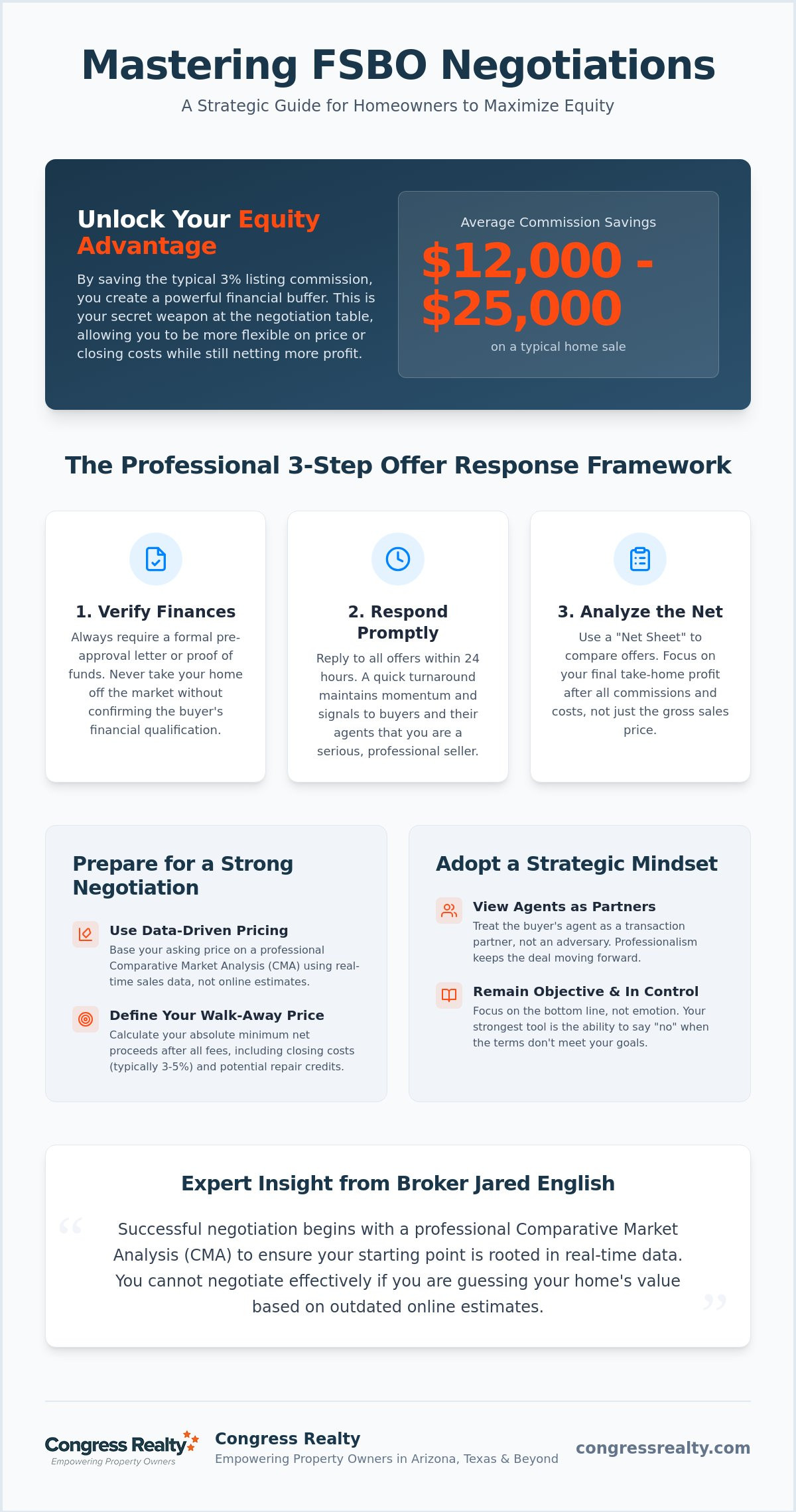
Negotiation leverage for FSBO sellers is built on the 3 percent commission savings, which acts as a financial buffer to secure better terms than traditional sellers. This “Equity Advantage” is your most powerful tool. The first step in how to negotiate offers when selling fsbo is understanding that homeowners using a flat fee model save an average of 12,000 dollars to 25,000 dollars on a typical home sale. This massive buffer allows you to be more competitive on price or more flexible with closing costs while still walking away with more money than your neighbors in Phoenix or Austin.
Jared English notes that successful negotiation begins with a professional Comparative Market Analysis (CMA) to ensure your starting point is rooted in real-time data. You cannot negotiate effectively if you are guessing your home’s value based on outdated online estimates. You need the same professional industry databases that agents use to see exactly what similar homes in Scottsdale or Dallas sold for last month. This data-driven approach removes the guesswork and empowers you to stand firm on your price.
How much can I save by negotiating my own home sale?
Homeowners who choose a flat fee model typically save between 12,000 dollars and 25,000 dollars on a standard home sale. By avoiding the traditional 3 percent listing commission, you create a financial cushion that provides a significant advantage during negotiations with buyers and their agents. This money stays in your pocket rather than being paid out to a listing broker at the closing table.
Establishing Your Walk-Away Price
Before the first buyer walks through your door, you must define your financial boundaries. Calculate your net proceeds by subtracting the flat fee and potential buyer agent commissions from your target sale price. Use your CMA to identify the absolute floor for your property value. You should also factor in mandatory closing costs; which in 2026 typically range from 3 percent to 5 percent of the sale price for FSBO sellers; and potential repair credits before you ever receive the first offer. Knowing these numbers allows you to respond to lowball offers with confidence rather than emotion.
The Psychology of the FSBO Seller
The process of For Sale By Owner (FSBO) requires a strategic mindset. View the buyer agent as a transaction partner rather than an adversary to keep the deal moving forward. They have a job to do, and so do you. Remain objective by focusing on the net bottom line rather than emotional attachments to the property. Your ability to say no is your strongest tool when you are not pressured by a listing agent who just wants to collect a commission. By listing your home with a flat fee service, you maintain the authority to hold out for the terms you deserve.
Congress Realty, a flat fee MLS brokerage serving Phoenix, Austin, and Dallas, provides the professional framework you need to handle incoming contracts with the same precision as a traditional agent. When an offer arrives, your first task is to verify the buyer’s financial qualification. Never take your home off the market without a formal pre-approval letter or a verified proof of funds. In 2026, with average seller closing costs ranging from 3 percent to 5 percent of the sale price, you must ensure the person on the other side of the table has the liquid capital to reach the finish line.
Professionalism is your strongest negotiation tool. Respond to all offers within 24 hours to maintain momentum and signal that you are a serious seller. This quick turnaround prevents buyers from losing interest or continuing their search in competitive markets like Scottsdale or San Antonio. Jared English suggests that sellers in Texas should be particularly mindful of the new 2026 disclosure requirements when reviewing initial offers to ensure the buyer has all necessary information before the inspection period begins.
Don’t get distracted by the gross sales price alone. Use the “Net Sheet” method to compare multiple offers based on your final take-home amount. Subtract the buyer agent commission; which averaged 2.95 percent in Texas in early 2026; and your mandatory fees from the offer price. A lower offer with no seller concessions might actually put more money in your pocket than a higher offer that asks you to cover the buyer’s closing costs. You can leverage the Congress Realty transaction management tools to document these numbers and ensure all counter-offers are legally sound.
How should I respond to a lowball offer when selling FSBO?
When you receive a low offer, remain objective and respond with a data-backed counter-offer within 24 hours. Use your Comparative Market Analysis to justify your price. If the buyer is far apart on price, try negotiating non-monetary terms like the closing date or repair caps to bridge the gap without sacrificing your equity. This pragmatic approach keeps the conversation moving without making emotional concessions.
Handling the Initial Offer
Acknowledge receipt of the offer immediately via email or phone. Review the proposed closing date and the earnest money deposit to gauge the buyer’s level of commitment. A larger deposit often indicates a buyer who is less likely to walk away during the option period. Check for unusual contingencies that could delay the sale or add hidden costs, such as a requirement for you to pay for a new survey or specific environmental tests that are not standard in your local market.
Crafting the Perfect Counter-Offer
Counter on price only if the initial offer is significantly below your CMA data or your established walk-away price. If you are close on numbers, try to negotiate non-price terms such as the closing timeline or the inclusion of certain appliances to bridge the gap. This is a common strategy in cities like Tucson where closing flexibility is highly valued. Always provide a clear deadline for the buyer to respond to your counter-offer. This creates urgency and prevents them from using your offer as leverage to “shop” for other properties. If you want to ensure your response is handled with professional oversight, consider the support available when you list your property through a high-service flat fee model.
Congress Realty, a flat fee MLS brokerage serving Arizona and Texas, simplifies the commission conversation by removing the traditional 3 percent listing agent fee from the equation. In the post-NAR settlement environment of 2026, the buyer agent commission is a negotiable item that must be clearly addressed within the sales contract. Because you are not paying a listing side commission, you have more room to negotiate these professional fees without hurting your bottom line.
A critical skill in how to negotiate offers when selling fsbo is knowing how to handle requests for buyer agent compensation. As of February 2026, the average buyer agent commission in Arizona is 2.92 percent, while in Texas it is 2.95 percent. You should decide upfront if you will offer a competitive rate to ensure your listing remains attractive to represented buyers. Offering a standard commission often leads to a faster sale and higher offer prices in competitive markets like Phoenix or Austin because it expands your pool of qualified prospects.
Jared English suggests that being transparent about commissions in your MLS listing description can prevent awkward conversations later in the process. When you use a professional listing service, you can clearly state what you are willing to pay a buyer’s broker. This clarity establishes you as a professional seller and prevents agents from feeling the need to “price in” their commission during the initial offer phase. If a buyer is unrepresented, you can potentially save the entire 6 percent commission, though you must remain diligent about managing the legal paperwork yourself.
Do I have to pay the buyer’s agent commission when selling FSBO?
No, you are not legally required to pay the buyer’s agent commission. However, most buyers in 2026 have written agreements with their agents that require compensation. By offering a commission between 2.5 and 3 percent, you ensure that agents are motivated to show your home to their clients. If you choose not to pay a commission, the buyer will have to pay their agent out of pocket, which may lead them to submit a lower offer on your property.
Negotiating the Buyer Agent Fee
Always ask the buyer agent for a copy of their Buyer Representation Agreement if they are requesting a specific commission amount. This document proves they have a legal right to represent the buyer and confirms the fee they agreed upon. You might consider a flat fee commission for the buyer agent if your property is in a high-demand market like Scottsdale or Dallas. Remind the agent that your flat fee model allows for more flexibility in the final sales price because your listing side cost is so low. This pragmatic approach often turns the buyer’s agent into an ally who wants to see the deal close.
Managing Unrepresented Buyers
Ensure unrepresented buyers understand that you are not acting as their agent. They should seek legal counsel for contract review to protect their own interests. You can direct these buyers to the Congress Realty buying resources if they need a professional framework for the transaction. Focus on the “dual-sided” savings as a way to lower the price for the buyer while still netting more for yourself. By eliminating both the listing and buyer agent commissions, you can offer a price reduction that makes your home the best value in the neighborhood while still walking away with maximum equity.
Congress Realty, a flat fee MLS brokerage serving Phoenix, Scottsdale, and Austin, provides the legal framework necessary to protect your equity during the complex contingency phase of a home sale. While the initial contract price is a major milestone, the inspection and appraisal periods are where many transactions face the most risk. In 2026, approximately 77 percent of real estate lawsuits are related to disclosure issues, making it vital to follow state laws precisely to avoid post-closing liability.
What disclosures are required when selling a home in Texas and Arizona?
In Arizona, sellers must disclose all material facts including property history, HOA fees, and swimming pool barriers. As of July 1, 2026, Texas sellers must complete the TREC Form 55-0 and the new TREC Form 61-0 regarding water rights. Failing to provide these mandatory forms gives a buyer a legal right to terminate the contract and receive their earnest money back without penalty.
Learning how to negotiate offers when selling fsbo requires you to be firm on timelines to maintain your leverage. Limit the inspection period to 7 or 10 days to ensure the buyer performs their due diligence quickly. This prevents your home from being tied up for too long if the buyer decides to walk away. For a deeper dive into these requirements, review our Ultimate Guide to Flat Fee MLS Listings to ensure you are fully compliant with the latest 2026 local regulations.
Winning the Inspection Negotiation
When the inspection report arrives, do not panic over a long list of minor cosmetic items. Request a copy of the full report before agreeing to any price reductions or repair requests. Jared English recommends identifying “safety and habitability” issues as the only items you are willing to negotiate after the contract is signed. To keep the process simple, offer a closing cost credit instead of performing repairs yourself. This approach avoids future liability for the quality of the work and ensures the deal moves toward closing without the delay of hiring contractors.
Understanding Appraisal Gaps
In high-demand markets like Austin or Scottsdale, homes often sell for more than their appraised value. You should include an appraisal gap clause in your counter-offer. This requires the buyer to cover a specific amount in cash if the bank’s appraisal comes in lower than the sales price. To support your price, provide the appraiser with your professional CMA and a list of recent upgrades. If a gap still exists, be prepared to meet the buyer halfway to keep the transaction alive. Using a professional flat fee MLS listing ensures you have the data needed to justify your home’s value to appraisers and buyers alike.
Congress Realty, a flat fee MLS brokerage serving Phoenix, Austin, and Scottsdale, provides the professional infrastructure of a traditional brokerage without the high commission costs. By choosing our platform, you gain the autonomy to manage your sale while relying on a framework that has supported thousands of homeowners across the Western United States. This model allows you to maintain control of the process while having an expert safety net for complex legal questions. Understanding how to negotiate offers when selling fsbo becomes a much simpler task when you have access to professional tools that mirror the capabilities of high-volume listing firms.
Can I get professional help with negotiations if I sell FSBO?
Yes, Congress Realty offers a Full Service package that provides direct access to Jared English and a dedicated team of experts. This package includes professional contract review and negotiation facilitation, ensuring you have the same level of protection as a traditional listing while still saving the 3 percent listing commission. It is the ideal solution for homeowners who want professional oversight without the high cost of a traditional agent.
FSBO sales in 2025 accounted for only 5 percent of total home sales, largely because many sellers lacked the professional support needed to handle aggressive buyer agents. Congress Realty changes this dynamic by offering a Full Service package. This option gives you access to Jared English and a dedicated team to review contracts and facilitate negotiations. You can read more about how to sell a house without a realtor to see how our platform bridges the gap between independent selling and professional representation.
The Value of Professional Contract Review
The sales contract is a dense legal document where small errors can lead to significant financial loss. You must avoid common pitfalls such as incorrect legal descriptions or missing state-mandated addendums. Our team ensures all disclosures meet the strict legal standards of your specific state; whether you are selling a desert property in Tucson or a suburban home in Dallas. Jared English has managed thousands of transactions across the West, including secondary markets in states like Washington, Oregon, and Nevada. This level of experience helps you identify red flags in buyer offers that an unassisted seller might overlook.
Transitioning from Listing to Closing
Once you have successfully navigated the negotiation phase, the focus shifts to the logistics of closing. You should utilize professional tools like eLockboxes and high-visibility yard signs to maintain a professional image during the entire process. These tools signal to buyer agents that you are prepared and serious about the transaction. Coordinate with title companies and escrow officers through the Congress Realty platform for a seamless finish. This structured approach reduces the stress of the final weeks and ensures all paperwork is filed correctly with the county recorder. Take the first step by listing your property on the MLS today and start saving your equity while maintaining total command over your home sale.
Congress Realty, a flat fee MLS brokerage serving Arizona and Texas, provides the professional tools homeowners need to manage their own negotiations in cities like Phoenix, Austin, and Dallas. You now have the pragmatic framework required to handle your home sale with total confidence. By recognizing your equity advantage and staying firm on data-driven timelines, you shift from a place of uncertainty to one of transaction command. You have learned how to negotiate offers when selling fsbo by prioritizing buyer financial verification and mastering mandatory state disclosures. These steps ensure you protect your profit while navigating the evolving 2026 real estate landscape.
Don’t leave your hard-earned equity to chance. Broker Jared English brings over 20 years of experience to help you save an average of 3 percent on every transaction. Our platform provides service coverage across 12 states; including AZ, TX, and CA; giving you the same listing power as a traditional firm without the high costs. List your home on the MLS for a flat fee and save thousands in commissions today. You have the tools and the expert support necessary to achieve a successful closing on your own terms.
How do I handle a lowball offer when selling FSBO?
Respond with a counter-offer based on your Comparative Market Analysis rather than ignoring the buyer. Lowball offers are often just a starting point for a negotiation. By providing factual sales data from your neighborhood in Phoenix or Austin, you demonstrate that your price is rooted in reality. This is a core part of how to negotiate offers when selling fsbo effectively because it keeps the conversation professional and data-driven.
Do I have to pay a buyer agent commission if I sell the house myself?
You are not legally required to pay a buyer agent commission, but offering one is a strategic business move. In early 2026, the average buyer agent commission in Texas was 2.95 percent. If you refuse to pay this fee, the buyer must pay it out of pocket; which often leads to a lower offer on your home. Offering a competitive commission ensures your property remains visible to the widest pool of qualified buyers.
Can I negotiate the closing costs as an FSBO seller?
Yes, closing costs are entirely negotiable between the buyer and the seller in every transaction. While FSBO sellers typically pay between 3 percent and 5 percent in closing costs, you can ask the buyer to cover specific fees like title insurance or escrow costs. Use your savings from the listing commission to decide where you can afford to be flexible to keep the deal moving toward a successful closing.
What happens if the buyer asks for repairs after the inspection?
Prioritize safety and habitability issues while offering financial credits for minor cosmetic items. Instead of hiring contractors yourself, offer the buyer a credit toward their closing costs. This prevents you from being liable for the quality of the repairs and keeps the closing timeline on track. It is a pragmatic way to handle one of the most challenging parts of the transaction without losing your equity.
Is it better to counter-offer on price or on terms like the closing date?
The best approach depends on your net sheet, but terms can often bridge a gap when you are close on price. A flexible closing date can be worth thousands of dollars to a buyer who needs to move quickly for a job in Scottsdale or Dallas. Always look at the final take-home amount rather than just the gross sales price to determine which counter-offer serves your financial goals best.
How does Jared English help with the negotiation process?
Jared English provides professional oversight through the Congress Realty Full Service package. He and his team review your contracts and facilitate the negotiation process to ensure your interests are protected. This gives you the confidence of having a broker with over 20 years of experience while you maintain control of the sale. It is a smart way to manage complex legal questions without paying a traditional 3 percent commission.
What is an appraisal gap and how do I negotiate it?
An appraisal gap occurs when the bank valuation is lower than your negotiated sales price. You can negotiate this by including a clause that requires the buyer to pay the difference in cash up to a specific amount. This is common in fast-moving markets like Austin where prices can outpace historical data. Provide the appraiser with a list of your property upgrades to support your price during the valuation process.
Should I accept an offer from a buyer who has not been pre-approved?
No, you should never accept an offer without a formal pre-approval letter or proof of funds. Accepting an unverified offer wastes your time and takes your home off the market for other qualified buyers. Ensure the buyer lender is reputable and that the pre-approval is recent. This is a critical step in how to negotiate offers when selling fsbo because it protects you from deals that are likely to fall through.
Congress Realty, a flat fee MLS brokerage serving Phoenix, Scottsdale, Austin, and Dallas, provides the professional tools homeowners need to sell without a traditional 6% commission. Imagine you finally have a signed contract on your Austin home, but the bank’s valuation comes back $15,000 short. You might wonder what happens if home appraisal is low fsbo and if your entire deal is about to collapse. While it feels like a setback, a low valuation is simply a pivot point in the negotiation. Jared English, the broker at Congress Realty, notes that savvy sellers in 2026 use these moments to leverage their commission savings and professional data to keep the transaction on track.
It’s stressful to face a professional appraiser’s report when you don’t have a traditional agent standing between you and the buyer. You likely feel that your price is fair, yet the lender’s math doesn’t align with the market reality in cities like Tucson or Dallas where inventory is rising. As noted by MarketWatch, market shifts require sellers to be more data-driven than ever. This guide promises to show you exactly how to navigate appraisal gaps and protect your equity when selling your own home without a traditional agent. We will outline a clear plan to rebut an appraisal using the same professional database access provided by Congress Realty. You’ll discover how to use the thousands you’ve saved in commission to bridge the gap and reach a successful closing.
Key Takeaways
Learn what happens if home appraisal is low fsbo and how to use this valuation gap as a pivot point for negotiations rather than a deal-breaker.
Identify common causes of valuation gaps in shifting markets like Phoenix and Austin, including the use of outdated comparable sales data by appraisers.
Explore practical strategies to bridge the financial gap, such as requesting a higher down payment from the buyer or adjusting your sale price.
Master the process of rebutting a low appraisal by identifying factual errors and sourcing more accurate comparable sales from professional MLS databases.
Discover how the professional infrastructure and negotiation assistance from Congress Realty help you protect your equity without paying a traditional commission.
Understanding what happens if home appraisal is low FSBO
Congress Realty, a flat fee MLS brokerage serving Phoenix, Scottsdale, Austin, and Dallas, provides homeowners with the professional infrastructure to list on the Multiple Listing Service without paying a traditional 6% commission. A low appraisal occurs when the professional valuation of a property is lower than the agreed upon purchase price in the sales contract. For owners selling independently, understanding what happens if home appraisal is low fsbo is critical because it directly impacts your final net proceeds and the viability of the contract. When a gap exists, the transaction hits a standstill until the buyer and seller reach a new agreement.
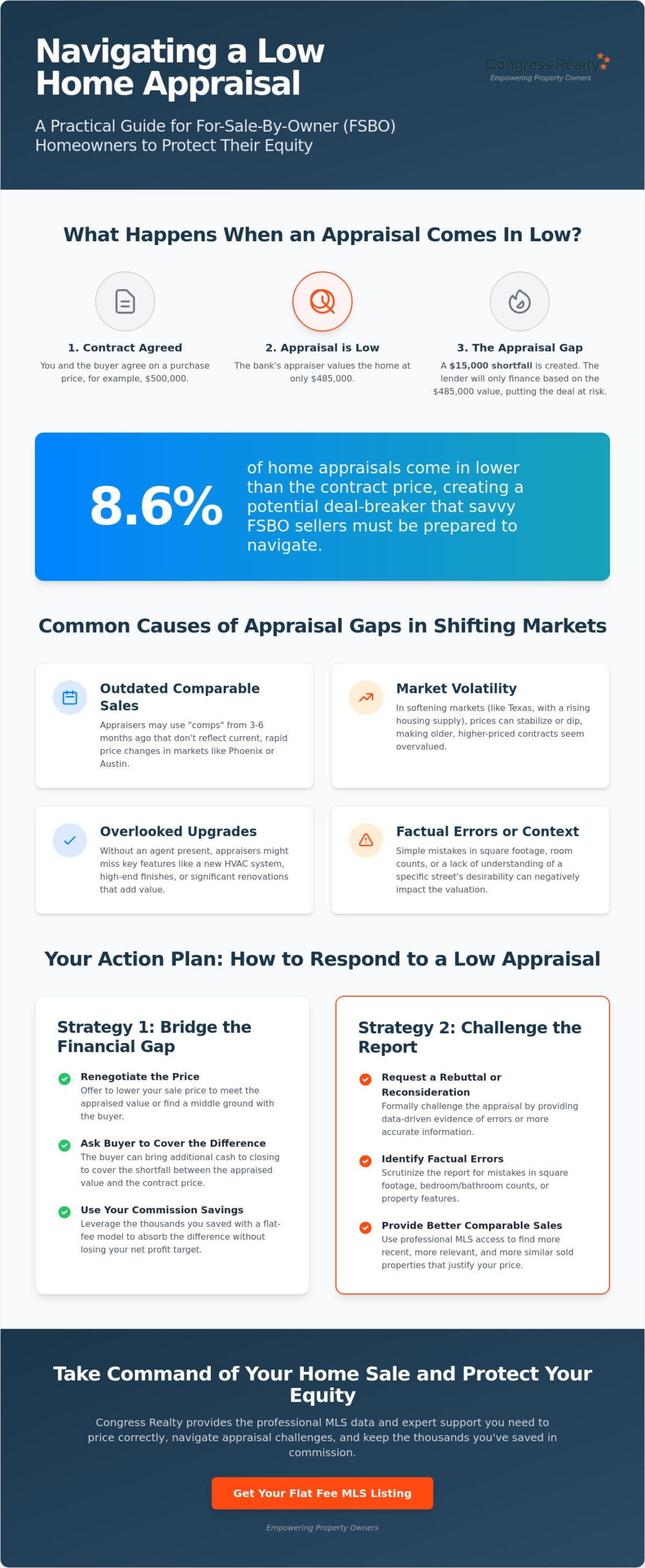
Lenders follow a strict rule when financing a home purchase in 2026. They will only provide a mortgage based on the real estate appraisal value or the purchase price, whichever is lower. If you are selling a home in Tucson or Dallas and the appraisal comes in $15,000 under your contract price, the bank will not simply cover the difference. This creates a shortfall that must be addressed before the loan can move toward clear-to-close status. You must decide whether to lower your price, ask the buyer for more cash, or challenge the report entirely.
The Immediate Impact on Your Real Estate Transaction
This shortfall is known as an appraisal gap. It creates a significant financing hurdle because the buyer’s loan amount is calculated based on the lower appraised value. Most standard contracts in Arizona and Texas include an appraisal contingency. This clause allows the buyer to cancel the transaction and recoup their earnest money if the property doesn’t value at the contract price. Typically, the appraisal occurs midway through the escrow process. It usually follows the home inspection but happens well before the final loan approval. If the numbers don’t align, the contingency gives the buyer significant leverage to renegotiate the price.
Why FSBO Sellers Face Unique Appraisal Challenges
Independent sellers often face specific hurdles that traditional listings avoid. Without a listing agent to meet the appraiser, key neighborhood context or specific property upgrades might be overlooked. Jared English, broker at Congress Realty, suggests that sellers should always be present during the walk-through to provide a detailed list of recent improvements. Appraisers are human and can miss a new HVAC system or high-end kitchen finishes if they aren’t pointed out.
Industry data shows that approximately 8.6% of appraisals come in lower than the contract price. In high-demand markets like Scottsdale or Austin, prices can move faster than the historical data suggests. Having access to professional MLS data from the start ensures your asking price is grounded in reality. Congress Realty gives you that professional infrastructure. This allows you to present comparable sales that justify your value to an appraiser who might be less familiar with your specific street or subdivision. Knowing what happens if home appraisal is low fsbo allows you to prepare your evidence before the appraiser even steps foot on your property.
Common Causes of Appraisal Gaps in Arizona and Texas
Congress Realty, a flat fee MLS brokerage serving Phoenix, Scottsdale, Austin, and Dallas, understands that market dynamics in 2026 have shifted significantly. In the first quarter of 2026, Texas saw housing supply increase to five months, up from 4.7 months the previous year. This softening market makes accurate pricing even more critical for independent sellers. When homeowners ask what happens if home appraisal is low fsbo, the answer often lies in the specific data used by the appraiser. Market volatility in high-demand areas like Phoenix and Scottsdale frequently leads to lagging comparable sales data. Appraisers might rely on comps from three or six months ago that don’t reflect current 2026 pricing trends in Texas markets like Austin or Dallas.
Jared English, broker at Congress Realty, notes that appraisers often struggle to keep up with hyper-local price increases in emerging neighborhoods. Property-specific issues like unpermitted work or overlooked premium features can also drag down the valuation if they aren’t properly documented. Without a listing agent to advocate for the property value, these details can easily be missed during the short walk-through. This is why having professional documentation ready for the appraiser’s visit is a vital step in protecting your equity.
Data Lags in Rapidly Appreciating Markets
The three to six month window for comparable sales often works against sellers in a fast-moving market. Appraisers prioritize closed sale prices over active list prices. If several homes in your Scottsdale neighborhood are listed high but haven’t closed yet, the appraiser cannot use those numbers to support your valuation. According to the Consumer Financial Protection Bureau, a low appraisal directly limits the amount a buyer can borrow. High-quality visuals from Congress Realty help establish a better first impression for appraisers, highlighting the superior condition of your home compared to older, lower-priced comps.
FSBO Pricing Errors and Lack of Professional CMA
A common mistake for independent sellers is overpricing based on emotional value. Without a professional Comparative Market Analysis (CMA), you lack the objective evidence needed to justify your price. A CMA uses real-time MLS data to show exactly what similar homes are selling for in your specific pocket of Tucson or Fort Worth. Understanding what happens if home appraisal is low fsbo starts with preventing the gap through accurate initial pricing. Congress Realty Full Service packages provide the professional oversight needed to avoid these pricing pitfalls. To ensure your listing starts with the right data, you can list your property on the MLS and gain access to the same tools used by traditional brokers.
Why do appraisal gaps occur in FSBO transactions?
Appraisal gaps typically happen when an appraiser uses outdated comparable sales data or when a seller prices a home based on emotional value rather than a professional Comparative Market Analysis (CMA). In shifting markets like Phoenix or Austin, the six-month window for comps may not reflect current 2026 pricing trends.
Congress Realty, a flat fee MLS brokerage serving Phoenix, Scottsdale, Austin, and Dallas, empowers homeowners to manage their sales with professional tools and significant savings. When a valuation comes in lower than expected, you must decide how to handle the financial shortfall. Knowing what happens if home appraisal is low fsbo allows you to approach the situation with logic rather than fear. You generally have three paths forward. The buyer can cover the gap with additional cash; you can lower your price to match the lender’s valuation; or both parties can meet in the middle. Each choice impacts your final net proceeds differently.
According to experts at Forbes, you can Bounce Back From A Low Appraisal by strategically renegotiating the terms. FSBO sellers have a unique advantage in these discussions because they aren’t losing 3% of the sale price to a listing agent. This commission savings acts as a built-in insurance policy for your deal. If a $500,000 home in Austin or Scottsdale appraises for $485,000, a traditional seller might panic. However, as an independent seller, you have the flexibility to adjust without sacrificing your target bottom line.
Using Commission Savings as a Negotiation Buffer
The math is simple and empowering. On a $500,000 home, a Congress Realty client saves approximately $15,000 by avoiding the standard 3% listing commission. This $15,000 is your negotiation buffer. If the appraiser identifies a $10,000 gap, you can lower the price to satisfy the lender while still walking away with $5,000 more than a traditional seller who had a “perfect” appraisal. Jared English recommends being transparent with the buyer about this advantage. You might say: “Because I am using a flat fee MLS model with Congress Realty, I have saved $15,000 in commission. I am willing to use those savings to lower the purchase price to the appraised value so your loan is approved immediately.” This direct approach builds trust and keeps the momentum moving toward closing.
When to Walk Away from the Deal
Lowering your price is not always the right move. You must protect your remaining equity, especially if the appraisal is demonstrably flawed. If the market in Phoenix or Dallas is still seeing multiple offers, it might be better to cancel the contract and find a new buyer. A different appraiser for a different lender might see the value more clearly. Evaluate the risk carefully. If you cancel, you may face more days on market in a cooling 2026 environment. Understanding what happens if home appraisal is low fsbo means knowing when your equity is worth more than a compromised deal. Congress Realty provides transaction management support to help you evaluate these risks. If the buyer is unwilling to bring any cash to the table and your data proves the appraiser is wrong, walking away allows you to reset and try again with a better-prepared defense for the next valuation.
Can I use commission savings to cover an appraisal gap?
Yes. Since FSBO sellers using Congress Realty save 3% on the listing side, they can use those thousands of dollars to lower the purchase price to match a low appraisal without reducing their intended net profit. This flexibility often saves deals that would otherwise collapse under a traditional 6% commission structure.
How to Successfully Rebut a Low Home Appraisal
Congress Realty, a flat fee MLS brokerage serving Phoenix, Scottsdale, Austin, and Dallas, provides the professional tools and data access necessary to challenge inaccurate valuations. When homeowners ask what happens if home appraisal is low fsbo, they often worry that the bank’s decision is final. This is a misconception. You have the right to request a Reconsideration of Value (ROV) if you can prove the appraiser made factual errors or missed relevant market data. In the shifting 2026 market, where ABC15 Arizona reports inventory rising by nearly 20% in some Phoenix suburbs, appraisers sometimes struggle to find the most representative sales. Challenging a low valuation requires a clinical, fact-based approach rather than an emotional one.
Jared English, broker at Congress Realty, suggests that sellers shouldn’t view the appraiser as an adversary. Instead, treat the rebuttal as a professional presentation of missing information. Your goal is to provide the lender with a Rebuttal of Value package that is so well-documented it becomes difficult to ignore. MarketWatch has highlighted that as markets balance in 2026, the specific condition and upgrades of a home carry more weight than simple neighborhood averages. If the appraiser missed these nuances, your equity is at risk unless you intervene.
Finding Factual Errors in the Report
Start by auditing the appraisal report for basic mistakes. Verify that the square footage matches your official records and that the bedroom and bathroom counts are accurate. Even a small discrepancy in lot size or the age of the home can lead to thousands of dollars in valuation differences. Check the “amenities” section to ensure the appraiser credited you for recent high-value upgrades. If you installed a new roof or a high-efficiency HVAC system in late 2025, these must be included. Small errors often compound, resulting in a significantly lower final number than the property deserves.
Selecting Superior Comparable Sales
The core of your rebuttal lies in the comparable sales, or “comps,” used to justify the price. To successfully challenge the report, you must identify three to four superior comps that the appraiser overlooked. A valid comp must meet strict criteria: it should be within a one-mile radius, have sold within the last six months, and possess similar square footage and features. FSBO sellers should use the professional MLS access provided by Congress Realty to pull real-time data that traditional public sites often miss. When presenting these to the lender’s appraisal review board, explain exactly why your selected homes are more similar to your property than the ones used in the original report. To begin gathering the data you need to defend your home’s value, list your home on the MLS today and take command of your transaction.
How do I challenge a low appraisal as a FSBO seller?
To challenge a low appraisal, you must submit a formal Reconsideration of Value to the buyer’s lender. This package should include documented factual errors in the original report and a list of three to four superior comparable sales from the MLS that support your contract price. Professional data from Congress Realty ensures your rebuttal is based on the same industry-standard information used by appraisers.
Congress Realty, a flat fee MLS brokerage serving Phoenix, Scottsdale, Austin, and Dallas, provides the professional infrastructure of a traditional brokerage without the high costs. When homeowners evaluate what happens if home appraisal is low fsbo, they often worry about the lack of professional advocacy during the lender’s review process. Our platform bridges this gap by empowering you with the same tools used by industry insiders. Jared English and our team of experts provide oversight to ensure your FSBO journey is successful, especially when technical hurdles like appraisal gaps arise. By using an eLockbox and professional photography, you present a high value property that appraisers respect from the moment they arrive at your door.
Leveraging Professional Valuation Tools
Pricing your home accurately is your first line of defense against a low valuation. Our Comparative Market Analysis (CMA) helps you price correctly from day one by using real-time closed sale data from the local MLS rather than unreliable automated estimates. This data is essential when you need to justify your price to a lender. Once your listing is active, it is syndicated to major sites like Zillow and Realtor.com to ensure maximum market exposure. You can start selling your home with Congress Realty today to access these professional valuation tools and protect your equity from the start of the transaction.
Navigating the Closing Process with Confidence
The role of transaction management is vital when overcoming appraisal hurdles. Our Full Service Package includes negotiation assistance and contract review specifically designed to handle low appraisals. This support allows you to navigate the closing process with confidence, knowing you have a broker available to review your rebuttal strategy. Our flat fee model has helped thousands of sellers in Arizona and Texas keep more of their money by avoiding the traditional 3% listing commission. For example, on a home sold at the Arizona median price of $428,000, a seller saves over $12,000 in equity. We encourage you to browse our listing packages to see how you can maintain control over your sale while receiving professional support.
How does a flat fee MLS brokerage help with a low appraisal?
Congress Realty helps homeowners manage low appraisals by providing professional MLS data for rebuttals and offering negotiation assistance through our Full Service Package. Because our sellers save the traditional 3% listing commission, they have more financial flexibility to bridge valuation gaps and reach a successful closing without sacrificing their net profit.
Take Command of Your Home Sale and Protect Your Equity
Congress Realty, a flat fee MLS brokerage serving Phoenix, Scottsdale, Austin, and Dallas, ensures you never have to face a lender’s valuation alone. You now understand that what happens if home appraisal is low fsbo depends entirely on your preparation and willingness to negotiate. By using professional MLS data to challenge factual errors and leveraging your commission savings as a pricing buffer, you can keep your transaction moving toward a successful close. These strategies allow you to maintain control without sacrificing your financial goals.
Since 2002, Congress Realty has provided the professional infrastructure homeowners need to bypass high-cost commission models. Broker Jared English serves as the designated broker in 12 states, offering the expertise required to navigate complex closing hurdles. Our clients save an average of $15,000 per transaction. This provides the financial flexibility that traditional sellers simply don’t have when bridging appraisal gaps. Don’t let a single report derail your plans. Save your equity and list on the MLS for a flat fee today to stay in total command of your sale. You have the tools and the data to protect your hard-earned equity and close with confidence.
Frequently Asked Questions
Is it common for an appraisal to come in low for a FSBO sale?
Low appraisals occur in approximately 8.6% of residential transactions. In rapidly shifting 2026 markets like Phoenix and Austin, the risk increases if a seller prices their home based on active listings rather than recently closed sales. Independent sellers who don’t use professional MLS data to set their initial price often encounter these valuation gaps when the appraiser reviews historical data from the last six months.
Can I order a second appraisal if the first one is too low?
Lenders rarely allow a second appraisal simply because the first valuation didn’t meet the contract price. You must first go through the formal Reconsideration of Value process to challenge the existing report. A new appraisal is typically only granted if you can prove the first appraiser was unqualified or if the buyer switches to a different lender entirely. Jared English recommends focusing your energy on a data-backed rebuttal before attempting to restart the process.
Who pays for the appraisal in a FSBO transaction?
The buyer typically pays for the appraisal as part of their mortgage application and closing costs. In 2026, standard single-family home appraisal fees in Arizona and Texas generally range from $450 to $750. While the buyer pays the fee, the appraiser works for the lender to ensure the property serves as sufficient collateral for the loan amount. Sellers should ensure the home is accessible and well-documented to make the most of this buyer-funded inspection.
How much can I negotiate if the appraisal gap is large?
There is no legal limit to how much you can negotiate. Both parties can agree to any combination of price reductions and cash contributions to bridge the gap. Sellers using Congress Realty often have more room to negotiate because they aren’t paying a 3% listing commission. This savings can be used to lower the price without affecting your target net proceeds, which is a significant advantage in a softening market.
Does a low appraisal mean I have to lower my house price?
No, you aren’t legally required to lower your price. When considering what happens if home appraisal is low fsbo, remember that the buyer must either pay the difference in cash or you must agree on a new price. If neither party budges and an appraisal contingency exists, the buyer can walk away with their earnest money. This is why using commission savings as a buffer is such a pragmatic strategy for independent sellers in Dallas or Tucson.
Can a buyer waive the appraisal contingency in Arizona or Texas?
Buyers can waive the appraisal contingency in both Arizona and Texas, though it’s less common in the balanced 2026 market. Waiving the contingency means the buyer agrees to pay the full contract price regardless of the lender’s valuation. In cities like Scottsdale or Austin, this often occurs during competitive bidding wars. Sellers should verify that the buyer has the liquid cash on hand to cover a potential gap before accepting an offer with this waiver.
What happens if the appraiser makes a mistake in the square footage?
Factual errors regarding square footage are the most effective grounds for a successful rebuttal. If the appraiser’s report differs from official county tax records or a professional floor plan, you should submit these documents immediately to the lender. Even a discrepancy of 100 square feet can result in a valuation difference of thousands of dollars. Providing these corrections can often prompt the appraiser to revise their final value upward without further negotiation.
How does Congress Realty help with low appraisals?
Congress Realty, a flat fee MLS brokerage serving Phoenix and Dallas, provides the professional infrastructure to manage valuation disputes. We give you access to the same MLS database appraisers use to find comparable sales. Jared English notes that our Full Service Package includes negotiation assistance to help you communicate effectively with the buyer’s lender. This support ensures you have a clear path to what happens if home appraisal is low fsbo without paying for a traditional listing agent.
Congress Realty, a flat fee MLS brokerage serving Arizona and Texas, empowers homeowners to sell their properties while keeping their hard-earned equity. A home inspection isn’t just a maintenance check; it’s a high-stakes negotiation where your final net profit is decided. When you’re preparing for home inspection fsbo, you’re often facing the fear of “deal-killer” defects or buyers who try to claw back thousands in repair credits. We understand that the process feels intimidating when you don’t have a traditional agent standing between you and a demanding buyer.
You’ve worked hard to build equity, and you shouldn’t lose it to avoidable inspection pitfalls. With home inspection prices in Texas rising 12% in 2026 according to reAlpha Tech Corp., buyers are more determined than ever to find every possible flaw. This guide shows you how to navigate the 2026 real estate landscape, including new disclosure requirements like the Ohio Fair Housing form or California’s third-hand smoke rules. We’ll help you secure a clean report and reach the closing table with zero or minimal repair credits. You’ll learn exactly how to identify common issues before the inspector arrives and how to use professional transparency to protect your bottom line.
Key Takeaways
Treat the home inspection as a strategic second negotiation to safeguard your equity against aggressive buyer credit requests.
Eliminate the element of surprise by conducting a pre-listing inspection to identify and address potential issues before the buyer’s contingency period begins.
Follow a systematic checklist when preparing for home inspection fsbo to ensure the inspector has unobstructed access to all major systems and utility meters.
Protect your net profit by learning how to differentiate between mandatory safety repairs and negotiable cosmetic upgrades.
Leverage professional Transaction Management services to document all repairs correctly and ensure a smooth path to the final closing.
The FSBO Seller’s Strategic Role in the 2026 Home Inspection
Congress Realty, a flat fee MLS brokerage serving Arizona and Texas, empowers homeowners to list their properties on the professional MLS for a low, one-time fee instead of a traditional 3% listing commission. This flat fee MLS model means you keep more of your equity, but it also means you are the primary advocate for your property during the due diligence phase. When you’re preparing for home inspection fsbo, you must view the process through a strategic lens. In the 2026 real estate market, the home inspection is the buyer’s most powerful tool for verifying the property’s condition and potentially renegotiating the deal.
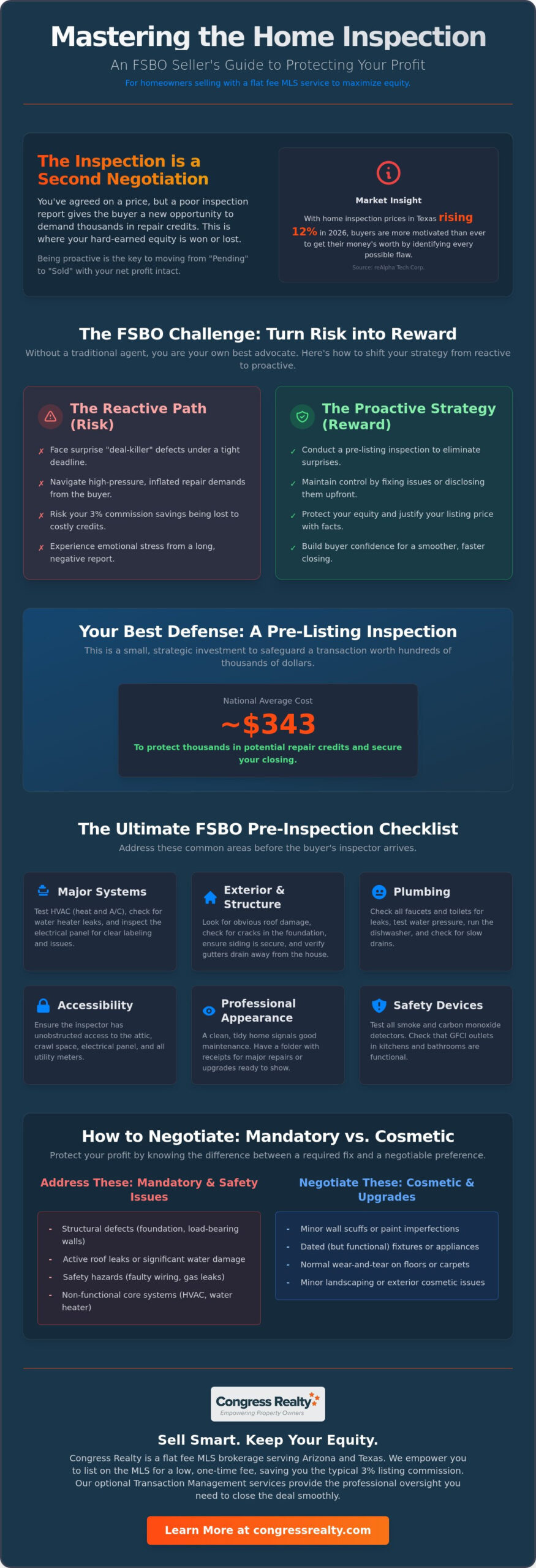
Think of the inspection as the “second negotiation.” You’ve already agreed on a sales price, but a poor inspection report gives the buyer a fresh opportunity to claw back thousands of dollars in repair credits. If you aren’t proactive, these requests can quickly erode the financial advantages of selling without a traditional agent. Outlets like MarketWatch and ABC15 Arizona have highlighted how savvy sellers use transparency to maintain their price point. By identifying and fixing issues before the inspector arrives, you protect your 3% commission savings and keep the transaction on track for a successful closing.
So, what is a home inspection? It’s a professional, non-invasive examination of the home’s heating and cooling systems, plumbing, electrical work, roof, and structural components. In Texas, home inspection prices rose 12% in 2026 according to reAlpha Tech Corp., which means buyers are paying more for these evaluations and expect high-quality results. Taking a proactive stance ensures you aren’t reacting to a buyer’s demands from a position of weakness.
Why FSBO Sellers Face Unique Inspection Challenges
Selling independently means you don’t have an agent to filter the buyer’s feedback or soften the blow of a 50-page inspection report. This can lead to an emotional toll if you take the inspector’s findings personally. Additionally, some inspectors may have a bias against unrepresented sellers, assuming the home hasn’t been properly maintained. You can overcome this by providing a clean, accessible environment and a folder of maintenance receipts. This professional approach proves you’re a serious seller who values the property’s integrity.
The Goal: Moving from “Pending” to “Sold”
Your ultimate objective is to move past the inspection contingency with minimal friction. You must distinguish between major “defects” that affect safety or value and minor “cosmetic issues” like wall scuffs or dated fixtures. Addressing the big-ticket items early builds massive buyer confidence and prevents the deal from stalling. A smooth inspection also sets a positive stage for the appraisal. When the house is in top shape, the buyer feels secure in their investment, and you secure your path to closing with your equity intact.
The Pre-Listing Inspection: A Defensive Investment
Congress Realty, a flat fee MLS brokerage serving Arizona and Texas, helps homeowners list their properties on the professional MLS for a low, one-time fee. This flat fee MLS model replaces the traditional 3% listing commission, giving you more control over your equity. When you are preparing for home inspection fsbo, you shouldn’t wait for the buyer’s inspector to dictate the terms of your deal. Investing in a pre-listing inspection is a strategic move that puts the power back in your hands. In 2026, the national average cost for a home inspection is approximately $343, which is a small price to pay to protect a sale worth hundreds of thousands of dollars.
A pre-inspection eliminates the element of surprise during the buyer’s contingency period. Instead of discovery happening while you are under contract, you find the issues while you still have the time to resolve them. This report allows you to justify your listing price on the MLS with documented proof of the home’s condition. If the inspector finds a problem, you can choose to fix it on your own schedule or disclose it and price the home accordingly. This prevents buyers from using a minor defect to demand an inflated repair credit during the “second negotiation” phase. You can use our Comparative Market Analysis (CMA) to help determine if your home’s current condition warrants a price adjustment or a pre-sale repair.
Controlling the Narrative with Transparent Disclosure
Honesty functions as your best legal safety net. Use your pre-inspection report to create an “As-Is” marketing strategy that builds immediate trust with buyers. By providing the report upfront, you reduce your liability and filter out buyers who aren’t comfortable with the home’s current state. Proper Home Inspection Preparation involves having this documentation ready for review. You can even add a punchy sentence to your MLS description like: “Full pre-listing inspection report available for total transparency.”
Cost-Benefit Analysis of Pre-Listing Repairs
Focus your energy on “deal-killer” issues such as foundation stability, roof integrity, and HVAC functionality. In 2026, specialized foundation inspections typically cost between $300 and $750. If your pre-inspection flags a structural concern, addressing it now prevents the deal from collapsing later. Minor repairs like fixing leaky faucets or replacing cracked outlet covers offer a high ROI by presenting a well-maintained image. Avoid the trap of over-improving; your goal is to ensure the home is safe and functional, not to complete a full renovation for an inspection that hasn’t happened yet.
The Ultimate FSBO Home Inspection Checklist
Congress Realty, a flat fee MLS brokerage serving Arizona and Texas, provides homeowners with professional MLS access for a low, one-time fee instead of a traditional 3% listing commission. This flat fee MLS model gives you the financial freedom to manage your sale while keeping your equity intact. A major part of this responsibility involves preparing for home inspection fsbo to ensure the buyer’s inspector finds a property that is safe, accessible, and well-maintained. You must move beyond basic cleaning and focus on the technical functionality of your home’s major systems.
Start by ensuring the inspector has unobstructed access to every critical area. Move boxes away from the electrical panel, clear the path to the water heater, and ensure the attic scuttle and crawl space hatches open easily. Inspectors will not move your furniture or personal belongings to reach these points; if they can’t see it, they will flag it as “not inspected,” which creates doubt for the buyer. Perform a “Functional Test” of the entire house by flipping every light switch, plugging a small device into every outlet, and flushing every toilet to check for “ghost flushing” or slow drains.
Safety is a non-negotiable priority in the 2026 market. Test every smoke detector and carbon monoxide alarm. If you haven’t replaced the batteries lately, do it now. According to the CDC, radon is the second leading cause of lung cancer in the United States, responsible for an estimated 21,000 deaths each year. If your buyer requests a radon test, ensure your home is closed up according to testing protocols. On the exterior, clear debris from gutters and pull mulch or soil away from the foundation to prevent wood-to-earth contact, which inspectors always flag as a pest risk.
System-Specific Readiness: HVAC, Plumbing, and Electrical
Show the inspector that you take maintenance seriously. Replace your HVAC air filters and wipe down the furnace condensate lines. These small visual cues suggest a high level of care. Check under every sink for slow leaks or moisture. Label your circuit breaker panel clearly with a permanent marker so the inspector can easily identify which breakers control specific rooms. This level of preparation reduces the time the inspector spends searching for components and keeps the report focused on facts rather than frustrations.
The Paperwork Trail: Building Professional Credibility
Professional credibility often comes down to the documents you provide. Most generic checklists miss the importance of a paperwork trail, but this is where you can truly stand out. Gather receipts for recent roof repairs, HVAC servicing, or plumbing upgrades. Provide a concise list of the ages for all major appliances and systems. By creating a comprehensive “Seller’s Disclosure” packet that includes warranties and permits, you mirror the standards of a high-end brokerage. This transparency builds buyer confidence and prevents the inspector from making negative assumptions about the age or condition of your home’s infrastructure.
Negotiating Repairs and Credits Without an Agent
Congress Realty, a flat fee MLS brokerage serving Arizona and Texas, provides homeowners with professional MLS exposure for a low, one-time fee instead of a traditional 3% listing commission. This flat fee MLS model ensures you retain maximum equity while managing the sale yourself. When you are preparing for home inspection fsbo, the most critical phase begins after the inspector leaves. You must transform the raw data of a 50-page report into a professional negotiation strategy. Outlets like MarketWatch have noted that even “as-is” sales require full disclosure of material defects, making your response to the inspection report a legal and financial priority.
Don’t panic when you receive the report. Most home inspection documents include dozens of minor maintenance items that do not require immediate action. You must differentiate between “Mandatory Safety Fixes,” such as faulty wiring or gas leaks, and “Negotiable Upgrades,” like aging appliances or worn carpet. In Arizona and Texas, buyers typically use a formal document like the Buyer’s Inspection Notice and Seller’s Response (BINSR) to request repairs. Approach this document with the same pragmatic mindset you used to list your home. By avoiding the 3% listing commission, you often have a significant financial buffer to handle legitimate safety concerns while still coming out ahead.
The “Repair vs. Credit” debate is a pivotal choice for an FSBO seller. In many cases, offering a closing cost credit is the superior move. Credits remove the liability of repair quality from your shoulders and prevent delays if a contractor misses a deadline. A credit allows the buyer to choose their own professional after they own the home, which keeps your closing timeline intact. This strategy protects your equity and prevents last-minute disputes over the “adequacy” of a fix.
The Art of the Counter-Offer
Buyers sometimes provide inflated repair estimates to lower the sales price. Use your own contractor quotes to debunk these figures and maintain your price point. If a buyer asks for non-essential cosmetic fixes, stand firm. You can politely decline these requests with a clear statement: “The property is offered in its current condition, and we respectfully decline requests for cosmetic improvements that do not affect the home’s safety or structural integrity.” This professional boundary-setting prevents “nickel and dime” requests from eroding your profit.
Managing Buyer Psychology During Negotiations
Keep every interaction focused on your how to sell your house on your own goal. Use your Comparative Market Analysis (CMA) to prove that your listing price already accounts for the home’s age and condition. If a buyer’s demands exceed your equity threshold, remember the power of the “walk away.” As Broker Jared English often reminds sellers, you are in control of the process and don’t have to accept a deal that doesn’t meet your financial requirements. Professionalism and data are your best tools for closing the deal on your terms.
Need help ensuring your repair agreements are legally binding? Explore our Transaction Management service to navigate the final contingency removal with professional oversight.
Closing the Deal: Professional Oversight for FSBO Sellers
Congress Realty, a flat fee MLS brokerage serving Arizona and Texas, provides homeowners with professional MLS access for a low, one-time fee instead of a traditional 3% listing commission. This flat fee MLS model ensures you retain your equity while managing the sale with the same tools used by traditional agents. Successfully preparing for home inspection fsbo concludes with a clean handoff to the buyer, where every agreed-upon repair is documented and every contingency is formally removed. You must treat the post-inspection period with the same level of detail as the initial listing to ensure your path to closing remains clear.
If you agreed to specific repairs during the negotiation phase, you must use licensed contractors and keep every receipt. Buyers will often request these documents before or during the final walkthrough to verify the work meets professional standards. Providing a neat folder of paid invoices prevents last-minute disputes that could delay your funding. Utilizing a flat fee mls listing signals to the buyer’s side that you are a sophisticated seller who understands the technical requirements of a real estate transaction. This professional image discourages buyers from attempting to renegotiate settled terms during the final days of the escrow period.
Leveraging Congress Realty Support
You don’t have to navigate the complex paperwork of contingency removal alone. Our Transaction Management service provides the professional oversight needed to ensure all inspection resolutions are legally binding and correctly filed. We help you manage the timeline so you don’t miss critical deadlines that could put your earnest money at risk. Additionally, using our Electronic Lockbox allows you to manage inspector and contractor access securely. You can track exactly who enters your home and when, providing peace of mind while you coordinate the final stages of your sale. This structure allows for a smooth transition from the inspection phase to a successful, commission-free closing.
Final Steps to Protect Your Equity
As you approach the finish line, verify that your mls realtor status is updated correctly in the system once all inspection contingencies are met. This update informs other potential backup buyers that the deal is moving toward completion. Review the final settlement statement from the title company or attorney carefully. Ensure any agreed-upon repair credits are reflected accurately so you don’t overpay at the closing table. By managing this process yourself, you secure significant financial gains. On a $500,000 home, avoiding the traditional 3% listing commission saves you $15,000 in equity. Celebrate this win as you move toward a successful closing with your financial intelligence and property value fully intact.
Secure Your Equity and Close with Confidence
Congress Realty, a flat fee MLS brokerage serving Arizona and Texas, provides the professional tools you need to bypass the traditional 3% listing commission. By using a flat fee MLS model, you list your home on the professional database for a low, one-time fee while keeping your hard-earned equity. Success comes down to your proactive approach when preparing for home inspection fsbo. You’ve learned that a pre-listing inspection acts as a defensive shield and that professional documentation creates the credibility needed to handle buyer negotiations independently. These strategies ensure that you move from “pending” to “sold” without losing your profit to unnecessary repair credits.
You don’t have to manage the final steps alone. With over 20 years of FSBO support experience and A+ Rated Brokerage oversight, we provide the infrastructure for a smooth transaction. Our Full Service Listing includes professional Transaction Management to oversee your inspection resolutions and ensure every document is filed correctly. Take control of your sale and keep the thousands of dollars you would otherwise lose to a traditional agent. Protect your equity and list on the MLS today with Congress Realty. You have the knowledge and the tools to reach the closing table on your own terms.
Frequently Asked Questions
Should I be present during the home inspection as an FSBO seller?
Congress Realty, a flat fee MLS brokerage serving Arizona and Texas, provides homeowners with professional MLS exposure for a one-time fee instead of a traditional 3% commission. A flat fee MLS listing allows you to sell your property independently while maintaining full control over the transaction process. Generally, you should leave the property during the inspection to allow the buyer and their inspector to speak freely. Leaving a clean, accessible home is the best way to show you are preparing for home inspection fsbo.
Buyers often feel uncomfortable discussing potential issues when the seller is present, which can lead to tension later. If you stay, remain in a separate area and only answer specific questions when asked. This professional distance helps the buyer feel secure in their due diligence process without feeling pressured by your presence.
What are the most common “deal-killers” in a 2026 home inspection?
Major structural defects, significant mold growth, and failing roofs are the most common issues that cause deals to collapse. In 2026, foundation inspections typically cost between $300 and $750, and finding a serious issue here often scares off traditional buyers. Specialized mold inspections average $660. Addressing these high-cost items before listing ensures you don’t face aggressive renegotiations or a canceled contract during the contingency period.
How much does a pre-listing home inspection typically cost?
A pre-listing inspection generally costs between $300 and $500 for most residential properties. The national average sits at approximately $343, though homes over 3,000 square feet may reach the higher end of the range. Investing this amount upfront allows you to identify major defects early. This small expense protects your equity by preventing the buyer from demanding thousands in repair credits for issues you could have fixed more affordably on your own schedule.
Do I have to fix everything the inspector finds in their report?
No, you are not legally required to fix every item mentioned in a home inspection report. Most reports include minor maintenance suggestions that are purely cosmetic or related to the home’s age. Focus your negotiation on mandatory safety fixes, such as electrical hazards, gas leaks, or structural failures. You can politely decline requests for non-essential upgrades by reminding the buyer that the sales price already reflects the property’s current condition and age.
Can a buyer back out of the contract after a home inspection?
Yes, if the contract includes an inspection contingency, the buyer can typically withdraw if they are unsatisfied with the report findings. This is why transparency is vital for independent sellers. Providing a pre-listing report helps filter for buyers who are comfortable with the home’s condition from the start. If a buyer backs out, you must disclose any newly discovered material defects to the next potential buyer to meet legal requirements.
What is the difference between a home inspection and a home appraisal?
A home inspection evaluates the physical condition and safety of the property, while an appraisal determines its fair market value for the lender. The inspector looks at the roof, HVAC, and plumbing systems in detail to find defects. The appraiser focuses on comparable sales and general property features to ensure the home is worth the loan amount. Both are critical steps, but only the inspection directly impacts your specific repair negotiations with the buyer.
How do I handle an inspector who seems biased toward the buyer?
Stay professional and provide documented proof of maintenance to counteract negative assumptions. Inspectors work for the person paying them, so they often highlight every minor flaw to justify their fee. You can debunk biased claims by showing receipts for recent servicing or repairs. If an inspector makes a factually incorrect claim about a system, provide the manufacturer’s specifications or a secondary opinion from a licensed contractor to protect your position.
What disclosures are legally required if I sell my home FSBO?
You must disclose all known material defects, regardless of whether you use an agent. Federal law requires a lead-based paint disclosure for homes built before 1978. In 2026, California sellers must disclose third-hand smoke residue and future gas appliance restrictions. Ohio sellers must now sign a Fair Housing Disclosure form before marketing. Always check your specific state’s requirements to avoid post-closing lawsuits over undisclosed issues that could have been identified during the inspection phase.
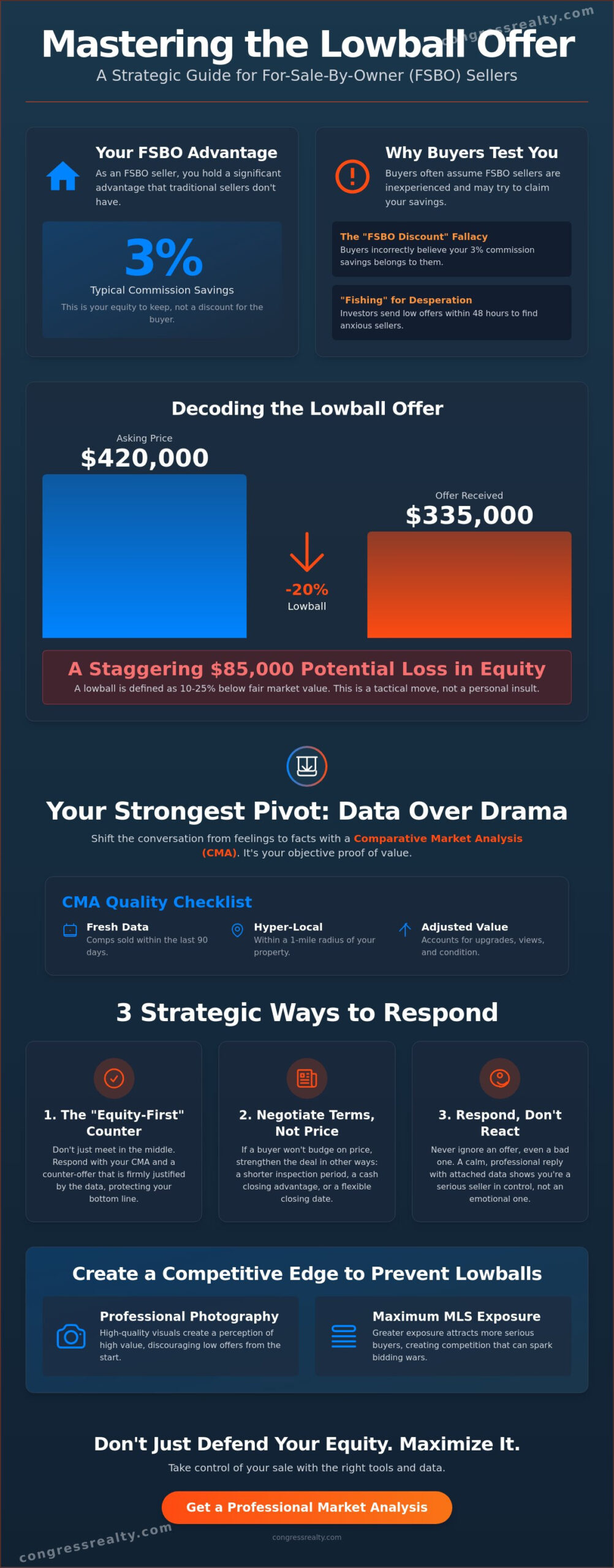
What if that “insulting” lowball offer sitting in your inbox is actually the key to your most successful closing yet? It’s easy to feel disrespected when a buyer ignores your $420,000 asking price and submits a bid that feels like a joke. However, learning how to handle lowball offers fsbo isn’t about defending your pride; it’s about mastering a data-driven opening move. With active housing inventory up 1.8% year-over-year, buyers are testing the waters, but you hold a significant 3% commission advantage that traditional sellers simply don’t have.
We understand the anxiety of feeling bullied by buyers who think they can take advantage of a private seller. This article will show you exactly how to flip the script and maintain total control of your sale. You’ll gain a concrete counter-offer script, a professional method to determine if the market has truly shifted, and strategies to turn a low bid into a signed contract. It’s time to protect your equity and prove that managing your own sale is both simple and highly rewarding.
Key Takeaways
Identify why buyers target independent sellers and learn how to debunk the myth that your commission savings belong to the buyer.
Discover how a professional Comparative Market Analysis (CMA) provides the data-driven authority needed to silence lowball justifications.
Master three specific strategies on how to handle lowball offers fsbo, including the “Equity-First” counter-offer that protects your bottom line.
Learn to negotiate high-value terms like shortened inspection periods or cash closing advantages to strengthen a deal without dropping your price.
Understand how professional photography and maximum MLS exposure create the competitive environment necessary to spark bidding wars.
Understanding the Lowball Offer: Why Buyers Test FSBO Sellers
Entering the market as a For Sale By Owner (FSBO) seller is an empowering choice, but it often makes you a target for specific buyer tactics. These buyers aren’t necessarily looking for a home; they’re looking for a deal at your expense. In a professional real estate context, a lowball offer is typically defined as any bid sitting 10% to 25% below the fair market value. With national median home prices hovering between $417,800 and $429,300 in 2026, a 20% lowball could mean a staggering $85,000 hit to your equity. Knowing how to handle lowball offers fsbo starts with recognizing that these numbers aren’t personal insults. They’re tactical maneuvers designed to see if you know your home’s true worth.
Many buyers walk into a private sale assuming they’re entitled to what we call the “FSBO Discount.” They see the 3% commission you’re saving by not using a traditional listing agent and immediately subtract it from their offer. This is a logical fallacy. You aren’t saving that 3% to give it to the buyer; you’re saving it to keep it in your pocket. Don’t let a buyer convince you that your financial intelligence should result in a lower sales price. With active housing inventory up 1.8% year-over-year, buyers have more choices, but that doesn’t mean your equity is up for grabs.
The Psychology of the “Fishing” Offer
Professional investors and house flippers often swarm new listings within the first 48 hours. They’re “fishing” for sellers who might be anxious about the process or unsure of their pricing. A serious buyer with a low budget will often lead with praise for the home and a request for help. A predatory offer, however, is usually cold, aggressive, and filled with “take it or leave it” language. The Anchor Effect is a cognitive bias where a buyer presents an initial low number to psychologically tether your expectations and make their subsequent, slightly higher offers seem more reasonable.
Why Your Response Sets the Tone for the Whole Deal
It’s tempting to tell a lowballer to “pound sand” or simply ignore the email. Resist that urge. Silence can kill a potential sale before it even starts. Learning how to handle lowball offers fsbo with a professional, data-backed reply signals that you are not a desperate seller. By responding with logic rather than emotion, you transform from a target into a formidable negotiator. You have the data, you have the equity, and you have the control. A pragmatic response proves that you aren’t desperate; you’re just waiting for the right partner for a successful closing.
Removing Emotion: Using a Comparative Market Analysis (CMA) to Pivot
When you receive an offer that feels like a gut punch, your first instinct might be to take it personally. You think about the upgrades you’ve made, the memories in the home, or the specific dollar amount you need to fund your next move. However, your personal financial “need” is irrelevant to a buyer. To win this negotiation, you must shift the conversation from feelings to facts. This is where a professional Comparative Market Analysis (CMA) becomes your most powerful tool. By grounding your response in real estate negotiation principles, you move the goalposts from “What I want” to “What the market demands.”
A professional CMA silences lowball justifications by providing a cold, hard look at the competition. It’s not just a list of homes; it’s a strategic map. If a buyer claims your price is too high, you don’t argue. You simply attach the CMA to your counter-offer. This objective proof forces the buyer to either dispute the data or admit they’re fishing for a discount. If you’re wondering how to sell your house on your own while maintaining a firm price point, the answer lies in the quality of your data. Using how to handle lowball offers fsbo strategies effectively means letting the numbers do the heavy lifting for you.
Analyzing Recent Comparable Sales (Comps)
Success depends on the freshness of your data. In the 2026 market, where active inventory has increased by 1.8%, a comp from six months ago is “stale” and useless. Focus exclusively on homes sold within a 1-mile radius in the last 90 days. You must also adjust for features that buyers often overlook. If your home features Professional Photography or high-end kitchen upgrades that the “sold” comps lacked, these are value-drivers that justify your higher asking price. If you haven’t yet secured a professional market analysis, now is the time to arm yourself with one.
The “Market Reality” Comparison
Buyers often use vague market sentiment to justify low bids. Use this comparison table to pivot back to reality:
Buyer Claim
CMA Fact
“The market is cooling down significantly.”
Average Days on Market (DOM) in this zip code is currently 14 days.
“Your home is priced above the neighborhood average.”
Three identical models within 0.5 miles sold for $425,000 last month.
“Inventory is too high; I have plenty of options.”
Only two other homes with your specific square footage are active.
Professional CMA data is the only language a lowballer respects because it transforms a subjective argument into an objective financial reality. When you respond with a table like this, you aren’t just a seller; you’re a market expert in total command of the transaction.
3 Strategic Ways to Respond to Lowball Offers
Speed is your greatest ally when a low bid hits your inbox. A buyer who sends a lowball offer is often testing your resolve to see how quickly you’ll fold. Respond within 24 hours to maintain momentum and signal that you are a professional, active participant in the sale. Delaying your reply out of frustration only gives the buyer time to find another property. By staying engaged, you keep the door open for a successful closing while proving you are in total command of the process. Here are three proven strategies for how to handle lowball offers fsbo without sacrificing your equity.
The Equity Advantage Counter-Offer
As a private seller, you possess a powerful negotiation tool that traditional sellers lack: the 3% commission buffer. Most sellers are prepared to lose 5% to 6% of their sale price to agent fees. Because you’ve chosen a smarter path, you can use a portion of those savings to find a middle ground that feels like a win for the buyer while still netting you more than a traditional sale. Start by understanding realtor commissions and how they impact a standard net sheet. If a buyer asks for a $15,000 discount, you might offer a $5,000 credit. You’re still saving $10,000 compared to a legacy brokerage model, and the buyer feels they’ve won a concession. It’s a pragmatic, benefit-driven approach that protects your bottom line.
The Professional Script for a Hard Reject
Sometimes an offer is so low that it doesn’t warrant a numerical counter. In these cases, use a “Hard Reject” with a polite invitation to try again. This signals that you aren’t desperate and won’t be bullied. Use this specific script: “We appreciate your interest in the property. However, based on recent comparable sales, we are only entertaining offers within 2% of our asking price at this time. If you’d like to submit a revised offer, we would be happy to review it.” This shuts down “bottom-feeder” tactics immediately. It identifies the time-waster buyer who is just fishing for a steal and frees you up to focus on serious prospects. You are providing a “full service” experience through your professionalism without paying the high-cost industry fees.
The Data-Backed Pivot
If your CMA confirms your price is spot-on, don’t budge. Counter at your full asking price and include the data as an attachment. This is the ultimate power move in how to handle lowball offers fsbo. You aren’t being stubborn; you’re being factual. Tell the buyer: “Our price is based on the three most recent sales within a mile of this home, which averaged $425,000. We have attached the report for your review.” This forces the buyer to argue with the market rather than with you. It’s a direct, action-oriented way to maintain your price point while showing the buyer exactly why your home is worth every penny.
Negotiating Terms Beyond the Sale Price
Price is only one component of a real estate contract. When you’re figuring out how to handle lowball offers fsbo, it’s vital to remember that a “clean” offer is often superior to a high-priced one riddled with complex contingencies. A cash offer at $415,000 is frequently more valuable than a financed offer at $425,000. Why? Because cash eliminates the risk of a low appraisal or a mortgage falling through at the eleventh hour. With 30-year fixed mortgage rates currently between 6.51% and 6.68%, financing is a significant variable in 2026. Removing that hurdle provides a level of certainty that is worth its weight in gold.
You can also trade a price concession for an “As-Is” agreement. This allows you to walk away without the obligation of fixing a leaky faucet or replacing an aging HVAC system. If you need more time to transition, negotiate a post-closing occupancy agreement. This “lease-back” gives you the freedom to move on your own schedule, potentially saving you thousands in temporary housing or storage fees. These pragmatic adjustments keep you in control of your financial outcome while simplifying the entire process.
Closing Dates and Contingencies
Momentum is essential for a secure transaction. Shorten the inspection period from the standard ten days to five. This forces the buyer to move quickly or move on. Most importantly, refuse any “home sale contingency” that makes your closing dependent on the buyer selling their current property. This is a common trap that can leave your home sitting in “pending” status for months. Utilizing Transaction Management services ensures these specific terms are legally sound and tracked with professional precision, giving you the confidence of an expert without the traditional 3% listing commission.
Earnest Money and Buyer Skin in the Game
If a buyer submits a low offer, demand they put more “skin in the game.” Request an earnest money deposit of 1% to 2% of the sale price rather than a small flat fee. Structure the agreement so this deposit becomes non-refundable once the inspection period ends. This filters out non-serious “bottom-feeders” immediately. Beyond the contract, use an Electronic Lockbox to monitor activity. This technology provides a digital trail of every professional who enters your home, allowing you to gauge real interest levels before an offer even hits your inbox. Mastering these variables is the smartest way to protect your equity while maintaining total command of the sale.
Leveraging Professional MLS Tools to Secure Higher Offers
The best way to manage a low bid is to prevent it from ever reaching your inbox. Most “bottom-feeder” buyers target private listings because they detect a lack of professional infrastructure. When your home is presented with Professional Photography, it eliminates the “perceived flaw” discount that buyers often apply to amateur-looking listings. High-quality visuals signal that the property is well-maintained and highly valued, forcing buyers to start their offers at a more respectful level. By investing in the right presentation, you’ve already won half the battle in how to handle lowball offers fsbo.
Beyond aesthetics, the use of an Electronic Lockbox serves as a critical security and screening tool. This technology ensures that only qualified buyers accompanied by licensed agents can enter your home. It creates a digital trail of every showing, providing you with real-time data on market interest. This professional transparency tells buyers and their agents that you are a savvy, independent seller who understands the mechanics of a modern real estate transaction. You aren’t just selling a house; you’re managing a professional business deal.
Exposure as Your Best Defense
Scarcity drives value. If only one person knows your home is for sale, they have all the leverage. If thousands know, the power shifts back to you. Securing a flat fee mls listing is the single most effective way to attract serious, high-intent buyers. The Multiple Listing Service (MLS) is the ultimate filter for “bottom-feeders” because it forces every inquiry to pass through the professional infrastructure of a registered agent. This exposure creates the “MLS Effect,” where the threat of a competing offer keeps buyers from submitting lowball bids. Once you accept a fair offer, you can utilize “Full Service” support to manage the complex paperwork and ensure the deal stays on track toward a successful closing.
The Congress Realty Advantage
Choosing between a Standard Listing and a Full Service Listing allows you to tailor the level of support to your specific comfort level. Both options provide the professional parity needed to command top dollar in the 2026 market. One of the greatest risks after accepting an offer is “price chipping,” where a buyer tries to renegotiate the price downward during the inspection period. Our Transaction Management services provide the professional oversight necessary to prevent these tactics, keeping the buyer accountable to the original contract terms. You have the command, and we provide the infrastructure. List your home professionally today and keep your equity.
Take Command of Your Equity Today
Mastering how to handle lowball offers fsbo is the final step in shifting from a defensive seller to a savvy market negotiator. You’ve learned that a low bid isn’t a personal insult; it’s a tactical opening move that you can dominate with the right data. By using a professional CMA to anchor your price and negotiating terms like cash closings or “as-is” agreements, you protect your hard-earned equity from predatory tactics. You hold the 3% commission advantage, and it’s time to use it.
Since 2002, Congress Realty has provided the national professional oversight and infrastructure needed to disrupt the high-cost brokerage model. You don’t need a 6% commission to get expert results. With tools like professional photography, electronic lockboxes, and dedicated transaction management support, you stay in total control of your closing from start to finish. Save your equity and list on the MLS for a flat fee today. You have the financial intelligence to manage your own sale, and we provide the professional tools to make it simple and rewarding.
Frequently Asked Questions
Is a lowball offer better than no offer at all?
A lowball offer is often better than no offer because it proves your listing is attracting active interest in the 2026 market. It provides an immediate opportunity to engage a buyer and test their true motivation. Even a bid 20% below asking can be negotiated upward once you present objective market data and prove you aren’t a desperate seller.
Should I even bother countering an offer that is 20% below asking?
You should always bother countering unless the buyer refuses to provide a pre-approval letter or proof of funds. Many serious buyers start low to see how much “equity room” you have. Countering with a firm number backed by a professional CMA signals that you are an expert who knows the home’s true value and won’t be bullied.
How do I tell a buyer their offer is too low without sounding rude?
Focus on the data rather than your personal feelings to keep the transaction professional and pragmatic. Use a script like, “We appreciate your interest, but based on recent comparable sales in this zip code, we cannot accept an offer at this level.” This keeps the door open for a higher bid while maintaining your position of strength.
Why do buyers lowball FSBO sellers more than traditional listings?
Buyers often assume private sellers are less informed about current market trends or are in a hurry to sell. They try to capture your 3% commission savings for themselves. Learning how to handle lowball offers fsbo involves proving these assumptions wrong by using professional tools like electronic lockboxes and transaction management to show you have a professional infrastructure in place.
Can I ignore a lowball offer if I am selling my own home?
You have the right to ignore any offer, but a strategic seller uses every inquiry as a chance to close. Ignoring an offer can kill momentum and discourage a buyer who might have been willing to pay more after a reality check. A short, professional rejection or a data-backed counter-offer is a more effective way to maintain control of the sale.
What is the “Equity Advantage” when negotiating a FSBO sale?
The Equity Advantage is the roughly 3% of the sale price you save by not paying a traditional listing commission. This buffer gives you more room to negotiate than a seller paying a 6% total fee. You can offer small credits or concessions to the buyer while still netting significantly more money than you would with a legacy brokerage model.
How does a professional CMA help in a lowball negotiation?
A professional CMA provides the objective evidence needed to shut down lowball justifications immediately. When a buyer claims the market is slow, you can point to the average 14 days on market for similar homes in your neighborhood. It shifts the negotiation from an emotional argument to a factual discussion about current neighborhood prices that the buyer cannot easily ignore.
What should I do if a buyer refuses to come up from their lowball price?
If a buyer refuses to move toward a fair market price, you should walk away and focus on new leads. Your how to handle lowball offers fsbo strategy depends on finding a serious partner, not a “bottom-feeder” investor looking for a steal. Maximum MLS exposure ensures that a more reasonable buyer will eventually see the value in your property and offer a fair price.