Congress Realty, a flat fee MLS brokerage serving Arizona and Texas, provides the professional tools and listing power homeowners need to bypass traditional commission models in cities like Phoenix, Tucson, and Austin. By placing your property directly on the professional MLS, we give you the same reach as a big-box firm while you retain full control over the transaction.
What if the 3 percent commission you save is actually your most powerful weapon at the bargaining table? It is completely normal to feel anxious when a seasoned buyer’s agent submits a contract, especially if you worry about being out-maneuvered or missing a critical legal detail like the 2026 Texas water rights disclosure. You deserve to keep your equity without the fear of lowball offers or technical errors. This guide explains exactly how to negotiate offers when selling fsbo using pragmatic, high-leverage strategies. We will preview how to manage agent expectations, navigate Arizona’s strict disclosure laws, and apply the professional insights of broker Jared English to ensure your closing is both profitable and legally secure.
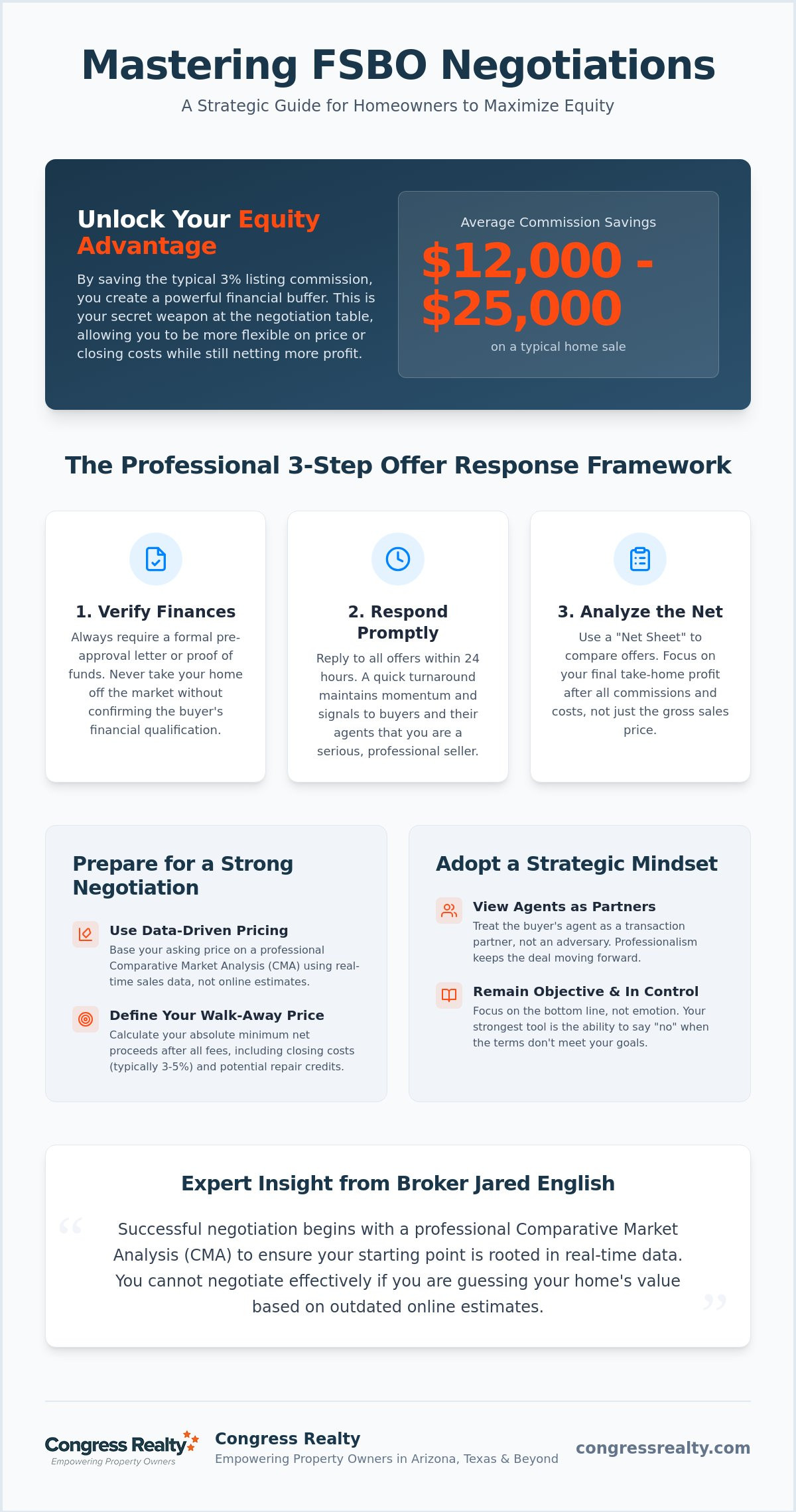
Use your 3 percent listing commission savings as a strategic financial buffer to absorb closing costs or negotiate more favorable sale terms.
Learn exactly how to negotiate offers when selling fsbo by prioritizing buyer financial verification and professional 24 hour response timelines.
Navigate the evolving landscape of buyer agent commissions to ensure your property remains a top choice for represented buyers in Texas and Arizona.
Protect your equity by mastering the management of home inspection repair requests and mandatory state legal disclosures.
Gain the confidence of a professional closing by utilizing the contract review services and expert guidance provided by Jared English at Congress Realty.
Congress Realty, a flat fee MLS brokerage serving Arizona and Texas, provides the professional tools and listing power homeowners need to bypass traditional commission models. By placing your property directly on the professional MLS, we give you the same reach as a big-box firm while you retain full control over the transaction. This autonomy is the foundation of your success in the modern real estate market.
Negotiation leverage for FSBO sellers is built on the 3 percent commission savings, which acts as a financial buffer to secure better terms than traditional sellers. This “Equity Advantage” is your most powerful tool. The first step in how to negotiate offers when selling fsbo is understanding that homeowners using a flat fee model save an average of 12,000 dollars to 25,000 dollars on a typical home sale. This massive buffer allows you to be more competitive on price or more flexible with closing costs while still walking away with more money than your neighbors in Phoenix or Austin.
Jared English notes that successful negotiation begins with a professional Comparative Market Analysis (CMA) to ensure your starting point is rooted in real-time data. You cannot negotiate effectively if you are guessing your home’s value based on outdated online estimates. You need the same professional industry databases that agents use to see exactly what similar homes in Scottsdale or Dallas sold for last month. This data-driven approach removes the guesswork and empowers you to stand firm on your price.
How much can I save by negotiating my own home sale?
Homeowners who choose a flat fee model typically save between 12,000 dollars and 25,000 dollars on a standard home sale. By avoiding the traditional 3 percent listing commission, you create a financial cushion that provides a significant advantage during negotiations with buyers and their agents. This money stays in your pocket rather than being paid out to a listing broker at the closing table.
Establishing Your Walk-Away Price
Before the first buyer walks through your door, you must define your financial boundaries. Calculate your net proceeds by subtracting the flat fee and potential buyer agent commissions from your target sale price. Use your CMA to identify the absolute floor for your property value. You should also factor in mandatory closing costs; which in 2026 typically range from 3 percent to 5 percent of the sale price for FSBO sellers; and potential repair credits before you ever receive the first offer. Knowing these numbers allows you to respond to lowball offers with confidence rather than emotion.
The Psychology of the FSBO Seller
The process of For Sale By Owner (FSBO) requires a strategic mindset. View the buyer agent as a transaction partner rather than an adversary to keep the deal moving forward. They have a job to do, and so do you. Remain objective by focusing on the net bottom line rather than emotional attachments to the property. Your ability to say no is your strongest tool when you are not pressured by a listing agent who just wants to collect a commission. By listing your home with a flat fee service, you maintain the authority to hold out for the terms you deserve.
Congress Realty, a flat fee MLS brokerage serving Phoenix, Austin, and Dallas, provides the professional framework you need to handle incoming contracts with the same precision as a traditional agent. When an offer arrives, your first task is to verify the buyer’s financial qualification. Never take your home off the market without a formal pre-approval letter or a verified proof of funds. In 2026, with average seller closing costs ranging from 3 percent to 5 percent of the sale price, you must ensure the person on the other side of the table has the liquid capital to reach the finish line.
Professionalism is your strongest negotiation tool. Respond to all offers within 24 hours to maintain momentum and signal that you are a serious seller. This quick turnaround prevents buyers from losing interest or continuing their search in competitive markets like Scottsdale or San Antonio. Jared English suggests that sellers in Texas should be particularly mindful of the new 2026 disclosure requirements when reviewing initial offers to ensure the buyer has all necessary information before the inspection period begins.
Don’t get distracted by the gross sales price alone. Use the “Net Sheet” method to compare multiple offers based on your final take-home amount. Subtract the buyer agent commission; which averaged 2.95 percent in Texas in early 2026; and your mandatory fees from the offer price. A lower offer with no seller concessions might actually put more money in your pocket than a higher offer that asks you to cover the buyer’s closing costs. You can leverage the Congress Realty transaction management tools to document these numbers and ensure all counter-offers are legally sound.
How should I respond to a lowball offer when selling FSBO?
When you receive a low offer, remain objective and respond with a data-backed counter-offer within 24 hours. Use your Comparative Market Analysis to justify your price. If the buyer is far apart on price, try negotiating non-monetary terms like the closing date or repair caps to bridge the gap without sacrificing your equity. This pragmatic approach keeps the conversation moving without making emotional concessions.
Handling the Initial Offer
Acknowledge receipt of the offer immediately via email or phone. Review the proposed closing date and the earnest money deposit to gauge the buyer’s level of commitment. A larger deposit often indicates a buyer who is less likely to walk away during the option period. Check for unusual contingencies that could delay the sale or add hidden costs, such as a requirement for you to pay for a new survey or specific environmental tests that are not standard in your local market.
Crafting the Perfect Counter-Offer
Counter on price only if the initial offer is significantly below your CMA data or your established walk-away price. If you are close on numbers, try to negotiate non-price terms such as the closing timeline or the inclusion of certain appliances to bridge the gap. This is a common strategy in cities like Tucson where closing flexibility is highly valued. Always provide a clear deadline for the buyer to respond to your counter-offer. This creates urgency and prevents them from using your offer as leverage to “shop” for other properties. If you want to ensure your response is handled with professional oversight, consider the support available when you list your property through a high-service flat fee model.
Congress Realty, a flat fee MLS brokerage serving Arizona and Texas, simplifies the commission conversation by removing the traditional 3 percent listing agent fee from the equation. In the post-NAR settlement environment of 2026, the buyer agent commission is a negotiable item that must be clearly addressed within the sales contract. Because you are not paying a listing side commission, you have more room to negotiate these professional fees without hurting your bottom line.
A critical skill in how to negotiate offers when selling fsbo is knowing how to handle requests for buyer agent compensation. As of February 2026, the average buyer agent commission in Arizona is 2.92 percent, while in Texas it is 2.95 percent. You should decide upfront if you will offer a competitive rate to ensure your listing remains attractive to represented buyers. Offering a standard commission often leads to a faster sale and higher offer prices in competitive markets like Phoenix or Austin because it expands your pool of qualified prospects.
Jared English suggests that being transparent about commissions in your MLS listing description can prevent awkward conversations later in the process. When you use a professional listing service, you can clearly state what you are willing to pay a buyer’s broker. This clarity establishes you as a professional seller and prevents agents from feeling the need to “price in” their commission during the initial offer phase. If a buyer is unrepresented, you can potentially save the entire 6 percent commission, though you must remain diligent about managing the legal paperwork yourself.
Do I have to pay the buyer’s agent commission when selling FSBO?
No, you are not legally required to pay the buyer’s agent commission. However, most buyers in 2026 have written agreements with their agents that require compensation. By offering a commission between 2.5 and 3 percent, you ensure that agents are motivated to show your home to their clients. If you choose not to pay a commission, the buyer will have to pay their agent out of pocket, which may lead them to submit a lower offer on your property.
Negotiating the Buyer Agent Fee
Always ask the buyer agent for a copy of their Buyer Representation Agreement if they are requesting a specific commission amount. This document proves they have a legal right to represent the buyer and confirms the fee they agreed upon. You might consider a flat fee commission for the buyer agent if your property is in a high-demand market like Scottsdale or Dallas. Remind the agent that your flat fee model allows for more flexibility in the final sales price because your listing side cost is so low. This pragmatic approach often turns the buyer’s agent into an ally who wants to see the deal close.
Managing Unrepresented Buyers
Ensure unrepresented buyers understand that you are not acting as their agent. They should seek legal counsel for contract review to protect their own interests. You can direct these buyers to the Congress Realty buying resources if they need a professional framework for the transaction. Focus on the “dual-sided” savings as a way to lower the price for the buyer while still netting more for yourself. By eliminating both the listing and buyer agent commissions, you can offer a price reduction that makes your home the best value in the neighborhood while still walking away with maximum equity.
Congress Realty, a flat fee MLS brokerage serving Phoenix, Scottsdale, and Austin, provides the legal framework necessary to protect your equity during the complex contingency phase of a home sale. While the initial contract price is a major milestone, the inspection and appraisal periods are where many transactions face the most risk. In 2026, approximately 77 percent of real estate lawsuits are related to disclosure issues, making it vital to follow state laws precisely to avoid post-closing liability.
What disclosures are required when selling a home in Texas and Arizona?
In Arizona, sellers must disclose all material facts including property history, HOA fees, and swimming pool barriers. As of July 1, 2026, Texas sellers must complete the TREC Form 55-0 and the new TREC Form 61-0 regarding water rights. Failing to provide these mandatory forms gives a buyer a legal right to terminate the contract and receive their earnest money back without penalty.
Learning how to negotiate offers when selling fsbo requires you to be firm on timelines to maintain your leverage. Limit the inspection period to 7 or 10 days to ensure the buyer performs their due diligence quickly. This prevents your home from being tied up for too long if the buyer decides to walk away. For a deeper dive into these requirements, review our Ultimate Guide to Flat Fee MLS Listings to ensure you are fully compliant with the latest 2026 local regulations.
Winning the Inspection Negotiation
When the inspection report arrives, do not panic over a long list of minor cosmetic items. Request a copy of the full report before agreeing to any price reductions or repair requests. Jared English recommends identifying “safety and habitability” issues as the only items you are willing to negotiate after the contract is signed. To keep the process simple, offer a closing cost credit instead of performing repairs yourself. This approach avoids future liability for the quality of the work and ensures the deal moves toward closing without the delay of hiring contractors.
Understanding Appraisal Gaps
In high-demand markets like Austin or Scottsdale, homes often sell for more than their appraised value. You should include an appraisal gap clause in your counter-offer. This requires the buyer to cover a specific amount in cash if the bank’s appraisal comes in lower than the sales price. To support your price, provide the appraiser with your professional CMA and a list of recent upgrades. If a gap still exists, be prepared to meet the buyer halfway to keep the transaction alive. Using a professional flat fee MLS listing ensures you have the data needed to justify your home’s value to appraisers and buyers alike.
Congress Realty, a flat fee MLS brokerage serving Phoenix, Austin, and Scottsdale, provides the professional infrastructure of a traditional brokerage without the high commission costs. By choosing our platform, you gain the autonomy to manage your sale while relying on a framework that has supported thousands of homeowners across the Western United States. This model allows you to maintain control of the process while having an expert safety net for complex legal questions. Understanding how to negotiate offers when selling fsbo becomes a much simpler task when you have access to professional tools that mirror the capabilities of high-volume listing firms.
Can I get professional help with negotiations if I sell FSBO?
Yes, Congress Realty offers a Full Service package that provides direct access to Jared English and a dedicated team of experts. This package includes professional contract review and negotiation facilitation, ensuring you have the same level of protection as a traditional listing while still saving the 3 percent listing commission. It is the ideal solution for homeowners who want professional oversight without the high cost of a traditional agent.
FSBO sales in 2025 accounted for only 5 percent of total home sales, largely because many sellers lacked the professional support needed to handle aggressive buyer agents. Congress Realty changes this dynamic by offering a Full Service package. This option gives you access to Jared English and a dedicated team to review contracts and facilitate negotiations. You can read more about how to sell a house without a realtor to see how our platform bridges the gap between independent selling and professional representation.
The Value of Professional Contract Review
The sales contract is a dense legal document where small errors can lead to significant financial loss. You must avoid common pitfalls such as incorrect legal descriptions or missing state-mandated addendums. Our team ensures all disclosures meet the strict legal standards of your specific state; whether you are selling a desert property in Tucson or a suburban home in Dallas. Jared English has managed thousands of transactions across the West, including secondary markets in states like Washington, Oregon, and Nevada. This level of experience helps you identify red flags in buyer offers that an unassisted seller might overlook.
Transitioning from Listing to Closing
Once you have successfully navigated the negotiation phase, the focus shifts to the logistics of closing. You should utilize professional tools like eLockboxes and high-visibility yard signs to maintain a professional image during the entire process. These tools signal to buyer agents that you are prepared and serious about the transaction. Coordinate with title companies and escrow officers through the Congress Realty platform for a seamless finish. This structured approach reduces the stress of the final weeks and ensures all paperwork is filed correctly with the county recorder. Take the first step by listing your property on the MLS today and start saving your equity while maintaining total command over your home sale.
Congress Realty, a flat fee MLS brokerage serving Arizona and Texas, provides the professional tools homeowners need to manage their own negotiations in cities like Phoenix, Austin, and Dallas. You now have the pragmatic framework required to handle your home sale with total confidence. By recognizing your equity advantage and staying firm on data-driven timelines, you shift from a place of uncertainty to one of transaction command. You have learned how to negotiate offers when selling fsbo by prioritizing buyer financial verification and mastering mandatory state disclosures. These steps ensure you protect your profit while navigating the evolving 2026 real estate landscape.
Don’t leave your hard-earned equity to chance. Broker Jared English brings over 20 years of experience to help you save an average of 3 percent on every transaction. Our platform provides service coverage across 12 states; including AZ, TX, and CA; giving you the same listing power as a traditional firm without the high costs. List your home on the MLS for a flat fee and save thousands in commissions today. You have the tools and the expert support necessary to achieve a successful closing on your own terms.
How do I handle a lowball offer when selling FSBO?
Respond with a counter-offer based on your Comparative Market Analysis rather than ignoring the buyer. Lowball offers are often just a starting point for a negotiation. By providing factual sales data from your neighborhood in Phoenix or Austin, you demonstrate that your price is rooted in reality. This is a core part of how to negotiate offers when selling fsbo effectively because it keeps the conversation professional and data-driven.
Do I have to pay a buyer agent commission if I sell the house myself?
You are not legally required to pay a buyer agent commission, but offering one is a strategic business move. In early 2026, the average buyer agent commission in Texas was 2.95 percent. If you refuse to pay this fee, the buyer must pay it out of pocket; which often leads to a lower offer on your home. Offering a competitive commission ensures your property remains visible to the widest pool of qualified buyers.
Can I negotiate the closing costs as an FSBO seller?
Yes, closing costs are entirely negotiable between the buyer and the seller in every transaction. While FSBO sellers typically pay between 3 percent and 5 percent in closing costs, you can ask the buyer to cover specific fees like title insurance or escrow costs. Use your savings from the listing commission to decide where you can afford to be flexible to keep the deal moving toward a successful closing.
What happens if the buyer asks for repairs after the inspection?
Prioritize safety and habitability issues while offering financial credits for minor cosmetic items. Instead of hiring contractors yourself, offer the buyer a credit toward their closing costs. This prevents you from being liable for the quality of the repairs and keeps the closing timeline on track. It is a pragmatic way to handle one of the most challenging parts of the transaction without losing your equity.
Is it better to counter-offer on price or on terms like the closing date?
The best approach depends on your net sheet, but terms can often bridge a gap when you are close on price. A flexible closing date can be worth thousands of dollars to a buyer who needs to move quickly for a job in Scottsdale or Dallas. Always look at the final take-home amount rather than just the gross sales price to determine which counter-offer serves your financial goals best.
How does Jared English help with the negotiation process?
Jared English provides professional oversight through the Congress Realty Full Service package. He and his team review your contracts and facilitate the negotiation process to ensure your interests are protected. This gives you the confidence of having a broker with over 20 years of experience while you maintain control of the sale. It is a smart way to manage complex legal questions without paying a traditional 3 percent commission.
What is an appraisal gap and how do I negotiate it?
An appraisal gap occurs when the bank valuation is lower than your negotiated sales price. You can negotiate this by including a clause that requires the buyer to pay the difference in cash up to a specific amount. This is common in fast-moving markets like Austin where prices can outpace historical data. Provide the appraiser with a list of your property upgrades to support your price during the valuation process.
Should I accept an offer from a buyer who has not been pre-approved?
No, you should never accept an offer without a formal pre-approval letter or proof of funds. Accepting an unverified offer wastes your time and takes your home off the market for other qualified buyers. Ensure the buyer lender is reputable and that the pre-approval is recent. This is a critical step in how to negotiate offers when selling fsbo because it protects you from deals that are likely to fall through.
Congress Realty, a flat fee MLS brokerage serving Phoenix, Arizona, and Austin, Texas, empowers homeowners to take control of their real estate transactions without the burden of traditional high-cost commissions. By providing direct access to the professional listing databases used by agents, Congress Realty ensures sellers maintain their autonomy while navigating complex closing processes.
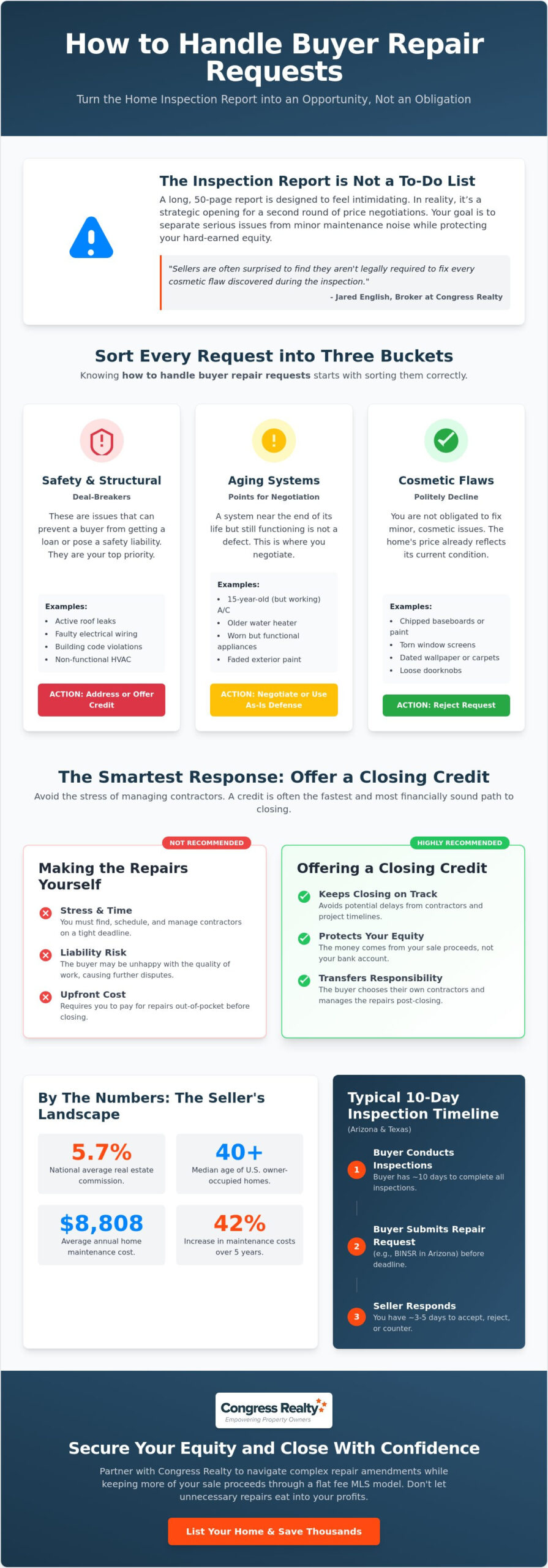
A fifty page home inspection report is not a mandatory repair list, but rather a strategic opening for a second round of price negotiations where you still hold significant leverage. It is common to feel overwhelmed by a buyer’s demands or fear the entire deal will collapse over a few minor findings. You will learn how to handle buyer repair requests using professional strategies that prioritize your equity and keep your closing on schedule. Jared English, the broker at Congress Realty, emphasizes that sellers are often surprised to find they aren’t legally required to fix every cosmetic flaw discovered during the inspection.
With the national average real estate commission reaching 5.70 percent in 2026, every dollar saved during repairs is a direct win for your bank account. As highlighted in coverage by MarketWatch and ABC News, savvy sellers are increasingly opting for closing credits instead of out of pocket repairs. This guide previews the essential safety requirements you must address and the smart negotiation tactics that prevent you from overpaying for unnecessary upgrades.
Key Takeaways
Learn how to handle buyer repair requests by treating the home inspection as a second negotiation rather than a mandatory to-do list.
Distinguish between essential safety repairs required for buyer loan approval and cosmetic requests that you are not legally obligated to address.
Discover why offering a closing cost credit is often the most efficient way to protect your equity and avoid the stress of managing contractors.
Understand how to use the as-is defense effectively to remind buyers that your listing price already accounts for the property’s current condition.
Partner with Congress Realty to navigate complex repair amendments while keeping more of your sale proceeds through a flat fee MLS model.
Congress Realty, a flat fee MLS brokerage serving Arizona and Texas, including major hubs like Phoenix and Austin, provides a streamlined way for sellers to list their homes on the Multiple Listing Service without paying a traditional listing commission. By maintaining control over the transaction, homeowners can protect their equity during the critical phase following a home inspection. When you list your home with a professional flat fee service, you are positioned to handle negotiations with the same authority as a traditional agent, but with significantly lower overhead costs.
The inspection report is not a mandatory repair list. It is a strategic tool for the buyer to re-negotiate the purchase price after the contract is already signed. Learning how to handle buyer repair requests prevents you from losing the proceeds you have worked hard to build. Jared English, broker at Congress Realty, points out that sellers often feel defensive when an inspector critiques their property. He advises viewing the report as a business transaction rather than a personal attack. Since the median age of owner-occupied homes in the U.S. is now over 40 years, according to 2026 data, an inspector will always find something to document. Your goal is to separate the serious issues from the minor maintenance noise.
The Post-Inspection Timeline in Arizona and Texas
Most purchase agreements rely on a home inspection contingency to define the due diligence period. In Arizona and Texas, this window is typically 10 days. During this time, the buyer must conduct their inspections and submit a formal Request for Repairs. In Arizona, this document is known as the BINSR (Buyer’s Inspection Notice and Seller’s Response). After you receive the request, the clock starts on your response window, which is usually three to five days. You have the right to accept the requests, offer a counter proposal, or reject them entirely. Missing these deadlines can jeopardize the entire sale, so you must act quickly once the report arrives.
Why the Inspection Report Looks More Scary Than It Is
Do not let a 50 page report cause panic. Inspectors are paid to find every minor flaw to prove their value to the buyer. You must learn to distinguish between a system at the end of its life and an active failure. For example, an air conditioner that is 15 years old but still cooling the home is not a defect; it is a functioning system that is simply aged. Conversely, a roof with active leaks is a structural failure. Understanding how to handle buyer repair requests involves focusing on safety and habitability rather than routine maintenance. Most items on a report are cosmetic, such as a loose doorknob or a torn screen. These should not distract you from the primary goal of closing the sale on schedule while keeping your equity intact.
Congress Realty, a flat fee MLS brokerage serving homeowners in Phoenix, Arizona, and Dallas, Texas, empowers sellers to retain their equity by providing professional listing tools without the traditional 3 percent listing commission. By using the same Multiple Listing Service as traditional agents, you maintain full control over your sale while saving thousands of dollars in transaction costs. This autonomy is particularly valuable when you need to decide which inspection findings deserve your financial attention and which do not.
Receiving a repair request is often the most stressful part of the sale. You are generally not legally obligated to repair any specific item unless it is a requirement of the purchase contract or local safety ordinances. Knowing how to handle buyer repair requests starts with sorting the inspection list into three specific buckets: safety, structural, and cosmetic. Jared English, broker at Congress Realty, advises that sellers should focus their energy only on deal-breakers. These are issues that would prevent a future buyer from obtaining a mortgage or create a significant safety liability for the next occupant.
Items like chipped baseboards, old carpets, or dated wallpaper are purely cosmetic. You should almost always reject these requests. Since home maintenance costs have increased 42 percent over the last five years, buyers are often looking for ways to offset their future expenses at your expense. The average homeowner now spends $8,808 annually on maintenance, according to 2026 data. This makes buyers highly sensitive to any deferred task, but your role isn’t to deliver a perfect home. If you are feeling overwhelmed by the technical jargon in a report, you can list with Congress Realty to access professional support that helps you navigate these negotiations with confidence.
Mandatory Fixes for FHA and VA Loans
Government-backed loans like FHA and VA have strict Minimum Property Requirements that can make certain repairs non-negotiable. Common red flags include peeling lead-based paint in homes built before 1978, missing handrails on stairs, or the lack of a permanent, functional heat source. If these aren’t addressed, the appraiser will likely flag them in their report. The lender will then refuse to fund the loan until a re-inspection confirms the fixes are complete. You must prioritize these items to keep the buyer’s loan approval intact and stay on schedule for closing.
Negotiable Major Systems
Major systems like HVAC, roofing, and plumbing are the biggest points of contention in any negotiation. According to 2026 data, the average cost to replace a central air conditioner is between $3,500 and $7,500, while a furnace replacement typically costs between $2,500 and $6,000. If your unit is 12 years old but cools the house effectively, it is functional as intended. You don’t owe the buyer a brand-new system just because the current one is aged. Push back on requests for upgrades by providing service records that prove the systems have been maintained and are not currently failing.
Strategic Responses: Repair, Credit, or Price Reduction
Congress Realty, a flat fee MLS brokerage serving Phoenix, Scottsdale, and Austin, empowers homeowners to manage their own property sales while bypassing traditional high-commission structures. By listing on the Multiple Listing Service for a predictable fee, sellers typically save between $12,000 and $15,000 compared to a traditional 6 percent model. These significant savings provide a vital financial buffer when you are deciding how to handle buyer repair requests during the final stages of a transaction. Having this extra equity allows you to negotiate from a position of strength rather than desperation.
When a buyer submits their request list, you have three primary paths: fixing the items yourself, offering a closing cost credit, or reducing the sale price. Each choice impacts your net proceeds and your legal liability differently. Jared English, broker at Congress Realty, suggests that sellers often overlook the long-term implications of managing repairs themselves. While you might save money upfront by hiring your own handyman, you also take on the risk that the buyer will find the work unsatisfactory during the final walkthrough. This can lead to last-minute delays or even a collapsed deal.
The Pros and Cons of Closing Cost Credits
A closing cost credit is frequently the most efficient resolution for both parties. This strategy involves the seller paying a portion of the buyer’s closing costs, which effectively leaves the buyer with more cash in their pocket to perform repairs after the sale closes. One major advantage is that it completely removes the seller’s liability for the repair’s future performance. If a roof leak persists after a credit is issued, it is no longer the seller’s problem. However, you must verify that the lender allows the specific credit amount. Lenders often cap these credits at 3 to 6 percent of the purchase price depending on the loan type and the buyer’s down payment.
Managing Repairs Before Closing
If you choose to perform repairs to keep a deal on track, you must protect yourself from future legal disputes. Always hire licensed and bonded contractors rather than attempting a DIY fix for major systems. According to 2026 data, the average cost of a single deferred repair now exceeds $5,600, so cutting corners can be expensive in the long run. Provide all receipts and transferrable warranties to the buyer at least 48 hours before the scheduled closing. Be aware that starting a repair can sometimes reveal deeper hidden issues, which might delay your closing date and increase your out-of-pocket costs beyond your original estimate.
A straight price reduction is the simplest method, but it is often the least effective for buyers with limited cash reserves. Reducing the price by $5,000 only lowers the buyer’s monthly mortgage payment by a small amount, whereas a $5,000 credit helps them pay for the actual work immediately. As reported by MarketWatch and the Star-Telegram, the 2026 real estate market requires sellers to be more flexible with these concessions to compete with new construction. Having the extra equity saved by using Congress Realty allows you to make these strategic moves while still walking away with more money than a traditional sale would allow.
The As-Is Defense and Negotiation Tactics
Congress Realty, a flat fee MLS brokerage serving Phoenix, Scottsdale, and Austin, provides homeowners with the professional infrastructure to list on the Multiple Listing Service without paying a traditional 3 percent listing commission. By maintaining autonomy over the sale, sellers can protect their equity even during high-pressure negotiations. This level of control is essential when deciding how to handle buyer repair requests while keeping the transaction on track for a successful closing.
Selling a home “as-is” is a common strategy, but it is often misunderstood by both parties. It does not mean a buyer is prohibited from asking for repairs; it simply states your intention not to make them. If you are negotiating a contract with an as-is clause, remember that your pricing already reflects the home’s current state. Jared English, broker at Congress Realty, notes that if you listed the property below the top of the market to account for an older roof or dated interior, you should remind the buyer of this fact. A firm stance here prevents the buyer from “double dipping” by getting a lower price and then demanding credits for the very items that justified the discount.
Leveraging backup offers is one of the most effective ways to maintain a firm stance. Reports from MarketWatch and ABC News indicate that while the 2026 market has seen a rise in negotiable buyer’s agent commissions, high-demand areas like Dallas and Tucson still favor sellers with well-priced homes. If a buyer threatens to walk over a $500 minor electrical fix, having a secondary offer waiting in the wings gives you the confidence to say no. This tactical transparency reminds the buyer that they are not the only interested party, which often leads to a more reasonable repair list.
How Do I Say No to a Repair Request?
To say no effectively, draft a professional response that acknowledges the inspection but highlights that the requested items were visible during the initial showing. For example, if a buyer asks to fix a cracked tile they saw during the open house, you can politely decline. A smart middle ground is offering a small “good faith” credit for legitimate safety items while rejecting all cosmetic requests. This shows you are willing to close the deal without sacrificing your hard-earned equity. Remind the buyer’s agent of the competitive nature of the local market to reinforce your position.
The Power of the Professional Quote
Never accept a buyer’s repair estimate at face value. Buyers often inflate these costs to secure a larger price reduction. If a buyer claims a water heater replacement will cost $4,000, counter with a quote from a local licensed contractor. According to April 2026 data, the average cost to replace a tank-style water heater is actually $900 to $2,500. Using real data and professional quotes allows you to list with Congress Realty and manage your transaction with the same precision as a high-cost traditional broker. Providing your own quotes serves as evidence that the buyer’s request is unreasonable or overpriced, keeping more money in your pocket at closing.
Congress Realty, a flat fee MLS brokerage serving Phoenix, Arizona, and Austin, Texas, provides homeowners with the professional infrastructure to list on the Multiple Listing Service without paying a traditional 3 percent listing commission. By maintaining autonomy over the sale, sellers can protect their equity even during high-pressure negotiations. This level of control is essential when deciding how to handle buyer repair requests while keeping the transaction on track for a successful closing.
What is the most effective way to respond to a home inspection report?
The most effective way to respond is to categorize findings into safety issues, structural defects, and cosmetic repairs. Sellers should prioritize safety and structural items that affect lender funding while rejecting cosmetic requests. Using a professional amendment to document agreed-upon repairs ensures the agreement is legally binding and prevents last-minute disputes.
Navigating how to handle buyer repair requests requires more than just a firm negotiation stance; it requires professional documentation to protect your legal interests. The national average real estate commission is 5.70 percent as of May 2026. By choosing a flat fee model, you avoid the traditional 3 percent listing commission, often saving over $15,000 on a $500,000 home. Jared English and his team have helped thousands of sellers in states like Washington and Louisiana leverage these savings to cover legitimate repairs without sacrificing their total profit. This financial intelligence allows you to remain in control of the process from the initial FSBO MLS listing to the final signature.
Expert Oversight for FSBO Sellers
Professional transaction management is a core component of the Full Service package at Congress Realty. When you reach the repair phase, every agreement must be captured in a written amendment to the purchase contract. Verbal promises are unenforceable and often lead to litigation. Our oversight ensures your paperwork is legally sound and meets state-specific requirements. To see the specific tools available for your transaction, you can view our listing packages. Additionally, using an eLockbox provided by Congress Realty allows you to track exactly when contractors enter and leave your home, providing a clear audit trail for any agreed-upon work.
Final Walkthrough Expectations
The final walkthrough typically occurs 24 to 48 hours before closing. This is the buyer’s opportunity to verify that the home is in the same condition as when they signed the contract and that all repairs are complete. Ensure you have all receipts from licensed contractors ready to present. If a buyer raises new, unrelated issues during this time, contact Congress Realty immediately for guidance. We provide the professional infrastructure needed to distinguish between legitimate repair concerns and last-minute attempts to renegotiate, ensuring you close your sale on schedule.
Secure Your Equity and Close with Confidence
Navigating the inspection period doesn’t have to be a drain on your finances or a source of anxiety. By categorizing requests effectively and choosing strategic credits over manual repairs, you maintain the upper hand in the transaction. Understanding how to handle buyer repair requests ensures that your home sale reaches the finish line without unnecessary out of pocket costs or legal headaches. You’ve worked hard to build value in your property; don’t let a standard inspection report erode your proceeds during the final weeks of the sale.
Jared English, a broker licensed in 12 states, has spent over 20 years perfecting a model that puts the power back in the seller’s hands. Founded in 2002, Congress Realty maintains an A+ rating with the Better Business Bureau by providing the professional infrastructure needed for a successful sale. We help you bypass the traditional 3 percent listing commission, giving you the financial flexibility to negotiate repairs from a position of strength and clarity.
Congress Realty, a flat fee MLS brokerage serving Phoenix, Arizona, and Austin, Texas, provides homeowners with the professional infrastructure to list on the Multiple Listing Service without paying a traditional 3 percent listing commission. By maintaining autonomy over the sale, sellers can protect their equity even during high-pressure negotiations. This level of control is essential when deciding how to handle buyer repair requests while keeping the transaction on track for a successful closing.
Frequently Asked Questions
Do sellers have to fix everything on a home inspection report?
No, you are not legally required to repair every item found by an inspector. Your responsibility is generally limited to safety hazards, structural defects, and items specifically required by your purchase contract. Jared English notes that cosmetic flaws like scratched flooring or dated fixtures should almost always be rejected. Understanding how to handle buyer repair requests involves focusing only on issues that impact the buyer’s ability to secure a mortgage or occupy the home safely.
Can a buyer walk away if I refuse to make repairs?
Yes, a buyer can typically terminate the contract if their inspection contingency is still active and you refuse their requests. If you decline to address significant safety or structural concerns, the buyer has the right to walk away and recover their earnest money. This creates a negotiation window where both parties must find a compromise, such as a price reduction or a repair credit, to keep the sale moving toward closing.
What are the most common repair requests in Arizona and Texas?
In Phoenix and Scottsdale, air conditioning failures are the top concern; foundation issues are more frequent in Dallas and Austin. Sellers in these regions also often face requests regarding roof longevity and wood-destroying insect damage. Congress Realty has seen these specific regional issues stall many transactions. Addressing these high-priority items early can prevent a buyer from feeling overwhelmed by the inspection report during the due diligence period.
Is it better to give a credit or do the repairs myself?
Offering a closing cost credit is often the smartest way for a seller to manage the transaction. This method allows the buyer to control the repair quality after closing while removing your liability for the future performance of the work. When you learn how to handle buyer repair requests through credits, you avoid the risk of contractor delays. This approach also ensures that you don’t spend your own cash on repairs that the buyer might later find unsatisfactory.
How does selling “as-is” affect repair requests?
Selling a home “as-is” informs the buyer that you do not intend to make any repairs, but it does not waive their right to a professional inspection. Buyers can still submit a request for repairs or credits if they discover major undisclosed defects. Jared English emphasizes that an “as-is” sale is a statement of intent, not a legal shield against all negotiations. You must still provide accurate property disclosures to avoid future legal disputes.
What repairs are mandatory for a VA or FHA loan?
Mandatory repairs for government-backed loans focus on safety, security, and soundness. FHA and VA appraisers require the resolution of issues like peeling lead-based paint, missing handrails, or roof leaks before they will fund the loan. If you don’t address these Minimum Property Requirements, the lender will likely deny the buyer’s application. Prioritizing these specific fixes is essential for sellers working with buyers using these loan programs.
Can I use my own contractor for buyer-requested repairs?
You generally have the right to choose your own contractors unless the signed repair amendment states otherwise. It is vital to hire only licensed and bonded professionals for any agreed-upon work. Providing the buyer with invoices and transferrable warranties at least 48 hours before closing builds trust and satisfies contract requirements. Using your own trusted vendors helps you control the costs while ensuring the work meets professional standards.
What happens if a repair costs more than the original estimate?
The seller is usually responsible for the difference if they agreed to fix the item in a signed amendment. This financial risk is a primary reason why Congress Realty recommends offering credits instead of performing physical repairs. Once you sign an amendment promising a functional system, you must deliver it regardless of the final bill. Strategic negotiation at the start of the repair period protects your equity from these unexpected expenses.