Your property description isn’t just a list of features. In the 2026 market, it’s a strategic marketing narrative that justifies your asking price and validates your decision to use a flat-fee listing model. You might feel the weight of writer’s block or worry about accidentally violating Fair Housing laws, but you don’t need a high-priced agent to sound like a professional. Learning how to write a compelling property description is the most effective way to ensure your home stands out on the MLS and captures the attention of today’s tech-savvy buyers.
We understand that describing your own home feels personal and high-stakes. You want to highlight that recent renovation or your spacious open floorplan without sounding amateur. This article promises to reveal the professional copywriting secrets that hook buyers and maximize your equity. We’ll show you how to use modern AI tools to beat writer’s block while maintaining the human touch that automated platforms often miss. You’ll get a step-by-step breakdown of how to structure your listing, which keywords drive showing requests, and how to stay compliant with local MLS rules so you can sell with total confidence.
Key Takeaways
Master the art of bridging the credibility gap by turning your listing into a 24/7 sales pitch that justifies your asking price.
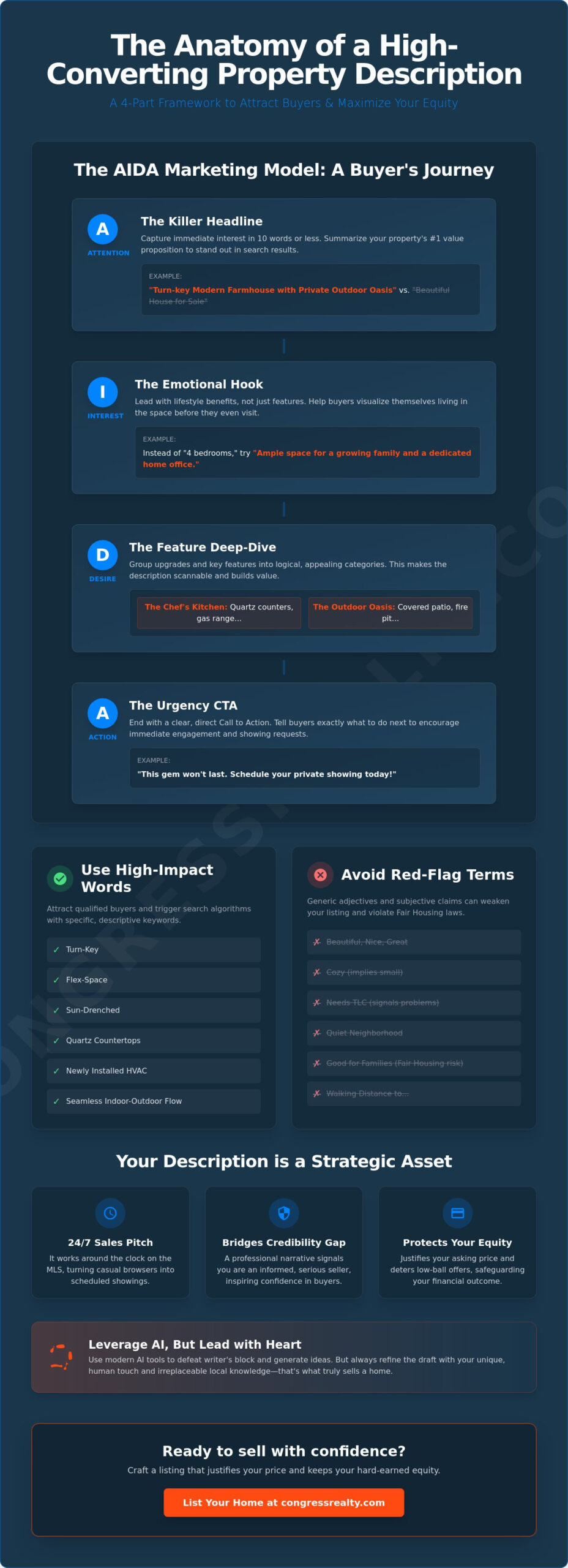
Apply the AIDA marketing model to structure your narrative, starting with a 10-word headline that captures immediate attention.
Learn how to write a compelling property description by swapping generic adjectives for high-impact terms like “flex-space” and “turn-key.”
Use AI prompt engineering to defeat writer’s block while ensuring your local knowledge remains the heart of the final draft.
Optimize your entry for national MLS databases by prioritizing critical features within character limits to maximize showing requests.
The Strategic Role of Your Property Description in a Flat-Fee Listing
Your property description is much more than a simple list of features; it’s a dedicated sales pitch that works 24/7 on the MLS. While your photos capture a buyer’s attention, your words provide the context that turns a casual browser into a scheduled showing. When you choose how to sell a house without a realtor, you take on the role of the primary marketer. This means you must understand how to write a compelling property description that matches or exceeds the quality of listings managed by high-commission agents.
A professional description bridges the credibility gap that sometimes exists for independent sellers. Buyers and their agents look for signals that a transaction will be smooth and professional. By moving beyond basic legal descriptions and dry data points, you signal that you are an informed, serious seller. This narrative approach allows you to control the conversation and highlight the lifestyle benefits that a simple data sheet cannot convey.
Use your text as a strategic filter to attract qualified buyers. Instead of trying to appeal to everyone, focus on the specific type of buyer who will value your home’s unique assets. If your description highlights a “sun-drenched home office” or a “seamless indoor-outdoor flow,” you’re actively courting people who prioritize those features. This targeted approach reduces wasted time and ensures that the people walking through your door are already halfway to making an offer.
Why Words Matter in the Digital-First Market
Search algorithms on major platforms like Zillow and Realtor.com scan your text for specific keywords to help buyers find exactly what they want. If you fail to mention a “newly installed HVAC” or “quartz countertops,” your home might never appear in filtered search results. There’s also a strong psychological link between the quality of a listing and the perceived condition of the home. A crisp, well-structured description suggests a home that’s been maintained with the same level of care. A truly compelling description is one that answers the buyer’s “Why” before they even have a chance to ask it.
Protecting Your Equity Through Professionalism
Your narrative serves as a financial shield for your equity. Weak or amateur listings often invite low-ball offers because they make the seller appear uninformed or desperate. By crafting a high-impact narrative, you support your flat fee mls listing strategy with total confidence. You aren’t just saving money on commissions; you’re actively building a case for your full asking price. Every sentence should reinforce the value of the property, ensuring you compete effectively against 6% commission listings while keeping more of your hard-earned equity in your pocket.
The Anatomy of a High-Converting Property Listing: A 4-Part Framework
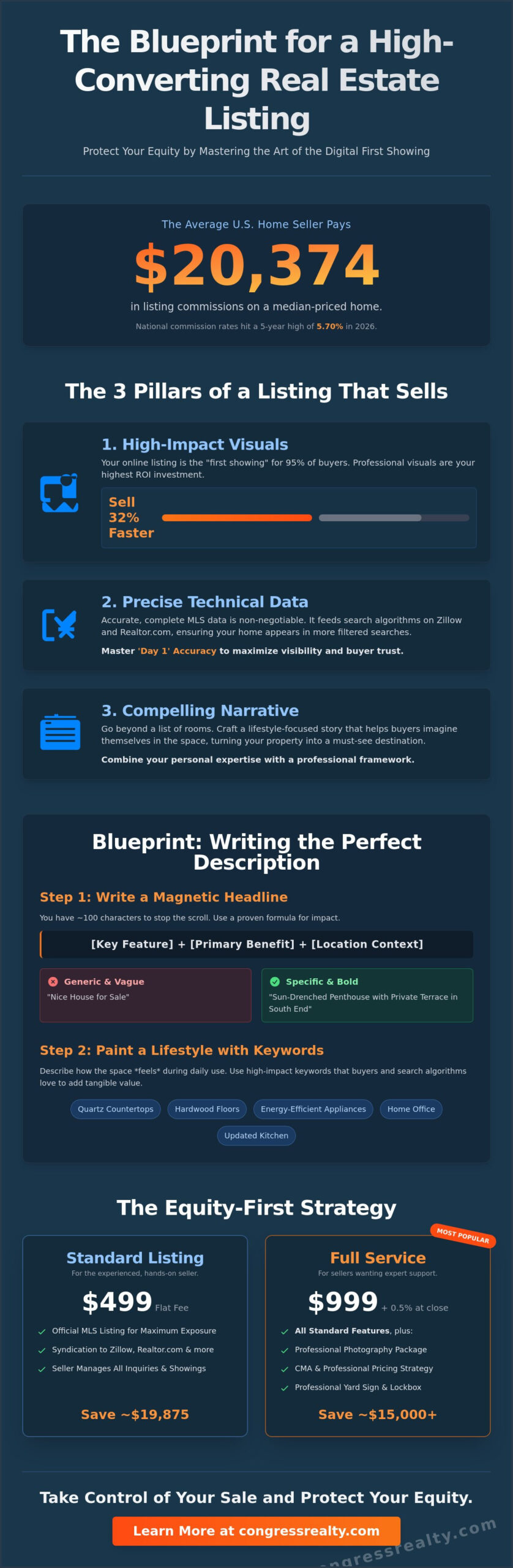
To master how to write a compelling property description, you must move beyond simple data entry and embrace a proven marketing structure. Professional copywriters rely on the AIDA model: Attention, Interest, Desire, and Action. This framework transforms a static list of rooms into a persuasive narrative that drives buyer behavior. By following a consistent structure, you ensure that every word serves a purpose and leads the reader closer to scheduling a showing.
Your listing begins with the “Killer Headline,” which should summarize your property’s primary value proposition in 10 words or less. This is followed by the “Emotional Hook,” where you lead with lifestyle benefits rather than bedroom counts. Instead of saying “4 bedrooms,” try “Plenty of room for a growing family or a dedicated home office.” The “Feature Deep-Dive” then groups your upgrades logically, such as “The Chef’s Kitchen” or “The Outdoor Oasis,” to help buyers visualize how they’ll use the space. Finally, end with an “Urgency CTA” that provides clear instructions. Tell them to “Schedule your showing via the electronic lockbox today” to prompt immediate engagement.
Drafting the Perfect Headline
Your headline is the first thing a buyer sees in their search results. A generic title like “Beautiful House” fails to capture interest and wastes valuable digital real estate. Contrast that with a high-impact headline like “Sun-Drenched Modern Farmhouse with Private Pool.” This specific phrasing includes key search terms without resorting to keyword stuffing. Follow the “One Big Thing” rule by focusing your headline on the home’s most unique or valuable asset. While this comprehensive guide from industry experts emphasizes general structure, your goal is to highlight the specific advantage that sets your home apart from the competition.
Crafting the Narrative Body
The body of your listing should function as a virtual walkthrough. Guide the reader room-by-room through your text, highlighting high-ROI upgrades that are already visible in your professional photography. Mentioning standard listing features like yard signs and electronic lockboxes adds a layer of professional polish to your independent listing. These details reassure buyers and agents that you have the necessary infrastructure to facilitate a smooth, secure transaction. If you want to see how these elements come together, you can view our current listings to find inspiration for your own narrative.
Choosing the Right Words: High-Impact Adjectives vs. Red-Flag Terms
The words you choose act as the connective tissue between your professional photos and a buyer’s imagination. In the 2026 real estate market, generic flattery no longer cuts it. Buyers are more data-driven and skeptical of flowery language that lacks substance. Understanding how to write a compelling property description requires a shift from generic praise to strategic vocabulary that highlights modern priorities. You want to use “Value-Add” descriptors that resonate with current trends, such as “sustainable” features, “smart-home integrated” systems, “flex-space” for remote work, and “turn-key” condition.
Adhering to the “Show, Don’t Tell” rule is the fastest way to elevate your listing. Instead of calling a room “beautiful,” describe the light hitting the hardwood floors or the panoramic view from the floor-to-ceiling windows. Conversely, you must avoid “Red-Flag” terms that inadvertently signal distress or hidden costs. Words like “fixer-upper,” “sold as-is,” and “motivated seller” are magnets for low-ball offers. Even the word “potential” can be a double-edged sword; it often suggests that the home requires more work than the buyer is willing to take on. If you’re dealing with a smaller footprint, frame it as “cozy” or “efficient” to highlight the lifestyle benefits of a manageable space.
Fair Housing Compliance for Independent Sellers
When learning how to sell your house on your own, your first priority is staying on the right side of federal law. Fair Housing violations can lead to heavy fines and legal delays. Avoid any language that references religion, familial status, or ethnic background. This means omitting phrases like “quiet Christian neighborhood,” “perfect for a young family,” or “walking distance to the synagogue.” Your description should focus exclusively on the physical attributes of the property and its amenities. By describing the house rather than the “ideal” buyer, you protect yourself while ensuring your listing remains professional and inclusive.
The Power of Specificity
Specificity is the enemy of doubt. Replace vague qualifiers like “upgraded” with concrete details like “Quartz countertops and custom cabinetry.” If you have high-end appliances or a specific smart home system, name the brands. Mentioning a Bosch dishwasher or a Nest thermostat builds immediate trust and establishes a baseline of quality. Use sensory language to evoke the feeling of living in the home. Describe the “soft morning light in the breakfast nook” or the “crackle of the wood-burning fireplace.” This level of detail helps buyers mentally move into the space before they even step through the front door.
How to Leverage AI Tools to Draft Your Description (Without Losing the Human Touch)
Writer’s block is one of the biggest hurdles for independent sellers. Staring at a blank screen while trying to figure out how to write a compelling property description can be exhausting. Fortunately, AI tools like ChatGPT and Claude have become powerful assistants for real estate marketing. These platforms aren’t meant to replace your expertise; they’re designed to provide a solid first draft that you can refine. By using AI to handle the initial structure, you save time and ensure you don’t forget essential details.
The secret to high-quality AI output lies in “Prompt Engineering.” If you give the tool generic instructions, you’ll get generic results. Instead, feed the AI a comprehensive list of your home’s features, upgrades, and your preferred tone. This allows the technology to do the heavy lifting while you maintain total command over the final product. Remember that AI is a facilitator, not a homeowner. It can summarize your kitchen renovation, but it can’t describe the specific way the morning light hits your breakfast nook or the quiet peace of your backyard at sunset. Adding these “Human Soul” details is what truly connects with a buyer’s emotions.
Before you publish, you must perform a rigorous “Verification Step.” AI can occasionally hallucinate details or include features your home doesn’t actually have. Manually checking every claim ensures you remain compliant with MLS accuracy standards. Once you have a draft that is factually perfect, you can submit your listing through our platform to gain immediate exposure on the most important professional databases.
A Sample AI Prompt for Sellers
To get the best results, follow a structured input method. Start by listing your core specs: bedroom count, square footage, and specific high-ROI upgrades. Then, ask for multiple tonal versions to see which fits your property best. Use this specific prompt structure: “Write a 200-word MLS description for a [Property Type] with [Feature 1], [Feature 2], and [Feature 3]. Provide three versions: one luxury-focused, one family-friendly, and one modern and punchy.” This gives you a variety of options to mix and match for the perfect final result.
Editing for Clarity and Flow
After you have your AI draft, it’s time to polish the narrative for a human audience. Remove “fluff” and unnecessary adverbs that don’t add value. Your description should flow logically, matching the order of your professional photos. If your first photo is the curb appeal, your first paragraph should address the exterior. Read your description aloud to check for a natural rhythm. If a sentence feels clunky or robotic, rewrite it in your own voice. This ensures your listing feels authentic and trustworthy to potential buyers.
Finalizing Your Listing: From Description to National MLS Exposure
Once you’ve mastered how to write a compelling property description, it’s time to move your narrative into the professional arena. You’ll enter your text directly into the Congress Realty portal, which serves as your command center for national exposure. This is where your marketing strategy meets technical execution. Pay close attention to character limits. Many MLS platforms truncate descriptions after a certain point, meaning your most critical information must appear in the first two sentences. If a buyer doesn’t see your home’s biggest value proposition immediately, they might keep scrolling before reaching the end of your text.
Your description should reflect a broader list of multiple listing services strategy. Because your listing will be syndicated to hundreds of sites, your words need to be universal yet impactful. Before hitting the submit button, perform a final, meticulous proofread. A “$1,000 typo,” such as listing the wrong number of bathrooms or misstating the square footage, can lead to legal headaches or missed showings. Accuracy is the foundation of your professional credibility and protects you from unnecessary delays.
Synchronizing Text and Media
Your description shouldn’t exist in a vacuum. It must reference the specific features seen in your professional photography to create a cohesive experience for the buyer. If your photos show a stunning backyard, your text should explain the “private terrace perfect for evening entertaining.” Mention that you have an electronic lockbox installed to reassure buyer agents that scheduling a showing is simple and secure. Additionally, use your Comparative Market Analysis (CMA) to ensure your description’s tone aligns with market expectations. If the data shows your neighborhood is trending toward luxury buyers, your language should reflect that sophistication.
The Congress Realty Advantage
Our platform is designed to give you the same tools as a traditional brokerage without the high commission costs. Whether you choose our Standard Listing or the Full Service Listing, we ensure your data is handled with professional precision. You maintain command over the process while we provide the infrastructure needed to reach the widest possible audience. Once your compelling description attracts an offer, our transaction management services can guide you through the complexities of closing. You aren’t just listing a home; you’re executing a smart financial plan that keeps your equity where it belongs.
You now have the professional toolkit to turn your listing into a high-converting marketing asset. By applying the AIDA framework and choosing high-impact adjectives that resonate with 2026 buyers, you’ve bridged the credibility gap. You know how to write a compelling property description that highlights your home’s unique soul while staying strictly compliant with Fair Housing standards. This isn’t just about writing; it’s about protecting your equity and proving that you don’t need a traditional agent to achieve professional results.
Congress Realty has spent over 20 years advocating for independent sellers. We provide the essential infrastructure, from professional photography and electronic lockboxes to national MLS exposure, all with fixed-fee pricing starting at $299. Don’t leave your hard-earned equity on the closing table. Start your Flat Fee MLS listing and keep your 3% commission!
You have the control. You have the tools. Now, it’s time to show the market what your home is truly worth.
Frequently Asked Questions
How long should a property description be on the MLS?
Most MLS platforms allow between 250 and 1,000 characters, but you should aim for a sweet spot of around 500 to 700 characters. This length is sufficient to tell a story without losing the buyer’s attention. Focus on the most impactful features in the first two sentences because many mobile apps truncate text early in the search results.
Can I use bullet points in my property description?
You can use bullet points, but be aware that some MLS software strips out special formatting. If you want to list features clearly, use simple symbols like dashes or asterisks. This ensures your list remains readable across all syndicated sites like Zillow and Realtor.com while maintaining a clean, professional appearance.
Is it okay to use all caps for emphasis in a listing?
Avoid using all caps for your entire description or even for single words. It often triggers spam filters and looks unprofessional to potential buyers. Use strong adjectives and specific data points to create emphasis instead of relying on capitalization, which can make your listing feel like a high pressure sales tactic.
What are the most important features to highlight in 2026?
In 2026, buyers prioritize sustainable features, smart home integration, and dedicated flex spaces for remote work. According to a 2026 survey, 58% of buyers still prefer open floorplans. Highlighting these modern assets is a key part of how to write a compelling property description that resonates with current market trends and buyer expectations.
How do I handle Fair Housing laws when writing my own description?
Protect yourself by describing the property’s physical attributes rather than the type of people you think should live there. Avoid any terms related to race, religion, or familial status. Stick to factual descriptions like “spacious fenced backyard” instead of “perfect for a large family” to stay strictly compliant with federal housing laws.
Should I mention the price or commission in the description?
Don’t include the asking price or agent commissions in the public description field. The MLS has dedicated, searchable data fields for these specific numbers. Using your description space for price data wastes valuable room that you should use for marketing the home’s unique lifestyle benefits and upgrades.
Can I change my property description after the listing is live?
You can absolutely update your description after the listing goes live through the Congress Realty portal. This allows you to refresh your narrative if you add a new upgrade or want to test a different headline strategy. Keeping your listing fresh helps maintain momentum and ensures your marketing stays relevant to the current market.
What is the best way to describe a home that needs work?
Frame a home that needs work as an “investor opportunity” or a “blank canvas for your vision.” Focus on the structural “bones” of the house, such as a large lot size or a highly desirable location. Being honest about the condition while highlighting the future potential helps you attract serious, qualified buyers looking for a project.
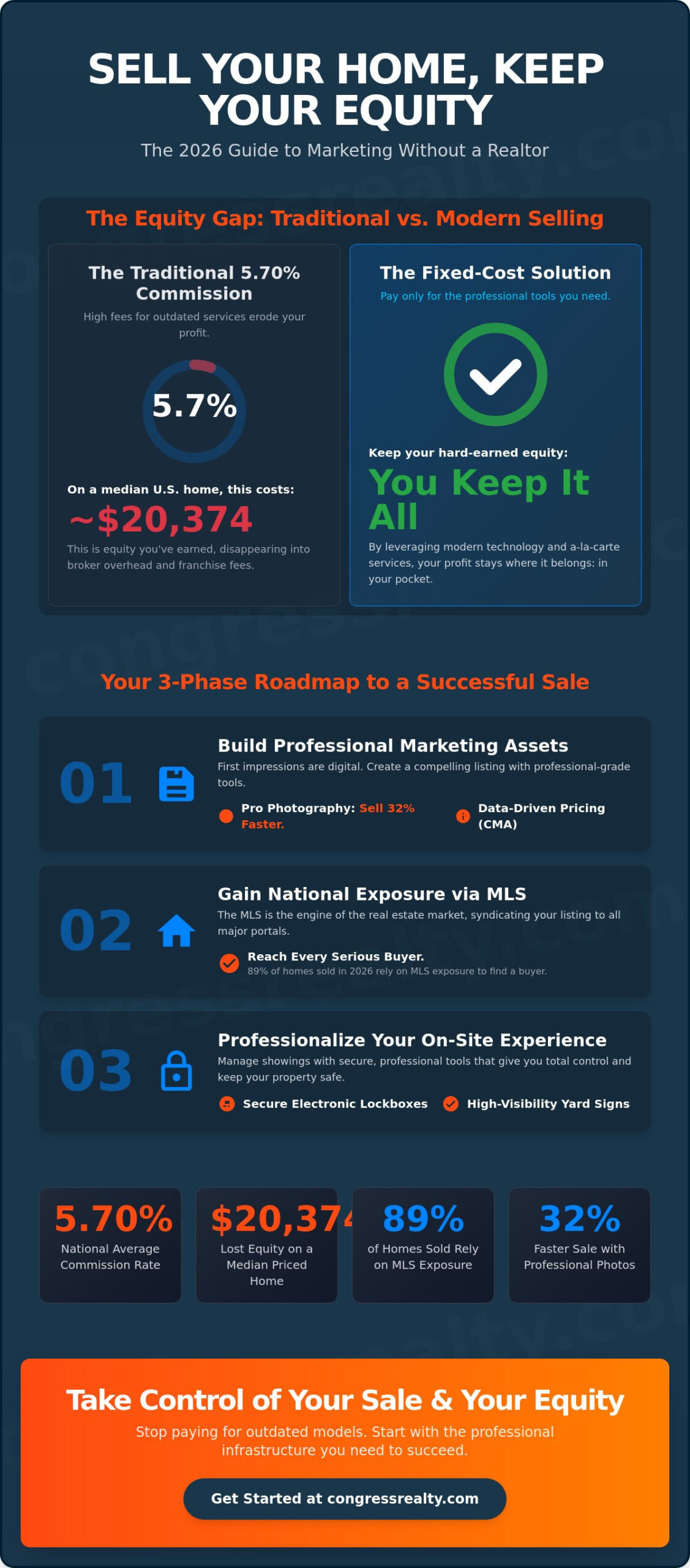
Did you know that listings with high-quality imagery sell for up to $11,200 more than those with grainy, DIY snapshots? For the equity-first seller, every dollar counts. You likely feel that your smartphone is sufficient for a quick listing, but the reality of the 2026 market is that digital curb appeal is your most valuable asset. It’s understandable to fear overpaying for marketing when you’re already trying to save on commissions, but understanding why professional real estate photos matter is the first step toward a smarter, more profitable sale.
We agree that you shouldn’t have to sacrifice your hard-earned profit to get professional results. This guide will show you how high-end photography transforms your listing from a simple digital thumb-stop into a high-value transaction while keeping you in total control of the process. We’ll preview the specific ROI of professional imagery, including the fact that these homes sell 32% faster according to industry data. You’ll also learn how to navigate new transparency regulations like California’s AB 723 and how to leverage professional media to win over the latest MLS algorithms.
Key Takeaways
Master the 2.7-second rule to ensure your digital storefront stops the scroll and compels buyers to engage with your property.
Justify a higher asking price and protect your equity by understanding exactly why professional real estate photos matter for your bottom line.
Identify the technical pitfalls of DIY photography that make rooms look small or dark, and learn how professional equipment solves these issues.
Boost your visibility on major search portals by leveraging the specific high-resolution media types that listing algorithms prioritize.
Discover how to access premium marketing infrastructure within a flat-fee model to keep your equity where it belongs.
The Digital First Impression: Why Professional Real Estate Photos Matter in 2026
You have exactly 2.7 seconds to win. That’s the average amount of time a buyer spends looking at a listing’s primary photo before deciding to click for more details or scroll past it forever. In the fast-paced market of 2026, your digital storefront has officially replaced physical curb appeal as the most critical factor in a successful sale. If your lead image doesn’t stop the thumb, your high-end kitchen and manicured backyard will never even be seen. This is why professional real estate photos matter more than any other marketing tool in your arsenal.
High-quality imagery is about more than just looking “nice”; it’s about maintaining momentum. Data shows that homes with professional photos sell 32% faster than those without. This reduction in Days on Market (DOM) is essential for protecting your equity. When a listing lingers, it becomes stale, which often leads to price drops and lowball offers. Professional media also builds immediate trust with the growing number of out-of-state and remote buyers. These individuals often make life-changing decisions based entirely on what they see on their screens. For example, in competitive regions like Southwest Florida, professional groups such as Team239 rely on high-quality imagery to showcase residential properties and new construction to a global audience, ensuring buyers see every corner with clarity and professional precision before they schedule a tour or make an offer.
The Psychology of the Scroll
Mobile devices have completely reshaped the visual hierarchy of home buying. The human eye is naturally drawn to light, balanced composition, and a sense of space. Professional Architectural photography techniques leverage these instincts to guide a buyer’s attention to your home’s best features. When you rely on “good enough” DIY photos, you’re unintentionally driving buyers toward your competition. Dark corners, yellow lighting, and tilted walls create a subconscious sense of neglect. A professional shot creates an emotional hook. It allows a buyer to imagine their own life in the space before they ever step through the front door.
Data-Backed Results for Modern Sellers
The numbers offer a clear roadmap for the savvy, independent seller. Listings featuring high-end media receive significantly higher click-through rates (CTR) on major search portals. This increased traffic translates directly into higher offers. Research indicates that listings with professional photography can sell for between $3,400 and $11,200 more than those with amateur shots. The visual premium is the measurable increase in perceived property value generated by high-quality marketing assets. By choosing professional photography, you’re not just taking pictures; you’re establishing a higher baseline for your final sales price.
Justifying the Price: The ROI of High-End Property Media
Is spending a few hundred dollars on a photographer really worth it when you’re trying to maximize your savings? For the savvy seller, the answer is a resounding yes. When you calculate the return on investment, professional media isn’t an expense; it’s the most effective way to protect your equity. By investing in high-quality assets, you establish “Professionalism Parity.” This ensures your flat-fee listing looks identical to, or even better than, a traditional 3% commission listing on the MLS. This visual authority allows you to justify a higher asking price even when buyers are wary of an appraisal gap.
High-end photos do more than just attract clicks; they reduce the need for future price drops. By generating higher initial interest and multiple competing offers, you create a sense of urgency that amateur photos simply cannot replicate. Research indicates that listings with professional photography can sell for between $3,400 and $11,200 more than those without. When you compare that gain to the national average cost of a photoshoot, which typically ranges from $150 to $300, the financial intelligence of this choice becomes undeniable. Adding Professional Photography to your strategy is a pragmatic move that pays for itself many times over at the closing table.
Protecting Your Equity
Professional photos are the cheapest high-impact marketing tool available to a homeowner. They function as a shield against “low-ball” offers that often stem from a poor perception of the property’s condition. If a listing looks unpolished, buyers assume the seller is unmotivated or the home is poorly maintained. Understanding why professional real estate photos matter is just one part of the puzzle. You should also look at How Much Does the Realtor Make? Understanding Commissions in 2026 to see how much more you keep when you pair flat-fee savings with high-impact marketing.
The Cost of DIY: Hidden Losses
The true cost of DIY photography is found in the opportunity cost of a stagnant listing. Effective visual storytelling in real estate creates an emotional connection that smartphone snapshots cannot achieve. Poor lighting and distorted angles carry a heavy stigma; they make rooms look smaller, ceilings lower, and finishes cheaper. Buyers quickly associate amateur visuals with a lack of professionalism, leading them to wonder what else the seller might be cutting corners on. Don’t let a “good enough” photo be the reason your equity sits on the market for an extra month.
Professional vs. DIY: The Technical Difference You Can’t Fake
While smartphone cameras have improved, they still can’t overcome the fundamental laws of physics. Many sellers believe a modern phone is “good enough” for a quick listing, but this misconception often leads to flat, distorted, or poorly lit images that fail to capture the true value of a home. This is why professional real estate photos matter; they utilize specialized hardware and software that a pocket-sized sensor simply cannot match. When you rely on amateur tech, you’re essentially presenting a lower-value version of your property to the world.
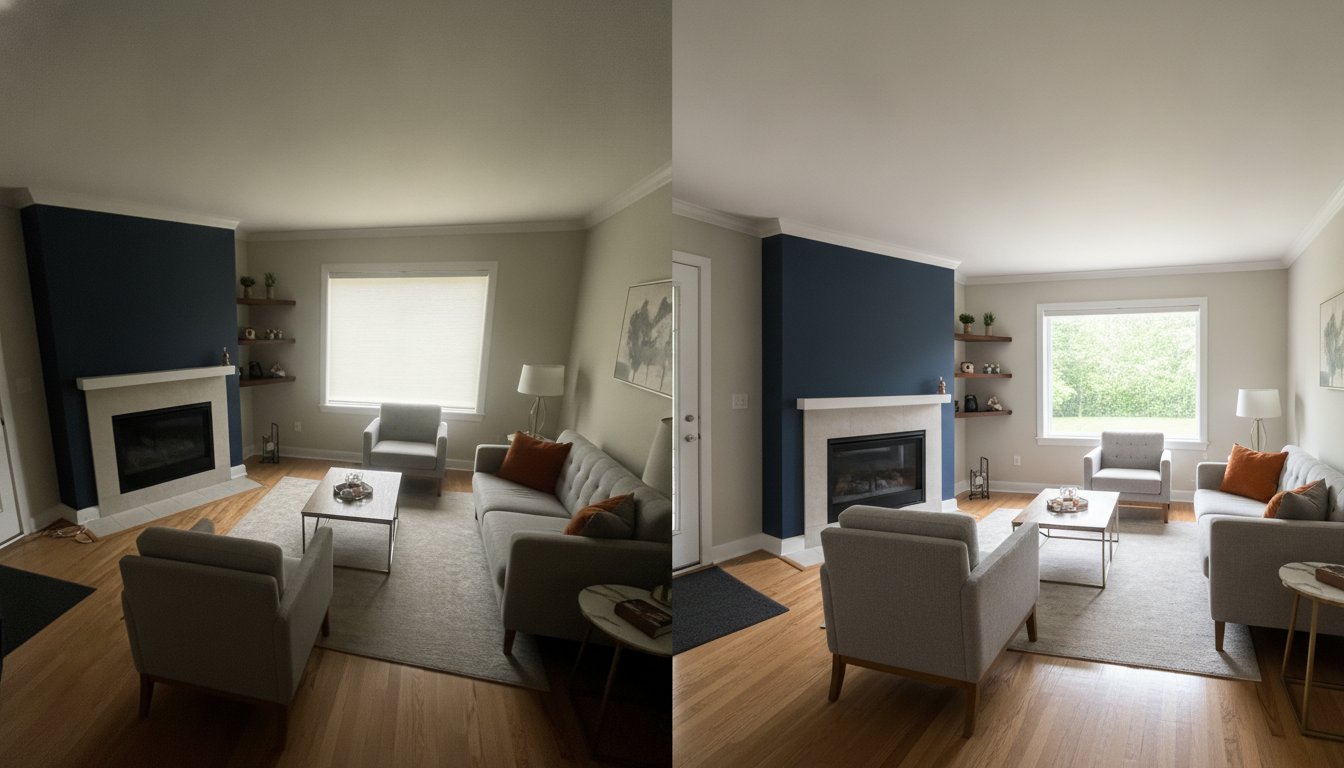
A major hurdle for DIY shooters is dynamic range. When you take a photo of a living room with large windows, a phone usually makes the room appear dark or turns the windows into glowing white rectangles. Professional photographers use High Dynamic Range (HDR) techniques, blending multiple exposures to ensure the view outside the window is just as clear as the furniture inside. This technical balance creates a polished, high-end look that justifies your asking price and makes your listing stand out on the MLS.
Then there is the issue of spatial distortion. Smartphone “wide” lenses often create a “fish-eye” effect that makes straight walls look curved and unnatural. Professionals use rectilinear wide-angle lenses that keep the space looking expansive yet accurate. Crucially, they ensure vertical lines stay perfectly vertical. If your walls look like they’re leaning backward or the floors appear tilted, buyers subconsciously feel the listing is sloppy or unprofessional. Post-production refinements, such as blue sky replacements and color correction, further ensure your home looks its absolute best regardless of the weather or the time of day.
The Lighting Challenge
Managing the interplay between shadows and highlights is a precise art form. A professional understands how to showcase your home’s natural light without letting it overwhelm the shot. While “golden hour” remains the gold standard for your primary hero image, midday interior shots require much more control. Professional flashes are required for balanced interior exposures to ensure that every corner of the room is visible while maintaining the natural color of your flooring and finishes. This level of technical precision creates a bright, airy feeling that naturally attracts more buyers to your listing.
Composition and Staging Strategy
A professional eye sees the details you might overlook. They utilize the rule of thirds to lead a buyer’s eye through the room, focusing on the flow of the floor plan rather than just the furniture. This strategy involves several key elements:
Decluttering for the Lens: Identifying specific items that distract from the architectural space and removing them before the shutter clicks.
Architectural Highlights: Capturing unique crown molding, built-ins, or high-end fixtures that DIY shots often overlook or fail to emphasize.
Spatial Accuracy: Positioning the camera at the correct height to make rooms feel grounded, inviting, and accurately sized.
By highlighting these specific details, you emphasize the inherent value of your home and maintain complete control over the narrative of your sale.
Algorithm Advantage: Maximizing MLS and Portal Reach
Ever wonder why some houses appear at the top of Zillow searches while others are buried on page ten? It isn’t luck. Real estate portals like Zillow and Realtor.com use sophisticated algorithms to determine which listings get the most exposure. These systems prioritize high-resolution media because it keeps users on their platforms longer. This is a primary reason why professional real estate photos matter for your visibility. When you upload professional shots, you aren’t just showing off your home; you’re feeding the algorithm exactly what it wants to see.
The “Photo Count” factor is a simple but powerful metric. Listings with a higher number of professional images keep buyers on your page for longer durations. This high “dwell time” signals to the portal that your listing is high-quality, which in turn pushes it higher in search results. Additionally, high-resolution media is far more shareable on social media. A stunning kitchen shot has the potential to go viral within local community groups, driving thousands of extra eyes to your listing. This creates a ripple effect that reaches buyer agents across the country who are monitoring their own professional industry databases for new opportunities.
Winning the Portal War
Every time a buyer clicks, saves, or shares a photo, it triggers an algorithm boost. High engagement levels act as a vote of confidence for your property. Your “Hero Image” is the most important piece of this puzzle because it appears in the automated email alerts sent to thousands of active buyers. If that first image is a dark, blurry smartphone shot, they won’t click. If it’s a professional, bright, and inviting exterior, your click-through rate will skyrocket. To understand how this fits into your broader strategy, read The Ultimate Guide to Flat Fee MLS Listings: Save Your Equity in 2026. Maximizing your reach starts with the right infrastructure.
MLS Data Integrity
The Multiple Listing Service (MLS) maintains strict professional standards for data integrity. Low-resolution or poorly cropped photos can actually be flagged or suppressed by automated systems, limiting your home’s exposure to other brokers. Professional photography ensures you meet these technical requirements from day one. These images also play a vital role in the Comparative Market Analysis (CMA) process. When appraisers or other agents look at your home as a “comp,” they rely on your listing photos to judge its condition and value. Clear, professional visuals ensure your home is compared to high-value properties rather than neglected ones. If you want to ensure your listing meets these high-tech standards, consider adding Professional Photography to your listing package today.
The Congress Realty Model: Professional Results on a Flat-Fee Budget
Traditional brokerages often use high-end marketing as a justification for their 3% listing commissions. They suggest that professional visuals are a luxury only they can provide. We disagree. At Congress Realty, we’ve disrupted this high-cost model by integrating Professional Photography directly into our tiered listing packages. This ensures you don’t have to choose between saving your equity and presenting your home in its best light. You get the same high-caliber tools used by top-tier traditional firms, but you keep the thousands of dollars normally lost to percentage-based fees.
Our “Equity-First” approach is designed for the savvy homeowner who values financial intelligence. We provide the professional infrastructure, including seamless coordination from the photographer’s lens to the Multiple Listing Service (MLS). You don’t need to worry about technical upload requirements or data integrity. We handle the backend logistics so your high-resolution media feeds correctly into every major search portal. This is exactly why professional real estate photos matter in our model; they serve as the foundational proof that your home is a premium offering, regardless of the commission structure you choose.
Beyond the Photos: A Complete Marketing Suite
A great photo is only effective if it’s backed by a professional sales process. We combine high-end media with essential tools like an Electronic Lockbox and a Yard Sign and Post to create a comprehensive marketing presence. Our professional oversight ensures your photos are utilized for maximum impact across all platforms, from the MLS to local buyer agent databases. If you’re ready to maximize your profit, check out How to Sell Your House on Your Own: The 2026 Equity-First Guide for a step-by-step breakdown of the process.
Taking Control of Your Sale
You don’t need to pay a 3% commission to get 5-star photography. The Congress Realty onboarding process is simple, pragmatic, and designed to put you in the driver’s seat. We provide the expertise and the professional connections; you provide the home and the vision. This partnership allows you to navigate the 2026 market with the confidence of a seasoned pro. Don’t let traditional industry models dictate how much of your equity you get to keep. Take the smart path to a successful closing. List your home with professional media today and experience the satisfaction of a high-value sale on a fixed-fee budget.
Take Command of Your Home Sale Today
Your home deserves a presentation that reflects its true value. By now, it’s clear that high-end imagery is the foundational infrastructure of a successful sale. You’ve seen how professional media stops the scroll, beats the portal algorithms, and ultimately protects your equity from low-ball offers. Understanding why professional real estate photos matter is the first step toward a smarter, more profitable transaction. You don’t need a traditional broker to access these results; you just need the right partner to facilitate the process.
At Congress Realty, we provide the professional framework you need to succeed independently. With over 20 years of flat-fee MLS expertise, we offer national coverage with local MLS precision. Our service includes professional transaction management to ensure your sale stays on track from the first photo to the final signature. Don’t leave your equity to chance with amateur snapshots. List your home with professional photography for a flat fee today and stay in total control of your financial future. You have the tools, the data, and the support to win. We’re ready to help you get started.
Frequently Asked Questions
Can I just use my iPhone 17 Pro for my real estate photos?
While your phone is powerful, it can’t replicate the dynamic range or rectilinear lenses of a professional setup. Phone cameras often distort walls or blow out window views, which is why professional real estate photos matter for maintaining spatial accuracy. Professionals use specialized gear and HDR techniques to ensure your home looks expansive and correctly lit. This technical precision creates a polished look that smartphone sensors simply cannot achieve.
How many photos should a professional real estate listing have?
Most MLS platforms allow for a maximum of 40 to 50 images. You should aim for at least 25 to 30 high-resolution shots to keep buyers engaged on your listing page. This volume satisfies the “Photo Count” factor that search algorithms use to rank your property higher. Providing a comprehensive visual tour ensures that out-of-state buyers have enough information to feel confident making an offer without a physical tour.
Do I need to be home when the real estate photographer arrives?
You don’t need to be present for the shoot. Many sellers find it easier to provide access through an Electronic Lockbox. This allows the photographer to work efficiently through the home while you manage your daily schedule without interruption. It also ensures the photographer can move furniture or adjust lighting without the distraction of a crowded house. Just ensure the home is camera ready before you leave for the day.
What is the difference between real estate photography and architectural photography?
Real estate photography focuses on marketing a property for sale by highlighting flow, features, and emotional appeal. Architectural photography is a broader subgenre that emphasizes the artistic design, structural intent, and historical record of a building. While they share techniques, real estate media is specifically engineered to drive clicks and offers. It prioritizes the buyer’s perspective and the practical layout of the living space over purely artistic expression.
How much value does professional photography actually add to a home sale?
High-quality imagery has a measurable impact on your bottom line and is a key reason why professional real estate photos matter for savvy sellers. Data from 2026 suggests that listings with professional photos can sell for between $3,400 and $11,200 more than those without. This visual premium directly protects your equity by establishing a high perceived value. It’s a pragmatic investment that pays for itself by attracting more competitive offers.
Should I include drone photography for my listing?
Drone photography is a powerful tool for properties with significant acreage, unique locations, or impressive exterior features. It provides a perspective that ground-level shots can’t capture, such as proximity to parks, water, or neighborhood amenities. For land-focused listings, such as those represented by Coulee Land Company, these perspectives are vital for illustrating property boundaries and terrain. Research indicates that 83% of sellers prefer to work with professionals who offer these aerial views. If your property has a great roof or a large backyard, drone shots are essential for showing the full scope.
Do I need to stage my home before the professional photographer comes?
Staging is essential to ensure the camera captures the home’s potential rather than your personal belongings. Focus on decluttering surfaces and depersonalizing the space to create a clean slate. This allows the photographer to use composition techniques that lead the buyer’s eye through the floor plan effectively. A well-staged home translates into better visual storytelling, helping buyers imagine their own lives in the space before they even visit the property.
How long does it take to get the edited photos back for my MLS listing?
Most professional photographers deliver edited, high-resolution images within 24 to 48 hours of the shoot. This quick turnaround is vital for getting your home onto the MLS and into the hands of buyer agents while your listing is still fresh. Speed is a competitive advantage in a fast-moving market. Once you receive the files, you can immediately integrate them into your listing to start stopping the scroll and generating immediate interest.
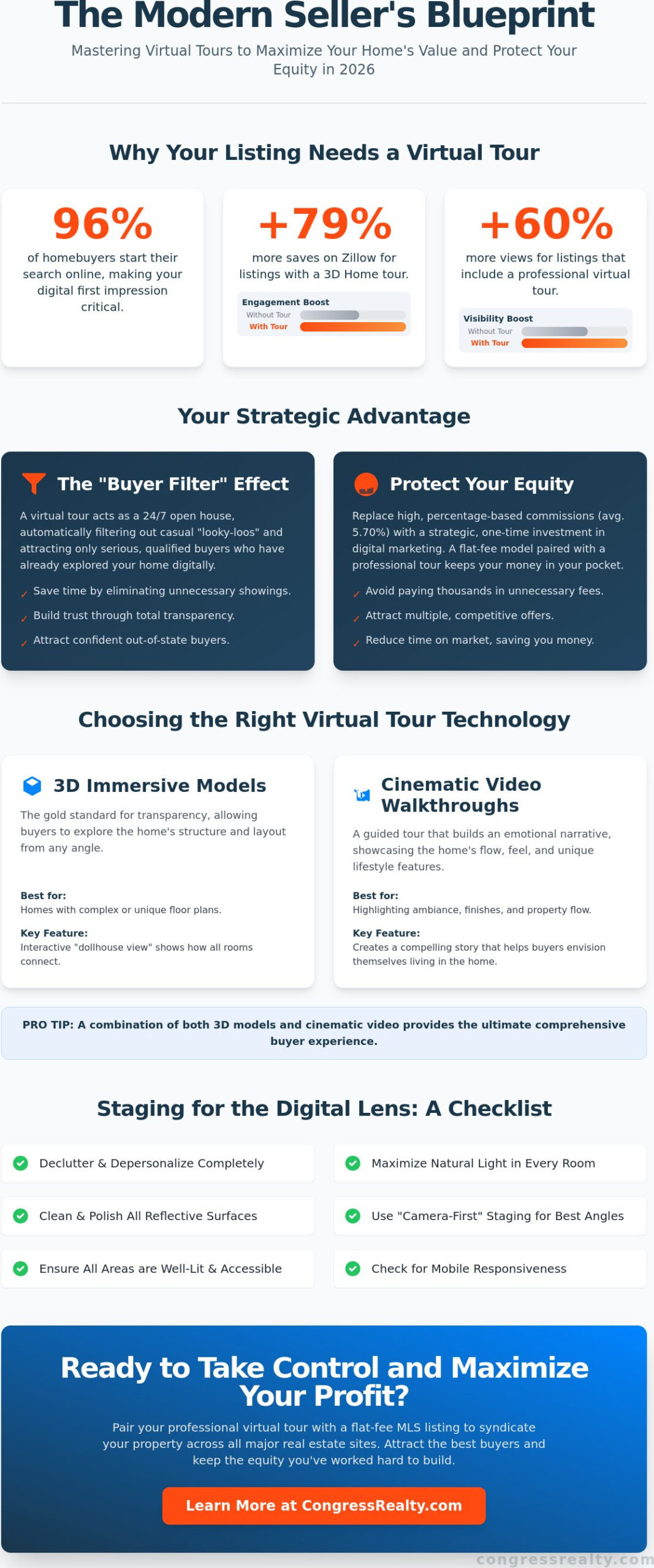
Did you know that listings featuring a Zillow 3D Home tour receive 79% more saves and 60% more views than those without? It’s a staggering reality in 2026, where 96% of homebuyers start their search online. You’ve worked hard to build equity in your property. Watching a 5.70% commission disappear at the closing table feels like an unnecessary loss, especially when you can manage the digital presentation of your home with professional precision.
It’s common to feel anxious about constant foot traffic from unqualified visitors or confused by which 3D tech is actually worth the cost. This guide provides the essential virtual tour tips for selling your home to help you attract serious, motivated buyers while keeping your equity where it belongs. You’ll learn how to master digital property presentation to protect your financial interests and maintain full control of the process. We’ll show you how to leverage professional photography and 3D walkthroughs to create a listing that commands attention on the MLS, replacing high percentage-based costs with a smarter, fixed-fee approach.
Key Takeaways
Filter out “looky-loo” traffic and save time by using a virtual tour as a 24/7 digital open house that qualifies buyers before they step foot on your property.
Discover the best virtual tour tips for selling your home, including how to use “camera-first” staging and natural light to eliminate digital dead zones.
Compare 3D immersive models with cinematic video walkthroughs to choose the technology that best showcases your home’s unique layout and flow.
Maximize your return on investment by pairing professional photography with a flat fee MLS listing to protect your equity from traditional commission costs.
Gain full control over your marketing by learning how to syndicate your digital walkthrough across major industry databases and third-party real estate sites.
Why Virtual Tours are Essential for Selling Your Home in 2026
In the current real estate market, your home’s first showing doesn’t happen in the driveway. It happens on a smartphone screen. If you’re looking for virtual tour tips for selling your home, start by reframing what a digital walkthrough actually does. It functions as a 24/7 open house that works for you while you’re at work or sleeping. By the time a buyer requests an in-person visit, they’ve already walked through your kitchen and checked the layout of the primary suite. This digital-first approach is no longer a luxury; it’s the standard for serious sellers who want to maximize their reach.
Understanding what is a virtual tour is critical for any equity-conscious seller. In 2026, buyers view these digital assets as a mandatory requirement. If your listing lacks one, many serious leads will simply scroll past. This is especially true for the growing number of out-of-state buyers who are relocating for work and often make offers sight-unseen. They need the confidence that a high-resolution 3D scan provides to make a high-stakes decision from a distance.
The “Buyer Filter” Effect
One of the greatest advantages of a digital walkthrough is its ability to eliminate “looky-loo” traffic. These are casual browsers who aren’t ready to buy but still require you to stage, clean, and vacate your home for a showing. A virtual tour acts as a pre-qualification tool. It provides total transparency, which builds immediate trust with serious prospects. When buyers can explore every corner of the property online, they experience a sense of immersive ownership. They start mentally placing their furniture in your living room before they ever grab their car keys. This psychological connection leads to higher-quality offers and fewer surprises during the inspection phase because the buyer already has a realistic view of the property’s condition.
Protecting Your Equity through Digital Marketing
Traditional agents often use the promise of “open houses” to justify high commission rates. However, savvy sellers know that a professional digital presence is far more effective and less intrusive. By investing in high-quality digital assets, you bypass the need for expensive, traditional hosting services that eat into your profit. It’s essential to stay informed about understanding commissions when you’re building your marketing stack. Choosing a Professional Photography add-on for your listing isn’t just about aesthetics; it’s a strategic move to protect your equity. A small upfront investment in a professional tour often pays for itself by attracting multiple offers and reducing the time your home sits on the market. You maintain full command of the process while ensuring your listing stands out against the competition on the MLS.
Choosing the Right Virtual Tour Technology for Your Listing
Selecting the right tech for your digital presentation depends on your property’s layout and your target buyer. You don’t need a Hollywood budget to look professional, but you do need to understand the tools available in 2026. High-quality assets are the foundation of any successful Standard or Full Service listing. Whether you choose an immersive 3D model or a cinematic video, your goal is to provide a clear, honest view of the home that encourages a fast offer.
When reviewing virtual tour tips for selling your home, consider how different technologies serve different purposes. 3D models provide a structural understanding of the space, while video walkthroughs excel at building an emotional narrative. Many successful sellers now use a combination of both to provide a comprehensive experience. Beyond the visual style, ensure your chosen platform is mobile-responsive. With the majority of buyers searching on their phones, a tour that crashes or loads slowly will drive away potential leads.
3D Models: The Gold Standard for Transparency
Immersive 3D models, such as those created with Matterport, are highly effective for homes with complex floor plans. These models offer the famous “dollhouse view,” which allows buyers to see the entire home as a 3D structure. This perspective is incredibly helpful for understanding how rooms connect. According to the National Association of REALTORS® virtual tour playbook, providing this level of detail builds trust and reduces the number of basic questions you’ll have to answer. These models also allow for precise digital measurements. If a buyer is worried their sectional won’t fit in the living room, they can use the measurement tool to verify the space themselves.
Video Walkthroughs: Creating an Emotional Connection
Video walkthroughs offer a different advantage by focusing on the “flow” and vibe of the home. Use high-definition 4K video to highlight specific features like the sound of a backyard fountain or the way sunlight hits the breakfast nook. Modern attention spans are short; keep your clips under two minutes to ensure viewers stay engaged. Focus on a logical path through the home, starting at the front door and moving through the main living areas. This format is perfect for social media sharing and can quickly go viral if the production quality is high.
Technical compliance is another critical factor. Most MLS databases require “unbranded” versions of your virtual tours for syndication. This means your tour cannot contain your name, contact information, or any logos. If you upload a branded version to the primary MLS field, it may be rejected or stripped from third-party sites. Always ask your photographer for both a branded version for your personal social media and an unbranded version for your official listing. By following these technical requirements, you ensure your home gets maximum exposure across the entire professional industry network.
Staging Your Home for the Digital Lens: A Checklist
Preparing your property for a 3D scan requires a different strategy than a traditional photo shoot. Because 360-degree cameras capture an entire room simultaneously, you cannot simply shove clutter behind the photographer’s tripod like you would during a standard session. Every corner is visible. When implementing virtual tour tips for selling your home, adopt a “camera-first” mindset. This means looking at your space through the lens of a wide-angle sensor that amplifies both the beauty and the blemishes of a room.
Lighting is your most powerful tool for avoiding “dead zones” in a digital walkthrough. Open every blind and curtain to maximize natural light, as 360 cameras often struggle with the high contrast between bright windows and dark corners. Turn on every light in the house, including lamps and under-cabinet LEDs, to create a consistent exposure. You should also watch out for the “wide angle trap.” While you might think pushing furniture against the walls makes a room look larger, it often creates an unnatural, empty “caved-in” look in 3D. Arrange furniture in small, conversational groupings to help the camera define the scale and purpose of the space.
Virtual Staging: The Low-Cost Alternative
If you’re selling an empty house, AI-powered virtual staging is a game-changer for your equity. In 2026, AI services can deliver professionally staged rooms in under 30 seconds for as little as $1 to $15 per image. This allows you to transform a cold, vacant space into a designer home that resonates with your target demographic. Just remember that transparency is key. You must disclose virtual staging in your MLS listing notes to maintain trust with buyers. Choose a decor style that matches the architecture of the home to keep the digital experience feeling grounded and realistic.
Pre-Shoot Technical Preparation
Technical glitches can ruin a high-end tour. High-reflectivity surfaces like windows and mirrors can “blind” 3D sensors or cause “ghosting” effects in the final render. Clean these surfaces meticulously before the shoot. You also need to remove “trip hazards” for the lens. Hide all power cords, pet bowls, and trash cans. Since the camera sees everything, designate one specific area, like a small closet or the garage, as your “staging dump.” This is where you’ll store all the items you’ve cleared from the rest of the house. Keeping this one area off-camera allows you to maintain a pristine environment throughout the rest of the digital walkthrough.
Professional vs. DIY Virtual Tours: Maximizing Your ROI
Deciding between a DIY approach and hiring a professional is a critical step in protecting your home’s equity. While you want to minimize costs, a low-quality digital presentation can result in fewer offers and a longer time on the market. When looking for virtual tour tips for selling your home, evaluate the property’s price point and your own technical comfort level. For lower-priced properties, a high-end smartphone paired with a stabilizer gimbal can produce acceptable results. However, for most listings, the Professional Photography add-on provides a high-ROI investment that pays for itself by attracting serious buyers quickly. This is a core component of a successful flat fee MLS listing, ensuring your home competes with those represented by high-commission agencies.
Professional assets also significantly impact your “Listing Quality Score” on major platforms like Zillow and Realtor.com. These sites use algorithms to prioritize listings with high-resolution 3D tours and professional media. Better ranking means more views, which leads to more qualified leads. If you are aiming for the highest possible sale price, professional-grade imagery is the most efficient way to prove your home’s value to the market without the need for an expensive traditional agent.
The Hidden Costs of DIY
DIY isn’t always as “free” as it seems. Learning complex 3D scanning software and editing video can take days of your time. There is also the “Amateur Penalty” to consider. Poor lighting or shaky camera work can actually decrease your home’s perceived value in the eyes of a buyer. Additionally, many 3D hosting platforms require monthly subscription fees. For example, some professional-grade software requires ongoing hosting at $20 per month per tour. Professional photographers usually include these hosting costs in their flat-rate fee, saving you the hassle of managing multiple accounts.
Hiring a Pro: What to Look For
If you choose to hire an expert, ensure they understand the specific needs of an independent seller. Ask for a “Media Bundle” that includes high-definition stills, a 3D walkthrough, and interactive floor plans for a single flat rate. It’s also vital to verify that they will provide an “unbranded” link. This is a requirement for MLS compliance, as branded links with contact info will be rejected by the system. Finally, check their turnaround times. You want your media ready for peak search days, typically mid-week, to build momentum for the weekend. Ready to take control of your sale? Browse our professional listing options to find the right fit for your equity goals.
Leveraging Your Virtual Tour with Congress Realty
How do you actually get your digital assets in front of serious buyers? Having the best virtual tour tips for selling your home won’t matter if your link isn’t properly syndicated. When you choose a Standard or Full Service listing, we provide the professional infrastructure to host and distribute your media. The MLS contains a dedicated “Virtual Tour” field designed specifically for these links. Once we enter your unbranded link into this field, your tour automatically syndicates to Zillow, Realtor.com, and thousands of other brokerage sites. This ensures your home maintains the same level of visibility as any property listed by a traditional, high-commission agent.
Congress Realty handles the technical heavy lifting for you. We ensure your assets meet strict MLS compliance standards, which prevents your listing from being flagged or suppressed by local boards. Our transaction management team provides the professional oversight you need to ensure your digital marketing stays on track. You stay in command of the sale while we provide the professional industry database access that makes the process work. It’s a pragmatic, fixed-fee solution that replaces the unpredictable costs of traditional brokerages.
From Digital Click to Electronic Lockbox
The workflow for an equity-first sale is efficient and secure. A buyer clicks your virtual tour and explores the layout. Because they’ve already “walked” the home digitally, they are much more qualified than a casual browser. When they request a showing, you grant access via an electronic lockbox. This sequence significantly reduces the number of “unsupervised” entries into your home. You only open your doors for leads who have already vetted the property online. During the negotiation and escrow phase, the virtual tour remains a valuable reference tool. Buyers can revisit the digital scan to verify room dimensions or show the home to family members, keeping the momentum high through the final closing steps.
Finalizing Your Listing Strategy
The most successful sellers combine a professional CMA with high-end virtual assets to create a listing that stands out. By pricing your home accurately and presenting it with professional photography, you eliminate the need for traditional middlemen. The “Equity-First” model is the smartest way to sell your house without a realtor while maintaining professional standards. You keep your hard-earned profit and stay in total control of the transaction. Ready to maximize your equity and take charge of your sale? Get your home on the MLS today with Congress Realty and start attracting serious buyers immediately.
Take Command of Your Home Sale with Digital Precision
Mastering the digital presentation of your property is the most effective way to filter out casual browsers and focus your energy on serious, high-intent buyers. By applying these virtual tour tips for selling your home, you’ve moved beyond traditional, high-cost marketing methods. You now understand how to choose the right technology, stage for the 360-degree lens, and leverage professional media to stand out on the MLS. This strategic approach doesn’t just sell your home faster; it ensures you remain the primary beneficiary of your property’s value.
You don’t need to sacrifice professional quality to protect your equity. By choosing a smarter path, you can save the traditional 3% listing commission while still accessing professional photography and 3D tour support. With expert transaction management guiding you to a smooth closing, you stay in total control of every detail. It’s time to put your hard-earned equity back in your pocket where it belongs.
The tools for a successful, independent sale are at your fingertips. Take the lead, showcase your home’s true potential, and enjoy the financial rewards of a smart, intelligence-driven transaction.
Frequently Asked Questions
Does a virtual tour really help sell a house faster?
Yes, a virtual tour is a powerful tool to accelerate your sale. Listings with a Zillow 3D Home tour receive 79% more saves and 60% more views than those without. This increased visibility leads to more qualified leads and faster offers. By letting buyers explore the home digitally, you ensure that only serious prospects request in-person showings, which streamlines the entire transaction and saves you time.
How much does it cost to create a 3D virtual tour in 2026?
Costs vary based on whether you choose professional services or a DIY software approach. In 2026, a professional scanning service for a typical 2,000 to 3,000 square foot home generally costs between $350 and $600. If you prefer to manage the process yourself, software subscriptions range from free plans to around $69 per month. Don’t forget to account for potential hosting fees and floor plan add-ons.
Can I use my smartphone to make a professional-looking virtual tour?
You can produce a high-quality tour using a modern smartphone, provided you use the right tools. A stabilizer gimbal is essential to prevent shaky footage, which can lower your home’s perceived value. While high-end smartphones have excellent 4K sensors, you’ll still need to follow professional virtual tour tips for selling your home, such as maximizing natural light and using a tripod to ensure consistent image quality throughout the walkthrough.
What is the difference between a virtual tour and a video walkthrough?
A virtual tour is an interactive, 3D experience that allows viewers to move through the home at their own pace. This often includes the “dollhouse view” for structural clarity. A video walkthrough is a linear, cinematic movie that highlights the home’s flow and atmosphere. While a 3D tour provides transparency and measurements, a video is better for creating an emotional connection and showcasing the neighborhood’s vibe.
Will a virtual tour make my home look smaller than it is?
A virtual tour won’t make your home look smaller if you arrange your furniture correctly. Avoid pushing all items against the walls, as this can create an unnatural “caved-in” look in 360-degree captures. Instead, group furniture into conversational areas to give the camera a sense of scale. Professional lighting and clear sightlines help the digital lens capture the true volume of each room accurately.
Do I need to disclose if my virtual tour uses virtual staging?
You must disclose virtual staging in your MLS listing notes to maintain legal compliance and buyer trust. While AI-based staging is a cost-effective way to showcase an empty home’s potential, buyers expect transparency. Clearly stating that certain rooms are virtually staged prevents confusion when they visit the property in person. This honest approach builds credibility and ensures your transaction moves forward without unnecessary friction.
How do I add a virtual tour to my MLS listing without a traditional agent?
You can add a virtual tour by using a professional listing service that provides access to the MLS for a fixed fee. We provide a dedicated “Virtual Tour” field for your unbranded link, which then syndicates to major third-party real estate sites. This allows you to manage your marketing independently without paying a traditional 3% commission. It’s a pragmatic way to maintain full control over your digital assets.
Are virtual tours safe for my privacy and security?
Virtual tours are safe as long as you prepare your home for the digital lens with privacy in mind. Remove personal photos, sensitive documents, and high-value portable items before the shoot. Since the camera captures a 360-degree view, ensure you haven’t left any identifying information visible in any room. Taking these simple precautions allows you to market your home effectively while protecting your family’s personal space.
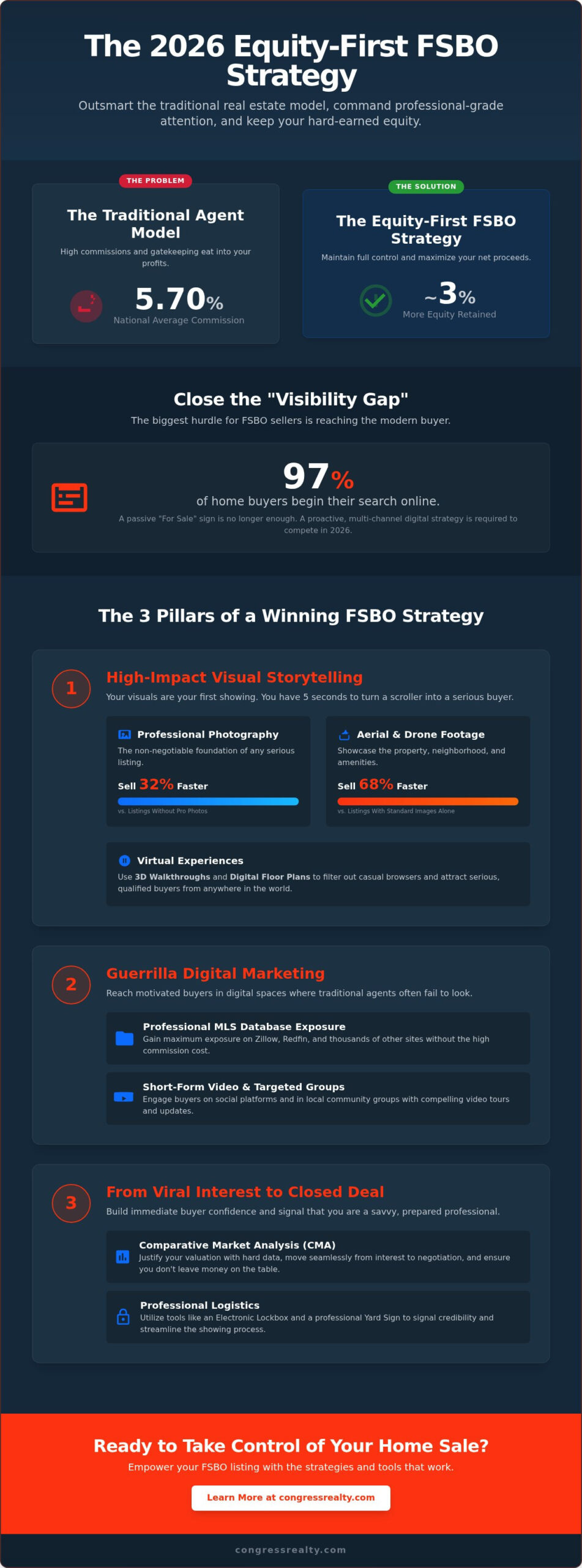
What if the secret to beating a traditional real estate agent isn’t matching their strategy, but outsmarting it? Many sellers feel the pressure of the 5.70% national average commission rate and want a better way. You might worry that your DIY listing will look “cheap” or be ignored by buyers’ agents. These are valid concerns in a 2026 market where listings with professional photos sell 32% faster than those without.
You can command the same attention as a luxury brokerage while keeping your hard-earned equity. This guide reveals the 2026 Equity-First Strategy, a hybrid approach that combines professional-grade tools with personal storytelling. We’ll explore creative ways to market a fsbo property that go far beyond a simple Zillow post. You’ll learn how to leverage high-impact digital assets and professional photography to generate high-quality leads. We’ll show you how to outshine traditional listings and retain 3% more of your closing price while maintaining total control of your sale.
Key Takeaways
Learn how to close the “Visibility Gap” by shifting from passive signs to a proactive strategy that meets the 2026 buyer’s demand for direct transparency.
Capture serious interest within the first five seconds of engagement by using professional photography to anchor your visual storytelling.
Utilize short-form video and targeted community groups to reach motivated buyers in digital spaces where traditional agents often fail to look.
Discover creative ways to market a fsbo property by leveraging professional MLS databases to gain maximum exposure without losing your equity to high commissions.
Build immediate buyer confidence and justify your valuation with a Comparative Market Analysis (CMA) to move seamlessly from viral interest to a closed deal.
Beyond the “For Sale” Sign: Why FSBO Marketing Needs a 2026 Upgrade
Sticking a wooden sign in your front lawn and hoping for the best is a 1995 strategy trying to survive in a 2026 market. Today, the “Visibility Gap” is the primary reason independent listings fail. This gap represents the distance between your property and the screens of the 97% of buyers who begin their home search online. If your marketing is passive, your listing becomes stagnant. In a market where the national average real estate commission is 5.70%, you can’t afford to be invisible. You need a multi-channel approach that mirrors professional brokerage standards to protect your equity.
The traditional agent model relies on gatekeeping. Agents often act as filters, controlling the flow of information and access to the property. As an empowered seller, you flip this script. You provide direct access and immediate answers. This transparency is one of the most effective creative ways to market a fsbo property because it builds a level of trust that a middleman simply can’t replicate. By using professional logistics like an Electronic Lockbox and a Yard Sign and Post, you signal to the market that you’re a savvy, prepared professional.
The Psychology of the Modern Home Buyer
Buyers in 2026 are tired of the “call for details” culture. They want data, and they want it now. Most people are increasingly comfortable with For Sale By Owner (FSBO) transactions because they value the direct line of communication with the person who knows the home best. To succeed, you must provide trust markers. Professional Photography is a non-negotiable tool here. It bridges the credibility gap instantly. When a buyer sees high-end visuals, they stop worrying about whether the transaction will be “messy” and start focusing on the floor plan.
The Cost of “Quiet” Marketing
Relying on word-of-mouth or a single portal limits your price potential. If only ten people see your home, you’re at the mercy of their schedules. If 10,000 people see it, you’re in the driver’s seat. Achieving “Market Saturation” solo requires using professional industry databases to ensure your home appears everywhere buyers look. Strategic self-marketing is about equity preservation. While the FSBO market share hit a historic low of 5% in 2025, those who use creative ways to market a fsbo property often see results that rival agent-assisted sales. Using a Comparative Market Analysis (CMA) helps you justify your price to skeptical buyers, ensuring you don’t leave money on the table just because you’re selling independently.
High-Impact Visual Storytelling: Turning Scrollers into Serious Buyers
In the digital marketplace, your photos are your first showing. You have exactly five seconds to capture a buyer’s attention before they swipe to the next listing. This “First 5 Seconds” rule dictates whether a lead explores your property or ignores it. Professional Photography isn’t just a luxury; it’s the non-negotiable foundation of all creative ways to market a fsbo property. Research from Luxury Presence in February 2026 shows that listings with high-quality, professional images sell 32% faster than those without.
Moving beyond basic room shots, you should employ “Lifestyle Staging.” This technique involves arranging scenes that tell a story, such as a set dining table or a cozy reading nook. It helps buyers visualize their future daily life in the space. To truly stand out, add drone footage. Homes featuring aerial photos sell 68% faster than those with standard images alone, as reported by FlippingBook Blog in March 2026. This bird’s-eye view markets the neighborhood and proximity to local amenities, providing context that ground-level shots miss.
The “Hero Shot” Strategy
Your primary thumbnail, or “Hero Shot,” must trigger an immediate click-through. Aim for a front exterior photo taken during the “golden hour”, which is just after sunrise or before sunset. The warm, soft lighting creates an emotional pull that harsh midday sun cannot replicate. Avoid DIY smartphone photos. While modern phones are impressive, they often struggle with wide-angle distortion and interior lighting balance. Low-quality images can actually devalue a high-end property by making it look unprofessional or neglected.
Virtual Experiences and Spatial Context
3D walkthroughs act as a powerful filter. They allow out-of-town buyers to experience the layout without a physical visit, which saves you time by weeding out “window shoppers.” Pair these with digital floor plans so buyers can plan furniture placement before they even step foot on the property. When you link these visual assets to a Standard Listing, your property gains maximum syndication across major real estate portals. This professional presentation ensures your listing holds its own against agent-led properties. By choosing a fixed-cost approach over high-commission models, you keep your equity where it belongs. If you want to ensure your home makes the right first impression, investing in Professional Photography is a smart, strategic choice.
Guerilla Digital Marketing: Reaching Buyers Where Agents Dont Look
Most real estate agents follow a predictable, automated playbook. They upload a listing to the MLS and wait for the phone to ring. To truly stand out, you need to go where the competition isnt looking. Guerilla marketing is about using high-impact, low-cost tactics to create a buzz that traditional brokerages often miss. By engaging directly with your community and leveraging modern social trends, you can drive significant traffic to your listing without paying a traditional 3% listing commission.
One of the most effective creative ways to market a fsbo property involves leveraging local community groups on platforms like Facebook and Nextdoor. The key is to avoid looking like a spammer. Instead of simply dropping a link, share a “neighborhood appreciation” post. Highlight what you’ve loved about living there, from the local coffee shop to the quiet cul-de-sac. This narrative approach builds an emotional connection with potential buyers who are already looking in that specific area. Short-form video is another primary tool for discovery in 2026. Use Reels or TikTok to show off unique features, like a hidden pantry or a sun-drenched home office. These platforms allow you to reach a massive audience with an average CPM of $8 to $14, making it a highly cost-effective way to generate interest.
Social Media as a Secondary MLS
Think of your social media profiles as a dedicated property landing page. Create a specific “property bio” that houses all your high-quality visual assets. If you’re seeing a trend of people moving to your area from specific high-outflow states, use targeted social sharing to put your home in front of them. Use “Story” updates to provide a behind-the-scenes look at the home. A “New kitchen reveal” or a video of the view at sunset keeps your listing top-of-mind for your network and their friends. This creates a ripple effect of organic reach that a static agent listing rarely achieves.
Unconventional Offline Tactics
Physical marketing still matters, but it needs a modern twist. Place a QR code on your Yard Sign and Post that links directly to your mobile-optimized listing. This allows passersby to view the price and interior photos instantly without needing to wait for a flyer. Consider rethinking the traditional “Open House” as a “Private Tour” event. By requiring a scheduled time, you build a sense of exclusivity and urgency. You can also partner with local businesses to display “Featured Home” flyers. Use high-end sign riders that highlight specific, high-value upgrades like “Solar Owned” or “Electric Vehicle Charging.” These specific details often get lost in a standard property description but can be the deciding factor for a savvy 2026 buyer.
The Hybrid Advantage: Using Professional Databases for Creative Exposure
While social media and guerilla tactics build incredible buzz, the Multiple Listing Service (MLS) remains the powerhouse of your marketing strategy. It’s the most effective of all creative ways to market a fsbo property because it acts as the primary source of truth for the entire real estate industry. Think of the MLS not as a bureaucratic checkbox, but as your central broadcasting station. It’s the engine that pushes your professional photos and descriptions to the world’s most visited real estate portals. When you choose to list on MLS without a realtor, you’re tapping into the same infrastructure used by high-commission brokerages while maintaining total autonomy.
The syndication process is where the magic happens. One single, accurate entry into the MLS automatically populates your home on Zillow, Realtor.com, and thousands of local brokerage websites. This ensure your creative marketing materials reach every corner of the market, from local families to out-of-state relocation buyers. Data accuracy is critical here. If your listing isn’t categorized correctly, your high-impact photos won’t matter because buyers won’t find them in their filtered searches. Using a professional service ensures your data meets strict industry standards. This level of precision, combined with a Yard Sign and Post and an Electronic Lockbox, signals to every buyer’s agent that you’re a serious, professional seller. It removes the friction often associated with independent sales and keeps you in the driver’s seat.
Maximizing the “Remarks” Section
Your property description is your digital sales pitch. The first 200 characters are the most important because this is what appears in the preview on most mobile apps. Start with a punchy hook that highlights your home’s most unique feature immediately. Use keyword-rich language to trigger specific search filters, but avoid “Agent Speak.” Words like “charming” or “cozy” often signal “small” or “old” to savvy buyers. Instead, use authentic, approachable language that speaks directly to the buyer’s lifestyle and aspirations. This directness builds a connection that traditional agent listings often lack.
Syndication and National Reach
Modern flat fee mls listings provide national exposure that solo posting simply cannot match. This is especially vital in a 2026 market where buyers are looking for transparency and direct communication. Having a professional broker handle the data entry and compliance protects you from common paperwork pitfalls while you lead the process. This hybrid model allows you to offer a competitive buyer’s agent commission to ensure your home is shown to the widest possible pool of qualified leads. If you’re ready to maximize your exposure while keeping your equity, consider starting with a Standard Listing today.
From Viral Interest to Closed Deal: Mastering the FSBO Conversion
Marketing doesn’t end once a buyer clicks your listing. In the final stage of the sale, your logistics become your most persuasive marketing tool. If a buyer’s agent finds it difficult to schedule a showing or get answers, your creative efforts are wasted. Professional infrastructure signals to the market that the transaction will be smooth and reliable. This is one of the most effective creative ways to market a fsbo property because it addresses the buyer’s primary fear: a “difficult” independent seller. By using an Electronic Lockbox, you allow agents to show the home on their schedule, which increases showing volume and creates the competitive environment needed for a high-value offer.
A successful conversion relies on proving your home’s worth with hard data. When a buyer or their agent questions your price, you shouldn’t rely on emotion. You need professional-grade documentation to justify every dollar. This is where a Comparative Market Analysis (CMA) transforms from a pricing tool into a marketing asset. It provides the transparency that 2026 buyers demand. By removing the mystery from your valuation, you build the confidence required for a buyer to sign a contract. It’s about making the home as easy to buy as it was to find.
Pricing as a Marketing Lever
Your price is a message that dictates who sees your home. A Professional CMA gives you the data needed to prove value to skeptical buyers and their agents. Instead of guessing, you present a report that mirrors what an appraiser looks for. Use psychological pricing to stay within search filters. Listing at $499,000 instead of $505,000 ensures you appear in “under $500k” searches. Remember, your lack of a 3% listing commission is a powerful negotiation tool. You can use a portion of those significant savings to offer buyer credits, which often closes the deal faster than a simple price drop would.
The “Easy-to-Buy” Framework
Make the purchase process frictionless for the buyer. Provide a “Home Fact Sheet” during every showing. This document should answer common objections before they are raised, covering utility costs, recent upgrades, and school zones. It acts as a silent salesperson that remains with the buyer after they leave. Once you have an offer, transaction management services provide the final professional touch that secures the sale. This service ensures all paperwork stays on track and deadlines are met. By using these creative ways to market a fsbo property, you don’t just find a buyer; you lead the process to a successful closing while keeping your equity where it belongs.
Take Control of Your Home Sale and Your Equity
You’ve seen how the 2026 Equity-First Strategy transforms a simple listing into a high-impact marketing campaign. By combining professional photography with the visibility of the MLS, you eliminate the gatekeepers and speak directly to your buyers. These creative ways to market a fsbo property ensure you don’t just reach the market; you command it. You’ve learned that professional logistics like electronic lockboxes and data-backed CMAs aren’t just tools; they’re trust markers that secure your closing.
Selling on your own doesn’t mean selling alone. You can maintain total control while leveraging the same professional infrastructure used by the nation’s top brokerages. Congress Realty was founded in 2002 and brings over 20 years of FSBO expertise to your transaction. We provide national coverage and professional broker oversight without ever charging a 3% listing commission. It’s time to stop overpaying for services you can manage with the right partner by your side.
What is the most effective way to market a FSBO home in 2026?
The most effective way to market a FSBO home in 2026 is through a hybrid strategy that pairs professional MLS syndication with digital-first visual storytelling. This approach ensures your property appears on every major real estate portal while using high-quality assets to capture buyer attention. By controlling the narrative and providing direct transparency, you meet the modern buyer’s demand for immediate information and clear communication.
Can I get my house on the MLS without hiring a full-commission agent?
You can absolutely list your home on the MLS without paying a traditional 3% listing commission by using a flat-fee service. This model provides the professional infrastructure of a brokerage while allowing you to manage the process independently. You retain the freedom to lead your sale and save thousands in equity at closing. It’s a smart, utilitarian tool for savvy sellers who want professional exposure without high-cost industry models.
Do creative marketing tactics actually work for selling a home?
Creative marketing tactics are essential for making your home stand out in a competitive market. These strategies, such as short-form video tours and neighborhood lifestyle marketing, help independent sellers outshine traditional listings. Using creative ways to market a fsbo property allows you to build an emotional connection with buyers that a standard, static agent listing often fails to achieve. High-impact visuals and proactive social engagement drive serious interest.
How much should I spend on marketing my home for sale by owner?
Budget for high-impact essentials that generate the highest return on investment. Prioritize professional photography, a yard sign, and a flat-fee MLS listing to ensure maximum visibility. While costs vary by market and service level, investing in these professional-grade materials is much more cost-effective than paying a percentage-based commission. Smart sellers view these fixed costs as an investment in preserving their equity rather than just an expense.
How do I handle buyers agents who refuse to show FSBO properties?
Eliminate resistance by offering a competitive buyer’s agent commission and using professional tools like an electronic lockbox. When agents see a listing on the MLS with professional photos and easy showing instructions, they treat it like any other brokerage listing. Clear communication and professional-grade logistics signal that the transaction will be simple and reliable. This removes the perceived risk for agents and keeps your property in their showing rotation.
Is professional photography really worth the cost for a FSBO listing?
Professional photography is one of the most critical investments you can make. Listings with high-quality, edited images sell 32% faster than those with DIY photos, according to February 2026 data from Luxury Presence. High-end visuals anchor your creative ways to market a fsbo property by establishing instant credibility with buyers. Don’t risk devaluing your home with smartphone photos that struggle with lighting and wide-angle distortion.
What are the best social media platforms for real estate marketing?
Focus your efforts on visual platforms like Instagram and Facebook, where neighborhood groups and reels drive high engagement. TikTok is also a primary tool for discovery in 2026, especially for showing off unique home features through short-form video. These platforms allow you to reach motivated buyers where traditional agents often fail to look. Use targeted social sharing to put your home in front of people relocating from high-outflow areas.
How do I write a property description that sells?
Write a description that leads with a punchy hook in the first 200 characters to capture mobile users. Focus on lifestyle benefits and unique upgrades rather than using generic “agent speak” adjectives. Use keyword-rich descriptions to help your home appear in specific search filters. This direct, authentic approach builds trust and helps buyers visualize their future in the space more effectively than a standard brokerage blurb.
Did you know that 89% of homes sold in 2026 rely on MLS exposure, yet the national average commission rate has climbed to a five-year high of 5.70%? For a median U.S. home, that’s roughly $20,374 disappearing from your equity. If you’re wondering how to market your home without a realtor while still reaching every serious buyer, you aren’t alone. You likely feel that the traditional 3% listing commission is an unnecessary tax on your hard-earned wealth. It’s a common anxiety, especially when you’re worried about missing out on professional photography or navigating new 2026 disclosure laws regarding smoking history or AI-edited images.
You deserve a professional-looking listing and maximum market exposure without the high-cost industry baggage. We’ll show you how to bypass traditional models by using a strategic suite of tools, from electronic lockboxes to professional photography that helps homes sell 32% faster. This article provides a clear, step-by-step roadmap to managing your own sale with confidence. You’ll learn how to leverage professional listing services and fixed-cost transaction management to secure a top-tier sale price. By the end, you’ll have a pragmatic plan to keep your equity where it belongs: in your pocket.
Key Takeaways
Reclaim your equity by identifying how traditional commissions erode your profit and why 2026 technology makes independent selling the smarter choice.
Master the essentials of how to market your home without a realtor, starting with professional photography and a Comparative Market Analysis (CMA) to drive buyer interest.
Unlock national exposure on platforms like Zillow and Redfin by utilizing the MLS to ensure your property reaches every serious buyer in the country.
Professionalize your on-site experience with high-visibility yard signs and secure electronic lockboxes that simplify showings while keeping you in total control.
Deploy a professional infrastructure for your sale by choosing between tiered listing services that offer the exact level of transaction management you need.
The Shift in 2026: Why Marketing Your Own Home is Smarter Than Ever
The real estate landscape has fundamentally changed in 2026. Information that used to be a guarded industry secret is now at your fingertips. Understanding how to market your home without a realtor is the most effective way to protect your equity in a market where commissions have climbed to a five-year high. Think of marketing as the essential bridge between your front door and the Multiple Listing Service (MLS). When you control this bridge, you control the sale. The democratization of data means you no longer need to pay a premium for access to buyers; you simply need the right professional tools to reach them.
The “Equity Gap” is a real threat to your financial goals. With the national average commission rate currently at 5.70%, selling a median-priced home costs you roughly $20,374 in fees. By acting as your own facilitator, you replace high-commission brokers with professional infrastructure. This shift allows you to manage the process with the same tools the pros use, but without the percentage-based drain on your profit. You’re making a choice for financial intelligence and autonomy, ensuring that the value of your home stays with you rather than being split among intermediaries.
The Problem with Traditional Listing Commissions
The traditional 6% commission model is built on an outdated premise. It assumes you need a middleman to find a buyer. In reality, listing agents often earn an average of 2.88% just for putting your home on the MLS and placing a sign in the yard. Paying for a “brand name” brokerage rarely translates to a higher sale price. Instead, it often leads to diminishing returns as you pay for the broker’s overhead rather than your home’s visibility. A fixed-cost model disrupts this by providing transparency. You pay for the services you actually use, ensuring your financial intelligence is rewarded at the closing table. Don’t pay for a brand name when you can pay for results.
Marketing vs. Selling: Understanding the Difference
It’s helpful to distinguish between marketing and selling to reduce any anxiety about the process. Marketing is the act of generating lead flow and visibility. It’s about high-quality visuals and broad digital reach. Selling, on the other hand, involves the negotiation and closing steps. Many sellers find that For Sale By Owner (FSBO) transactions are remarkably straightforward once the marketing is handled professionally. Learning how to sell your house on your own starts with a professional marketing strategy. When you deploy the right tools to attract buyers, the negotiation often takes care of itself because your property’s value is clearly demonstrated through its presentation.
Phase 1: Building Your Professional Marketing Assets
Successful home sales aren’t built on luck; they’re built on high-quality assets. Learning how to market your home without a realtor requires you to think like a creative director. Your digital presence is your property’s actual front door in 2026. Buyers decide whether to visit your home within seconds of scrolling through their feeds. If your assets look amateur, buyers often assume the property is neglected. You must deploy professional-grade tools to ensure your listing stands out against traditional brokerage entries. By taking control of your presentation, you establish immediate credibility with both buyers and their agents.
The ROI of Professional Photography
Low-quality smartphone photos are the primary reason independent listings fail to gain traction. They lack the dynamic range and wide angles necessary to make rooms feel spacious and inviting. Data shows that listings with professional photos sell 32% faster than those without. You need a specific shot list to compete effectively in the modern marketplace. This includes wide-angle interior shots that capture the flow of each room and drone exteriors to show the property’s position in the neighborhood. Professional lighting and editing create a “magazine-ready” look that justifies a higher asking price. It’s a strategic investment that delivers a massive return on your equity by driving higher offer volumes.
Comparative Market Analysis (CMA) Explained
Pricing is a science, not a guess. While automated valuation tools offer a quick starting point, they often miss the nuances of your specific street or recent upgrades. A Comparative Market Analysis (CMA) is the professional standard used by appraisers and brokers to determine true market value. To price effectively, you must analyze “Sold” data from the last six months rather than looking at “Active” listings. Active prices represent what sellers want; sold prices represent what the market actually pays. Adjust your valuation based on local market velocity and unique features like a finished basement or a new roof. Ordering a professional CMA ensures you don’t leave money on the table or let your home sit stagnant due to overpricing.
Your listing description should function as a narrative, not just a grocery list of features. Highlight high-value upgrades such as energy-efficient systems or smart home integrations that appeal to 2026 buyers. Pair this with a focus on digital curb appeal. In the digital marketplace, your primary photo is your curb appeal. Ensure the exterior is pristine and the lighting is perfect. This professional synergy creates a compelling package that motivates buyers to schedule a showing immediately.
The MLS Power Play: Gaining National Exposure
The Multiple Listing Service (MLS) is the engine of the real estate market. While many believe agents have a secret vault of buyers, the reality is far more digital. In 2026, roughly 89% of homes are sold with MLS exposure. When you understand how to market your home without a realtor, you realize that the MLS is the “Source of Truth” for every major platform. Sites like Zillow, Realtor.com, and Redfin do not invent their own data; they pull it directly from local MLS feeds. By securing a flat fee mls listing, you bridge the gap between a private sale and professional exposure. You gain the same national visibility as a full-commission listing while maintaining total control over your equity.
Mastering how to market your home without a realtor means leveraging these automated feeds to ensure your property is visible on every screen in your target market. You aren’t just putting a sign in the yard; you’re inserting your property into the global stream of real estate data. This professional parity is what allows savvy sellers to compete with massive brokerages on a level playing field.
Syndication: How Your Home Appears Everywhere
Visibility is a numbers game. If you only list your property on “FSBO-only” websites, you’re essentially hiding it from 90% of active buyers. These niche sites lack the automated syndication power of a professional listing service. A true MLS entry triggers a digital wave, pushing your data to thousands of brokerage websites across the country. To maximize this, you must focus on search algorithm optimization. This means filling out every data field accurately, from school zones to specific property tax figures. Incomplete data can cause your home to be filtered out of buyer searches. When your data is precise, the algorithms work for you, placing your home in front of the most qualified leads.
Managing the “Buyer Agent” Relationship
One common concern for independent sellers is how to work with buyer agents. It’s important to remember that most buyers in 2026 still work with an agent who handles their tours and paperwork. To ensure these agents bring their clients to your home, consider offering a competitive Buyer Agent Commission (BAC). This incentivizes the 2.82% average commission that buyer agents typically earn without you paying a duplicate fee for a listing agent. Handle inquiries with professional clarity. When an agent calls, be ready with your showing schedule and property details. You don’t need a middleman to speak for you; you just need to be accessible. By using a secure electronic lockbox, you can facilitate showings without being present, maintaining a professional boundary while staying in command of the process.
On-Site Marketing: Signs, Lockboxes, and Security
While your digital presence captures the initial lead, your physical on-site strategy is what truly closes the deal. Understanding how to market your home without a realtor involves mastering the “last mile” of the buyer’s journey. This is where your property’s curb appeal meets professional infrastructure to create a seamless, secure experience. You don’t need to be physically present for every interaction to be effective. In fact, deploying the right tools allows you to maintain a professional boundary while keeping the sales process moving forward 24/7.
Professional Signage and Curb Appeal
The yard sign is your most consistent silent salesperson. A flimsy, store-bought sign sends the wrong message to the market. It suggests a lack of professional support and can inadvertently invite low-ball offers from opportunistic buyers who think you’re desperate or uninformed. In contrast, a high-quality yard sign and post mirrors the aesthetic of a traditional brokerage listing. This visual parity signals to the neighborhood and passing traffic that you are a savvy, serious seller. Enhance this by adding a QR code that links directly to your digital listing. This allows passersby to view professional photos and property details instantly on their phones, turning a casual drive-by into a qualified lead.
The Security of Electronic Lockboxes
Security is a primary concern for independent sellers, and manual combination codes are simply not enough in 2026. Professional electronic lockboxes are the superior solution for both safety and convenience. These devices track exactly who enters your home and at what time, providing a digital paper trail of every showing. This technology allows buyer agents to show your home using their standard industry credentials, just as they would with any other listing. It means you don’t have to leave work or disrupt your life to let someone in. By automating access, you turn a potential logistical nightmare into a hands-off process. You’ll receive notifications when a showing begins and ends, allowing you to monitor activity from your smartphone with total transparency.
Screening leads is another critical step in your on-site strategy. Before allowing anyone into your home, request a mortgage pre-approval letter or proof of funds. This ensures that only qualified, serious leads are occupying your time. Once they arrive, have a “Buyer Information Packet” ready on the kitchen counter. This should include your CMA data, a list of recent upgrades, and local utility costs. This pragmatic approach makes the buyer’s decision easier and positions you as an expert facilitator who is fully in control of the transaction. If you’re ready to secure your property and professionalize your showings, consider adding an electronic lockbox to your listing package.
Congress Realty: Professional Infrastructure for Savvy Sellers
Congress Realty stands as a national leader in flat-fee listing services, providing the essential professional infrastructure that modern sellers require. You don’t need a high-commission broker to access the market’s most powerful tools. Instead, you need a partner that advocates for your financial intelligence. By choosing a platform that prioritizes your autonomy, you can successfully implement the strategy of how to market your home without a realtor while keeping your equity intact. We provide the professional database access and physical tools that were once locked behind expensive traditional models. Our goal is to empower you to lead the process with confidence.
Our platform is designed for the savvy, independent user. Whether you’re a seasoned investor or a first-time seller, we deliver the necessary infrastructure to compete on a level playing field. This includes a professional Comparative Market Analysis (CMA) to ensure your pricing is data-driven, high-impact professional photography to capture buyer attention, and secure electronic lockboxes to manage showings with ease. We replace the traditional percentage-based fee with a predictable, transparent structure. You get the visibility of a big-brand brokerage without the massive bill at the closing table.
Standard vs. Full Service: Choosing Your Level of Support
We offer a tiered approach to match your specific needs and experience level. The Standard Listing is perfect for the purely independent seller who wants maximum exposure on the MLS and national portals with minimal interference. It provides the foundation for a successful sale while you handle the inquiries and negotiations. For those who want more comprehensive oversight, the Full Service Listing adds professional valuation support and expert transaction management. This ensures that every legal document and deadline is handled correctly from the moment you receive an offer to the final close. Both options strictly exclude the traditional 3% listing commission, allowing you to save a significant portion of your sale price.
Empowerment Through Technology
Our brand mantra is simple: you lead the process, and we provide the professional tools. This relationship ensures you remain in total command of your home sale. There’s no need to wait weeks for a traditional agent to prepare a marketing plan or coordinate photos. With Congress Realty, you can get started immediately and have your property appearing on every major real estate database within 24 to 48 hours. This efficiency-focused approach reduces the complexity of the transaction and creates a steady, reassuring pace for your sale. You’re never left wondering about the status of your listing or the security of your home.
You have the intelligence and the drive to manage your own home sale. We provide the professional-grade assets to make it happen. Reclaim your equity and take control of your financial future by choosing a model built for the modern marketplace. It’s time to stop paying for a middleman and start paying for results. Start your professional listing with Congress Realty today.
Take Command of Your Equity Today
You now have the professional strategy needed to navigate the 2026 real estate market with confidence. By combining high-impact visuals, data-driven pricing, and national MLS exposure, you’ve learned exactly how to market your home without a realtor while protecting your hard-earned equity. You don’t need a high-cost broker when you have access to the same professional databases and security tools that the industry pros use. It’s about using the right infrastructure to achieve a superior result.
Congress Realty is your reliable ally in this process. Founded in 2002, we bring over 20 years of experience to your transaction. We are A+ Rated by the Better Business Bureau and remain committed to a transparent model with no 3% listing commission, ever. We provide the professional tools; you keep the profit. It’s a simple, rewarding way to sell that puts you in the driver’s seat from day one. List your home on the MLS for a flat fee and save thousands. The market is ready for your listing. Take the first step toward a smarter sale today.
Frequently Asked Questions
Can I really market my home on the MLS without a traditional realtor?
Yes, you can access the Multiple Listing Service through a flat-fee listing service. This professional bridge allows your property to appear on Zillow, Realtor.com, and Redfin just like any traditional listing. It’s a pragmatic way to gain national exposure without paying a 3% listing commission. You maintain total control of the process while utilizing the industry’s most powerful database to reach 89% of active buyers.
What is the most effective way to market a house for sale by owner?
The most effective strategy is a professional-grade digital presence combined with broad MLS syndication. You must ensure your listing looks identical to those represented by big-brand brokerages to maintain credibility. This includes using high-quality visuals and accurate data fields for search optimization. Learning how to market your home without a realtor means focusing on lead generation through the same digital channels the pros use every day.
How much does it cost to list a home on the MLS with a flat fee service?
Flat-fee services typically offer tiered packages based on the specific level of support you need. These services replace the traditional percentage-based commission with a predictable, fixed-cost structure. This transparency allows you to budget effectively and keep a significantly larger portion of your home’s equity. You pay for the professional infrastructure you use rather than a brand-name brokerage’s overhead and marketing costs.
Will buyer agents show my home if I am not using a listing agent?
Yes, buyer agents will show your home if you offer a competitive Buyer Agent Commission (BAC). Most agents search for properties on the MLS and prioritize their client’s needs and their own commission. Offering the national average of roughly 2.82% ensures your property remains attractive to the agents who represent qualified buyers. A flat-fee listing looks professional and identical to full-commission entries in the agent’s database.
Is professional photography really necessary for a FSBO listing?
Professional photography is essential because listings with high-quality photos sell 32% faster on average. In the 2026 digital marketplace, your first photo serves as your digital curb appeal. Smartphone photos often look amateur and can devalue your property perception in the eyes of serious buyers. Professional lighting and wide-angle shots capture the flow of your home and help justify a higher asking price from the start.
How do I handle the legal paperwork when marketing my home myself?
You can manage the paperwork by utilizing professional transaction management services that guide you through the required disclosures and contracts. These services ensure a smooth, legally compliant close without the need for a traditional listing agent. It’s vital to stay updated on 2026 regulations, such as California’s AB 723 regarding AI-edited images or federal FinCEN reporting for all-cash entity purchases, to avoid legal complications.
What is an electronic lockbox and do I need one?
An electronic lockbox is a secure device that allows authorized buyer agents to access your home for showings. It’s far superior to manual combination codes because it tracks exactly who entered and at what time. This tool is a necessity for savvy sellers who want to automate the showing process. It helps you maintain a professional boundary and ensures your home is accessible even when you aren’t present.
How do I determine the right asking price without an agent?
Use a Comparative Market Analysis (CMA) to set a data-driven price based on actual “Sold” properties rather than “Active” listings. Avoid relying solely on automated online estimates, which often miss local nuances or recent property upgrades. A professional CMA analyzes market velocity and specific neighborhood data to ensure you don’t leave money on the table or let your home sit stagnant due to an unrealistic valuation.
Did you know that in 2025, the median FSBO home sold for $360,000 while agent-assisted sales reached $425,000? This $65,000 gap isn’t an inevitable fee for an agent’s expertise. Instead, it’s the high price of missing the professional infrastructure required to compete in a modern market. You’re likely tired of the traditional 3% listing commission eating into your hard-earned equity. It’s frustrating to feel like you must choose between keeping your money and protecting yourself from legal risks or pricing blunders.
You deserve to stay in control of your sale without the anxiety of paperwork errors or underpricing your asset. This guide identifies the most common fsbo mistakes to avoid so you can secure a smooth closing while bypassing high-cost industry models. We’ll show you how to leverage professional-level marketing on the MLS and handle new 2026 legal requirements, such as the Ohio Fair Housing Disclosure and federal LLC rules, with total confidence. Discover how to protect your equity by replacing outdated percentage-based costs with a smart, fixed-cost approach that puts you in the driver’s seat.
Key Takeaways
Stop relying on a yard sign and learn how to leverage the MLS to ensure every buyer agent in the market sees your home.
Avoid the “Endowment Effect” by using data-driven pricing strategies that prevent your listing from becoming stale in the first two weeks.
Master buyer psychology during showings by giving prospects the space they need to envision themselves living in your property.
Protect your equity and your peace of mind by identifying common fsbo mistakes to avoid regarding mandatory legal disclosures and paperwork.
Transition from a DIY mindset to a professional approach using tools like electronic lockboxes and professional photography to maximize your sale price.
Mistake #1: Limiting Exposure by Skipping the Multiple Listing Service (MLS)
Relying on a wooden “For Sale” sign in the front yard is a relic of the past. In 2026, buyers don’t drive through neighborhoods hoping to spot a new listing; they set digital alerts that ping their phones the second a property matching their criteria hits the database. One of the most For Sale By Owner (FSBO) pitfalls is believing that local visibility equals market exposure. If your home isn’t on the Multiple Listing Service (MLS), it effectively doesn’t exist to the 91% of sellers who used an agent in 2025. This is a primary example of common fsbo mistakes to avoid because it creates a “pocket listing” that lacks competitive tension. Without the pressure of multiple bidders, you often end up accepting the first offer that wanders by, which typically sits well below your home’s true value.
The Myth of the ‘Agent-Only’ Database
Many homeowners assume the MLS is a private club accessible only by paying a traditional 3% listing commission. This misconception keeps sellers from the very tool they need to succeed. You can secure a Standard Listing or a Full Service Listing that places your property directly into this professional ecosystem for a flat fee. The MLS is the primary engine driving over 90% of residential sales. Once your home is in the system, it doesn’t just sit there. It syndicates instantly to national portals, catching the eye of out-of-state buyers who are relocating and haven’t even stepped foot in your city yet. This professional infrastructure ensures you aren’t just selling to your neighbors, but to the entire pool of qualified buyers.
Why Zillow and Social Media Aren’t Enough
Posting on Zillow’s “For Sale By Owner” tab or a local Facebook group feels productive, but it’s often a dead end. Most buyer agents set their search filters to exclude non-MLS properties. They do this to protect their clients and ensure they’re dealing with verified, professional listings. When you skip the MLS, you’re voluntarily hiding your home from the professionals who bring the buyers. This lack of professional exposure is one of the common fsbo mistakes to avoid if you want to maximize your “Days on Market” efficiency. A property that lingers too long without broad exposure becomes “stale,” leading buyers to wonder if there are hidden defects. By using professional tools like an Electronic Lockbox and an MLS listing, you signal to the market that you are a serious, prepared seller ready for a smooth transaction.
Mistake #2: Pricing Your Home Based on Sentiment Instead of Data
Why do so many independent sellers struggle to get offers? Often, it’s the “Endowment Effect.” This psychological bias makes us overvalue what we own simply because we own it. You see the years of memories and the hard work you put into a kitchen remodel. A buyer only sees the square footage and the market data. Pricing based on emotion is one of the most common mistakes that kill home sales because it stops the transaction before it even starts. If you overprice in the first two weeks, your listing becomes “stale.” Buyers and their agents watch the “Days on Market” counter closely. When a house sits too long, they assume something is wrong with the property, leading to lowball offers later.
You also need to consider the “Appraisal Gap.” Even if you find a buyer willing to pay your sentimental price, their bank is the final hurdle. If the appraisal comes in lower than the contract price, the deal usually collapses. This is a primary example of common fsbo mistakes to avoid. Using objective, professional data is the only way to protect your equity and ensure the deal actually reaches the closing table. You must compete with recently sold homes in your exact area, not just the aspirational “active” listings you see online.
The Power of a Comparative Market Analysis (CMA)
An automated online estimate is just a guess. It doesn’t know about your new roof or the quiet cul-de-sac location. A professional Comparative Market Analysis (CMA) provides a deep dive into active, pending, and recently sold homes. It allows you to identify true “comparables” and adjust for condition without getting emotional. This professional infrastructure gives you the same intelligence as a high-commission agent, but keeps you in total control of the final number.
Strategic Pricing to Spark a Bidding War
Think of pricing as a marketing tool rather than a final destination. The “Sweet Spot” strategy involves pricing your home at or slightly below market value to drive massive foot traffic. This creates the competitive tension needed for a bidding war. Chasing the market down with frequent price cuts is a losing battle. It signals desperation and gives buyers more leverage. Review our comprehensive guide on how to sell your house on your own to master these pricing nuances. By using data instead of feelings, you avoid the common fsbo mistakes to avoid and position yourself for a high-value, rapid sale.
Mistake #3: Hovering Over Buyers During Showings
Your presence at a showing is one of the most effective ways to kill a potential deal. When you follow buyers from room to room, you prevent them from achieving “psychological ownership.” This is the moment a buyer stops looking at your house and starts imagining it as their home. If you are standing in the kitchen explaining exactly how you renovated the cabinets, the buyer feels like a guest in your space rather than a future owner. This social pressure makes them rush through the tour and leave as quickly as possible. Hovering is high on the list of common mistakes that kill home sales because it stifles the emotional connection necessary for an offer.
There is also the “TMI” trap. You love your home and want to highlight every feature, but over-explaining often backfires. Mentioning that the neighborhood is “usually very quiet” or that the “roof only had one small leak” raises red flags that a buyer might never have considered. Professional infrastructure allows you to step back and let the property speak for itself. Beyond the sales psychology, safety is a critical factor. Letting unvetted strangers into your home without a tracking system is a risk you don’t need to take. Learning which common fsbo mistakes to avoid regarding property access will protect both your equity and your personal security.
Using Electronic Lockboxes for Secure Access
Relying on a cheap hardware store lockbox is a significant security oversight. Professional-grade Electronic Lockboxes are the industry standard for a reason. These devices integrate with the MLS and track exactly who enters and exits your property. They provide secure access only to licensed buyer agents, allowing you to manage showings while you are at work or away. This system creates a digital paper trail and ensures that every person walking through your door is a verified professional with a reason to be there. It’s a smart, utilitarian tool that provides the same security as a traditional brokerage without the high-cost commission.
Vetting Buyers Before They Walk Through the Door
Don’t waste time cleaning your house for “looky-loos” who aren’t qualified to buy. One of the most important common fsbo mistakes to avoid is failing to vet prospects. Require a pre-approval letter or proof of funds before you ever approve a showing request. You can manage these requests through a professional service to maintain a buffer between your personal life and the transaction. Once a buyer is vetted, use a “Showing Prep” checklist to ensure the house is always stage-ready. This includes turning on all lights, opening blinds, and removing pet items. By providing professional access and vetting, you maintain total command over the process while giving buyers the space they need to fall in love with the home.
Mistake #4: Neglecting Legal Disclosures and Paperwork
Selling your own home is an exercise in risk management. You aren’t just handing over a set of keys; you are legally transferring a massive asset. One of the most common fsbo mistakes to avoid is treating the sales contract like a simple receipt. Legal pitfalls are everywhere. Federal law mandates lead-based paint disclosures for any home built before 1978. State-level requirements are even more specific. For example, as of April 3, 2026, Ohio sellers must provide a signed Fair Housing Disclosure before even marketing the property. If you are selling through an LLC, a new federal rule effective March 1, 2026, requires you to disclose beneficial owners in many cash transactions. Ignoring these details doesn’t just delay your closing; it invites a process server to your new front door.
Many sellers believe that listing a home “As-Is” provides a total shield against future claims. This is a dangerous myth. An “As-Is” clause does not give you permission to hide known material defects. Whether it is a cracked foundation, a recurring roof leak, or specific HOA restrictions, you must be transparent. Relying on generic online contract templates is another significant risk. These documents often lack the nuanced clauses needed to protect your earnest money or define strict inspection timelines. If you don’t manage the timeline of inspections and appraisal contingencies with precision, you could find yourself stuck in a contract with a buyer who can’t actually close.
Mandatory Disclosures: Protecting Your Post-Sale Equity
Honesty is your best insurance policy when managing a transaction independently. Federal and state laws require a paper trail for everything from environmental hazards to structural issues. Non-disclosure is the #1 cause of post-closing litigation. By being transparent upfront, you eliminate the buyer’s ability to claim they were misled, effectively locking in your profit once the deal is done.
Professional Transaction Management
You don’t need a traditional agent to stay compliant. Professional Transaction Management provides the infrastructure to keep your file in order. A dedicated coordinator ensures every signature is collected and every deadline is met, from the initial offer to the final HUD-1 statement. When you compare this streamlined service to how much does the realtor make, the financial advantage is obvious. You get the security of professional-grade compliance without sacrificing your hard-earned equity. Secure your closing today with professional transaction management and maintain total command over your sale.
How to Avoid FSBO Failures with a Professional Infrastructure
Successful selling isn’t about doing everything yourself; it’s about doing everything right. Most sellers fail because they approach the process with a “DIY” mindset that lacks the technical tools used by the pros. To protect your equity, you must transition to a “Professional FSBO” approach. This hybrid model allows you to maintain total command over the transaction while utilizing the same professional infrastructure that traditional agents use to justify their high commissions. By choosing a smart, fixed-cost fee structure instead of a 5.7% national average commission, you position yourself to save tens of thousands of dollars without sacrificing market impact or legal security.
Congress Realty provides the essential bridge between a pure independent sale and a traditional listing. We empower you with the professional tools required to bypass the common fsbo mistakes to avoid that we have discussed in this guide. You don’t have to choose between saving money and having a professional presence. Instead, you can leverage a system designed to maximize your financial intelligence and ensure a smooth, predictable closing.
The Congress Realty Advantage
Our Standard Listing and Full Service Listing packages are designed to eliminate the gaps that lead to lower sale prices. We provide access to Professional Photography to ensure your first digital impression is flawless. We also supply Electronic Lockboxes and Yard Signs and Posts to manage property access and local visibility with ease. You gain the credibility of being listed on professional industry databases, which reassures buyers and their agents that your property is a high-value, serious listing. This level of parity with traditional providers is why savvy sellers choose our flat-fee model over outdated percentage-based costs.
Your Next Steps to a Successful Sale
Taking control of your home sale is simple when you follow a structured, methodical workflow. Follow these steps to ensure you avoid the common fsbo mistakes to avoid and reach the closing table with your equity intact.
Step 1: Secure a Comparative Market Analysis (CMA). Use objective data to nail your pricing strategy from day one and avoid the “stale listing” trap.
Step 2: List on the MLS. Trigger national syndication to Zillow, Realtor.com, and thousands of other sites to reach the widest possible audience of buyers.
Step 3: Utilize Transaction Management. Let a professional coordinator handle the legal heavy lifting, from managing deadlines to ensuring all 2026 disclosure requirements are met.
Selling your home independently shouldn’t mean sacrificing professional results. By mastering the common fsbo mistakes to avoid, you’ve already taken the first step toward a smarter, more profitable transaction. Broad MLS exposure remains the primary engine for buyer traffic; meanwhile, data-backed pricing ensures you don’t leave money on the table. Protecting yourself with mandatory disclosures and professional transaction management isn’t just about legal compliance. It’s about the confidence of knowing your equity is safe throughout the entire process.
Since 2002, Congress Realty has provided national coverage across the US. We have facilitated thousands of successful closings without the burden of traditional listing commissions. We provide the professional infrastructure. You keep the control and the savings. You have the financial intelligence and the modern tools needed to succeed in today’s market. Take command of your home sale today and see how rewarding an independent, professional-grade transaction can be.
Is it really possible to sell a house FSBO without making major mistakes?
Yes, selling independently is highly rewarding when you replace the DIY mindset with a professional infrastructure. Most failures happen because sellers lack the tools to compete with traditional brokerages. By using a smart, fixed cost model to access professional industry databases, you maintain total command over the transaction while protecting your equity from high commission rates.
What is the single biggest mistake FSBO sellers make in 2026?
The most significant error is skipping the MLS to avoid fees. Without the MLS, your property is invisible to the 91% of buyers who use an agent. This error is a primary example of common fsbo mistakes to avoid because it limits your audience and prevents the competitive tension needed to drive up your final sale price.
How do I handle legal paperwork if I’m not using a traditional realtor?
You can utilize professional Transaction Management to ensure every document is compliant. This service manages the legal heavy lifting, including mandatory 2026 disclosures like the Ohio Fair Housing form or federal LLC beneficial owner rules. A dedicated coordinator tracks every signature and deadline, so you can focus on the financial advantages of your sale.
Can I get my house on the MLS without paying a 3% listing commission?
Yes, you can secure a Standard Listing or Full Service Listing for a flat fee to gain full MLS access. This strategy allows you to bypass the traditional percentage based costs that disrupt your profit margins. You get the same national syndication as any high cost brokerage while keeping your hard earned equity in your own pocket.
What happens if I underprice my home as a FSBO seller?
Underpricing leaves thousands of dollars on the table and is a frequent result of not using professional data. In 2025, the median FSBO sale price was $360,000, which was significantly lower than the $425,000 median for agent assisted sales. Using a professional valuation tool ensures you don’t become part of this statistic by capturing your home’s full market value.
Do I have to pay a commission to the buyer’s agent when selling FSBO?
While not legally mandatory, offering a competitive buyer agent commission is a pragmatic move to maximize traffic. Most qualified buyers are represented by professionals. By offering a commission, you ensure these agents prioritize your listing, which is a key strategy for identifying common fsbo mistakes to avoid and reaching a successful closing faster.
How do I ensure my safety when showing my home to strangers?
Install an Electronic Lockbox to manage and track property access securely. These professional grade tools only grant entry to licensed buyer agents, creating a digital record of everyone who enters your home. This system removes the risk of letting unvetted individuals into your space and allows you to stay away during showings for a better buyer experience.
What is a Comparative Market Analysis and why do I need one?
A Comparative Market Analysis (CMA) is a detailed report comparing your home to active, pending, and recently sold properties in your area. You need this objective data to nail your pricing strategy from day one. It eliminates the emotional bias that often leads to overpricing, ensuring your home stays competitive and attracts serious offers immediately.
Did you know that the average U.S. home seller now hands over approximately $20,374 in commission fees just to close a median-priced sale? With national commission rates hitting a five-year high of 5.70% in 2026, learning how to write a real estate listing that sells is the most effective way to protect your equity. You shouldn’t have to choose between professional market exposure and your financial intelligence.
It’s natural to feel anxious about managing this process independently. You might worry that your marketing will look amateur or that missing a technical detail on the MLS will leave your property sitting stagnant for months. We understand those concerns. This guide provides the professional framework you need to craft a high-impact presentation that triggers immediate showing requests while you maintain total control of the sale.
We’ll break down the essential steps to combine professional visual assets with precise data. From complying with new 2026 AI photo disclosure laws to leveraging the local MLS ecosystem, you’ll gain the tools to manage your transaction with absolute confidence and zero traditional listing commissions.
Key Takeaways
Master the three pillars of a high-converting listing—visuals, technical data, and narrative—to ensure your online presence acts as a powerful “first showing” for 95% of buyers.
Discover exactly how to write a real estate listing that sells by using a lifestyle-focused blueprint and magnetic headlines that highlight your home’s most valuable assets.
Learn why professional photography is your highest ROI investment and how to strategically select the “First Five” images that stop the scroll on major search portals.
Ensure your property ranks higher in buyer searches by mastering “Day 1” accuracy and navigating mandatory MLS disclosure fields with professional-grade precision.
Compare Standard and Full Service listing packages to determine which equity-saving strategy fits your experience level while maintaining the professional standards of a brokerage.
The Anatomy of a High-Converting Real Estate Listing
You only get one chance to make a first impression. In 2026, that impression doesn’t happen at the curb; it happens on a smartphone screen. Research shows that 95% of buyers view your digital listing as their “first showing.” If the presentation lacks professional polish, they’ll swipe past your property before they ever consider scheduling a visit. Learning how to write a real estate listing that sells requires a psychological shift. You must stop viewing yourself as a homeowner and start acting like a property marketer. A high-converting listing is a strategic asset built on three specific pillars: high-impact visuals, precise technical data, and a compelling narrative.
Professionalism is non-negotiable in today’s competitive market. Buyers are more tech-savvy than ever, and their expectations are shaped by high-end retail experiences. If your listing features dark, blurry photos or incomplete data, buyers assume the property has been poorly maintained. To command the best price, your listing must appear on the Multiple Listing Service (MLS) with the same level of sophistication as a traditional brokerage entry. This isn’t about fluff; it’s about providing the professional infrastructure that buyers and their agents trust.
Beyond the Description: The Full Marketing Package
Your listing is more than just a paragraph of text. It’s a data-rich profile that feeds the search algorithms on sites like Zillow and Realtor.com. When you provide accurate MLS data, your home appears in more filtered searches for specific features like “home office” or “updated kitchen.” High-quality media is equally critical. Listings with Professional Photography sell 32% faster than those with amateur snapshots. To bridge the gap between the digital world and reality, physical assets like a professional Yard Sign and Post signal to the neighborhood that you’re a serious seller who values quality.
The Financial Advantage of Self-Managed Listings
The traditional 3% listing commission is a relic of a high-cost industry model. On a median-priced home, that commission can cost you over $20,000 in hard-earned equity. By choosing a fixed-cost model, such as a Standard Listing or a Full Service Listing, you keep that money in your pocket. You’re the undisputed expert on your home’s best features, from the quiet morning light in the breakfast nook to the specific brand of the smart thermostat. When you combine your personal expertise with professional tools like an Electronic Lockbox and a Comparative Market Analysis (CMA), you maintain total control of the process while protecting your financial intelligence.
Crafting the Perfect Listing Description: A Step-by-Step Blueprint
Once you understand the pillars of a professional listing, it’s time to execute the narrative. Learning how to write a real estate listing that sells is about more than just listing facts. It’s about strategic communication. You need to guide a buyer’s imagination while providing the hard data they require to make a decision. Follow this five-step blueprint to turn your property into a must-see destination for buyers and their agents alike.
The Hook: Writing a Magnetic Headline
Your headline is the single most important string of text in your entire marketing package. On mobile devices, you have roughly 100 characters to stop a buyer from scrolling. A generic title like “Nice House for Sale” is a wasted opportunity. Instead, use a proven formula: [Key Feature] + [Primary Benefit] + [Location Context]. For example, “Sun-Drenched Penthouse with Private Terrace in South End” immediately identifies the unique value proposition. Avoid vague terms. Phrases like “charming starter” often function as industry code for “small and outdated.” Be specific and bold.
The Body: Painting a Lifestyle with Strategic Keywords
The opening paragraph should focus on lifestyle rather than a dry list of rooms. Describe how the space feels during daily use. You want to write killer listing descriptions that help buyers mentally place their own furniture in your living room. Use high-impact keywords that search algorithms and buyers love. Terms like “quartz countertops,” “hardwood floors,” and “energy-efficient appliances” add tangible value.
Mastering how to write a real estate listing that sells also means auditing every adjective. If a word doesn’t add specific value, cut it. Avoid red flag phrases that trigger lowball offers. Words like “motivated seller,” “handyman special,” or “must sell” signal desperation and weaken your negotiating position. Instead, highlight the property’s strengths through scannable bulleted lists. If you’ve used a Comparative Market Analysis (CMA) to price your home, you already know which features are currently commanding a premium in your neighborhood. Feature those prominently.
The Closing: Creating Urgency and Next Steps
End your description with a clear, active call to action. A passive closing like “call for more info” rarely drives results. Use active, low-friction prompts like “Schedule your private tour today” or “Submit your offer by Monday at 5 PM.” These statements create a sense of momentum.
Don’t forget the “private remarks” section for buyer agents. This is where you clarify showing instructions and mention that the Electronic Lockbox is ready for immediate access. This transparency reduces friction for the professionals who represent your buyers. It ensures your listing remains at the top of their showing list because you’ve made the process simple and professional.
Visual Storytelling: Why Photos and Signage Outperform Text
While understanding how to write a real estate listing that sells is vital for providing context, your visual assets do the heavy lifting of capturing attention. In a market where 100% of home buyers use the internet, your photos are the primary filter through which a buyer decides if your property is worth a visit. You aren’t just selling a house; you’re selling a vision of their future life. This is why professional visual standards are the cornerstone of an equity-first marketing strategy. Words provide the details, but images drive the emotional connection that leads to an offer.
The ROI of Professional Photography
Data confirms that listings with Professional Photography sell 32% faster than those featuring amateur shots. High-quality images with proper lighting and wide-angle lenses increase the perceived value of every square foot. Focus your attention on the “Rule of First Five.” These are the initial images a buyer sees on a search portal. You must prioritize the exterior curb appeal, the kitchen, and the primary suite to ensure they don’t scroll past. Professional angles and natural light dictate the perceived value more than any paragraph of text ever could. As of January 1, 2026, remember that California law requires a clear disclosure for any images that have been digitally altered or generated with AI. Transparency builds buyer trust. Providing the original, unedited photos alongside your professional set ensures you stay compliant while maintaining a polished, professional image.
Bridging the Digital and Physical Gap
Your marketing shouldn’t end at the computer screen. A professional Yard Sign and Post acts as a 24/7 silent salesperson for local traffic and neighbors who may know a potential buyer. This physical presence validates your online listing and signals that you are a serious, organized seller. It creates a sense of permanence and trust that a digital ad alone cannot replicate.
To truly professionalize the experience for buyer agents, use an Electronic Lockbox. This tool provides secure, tracked access to your home, removing the friction of manual key handoffs. By integrating these physical assets with your presence on professional industry databases, you provide a seamless transition from a digital click to a physical walkthrough. This level of organization reinforces your command over the sale process. It proves that you can manage the transaction with the same efficiency as a traditional brokerage while keeping your hard-earned equity intact.
Maximizing MLS Exposure and Technical Accuracy
Mastering how to write a real estate listing that sells means looking beyond the creative description to the rigorous technical data that powers search engines. Every MLS has a specific set of mandatory fields that act as digital filters for buyers. If your square footage, lot size, or zoning information is inaccurate, you risk being filtered out of the very searches you need to win. Accuracy on “Day 1” is paramount. The initial launch generates the highest algorithmic ranking on major portals. Making corrections later can reset your momentum and create unnecessary buyer skepticism.
Navigating Mandatory Disclosures and Data Fields
Treat your data checklist with professional discipline. Ensure you have verified the school district and neighborhood names. These are high-value SEO terms for buyers who prioritize location above all else. If you’re listing “As-Is”, be transparent without being negative. Focus on the potential and the price point rather than just the defects. This technical precision ensures your listing remains “Active” and attractive, reducing the likelihood of it falling into “Back-on-Market” status. This status often carries a negative stigma that you want to avoid. By providing comprehensive data from the start, you establish yourself as a reliable and professional seller.
Strategic Pricing: Using CMA Data to Win the Algorithm
Pricing is the most powerful lever in your technical arsenal. Buyers search in brackets. Pricing your home at $499,900 instead of $500,000 ensures you appear in the lower search tier while still being visible to those searching for “up to $500k”. To justify your number, you must rely on a Comparative Market Analysis. A CMA provides the hard evidence of what similar properties in your immediate area have actually sold for recently. This protects you from the “Price Drop” trap. Launching at the right price point is the difference between a quick sale and a house that sits stagnant on the market for months.
Managing your listing status is an ongoing responsibility. Moving from “Active” to “Pending” signals success to the market. However, if a deal falls through, your “Back-on-Market” status needs to be handled with a fresh narrative or a slight price adjustment to maintain buyer interest. This level of transaction management ensures you remain the expert facilitator of your own sale. You have the tools to manage these shifts with total autonomy and financial intelligence. Secure your spot on the professional industry databases today by selecting a Standard Listing package that puts you in command.
The Equity-First Strategy: Launching with Congress Realty
Mastering how to write a real estate listing that sells is only the first half of the equation. Even the most compelling description and professional photography won’t move the needle if they aren’t visible on the professional industry databases that buyers and agents actually use. To maximize your reach, you need the infrastructure of the Multiple Listing Service (MLS). This is the primary ecosystem used by traditional, high-commission brokerages. By choosing a fixed-cost model, you gain access to this essential network without sacrificing your home equity. You can sell a house without a realtor while maintaining the professional standards that modern buyers demand.
Standard vs. Full Service Listing Packages
We provide two distinct paths to help you maintain command over your sale. The Standard Listing package is designed for the savvy seller who simply needs the professional infrastructure to go live. It includes your MLS entry, professional signage, and the ability to upload your high-impact media. If you prefer more professional advocacy, the Full Service Listing provides additional valuation support and expert oversight throughout the process. Both models operate on a transparent, fixed-cost fee structure. This predictability is a direct counterpoint to the traditional 3% listing commission, which fluctuates based on your home’s sale price. You deserve to know exactly what your marketing costs are from the start.
From Listing to Closing: Your Command Center
Your journey doesn’t end when the listing goes live. Moving from “Listed” to “Sold” requires methodical Transaction Management. Congress Realty serves as your professional infrastructure, providing the tools you need to manage offers and navigate legal documentation with confidence. You’ll use an Electronic Lockbox to track showings and a Yard Sign and Post to capture local interest. By handling the logistics yourself, you avoid high-cost industry models and keep significantly more of your profit at the closing table. This is the essence of financial intelligence in 2026.
Before you launch, run through your final checklist. Verify your Comparative Market Analysis (CMA) one last time to ensure your price is competitive for current market conditions. Review your listing for “Day 1” accuracy, checking every data field for precision. Once you’re ready, hit publish. You are now in total control of the sale process, backed by the same professional tools used by the biggest names in the industry. Learning how to write a real estate listing that sells has prepared you to lead this transaction to a successful, high-equity conclusion.
Take Command of Your Home Sale
You now have the professional framework to transform your property into a high-impact listing. By combining lifestyle-focused descriptions with precise technical data and professional photography, you’ve mastered how to write a real estate listing that sells in today’s visual-first market. You don’t need to sacrifice your hard-earned equity to achieve a fast, professional sale. The tools used by high-commission brokerages are now directly in your hands.
Congress Realty has been an industry ally for savvy homeowners since 2002. We provide the national professional MLS coverage you need to reach the 89% of buyers who find their homes through the MLS ecosystem. Our fixed-cost pricing ensures total transparency. There are no hidden listing commissions to erode your profits at the closing table. Whether you choose a Standard Listing or a Full Service Listing, you remain the expert lead in your transaction.
What is the most important part of a real estate listing description?
The headline and the initial 100 characters are the most critical components of your listing. Most buyers view properties on mobile devices, so your first sentence must hook them immediately before they scroll past. Focus on a specific unique selling proposition like “Chef’s Kitchen” or “Panoramic Views” to ensure your property stands out in a crowded digital marketplace.
How long should a real estate listing description be in 2026?
Aim for a description length between 150 and 250 words. This range is ideal for 2026 search algorithms and keeps mobile users engaged without overwhelming them. Use this space to weave in lifestyle keywords and specific technical upgrades. Shorter descriptions often lack the detail needed to build an emotional connection, while longer ones risk losing a buyer’s attention.
Do I really need professional photos if my smartphone has a great camera?
Yes, professional equipment still significantly outperforms even the best smartphone technology. Professional Photography utilizes specialized wide-angle lenses and advanced lighting techniques to make rooms appear larger and more inviting. Since listings with professional images sell 32% faster, this is a vital investment. Remember that 2026 California laws require clear disclosures for any AI-altered or generated images.
What words should I avoid when writing my property listing?
Steer clear of “red flag” words like “motivated,” “must sell,” or “bargain.” These terms signal desperation and frequently invite lowball offers from predatory investors. Instead, use value-driven adjectives that highlight quality and durability. Learning how to write a real estate listing that sells involves protecting your negotiating power by focusing on the property’s strengths rather than your personal timeline.
How do I get my home listed on the MLS without a traditional agent?
You can access professional industry databases by using a Standard Listing or Full Service Listing package. These services place your home on the local MLS for a transparent, fixed fee rather than a percentage of your sale price. You maintain total command over the sale process while avoiding the traditional 3% listing commission. It’s a pragmatic choice for the financially intelligent homeowner.
Is a yard sign still necessary in a digital-first real estate market?
A professional Yard Sign and Post remains a powerful tool for capturing local interest and neighborhood referrals. It serves as a 24/7 advertisement for people driving through the area who may already love the neighborhood. While digital search is dominant, physical signage validates your listing’s legitimacy and creates a professional bridge between your online presence and the actual property.
Can I change my listing description after it is already live on the MLS?
You can absolutely update your listing details through your professional dashboard at any time. Active Transaction Management allows you to refine your message based on buyer feedback or recent market shifts. If you decide to add an Electronic Lockbox or update your pricing after reviewing a new CMA, you can reflect those changes on the MLS immediately to keep your listing relevant.
How do I write a listing for a house that needs significant repairs?
Focus on the “opportunity” and the “potential” of the space rather than the defects. Highlight the location, the lot size, or the architectural “bones” that can’t be easily replicated by newer builds. Be transparent about the condition to build trust, but keep the narrative focused on what the home could become. This approach attracts savvy investors and buyers looking for a rewarding project.
Why would you hand over $20,374 of your home equity just to get your property noticed? As of May 2026, the national average real estate commission has climbed to a five-year high of 5.70%. Real estate listing syndication is the actual engine that puts your home in front of buyers on over 900 websites, and you don’t need a traditional agent to access it. You probably feel that selling independently means sacrificing visibility or getting lost in the digital noise. It’s a common fear, especially when the mechanics of how property data travels online seem like a guarded industry secret.
This guide will show you how to master the digital megaphone of the MLS to ensure 100% market visibility while keeping your hard-earned equity where it belongs. We’ll demystify the process of how your listing moves from a professional database to major portals. You’ll learn how to use flat-fee services to access professional networks and manage your property data like a pro. By the end of this article, you’ll have a clear, step-by-step roadmap to maximizing your home’s exposure without the burden of high-commission costs.
Key Takeaways
Identify how the professional MLS acts as the “source of truth” to keep your property data accurate and consistent across every corner of the web.
Master the difference between IDX and real estate listing syndication to ensure your home appears on both local agent websites and massive national consumer portals.
Secure professional-grade visibility on over 900 websites for a fixed fee instead of losing your home equity to a traditional percentage-based commission.
Leverage the power of automated data aggregators to push your listing to the world’s most-visited real estate platforms the moment you go live.
Combine your digital reach with professional photography to ensure your property captures buyer attention and drives competitive offers in the 2026 market.
What is Real Estate Listing Syndication and Why is it Critical?
Why would you limit your potential buyer pool to just a few local connections? In the modern market, real estate listing syndication is the essential tool that ensures your property is visible to every active buyer in the country. It is the automated distribution of your property data from the professional Multiple Listing Service (MLS) to hundreds of public-facing websites. Instead of your home sitting in a private database, syndication acts as a broadcast system that pushes your listing to the platforms where buyers actually spend their time.
Visibility is the primary factor in driving competitive offers and securing a higher sale price. Industry data from sources like ListHub shows that nearly 96% of consumers now use online tools during their home search. This massive shift from print media to digital platforms means your home must be where the eyeballs are. When you use a professional syndication network, your home doesn’t just appear on Zillow or Realtor.com; it populates on news sites, local brokerage pages, and niche real estate search engines. This creates a relationship where the local MLS acts as the “source of truth” and national platforms act as the storefronts for your property data.
The Digital Megaphone for Your Home
A single entry into the MLS triggers a massive web presence. This is far more efficient than trying to post your home manually on individual websites. Manual listing is a recipe for disaster. It leads to inconsistent data, outdated pricing, and missed opportunities that can cost you thousands. By using a professional system, you ensure that Realtor.com and other major sites display the most accurate, professional face of your property. This automation saves you hours of work and ensures your listing remains legally compliant across all platforms without you having to lift a finger.
Maximum Exposure vs. Private Listings
Don’t fall for the trap of “pocket listings” or off-market sales. These private deals might sound exclusive, but they often lead to lower sale prices because they lack the pressure of competition. In a high-interest environment, you need the “bidding war” effect that only comes from maximum exposure. This reach is powered by Internet Data Exchange (IDX) and syndication agreements that connect your home to every possible buyer. Whether it’s a national giant or a small local blog, your home will be there. This level of exposure puts you in total command of the sale and ensures you don’t leave your hard-earned equity on the table.
How the Syndication Cycle Works: From Your Living Room to the World
How does your house travel from your living room to a smartphone screen in another state? It isn’t magic; it’s a structured cycle that relies on a single “Source of Truth.” Every successful real estate listing syndication strategy begins with a professional entry into your local Multiple Listing Service (MLS). This database is the authoritative record that every major portal trusts. When you bypass this step by trying to post manually on separate sites, you’re essentially shouting into a void without a microphone. Professional buyers and agents look for the MLS verification stamp before they even consider an inquiry.
Once your data is in the MLS, aggregators like ListHub step in to handle the heavy lifting. These platforms act as the delivery service; they clean your data and push it out to hundreds of publishers across the globe. Timing is everything here. While your listing will often appear on major sites within 24 to 48 hours, the quality of that first impression is what matters most. Using professional photography ensures that when the syndication engine fires, your home looks its absolute best on every screen. High-quality data, including a well-researched Comparative Market Analysis (CMA), ensures your price is competitive from day one. This prevents your listing from being ignored by savvy buyers who are looking for value in a crowded market.
The Path of a Digital Listing
The journey follows a specific, three-step sequence that guarantees your home gets the attention it deserves:
Step 1: Data Entry. Your property details are entered into the local MLS by a licensed broker, creating the master file that all other sites will reference.
Step 2: Formatting. The syndication engine translates this data into the specific formats and resolutions required by various portals.
Step 3: Portal Display. Public sites like Zillow and Trulia pull this formatted feed, displaying your home to millions of active searchers instantly.
Maintaining Data Integrity
Accuracy is the backbone of a successful sale. Automated feeds are far superior to manual For Sale By Owner (FSBO) entries because they eliminate human error and data fragmentation. Manual entries often lead to “ghost listings” where old information remains online long after a price drop. When you change your price or your status moves to “Pending,” an automated system updates that information across the entire internet simultaneously. You won’t have to worry about old prices lingering on obscure websites or confusing potential buyers. Congress Realty ensures your data remains consistent across 900+ sites. This level of control gives you the professional edge of a traditional agency without the high-cost commission structure. You stay in command while the technology handles the logistics.
Syndication vs. IDX: Understanding the Difference for Your Sale
Do you know where your home actually lives online? Most sellers use the terms IDX and syndication interchangeably, but they serve two very different purposes in your marketing strategy. If you want to capture every possible buyer, you must understand how these two systems work together to create a total market presence. One focuses on the local network; the other handles national advertising. Both are essential for a successful sale in 2026.
Traditional agents often justify a high listing commission by promising broad marketing exposure. In reality, the heavy lifting is handled by automated technology. When you look at how much does the realtor make, it becomes clear that paying a percentage of your equity for automated data distribution is an outdated model. You can control these professional networks yourself for a fixed fee. This ensures your home is seen by local neighbors and out-of-state transplants alike without draining your bank account.
IDX: The Local Network Effect
Internet Data Exchange (IDX) is the technical agreement that allows every brokerage in your area to display each other’s listings on their own websites. This is how your home becomes a featured search on a competitor’s site. It is critical because many buyers start their search on the website of a local agent they already trust. IDX ensures that even if a buyer never visits a national portal, they will still find your home while browsing local broker sites. It captures the buyers who are already working with other agents in your specific market, creating a localized network effect that drives traffic back to your professional listing.
Syndication: The National Reach
While IDX handles the local agents, real estate listing syndication is what pushes your property to the massive national portals like Zillow, Realtor.com, and Redfin. These sites have massive psychological authority. Buyers feel confident searching there because of the brand recognition. To feed these national engines, you first need to be on the right list of multiple listing services. Once you are in the professional database, syndication takes over. It broadcasts your home to news sites and national real estate brands, ensuring you don’t miss the high-budget buyers moving in from out of state. This dual-threat approach is what drives bidding wars and protects your equity from unnecessary costs.
How to Access Professional Syndication Without a 3% Commission
Why hand over a massive percentage of your home’s value just to “unlock” a digital database? You don’t need a traditional agent to access the power of real estate listing syndication. The industry has changed; the flat-fee MLS model now allows you to broadcast your property to the same professional networks used by high-commission brokerages for a simple, one-time cost. This approach puts you in the driver’s seat, allowing you to manage the sale while keeping your equity intact.
Follow this clear, four-step process to trigger your national web presence:
Step 1: Select Your Package. Choose a listing package that includes national syndication and the professional tools you need to succeed.
Step 2: Prepare Your Assets. Gather professional photography and run an accurate CMA to ensure your home looks its best and is priced for the current market.
Step 3: Submit Your Data. Provide your property details to a licensed flat-fee broker who will enter the information into the MLS and trigger the syndication feed.
Step 4: Verify and Respond. Check your listing on major portals to ensure accuracy, then prepare to handle direct buyer inquiries as they arrive.
Breaking the Traditional Brokerage Barrier
You don’t need a full-service agent to use the industry’s most powerful marketing tools. The syndication engine is no longer a guarded secret; it is a utility you can hire. By using a flat-fee model, you maintain total control over your leads. Inquiries from portals like Zillow or Realtor.com come directly to you rather than being filtered through a middleman who might prioritize their own commission. You can sell your home with the same digital reach as any national franchise while acting as your own advocate. When an unrepresented buyer contacts you directly, understanding the process of selling to a buyer without an agent ensures you can manage that transaction confidently and keep even more of your equity.
The FSBO Syndication Trap
Many sellers try to save money by listing as “For Sale By Owner” directly on consumer sites. This is a mistake. Portals like Zillow often hide or deprioritize FSBO listings in a separate “Other Listings” tab that most buyers never click. An “Agent-Listed” property, powered by an MLS feed, gets significantly more views because it appears in the primary search results. Learning how to sell your house on your own is made possible through automated syndication that gives you professional status without the professional price tag. If you are ready to maximize your exposure and save thousands, explore a flat-fee listing agreement to get started today.
Maximizing Your Equity with Congress Realty’s Syndication Network
How much is your equity worth to you? Every percentage point you save on commissions represents thousands of dollars staying in your bank account. Congress Realty offers a sophisticated real estate listing syndication network that reaches over 900 websites for a predictable, fixed fee. We provide the professional infrastructure typically reserved for traditional, high-cost brokerages, but we step back to let you lead the process. By combining our digital reach with professional photography, your home doesn’t just appear online. It stands out in the competitive 2026 market, capturing attention from the moment it goes live.
Our approach is fundamentally Equity-First. We believe you shouldn’t have to sacrifice a 3% listing commission just to get on the MLS. We handle the technical heavy lifting of data distribution so you can focus on showing your home and evaluating offers. Whether you choose our Standard Listing or our Full Service Listing, you receive the same powerful syndication engine that drives traffic to your door. This is about financial intelligence and the confidence of being in control of your own transaction.
Professional Infrastructure, Personal Control
Managing a sale independently is simple when you have the right tools. Our packages include more than just a digital feed. We provide professional yard signs and posts to capture local drive-by traffic while electronic lockboxes allow you to manage showings securely. If the logistics of the closing process feel daunting, our transaction management service provides the expert oversight you need to finish strong. We provide the professional industry databases and the support; you maintain the command over the entire sale. This hybrid model ensures you have the professional parity of a traditional agency without the unnecessary costs. If buyers reach out to you directly without representation, our resources on selling to a buyer without an agent will walk you through the paperwork and legal steps to close with confidence.
Start Your Equity-First Listing Today
Launching your home onto the national stage is a straightforward, methodical process. Thousands of savvy sellers have already moved away from the traditional commission model to maximize their ROI. You can join them by choosing a partner that values your autonomy as much as your savings. Don’t let high commissions eat into your hard-earned home value. Ready to syndicate your home to the world? List your property with Congress Realty today.
Take Command of Your Home Sale and Your Equity
You now have the technical roadmap to outpace the traditional real estate model. By understanding how real estate listing syndication functions, you can ensure your home reaches the widest possible audience without sacrificing your hard-earned equity. You don’t need to pay a 3% listing commission just to access professional databases. You’ve seen how the combination of the MLS and automated data feeds puts your property on the same national platforms as the biggest corporate brokerages. This is about financial intelligence and keeping control where it belongs: in your hands.
Secure the professional infrastructure you need to succeed in the 2026 market. With syndication to 900+ real estate websites and expert broker support that has empowered sellers since 2002, you can move forward with total confidence. It’s time to stop paying for automation and start investing in your own bottom line. Get National Exposure for a Flat Fee and keep your equity for your next chapter. You’ve got the tools; now it’s time to launch your listing and watch the offers come in.
Frequently Asked Questions
What exactly is real estate listing syndication?
It is the automated distribution of your property data from the professional MLS to hundreds of public-facing websites. Think of it as a digital megaphone that broadcasts your home’s details across the internet. This process ensures your listing is visible on the platforms where buyers actually spend their time searching for homes. It transforms a single database entry into a massive online presence.
Will my home appear on Zillow and Realtor.com if I use a flat-fee service?
Yes, your home will appear on all major national portals because flat-fee services use the same professional MLS infrastructure as traditional agents. Once your data is entered into the system, the syndication engine pushes it to Zillow, Realtor.com, and hundreds of other sites. You receive identical market exposure to a high-commission listing while keeping your equity intact. It is a smart, efficiency-focused way to sell.
How long does it take for my listing to show up on all websites?
Most listings appear on the primary national sites within 24 to 48 hours after being activated in the MLS. While some niche websites might take slightly longer to refresh their feeds, the automated rollout is relatively quick. This rapid distribution allows you to hit the market with immediate momentum. You can start capturing buyer interest and scheduling showings almost as soon as you go live.
Can I change my price or photos after the listing has been syndicated?
You can update your price, photos, or property description at any time through your professional dashboard. These changes are pushed out through the real estate listing syndication feed automatically to maintain data integrity. Most websites will reflect these updates within a single day. This ensures that buyers always see the most accurate and attractive version of your home regardless of which site they use.
Is syndication the same as the Multiple Listing Service (MLS)?
No, they are distinct but connected tools in the real estate marketing cycle. The MLS is the private, authoritative database where licensed brokers share property information with one another. Syndication is the process of taking that verified data and broadcasting it to public consumer websites. You need a professional MLS entry to trigger the wide-reaching syndication feed that reaches the general public.
Why do some websites show different information for my home?
Minor discrepancies occur because different websites refresh their data at different intervals throughout the day. Some portals might lag by a few hours or use slightly different formatting for property descriptions. Using a professional MLS feed minimizes these errors significantly compared to manual entries. It ensures that your “source of truth” remains consistent across the web even as different sites update their caches.
Do I have to pay each website individually to list my home?
No, you never have to pay individual sites like Zillow or Realtor.com to display your listing. A single flat-fee listing package covers the entire cost of distributing your data to over 900 websites. This centralized efficiency is why the model is so powerful for savvy sellers. You pay once for the professional infrastructure and gain massive national reach without managing dozens of separate accounts.
How do I handle buyer leads that come from syndicated websites?
You handle all inquiries directly, which keeps you in total command of the transaction. When you use a flat-fee service, your contact information is typically what buyers see on the public portals. This allows you to answer questions, schedule showings, and evaluate offers without a middleman. It is a rewarding process that ensures you are the primary advocate for your own home sale.