What if the traditional open house is actually the least effective way to sell your home in 2026? You’ve likely spent your Saturday afternoon hiding at a local cafe while “tire-kickers” and nosy neighbors poke through your laundry room. It’s frustrating to keep your house in a constant state of “show-ready” perfection for hours on end, especially when many of those visitors aren’t even qualified buyers. You deserve a more strategic approach that respects your time and your privacy. By looking into smart open house alternatives for fsbo, you can reclaim your weekends and focus on the strategies that actually lead to a signed contract.
We’re here to show you that selling independently doesn’t mean you have to play host to the entire neighborhood. You’ll discover how to use high-impact showing strategies that sell your home faster than a traditional open house without the security risks or the four hour stress sessions. This guide previews the most effective tools for the modern market, from professional 3D virtual tours that act as a 24/7 digital showing to secure electronic lockboxes that manage access for you. It’s time to take control of your sale with a pragmatic, tech-forward plan that puts your needs first and maximizes your financial gain.
Key Takeaways
Identify why traditional open houses often attract “tire-kickers” and learn how to prioritize qualified leads over raw foot traffic.
Leverage 3D walkthroughs and professional photography to create a 24/7 digital filter that ensures only serious buyers request in-person tours.
Discover high-impact open house alternatives for fsbo that use electronic lockboxes to provide secure, tracked access without the weekend stress.
Implement strategic “Showing Blocks” to consolidate tours into manageable windows and create a natural sense of buyer urgency.
See how professional listing packages provide the infrastructure you need to manage showings and documentation with total autonomy.
Why Traditional Open Houses Are Often Ineffective for FSBO Sellers
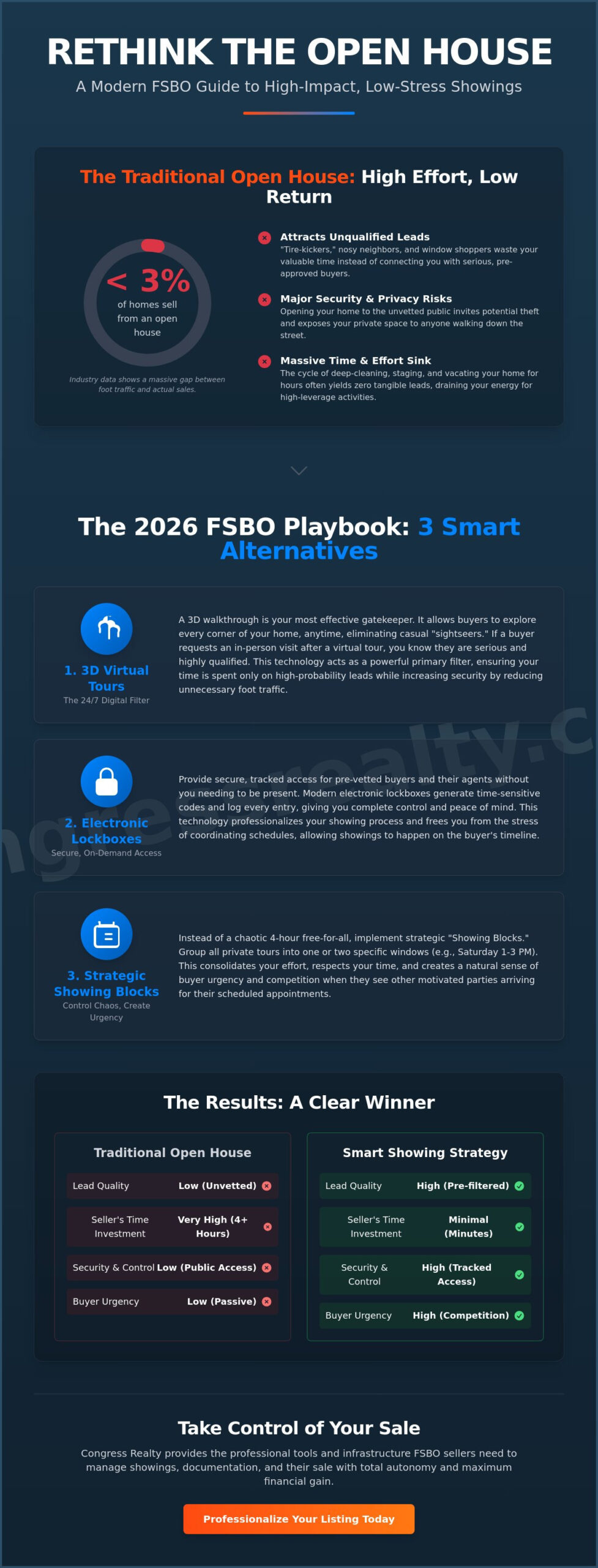
Is your Sunday afternoon really worth three hours of strangers wandering through your bedrooms? Many sellers fall for the “Open House Myth,” believing that high foot traffic naturally leads to a faster sale. In reality, there’s a massive gap between a curious visitor and a qualified lead. When you manage a For Sale By Owner (FSBO) transaction, your time is your most valuable asset. Traditional open houses often turn into marketing theater for buyer’s agents rather than a sales tool for you. These agents frequently use your living room to collect contact information from unrepresented buyers, often redirecting them to other listings later that day. You’re essentially providing a free office for someone else’s lead generation.
Security and privacy risks also climb when you open your doors to the unfiltered public. Without a vetting process, you’re inviting anyone off the street into your private space. This lack of control is exactly why savvy sellers are shifting toward open house alternatives for fsbo. Instead of hoping for the best with a sign in the yard, you can implement strategies that ensure only serious, pre-approved buyers cross your threshold. Nosy neighbors and “tire-kickers” may enjoy the tour, but they rarely bring a signed contract to the table. They simply waste the time you could be spending with legitimate prospects.
The Statistics Behind the Sunday Ritual
Industry data consistently shows that less than 3% of homes actually sell as a direct result of an open house. By 2026, the psychological shift among serious buyers has become even more pronounced. Real buyers don’t want to shuffle through a crowded room; they prioritize private, scheduled tours where they can focus on the property’s details. The “looker” mindset is passive and social. The “ready-to-offer” mindset is targeted and efficient. Don’t let the noise of a busy Sunday fool you into thinking you’re making progress when the data suggests the opposite.
The Hidden Costs of Hosting
Hosting an event requires a massive time investment. You’ll spend days deep-cleaning, staging every corner, and then vacating your own home for four or more hours. This effort often results in zero tangible leads. There’s also a significant opportunity cost. Every hour spent managing a generic public event is an hour you aren’t available for high-leverage activities. Learning how to sell your house on your own means focusing on strategies that maximize equity, not just activity. Using smarter open house alternatives for fsbo allows you to maintain your lifestyle while your listing works for you in the background.
Virtual Tours and 3D Walkthroughs: The 24/7 Digital Open House
Stop thinking of virtual tours as optional extras. In 2026, a 3D walkthrough is your most effective gatekeeper. It allows a buyer to explore every corner of your home at 2 AM without you ever having to fluff a single pillow. This is one of the most powerful open house alternatives for fsbo because it eliminates “sightseers” who just want to peek inside your cabinets. If a buyer still wants a physical tour after virtually walking through the kitchen and master suite, you know they are serious and qualified. This technology acts as a primary filter, ensuring your time is only spent on high-probability leads.
A digital walkthrough builds a level of transparency that static photos simply can’t match. Buyers feel more confident when they can see the flow of the house for themselves. This trust is critical when you are managing the sale independently. While you’re reviewing real estate safety tips, remember that reducing the number of strangers in your home is the best way to stay secure. Digital tours ensure that the only people who enter your front door are those who already love the layout. You can explore our listing services to see how professional tools can streamline this process for you.
Professional Photography vs. Smartphone Snaps
Your first showing happens on a smartphone screen, not at the curb. Grainy, poorly lit photos taken on a phone can kill interest before a buyer even reads your description. Professional photography uses wide-angle lenses and high-dynamic-range processing to make spaces look bright and expansive. These high-quality visuals are a foundational part of professional flat fee mls listing packages. They drive higher click-through rates and ensure your home stands out against the competition in a digital-first market.
Implementing Interactive Floor Plans
Static images can be deceiving, but an interactive floor plan provides essential context. It helps buyers visualize where their sectional sofa will go or if the home office is far enough from the kitchen. By answering these logistical questions early, you reduce the time wasted on “discovery” during physical showings. These digital assets are essential for out-of-state buyers who may be ready to make a high-value offer without a weekend trip. Using these open house alternatives for fsbo positions you as a savvy seller who values efficiency and clear communication.
Electronic Lockboxes: Secure, On-Demand Showings Without the Hassle
Why disrupt your entire life for a single four-hour window when you can offer secure access every day of the week? Electronic lockboxes serve as the professional standard for modern property accessibility. Unlike the insecure “key under the mat” methods often discussed on community forums, these devices provide a high-tech gateway that you control entirely. Implementing this technology is one of the most effective open house alternatives for fsbo because it balances buyer convenience with seller security. You provide a professional experience that mirrors traditional brokerage models without the high commission costs.
Vetting and Verification Protocols
Don’t let just anyone walk through your front door. Before granting access, establish a strict protocol that requires a pre-approval letter or proof of funds. This simple step filters out casual browsers and ensures your time is reserved for serious contenders. When looking for open house alternatives for fsbo, vetting is your best defense against the security risks of public events. By using digital showing services, you can manage these requests and verify identities before a code is ever generated. An electronic lockbox records the specific identity and timing of every visitor, providing a digital audit trail that manual locks simply cannot offer. This data-driven approach gives you peace of mind while you’re away from the property.
The Freedom of Remote Access
Reclaim your schedule by eliminating the need to be present for every showing. Remote access means you don’t have to rush home from work or cancel your weekend plans for a last-minute tour request. The buyer’s agent can lead their clients through the home while you maintain your daily routine. This setup creates a streamlined, broker-like environment that buyers appreciate for its efficiency. It removes the awkwardness of the seller hovering in the kitchen, allowing buyers to speak freely about the home’s potential.
Ensure your showing instructions are properly integrated into your list of multiple listing services documentation. This clarity allows agents to book appointments seamlessly, maximizing the exposure of your home to the most motivated buyers in the market. By providing this professional infrastructure, you demonstrate that you’re a savvy seller who is serious about closing the deal on your own terms.
Strategic Showing Windows: Controlling the Chaos
Tired of having your dinner interrupted by a last-minute showing request? You don’t have to be at the beck and call of every buyer who passes by. Strategic showing windows allow you to regain control of your home and your schedule. By utilizing a “By Appointment Only” model, you immediately signal that your property is in high demand. This approach creates a sense of exclusivity that a wide-open public event simply cannot replicate. When buyers know they must qualify for a specific time slot, they treat the tour with more respect and urgency. These open house alternatives for fsbo turn the showing process into a professional operation that respects your boundaries.
One of the most effective open house alternatives for fsbo involves setting up “Showing Blocks.” Instead of scattering tours throughout the week, consolidate them into a specific two-hour window on a Saturday morning or a Tuesday evening. This concentration of activity makes the process much easier to manage. You only have to get the house “show-ready” once; you can vacate the property for a single, short period. Use automated scheduling tools to handle the logistics. These platforms prevent double-booking and ensure that tours don’t overlap, giving each buyer the space they need to fall in love with the home without feeling rushed.
If you encounter “drive-by” inquiries from people seeing your yard sign, don’t give out your personal phone number. Direct them to your online listing or the professional contact information provided by your service. This maintains your privacy and ensures that every lead is properly tracked and vetted before they ever step foot on your porch. You stay in command of the interaction from the very first point of contact.
Creating Competitive Pressure
Stacking your appointments back-to-back is a brilliant psychological move. When one buyer is leaving and another is pulling into the driveway, it creates immediate competitive pressure. They see firsthand that they aren’t the only ones interested. You can also host a “Broker Open,” which is a targeted event specifically for local buyer’s agents. This is far more effective than a public open house because it puts your home in front of the professionals who represent active, qualified buyers. Always ask for a “top 3” feedback list from every visitor. This data helps you adjust your strategy based on real market reactions and specific buyer concerns.
The “MLS Effect” on Showing Volume
You don’t need a crowd of neighbors to sell a house; you need the right buyers. Being on the MLS automatically pushes your home to thousands of agents and their clients. This digital reach replaces the need for traditional foot traffic marketing. An MLS listing generates significantly higher-quality leads because these buyers are already working with professionals and have been vetted. If you want to maximize this exposure, check out our guide on how to sell a house without a realtor for listing optimization tips. To start attracting serious offers without the stress, get your property listed on the MLS today.
How Congress Realty Professionalizes the FSBO Showing Process
Many sellers worry that by choosing an independent path, they sacrifice the professional image needed to attract high-value offers. This is a common misconception that traditional agencies want you to believe. In reality, you don’t need a high-commission agent to maintain a polished, authoritative presence in the market. Congress Realty provides the professional infrastructure and database access that were once exclusive to traditional firms. Our Standard and Full Service listing packages are designed to give you total control over your equity. By utilizing these open house alternatives for fsbo, you can focus on the financial intelligence of your sale rather than the logistical headache of hosting strangers.
Tools for the Modern Independent Seller
Establishing the right price is the first step in any successful showing strategy. We provide a Comparative Market Analysis (CMA) to ensure your home is positioned for immediate interest from the moment it hits the MLS. Having a designated broker oversee your professional listing ensures that your data is accurate and compliant with local regulations. This oversight effectively eliminates the objection that independent sellers lack “professional polish.” You get the credibility of a professional listing service while maintaining the autonomy to lead the process. Our “Equity-First” philosophy ensures you achieve professional results without the 3% listing commission eating into your hard-earned profit.
Vetting buyers is a critical part of the process that many sellers find daunting. Our Transaction Management services help bridge this gap by providing a framework to verify that a buyer is actually capable of closing. When you combine this level of vetting with the high-resolution Professional Photography and Electronic Lockbox included in our packages, you’re not just selling a house; you’re managing a sophisticated business transaction. These tools work together to filter out the noise and prioritize serious, qualified leads.
Taking the Next Step Toward a Secure Sale
It’s time to stop letting the traditional industry models dictate how you sell your property. You don’t need to endure weekend stress or security risks to find the right buyer. Bypass the outdated open house ritual and use the professional showing tools that modern buyers actually prefer. Getting started is simple, predictable, and highly rewarding. Choose a tiered listing package that fits your needs and start your journey toward a secure, high-equity sale today. View our Flat Fee MLS Listing Packages to see how we empower you to lead the process with total confidence and professional support.
Take Command of Your Home Sale Today
Selling your home on your own terms is no longer a matter of trial and error. You’ve seen how digital gatekeepers like 3D walkthroughs and strategic showing blocks can eliminate the chaos of unvetted visitors. By implementing these open house alternatives for fsbo, you transition from a passive host to a savvy transaction manager. You don’t have to sacrifice your weekends or your security to find the right buyer. The modern real estate landscape favors efficiency and transparency over outdated rituals. You’ve learned that professional infrastructure, not foot traffic, is the true engine of a successful sale.
It’s time to leverage the same tools the professionals use while keeping your hard-earned equity for yourself. You can secure nationwide MLS exposure and professional electronic lockboxes included in your package without ever paying a 3% listing commission. This pragmatic approach puts you in the driver’s seat of your financial future. Maximize your equity with a professional Flat Fee MLS listing today. You have the expertise and the technology to close this deal with confidence and ease. Your successful sale starts with one smart decision.
Frequently Asked Questions
Is an open house necessary to sell a house FSBO in 2026?
No, an open house isn’t required to secure a high-value offer. In fact, industry data shows that less than 3% of homes sell as a direct result of these events. Most serious buyers prioritize private, scheduled tours that allow for a detailed evaluation of the property. Focus your energy on open house alternatives for fsbo like 3D virtual tours and professional MLS exposure to reach motivated buyers who are ready to act.
How do I vet buyers before letting them into my home for a private showing?
Always require a pre-approval letter or proof of funds before you confirm a showing appointment. This simple step is your most effective tool for filtering out “tire-kickers” and ensuring your time is only spent with qualified leads. If a buyer is working with an agent, you can also verify the agent’s credentials through local professional databases. This protocol maintains your security and keeps the focus on serious financial contenders.
What is the most secure way to allow showings when I am not home?
Utilizing a professional electronic lockbox is the most secure method for managing remote showings. These devices allow you to grant tracked access to licensed buyer agents while you’re at work or away for the weekend. Unlike manual combination locks, an electronic system creates a digital audit trail of every person who enters your home. This technology provides the professional infrastructure needed to manage the sale autonomously without sacrificing your peace of mind.
Do buyers agents prefer open houses or private showings?
Most professional buyer agents prefer private showings because they offer a controlled environment to discuss the property’s merits with their clients. Private tours eliminate the distractions of a crowded open house and allow agents to provide focused feedback. By making your home accessible via a lockbox and a professional scheduling service, you make it easier for agents to bring their highly motivated clients through your door on their own schedule.
How can I make my home stand out online without a public open house?
Invest in high-resolution professional photography and interactive 3D walkthroughs to capture a buyer’s interest immediately. Since the first showing always happens on a smartphone screen, your digital presentation must be flawless. Combine these visuals with a keyword-optimized listing on the MLS to ensure your property stands out in professional databases. This digital-first strategy generates more high-quality inquiries than a traditional yard sign or a public event ever could.
What should I do if a buyer shows up at my door without an appointment?
Politely decline the request and direct the visitor to your online listing to book a formal appointment. Never allow an unvetted stranger into your home on a whim, as this bypasses your security protocols. Explain that for safety reasons and to ensure they have your full attention, all tours must be scheduled in advance with a pre-approval letter. This maintains your professional boundaries and ensures you only interact with serious prospects.
Are virtual tours worth the investment for a FSBO listing?
Yes, virtual tours are one of the most cost-effective open house alternatives for fsbo because they act as a 24/7 digital filter. They allow buyers to explore the layout and flow of your home from their own devices, which significantly reduces the number of low-intent physical tours. By the time a buyer requests an in-person showing, they’ve already “walked” the house and are much closer to making a formal offer on the property.
How does an electronic lockbox differ from a standard combination lockbox?
An electronic lockbox provides a level of security and accountability that standard combination locks simply can’t match. Standard boxes use static codes that are easily shared or stolen, while electronic versions require digital keys or app-based authentication. These professional devices record the specific identity and timing of every visitor, providing you with a complete digital log. This ensures that only authorized professionals gain entry, keeping your property secure throughout the entire sales process.
Did you know that using a modern showing scheduler can reduce your back-and-forth emails by 70% and save you up to four hours of coordination every single week? Learning how to manage home showings fsbo doesn’t mean you have to act as a 24/7 receptionist for every “looky-loo” who finds your phone number. You want to sell your home on your own terms, but the thought of unqualified strangers wandering through your living room is understandably stressful. You deserve a process that protects your time and your property security without the high cost of a traditional agent.
This guide will show you how to build a professional gatekeeper system that automates your calendar, vets every visitor for pre-approval, and maintains the high standards of a top-tier brokerage. We will walk through the essential tools and 2026 legal updates, such as mandatory Fair Housing disclosures and new proof of funds requirements, to ensure your transaction is both secure and compliant. You are about to transform your showing process into a streamlined, “broker-like” experience that puts you firmly in control of your sale.
Key Takeaways
Adopt the mindset of a professional facilitator rather than a host to keep your interactions objective and focused on the transaction.
Master how to manage home showings fsbo by implementing a strict vetting system that requires a pre-approval letter or proof of funds before any door is opened.
Prepare your property for maximum impact by focusing on de-cluttering and sensory staging to appeal to the psychological triggers of the modern buyer.
Secure your home with an electronic lockbox to provide a digital paper trail of exactly who entered your property and at what time.
Streamline your workflow by using professional infrastructure like yard signs and MLS-integrated tools to automate showing requests and feedback.
Selling your home independently requires a fundamental mental shift. Most sellers mistakenly believe they need to be a “host,” greeting guests with small talk and a guided tour of every closet. In reality, a successful For Sale By Owner (FSBO) transaction requires you to be a facilitator. You are managing a high-value asset exchange, not a social gathering. This distinction is vital when learning how to manage home showings fsbo effectively. You want to provide professional access while maintaining a objective, business-like distance that allows buyers to envision themselves in the space.
Traditional agents often push for open houses because they are excellent for picking up new buyer clients, but for the seller, they often result in “looky-loos” rather than serious offers. Focus your energy on private, vetted showings instead. This “equity-first” approach ensures every minute you spend on a showing is a minute spent with a qualified prospect. You aren’t just opening your door; you are guarding your time and your home’s security.
Traditional agent-led showings often feel like a black box. You leave your house, an agent brings a stranger in, and you wait days for a filtered report. The modern, tech-enabled way to manage home showings fsbo is different. You use professional tools like electronic lockboxes to track entry and automated systems to gather feedback. This professional infrastructure replaces the need for a high-commission middleman while providing better security and faster results.
Why Control is Your Greatest Asset
When you understand how to sell your house on your own, you realize that control is your biggest advantage. You aren’t relying on a third party to relay messages or screen callers. You know exactly who is in your home and when. By handling the process yourself with the right professional tools, you shorten the feedback loop. You get direct answers from buyers and their agents immediately. This transparency allows you to adjust your strategy in real-time, keeping your equity where it belongs.
Setting Your Showing Hours
Maintaining your sanity is just as important as maintaining your home’s cleanliness. Set a specific “showing window” that works for your schedule. Don’t feel obligated to drop everything for a last-minute request. A professional, 24-hour notice rule is standard in the industry and keeps your home in peak condition for every visitor. If someone asks for a short-notice tour, politely inform them that the property is currently being prepared and offer the next available slot in your window.
Establish clear start and end times for daily showings.
Require at least 24 hours of lead time to ensure the home is staged.
Use a digital calendar to track appointments and avoid double-booking.
Politely decline “drive-by” requests to maintain a professional standard.
Vetting Buyers: The Gatekeeper Framework
Professionalism starts at the first point of contact. When you learn how to manage home showings fsbo, you quickly realize that your front door isn’t a revolving entrance for everyone with an internet connection. You need a gatekeeper framework. This systematic approach ensures that only serious, financially capable individuals step foot on your property. The golden rule is simple: if they haven’t provided a pre-approval letter or proof of funds, they don’t get a time slot. This isn’t about being difficult. It’s about protecting your equity and your personal safety.
Follow this four-step sequence for every inquiry to maintain total control over the process:
Initial Phone Screening: Ask about their desired closing date and if they have a home to sell first. This quickly reveals their level of motivation and urgency.
Document Request: Ask the buyer or their agent to email the pre-approval letter before you confirm a time. Professional buyers expect this request and will have the PDF ready to send.
Verification: If an agent is involved, look up their name on your state’s licensing board website. Ensure they are active and associated with the brokerage they claim to represent.
Formal Confirmation: Once the paperwork is in hand, send a calendar invite or a professional text. This creates a digital paper trail for the appointment.
Research indicates that automated reminders and structured scheduling can decrease “no-show” appointments by 70%. By implementing this framework, you save an average of two to four hours per week in coordination time that would otherwise be wasted on unqualified leads.
Handling Buyers Agents vs. Unrepresented Buyers
Buyers agents carry professional liability insurance and are governed by strict state regulations. This makes them lower-risk visitors. Always ask for their brokerage details and cell phone number before confirming. Unrepresented buyers, however, require more diligence. These “looky-loos” often haven’t spoken to a lender yet. Politely explain that for security and efficiency, you only show the home to mortgage-ready prospects. If they’re truly serious about your home, they’ll appreciate your professional standards and provide the letter.
Automation Tools for Scheduling
Don’t waste hours on back-and-forth texting. Use a scheduling link like Calendly to let buyers pick from your pre-set windows. You can even include these instructions directly in your flat fee mls listing. When agents see a clear, automated process, they treat you like a fellow professional rather than an amateur. To really elevate your game and ensure total security, consider adding an electronic lockbox to your listing package. This allows for secure, tracked access and provides you with a log of exactly who entered your home and at what time.
Staging and Preparation for Maximum Impact
Once you’ve vetted your prospects using the gatekeeper framework, the physical presentation of your home must seal the deal. Learning how to manage home showings fsbo effectively requires an objective eye for detail. You aren’t just cleaning a house; you’re preparing a product for a high-value transaction. In 2026, the gold standard for a successful sale remains the “De-clutter, De-personalize, Deep Clean” mantra. This means removing family photos, clearing every countertop, and ensuring the property feels like a neutral canvas. Buyers need to see their own future in your space, not your past.
Sensory psychology plays a massive role in buyer behavior. The “smell of the home” is often the first thing a visitor notices. Avoid heavy air fresheners or candles that suggest you’re hiding a problem. Instead, focus on deep cleaning and proper ventilation. Before the doorbell rings, light every corner of the house. Open the curtains to let in natural light and adjust the thermostat to a comfortable 70 degrees. A property that feels stuffy or dark creates an immediate, subconscious barrier for the buyer. You want them to feel at ease the moment they step inside.
Leave a professional “Property Highlight Sheet” on the kitchen counter for every visitor. This simple document should list recent upgrades, average utility costs, and neighborhood perks. It gives the buyer something tangible to take home and review. It also serves as a silent salesperson, highlighting the value of the property while you maintain your professional distance as a facilitator.
The Role of Professional Photography
Your “first showing” actually happens on a screen. If your listing photos are dark, grainy, or cluttered, serious buyers will scroll past your property before ever requesting a tour. High-quality visuals are the cornerstone of any successful flat fee mls listing service. We offer professional photography because we know that premium images attract premium buyers. When your online presence is polished, you’re already halfway to a successful showing.
The “Five-Minute Dash” Checklist
Keep a “Five-Minute Dash” checklist ready for every appointment. Turn on all lights, even in the closets. Ensure all toilet lids are down and sinks are dry. If you have pets or children, they should be out of the house during the showing window to allow the buyer to focus entirely on the property. Most importantly, safeguard your valuables. Lock away jewelry, small electronics, and prescription medications in a secure safe or take them with you. Maintaining security is a key part of being a smart, independent seller.
Clear all surfaces of personal items and mail.
Open all interior doors to create a sense of flow.
Check the entryway for stray shoes or coats.
Empty all trash cans and hide pet bowls.
Access and Security: The Electronic Lockbox Advantage
Security is often the primary source of anxiety for independent sellers. You want to know exactly who is entering your property, but you can’t always be there to check IDs at the door. This is why professional-grade technology is the cornerstone of how to manage home showings fsbo safely. Electronic lockboxes are the industry gold standard for a reason. They provide a secure, encrypted way for authorized parties to access your home while giving you a digital footprint of every single visit. You aren’t just giving out a key; you’re managing a sophisticated access control system.
Modern electronic systems distinguish between one-time access codes for specific buyers and agent-specific credentials. When a licensed agent uses their digital key, the system records their identity, the brokerage they represent, and the exact time of entry and exit. This level of accountability is essential for your peace of mind and property protection. If you ever need to be present for a showing, follow a strict safety protocol: never show your home alone. Have a friend, neighbor, or family member stay with you to maintain a professional and secure environment throughout the walkthrough.
By using professional access tools, you also streamline the process for buyers’ agents. They are accustomed to these systems and appreciate the ease of entry. This professional infrastructure removes friction from the showing process, making it more likely that agents will show your home to their clients. It shows that you value their time and are prepared to handle the transaction like a seasoned pro.
Why Mechanical Lockboxes are a Risk
Many sellers try to save a few dollars with a basic combination lock from a hardware store. This is a significant security oversight. Mechanical lockboxes lack an “audit trail,” meaning you have no way of knowing if the code was shared with unauthorized parties or if the box was left open after a visit. Once a code is out, it’s out. In contrast, professional-grade tech signals to buyers and agents that you are a serious, savvy seller who values security. It immediately elevates the perceived value of your listing and protects your equity from the risks of untracked access.
Vetting the Showing Agent
If you choose to greet the showing agent, don’t be afraid to ask for their professional identification upon arrival. A quick check of their real estate license ensures you’re dealing with a verified professional. Once the showing is over, use your electronic logs to follow up for feedback immediately. Because you know exactly when they left, you can send a feedback request while the property is still fresh in their mind. This data is invaluable for making pricing or staging adjustments. Finally, always double-check that every door and window is secured after every visit, regardless of who was in the home.
Mastering how to manage home showings fsbo is much simpler when you have a professional infrastructure backing your every move. Congress Realty provides the essential tools to automate your workflow, from high-visibility yard signs to secure electronic lockboxes. You aren’t just listing a property; you’re launching a professional sales operation. By appearing on the comprehensive list of multiple listing services, your home becomes visible to every local buyer’s agent. This visibility triggers a streamlined flow of showing requests directly to your phone or inbox. You maintain 100% control over who enters your home while saving the traditional 3% listing commission. This is the ultimate expression of financial intelligence in today’s real estate market.
Our system is designed to remove the friction points that often trip up independent sellers. When an agent sees a Congress Realty sign and a professional lockbox, they know they’re dealing with a seller who values efficiency. This professional parity ensures your listing is treated with the same respect as any traditional brokerage entry. You get the exposure of the big databases without the high-cost middleman eating into your hard-earned equity.
From Showing to Closing
Once the showings begin, your focus shifts to data analysis. Every visitor provides a valuable data point. If multiple buyers mention the same concern, you have the autonomy to react immediately. Use your Comparative Market Analysis (CMA) to defend your asking price during these interactions. When you hold a professional CMA, you aren’t just guessing at your home’s value; you’re presenting documented facts. This positions you as a savvy negotiator who understands the local market dynamics. When a showing turns into a written offer, our Transaction Management service can step in to handle the complex paperwork, ensuring a smooth and legally sound path to the closing table.
Next Steps for Your FSBO Journey
You are now in the driver’s seat of your home’s equity. You’ve learned how to manage home showings fsbo by vetting buyers, staging for maximum sensory impact, and securing your property with professional-grade technology. The path to a successful sale is clear. It’s time to put this knowledge into action and stop leaving money on the table. Select a listing package that includes an electronic lockbox to maximize your security and professional appeal to agents. You have the tools, the data, and the strategy. Start your listing process today and take full command of your financial future.
Choose a package that includes professional photography to win the “first showing” online.
Install your yard sign and electronic lockbox as soon as they arrive.
Set your showing windows and stick to your vetting framework.
Review your CMA weekly to stay aligned with market trends.
Take Command of Your Equity and Your Schedule
Success in the independent market is about replacing guesswork with professional systems. By shifting your mindset from host to facilitator and implementing a strict gatekeeper framework, you ensure that only the most qualified buyers cross your threshold. You now have the tactical knowledge of how to manage home showings fsbo with the same security and precision as a top-tier brokerage. Protecting your time and your property isn’t just possible; it’s simple when you use the right tools.
You don’t need to sacrifice 3% of your home’s value to get professional results. Our Full Service packages include professional electronic lockboxes to track every entry and expert Transaction Management support to guide you from the first showing to the final signature. You’re the expert of your own home, and we provide the infrastructure to help you prove it. Stop letting high commissions eat into your financial future and start showing your home on your own terms.
Do I have to be present during home showings as a FSBO seller?
No, you should actually avoid being present if possible. Buyers often feel pressured or uncomfortable exploring a home when the owner is watching. It’s best to use an electronic lockbox to grant secure access to licensed agents while you’re away. This creates a professional environment where the buyer can speak freely with their agent and envision themselves living in the space.
How do I handle a buyers agent who asks for a commission?
State your commission policy clearly during the initial vetting call. While you’re skipping the 3% listing commission, most independent sellers still offer a commission to the buyer’s agent to ensure maximum MLS exposure. Document this agreement in writing before the showing occurs. This transparency prevents awkward negotiations later and ensures agents feel motivated to show your property to their qualified clients.
What should I do if a buyer shows up without an appointment?
Politely decline entry and direct them to your official scheduling process. Explain that for security reasons and to maintain the property’s condition, you only show the home to pre-approved buyers with a confirmed time slot. Hand them a property highlight sheet and ask them to email their pre-approval letter. This maintains your professional boundaries and ensures you aren’t wasting time on unvetted “drive-by” visitors.
Is it safe to let strangers into my home for a showing?
Safety is a result of your vetting process and the tools you use. Never grant access to anyone who hasn’t provided a pre-approval letter and verified identification. Using an electronic lockbox is the best way to manage home showings fsbo because it creates a digital audit trail of everyone who enters. If you must be home, ensure a friend or family member is there with you.
How many showings should I expect before I get an offer?
Market conditions vary, but many sellers receive a serious offer within 10 to 15 qualified showings. If you surpass 20 showings without an offer, it’s a signal to review your price or property condition. Use a Comparative Market Analysis (CMA) to ensure your asking price stays competitive. High showing volume without offers usually means the market likes the house but finds the price slightly too high.
Should I provide refreshments or snacks during a showing?
Skip the refreshments and focus entirely on the property’s presentation. Snacks can create trash, lingering odors, or potential allergy issues for visitors. Your role is a facilitator of a business transaction, not a social host. Focus your energy on lighting, temperature control, and deep cleaning. A neutral, sparkling clean environment is far more persuasive to a buyer than a plate of cookies.
How do I get feedback from buyers after they leave?
Send a professional feedback request to the buyer’s agent within 24 hours of the appointment. Ask specific questions about the home’s price, its condition compared to others they’ve seen, and the buyer’s level of interest. This data is vital for learning how to manage home showings fsbo effectively. Consistent feedback helps you identify if there are small, fixable issues that are preventing buyers from making an offer.
What is the best way to decline a showing request from an unqualified buyer?
Be direct and professional by citing your security protocol. Tell the caller that you’ve established a policy to only show the home to buyers who have submitted a pre-approval letter or proof of funds. Explain that this protects your time and ensures the home stays in peak condition for serious prospects. Most motivated buyers will respect your professional standards and provide the necessary documentation immediately.
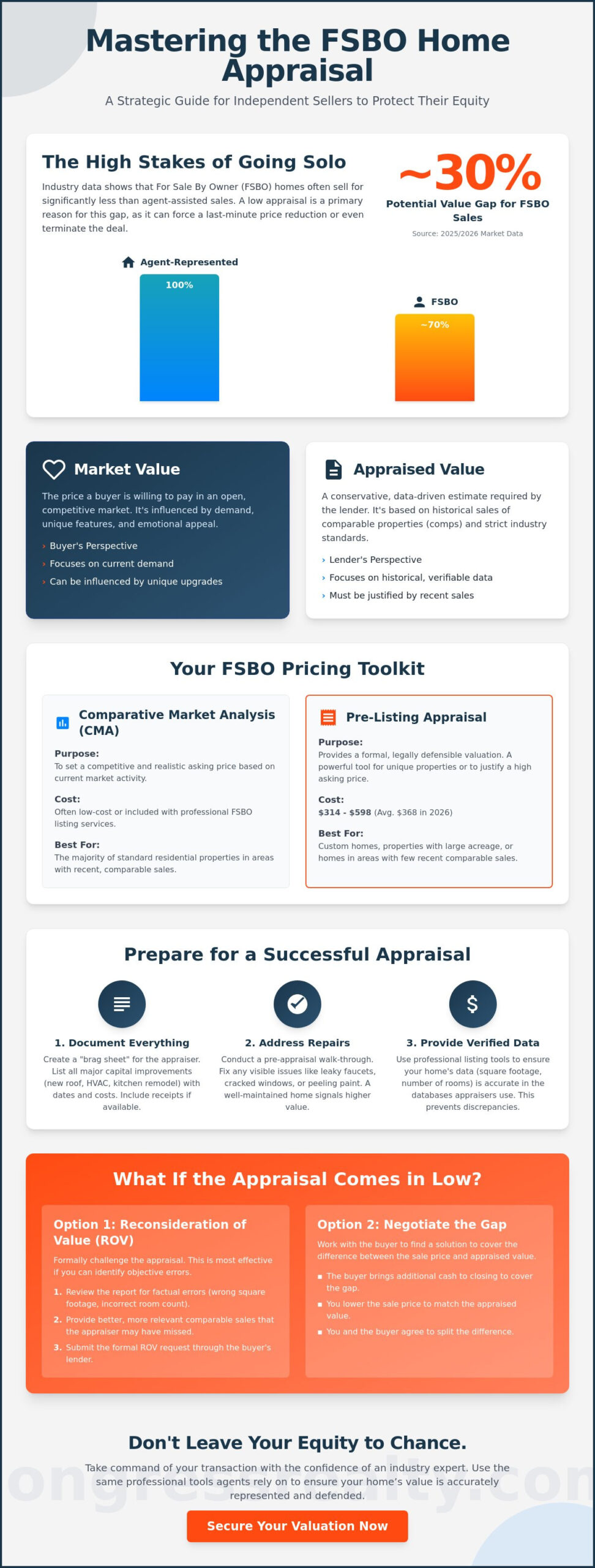
Did you know that in 2026, FSBO homes are reported to sell for about 30% less than those with agent representation? This staggering price gap often comes down to a single, high-stakes moment: the appraisal. It is the point where many independent deals falter because sellers feel unprepared to defend their valuation against a professional’s report. If you are worried that a low appraisal might sink your sale or force a painful price cut, you aren’t alone.
We understand that managing the fsbo home appraisal process solo can feel like a gamble when your equity is on the line. You deserve the same level of data and documentation that traditional agents use to protect their listings. This guide will show you exactly how to navigate the appraisal hurdle, from understanding the difference between a CMA and a formal valuation to preparing professional-grade records that help the appraiser see your home’s true worth. You’ll learn how to master the new UAD 3.6 reporting standards and secure a successful closing at the price you earned. It is time to take command of your transaction with the confidence of an industry expert.
Key Takeaways
Distinguish between a Comparative Market Analysis (CMA) used for setting your price and a formal appraisal required for buyer financing.
Prepare for the appraiser’s visit by documenting major capital improvements and conducting a proactive walk-through to address visible repairs.
Navigate the fsbo home appraisal process with confidence by learning how to provide appraisers with verified data that supports your asking price.
Understand your options for managing a low appraisal, including the specific steps for a Reconsideration of Value or negotiating price gap coverage.
Protect your equity by using professional listing tools that ensure your home’s data is accurately recorded in the databases appraisers trust most.
Navigating the FSBO Home Appraisal Process: Why It Matters for Your Sale
A home appraisal is a professional, unbiased estimate of your property’s value. Think of it as the silent partner in your transaction. While you and your buyer have agreed on a price, the lender won’t release the funds until a licensed professional confirms the asset is worth the investment. This step is where many independent sellers feel the most pressure. In the fsbo home appraisal process, you don’t have a listing agent to run interference or hand over a folder of comps. You are the primary advocate for your home’s value.
The appraisal directly impacts the buyer’s Loan-to-Value (LTV) ratio. If the house appraises for less than the contract price, the lender will only cover a percentage of that lower value. This creates a valuation gap that the buyer must pay in cash, or you must lower your price to close the deal. Managing this risk is a core part of learning how to sell your house on your own successfully. Since 2025 data shows FSBO homes often sell for 30% less than agent-assisted sales, protecting your agreed-upon price is vital for your bottom line.
The Difference Between Market Value and Appraised Value
Market value is the price a buyer is willing to pay in an open, competitive environment. Appraised value is a more conservative figure based on historical data and strict Real estate appraisal process standards. In a fast-moving 2026 market, these two numbers often diverge. Buyers might be eager to pay a premium for your unique upgrades, but appraisers look for settled sales from the last few months to justify the risk to the bank. They focus on what has already happened, not the potential of what might happen next.
Why the Lender’s Appraisal is the Ultimate Hurdle
It is a common misconception that the appraisal belongs to the buyer because they paid for it. In reality, the lender owns the process. Federal regulations mandate a firewall between the loan officers and the appraisers to prevent conflicts of interest. This is typically handled by an Appraisal Management Company (AMC). The AMC selects the appraiser, ensuring they are an independent third party who follows the Uniform Standards of Professional Appraisal Practice (USPAP). For a FSBO seller, this means you must be ready with professional-grade documentation the moment they walk through your door. You only get one chance to make a first impression on the person who holds the keys to your closing.
Pre-Listing Appraisal vs. Comparative Market Analysis (CMA)
How do you determine the right number for your home? In the fsbo home appraisal process, pricing is your most powerful tool. You have two primary options: the Comparative Market Analysis (CMA) and a formal pre-listing appraisal. While both help you understand your home’s value, they serve different strategic purposes. A CMA is an informal estimate based on market trends, while an appraisal is a legally recognized valuation performed by a state-licensed professional.
Cost is a major factor for independent sellers. A CMA is often included as a low-cost feature of a professional listing service. In contrast, a professional appraisal in 2026 averages $368, with a typical range between $314 and $554. For a standard single-family home, you might pay up to $598. It’s vital to remember that a pre-listing appraisal is for your benefit only. It does not replace the buyer’s lender-mandated appraisal. The bank will still hire their own independent appraiser to secure the loan.
When to Invest in a Professional Pre-Listing Appraisal
Most sellers don’t need a pre-listing appraisal, but certain “red flag” properties make it a smart investment. If your home is a unique custom build, sits on massive acreage, or is located in an area with very few recent sales, a professional valuation provides a solid baseline. It acts as a powerful marketing tool for FSBOs. By showing a signed appraisal to prospective buyers, you set a firm “ceiling” for negotiations. This prevents buyers from lowballing you and gives you a professional-grade defense for your asking price.
Leveraging a CMA to Set a Realistic Asking Price
For the majority of residential sales, a high-quality Comparative Market Analysis (CMA) is the most efficient way to start. A CMA focuses on “solds” and “actives” to gauge what buyers are actually paying right now. Don’t fall into the trap of relying on automated valuation models (AVMs). These algorithms often miss the value of your recent kitchen remodel or the impact of a quiet cul-de-sac. Using professional brokerage tools allows you to access the same data points that agents use, ensuring your price is competitive from day one. It gives you the confidence to lead the transaction without overpaying for unnecessary reports.
How to Prepare Your Home for the Appraiser’s Visit
The physical inspection is a high-stakes moment in the fsbo home appraisal process. While many sellers spend hours deep cleaning or landscaping, professional appraisers focus on structural integrity, safety, and data-backed improvements rather than your decor. To ensure you receive a fair valuation, you must treat this visit with professional rigor. Follow these four pragmatic steps to prepare your property for the inspection.
Step 1: Conduct a “pre-appraisal” walk-through. Identify and fix visible minor repairs like leaky faucets, peeling paint, or cracked window panes. These small issues can lead an appraiser to assume the home hasn’t been well-maintained.
Step 2: Gather receipts for all major capital improvements. Focus on high-impact projects from the last 5-10 years. Documentation proves the value of upgrades that aren’t immediately visible.
Step 3: Ensure all utilities are functional. The appraiser must test your appliances, HVAC, and water systems. If the utilities are off, you may face a re-inspection fee, which typically ranges from $100 to $250. Don’t forget to test your smoke and carbon monoxide detectors as well.
Step 4: Create the “Appraiser’s Package.” This is a professional folder you will hand to the appraiser upon arrival to provide them with the best possible data for their report.
Documenting Upgrades and Major Systems
Appraisers use specific forms that prioritize the age and condition of your home’s major systems. Create a clear “Improvements List” that highlights high-value items like the age of the roof, the SEER rating of your HVAC unit, and the date of any kitchen or bath remodels. For maximum impact, format this list with the project name, the year completed, and the approximate cost. If you’ve done hidden renovations, such as upgraded electrical wiring or new attic insulation, provide “before and after” photos. This transparency helps the appraiser justify a higher condition rating in their final report.
The Appraiser’s Package: Your Secret Weapon
Since you don’t have a traditional agent to represent you, the “Appraiser’s Package” is your voice. Include a copy of the executed sales contract, your most recent Comparative Market Analysis (CMA), and your detailed list of improvements. A critical addition is the “Comps Sheet.” This is a list of 3-5 local sales that most closely resemble your home. By providing the appraiser with verified data on nearby sales, you help them find the most accurate benchmarks for your property. When the appraiser arrives, be polite and helpful, but give them space to work. Answer their questions directly without being “pushy” or hovering, which allows them to complete their task efficiently while respecting their professional independence.
Managing a Low Appraisal: Strategies for Independent Sellers
What happens when the appraisal report arrives with a number lower than your contract price? This scenario, known as a low appraisal, is a common hurdle in the fsbo home appraisal process. It doesn’t mean your deal is over. As an independent seller, you must step into the role of transaction manager to protect your equity. Stay calm and keep your focus on the data. You have three primary paths: challenge the report, negotiate the price gap, or cancel the contract and find a new buyer.
Challenging the Appraisal with Better Comparables
Appraisers are professionals, but they aren’t infallible. If you spot a factual error, such as incorrect square footage or the wrong number of bedrooms, you have grounds for a Reconsideration of Value (ROV). Review the report line by line. Did they miss the high-value sale that closed last week just two doors down? Use the professional tools from your Transaction Management service to pull a fresh set of comparables. When you contact the lender, present your findings in a concise, non-emotional letter. Highlight the specific data points that justify a higher valuation and ask for a formal review.
Negotiating the Price Gap with the Buyer
If the lender refuses to budge on the valuation, the ball moves to the negotiation table. Most buyers use an appraisal contingency to protect their earnest money. This gives them the right to walk away, but most still want your home. Ask the buyer to bridge the gap with additional cash. Since the lender will only loan based on the appraised value, the buyer must cover the difference out of pocket. You might offer to meet them in the middle to keep the momentum going. If the gap is too large and the buyer is unwilling to negotiate, remember that you are in control. You can choose to put the home back on the market and wait for a buyer with a different lender or a larger down payment. Your equity is worth the effort of finding the right partner for the sale.
Securing Your Equity with Professional Listing Tools
Appraisers don’t rely on public search portals for their final reports. They use the Multiple Listing Service (MLS) because it provides verified, historical data that isn’t available elsewhere. When you manage the fsbo home appraisal process, having your property listed on the MLS ensures that the appraiser sees a professional record of your home’s features and transaction history. This level of accuracy prevents common data errors that could lead to a low valuation. By using professional tools, you bridge the gap between independent selling and the rigorous standards of the appraisal industry.
The most significant advantage of this approach is the financial gain. Traditional models often demand a 3% listing commission just to get your home on the right databases. By choosing a professional flat-fee model, you maintain your equity while accessing the same infrastructure used by high-priced agents. You keep control of your money and your transaction, ensuring that every dollar of your home’s appraised value stays in your pocket.
How MLS Listing Enhances Appraisal Accuracy
An appraiser’s job is to find the most accurate “comps,” and they prioritize properties with detailed MLS histories. They look specifically for “days on market” and “seller concessions” to determine if a sale price was inflated. If your home isn’t in the MLS, the appraiser might struggle to verify your data, leading them to use less favorable comparisons. Professional photography also plays a vital role here. When an appraiser reviews the MLS listing, high-quality images influence their “Condition” rating of the property. You should use a flat fee mls listing to ensure your home has the professional visibility required to support a high valuation.
The Congress Realty Advantage: Professional Support Without the Fee
You don’t need to sacrifice professional quality to save on commission. A standard listing provides the essential infrastructure needed for a smooth appraisal, including placement in the databases appraisers trust most. Beyond the listing, our Transaction Management services help you navigate the complex hurdles of escrow and lender requirements. We provide the smart, utilitarian tools you need to lead the process yourself. Take control of your sale, protect your hard-earned equity, and close your deal with the confidence of an expert. The tools are ready; the next move is yours.
Take Command of Your Closing and Your Equity
Mastering the fsbo home appraisal process isn’t about luck; it’s about professional preparation and visibility. You now have the roadmap to prepare an unshakeable Appraiser’s Package and the strategies to negotiate a valuation gap with total confidence. By documenting your upgrades and leveraging verified market data, you ensure that your home’s true value is recognized by the lender and the buyer alike. Independent selling doesn’t mean being alone in the process. It means having the freedom to lead your own success.
Since 2002, we’ve empowered independent sellers to navigate these complex hurdles with national coverage and expert transaction management. We’ve saved our clients over $100M in commissions by replacing outdated, high-cost models with smart, flat-fee solutions. You don’t need a traditional agent to protect your equity. You just need the right professional infrastructure to back your decisions. List Your Home on the MLS for a Flat Fee and Save Thousands today. You’ve done the hard work of preparing your home for the market. Now, take control of the final steps and keep the equity you’ve earned. Success is within your reach.
Frequently Asked Questions
Who pays for the home appraisal in a FSBO sale?
The buyer typically pays the appraisal fee as part of their mortgage closing costs. While the lender orders the service to protect their investment, the buyer is responsible for the bill, which in 2026 averages $368. In some negotiations, a seller might offer to cover this cost as a concession, but it’s standard for the buyer to handle it as part of their loan application process.
Can I talk to the appraiser when they come to my house?
You are absolutely allowed to speak with the appraiser, but you must respect their professional independence. Use this time to hand over your prepared documentation, such as receipts for major system upgrades or a list of recent local sales. Avoid hovering or pressuring them to reach a specific number, as federal regulations require a firewall between the valuation and the parties involved in the transaction.
How long does the home appraisal process take in 2026?
The entire fsbo home appraisal process usually takes between seven and ten business days from the moment the lender orders the report. The physical inspection of your property is relatively quick, often lasting only 30 to 60 minutes. The remaining time is spent by the appraiser researching comparable sales and finalizing the report according to the new UAD 3.6 data standards required by November 2, 2026.
What happens if the appraisal comes in lower than my asking price?
A low appraisal creates a valuation gap that must be resolved before the lender will fund the loan. You can ask the buyer to cover the difference in cash, lower your sales price, or meet somewhere in the middle. If you believe the report contains factual errors, you can also work with the lender to request a formal Reconsideration of Value by providing updated data and better comparable sales.
Does a messy house affect the home appraisal value?
Cleanliness does not technically impact your home’s appraised value, as appraisers focus on the structure, fixtures, and permanent improvements. However, extreme clutter that prevents the appraiser from accessing the attic, crawlspace, or mechanical systems can hinder the process. A tidy home also creates a better impression of overall maintenance, which can subtly influence the “Condition” rating the appraiser assigns to the property in their final report.
Is a home inspection the same thing as a home appraisal?
A home inspection and an appraisal serve two completely different purposes in a real estate transaction. An inspector evaluates the physical condition and safety of the home’s systems to protect the buyer from hidden defects. An appraiser determines the fair market value of the property to protect the lender from over-leveraging the loan. You need both to reach a successful closing when the buyer is using traditional financing.
Can I use a pre-listing appraisal to prove my home’s value to a buyer?
A pre-listing appraisal is an excellent marketing tool that provides a professional baseline for your negotiations. While it won’t replace the lender’s mandatory appraisal, it gives you a legally recognized valuation to show prospective buyers. This is especially helpful for unique properties where a standard Comparative Market Analysis (CMA) might not capture the full complexity or the high-end upgrades of your specific home.
What are the most common things that fail a home appraisal?
Appraisals don’t fail in the traditional sense, but certain safety issues can trigger a “subject to repair” status. Common red flags include non-functional smoke detectors, peeling lead-based paint, or water heaters that aren’t properly strapped. If these items aren’t fixed, the appraiser must return for a re-inspection, which typically costs between $100 and $250. Address these small safety hazards before the visit to keep the fsbo home appraisal process moving smoothly.
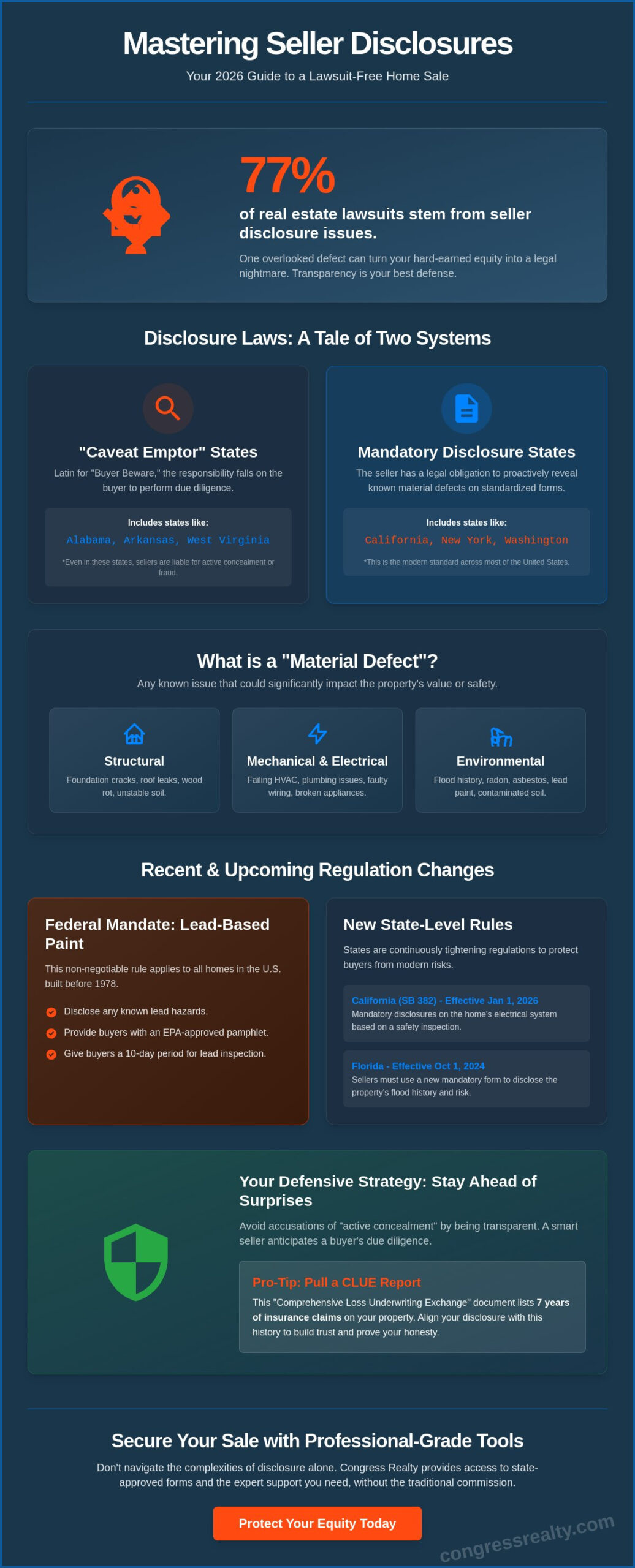
Did you know that 77% of real estate lawsuits stem from seller disclosure issues? It’s a staggering figure that shows how one overlooked defect can turn your hard-earned equity into a legal nightmare. When you’re managing your own sale, understanding the specific seller disclosure requirements by state is your best defense against post-sale litigation. You’ve worked hard to build value in your home. The last thing you want is a “hidden” problem surfacing months after the keys have changed hands. It’s completely normal to feel overwhelmed by conflicting state mandates or the mountain of paperwork required when you’re taking charge of the process yourself.
This guide empowers you to master the complex world of property disclosures so you can protect your financial interests and secure a clean sale. We’ll break down the latest 2026 mandates, from California’s new electrical safety rules to New York’s mandatory disclosure forms. You’ll gain the confidence to complete every document with professional precision. This ensures your transaction is successful, predictable, and free from any legal “hangover.”
Key Takeaways
Identify “material defects” that affect property value and safety so you can disclose known issues with complete accuracy.
Navigate the specific seller disclosure requirements by state to ensure you’re using the correct standardized forms for your local jurisdiction.
Master the strategic timeline for presenting disclosures to prospective buyers, effectively neutralizing the risk of post-sale lawsuits.
Learn how to avoid the “active concealment” trap by understanding your legal obligations versus a buyer’s duty to perform due diligence.
Secure your sale with professional infrastructure that provides access to state-approved documentation without the cost of a traditional agent.
The Landscape of Seller Disclosure Requirements by State
Selling your home is a significant financial milestone, but it comes with a heavy side of legal responsibility. Seller disclosure is your legal obligation to reveal known material defects to potential buyers. It’s not a suggestion. It’s a requirement designed to protect both the buyer’s safety and your financial equity. By providing a clear record of the property’s condition, you establish a transparent transaction that leaves no room for post-sale disputes. In the high-stakes market of 2026, transparency today is the only way to prevent expensive litigation tomorrow.
The legal framework has shifted away from the old days of “Buyer Beware.” Modern laws prioritize consumer protection, placing the burden of information on the person who knows the home best: you. This evolution ensures that buyers aren’t walking into a financial trap. Recent 2026 regulations have tightened these rules even further, specifically regarding environmental risks like flood history and climate-related hazards. Understanding the seller disclosure requirements by state is the first step in taking command of your sale and protecting your profit.
Caveat Emptor vs. Mandatory Disclosure States
While most of the country has moved toward full transparency, a few states still operate under “Caveat Emptor” or “Buyer Beware” principles. This list includes Alabama, Arkansas, and West Virginia. Virginia also follows this rule, though it requires a disclosure statement to prompt buyer due diligence. Don’t let these labels fool you. Fraud and active concealment are never protected. If you know about a major issue and take steps to hide it, you are still legally liable. Contrast this with “Full Disclosure” states like California or Washington, where you must proactively list every known defect on a standardized form before the contract is signed.
Federal Mandates: The Lead-Based Paint Exception
Federal law creates a baseline that every homeowner must follow, regardless of local rules. The 1992 Federal Lead-Based Paint Hazard Reduction Act is the most critical example. If your home was built before 1978, you must disclose any known lead-based paint hazards. This involves providing an EPA-approved pamphlet and a specific disclosure form. You must also give the buyer a 10-day period to conduct their own lead inspection. These federal seller disclosure requirements by state are non-negotiable and apply to every residential transaction in the country. Ignoring this step can lead to severe federal penalties and jeopardize your entire closing.
What Must Be Disclosed? Categorizing Material Defects
What exactly qualifies as a “material defect”? In the context of 2026 real estate, a material defect is any condition that significantly impacts the property’s value or the safety of its occupants. It’s the difference between a minor cosmetic scratch and a foundational crack that threatens the home’s integrity. Understanding seller disclosure requirements by state means recognizing that you aren’t just reporting what you’ve fixed. You’re reporting what you know is currently broken. A study by Cinch Home Services found that 95% of buyers find issues after closing, and if those issues were known but hidden, you’re looking at a potential lawsuit.
There’s a critical distinction between “known” defects and things a seller “should have known.” You can’t claim ignorance if a massive water stain is clearly visible on the ceiling. Courts often rule that if a reasonable person would have noticed the problem, the seller is liable for failing to disclose it. To protect yourself, consider pulling a CLUE (Comprehensive Loss Underwriting Exchange) report. This document lists seven years of insurance claims on your property. Buyers will likely see this report, so ensuring your disclosure matches the insurance history is a smart way to maintain your credibility and avoid the “active concealment” trap.
Structural, Mechanical, and Environmental Hazards
These are the heavy hitters of disclosure. You must report foundational shifts, roof leaks, and failing HVAC systems. Under California’s SB 382, effective January 1, 2026, sellers must now provide specific disclosures regarding the home’s electrical system based on a safety inspection. Environmental hazards are equally vital. Florida law now requires a mandatory flood disclosure form as of October 1, 2024, detailing any history of water damage. Whether it’s radon gas, asbestos, or contaminated soil, if it’s in the house, it needs to be on the paper. For those managing their own sale, using a flat fee MLS listing ensures you have access to the exact state-approved forms needed to document these hazards correctly.
Legal, Financial, and Neighborhood Encumbrances
Defects aren’t always physical. Legal issues like boundary disputes, unpermitted additions, or easement violations can tank a sale if discovered late. You’re also responsible for disclosing financial “surprises” like pending HOA assessments or ongoing litigation within your community. Don’t overlook neighborhood nuisances either. If your home is next to a site with extreme noise levels or industrial odors, many seller disclosure requirements by state mandate that you inform the buyer. Transparency here prevents the buyer from claiming they were misled about the “quiet enjoyment” of their new home.
Stigmatized Properties: Death, Crime, and Ghosts
Can a house be legally “haunted”? In 2026, the answer depends entirely on your zip code. Most states don’t require you to disclose a natural death on the property, but violent crimes are a different story. California’s AB 455 now even requires disclosing “thirdhand smoke” or nicotine residue. While psychological impacts like “ghosts” aren’t physical defects, if a house has a public reputation for being haunted, some jurisdictions suggest disclosing it to avoid a “misrepresentation” claim. When in doubt, disclosure is your best insurance policy.
State-by-State Disclosure Framework: A Comparative View
While every state requires some level of honesty, the actual paperwork varies wildly depending on your property’s location. We can categorize the seller disclosure requirements by state into three distinct levels of burden: high, moderate, and low. High-burden states like California and Washington require exhaustive, multi-page checklists that leave nothing to chance. Moderate-burden states like Illinois or Florida mandate specific forms but allow for more seller discretion on minor issues. Finally, low-burden states still lean on “Caveat Emptor” principles, though even these are disappearing in favor of standardized consumer protection. Understanding exactly where your state falls is a non-negotiable step when learning how to sell your house on your own.
The most significant difference between these frameworks is the requirement for a “Standardized Form” versus a “Custom Statement.” In most jurisdictions, you cannot simply write a letter listing what is broken. You must use the state-approved document, such as the TREC Form OP-H in Texas or the PCDS in New York. Some high-burden states even require a Natural Hazard Disclosure (NHD) report. This is a third-party document that identifies if your home sits in a fire, flood, or seismic hazard zone. Without the correct form, your contract could be voidable, or worse, you could be liable for damages long after the sale is finalized.
Strict Disclosure States (The California Model)
California’s Transfer Disclosure Statement (TDS) remains the gold standard for strictness. As of January 1, 2026, this includes new mandates for electrical system safety inspections and “thirdhand smoke” residue disclosures. Texas follows a similar path, requiring the Seller’s Disclosure Notice to cover everything from structural integrity to the presence of an underground storage tank. These states see the highest rates of FSBO litigation because independent sellers often underestimate the level of detail required. Missing a single checkmark on these forms can provide a buyer with the legal leverage they need to sue for “active concealment.”
The ‘Caveat Emptor’ Holdouts: What You Still Must Say
Virginia and New York were once the kings of “Buyer Beware,” but the landscape has changed. In New York, the previous “Credit in Lieu of Disclosure” (where a seller could pay $500 to avoid the form) was eliminated on March 20, 2024. The Property Condition Disclosure Statement is now mandatory. Virginia remains a “Caveat Emptor” state, yet sellers must still provide a Residential Property Disclosure Statement that explicitly warns buyers to perform their own due diligence. Even if your state has low requirements, smart sellers provide full transparency anyway. It builds immediate buyer trust, reduces friction during the inspection period, and significantly speeds up the timeline of your mls sale.
The FSBO Disclosure Workflow: A Step-by-Step Strategy
Taking command of your home sale means becoming your own compliance officer. When you learn how to sell a house without a realtor, your biggest priority is meticulous record-keeping. You must establish a clear, timestamped paper trail for every document you provide. This isn’t just about following the seller disclosure requirements by state; it’s about building a defensive perimeter around your equity. If a buyer claims they weren’t informed about a leaky roof, your digital receipts will be your best evidence in court.
The “Active Concealment” trap is the most common pitfall for independent sellers. Active concealment happens when you take deliberate steps to hide a defect, such as painting over a water-damaged ceiling or placing furniture over a foundation crack. In the eyes of the law, this is fraud. If a new issue arises after you’ve already provided the initial disclosure, don’t ignore it. States like Illinois require you to supplement your disclosure in writing if you become aware of any errors or new defects before closing. Always err on the side of over-disclosure to maintain your legal protection.
Selling ‘As-Is’ vs. The Duty to Disclose
Many sellers mistakenly believe that listing a home “As-Is” provides a “get out of jail free” card for property defects. This is a dangerous myth. While an “As-Is” clause signals that you won’t pay for repairs or offer credits, it does not exempt you from seller disclosure requirements by state. In Florida, the landmark Johnson v. Davis ruling ensures that sellers must disclose any known facts that materially affect the value of the property, even in “As-Is” sales. Using “As-Is” as a shield for known fraud can lead to severe legal repercussions and a cancelled contract. “As-Is” is a pricing strategy, not a legal loophole.
Timing and Delivery: The Disclosure Deadline
When should you hand over the paperwork? Best practices suggest providing disclosures before a buyer even makes an offer. This proactive approach prevents “buyer’s remorse” cancellations during the inspection period. If you wait until after the contract is signed, you may trigger a “Right of Rescission.” In many jurisdictions, delivering disclosures late gives the buyer a legal “out,” allowing them to cancel the deal within three to five days for any reason. Use digital delivery platforms to ensure you have a verified, timestamped acknowledgment of receipt. To ensure you have all the professional infrastructure needed for a secure transaction, explore the transaction management services provided by Congress Realty.
Professional Support for the Independent Seller
Many traditional brokers want you to believe that real estate paperwork is a terrifying maze only they can navigate. They use this fear to justify a 3% commission that eats into your hard-earned equity. The truth is simpler. You can master the seller disclosure requirements by state by using the right professional infrastructure. Congress Realty acts as your smart, utilitarian ally. We provide the necessary tools and then step back to let you lead. You don’t need to pay for an agent’s luxury car lease to ensure your home sale is legally protected.
By utilizing a flat fee mls listing, you gain immediate access to the professional databases and state-approved forms that define a successful transaction. This approach replaces the high-cost industry model with a predictable, fixed-cost structure. You get the same legal security as a traditional listing but keep the financial rewards of your intelligence and autonomy. It’s about being in control without being alone.
Accessing State-Specific Forms and Disclosures
Our platform automates the complex task of document gathering. Instead of scouring government websites for the correct PDF, you receive the exact 2026 versions of state-mandated forms. This is critical because laws change rapidly. Whether you need the latest flood disclosure in Florida or the new electrical safety forms in California, we ensure you have the correct paperwork. Consulting our list of multiple listing services ensures your documentation meets local board standards. This parity with traditional providers guarantees that your FSBO sale is indistinguishable from a high-commission transaction in terms of professional quality.
Transaction Coordination: Your Final Safety Net
The final stage of any sale involves a mountain of signatures and strict escrow timelines. Our Transaction Management service acts as your professional safety net during this high-pressure period. A transaction manager reviews your entire file for missing initials or overlooked disclosures. This oversight is vital for preventing the 77% of real estate lawsuits that originate from disclosure errors. Professional oversight ensures you don’t leave yourself vulnerable to post-sale disputes.
Review all state-specific mandates for accuracy and completion.
Ensure all federal lead-based paint forms are correctly executed for pre-1978 homes.
Verify that all digital timestamps meet legal requirements for disclosure delivery.
Closing your sale should be a moment of celebration, not a source of anxiety. With professional oversight, you can finalize the deal knowing your equity is safe and your legal obligations are fulfilled. You’ve taken command of the process, saved thousands in commissions, and secured a clean sale with no legal “hangover.”
Secure Your Equity with Professional Disclosure Management
Mastering the seller disclosure requirements by state isn’t just about following the law; it’s about building a fortress around your financial future. You now know that an “As-Is” label isn’t a legal shield and that proactive transparency is your greatest asset. By using standardized 2026 forms and maintaining meticulous digital records, you eliminate the ambiguity that often leads to costly post-sale litigation. You’ve worked hard to build value in your home, and you deserve to keep every dollar of that equity through a clean, transparent transaction.
You don’t have to sacrifice a massive 3% commission to get professional results. With over 20 years of expertise, Congress Realty provides the exact same MLS databases used by traditional brokers. Our Full Service Listing even includes professional Transaction Management to ensure every signature is captured and every deadline is met. Take command of your sale today and move forward with the satisfaction of financial intelligence and the confidence of being in total control of your results.
Your obligation to disclose a death depends on your specific state laws and the circumstances of the passing. In California, you must disclose any death on the property that occurred within the last three years. However, most states don’t require disclosure for natural deaths or suicides unless a buyer specifically asks. Violent crimes or deaths related to the property’s condition are generally considered material facts that require transparency to avoid future liability.
What happens if I forget to disclose a major defect?
Forgetting a major defect doesn’t exempt you from legal liability or potential lawsuits for misrepresentation. If a buyer discovers a significant issue after closing, they may seek damages for repair costs and legal fees. Since 77% of real estate lawsuits involve disclosure issues, accuracy is your best defense. If you realize you missed something before the sale is finalized, provide a written amendment to the buyer immediately to maintain your legal protection.
Can a buyer sue me after the house is sold if they find a leak?
A buyer can sue you after the sale if they can prove you had prior knowledge of the leak and failed to report it. The burden of proof lies with the buyer to show that the defect existed and was known to you before the transfer. Courts look for evidence like past repair receipts, insurance claims, or fresh paint used to hide water stains. Being honest about past issues and repairs is the most effective way to prevent these post-sale “surprises.”
Is a seller disclosure required for a ‘For Sale By Owner’ (FSBO) transaction?
Yes, seller disclosure requirements by state apply to every residential sale, regardless of whether you use a traditional agent or sell the home yourself. State laws are designed to protect consumers, and those protections don’t disappear in a FSBO transaction. Taking charge of your own sale means you are responsible for identifying and providing the correct state-mandated forms. Using a professional listing service ensures you have access to the exact documentation required by your local jurisdiction.
How do I fill out a disclosure form if I’ve never lived in the property?
If you’ve never occupied the property, you must still complete the disclosure form based on your actual knowledge. You aren’t required to guess about the home’s condition, so you can mark “Unknown” for items you haven’t personally observed. However, you must still disclose any issues mentioned in past inspection reports, repair records, or communications from property managers. Transparency regarding what you don’t know is just as vital as reporting what you do know.
Do I need to disclose neighborhood issues like a noisy dog or a nearby airport?
Neighborhood nuisances must be disclosed if they materially affect the property’s value or the buyer’s quiet enjoyment of the home. This includes consistent, significant noise from nearby airports, industrial sites, or even documented disputes with neighbors. If a nuisance is “material” and not easily observable during a standard walk-through, reporting it protects you from claims that you misled the buyer about the living environment. When in doubt, it’s safer to disclose the issue.
Should I get a pre-listing inspection to help with my disclosure?
A pre-listing inspection is a powerful tool for ensuring your seller disclosure requirements by state are met with professional accuracy. By hiring an inspector before you list, you uncover latent issues that you might not have known about otherwise. This allows you to either fix the problems or disclose them upfront, which builds immediate trust with buyers. It also prevents a buyer’s inspector from finding “surprises” that could tank your deal during the escrow period.
Does an ‘As-Is’ clause protect me from all disclosure requirements?
An “As-Is” clause is a pricing strategy, not a legal loophole that excuses you from reporting known defects. While it tells the buyer you won’t pay for repairs, you are still legally obligated to reveal any material issues that impact the home’s value or safety. Using an “As-Is” contract as a shield to hide a cracked foundation or toxic mold is considered fraud in most states. True protection comes from full transparency combined with a professional transaction management process.
Why would you hand over more than $10,000 of your equity to a buyer’s agent when the 2024 NAR settlement already uncoupled commissions for you? With the median home sale price sitting at $358,660 as of March 2026, every percentage point you keep is a victory for your bottom line. You likely agree that traditional commission models are outdated, yet the fear of legal liability or confusing paperwork might feel like a barrier. It’s a valid concern. Handling the current market requires a clear understanding of mandatory buyer-agent agreements and the latest FinCEN reporting rules for entity-based cash purchases.
This guide shows you exactly how selling to a buyer without an agent can be your most profitable move this year. You’ll learn how to manage a no-agent transaction to save thousands in commissions while protecting your legal interests at every step. We will walk through the modern paperwork process, explain how to secure professional-level listing exposure, and demonstrate how utilizing tools like transaction management ensures you remain the expert facilitator of your own successful sale.
Key Takeaways
Master the post-NAR settlement landscape and understand why unrepresented buyers are becoming the new standard for savvy sellers.
Learn a professional vetting protocol for selling to a buyer without an agent to protect your time and identify serious, qualified leads.
Identify the primary legal risks involved in no-agent transactions and how to use proper disclosures to shield your equity.
Navigate the critical steps of the closing process, including how to handle purchase offers and inspection contingencies with confidence.
Discover how to leverage professional tools like Transaction Management and Flat Fee MLS listings to secure high-end exposure without the 3% commission.
What Does It Mean to Sell to a Buyer Without an Agent in 2026?
Why would you pay for a service the buyer isn’t even using? An unrepresented buyer is simply a purchaser who chooses to manage their side of the transaction without hiring a licensed real estate agent. While this was once a rarity, it’s now a strategic choice for many savvy homeowners. By selling to a buyer without an agent, you eliminate the traditional requirement to pay a 2.5% to 3% commission to a buyer’s representative. When you combine this with your own choice to skip a traditional listing agent by using For Sale By Owner (FSBO) strategies, you can keep up to 6% of your home’s equity in your own pocket.
How does this impact your bottom line? This shift is largely due to the 2024 NAR settlement, which decoupled buyer agent fees from the listing process. Previously, commissions were often bundled into a single, invisible cost paid by the seller. Today, transparency is the standard. It’s vital to distinguish this from the “dual agency” trap. In dual agency, one agent attempts to represent both parties, often collecting a full commission while providing limited advocacy for either side. In a truly unrepresented transaction, you maintain total control. The buyer represents their own interests, and you represent yours; this ensures no one is skimming your hard-earned equity for facilitation fees.
The 2026 Real Estate Landscape
The market has moved toward radical transparency. As of May 2026, mandatory buyer-agent agreements are the norm. Buyers must sign these documents before they even tour a home, and the paperwork clearly outlines the fees they owe their agent. Because buyers are now seeing these costs upfront, many choose to go solo to make their offers more competitive. They know that by being unrepresented, their offer is more attractive to you. You aren’t just looking at the purchase price; you’re looking at the net gain. A buyer without an agent allows you to accept a competitive offer without losing a massive chunk of the proceeds to a middleman.
Why Sellers Are Choosing the No-Agent Route
The math is simple and compelling. With the median home sale price reaching $358,660 in March 2026, a 6% commission totals over $21,500. For most homeowners, that’s a year’s worth of mortgage payments or a significant down payment on their next property. Choosing the no-agent route isn’t just about the money, though. It’s about autonomy. You speak directly to the buyer. You set the showing schedule. You avoid the “telephone game” delays that happen when multiple people have to coordinate a single inspection time. Selling to a buyer without an agent puts you in the driver’s seat of your financial future.
Is It Safe to Sell to a Buyer Without an Agent? Risks vs. Rewards
Is it risky to manage a sale without a traditional agent? For many, the fear of legal pitfalls is the only thing standing between them and a massive equity gain. Traditional brokerages often suggest that agents are your only shield against lawsuits, but this is a common industry misconception. While professional oversight is essential, that protection doesn’t have to cost you 3% of your home’s value. By utilizing a structured process and professional documentation, selling to a buyer without an agent is not only safe; it’s often more transparent than a traditional transaction.
The primary reward of this approach is total control. You decide which offers to entertain, you set the closing timeline, and you negotiate the final sales price without a middleman pressuring you to “just close the deal” to secure their own commission. You’ll need to bridge the “professional gap” by staying pragmatic during negotiations, but removing the emotional layers of a third-party representative often leads to a cleaner, faster agreement.
Managing Legal and Financial Liability
Your strongest defense in any real estate transaction is the Real Estate Purchase Agreement. This legally binding document outlines every contingency, deadline, and financial obligation. If you are selling a house as is, you must use specific disclosure forms to document the property’s condition accurately. This transparency protects you from post-sale claims of “hidden defects.”
Professional oversight remains a priority, but you can achieve it through targeted services rather than a full-commission agent. Title companies and escrow officers handle the heavy lifting of fund transfers and deed recording. According to the National Association of REALTORS® in their guide on Working With FSBOs, sellers who provide clear, written disclosures and follow state-mandated guidelines significantly reduce their liability. You don’t need a 3% agent to stay out of court; you need a professional-grade contract and a commitment to honesty.
The Efficiency Factor
Speed is a major advantage in the 2026 market. With a median of just 21 days until a home goes pending, you can’t afford to wait 48 hours for an agent to return a phone call. Direct communication with an unrepresented buyer eliminates the “telephone game” that often stalls repair negotiations. You hear their concerns firsthand and can offer immediate resolutions. This clarity prevents small misunderstandings from becoming deal-breakers. To ensure the process stays on track, you can utilize transaction management services to handle the clerical milestones without the high cost of a traditional brokerage. This ensures the buyer is meeting their deadlines and providing proof of funds, keeping your sale moving toward a successful, high-equity closing.
How to Vet and Manage an Unrepresented Buyer
Don’t let window shoppers waste your weekend. When you’re selling to a buyer without an agent, you are the gatekeeper of your own time and equity. This requires a strict vetting protocol to ensure every person walking through your front door is financially capable of crossing the finish line. Start by establishing a clear boundary during the initial inquiry. Ask for their documentation before you ever schedule a tour. This isn’t just about convenience; it’s a professional move that signals you are a savvy seller who values efficiency and security.
You must also maintain a firm stance on your role in the transaction. It’s easy to fall into a helpful facilitator role, but you are not the buyer’s agent. Never offer legal advice or attempt to interpret contract clauses for them. If they have questions about their rights or obligations, direct them to their own legal counsel or a title professional. Keeping the relationship strictly transactional protects your negotiating position and prevents any claims of “implied agency” later on. Your goal is a clean, arm’s length sale where both parties are responsible for their own due diligence.
The Pre-Approval Checklist
Demand a formal pre-approval letter, not a simple pre-qualification. In the 2026 market, a pre-approval means a lender has already verified the buyer’s income and credit. Check the expiration date and call the loan officer to confirm the letter is authentic. If you are dealing with a cash buyer, remember the March 2026 FinCEN rules. You must verify the availability of liquid assets through a recent bank statement. If the buyer is a legal entity or trust, they will face increased identity verification requirements at the title office, so flag this early to avoid closing delays.
Showing the Property Safely
Safety and security are paramount when hosting unrepresented strangers. Set firm boundaries for tours and never show your home alone if you can avoid it. Many sellers now utilize electronic lockboxes to manage access. These tools provide a digital paper trail of exactly who entered the property and when, offering a level of security that manual keys cannot match. Limit inspections and walkthroughs to specific windows of time, ensuring you remain in control of the property until the final deed is recorded and funds are disbursed.
Steps to Safely Closing a Sale with an Unrepresented Buyer
Closing the deal doesn’t have to be a mystery. Once you’ve successfully vetted your lead, the real work begins. When selling to a buyer without an agent, you must ensure the Purchase Offer is airtight. This document is the blueprint for your entire closing process. Review every line carefully, focusing on contingencies that could allow a buyer to walk away with their deposit. Professional review at this stage is a smart investment that costs a fraction of a traditional commission. It ensures your interests are protected without sacrificing your equity.
The inspection phase is often where deals stumble. Without an agent to filter the buyer’s emotions, you might receive a laundry list of minor repair requests. Stay pragmatic. Focus on structural, safety, or mechanical issues. Because you aren’t paying a buyer’s agent commission, you have more room to negotiate. Don’t let a buyer use the lack of agents as leverage to demand unnecessary upgrades. Clear, direct communication keeps the 21-day median timeline on track and prevents small misunderstandings from becoming deal-breakers.
The Contract Phase
Use a standard, state-approved contract to avoid legal ambiguity. Every no-agent agreement should mandate a significant earnest money deposit. This ensures the buyer has skin in the game and won’t flake as the closing date nears. Set firm, non-negotiable deadlines for financing and appraisal contingencies. If the buyer misses a milestone, you need the right to terminate and move to the next offer. This level of control is exactly what makes independent selling so rewarding and financially secure.
The Disclosure Requirements
Transparency is your best defense against future litigation. You must provide federal Lead-Based Paint disclosures for homes built before 1978, along with all state-mandated property condition forms. Use a sell your home checklist to stay organized. This ensures no form is forgotten in the shuffle of a solo transaction. Full transparency regarding the home’s history is the only way to avoid post-sale lawsuits.
Coordinate closely with your title company or escrow officer. They act as the neutral third party, holding funds and ensuring the deed transfer is recorded correctly. As of March 2026, they also handle the new FinCEN reporting for cash purchases made by legal entities. Review your final Closing Disclosure (CD) at least three days before settlement to verify that every credit and debit matches your expectations. Ready to take command of your closing? Explore our Transaction Management services to ensure your paperwork is professional, compliant, and ready for a successful sale.
The Congress Realty Advantage: Professional Support for Solo Sellers
You’ve mastered the 2026 market landscape and developed a protocol for vetting leads. Now, you need the professional infrastructure to bring the deal home. Congress Realty serves as your expert facilitator, providing the tools of a high-commission brokerage without the percentage-based drain on your equity. When selling to a buyer without an agent, you don’t have to sacrifice exposure or security. Our Flat Fee MLS listings place your property on the same professional industry databases used by every traditional agent in the country. This ensures your home is visible to the widest possible audience, driving the competition you need to secure a top-market price.
We replace the traditional agent’s clerical role with precision-focused Transaction Management. This service is the engine of your sale. It manages the flow of documentation, tracks critical contract deadlines, and ensures every state-mandated disclosure is executed correctly. Many sellers worry about the “paperwork gap” when they skip the 3% commission, but our structured workflow demystifies the process. You remain in command of the transaction while we provide the professional backbone to keep it compliant and moving toward a successful closing.
Professional Infrastructure, Not Commissions
Learning how to sell your house on your own is simpler when you have a tiered support model. You can choose the level of involvement that fits your comfort zone, from a Standard Listing to a Full Service approach. Every tier benefits from the oversight of a designated broker who ensures your listing meets all regulatory standards. We also provide a Comparative Market Analysis (CMA) to help you price your home with confidence. Since home price growth was a modest 1.2% year-over-year in March 2026, accurate pricing is the difference between a quick 21-day sale and a stagnant listing.
Your Equity, Your Choice
A fixed-cost fee structure provides a level of predictability that percentage-based commissions simply can’t match. You know exactly what your costs are from day one. This transparency allows you to calculate your net gain with total accuracy. You have the absolute freedom to accept, counter, or reject offers from unrepresented buyers on your own terms. Visuals remain your best calling card; our professional photography and high-visibility yard signs ensure your home makes a powerful first impression.
Stop letting traditional commission models dictate your financial future. You have the intelligence to manage this process and the autonomy to keep your equity. Lead your sale with the confidence of a professional. Explore our listing options today and take the first step toward a high-equity, agent-free closing.
Secure Your Equity and Lead Your Sale
You now have the framework to navigate the post-NAR settlement landscape with absolute confidence. Selling to a buyer without an agent isn’t just a cost-saving measure; it’s a strategic move that puts you in the driver’s seat of your financial future. By utilizing a professional vetting protocol and a structured disclosure process, you can safely bypass traditional commission models while ensuring your legal interests remain protected. You’ve learned that the right infrastructure makes all the difference in maintaining control over your timeline and your bottom line.
Since 2002, Congress Realty has functioned as a reliable ally for savvy homeowners. With Andrew English serving as your designated broker across multiple states, you receive the same industry database exposure as traditional listings without the high-cost overhead. If you choose our Full Service Listing, we include professional Transaction Management to replace the agent’s clerical duties, keeping your closing on track and compliant. Don’t let outdated industry standards erode your hard-earned home value. Save your equity and list your home on the MLS for a flat fee today. You have the tools and the intelligence to manage this process successfully. Take command of your equity and start your next chapter with thousands more in your pocket.
Frequently Asked Questions
Do I have to pay the buyer agent commission if the buyer doesn’t have an agent?
No, you are not required to pay a commission to a non-existent representative. Since the 2024 NAR settlement, sellers have the autonomy to negotiate or entirely omit buyer agent compensation from their listings. When selling to a buyer without an agent, that 2.5% to 3% fee stays in your pocket as pure equity. This transparency is the new standard in 2026, allowing you to prioritize your financial gain over outdated industry bundles.
Who writes the contract when selling to a buyer without an agent?
Typically, the buyer submits their offer using a standard, state-approved Real Estate Purchase Agreement. If they don’t have a form, you can provide one or use professional transaction management services to ensure the documentation is compliant. While you aren’t paying a 3% commission, having a professional-grade contract is essential for defining deadlines and contingencies. This ensures both parties understand their obligations without needing a middleman to coordinate the terms.
Is it legal to sell my house to an unrepresented buyer?
It is absolutely legal to sell your property to an unrepresented buyer in every state. Homeowners have the fundamental right to sell their property to any qualified purchaser. The key is ensuring you follow all state-mandated disclosure laws and title requirements. By managing the sale independently, you take full command of the process. This legal path is often more straightforward because it eliminates the conflicting interests that sometimes arise in traditional brokerage models.
What happens if an unrepresented buyer asks me for legal advice?
You must clarify that you are not their representative and cannot provide legal or financial guidance. If an unrepresented buyer asks for advice, direct them to their own attorney or a title professional. Providing advice could create a “dual agency” risk or lead to claims of implied representation. Protecting your interests means staying pragmatic and maintaining a clear, arm’s-length relationship throughout the negotiation and closing phases of the transaction.
How do I know if an unrepresented buyer is actually qualified to buy my home?
Always demand a formal pre-approval letter or a recent bank statement for cash purchases. A pre-approval means a lender has already verified their income and credit history. Don’t rely on a simple pre-qualification, which is often unverified. Call the buyer’s loan officer to confirm the document’s authenticity and expiration date. This vetting step ensures you only spend time on serious leads who have the liquid assets or financing to close the deal.
Do I need a real estate attorney if there are no agents involved in the sale?
While not legally required in every state, hiring an attorney for a flat fee is a smart way to secure professional review. An attorney can review the Purchase Agreement and disclosures to ensure your liability is minimized. This is a pragmatic alternative to the traditional commission model. You get the same legal peace of mind for a predictable cost, keeping your hard-earned equity exactly where it belongs: in your bank account.
Can I still list my house on the MLS if I want to sell to an unrepresented buyer?
Yes, you can and should list on the MLS to gain maximum exposure. Using a Flat Fee MLS service allows you to reach the same professional databases as a traditional agent. In 2026, you can specify that you are selling to a buyer without an agent or that buyer agent compensation is not being offered. This attracts solo buyers who are looking for a competitive edge and allows you to keep more of your home’s value.
What are the most common mistakes when selling to a buyer without an agent?
The most frequent errors include failing to provide complete property disclosures and missing contract milestones. If you don’t disclose a known defect, you open yourself up to future litigation. Additionally, failing to hold the buyer to strict financing deadlines can stall your sale. Using a professional checklist and transaction management services helps you avoid these pitfalls, ensuring your solo transaction is as smooth and secure as a traditional one.
Why would you hand over $20,374 of your home equity just to get your property noticed? As of May 2026, the national average real estate commission has climbed to a five-year high of 5.70%. Real estate listing syndication is the actual engine that puts your home in front of buyers on over 900 websites, and you don’t need a traditional agent to access it. You probably feel that selling independently means sacrificing visibility or getting lost in the digital noise. It’s a common fear, especially when the mechanics of how property data travels online seem like a guarded industry secret.
This guide will show you how to master the digital megaphone of the MLS to ensure 100% market visibility while keeping your hard-earned equity where it belongs. We’ll demystify the process of how your listing moves from a professional database to major portals. You’ll learn how to use flat-fee services to access professional networks and manage your property data like a pro. By the end of this article, you’ll have a clear, step-by-step roadmap to maximizing your home’s exposure without the burden of high-commission costs.
Key Takeaways
Identify how the professional MLS acts as the “source of truth” to keep your property data accurate and consistent across every corner of the web.
Master the difference between IDX and real estate listing syndication to ensure your home appears on both local agent websites and massive national consumer portals.
Secure professional-grade visibility on over 900 websites for a fixed fee instead of losing your home equity to a traditional percentage-based commission.
Leverage the power of automated data aggregators to push your listing to the world’s most-visited real estate platforms the moment you go live.
Combine your digital reach with professional photography to ensure your property captures buyer attention and drives competitive offers in the 2026 market.
What is Real Estate Listing Syndication and Why is it Critical?
Why would you limit your potential buyer pool to just a few local connections? In the modern market, real estate listing syndication is the essential tool that ensures your property is visible to every active buyer in the country. It is the automated distribution of your property data from the professional Multiple Listing Service (MLS) to hundreds of public-facing websites. Instead of your home sitting in a private database, syndication acts as a broadcast system that pushes your listing to the platforms where buyers actually spend their time.
Visibility is the primary factor in driving competitive offers and securing a higher sale price. Industry data from sources like ListHub shows that nearly 96% of consumers now use online tools during their home search. This massive shift from print media to digital platforms means your home must be where the eyeballs are. When you use a professional syndication network, your home doesn’t just appear on Zillow or Realtor.com; it populates on news sites, local brokerage pages, and niche real estate search engines. This creates a relationship where the local MLS acts as the “source of truth” and national platforms act as the storefronts for your property data.
The Digital Megaphone for Your Home
A single entry into the MLS triggers a massive web presence. This is far more efficient than trying to post your home manually on individual websites. Manual listing is a recipe for disaster. It leads to inconsistent data, outdated pricing, and missed opportunities that can cost you thousands. By using a professional system, you ensure that Realtor.com and other major sites display the most accurate, professional face of your property. This automation saves you hours of work and ensures your listing remains legally compliant across all platforms without you having to lift a finger.
Maximum Exposure vs. Private Listings
Don’t fall for the trap of “pocket listings” or off-market sales. These private deals might sound exclusive, but they often lead to lower sale prices because they lack the pressure of competition. In a high-interest environment, you need the “bidding war” effect that only comes from maximum exposure. This reach is powered by Internet Data Exchange (IDX) and syndication agreements that connect your home to every possible buyer. Whether it’s a national giant or a small local blog, your home will be there. This level of exposure puts you in total command of the sale and ensures you don’t leave your hard-earned equity on the table.
How the Syndication Cycle Works: From Your Living Room to the World
How does your house travel from your living room to a smartphone screen in another state? It isn’t magic; it’s a structured cycle that relies on a single “Source of Truth.” Every successful real estate listing syndication strategy begins with a professional entry into your local Multiple Listing Service (MLS). This database is the authoritative record that every major portal trusts. When you bypass this step by trying to post manually on separate sites, you’re essentially shouting into a void without a microphone. Professional buyers and agents look for the MLS verification stamp before they even consider an inquiry.
Once your data is in the MLS, aggregators like ListHub step in to handle the heavy lifting. These platforms act as the delivery service; they clean your data and push it out to hundreds of publishers across the globe. Timing is everything here. While your listing will often appear on major sites within 24 to 48 hours, the quality of that first impression is what matters most. Using professional photography ensures that when the syndication engine fires, your home looks its absolute best on every screen. High-quality data, including a well-researched Comparative Market Analysis (CMA), ensures your price is competitive from day one. This prevents your listing from being ignored by savvy buyers who are looking for value in a crowded market.
The Path of a Digital Listing
The journey follows a specific, three-step sequence that guarantees your home gets the attention it deserves:
Step 1: Data Entry. Your property details are entered into the local MLS by a licensed broker, creating the master file that all other sites will reference.
Step 2: Formatting. The syndication engine translates this data into the specific formats and resolutions required by various portals.
Step 3: Portal Display. Public sites like Zillow and Trulia pull this formatted feed, displaying your home to millions of active searchers instantly.
Maintaining Data Integrity
Accuracy is the backbone of a successful sale. Automated feeds are far superior to manual For Sale By Owner (FSBO) entries because they eliminate human error and data fragmentation. Manual entries often lead to “ghost listings” where old information remains online long after a price drop. When you change your price or your status moves to “Pending,” an automated system updates that information across the entire internet simultaneously. You won’t have to worry about old prices lingering on obscure websites or confusing potential buyers. Congress Realty ensures your data remains consistent across 900+ sites. This level of control gives you the professional edge of a traditional agency without the high-cost commission structure. You stay in command while the technology handles the logistics.
Syndication vs. IDX: Understanding the Difference for Your Sale
Do you know where your home actually lives online? Most sellers use the terms IDX and syndication interchangeably, but they serve two very different purposes in your marketing strategy. If you want to capture every possible buyer, you must understand how these two systems work together to create a total market presence. One focuses on the local network; the other handles national advertising. Both are essential for a successful sale in 2026.
Traditional agents often justify a high listing commission by promising broad marketing exposure. In reality, the heavy lifting is handled by automated technology. When you look at how much does the realtor make, it becomes clear that paying a percentage of your equity for automated data distribution is an outdated model. You can control these professional networks yourself for a fixed fee. This ensures your home is seen by local neighbors and out-of-state transplants alike without draining your bank account.
IDX: The Local Network Effect
Internet Data Exchange (IDX) is the technical agreement that allows every brokerage in your area to display each other’s listings on their own websites. This is how your home becomes a featured search on a competitor’s site. It is critical because many buyers start their search on the website of a local agent they already trust. IDX ensures that even if a buyer never visits a national portal, they will still find your home while browsing local broker sites. It captures the buyers who are already working with other agents in your specific market, creating a localized network effect that drives traffic back to your professional listing.
Syndication: The National Reach
While IDX handles the local agents, real estate listing syndication is what pushes your property to the massive national portals like Zillow, Realtor.com, and Redfin. These sites have massive psychological authority. Buyers feel confident searching there because of the brand recognition. To feed these national engines, you first need to be on the right list of multiple listing services. Once you are in the professional database, syndication takes over. It broadcasts your home to news sites and national real estate brands, ensuring you don’t miss the high-budget buyers moving in from out of state. This dual-threat approach is what drives bidding wars and protects your equity from unnecessary costs.
How to Access Professional Syndication Without a 3% Commission
Why hand over a massive percentage of your home’s value just to “unlock” a digital database? You don’t need a traditional agent to access the power of real estate listing syndication. The industry has changed; the flat-fee MLS model now allows you to broadcast your property to the same professional networks used by high-commission brokerages for a simple, one-time cost. This approach puts you in the driver’s seat, allowing you to manage the sale while keeping your equity intact.
Follow this clear, four-step process to trigger your national web presence:
Step 1: Select Your Package. Choose a listing package that includes national syndication and the professional tools you need to succeed.
Step 2: Prepare Your Assets. Gather professional photography and run an accurate CMA to ensure your home looks its best and is priced for the current market.
Step 3: Submit Your Data. Provide your property details to a licensed flat-fee broker who will enter the information into the MLS and trigger the syndication feed.
Step 4: Verify and Respond. Check your listing on major portals to ensure accuracy, then prepare to handle direct buyer inquiries as they arrive.
Breaking the Traditional Brokerage Barrier
You don’t need a full-service agent to use the industry’s most powerful marketing tools. The syndication engine is no longer a guarded secret; it is a utility you can hire. By using a flat-fee model, you maintain total control over your leads. Inquiries from portals like Zillow or Realtor.com come directly to you rather than being filtered through a middleman who might prioritize their own commission. You can sell your home with the same digital reach as any national franchise while acting as your own advocate. When an unrepresented buyer contacts you directly, understanding the process of selling to a buyer without an agent ensures you can manage that transaction confidently and keep even more of your equity.
The FSBO Syndication Trap
Many sellers try to save money by listing as “For Sale By Owner” directly on consumer sites. This is a mistake. Portals like Zillow often hide or deprioritize FSBO listings in a separate “Other Listings” tab that most buyers never click. An “Agent-Listed” property, powered by an MLS feed, gets significantly more views because it appears in the primary search results. Learning how to sell your house on your own is made possible through automated syndication that gives you professional status without the professional price tag. If you are ready to maximize your exposure and save thousands, explore a flat-fee listing agreement to get started today.
Maximizing Your Equity with Congress Realty’s Syndication Network
How much is your equity worth to you? Every percentage point you save on commissions represents thousands of dollars staying in your bank account. Congress Realty offers a sophisticated real estate listing syndication network that reaches over 900 websites for a predictable, fixed fee. We provide the professional infrastructure typically reserved for traditional, high-cost brokerages, but we step back to let you lead the process. By combining our digital reach with professional photography, your home doesn’t just appear online. It stands out in the competitive 2026 market, capturing attention from the moment it goes live.
Our approach is fundamentally Equity-First. We believe you shouldn’t have to sacrifice a 3% listing commission just to get on the MLS. We handle the technical heavy lifting of data distribution so you can focus on showing your home and evaluating offers. Whether you choose our Standard Listing or our Full Service Listing, you receive the same powerful syndication engine that drives traffic to your door. This is about financial intelligence and the confidence of being in control of your own transaction.
Professional Infrastructure, Personal Control
Managing a sale independently is simple when you have the right tools. Our packages include more than just a digital feed. We provide professional yard signs and posts to capture local drive-by traffic while electronic lockboxes allow you to manage showings securely. If the logistics of the closing process feel daunting, our transaction management service provides the expert oversight you need to finish strong. We provide the professional industry databases and the support; you maintain the command over the entire sale. This hybrid model ensures you have the professional parity of a traditional agency without the unnecessary costs. If buyers reach out to you directly without representation, our resources on selling to a buyer without an agent will walk you through the paperwork and legal steps to close with confidence.
Start Your Equity-First Listing Today
Launching your home onto the national stage is a straightforward, methodical process. Thousands of savvy sellers have already moved away from the traditional commission model to maximize their ROI. You can join them by choosing a partner that values your autonomy as much as your savings. Don’t let high commissions eat into your hard-earned home value. Ready to syndicate your home to the world? List your property with Congress Realty today.
Take Command of Your Home Sale and Your Equity
You now have the technical roadmap to outpace the traditional real estate model. By understanding how real estate listing syndication functions, you can ensure your home reaches the widest possible audience without sacrificing your hard-earned equity. You don’t need to pay a 3% listing commission just to access professional databases. You’ve seen how the combination of the MLS and automated data feeds puts your property on the same national platforms as the biggest corporate brokerages. This is about financial intelligence and keeping control where it belongs: in your hands.
Secure the professional infrastructure you need to succeed in the 2026 market. With syndication to 900+ real estate websites and expert broker support that has empowered sellers since 2002, you can move forward with total confidence. It’s time to stop paying for automation and start investing in your own bottom line. Get National Exposure for a Flat Fee and keep your equity for your next chapter. You’ve got the tools; now it’s time to launch your listing and watch the offers come in.
Frequently Asked Questions
What exactly is real estate listing syndication?
It is the automated distribution of your property data from the professional MLS to hundreds of public-facing websites. Think of it as a digital megaphone that broadcasts your home’s details across the internet. This process ensures your listing is visible on the platforms where buyers actually spend their time searching for homes. It transforms a single database entry into a massive online presence.
Will my home appear on Zillow and Realtor.com if I use a flat-fee service?
Yes, your home will appear on all major national portals because flat-fee services use the same professional MLS infrastructure as traditional agents. Once your data is entered into the system, the syndication engine pushes it to Zillow, Realtor.com, and hundreds of other sites. You receive identical market exposure to a high-commission listing while keeping your equity intact. It is a smart, efficiency-focused way to sell.
How long does it take for my listing to show up on all websites?
Most listings appear on the primary national sites within 24 to 48 hours after being activated in the MLS. While some niche websites might take slightly longer to refresh their feeds, the automated rollout is relatively quick. This rapid distribution allows you to hit the market with immediate momentum. You can start capturing buyer interest and scheduling showings almost as soon as you go live.
Can I change my price or photos after the listing has been syndicated?
You can update your price, photos, or property description at any time through your professional dashboard. These changes are pushed out through the real estate listing syndication feed automatically to maintain data integrity. Most websites will reflect these updates within a single day. This ensures that buyers always see the most accurate and attractive version of your home regardless of which site they use.
Is syndication the same as the Multiple Listing Service (MLS)?
No, they are distinct but connected tools in the real estate marketing cycle. The MLS is the private, authoritative database where licensed brokers share property information with one another. Syndication is the process of taking that verified data and broadcasting it to public consumer websites. You need a professional MLS entry to trigger the wide-reaching syndication feed that reaches the general public.
Why do some websites show different information for my home?
Minor discrepancies occur because different websites refresh their data at different intervals throughout the day. Some portals might lag by a few hours or use slightly different formatting for property descriptions. Using a professional MLS feed minimizes these errors significantly compared to manual entries. It ensures that your “source of truth” remains consistent across the web even as different sites update their caches.
Do I have to pay each website individually to list my home?
No, you never have to pay individual sites like Zillow or Realtor.com to display your listing. A single flat-fee listing package covers the entire cost of distributing your data to over 900 websites. This centralized efficiency is why the model is so powerful for savvy sellers. You pay once for the professional infrastructure and gain massive national reach without managing dozens of separate accounts.
How do I handle buyer leads that come from syndicated websites?
You handle all inquiries directly, which keeps you in total command of the transaction. When you use a flat-fee service, your contact information is typically what buyers see on the public portals. This allows you to answer questions, schedule showings, and evaluate offers without a middleman. It is a rewarding process that ensures you are the primary advocate for your own home sale.
Why should you hand over nearly 6% of your home’s value just to get it sold? With national average commission rates hitting 5.7% in May 2026, homeowners are watching thousands of dollars in equity vanish at the closing table. You know there’s a better way to handle your investment. Learning how to sell a house without a realtor is no longer a DIY shot in the dark; it’s a strategic move for the financially intelligent seller.
You deserve full control over your transaction and the peace of mind that comes with professional infrastructure. You likely feel that high commissions eat too far into your hard-earned savings, and you’re right to want a change. This equity-first guide promises to equip you with the exact roadmap needed to sell independently while retaining your profit. You’ll discover how to leverage tools like professional photography, comparative market analyses, and electronic lockboxes to compete with any traditional listing. We’ll break down the process of using a fixed-cost standard listing to move from “For Sale” to “Sold” using the same professional databases as the industry insiders.
Key Takeaways
Understand why 2026 technology makes it simpler than ever to retain your equity by removing high-cost listing commissions from the equation.
Discover how to sell a house without a realtor by leveraging a professional Comparative Market Analysis to find the perfect price point for your local market.
Learn why listing on the Multiple Listing Service (MLS) is the non-negotiable step for achieving professional-level exposure and securing top-dollar offers.
Build the confidence to manage buyer vetting and counter-offers using the same tactical tools and transaction management systems that traditional agents use.
Explore how to customize your selling experience with scalable infrastructure, from electronic lockboxes to professional photography and yard signage.
Why Homeowners are Choosing to Sell Without a Realtor in 2026
The real estate market changed forever when homeowners realized they no longer needed a middleman to access the market’s inner workings. In 2026, the shift is driven by a simple truth: technology has democratized data. You can now access the same professional tools once reserved for elite brokerages. This evolution has transformed For Sale By Owner (FSBO) from a niche experiment into a sophisticated strategy for savvy sellers. Choosing how to sell a house without a realtor isn’t just about saving money; it’s about reclaiming authority over your most valuable asset. The old model of percentage-based commissions is being disrupted by sellers who value financial intelligence over traditional habit.
The True Cost of Traditional Real Estate Commissions
Traditional percentage-based models are built on an outdated premise. When the national average commission rate sits near 5.7%, a seller loses a massive chunk of their net proceeds to fees. On a $400,000 home, that is over $22,000 gone instantly. By adopting an equity-first mindset, you replace that variable listing fee with a predictable, fixed-cost professional listing service. This pragmatic approach ensures you keep your equity where it belongs. It’s the difference between paying for a result and paying for a process you can easily manage yourself with the right infrastructure. Every dollar saved on commissions is an extra dollar of profit for your next move.
Empowerment Through Autonomy and Control
Selling your home is personal. When you remove the agent, you remove the filter between you and your potential buyers. You control the showing schedule, you hear the feedback directly, and you set the pace of the negotiation. This direct line of communication often leads to faster decisions and clearer expectations. You don’t have to wait for an agent to return a call or relay a message. If you’ve ever wondered, Can I Sell My House Without a Realtor?, the answer is found in the confidence of being the primary decision-maker. You know your home better than anyone else; you are its best advocate.
The modern seller understands that the “time” an agent claims to save often comes at a cost of thousands of dollars per hour. With transaction management tools and professional photography at your fingertips, the “work” of selling is streamlined. You aren’t doing it alone. You’re doing it with professional-grade tools that work on your behalf. This balance of professional support and personal control is why more homeowners are choosing how to sell a house without a realtor to maximize their financial outcome.
Strategic Preparation and Valuation: Pricing Your Home Like a Pro
Success in the independent market starts with a realistic number. Many sellers fail because they let emotion dictate their asking price, leading to a listing that sits stagnant for months. When you master how to sell a house without a realtor, your first task is to separate your memories from the market reality. You need a strategy that relies on cold, hard data to attract serious buyers and secure your equity.
Valuation Beyond the Algorithm
Don’t rely on automated online “Zestimates” or generic algorithms to value your investment. These tools often miss recent local nuances and specific property upgrades. In 2025, the median sale price for FSBO homes was $360,000, significantly lower than agent-assisted sales. This gap often exists because independent sellers lack the professional data to defend their price. A professional Comparative Market Analysis (CMA) is your best defense. It provides a deep dive into recently sold properties in your immediate area; this is the same data appraisers use. Use this report to find your “sweet spot” price that generates traffic without leaving money on the table.
Visual Marketing: The Professional Standard
Your online listing is your first and often only chance to make an impression. In 2026, buyers scroll through dozens of properties in minutes. High-impact visual marketing is non-negotiable. Professional photography is the single most important factor in driving click-through rates. Listings with high-quality, wide-angle shots receive significantly more attention than those with dark, amateur photos. Combine these visuals with these essential tips for selling your home to ensure your property stands out from the competition. Follow these steps to prepare your rollout:
Conduct a deep-dive CMA: Use actual sold data from the last six months rather than active listing “wish prices.”
Objective assessment: Walk through your home with a critical eye. Fix the small leaks and paint the scuffed walls before the photographer arrives.
Professional Photography: Invest in high-resolution images that emphasize space and natural light.
Disclosure Packet: Draft your mandatory property disclosures early. Having these ready builds immediate trust with potential buyers.
Marketing Timeline: Set a firm “live” date. Ensure your yard sign and post are installed and your electronic lockbox is ready before the first inquiry hits.
By treating your home sale like a professional business transaction, you eliminate the guesswork. This methodical preparation ensures you’re ready to handle the traffic that a national listing generates. If you want to ensure your pricing is bulletproof, consider starting with a professional Comparative Market Analysis to anchor your strategy in facts.
The MLS Advantage: Bridging the Gap Between FSBO and Professional Exposure
Visibility is the currency of a successful home sale. While many homeowners worry they’ll lose out on buyer traffic without an agent, the reality is that the market’s engine is accessible to everyone. The Multiple Listing Service (MLS) is the central database used by all licensed real estate agents to share inventory. It’s the primary source of truth for the industry. If you want to master how to sell a house without a realtor, you must secure a spot on this platform. An MLS listing doesn’t just reach local agents; it syndicates your property to Zillow, Realtor.com, and thousands of other search sites instantly.
The “Flat Fee MLS” model has disrupted the old way of doing business. Instead of losing a 3% listing commission, you pay a predictable, fixed cost to place your home on the same database used by the biggest brokerages. This gives you professional-level exposure while you retain your hard-earned equity. You aren’t sacrificing visibility; you’re simply choosing a more efficient way to pay for it. This transparency allows you to compete on a level playing field with any traditional listing in your neighborhood. Before committing to any platform, it’s worth reading a detailed fsbo.com review and comparison of FSBO listing services to understand which option delivers the best combination of exposure and equity protection.
How the MLS Drives Buyer Traffic
The real power of the MLS lies in its automated infrastructure. When your home is listed, it triggers automatic alerts for thousands of buyers who have saved searches matching your home’s criteria. Buyer agents also receive notifications the moment your status goes “Active.” Since over 90% of buyers start their journey on platforms powered by this data, being present is non-negotiable for a top-dollar sale. For a deeper look at this process, see The Ultimate Guide to Flat Fee MLS Listings. This system ensures your home is seen by the right people at the right time without the need for a traditional middleman.
Maintaining Professionalism on National Databases
Exposure is only half the battle; you must also project a professional image to attract serious offers. Managing your listing on a national database requires attention to detail. This means providing accurate data entry and compelling, professional property descriptions that highlight your home’s unique value. Using professional tools like an electronic lockbox and a high-quality yard sign and post signals to buyer agents that you’re a serious, prepared seller. It removes the friction from the showing process. You must also proactively manage your listing status. Moving a property from “Active” to “Pending” promptly keeps the market informed and maintains the integrity of your professional presentation. By using this infrastructure, you stay in command of the narrative while leveraging the industry’s most powerful tools.
Managing Showings, Negotiations, and the Legal Closing Process
Once your listing is live on the national databases, the inquiries will start. Knowing how to sell a house without a realtor means you are the gatekeeper of your property. Don’t let just anyone through the door. Protect your time and security by vetting every potential buyer before scheduling a showing. Require a current pre-approval letter or proof of funds from the buyer’s agent. This simple step filters out “tire-kickers” and ensures that only qualified individuals tour your home. It’s about working smarter to protect your equity and your peace of mind.
Negotiations are where your financial intelligence truly shines. When an offer arrives, treat it as a business proposal rather than a personal critique. The art of the counter-offer is rooted in data, not emotion. If a buyer comes in low, use the Comparative Market Analysis you conducted earlier to justify your price with hard facts. Maintain a structured timeline for responses to keep the momentum high. By staying objective, you keep the transaction moving toward the closing table without the unnecessary friction that often comes with middleman communication.
Secure and Efficient Showing Management
Managing access to your home doesn’t have to disrupt your daily life. Use an electronic lockbox to grant secure access to buyer agents. These devices track exactly who enters and when, providing a digital paper trail that traditional keys lack. Implement a 24-hour notice rule to balance your personal schedule with buyer accessibility. After each showing, proactively gather feedback. This information is a goldmine; it tells you exactly how the market perceives your home and allows you to adjust your marketing strategy in real-time. This level of control ensures you’re always aware of your listing’s performance.
Navigating the Paperwork to the Finish Line
The transition from “Under Contract” to “Closed” requires a methodical approach to legal documentation. You’ll need to navigate the purchase contract, paying close attention to common contingencies like home inspections, appraisals, and financing deadlines. Completing your mandatory property disclosures early is your best defense against post-sale legal disputes. These documents provide a transparent history of the home, protecting you from future liability. For a comprehensive roadmap, review the 8 essential steps to selling a house to ensure no detail is overlooked during the final stretch.
A structured closing process involves coordinating with a title company or escrow officer who handles the final transfer of funds and deed recording. They act as the neutral third party to finalize the deal. To stay organized and avoid common delays, utilizing professional transaction management tools can help you track every deadline with precision. You are in command of the process from start to finish, ensuring a smooth transition of ownership while keeping your full profit.
Congress Realty: The Professional Infrastructure for Independent Sellers
Deciding how to sell a house without a realtor does not mean you have to wander through the process alone. The most successful independent sellers in 2026 recognize that they don’t need a high-commission agent; they need professional infrastructure. Congress Realty serves as your pragmatic ally, providing the necessary tools to navigate the market while you retain your equity. By replacing the traditional percentage-based model with a predictable, fixed-cost structure, you ensure that your hard-earned profit stays in your pocket. It is the smart choice for homeowners who value financial intelligence and total control.
We offer a range of support levels designed to match your specific needs. Whether you prefer a Standard Listing to get your property on the national databases or a Full Service Listing for more comprehensive support, the choice remains yours. You get the same visibility as any traditional brokerage without the burden of a 3% listing commission. This “No Listing Commission” guarantee is our primary commitment to your bottom line. You pay for the service you use, not a percentage of your home’s total value.
A Modern Alternative to Traditional Brokerage
Congress Realty functions as a high-efficiency tool for the savvy seller. You benefit from having a designated broker oversee your listing, ensuring that your property meets all professional standards for the MLS. This isn’t a “discount” approach; it’s a streamlined one. Our workflow integrates Professional Photography and a high-quality Yard Sign and Post to ensure your home looks the part from day one. We combine national-scale reach with localized MLS expertise, giving you the best of both worlds. You lead the process, and we provide the infrastructure to make it happen.
Your Next Steps Toward a Successful Sale
Taking command of your sale is a straightforward, methodical process. First, evaluate your goals to choose the package that fits your property. If you want a hands-off approach to the paperwork, our Transaction Management service keeps your closing on track by monitoring every deadline and contingency. The onboarding process is designed for speed and clarity. From the moment you sign up, we guide you through the data entry required to move your status to “Active” on the MLS.
Stop letting traditional commissions drain your home equity. You have the tools, the data, and the professional support needed to succeed on your own terms. It is time to move forward with confidence. Start your Congress Realty listing today and experience the freedom of a truly independent, equity-first sale.
Take Command of Your Home Equity
You’ve seen the roadmap; now it’s time to act on your financial intelligence. Mastering how to sell a house without a realtor is simply a matter of choosing professional tools over high-cost traditions. You don’t need to sacrifice exposure or security to save your equity. By leveraging the same national databases and transaction management systems used by the industry’s top agents, you maintain full control of your sale from start to finish.
Congress Realty has championed the consumer since 2002, providing a reliable alternative to the outdated 3% listing commission. We offer the professional infrastructure you need, including national coverage and expert oversight, to ensure your closing is handled with precision. You have the knowledge and the strategy to succeed. It’s time to step into the driver’s seat and protect the profit you’ve worked so hard to build. You’ve done the research; now let the results speak for themselves.
Is it legal to sell my house without a realtor in 2026?
Yes, it is entirely legal to sell your own property in all 50 states. Homeowners have the inherent right to represent themselves in a real estate transaction. While some states require a real estate attorney to oversee the final closing and title transfer, a listing agent is never a legal requirement. Knowing how to sell a house without a realtor starts with understanding that you are legally entitled to manage your own equity.
How much can I actually save by selling FSBO?
You save the traditional listing agent commission, which averages 2.88% in 2026. Data from 2025 shows that homeowners who sold FSBO saved an average of $12,750. By removing the listing agent fee, you keep thousands of dollars in equity that would otherwise be lost at the closing table. These savings represent a significant return on the time you invest in managing the process yourself.
Will buyer agents still show my house if I don’t have a listing agent?
Yes, buyer agents will show your home as long as it is listed on the MLS and you offer a competitive commission. Most agents prioritize their clients’ needs and will show any property that fits their criteria. Since 91% of buyers used an agent in 2025, maintaining visibility on professional databases is the key to ensuring these agents bring their qualified buyers to your door.
What paperwork is required to sell a house without a realtor?
You will need a legally binding purchase contract, property disclosure forms, and a lead-based paint disclosure if your home was built before 1978. Additionally, you’ll need to provide a clear title and a final closing statement. Using professional transaction management tools helps ensure that all documents meet state requirements. This structured approach protects you from legal oversights and keeps the closing process moving toward a successful finish.
How do I get my house on the MLS without a traditional agent?
You can access the MLS by using a flat-fee listing service. This allows you to pay a predictable, fixed cost to have your property entered into the same database used by all licensed agents. When you are learning how to sell a house without a realtor, the MLS is your most important tool for syndicating your listing to sites like Zillow and Realtor.com. It provides professional exposure without the high-cost commission.
What are the biggest risks of selling a home on my own?
The primary risks involve incorrect pricing and potential legal errors in the disclosure process. If you price the home too high, it may sit on the market; if you price it too low, you leave equity on the table. You can mitigate these risks by using a professional Comparative Market Analysis (CMA) to set an accurate price. Following a structured transaction checklist further reduces the chance of paperwork mistakes.
Do I still have to pay a commission to the buyer’s agent?
You aren’t required to pay a buyer’s agent, but it is a pragmatic move to attract more offers. The average buyer’s agent commission in 2026 is 2.82%. Offering this commission ensures your home is shown to the vast majority of buyers who are represented by professionals. Even after paying this fee, you still save the 2.88% listing commission, which keeps your overall costs significantly lower than a traditional sale.
How do I determine the right asking price for my home?
The most accurate way to price your home is through a Comparative Market Analysis (CMA). This report uses actual sold data from similar properties in your immediate area over the last six months. Avoid relying on automated online estimates, which often lack the nuance of recent local trends. A professional CMA provides the factual evidence you need to defend your price during negotiations and ensures you don’t undervalue your investment.
Why would you hand over $23,000 of your hard-earned equity just to have a middleman list your property? With the national median home price at $404,300 as of May 2026, paying a traditional commission of 5.70% feels more like a penalty than a service. You deserve a smarter, more pragmatic way to handle how to sell a house without draining your bank account or losing control of your financial future.
It’s natural to feel anxious about new 2026 real estate regulations or the fear of missing out on vital MLS exposure. We agree that the old commission model is broken and you should be the one benefiting from your home’s appreciation. This guide promises to empower you with the step-by-step process of selling while protecting your equity and managing your own transaction. We’ll explore how to secure professional-grade marketing, handle the necessary legal paperwork, and follow a clear roadmap to a successful closing that saves you thousands in unnecessary fees.
Key Takeaways
Discover why the 2026 real estate landscape rewards independent sellers who ditch the traditional 6% commission model for a more transparent, equity-first approach.
Identify the high-impact, low-cost property updates that maximize your valuation and capture the attention of digital-first buyers.
Master the step-by-step logistics of how to sell a house by leveraging a Flat Fee MLS listing to reach 100+ real estate sites while maintaining full control.
Learn how to manage professional-grade marketing and secure showings using electronic lockboxes to simplify your path to a successful closing.
Compare tailored listing packages that provide the professional infrastructure you need, from CMAs to transaction management, without the high-commission burden.
Selling a House in 2026: Navigating the New Real Estate Landscape
The real estate market in May 2026 looks nothing like the high-pressure environment of the early 2020s. With 30-year fixed mortgage rates hovering between 6.37% and 6.56% and housing inventory on the rise, the power has shifted back to the savvy homeowner. Learning how to sell a house in this climate requires a digital-first strategy that prioritizes transparency and financial intelligence. You no longer need to sacrifice a massive portion of your equity to a traditional brokerage just to get noticed. The “Standard 6%” model has been disrupted by sellers who realize that the Multiple Listing Service (MLS) is the true engine behind every successful deal. By adopting an equity-first mindset, you prioritize your net proceeds over the perceived convenience of a high-commission agent.
Success in today’s market depends on your ability to leverage professional tools while maintaining total autonomy. National home prices have remained relatively flat, with the median price for single-family homes sitting at $404,300 as of the first quarter of 2026. This stagnation means that every percentage point lost to commission has a direct impact on your relocation budget or retirement savings. Instead of following outdated traditions, modern sellers use the MLS as the central nervous system of their sale, ensuring their property reaches every potential buyer without paying for unnecessary middleman services.
The 2026 Commission Shift
The landscape of buyer-agent commissions changed forever following the regulatory shifts that reached full maturity by early 2026. Today, national average commissions sit between 5.44% and 5.70%, yet many sellers are choosing to pay even less. You’re no longer obligated to offer a standard 3% listing fee to get professional results. In fact, understanding commissions in 2026 allows you to price your home more competitively while keeping thousands of dollars in your pocket. This transparency ensures that every dollar spent on the real estate transaction process is accounted for and serves your bottom line rather than an agent’s overhead.
Why You Control the Sales Process
You are the leading expert on your own home. No agent knows the neighborhood’s quietest hours or the specific value of your recent upgrades better than you do. The myth of the “Agent Secret Sauce” has been dismantled by the reality of data-driven marketing. In 2026, technology has completely leveled the playing field for independent sellers. When you list your home on the local MLS, your property syndicates to over 100 real estate sites instantly. This exposure is what sells homes; the agent is simply a high-priced gatekeeper. By managing the process yourself, you maintain full authority over showings, feedback, and negotiations. You control your sales process because you have the same professional infrastructure at a fraction of the cost.
Preparing Your Property: From Valuation to Professional Presentation
First impressions drive final offers. In a market where 30-year fixed mortgage rates sit between 6.37% and 6.56%, buyers are more selective than ever. They want “move-in ready” homes to avoid additional high-interest financing for repairs. Focus on high-impact updates like neutral paint or updated cabinet hardware. These minor repairs offer a much higher ROI than major renovations that might not match a buyer’s taste. Your goal is to eliminate mental “to-do” lists for the buyer. When you’re figuring out how to sell a house effectively, remember that the camera sees clutter differently than the human eye. Proper lighting and depersonalization allow buyers to visualize their own lives in your space.
Staging for the camera is different than staging for a walkthrough. For the digital shelf, you need to emphasize space and light. Remove 50% of your decor to make rooms appear larger. This creates a sense of flow that translates well to the screen. While a walkthrough is about the “feel” of a home, your online presence is about the “look.” You’re competing for attention against hundreds of other listings, so your home must stand out instantly. A clean, bright, and uncluttered home signals to buyers that the property has been well-maintained, reducing their perceived risk.
Mastering the Comparative Market Analysis (CMA)
Don’t rely on automated estimates from national portals. These algorithms often miss the nuances of your specific street or recent upgrades. A professional Comparative Market Analysis (CMA) provides a reality check by analyzing true “comps.” These are homes with similar square footage and age that sold within the last 90 days. With the national median price at $404,300, overpricing by even 2% can lead to your listing becoming “stale.” A data-driven CMA ensures you hit the market with a price that attracts multiple offers while protecting your equity. You can get a professional CMA to ensure your strategy is rooted in current local data.
Professional Photography and Digital Curb Appeal
Your home’s first showing happens on a smartphone screen. If you use grainy photos, you instantly lose the “First 10 Seconds” rule. Buyers filter homes on Zillow and Realtor.com based on that primary thumbnail image. Professional photography isn’t just an expense; it’s a strategic tool that increases your home’s perceived value by thousands. Before the shoot, de-clutter every surface and open all blinds to maximize natural light. This preparation is vital because your digital curb appeal dictates whether a buyer ever steps foot on your property. Since understanding the closing process begins with securing that first offer, you must prioritize high-quality visuals to get buyers through the door.
Choosing Your Sales Strategy: Traditional Agents vs. Flat Fee MLS
Choosing the right strategy is the most significant financial decision you’ll make in the process of how to sell a house. The traditional brokerage model typically demands a 3% listing commission plus a 3% buyer-side commission. On a national median-priced home of $404,300, that’s a staggering $24,258 gone before you even pay your own mortgage off. Many sellers find this pill hard to swallow, especially when they realize they’re doing much of the heavy lifting themselves. You might also consider iBuyers or “instant cash offers,” but these often come at a cost of 10% to 15% of your home’s total value. While they offer speed, they strip away a massive portion of your equity for the sake of convenience.
The “Middle Path” is the Flat Fee MLS model. This strategy allows you to maintain professional parity with traditional agents without the high-commission overhead. You get the exact same exposure on the LOCAL MLS that every major brokerage uses. You aren’t sacrificing quality; you’re simply choosing to manage the sales process yourself to keep more of your hard-earned money. It’s a pragmatic choice for the savvy homeowner who understands that the MLS, not the agent’s personality, is what actually attracts buyers. You Control Your Sales Process by leveraging the same infrastructure as the pros for a fraction of the cost.
The Flat Fee Advantage
A flat fee mls listing puts you in the driver’s seat. Your property is instantly syndicated to over 100 real estate websites, including Zillow and Realtor.com, ensuring maximum professional exposure. Unlike restrictive traditional contracts, this model offers incredible flexibility. You can cancel your listing or change your terms at any time without paying a penalty. This autonomy ensures that you remain the decision-maker throughout the entire transaction. You get the professional tools you need, like electronic lockboxes and professional photography, while retaining thousands in equity that would otherwise go to a listing agent.
Calculating Your Net Proceeds
To understand your true profit, you must look at your net proceeds rather than just the sale price. Compare your potential earnings by subtracting commissions, closing costs, and title insurance from the final offer. In 2026, many buyers also request concessions for their own agent’s fees, so factoring these in is vital for an accurate calculation. By eliminating the listing-side commission, you significantly lower your break-even point and increase your negotiating power. Saving thousands on commissions by choosing a flat-fee model is the most effective way to reach your ultimate financial goal.
The Step-by-Step Execution: Marketing, Showings, and Contract Management
Executing the sale of your home requires a methodical approach that replaces agent-led mystery with homeowner-led efficiency. Once you understand how to sell a house using modern tools, the process becomes a sequence of manageable milestones. The first step is activating your listing on the LOCAL MLS. This single action triggers syndication to over 100 real estate sites, ensuring your property is visible wherever buyers are searching. You aren’t just listing a home; you’re launching a professional marketing campaign that reaches every corner of the digital market.
Vetting buyers is where you separate serious contenders from “lookers.” In a market where mortgage rates sit near 6.5%, a buyer’s financial readiness is your top priority. Always demand a current pre-approval letter before entertaining an offer. This document proves the buyer has the backing to cross the finish line. When offers arrive, don’t feel rushed. You have the authority to counter-offer on price, closing dates, or contingencies. Maintain your focus on the net proceeds, ensuring every negotiation protects your equity.
Showings and Security
Managing showings doesn’t mean you have to be present for every tour. Electronic lockboxes are the industry standard for a reason. They provide a digital audit trail, showing exactly which licensed agent entered your home and at what time. You can use integrated scheduling tools to approve or decline showing requests instantly, keeping you in full control of your daily life. For private tours, always verify the agent’s credentials through the lockbox system to ensure your property remains secure while maintaining maximum accessibility for qualified buyers.
From Offer to Escrow
Once you’ve accepted an offer, the “Under Contract” phase begins. This period involves coordinating inspections, appraisals, and title work. A standard real estate contract includes critical components like the purchase price, inspection contingencies, and the specific closing date. To ensure you don’t miss a single legal deadline while learning how to sell a house independently, many savvy sellers utilize transaction management services. These professionals bridge the gap between a solo sale and a professional closing, managing the paperwork so you can focus on your move. You can start your listing today and take the first step toward a successful, high-equity closing.
Maximizing Your Equity with Congress Realty’s Strategic Packages
Congress Realty has operated as a professional advocate for homeowners since 2002. We’ve spent over two decades positioning ourselves as a champion against the traditional, high-commission real estate model. Our approach is simple: we provide the professional infrastructure, and you lead the process. This isn’t just about listing a property; it’s about a smarter financial strategy that ensures you keep the lion’s share of your equity. When you’re deciding how to sell a house in 2026, you shouldn’t have to choose between professional exposure and your bank balance.
Our flat-fee model serves as a predictable anchor in a volatile market. While traditional agents might take a 5.70% cut of your home’s value, we offer a transparent alternative. This professional oversight ensures you never feel like you’re going it alone during the transaction. You get the same reach as a traditional brokerage but maintain the autonomy that comes with being an independent seller. You Control Your Sales Process by using our tools to manage your own equity and reach your financial goals.
The Congress Realty Standard Package
The Standard Package is the perfect starting point for the confident, independent seller. It includes a comprehensive listing on the LOCAL MLS, which syndicates your home to every major real estate portal. We include professional photography to ensure your digital curb appeal is flawless from day one. You’ll also receive a professional yard sign and post to capture local drive-by interest. One of the most vital tools included is the Electronic Lockbox. This device provides a secure digital audit trail of every licensed agent who enters your property, offering peace of mind. It’s a simple, pragmatic solution for those who want to manage their own showings while benefiting from professional-grade marketing.
Full Service: Professional Advocacy Without the 3% Fee
If you want the best of both worlds, our Full Service Listing adds a layer of professional advocacy to your sale. You get everything in the Standard Package plus dedicated transaction management and contract negotiation support. We handle the heavy lifting of paperwork and deadlines, ensuring you stay on track for a successful closing. This is how to sell a house with the confidence of an expert facilitator by your side. You don’t have to pay a 3% listing commission to get high-level representation. By choosing this level of support, you benefit from our expertise in documentation services while keeping thousands of dollars in equity. It’s a benefit-driven approach that prioritizes your financial gain at every stage of the transaction.
Take Control of Your Equity Today
Selling your home in 2026 doesn’t have to mean handing over your hard-earned equity to a high-commission agency. You’ve discovered that the secret to how to sell a house lies in leveraging the local MLS and maintaining absolute control over your own transaction. By focusing on data-driven pricing through a CMA and ensuring professional-grade presentation, you position yourself as a savvy participant in a shifting market. You don’t need a middleman to find buyers; you need the right tools to let them find you.
Since 2002, Congress Realty has provided the professional infrastructure homeowners need to bypass the traditional 6% model. Whether you choose our Standard or Full Service package, you receive the same high-impact tools used by major brokerages, including electronic lockboxes and professional photography. You’re never alone in this process; you’re simply the one in charge of your financial outcome. List your home on the MLS for a flat fee and save thousands in commissions today. It’s time to experience the satisfaction of a simple, rewarding sale on your own terms.
Frequently Asked Questions
Can I really sell my house without a realtor in 2026?
Yes, you can absolutely manage the sale of your home independently while still achieving professional results. By using a flat-fee listing service, you bypass the traditional listing agent fee and keep more of your equity. You retain full control over showings and negotiations while leveraging the same professional MLS exposure that agents use. This approach is the most pragmatic way to handle how to sell a house in today’s digital-first market.
How do I get my house on the MLS without paying a 3% commission?
You can get your property on the local MLS by using a flat-fee listing service instead of a traditional brokerage. This method ensures your home syndicates to over 100 real estate websites, including Zillow and Realtor.com, for a single flat rate. You completely eliminate the standard 3% listing commission that traditional agents charge. It’s a simple, cost-effective strategy that puts your property in front of every buyer’s agent in your region.
What is the most expensive part of selling a house?
Broker commissions remain the single largest expense for most homeowners during a sale. With national average commissions sitting between 5.44% and 5.70% as of May 2026, a seller with a median-priced home of $404,300 could face over $23,000 in fees. By choosing a flat-fee model, you remove the listing-side commission entirely. This financial intelligence allows you to protect your hard-earned equity and maximize your final net proceeds.
Do I have to pay the buyer’s agent commission in 2026?
Offering a buyer’s agent commission is negotiable and no longer a mandatory requirement for an MLS listing. Following the regulatory shifts that reached maturity in early 2026, you have the autonomy to decide whether to offer this concession. Many buyers still request that their agent’s fee be covered in their offer, especially with mortgage rates between 6.37% and 6.56%. You should evaluate every offer based on the total net profit it brings you.
How do I determine the right asking price for my home?
The most effective way to price your home is through a professional Comparative Market Analysis (CMA). You should look at properties with similar square footage and features that have sold within the last 90 days. Avoid relying on automated estimates, as they often lag behind real-time market data. Since national home prices are projected to remain relatively flat in 2026, an accurate, data-driven price is vital to attracting serious, qualified buyers quickly.
What paperwork is required to sell a house on my own?
Selling independently requires several key documents, including state-mandated property disclosures, a formal sales contract, and the property deed. You’ll also need to manage the closing statements and any necessary lead-based paint disclosures for older properties. Learning how to sell a house on your own is much simpler when you utilize transaction management services. These professionals ensure your documentation is accurate and legally compliant, allowing you to close with total confidence.
How does an electronic lockbox work for independent sellers?
Electronic lockboxes allow licensed real estate agents to access your property securely using a specialized mobile application. Each time the box is opened, it creates a digital audit trail that identifies the agent and the exact time of entry. You can manage and approve showing requests directly from your smartphone, keeping you in full control of your schedule. This technology provides professional-grade security for your home without the need for a traditional listing agent to be present.
What happens if I list my house and it doesn’t sell?
If your property doesn’t sell as quickly as expected, you have the flexibility to adjust your price or terms without paying a penalty. Unlike traditional listing agreements that often lock you into long-term contracts, flat-fee services offer the freedom to cancel or change your strategy at any time. You can use buyer feedback to identify high-impact, low-cost repairs that might improve your home’s appeal. This level of control ensures you can adapt to market conditions and protect your equity.
Why would you volunteer to give away 5.70% of your hard-earned equity when the most effective tools for a professional sale are already at your fingertips? It’s a common frustration for homeowners who want to maximize their profit but fear the complexity of the market. You understand that your home is your largest asset, and the thought of losing thousands in listing commissions feels like an unnecessary tax on your hard work. Mastering the steps to selling a house in 2026 doesn’t require a traditional agent. It requires a clear, pragmatic strategy that puts you in the driver’s seat.
We agree that the process should be transparent and rewarding, not a source of anxiety over legal paperwork or missed exposure. This manual provides the professional infrastructure you need to secure maximum market presence on the local MLS for a flat fee while maintaining total control. You’ll learn how to manage the 2026 market, including negotiating the 2.82% average buyer’s agent commission and utilizing the $500,000 capital gains tax exclusion for married couples. We’re going to walk through the eight essential steps to ensure a smooth, legally sound closing that keeps your money where it belongs.
Key Takeaways
Establish a realistic 2026 timeline and calculate your estimated net proceeds to ensure you maintain full financial control from the start.
Prioritize high-impact, low-cost cosmetic updates over major renovations to eliminate buyer red flags and maximize your home’s immediate market appeal.
Master data-driven pricing by learning how to select accurate “Comps” that reflect your property’s true value rather than relying on automated estimates.
Follow the proven steps to selling a house to secure 90%+ market exposure on the local MLS while bypassing traditional 6% commissions.
Gain the confidence to decode complex purchase agreements and navigate the middle milestones of inspections and appraisals with professional clarity.
Step 1: Strategizing Your Sale and Choosing a Listing Model
Successful sales don’t happen by accident; they’re the result of a calculated strategy. Before you plant a sign in the yard, you must define your “Why” and establish a firm move-out date. Are you looking to capitalize on the projected 14% increase in national home sales for 2026, or are you moving to a more affordable market in the Midwest? Understanding your motivation helps you set a realistic timeline. One of the most critical steps to selling a house is calculating your estimated net proceeds early. Take your expected sale price and subtract your mortgage payoff, property taxes, and closing costs. These costs can vary significantly by location and local regulations, typically ranging from 3% to 5% of the sale price.
Identifying Your Selling Goals and Timeline
To hit your target move-out date, work backward by at least 90 days. A standard real estate transaction typically requires 30 to 45 days for the closing process alone. You should also account for two to four weeks of property preparation and active marketing. If you’re buying a new home simultaneously, consider seasonal market fluctuations. The national real estate cycle usually peaks in late spring, but 2026 data suggests a rebalancing market with more inventory, giving you more flexibility than previous years. Use this to your advantage by setting a schedule that minimizes the stress of a two-house transition.
The Financial Breakdown: Commissions vs. Flat Fees
The traditional real estate model relies on a percentage-based commission that averages 5.70% in 2026. In this scenario, the listing agent typically takes about 2.88%, while the buyer’s agent receives approximately 2.82%. For a $500,000 home, that’s nearly $29,000 exiting your equity. You have three primary choices for your listing model:
Traditional Brokerage: Full service with a high percentage-based commission cost.
For Sale By Owner (FSBO): Zero listing commission but lacks the essential exposure of the MLS.
Flat Fee MLS: The professional middle ground that provides LOCAL MLS access for a predictable, transparent fee.
The Flat Fee advantage is clear: you gain the exact same professional MLS exposure as a traditional agent without sacrificing a 3% listing commission. This model empowers you to manage your own showings and negotiations while keeping thousands of dollars in your pocket. A flat fee model replaces the unpredictable percentage-based listing commission with a transparent, fixed cost that secures your equity from the moment you list. For a broader look at how to approach the current market, reviewing proven tips for selling your home in 2026 can help you refine your overall strategy before you commit to a listing model.
Step 2: Preparing the Property for Maximum Market Appeal
Walk through your front door as if you’ve never seen the property before. This “buyer-eye” walkthrough is one of the most effective steps to selling a house because it reveals the small red flags that buyers use to negotiate lower prices. You don’t need a massive renovation budget to win. With home price growth expected to level out at 2% to 3% in 2026, over-investing in structural overhauls can actually shrink your net proceeds. Instead, focus on high-impact, low-cost cosmetic fixes that make the property feel move-in ready. For homeowners with significant equity, a quick, well-prepared sale can even serve as a strategic alternative to foreclosure if financial circumstances have shifted.
Essential Repairs vs. Cosmetic Upgrades
Prioritize the “big three”: fresh neutral paint, updated lighting fixtures, and manicured curb appeal. These changes offer the highest return on investment. Consider a pre-listing inspection to identify “deal-breaker” issues like roofing leaks or electrical hazards before they surface during the buyer’s contingency period. Solving these problems now prevents your deal from falling through later. When you handle the prep yourself, you keep control of the budget and the timeline. To ensure your home is in top-tier showing condition, you can learn more about Way Beyond Cleaning and their specialized real estate cleaning options. It’s about being pragmatic and protecting your equity.
Decluttering is your secret weapon for the digital-first 2026 market. Remove personal items and excess furniture to make rooms appear larger in MLS thumbnails. A clean, minimalist space allows potential buyers to visualize their own lives in the home. Once the house is staged and ready, get your property listed to start attracting serious interest without the burden of a 3% listing commission.
Professional Photography: Your Digital Curb Appeal
In 2026, your first showing happens on a smartphone screen. Smartphone photos are no longer sufficient; they often lead to lower offers and more days on market. High-resolution, professional imagery is a non-negotiable requirement for standing out on national portals like Zillow and Realtor.com. Professional photographers understand how to use wide-angle lenses and natural lighting to highlight your home’s best features. These images are the fuel for your LOCAL MLS listing, ensuring you capture the attention of the 90% of buyers who start their search online. High-quality photos demonstrate that you are a serious, professional seller who values the transaction.
Step 3: Data-Driven Pricing Using Comparative Market Analysis
Pricing is math. It isn’t personal. One of the most critical steps to selling a house is setting a price that attracts qualified buyers without leaving your equity on the table. Don’t rely on a “Zestimate” or other automated valuation models; these are often inaccurate algorithms that don’t account for your specific upgrades or neighborhood nuances. Similarly, an appraisal is a formal valuation for a lender. You need a Comparative Market Analysis (CMA). While a step-by-step guide can help you prep the lawn, your price determines how many people actually walk across it. Use real-world data from the LOCAL MLS to find the “sweet spot” where market demand meets your financial goals.
How to Read and Use Comparables Like a Pro
Professional sellers use the 3-3-3 Rule to find accurate “comps.” Look for three properties that sold within three miles of your home in the last three months. This provides a snapshot of current buyer behavior in the 2026 rebalancing market. When you analyze these listings, pay close attention to:
Sold Listings: These represent the actual market value.
Pending Listings: These show you what buyers are currently willing to pay.
Active Listings: This is your direct competition.
Adjust your price based on differences in square footage, bedroom count, and lot size. If a neighbor’s house sold for a premium but had a finished basement you lack, adjust your target downward. If you’ve invested in energy-efficient upgrades that are trending in 2026, you can justify a higher position. Remember the psychology of pricing; listing at $499,000 instead of $500,000 keeps you visible in lower search brackets and often drives higher traffic.
Avoiding the Overpricing Trap
The first 14 days your home is on the market are the most vital. This is when your listing has the “New” badge on national portals and generates the most excitement. If you overprice, you kill that momentum instantly. Buyers are savvy; they know when a price doesn’t match the data. If you don’t receive serious inquiries or showing requests within the first 21 days, it’s time for a strategy shift. A small, early price adjustment is far more effective than a massive cut after the listing has gone stale. You’re in control of this process. Use a professional CMA service to validate your numbers before you list, ensuring your flat-fee entry onto the MLS is backed by hard evidence.
Step 4: Listing on the MLS and Managing Showings
Once your property is prepped and your pricing is validated, it’s time to broadcast your home to the world. The Multiple Listing Service (MLS) is not just a database; it is the primary engine of the American real estate market. In 2026, over 90% of successful home sales originate from an MLS listing. Without this exposure, you’re essentially invisible to the vast majority of qualified buyers and their agents. This is one of the most vital steps to selling a house because it forces national portals like Zillow, Realtor.com, and Redfin to display your property alongside those represented by high-commission traditional brokers.
The Power of the Local MLS
When you list on the LOCAL MLS, your home’s data syndicates to thousands of secondary websites within minutes. This massive digital footprint ensures you aren’t hunting for buyers; you’re letting them find you. Accuracy during this stage is paramount. Inaccurate data entry regarding square footage or school districts can lead to listing fines from the local board or, worse, legal delays during the closing process. Focus on crafting a property description that highlights benefits over features. Instead of simply listing “new windows,” describe the “energy-efficient, sound-dampening windows that lower monthly utility costs.” You’re selling a lifestyle and financial intelligence, not just a structure.
You don’t need to pay a 3% listing commission to get professional-grade market saturation. By choosing a smarter model, you maintain total authority over your home’s public profile. To get started today, you can list your home on the MLS for a flat fee and keep your equity where it belongs.
Managing Showings and Electronic Lockboxes
Control is the recurring theme of a successful independent sale. You decide when your home is available for viewing, balancing your personal schedule with the need for accessibility. To manage this safely and professionally, use an electronic lockbox rather than a traditional manual code box. Electronic versions provide a higher level of security by requiring verified agent credentials for access. They also create a digital log of exactly who entered your home and at what time. This technology allows you to gather immediate buyer feedback. Most electronic systems automatically email the showing agent a survey after they leave, providing you with raw, honest data on how the market perceives your home. Use this feedback to refine your presentation or adjust your strategy. Once you accept an offer, remember to update your listing status from “Active” to “Pending” to signal to the market that you’ve successfully navigated the first half of the transaction.
Step 5: Navigating Offers and Transaction Management
The offers are arriving. You’ve successfully navigated the early steps to selling a house, and now you must move from marketing to management. This phase is about precision. A purchase agreement is a legally binding contract that dictates your price, your closing date, and your net proceeds. Don’t be blinded by a high offer price if the terms are weak. A cash offer at a slightly lower price often beats a higher financed offer with multiple contingencies. You need to scrutinize every detail to ensure you keep your equity.
Evaluating and Negotiating Purchase Offers
When you receive an offer, look beyond the top line number. In the 2026 market, buyers are often savvy about negotiating the 2.82% average buyer’s agent commission. Check for common contingencies like home inspections, appraisals, and the sale of the buyer’s current home. These are “exit ramps” that allow a buyer to back out without losing their earnest money. If an offer feels lopsided, issue a professional counter-offer. You have the right to demand a shorter inspection period or a higher earnest money deposit. This is your transaction. You set the terms that protect your financial interests.
The Role of Transaction Coordination
The “Middle Milestone” is often the most stressful part of the journey. This is when home inspections occur and appraisal gaps can appear. If an inspector finds a $5,000 roof issue, you don’t have to panic. You can negotiate a credit or choose to handle the repair yourself. This is where professional transaction management becomes your secret weapon. Most homeowners fear the mountain of legal disclosures and deadlines required for a smooth closing. Congress Realty provides the necessary professional infrastructure to manage these documents for a fraction of the cost of a traditional agent.
For those who prefer a more personalized partnership to navigate these complexities, you can discover Louisa Shaw Baker Real Estate to see how an experienced professional supports clients through every stage of the sale.
Managing the paperwork ensures the buyer can’t back out due to a missed deadline. You’ll handle the final walkthrough, where the buyer confirms the home’s condition, and then proceed to the signing. Sellers typically pay between 3% and 9% of the sale price in closing costs, but because you’ve avoided the 3% listing commission, your net profit remains significantly higher. You’ve controlled the process from start to finish. Now, you simply sign the documents and collect your check.
Take Command of Your Home Sale Today
Selling your home in 2026 is no longer about following the traditional 5.70% commission model. You’ve seen how mastering the steps to selling a house allows you to bypass high fees while maintaining professional parity on the LOCAL MLS. By prioritizing high-impact cosmetic updates and using the 3-3-3 rule for data-driven pricing, you position yourself as a savvy market leader. You don’t need to sacrifice your hard-earned equity for a facilitator when you have the tools to lead the process yourself. Professional transaction management ensures your closing is legally sound and stress-free without the heavy price tag.
Congress Realty has been a trusted ally for independent sellers since 2002. With A+ rated brokerage support and over $1 billion in property listed, we provide the professional infrastructure while you make the decisions. It’s time to stop paying for services you don’t need and start keeping the profit you’ve earned. Save thousands on your sale; explore Congress Realty’s Flat Fee MLS Packages today. You’ve done the work to build your equity; now it’s time to claim the full reward. You control your sales process, and the results will reflect your financial intelligence.
Frequently Asked Questions
How long does it typically take to sell a house from listing to closing?
You should plan for a 60 to 90 day window from start to finish. The closing process itself typically takes 30 to 45 days once you accept an offer. Adding 30 days for property preparation and active marketing ensures a realistic timeline. Working backward from your move-out date is one of the smartest steps to selling a house.
Can I really list my house on the MLS without paying a 3% commission?
Yes, you can skip the 3% listing commission entirely. By using a flat-fee service, you get your property on the LOCAL MLS for a predictable, transparent fee. This gives you the same professional exposure as a traditional 5.70% commission brokerage but keeps thousands of dollars in your pocket. You maintain full authority over the listing profile.
What are the most important repairs to make before selling my home?
Prioritize fresh neutral paint, modern lighting fixtures, and manicured curb appeal. These cosmetic updates offer the highest return on investment in the 2026 market. Avoid major structural renovations unless they are “deal-breaker” repairs required for buyer financing approval. Small, strategic improvements make your home look move-in ready for high-resolution digital thumbnails.
What happens if my home appraisal comes in lower than the offer price?
You have three main options if an appraisal gap occurs. You can ask the buyer to pay the difference in cash, lower your sale price to match the appraisal, or negotiate a compromise where both parties meet in the middle. In a rebalancing market with 2% to 3% price growth, these gaps are common. Having a professional CMA helps you defend your price early.
Do I have to pay a commission to the buyer’s agent if I sell via flat fee?
Paying a buyer’s agent is negotiable following the NAR settlement changes. While the national average for a buyer’s agent has rebounded to 2.82% in early 2026, you aren’t required to offer this compensation upfront on the MLS. You can decide how to handle these requests during the offer negotiation phase to protect your hard-earned equity.
What is a Comparative Market Analysis and do I really need one?
A Comparative Market Analysis (CMA) is a professional report that evaluates your home against similar properties sold within the last three months. You absolutely need one to avoid the overpricing trap. It provides the hard data required to compete with other listings on the MLS and justifies your asking price to savvy buyers and their agents.
Is an electronic lockbox safe for my home during showings?
Electronic lockboxes are highly secure and preferred by professional sellers. Unlike manual code boxes, they require verified agent credentials for access and record a digital log of everyone who enters your property. This technology gives you peace of mind and allows you to gather immediate feedback. It’s a simple, utilitarian tool that keeps you in control.
What are the typical closing costs for a seller in 2026?
Sellers typically pay between 3% and 9% of the home’s sale price in closing costs. This range covers title insurance, transfer taxes, and escrow fees. For example, Texas sellers average 3.28% in costs excluding commissions. Understanding these steps to selling a house helps you calculate your true net proceeds before you ever reach the closing table.
Can I sell my house without a realtor and still get professional results?
Absolutely. Many homeowners successfully complete the entire process independently by leveraging flat-fee MLS services, professional photography, and transaction management support. If you’re wondering whether you can sell your house without a realtor while maintaining professional-grade market exposure and legal compliance, the answer is yes — and the tools to do it are more accessible than ever in 2026.
Did you know that 36% of homeowners who sell independently report making legal mistakes due to paperwork errors? It’s a sobering statistic, especially when you’re working hard to avoid the national average commission rate of 5.70%. On a median-priced home of $366,000, that traditional fee swallows $20,900 of your hard-earned equity. You deserve to keep that money, and you don’t need a high-commission agent to handle the logistics. Mastering the legal documents for selling a house by owner is the professional framework that secures your financial freedom.
We understand that the fear of a lawsuit or confusion over technical jargon can feel like a barrier. You want the confidence that your sale is legally sound without paying for a traditional 3% listing commission. This guide provides an actionable checklist for 2026, including new mandates like the FinCEN all-cash reporting and various state-mandated disclosures, such as those concerning electrical systems. You’ll learn exactly which forms you need for the pre-listing, contract, and closing phases to stay in control of your sale. We’re going to demystify the paperwork so you can focus on maximizing your net profit.
Key Takeaways
Learn how to organize original purchase records and preliminary title reports to establish a professional baseline for your home sale.
Shield yourself from liability by mastering the mandatory legal documents for selling a house by owner, including property condition and lead-based paint disclosures.
Discover the essential components of a solid purchase agreement, from price and timelines to the secure management of earnest money in escrow.
Navigate the closing phase with confidence by reviewing your final settlement statements and executing the warranty deed to transfer ownership.
Leverage professional transaction management to access the same documentation infrastructure used by traditional agents while you control your sales process.
The Pre-Listing Phase: Essential Documentation to Launch Your Sale
Listing your home independently starts with a solid foundation of facts. While many sellers rush to take photos, the smart ones start with the filing cabinet. Preparing your legal documents for selling a house by owner before the first showing prevents the 11th-hour deal killers that often plague FSBO transactions. Statistics show that 36% of independent sellers report making legal mistakes; you can avoid this by organizing your original purchase contract and settlement statement now. These documents establish your cost basis and prove you have the authority to move forward with the sale.
Order a preliminary title report as soon as you decide to sell. This report identifies liens, easements, or encumbrances that could stall your progress. Don’t let a forgotten $500 contractor lien from years ago stop a high-value sale in its tracks. You also need to compile your property tax records and any HOA documentation. For 2026, ensure your HOA package includes the newly mandated exterior inspection reports for elevated elements. This level of transparency builds immediate trust with buyers who are increasingly wary of hidden costs and complex regulations.
Verifying Ownership and Boundaries
Your Property Deed is the primary tool for proving your legal right to transfer title. It’s the cornerstone of the For Sale By Owner (FSBO) process and must be readily available for review. Pair this with an updated Property Survey. Modern mortgage underwriters have become much more stringent about boundary lines and potential encroachments. If your survey is outdated, a buyer’s lender may require a new one before funding the loan. Having these documents ready allows you to launch a flat fee mls listing with a professional profile that rivals any traditional brokerage. It signals to everyone in the industry that you are a savvy seller who understands the professional infrastructure of a real estate transaction.
Maintenance and Utility Records
Trust is the currency of a successful sale. Create a “Home Manual” that includes appliance warranties and a chronological service history. This simple step eliminates buyer doubt and positions you as a diligent, responsible owner. Compile at least 12 months of utility bills to validate your home’s efficiency claims with hard data. Finally, document every major capital improvement you’ve made. Clear records of a recent roof replacement or a high-efficiency HVAC upgrade provide the evidence needed to support your Comparative Market Analysis (CMA) valuation. When you lead with facts and professional-grade records, you protect your equity and stay in control of the negotiation. You don’t need to pay a 3% commission to prove your home’s value; your documentation does the work for you.
Mandatory Disclosure Forms: Your Legal Shield Against Liability
How do you protect your $20,900 in equity once the deal is signed? You do it through absolute transparency. Mandatory disclosures are often viewed as a burden, but they’re actually your strongest legal shield against future litigation. When you handle the legal documents for selling a house by owner, your goal is to eliminate any “he-said, she-said” scenarios that could arise months after closing. By being the most transparent person in the room, you maintain total control over your sales process and keep your profit where it belongs: in your pocket.
Don’t forget the Federal Lead-Based Paint Disclosure. If your home was built before 1978, this is a non-negotiable requirement. Failing to provide this specific document can result in heavy federal fines and give the buyer a legal “out” regardless of other contract terms. Managing the legal documents for selling a house by owner requires attention to detail, but it pays off by making your transaction bulletproof against post-sale claims.
Defining the Property Disclosure Statement
The Property Disclosure Statement is a formal legal record where you document every known physical defect or issue that could impact the property’s value or safety. Patent defects are obvious issues, such as a broken window or a visible water stain on a ceiling. Latent defects are hidden problems that a standard inspection might miss, like a cracked foundation behind a finished wall or a faulty sewer line. Disclosing both types is critical. When you’re honest upfront, you prevent buyers from using the inspection period as a tool to renegotiate the price or back out of the deal entirely.
Special Disclosures and Addenda
Check your local regulations for Natural Hazard Disclosures. In 2026, many states have tightened requirements regarding flood zones and wildfire risks. If your home is part of an association, you must disclose any pending HOA assessments or ongoing litigation. A new 2026 California law even requires HOAs to provide detailed inspection reports for exterior elevated elements to prospective buyers. While including an “As-Is” clause in your contract is helpful, it doesn’t exempt you from the legal duty to disclose known issues. For a complete look at how these sales records impact your financial standing, consult IRS Publication 523 to understand the long-term tax treatment of your home sale.
Adopt an “over-disclose” strategy. If you’re wondering whether a minor basement leak from three years ago needs to be mentioned, the answer is always yes. Documenting it now prevents a $10,000 legal bill later. Ready to secure the professional forms used by the pros? You can access comprehensive transaction management tools that ensure your disclosure package is complete and compliant.
The Purchase Agreement: Drafting the Core Contract
The purchase agreement is the definitive rulebook for your transaction. While traditional agents might claim these contracts are too complex for a solo seller, the reality is that standard, state-approved forms provide a clear roadmap for both parties. When you manage the legal documents for selling a house by owner, you aren’t just filling out forms; you’re defining the terms of your financial victory. This contract outlines the final sale price, the closing timeline, and the specific legal obligations that keep the buyer committed to the deal.
Secure the deal with a meaningful Earnest Money Deposit (EMD). Typically ranging from 1% to 3% of the purchase price, this deposit serves as the buyer’s “skin in the game.” Ensure the contract specifies that an independent third party, such as a title company or an escrow agent, holds these funds. This protects you from the risk of a buyer walking away without a valid legal reason. By setting firm deadlines for inspections, appraisals, and financing approvals, you maintain the momentum necessary to reach the closing table without unnecessary delays.
Key Components of a Valid Sales Contract
Precision is your best defense against legal disputes. Always include the full legal description of the property, such as the lot and block number found on your deed, rather than just the mailing address. Be explicit about personal property. If you plan to leave the smart refrigerator but take the heirloom chandelier, document it clearly to avoid last-minute friction. Finally, ensure your contract includes a “Time is of the Essence” clause. This legal phrasing compels the buyer to perform their duties by the agreed-upon dates or risk being in breach of contract.
Managing Contingencies and Addenda
Contingencies are the “escape hatches” in a contract. The inspection contingency is the most common hurdle; handle it pragmatically by offering credits for major repairs rather than attempting to manage contractors yourself. This keeps the deal moving and keeps you in control. If an appraisal comes in lower than the sale price, an appraisal contingency allows you to negotiate a price adjustment or require the buyer to cover the gap with cash.
You don’t have to track these complex dates alone. Utilizing professional Transaction Management allows you to oversee every deadline with the same precision as a high-volume brokerage. This service ensures all legal documents for selling a house by owner are executed in the correct sequence, protecting your equity and your peace of mind. By automating the administrative timeline, you stay focused on the outcome: a successful, high-profit closing.
Closing and Settlement: Navigating the Final Paperwork
You’ve reached the finish line. This is the moment where the “thousands saved” move from a projected goal to a concrete reality on your bank statement. Reviewing the final legal documents for selling a house by owner ensures every credit and debit is accounted for with total precision. The Closing Disclosure (CD) is your primary roadmap during this stage. It details the final purchase price, escrow deposits, and prorated expenses. Look closely at the “Seller’s Column.” This is where you’ll see the absence of that traditional 3% listing commission, a sight that validates your financial intelligence and your decision to stay in control.
You’ll also need to execute the Warranty Deed. This is the official legal instrument that transfers the property title from your name to the buyer. It’s a high-stakes document that must be notarized to be legally binding and recorded with the county. If you’re leaving behind a riding lawnmower or a specific set of appliances, prepare a Bill of Sale. This simple document prevents any post-closing confusion about what was included in the real estate versus personal property. Finally, you’ll sign the 1099-S form. This is the mandatory IRS reporting document that tracks the proceeds from your home sale, ensuring your transaction is fully compliant with federal tax regulations.
Final Financial Statements
Don’t just glance at the ALTA Settlement Statement; audit it. This document provides a granular look at every penny in the transaction, including prorated property taxes and HOA fees. Verify that your existing mortgage payoff amount is exact to the day of closing. Any secondary liens or local assessments must also show as “paid in full.” Seeing your net proceeds without a massive commission deduction is the ultimate reward for managing the legal documents for selling a house by owner yourself. It’s the final proof that the flat fee model works in your favor.
The Transfer of Possession
Most closings require an Affidavit of Title. This is a sworn statement where you confirm there are no new liens, judgments, or legal disputes involving the property since the initial title search. In certain jurisdictions, you may also need a Certificate of Occupancy to prove the home meets local building codes for the new owner. Once the ink is dry, provide a “Keys and Codes” document. Include garage door frequencies, smart lock codes, and alarm instructions to ensure a professional handover experience. Ready to finalize your sale with professional precision? Explore our Transaction Management services to ensure your closing paperwork is handled correctly from start to finish.
Simplifying FSBO Legal Process with Flat Fee MLS and Transaction Management
Selling a home independently shouldn’t feel like a legal gamble. Many homeowners hesitate to go solo because they fear the administrative burden of contract management. Congress Realty acts as your professional advocate, providing the exact same legal documents for selling a house by owner that traditional agents use, but without the 3% listing fee. By utilizing a flat fee model, you gain access to the professional infrastructure necessary to protect your equity while maintaining total autonomy. You’re not just saving money; you’re taking command of the transaction from a position of strength.
The real power of this model lies in the predictability of the process. While traditional brokers might charge a 5.70% total commission, our flat fee approach keeps your costs transparent and fixed. Our Transaction Management service oversees your legal document timeline, ensuring every disclosure is signed and every deadline is met. This methodical approach demystifies the real estate process, moving you logically from the initial listing to the final closing with consistent financial reinforcement at every stage. You control your sales process while we provide the professional framework to make it simple.
Professional Infrastructure for the Independent Seller
Success in the 2026 market requires more than just a sign in the yard. Through the Congress Realty listing portal, you get immediate access to state-approved contracts and mandatory disclosure forms. Using an electronic lockbox and professional signage signals to buyer agents that this is a legally serious transaction. Having a broker-owner like Andrew English oversee your listing provides an extra layer of professional parity with traditional agencies. This setup ensures your legal documents for selling a house by owner are handled with the same scrutiny as any high-commission listing, giving you the confidence to negotiate as an equal.
Taking Control of Your Equity
Consider the financial impact on a $500,000 sale. At the national average commission rate of 5.70%, you’d pay $28,500 at the closing table. Even if you only account for the 2.88% listing agent fee, that’s $14,400 of your equity gone. By choosing a flat fee service, you keep that money in your pocket. Our Full Service package handles the heavy lifting of document coordination, allowing you to focus on the sale itself. Why pay thousands for a listing agent when you can access the same professional tools for a fraction of the cost? Ready to lead your own sale? List your property on the MLS today and secure the profit you’ve earned.
Take Command of Your Equity and Finalize Your Sale
You have the roadmap; now it’s time to act. Mastering the legal documents for selling a house by owner isn’t just about compliance; it’s about protecting the thousands of dollars in equity you’ve built. By organizing your pre-listing records, providing transparent disclosures, and following a structured closing process, you eliminate the need for a traditional 3% listing commission. You don’t need a high-priced agent when you have access to the right professional infrastructure. This process is simple when you lead with facts and maintain control.
Congress Realty provides that professional framework. With over 20 years of experience in flat-fee real estate and an A+ rating from the Better Business Bureau, we offer the professional parity you deserve. Our service is managed by designated broker Andrew English, ensuring your transaction follows the highest industry standards. You control your sales process, and we provide the tools to make it rewarding. Your financial intelligence is your greatest asset in this market. Use it to keep your equity where it belongs.
What documents are legally required to sell a house by owner in 2026?
At a minimum, you must provide the property deed, state-mandated property disclosures, and the lead-based paint disclosure for homes built before 1978. In 2026, you’re also required to comply with new FinCEN reporting rules for all-cash transactions involving entities like LLCs. These legal documents for selling a house by owner establish your right to sell and ensure the transaction meets federal transparency standards.
Do I need a lawyer to review my FSBO sales contract?
While not legally mandatory in all states, hiring a real estate attorney is a smart move to protect your equity. An attorney provides a professional review of the contract’s specific language to ensure you aren’t exposed to unnecessary liability. This small investment ensures your $20,900 in commission savings stay protected from potential loopholes or legal disputes that could arise after the closing.
Who is responsible for preparing the purchase agreement in a FSBO sale?
The buyer’s agent often prepares the initial offer, but you are responsible for the final purchase agreement used in the sale. If you’re dealing with an unrepresented buyer, you can provide a state-approved contract template to define the terms. Taking the lead on the paperwork allows you to set the deadlines for inspections and financing that best fit your moving timeline.
What happens if I forget to disclose a property defect?
Forgetting to disclose a known defect can lead to expensive post-sale litigation or a total rescission of the contract. If a buyer discovers a latent defect after closing that you failed to document, you could be held liable for the repair costs and legal fees. This risk is why 36% of independent sellers report anxiety over paperwork; always choose to over-disclose to keep your profit secure.
Can I use standard real estate forms if I’m not a licensed agent?
Yes, you can use state-approved real estate forms even if you don’t hold a professional license. Most state real estate commissions provide public access to the standard purchase agreements and disclosure statements required for a legal transfer. Using these legal documents for selling a house by owner ensures your transaction follows the same professional standards as a traditional brokerage sale.
How do I handle the earnest money deposit without an agent?
You must have a neutral third party, such as a title company or escrow agent, hold the earnest money deposit. Never accept a check directly from the buyer to hold in your personal account, as this creates significant legal risk. This professional escrow arrangement ensures the funds are only released when all contract contingencies, such as the appraisal and inspection, have been fully satisfied.
What is a 1099-S form and why do I need it for my home sale?
The 1099-S is a mandatory IRS form used to report the gross proceeds from a real estate transaction. The settlement agent typically files this form to ensure the government can track potential capital gains from the sale. It’s a critical document for your tax records, especially if your profit exceeds the standard federal exclusion limits for a primary residence.
How does a flat-fee MLS service help with the legal paperwork?
A flat-fee MLS service provides the professional infrastructure and document portal needed to manage your sale with confidence. Instead of hunting for templates, you get access to a curated package of state-specific forms and automated disclosure checklists. This system simplifies the administrative side of the transaction, allowing you to focus on the goal of maximizing your net profit without an agent.