
Congress Realty, a flat fee MLS brokerage serving Arizona and Texas, empowers homeowners to sell their properties while keeping their hard-earned equity. A home inspection isn’t just a maintenance check; it’s a high-stakes negotiation where your final net profit is decided. When you’re preparing for home inspection fsbo, you’re often facing the fear of “deal-killer” defects or buyers who try to claw back thousands in repair credits. We understand that the process feels intimidating when you don’t have a traditional agent standing between you and a demanding buyer.
You’ve worked hard to build equity, and you shouldn’t lose it to avoidable inspection pitfalls. With home inspection prices in Texas rising 12% in 2026 according to reAlpha Tech Corp., buyers are more determined than ever to find every possible flaw. This guide shows you how to navigate the 2026 real estate landscape, including new disclosure requirements like the Ohio Fair Housing form or California’s third-hand smoke rules. We’ll help you secure a clean report and reach the closing table with zero or minimal repair credits. You’ll learn exactly how to identify common issues before the inspector arrives and how to use professional transparency to protect your bottom line.
Key Takeaways
- Treat the home inspection as a strategic second negotiation to safeguard your equity against aggressive buyer credit requests.
- Eliminate the element of surprise by conducting a pre-listing inspection to identify and address potential issues before the buyer’s contingency period begins.
- Follow a systematic checklist when preparing for home inspection fsbo to ensure the inspector has unobstructed access to all major systems and utility meters.
- Protect your net profit by learning how to differentiate between mandatory safety repairs and negotiable cosmetic upgrades.
- Leverage professional Transaction Management services to document all repairs correctly and ensure a smooth path to the final closing.
The FSBO Seller’s Strategic Role in the 2026 Home Inspection
Congress Realty, a flat fee MLS brokerage serving Arizona and Texas, empowers homeowners to list their properties on the professional MLS for a low, one-time fee instead of a traditional 3% listing commission. This flat fee MLS model means you keep more of your equity, but it also means you are the primary advocate for your property during the due diligence phase. When you’re preparing for home inspection fsbo, you must view the process through a strategic lens. In the 2026 real estate market, the home inspection is the buyer’s most powerful tool for verifying the property’s condition and potentially renegotiating the deal.
Think of the inspection as the “second negotiation.” You’ve already agreed on a sales price, but a poor inspection report gives the buyer a fresh opportunity to claw back thousands of dollars in repair credits. If you aren’t proactive, these requests can quickly erode the financial advantages of selling without a traditional agent. Outlets like MarketWatch and ABC15 Arizona have highlighted how savvy sellers use transparency to maintain their price point. By identifying and fixing issues before the inspector arrives, you protect your 3% commission savings and keep the transaction on track for a successful closing.
So, what is a home inspection? It’s a professional, non-invasive examination of the home’s heating and cooling systems, plumbing, electrical work, roof, and structural components. In Texas, home inspection prices rose 12% in 2026 according to reAlpha Tech Corp., which means buyers are paying more for these evaluations and expect high-quality results. Taking a proactive stance ensures you aren’t reacting to a buyer’s demands from a position of weakness.
Why FSBO Sellers Face Unique Inspection Challenges
Selling independently means you don’t have an agent to filter the buyer’s feedback or soften the blow of a 50-page inspection report. This can lead to an emotional toll if you take the inspector’s findings personally. Additionally, some inspectors may have a bias against unrepresented sellers, assuming the home hasn’t been properly maintained. You can overcome this by providing a clean, accessible environment and a folder of maintenance receipts. This professional approach proves you’re a serious seller who values the property’s integrity.
The Goal: Moving from “Pending” to “Sold”
Your ultimate objective is to move past the inspection contingency with minimal friction. You must distinguish between major “defects” that affect safety or value and minor “cosmetic issues” like wall scuffs or dated fixtures. Addressing the big-ticket items early builds massive buyer confidence and prevents the deal from stalling. A smooth inspection also sets a positive stage for the appraisal. When the house is in top shape, the buyer feels secure in their investment, and you secure your path to closing with your equity intact.
The Pre-Listing Inspection: A Defensive Investment
Congress Realty, a flat fee MLS brokerage serving Arizona and Texas, helps homeowners list their properties on the professional MLS for a low, one-time fee. This flat fee MLS model replaces the traditional 3% listing commission, giving you more control over your equity. When you are preparing for home inspection fsbo, you shouldn’t wait for the buyer’s inspector to dictate the terms of your deal. Investing in a pre-listing inspection is a strategic move that puts the power back in your hands. In 2026, the national average cost for a home inspection is approximately $343, which is a small price to pay to protect a sale worth hundreds of thousands of dollars.
A pre-inspection eliminates the element of surprise during the buyer’s contingency period. Instead of discovery happening while you are under contract, you find the issues while you still have the time to resolve them. This report allows you to justify your listing price on the MLS with documented proof of the home’s condition. If the inspector finds a problem, you can choose to fix it on your own schedule or disclose it and price the home accordingly. This prevents buyers from using a minor defect to demand an inflated repair credit during the “second negotiation” phase. You can use our Comparative Market Analysis (CMA) to help determine if your home’s current condition warrants a price adjustment or a pre-sale repair.
Controlling the Narrative with Transparent Disclosure
Honesty functions as your best legal safety net. Use your pre-inspection report to create an “As-Is” marketing strategy that builds immediate trust with buyers. By providing the report upfront, you reduce your liability and filter out buyers who aren’t comfortable with the home’s current state. Proper Home Inspection Preparation involves having this documentation ready for review. You can even add a punchy sentence to your MLS description like: “Full pre-listing inspection report available for total transparency.”
Cost-Benefit Analysis of Pre-Listing Repairs
Focus your energy on “deal-killer” issues such as foundation stability, roof integrity, and HVAC functionality. In 2026, specialized foundation inspections typically cost between $300 and $750. If your pre-inspection flags a structural concern, addressing it now prevents the deal from collapsing later. Minor repairs like fixing leaky faucets or replacing cracked outlet covers offer a high ROI by presenting a well-maintained image. Avoid the trap of over-improving; your goal is to ensure the home is safe and functional, not to complete a full renovation for an inspection that hasn’t happened yet.
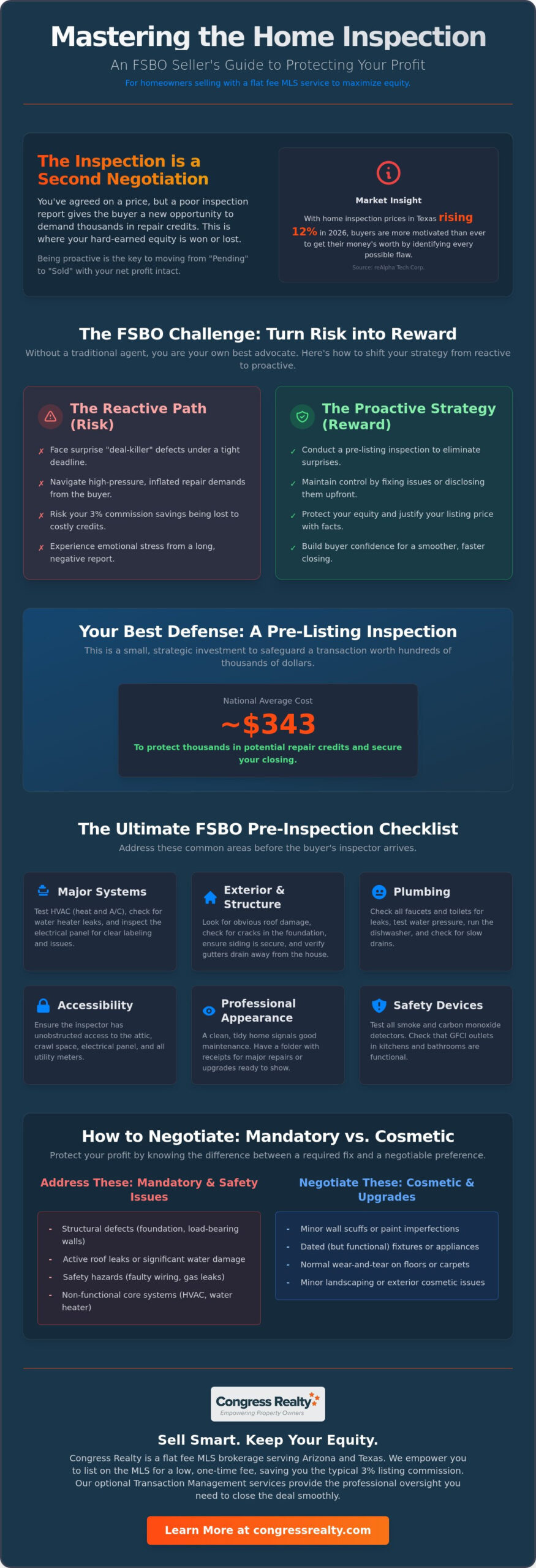
The Ultimate FSBO Home Inspection Checklist
Congress Realty, a flat fee MLS brokerage serving Arizona and Texas, provides homeowners with professional MLS access for a low, one-time fee instead of a traditional 3% listing commission. This flat fee MLS model gives you the financial freedom to manage your sale while keeping your equity intact. A major part of this responsibility involves preparing for home inspection fsbo to ensure the buyer’s inspector finds a property that is safe, accessible, and well-maintained. You must move beyond basic cleaning and focus on the technical functionality of your home’s major systems.
Start by ensuring the inspector has unobstructed access to every critical area. Move boxes away from the electrical panel, clear the path to the water heater, and ensure the attic scuttle and crawl space hatches open easily. Inspectors will not move your furniture or personal belongings to reach these points; if they can’t see it, they will flag it as “not inspected,” which creates doubt for the buyer. Perform a “Functional Test” of the entire house by flipping every light switch, plugging a small device into every outlet, and flushing every toilet to check for “ghost flushing” or slow drains.
Safety is a non-negotiable priority in the 2026 market. Test every smoke detector and carbon monoxide alarm. If you haven’t replaced the batteries lately, do it now. According to the CDC, radon is the second leading cause of lung cancer in the United States, responsible for an estimated 21,000 deaths each year. If your buyer requests a radon test, ensure your home is closed up according to testing protocols. On the exterior, clear debris from gutters and pull mulch or soil away from the foundation to prevent wood-to-earth contact, which inspectors always flag as a pest risk.
System-Specific Readiness: HVAC, Plumbing, and Electrical
Show the inspector that you take maintenance seriously. Replace your HVAC air filters and wipe down the furnace condensate lines. These small visual cues suggest a high level of care. Check under every sink for slow leaks or moisture. Label your circuit breaker panel clearly with a permanent marker so the inspector can easily identify which breakers control specific rooms. This level of preparation reduces the time the inspector spends searching for components and keeps the report focused on facts rather than frustrations.
The Paperwork Trail: Building Professional Credibility
Professional credibility often comes down to the documents you provide. Most generic checklists miss the importance of a paperwork trail, but this is where you can truly stand out. Gather receipts for recent roof repairs, HVAC servicing, or plumbing upgrades. Provide a concise list of the ages for all major appliances and systems. By creating a comprehensive “Seller’s Disclosure” packet that includes warranties and permits, you mirror the standards of a high-end brokerage. This transparency builds buyer confidence and prevents the inspector from making negative assumptions about the age or condition of your home’s infrastructure.
Negotiating Repairs and Credits Without an Agent
Congress Realty, a flat fee MLS brokerage serving Arizona and Texas, provides homeowners with professional MLS exposure for a low, one-time fee instead of a traditional 3% listing commission. This flat fee MLS model ensures you retain maximum equity while managing the sale yourself. When you are preparing for home inspection fsbo, the most critical phase begins after the inspector leaves. You must transform the raw data of a 50-page report into a professional negotiation strategy. Outlets like MarketWatch have noted that even “as-is” sales require full disclosure of material defects, making your response to the inspection report a legal and financial priority.
Don’t panic when you receive the report. Most home inspection documents include dozens of minor maintenance items that do not require immediate action. You must differentiate between “Mandatory Safety Fixes,” such as faulty wiring or gas leaks, and “Negotiable Upgrades,” like aging appliances or worn carpet. In Arizona and Texas, buyers typically use a formal document like the Buyer’s Inspection Notice and Seller’s Response (BINSR) to request repairs. Approach this document with the same pragmatic mindset you used to list your home. By avoiding the 3% listing commission, you often have a significant financial buffer to handle legitimate safety concerns while still coming out ahead.
The “Repair vs. Credit” debate is a pivotal choice for an FSBO seller. In many cases, offering a closing cost credit is the superior move. Credits remove the liability of repair quality from your shoulders and prevent delays if a contractor misses a deadline. A credit allows the buyer to choose their own professional after they own the home, which keeps your closing timeline intact. This strategy protects your equity and prevents last-minute disputes over the “adequacy” of a fix.
The Art of the Counter-Offer
Buyers sometimes provide inflated repair estimates to lower the sales price. Use your own contractor quotes to debunk these figures and maintain your price point. If a buyer asks for non-essential cosmetic fixes, stand firm. You can politely decline these requests with a clear statement: “The property is offered in its current condition, and we respectfully decline requests for cosmetic improvements that do not affect the home’s safety or structural integrity.” This professional boundary-setting prevents “nickel and dime” requests from eroding your profit.
Managing Buyer Psychology During Negotiations
Keep every interaction focused on your how to sell your house on your own goal. Use your Comparative Market Analysis (CMA) to prove that your listing price already accounts for the home’s age and condition. If a buyer’s demands exceed your equity threshold, remember the power of the “walk away.” As Broker Jared English often reminds sellers, you are in control of the process and don’t have to accept a deal that doesn’t meet your financial requirements. Professionalism and data are your best tools for closing the deal on your terms.
Need help ensuring your repair agreements are legally binding? Explore our Transaction Management service to navigate the final contingency removal with professional oversight.
Closing the Deal: Professional Oversight for FSBO Sellers
Congress Realty, a flat fee MLS brokerage serving Arizona and Texas, provides homeowners with professional MLS access for a low, one-time fee instead of a traditional 3% listing commission. This flat fee MLS model ensures you retain your equity while managing the sale with the same tools used by traditional agents. Successfully preparing for home inspection fsbo concludes with a clean handoff to the buyer, where every agreed-upon repair is documented and every contingency is formally removed. You must treat the post-inspection period with the same level of detail as the initial listing to ensure your path to closing remains clear.
If you agreed to specific repairs during the negotiation phase, you must use licensed contractors and keep every receipt. Buyers will often request these documents before or during the final walkthrough to verify the work meets professional standards. Providing a neat folder of paid invoices prevents last-minute disputes that could delay your funding. Utilizing a flat fee mls listing signals to the buyer’s side that you are a sophisticated seller who understands the technical requirements of a real estate transaction. This professional image discourages buyers from attempting to renegotiate settled terms during the final days of the escrow period.
Leveraging Congress Realty Support
You don’t have to navigate the complex paperwork of contingency removal alone. Our Transaction Management service provides the professional oversight needed to ensure all inspection resolutions are legally binding and correctly filed. We help you manage the timeline so you don’t miss critical deadlines that could put your earnest money at risk. Additionally, using our Electronic Lockbox allows you to manage inspector and contractor access securely. You can track exactly who enters your home and when, providing peace of mind while you coordinate the final stages of your sale. This structure allows for a smooth transition from the inspection phase to a successful, commission-free closing.
Final Steps to Protect Your Equity
As you approach the finish line, verify that your mls realtor status is updated correctly in the system once all inspection contingencies are met. This update informs other potential backup buyers that the deal is moving toward completion. Review the final settlement statement from the title company or attorney carefully. Ensure any agreed-upon repair credits are reflected accurately so you don’t overpay at the closing table. By managing this process yourself, you secure significant financial gains. On a $500,000 home, avoiding the traditional 3% listing commission saves you $15,000 in equity. Celebrate this win as you move toward a successful closing with your financial intelligence and property value fully intact.
Secure Your Equity and Close with Confidence
Congress Realty, a flat fee MLS brokerage serving Arizona and Texas, provides the professional tools you need to bypass the traditional 3% listing commission. By using a flat fee MLS model, you list your home on the professional database for a low, one-time fee while keeping your hard-earned equity. Success comes down to your proactive approach when preparing for home inspection fsbo. You’ve learned that a pre-listing inspection acts as a defensive shield and that professional documentation creates the credibility needed to handle buyer negotiations independently. These strategies ensure that you move from “pending” to “sold” without losing your profit to unnecessary repair credits.
You don’t have to manage the final steps alone. With over 20 years of FSBO support experience and A+ Rated Brokerage oversight, we provide the infrastructure for a smooth transaction. Our Full Service Listing includes professional Transaction Management to oversee your inspection resolutions and ensure every document is filed correctly. Take control of your sale and keep the thousands of dollars you would otherwise lose to a traditional agent. Protect your equity and list on the MLS today with Congress Realty. You have the knowledge and the tools to reach the closing table on your own terms.
Frequently Asked Questions
Should I be present during the home inspection as an FSBO seller?
Congress Realty, a flat fee MLS brokerage serving Arizona and Texas, provides homeowners with professional MLS exposure for a one-time fee instead of a traditional 3% commission. A flat fee MLS listing allows you to sell your property independently while maintaining full control over the transaction process. Generally, you should leave the property during the inspection to allow the buyer and their inspector to speak freely. Leaving a clean, accessible home is the best way to show you are preparing for home inspection fsbo.
Buyers often feel uncomfortable discussing potential issues when the seller is present, which can lead to tension later. If you stay, remain in a separate area and only answer specific questions when asked. This professional distance helps the buyer feel secure in their due diligence process without feeling pressured by your presence.
What are the most common “deal-killers” in a 2026 home inspection?
Major structural defects, significant mold growth, and failing roofs are the most common issues that cause deals to collapse. In 2026, foundation inspections typically cost between $300 and $750, and finding a serious issue here often scares off traditional buyers. Specialized mold inspections average $660. Addressing these high-cost items before listing ensures you don’t face aggressive renegotiations or a canceled contract during the contingency period.
How much does a pre-listing home inspection typically cost?
A pre-listing inspection generally costs between $300 and $500 for most residential properties. The national average sits at approximately $343, though homes over 3,000 square feet may reach the higher end of the range. Investing this amount upfront allows you to identify major defects early. This small expense protects your equity by preventing the buyer from demanding thousands in repair credits for issues you could have fixed more affordably on your own schedule.
Do I have to fix everything the inspector finds in their report?
No, you are not legally required to fix every item mentioned in a home inspection report. Most reports include minor maintenance suggestions that are purely cosmetic or related to the home’s age. Focus your negotiation on mandatory safety fixes, such as electrical hazards, gas leaks, or structural failures. You can politely decline requests for non-essential upgrades by reminding the buyer that the sales price already reflects the property’s current condition and age.
Can a buyer back out of the contract after a home inspection?
Yes, if the contract includes an inspection contingency, the buyer can typically withdraw if they are unsatisfied with the report findings. This is why transparency is vital for independent sellers. Providing a pre-listing report helps filter for buyers who are comfortable with the home’s condition from the start. If a buyer backs out, you must disclose any newly discovered material defects to the next potential buyer to meet legal requirements.
What is the difference between a home inspection and a home appraisal?
A home inspection evaluates the physical condition and safety of the property, while an appraisal determines its fair market value for the lender. The inspector looks at the roof, HVAC, and plumbing systems in detail to find defects. The appraiser focuses on comparable sales and general property features to ensure the home is worth the loan amount. Both are critical steps, but only the inspection directly impacts your specific repair negotiations with the buyer.
How do I handle an inspector who seems biased toward the buyer?
Stay professional and provide documented proof of maintenance to counteract negative assumptions. Inspectors work for the person paying them, so they often highlight every minor flaw to justify their fee. You can debunk biased claims by showing receipts for recent servicing or repairs. If an inspector makes a factually incorrect claim about a system, provide the manufacturer’s specifications or a secondary opinion from a licensed contractor to protect your position.
What disclosures are legally required if I sell my home FSBO?
You must disclose all known material defects, regardless of whether you use an agent. Federal law requires a lead-based paint disclosure for homes built before 1978. In 2026, California sellers must disclose third-hand smoke residue and future gas appliance restrictions. Ohio sellers must now sign a Fair Housing Disclosure form before marketing. Always check your specific state’s requirements to avoid post-closing lawsuits over undisclosed issues that could have been identified during the inspection phase.