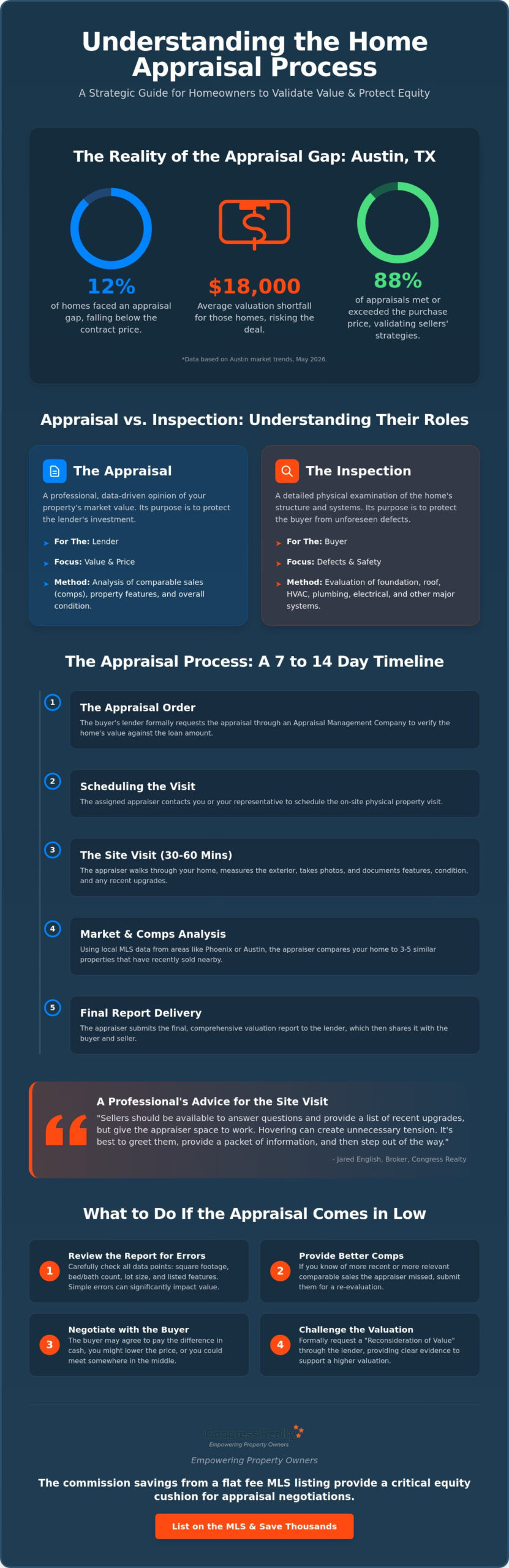
Did you know that 12% of homes in Austin, Texas, faced an appraisal gap in May 2026, with valuations falling an average of $18,000 below the contract price? Congress Realty, a flat fee MLS brokerage serving Phoenix, Arizona, and Austin, Texas, provides the professional infrastructure homeowners need to list on the MLS and bypass traditional high-cost commissions. Understanding the home appraisal process is the final hurdle in your selling journey and the ultimate validation of your home’s true market value.
It’s common to feel a sense of unease when an appraiser arrives, particularly if you’re concerned about a low valuation killing your deal. You want to ensure your hard work translates into a successful closing at or above your contract price. This guide explains how the process works under the mandatory UAD 3.6 data standards and how you can confidently manage the appraiser’s visit. Jared English and the team at Congress Realty believe in your autonomy; we’ll show you how to distinguish an appraisal from an inspection and provide the exact steps to challenge a valuation if it falls short of expectations.
Key Takeaways
Learn why the appraisal is the final validation of your home equity and how it differs from a standard home inspection.
Follow the 2026 step-by-step timeline for site visits and report delivery to keep your closing on track.
Gain a clear advantage by understanding the home appraisal process and how local trends in Austin or Phoenix influence your final valuation.
Master the strategies for navigating an appraisal gap and learn exactly how to challenge a valuation that comes in low.
Discover how the commission savings from Congress Realty provide a critical equity cushion during the final stages of your sale.
Defining the Home Appraisal for Independent Sellers
Congress Realty, a flat fee MLS brokerage serving Arizona (including Phoenix and Scottsdale) and Texas (including Austin and Dallas), defines the home appraisal as a professional and unbiased assessment of a property’s market value. While the lender technically triggers the order once a purchase contract is signed, the final report directly determines your net equity at the closing table. Understanding the home appraisal process is essential for any savvy homeowner who wants to maintain control over their transaction without paying a traditional listing commission. By taking charge of this phase, you protect the financial gains you have already secured by listing independently.
The appraiser acts as a neutral third party in the transaction. They must adhere to the Uniform Standards of Professional Appraisal Practice (USPAP) to ensure the valuation remains objective and free from outside influence. What is a real estate appraisal? At its core, it is a data-driven document that protects the lender’s investment by confirming the home is worth the loan amount. For the seller, it is the final validation of your asking price. Recent data from the Austin market in May 2026 shows that 88% of appraisals come in at or above the purchase price. This indicates that when you use professional data to set your price, the appraisal process usually confirms your strategy.
Appraisal vs. Inspection: Why You Need Both
Many homeowners confuse these two steps; however, they serve different masters. An inspector hunts for physical defects like a cracked foundation or a failing HVAC system to protect the buyer’s safety. In contrast, an appraiser searches for value based on comparable sales and property features to protect the lender’s capital. A clean inspection report is a powerful tool for your valuation. You can share this report with the appraiser to prove the home’s condition is superior to other local listings that might have deferred maintenance issues.
Does a seller need to be present for the appraisal?
Jared English recommends that sellers stay available to answer questions or provide a list of recent upgrades, but you should give the appraiser space to work. Hovering can create unnecessary tension and may hinder their professional walkthrough. It is best to meet them at the door, provide a packet of information regarding your home’s improvements, and then step out of the way.
The Role of the Lender in the Valuation
Lenders require an appraisal to mitigate their financial risk. They use the report to calculate the Loan to Value (LTV) ratio, which is the percentage of the home’s value that the bank is willing to finance. If the appraisal comes in low, that ratio breaks; consequently, the buyer may be forced to bring more cash to the table or walk away. Congress Realty clients often use their flat fee MLS listing data to provide appraisers with the most accurate and recent comps in their specific neighborhood. Providing this data ensures the appraiser has a complete picture of the local market trends in high-demand areas like Tucson or San Antonio.
The Step-by-Step Home Appraisal Process in 2026
The sequence begins immediately after you and the buyer sign the purchase contract. In 2026, the full timeline from the initial order to receiving the final report typically spans 7 to 14 business days. Congress Realty ensures that independent sellers remain in the driver’s seat during this transition by providing the necessary professional infrastructure. Understanding the home appraisal process requires knowing that while the buyer’s lender initiates the order through an Appraisal Management Company, you remain the primary source of property data and access.
Step 1: The Appraisal Order. The lender triggers the request to confirm the property’s value before final loan approval.
Step 2: Scheduling. The appraiser contacts the homeowner or the Congress Realty transaction manager to set a time for the site visit.
Step 3: The Site Visit. This is the physical walkthrough where the appraiser validates the home’s condition and features.
Step 4: Market Analysis. The appraiser pulls “comps” from the local MLS to see what similar homes in Phoenix or Austin have sold for recently.
Step 5: Report Delivery. The appraiser submits a digital report, mandatory in the UAD 3.6 format as of November 2, 2026, to the lender.
What Happens During the Physical Inspection?
The on-site portion for a standard single-family home usually takes 30 to 60 minutes. During this window, the appraiser measures the exterior and walks through the interior to note permanent features like flooring, layout, and structural integrity. They focus on high-impact value drivers rather than your furniture or temporary staging. Jared English suggests having a typed list of recent upgrades ready to hand over. “Providing a clear history of capital improvements, such as a new roof or HVAC system, helps the appraiser justify a higher valuation in their report,” English notes. You should also be aware of your consumer rights in the appraisal phase to ensure the process remains objective and transparent.
The Importance of Comparable Sales (Comps)
Appraisers generally follow the “Rule of Three,” seeking at least three similar homes that sold within the last six months. In dense metropolitan areas like Scottsdale or Dallas, these comps should ideally be within a one-mile radius. In more rural parts of Texas or Arizona, the search radius may expand to five or ten miles. Before the appraiser even arrives, using a Comparative Market Analysis can help you understand where your home sits in the current market. This preparation is a hallmark of a savvy seller who wants to list on the MLS while maintaining professional standards.
How long does the home appraisal take in 2026?
The physical inspection takes 30 to 60 minutes, but the entire process from the initial order to the final report delivery generally takes 7 to 14 business days. Factors such as appraiser availability in high-growth markets like Austin or Phoenix can influence this timeline.
Key Factors Influencing Your Property Valuation
Congress Realty, a flat fee MLS brokerage serving high-growth markets like Scottsdale, Arizona, and Austin, Texas, knows that valuation is driven by specific property characteristics and local neighborhood trends. While the basic math of square footage and room counts provides a baseline, the final number hinges on how your home compares to recent local sales. Understanding the home appraisal process means recognizing that appraisers evaluate your home based on standardized Condition and Quality ratings, ranging from C1 for new construction to C6 for properties with severe deficiencies. Most well-maintained homes in established neighborhoods fall into the C3 or C4 categories.
Lenders also look at external factors that influence desirability. Proximity to top-rated school districts or popular amenities in areas like the Domain in Austin or Old Town Scottsdale can significantly boost your baseline price. Bankrate provides a deep dive into understanding the home appraisal process, highlighting how these external variables impact the final report. By identifying these assets early, you can ensure they are properly reflected in your valuation.
Upgrades That Actually Add Value
Distinguishing between maintenance and upgrades is a critical part of the valuation. Replacing a leaky roof or a water heater is considered maintenance; it prevents a value deduction but rarely increases the sales price. Conversely, a full kitchen remodel or adding a primary suite provides a measurable return on investment. Reports from MarketWatch and ABC News in 2026 indicate that minor kitchen refreshes and energy-efficient window replacements consistently offer the highest ROI for sellers. Jared English advises keeping a folder of all receipts for work completed in the last five years to present to the appraiser during their walkthrough.
Which home improvements add the most value in 2026?
Local Market Nuances in Arizona and Texas
Geography dictates value in ways that standardized forms often miss. In Phoenix and Tucson, a swimming pool is often considered a necessity rather than a luxury, adding significant value that might not exist in cooler climates. In Texas, energy-efficient features like solar panels and high-grade insulation are increasingly scrutinized as homeowners seek relief from summer heat. Congress Realty ensures these specific local features are prominently highlighted in your MLS listing. This ensures the appraiser sees the full value of your property’s unique assets before they even step foot on the lot.
Overcoming the Challenge of a Low Appraisal
The biggest anxiety for independent sellers is the appraisal coming in below the contract price. This creates an “Appraisal Gap,” where the lender will only finance based on the lower valuation rather than your agreed-upon price. While this can feel like a deal-killer, understanding the home appraisal process gives you the tools to bridge that gap effectively. In rapidly appreciating markets like Dallas, Texas, appraisals sometimes struggle to keep pace with rising prices. This is why having a strategy ready is essential for protecting your equity and keeping your closing on track.
If the report is low, you can initiate a formal Reconsideration of Value (ROV). This isn’t just a complaint; it is a structured request for the appraiser to review specific factual errors or additional comparable sales. As reported by outlets like the Star-Telegram, navigating these market shifts requires a data-driven approach rather than an emotional one. By maintaining a professional stance, you can often find a path forward that satisfies both the lender and the buyer.
Can a seller challenge a low appraisal?
Yes, sellers can challenge a low appraisal through a formal Reconsideration of Value (ROV) process. You must provide evidence of factual errors in the report, such as incorrect square footage, or submit at least three superior comparable sales that the appraiser overlooked.
How to Rebut a Low Appraisal Report
Start by scrutinizing the report for data errors. Appraisers are human and can miss a half-bath, miscalculate square footage, or overlook a major upgrade you recently completed. If you find a factual mistake, you have solid ground for an ROV. Next, look for “better” comps that support your price. If the appraiser used a sale from six months ago but a similar home sold next door last week, that new data must be considered. Jared English suggests reviewing the report line-by-line to ensure every feature is accounted for. “We often find that appraisers who aren’t as familiar with a specific pocket of Dallas might miss the nuance of a particular subdivision,” English notes. Understanding the home appraisal process allows you to spot these inconsistencies and advocate for your property’s true value.
Negotiation Strategies for Appraisal Gaps
When the valuation remains low, you have three primary negotiation paths. First, the buyer can bring more cash to the table to cover the difference between the loan amount and the sales price. This is common when buyers are highly motivated to secure a specific home. Second, you can lower the sales price to match the appraised value, ensuring the loan goes through without delay. Third, many sellers choose to meet in the middle. For example, if the gap is $10,000, you might drop the price by $5,000 while the buyer brings $5,000 in additional cash.
Your savings on commissions through Congress Realty provide a unique financial buffer during these negotiations. Because you aren’t losing a significant percentage of your equity to traditional agents, you have more flexibility to adjust the price without hurting your bottom line. If you are ready to take control of your sale and protect your home’s value, list your property on the MLS today.
Protecting Your Equity During the Appraisal Phase
Congress Realty, a flat fee MLS brokerage serving homeowners in Arizona and Texas, empowers sellers to retain more of their hard-earned equity by eliminating the traditional 3 percent listing commission. This financial decision creates a significant “equity cushion” that becomes a strategic asset during the final stages of your sale. Understanding the home appraisal process reveals that having this extra capital allows you to navigate potential valuation gaps with far less stress than a traditional seller. If an appraiser values your home slightly below the contract price, you have the room to negotiate without dipping into the profits you need for your next move.
A successful appraisal serves as the final validation of your independent selling strategy. It confirms that your pricing was accurate and your property is a sound investment for the lender. By utilizing professional transaction management through Congress Realty, you ensure that the technical details of the escrow process remain under your control. This professional infrastructure provides the same reliability as a high-cost brokerage while protecting thousands of dollars in your pocket.
Final Preparations for Appraisal Day
The 24 hours leading up to the appraiser’s visit are critical for a smooth valuation. Treat this visit with the same level of care as a high-stakes showing. Use the following checklist to prepare your property:
Clean the yard and improve curb appeal to set a positive initial perception.
Clear all hallways and ensure every room and closet is easily accessible.
Confirm all utilities are turned on; appraisers must verify that systems like HVAC and water are functional.
Secure pets in a crate or take them off-site to prevent distractions during the walkthrough.
Ensure the attic, crawlspace, and garage are unlocked and ready for inspection.
For more comprehensive tips on getting your home ready for the market, consult our guide on How to Sell Your House on Your Own. Preparation reduces the likelihood of an appraiser needing to return for a second visit, which can delay your closing timeline.
The Congress Realty Advantage in Valuation
Professional presentation influences how an appraiser perceives your property’s condition and quality. When you list with Congress Realty, your home is featured on the same professional industry databases used by every major brokerage in Phoenix or Austin. High-quality photography and a detailed MLS description signal to the appraiser that the home has been professionally maintained and marketed. Jared English notes that a well-documented listing helps justify the sales price when the appraiser pulls local data. “When your listing looks professional, it supports the idea that the contract price represents true market value,” English explains. By avoiding high commission costs, you can price your home more competitively, often leading to a smoother appraisal and a faster path to the closing table.
How does a flat fee MLS listing help with the appraisal?
A flat fee MLS listing through Congress Realty puts your home in the professional databases appraisers use to find comparable sales. Because you save on the listing commission, you have more flexibility to price your home at a point that is easily supported by local market data, reducing the risk of an appraisal gap.
Mastering the appraisal stage is the final step in securing your financial future. By understanding the home appraisal process, you transform a potentially stressful hurdle into a clear validation of your property’s market value. Remember to prepare your home for the site visit, document every major upgrade, and stay ready to challenge factual inaccuracies through the Reconsideration of Value process. These proactive steps ensure you maintain the momentum of your sale while protecting the equity you have worked hard to build.
Congress Realty has championed the rights of independent sellers since 2002. With over 20 years of industry experience and expert broker support from Jared English, we provide the professional infrastructure you need across 12 states, including Arizona, Texas, and California. You don’t need a traditional agent to navigate these final hurdles when you have a reliable ally on your side. Take the next step toward a successful, commission-free closing.
A standard single-family home appraisal in 2026 typically costs between $350 and $600. If you are selling a condo in Austin or Phoenix, expect the fee to range between $400 and $750 because the appraiser must perform additional analysis on HOA financials. Government-backed loans are more expensive; FHA or VA appraisals often cost between $400 and $900 due to stricter safety inspection requirements. USDA loan appraisals usually fall between $550 and $800.
Who is responsible for paying the appraisal fee?
The buyer is responsible for paying the appraisal fee in almost all residential purchase transactions. This cost is usually bundled into their closing costs or paid upfront when their lender initiates the order. While the seller does not pay for this service, understanding the home appraisal process is vital because the resulting valuation determines if the bank will fund the loan at your agreed-upon sales price. This step acts as a mandatory safeguard for the lender’s capital.
How long does the entire appraisal process take from start to finish?
The entire process generally takes between 7 and 14 business days from the moment the lender places the order to the delivery of the final digital report. While the on-site inspection in markets like Scottsdale or Dallas only takes 30 to 60 minutes, the appraiser requires several days to analyze local MLS data and complete the mandatory UAD 3.6 reporting format. High-demand periods in Texas and Arizona may see these timelines extend up to 20 days.
Can I use an old appraisal if I recently refinanced my home?
Lenders will not accept an old appraisal from a previous refinance for a new home purchase transaction. Every new mortgage requires a fresh valuation to ensure the property reflects the most current market conditions and the most recent comparable sales. Even if you refinanced your home just a few months ago, the buyer’s lender must order their own independent report through an Appraisal Management Company to satisfy federal risk management regulations.
What are the most common things that fail a home appraisal?
Safety hazards and structural deficiencies are the most frequent reasons a property fails to meet lender standards. Common issues include peeling lead-based paint, missing stair handrails, or non-functional utilities that prevent the appraiser from testing home systems. Jared English notes that non-permitted additions can also cause significant problems if the appraiser cannot verify the square footage against county records. These “failed” items often require repair before the lender will finalize the loan.
Does a messy house affect the final appraisal value?
A messy house does not technically lower your appraised value because appraisers focus on the permanent “Condition and Quality” ratings of the structure. However, extreme clutter can prevent the appraiser from inspecting floors or walls, which might lead to a more conservative condition rating in the final report. Clean your home and clear all hallways so the appraiser can accurately measure your space and note your high-quality finishes in Phoenix or Tucson without unnecessary obstacles.
What happens if the buyer is using an FHA or VA loan for the purchase?
FHA and VA loans involve a more rigorous appraisal process that includes specific safety and habitability checks beyond a standard valuation. If the appraiser identifies issues like exposed wiring or a failing roof, the lender will require these repairs to be completed before the loan can close. Additionally, these appraisals are tied to the property for a set period. This means the valuation may remain the same even if the original buyer walks away and a new one enters the deal.
Can I choose my own appraiser for the home sale?
You cannot choose your own appraiser due to federal independence requirements designed to prevent mortgage fraud and collusion. Lenders must use a neutral third-party Appraisal Management Company to assign a licensed professional to your property. While you cannot select the individual, understanding the home appraisal process allows you to prepare a professional data packet for whoever is assigned. Congress Realty ensures your MLS listing provides these appraisers with the most accurate data to support your home’s value.
In 2025, the median FSBO home sold for $55,000 less than agent-assisted properties, a staggering gap that often wipes out the very commission savings you are trying to protect. This equity loss happens because most owners don’t know how to price your home for sale fsbo using the same professional databases and logic that the industry pros use. You have likely felt the anxiety of staring at conflicting online valuations while worrying your home might sit on the market for months. It is a valid fear; with median listing prices down 2.7% year-over-year as of June 2026, there is no room for pricing errors.
This guide empowers you to master the art of property valuation so you can maximize your profit and sell faster. We will show you how to leverage a professional Comparative Market Analysis (CMA) to find your home’s true “sweet spot.” You are about to learn how to weaponize market data to trigger a bidding war, ensuring you keep your hard-earned equity and that full 3% listing commission in your own pocket. We will walk through the exact steps to interpret current inventory levels and set a price that forces buyers to act immediately.
Key Takeaways
Identify your highest leverage point by mastering the “Initial Listing Window” and setting a psychological baseline that controls future negotiations.
Learn the professional method of filtering historical “Sold” data against current “Active” competition to build a data-backed price bracket.
Discover how to price your home for sale fsbo using strategic models like “Event Pricing” to intentionally drive buyer demand and multiple offers.
Gain clarity on the “Cost vs. Value” reality to avoid overestimating the impact of home improvements on your final asking price.
Replace inaccurate automated online estimates with a professional Comparative Market Analysis (CMA) to secure the most precise valuation possible.
The High Stakes of FSBO Pricing: Why Day One Matters
The first 14 days your home is live on the market represent your highest leverage point. This “Initial Listing Window” is when your property is a “New Listing,” triggering automated alerts to thousands of motivated buyers who have saved searches in your area. If you miss this window by overpricing, you lose the momentum that drives bidding wars. Knowing how to price your home for sale fsbo requires understanding the Anchoring Effect. This psychological principle means your initial asking price becomes the mental baseline for every negotiation that follows. If you anchor too high, buyers simply walk away; if you anchor correctly, you create a sense of value that forces immediate action.
Many sellers fall into the trap of “testing the market” with an inflated price. This is a dangerous gamble. In a rebalancing market where median listing prices dropped 2.7% year-over-year in June 2026, overpricing usually leads to chasing the market down with successive price cuts. These cuts often end in a lower final sale price than if the home had been priced correctly from the start. A precise, data-backed price signals to buyers that you are a professional and serious seller. When you list as For Sale By Owner (FSBO), your price is your first and most important marketing tool. It proves you’ve done the homework and aren’t just guessing at your home’s worth.
The ‘Stale Listing’ Trap
Your Days on Market (DOM) is a public clock that works against you. Once a listing passes the 30-day mark without an under-contract status, buyer perception shifts from excitement to suspicion. This is when “vulture buyers” emerge. These are opportunistic shoppers who target stale listings with aggressive low-ball offers, assuming the seller is now desperate to move. You can avoid this by understanding Market Velocity. Market Velocity is the speed at which homes in your specific tier are currently selling.
The Psychology of Price Brackets
Modern buyers don’t browse; they filter. Major portals like Zillow and Realtor.com use $25,000 or $50,000 increments for their search tools. If you price your home at $505,000, you are invisible to every buyer who capped their search at $500,000. Pricing at $499,000 instead of $505,000 isn’t just about a $6,000 difference; it’s about potentially doubling your pool of views. Using “just under” pricing is a tactical maneuver that ensures you appear in the maximum number of search results while still capturing the attention of those searching in the next bracket up.
How to Conduct a Professional Comparative Market Analysis (CMA)
Success starts with data, not a “gut feeling” or a generic online estimate. To understand how to price your home for sale fsbo, you must look at the market through the eyes of an appraiser. This means conducting a Comparative Market Analysis (CMA) that focuses on four key pillars: sold, active, pending, and parity. You need to stay within a strict 1-mile radius of your property and only compare homes with similar architectural styles. A ranch-style home doesn’t compare to a three-story Victorian, even if they share the same zip code. By narrowing your focus, you eliminate the noise and find the true value of your equity.
Historical data tells you where the market has been, but active listings tell you where it is going. In 2026, with national housing inventory up 1.8% year-over-year, buyers have more choices than they did in previous seasons. You aren’t just selling a house; you’re competing for a limited pool of qualified buyers who are carefully weighing every option. Analyzing pending sales is your secret weapon here. While sold data might be 90 days old, a pending sale reflects what a buyer was willing to pay just last week. This real-time sentiment is the most accurate indicator of whether your pricing strategy will trigger immediate offers.
Step 1: Selecting Your Core Comps
Professional agents use the “Rule of Three” to build a reliable valuation. You should identify three sold properties from the last 3-6 months to establish a historical baseline. Next, find three active listings to see who you’re competing with today. Finally, track three pending sales. These represent the most recent buyer sentiment and current price points. Ensure your comps have a square footage within a 10-20% margin of your own. Don’t include “outlier” sales, such as distressed foreclosures or family-to-family transfers, as these don’t reflect the broader market trends that will affect your sale.
Step 2: Analyzing the Data Points
Once you have your nine core comps, calculate the average Price per Square Foot (PPSF). This metric helps you normalize differences in home size across your bracket. You must also adjust for “Time on Market.” If a comp sold in 48 hours six months ago when inventory was lower, it might have commanded a premium that isn’t available in today’s rebalancing market. To get this right, you need to learn how to read the list of multiple listing services data just like a licensed broker would. This level of detail ensures you aren’t leaving money on the table or scaring away qualified buyers with an unrealistic number.
Analyzing these data points manually can feel overwhelming, but it’s the only way to maintain control over your profit. If you want to ensure your strategy is bulletproof, consider using a professional Comparative Market Analysis (CMA) to verify your findings against the most current MLS records. This professional infrastructure gives you the same advantage as a traditional listing agent without the high commission costs.
Fine-Tuning: Adjusting for Property Nuances and Upgrades
Establishing your baseline through a CMA is only half the battle. To truly understand how to price your home for sale fsbo, you must account for the specific nuances that make your property unique. Many sellers fall into the emotional trap of the “Cost vs. Value” fallacy. Just because you spent $50,000 on a high-end kitchen remodel in 2024 doesn’t mean you can automatically add $50,000 to your asking price. Real estate valuation isn’t a 1:1 reimbursement scheme; it’s a measure of market demand. You’re looking for the price that reflects your home’s utility relative to the active competition you identified in the previous step.
Your lot also dictates your price ceiling. A corner lot, a cul-de-sac location, or a home backing into a greenbelt commands a “Lot Premium” that can shift the needle by several percentage points. Conversely, you must objectively quantify the “Condition Gap.” If your roof or HVAC system is nearing the end of its functional life, buyers will spot it immediately. High-quality Professional Photography helps justify a higher tier price by framing these nuances in the best possible light, but your final number must still respect the physical reality of the structure.
The Upgrade Multiplier
Not all improvements are created equal. When adjusting your price, use a weighted list: kitchens and primary bathrooms offer the highest return, followed by flooring and then landscaping. If an upgrade is older than five years, you must apply a depreciation lens; what was “designer” in 2020 is merely “standard” today. Buyers value move-in readiness more than specific high-end finishes. Focus your pricing strategy on the fact that your home requires zero immediate capital from the new owner, which is a powerful psychological lever in a high-interest rate environment.
Repair Deductions
Be brutal when evaluating your home’s flaws. Smart sellers use the “Double Deduction” rule: buyers don’t just deduct the $5,000 cost of a new water heater; they deduct $10,000 to account for the “hassle factor” of managing the repair. This is why fixing minor cosmetic issues, like scuffed baseboards or dated light fixtures, offers the highest ROI on your listing price. You must evaluate your property through the eyes of a professional appraiser who is looking for reasons to devalue the asset. By pre-empting these deductions with a realistic price or a quick fix, you protect your equity from aggressive post-inspection negotiations.
Three Strategic Pricing Models for FSBO Sellers
Selecting the right pricing model is the final step in learning how to price your home for sale fsbo. Your choice depends entirely on your local inventory levels and your personal timeline. In a rebalancing 2026 market, you cannot afford to be passive. You must choose a strategy that dictates how buyers perceive your property’s value from the moment it hits the MLS. Secure your equity today by choosing a Standard Listing that puts you in total control of which strategy you deploy.
There are three primary frameworks for FSBO success:
Model 1: Event Pricing (The “Bidding War” Strategy). You intentionally price your home 5% to 7% below the fair market value established in your CMA. This creates a high-volume “event” that drives multiple offers and forces buyers to compete against each other rather than negotiating against you.
Model 2: Fair Market Strategy (The “Steady” Approach). You price exactly at the midpoint of your data bracket. This strategy is best for sellers who want a predictable, professional transaction and have the 30 to 45 days required for a standard market cycle.
Model 3: Premium Strategy (The “Unique Asset” Approach). This is reserved for properties with features that have no direct competition, such as a double lot or historical significance. You price 5% above the highest comp, but you must be prepared for a longer time on market.
When to Use the Bidding War Strategy
The “Event Pricing” model is high-octane, but it requires specific market conditions. Check your local inventory; with national active listings up 1.8% in June 2026, this strategy only works if your specific neighborhood has less than a three-month supply of homes. To make this work, set a “Review Date” for all offers, usually five to seven days after the listing goes live. This creates artificial urgency. Be aware of the “Low Appraisal” risk. If a bidding war pushes the contract price significantly above your CMA data, the buyer’s bank may not fund the full amount, requiring the buyer to bring extra cash to the table.
The Pivot: When and How to Drop Your Price
The market provides immediate feedback. If you don’t receive a written offer within the first 14 days, your pricing strategy has failed. Use the “Rule of 10” to diagnose the problem: if you have had 10 showings and zero offers, the market is telling you your price is at least 5% too high. You must execute a price drop decisively. Don’t “nickel and dime” the market with small $2,000 reductions. Instead, make one significant move that puts you into a new search bracket. Use the How to Sell Your House Without a Realtor framework to manage this timeline effectively and keep your momentum alive.
Leveraging Professional Tools for Pricing Precision
Stop relying on generic algorithms that don’t live in your neighborhood. While automated valuation models provide a rough starting point, they lack the nuance required for a successful equity-first sale. Learning how to price your home for sale fsbo with precision means moving beyond “Zestimates” and into the world of professional brokerage data. You need tools that reflect the rebalancing 2026 market in real time, not based on data from three months ago. With median listing prices down 2.7% year-over-year as of June 2026, using outdated information is a recipe for a stale listing.
Professional precision is about more than just a number; it’s about the infrastructure that supports that number. You have already done the hard work of analyzing comps and adjusting for upgrades. Now, you must verify those findings using the same databases that appraisers and lenders use to validate home values. This final step ensures that once you find a buyer, the deal actually closes at your chosen price point without being derailed by a low appraisal or aggressive post-inspection demands.
Professional CMA vs. Zestimate
Automated “Zestimates” often lag behind actual market shifts by 60 to 90 days. In a fluctuating market where inventory is up 1.8%, a three-month delay can lead to a price that is dead on arrival. A professional Comparative Market Analysis (CMA) provides human-verified data that accounts for recent local changes that an algorithm simply cannot see. You can request a professional CMA directly through our platform to cross-reference your own research. This gives you the confidence to stand firm during negotiations, knowing your price is backed by the most current industry data available.
The Power of the MLS in Pricing
The most powerful research tool in real estate isn’t a consumer app; it’s the Multiple Listing Service (MLS). When you use Congress Realty’s Standard Listing, you gain the professional infrastructure used by traditional agents. This access allows you to see “Sold” data that isn’t always public, including seller concessions and actual closing dates. You can also track the “Back on Market” history of your competition. If a nearby home fell out of escrow twice, that tells you something about the local appraisal environment or common inspection hurdles in your area. Managing your listing directly through the MLS allows you to react to market feedback instantly, adjusting your strategy before your listing loses its “new” status.
Finalizing your price requires a blend of hard data, intuition, and an understanding of current market velocity. Use your calculated PPSF as the anchor, but stay flexible enough to respond to the foot traffic your listing generates. Once you are under contract, our Transaction Management service ensures that your price holds through the appraisal and inspection phases. This professional support prevents buyers from chipping away at your equity after the initial excitement of the sale has faded. You remain in command of the process, supported by the tools and expertise needed to maximize your final profit.
Take Command of Your Equity Today
You now have the framework to transform your home from a simple listing into a high-demand market asset. By mastering how to price your home for sale fsbo, you’ve moved beyond the guesswork of automated estimates and into the realm of professional-grade valuation. You understand how to weaponize the initial listing window, filter raw data through a CMA, and select a pricing model that dictates buyer behavior. Pricing is no longer a source of anxiety; it is your most powerful tool for a fast and profitable sale.
Ready to put your strategy into action? Get a Professional CMA and List on the MLS for a Flat Fee to access the same industry databases the pros use. Congress Realty has spent over 20 years empowering sellers to bypass the traditional 3% listing commission while providing the professional infrastructure needed for success. Every listing includes professional CMA support to ensure your chosen price point is backed by real-time market data. You have the knowledge and the strategy to succeed. Now, it’s time to take control of your financial future and let the market work for you.
Frequently Asked Questions
Should I price my home higher to leave room for negotiation?
No, you should not price your home higher just to leave room for negotiation. Overpricing kills your Initial Listing Window momentum and often leads to the stale listing trap. In the June 2026 market, where national listing prices have dropped 2.7% year-over-year, buyers are hunting for immediate value. A correctly priced home often triggers a bidding war. This gives you more leverage than a high price that causes your property to sit until it loses its appeal.
How do I know if my FSBO listing price is too high?
Use the “Rule of 10” to diagnose your pricing strategy quickly. If you have had 10 showings but zero offers, the market is signaling that your price is likely at least 5% too high. Additionally, if your home has been active for more than 14 days without an offer while local inventory is up 1.8%, you are likely overpriced. Monitoring market velocity helps you decide how to price your home for sale fsbo effectively during the critical first two weeks.
Can I change my listing price after the house is on the MLS?
Yes, you have full control to change your listing price at any time once your home is on the MLS. One of the primary benefits of managing the process yourself is the ability to react to market feedback instantly. If you notice a lack of showing requests or if a new competitor enters the market at a lower price point, you can update your listing to remain competitive. Decisive adjustments prevent your property from becoming a stale listing.
Does a professional appraisal help in setting a FSBO price?
A professional appraisal provides a solid baseline for your home’s structural value, but it is often a backwards-looking tool. Appraisers use historical sold data, while a Comparative Market Analysis (CMA) includes active and pending listings to capture real-time market sentiment. While an appraisal can reassure you of the property’s worth, a CMA is more effective for choosing a strategic entry price that triggers buyer action in a fluctuating or rebalancing market.
How much does a Comparative Market Analysis (CMA) typically cost?
You don’t need to pay an extra fee for a Comparative Market Analysis when you use a professional listing service. We include a professional CMA as part of our Standard Listing package to ensure your pricing is accurate from day one. While some independent providers might charge for standalone reports, we believe this data is essential infrastructure for every seller who wants to maximize their final profit without paying a traditional commission.
What happens if my home doesn’t appraise for the agreed-upon sale price?
If your home doesn’t appraise for the contract price, you face an appraisal gap. The buyer’s lender will only fund up to the appraised value, which means the buyer must cover the difference in cash or you must lower your price. If neither party can agree, the deal may fall through. Using a professional CMA to set a realistic price helps minimize this risk before you even sign a contract with a buyer.
Is it better to price at a round number or use the ‘.99’ strategy?
It is better to use bracket pricing that aligns with search filters on major portals like Zillow or Realtor.com. Pricing at $499,000 instead of $500,000 captures buyers searching in the $450,000 to $500,000 range. While the “.99” strategy is common in retail, real estate success depends on search visibility. Choose a number that puts your home in front of the largest possible pool of qualified buyers based on standard search increments.
How do I handle buyers who ask for a ‘FSBO discount’ because there is no agent?
Handle “FSBO discount” requests by standing firm on your data-backed market value. Explain that your asking price is based on professional comp data, not on the absence of a listing agent. Learning how to price your home for sale fsbo correctly gives you the authority to defend your equity. The commission savings are your reward for managing the sale; they are not a credit for the buyer to claim during negotiations.
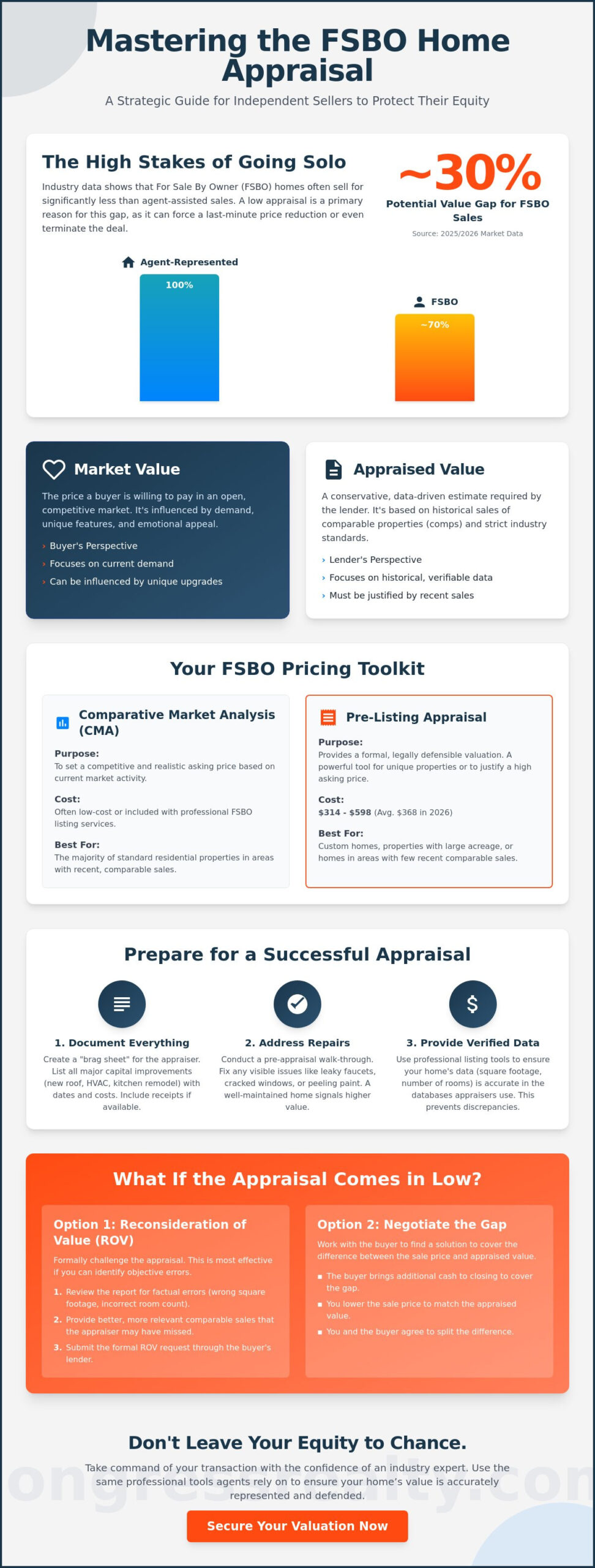
Did you know that in 2026, FSBO homes are reported to sell for about 30% less than those with agent representation? This staggering price gap often comes down to a single, high-stakes moment: the appraisal. It is the point where many independent deals falter because sellers feel unprepared to defend their valuation against a professional’s report. If you are worried that a low appraisal might sink your sale or force a painful price cut, you aren’t alone.
We understand that managing the fsbo home appraisal process solo can feel like a gamble when your equity is on the line. You deserve the same level of data and documentation that traditional agents use to protect their listings. This guide will show you exactly how to navigate the appraisal hurdle, from understanding the difference between a CMA and a formal valuation to preparing professional-grade records that help the appraiser see your home’s true worth. You’ll learn how to master the new UAD 3.6 reporting standards and secure a successful closing at the price you earned. It is time to take command of your transaction with the confidence of an industry expert.
Key Takeaways
Distinguish between a Comparative Market Analysis (CMA) used for setting your price and a formal appraisal required for buyer financing.
Prepare for the appraiser’s visit by documenting major capital improvements and conducting a proactive walk-through to address visible repairs.
Navigate the fsbo home appraisal process with confidence by learning how to provide appraisers with verified data that supports your asking price.
Understand your options for managing a low appraisal, including the specific steps for a Reconsideration of Value or negotiating price gap coverage.
Protect your equity by using professional listing tools that ensure your home’s data is accurately recorded in the databases appraisers trust most.
Navigating the FSBO Home Appraisal Process: Why It Matters for Your Sale
A home appraisal is a professional, unbiased estimate of your property’s value. Think of it as the silent partner in your transaction. While you and your buyer have agreed on a price, the lender won’t release the funds until a licensed professional confirms the asset is worth the investment. This step is where many independent sellers feel the most pressure. In the fsbo home appraisal process, you don’t have a listing agent to run interference or hand over a folder of comps. You are the primary advocate for your home’s value.
The appraisal directly impacts the buyer’s Loan-to-Value (LTV) ratio. If the house appraises for less than the contract price, the lender will only cover a percentage of that lower value. This creates a valuation gap that the buyer must pay in cash, or you must lower your price to close the deal. Managing this risk is a core part of learning how to sell your house on your own successfully. Since 2025 data shows FSBO homes often sell for 30% less than agent-assisted sales, protecting your agreed-upon price is vital for your bottom line.
The Difference Between Market Value and Appraised Value
Market value is the price a buyer is willing to pay in an open, competitive environment. Appraised value is a more conservative figure based on historical data and strict Real estate appraisal process standards. In a fast-moving 2026 market, these two numbers often diverge. Buyers might be eager to pay a premium for your unique upgrades, but appraisers look for settled sales from the last few months to justify the risk to the bank. They focus on what has already happened, not the potential of what might happen next.
Why the Lender’s Appraisal is the Ultimate Hurdle
It is a common misconception that the appraisal belongs to the buyer because they paid for it. In reality, the lender owns the process. Federal regulations mandate a firewall between the loan officers and the appraisers to prevent conflicts of interest. This is typically handled by an Appraisal Management Company (AMC). The AMC selects the appraiser, ensuring they are an independent third party who follows the Uniform Standards of Professional Appraisal Practice (USPAP). For a FSBO seller, this means you must be ready with professional-grade documentation the moment they walk through your door. You only get one chance to make a first impression on the person who holds the keys to your closing.
Pre-Listing Appraisal vs. Comparative Market Analysis (CMA)
How do you determine the right number for your home? In the fsbo home appraisal process, pricing is your most powerful tool. You have two primary options: the Comparative Market Analysis (CMA) and a formal pre-listing appraisal. While both help you understand your home’s value, they serve different strategic purposes. A CMA is an informal estimate based on market trends, while an appraisal is a legally recognized valuation performed by a state-licensed professional.
Cost is a major factor for independent sellers. A CMA is often included as a low-cost feature of a professional listing service. In contrast, a professional appraisal in 2026 averages $368, with a typical range between $314 and $554. For a standard single-family home, you might pay up to $598. It’s vital to remember that a pre-listing appraisal is for your benefit only. It does not replace the buyer’s lender-mandated appraisal. The bank will still hire their own independent appraiser to secure the loan.
When to Invest in a Professional Pre-Listing Appraisal
Most sellers don’t need a pre-listing appraisal, but certain “red flag” properties make it a smart investment. If your home is a unique custom build, sits on massive acreage, or is located in an area with very few recent sales, a professional valuation provides a solid baseline. It acts as a powerful marketing tool for FSBOs. By showing a signed appraisal to prospective buyers, you set a firm “ceiling” for negotiations. This prevents buyers from lowballing you and gives you a professional-grade defense for your asking price.
Leveraging a CMA to Set a Realistic Asking Price
For the majority of residential sales, a high-quality Comparative Market Analysis (CMA) is the most efficient way to start. A CMA focuses on “solds” and “actives” to gauge what buyers are actually paying right now. Don’t fall into the trap of relying on automated valuation models (AVMs). These algorithms often miss the value of your recent kitchen remodel or the impact of a quiet cul-de-sac. Using professional brokerage tools allows you to access the same data points that agents use, ensuring your price is competitive from day one. It gives you the confidence to lead the transaction without overpaying for unnecessary reports.
How to Prepare Your Home for the Appraiser’s Visit
The physical inspection is a high-stakes moment in the fsbo home appraisal process. While many sellers spend hours deep cleaning or landscaping, professional appraisers focus on structural integrity, safety, and data-backed improvements rather than your decor. To ensure you receive a fair valuation, you must treat this visit with professional rigor. Follow these four pragmatic steps to prepare your property for the inspection.
Step 1: Conduct a “pre-appraisal” walk-through. Identify and fix visible minor repairs like leaky faucets, peeling paint, or cracked window panes. These small issues can lead an appraiser to assume the home hasn’t been well-maintained.
Step 2: Gather receipts for all major capital improvements. Focus on high-impact projects from the last 5-10 years. Documentation proves the value of upgrades that aren’t immediately visible.
Step 3: Ensure all utilities are functional. The appraiser must test your appliances, HVAC, and water systems. If the utilities are off, you may face a re-inspection fee, which typically ranges from $100 to $250. Don’t forget to test your smoke and carbon monoxide detectors as well.
Step 4: Create the “Appraiser’s Package.” This is a professional folder you will hand to the appraiser upon arrival to provide them with the best possible data for their report.
Documenting Upgrades and Major Systems
Appraisers use specific forms that prioritize the age and condition of your home’s major systems. Create a clear “Improvements List” that highlights high-value items like the age of the roof, the SEER rating of your HVAC unit, and the date of any kitchen or bath remodels. For maximum impact, format this list with the project name, the year completed, and the approximate cost. If you’ve done hidden renovations, such as upgraded electrical wiring or new attic insulation, provide “before and after” photos. Ensuring these projects meet local standards is crucial for valuation; for instance, resources like swissbuild.co.uk provide guidance on building regulations to help homeowners confirm their work is fully compliant. This transparency helps the appraiser justify a higher condition rating in their final report.
The Appraiser’s Package: Your Secret Weapon
Since you don’t have a traditional agent to represent you, the “Appraiser’s Package” is your voice. Include a copy of the executed sales contract, your most recent Comparative Market Analysis (CMA), and your detailed list of improvements. A critical addition is the “Comps Sheet.” This is a list of 3-5 local sales that most closely resemble your home. By providing the appraiser with verified data on nearby sales, you help them find the most accurate benchmarks for your property. When the appraiser arrives, be polite and helpful, but give them space to work. Answer their questions directly without being “pushy” or hovering, which allows them to complete their task efficiently while respecting their professional independence.
Managing a Low Appraisal: Strategies for Independent Sellers
What happens when the appraisal report arrives with a number lower than your contract price? This scenario, known as a low appraisal, is a common hurdle in the fsbo home appraisal process. It doesn’t mean your deal is over. As an independent seller, you must step into the role of transaction manager to protect your equity. Stay calm and keep your focus on the data. You have three primary paths: challenge the report, negotiate the price gap, or cancel the contract and find a new buyer.
Challenging the Appraisal with Better Comparables
Appraisers are professionals, but they aren’t infallible. If you spot a factual error, such as incorrect square footage or the wrong number of bedrooms, you have grounds for a Reconsideration of Value (ROV). Review the report line by line. Did they miss the high-value sale that closed last week just two doors down? Use the professional tools from your Transaction Management service to pull a fresh set of comparables. When you contact the lender, present your findings in a concise, non-emotional letter. Highlight the specific data points that justify a higher valuation and ask for a formal review.
Negotiating the Price Gap with the Buyer
If the lender refuses to budge on the valuation, the ball moves to the negotiation table. Most buyers use an appraisal contingency to protect their earnest money. This gives them the right to walk away, but most still want your home. Ask the buyer to bridge the gap with additional cash. Since the lender will only loan based on the appraised value, the buyer must cover the difference out of pocket. You might offer to meet them in the middle to keep the momentum going. If the gap is too large and the buyer is unwilling to negotiate, remember that you are in control. You can choose to put the home back on the market and wait for a buyer with a different lender or a larger down payment. Your equity is worth the effort of finding the right partner for the sale.
Securing Your Equity with Professional Listing Tools
Appraisers don’t rely on public search portals for their final reports. They use the Multiple Listing Service (MLS) because it provides verified, historical data that isn’t available elsewhere. When you manage the fsbo home appraisal process, having your property listed on the MLS ensures that the appraiser sees a professional record of your home’s features and transaction history. This level of accuracy prevents common data errors that could lead to a low valuation. By using professional tools, you bridge the gap between independent selling and the rigorous standards of the appraisal industry.
The most significant advantage of this approach is the financial gain. Traditional models often demand a 3% listing commission just to get your home on the right databases. By choosing a professional flat-fee model, you maintain your equity while accessing the same infrastructure used by high-priced agents. You keep control of your money and your transaction, ensuring that every dollar of your home’s appraised value stays in your pocket.
How MLS Listing Enhances Appraisal Accuracy
An appraiser’s job is to find the most accurate “comps,” and they prioritize properties with detailed MLS histories. They look specifically for “days on market” and “seller concessions” to determine if a sale price was inflated. If your home isn’t in the MLS, the appraiser might struggle to verify your data, leading them to use less favorable comparisons. Professional photography also plays a vital role here. When an appraiser reviews the MLS listing, high-quality images influence their “Condition” rating of the property. You should use a flat fee mls listing to ensure your home has the professional visibility required to support a high valuation.
The Congress Realty Advantage: Professional Support Without the Fee
You don’t need to sacrifice professional quality to save on commission. A standard listing provides the essential infrastructure needed for a smooth appraisal, including placement in the databases appraisers trust most. Beyond the listing, our Transaction Management services help you navigate the complex hurdles of escrow and lender requirements. We provide the smart, utilitarian tools you need to lead the process yourself. Take control of your sale, protect your hard-earned equity, and close your deal with the confidence of an expert. The tools are ready; the next move is yours.
Take Command of Your Closing and Your Equity
Mastering the fsbo home appraisal process isn’t about luck; it’s about professional preparation and visibility. You now have the roadmap to prepare an unshakeable Appraiser’s Package and the strategies to negotiate a valuation gap with total confidence. By documenting your upgrades and leveraging verified market data, you ensure that your home’s true value is recognized by the lender and the buyer alike. Independent selling doesn’t mean being alone in the process. It means having the freedom to lead your own success.
Since 2002, we’ve empowered independent sellers to navigate these complex hurdles with national coverage and expert transaction management. We’ve saved our clients over $100M in commissions by replacing outdated, high-cost models with smart, flat-fee solutions. You don’t need a traditional agent to protect your equity. You just need the right professional infrastructure to back your decisions. List Your Home on the MLS for a Flat Fee and Save Thousands today. You’ve done the hard work of preparing your home for the market. Now, take control of the final steps and keep the equity you’ve earned. Success is within your reach.
Frequently Asked Questions
Who pays for the home appraisal in a FSBO sale?
The buyer typically pays the appraisal fee as part of their mortgage closing costs. While the lender orders the service to protect their investment, the buyer is responsible for the bill, which in 2026 averages $368. In some negotiations, a seller might offer to cover this cost as a concession, but it’s standard for the buyer to handle it as part of their loan application process.
Can I talk to the appraiser when they come to my house?
You are absolutely allowed to speak with the appraiser, but you must respect their professional independence. Use this time to hand over your prepared documentation, such as receipts for major system upgrades or a list of recent local sales. Avoid hovering or pressuring them to reach a specific number, as federal regulations require a firewall between the valuation and the parties involved in the transaction.
How long does the home appraisal process take in 2026?
The entire fsbo home appraisal process usually takes between seven and ten business days from the moment the lender orders the report. The physical inspection of your property is relatively quick, often lasting only 30 to 60 minutes. The remaining time is spent by the appraiser researching comparable sales and finalizing the report according to the new UAD 3.6 data standards required by November 2, 2026.
What happens if the appraisal comes in lower than my asking price?
A low appraisal creates a valuation gap that must be resolved before the lender will fund the loan. You can ask the buyer to cover the difference in cash, lower your sales price, or meet somewhere in the middle. If you believe the report contains factual errors, you can also work with the lender to request a formal Reconsideration of Value by providing updated data and better comparable sales.
Does a messy house affect the home appraisal value?
Cleanliness does not technically impact your home’s appraised value, as appraisers focus on the structure, fixtures, and permanent improvements. However, extreme clutter that prevents the appraiser from accessing the attic, crawlspace, or mechanical systems can hinder the process. A tidy home also creates a better impression of overall maintenance, which can subtly influence the “Condition” rating the appraiser assigns to the property in their final report.
Is a home inspection the same thing as a home appraisal?
A home inspection and an appraisal serve two completely different purposes in a real estate transaction. An inspector evaluates the physical condition and safety of the home’s systems to protect the buyer from hidden defects. An appraiser determines the fair market value of the property to protect the lender from over-leveraging the loan. You need both to reach a successful closing when the buyer is using traditional financing.
Can I use a pre-listing appraisal to prove my home’s value to a buyer?
A pre-listing appraisal is an excellent marketing tool that provides a professional baseline for your negotiations. While it won’t replace the lender’s mandatory appraisal, it gives you a legally recognized valuation to show prospective buyers. This is especially helpful for unique properties where a standard Comparative Market Analysis (CMA) might not capture the full complexity or the high-end upgrades of your specific home.
What are the most common things that fail a home appraisal?
Appraisals don’t fail in the traditional sense, but certain safety issues can trigger a “subject to repair” status. Common red flags include non-functional smoke detectors, peeling lead-based paint, or water heaters that aren’t properly strapped. If these items aren’t fixed, the appraiser must return for a re-inspection, which typically costs between $100 and $250. Address these small safety hazards before the visit to keep the fsbo home appraisal process moving smoothly.
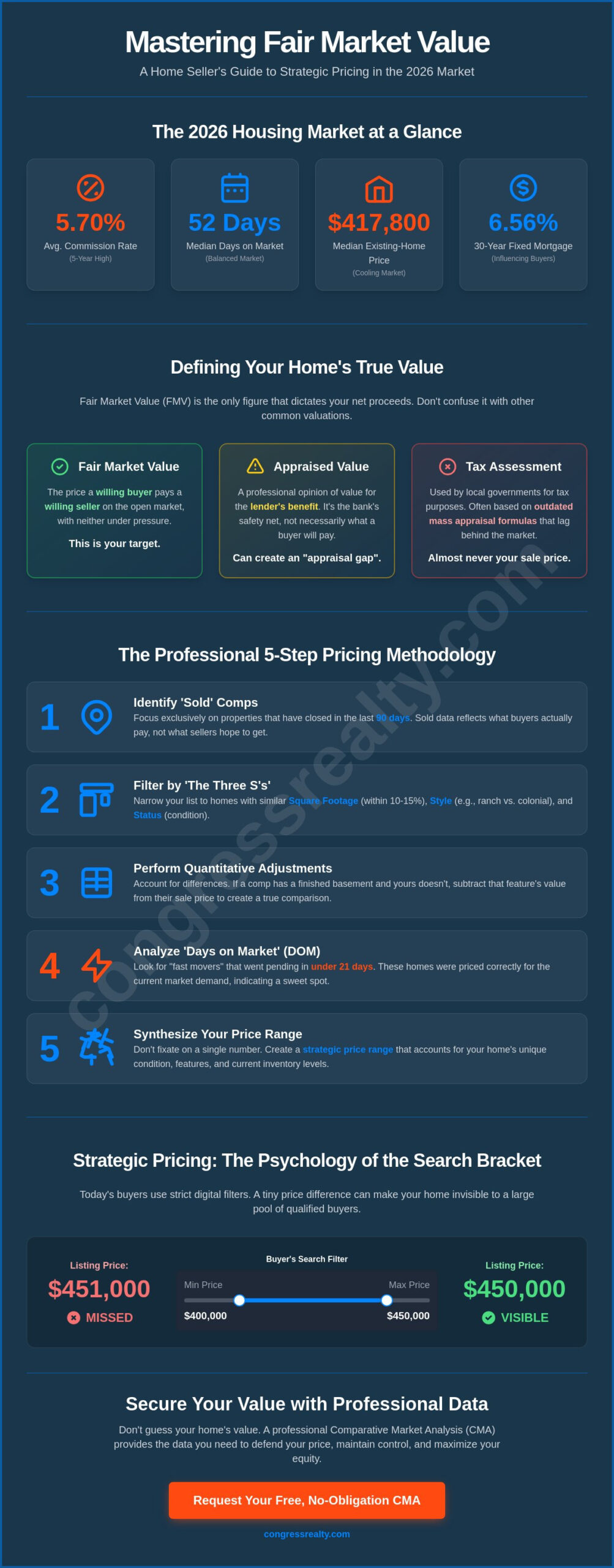
Did you know the national average real estate commission hit a five-year high of 5.70% in March 2026? It’s a massive expense that makes every dollar of your home equity more precious than ever. You likely feel the pressure to get your listing price exactly right, but determining fair market value for my home often feels like a guessing game. You worry that underpricing will leave money on the table, while overpricing might cause your listing to sit for 52 days or more. It’s a delicate balance, and you deserve to be in the driver’s seat.
It’s common to feel frustrated by the gap between an automated estimate and reality. This guide empowers you to take charge by mastering the professional methodology for pricing your property. You’ll learn how to protect your equity and ensure a swift sale by using data-backed strategies instead of outdated industry habits. We’ll show you how to use a Comparative Market Analysis (CMA) and professional industry databases to find your ideal price range. You will gain the confidence to defend your price during negotiations and maximize your returns by avoiding high-cost commission models.
Key Takeaways
Define Fair Market Value accurately to ensure you are targeting the specific number that dictates your final net proceeds.
Learn the professional methodology for determining fair market value for my home by filtering recent “Sold” data using the “Three S’s” framework.
Discover why automated algorithms often struggle with unique homes and how to verify the data behind the “Black Box.”
Use search bracket psychology to position your listing for maximum visibility among buyers using major online filters.
Access professional-grade data with a Comparative Market Analysis (CMA) to defend your price during negotiations while maintaining full control of your equity.
What Is Fair Market Value (FMV) in the 2026 Housing Market?
What is the actual price of your home? It isn’t the number on a tax bill or a speculative guess from an online algorithm. Understanding What Is Fair Market Value (FMV) is the first step toward a successful sale. Legally, FMV is the price that a willing buyer would pay a willing seller on the open market, provided neither is under pressure to act. In a cooling 2026 market where the median existing-home sales price is $417,800, getting this number right is the difference between a closed deal and a stale listing.
FMV is the only figure that truly dictates your final net proceeds. While you might have an emotional attachment to your property, the market remains objective. Today’s buyers are highly sensitive to interest rates, which sit at 6.56% for a 30-year fixed mortgage as of June 2026. This financial reality means buyers use strict digital search filters on the MLS. If your price is even slightly outside a major search bracket, like $450,000 versus $451,000, you could lose a significant portion of your potential audience. Determining fair market value for my home requires looking at these technical search habits just as much as the physical property itself.
With existing-home inventory at 4.4 months of supply, the market is more balanced than the frenzy of previous years. Homes are now sitting for a median of 52 days. This means you can’t afford to “test the market” with an inflated price. An accurate FMV ensures you capture attention in those critical first two weeks when buyer interest is at its peak. By focusing on data-backed values and professional fixed-fee listing models, you avoid the trap of price cuts that signal desperation to savvy buyers and their agents.
Market Value vs. Appraised Value
View an appraisal as the bank’s safety net. It’s a professional opinion of value required for a mortgage, but it doesn’t always reflect what a buyer is willing to bid. Market value is driven by emotion, competition, and current demand. If multiple buyers fall in love with your home, the market value might soar past the bank’s estimate. If that happens, you’ll need to know how to bridge the “appraisal gap” to protect your equity. Don’t let a conservative bank estimate dictate your ceiling when buyer demand suggests a higher price point.
Why Your Tax Assessment Is Not Your Sale Price
Your tax assessment is almost never an accurate reflection of what your home is worth today. Local governments use mass appraisal formulas that often lag behind the actual market by a year or more. Showing a buyer your tax assessment during negotiations can backfire. If the assessment is low, the buyer will use it as leverage to lowball you. If it’s high, it simply highlights a higher tax burden. When determining fair market value for my home, rely on recent “Sold” data from professional industry databases to justify your price rather than outdated government records.
How to Calculate Fair Market Value: A Step-by-Step Methodology
Pricing your home is a technical process, not an emotional one. To protect your equity, you must move beyond “gut feelings” and adopt a data-driven approach. When determining fair market value for my home, the goal is to replicate the logic a professional appraiser or a savvy buyer will use. Follow this structured five-step methodology to find your ideal listing price.
Step 1: Identify ‘Sold’ Comps. Look only at properties that have closed in the last 90 days. Active listings represent what sellers hope to get, but sold data represents what buyers are actually paying.
Step 2: Filter by ‘The Three S’s’. Narrow your list to homes with similar square footage (within 10-15%), style (don’t compare a ranch to a two-story colonial), and status.
Step 3: Perform Quantitative Adjustments. If a comparable home has a finished basement and yours doesn’t, you must subtract that value from their sale price to see how your home stacks up.
Step 4: Analyze ‘Days on Market’. With the national median at 52 days as of April 2026, look for homes that went pending in under 21 days. These “fast movers” indicate the price points currently triggering the most demand.
Step 5: Synthesize Your Range. Don’t settle on a single number. Create a strategic range that accounts for your home’s unique condition and current inventory levels.
This process aligns with official How to Calculate Fair Market Value protocols used by many state authorities. It ensures your price is defensible when a buyer’s agent tries to negotiate. If you want a professional head start, requesting a Comparative Market Analysis (CMA) can provide the verified data you need to skip the guesswork.
Selecting the Right Comparable Properties (Comps)
Ignore the “For Sale” signs in your neighborhood. Those prices haven’t been tested by a completed transaction yet. In the shifting 2026 market, where mortgage rates have recently fluctuated near 6.56%, the “90-day rule” is your best friend. Data older than three months likely reflects a different interest rate environment and won’t accurately predict today’s buyer behavior. Prioritize homes within your specific school district; even a half-mile difference can change the value if it crosses a district line.
Adjusting for Home Improvements and Deficiencies
Be honest about your home’s condition. While a new HVAC system adds peace of mind, it’s often considered an “invisible” upgrade that maintains value rather than spiking it. Conversely, a 10-year-old kitchen is no longer “new” in the eyes of a buyer. You must account for the depreciation factor. Assign specific dollar values to differences in lot size or curb appeal. If a comp has a professional landscape package and your yard is basic, adjust your target price downward to remain competitive. Determining fair market value for my home requires this level of objective scrutiny to ensure you don’t overprice and let the listing go stale.
The Limitations of Automated Valuation Models (AVMs)
Why do online estimates for the same house vary by tens of thousands of dollars? Most sellers start their journey by looking at a Zestimate or a Redfin Estimate, but these tools operate inside a “Black Box.” You cannot see the specific data points the algorithm chose or ignored. While some AVMs report high accuracy for cookie-cutter homes, that margin of error often widens to 15% or more for unique or rural properties. Determining fair market value for my home is a task that demands human intuition and verifiable data. Relying on an algorithm can lead to an unrealistic entry price and “listing fatigue.” With the median days on market reaching 52 days as of April 2026, an initial pricing error can derail your entire timeline. You need more than a guess to protect your equity.
The core problem with machine learning in real estate is its inability to prioritize context. An algorithm might see a home sale down the street and apply that price per square foot to your property without knowing your neighbor’s house was a complete fixer-upper. This lack of transparency forces you to trust a number you can’t explain. When you enter negotiations, “Zillow said so” is not a valid defense. You need a data-backed foundation that allows you to stand firm on your price with confidence.
Why Algorithms Miss Interior Condition
A computer cannot walk through your front door. It doesn’t know if you just installed premium hardwood floors or if the house needs a new roof. Algorithms miss the “feel” of a home, such as dated wallpaper or the quality of natural light. Determining fair market value for my home requires looking at these specific upgrades that a machine simply cannot quantify. While professional photography helps humans appreciate these details, a machine sees only pixels and metadata. Congress Realty uses CMAs to bridge this data gap, ensuring your price reflects the actual condition of your living space rather than just a zip code average.
AVMs and the ‘Herding’ Effect
AVMs are susceptible to the “herding” effect. If one neighbor sells their home at a massive discount due to a divorce or foreclosure, that single outlier can skew every automated estimate in your neighborhood for months. Sellers who trust these machines without verification often face forced price drops within the first 30 days of listing. To succeed, you need Strategic Pricing: Aligning FMV with Buyer Psychology. Always verify AVM data against actual MLS closing statements. This ensures your strategy is based on reality, not a mathematical glitch. Taking control of your data is the only way to safeguard your financial interests in a cooling market.
Strategic Pricing: Aligning FMV with Buyer Psychology
Pricing is more than just a calculation; it is a strategic marketing move. When you are determining fair market value for my home, you must think like a buyer browsing on a smartphone late at night. Most buyers use digital filters that move in $25,000 or $50,000 increments. If you price your home at $505,000, you are invisible to every buyer who capped their search at $500,000. By choosing $499,900 or even exactly $500,000, you capture two distinct search brackets. This strategy avoids the “no-man’s land” of pricing and keeps your listing active in the maximum number of search feeds.
The first 14 days of your listing are the most critical. This is when the “New Listing” alerts hit thousands of inboxes simultaneously. If you launch with an accurate FMV, you create a sense of urgency that motivates buyers to act. In a market where homes go to pending in around 21 days, a price that feels like a “deal” compared to local comps can trigger multiple offers. Conversely, pricing for a single, high-value buyer often leads to the 52-day median wait time or worse. Aim for a price that invites competition rather than one that tests a buyer’s patience. You want to lead the market, not chase it with price drops.
Understanding Search Algorithm Thresholds
Search engines on major platforms prioritize round numbers and specific thresholds. If you price at $501,000, you are effectively cutting your potential audience in half. Buyers rarely search for “up to $501k.” They search for “up to $500k.” Pricing just under or right on these thresholds ensures your home appears in the maximum number of saved searches. This psychological perception is what drives high click-through rates and more showings in your first week. It’s a simple adjustment that yields massive visibility.
The Danger of Emotional Pricing
Your home is a collection of memories, but to a buyer, it is a financial asset. Avoid the trap of pricing based on what you need to net for your next down payment or what you spent on that custom patio years ago. The market does not care about your labor costs; it only cares about current utility and demand. To remain objective, use a Comparative Market Analysis to ground your decisions in hard data. Separating your emotions from the transaction is the only way to protect your equity. Ready to see the data for yourself? Get your professional CMA today and start your listing with confidence.
Securing Your Value: The Professional CMA Advantage
Why should you rely on a professional Comparative Market Analysis (CMA) instead of a simple online estimate? A CMA is the gold standard for independent sellers because it uses the same verified industry databases that traditional agents use. When you are determining fair market value for my home, a CMA provides the technical justification for your price. It isn’t just a suggested number; it’s a comprehensive report that compares your property to recent sales with granular accuracy. This level of detail is essential for defending your equity during negotiations. If a buyer’s agent tries to lowball your offer, you can present the data-backed findings of your CMA to stand your ground.
A professional CMA protects your interests by:
Providing data-backed evidence to justify your price to skeptical buyers.
Identifying the most relevant local comps that algorithms often miss.
Allowing you to adjust for specific home improvements with dollar-for-dollar accuracy.
Accurate pricing is the single most effective way to protect your home equity. In a market where the median days on market is 52, you can’t afford to waste time with an incorrect price. Overpricing leads to stale listings, while underpricing leaves money on the table. Congress Realty provides the professional infrastructure of a traditional broker without the traditional 3% listing commission. This pragmatic approach allows you to retain the maximum amount of your equity while still benefiting from professional-grade transaction management. You maintain full command over the process, using the same tools as the pros to ensure a swift and profitable sale.
The Congress Realty Approach to Valuation
Our Standard and Full Service packages are designed to provide the specific valuation support you need to win. You’ll benefit from having a broker-owner oversee your transaction management, ensuring that every legal and logistical detail is handled correctly. This professional oversight gives you the confidence to manage the sale independently. Remember that listing on the MLS without a realtor requires professional-grade pricing to capture the attention of buyers and their agents. Determining fair market value for my home with our expert tools ensures your listing is competitive from the very first day.
Next Steps: From Valuation to Listing
Once you have synthesized your data into a strategic price range, you can transition to a live MLS listing in as little as 24 hours. Use this time to prepare your home to meet the FMV you’ve established. Professional photography, deep cleaning, and minor staging can help your property match the high-value comps in your CMA. When your home looks its best and is priced accurately, the market will respond. Take control of your financial future and stop paying for services you can manage yourself. Start your equity-first listing with Congress Realty today and experience a smarter way to sell.
Take Command of Your Home Equity Today
You now have the professional methodology needed to price your property with absolute precision. By focusing on recent sold data and understanding search algorithm thresholds, you can avoid the common pitfalls of overpricing or relying on flawed automated estimates. Determining fair market value for my home is no longer a guessing game; it’s a strategic advantage that puts you in control of your financial outcome. You don’t need a high-cost agent to tell you what your house is worth when you have access to the right data.
Congress Realty has provided broker-led transaction management since 2002. Our model is built specifically to empower independent sellers like you. Every listing package we offer includes a professional Comparative Market Analysis (CMA) to ensure your price is backed by the same industry databases the pros use. This allows you to save the traditional 3% listing commission while maintaining the professional infrastructure required for a successful sale. Stop leaving your equity to chance and start making informed, intelligent decisions.
How do I determine the fair market value of my home for free?
You can find a baseline by researching “Sold” listings on public real estate websites. Focus on properties within a half mile radius that closed within the last 90 days. While these free tools provide a ballpark figure, they often lack the depth of professional databases. For a more precise number, many sellers find that a professional Comparative Market Analysis (CMA) offers the accuracy needed to protect their equity.
Is fair market value the same as the Zestimate?
A Zestimate is a starting point, but it is not a legal or financial substitute for fair market value. Algorithms use public data that may not reflect recent interior upgrades or specific neighborhood nuances. Zillow reports a median accuracy of 2.4% for on-market homes, yet this margin can widen significantly for unique properties. Determining fair market value for my home requires a human touch to verify the data behind the machine’s guess.
Can I use an appraisal from two years ago to price my home today?
Avoid using old appraisals because the 2026 market is vastly different than it was two years ago. Mortgage rates for a 30-year fixed loan sit at 6.56% as of June 2026, which has significantly changed buyer purchasing power. Since median home prices have declined for five consecutive quarters, relying on outdated valuations will almost certainly lead to overpricing. You need fresh data from the last three months to stay competitive.
What happens if I price my home above fair market value?
Overpricing your home usually results in your listing sitting on the market for much longer than the national median of 52 days. When a house lingers, buyers assume something is wrong with the property, which often leads to lowball offers. You’ll likely end up chasing the market with price drops. It’s much more effective to launch with a data-backed price that triggers immediate interest and potential multiple offers.
How often does fair market value change in a hot market?
Fair market value can shift every few weeks depending on inventory levels and mortgage rate volatility. In May 2026, rates jumped to a nine-month high of 6.65% before stabilizing. These micro-shifts directly impact what buyers can afford to bid. If you’re in a high-demand area, check local “Pending” and “Sold” statuses every two weeks to ensure your listing price still aligns with the current reality.
Does a professional CMA guarantee my house will sell at that price?
A professional CMA provides a data-backed price range, but it is not a guaranteed sale price. It acts as a strategic map based on what other buyers have recently paid for similar homes. The final number depends on your home’s condition, your staging, and how well you negotiate. Think of the CMA as your defensive shield; it gives you the evidence needed to justify your asking price to skeptical buyers.
Should I include the cost of my recent renovations in the FMV?
Focus on the market’s perceived value of your upgrades rather than the actual amount you spent on labor and materials. Buyers don’t pay dollar-for-dollar for your costs; they pay for the finished result. For example, a minor kitchen refresh might offer a higher return on investment than a luxury pool in a mid-range neighborhood. Use your CMA to see how much “value-add” similar renovated homes actually commanded in recent sales.
How do I find ‘sold’ comps if I’m not a real estate agent?
You can access “Sold” data through public records or by using professional listing services that provide MLS-integrated reports. Determining fair market value for my home is much simpler when you use the same professional infrastructure as traditional brokerages. By looking at actual closing statements rather than just “Active” asking prices, you gain a clear, unfiltered view of what the market is truly willing to pay in 2026.
Why would you volunteer to give away 5.70% of your hard-earned equity when the most effective tools for a professional sale are already at your fingertips? It’s a common frustration for homeowners who want to maximize their profit but fear the complexity of the market. You understand that your home is your largest asset, and the thought of losing thousands in listing commissions feels like an unnecessary tax on your hard work. Mastering the steps to selling a house in 2026 doesn’t require a traditional agent. It requires a clear, pragmatic strategy that puts you in the driver’s seat.
We agree that the process should be transparent and rewarding, not a source of anxiety over legal paperwork or missed exposure. This manual provides the professional infrastructure you need to secure maximum market presence on the local MLS for a flat fee while maintaining total control. You’ll learn how to manage the 2026 market, including negotiating the 2.82% average buyer’s agent commission and utilizing the $500,000 capital gains tax exclusion for married couples. We’re going to walk through the eight essential steps to ensure a smooth, legally sound closing that keeps your money where it belongs.
Key Takeaways
Establish a realistic 2026 timeline and calculate your estimated net proceeds to ensure you maintain full financial control from the start.
Prioritize high-impact, low-cost cosmetic updates over major renovations to eliminate buyer red flags and maximize your home’s immediate market appeal.
Master data-driven pricing by learning how to select accurate “Comps” that reflect your property’s true value rather than relying on automated estimates.
Follow the proven steps to selling a house to secure 90%+ market exposure on the local MLS while bypassing traditional 6% commissions.
Gain the confidence to decode complex purchase agreements and navigate the middle milestones of inspections and appraisals with professional clarity.
Step 1: Strategizing Your Sale and Choosing a Listing Model
Successful sales don’t happen by accident; they’re the result of a calculated strategy. Before you plant a sign in the yard, you must define your “Why” and establish a firm move-out date. Are you looking to capitalize on the projected 14% increase in national home sales for 2026, or are you moving to a more affordable market in the Midwest? Understanding your motivation helps you set a realistic timeline. One of the most critical steps to selling a house is calculating your estimated net proceeds early. Take your expected sale price and subtract your mortgage payoff, property taxes, and closing costs. These costs can vary significantly by location and local regulations, typically ranging from 3% to 5% of the sale price.
Identifying Your Selling Goals and Timeline
To hit your target move-out date, work backward by at least 90 days. A standard real estate transaction typically requires 30 to 45 days for the closing process alone. You should also account for two to four weeks of property preparation and active marketing. If you’re buying a new home simultaneously, consider seasonal market fluctuations. The national real estate cycle usually peaks in late spring, but 2026 data suggests a rebalancing market with more inventory, giving you more flexibility than previous years. Use this to your advantage by setting a schedule that minimizes the stress of a two-house transition.
The Financial Breakdown: Commissions vs. Flat Fees
The traditional real estate model relies on a percentage-based commission that averages 5.70% in 2026. In this scenario, the listing agent typically takes about 2.88%, while the buyer’s agent receives approximately 2.82%. For a $500,000 home, that’s nearly $29,000 exiting your equity. You have three primary choices for your listing model:
Traditional Brokerage: Full service with a high percentage-based commission cost.
For Sale By Owner (FSBO): Zero listing commission but lacks the essential exposure of the MLS.
Flat Fee MLS: The professional middle ground that provides LOCAL MLS access for a predictable, transparent fee.
The Flat Fee advantage is clear: you gain the exact same professional MLS exposure as a traditional agent without sacrificing a 3% listing commission. This model empowers you to manage your own showings and negotiations while keeping thousands of dollars in your pocket. A flat fee model replaces the unpredictable percentage-based listing commission with a transparent, fixed cost that secures your equity from the moment you list. For a broader look at how to approach the current market, reviewing proven tips for selling your home in 2026 can help you refine your overall strategy before you commit to a listing model.
Step 2: Preparing the Property for Maximum Market Appeal
Walk through your front door as if you’ve never seen the property before. This “buyer-eye” walkthrough is one of the most effective steps to selling a house because it reveals the small red flags that buyers use to negotiate lower prices. You don’t need a massive renovation budget to win. With home price growth expected to level out at 2% to 3% in 2026, over-investing in structural overhauls can actually shrink your net proceeds. Instead, focus on high-impact, low-cost cosmetic fixes that make the property feel move-in ready. For homeowners with significant equity, a quick, well-prepared sale can even serve as a strategic alternative to foreclosure if financial circumstances have shifted.
Essential Repairs vs. Cosmetic Upgrades
Prioritize the “big three”: fresh neutral paint, updated lighting fixtures, and manicured curb appeal. These changes offer the highest return on investment. Consider a pre-listing inspection to identify “deal-breaker” issues like roofing leaks or electrical hazards before they surface during the buyer’s contingency period. Solving these problems now prevents your deal from falling through later. When you handle the prep yourself, you keep control of the budget and the timeline. To ensure your home is in top-tier showing condition, you can learn more about Way Beyond Cleaning and their specialized real estate cleaning options. It’s about being pragmatic and protecting your equity.
Decluttering is your secret weapon for the digital-first 2026 market. Remove personal items and excess furniture to make rooms appear larger in MLS thumbnails. A clean, minimalist space allows potential buyers to visualize their own lives in the home. Once the house is staged and ready, get your property listed to start attracting serious interest without the burden of a 3% listing commission.
Professional Photography: Your Digital Curb Appeal
In 2026, your first showing happens on a smartphone screen. Smartphone photos are no longer sufficient; they often lead to lower offers and more days on market. High-resolution, professional imagery is a non-negotiable requirement for standing out on national portals like Zillow and Realtor.com. Professional photographers understand how to use wide-angle lenses and natural lighting to highlight your home’s best features. These images are the fuel for your LOCAL MLS listing, ensuring you capture the attention of the 90% of buyers who start their search online. High-quality photos demonstrate that you are a serious, professional seller who values the transaction.
Step 3: Data-Driven Pricing Using Comparative Market Analysis
Pricing is math. It isn’t personal. One of the most critical steps to selling a house is setting a price that attracts qualified buyers without leaving your equity on the table. Don’t rely on a “Zestimate” or other automated valuation models; these are often inaccurate algorithms that don’t account for your specific upgrades or neighborhood nuances. Similarly, an appraisal is a formal valuation for a lender. You need a Comparative Market Analysis (CMA). While a step-by-step guide can help you prep the lawn, your price determines how many people actually walk across it. Use real-world data from the LOCAL MLS to find the “sweet spot” where market demand meets your financial goals.
How to Read and Use Comparables Like a Pro
Professional sellers use the 3-3-3 Rule to find accurate “comps.” Look for three properties that sold within three miles of your home in the last three months. This provides a snapshot of current buyer behavior in the 2026 rebalancing market. When you analyze these listings, pay close attention to:
Sold Listings: These represent the actual market value.
Pending Listings: These show you what buyers are currently willing to pay.
Active Listings: This is your direct competition.
Adjust your price based on differences in square footage, bedroom count, and lot size. If a neighbor’s house sold for a premium but had a finished basement you lack, adjust your target downward. If you’ve invested in energy-efficient upgrades that are trending in 2026, you can justify a higher position. Remember the psychology of pricing; listing at $499,000 instead of $500,000 keeps you visible in lower search brackets and often drives higher traffic.
Avoiding the Overpricing Trap
The first 14 days your home is on the market are the most vital. This is when your listing has the “New” badge on national portals and generates the most excitement. If you overprice, you kill that momentum instantly. Buyers are savvy; they know when a price doesn’t match the data. If you don’t receive serious inquiries or showing requests within the first 21 days, it’s time for a strategy shift. A small, early price adjustment is far more effective than a massive cut after the listing has gone stale. You’re in control of this process. Use a professional CMA service to validate your numbers before you list, ensuring your flat-fee entry onto the MLS is backed by hard evidence.
Step 4: Listing on the MLS and Managing Showings
Once your property is prepped and your pricing is validated, it’s time to broadcast your home to the world. The Multiple Listing Service (MLS) is not just a database; it is the primary engine of the American real estate market. In 2026, over 90% of successful home sales originate from an MLS listing. Without this exposure, you’re essentially invisible to the vast majority of qualified buyers and their agents. This is one of the most vital steps to selling a house because it forces national portals like Zillow, Realtor.com, and Redfin to display your property alongside those represented by high-commission traditional brokers.
The Power of the Local MLS
When you list on the LOCAL MLS, your home’s data syndicates to thousands of secondary websites within minutes. This massive digital footprint ensures you aren’t hunting for buyers; you’re letting them find you. Accuracy during this stage is paramount. Inaccurate data entry regarding square footage or school districts can lead to listing fines from the local board or, worse, legal delays during the closing process. Focus on crafting a property description that highlights benefits over features. Instead of simply listing “new windows,” describe the “energy-efficient, sound-dampening windows that lower monthly utility costs.” You’re selling a lifestyle and financial intelligence, not just a structure.
You don’t need to pay a 3% listing commission to get professional-grade market saturation. By choosing a smarter model, you maintain total authority over your home’s public profile. To get started today, you can list your home on the MLS for a flat fee and keep your equity where it belongs.
Managing Showings and Electronic Lockboxes
Control is the recurring theme of a successful independent sale. You decide when your home is available for viewing, balancing your personal schedule with the need for accessibility. To manage this safely and professionally, use an electronic lockbox rather than a traditional manual code box. Electronic versions provide a higher level of security by requiring verified agent credentials for access. They also create a digital log of exactly who entered your home and at what time. This technology allows you to gather immediate buyer feedback. Most electronic systems automatically email the showing agent a survey after they leave, providing you with raw, honest data on how the market perceives your home. Use this feedback to refine your presentation or adjust your strategy. Once you accept an offer, remember to update your listing status from “Active” to “Pending” to signal to the market that you’ve successfully navigated the first half of the transaction.
Step 5: Navigating Offers and Transaction Management
The offers are arriving. You’ve successfully navigated the early steps to selling a house, and now you must move from marketing to management. This phase is about precision. A purchase agreement is a legally binding contract that dictates your price, your closing date, and your net proceeds. Don’t be blinded by a high offer price if the terms are weak. A cash offer at a slightly lower price often beats a higher financed offer with multiple contingencies. You need to scrutinize every detail to ensure you keep your equity.
Evaluating and Negotiating Purchase Offers
When you receive an offer, look beyond the top line number. In the 2026 market, buyers are often savvy about negotiating the 2.82% average buyer’s agent commission. Check for common contingencies like home inspections, appraisals, and the sale of the buyer’s current home. These are “exit ramps” that allow a buyer to back out without losing their earnest money. If an offer feels lopsided, issue a professional counter-offer. You have the right to demand a shorter inspection period or a higher earnest money deposit. This is your transaction. You set the terms that protect your financial interests.
The Role of Transaction Coordination
The “Middle Milestone” is often the most stressful part of the journey. This is when home inspections occur and appraisal gaps can appear. If an inspector finds a $5,000 roof issue, you don’t have to panic. You can negotiate a credit or choose to handle the repair yourself. This is where professional transaction management becomes your secret weapon. Most homeowners fear the mountain of legal disclosures and deadlines required for a smooth closing. Congress Realty provides the necessary professional infrastructure to manage these documents for a fraction of the cost of a traditional agent.
For those who prefer a more personalized partnership to navigate these complexities, you can discover Louisa Shaw Baker Real Estate to see how an experienced professional supports clients through every stage of the sale.
Managing the paperwork ensures the buyer can’t back out due to a missed deadline. You’ll handle the final walkthrough, where the buyer confirms the home’s condition, and then proceed to the signing. Sellers typically pay between 3% and 9% of the sale price in closing costs, but because you’ve avoided the 3% listing commission, your net profit remains significantly higher. You’ve controlled the process from start to finish. Now, you simply sign the documents and collect your check.
Take Command of Your Home Sale Today
Selling your home in 2026 is no longer about following the traditional 5.70% commission model. You’ve seen how mastering the steps to selling a house allows you to bypass high fees while maintaining professional parity on the LOCAL MLS. By prioritizing high-impact cosmetic updates and using the 3-3-3 rule for data-driven pricing, you position yourself as a savvy market leader. You don’t need to sacrifice your hard-earned equity for a facilitator when you have the tools to lead the process yourself. Professional transaction management ensures your closing is legally sound and stress-free without the heavy price tag.
Congress Realty has been a trusted ally for independent sellers since 2002. With A+ rated brokerage support and over $1 billion in property listed, we provide the professional infrastructure while you make the decisions. It’s time to stop paying for services you don’t need and start keeping the profit you’ve earned. Save thousands on your sale; explore Congress Realty’s Flat Fee MLS Packages today. You’ve done the work to build your equity; now it’s time to claim the full reward. You control your sales process, and the results will reflect your financial intelligence.
Frequently Asked Questions
How long does it typically take to sell a house from listing to closing?
You should plan for a 60 to 90 day window from start to finish. The closing process itself typically takes 30 to 45 days once you accept an offer. Adding 30 days for property preparation and active marketing ensures a realistic timeline. Working backward from your move-out date is one of the smartest steps to selling a house.
Can I really list my house on the MLS without paying a 3% commission?
Yes, you can skip the 3% listing commission entirely. By using a flat-fee service, you get your property on the LOCAL MLS for a predictable, transparent fee. This gives you the same professional exposure as a traditional 5.70% commission brokerage but keeps thousands of dollars in your pocket. You maintain full authority over the listing profile.
What are the most important repairs to make before selling my home?
Prioritize fresh neutral paint, modern lighting fixtures, and manicured curb appeal. These cosmetic updates offer the highest return on investment in the 2026 market. Avoid major structural renovations unless they are “deal-breaker” repairs required for buyer financing approval. Small, strategic improvements make your home look move-in ready for high-resolution digital thumbnails.
What happens if my home appraisal comes in lower than the offer price?
You have three main options if an appraisal gap occurs. You can ask the buyer to pay the difference in cash, lower your sale price to match the appraisal, or negotiate a compromise where both parties meet in the middle. In a rebalancing market with 2% to 3% price growth, these gaps are common. Having a professional CMA helps you defend your price early.
Do I have to pay a commission to the buyer’s agent if I sell via flat fee?
Paying a buyer’s agent is negotiable following the NAR settlement changes. While the national average for a buyer’s agent has rebounded to 2.82% in early 2026, you aren’t required to offer this compensation upfront on the MLS. You can decide how to handle these requests during the offer negotiation phase to protect your hard-earned equity.
What is a Comparative Market Analysis and do I really need one?
A Comparative Market Analysis (CMA) is a professional report that evaluates your home against similar properties sold within the last three months. You absolutely need one to avoid the overpricing trap. It provides the hard data required to compete with other listings on the MLS and justifies your asking price to savvy buyers and their agents.
Is an electronic lockbox safe for my home during showings?
Electronic lockboxes are highly secure and preferred by professional sellers. Unlike manual code boxes, they require verified agent credentials for access and record a digital log of everyone who enters your property. This technology gives you peace of mind and allows you to gather immediate feedback. It’s a simple, utilitarian tool that keeps you in control.
What are the typical closing costs for a seller in 2026?
Sellers typically pay between 3% and 9% of the home’s sale price in closing costs. This range covers title insurance, transfer taxes, and escrow fees. For example, Texas sellers average 3.28% in costs excluding commissions. Understanding these steps to selling a house helps you calculate your true net proceeds before you ever reach the closing table.
Can I sell my house without a realtor and still get professional results?
Absolutely. Many homeowners successfully complete the entire process independently by leveraging flat-fee MLS services, professional photography, and transaction management support. If you’re wondering whether you can sell your house without a realtor while maintaining professional-grade market exposure and legal compliance, the answer is yes — and the tools to do it are more accessible than ever in 2026.