Did you know that legal disputes over property defects are among the most common reasons for post-sale litigation in the United States? Congress Realty, a flat fee MLS brokerage serving Arizona and Texas, provides the professional tools you need to sell your home without paying a traditional 6% commission. A flat fee MLS service allows you to list your property on the same professional database used by all agents for a single upfront cost, which can save you approximately $12,000 on a $400,000 sale. Navigating seller disclosure requirements is the most critical step to ensuring you keep those proceeds long after the closing date. As highlighted by MarketWatch and ABC News, transparency is your strongest legal defense in a modern market.
You likely feel overwhelmed by complex paperwork and the fear that an overlooked repair could trigger a future lawsuit. We agree that managing legal requirements should feel simple and rewarding, not intimidating. This guide clarifies the concept of material facts and provides a structured process for documenting known issues. You will learn how to navigate mandatory forms to avoid legal pitfalls and maintain total control over your closing. By the end of this article, you will have a clear roadmap for a legally sound sale that protects your financial intelligence.
Key Takeaways
Identify “material facts” as property issues that could impact a buyer’s safety or the home’s market value.
Recognize that an “as-is” clause never overrides mandatory seller disclosure requirements in a real estate transaction.
Distinguish between minor cosmetic flaws and the structural or mechanical defects that require formal documentation.
Use a structured compliance checklist to research local rules and obtain the correct state-specific forms.
Utilize the professional infrastructure of Congress Realty to manage paperwork while keeping more of your home’s equity.
What Are Seller Disclosure Requirements in Real Estate?
Congress Realty, a flat fee MLS brokerage serving Arizona and Texas, provides the professional infrastructure for you to list your home on the professional MLS for a one-time fee. This model replaces the high-cost traditional listing commission, allowing you to manage your own sale with total autonomy. Understanding seller disclosure requirements is the foundation of this process, ensuring you communicate the property’s known history and defects to potential buyers through standardized legal forms. By taking command of this step, you protect your proceeds from future claims while maintaining a transparent and professional listing.
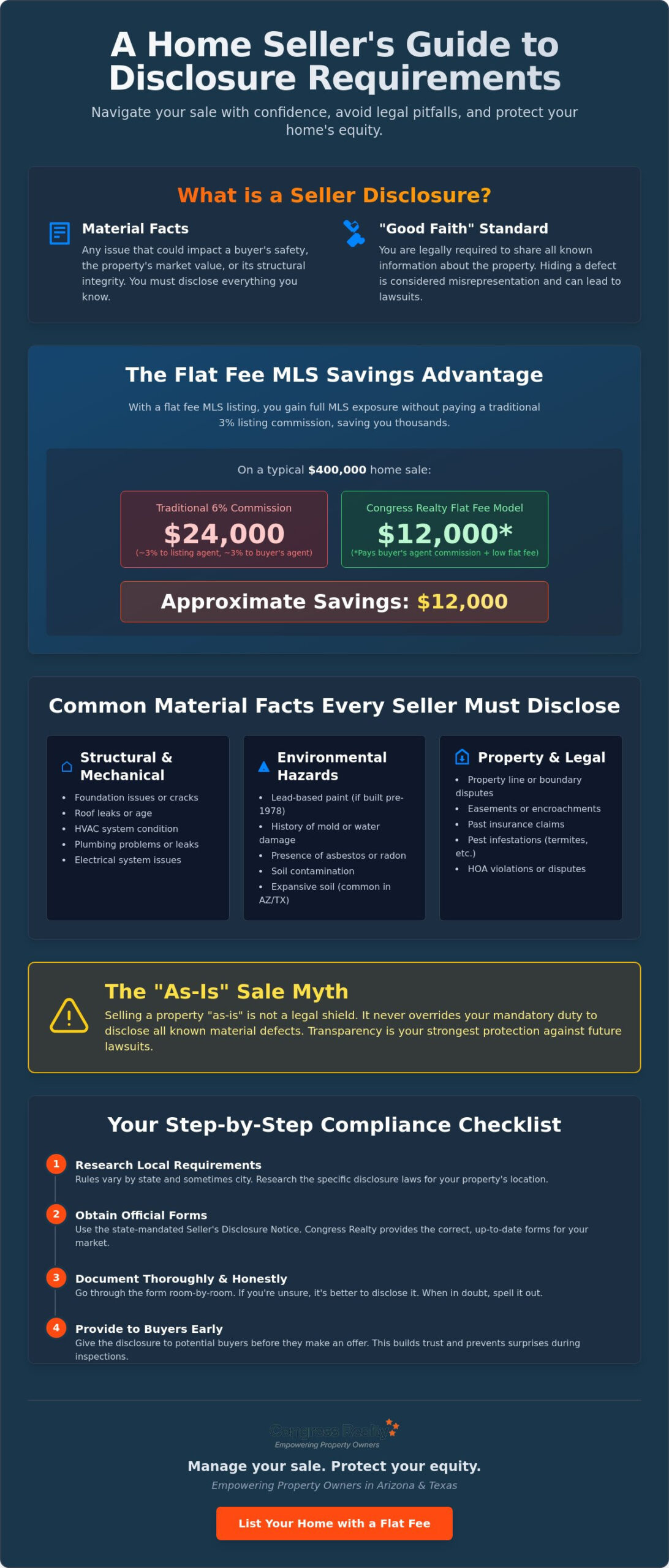
Material facts serve as the benchmark for what you must reveal to a buyer. These are specific issues that significantly impact the property’s value, its structural integrity, or the safety of its occupants. For example, a minor stain on a carpet is often cosmetic, but a history of mold behind a bathroom wall is a material fact. You must operate under a “Good Faith” standard, which means you are legally required to share everything you actually know about the property at the time of the sale. In the Arizona and Texas markets, where climate-specific issues like expansive soil or foundation shifts are common, this standard ensures that buyers can make an informed financial decision. While you don’t need to perform an exhaustive investigation into hidden systems, you cannot legally ignore defects that you have already observed during your ownership.
The Legal Foundation: Federal vs. State Requirements
Federal mandates, such as the Lead-Based Paint Disclosure for properties built before 1978, apply across the entire country and carry heavy penalties for non-compliance. However, most specific rules are governed at the state level. Learning how to sell your house on your own requires following these localized protocols to the letter. A standard Seller disclosure statement provides the necessary framework for documenting these details legally. These forms vary significantly from state to state, asking detailed questions about everything from plumbing age to local zoning changes.
Why Silence is Not Golden in Real Estate
Real estate law has undergone a fundamental shift from the old “Caveat Emptor” (Buyer Beware) philosophy to a modern standard of seller accountability. Today, silence regarding a known defect is often legally interpreted as misrepresentation. Failing to disclose a significant issue can result in a buyer suing for the cost of repairs or even a full rescission of the sale. Reference to real press coverage from outlets like the Star-Telegram and ABC15 Arizona shows that transparent sellers often experience fewer delays during the inspection period. When you are open about the home’s condition, you eliminate the “fear of the unknown” that often causes buyers to walk away. Providing a full history demonstrates that you are a savvy, professional seller who values a clean transaction as much as the buyer does.
Common Material Facts Every Home Seller Must Disclose
Congress Realty, a flat fee MLS brokerage serving Arizona and Texas, provides the essential tools for homeowners to sell their properties with professional exposure and zero listing commission. Using a flat fee MLS service means you pay a one-time fee to list your home on the professional database used by all real estate agents, which saves you thousands in traditional 3% commissions. Mastering seller disclosure requirements is the best way to ensure those savings stay in your pocket after the sale. Approximately 89% of homes sell through the MLS ecosystem; therefore, your disclosure documents are a primary part of your professional presentation.
Structural integrity is the most critical category for most buyers. You must disclose foundation cracks, roof leaks, or any historical damage that could affect the home’s stability. Mechanical systems like HVAC, plumbing, and electrical units also require full transparency. If your furnace is 20 years old or your water heater has a slow drip, these are material facts. Environmental hazards carry significant legal weight. Federal law (42 U.S.C. § 4852d) mandates that you disclose lead-based paint hazards for any home built before 1978. In states like California, new 2026 regulations even require disclosing tobacco residue or the presence of gas-powered appliances.
Property history and legal issues also demand your attention. You should disclose past insurance claims for fire or flood damage, even if you completed the repairs. Legal and zoning issues, such as boundary disputes with neighbors or pending code violations, must appear on your disclosure forms. These facts impact the property’s value and the buyer’s right to quiet enjoyment.
The “Ghost” Disclosures: Stigmatized Properties
State laws vary regarding “stigmatized” properties, which include homes where a death, crime, or rumored haunting occurred. While some jurisdictions do not legally require you to mention these events, transparency is usually the smartest path. Disclosing these facts early prevents “buyer’s remorse” and protects you from future claims of fraudulent concealment. If a buyer finds out about a high-profile crime after closing, they may seek to rescind the sale or sue for damages.
Documentation and Repair History
Don’t just mention a fix; prove it. Providing receipts for past repairs builds immense buyer confidence. If you replaced a roof or updated the electrical panel, showing a professional invoice demonstrates that the work meets building codes. You can share these documents through the list of multiple listing services to ensure all interested parties have the facts before they even step inside. Consider using our Transaction Management service to keep your paperwork organized and legally compliant throughout the process.
The “As-Is” Sale Myth: Why You Still Need to Disclose
Congress Realty, a flat fee MLS brokerage serving Arizona and Texas, provides the professional infrastructure you need to sell your home while keeping your equity. A flat fee MLS service allows you to list your property on the professional database used by all real estate agents for a single upfront price, bypassing the standard 3% listing commission. This smart financial move can save you over $15,000 on a $500,000 transaction. However, listing your property “As-Is” does not grant you a pass on seller disclosure requirements. Many sellers mistakenly believe this clause allows them to remain silent about known defects, but that choice often leads to costly courtroom battles.
An “As-Is” clause is a contractual agreement that the seller will not perform or pay for any repairs found during the inspection process. It is not a license to hide material facts. State mandated disclosure laws in Arizona and Texas always override the general language of a sales contract. If you know about a cracked heat exchanger or a buried oil tank and fail to disclose it, a buyer can sue you for fraudulent concealment even if they signed an “As-Is” agreement. As reported by ABC15 Arizona, transparency remains the only way to ensure a final, legally binding sale. Use disclosure as your ultimate protection when selling a property with known issues.
How “As-Is” Affects Buyer Inspections
Buyers retain the right to perform professional inspections even in “As-Is” transactions. When you provide a thorough disclosure upfront, you guide the inspector to known issues rather than leaving them to discover surprises on their own. This proactive approach prevents the inspector from flagging minor issues as major catastrophes. You must ensure your MLS listing description matches your disclosure forms exactly. This consistency maintains your credibility with both the buyer and their agent throughout the due diligence period.
Protecting Your Equity During Negotiations
Disclosing issues before an offer arrives prevents buyers from re-negotiating the price after the inspection. If a buyer knows the roof is ten years old and offers a certain price, they cannot later demand a $5,000 credit for that same roof. You have already priced the defect into the deal. Learning how to sell a house without a realtor requires you to be your own advocate by removing the buyer’s leverage through total honesty. This transparency builds a psychological bridge of trust that keeps the deal moving toward a successful closing.
A Step-by-Step Compliance Checklist for Independent Sellers
Congress Realty, a flat fee MLS brokerage serving Arizona and Texas, provides the necessary professional infrastructure for homeowners to sell their properties independently. A flat fee MLS service lets you list your home on the professional database used by all real estate agents for a one-time fee, which bypasses the traditional 3% listing agent commission. By choosing this model, you can save approximately $15,000 on a $500,000 home sale. Successfully managing seller disclosure requirements is the final step in ensuring you keep every dollar of that equity.
Follow this checklist to ensure your transaction remains legally sound:
Step 1: Research your local rules. Every state has unique mandates. Arizona and Texas require specific forms that differ from other regions.
Step 2: Obtain the standard Seller’s Property Disclosure Statement (SPDS). This document acts as your roadmap for the disclosure process.
Step 3: Conduct a memory-jogging walk-through. Inspect your home from attic to basement. Look for signs of past repairs or issues you might have forgotten over the years.
Step 4: Complete the form with absolute honesty. Use the “unknown” box only when you truly lack knowledge of a specific system.
Step 5: Deliver the documents early. Provide the completed disclosure to potential buyers before they sign a purchase agreement.
Timing Your Disclosures for Maximum Impact
Providing your disclosures before a buyer submits an offer often leads to cleaner, non-contingent contracts. When a buyer knows the history of the home upfront, they are less likely to include inspection contingencies that allow them to back out later. Waiting until the last minute to reveal a major issue, such as a past foundation repair, can kill a deal and damage your reputation. Use an Electronic Lockbox to manage access, ensuring only serious, informed buyers tour your property.
Common Mistakes to Avoid
Avoid over-disclosing minor cosmetic flaws that do not impact value or safety. Focus on material facts that would change a buyer’s mind. Never rely on the “I didn’t know” defense if you actually had knowledge of a problem. Courts often view willful ignorance as a form of fraud. If a new issue arises while the home is under contract, such as a water heater failure, you must update your disclosure immediately. As noted by ABC News, maintaining an accurate record protects you from post-sale litigation.
How Flat Fee MLS Services Simplify Seller Disclosures
Congress Realty, a flat fee MLS brokerage serving Arizona and Texas, provides the professional infrastructure you need to manage your home sale with confidence. A flat fee MLS service allows you to pay a one-time fee to list your home on the professional database used by all real estate agents, which effectively removes the traditional 3% listing commission from the equation. This model ensures you meet all seller disclosure requirements while saving your equity. By providing state-specific forms and professional guidance, Congress Realty eliminates the confusion that often leads to legal errors in independent sales.
One of the primary benefits of using a flat fee MLS service is the parity it creates between your listing and those managed by high-cost brokerages. When you list with Congress Realty, your property appears on the same professional platforms as every other home on the market. This professional presentation includes access to the standardized disclosure forms that buyers and their agents expect to see. Providing these documents through the MLS ecosystem shows that you are a serious, well-prepared seller. This transparency builds immediate trust, which is a key factor in reaching a successful closing as noted in real estate reports from the Star-Telegram and MarketWatch.
The Power of Professional Transaction Management
Managing the fine details of a real estate contract requires precision. Our Transaction Management service provides you with a dedicated expert who keeps your disclosures and paperwork organized. They review your documents to ensure every signature is in the correct place and that all dates comply with your contract milestones. This professional oversight reduces the stress of managing legal requirements solo and provides a safety net for your equity. This service bridges the gap between a traditional “for sale by owner” experience and a full-service brokerage, giving you the best of both worlds. You get the professional security you need without the 6% price tag often discussed by ABC15 Arizona.
Taking Control of Your Sale
The financial advantage of selling independently is clear. On a $450,000 home sale, bypassing the traditional listing commission can save you over $13,000. This is money that stays in your bank account rather than going to a brokerage. You have the power to navigate the legal landscape, document your home’s history, and protect yourself from future liability. Move forward with the confidence that you are legally protected and financially savvy. You are in command of the process from start to finish. Start your flat fee MLS listing today and take control of your financial future.
Secure Your Equity and Close with Confidence
Congress Realty, a flat fee MLS brokerage serving Arizona and Texas, empowers you to sell your home with professional exposure and zero listing commission. Using a flat fee MLS service means you pay a one-time fee to list on the professional database used by all real estate agents, saving you thousands on every transaction. We have shown that navigating seller disclosure requirements is not a hurdle; it is a legal shield that protects your proceeds from future claims. You now know that an “As-Is” clause never overrides your duty to disclose material facts and that early transparency builds the trust necessary for a clean, non-contingent offer.
You have the autonomy to manage a successful sale while staying legally sound. With over 20 years of flat fee expertise, Congress Realty provides the state-specific forms you need and offers professional Transaction Management to ensure your paperwork is perfect. Stop leaving your equity on the table and start your journey toward a smarter home sale. Protect your equity and list on the MLS for a flat fee today. You have the tools, the knowledge, and the support to finalize your closing with total peace of mind.
Frequently Asked Questions
Do I have to disclose a problem that I already fixed?
Yes, you should disclose past issues even if you have already repaired them. Providing a history of the repair along with professional receipts builds buyer trust and proves you maintained the home properly. This transparency prevents the buyer from claiming you concealed a recurring defect if a similar problem happens in that same area after the closing date.
What happens if I forget to disclose a major defect?
Forgetting to disclose a major defect can lead to serious legal liability, including lawsuits for fraud or negligent misrepresentation. If a buyer discovers a hidden issue after the sale, they may seek damages for repair costs and attorney fees. Congress Realty recommends using our Transaction Management service to ensure you review all seller disclosure requirements thoroughly before you sign the final paperwork.
Can a buyer sue me after the sale is final?
A buyer can sue you after the sale if they prove you intentionally concealed a material fact that you knew about. While statute of limitations vary by state, the risk of litigation often persists for several years after the transaction. Being honest upfront is the most cost-effective way to protect your equity and avoid the high costs of a courtroom battle.
Do I need to disclose if someone died in the house?
In Arizona and Texas, you generally don’t have to disclose a natural death, suicide, or accidental death that was unrelated to the property’s condition. However, you must disclose if a death resulted from a specific defect in the home itself. Always check the specific state forms provided by Congress Realty to ensure you meet local standards for stigmatized properties.
Is a seller disclosure required for an “as-is” sale?
A disclosure is mandatory even when you sell a property “as-is.” The “as-is” clause simply means you won’t pay for repairs; it does not exempt you from the legal duty to reveal known defects. Failing to provide a disclosure in an “as-is” transaction can be seen as an attempt to defraud the buyer, which voids your contractual protections.
How do I know what is considered a “material fact” in my state?
You can identify material facts by reviewing the standardized forms for your state, such as the Arizona SPDS or the Texas Seller’s Disclosure Notice. These documents list the specific categories and questions that state laws deem important for a buyer’s decision. Following these forms ensures you address every issue that could impact the home’s value or safety.
What if I have never lived in the property I am selling?
You must still complete the disclosure forms based on your actual knowledge of the property. If you have never lived in the home, you will likely mark “unknown” for many questions regarding daily operations. However, you must still disclose any issues mentioned in past inspection reports, insurance claims, or repair invoices that you have access to as the owner.
Who pays for the home inspection if I already provided a disclosure?
The buyer typically pays for their own home inspection. Your disclosure serves as a helpful record of the home’s history, but it does not replace the buyer’s right to hire a professional for their own due diligence. Providing your disclosure early allows the buyer’s inspector to verify your claims, which often speeds up the path to a successful closing.
Did you know the national average real estate commission hit a five-year high of 5.70% in March 2026? It’s a massive expense that makes every dollar of your home equity more precious than ever. You likely feel the pressure to get your listing price exactly right, but determining fair market value for my home often feels like a guessing game. You worry that underpricing will leave money on the table, while overpricing might cause your listing to sit for 52 days or more. It’s a delicate balance, and you deserve to be in the driver’s seat.
It’s common to feel frustrated by the gap between an automated estimate and reality. This guide empowers you to take charge by mastering the professional methodology for pricing your property. You’ll learn how to protect your equity and ensure a swift sale by using data-backed strategies instead of outdated industry habits. We’ll show you how to use a Comparative Market Analysis (CMA) and professional industry databases to find your ideal price range. You will gain the confidence to defend your price during negotiations and maximize your returns by avoiding high-cost commission models.
Key Takeaways
Define Fair Market Value accurately to ensure you are targeting the specific number that dictates your final net proceeds.
Learn the professional methodology for determining fair market value for my home by filtering recent “Sold” data using the “Three S’s” framework.
Discover why automated algorithms often struggle with unique homes and how to verify the data behind the “Black Box.”
Use search bracket psychology to position your listing for maximum visibility among buyers using major online filters.
Access professional-grade data with a Comparative Market Analysis (CMA) to defend your price during negotiations while maintaining full control of your equity.
What Is Fair Market Value (FMV) in the 2026 Housing Market?
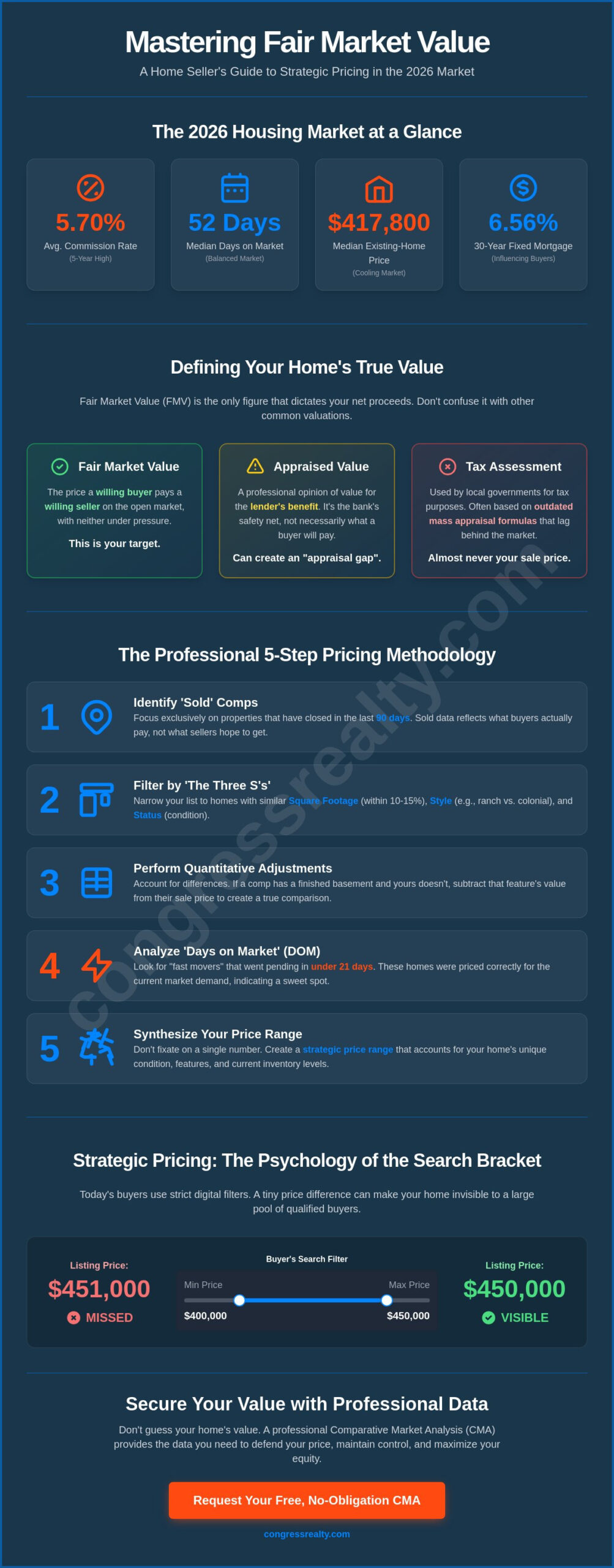
What is the actual price of your home? It isn’t the number on a tax bill or a speculative guess from an online algorithm. Understanding What Is Fair Market Value (FMV) is the first step toward a successful sale. Legally, FMV is the price that a willing buyer would pay a willing seller on the open market, provided neither is under pressure to act. In a cooling 2026 market where the median existing-home sales price is $417,800, getting this number right is the difference between a closed deal and a stale listing.
FMV is the only figure that truly dictates your final net proceeds. While you might have an emotional attachment to your property, the market remains objective. Today’s buyers are highly sensitive to interest rates, which sit at 6.56% for a 30-year fixed mortgage as of June 2026. This financial reality means buyers use strict digital search filters on the MLS. If your price is even slightly outside a major search bracket, like $450,000 versus $451,000, you could lose a significant portion of your potential audience. Determining fair market value for my home requires looking at these technical search habits just as much as the physical property itself.
With existing-home inventory at 4.4 months of supply, the market is more balanced than the frenzy of previous years. Homes are now sitting for a median of 52 days. This means you can’t afford to “test the market” with an inflated price. An accurate FMV ensures you capture attention in those critical first two weeks when buyer interest is at its peak. By focusing on data-backed values and professional fixed-fee listing models, you avoid the trap of price cuts that signal desperation to savvy buyers and their agents.
Market Value vs. Appraised Value
View an appraisal as the bank’s safety net. It’s a professional opinion of value required for a mortgage, but it doesn’t always reflect what a buyer is willing to bid. Market value is driven by emotion, competition, and current demand. If multiple buyers fall in love with your home, the market value might soar past the bank’s estimate. If that happens, you’ll need to know how to bridge the “appraisal gap” to protect your equity. Don’t let a conservative bank estimate dictate your ceiling when buyer demand suggests a higher price point.
Why Your Tax Assessment Is Not Your Sale Price
Your tax assessment is almost never an accurate reflection of what your home is worth today. Local governments use mass appraisal formulas that often lag behind the actual market by a year or more. Showing a buyer your tax assessment during negotiations can backfire. If the assessment is low, the buyer will use it as leverage to lowball you. If it’s high, it simply highlights a higher tax burden. When determining fair market value for my home, rely on recent “Sold” data from professional industry databases to justify your price rather than outdated government records.
How to Calculate Fair Market Value: A Step-by-Step Methodology
Pricing your home is a technical process, not an emotional one. To protect your equity, you must move beyond “gut feelings” and adopt a data-driven approach. When determining fair market value for my home, the goal is to replicate the logic a professional appraiser or a savvy buyer will use. Follow this structured five-step methodology to find your ideal listing price.
Step 1: Identify ‘Sold’ Comps. Look only at properties that have closed in the last 90 days. Active listings represent what sellers hope to get, but sold data represents what buyers are actually paying.
Step 2: Filter by ‘The Three S’s’. Narrow your list to homes with similar square footage (within 10-15%), style (don’t compare a ranch to a two-story colonial), and status.
Step 3: Perform Quantitative Adjustments. If a comparable home has a finished basement and yours doesn’t, you must subtract that value from their sale price to see how your home stacks up.
Step 4: Analyze ‘Days on Market’. With the national median at 52 days as of April 2026, look for homes that went pending in under 21 days. These “fast movers” indicate the price points currently triggering the most demand.
Step 5: Synthesize Your Range. Don’t settle on a single number. Create a strategic range that accounts for your home’s unique condition and current inventory levels.
This process aligns with official How to Calculate Fair Market Value protocols used by many state authorities. It ensures your price is defensible when a buyer’s agent tries to negotiate. If you want a professional head start, requesting a Comparative Market Analysis (CMA) can provide the verified data you need to skip the guesswork.
Selecting the Right Comparable Properties (Comps)
Ignore the “For Sale” signs in your neighborhood. Those prices haven’t been tested by a completed transaction yet. In the shifting 2026 market, where mortgage rates have recently fluctuated near 6.56%, the “90-day rule” is your best friend. Data older than three months likely reflects a different interest rate environment and won’t accurately predict today’s buyer behavior. Prioritize homes within your specific school district; even a half-mile difference can change the value if it crosses a district line.
Adjusting for Home Improvements and Deficiencies
Be honest about your home’s condition. While a new HVAC system adds peace of mind, it’s often considered an “invisible” upgrade that maintains value rather than spiking it. Conversely, a 10-year-old kitchen is no longer “new” in the eyes of a buyer. You must account for the depreciation factor. Assign specific dollar values to differences in lot size or curb appeal. If a comp has a professional landscape package and your yard is basic, adjust your target price downward to remain competitive. Determining fair market value for my home requires this level of objective scrutiny to ensure you don’t overprice and let the listing go stale.
The Limitations of Automated Valuation Models (AVMs)
Why do online estimates for the same house vary by tens of thousands of dollars? Most sellers start their journey by looking at a Zestimate or a Redfin Estimate, but these tools operate inside a “Black Box.” You cannot see the specific data points the algorithm chose or ignored. While some AVMs report high accuracy for cookie-cutter homes, that margin of error often widens to 15% or more for unique or rural properties. Determining fair market value for my home is a task that demands human intuition and verifiable data. Relying on an algorithm can lead to an unrealistic entry price and “listing fatigue.” With the median days on market reaching 52 days as of April 2026, an initial pricing error can derail your entire timeline. You need more than a guess to protect your equity.
The core problem with machine learning in real estate is its inability to prioritize context. An algorithm might see a home sale down the street and apply that price per square foot to your property without knowing your neighbor’s house was a complete fixer-upper. This lack of transparency forces you to trust a number you can’t explain. When you enter negotiations, “Zillow said so” is not a valid defense. You need a data-backed foundation that allows you to stand firm on your price with confidence.
Why Algorithms Miss Interior Condition
A computer cannot walk through your front door. It doesn’t know if you just installed premium hardwood floors or if the house needs a new roof. Algorithms miss the “feel” of a home, such as dated wallpaper or the quality of natural light. Determining fair market value for my home requires looking at these specific upgrades that a machine simply cannot quantify. While professional photography helps humans appreciate these details, a machine sees only pixels and metadata. Congress Realty uses CMAs to bridge this data gap, ensuring your price reflects the actual condition of your living space rather than just a zip code average.
AVMs and the ‘Herding’ Effect
AVMs are susceptible to the “herding” effect. If one neighbor sells their home at a massive discount due to a divorce or foreclosure, that single outlier can skew every automated estimate in your neighborhood for months. Sellers who trust these machines without verification often face forced price drops within the first 30 days of listing. To succeed, you need Strategic Pricing: Aligning FMV with Buyer Psychology. Always verify AVM data against actual MLS closing statements. This ensures your strategy is based on reality, not a mathematical glitch. Taking control of your data is the only way to safeguard your financial interests in a cooling market.
Strategic Pricing: Aligning FMV with Buyer Psychology
Pricing is more than just a calculation; it is a strategic marketing move. When you are determining fair market value for my home, you must think like a buyer browsing on a smartphone late at night. Most buyers use digital filters that move in $25,000 or $50,000 increments. If you price your home at $505,000, you are invisible to every buyer who capped their search at $500,000. By choosing $499,900 or even exactly $500,000, you capture two distinct search brackets. This strategy avoids the “no-man’s land” of pricing and keeps your listing active in the maximum number of search feeds.
The first 14 days of your listing are the most critical. This is when the “New Listing” alerts hit thousands of inboxes simultaneously. If you launch with an accurate FMV, you create a sense of urgency that motivates buyers to act. In a market where homes go to pending in around 21 days, a price that feels like a “deal” compared to local comps can trigger multiple offers. Conversely, pricing for a single, high-value buyer often leads to the 52-day median wait time or worse. Aim for a price that invites competition rather than one that tests a buyer’s patience. You want to lead the market, not chase it with price drops.
Understanding Search Algorithm Thresholds
Search engines on major platforms prioritize round numbers and specific thresholds. If you price at $501,000, you are effectively cutting your potential audience in half. Buyers rarely search for “up to $501k.” They search for “up to $500k.” Pricing just under or right on these thresholds ensures your home appears in the maximum number of saved searches. This psychological perception is what drives high click-through rates and more showings in your first week. It’s a simple adjustment that yields massive visibility.
The Danger of Emotional Pricing
Your home is a collection of memories, but to a buyer, it is a financial asset. Avoid the trap of pricing based on what you need to net for your next down payment or what you spent on that custom patio years ago. The market does not care about your labor costs; it only cares about current utility and demand. To remain objective, use a Comparative Market Analysis to ground your decisions in hard data. Separating your emotions from the transaction is the only way to protect your equity. Ready to see the data for yourself? Get your professional CMA today and start your listing with confidence.
Securing Your Value: The Professional CMA Advantage
Why should you rely on a professional Comparative Market Analysis (CMA) instead of a simple online estimate? A CMA is the gold standard for independent sellers because it uses the same verified industry databases that traditional agents use. When you are determining fair market value for my home, a CMA provides the technical justification for your price. It isn’t just a suggested number; it’s a comprehensive report that compares your property to recent sales with granular accuracy. This level of detail is essential for defending your equity during negotiations. If a buyer’s agent tries to lowball your offer, you can present the data-backed findings of your CMA to stand your ground.
A professional CMA protects your interests by:
Providing data-backed evidence to justify your price to skeptical buyers.
Identifying the most relevant local comps that algorithms often miss.
Allowing you to adjust for specific home improvements with dollar-for-dollar accuracy.
Accurate pricing is the single most effective way to protect your home equity. In a market where the median days on market is 52, you can’t afford to waste time with an incorrect price. Overpricing leads to stale listings, while underpricing leaves money on the table. Congress Realty provides the professional infrastructure of a traditional broker without the traditional 3% listing commission. This pragmatic approach allows you to retain the maximum amount of your equity while still benefiting from professional-grade transaction management. You maintain full command over the process, using the same tools as the pros to ensure a swift and profitable sale.
The Congress Realty Approach to Valuation
Our Standard and Full Service packages are designed to provide the specific valuation support you need to win. You’ll benefit from having a broker-owner oversee your transaction management, ensuring that every legal and logistical detail is handled correctly. This professional oversight gives you the confidence to manage the sale independently. Remember that listing on the MLS without a realtor requires professional-grade pricing to capture the attention of buyers and their agents. Determining fair market value for my home with our expert tools ensures your listing is competitive from the very first day.
Next Steps: From Valuation to Listing
Once you have synthesized your data into a strategic price range, you can transition to a live MLS listing in as little as 24 hours. Use this time to prepare your home to meet the FMV you’ve established. Professional photography, deep cleaning, and minor staging can help your property match the high-value comps in your CMA. When your home looks its best and is priced accurately, the market will respond. Take control of your financial future and stop paying for services you can manage yourself. Start your equity-first listing with Congress Realty today and experience a smarter way to sell.
Take Command of Your Home Equity Today
You now have the professional methodology needed to price your property with absolute precision. By focusing on recent sold data and understanding search algorithm thresholds, you can avoid the common pitfalls of overpricing or relying on flawed automated estimates. Determining fair market value for my home is no longer a guessing game; it’s a strategic advantage that puts you in control of your financial outcome. You don’t need a high-cost agent to tell you what your house is worth when you have access to the right data.
Congress Realty has provided broker-led transaction management since 2002. Our model is built specifically to empower independent sellers like you. Every listing package we offer includes a professional Comparative Market Analysis (CMA) to ensure your price is backed by the same industry databases the pros use. This allows you to save the traditional 3% listing commission while maintaining the professional infrastructure required for a successful sale. Stop leaving your equity to chance and start making informed, intelligent decisions.
How do I determine the fair market value of my home for free?
You can find a baseline by researching “Sold” listings on public real estate websites. Focus on properties within a half mile radius that closed within the last 90 days. While these free tools provide a ballpark figure, they often lack the depth of professional databases. For a more precise number, many sellers find that a professional Comparative Market Analysis (CMA) offers the accuracy needed to protect their equity.
Is fair market value the same as the Zestimate?
A Zestimate is a starting point, but it is not a legal or financial substitute for fair market value. Algorithms use public data that may not reflect recent interior upgrades or specific neighborhood nuances. Zillow reports a median accuracy of 2.4% for on-market homes, yet this margin can widen significantly for unique properties. Determining fair market value for my home requires a human touch to verify the data behind the machine’s guess.
Can I use an appraisal from two years ago to price my home today?
Avoid using old appraisals because the 2026 market is vastly different than it was two years ago. Mortgage rates for a 30-year fixed loan sit at 6.56% as of June 2026, which has significantly changed buyer purchasing power. Since median home prices have declined for five consecutive quarters, relying on outdated valuations will almost certainly lead to overpricing. You need fresh data from the last three months to stay competitive.
What happens if I price my home above fair market value?
Overpricing your home usually results in your listing sitting on the market for much longer than the national median of 52 days. When a house lingers, buyers assume something is wrong with the property, which often leads to lowball offers. You’ll likely end up chasing the market with price drops. It’s much more effective to launch with a data-backed price that triggers immediate interest and potential multiple offers.
How often does fair market value change in a hot market?
Fair market value can shift every few weeks depending on inventory levels and mortgage rate volatility. In May 2026, rates jumped to a nine-month high of 6.65% before stabilizing. These micro-shifts directly impact what buyers can afford to bid. If you’re in a high-demand area, check local “Pending” and “Sold” statuses every two weeks to ensure your listing price still aligns with the current reality.
Does a professional CMA guarantee my house will sell at that price?
A professional CMA provides a data-backed price range, but it is not a guaranteed sale price. It acts as a strategic map based on what other buyers have recently paid for similar homes. The final number depends on your home’s condition, your staging, and how well you negotiate. Think of the CMA as your defensive shield; it gives you the evidence needed to justify your asking price to skeptical buyers.
Should I include the cost of my recent renovations in the FMV?
Focus on the market’s perceived value of your upgrades rather than the actual amount you spent on labor and materials. Buyers don’t pay dollar-for-dollar for your costs; they pay for the finished result. For example, a minor kitchen refresh might offer a higher return on investment than a luxury pool in a mid-range neighborhood. Use your CMA to see how much “value-add” similar renovated homes actually commanded in recent sales.
How do I find ‘sold’ comps if I’m not a real estate agent?
You can access “Sold” data through public records or by using professional listing services that provide MLS-integrated reports. Determining fair market value for my home is much simpler when you use the same professional infrastructure as traditional brokerages. By looking at actual closing statements rather than just “Active” asking prices, you gain a clear, unfiltered view of what the market is truly willing to pay in 2026.
Did you know that selling a median-priced home can cost you tens of thousands of dollars in traditional real estate commissions? It’s a staggering figure that feels more like a penalty for your success than a fair price for a service. You’ve worked hard to build equity in your property, and watching a significant portion of it disappear at the closing table is a painful reality for many homeowners. If you’re looking for a way to get your home on the market without the heavy financial burden, a flat fee MLS listing is the smartest tool in your arsenal.
We understand that you want the maximum exposure of Zillow and Realtor.com without the hidden fees of discount brokerages. This guide will teach you how to leverage professional broker support and transaction management to sell your home like a pro. You’ll learn how to handle complex legal disclosures and use high-impact tools like electronic lockboxes to simplify your sale. By the end of this article, you’ll have a clear roadmap to bypass the traditional 3% listing commission and maximize your profit.
Key Takeaways
Stop paying for a brand name and start paying for results by using a professional flat fee mls listing arizona to access the same databases used by traditional agents.
Protect your home equity by replacing the standard 3% listing commission with a predictable, fixed-cost structure that puts you in command of your profit.
Master the logistics of a successful sale by utilizing professional photography and electronic lockboxes to manage showings securely and efficiently.
Gain the confidence of professional oversight with direct access to an experienced Arizona broker who ensures your transaction remains legally compliant.
Learn why offering a competitive buyer’s agent commission remains a strategic move to ensure maximum interest and a faster closing at the best price.
A flat fee mls listing arizona is a strategic real estate tool that allows you to list your home on the professional market for a one-time payment instead of a percentage-based commission. In a traditional sale, you typically lose 3% of your home’s value just to have an agent put your data into a database. This model disrupts that high-cost cycle. By paying a fixed fee, you gain full access to the professional infrastructure used by every licensed agent in the state. You maintain complete control over your equity while ensuring your property is visible to every serious buyer in the region.
This approach is fully supported by Arizona real estate law through what are known as “limited service” brokerage agreements. Unlike a “For Sale By Owner” (FSBO) attempt, which often lacks legal protections and market reach, a flat fee agreement provides a professional framework. The role of the Designated Broker is central here. They ensure your listing meets all state-wide professional standards and disclosure requirements. While you manage the showings and negotiations, the broker provides the necessary oversight to keep your transaction compliant and professional. This isn’t just a software upload; it’s a broker-backed entry into the professional marketplace.
The Difference Between Flat Fee and Traditional Brokerages
Traditional models operate on a 6% total commission structure. This is usually split into 3% for the listing agent and 3% for the buyer’s agent. When you choose a flat fee model, you immediately eliminate that 3% listing side commission. You keep that equity in your pocket. Despite the lower cost, there is no “service gap” in terms of visibility. Your property appears on major search portals exactly like a traditional listing. You receive the same professional exposure without the predatory pricing of legacy brokerage models.
Why the MLS is Essential for Arizona Sellers
The Multiple Listing Service (MLS) is the engine that drives the entire real estate market. When your home is listed here, the data syndicates automatically to Zillow, Trulia, and Realtor.com. This is vital because approximately 90% of buyers are represented by agents who rely exclusively on the MLS to find homes for their clients. MLS-sourced data carries significantly more weight than manual posts or “Zestimates” because it is verified and updated in real-time. Using this database ensures your home is seen by the right people at the right time with the most accurate information possible.
How the Flat Fee MLS Process Works in Arizona
Taking control of your home sale doesn’t mean you have to figure it out alone. The process for a flat fee mls listing arizona is designed for efficiency and transparency. It starts with you selecting a professional listing tier that matches your comfort level. Some sellers prefer a basic entry, while others opt for full-service support that includes transaction management. Once you’ve chosen your path, you’ll submit your property data, upload high-resolution photos, and complete the necessary state-required disclosures. This is your opportunity to showcase your home’s best features to the entire market.
After your submission, a licensed broker reviews your information to ensure it meets professional standards. They don’t just “post and ghost.” They verify that your listing is compliant and ready for the Arizona Multiple Listing Service. Once activated, your property is live and visible to thousands of buyer agents. You’ll manage inquiries directly and use an electronic lockbox to provide secure, trackable access for showings. When the offers start rolling in, you’ll evaluate the terms and move toward a successful closing with the confidence of an expert. If you want to see which level of support fits your goals, explore our listing options to get started.
Preparing Your Property Data
Accuracy is your best friend when preparing your listing. Ensure your square footage and bedroom counts are exact, as these are the primary filters buyers use during their search. A compelling description that highlights high-value upgrades like granite countertops or a new HVAC system can set you apart. You must also strictly adhere to Arizona real estate regulations regarding property disclosures. Providing a thorough Seller’s Property Disclosure Statement (SPDS) early in the process prevents post-sale liability and builds trust with potential buyers.
The Syndication Timeline
Speed is a major advantage of the flat fee model. Most brokers will have your listing live within one to two business days of receiving your completed paperwork. Once the broker hits “submit” on the MLS, a digital wave carries your data to over 100 real estate websites, including the big names like Zillow and Realtor.com. This ensures you don’t miss out on early interest from motivated buyers. Any updates you make to the price or property details in the MLS are usually reflected on third-party sites within 24 hours. This automated system keeps your marketing fresh and accurate across the entire internet without any extra effort on your part.
Flat Fee MLS vs. Traditional 6% Commission: The Math
Why should the cost of selling your home be tied to its value? In a traditional real estate model, you pay a variable percentage that punishes you for your home’s appreciation. If your property value goes up, your agent gets a raise, even if the workload remains exactly the same. A flat fee mls listing arizona flips this script by replacing the 3% listing commission with a predictable, fixed cost. This shift allows you to treat professional market access as a service rather than a tax on your hard-earned equity. When you stop thinking in percentages and start thinking in fixed costs, the financial advantage becomes undeniable.
Understanding What is a Flat Fee MLS Listing? is the first step toward reclaiming your profit. Under this model, the “listing side” of the commission is eliminated. However, it’s vital to distinguish between the listing agent’s fee and the Buyer Agent Commission (BAC). While you bypass the 3% listing fee, we still recommend offering a competitive 2% to 3% to the agent who brings the buyer. This ensures your home remains a priority for the thousands of licensed professionals searching the database for their clients. By separating these two costs, you maintain a competitive edge without overpaying for the listing itself.
Predictability is the ultimate benefit of this financial structure. Traditional sellers often encounter “sliding scale” surprises or high-pressure demands for extra services. With a flat fee mls listing arizona, your upfront costs are transparent. You choose your tier and know exactly what you’re paying before the sign goes in the yard. You should watch for minor add-ons like yard sign rentals or photo upgrades, but these are small, manageable expenses compared to the five-figure hit of a traditional commission. You keep the listing side equity where it belongs: in your bank account.
Calculating Your Potential Savings
The numbers tell a compelling story. Consider a $500,000 home sale in the Phoenix or Scottsdale market. A traditional 3% listing commission would cost you $15,000 at the closing table. By choosing a flat fee model, you keep nearly that entire amount. How much does the realtor make? In the traditional model, they make enough to cover your next down payment. Reinvesting that $15,000 can cover your moving costs, fund a kitchen upgrade in your new house, or simply bolster your retirement savings.
Why Offering a Buyer Agent Commission Matters
You don’t want to save money at the expense of market reach. Offering a BAC incentivizes the buyer agent community to prioritize your home. When an agent sees a fair commission offer in the MLS, they’re more likely to show your property to their motivated buyers. In Arizona’s shifting market, staying competitive means playing by the rules of the professional database while refusing to pay for redundant listing services. You provide the incentive for the buyer’s side while retaining your autonomy on the listing side.
Essential Features for a Successful Flat Fee Listing
How do you ensure your listing doesn’t just sit on the market? Success requires more than just a digital entry. It demands a suite of professional tools that signal quality to both buyers and their agents. When you utilize a flat fee mls listing arizona, you aren’t sacrificing professional standards. Instead, you’re choosing which high-impact features to deploy to maximize your sale. By focusing on the same tools used by top-tier traditional agents, you maintain the professional edge needed to secure a high-value offer while keeping your equity intact.
A professional yard sign and post also play a vital role in your local marketing strategy. While digital exposure is massive, signaling to the neighborhood that the property is officially on the market invites word-of-mouth leads and local interest. This physical presence, combined with a robust online profile, creates a comprehensive marketing umbrella that leaves no stone unturned. You’re the one in charge, but these tools provide the professional infrastructure that makes your independence possible and profitable.
Leveraging Professional Photography and CMA
First impressions happen in milliseconds. Using cell phone photos often leads to lower offers and longer days on the market because buyers associate poor imagery with a lack of property care. High-resolution images do more than just look pretty; they build a digital narrative that justifies your asking price. Professional photography is the single most important factor in click-through rates on Zillow and Realtor.com. Without it, your equity is at risk from low-ball offers.
Pair these visuals with a Comparative Market Analysis (CMA). A CMA uses real-time data from recent sales to help you avoid the “overpricing trap” that kills initial momentum. You want to hit the market with a price that is both aggressive for your equity and attractive to buyers. Check out our guide on pricing your home for the MLS to ensure you start strong and stay competitive.
Showings and Transaction Management
Efficiency is the key to a smooth closing. Electronic lockboxes are essential for providing secure, trackable access to buyer agents without requiring your physical presence. These devices log every entry. They give you peace of mind and professional accountability. You can see exactly which agent entered your home and when, which is a level of security traditional “combo” boxes simply can’t provide.
Managing the paperwork is often the most daunting part of a solo sale. Transaction management services bridge the gap between a handshake and a successful wire transfer. They track the critical dates that, if missed, could jeopardize your contract. You need to ensure all Arizona-specific legal forms are completed correctly for the file to prevent post-sale liability. By leveraging these professional tools, you maintain command over the process while enjoying the support of a structured transaction framework. Ready to equip your sale with the best tools in the industry? Browse our professional listing packages today to get started.
Why Savvy Sellers Choose Congress Realty in Arizona
Why trust a newcomer when you can work with a pioneer? Founded in 2002, Congress Realty has spent over two decades refining the way homeowners sell. We aren’t just a tech platform that uploads your data and disappears. When you choose a flat fee mls listing arizona through us, you’re partnering with Andrew English, our Designated Broker. This provides you with direct access to professional oversight and industry expertise that a simple software-only service cannot match. You get the protection of a licensed brokerage with the freedom of an independent sale.
We believe in providing options that respect your autonomy. Some sellers are comfortable managing every detail themselves, while others want the security of professional transaction management. That’s why we offer tiered service options. You can choose our “Standard” listing for a streamlined, efficient experience or opt for our “Full Service” package if you want a dedicated partner through the closing process. Regardless of your choice, our commitment remains firm: you pay no 3% listing commission. Every dollar of that saved equity stays exactly where it belongs: in your pocket.
The Congress Realty Advantage
We bridge the gap between modern efficiency and traditional reliability. While we leverage the latest syndication technology to blast your home across the web, we maintain the professional standards of a legacy brokerage. Our proven track record across the state includes thousands of successful closings since 2002. We provide the comprehensive support you need, from the initial listing entry to the final signatures. This isn’t a “one-size-fits-all” model. It’s a tailored approach designed for the modern, independent seller who values both their time and their equity.
Getting Started with Your Arizona Listing
Ready to take command? The first step is selecting the package that aligns with your specific goals and comfort level. Our onboarding process is intentionally simple. We’ve stripped away the complexity and the high-pressure sales tactics common in the traditional industry. Once you submit your information, we move quickly to get your home live on the professional database. Don’t let another day of equity slip away to outdated commission models. Take the final step to save your equity in 2026 and experience the freedom of selling on your own terms with professional backing.
Take Command of Your Arizona Home Sale Today
Selling your home shouldn’t mean handing over your hard-earned equity to an outdated commission model. You now have the roadmap to maintain professional visibility while keeping thousands of dollars in your pocket. By choosing a flat fee mls listing arizona, you’re opting for financial intelligence over industry tradition. You’ve learned that you don’t have to sacrifice quality; high-impact tools like professional photography and electronic lockboxes ensure your listing stands out and remains secure throughout the process.
Congress Realty has been a trusted ally for homeowners since 2002. Broker Andrew English has overseen thousands of successful listings, providing the A+ rated service and professional oversight you need to navigate the market with ease. You get the perfect blend of modern efficiency and veteran experience without the burden of a 3% listing commission. Stop letting legacy fees drain your profit at the closing table. List Your Arizona Home on the MLS with Congress Realty Today and start your journey toward a smarter, more profitable sale. You have the tools, the data, and the professional backing to succeed. It’s time to take control of your future.
Frequently Asked Questions
How much does a flat fee MLS listing in Arizona cost?
The cost depends on the level of support and professional tools you choose for your sale. A flat fee mls listing arizona replaces the traditional 3% listing commission with a one-time upfront payment, though the exact amount varies between standard entry and full-service packages. This fixed-cost structure ensures you know your expenses from day one, allowing you to protect your equity rather than losing it to a variable percentage at the closing table.
Can I list on the MLS without a realtor in Arizona?
No, you must work with a licensed broker to gain access to the professional database. The MLS is a restricted tool reserved for real estate professionals, but a flat fee service provides a “limited service” agreement that bridges this gap. You get the professional entry you need to reach buyers while maintaining full command over your showings and negotiations, effectively bypassing the high costs of a traditional listing agent.
Will my home show up on Zillow and Realtor.com with a flat fee listing?
Yes, your property will receive the exact same online exposure as any traditional listing. These major search portals pull their data directly from the MLS, so once your broker activates your file, your home syndicates to hundreds of websites automatically. This ensures your home is visible to millions of potential buyers on Zillow and Realtor.com without requiring you to pay a legacy 3% listing commission for that visibility.
Do I still have to pay a commission to the buyer’s agent?
You should plan to offer a commission to the agent who brings the buyer to stay competitive in the Arizona market. While a flat fee mls listing arizona eliminates the listing side commission, offering 2% or 3% to the buyer’s agent incentivizes the professional community to show your home. This strategy ensures your property remains a priority for agents working with qualified buyers, helping you secure a faster closing at a better price.
What happens if I find a buyer myself without an agent?
You save the entire commission if the buyer is unrepresented. In this scenario, you avoid both the listing side fee and the buyer side commission, which can save you tens of thousands of dollars in equity. You’ll still benefit from our professional infrastructure to ensure your paperwork and legal disclosures are handled correctly, providing a secure and profitable framework for your completely independent transaction.
Is Congress Realty a licensed brokerage in Arizona?
Yes, Congress Realty is a fully licensed real estate brokerage that has been operating in Arizona since 2002. We aren’t a third-party referral site; we provide direct professional oversight through our Designated Broker, Andrew English. This gives you the confidence of working with a veteran organization that has overseen thousands of successful listings while maintaining an A+ rated service standard across the industry.
Can I make changes to my MLS listing after it goes live?
You can update your listing details, price, or photos at any time to keep your marketing fresh. Whether you need to adjust your asking price based on a recent CMA or upload new professional photography, the process is simple and efficient. Most changes are processed by the broker quickly and reflect on syndicated websites like Zillow within 24 hours, ensuring your data stays accurate for potential buyers.
How long does a flat fee MLS listing stay active?
Listing durations typically range from six months to a full year depending on the package you select. This timeframe gives you plenty of room to find the right buyer without the pressure of a traditional agent’s short-term contract. If your home hasn’t sold within the initial term, you often have the option to extend your listing, ensuring you maintain professional market presence until your transaction is successfully closed.
If you sell a $400,000 home today, you’ll likely hand over $22,800 in commissions. Despite the headlines about legal settlements in 2024 and 2025, the national average real estate commission reached 5.70% in February 2026. You are probably asking yourself: how much does the realtor make and why is so much of your hard-earned equity disappearing? It’s frustrating to feel like your home’s value is a “black box” where thousands of dollars vanish at the closing table without a clear explanation.
We agree that you deserve total transparency and control over your financial future. This article promises to reveal exactly how commissions are calculated in the current market, who really gets paid, and how you can safeguard your equity from high fees. You’ll discover the truth about typical commission rates, the rebound of buyer agent fees to 2.82%, and how a flat fee MLS listing helps you keep thousands saved while you control your sales process. Understanding these numbers is the first step toward a simple, rewarding, and highly profitable sale.
Key Takeaways
Understand why realtors operate as independent contractors and how this performance-based model impacts your final closing costs.
Deconstruct the traditional commission split to see exactly how much does the realtor make compared to their brokerage and the buyer’s agent.
Navigate the post-2024 legal landscape with clarity on new buyer agency requirements and the end of mandatory MLS compensation offers.
Identify the “Value Gap” in full-service listings and learn why the digital age makes paying a 3% listing fee unnecessary for most savvy sellers.
Master the Flat Fee MLS model to list your home professionally and keep thousands in equity while you lead the transaction.
Understanding Realtor Compensation: Salary vs. Commission
Most people assume real estate agents receive a steady paycheck for their time. That isn’t how it works. Almost all agents operate as independent contractors. They don’t have a base salary, health benefits, or a 401(k) provided by their brokerage. Instead, they rely entirely on performance-based pay. If a deal doesn’t close, the agent earns exactly zero dollars for the weeks or months of work they invested. This high-risk model is the primary reason traditional commissions remain so high. When asking how much does the realtor make, you have to look past the total commission check to see the actual net profit.
It helps to understand the hierarchy of the industry. A real estate agent is licensed to help people buy and sell property. A broker has additional education and can own a firm. A REALTOR® is simply an agent or broker who belongs to the National Association of Realtors and agrees to their code of ethics. Regardless of the title, real estate agent compensation usually flows through the brokerage first. The brokerage takes a significant cut before the agent ever sees a dime.
The Median Earning Reality in 2026
As of February 2026, the national average real estate commission rate sits at 5.70%. While this sounds like a massive payday, the median income for agents remains modest. New agents often struggle, while the top 10% of earners handle the majority of high-volume market transactions. In Texas, the average commission is even higher at 5.88% as of April 2026. This geographic variation means an agent in Austin or Dallas might have a higher income potential than one in a lower-demand rural area, but their cost of living and marketing expenses scale upward as well.
Fixed Expenses That Eat Into Agent Pay
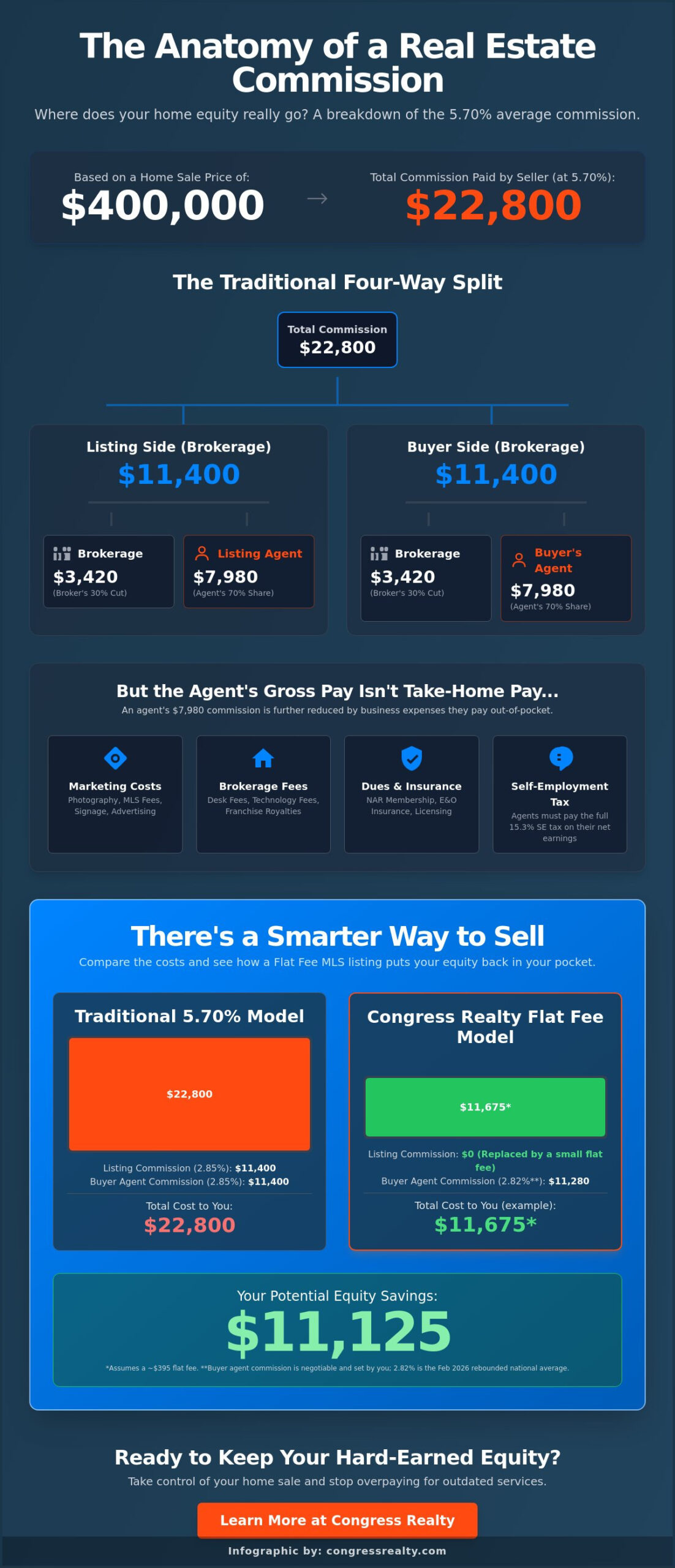
The gross commission is never the “take-home” pay. First, the brokerage typically takes a split ranging from 20% to 50% of the agent’s portion. After that, the agent must cover their own overhead. These costs include:
Brokerage Fees: Monthly “desk fees” and franchise royalties paid regardless of sales.
Marketing Costs: Professional photography, signage, and premium LOCAL MLS placement for listings.
Dues and Insurance: Mandatory NAR membership dues and Errors and Omissions (E&O) insurance.
Taxes: Since they are self-employed, agents must pay the full 15.3% self-employment tax.
When you calculate how much does the realtor make after these deductions, the “big check” at closing looks much smaller. However, as a homeowner, you shouldn’t have to subsidize an agent’s inefficient business model with your hard-earned equity. You can choose a smarter path that keeps your money where it belongs: in your pocket.
The Anatomy of a Commission: Where Your Money Goes
Have you ever wondered why the standard commission feels like a massive lump sum? While the national average as of February 2026 is 5.70%, that money rarely goes to just one person. In states like Texas, the average is even higher at 5.88% as of April 2026. Historically, the seller has paid the entire bill for both the listing agent and the buyer’s agent. This practice stems from a long-standing industry standard where the listing brokerage shares a portion of the total fee with the firm that brings the buyer. Even with recent legal shifts and scrutiny from the Department of Justice on NAR settlement, many sellers still feel pressured to cover both sides to ensure their home gets maximum visibility on the LOCAL MLS.
The Four-Way Split Explained
Imagine a $400,000 home sale with a 5.70% commission totaling $22,800. This amount is typically split 50/50 between the listing brokerage and the buyer’s brokerage. From there, each firm takes its own cut. The “Broker of Record” at each office manages the funds and ensures legal compliance. If an agent is on a 70/30 split with their firm, they only keep 70% of their half. After everyone takes their piece, the individual agent might walk away with just 1.5% to 2% of the total sale price. When people ask how much does the realtor make, they often overlook these layers of middle management taking a bite out of the equity.
Transaction Costs and Referral Fees
The drain on your equity doesn’t stop at the brokerage split. Many agents pay high referral fees to acquire clients. If an agent gets a lead from a relocation company, they might lose 25% to 35% of their commission right off the top. Similarly, leads from platforms like Zillow or Opcity come with a heavy price tag for the agent. There are also administrative costs, like transaction coordination fees, that appear at closing. These hidden layers of the traditional model explain why agents fight so hard for high commissions. You shouldn’t have to pay for an agent’s marketing debt or their office’s franchise royalties. You can choose to list on the MLS without a realtor and bypass these expensive corporate structures entirely.
By understanding these mechanics, you can see why the traditional model is so expensive. It’s designed to support a heavy corporate infrastructure, not just to sell your home. When you calculate how much does the realtor make versus how much you actually keep, the value of a flat-fee approach becomes clear. If you’re still wondering what is a flat fee and how fixed-cost real estate pricing works, understanding the contrast with the traditional commission model is the perfect starting point. You keep your hard-earned equity while still getting the professional exposure you need to close the deal.
How the 2024 NAR Settlement Changed Agent Pay Forever
The August 2024 settlement wasn’t just a legal footnote. It fundamentally shifted the power dynamic back to you, the homeowner. For decades, the industry operated on a “pay-to-play” model where sellers had to offer a set fee to buyer agents just to get on the MLS. That mandate is gone. Now, commissions are “decoupled.” This means each party is responsible for their own representation. You finally have a clear view of how much does the realtor make on each side of the deal. Transparency is the new standard, and it’s about time.
Agents must now be explicit about their fees. Before a buyer even tours your home, they must sign a written agreement with their agent. This document clearly states the agent’s compensation. This prevents the old “hidden fee” trap where buyers thought their agent’s services were free. When you understand how much does the realtor make in this new landscape, you’ll see that the 6% “standard” is a relic of the past. You are in the driver’s seat.
New Rules for the Multiple Listing Service (MLS)
The most visible change is the total removal of buyer agent compensation fields from the Multiple Listing Service. Agents can no longer use the MLS database to guarantee their payday. However, sellers can still offer “seller concessions.” This is a specific dollar amount or percentage you agree to pay toward the buyer’s closing costs. By early 2026, this has become the standard way to maintain listing visibility while keeping the ability to negotiate. You Control Your Sales Process by deciding exactly how much of a concession to offer, if any.
Negotiating the Buyer Agent Fee
You are no longer the default bank for the buyer’s representative. While the average buyer’s agent commission rebounded to 2.82% by February 2026, it is entirely negotiable. You can offer a competitive rate to attract more buyers, or you can offer 0% and let the buyer handle their own agent’s fee. Offering 0% is a bold move that keeps more equity in your pocket, but it can shrink your pool of potential buyers. Many buyers in 2026 struggle with down payments and can’t afford to pay their agent out of pocket. Using commission savings as a leverage tool allows you to close the deal on your terms without being forced into a 3% “standard” that no longer exists. If you want to take full control of the process, learning how to sell your house on your own gives you the knowledge to navigate these negotiations with confidence.
The Real Cost of Full-Service Brokerages for Sellers
Paying a 3% listing fee was standard when agents held the keys to all the data. In 2026, that’s no longer the case. Buyers find homes themselves on Zillow and other major portals. These sites pull data directly from the LOCAL MLS automatically. When you consider how much does the realtor make for simply uploading photos and managing a few digital documents, the “Value Gap” becomes glaringly obvious. Traditional brokerages still charge as if they are doing the manual legwork of the 1990s. This outdated model assumes you can’t handle basic communication or schedule a few showings on your own.
This model has turned full-service representation into a luxury choice rather than a necessity. You don’t need a high-commission agent to “find” a buyer. The internet does that for you. Professional oversight is still valuable, but you shouldn’t have to pay a percentage of your home’s total value for it. A flat fee or a reduced rate makes more sense for the savvy, independent property owner who wants to stay in control. It’s about paying for the infrastructure you need, not the hand-holding you don’t. For a comprehensive look at how to approach selling a home in 2026 while maximizing your equity, understanding where the traditional model falls short is the critical first step.
What You Are Actually Paying For
Most full-service agents justify their 3% fee by listing several “premium” services. However, a closer look reveals these tasks are often streamlined or outsourced. You are essentially paying a massive premium for an agent to coordinate these basic logistics:
Professional photography: Agents usually hire a third-party photographer for a few hundred dollars; they don’t take the photos themselves.
Comparative Market Analysis (CMA): Modern software generates these pricing strategies in minutes using recent sales data.
Transaction Management: Digital signature platforms have made contract handling and documentation services incredibly simple for anyone to manage.
The High Cost of Traditional Listing
Let’s look at the math. On a $500,000 home sale, a 3% listing commission is $15,000. If an agent spends 20 hours total on your listing from start to finish, you are effectively paying them $750 per hour. That is more than most specialized attorneys or surgeons earn. When you calculate how much does the realtor make per hour of actual labor, the cost is staggering. It’s a high price to pay for a service that has been largely automated by technology.
The Equity Drain is the unnecessary loss of home profit caused by paying percentage-based fees for tasks that no longer require manual, full-service labor.
You can protect your profit. Stop the drain and save your equity in 2026 by choosing a more efficient, flat-fee model that keeps you in control of your sales process.
Empowering Sellers: How to Keep Your Equity with Flat Fee MLS
You’ve seen the breakdown of the 5.70% national average and the 5.88% Texas rate. You know exactly how much does the realtor make from your equity. Now it’s time to take that money back. The Flat Fee MLS model is the ultimate tool for the financially intelligent homeowner. It provides the same professional exposure as a traditional brokerage without the 3% listing cut. You get your property on the LOCAL MLS, which then syndicates to Zillow, Realtor.com, and hundreds of other sites. This ensures every active buyer in your market sees your home within minutes of it going live.
You can list on MLS without a realtor while maintaining full professional parity. Congress Realty provides the necessary infrastructure to make the process easy and efficient. We offer electronic lockboxes that track every agent who enters your home for your peace of mind. Our CMA support gives you the same pricing data traditional agents use to help you set a competitive price. You aren’t sacrificing quality; you’re simply cutting out the middleman’s overhead. You stay in the driver’s seat throughout the entire transaction.
Standard vs. Full Service Flat Fee
We offer tiered packages because every seller has a different comfort level. A standard listing works for the DIY expert who just needs the data feed to the major portals. A full-service flat fee model adds professional photography and dedicated transaction management. Professional photography is the highest-ROI add-on you can choose. It’s the first thing buyers see on the LOCAL MLS, and it drives the first impression. For complex closings, having a transaction coordinator ensures your documentation services are perfect. This professional facilitator handles the legal paperwork while you lead the negotiations. To get a deeper understanding of how these pricing structures compare to traditional commissions, our complete guide explaining what is a flat fee in real estate and how fixed-cost models protect your equity walks you through every detail.
The Financial Impact of Going Flat Fee
The math is simple and rewarding. On a $400,000 home, a traditional 6% commission drains $24,000 from your profit. That’s a massive amount of money to hand over at the closing table for services you can largely manage yourself. With a flat fee listing, you pay a predictable rate and decide how much to offer the buyer’s agent. Even if you offer the 2.82% average to a buyer’s agent to attract more traffic, you still keep over $12,000 in your pocket. That is money you can use for your next down payment or your retirement savings. Homeowners who want to go even further can follow a step-by-step approach to sell your house on your own in 2026 and reclaim every dollar of unnecessary commission.
Stop wondering how much does the realtor make and start focusing on how much you keep. Our platform is a smart, utilitarian tool for the savvy property owner. Congress Realty helps you “Control Your Sales Process” from the initial listing to the final closing. It’s time to list your home on the local MLS today and experience a simple, rewarding, and highly profitable sale.
Take Back Your Home Equity
The real estate landscape shifted permanently after the August 2024 settlement. You don’t have to accept the 5.70% national average commission as an unavoidable cost of selling. By identifying the “Value Gap” in traditional listings, you can protect your equity from high fees. Stop worrying about how much does the realtor make and start deciding how much you want to keep. You have the power to negotiate and the right to transparency at every stage of the transaction.
Congress Realty has championed homeowners since 2002. With over two decades of expertise, we provide the professional infrastructure you need without the corporate bloat. You get direct broker support from Andrew English and access to tiered packages featuring professional photography and transaction management. You Control Your Sales Process while keeping your profit where it belongs. Our platform is a smart, utilitarian tool designed for the savvy property owner who values autonomy.
Selling your property should be a simple, rewarding victory. You have the data, the tools, and the right ally to secure your financial future. Take charge of your sale and move forward with total confidence.
Frequently Asked Questions
Do I have to pay the buyer’s agent commission in 2026?
No, you aren’t required to pay the buyer’s agent commission. Since the 2024 settlement, commissions are decoupled, meaning each party is responsible for their own representative. While the average buyer agent fee reached 2.82% in early 2026, you can choose to offer 0% or provide a specific seller concession to help the buyer cover their agent’s costs.
Can I negotiate the percentage a realtor makes?
Yes, all real estate commissions are negotiable by law. There is no such thing as a “standard” 6% fee. While a February 2026 survey showed a national average of 5.70%, you have the right to negotiate this number down or opt for a flat-fee service that keeps your equity intact.
What is the difference between a flat fee and a commission?
A flat fee is a fixed, predictable price you pay upfront for specific services like a LOCAL MLS listing. A commission is a percentage-based fee that scales with your home’s sale price. Flat fees provide transparency and massive savings, while commissions often result in you paying more for the same amount of work as your home value increases.
How much does a realtor make on a $400,000 house?
On a $400,000 home, the total commission at the 5.70% national average is $22,800. This total is split between two brokerages. When asking how much does the realtor make individually, the listing agent typically keeps about 1.5% to 2% of the sale price after their broker takes a 20% to 50% cut of the agent’s portion.
Is it legal to sell a house without a realtor?
Yes, it’s entirely legal to sell your home without a traditional full-service agent. You have the right to represent yourself and manage your own negotiations. Using a flat-fee listing service gives you the professional exposure of the MLS without the high cost of a 3% listing commission, allowing you to stay in total control.
Why do realtors charge so much if I found the buyer myself?
Traditional listing contracts often include an “exclusive right to sell” clause. This means the broker gets paid regardless of who finds the buyer. This outdated model ignores the reality that 90% of buyers find homes online themselves. You can avoid this trap by using a flat-fee model that doesn’t penalize you for your own marketing efforts.
What happens if my house doesn’t sell-do I still owe the realtor money?
With a traditional commission model, you typically don’t owe a fee unless the deal closes. However, you’re often tied to a long-term contract that prevents you from trying other options. Flat-fee services require a small upfront payment for the listing, but they don’t lock you into a massive percentage-based debt if the home doesn’t sell.
Can I list on the MLS for a flat fee and still offer a buyer agent commission?
Yes, this is the most effective way to save money while maintaining high visibility. You pay a small flat fee to list your home professionally and then decide how much does the realtor make on the buyer’s side. Offering a competitive buyer agent commission or concession ensures that agents remain motivated to show your property to their clients.
Why would you hand over $17,000 or more of your hard-earned equity just for the “privilege” of selling your own home? With the national average real estate commission sitting at 5.70% as of April 24, 2026, the traditional model is a massive drain on your final profit. You likely feel that the old way of selling is broken, especially with the recent NAR settlement changing how buyer agent compensation works. It’s natural to worry about legal paperwork or exposure, which is why finding a reliable how to sell a house by owner checklist 2026 is the first step toward your financial freedom.
This guide is your professional-grade roadmap to bypassing the standard 2.88% listing commission while maintaining total control. We promise to show you how to master the for-sale-by-owner process using the same tools the pros use, like the Local MLS and professional photography. You’ll gain the confidence to handle every step from pricing to closing. This checklist previews the exact path to a smooth, legally sound sale that ensures thousands saved and puts you back in the driver’s seat of your own transaction.
Key Takeaways
Learn how to conduct a professional property audit and gather critical financial documents to build buyer confidence before your first showing.
Discover how to leverage a Flat Fee MLS listing and professional photography to gain maximum digital exposure without paying a 3% listing commission.
Master our comprehensive how to sell a house by owner checklist 2026 to navigate updated commission rules and legal requirements with total confidence.
Find out how to use electronic lockboxes and structured scheduling to manage professional showings while you maintain total control of the process.
Streamline your path to the closing table by utilizing expert transaction management services to track every legal deadline and documentation requirement.
Step 1: Pre-Listing Preparation and Valuation
Successful sales start with a solid foundation. You’re shifting from “homeowner” to “project manager,” and your first move in this how to sell a house by owner checklist 2026 is gathering the data that proves your home’s value. Buyers in 2026 are highly analytical and they want to see the receipts. Start by identifying “confidence-building” repairs, like fixing a leaky roof or updating an electrical panel, which differ from “presentation” repairs like fresh paint. While presentation helps you get an initial offer, confidence-building repairs ensure the deal doesn’t fall through during the inspection. Taking this proactive approach puts you ahead of traditional listings where agents often wait for the inspection report to react.
The Documentation Audit
Don’t wait for a buyer to ask for paperwork. Compile a digital and physical folder containing your mortgage payoff statement, HOA bylaws, and recent utility bills. If you’ve made significant upgrades, like a new HVAC system installed in 2025, include those receipts to justify a higher asking price. Verifying your property surveys and boundary maps now prevents expensive legal disputes later. You should also prepare a draft of the Seller’s Disclosure Notice early. This transparency is a hallmark of the For Sale By Owner (FSBO) process. It builds immediate trust with potential buyers and their agents, showing them you’re a prepared and professional seller.
Pricing for the 2026 Market
Setting the right price is a science, not a feeling. With home price growth forecast to be flat or modest at 0% to 3% in 2026, overpricing is a dangerous mistake that leads to “stale” listings. You need to analyze recent sales of similar homes in your immediate neighborhood from the last six months to stay relevant. The most effective way to do this is through a Comparative Market Analysis (CMA). This report provides the same data traditional brokers use, allowing you to set a price that reflects true market value. Because you aren’t paying a 3% listing commission, you have more flexibility to price competitively while still walking away with higher net proceeds. This is a critical step in your how to sell a house by owner checklist 2026 because it defines your entire negotiation leverage from day one.
Step 2: Maximizing Market Exposure via the MLS
You can’t sell what people can’t see. While a yard sign is a great local signal, it won’t reach the buyer moving from across the country or the agent searching for their client’s next home. To truly compete, your property must appear on the Local MLS. This is the “source of truth” for the real estate industry. By securing a Flat Fee MLS listing, you place your property on a level playing field with high-commission listings. This approach is a core pillar of any how to sell a house by owner checklist 2026 because it ensures your home automatically syndicates to Zillow, Realtor.com, and hundreds of other major search portals. You retain total control of your sales process while bypassing the traditional 3% listing commission. Note that in 2026, the MLS no longer displays buyer agent commission offers, which gives you more leverage to negotiate these terms directly with interested parties.
Writing your property description requires an objective, asset-focused mindset. Avoid fluff and focus on concrete details that add value. Mention the 2025 roof replacement, the quartz countertops, or the proximity to top-rated schools. Buyers in 2026 are looking for clarity and transparency. If you provide a clear, professional description alongside your listing, you reduce the friction of the transaction and attract higher-quality inquiries. This is about working smarter, not harder, to reach the widest possible buyer pool.
The Power of Professional Media
First impressions happen in milliseconds on a smartphone screen. High-resolution professional photography is the single most important factor in your click-through rate. In 2026, buyers expect more than just static images. They want to see detailed floor plans and 3D walkthroughs to pre-screen the property before they ever request a showing. This saves you time by filtering out “looky-loos” and focusing only on serious, qualified buyers who already know the layout of your home. If your photos are dark, cluttered, or blurry, buyers will swipe past your listing regardless of the price. Investing in professional media is a pragmatic move that pays for itself by driving higher demand and faster offers.
Strategic MLS Listing Management
Once your home is live, active management is the key to success. You need to choose the right package for your specific needs, whether it’s a Standard Listing for the seasoned DIY seller or a Full Service Listing for those who want professional transaction support. Accuracy in your listing data is vital for a smooth closing. Double-check that your contact information is correctly displayed so buyer agents can reach you directly for questions or showing requests. In the fast-moving 2026 market, you must update your listing status immediately as offers arrive. This maintains your professional reputation and prevents wasted time for all parties involved. If you’re ready to take charge, you can list your home on the MLS today and start saving thousands.
Step 3: Managing Showings and Buyer Inquiries
Managing the flow of potential buyers is often the part of the how to sell a house by owner checklist 2026 that homeowners dread most. Traditional agents want you to believe that managing showings is an impossible disruption. It isn’t. It’s simply a matter of using the right professional infrastructure. By taking charge of your own schedule, you ensure that every person walking through your door is a serious contender rather than a “looky-loo” just passing by. This level of oversight protects your time and your property.
Establish a clear showing window that works for your life. You don’t have to be available 24/7. In fact, setting specific times for tours can create a sense of urgency among buyers. After each visit, send a quick digital survey to the buyer or their agent. Analyzing this feedback allows you to make real-time adjustments to your presentation or price. If three different people mention the same minor issue, fix it immediately. This data-driven approach is how savvy owners close deals faster than those relying on a traditional agent’s intuition. You control your sales process, and that includes who enters your home and when.
Security and Accessibility
Safety and security are paramount when you manage your own sales process. Forget the old-fashioned mechanical lockboxes with four-digit codes that never change. Instead, install an electronic lockbox. These devices provide secure, tracked access for buyer agents, sending you an immediate alert when someone enters and exits. You’ll know exactly who was in your home and when. For your external presence, a professional yard sign and post installation signals to the neighborhood that you’re a serious seller. This combination of digital security and physical visibility ensures a professional environment for every viewing without the high cost of a traditional broker.
Vetting Potential Buyers
Don’t let anyone through the door without proof of their ability to pay. This is a non-negotiable rule in 2026. For buyers with financing, require a current pre-approval letter from a reputable lender. For cash offers, ask for a recent bank statement showing proof of funds. Managing these inquiries through a dedicated email address or phone line keeps your personal life separate and organized. By filtering out unrepresented buyers who haven’t started their mortgage process, you focus your energy on qualified, ready-to-act buyers. This pragmatic vetting process is what separates successful sellers from those who get stuck in listing limbo. Using this how to sell a house by owner checklist 2026 ensures you act like a pro at every step.
Step 4: Navigating Offers and 2026 Commission Rules
Receiving your first offer is the moment your hard work pays off, but it’s also where the most critical financial decisions happen. In the 2026 real estate market, the landscape of offers has shifted significantly. You aren’t just looking at the top-line number anymore. You must evaluate the entire Purchase Agreement to understand the true value of the deal. This part of the how to sell a house by owner checklist 2026 requires a pragmatic look at contingencies, timelines, and the buyer’s financial strength. Don’t be afraid to pick up the phone and call the buyer’s lender directly to verify their ability to close. A high offer means nothing if the financing is shaky or the appraisal won’t support the price.
Negotiation is a professional skill you can master with the right data. While traditional agents might push you to accept the first offer to collect their commission, you have the freedom to hold out for the best terms. Counter-offer on items like the earnest money deposit or the length of the inspection period. Increasing the earnest money shows the buyer is serious and has “skin in the game.” If you want to keep more of your equity, you can save thousands by managing your own negotiations instead of paying a listing agent to do it for you.
The Negotiator’s Checklist
Price: Compare the offer against the CMA-backed valuation you established in Step 1. If the offer is lower, use your data to justify your price.
Contingencies: Every contingency is an “out” for the buyer. Look for offers with fewer hurdles, such as waived inspections or shorter appraisal windows.
Timeline: Ensure the closing date aligns with your move-out plans. A flexible buyer is often worth more than a slightly higher price with a rigid schedule.
Handling Buyer Agent Commissions
The 2026 market is defined by commission transparency. Following the NAR settlement, buyer agent compensation is no longer advertised on the MLS. This gives you immense leverage. While the average buyer’s agent commission was 2.42% as of late 2025, you are not required to pay this. You must decide whether to offer a flat fee, a smaller percentage, or no commission at all. Some buyers may even include a request for you to cover their agent’s fee within their offer. Write a clear, concise sentence in your response explaining your stance. Being direct prevents confusion and ensures you maintain the financial advantage. Remember, every dollar you don’t pay in commissions is a dollar that stays in your pocket at the closing table.
Step 5: Closing and Transaction Management
Traditional brokers often claim the closing table is where you’ll fail without their help. They want you to believe the paperwork is a labyrinth only they can navigate. In reality, the heavy lifting is done by a neutral third party, such as a title company or real estate attorney. Your role in this final part of the how to sell a house by owner checklist 2026 is that of a project manager. You’ll coordinate the home inspection and manage any repair requests with a cool, business-like head. If a buyer asks for a $5,000 credit for a minor repair, you have the data to counter or refuse. Using a professional Transaction Management service ensures you never miss a legal deadline, tracking everything from the option period to the final funding.
Once the inspection is complete and repairs are negotiated, you’ll prepare for the final walkthrough. This is the buyer’s last chance to verify the property is in the agreed-upon condition. You’ve already done the hard work of marketing and negotiating; now you simply need to ensure the logistics stay on track. By managing this stage yourself, you maintain total control over the timeline and the final outcome. You aren’t waiting on an agent to relay messages; you’re the one driving the deal to completion.
Navigating Escrow and Title
Selecting a reputable title company is your first move once a contract is signed. They act as the neutral escrow officer, holding the buyer’s earnest money and ensuring all “clouds” on the title are cleared before the transfer. This includes verifying that old liens or boundary disputes are resolved. You’ll review the Bill of Sale and other transfer documents provided by the title company to ensure accuracy. This process is highly standardized, making it easy for any organized homeowner to manage without paying a 3% listing commission. It’s a pragmatic way to finish your how to sell a house by owner checklist 2026 with professional precision.
The Final Equity Check
Before you sign the Closing Disclosure, perform a thorough review of the Settlement Statement. This is your chance to verify that no hidden “junk fees” have crept into the numbers. Check that the 0% listing commission is accurately reflected. In a traditional sale, you’d see a massive deduction for the listing agent’s fee; here, that money stays in your bank account. Once the ink is dry and the loan is funded, you’ve successfully bypassed the high-commission model. Ready to skip the 3% commission? List your home on the MLS today with Congress Realty and keep your equity where it belongs.
Take Command of Your Home Sale Today
Selling your home independently in 2026 is no longer a mystery. It’s a strategic financial choice. By following this how to sell a house by owner checklist 2026, you’ve learned how to leverage professional tools like the Local MLS and CMA reports to bypass the traditional high-commission model. You’ve discovered that managing showings and navigating new commission rules is entirely within your reach when you have the right infrastructure. The power has shifted back to you, the homeowner.
Congress Realty was founded in 2002 to be your professional ally. We’ve helped our clients save over $100 million in commissions by providing expert transaction management and the same visibility as traditional agents. You don’t need to sacrifice professional quality to save your equity. Save thousands by listing your home for a flat fee on the local MLS today!
You have the knowledge and the tools to succeed. Take the first step toward a smarter, more profitable closing. You control your sales process, and the rewards are waiting for you at the finish line.
Frequently Asked Questions
Is it legal to sell my house without a realtor in 2026?
Yes, it is 100% legal to sell your own property in every U.S. state. You have the fundamental right to represent yourself in a real estate transaction. While laws regarding specific disclosures vary by location, no federal or state law requires you to hire a listing agent to sell your home. You can manage the entire process from listing to closing independently.
How much can I actually save by selling by owner?
You can save the traditional listing commission, which averaged 2.88% of the sale price as of April 24, 2026. On a $500,000 home, this equates to $14,400 kept in your pocket. By using a flat fee model, you bypass the high percentage based fees that traditional brokers charge for the same digital exposure. It is a pragmatic way to protect your equity.
What is a Flat Fee MLS listing and why do I need it?
A Flat Fee MLS listing is a professional tool that places your home on the local database used by all real estate agents. You need it because the MLS is the primary source of data for sites like Zillow and Realtor.com. Without it, your property remains invisible to the 89% of buyers who start their search online. It provides professional parity without the high costs.
Do I still have to pay a commission to the buyer’s agent?
You are not legally required to pay a buyer’s agent commission in 2026. Following the NAR settlement, these offers are no longer advertised on the MLS. You can choose to offer a flat fee, a smaller percentage, or nothing at all. However, offering a competitive rate may attract a larger pool of buyers who have already signed representation agreements with their agents.
How do I handle the paperwork for selling a house by owner?
You handle the paperwork by utilizing professional transaction management services and a reputable title company. This how to sell a house by owner checklist 2026 recommends having a real estate attorney review your contracts to ensure legal compliance. Most of the technical closing documents are prepared by the title company or escrow officer, making the process much simpler than traditional agents suggest.
What happens if a buyer doesn’t have an agent?
If a buyer is unrepresented, you deal with them directly and save the entire commission. This is often the most profitable scenario for a seller. You should still require a pre-approval letter or proof of funds before showing the home. In these cases, a title company or attorney ensures the contract remains legally sound for both parties without the need for intermediaries.
Can I list my home on the MLS for a flat fee and still sell it myself?
Yes, listing for a flat fee allows you to retain total control of your sales process. You manage the showings, negotiate the offers, and keep your equity. The service provides the professional infrastructure of the LOCAL MLS while you act as the primary point of contact for all inquiries. It is the perfect middle ground that provides professional exposure without the 3% listing fee.
How do I price my home correctly without an agent?
You price your home correctly by using a professional Comparative Market Analysis (CMA). This report uses the same sold data from the last six months that appraisers and agents use. Don’t rely on automated online estimates, which can be inaccurate by 5% or more. A data-driven CMA ensures you don’t leave money on the table or let your listing go stale in the 2026 market.