You don’t owe anyone 6% of your hard-earned equity just to get your property in front of serious buyers. While the national average real estate commission still sits between 5.44% and 5.70% as of May 2026, paying these high rates is a choice, not a necessity. Most homeowners feel locked out of professional tools or fear that an independent mls sale won’t reach the same audience as a traditional agent. You might feel confused about how data flows to sites like Zillow or worry that you’ll lose control of the transaction without a high-priced middleman.
We believe you deserve the professional infrastructure to sell your home without the predatory price tag. This article reveals the reality of how the LOCAL MLS works and how you can access its full power for a simple flat fee. You’ll learn how to list with professional parity, reach every major buyer portal, and save thousands in the process. We are breaking down the mechanics of the 2026 market so you can stop overpaying and start leading. You control your sales process, and we provide the tools to make it simple and rewarding.
Key Takeaways
Stop believing the gatekeeper myth and learn how to access the professional database used by brokers without paying a 6% commission.
Understand the power of automated syndication and how your listing reaches every major real estate portal through a single entry into the LOCAL MLS.
Compare the financial impact of a traditional model against a flat fee mls sale to see exactly how much equity you can retain at closing.
Follow a proven preparation process involving an accurate Comparative Market Analysis and professional photography to attract serious buyers in the 2026 market.
Discover how to bridge the gap between selling independently and having professional infrastructure while you maintain total control over your sales process.
What is an MLS Sale? Debunking the Gatekeeper Myth
An MLS is more than just a list of homes; it’s the most powerful tool for protecting your equity. For decades, the real estate industry suggested that only traditional agents could open the door to this network. That’s simply not true in 2026. A successful mls sale is the result of placing your property exactly where every professional buyer’s agent is looking. If you want to understand the foundational structure of this system, it helps to look at What is a Multiple Listing Service. Essentially, it’s a localized database where brokers share property data to facilitate transactions. It’s a data utility, not a private club.
The myth that you must pay a 6% commission to enter this database is a relic of the past. Modern flat-fee brokerages have dismantled this barrier. You can now list on the exact same local MLS used by the top-producing agents in your city without sacrificing 3% of your home’s value to a listing agent. This shift represents a massive win for homeowners who want to retain their hard-earned money while maintaining professional visibility. Compared to “off-market” or “pocket” listings, which hide your home from the broader market, the MLS is the gold standard for exposure. With 489 different local databases making up the complete list of multiple listing services across the country, understanding which system covers your market is the first step toward a smarter sale.
The Definition of an MLS Sale
An mls sale occurs when a property listed within this professional database successfully closes. It’s different from a traditional “For Sale By Owner” sign in the yard because the data is standardized and broadcasted to the entire brokerage community. While sites like Zillow or Realtor.com are popular, they are merely aggregators. The MLS is the primary source of truth. When your data is entered here, it carries professional weight. It ensures your home is visible among the 1,155,079 properties currently for sale nationwide as of March 31, 2026.
Why the “Agent-Only” Myth Persists
Real estate gatekeeping lasted for years because it protected high commissions. By keeping the MLS “private,” the industry made sellers feel dependent on a full-service model. Technology and legal shifts have fundamentally changed this environment. The NAR settlement rules that went into effect on August 17, 2024, emphasized that commissions are negotiable and not set by law. You’re no longer “locked out” of the system. In fact, selling your house on your own is fully supported by the MLS through flat-fee models. You get the same digital footprint as a mansion listed by a corporate firm, but you keep your savings. This is about financial intelligence and taking control of your largest asset.
The Mechanics of an MLS Sale: How Your Listing Reaches the World
Selling your home isn’t about hope; it’s about distribution. When you initiate an mls sale, you’re plugging into a high-speed data network that broadcasts your property details to every corner of the internet. This isn’t magic. It’s a sophisticated technical pipeline that ensures your home appears where buyers are actually looking. While a sign in the yard helps, it only reaches the people driving down your street. The MLS reaches the world.
This technical infrastructure is built on the concept of a shared network. In the past, this was a closed loop, but today’s market is much more transparent. You can now leverage the same tools that corporate firms use to move inventory quickly. By using a flat-fee model, you’re choosing the most efficient path to market. You get the professional visibility you need while keeping your equity where it belongs: in your pocket.
The Power of Automated Syndication
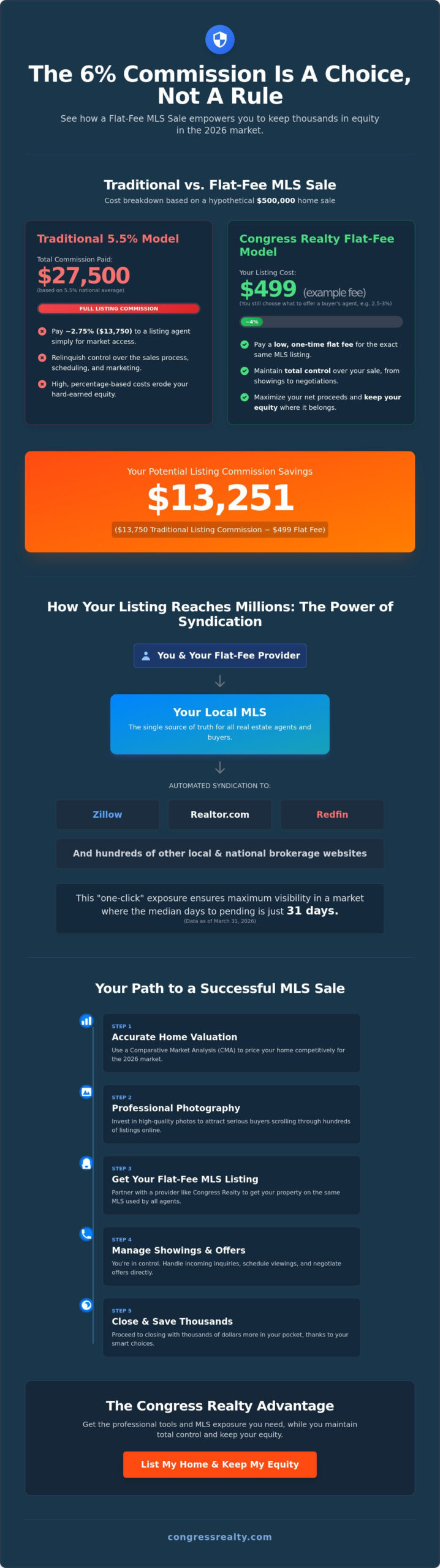
Syndication is the digital distribution of listing data across the web. Instead of manually creating accounts on dozens of different sites, you enter your data once into the LOCAL MLS. From there, the system pushes that information out to Realtor.com, Zillow, Redfin, and hundreds of local brokerage sites. This “one-click” exposure is the most efficient way to capture attention in a market where the median days to pending is just 31 days as of March 31, 2026. If you want to ensure your data is perfect from day one, you can list your home professionally and manage the process with precision.
MLS vs. Public Portals
Public portals like Zillow are essentially mirrors of the underlying MLS data. They don’t generate the data; they just display it. Because the MLS is the primary source of truth, agents trust it more than third-party FSBO sites. Listings found on isolated FSBO platforms often lack standardized data fields, making them harder to find and less “clickable” for professional buyers. The legality of alternative commission models has paved the way for you to access this professional formatting without the traditional 6% overhead.
The Internet Data Exchange (IDX) is the protocol that allows competing brokerages to display each other’s listings. This means your home will show up on the websites of local firms, even if you didn’t hire them. It’s a massive network effect that FSBO sites simply cannot replicate. However, this power comes with a responsibility for data accuracy. Inaccurate square footage or incorrect pricing can lead to your listing “staling” or being flagged by the system. A professional mls sale requires clean data to ensure you don’t lose momentum in the first crucial week of your listing.
MLS Sale vs. Traditional Listing: Comparing the Costs
Choosing between a traditional brokerage and a flat fee model is the most significant financial decision you’ll make during your mls sale. For decades, the industry standard hovered around a 6% commission. In this old model, you typically pay 3% to the listing agent and 3% to the buyer’s agent. While the national average real estate commission has shifted slightly to between 5.44% and 5.70% as of May 2026, the underlying problem remains the same. You are paying a massive portion of your equity for services you might not actually need.
The “Equity Drain” myth suggests that a high commission is the only way to get professional exposure. This is false. A flat fee mls listing preserves your home’s value by unbundling these costs. You pay a one-time fee to the listing broker to get your home into the database, but you pay 0% in listing commissions. This allows you to retain thousands more of your home’s appreciation from the last year, which saw a 0.4% price growth nationwide as of March 2026.
Breaking Down the Commission Structure
Commissions are always negotiable. They are not set by law, and they never have been. The NAR settlement rules that took effect on August 17, 2024, made this transparency even more critical for sellers. In a traditional model, you’re paying for the agent’s office rent, marketing for their own brand, and their time spent on other clients. When you choose a flat fee approach, you’re only paying for the professional infrastructure of the LOCAL MLS. If you want to know exactly how much does the realtor make, you’ll see that a significant portion of a 6% commission doesn’t actually go toward selling your specific house.
The Financial Impact of a Flat Fee
Numbers tell the real story. With the US median home sale price sitting at $354,667 as of February 2026, a traditional 6% commission would cost you over $21,000. By switching to a flat fee for the listing side, you immediately cut that expense in half or more. This provides a level of transparency and predictability that traditional models lack. You won’t face “hidden costs” like long contract lock-ins that prevent you from changing your strategy if the market shifts. Instead, you gain the confidence of knowing exactly what your closing costs will be. This financial intelligence is what separates savvy sellers from those who simply follow the crowd and lose their equity in the process.
Actionable Steps: Preparing for Your MLS Listing
Success in an mls sale isn’t a matter of luck. It’s the result of methodical preparation and high-quality data. Now that you understand the cost-saving power of the flat-fee model, it’s time to execute. You have the professional tools; now you must use them with the same precision as a seasoned broker. Transitioning from a traditional model to an independent sale means taking responsibility for the two pillars of real estate: pricing and presentation.
You aren’t just putting a house on a website. You’re launching a product into a competitive marketplace. In a market where 21.6% of homes sold over list price as of February 2026, those who prepare the best are the ones who win. By following a structured sequence, you ensure your home doesn’t just sit on the market; it moves. For a comprehensive walkthrough of every step involved, the professional equity-first guide to house selling in 2026 provides an in-depth roadmap for maximizing your return.
Pricing and Presentation
Overpricing is the primary reason why listings fail to gain traction. With national inventory up 2.3% year-over-year in early May 2026, buyers have more choices than they did in previous seasons. You must conduct a Comparative Market Analysis (CMA) to find the “sweet spot” based on actual sold data, not just active competition. Homes that are priced realistically are selling, while those that aren’t linger on the market beyond the national median of 31 days to pending. Once the price is set, your visual marketing takes over. Professional photos are the highest ROI investment for an MLS listing. High-quality imagery increases “saves” and “shares” on syndicated portals, ensuring your property stands out among the 1,155,079 homes currently for sale nationwide.
Data and Disclosures
The LOCAL MLS is a database of facts. You’ll need to gather specific property data before your listing goes live. This includes technical details such as square footage, year built, HVAC type, and tax ID numbers. Beyond the specs, you have a legal obligation to provide property disclosures. These documents protect you from future liability by transparently listing the home’s condition. Managing this paperwork can feel daunting, but it’s essential for a secure transaction. To streamline this process, you can access professional transaction management to ensure every document is handled correctly.
Security and accessibility are the final pieces of the puzzle. Consider using an electronic lockbox to facilitate secure showings for buyer agents. These devices allow you to track exactly who enters your home and when, providing peace of mind during the mls sale process. This level of professional infrastructure ensures you stay in control while providing the accessibility buyers expect in a modern market. When you combine accurate data with professional tools, you position yourself as a savvy, independent seller ready to close.
The Congress Realty Advantage: You Control Your Sales Process
Congress Realty bridges the gap between the total freedom of a traditional “For Sale By Owner” listing and the massive visibility of a professional mls sale. You don’t have to choose between saving money and getting exposure. We provide the infrastructure you need to compete with corporate firms while ensuring you keep thousands more of your equity. Our “No Listing Commission” promise is simple: you pay a flat rate to access the database, and you pay 0% to the listing agent. In a market where the US median home value reached $366,019 as of March 31, 2026, this decision alone can save you a small fortune at the closing table.
Professional oversight is a critical component of our service. While you lead the process, we serve as your Broker of Record. This provides the legal protection and professional credibility you need when negotiating with buyer agents who are now required to have written agreements as of the August 2024 NAR settlement. You aren’t just “trying” to sell a house; you’re conducting a professional transaction backed by an expert ally. This parity ensures your listing is treated with the same respect as any other property in the LOCAL MLS.
Tiered Service for Every Seller
We offer flexibility through tiered packages designed for your specific comfort level. Our Standard Listing package provides the essentials, including the crucial entry into the LOCAL MLS and a professional yard sign. If you need more support, our Full Service Listing adds layers of transaction management and professional photography. Regardless of the tier you choose, you maintain the right to sell the property yourself to a buyer without an agent. If you find the buyer, you pay no commission at all. This is the ultimate form of financial intelligence in real estate.
Expert Support Without the Expert Price
You shouldn’t have to navigate complex documentation alone. We offer Comparative Market Analysis (CMA) support to help you price your home correctly and transaction management to guide you through the closing paperwork. Our role is to be an expert facilitator. We provide the tools, the lockboxes, and the professional documentation services, then we step back. You are in control because it’s your home and your equity. You can list your home in minutes and start reaching the 1,155,079 active buyers currently in the market.
List your home with Congress Realty today and join thousands of savvy sellers who have successfully navigated an independent mls sale. Take the first step toward a smarter, more rewarding closing today.
Take Command of Your Home Sale Today
The traditional 6% commission model is a relic that no longer serves the modern homeowner. You now understand that a professional mls sale is about data distribution and strategic preparation, not paying for an agent’s overhead. By leveraging the power of automated syndication and maintaining control over your pricing, you position yourself to win in the 2026 market. You don’t need to sacrifice your hard-earned equity to gain the same visibility as the largest corporate brokerages.
Since 2002, Congress Realty has empowered sellers to bypass high commissions while providing the professional infrastructure required for a secure transaction. With over 20 years of flat-fee expertise and optional professional transaction management, we bridge the gap between independent freedom and brokerage power. Stop letting high fees drain your home’s value. Save thousands on your next home sale with Congress Realty and experience the satisfaction of being in total control. Your equity belongs to you; it’s time to keep it.
Frequently Asked Questions
What is an MLS sale and how does it differ from a regular sale?
An mls sale is a transaction where the property was marketed through the Multiple Listing Service database. It differs from a “regular” private sale because it uses a standardized system to broadcast your home’s details to every brokerage in the region. This ensures your property is visible to the entire professional community rather than relying on word-of-mouth or a single agent’s limited network.
Can I list my house on the MLS without a realtor?
You can’t list a property yourself because the database is reserved for licensed brokers, but you can use a flat-fee service to gain access. This allows you to bypass the traditional listing agent and their high commission while still appearing in the same professional system. You maintain your autonomy and lead the process while leveraging the broker’s technical infrastructure to reach buyers.
Do I have to pay a commission if I sell my home through the MLS?
You don’t have to pay a listing commission when using a flat-fee model, though you may choose to offer a buyer agent commission. Since the rule changes on August 17, 2024, compensation offers are no longer published on the MLS, making these fees a matter of direct negotiation. Most sellers still offer a competitive rate to attract the largest pool of represented buyers.
How long does it take for a listing to appear on the MLS?
Most listings go live on the LOCAL MLS within 24 to 48 hours after you submit your property data and professional photos. Once the listing is active, automated syndication pushes your home to national portals like Zillow and Realtor.com shortly after. This rapid deployment is crucial for capturing early interest in a market where the median days to pending is 31 days.
Will buyer agents show my home if it is a flat-fee MLS listing?
Yes, buyer agents will show your home because it appears as a professional, verified listing in their primary search tool. They prioritize properties in the MLS over those on isolated FSBO sites because the data follows strict industry standards. As long as you offer a competitive commission to the buyer’s side, your property remains just as attractive as any traditional listing.
What happens if I find a buyer myself while listed on the MLS?
You pay zero commission if you find an unrepresented buyer on your own. This is a core advantage of the flat-fee mls sale approach. You retain the legal right to sell your property independently, which means you keep 100% of the equity that would have otherwise been paid out in commissions. You simply notify your broker to update the listing status once you’ve signed a contract.
Is an MLS sale better than a Zillow FSBO listing?
An MLS listing is significantly more powerful because it creates a network effect that isolated FSBO sites cannot match. While Zillow is a popular aggregator, the MLS is the primary source of truth that feeds hundreds of different brokerage websites and agent tools. This professional exposure is why 21.6% of homes were able to sell over list price in early 2026. To understand how the national network is structured, reviewing the complete list of multiple listing services operating across the US reveals just how extensive this professional infrastructure truly is.
Can I change my listing price or photos once it is on the MLS?
You can update your price, description, and photos at any time through your broker’s platform. Staying responsive to market feedback is essential for a successful sale. If your home doesn’t attract an offer within the national median timeframe, you have the flexibility to adjust your strategy instantly. You remain in total control of your marketing and presentation from start to finish.
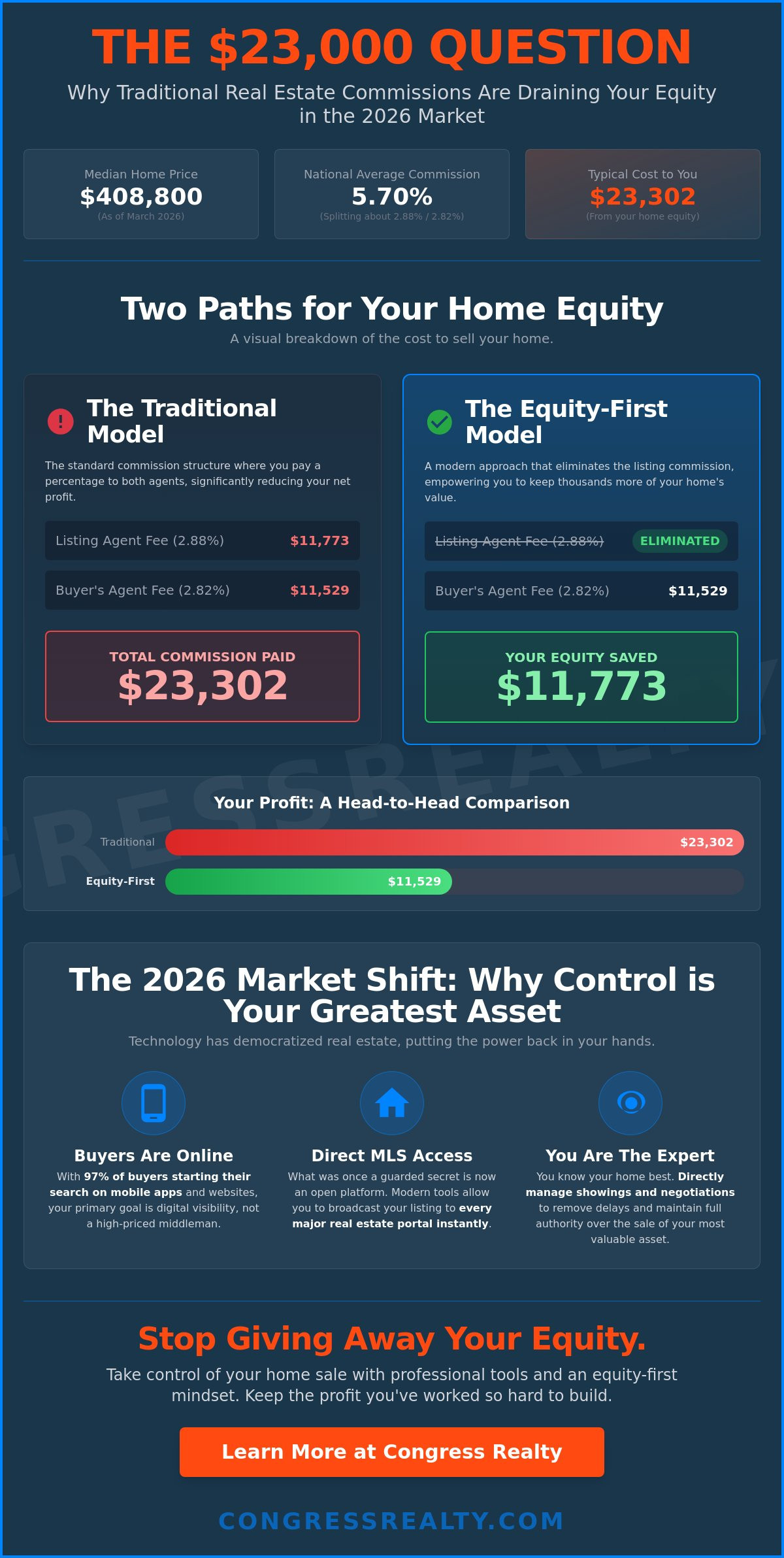
Why are you still planning to hand over more than $23,000 of your hard-earned equity just to list your property? With the median home price sitting at $408,800 as of March 2026, the national average commission rate of 5.70% is no longer just a cost of doing business; it’s a massive financial hit. You shouldn’t have to choose between professional exposure and your bank account. When you decide to sell your home in this normalizing market, you deserve a process that prioritizes your profit over an agent’s payday.
To successfully sell your home in the normalizing market of 2026, you must present your property with the same level of sophistication as a high-end brokerage. For those who want to understand the gold standard of Seller Representation, looking at how premier agencies market their listings can provide a blueprint for your own success. Buyers are more selective now that inventory has improved to a 4.1-month supply as of March 2026. They expect a seamless, professional experience from the moment they see your listing online to the second they walk through the front door. By following these five pillars, you ensure your home isn’t just another address on a map; it’s a premium product that commands attention.
We know it’s frustrating to feel pressured by high-stakes pitches while 30-year fixed mortgage rates hover around 6.38%. You want to maintain full control over your showings and negotiations without sacrificing the reach of the LOCAL MLS. This article provides a pragmatic, equity-first checklist to help you secure full market exposure and professional tools while saving thousands in unnecessary fees. You’ll discover how to navigate new 2026 regulations, such as the required disclosures for digitally altered photos and thirdhand smoke, so you can lead your sale with total confidence and financial intelligence.
Key Takeaways
Adopt the “Equity-First” mindset to leverage modern technology and bypass traditional 6% commissions that drain your net profit.
Master the five pillars of a professional listing, ensuring your property stands out on the LOCAL MLS with high-impact visuals and data-driven pricing.
Compare the real-world financial impact of different brokerage models and discover how to keep up to $30,000 more of your home’s value.
Use a proven, step-by-step checklist to sell your home while retaining total authority over your showing schedule and negotiation strategy.
Eliminate the stress of escrow by utilizing professional transaction management tools to oversee documentation and meet every critical deadline.
Evaluating the 2026 Real Estate Market: Why High Commissions are Obsolete
The traditional real estate model is failing to keep pace with a digital-first world. In May 2026, buyers don’t wait for an agent to call them with new listings; they find properties themselves on mobile apps while drinking their morning coffee. This shift has turned the old-school 3% listing commission into an obsolete tax on your equity. Equity-First Selling is the modern standard for homeowners who realize that technology has already done the heavy lifting of marketing. When you decide to sell your home, you’re no longer paying for a gatekeeper. You’re paying for a platform that connects you directly to the market.
Access to the Multiple Listing Service (MLS) was once a guarded secret, but those days are gone. Professional tools now allow you to broadcast your property to every major real estate portal in seconds. Since 97% of buyers start their search online, your primary goal is visibility, not a high-priced middleman. The value of a listing agent has shifted from “finding a buyer” to simply “providing the data.” If the technology handles the exposure, paying a massive percentage of your home’s value for a simple data entry task no longer makes sense.
The Death of the Traditional 6% Model
The typical commission structure often totals between 5.44% and 5.70% as of early 2026. This is usually split down the middle: roughly 2.88% for the listing agent and 2.82% for the buyer’s agent. On a median-priced home of $408,800, that total fee exceeds $23,000. Flat-fee models disrupt this by eliminating the listing side of that expense entirely. You still offer a competitive commission to the buyer’s agent to attract motivated shoppers, but you keep the thousands of dollars normally reserved for the listing broker. It’s a pragmatic choice that reflects the actual work required to list a home in a normalizing market with 4.1 months of inventory.
Why Control is Your Greatest Asset
You know your home better than anyone else. Managing your own showings and receiving direct feedback from potential buyers gives you an edge that a busy agent can’t provide. Direct communication speeds up the decision-making process and removes the “game of telephone” that often stalls negotiations. By acting as an empowered seller, you maintain the authority to accept or reject offers on your own terms. You don’t need a middleman to sell your home when you have the right professional tools in your hands. You aren’t just saving money; you’re ensuring that the person most invested in the sale is the one calling the shots. Professional backing through documentation services ensures you stay compliant with new 2026 laws, such as the new FinCEN reporting rules for all-cash transactions, while you lead the process.
The Strategic Home Seller’s Checklist: 5 Pillars of a Professional Listing
To successfully sell your home in the normalizing market of 2026, you must present your property with the same level of sophistication as a high-end brokerage. Buyers are more selective now that inventory has improved to a 4.1-month supply as of March 2026. They expect a seamless, professional experience from the moment they see your listing online to the second they walk through the front door. By following these five pillars, you ensure your home isn’t just another address on a map; it’s a premium product that commands attention.
Pillar 1 & 2: Visuals and Valuation
The first impression happens on a screen. Smartphone photos are a deal-breaker because they signal a lack of effort and can drive down your perceived value. High-resolution, professional photography is mandatory. If you are in California, remember that new 2026 laws require you to disclose any digitally altered images. Transparency builds trust, and trust leads to offers. Pair these visuals with a “sweet spot” price determined by a Comparative Market Analysis (CMA). A CMA is a data-driven approach to pricing based on recent national sales trends and actual sold prices in your specific neighborhood. Since home prices saw a modest year-over-year increase of only 0.7% in February 2026, overpricing even by a small margin can cause your listing to stagnate.
Checklist item: Schedule high-resolution photography including drone shots to highlight the property’s perimeter and neighborhood context.
Checklist item: Perform a CMA to ensure you aren’t “testing the market” with an unrealistic price that ignores current inventory levels.
Pillar 3, 4 & 5: Infrastructure and Access
Marketing is the engine of your sale. Maximum exposure means your property must live on the LOCAL MLS. This is the primary data source that feeds national giants like Zillow and Realtor.com. Without it, you are invisible to the buyer’s agents who represent the majority of active shoppers. Once you have their attention, you must make it easy for them to visit. Utilizing professional electronic lockboxes allows you to track every agent who enters your home, providing security and peace of mind. Finally, don’t underestimate the psychological impact of professional yard signage. It signals to the neighborhood that a serious, professional transaction is underway. A flat fee mls listing is the engine behind these pillars, providing the professional infrastructure you need without the high-commission overhead.
Checklist item: Verify your listing appears correctly on all major national syndication sites within 24 hours of going live.
Checklist item: Install a professional-grade electronic lockbox to manage agent access and receive automated showing feedback.
You Control Your Sales Process by setting the stage for success. If you’re ready to move forward, you can list your home today and start saving your equity immediately.
Financial Comparison: Calculating the True Cost to Sell Your Home
Are you prepared to lose $30,000 in a single afternoon? When you decide to sell your home for $500,000, that is exactly what happens under the traditional 6% commission model. This isn’t just a fee; it’s a massive drain on the wealth you’ve built through years of mortgage payments. In the normalizing market of May 2026, where home prices saw a modest 0.7% increase in February, every dollar of equity counts. You need to understand the mathematical reality of your options before signing a listing agreement that could cost you a fortune.
Traditional brokerages often lock you into long contracts with a 6% total commission. On a $500,000 sale, that is a $30,000 loss. Beyond the high price, these models carry hidden risks like dual agency, where one broker represents both sides and compromises your leverage. iBuyers and “cash offer” platforms are even more expensive. While they promise speed, they typically charge a 5% service fee plus a 5% to 10% “convenience” discount on your home’s value. This results in a total loss often exceeding $50,000. If you are considering selling a house as is to avoid repair costs, understanding these predatory cash-offer structures is especially critical before you accept any offer. Choosing the flat-fee model through Congress Realty eliminates the listing commission entirely, allowing you to offer a competitive buyer agent incentive while keeping thousands more in your pocket.
The “Math of Control” vs. The “Math of Convenience”
iBuyers are often the most expensive way to sell your home because you are paying for the company’s risk and overhead. In contrast, the flat-fee model is built for the savvy, independent owner. If you want to understand how to sell your house on your own and maximize every dollar of your equity, the flat-fee approach offers a predictable flat rate instead of a percentage, allowing you to offer a competitive buyer’s agent commission (which averaged 2.82% in early 2026) and still save roughly 50% compared to traditional fees. Saving thousands isn’t just a slogan; it’s a mathematical certainty when you remove the listing agent’s 3% cut from the equation.
Where Does Your Equity Go?
Equity is your net profit after all liens and selling costs are paid. It is your reward for homeownership. The listing commission is the only major selling cost you can fully control. While you can’t change the 6.38% mortgage interest rate or the new FinCEN reporting requirements for all-cash deals, you can choose how much of your profit you give away. A professional CMA is vital here. It protects your equity from underpricing, ensuring you don’t leave money on the table while also avoiding the stagnation of an overpriced listing. You Control Your Sales Process, and that starts with protecting your bottom line.
Master the MLS: A Step-by-Step Guide to Maximum Market Exposure
To sell your home successfully in 2026, you must understand that the real estate market is driven by data, not just pretty pictures. While websites like Zillow and Realtor.com are popular, they are merely mirrors reflecting information from the LOCAL MLS. If your property isn’t listed on the primary database used by professional brokers, you are essentially invisible to the 90% of buyers working with an agent. You don’t need a high-commission middleman to access this power; you just need a professional bridge to the system.
Following a structured process ensures your listing hits the market with maximum impact. Here is how you lead your sale from start to finish:
Step 1: Choose your listing package. Decide between a Standard or Full Service plan based on the level of documentation support you require.
Step 2: Submit property data and professional photos. Provide the essential details and high-resolution visuals to the broker for review.
Step 3: Activate on the LOCAL MLS. Once live, this triggers automated syndication to hundreds of national real estate portals.
Step 4: Set the Buyer’s Agent Commission (BAC). Choose a competitive rate to incentivize the professionals who represent active buyers.
Step 5: Monitor your listing. Verify that your data appears correctly on Zillow, Realtor.com, and local brokerage sites.
Why the “Local MLS” is Non-Negotiable
Think of the MLS as the source code for the entire real estate industry. It is a restricted database where professional agents search for properties to show their clients. When you list through a traditional agent, this is the first thing they do. By using Congress Realty as your facilitator, you gain the exact same professional entry point without the 3% listing fee. Without this exposure, your home won’t appear in the automated email alerts that buyers receive from their agents, which is where the most serious offers originate.
Incentivizing the Buyer’s Side
Even though you are bypassing the listing commission, it’s a smart, pragmatic move to offer a competitive commission to the agent bringing the buyer. As of early 2026, the national average buyer’s agent commission is approximately 2.82%. Offering a rate in this range ensures that every agent in town is motivated to show your property. Since you’ve already saved the entire 3% listing side of the fee, you have more room to be competitive on price or terms. Research local commission trends in your specific zip code to ensure your BAC is attractive to the pros. You Control Your Sales Process by deciding exactly how much to offer, keeping you in the driver’s seat of your equity. If you are ready to get started, you can list your home on the MLS today and take charge of your sale.
Transaction Management: Navigating Offers and Escrow with Professional Tools
The biggest fear for many homeowners isn’t finding a buyer; it’s what happens after the offer arrives. You might worry about missing a legal deadline or getting overwhelmed by a mountain of paperwork. In the 2026 real estate market, these concerns are valid. With 30-year fixed mortgage rates at 6.38% as of May 1, 2026, buyers are more cautious and their lenders are more demanding. You don’t need to pay a 3% listing commission to navigate this phase safely. Professional transaction management tools provide the structure you need to sell your home with the precision of a seasoned broker.
Transaction management is the process of overseeing every document, disclosure, and deadline from the moment a contract is signed until the keys are handed over. It turns a chaotic sequence of events into a methodical checklist. Congress Realty’s Full Service option serves as the ultimate safety net for sellers who want professional backing during these high-stakes negotiations. We ensure that your paperwork is compliant with current regulations, such as the FinCEN reporting rules for all-cash transactions that took effect on March 1, 2026. This professional infrastructure allows you to focus on your move while we help you protect your equity.
From Contract to Closing
The escrow period is the timeframe where a neutral third party holds funds and documents while both sides fulfill their contractual obligations. As the seller, your responsibilities include providing required disclosures, such as the 2026 California mandate regarding “thirdhand smoke” history. Missed disclosure deadlines are common “deal-killers” that can give a buyer a legal path to back out of the sale. Professional oversight prevents these errors by tracking every milestone in real time. Utilizing a broker-backed platform for digital document storage and signing ensures that your records are secure and accessible whenever you need them. It’s a pragmatic way to maintain momentum without the stress of manual tracking.
Closing the Deal on Your Terms
The final stage of the journey is the closing, where you sign the final settlement statement at the title company and receive your equity check. Because you chose a flat-fee model, that check will be significantly larger. You’ve successfully bypassed the traditional commission trap while maintaining full authority over the entire transaction. You Control Your Sales Process from the first showing to the final signature. Selling a home independently isn’t just a way to save money; it’s a way to prove that financial intelligence and professional results go hand in hand. Sell your home with the confidence that you’ve kept your hard-earned equity where it belongs.
You now have the blueprint to sell your home without sacrificing your hard-earned profit to outdated commission structures. By prioritizing professional photography, data-driven pricing, and the exposure of the LOCAL MLS, you position yourself as a savvy market leader. The current housing landscape proves that you don’t need a high-commission agent to find a buyer; you simply need the right professional infrastructure. With the median home price sitting at $408,800 as of March 2026, every percentage point you save is a significant financial victory for your next chapter.
Since 2002, Congress Realty has served as a reliable ally for independent sellers across the nation. With over two decades of flat-fee expertise and professional oversight from our designated broker, Andrew English, we provide the tools you need to succeed. Our tiered packages include everything from high-resolution photography to comprehensive transaction management, ensuring you have professional backing from the initial listing to the final closing signature. You have the intelligence to manage your own transaction, and we have the platform to make it simple.
You Control Your Sales Process. Step into the market with total confidence and keep your equity where it belongs.
Frequently Asked Questions
Can I really sell my home without a traditional listing agent?
Yes. You can list your property and manage the sale while bypassing the traditional 3% listing commission. Technology has democratized market access, allowing you to use a flat-fee broker to get your property on the LOCAL MLS. This approach puts you in the driver’s seat of the transaction while ensuring your property reaches the same audience as any high-priced brokerage listing. You maintain the authority to negotiate directly with buyers and keep your equity.
How does a flat fee MLS listing actually work?
You pay a one-time flat rate to a broker who lists your property on the LOCAL MLS instead of paying a percentage-based commission. Once the broker enters your data, your listing syndicates to hundreds of real estate websites used by buyers and agents. You retain the right to sell the property yourself and manage your own showings while the broker provides the professional entry point to the market. It is a simple, transparent process.
Will my home be listed on Zillow and Realtor.com?
Yes. Your property will appear on all major national portals including Zillow, Realtor.com, and Redfin. These sites pull their data directly from the LOCAL MLS. By using a flat-fee service to sell your home, you ensure that your property is visible to the 97% of buyers who start their home search online. Your listing will look identical to those represented by traditional full-commission agents, ensuring you receive maximum market exposure.
Do I still have to pay a commission to the buyer’s agent?
It is standard practice to offer a commission to the agent representing the buyer to incentivize them to show your home. As of early 2026, the national average for a buyer’s agent commission is approximately 2.82%. While you choose the exact amount, offering a competitive rate ensures professional agents remain motivated to bring their clients to your door. You still save the entire 3% typically reserved for the listing agent side of the transaction.
What is the difference between Standard and Full Service listing packages?
Standard packages focus on providing the essential MLS listing and syndication to national sites. Full Service packages add layers of professional support such as transaction management, contract review, and documentation assistance. If you want a safety net for navigating complex escrow requirements or the new 2026 FinCEN reporting rules, the Full Service option provides the expert oversight needed to close the deal with total confidence. You choose the level of support that fits your needs.
How do I handle showings if I am selling my home on my own?
You manage your own showing schedule through direct communication with buyer’s agents or unrepresented buyers. Most savvy sellers use professional electronic lockboxes to track agent entry and receive automated feedback. This gives you total control over who enters your home and when. You don’t have to wait for a middleman to relay messages, which often speeds up the decision-making process for motivated shoppers. It is a more efficient way to manage the process.
Is a Comparative Market Analysis (CMA) necessary for a flat fee listing?
A CMA is vital because it provides a data-driven price based on actual sold properties rather than just active listings. With national home prices seeing a modest 0.7% year-over-year increase in February 2026, pricing your home accurately is the difference between a quick sale and a stagnant listing. A professional CMA helps you find the “sweet spot” that attracts buyers while protecting every dollar of your equity. It is the foundation of a smart sales strategy.
What is transaction management and do I need it to sell my home?
Transaction management is the professional oversight of all documentation and deadlines from the contract stage to the final closing. It is highly recommended to ensure you meet all legal requirements, such as the 2026 California disclosure laws. Having an expert monitor your escrow period prevents common errors that could derail the sale. It’s a pragmatic tool that helps you sell your home with professional precision and less personal stress, ensuring a smooth path to the closing table.
Why would you volunteer to give away 5.70% of your hard-earned equity when the most effective tools for a professional sale are already at your fingertips? It’s a common frustration for homeowners who want to maximize their profit but fear the complexity of the market. You understand that your home is your largest asset, and the thought of losing thousands in listing commissions feels like an unnecessary tax on your hard work. Mastering the steps to selling a house in 2026 doesn’t require a traditional agent. It requires a clear, pragmatic strategy that puts you in the driver’s seat.
We agree that the process should be transparent and rewarding, not a source of anxiety over legal paperwork or missed exposure. This manual provides the professional infrastructure you need to secure maximum market presence on the local MLS for a flat fee while maintaining total control. You’ll learn how to manage the 2026 market, including negotiating the 2.82% average buyer’s agent commission and utilizing the $500,000 capital gains tax exclusion for married couples. We’re going to walk through the eight essential steps to ensure a smooth, legally sound closing that keeps your money where it belongs.
Key Takeaways
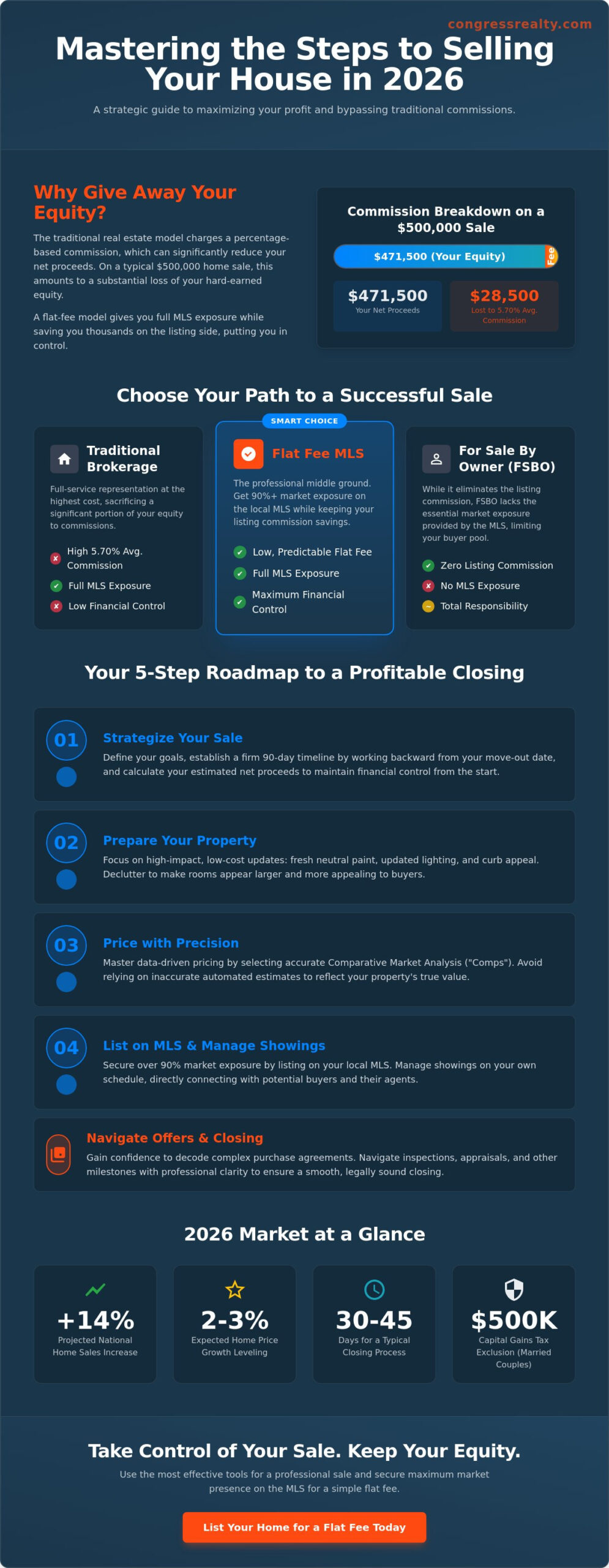
Establish a realistic 2026 timeline and calculate your estimated net proceeds to ensure you maintain full financial control from the start.
Prioritize high-impact, low-cost cosmetic updates over major renovations to eliminate buyer red flags and maximize your home’s immediate market appeal.
Master data-driven pricing by learning how to select accurate “Comps” that reflect your property’s true value rather than relying on automated estimates.
Follow the proven steps to selling a house to secure 90%+ market exposure on the local MLS while bypassing traditional 6% commissions.
Gain the confidence to decode complex purchase agreements and navigate the middle milestones of inspections and appraisals with professional clarity.
Step 1: Strategizing Your Sale and Choosing a Listing Model
Successful sales don’t happen by accident; they’re the result of a calculated strategy. Before you plant a sign in the yard, you must define your “Why” and establish a firm move-out date. Are you looking to capitalize on the projected 14% increase in national home sales for 2026, or are you moving to a more affordable market in the Midwest? Understanding your motivation helps you set a realistic timeline. One of the most critical steps to selling a house is calculating your estimated net proceeds early. Take your expected sale price and subtract your mortgage payoff, property taxes, and closing costs. These costs can vary significantly by location and local regulations, typically ranging from 3% to 5% of the sale price.
Identifying Your Selling Goals and Timeline
To hit your target move-out date, work backward by at least 90 days. A standard real estate transaction typically requires 30 to 45 days for the closing process alone. You should also account for two to four weeks of property preparation and active marketing. If you’re buying a new home simultaneously, consider seasonal market fluctuations. The national real estate cycle usually peaks in late spring, but 2026 data suggests a rebalancing market with more inventory, giving you more flexibility than previous years. Use this to your advantage by setting a schedule that minimizes the stress of a two-house transition.
The Financial Breakdown: Commissions vs. Flat Fees
The traditional real estate model relies on a percentage-based commission that averages 5.70% in 2026. In this scenario, the listing agent typically takes about 2.88%, while the buyer’s agent receives approximately 2.82%. For a $500,000 home, that’s nearly $29,000 exiting your equity. You have three primary choices for your listing model:
Traditional Brokerage: Full service with a high percentage-based commission cost.
For Sale By Owner (FSBO): Zero listing commission but lacks the essential exposure of the MLS.
Flat Fee MLS: The professional middle ground that provides LOCAL MLS access for a predictable, transparent fee.
The Flat Fee advantage is clear: you gain the exact same professional MLS exposure as a traditional agent without sacrificing a 3% listing commission. This model empowers you to manage your own showings and negotiations while keeping thousands of dollars in your pocket. A flat fee model replaces the unpredictable percentage-based listing commission with a transparent, fixed cost that secures your equity from the moment you list. For a broader look at how to approach the current market, reviewing proven tips for selling your home in 2026 can help you refine your overall strategy before you commit to a listing model.
Step 2: Preparing the Property for Maximum Market Appeal
Walk through your front door as if you’ve never seen the property before. This “buyer-eye” walkthrough is one of the most effective steps to selling a house because it reveals the small red flags that buyers use to negotiate lower prices. You don’t need a massive renovation budget to win. With home price growth expected to level out at 2% to 3% in 2026, over-investing in structural overhauls can actually shrink your net proceeds. Instead, focus on high-impact, low-cost cosmetic fixes that make the property feel move-in ready. For homeowners with significant equity, a quick, well-prepared sale can even serve as a strategic alternative to foreclosure if financial circumstances have shifted.
Essential Repairs vs. Cosmetic Upgrades
Prioritize the “big three”: fresh neutral paint, updated lighting fixtures, and manicured curb appeal. These changes offer the highest return on investment. Consider a pre-listing inspection to identify “deal-breaker” issues like roofing leaks or electrical hazards before they surface during the buyer’s contingency period. Solving these problems now prevents your deal from falling through later. When you handle the prep yourself, you keep control of the budget and the timeline. To ensure your home is in top-tier showing condition, you can learn more about Way Beyond Cleaning and their specialized real estate cleaning options. It’s about being pragmatic and protecting your equity.
Decluttering is your secret weapon for the digital-first 2026 market. Remove personal items and excess furniture to make rooms appear larger in MLS thumbnails. A clean, minimalist space allows potential buyers to visualize their own lives in the home. Once the house is staged and ready, get your property listed to start attracting serious interest without the burden of a 3% listing commission.
Professional Photography: Your Digital Curb Appeal
In 2026, your first showing happens on a smartphone screen. Smartphone photos are no longer sufficient; they often lead to lower offers and more days on market. High-resolution, professional imagery is a non-negotiable requirement for standing out on national portals like Zillow and Realtor.com. Professional photographers understand how to use wide-angle lenses and natural lighting to highlight your home’s best features. These images are the fuel for your LOCAL MLS listing, ensuring you capture the attention of the 90% of buyers who start their search online. High-quality photos demonstrate that you are a serious, professional seller who values the transaction.
Step 3: Data-Driven Pricing Using Comparative Market Analysis
Pricing is math. It isn’t personal. One of the most critical steps to selling a house is setting a price that attracts qualified buyers without leaving your equity on the table. Don’t rely on a “Zestimate” or other automated valuation models; these are often inaccurate algorithms that don’t account for your specific upgrades or neighborhood nuances. Similarly, an appraisal is a formal valuation for a lender. You need a Comparative Market Analysis (CMA). While a step-by-step guide can help you prep the lawn, your price determines how many people actually walk across it. Use real-world data from the LOCAL MLS to find the “sweet spot” where market demand meets your financial goals.
How to Read and Use Comparables Like a Pro
Professional sellers use the 3-3-3 Rule to find accurate “comps.” Look for three properties that sold within three miles of your home in the last three months. This provides a snapshot of current buyer behavior in the 2026 rebalancing market. When you analyze these listings, pay close attention to:
Sold Listings: These represent the actual market value.
Pending Listings: These show you what buyers are currently willing to pay.
Active Listings: This is your direct competition.
Adjust your price based on differences in square footage, bedroom count, and lot size. If a neighbor’s house sold for a premium but had a finished basement you lack, adjust your target downward. If you’ve invested in energy-efficient upgrades that are trending in 2026, you can justify a higher position. Remember the psychology of pricing; listing at $499,000 instead of $500,000 keeps you visible in lower search brackets and often drives higher traffic.
Avoiding the Overpricing Trap
The first 14 days your home is on the market are the most vital. This is when your listing has the “New” badge on national portals and generates the most excitement. If you overprice, you kill that momentum instantly. Buyers are savvy; they know when a price doesn’t match the data. If you don’t receive serious inquiries or showing requests within the first 21 days, it’s time for a strategy shift. A small, early price adjustment is far more effective than a massive cut after the listing has gone stale. You’re in control of this process. Use a professional CMA service to validate your numbers before you list, ensuring your flat-fee entry onto the MLS is backed by hard evidence.
Step 4: Listing on the MLS and Managing Showings
Once your property is prepped and your pricing is validated, it’s time to broadcast your home to the world. The Multiple Listing Service (MLS) is not just a database; it is the primary engine of the American real estate market. In 2026, over 90% of successful home sales originate from an MLS listing. Without this exposure, you’re essentially invisible to the vast majority of qualified buyers and their agents. This is one of the most vital steps to selling a house because it forces national portals like Zillow, Realtor.com, and Redfin to display your property alongside those represented by high-commission traditional brokers.
The Power of the Local MLS
When you list on the LOCAL MLS, your home’s data syndicates to thousands of secondary websites within minutes. This massive digital footprint ensures you aren’t hunting for buyers; you’re letting them find you. Accuracy during this stage is paramount. Inaccurate data entry regarding square footage or school districts can lead to listing fines from the local board or, worse, legal delays during the closing process. Focus on crafting a property description that highlights benefits over features. Instead of simply listing “new windows,” describe the “energy-efficient, sound-dampening windows that lower monthly utility costs.” You’re selling a lifestyle and financial intelligence, not just a structure.
You don’t need to pay a 3% listing commission to get professional-grade market saturation. By choosing a smarter model, you maintain total authority over your home’s public profile. To get started today, you can list your home on the MLS for a flat fee and keep your equity where it belongs.
Managing Showings and Electronic Lockboxes
Control is the recurring theme of a successful independent sale. You decide when your home is available for viewing, balancing your personal schedule with the need for accessibility. To manage this safely and professionally, use an electronic lockbox rather than a traditional manual code box. Electronic versions provide a higher level of security by requiring verified agent credentials for access. They also create a digital log of exactly who entered your home and at what time. This technology allows you to gather immediate buyer feedback. Most electronic systems automatically email the showing agent a survey after they leave, providing you with raw, honest data on how the market perceives your home. Use this feedback to refine your presentation or adjust your strategy. Once you accept an offer, remember to update your listing status from “Active” to “Pending” to signal to the market that you’ve successfully navigated the first half of the transaction.
Step 5: Navigating Offers and Transaction Management
The offers are arriving. You’ve successfully navigated the early steps to selling a house, and now you must move from marketing to management. This phase is about precision. A purchase agreement is a legally binding contract that dictates your price, your closing date, and your net proceeds. Don’t be blinded by a high offer price if the terms are weak. A cash offer at a slightly lower price often beats a higher financed offer with multiple contingencies. You need to scrutinize every detail to ensure you keep your equity.
Evaluating and Negotiating Purchase Offers
When you receive an offer, look beyond the top line number. In the 2026 market, buyers are often savvy about negotiating the 2.82% average buyer’s agent commission. Check for common contingencies like home inspections, appraisals, and the sale of the buyer’s current home. These are “exit ramps” that allow a buyer to back out without losing their earnest money. If an offer feels lopsided, issue a professional counter-offer. You have the right to demand a shorter inspection period or a higher earnest money deposit. This is your transaction. You set the terms that protect your financial interests.
The Role of Transaction Coordination
The “Middle Milestone” is often the most stressful part of the journey. This is when home inspections occur and appraisal gaps can appear. If an inspector finds a $5,000 roof issue, you don’t have to panic. You can negotiate a credit or choose to handle the repair yourself. This is where professional transaction management becomes your secret weapon. Most homeowners fear the mountain of legal disclosures and deadlines required for a smooth closing. Congress Realty provides the necessary professional infrastructure to manage these documents for a fraction of the cost of a traditional agent.
For those who prefer a more personalized partnership to navigate these complexities, you can discover Louisa Shaw Baker Real Estate to see how an experienced professional supports clients through every stage of the sale.
Managing the paperwork ensures the buyer can’t back out due to a missed deadline. You’ll handle the final walkthrough, where the buyer confirms the home’s condition, and then proceed to the signing. Sellers typically pay between 3% and 9% of the sale price in closing costs, but because you’ve avoided the 3% listing commission, your net profit remains significantly higher. You’ve controlled the process from start to finish. Now, you simply sign the documents and collect your check.
Take Command of Your Home Sale Today
Selling your home in 2026 is no longer about following the traditional 5.70% commission model. You’ve seen how mastering the steps to selling a house allows you to bypass high fees while maintaining professional parity on the LOCAL MLS. By prioritizing high-impact cosmetic updates and using the 3-3-3 rule for data-driven pricing, you position yourself as a savvy market leader. You don’t need to sacrifice your hard-earned equity for a facilitator when you have the tools to lead the process yourself. Professional transaction management ensures your closing is legally sound and stress-free without the heavy price tag.
Congress Realty has been a trusted ally for independent sellers since 2002. With A+ rated brokerage support and over $1 billion in property listed, we provide the professional infrastructure while you make the decisions. It’s time to stop paying for services you don’t need and start keeping the profit you’ve earned. Save thousands on your sale; explore Congress Realty’s Flat Fee MLS Packages today. You’ve done the work to build your equity; now it’s time to claim the full reward. You control your sales process, and the results will reflect your financial intelligence.
Frequently Asked Questions
How long does it typically take to sell a house from listing to closing?
You should plan for a 60 to 90 day window from start to finish. The closing process itself typically takes 30 to 45 days once you accept an offer. Adding 30 days for property preparation and active marketing ensures a realistic timeline. Working backward from your move-out date is one of the smartest steps to selling a house.
Can I really list my house on the MLS without paying a 3% commission?
Yes, you can skip the 3% listing commission entirely. By using a flat-fee service, you get your property on the LOCAL MLS for a predictable, transparent fee. This gives you the same professional exposure as a traditional 5.70% commission brokerage but keeps thousands of dollars in your pocket. You maintain full authority over the listing profile.
What are the most important repairs to make before selling my home?
Prioritize fresh neutral paint, modern lighting fixtures, and manicured curb appeal. These cosmetic updates offer the highest return on investment in the 2026 market. Avoid major structural renovations unless they are “deal-breaker” repairs required for buyer financing approval. Small, strategic improvements make your home look move-in ready for high-resolution digital thumbnails.
What happens if my home appraisal comes in lower than the offer price?
You have three main options if an appraisal gap occurs. You can ask the buyer to pay the difference in cash, lower your sale price to match the appraisal, or negotiate a compromise where both parties meet in the middle. In a rebalancing market with 2% to 3% price growth, these gaps are common. Having a professional CMA helps you defend your price early.
Do I have to pay a commission to the buyer’s agent if I sell via flat fee?
Paying a buyer’s agent is negotiable following the NAR settlement changes. While the national average for a buyer’s agent has rebounded to 2.82% in early 2026, you aren’t required to offer this compensation upfront on the MLS. You can decide how to handle these requests during the offer negotiation phase to protect your hard-earned equity.
What is a Comparative Market Analysis and do I really need one?
A Comparative Market Analysis (CMA) is a professional report that evaluates your home against similar properties sold within the last three months. You absolutely need one to avoid the overpricing trap. It provides the hard data required to compete with other listings on the MLS and justifies your asking price to savvy buyers and their agents.
Is an electronic lockbox safe for my home during showings?
Electronic lockboxes are highly secure and preferred by professional sellers. Unlike manual code boxes, they require verified agent credentials for access and record a digital log of everyone who enters your property. This technology gives you peace of mind and allows you to gather immediate feedback. It’s a simple, utilitarian tool that keeps you in control.
What are the typical closing costs for a seller in 2026?
Sellers typically pay between 3% and 9% of the home’s sale price in closing costs. This range covers title insurance, transfer taxes, and escrow fees. For example, Texas sellers average 3.28% in costs excluding commissions. Understanding these steps to selling a house helps you calculate your true net proceeds before you ever reach the closing table.
Can I sell my house without a realtor and still get professional results?
Absolutely. Many homeowners successfully complete the entire process independently by leveraging flat-fee MLS services, professional photography, and transaction management support. If you’re wondering whether you can sell your house without a realtor while maintaining professional-grade market exposure and legal compliance, the answer is yes — and the tools to do it are more accessible than ever in 2026.