Why would you volunteer to give away 5.70% of your hard-earned equity when the most effective tools for a professional sale are already at your fingertips? It’s a common frustration for homeowners who want to maximize their profit but fear the complexity of the market. You understand that your home is your largest asset, and the thought of losing thousands in listing commissions feels like an unnecessary tax on your hard work. Mastering the steps to selling a house in 2026 doesn’t require a traditional agent. It requires a clear, pragmatic strategy that puts you in the driver’s seat.
We agree that the process should be transparent and rewarding, not a source of anxiety over legal paperwork or missed exposure. This manual provides the professional infrastructure you need to secure maximum market presence on the local MLS for a flat fee while maintaining total control. You’ll learn how to manage the 2026 market, including negotiating the 2.82% average buyer’s agent commission and utilizing the $500,000 capital gains tax exclusion for married couples. We’re going to walk through the eight essential steps to ensure a smooth, legally sound closing that keeps your money where it belongs.
Key Takeaways
- Establish a realistic 2026 timeline and calculate your estimated net proceeds to ensure you maintain full financial control from the start.
- Prioritize high-impact, low-cost cosmetic updates over major renovations to eliminate buyer red flags and maximize your home’s immediate market appeal.
- Master data-driven pricing by learning how to select accurate “Comps” that reflect your property’s true value rather than relying on automated estimates.
- Follow the proven steps to selling a house to secure 90%+ market exposure on the local MLS while bypassing traditional 6% commissions.
- Gain the confidence to decode complex purchase agreements and navigate the middle milestones of inspections and appraisals with professional clarity.
Step 1: Strategizing Your Sale and Choosing a Listing Model
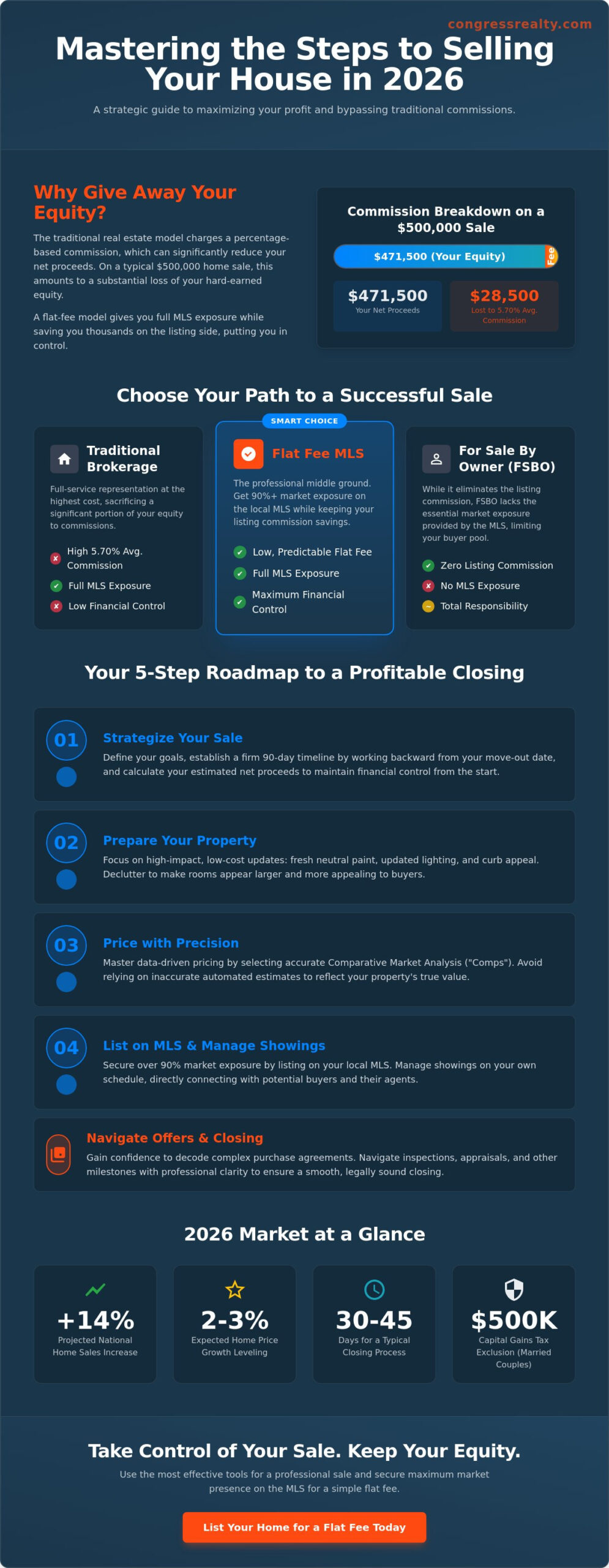
Successful sales don’t happen by accident; they’re the result of a calculated strategy. Before you plant a sign in the yard, you must define your “Why” and establish a firm move-out date. Are you looking to capitalize on the projected 14% increase in national home sales for 2026, or are you moving to a more affordable market in the Midwest? Understanding your motivation helps you set a realistic timeline. One of the most critical steps to selling a house is calculating your estimated net proceeds early. Take your expected sale price and subtract your mortgage payoff, property taxes, and closing costs. These costs can vary significantly by location and local regulations, typically ranging from 3% to 5% of the sale price.
Identifying Your Selling Goals and Timeline
To hit your target move-out date, work backward by at least 90 days. A standard real estate transaction typically requires 30 to 45 days for the closing process alone. You should also account for two to four weeks of property preparation and active marketing. If you’re buying a new home simultaneously, consider seasonal market fluctuations. The national real estate cycle usually peaks in late spring, but 2026 data suggests a rebalancing market with more inventory, giving you more flexibility than previous years. Use this to your advantage by setting a schedule that minimizes the stress of a two-house transition.
The Financial Breakdown: Commissions vs. Flat Fees
The traditional real estate model relies on a percentage-based commission that averages 5.70% in 2026. In this scenario, the listing agent typically takes about 2.88%, while the buyer’s agent receives approximately 2.82%. For a $500,000 home, that’s nearly $29,000 exiting your equity. You have three primary choices for your listing model:
- Traditional Brokerage: Full service with a high percentage-based commission cost.
- For Sale By Owner (FSBO): Zero listing commission but lacks the essential exposure of the MLS.
- Flat Fee MLS: The professional middle ground that provides LOCAL MLS access for a predictable, transparent fee.
The Flat Fee advantage is clear: you gain the exact same professional MLS exposure as a traditional agent without sacrificing a 3% listing commission. This model empowers you to manage your own showings and negotiations while keeping thousands of dollars in your pocket. A flat fee model replaces the unpredictable percentage-based listing commission with a transparent, fixed cost that secures your equity from the moment you list. For a broader look at how to approach the current market, reviewing proven tips for selling your home in 2026 can help you refine your overall strategy before you commit to a listing model.
Step 2: Preparing the Property for Maximum Market Appeal
Walk through your front door as if you’ve never seen the property before. This “buyer-eye” walkthrough is one of the most effective steps to selling a house because it reveals the small red flags that buyers use to negotiate lower prices. You don’t need a massive renovation budget to win. With home price growth expected to level out at 2% to 3% in 2026, over-investing in structural overhauls can actually shrink your net proceeds. Instead, focus on high-impact, low-cost cosmetic fixes that make the property feel move-in ready. For homeowners with significant equity, a quick, well-prepared sale can even serve as a strategic alternative to foreclosure if financial circumstances have shifted.
Essential Repairs vs. Cosmetic Upgrades
Prioritize the “big three”: fresh neutral paint, updated lighting fixtures, and manicured curb appeal. These changes offer the highest return on investment. Consider a pre-listing inspection to identify “deal-breaker” issues like roofing leaks or electrical hazards before they surface during the buyer’s contingency period. Solving these problems now prevents your deal from falling through later. When you handle the prep yourself, you keep control of the budget and the timeline. To ensure your home is in top-tier showing condition, you can learn more about Way Beyond Cleaning and their specialized real estate cleaning options. It’s about being pragmatic and protecting your equity.
Decluttering is your secret weapon for the digital-first 2026 market. Remove personal items and excess furniture to make rooms appear larger in MLS thumbnails. A clean, minimalist space allows potential buyers to visualize their own lives in the home. Once the house is staged and ready, get your property listed to start attracting serious interest without the burden of a 3% listing commission.
Professional Photography: Your Digital Curb Appeal
In 2026, your first showing happens on a smartphone screen. Smartphone photos are no longer sufficient; they often lead to lower offers and more days on market. High-resolution, professional imagery is a non-negotiable requirement for standing out on national portals like Zillow and Realtor.com. Professional photographers understand how to use wide-angle lenses and natural lighting to highlight your home’s best features. These images are the fuel for your LOCAL MLS listing, ensuring you capture the attention of the 90% of buyers who start their search online. High-quality photos demonstrate that you are a serious, professional seller who values the transaction.
Step 3: Data-Driven Pricing Using Comparative Market Analysis
Pricing is math. It isn’t personal. One of the most critical steps to selling a house is setting a price that attracts qualified buyers without leaving your equity on the table. Don’t rely on a “Zestimate” or other automated valuation models; these are often inaccurate algorithms that don’t account for your specific upgrades or neighborhood nuances. Similarly, an appraisal is a formal valuation for a lender. You need a Comparative Market Analysis (CMA). While a step-by-step guide can help you prep the lawn, your price determines how many people actually walk across it. Use real-world data from the LOCAL MLS to find the “sweet spot” where market demand meets your financial goals.
How to Read and Use Comparables Like a Pro
Professional sellers use the 3-3-3 Rule to find accurate “comps.” Look for three properties that sold within three miles of your home in the last three months. This provides a snapshot of current buyer behavior in the 2026 rebalancing market. When you analyze these listings, pay close attention to:
- Sold Listings: These represent the actual market value.
- Pending Listings: These show you what buyers are currently willing to pay.
- Active Listings: This is your direct competition.
Adjust your price based on differences in square footage, bedroom count, and lot size. If a neighbor’s house sold for a premium but had a finished basement you lack, adjust your target downward. If you’ve invested in energy-efficient upgrades that are trending in 2026, you can justify a higher position. Remember the psychology of pricing; listing at $499,000 instead of $500,000 keeps you visible in lower search brackets and often drives higher traffic.
Avoiding the Overpricing Trap
The first 14 days your home is on the market are the most vital. This is when your listing has the “New” badge on national portals and generates the most excitement. If you overprice, you kill that momentum instantly. Buyers are savvy; they know when a price doesn’t match the data. If you don’t receive serious inquiries or showing requests within the first 21 days, it’s time for a strategy shift. A small, early price adjustment is far more effective than a massive cut after the listing has gone stale. You’re in control of this process. Use a professional CMA service to validate your numbers before you list, ensuring your flat-fee entry onto the MLS is backed by hard evidence.
Step 4: Listing on the MLS and Managing Showings
Once your property is prepped and your pricing is validated, it’s time to broadcast your home to the world. The Multiple Listing Service (MLS) is not just a database; it is the primary engine of the American real estate market. In 2026, over 90% of successful home sales originate from an MLS listing. Without this exposure, you’re essentially invisible to the vast majority of qualified buyers and their agents. This is one of the most vital steps to selling a house because it forces national portals like Zillow, Realtor.com, and Redfin to display your property alongside those represented by high-commission traditional brokers.
The Power of the Local MLS
When you list on the LOCAL MLS, your home’s data syndicates to thousands of secondary websites within minutes. This massive digital footprint ensures you aren’t hunting for buyers; you’re letting them find you. Accuracy during this stage is paramount. Inaccurate data entry regarding square footage or school districts can lead to listing fines from the local board or, worse, legal delays during the closing process. Focus on crafting a property description that highlights benefits over features. Instead of simply listing “new windows,” describe the “energy-efficient, sound-dampening windows that lower monthly utility costs.” You’re selling a lifestyle and financial intelligence, not just a structure.
You don’t need to pay a 3% listing commission to get professional-grade market saturation. By choosing a smarter model, you maintain total authority over your home’s public profile. To get started today, you can list your home on the MLS for a flat fee and keep your equity where it belongs.
Managing Showings and Electronic Lockboxes
Control is the recurring theme of a successful independent sale. You decide when your home is available for viewing, balancing your personal schedule with the need for accessibility. To manage this safely and professionally, use an electronic lockbox rather than a traditional manual code box. Electronic versions provide a higher level of security by requiring verified agent credentials for access. They also create a digital log of exactly who entered your home and at what time. This technology allows you to gather immediate buyer feedback. Most electronic systems automatically email the showing agent a survey after they leave, providing you with raw, honest data on how the market perceives your home. Use this feedback to refine your presentation or adjust your strategy. Once you accept an offer, remember to update your listing status from “Active” to “Pending” to signal to the market that you’ve successfully navigated the first half of the transaction.
Step 5: Navigating Offers and Transaction Management
The offers are arriving. You’ve successfully navigated the early steps to selling a house, and now you must move from marketing to management. This phase is about precision. A purchase agreement is a legally binding contract that dictates your price, your closing date, and your net proceeds. Don’t be blinded by a high offer price if the terms are weak. A cash offer at a slightly lower price often beats a higher financed offer with multiple contingencies. You need to scrutinize every detail to ensure you keep your equity.
Evaluating and Negotiating Purchase Offers
When you receive an offer, look beyond the top line number. In the 2026 market, buyers are often savvy about negotiating the 2.82% average buyer’s agent commission. Check for common contingencies like home inspections, appraisals, and the sale of the buyer’s current home. These are “exit ramps” that allow a buyer to back out without losing their earnest money. If an offer feels lopsided, issue a professional counter-offer. You have the right to demand a shorter inspection period or a higher earnest money deposit. This is your transaction. You set the terms that protect your financial interests.
The Role of Transaction Coordination
The “Middle Milestone” is often the most stressful part of the journey. This is when home inspections occur and appraisal gaps can appear. If an inspector finds a $5,000 roof issue, you don’t have to panic. You can negotiate a credit or choose to handle the repair yourself. This is where professional transaction management becomes your secret weapon. Most homeowners fear the mountain of legal disclosures and deadlines required for a smooth closing. Congress Realty provides the necessary professional infrastructure to manage these documents for a fraction of the cost of a traditional agent.
For those who prefer a more personalized partnership to navigate these complexities, you can discover Louisa Shaw Baker Real Estate to see how an experienced professional supports clients through every stage of the sale.
Managing the paperwork ensures the buyer can’t back out due to a missed deadline. You’ll handle the final walkthrough, where the buyer confirms the home’s condition, and then proceed to the signing. Sellers typically pay between 3% and 9% of the sale price in closing costs, but because you’ve avoided the 3% listing commission, your net profit remains significantly higher. You’ve controlled the process from start to finish. Now, you simply sign the documents and collect your check.
Take Command of Your Home Sale Today
Selling your home in 2026 is no longer about following the traditional 5.70% commission model. You’ve seen how mastering the steps to selling a house allows you to bypass high fees while maintaining professional parity on the LOCAL MLS. By prioritizing high-impact cosmetic updates and using the 3-3-3 rule for data-driven pricing, you position yourself as a savvy market leader. You don’t need to sacrifice your hard-earned equity for a facilitator when you have the tools to lead the process yourself. Professional transaction management ensures your closing is legally sound and stress-free without the heavy price tag.
Congress Realty has been a trusted ally for independent sellers since 2002. With A+ rated brokerage support and over $1 billion in property listed, we provide the professional infrastructure while you make the decisions. It’s time to stop paying for services you don’t need and start keeping the profit you’ve earned. Save thousands on your sale; explore Congress Realty’s Flat Fee MLS Packages today. You’ve done the work to build your equity; now it’s time to claim the full reward. You control your sales process, and the results will reflect your financial intelligence.
Frequently Asked Questions
How long does it typically take to sell a house from listing to closing?
You should plan for a 60 to 90 day window from start to finish. The closing process itself typically takes 30 to 45 days once you accept an offer. Adding 30 days for property preparation and active marketing ensures a realistic timeline. Working backward from your move-out date is one of the smartest steps to selling a house.
Can I really list my house on the MLS without paying a 3% commission?
Yes, you can skip the 3% listing commission entirely. By using a flat-fee service, you get your property on the LOCAL MLS for a predictable, transparent fee. This gives you the same professional exposure as a traditional 5.70% commission brokerage but keeps thousands of dollars in your pocket. You maintain full authority over the listing profile.
What are the most important repairs to make before selling my home?
Prioritize fresh neutral paint, modern lighting fixtures, and manicured curb appeal. These cosmetic updates offer the highest return on investment in the 2026 market. Avoid major structural renovations unless they are “deal-breaker” repairs required for buyer financing approval. Small, strategic improvements make your home look move-in ready for high-resolution digital thumbnails.
What happens if my home appraisal comes in lower than the offer price?
You have three main options if an appraisal gap occurs. You can ask the buyer to pay the difference in cash, lower your sale price to match the appraisal, or negotiate a compromise where both parties meet in the middle. In a rebalancing market with 2% to 3% price growth, these gaps are common. Having a professional CMA helps you defend your price early.
Do I have to pay a commission to the buyer’s agent if I sell via flat fee?
Paying a buyer’s agent is negotiable following the NAR settlement changes. While the national average for a buyer’s agent has rebounded to 2.82% in early 2026, you aren’t required to offer this compensation upfront on the MLS. You can decide how to handle these requests during the offer negotiation phase to protect your hard-earned equity.
What is a Comparative Market Analysis and do I really need one?
A Comparative Market Analysis (CMA) is a professional report that evaluates your home against similar properties sold within the last three months. You absolutely need one to avoid the overpricing trap. It provides the hard data required to compete with other listings on the MLS and justifies your asking price to savvy buyers and their agents.
Is an electronic lockbox safe for my home during showings?
Electronic lockboxes are highly secure and preferred by professional sellers. Unlike manual code boxes, they require verified agent credentials for access and record a digital log of everyone who enters your property. This technology gives you peace of mind and allows you to gather immediate feedback. It’s a simple, utilitarian tool that keeps you in control.
What are the typical closing costs for a seller in 2026?
Sellers typically pay between 3% and 9% of the home’s sale price in closing costs. This range covers title insurance, transfer taxes, and escrow fees. For example, Texas sellers average 3.28% in costs excluding commissions. Understanding these steps to selling a house helps you calculate your true net proceeds before you ever reach the closing table.
Can I sell my house without a realtor and still get professional results?
Absolutely. Many homeowners successfully complete the entire process independently by leveraging flat-fee MLS services, professional photography, and transaction management support. If you’re wondering whether you can sell your house without a realtor while maintaining professional-grade market exposure and legal compliance, the answer is yes — and the tools to do it are more accessible than ever in 2026.