
Did you know that in 2026, FSBO homes are reported to sell for about 30% less than those with agent representation? This staggering price gap often comes down to a single, high-stakes moment: the appraisal. It is the point where many independent deals falter because sellers feel unprepared to defend their valuation against a professional’s report. If you are worried that a low appraisal might sink your sale or force a painful price cut, you aren’t alone.
We understand that managing the fsbo home appraisal process solo can feel like a gamble when your equity is on the line. You deserve the same level of data and documentation that traditional agents use to protect their listings. This guide will show you exactly how to navigate the appraisal hurdle, from understanding the difference between a CMA and a formal valuation to preparing professional-grade records that help the appraiser see your home’s true worth. You’ll learn how to master the new UAD 3.6 reporting standards and secure a successful closing at the price you earned. It is time to take command of your transaction with the confidence of an industry expert.
Key Takeaways
- Distinguish between a Comparative Market Analysis (CMA) used for setting your price and a formal appraisal required for buyer financing.
- Prepare for the appraiser’s visit by documenting major capital improvements and conducting a proactive walk-through to address visible repairs.
- Navigate the fsbo home appraisal process with confidence by learning how to provide appraisers with verified data that supports your asking price.
- Understand your options for managing a low appraisal, including the specific steps for a Reconsideration of Value or negotiating price gap coverage.
- Protect your equity by using professional listing tools that ensure your home’s data is accurately recorded in the databases appraisers trust most.
Navigating the FSBO Home Appraisal Process: Why It Matters for Your Sale
A home appraisal is a professional, unbiased estimate of your property’s value. Think of it as the silent partner in your transaction. While you and your buyer have agreed on a price, the lender won’t release the funds until a licensed professional confirms the asset is worth the investment. This step is where many independent sellers feel the most pressure. In the fsbo home appraisal process, you don’t have a listing agent to run interference or hand over a folder of comps. You are the primary advocate for your home’s value.
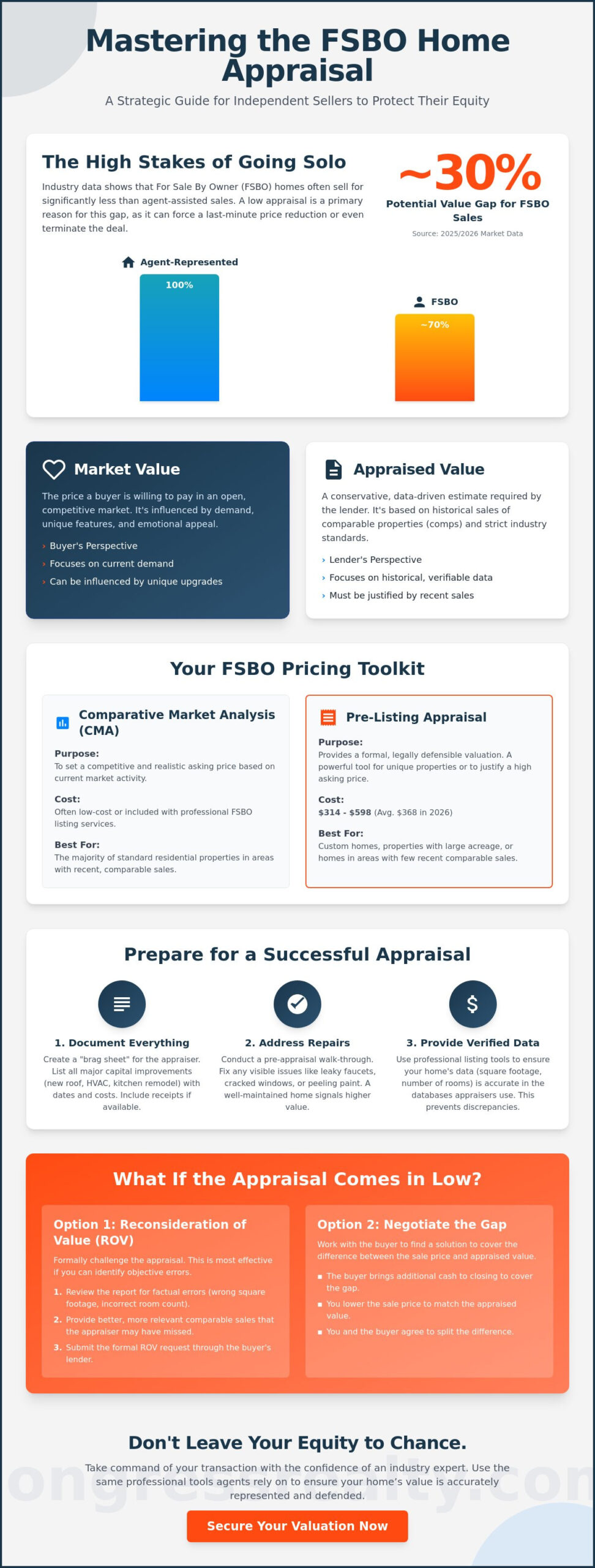
The appraisal directly impacts the buyer’s Loan-to-Value (LTV) ratio. If the house appraises for less than the contract price, the lender will only cover a percentage of that lower value. This creates a valuation gap that the buyer must pay in cash, or you must lower your price to close the deal. Managing this risk is a core part of learning how to sell your house on your own successfully. Since 2025 data shows FSBO homes often sell for 30% less than agent-assisted sales, protecting your agreed-upon price is vital for your bottom line.
The Difference Between Market Value and Appraised Value
Market value is the price a buyer is willing to pay in an open, competitive environment. Appraised value is a more conservative figure based on historical data and strict Real estate appraisal process standards. In a fast-moving 2026 market, these two numbers often diverge. Buyers might be eager to pay a premium for your unique upgrades, but appraisers look for settled sales from the last few months to justify the risk to the bank. They focus on what has already happened, not the potential of what might happen next.
Why the Lender’s Appraisal is the Ultimate Hurdle
It is a common misconception that the appraisal belongs to the buyer because they paid for it. In reality, the lender owns the process. Federal regulations mandate a firewall between the loan officers and the appraisers to prevent conflicts of interest. This is typically handled by an Appraisal Management Company (AMC). The AMC selects the appraiser, ensuring they are an independent third party who follows the Uniform Standards of Professional Appraisal Practice (USPAP). For a FSBO seller, this means you must be ready with professional-grade documentation the moment they walk through your door. You only get one chance to make a first impression on the person who holds the keys to your closing.
Pre-Listing Appraisal vs. Comparative Market Analysis (CMA)
How do you determine the right number for your home? In the fsbo home appraisal process, pricing is your most powerful tool. You have two primary options: the Comparative Market Analysis (CMA) and a formal pre-listing appraisal. While both help you understand your home’s value, they serve different strategic purposes. A CMA is an informal estimate based on market trends, while an appraisal is a legally recognized valuation performed by a state-licensed professional.
Cost is a major factor for independent sellers. A CMA is often included as a low-cost feature of a professional listing service. In contrast, a professional appraisal in 2026 averages $368, with a typical range between $314 and $554. For a standard single-family home, you might pay up to $598. It’s vital to remember that a pre-listing appraisal is for your benefit only. It does not replace the buyer’s lender-mandated appraisal. The bank will still hire their own independent appraiser to secure the loan.
When to Invest in a Professional Pre-Listing Appraisal
Most sellers don’t need a pre-listing appraisal, but certain “red flag” properties make it a smart investment. If your home is a unique custom build, sits on massive acreage, or is located in an area with very few recent sales, a professional valuation provides a solid baseline. It acts as a powerful marketing tool for FSBOs. By showing a signed appraisal to prospective buyers, you set a firm “ceiling” for negotiations. This prevents buyers from lowballing you and gives you a professional-grade defense for your asking price.
Leveraging a CMA to Set a Realistic Asking Price
For the majority of residential sales, a high-quality Comparative Market Analysis (CMA) is the most efficient way to start. A CMA focuses on “solds” and “actives” to gauge what buyers are actually paying right now. Don’t fall into the trap of relying on automated valuation models (AVMs). These algorithms often miss the value of your recent kitchen remodel or the impact of a quiet cul-de-sac. Using professional brokerage tools allows you to access the same data points that agents use, ensuring your price is competitive from day one. It gives you the confidence to lead the transaction without overpaying for unnecessary reports.
How to Prepare Your Home for the Appraiser’s Visit
The physical inspection is a high-stakes moment in the fsbo home appraisal process. While many sellers spend hours deep cleaning or landscaping, professional appraisers focus on structural integrity, safety, and data-backed improvements rather than your decor. To ensure you receive a fair valuation, you must treat this visit with professional rigor. Follow these four pragmatic steps to prepare your property for the inspection.
- Step 1: Conduct a “pre-appraisal” walk-through. Identify and fix visible minor repairs like leaky faucets, peeling paint, or cracked window panes. These small issues can lead an appraiser to assume the home hasn’t been well-maintained.
- Step 2: Gather receipts for all major capital improvements. Focus on high-impact projects from the last 5-10 years. Documentation proves the value of upgrades that aren’t immediately visible.
- Step 3: Ensure all utilities are functional. The appraiser must test your appliances, HVAC, and water systems. If the utilities are off, you may face a re-inspection fee, which typically ranges from $100 to $250. Don’t forget to test your smoke and carbon monoxide detectors as well.
- Step 4: Create the “Appraiser’s Package.” This is a professional folder you will hand to the appraiser upon arrival to provide them with the best possible data for their report.
Documenting Upgrades and Major Systems
Appraisers use specific forms that prioritize the age and condition of your home’s major systems. Create a clear “Improvements List” that highlights high-value items like the age of the roof, the SEER rating of your HVAC unit, and the date of any kitchen or bath remodels. For maximum impact, format this list with the project name, the year completed, and the approximate cost. If you’ve done hidden renovations, such as upgraded electrical wiring or new attic insulation, provide “before and after” photos. Ensuring these projects meet local standards is crucial for valuation; for instance, resources like swissbuild.co.uk provide guidance on building regulations to help homeowners confirm their work is fully compliant. This transparency helps the appraiser justify a higher condition rating in their final report.
The Appraiser’s Package: Your Secret Weapon
Since you don’t have a traditional agent to represent you, the “Appraiser’s Package” is your voice. Include a copy of the executed sales contract, your most recent Comparative Market Analysis (CMA), and your detailed list of improvements. A critical addition is the “Comps Sheet.” This is a list of 3-5 local sales that most closely resemble your home. By providing the appraiser with verified data on nearby sales, you help them find the most accurate benchmarks for your property. When the appraiser arrives, be polite and helpful, but give them space to work. Answer their questions directly without being “pushy” or hovering, which allows them to complete their task efficiently while respecting their professional independence.
Managing a Low Appraisal: Strategies for Independent Sellers
What happens when the appraisal report arrives with a number lower than your contract price? This scenario, known as a low appraisal, is a common hurdle in the fsbo home appraisal process. It doesn’t mean your deal is over. As an independent seller, you must step into the role of transaction manager to protect your equity. Stay calm and keep your focus on the data. You have three primary paths: challenge the report, negotiate the price gap, or cancel the contract and find a new buyer.
Challenging the Appraisal with Better Comparables
Appraisers are professionals, but they aren’t infallible. If you spot a factual error, such as incorrect square footage or the wrong number of bedrooms, you have grounds for a Reconsideration of Value (ROV). Review the report line by line. Did they miss the high-value sale that closed last week just two doors down? Use the professional tools from your Transaction Management service to pull a fresh set of comparables. When you contact the lender, present your findings in a concise, non-emotional letter. Highlight the specific data points that justify a higher valuation and ask for a formal review.
Negotiating the Price Gap with the Buyer
If the lender refuses to budge on the valuation, the ball moves to the negotiation table. Most buyers use an appraisal contingency to protect their earnest money. This gives them the right to walk away, but most still want your home. Ask the buyer to bridge the gap with additional cash. Since the lender will only loan based on the appraised value, the buyer must cover the difference out of pocket. You might offer to meet them in the middle to keep the momentum going. If the gap is too large and the buyer is unwilling to negotiate, remember that you are in control. You can choose to put the home back on the market and wait for a buyer with a different lender or a larger down payment. Your equity is worth the effort of finding the right partner for the sale.
Securing Your Equity with Professional Listing Tools
Appraisers don’t rely on public search portals for their final reports. They use the Multiple Listing Service (MLS) because it provides verified, historical data that isn’t available elsewhere. When you manage the fsbo home appraisal process, having your property listed on the MLS ensures that the appraiser sees a professional record of your home’s features and transaction history. This level of accuracy prevents common data errors that could lead to a low valuation. By using professional tools, you bridge the gap between independent selling and the rigorous standards of the appraisal industry.
The most significant advantage of this approach is the financial gain. Traditional models often demand a 3% listing commission just to get your home on the right databases. By choosing a professional flat-fee model, you maintain your equity while accessing the same infrastructure used by high-priced agents. You keep control of your money and your transaction, ensuring that every dollar of your home’s appraised value stays in your pocket.
How MLS Listing Enhances Appraisal Accuracy
An appraiser’s job is to find the most accurate “comps,” and they prioritize properties with detailed MLS histories. They look specifically for “days on market” and “seller concessions” to determine if a sale price was inflated. If your home isn’t in the MLS, the appraiser might struggle to verify your data, leading them to use less favorable comparisons. Professional photography also plays a vital role here. When an appraiser reviews the MLS listing, high-quality images influence their “Condition” rating of the property. You should use a flat fee mls listing to ensure your home has the professional visibility required to support a high valuation.
The Congress Realty Advantage: Professional Support Without the Fee
You don’t need to sacrifice professional quality to save on commission. A standard listing provides the essential infrastructure needed for a smooth appraisal, including placement in the databases appraisers trust most. Beyond the listing, our Transaction Management services help you navigate the complex hurdles of escrow and lender requirements. We provide the smart, utilitarian tools you need to lead the process yourself. Take control of your sale, protect your hard-earned equity, and close your deal with the confidence of an expert. The tools are ready; the next move is yours.
Take Command of Your Closing and Your Equity
Mastering the fsbo home appraisal process isn’t about luck; it’s about professional preparation and visibility. You now have the roadmap to prepare an unshakeable Appraiser’s Package and the strategies to negotiate a valuation gap with total confidence. By documenting your upgrades and leveraging verified market data, you ensure that your home’s true value is recognized by the lender and the buyer alike. Independent selling doesn’t mean being alone in the process. It means having the freedom to lead your own success.
Since 2002, we’ve empowered independent sellers to navigate these complex hurdles with national coverage and expert transaction management. We’ve saved our clients over $100M in commissions by replacing outdated, high-cost models with smart, flat-fee solutions. You don’t need a traditional agent to protect your equity. You just need the right professional infrastructure to back your decisions. List Your Home on the MLS for a Flat Fee and Save Thousands today. You’ve done the hard work of preparing your home for the market. Now, take control of the final steps and keep the equity you’ve earned. Success is within your reach.
Frequently Asked Questions
Who pays for the home appraisal in a FSBO sale?
The buyer typically pays the appraisal fee as part of their mortgage closing costs. While the lender orders the service to protect their investment, the buyer is responsible for the bill, which in 2026 averages $368. In some negotiations, a seller might offer to cover this cost as a concession, but it’s standard for the buyer to handle it as part of their loan application process.
Can I talk to the appraiser when they come to my house?
You are absolutely allowed to speak with the appraiser, but you must respect their professional independence. Use this time to hand over your prepared documentation, such as receipts for major system upgrades or a list of recent local sales. Avoid hovering or pressuring them to reach a specific number, as federal regulations require a firewall between the valuation and the parties involved in the transaction.
How long does the home appraisal process take in 2026?
The entire fsbo home appraisal process usually takes between seven and ten business days from the moment the lender orders the report. The physical inspection of your property is relatively quick, often lasting only 30 to 60 minutes. The remaining time is spent by the appraiser researching comparable sales and finalizing the report according to the new UAD 3.6 data standards required by November 2, 2026.
What happens if the appraisal comes in lower than my asking price?
A low appraisal creates a valuation gap that must be resolved before the lender will fund the loan. You can ask the buyer to cover the difference in cash, lower your sales price, or meet somewhere in the middle. If you believe the report contains factual errors, you can also work with the lender to request a formal Reconsideration of Value by providing updated data and better comparable sales.
Does a messy house affect the home appraisal value?
Cleanliness does not technically impact your home’s appraised value, as appraisers focus on the structure, fixtures, and permanent improvements. However, extreme clutter that prevents the appraiser from accessing the attic, crawlspace, or mechanical systems can hinder the process. A tidy home also creates a better impression of overall maintenance, which can subtly influence the “Condition” rating the appraiser assigns to the property in their final report.
Is a home inspection the same thing as a home appraisal?
A home inspection and an appraisal serve two completely different purposes in a real estate transaction. An inspector evaluates the physical condition and safety of the home’s systems to protect the buyer from hidden defects. An appraiser determines the fair market value of the property to protect the lender from over-leveraging the loan. You need both to reach a successful closing when the buyer is using traditional financing.
Can I use a pre-listing appraisal to prove my home’s value to a buyer?
A pre-listing appraisal is an excellent marketing tool that provides a professional baseline for your negotiations. While it won’t replace the lender’s mandatory appraisal, it gives you a legally recognized valuation to show prospective buyers. This is especially helpful for unique properties where a standard Comparative Market Analysis (CMA) might not capture the full complexity or the high-end upgrades of your specific home.
What are the most common things that fail a home appraisal?
Appraisals don’t fail in the traditional sense, but certain safety issues can trigger a “subject to repair” status. Common red flags include non-functional smoke detectors, peeling lead-based paint, or water heaters that aren’t properly strapped. If these items aren’t fixed, the appraiser must return for a re-inspection, which typically costs between $100 and $250. Address these small safety hazards before the visit to keep the fsbo home appraisal process moving smoothly.