
Did you know the national average real estate commission hit a five-year high of 5.70% in March 2026? It’s a massive expense that makes every dollar of your home equity more precious than ever. You likely feel the pressure to get your listing price exactly right, but determining fair market value for my home often feels like a guessing game. You worry that underpricing will leave money on the table, while overpricing might cause your listing to sit for 52 days or more. It’s a delicate balance, and you deserve to be in the driver’s seat.
It’s common to feel frustrated by the gap between an automated estimate and reality. This guide empowers you to take charge by mastering the professional methodology for pricing your property. You’ll learn how to protect your equity and ensure a swift sale by using data-backed strategies instead of outdated industry habits. We’ll show you how to use a Comparative Market Analysis (CMA) and professional industry databases to find your ideal price range. You will gain the confidence to defend your price during negotiations and maximize your returns by avoiding high-cost commission models.
Key Takeaways
- Define Fair Market Value accurately to ensure you are targeting the specific number that dictates your final net proceeds.
- Learn the professional methodology for determining fair market value for my home by filtering recent “Sold” data using the “Three S’s” framework.
- Discover why automated algorithms often struggle with unique homes and how to verify the data behind the “Black Box.”
- Use search bracket psychology to position your listing for maximum visibility among buyers using major online filters.
- Access professional-grade data with a Comparative Market Analysis (CMA) to defend your price during negotiations while maintaining full control of your equity.
What Is Fair Market Value (FMV) in the 2026 Housing Market?
What is the actual price of your home? It isn’t the number on a tax bill or a speculative guess from an online algorithm. Understanding What Is Fair Market Value (FMV) is the first step toward a successful sale. Legally, FMV is the price that a willing buyer would pay a willing seller on the open market, provided neither is under pressure to act. In a cooling 2026 market where the median existing-home sales price is $417,800, getting this number right is the difference between a closed deal and a stale listing.
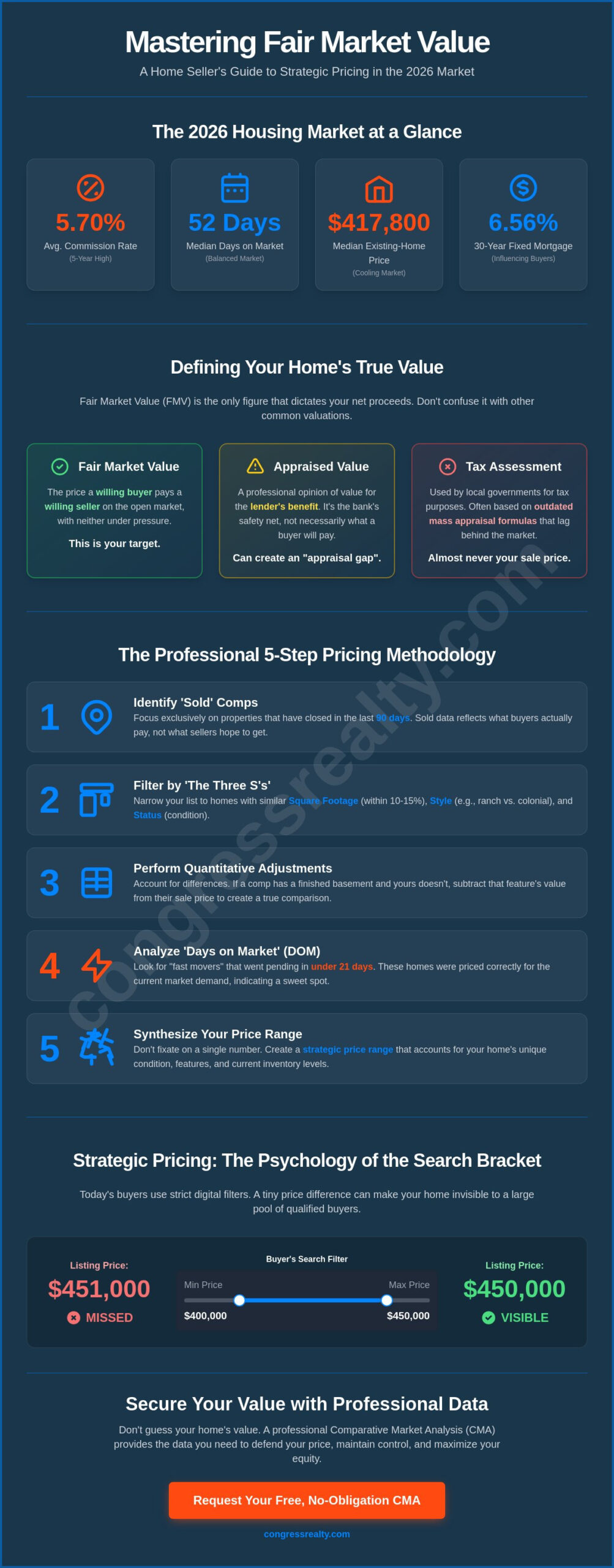
FMV is the only figure that truly dictates your final net proceeds. While you might have an emotional attachment to your property, the market remains objective. Today’s buyers are highly sensitive to interest rates, which sit at 6.56% for a 30-year fixed mortgage as of June 2026. This financial reality means buyers use strict digital search filters on the MLS. If your price is even slightly outside a major search bracket, like $450,000 versus $451,000, you could lose a significant portion of your potential audience. Determining fair market value for my home requires looking at these technical search habits just as much as the physical property itself.
With existing-home inventory at 4.4 months of supply, the market is more balanced than the frenzy of previous years. Homes are now sitting for a median of 52 days. This means you can’t afford to “test the market” with an inflated price. An accurate FMV ensures you capture attention in those critical first two weeks when buyer interest is at its peak. By focusing on data-backed values and professional fixed-fee listing models, you avoid the trap of price cuts that signal desperation to savvy buyers and their agents.
Market Value vs. Appraised Value
View an appraisal as the bank’s safety net. It’s a professional opinion of value required for a mortgage, but it doesn’t always reflect what a buyer is willing to bid. Market value is driven by emotion, competition, and current demand. If multiple buyers fall in love with your home, the market value might soar past the bank’s estimate. If that happens, you’ll need to know how to bridge the “appraisal gap” to protect your equity. Don’t let a conservative bank estimate dictate your ceiling when buyer demand suggests a higher price point.
Why Your Tax Assessment Is Not Your Sale Price
Your tax assessment is almost never an accurate reflection of what your home is worth today. Local governments use mass appraisal formulas that often lag behind the actual market by a year or more. Showing a buyer your tax assessment during negotiations can backfire. If the assessment is low, the buyer will use it as leverage to lowball you. If it’s high, it simply highlights a higher tax burden. When determining fair market value for my home, rely on recent “Sold” data from professional industry databases to justify your price rather than outdated government records.
How to Calculate Fair Market Value: A Step-by-Step Methodology
Pricing your home is a technical process, not an emotional one. To protect your equity, you must move beyond “gut feelings” and adopt a data-driven approach. When determining fair market value for my home, the goal is to replicate the logic a professional appraiser or a savvy buyer will use. Follow this structured five-step methodology to find your ideal listing price.
- Step 1: Identify ‘Sold’ Comps. Look only at properties that have closed in the last 90 days. Active listings represent what sellers hope to get, but sold data represents what buyers are actually paying.
- Step 2: Filter by ‘The Three S’s’. Narrow your list to homes with similar square footage (within 10-15%), style (don’t compare a ranch to a two-story colonial), and status.
- Step 3: Perform Quantitative Adjustments. If a comparable home has a finished basement and yours doesn’t, you must subtract that value from their sale price to see how your home stacks up.
- Step 4: Analyze ‘Days on Market’. With the national median at 52 days as of April 2026, look for homes that went pending in under 21 days. These “fast movers” indicate the price points currently triggering the most demand.
- Step 5: Synthesize Your Range. Don’t settle on a single number. Create a strategic range that accounts for your home’s unique condition and current inventory levels.
This process aligns with official How to Calculate Fair Market Value protocols used by many state authorities. It ensures your price is defensible when a buyer’s agent tries to negotiate. If you want a professional head start, requesting a Comparative Market Analysis (CMA) can provide the verified data you need to skip the guesswork.
Selecting the Right Comparable Properties (Comps)
Ignore the “For Sale” signs in your neighborhood. Those prices haven’t been tested by a completed transaction yet. In the shifting 2026 market, where mortgage rates have recently fluctuated near 6.56%, the “90-day rule” is your best friend. Data older than three months likely reflects a different interest rate environment and won’t accurately predict today’s buyer behavior. Prioritize homes within your specific school district; even a half-mile difference can change the value if it crosses a district line.
Adjusting for Home Improvements and Deficiencies
Be honest about your home’s condition. While a new HVAC system adds peace of mind, it’s often considered an “invisible” upgrade that maintains value rather than spiking it. Conversely, a 10-year-old kitchen is no longer “new” in the eyes of a buyer. You must account for the depreciation factor. Assign specific dollar values to differences in lot size or curb appeal. If a comp has a professional landscape package and your yard is basic, adjust your target price downward to remain competitive. Determining fair market value for my home requires this level of objective scrutiny to ensure you don’t overprice and let the listing go stale.
The Limitations of Automated Valuation Models (AVMs)
Why do online estimates for the same house vary by tens of thousands of dollars? Most sellers start their journey by looking at a Zestimate or a Redfin Estimate, but these tools operate inside a “Black Box.” You cannot see the specific data points the algorithm chose or ignored. While some AVMs report high accuracy for cookie-cutter homes, that margin of error often widens to 15% or more for unique or rural properties. Determining fair market value for my home is a task that demands human intuition and verifiable data. Relying on an algorithm can lead to an unrealistic entry price and “listing fatigue.” With the median days on market reaching 52 days as of April 2026, an initial pricing error can derail your entire timeline. You need more than a guess to protect your equity.
The core problem with machine learning in real estate is its inability to prioritize context. An algorithm might see a home sale down the street and apply that price per square foot to your property without knowing your neighbor’s house was a complete fixer-upper. This lack of transparency forces you to trust a number you can’t explain. When you enter negotiations, “Zillow said so” is not a valid defense. You need a data-backed foundation that allows you to stand firm on your price with confidence.
Why Algorithms Miss Interior Condition
A computer cannot walk through your front door. It doesn’t know if you just installed premium hardwood floors or if the house needs a new roof. Algorithms miss the “feel” of a home, such as dated wallpaper or the quality of natural light. Determining fair market value for my home requires looking at these specific upgrades that a machine simply cannot quantify. While professional photography helps humans appreciate these details, a machine sees only pixels and metadata. Congress Realty uses CMAs to bridge this data gap, ensuring your price reflects the actual condition of your living space rather than just a zip code average.
AVMs and the ‘Herding’ Effect
AVMs are susceptible to the “herding” effect. If one neighbor sells their home at a massive discount due to a divorce or foreclosure, that single outlier can skew every automated estimate in your neighborhood for months. Sellers who trust these machines without verification often face forced price drops within the first 30 days of listing. To succeed, you need Strategic Pricing: Aligning FMV with Buyer Psychology. Always verify AVM data against actual MLS closing statements. This ensures your strategy is based on reality, not a mathematical glitch. Taking control of your data is the only way to safeguard your financial interests in a cooling market.
Strategic Pricing: Aligning FMV with Buyer Psychology
Pricing is more than just a calculation; it is a strategic marketing move. When you are determining fair market value for my home, you must think like a buyer browsing on a smartphone late at night. Most buyers use digital filters that move in $25,000 or $50,000 increments. If you price your home at $505,000, you are invisible to every buyer who capped their search at $500,000. By choosing $499,900 or even exactly $500,000, you capture two distinct search brackets. This strategy avoids the “no-man’s land” of pricing and keeps your listing active in the maximum number of search feeds.
The first 14 days of your listing are the most critical. This is when the “New Listing” alerts hit thousands of inboxes simultaneously. If you launch with an accurate FMV, you create a sense of urgency that motivates buyers to act. In a market where homes go to pending in around 21 days, a price that feels like a “deal” compared to local comps can trigger multiple offers. Conversely, pricing for a single, high-value buyer often leads to the 52-day median wait time or worse. Aim for a price that invites competition rather than one that tests a buyer’s patience. You want to lead the market, not chase it with price drops.
Understanding Search Algorithm Thresholds
Search engines on major platforms prioritize round numbers and specific thresholds. If you price at $501,000, you are effectively cutting your potential audience in half. Buyers rarely search for “up to $501k.” They search for “up to $500k.” Pricing just under or right on these thresholds ensures your home appears in the maximum number of saved searches. This psychological perception is what drives high click-through rates and more showings in your first week. It’s a simple adjustment that yields massive visibility.
The Danger of Emotional Pricing
Your home is a collection of memories, but to a buyer, it is a financial asset. Avoid the trap of pricing based on what you need to net for your next down payment or what you spent on that custom patio years ago. The market does not care about your labor costs; it only cares about current utility and demand. To remain objective, use a Comparative Market Analysis to ground your decisions in hard data. Separating your emotions from the transaction is the only way to protect your equity. Ready to see the data for yourself? Get your professional CMA today and start your listing with confidence.
Securing Your Value: The Professional CMA Advantage
Why should you rely on a professional Comparative Market Analysis (CMA) instead of a simple online estimate? A CMA is the gold standard for independent sellers because it uses the same verified industry databases that traditional agents use. When you are determining fair market value for my home, a CMA provides the technical justification for your price. It isn’t just a suggested number; it’s a comprehensive report that compares your property to recent sales with granular accuracy. This level of detail is essential for defending your equity during negotiations. If a buyer’s agent tries to lowball your offer, you can present the data-backed findings of your CMA to stand your ground.
A professional CMA protects your interests by:
- Providing data-backed evidence to justify your price to skeptical buyers.
- Identifying the most relevant local comps that algorithms often miss.
- Allowing you to adjust for specific home improvements with dollar-for-dollar accuracy.
Accurate pricing is the single most effective way to protect your home equity. In a market where the median days on market is 52, you can’t afford to waste time with an incorrect price. Overpricing leads to stale listings, while underpricing leaves money on the table. Congress Realty provides the professional infrastructure of a traditional broker without the traditional 3% listing commission. This pragmatic approach allows you to retain the maximum amount of your equity while still benefiting from professional-grade transaction management. You maintain full command over the process, using the same tools as the pros to ensure a swift and profitable sale.
The Congress Realty Approach to Valuation
Our Standard and Full Service packages are designed to provide the specific valuation support you need to win. You’ll benefit from having a broker-owner oversee your transaction management, ensuring that every legal and logistical detail is handled correctly. This professional oversight gives you the confidence to manage the sale independently. Remember that listing on the MLS without a realtor requires professional-grade pricing to capture the attention of buyers and their agents. Determining fair market value for my home with our expert tools ensures your listing is competitive from the very first day.
Next Steps: From Valuation to Listing
Once you have synthesized your data into a strategic price range, you can transition to a live MLS listing in as little as 24 hours. Use this time to prepare your home to meet the FMV you’ve established. Professional photography, deep cleaning, and minor staging can help your property match the high-value comps in your CMA. When your home looks its best and is priced accurately, the market will respond. Take control of your financial future and stop paying for services you can manage yourself. Start your equity-first listing with Congress Realty today and experience a smarter way to sell.
Take Command of Your Home Equity Today
You now have the professional methodology needed to price your property with absolute precision. By focusing on recent sold data and understanding search algorithm thresholds, you can avoid the common pitfalls of overpricing or relying on flawed automated estimates. Determining fair market value for my home is no longer a guessing game; it’s a strategic advantage that puts you in control of your financial outcome. You don’t need a high-cost agent to tell you what your house is worth when you have access to the right data.
Congress Realty has provided broker-led transaction management since 2002. Our model is built specifically to empower independent sellers like you. Every listing package we offer includes a professional Comparative Market Analysis (CMA) to ensure your price is backed by the same industry databases the pros use. This allows you to save the traditional 3% listing commission while maintaining the professional infrastructure required for a successful sale. Stop leaving your equity to chance and start making informed, intelligent decisions.
Secure your equity and list your home for a flat fee today. You have the tools and the knowledge to lead this process with confidence. We’re ready to help you cross the finish line.
Frequently Asked Questions
How do I determine the fair market value of my home for free?
You can find a baseline by researching “Sold” listings on public real estate websites. Focus on properties within a half mile radius that closed within the last 90 days. While these free tools provide a ballpark figure, they often lack the depth of professional databases. For a more precise number, many sellers find that a professional Comparative Market Analysis (CMA) offers the accuracy needed to protect their equity.
Is fair market value the same as the Zestimate?
A Zestimate is a starting point, but it is not a legal or financial substitute for fair market value. Algorithms use public data that may not reflect recent interior upgrades or specific neighborhood nuances. Zillow reports a median accuracy of 2.4% for on-market homes, yet this margin can widen significantly for unique properties. Determining fair market value for my home requires a human touch to verify the data behind the machine’s guess.
Can I use an appraisal from two years ago to price my home today?
Avoid using old appraisals because the 2026 market is vastly different than it was two years ago. Mortgage rates for a 30-year fixed loan sit at 6.56% as of June 2026, which has significantly changed buyer purchasing power. Since median home prices have declined for five consecutive quarters, relying on outdated valuations will almost certainly lead to overpricing. You need fresh data from the last three months to stay competitive.
What happens if I price my home above fair market value?
Overpricing your home usually results in your listing sitting on the market for much longer than the national median of 52 days. When a house lingers, buyers assume something is wrong with the property, which often leads to lowball offers. You’ll likely end up chasing the market with price drops. It’s much more effective to launch with a data-backed price that triggers immediate interest and potential multiple offers.
How often does fair market value change in a hot market?
Fair market value can shift every few weeks depending on inventory levels and mortgage rate volatility. In May 2026, rates jumped to a nine-month high of 6.65% before stabilizing. These micro-shifts directly impact what buyers can afford to bid. If you’re in a high-demand area, check local “Pending” and “Sold” statuses every two weeks to ensure your listing price still aligns with the current reality.
Does a professional CMA guarantee my house will sell at that price?
A professional CMA provides a data-backed price range, but it is not a guaranteed sale price. It acts as a strategic map based on what other buyers have recently paid for similar homes. The final number depends on your home’s condition, your staging, and how well you negotiate. Think of the CMA as your defensive shield; it gives you the evidence needed to justify your asking price to skeptical buyers.
Should I include the cost of my recent renovations in the FMV?
Focus on the market’s perceived value of your upgrades rather than the actual amount you spent on labor and materials. Buyers don’t pay dollar-for-dollar for your costs; they pay for the finished result. For example, a minor kitchen refresh might offer a higher return on investment than a luxury pool in a mid-range neighborhood. Use your CMA to see how much “value-add” similar renovated homes actually commanded in recent sales.
How do I find ‘sold’ comps if I’m not a real estate agent?
You can access “Sold” data through public records or by using professional listing services that provide MLS-integrated reports. Determining fair market value for my home is much simpler when you use the same professional infrastructure as traditional brokerages. By looking at actual closing statements rather than just “Active” asking prices, you gain a clear, unfiltered view of what the market is truly willing to pay in 2026.