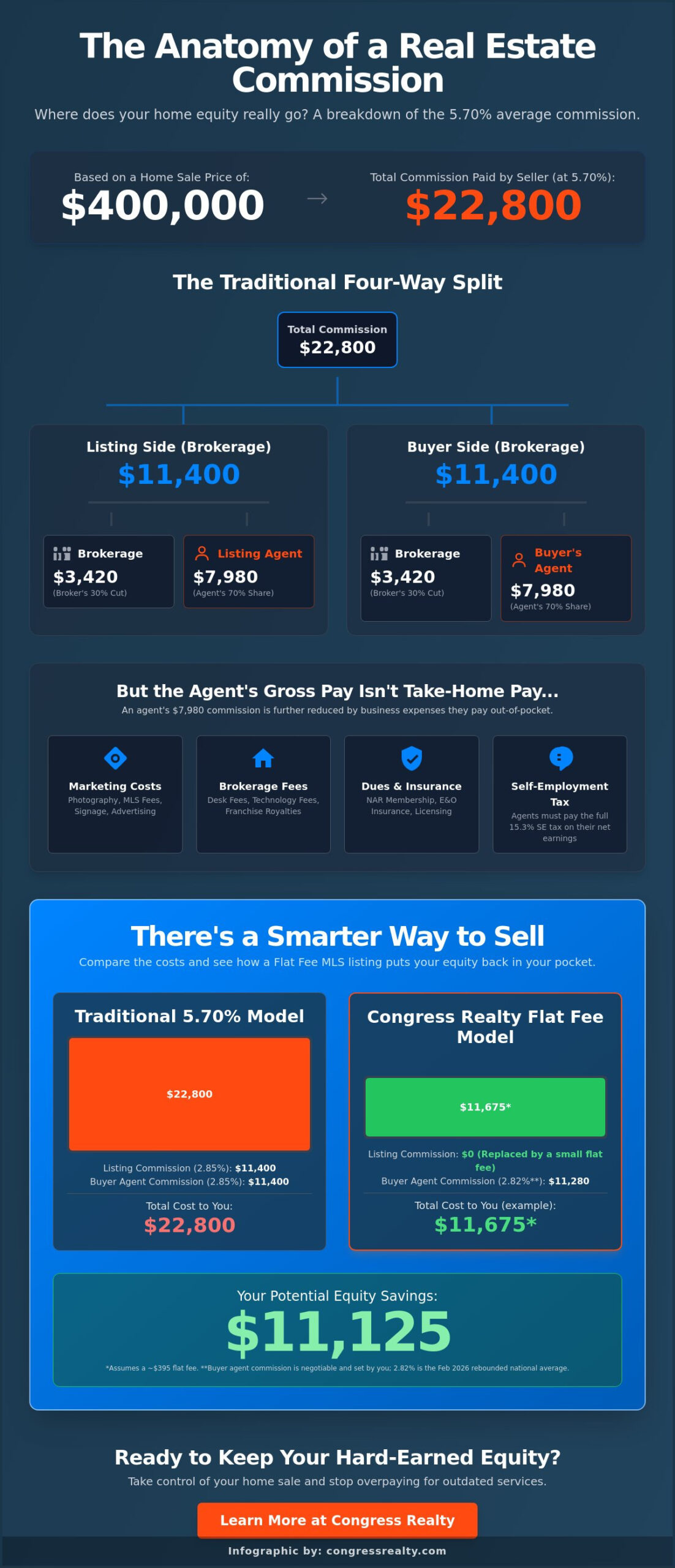
If you sell a $400,000 home today, you’ll likely hand over $22,800 in commissions. Despite the headlines about legal settlements in 2024 and 2025, the national average real estate commission reached 5.70% in February 2026. You are probably asking yourself: how much does the realtor make and why is so much of your hard-earned equity disappearing? It’s frustrating to feel like your home’s value is a “black box” where thousands of dollars vanish at the closing table without a clear explanation.
We agree that you deserve total transparency and control over your financial future. This article promises to reveal exactly how commissions are calculated in the current market, who really gets paid, and how you can safeguard your equity from high fees. You’ll discover the truth about typical commission rates, the rebound of buyer agent fees to 2.82%, and how a flat fee MLS listing helps you keep thousands saved while you control your sales process. Understanding these numbers is the first step toward a simple, rewarding, and highly profitable sale.
Key Takeaways
Understand why realtors operate as independent contractors and how this performance-based model impacts your final closing costs.
Deconstruct the traditional commission split to see exactly how much does the realtor make compared to their brokerage and the buyer’s agent.
Navigate the post-2024 legal landscape with clarity on new buyer agency requirements and the end of mandatory MLS compensation offers.
Identify the “Value Gap” in full-service listings and learn why the digital age makes paying a 3% listing fee unnecessary for most savvy sellers.
Master the Flat Fee MLS model to list your home professionally and keep thousands in equity while you lead the transaction.
Understanding Realtor Compensation: Salary vs. Commission
Most people assume real estate agents receive a steady paycheck for their time. That isn’t how it works. Almost all agents operate as independent contractors. They don’t have a base salary, health benefits, or a 401(k) provided by their brokerage. Instead, they rely entirely on performance-based pay. If a deal doesn’t close, the agent earns exactly zero dollars for the weeks or months of work they invested. This high-risk model is the primary reason traditional commissions remain so high. When asking how much does the realtor make, you have to look past the total commission check to see the actual net profit.
It helps to understand the hierarchy of the industry. A real estate agent is licensed to help people buy and sell property. A broker has additional education and can own a firm. A REALTOR® is simply an agent or broker who belongs to the National Association of Realtors and agrees to their code of ethics. Regardless of the title, real estate agent compensation usually flows through the brokerage first. The brokerage takes a significant cut before the agent ever sees a dime.
The Median Earning Reality in 2026
As of February 2026, the national average real estate commission rate sits at 5.70%. While this sounds like a massive payday, the median income for agents remains modest. New agents often struggle, while the top 10% of earners handle the majority of high-volume market transactions. In Texas, the average commission is even higher at 5.88% as of April 2026. This geographic variation means an agent in Austin or Dallas might have a higher income potential than one in a lower-demand rural area, but their cost of living and marketing expenses scale upward as well.
Fixed Expenses That Eat Into Agent Pay
The gross commission is never the “take-home” pay. First, the brokerage typically takes a split ranging from 20% to 50% of the agent’s portion. After that, the agent must cover their own overhead. These costs include:
Brokerage Fees: Monthly “desk fees” and franchise royalties paid regardless of sales.
Marketing Costs: Professional photography, signage, and premium LOCAL MLS placement for listings.
Dues and Insurance: Mandatory NAR membership dues and Errors and Omissions (E&O) insurance.
Taxes: Since they are self-employed, agents must pay the full 15.3% self-employment tax.
When you calculate how much does the realtor make after these deductions, the “big check” at closing looks much smaller. However, as a homeowner, you shouldn’t have to subsidize an agent’s inefficient business model with your hard-earned equity. You can choose a smarter path that keeps your money where it belongs: in your pocket.
The Anatomy of a Commission: Where Your Money Goes
Have you ever wondered why the standard commission feels like a massive lump sum? While the national average as of February 2026 is 5.70%, that money rarely goes to just one person. In states like Texas, the average is even higher at 5.88% as of April 2026. Historically, the seller has paid the entire bill for both the listing agent and the buyer’s agent. This practice stems from a long-standing industry standard where the listing brokerage shares a portion of the total fee with the firm that brings the buyer. Even with recent legal shifts and scrutiny from the Department of Justice on NAR settlement, many sellers still feel pressured to cover both sides to ensure their home gets maximum visibility on the LOCAL MLS.
The Four-Way Split Explained
Imagine a $400,000 home sale with a 5.70% commission totaling $22,800. This amount is typically split 50/50 between the listing brokerage and the buyer’s brokerage. From there, each firm takes its own cut. The “Broker of Record” at each office manages the funds and ensures legal compliance. If an agent is on a 70/30 split with their firm, they only keep 70% of their half. After everyone takes their piece, the individual agent might walk away with just 1.5% to 2% of the total sale price. When people ask how much does the realtor make, they often overlook these layers of middle management taking a bite out of the equity.
Transaction Costs and Referral Fees
The drain on your equity doesn’t stop at the brokerage split. Many agents pay high referral fees to acquire clients. If an agent gets a lead from a relocation company, they might lose 25% to 35% of their commission right off the top. Similarly, leads from platforms like Zillow or Opcity come with a heavy price tag for the agent. There are also administrative costs, like transaction coordination fees, that appear at closing. These hidden layers of the traditional model explain why agents fight so hard for high commissions. You shouldn’t have to pay for an agent’s marketing debt or their office’s franchise royalties. You can choose to list on the MLS without a realtor and bypass these expensive corporate structures entirely.
By understanding these mechanics, you can see why the traditional model is so expensive. It’s designed to support a heavy corporate infrastructure, not just to sell your home. When you calculate how much does the realtor make versus how much you actually keep, the value of a flat-fee approach becomes clear. If you’re still wondering what is a flat fee and how fixed-cost real estate pricing works, understanding the contrast with the traditional commission model is the perfect starting point. You keep your hard-earned equity while still getting the professional exposure you need to close the deal.
How the 2024 NAR Settlement Changed Agent Pay Forever
The August 2024 settlement wasn’t just a legal footnote. It fundamentally shifted the power dynamic back to you, the homeowner. For decades, the industry operated on a “pay-to-play” model where sellers had to offer a set fee to buyer agents just to get on the MLS. That mandate is gone. Now, commissions are “decoupled.” This means each party is responsible for their own representation. You finally have a clear view of how much does the realtor make on each side of the deal. Transparency is the new standard, and it’s about time.
Agents must now be explicit about their fees. Before a buyer even tours your home, they must sign a written agreement with their agent. This document clearly states the agent’s compensation. This prevents the old “hidden fee” trap where buyers thought their agent’s services were free. When you understand how much does the realtor make in this new landscape, you’ll see that the 6% “standard” is a relic of the past. You are in the driver’s seat.
New Rules for the Multiple Listing Service (MLS)
The most visible change is the total removal of buyer agent compensation fields from the Multiple Listing Service. Agents can no longer use the MLS database to guarantee their payday. However, sellers can still offer “seller concessions.” This is a specific dollar amount or percentage you agree to pay toward the buyer’s closing costs. By early 2026, this has become the standard way to maintain listing visibility while keeping the ability to negotiate. You Control Your Sales Process by deciding exactly how much of a concession to offer, if any.
Negotiating the Buyer Agent Fee
You are no longer the default bank for the buyer’s representative. While the average buyer’s agent commission rebounded to 2.82% by February 2026, it is entirely negotiable. You can offer a competitive rate to attract more buyers, or you can offer 0% and let the buyer handle their own agent’s fee. Offering 0% is a bold move that keeps more equity in your pocket, but it can shrink your pool of potential buyers. Many buyers in 2026 struggle with down payments and can’t afford to pay their agent out of pocket. Using commission savings as a leverage tool allows you to close the deal on your terms without being forced into a 3% “standard” that no longer exists. If you want to take full control of the process, learning how to sell your house on your own gives you the knowledge to navigate these negotiations with confidence.
The Real Cost of Full-Service Brokerages for Sellers
Paying a 3% listing fee was standard when agents held the keys to all the data. In 2026, that’s no longer the case. Buyers find homes themselves on Zillow and other major portals. These sites pull data directly from the LOCAL MLS automatically. When you consider how much does the realtor make for simply uploading photos and managing a few digital documents, the “Value Gap” becomes glaringly obvious. Traditional brokerages still charge as if they are doing the manual legwork of the 1990s. This outdated model assumes you can’t handle basic communication or schedule a few showings on your own.
This model has turned full-service representation into a luxury choice rather than a necessity. You don’t need a high-commission agent to “find” a buyer. The internet does that for you. Professional oversight is still valuable, but you shouldn’t have to pay a percentage of your home’s total value for it. A flat fee or a reduced rate makes more sense for the savvy, independent property owner who wants to stay in control. It’s about paying for the infrastructure you need, not the hand-holding you don’t. For a comprehensive look at how to approach selling a home in 2026 while maximizing your equity, understanding where the traditional model falls short is the critical first step.
What You Are Actually Paying For
Most full-service agents justify their 3% fee by listing several “premium” services. However, a closer look reveals these tasks are often streamlined or outsourced. You are essentially paying a massive premium for an agent to coordinate these basic logistics:
Professional photography: Agents usually hire a third-party photographer for a few hundred dollars; they don’t take the photos themselves.
Comparative Market Analysis (CMA): Modern software generates these pricing strategies in minutes using recent sales data.
Transaction Management: Digital signature platforms have made contract handling and documentation services incredibly simple for anyone to manage.
The High Cost of Traditional Listing
Let’s look at the math. On a $500,000 home sale, a 3% listing commission is $15,000. If an agent spends 20 hours total on your listing from start to finish, you are effectively paying them $750 per hour. That is more than most specialized attorneys or surgeons earn. When you calculate how much does the realtor make per hour of actual labor, the cost is staggering. It’s a high price to pay for a service that has been largely automated by technology.
The Equity Drain is the unnecessary loss of home profit caused by paying percentage-based fees for tasks that no longer require manual, full-service labor.
You can protect your profit. Stop the drain and save your equity in 2026 by choosing a more efficient, flat-fee model that keeps you in control of your sales process.
Empowering Sellers: How to Keep Your Equity with Flat Fee MLS
You’ve seen the breakdown of the 5.70% national average and the 5.88% Texas rate. You know exactly how much does the realtor make from your equity. Now it’s time to take that money back. The Flat Fee MLS model is the ultimate tool for the financially intelligent homeowner. It provides the same professional exposure as a traditional brokerage without the 3% listing cut. You get your property on the LOCAL MLS, which then syndicates to Zillow, Realtor.com, and hundreds of other sites. This ensures every active buyer in your market sees your home within minutes of it going live.
You can list on MLS without a realtor while maintaining full professional parity. Congress Realty provides the necessary infrastructure to make the process easy and efficient. We offer electronic lockboxes that track every agent who enters your home for your peace of mind. Our CMA support gives you the same pricing data traditional agents use to help you set a competitive price. You aren’t sacrificing quality; you’re simply cutting out the middleman’s overhead. You stay in the driver’s seat throughout the entire transaction.
Standard vs. Full Service Flat Fee
We offer tiered packages because every seller has a different comfort level. A standard listing works for the DIY expert who just needs the data feed to the major portals. A full-service flat fee model adds professional photography and dedicated transaction management. Professional photography is the highest-ROI add-on you can choose. It’s the first thing buyers see on the LOCAL MLS, and it drives the first impression. For complex closings, having a transaction coordinator ensures your documentation services are perfect. This professional facilitator handles the legal paperwork while you lead the negotiations. To get a deeper understanding of how these pricing structures compare to traditional commissions, our complete guide explaining what is a flat fee in real estate and how fixed-cost models protect your equity walks you through every detail.
The Financial Impact of Going Flat Fee
The math is simple and rewarding. On a $400,000 home, a traditional 6% commission drains $24,000 from your profit. That’s a massive amount of money to hand over at the closing table for services you can largely manage yourself. With a flat fee listing, you pay a predictable rate and decide how much to offer the buyer’s agent. Even if you offer the 2.82% average to a buyer’s agent to attract more traffic, you still keep over $12,000 in your pocket. That is money you can use for your next down payment or your retirement savings. Homeowners who want to go even further can follow a step-by-step approach to sell your house on your own in 2026 and reclaim every dollar of unnecessary commission.
Stop wondering how much does the realtor make and start focusing on how much you keep. Our platform is a smart, utilitarian tool for the savvy property owner. Congress Realty helps you “Control Your Sales Process” from the initial listing to the final closing. It’s time to list your home on the local MLS today and experience a simple, rewarding, and highly profitable sale.
Take Back Your Home Equity
The real estate landscape shifted permanently after the August 2024 settlement. You don’t have to accept the 5.70% national average commission as an unavoidable cost of selling. By identifying the “Value Gap” in traditional listings, you can protect your equity from high fees. Stop worrying about how much does the realtor make and start deciding how much you want to keep. You have the power to negotiate and the right to transparency at every stage of the transaction.
Congress Realty has championed homeowners since 2002. With over two decades of expertise, we provide the professional infrastructure you need without the corporate bloat. You get direct broker support from Andrew English and access to tiered packages featuring professional photography and transaction management. You Control Your Sales Process while keeping your profit where it belongs. Our platform is a smart, utilitarian tool designed for the savvy property owner who values autonomy.
Selling your property should be a simple, rewarding victory. You have the data, the tools, and the right ally to secure your financial future. Take charge of your sale and move forward with total confidence.
Frequently Asked Questions
Do I have to pay the buyer’s agent commission in 2026?
No, you aren’t required to pay the buyer’s agent commission. Since the 2024 settlement, commissions are decoupled, meaning each party is responsible for their own representative. While the average buyer agent fee reached 2.82% in early 2026, you can choose to offer 0% or provide a specific seller concession to help the buyer cover their agent’s costs.
Can I negotiate the percentage a realtor makes?
Yes, all real estate commissions are negotiable by law. There is no such thing as a “standard” 6% fee. While a February 2026 survey showed a national average of 5.70%, you have the right to negotiate this number down or opt for a flat-fee service that keeps your equity intact.
What is the difference between a flat fee and a commission?
A flat fee is a fixed, predictable price you pay upfront for specific services like a LOCAL MLS listing. A commission is a percentage-based fee that scales with your home’s sale price. Flat fees provide transparency and massive savings, while commissions often result in you paying more for the same amount of work as your home value increases.
How much does a realtor make on a $400,000 house?
On a $400,000 home, the total commission at the 5.70% national average is $22,800. This total is split between two brokerages. When asking how much does the realtor make individually, the listing agent typically keeps about 1.5% to 2% of the sale price after their broker takes a 20% to 50% cut of the agent’s portion.
Is it legal to sell a house without a realtor?
Yes, it’s entirely legal to sell your home without a traditional full-service agent. You have the right to represent yourself and manage your own negotiations. Using a flat-fee listing service gives you the professional exposure of the MLS without the high cost of a 3% listing commission, allowing you to stay in total control.
Why do realtors charge so much if I found the buyer myself?
Traditional listing contracts often include an “exclusive right to sell” clause. This means the broker gets paid regardless of who finds the buyer. This outdated model ignores the reality that 90% of buyers find homes online themselves. You can avoid this trap by using a flat-fee model that doesn’t penalize you for your own marketing efforts.
What happens if my house doesn’t sell-do I still owe the realtor money?
With a traditional commission model, you typically don’t owe a fee unless the deal closes. However, you’re often tied to a long-term contract that prevents you from trying other options. Flat-fee services require a small upfront payment for the listing, but they don’t lock you into a massive percentage-based debt if the home doesn’t sell.
Can I list on the MLS for a flat fee and still offer a buyer agent commission?
Yes, this is the most effective way to save money while maintaining high visibility. You pay a small flat fee to list your home professionally and then decide how much does the realtor make on the buyer’s side. Offering a competitive buyer agent commission or concession ensures that agents remain motivated to show your property to their clients.
Image sourced from Canva
Summary: Montana home sellers are losing over $15,000 to listing agent commissions, but there’s a catch: you need a licensed broker to access the MLS database, where 90% of buyers actually search. Here’s how savvy sellers are getting around this expensive barrier.
Key Takeaways
Montana home sellers can save over $15,000 by using flat-fee MLS services instead of paying traditional listing agent commissions of 2.98% on the median $505,900 home price.
Only licensed real estate brokers can access the MLS database, which automatically syndicates listings to Zillow, Realtor.com, and other major platforms where most buyers search for homes.
Montana’s shifting market shows 16.2% of listings hit price drops in March 2026, making fast MLS access critical for capturing buyer attention before competition increases.
Flat-fee MLS services provide the same database exposure as traditional agents for $299, compared to $15,076 in listing commissions, with listings going live within 48 hours.
The Montana real estate landscape has fundamentally shifted, leaving many home sellers frustrated with traditional listing processes that cost thousands while delivering slower results. Understanding MLS access has become vital for sellers who want to maximize their home’s exposure without paying excessive commissions.
Montana Sellers Save $15,000+ in Listing Agent Commission With Fast MLS Access.
Montana home sellers lose an average of $15,076 in listing agent commissions on every median-priced home sale. This staggering figure represents the 2.98% listing agent portion of typical real estate commissions on Montana’s $505,900 median home price. For many families, this commission equals a year’s worth of mortgage payments or a substantial down payment on their next property.
The traditional real estate model requires sellers to pay these hefty commissions for services they might not fully need. While full-service agents provide value through marketing, staging advice, and negotiation support, many experienced sellers prefer to handle these tasks themselves to retain more equity in their sale.Congress Realty has helped Montana sellers access MLS listings directly, eliminating the need for expensive listing agent commissions while maintaining professional standards.
Fast MLS access has become particularly vital in Montana’s current market conditions. With inventory levels rising and buyer preferences shifting, sellers who get listed quickly gain significant advantages over competitors who wait weeks for traditional agent processes to complete.
Why Only Licensed Brokers Control MLS Database Access
The Multiple Listing Service operates as a private, professional database accessible exclusively to licensed real estate brokers and their affiliated agents. This restriction is in place to maintain data integrity, ensure accurate property information, and uphold professional standards in the real estate industry. The Montana Association of REALTORS® oversees these access requirements, making broker licensing mandatory for participation in any MLS.
Individual homeowners cannot directly add their properties to MLS systems, regardless of their technical knowledge or real estate experience. This gatekeeping mechanism protects the database’s reliability but creates a dependency that traditional agents have used to justify high commission structures.
MLS Automatically Syndicates to Zillow and Major Platforms
When a property enters the MLS database, it automatically distributes across hundreds of real estate websites within hours. Zillow, Realtor.com, Redfin, Trulia, and dozens of other platforms pull listings directly from local MLS systems, creating massive exposure without additional marketing efforts. This syndication network reaches the vast majority of active home buyers, making MLS inclusion vital for maximum visibility.
The automated syndication process eliminates the need for sellers to post listings manually across multiple platforms. Professional photography, property descriptions, and pricing information flow seamlessly from the MLS to consumer-facing websites, ensuring consistent presentation across all channels.
No Broker License Means Zero MLS Visibility
Properties excluded from MLS databases remain virtually invisible to most buyers and their agents. Real estate professionals rely heavily on MLS searches to identify suitable properties for their clients, meaning unlisted homes miss countless showing opportunities. Even exceptional properties struggle to attract buyers without MLS exposure, regardless of their condition or competitive pricing.
Alternative listing methods, such as Craigslist, Facebook Marketplace, or newspaper classifieds, reach a limited audience compared to MLS syndication. These platforms lack the professional credibility and search features that serious buyers expect when house hunting.
Traditional Commission Math: $28,887 on Montana’s $505,900 Median Home
Montana’s average total real estate commission of 5.71% translates to $28,887 on a median-priced home of $505,900. This figure breaks down into approximately $15,076 for the listing agent and $13,811 for the buyer’s agent. These percentages have remained relatively stable despite technological advances that have streamlined many traditional agent responsibilities.
Commission calculations compound significantly on higher-value properties common in popular Montana markets like Bozeman, Whitefish, or Big Sky. A $750,000 home generates $42,825 in total commissions, with $22,350 going directly to the listing agent. These substantial fees often surprise sellers who assumed that commission rates would decrease in proportion to higher sale prices.
The listing agent’s commission covers services like market analysis, professional photography, marketing materials, showing coordination, and contract negotiation. However, experienced sellers often prefer to handle these responsibilities themselves to retain thousands of dollars in equity rather than pay for services they can competently manage.
Montana’s Shifting Market Creates New Listing Urgency
Montana’s housing market has transformed dramatically from the seller’s paradise of 2020-2022 to a more balanced environment favoring informed, strategic sellers. Current market conditions require faster response times and more competitive positioning to achieve optimal sales prices and timeframes.
Variable Days on Market: 53-115 Days vs. Increased Buyer Leverage
Montana homes currently spend between 53 and 115 days on the market, depending on location, price point, and property condition. This extended timeline contrasts sharply with the rapid sales experienced during the pandemic housing boom, when many properties sold within days of listing. The market has shifted toward increased buyer leverage and less seller competition.
Rural Montana properties typically experience longer marketing periods, while urban areas like Missoula and Billings maintain relatively shorter timeframes. Luxury properties above $750,000 often require 90+ days to attract qualified buyers, making early MLS entry vital for maximizing exposure during peak shopping seasons.
16.2% of Listings Hit Price Drops in March 2026
Price-reduction data reveal significant market softening, with 16.2% of Montana listings requiring price adjustments in March 2026. These reductions typically range from 3% to 8% of the original listing price, representing substantial financial losses for sellers who initially priced aggressively or delayed market entry.
Properties that enter the market quickly at competitive prices demonstrate higher success rates than those that wait for “perfect” conditions. Early listings capture motivated buyers before competing properties flood the market, reducing the likelihood of forced price reductions later in the selling process.
Flat-Fee MLS: Same Database, $299 Instead of $15,076 Listing Commission
Flat-fee MLS services provide the same database access as traditional listing agents for a fraction of the cost. Licensed brokers offering these services charge a one-time fee starting at $299 to enter properties into the appropriate Montana MLS system, thereby generating automatic syndication to major real estate platforms without ongoing commission obligations.
The core service remains unchanged: professional MLS entry, automatic syndication to consumer websites, and compliance with local listing standards. Sellers receive the same exposure benefits as traditional listings while retaining control over pricing, showing schedules, and negotiation processes.
What Sellers Handle vs. What’s Automated
Flat-fee MLS sellers manage property pricing, showing appointments, buyer communications, and contract negotiations independently. These responsibilities require time and attention but allow sellers to maintain complete control over their sales process and timeline. Many sellers appreciate the direct communication with potential buyers rather than filtering everything through an intermediary agent.
Automated processes include MLS data entry, syndication to major websites, and compliance with local listing requirements. The flat-fee broker handles technical aspects such as MLS formatting, accuracy of legal descriptions, and platform distribution, ensuring a professional presentation across all channels.
Full MLS Exposure Without Listing Agent Commission
Flat-fee listings receive the same MLS treatment as traditional agent listings, appearing in the same search results and displaying the same property information. Buyer agents can access these listings normally, schedule showings through standard protocols, and submit offers using conventional processes. The only difference lies in the commission structure and the seller’s level of involvement.
Buyers and their agents often cannot distinguish between flat-fee and traditional listings during their search process. Property presentation quality depends on the seller’s effort rather than the listing method, allowing motivated sellers to create compelling listings that compete effectively with agent-managed properties.
Get Listed Within 48 Hours and Keep Your $15,000+ Commission Savings
Speed represents a critical advantage in Montana’s current market conditions. Flat-fee MLS services can list properties within 48 hours of receiving complete information and payment, compared to traditional agents who often require 1-3 weeks for photography scheduling, marketing material preparation, and internal approval processes.
This rapid timeline allows sellers to capture immediate buyer attention, especially during peak shopping seasons when motivated buyers actively search for new listings. Early market entry often generates multiple showings and potential offers before competing properties can respond to changing conditions.
The combination of speed and cost savings creates compelling value propositions for experienced sellers comfortable managing their own transactions. Retaining $15,000+ in commission savings while gaining faster market access appeals to sellers prioritizing both financial and timing advantages in competitive markets.
Thinking about selling your home yourself to save on commission? Before you plant that “For Sale By Owner” sign in your yard, there’s a critical visibility problem you need to understand—one that could cost you $55,000 or more at closing.
Key Takeaways
MLS listings reach over 90% of active buyers compared to FSBO properties, which remain invisible to most home shoppers.
FSBO homes sell for $55,000 less on average and stay on the market 20% longer than MLS-listed properties.
Flat-fee MLS services provide maximum buyer exposure without paying full commission fees to listing agents.
Only 10% of FSBO sellers actually use MLS, missing out on where 86% of homes are successfully marketed and sold.
When selling a home, reaching the maximum number of qualified buyers directly impacts both sale price and time on market. The choice between MLS listings and For Sale By Owner (FSBO) approaches creates a stark difference in buyer exposure that most homeowners don’t fully understand.
MLS Listings Offer Dramatically More Buyer Exposure Than FSBO Properties
The Multiple Listing Service (MLS) serves as the central hub for real estate transactions, with approximately 86% of all homes for sale listed through this system. FSBO properties without MLS access remain invisible to over 90% of active buyers who rely on MLS-fed platforms and real estate professionals for their home searches.
This exposure gap creates a fundamental disadvantage for FSBO sellers. While yard signs and personal networks might generate some interest, the vast majority of today’s home buyers start their search online through platforms that pull inventory directly from MLS databases.Professional real estate services that include MLS listing ensure properties appear where serious buyers actually look.
The numbers tell the story clearly: only about 10% of FSBO sellers actually get their properties onto the MLS, even though that’s where most buyers and agents conduct their searches. This means 90% of FSBO sellers are marketing to a fraction of the available buyer pool.
Why Most Buyers Never See FSBO Properties
1. The MLS Fuels Most Online Home Searches, With 97% of Buyers Using the Internet to Find Homes
Modern home buying starts online, with 97% of buyers using internet searches to find properties. However, the major real estate portals like Zillow, Trulia, and Realtor.com primarily pull their inventory from MLS feeds, not from standalone FSBO listings. This creates a significant visibility gap for properties not listed through the MLS.
When buyers search these popular platforms, they’re browsing MLS inventory. FSBO properties that aren’t part of this system simply don’t appear in most search results, regardless of how attractive or well-priced they might be.
2. Zillow Lists FSBO Properties in a Separate Section, Which Can Reduce Their Visibility
Even when FSBO properties do appear on major platforms, they often face reduced visibility. Zillow separates FSBO listings from agent-listed homes, placing them in a secondary “By Owner” section which can reduce their visibility. Meanwhile, Realtor.com only displays homes listed through the MLS, ensuring verified and professionally updated properties take priority.
This segregation means FSBO listings compete for attention in a much smaller, less-trafficked section of these sites. The result is dramatically fewer page views, inquiries, and showing requests compared to MLS-listed properties.
3. Buyer’s Agents Often Bypass Non-MLS Properties
Real estate agents represent a significant portion of active buyers, and the MLS serves as their default search tool. It’s their “first stop” when finding homes for clients, which means an MLS listing instantly taps into that entire professional network.
Agents tend to bypass non-MLS properties for several practical reasons: uncertain compensation structures, difficulties scheduling showings directly with owners, and their primary reliance on MLS tools for client searches. This removes a large segment of represented buyers from the FSBO equation.
The Real Cost of Limited Buyer Exposure
FSBO Homes Sell for $55,000 Less on Average
FSBO sales have a median sale price of $380,000 versus $435,000 for homes listed by an agent, according to National Association of Realtors data. This $55,000 difference represents nearly 15% less in sale proceeds, often exceeding what sellers save by avoiding agent commissions.
The price gap stems from reduced competition among buyers. With fewer people seeing FSBO listings, sellers have less leverage in negotiations and fewer opportunities to receive multiple offers that drive up final sale prices. In competitive markets, this difference can be even more pronounced.
20% Longer Time on Market Without MLS
Beyond lower sale prices, FSBO homes typically take 20% longer to sell compared to agent-assisted properties. Extended market time creates additional carrying costs including mortgage payments, utilities, insurance, and maintenance expenses that quickly add up.
The longer timeline also increases the risk of the property becoming “stale” in buyers’ minds, potentially leading to further price reductions. Quick sales often depend on maximum initial exposure, which MLS listings provide but FSBO approaches typically cannot match.
When FSBO Actually Works
1. You Already Have a Lined-Up Buyer
FSBO makes the most sense when broad marketing isn’t necessary. About 38% of FSBO sellers in 2024 reported they already had a buyer lined up—often family members, friends, or neighbors—before deciding to sell. In these situations, maximum exposure isn’t needed since the transaction is pre-arranged.
When a specific buyer is already identified, FSBO can save on marketing costs and commission fees while still achieving a successful sale. The challenge lies in ensuring proper legal documentation and fair pricing without professional guidance.
2. Highly Desirable Property in Hot Market
In extremely hot real estate markets with severe inventory shortages, some unique or highly desirable properties can attract buyers through limited marketing channels. However, even in these situations, MLS exposure typically generates more competing offers and higher sale prices.
The decision often comes down to whether saving on commissions is more important than potentially maximizing the sale price through broader exposure and professional representation.
Flat-Fee MLS: Maximum Exposure Without Full Commission
For sellers who want MLS exposure without paying full listing agent commissions, flat-fee MLS services provide a middle-ground solution. These services allow homeowners to pay a one-time fee to have their property listed on the MLS, which automatically syndicates listings to major websites like Zillow and Realtor.com.
This hybrid approach provides access to the same buyer pool as traditional agent listings while maintaining more control over the sales process. Most flat-fee services still recommend offering competitive buyer’s agent commissions (typically 2.5-3%) to motivate agents to show properties and bring qualified buyers.
The key advantage is getting properties in front of both agent-represented buyers and the largest online platforms, while keeping listing costs significantly lower than full-service representation. This strategy addresses the primary weakness of FSBO—limited buyer exposure—while preserving most of the cost savings.
Get MLS Exposure for Your Home Sale Today
The data clearly shows that MLS listings reach significantly more potential buyers than FSBO approaches, leading to faster sales and higher sale prices in most market conditions. The FSBO market share hit an all-time low of 5% in 2025, indicating declining success rates for this selling method as buyers increasingly rely on MLS-fed platforms.
For sellers prioritizing maximum exposure and optimal outcomes, MLS listing—whether through full-service agents or flat-fee services—provides access to the buyer networks where real estate transactions actually happen. The choice isn’t really between MLS and FSBO; it’s about which level of MLS access and professional support best fits individual selling goals and budgets.
For expert guidance on maximizing your home’s exposure to qualified buyers,Congress Realty provides real estate services designed to achieve optimal selling outcomes.
Why are you still planning to hand over more than $23,000 of your hard-earned equity just to list your property? With the median home price sitting at $408,800 as of March 2026, the national average commission rate of 5.70% is no longer just a cost of doing business; it’s a massive financial hit. You shouldn’t have to choose between professional exposure and your bank account. When you decide to sell your home in this normalizing market, you deserve a process that prioritizes your profit over an agent’s payday.
To successfully sell your home in the normalizing market of 2026, you must present your property with the same level of sophistication as a high-end brokerage. For those who want to understand the gold standard of Seller Representation, looking at how premier agencies market their listings can provide a blueprint for your own success. Buyers are more selective now that inventory has improved to a 4.1-month supply as of March 2026. They expect a seamless, professional experience from the moment they see your listing online to the second they walk through the front door. By following these five pillars, you ensure your home isn’t just another address on a map; it’s a premium product that commands attention.
We know it’s frustrating to feel pressured by high-stakes pitches while 30-year fixed mortgage rates hover around 6.38%. You want to maintain full control over your showings and negotiations without sacrificing the reach of the LOCAL MLS. This article provides a pragmatic, equity-first checklist to help you secure full market exposure and professional tools while saving thousands in unnecessary fees. You’ll discover how to navigate new 2026 regulations, such as the required disclosures for digitally altered photos and thirdhand smoke, so you can lead your sale with total confidence and financial intelligence.
Key Takeaways
Adopt the “Equity-First” mindset to leverage modern technology and bypass traditional 6% commissions that drain your net profit.
Master the five pillars of a professional listing, ensuring your property stands out on the LOCAL MLS with high-impact visuals and data-driven pricing.
Compare the real-world financial impact of different brokerage models and discover how to keep up to $30,000 more of your home’s value.
Use a proven, step-by-step checklist to sell your home while retaining total authority over your showing schedule and negotiation strategy.
Eliminate the stress of escrow by utilizing professional transaction management tools to oversee documentation and meet every critical deadline.
Evaluating the 2026 Real Estate Market: Why High Commissions are Obsolete
The traditional real estate model is failing to keep pace with a digital-first world. In May 2026, buyers don’t wait for an agent to call them with new listings; they find properties themselves on mobile apps while drinking their morning coffee. This shift has turned the old-school 3% listing commission into an obsolete tax on your equity. Equity-First Selling is the modern standard for homeowners who realize that technology has already done the heavy lifting of marketing. When you decide to sell your home, you’re no longer paying for a gatekeeper. You’re paying for a platform that connects you directly to the market.
Access to the Multiple Listing Service (MLS) was once a guarded secret, but those days are gone. Professional tools now allow you to broadcast your property to every major real estate portal in seconds. Since 97% of buyers start their search online, your primary goal is visibility, not a high-priced middleman. The value of a listing agent has shifted from “finding a buyer” to simply “providing the data.” If the technology handles the exposure, paying a massive percentage of your home’s value for a simple data entry task no longer makes sense.
The Death of the Traditional 6% Model
The typical commission structure often totals between 5.44% and 5.70% as of early 2026. This is usually split down the middle: roughly 2.88% for the listing agent and 2.82% for the buyer’s agent. On a median-priced home of $408,800, that total fee exceeds $23,000. Flat-fee models disrupt this by eliminating the listing side of that expense entirely. You still offer a competitive commission to the buyer’s agent to attract motivated shoppers, but you keep the thousands of dollars normally reserved for the listing broker. It’s a pragmatic choice that reflects the actual work required to list a home in a normalizing market with 4.1 months of inventory.
Why Control is Your Greatest Asset
You know your home better than anyone else. Managing your own showings and receiving direct feedback from potential buyers gives you an edge that a busy agent can’t provide. Direct communication speeds up the decision-making process and removes the “game of telephone” that often stalls negotiations. By acting as an empowered seller, you maintain the authority to accept or reject offers on your own terms. You don’t need a middleman to sell your home when you have the right professional tools in your hands. You aren’t just saving money; you’re ensuring that the person most invested in the sale is the one calling the shots. Professional backing through documentation services ensures you stay compliant with new 2026 laws, such as the new FinCEN reporting rules for all-cash transactions, while you lead the process.
The Strategic Home Seller’s Checklist: 5 Pillars of a Professional Listing
To successfully sell your home in the normalizing market of 2026, you must present your property with the same level of sophistication as a high-end brokerage. Buyers are more selective now that inventory has improved to a 4.1-month supply as of March 2026. They expect a seamless, professional experience from the moment they see your listing online to the second they walk through the front door. By following these five pillars, you ensure your home isn’t just another address on a map; it’s a premium product that commands attention.
Pillar 1 & 2: Visuals and Valuation
The first impression happens on a screen. Smartphone photos are a deal-breaker because they signal a lack of effort and can drive down your perceived value. High-resolution, professional photography is mandatory. If you are in California, remember that new 2026 laws require you to disclose any digitally altered images. Transparency builds trust, and trust leads to offers. Pair these visuals with a “sweet spot” price determined by a Comparative Market Analysis (CMA). A CMA is a data-driven approach to pricing based on recent national sales trends and actual sold prices in your specific neighborhood. Since home prices saw a modest year-over-year increase of only 0.7% in February 2026, overpricing even by a small margin can cause your listing to stagnate.
Checklist item: Schedule high-resolution photography including drone shots to highlight the property’s perimeter and neighborhood context.
Checklist item: Perform a CMA to ensure you aren’t “testing the market” with an unrealistic price that ignores current inventory levels.
Pillar 3, 4 & 5: Infrastructure and Access
Marketing is the engine of your sale. Maximum exposure means your property must live on the LOCAL MLS. This is the primary data source that feeds national giants like Zillow and Realtor.com. Without it, you are invisible to the buyer’s agents who represent the majority of active shoppers. Once you have their attention, you must make it easy for them to visit. Utilizing professional electronic lockboxes allows you to track every agent who enters your home, providing security and peace of mind. Finally, don’t underestimate the psychological impact of professional yard signage. It signals to the neighborhood that a serious, professional transaction is underway. A flat fee mls listing is the engine behind these pillars, providing the professional infrastructure you need without the high-commission overhead.
Checklist item: Verify your listing appears correctly on all major national syndication sites within 24 hours of going live.
Checklist item: Install a professional-grade electronic lockbox to manage agent access and receive automated showing feedback.
You Control Your Sales Process by setting the stage for success. If you’re ready to move forward, you can list your home today and start saving your equity immediately.
Financial Comparison: Calculating the True Cost to Sell Your Home
Are you prepared to lose $30,000 in a single afternoon? When you decide to sell your home for $500,000, that is exactly what happens under the traditional 6% commission model. This isn’t just a fee; it’s a massive drain on the wealth you’ve built through years of mortgage payments. In the normalizing market of May 2026, where home prices saw a modest 0.7% increase in February, every dollar of equity counts. You need to understand the mathematical reality of your options before signing a listing agreement that could cost you a fortune.
Traditional brokerages often lock you into long contracts with a 6% total commission. On a $500,000 sale, that is a $30,000 loss. Beyond the high price, these models carry hidden risks like dual agency, where one broker represents both sides and compromises your leverage. iBuyers and “cash offer” platforms are even more expensive. While they promise speed, they typically charge a 5% service fee plus a 5% to 10% “convenience” discount on your home’s value. This results in a total loss often exceeding $50,000. If you are considering selling a house as is to avoid repair costs, understanding these predatory cash-offer structures is especially critical before you accept any offer. Choosing the flat-fee model through Congress Realty eliminates the listing commission entirely, allowing you to offer a competitive buyer agent incentive while keeping thousands more in your pocket.
The “Math of Control” vs. The “Math of Convenience”
iBuyers are often the most expensive way to sell your home because you are paying for the company’s risk and overhead. In contrast, the flat-fee model is built for the savvy, independent owner. If you want to understand how to sell your house on your own and maximize every dollar of your equity, the flat-fee approach offers a predictable flat rate instead of a percentage, allowing you to offer a competitive buyer’s agent commission (which averaged 2.82% in early 2026) and still save roughly 50% compared to traditional fees. Saving thousands isn’t just a slogan; it’s a mathematical certainty when you remove the listing agent’s 3% cut from the equation.
Where Does Your Equity Go?
Equity is your net profit after all liens and selling costs are paid. It is your reward for homeownership. The listing commission is the only major selling cost you can fully control. While you can’t change the 6.38% mortgage interest rate or the new FinCEN reporting requirements for all-cash deals, you can choose how much of your profit you give away. A professional CMA is vital here. It protects your equity from underpricing, ensuring you don’t leave money on the table while also avoiding the stagnation of an overpriced listing. You Control Your Sales Process, and that starts with protecting your bottom line.
Master the MLS: A Step-by-Step Guide to Maximum Market Exposure
To sell your home successfully in 2026, you must understand that the real estate market is driven by data, not just pretty pictures. While websites like Zillow and Realtor.com are popular, they are merely mirrors reflecting information from the LOCAL MLS. If your property isn’t listed on the primary database used by professional brokers, you are essentially invisible to the 90% of buyers working with an agent. You don’t need a high-commission middleman to access this power; you just need a professional bridge to the system.
Following a structured process ensures your listing hits the market with maximum impact. Here is how you lead your sale from start to finish:
Step 1: Choose your listing package. Decide between a Standard or Full Service plan based on the level of documentation support you require.
Step 2: Submit property data and professional photos. Provide the essential details and high-resolution visuals to the broker for review.
Step 3: Activate on the LOCAL MLS. Once live, this triggers automated syndication to hundreds of national real estate portals.
Step 4: Set the Buyer’s Agent Commission (BAC). Choose a competitive rate to incentivize the professionals who represent active buyers.
Step 5: Monitor your listing. Verify that your data appears correctly on Zillow, Realtor.com, and local brokerage sites.
Why the “Local MLS” is Non-Negotiable
Think of the MLS as the source code for the entire real estate industry. It is a restricted database where professional agents search for properties to show their clients. When you list through a traditional agent, this is the first thing they do. By using Congress Realty as your facilitator, you gain the exact same professional entry point without the 3% listing fee. Without this exposure, your home won’t appear in the automated email alerts that buyers receive from their agents, which is where the most serious offers originate.
Incentivizing the Buyer’s Side
Even though you are bypassing the listing commission, it’s a smart, pragmatic move to offer a competitive commission to the agent bringing the buyer. As of early 2026, the national average buyer’s agent commission is approximately 2.82%. Offering a rate in this range ensures that every agent in town is motivated to show your property. Since you’ve already saved the entire 3% listing side of the fee, you have more room to be competitive on price or terms. Research local commission trends in your specific zip code to ensure your BAC is attractive to the pros. You Control Your Sales Process by deciding exactly how much to offer, keeping you in the driver’s seat of your equity. If you are ready to get started, you can list your home on the MLS today and take charge of your sale.
Transaction Management: Navigating Offers and Escrow with Professional Tools
The biggest fear for many homeowners isn’t finding a buyer; it’s what happens after the offer arrives. You might worry about missing a legal deadline or getting overwhelmed by a mountain of paperwork. In the 2026 real estate market, these concerns are valid. With 30-year fixed mortgage rates at 6.38% as of May 1, 2026, buyers are more cautious and their lenders are more demanding. You don’t need to pay a 3% listing commission to navigate this phase safely. Professional transaction management tools provide the structure you need to sell your home with the precision of a seasoned broker.
Transaction management is the process of overseeing every document, disclosure, and deadline from the moment a contract is signed until the keys are handed over. It turns a chaotic sequence of events into a methodical checklist. Congress Realty’s Full Service option serves as the ultimate safety net for sellers who want professional backing during these high-stakes negotiations. We ensure that your paperwork is compliant with current regulations, such as the FinCEN reporting rules for all-cash transactions that took effect on March 1, 2026. This professional infrastructure allows you to focus on your move while we help you protect your equity.
From Contract to Closing
The escrow period is the timeframe where a neutral third party holds funds and documents while both sides fulfill their contractual obligations. As the seller, your responsibilities include providing required disclosures, such as the 2026 California mandate regarding “thirdhand smoke” history. Missed disclosure deadlines are common “deal-killers” that can give a buyer a legal path to back out of the sale. Professional oversight prevents these errors by tracking every milestone in real time. Utilizing a broker-backed platform for digital document storage and signing ensures that your records are secure and accessible whenever you need them. It’s a pragmatic way to maintain momentum without the stress of manual tracking.
Closing the Deal on Your Terms
The final stage of the journey is the closing, where you sign the final settlement statement at the title company and receive your equity check. Because you chose a flat-fee model, that check will be significantly larger. You’ve successfully bypassed the traditional commission trap while maintaining full authority over the entire transaction. You Control Your Sales Process from the first showing to the final signature. Selling a home independently isn’t just a way to save money; it’s a way to prove that financial intelligence and professional results go hand in hand. Sell your home with the confidence that you’ve kept your hard-earned equity where it belongs.
You now have the blueprint to sell your home without sacrificing your hard-earned profit to outdated commission structures. By prioritizing professional photography, data-driven pricing, and the exposure of the LOCAL MLS, you position yourself as a savvy market leader. The current housing landscape proves that you don’t need a high-commission agent to find a buyer; you simply need the right professional infrastructure. With the median home price sitting at $408,800 as of March 2026, every percentage point you save is a significant financial victory for your next chapter.
Since 2002, Congress Realty has served as a reliable ally for independent sellers across the nation. With over two decades of flat-fee expertise and professional oversight from our designated broker, Andrew English, we provide the tools you need to succeed. Our tiered packages include everything from high-resolution photography to comprehensive transaction management, ensuring you have professional backing from the initial listing to the final closing signature. You have the intelligence to manage your own transaction, and we have the platform to make it simple.
You Control Your Sales Process. Step into the market with total confidence and keep your equity where it belongs.
Frequently Asked Questions
Can I really sell my home without a traditional listing agent?
Yes. You can list your property and manage the sale while bypassing the traditional 3% listing commission. Technology has democratized market access, allowing you to use a flat-fee broker to get your property on the LOCAL MLS. This approach puts you in the driver’s seat of the transaction while ensuring your property reaches the same audience as any high-priced brokerage listing. You maintain the authority to negotiate directly with buyers and keep your equity.
How does a flat fee MLS listing actually work?
You pay a one-time flat rate to a broker who lists your property on the LOCAL MLS instead of paying a percentage-based commission. Once the broker enters your data, your listing syndicates to hundreds of real estate websites used by buyers and agents. You retain the right to sell the property yourself and manage your own showings while the broker provides the professional entry point to the market. It is a simple, transparent process.
Will my home be listed on Zillow and Realtor.com?
Yes. Your property will appear on all major national portals including Zillow, Realtor.com, and Redfin. These sites pull their data directly from the LOCAL MLS. By using a flat-fee service to sell your home, you ensure that your property is visible to the 97% of buyers who start their home search online. Your listing will look identical to those represented by traditional full-commission agents, ensuring you receive maximum market exposure.
Do I still have to pay a commission to the buyer’s agent?
It is standard practice to offer a commission to the agent representing the buyer to incentivize them to show your home. As of early 2026, the national average for a buyer’s agent commission is approximately 2.82%. While you choose the exact amount, offering a competitive rate ensures professional agents remain motivated to bring their clients to your door. You still save the entire 3% typically reserved for the listing agent side of the transaction.
What is the difference between Standard and Full Service listing packages?
Standard packages focus on providing the essential MLS listing and syndication to national sites. Full Service packages add layers of professional support such as transaction management, contract review, and documentation assistance. If you want a safety net for navigating complex escrow requirements or the new 2026 FinCEN reporting rules, the Full Service option provides the expert oversight needed to close the deal with total confidence. You choose the level of support that fits your needs.
How do I handle showings if I am selling my home on my own?
You manage your own showing schedule through direct communication with buyer’s agents or unrepresented buyers. Most savvy sellers use professional electronic lockboxes to track agent entry and receive automated feedback. This gives you total control over who enters your home and when. You don’t have to wait for a middleman to relay messages, which often speeds up the decision-making process for motivated shoppers. It is a more efficient way to manage the process.
Is a Comparative Market Analysis (CMA) necessary for a flat fee listing?
A CMA is vital because it provides a data-driven price based on actual sold properties rather than just active listings. With national home prices seeing a modest 0.7% year-over-year increase in February 2026, pricing your home accurately is the difference between a quick sale and a stagnant listing. A professional CMA helps you find the “sweet spot” that attracts buyers while protecting every dollar of your equity. It is the foundation of a smart sales strategy.
What is transaction management and do I need it to sell my home?
Transaction management is the professional oversight of all documentation and deadlines from the contract stage to the final closing. It is highly recommended to ensure you meet all legal requirements, such as the 2026 California disclosure laws. Having an expert monitor your escrow period prevents common errors that could derail the sale. It’s a pragmatic tool that helps you sell your home with professional precision and less personal stress, ensuring a smooth path to the closing table.
Image sourced from Canva
Summary: Thinking about selling your Idaho home but dreading that $27,000+ commission hit? There’s a legal MLS listing method most agents won’t tell you about—and after the 2024 NAR settlement, it’s more viable than ever.
Key Takeaways
Idaho homeowners can legally list their properties on the MLS without a traditional real estate agent by using a flat fee MLS service through a licensed broker.
Flat fee MLS services can save sellers thousands of dollars by eliminating the listing agent’s commission while providing the same MLS exposure as traditional listings.
The 2024 NAR settlement has increased transparency in buyer-agent compensation, which is now negotiated directly between buyers and their agents rather than displayed on the MLS.
Homes listed through flat fee services appear on all major real estate websites, including Zillow, Realtor.com, and Redfin, with identical exposure.
Sitting at the kitchen table with a calculator, many Idaho homeowners experience that stomach-dropping moment when they realize traditional real estate commissions could cost them $24,000 or more on their home sale. On Idaho’s average home price of $473,335, total realtor commissions averaging 5.71% mean roughly $27,000 walking out the door at closing. However, there’s a legal alternative that most agents won’t mention.
Yes, Idaho Homeowners Can List Without Traditional Agents
Idaho homeowners can absolutely list their properties on the Multiple Listing Service without hiring a traditional real estate agent. The key lies in understanding how the MLS system works and in using flat fee MLS services provided by licensed brokers.
While only licensed real estate brokers and agents can add properties directly to the MLS, homeowners can use flat fee MLS services to achieve the same result.Congress Realty offers flat fee MLS listing services in Idaho, allowing homeowners to get full MLS exposure without paying traditional listing commissions. The MLS serves as the official shared database that powers listings on Zillow, Realtor.com, and Redfin, making it essential for proper market exposure.
This approach is fully legal under the Idaho Real Estate Commission’s regulations. Licensed brokers like Congress Realty can list homes for a flat fee rather than a percentage of the sale price, giving homeowners the same professional-grade exposure without the hefty commission costs.
What Flat Fee MLS Means for Idaho Sellers
1. How Flat Fee MLS Works Legally in Idaho
Flat fee MLS operates on a simple but powerful concept: instead of paying a percentage-based commission, homeowners pay a licensed broker a one-time flat fee to list their property on the MLS. The Idaho Real Estate Commission oversees all licensed brokers in the state, ensuring these services operate within established legal frameworks.
When working with a flat fee service, homeowners sign a standard Idaho Association-approved listing agreement, just like with traditional agents. The key difference lies in the compensation structure: rather than paying 2.5-3% of the home’s value for listing services, sellers pay a predetermined flat rate regardless of the home’s sale price.
2. Your Home Gets Full MLS and Online Exposure
Properties listed through flat fee MLS services receive the same exposure as traditionally listed homes. Once on the MLS, listings automatically syndicate to major real estate websites, including Zillow, Realtor.com, Redfin, and Trulia. There’s no asterisk, discount label, or different treatment – the listing appears exactly like any other property on the market.
This wide exposure is important in Idaho’s active real estate market, where homes typically go under contract within 31 days. Buyers and their agents search the same MLS database regardless of how the listing was created, ensuring flat fee listings reach the same audience as traditional listings.
3. You Keep Control Over Pricing and Showings
Flat fee MLS services allow sellers to maintain control over key aspects of the selling process. Homeowners set their own listing price, manage showing schedules, and handle offer negotiations directly. Following the 2024 NAR settlement, buyer agent compensation is now negotiated directly between buyers and their agents rather than being displayed on the MLS, though sellers may still offer concessions to buyers outside of the MLS to assist with these costs.
Many sellers appreciate this hands-on approach, especially those who understand their local market or have previous selling experience. The seller retains decision-making authority while still getting professional MLS listing services.
Real Commission Savings on Idaho Home Prices
Traditional 5.71% Commission Breakdown
Traditional real estate commissions in Idaho average between 5% and 6%. While the overall average commission rate remains in this range, the traditional display of commission splits between buyer’s and seller’s agents on the MLS has changed due to the 2024 NAR settlement, with buyer agent compensation now negotiated separately. On common Idaho home values, this creates substantial costs that many sellers don’t fully grasp until closing approaches.
For a $400,000 home in Nampa, traditional commissions would total approximately $23,000. In Boise, where the average home value reaches $505,000, sellers face roughly $28,836 in total commission costs. Coeur d’Alene homeowners, with average values around $545,000, could pay over $31,000 in combined agent commissions.
Flat Fee vs. Traditional Cost Comparison
The financial advantage of flat fee MLS becomes clear when comparing actual costs. While traditional sellers pay percentage-based commissions regardless of the work performed, flat fee sellers pay a predetermined amount – often starting at $299 for basic MLS listing services.
The savings are realized by eliminating the listing agent’s percentage-based commission, and any buyer agent compensation is now negotiated separately by the buyer, potentially with seller concessions outside the MLS. On a $400,000 Idaho home, the difference between traditional listing commissions (approximately 2.85%) and flat fee services represents over $11,000 in savings. These savings represent real money that stays with the seller rather than going toward commission payments.
Will Buyer’s Agents Show Your Flat Fee Listing?
Buyer’s agents show properties based on their clients’ preferences and needs, not on how the listing was created. Since flat fee MLS listings appear in the same search results as traditional listings, agents encounter them naturally during their property searches.
Factors that drive showing activity include competitive pricing, good presentation, and effective marketing. The property’s appeal to buyers and market positioning matter more than the listing method used.
How the 2024 NAR Settlement Helps Flat Fee Sellers
Recent changes to the 2024 NAR settlement actually benefit flat-fee sellers by increasing transparency around buyer-agent compensation. New rules require buyers to agree to their agent’s commission structure in writing before touring homes, making commission discussions more open and negotiable.
This transparency helps level the playing field for flat fee listings. Buyers and agents now discuss compensation expectations upfront, reducing any potential bias against listings that handle compensation differently than traditional arrangements. The settlement essentially normalizes diverse commission structures across the market.
Idaho Real Estate Commission Rules and Legality
The Idaho Real Estate Commission strictly regulates all real estate brokers operating in the state, including those providing flat fee MLS services. These regulations ensure that flat fee services meet the same professional standards as traditional full-service brokerages.
Licensed brokers offering flat fee MLS must provide proper disclosures, use approved forms, and maintain appropriate insurance and bonding. Sellers working with legitimate flat fee services receive the same legal protections as those using traditional agents, including access to standard Idaho Association real estate forms and contracts.
What’s Included in Flat Fee MLS Packages
1. Basic MLS Listing and Syndication
Standard flat fee MLS packages include a six-month MLS listing duration, which typically exceeds the time needed to sell in Idaho’s active market. The listing automatically syndicates to major real estate websites, ensuring broad online exposure that matches traditional listings.
Sellers receive a unique MLS number and can include professional photos, property descriptions, and showing instructions. The listing appears in agent searches immediately, making the property visible to the entire network of buyer’s agents in the area.
2. Required Idaho Real Estate Forms
Flat fee MLS services provide access to all necessary Idaho Association-approved real estate forms and disclosures. These include standard purchase agreements, disclosure statements, and other legally required documentation for Idaho real estate transactions.
Having proper forms eliminates the guesswork around legal requirements and ensures transactions proceed smoothly. Sellers can complete necessary paperwork confidently, knowing they’re using the same approved forms that traditional agents utilize.
3. Optional Full-Service Support
Many flat fee providers offer upgraded packages that include additional support services. These might include professional photography, improved marketing, showing coordination, or even full transaction management for sellers who want more hands-on assistance.
Premium packages bridge the gap between a basic flat-fee listing and traditional full-service representation, allowing sellers to choose their desired level of support while still saving significantly on commission costs.
Start Listing Today and Keep Your Commission
Idaho’s active real estate market rewards sellers who act quickly to capture current buyer demand. With homes averaging just 31 days to pending status, delayed listing decisions can mean missed opportunities with motivated buyers who are searching right now.
Every month of delay also means continued carrying costs – mortgage payments, taxes, insurance, and maintenance expenses that add up quickly on higher-value Idaho properties. The combination of active buyer demand and ongoing ownership costs makes prompt listing decisions financially beneficial.
Flat fee MLS listing provides immediate market entry without the commitment to expensive traditional commissions. Sellers can test market response, adjust pricing based on feedback, and maintain maximum flexibility throughout the selling process while keeping significantly more of their home’s equity at closing.
For Idaho homeowners ready to sell while keeping more of their hard-earned equity,Congress Realty provides licensed flat fee MLS services that deliver full market exposure without traditional commission costs.
Why should you hand over $23,300 of your equity just to get your property noticed? With the national median home price at $408,800 and average commission rates still hovering around 5.70 percent, most sellers are losing a small fortune the moment they sign a listing agreement. You know that the traditional 6 percent model is outdated, yet the pressure to conform can make the process feel overwhelming. These tips for selling your home in 2026 are designed to disrupt that cycle and put you back in control.
We’ll show you how to combine the power of a LOCAL MLS listing with smart preparation to sell faster while keeping your equity where it belongs. You’ll learn how to navigate new 2026 mandates like California’s Digital Image Disclosure law and manage the 14 percent increase in buyer demand even as mortgage rates sit near 6.4 percent. This article provides a clear, ten step roadmap to maximize your net profit and maintain total control over your showings. By the end, you’ll have the confidence to manage your sale like an expert and save thousands in the process.
Key Takeaways
Learn why the traditional 6% commission model is no longer necessary to achieve professional results in a rebalancing 2026 market.
Discover how to apply the “30-Second Rule” to your foyer to create an immediate emotional connection with prospective buyers.
Master these essential tips for selling your home by using data-driven CMA reports to maximize your price during the critical first 14 days on the market.
Understand why professional photography is your highest-return marketing investment and how to navigate new digital disclosure laws.
Reclaim your equity by utilizing a flat-rate listing model that provides LOCAL MLS exposure without the burden of a 3% listing commission.
Navigating the 2026 Real Estate Market: Why Strategy Trumps Commission
Selling a home in April 2026 is no longer a passive event. It has evolved into a strategic operation where you, the homeowner, act as the primary manager of your equity. For decades, the industry relied on a standard 6 percent commission model that often felt like a mandatory tax on your hard work. However, with the national average commission rate currently between 5.44 percent and 5.70 percent, savvy sellers are realizing they can save over $23,000 on a median priced home of $408,800. These tips for selling your home prioritize your net profit by decoupling professional tools from high costs.
Technology has completely dismantled the old gatekeeper system. You don’t need to trade 3 percent of your home’s value just to get your property onto the LOCAL MLS. Today, you can access the same professional infrastructure used by traditional agents while maintaining total control. This shift isn’t just about saving money; it’s about professional advocacy for your own financial future. By choosing a flat rate model, you ensure that your equity stays in your bank account rather than being split among multiple intermediaries.
The Shift Toward Homeowner Autonomy
Digital platforms have democratized access to buyer data and real-time market trends. In 2026, buyers are savvy. They don’t look for a specific brokerage name; they look for listing quality, accurate data, and high-resolution imagery. Because you know your home better than any third party, you’re the best person to lead the sale. Taking charge of the real estate transaction process gives you a psychological edge. You decide when people visit, how the home is presented, and which offers deserve your attention. It’s a simple, empowering way to manage one of your largest financial assets.
Identifying Your Primary Selling Goals
Success starts with a clear objective. Are you looking for a lightning-fast exit or the maximum possible net profit? With home sales forecasted to increase by 14 percent nationwide this year, the market is active but competitive. Establish a realistic timeline by looking at current inventory levels, which are up 20 percent from last year. Before you list, calculate your “net walk-away” figure. This number should account for your remaining mortgage balance, potential 2026 capital gains taxes, and any necessary repairs. Having this data upfront ensures you won’t be swayed by high-pressure tactics later. You control your sales process from day one.
Maximizing ROI with Strategic Home Preparation
Why spend $15,000 on a full kitchen remodel when a $500 deep clean and modern hardware updates can achieve the same emotional response from a buyer? One of the most critical tips for selling your home is to prioritize repairs that function as deal-breakers rather than chasing expensive cosmetic overhauls. In April 2026, housing inventory has increased 20 percent compared to last year. This means buyers are more selective and will use visible maintenance issues to negotiate lower prices or walk away entirely. Focus your budget on ensuring the HVAC, roof, and plumbing are in top condition before you worry about paint colors.
The “30-Second Rule” remains the gold standard for home preparation. Most buyers form a definitive emotional connection to a property within the first 30 seconds of walking through the front door. Your foyer must be spotless, well-lit, and smelling fresh. Speaking of scents, remember that as of January 1, 2026, California sellers must disclose any history of smoking or vaping inside the property. Professional deep cleaning to remove thirdhand smoke residue isn’t just a courtesy; it’s a legal and financial necessity to protect your equity and prevent future litigation.
High-Impact Staging and Decluttering
Neutralizing your space is about removing the “you” so the buyer can see “them.” Remove family photos, eclectic collections, and bulky furniture that chokes the flow of a room. A “Less is More” philosophy naturally increases the perceived square footage of every area. Use high-wattage, warm-toned LED bulbs to highlight architectural features like crown molding or built-in shelving. This creates a “model home” aesthetic that justifies a premium price point. While you manage these details, you can list your property on the local MLS to ensure your hard work gets the professional exposure it deserves.
Curb Appeal: The Digital and Physical First Impression
In 2026, curb appeal starts on a five-inch mobile screen. Your primary listing photo must be flawless because it’s the gatekeeper to a physical showing. Once a buyer arrives at the curb, the physical transition must match the digital promise. Simple landscaping wins provide the highest return on investment. Follow these steps for an immediate impact:
Refresh the mulch: Dark, fresh mulch makes garden beds pop and look professionally maintained.
Trim the hedges: Ensure windows aren’t obscured and walkways are clear.
Paint the front door: A high-contrast color creates a focal point and looks modern in photos.
Update house numbers: Clean, modern typography signals that the home is updated and cared for.
By focusing on these high-ROI tasks, you maintain control over your timeline and ensure your home stands out in a rebalancing market. You don’t need a high-commission agent to tell you that a clean, functional, and welcoming home sells itself.
Pricing and Exposure: The Dual Engines of a Successful Sale
Pricing your property isn’t a gut feeling; it’s a data-driven decision that determines how much of your equity you’ll actually keep. In April 2026, with the national median home price sitting at $408,800, even a 2 percent error in your listing price can cost you thousands in lost momentum. The first 14 days on the market are your “golden window.” This is when buyer interest is at its absolute peak. If you overprice during this period, your listing quickly becomes stale, and you’ll likely end up chasing the market down with price cuts that signal desperation to savvy buyers.
Visibility is the second half of the equation. You can have the most beautiful home in the neighborhood, but it won’t matter if the right people don’t see it. One of the most effective tips for selling your home is to ensure it’s listed where 90 percent of buyers actually look. By utilizing a professional listing service, your property syndicates from the LOCAL MLS to every major real estate portal, including Zillow and Realtor.com. This level of exposure is exactly what traditional agents offer, but you can achieve it without sacrificing a 3 percent listing commission.
Using CMA for Precision Pricing
A Comparative Market Analysis (CMA) is a data-driven valuation tool used by professionals to determine a property’s fair market value based on recent local sales. To get an accurate number, identify 3 to 5 “true comps” in your immediate area that have sold within the last six months. Don’t look at active listings; those are just what people hope to get. Look at final sale prices. Adjust your valuation based on concrete differences such as square footage, lot size, and specific upgrades like a new roof or a modernized kitchen. This pragmatic approach ensures your price is competitive enough to spark a bidding war while still protecting your net profit.
Why the MLS is Your Most Powerful Tool
The MLS remains the industry’s gold standard because it’s the primary data source for the entire real estate ecosystem. Unlike “For Sale By Owner” websites that often languish in digital obscurity, an MLS listing puts your home in front of every active buyer’s agent in the region. It also ensures you stay compliant with 2026 regulations. For example, you must adhere to the California Digital Image Disclosure law by disclosing any digitally altered photos. Using a professional platform helps you manage these logistics simply and effectively. You control your sales process by providing the same professional infrastructure as a high-commission brokerage, ensuring your home is seen by the widest possible audience from day one.
Mastering Professional Marketing and Security Logistics
Your listing price gets people to click, but your marketing quality determines if they actually book a tour. In a market where national inventory has climbed 20 percent over the last year, your property cannot afford to look amateur. One of the most overlooked tips for selling your home is treating your digital presence like a high-end showroom. You aren’t just selling a house; you’re selling a lifestyle. This requires a shift from “good enough” to professional grade infrastructure that protects both your equity and your privacy.
Beyond the visuals, managing the physical flow of people through your home requires a pragmatic security strategy. You shouldn’t have to choose between maximum exposure and personal safety. By utilizing professional tools like electronic lockboxes and verified buyer filtering, you maintain total oversight of who enters your property. This allows you to focus on the high-value aspects of the deal while the system handles the logistical heavy lifting. You control your sales process without the need for a high-commission intermediary to hold your keys.
The Power of Professional Photography
Smartphone photos are a liability in 2026. While mobile cameras are advanced, they often lack the wide-angle capabilities and dynamic range needed to capture the true scale of a master suite or a vaulted living room. Professional photographers understand the “Golden Hour” technique, scheduling shoots during the soft, natural light of sunrise or sunset to make your home look its absolute best. Ensure your photo gallery follows the logical flow of a physical walkthrough. Start with the curb appeal, move through the foyer, and end with the backyard. This structure builds a narrative in the buyer’s mind before they ever step foot on your driveway.
Managing Showings with Electronic Lockboxes
Security is a primary concern for independent sellers. Electronic lockboxes provide a sophisticated solution by creating a digital audit trail. Every time an agent accesses the key, the system records their credentials and the exact time of entry. This is a massive security upgrade over manual combination locks that anyone can share. You can also set specific “showing windows” to ensure tours only happen when it’s convenient for your family. This level of organization signals to buyers and agents alike that you are a serious, professional seller. To get started with these tools, list your home on the LOCAL MLS and gain access to the same secure showing technology used by the biggest firms in the country.
Finally, don’t ignore the power of local neighborhood traffic. A professional yard sign remains a vital marketing tool because it captures “drive-by” interest from people who already love your area. When combined with a strategy that filters for pre-approved buyers, these marketing and security layers ensure that only serious, qualified individuals are engaging with your property.
Reclaiming Your Equity: The Congress Realty Advantage
The traditional real estate model relies on you giving away a significant portion of your hard-earned wealth just for the privilege of listing your property. On a median-priced home of $408,800 in April 2026, a standard 3 percent listing commission takes more than $12,200 out of your pocket at the closing table. Congress Realty disrupts this by eliminating that percentage-based fee entirely. By choosing a flat rate approach, you ensure that the money you’ve built up in your property stays with you. These tips for selling your home are only effective if you have a platform that supports your financial intelligence and rewards your autonomy.
We provide the professional infrastructure you need to compete with high-commission firms. This isn’t just about saving money; it’s about professional advocacy. You get the same LOCAL MLS exposure and syndication to major portals that any traditional agent offers, but you keep the thousands of dollars they would normally take as a commission. This pragmatic shift allows you to be more flexible with your pricing or simply walk away with a much larger check at the end of the day.
The Flat Fee Revolution
Why pay for services you don’t need? A flat fee model allows you to access the professional tools required to sell a home for a predictable, transparent cost. When you compare this to the $23,300 total average commission often paid on a median sale, the financial benefit is undeniable. For the independent seller, a “Standard Listing” package is the smart choice. It provides the essential MLS entry and documentation services without the high price tag. If you want a deeper look at how this model transforms the industry, read The Ultimate Guide to Flat Fee MLS Listings: Save Your Equity in 2026. This strategy puts you on equal footing with the biggest brokerages while protecting your bottom line.
Taking Command of Your Transaction
Control doesn’t mean you have to be alone in the process. While you lead the sale, you can choose the level of support that matches your comfort level. For those who want extra security, professional transaction management helps you navigate the complexities of escrow and closing. This service ensures all paperwork is filed correctly and that you meet all federal reporting requirements. This includes the new FinCEN rules for all-cash transactions involving entities like LLCs that went into effect on March 1, 2026. You get the peace of mind of professional oversight without the unnecessary expense of a traditional agent.
You have the data, the tools, and the strategy to succeed in today’s market. Don’t let outdated industry norms dictate your financial outcome. List your home on the MLS today, set your own timeline, and reclaim the equity you’ve worked so hard to build. You control your sales process, and with Congress Realty as your facilitator, the rewards are entirely yours to keep.
Take Command of Your Home Equity Today
Selling your home in 2026 doesn’t mean you have to sacrifice your hard-earned profit to outdated commission structures. You’ve learned how professional-grade MLS exposure and strategic preparation can drive a faster sale while keeping your equity intact. By focusing on high-ROI repairs and using data-driven pricing, you position yourself as a savvy seller in a rebalancing market. These tips for selling your home empower you to manage the logistics of showings and marketing with total confidence.
You deserve a partner that respects your autonomy. Since 2002, Congress Realty has led the flat-fee revolution with over $1 billion in real estate listed and an A+ Rating with the Better Business Bureau. We provide the professional infrastructure; you maintain the control. It’s time to stop paying for services you don’t need and start maximizing your net walk-away figure. You’ve worked hard for your home’s value, and you should be the one to realize the gain.
You have the knowledge and the tools to succeed. Take the final step and secure your financial future today. Selling is simple when you’re in charge.
Frequently Asked Questions
What are the most important repairs to make before selling my home?
Prioritize functional deal breakers like HVAC systems, roof integrity, and plumbing before focusing on cosmetic upgrades. In 2026, housing inventory is up 20 percent compared to last year, which means buyers are more likely to walk away from homes with visible maintenance issues. Spend your budget on professional deep cleaning and removing smoke residue to comply with California’s January 1, 2026 disclosure laws. These functional fixes prevent buyers from negotiating thousands off your price during the inspection period.
Can I really sell my home without paying a 3% listing commission?
Yes, you can eliminate the traditional 3 percent listing commission by using a flat rate MLS service. On a median priced home of $408,800, this simple choice saves you over $12,200 in equity. You receive the same professional exposure as a high commission brokerage while maintaining total control of your sales process. This is one of the most effective tips for selling your home while maximizing your net profit at the closing table.
How do I determine the right asking price for my house?
Use a Comparative Market Analysis (CMA) to identify 3 to 5 similar homes that sold within the last six months. Do not rely on active listing prices; focus on final sale data to understand what buyers are actually paying in your specific neighborhood. Adjust for square footage and upgrades to ensure your price is competitive. This data driven approach is critical during the first 14 days on the market when buyer interest is at its absolute peak.
Is it safe to let strangers into my home for showings?
Showings are secure when you utilize professional electronic lockboxes that create a digital audit trail. These devices record the identity and entry time of every licensed agent who enters your property, providing far more security than manual combination locks. You can also set specific showing windows to maintain your family’s privacy and schedule. This system ensures you know exactly who has been in your home and when, giving you peace of mind throughout the process.
What is the best time of year to list my home for sale in 2026?
Spring remains the peak season, but 2026 market trends show a 14 percent increase in sales volume throughout the entire year. With mortgage rates holding steady around 6.4 percent, buyers are active but remain very price sensitive. Listing early in the year allows you to capture demand before inventory levels climb even higher in the summer months. Strategic timing combined with professional LOCAL MLS exposure ensures you reach the widest audience of motivated buyers.
Do I need a lawyer to sell my house on my own?
Legal requirements vary by state, but professional transaction management services can handle your documentation and escrow logistics. While some states require an attorney to close the transaction, many sellers manage the bulk of the paperwork through a title company or escrow officer. We provide the professional infrastructure to ensure your disclosures and contracts meet all 2026 federal and state regulations, including the new FinCEN rules for all cash transactions that began on March 1, 2026.
How long does it typically take to sell a home through a flat fee MLS service?
Homes listed via flat fee MLS services sell at the same rate as those listed by traditional agents because they appear in the exact same database used by all Realtors. The speed of your sale depends primarily on your pricing strategy and the quality of your professional photography. In the current market, well priced homes typically see their highest engagement within the first 14 days. You control the timeline by responding quickly to inquiries and maintaining a flexible showing schedule.
What happens if a buyer has their own real estate agent?
If a buyer is represented by an agent, you typically offer a buyer broker commission, which currently averages around 2.82 percent nationally. This ensures your home remains attractive to the largest pool of buyers and their representatives. Even when paying a buyer’s agent, you still save the entire 3 percent listing commission by using a flat rate service. If you’re still weighing your options and wondering whether you can sell your house without a realtor while still attracting agent-represented buyers, this balance allows you to maintain professional parity with other listings while keeping thousands more of your equity at closing.
Why should you hand over $24,225 of your hard-earned equity on a median home sale just for the privilege of a “sold” sign? It feels like a gut punch when you see a 5.70% commission total on your closing statement. You worked for years to build that value, and it’s frustrating to see a massive chunk vanish in a single afternoon. You aren’t alone in feeling like the traditional system is rigged against the homeowner.
Learning how to avoid realtor fees when selling doesn’t mean you have to sacrifice professional exposure or settle for a lower sales price. We’ll show you exactly how to bypass the traditional 3% listing commission while keeping your home in front of every active buyer. You can retain full control over your transaction without the anxiety of navigating complex 2026 regulations alone.
This guide provides the professional strategies you need to list on the local MLS for a flat fee and keep your equity where it belongs. We’ll walk you through the new mandatory buyer agreement rules and explain how to secure the same Zillow and Realtor.com visibility as any high-priced agent. It’s time to stop overpaying and start selling smarter.
Key Takeaways
Understand how 2026 real estate regulations and the NAR settlement have fundamentally shifted commission transparency in your favor.
Master how to avoid realtor fees when selling by leveraging a flat-fee MLS listing to bypass the traditional 3% listing agent commission.
Identify why professional photography and a precise Comparative Market Analysis (CMA) are the two most critical factors in securing a top-dollar offer.
Compare the hidden costs of cash buyers and traditional FSBO methods against the professional infrastructure of a flat-fee brokerage model.
Learn to utilize the “You Control Your Sales Process” approach to maintain total autonomy over your home’s equity from listing to closing.
The 6% Myth: Decoding Real Estate Commissions in 2026
The “standard” 6% commission is a relic of a less transparent era. As of April 2026, market data shows the national average commission has shifted to between 5.44% and 5.70%. Despite this downward trend, many traditional agents still push for that full 6% slice of your home’s value. This isn’t just a fee; it’s an equity tax that drains your profit. When you understand how to avoid realtor fees when selling, you realize that paying a massive percentage for basic administrative tasks is no longer necessary in today’s high-demand market.
The real shift occurred in August 2024 following the landmark NAR settlement. Before this date, listing agents could advertise buyer agent compensation directly on the MLS, often creating a “bundled” fee that felt non-negotiable. Today, that practice is banned. This change forced a new level of transparency, requiring buyers to sign written agreements with their agents before they even tour a property. You now have the power to negotiate every dollar. The old-school model of bundled fees has crumbled, leaving room for more intelligent, flat-fee alternatives.
Listing Fees vs. Buyer’s Agent Commissions
To navigate the 2026 landscape, you must distinguish between the two halves of the commission. The listing fee is what you pay an agent to place your property on the MLS and manage marketing. In contrast, the buyer’s agent commission is a fee offered to the professional bringing a qualified buyer to the table. If you’ve ever wondered how much does the realtor make and how those commissions are calculated, understanding this split is the essential first step. While the listing side is where you can save the most, providing a buyer’s agent incentive remains a strategic choice rather than a mandatory rule. Understanding Real Estate Commissions helps clarify that these roles are distinct and their pay should be handled separately. Commission decoupling is now the standard practice for 2026, ensuring you only pay for the specific services you choose.
The True Cost of a Traditional Sale
Do the math on your home’s value. If you sell a $500,000 property, a traditional 6% commission wipes out $30,000 of your equity instantly. That’s a massive sum that could cover a down payment on your next home or fund your retirement. Beyond the raw numbers, traditional agents often lock you into long-term contracts that limit your flexibility. By choosing a flat-fee approach, you retain 100% of your listing-side equity and maintain the freedom to pivot your strategy if the market shifts. You control your sales process. You keep the thousands of dollars that would otherwise disappear at the closing table. This financial empowerment is the core benefit of knowing how to avoid realtor fees when selling in a modern market.
This focus on financial empowerment is common among high-level real estate professionals. Many experienced investors who prioritize maximizing their returns and optimizing their strategies participate in elite groups like The Boardroom Mastermind to stay at the forefront of the industry.
Flat Fee MLS: The Strategic Way to Bypass Listing Commissions
The biggest hurdle for most homeowners is the fear of losing visibility. You want to save money, but you don’t want your house sitting on the market for months. Flat Fee MLS is the professional answer for anyone looking for how to avoid realtor fees when selling without disappearing from the digital marketplace. It functions as a bridge. You get the same professional infrastructure as a traditional agent but retain the autonomy of a private seller. This hybrid model allows you to maintain the “You Control Your Sales Process” mantra while ensuring your home isn’t invisible to the 91% of buyers who used an agent in 2025.
How Flat Fee Listings Work
The process is straightforward and eliminates the need for a 3% listing commission. Instead of signing away a percentage of your sale price, you pay a one-time flat rate to a broker. In exchange, they list your property on the LOCAL MLS. This database is the engine behind the entire real estate industry. Once your home is in the system, it automatically populates to every major site. You remain the primary contact for all buyer inquiries; you set the showing schedule that fits your life, and you manage the negotiations directly. It’s a pragmatic choice for the savvy owner who wants to list your home while keeping thousands in equity.
Professional MLS entry ensures your home appears on Zillow, Realtor.com, and Trulia.
Direct contact information allows buyers and agents to reach you without a middleman.
Full control over your listing details means you can update pricing or photos instantly.
Busting the ‘No Exposure’ Myth
A common misconception is that a flat-fee listing is somehow “lesser” than a traditional one. This is false. To a buyer scrolling on their phone, your listing looks identical to every other property on the block. There are no “FSBO” watermarks or hidden flags. The data feed comes from the same MLS source used by every big-name brokerage in the country. When homeowners research how to avoid realtor fees when selling, they often worry about limited reach. However, data shows that 21% of people who start as pure FSBO eventually hire an agent because they lack this specific exposure. A flat-fee listing solves this problem immediately. You get 100% of the market reach for a fraction of the cost. You aren’t sacrificing eyeballs; you’re just cutting out the unnecessary commission expense. This ensures you get the same professional visibility without the heavy financial burden at closing.
Comparing Your Options: FSBO, Cash Buyers, and Flat Fee Brokers
Choosing the right path requires more than just looking at a commission percentage. You need to look at your net profit. While many homeowners search for how to avoid realtor fees when selling, they often fall into traps that cost more than the commission they’re trying to save. You have three primary alternatives to the traditional 6% model: pure FSBO, cash buyers, and discount brokers. Each has its own set of trade-offs, but only one truly maximizes your financial intelligence and keeps your equity intact.
The Hidden Cost of ‘Convenience’ Buyers
Cash buyers and iBuyers sell you on speed. They offer a “no fee” transaction that bypasses the traditional market entirely. However, this convenience comes with a steep price tag. These companies often offer 10% to 15% below market value to account for their own holding costs and profit margins. On a $425,000 home, which was the 2025 median for agent-assisted sales, that’s a potential loss of $42,500 or more. Contrast this with a flat-fee MLS sale where you keep your equity and reach the entire market. Use this checklist before signing with a cash buyer:
Does the offer reflect a current, professional Comparative Market Analysis (CMA)?
What are the “service fees” or “repair credits” deducted from the final check?
How does the net profit compare to an open-market sale with a flat-fee broker?
Discount brokerages often advertise a 1% listing fee. While this sounds better than 3%, it’s still a percentage-based model that punishes you for having a more valuable home. On a $600,000 sale, that 1% is still a $6,000 check. A flat rate doesn’t care how much your home is worth; it provides the same professional infrastructure for one predictable price. To fully understand how much does the realtor make on a typical sale versus what a flat fee costs you, the difference in net profit becomes immediately clear. This is the smartest way to manage how to avoid realtor fees when selling while ensuring you don’t simply trade one percentage for another.
Pure FSBO vs. Flat Fee MLS
Selling purely by yourself is the ultimate way to eliminate fees, but it often leads to a lower sale price. In 2025, pure FSBO homes had a median sale price of $360,000, while agent-assisted homes hit $425,000. Why the $65,000 gap? It’s the lack of exposure. A “For Sale By Owner” sign in the yard only reaches people driving down your street. Without the LOCAL MLS, you’re stuck with “pocket listings” that miss out on the bidding wars that drive prices up. Flat Fee MLS is FSBO with professional armor. You get the same Zillow and Realtor.com visibility as the big brokerages while paying a small fraction of the cost. You control your sales process without the risk of leaving thousands on the table. It’s the Goldilocks solution: professional reach with private-seller savings.
The 5-Step Roadmap to Selling Without a Traditional Agent
Selling a home independently is not a mystery; it is a structured sequence of professional actions. Many owners wonder how to avoid realtor fees when selling while still maintaining a high level of security and market presence. The answer lies in replacing the agent with a proven infrastructure. By following a methodical roadmap, you can navigate the 2026 real estate landscape with the same precision as a top-tier brokerage. This process ensures you don’t just “list” your home, but actually move it from “for sale” to “sold” while keeping your equity intact. For a deeper look at every stage of this process, the strategic guide to selling a home in 2026 and maximizing your equity covers each step in comprehensive detail.
Step 1: Conduct a Professional Comparative Market Analysis (CMA). Use actual sold data from the last 90 days to set a price that triggers bidding wars.
Step 2: Invest in Professional Photography. High-definition visuals are the primary driver of digital engagement and first impressions.
Step 3: List on the LOCAL MLS. Trigger immediate syndication to every major real estate portal through a flat-fee service.
Step 4: Deploy an Electronic Lockbox. Professionalize your showings and track every agent who enters your property.
Step 5: Utilize Transaction Management. Navigate the final paperwork and escrow requirements with expert oversight.
Pricing and Presentation
A Comparative Market Analysis (CMA) is superior to a “Zestimate” because it accounts for specific home upgrades and hyper-local market nuances that algorithms often miss. Setting the right price from day one is the most effective way to manage how to avoid realtor fees when selling, as it prevents the need for future price drops. Professional photography offers a massive return on investment; listings with professional images often see a significant increase in online views compared to those using cell phone pictures. To capture local interest, use a professional yard sign and post. This signals to your neighbors and local buyers that the sale is being handled with professional rigor.
Managing the Transaction
When multiple offers arrive, you need a clear system to evaluate them without a listing agent pressuring you to take the first deal. You Control Your Sales Process. Using an electronic lockbox is a critical step in this stage. It provides secure, tracked access for buyer agents, which is much safer and more professional than hiding a key under a mat. Finally, professional transaction oversight ensures that every disclosure and contract detail meets 2026 legal standards. This reduces the perceived complexity of the sale and leads to a simple and rewarding close. To get started with the right tools, list your home today and take full command of your equity.
Empowering Your Sale: How Congress Realty Maximizes Your Equity
You now understand that how to avoid realtor fees when selling isn’t about cutting corners; it’s about cutting out unnecessary costs. Congress Realty doesn’t just offer a listing service. We provide a professional infrastructure that empowers you to stand on equal footing with any traditional brokerage. By eliminating the 3% listing commission, we ensure that your hard-earned equity stays in your bank account. Our model is built on the belief that the modern homeowner is capable, savvy, and deserves full autonomy over their financial future.
We combine national reach with deep local MLS expertise. This dual advantage ensures your home is visible to the right buyers while benefiting from the oversight of a licensed professional. You Control Your Sales Process from the first day your listing goes live until the final signatures at closing. We provide the technical framework, the digital syndication, and the professional credibility. You provide the home and the vision. It is a pragmatic partnership designed for maximum profit and minimum stress.
Standard vs. Full Service: Choosing Your Level of Support
Every seller has different needs, so we offer tiered packages to match your comfort level. Our Standard Listing package provides the essentials to get you into the market immediately. This includes placement on the LOCAL MLS, professional syndication to sites like Zillow and Realtor.com, and a professional yard sign. It’s the perfect choice for the independent owner who wants the widest possible exposure with the lowest possible overhead.
If you prefer an extra layer of professional advocacy, our Full Service tier adds comprehensive Transaction Management. We help you navigate the complexities of escrow, disclosures, and closing documentation. This ensures that your sale remains compliant with 2026 regulations without requiring a traditional high-commission agent. Whether you choose Standard or Full Service, the goal remains the same: list your home and save thousands. It’s a proven, structured process that has helped homeowners across the country reclaim their equity.
Why Experience Matters: 20+ Years of Disrupting Real Estate
Trust is built on a foundation of performance. Congress Realty was founded in 2002 as a pioneer of the flat-fee model, long before the 2024 NAR settlement made commission transparency a national conversation. For over 20 years, we’ve been the disruptive ally for sellers who refuse to pay the “equity tax.” Andrew English, our designated broker, provides the professional oversight necessary to ensure every listing meets the highest industry standards. You aren’t just using a website; you’re leveraging two decades of real estate expertise.
Don’t let traditional commission structures dictate your profit margins. You have the tools, the roadmap, and the professional partner to succeed on your own terms. This is the smartest way to manage how to avoid realtor fees when selling while maintaining total control. Ready to save thousands? List your home with Congress Realty today.
Take Command of Your Home’s Equity Today
The traditional real estate model is no longer the only path to a successful sale. You’ve seen how the 2024 NAR settlement and current 2026 regulations have decoupled commissions; giving you the power to negotiate or bypass the 3% listing fee entirely. By utilizing a flat-fee MLS strategy, you ensure your property reaches the 91% of buyers who search via agent-assisted portals without sacrificing your hard-earned profit. You don’t need to feel robbed at the closing table when you have a proven roadmap to follow.
Choosing how to avoid realtor fees when selling is a decision rooted in financial intelligence. Congress Realty has been a pioneer in this space since 2002; providing an A+ Rated professional infrastructure for thousands of successful closings. You retain 100% control of your sales process while we provide the tools you need to dominate the market. It’s time to stop overpaying for services you can manage with the right partner by your side.
Your equity belongs to you. Take the next step toward a smarter, more profitable transaction. Start Your Flat Fee Listing and Save Your Equity today. Selling your home independently is not just possible; it’s a rewarding way to secure your financial future.
Frequently Asked Questions
Is it legal to sell a house without a realtor in 2026?
Yes, it’s completely legal to sell your home without a traditional real estate agent in 2026. Homeowners have the constitutional right to represent themselves in a property transaction in all 50 states. While only 5% of home sales in 2025 were FSBO transactions, this path remains a valid and legal option for anyone looking for how to avoid realtor fees when selling. You simply take on the responsibilities of marketing and negotiation yourself while keeping your equity intact.
How do I get my house on the MLS without a traditional agent?
You can access the Multiple Listing Service (MLS) by partnering with a flat-fee listing broker. These services provide the professional infrastructure required to enter your property into the LOCAL MLS database for a one-time fee. This allows you to skip the traditional 3% listing commission while ensuring your home is visible to every licensed agent and active buyer in your region. You remain the primary contact for all inquiries and showings.
Do I still have to pay a commission to the buyer’s agent?
Paying a buyer’s agent commission is negotiable and not a mandatory rule. Following the August 2024 NAR settlement, commission offers are no longer permitted on the MLS. You can choose to offer a commission to attract agents representing qualified buyers, or you can negotiate this fee on a case-by-case basis. Many savvy sellers offer a competitive rate to maintain high demand while still saving the 3% listing-side fee.
What is a flat fee MLS listing and how does it work?
A flat-fee MLS listing is a service where you pay a single upfront price to have a licensed broker list your home on the MLS. Instead of a percentage-based commission split, you pay a small fraction of that cost for the professional entry of your data. Once listed, your property syndicates to all major search portals. You manage the inquiries, showings, and negotiations directly, which keeps you in the driver’s seat of your sale.
Can I still list on Zillow and Realtor.com if I don’t use a 6% agent?
Yes, your home will appear on Zillow, Realtor.com, and Trulia automatically through MLS syndication. These platforms pull their data directly from the LOCAL MLS feed. When you use a flat-fee service, your listing looks identical to those managed by high-commission brokerages. This ensures you get the same professional visibility that 91% of sellers utilized in 2025 without the burden of a traditional listing agent fee.
What happens if I need help with the closing paperwork?
You can hire a transaction coordinator or use a “Full Service” flat-fee tier to manage the complex closing documentation. These professional services provide an expert safety net to ensure your disclosures and contracts meet 2026 legal standards. It’s a simple way to gain professional oversight while still keeping thousands of dollars in equity that would otherwise go to a traditional agent’s commission check.
How much can I actually save by using a flat fee service?
Sellers typically save the entire listing agent commission, which averages between 2.5% and 3% of the sale price. On a $500,000 home, this equates to a $15,000 savings. When you factor in the 5.70% national average blended rate, the total savings can be even more substantial. This is the most direct method for how to avoid realtor fees when selling and maximizing your net profit at the closing table.
Will buyer’s agents still show my home if I use a flat fee broker?
Yes, buyer’s agents will show your home as long as it meets their client’s needs and you’re willing to negotiate their compensation. Since the 2024 NAR settlement, buyers must sign representation agreements before touring homes. Agents are professionals looking for the best property for their clients. If your home is priced correctly and you remain open to agent negotiations, you will see the same showing volume as any traditional listing.
Why would you volunteer to give away 5.70% of your hard-earned equity when the most effective tools for a professional sale are already at your fingertips? It’s a common frustration for homeowners who want to maximize their profit but fear the complexity of the market. You understand that your home is your largest asset, and the thought of losing thousands in listing commissions feels like an unnecessary tax on your hard work. Mastering the steps to selling a house in 2026 doesn’t require a traditional agent. It requires a clear, pragmatic strategy that puts you in the driver’s seat.
We agree that the process should be transparent and rewarding, not a source of anxiety over legal paperwork or missed exposure. This manual provides the professional infrastructure you need to secure maximum market presence on the local MLS for a flat fee while maintaining total control. You’ll learn how to manage the 2026 market, including negotiating the 2.82% average buyer’s agent commission and utilizing the $500,000 capital gains tax exclusion for married couples. We’re going to walk through the eight essential steps to ensure a smooth, legally sound closing that keeps your money where it belongs.
Key Takeaways
Establish a realistic 2026 timeline and calculate your estimated net proceeds to ensure you maintain full financial control from the start.
Prioritize high-impact, low-cost cosmetic updates over major renovations to eliminate buyer red flags and maximize your home’s immediate market appeal.
Master data-driven pricing by learning how to select accurate “Comps” that reflect your property’s true value rather than relying on automated estimates.
Follow the proven steps to selling a house to secure 90%+ market exposure on the local MLS while bypassing traditional 6% commissions.
Gain the confidence to decode complex purchase agreements and navigate the middle milestones of inspections and appraisals with professional clarity.
Step 1: Strategizing Your Sale and Choosing a Listing Model
Successful sales don’t happen by accident; they’re the result of a calculated strategy. Before you plant a sign in the yard, you must define your “Why” and establish a firm move-out date. Are you looking to capitalize on the projected 14% increase in national home sales for 2026, or are you moving to a more affordable market in the Midwest? Understanding your motivation helps you set a realistic timeline. One of the most critical steps to selling a house is calculating your estimated net proceeds early. Take your expected sale price and subtract your mortgage payoff, property taxes, and closing costs. These costs can vary significantly by location and local regulations, typically ranging from 3% to 5% of the sale price.
Identifying Your Selling Goals and Timeline
To hit your target move-out date, work backward by at least 90 days. A standard real estate transaction typically requires 30 to 45 days for the closing process alone. You should also account for two to four weeks of property preparation and active marketing. If you’re buying a new home simultaneously, consider seasonal market fluctuations. The national real estate cycle usually peaks in late spring, but 2026 data suggests a rebalancing market with more inventory, giving you more flexibility than previous years. Use this to your advantage by setting a schedule that minimizes the stress of a two-house transition.
The Financial Breakdown: Commissions vs. Flat Fees
The traditional real estate model relies on a percentage-based commission that averages 5.70% in 2026. In this scenario, the listing agent typically takes about 2.88%, while the buyer’s agent receives approximately 2.82%. For a $500,000 home, that’s nearly $29,000 exiting your equity. You have three primary choices for your listing model:
Traditional Brokerage: Full service with a high percentage-based commission cost.
For Sale By Owner (FSBO): Zero listing commission but lacks the essential exposure of the MLS.
Flat Fee MLS: The professional middle ground that provides LOCAL MLS access for a predictable, transparent fee.
The Flat Fee advantage is clear: you gain the exact same professional MLS exposure as a traditional agent without sacrificing a 3% listing commission. This model empowers you to manage your own showings and negotiations while keeping thousands of dollars in your pocket. A flat fee model replaces the unpredictable percentage-based listing commission with a transparent, fixed cost that secures your equity from the moment you list. For a broader look at how to approach the current market, reviewing proven tips for selling your home in 2026 can help you refine your overall strategy before you commit to a listing model.
Step 2: Preparing the Property for Maximum Market Appeal
Walk through your front door as if you’ve never seen the property before. This “buyer-eye” walkthrough is one of the most effective steps to selling a house because it reveals the small red flags that buyers use to negotiate lower prices. You don’t need a massive renovation budget to win. With home price growth expected to level out at 2% to 3% in 2026, over-investing in structural overhauls can actually shrink your net proceeds. Instead, focus on high-impact, low-cost cosmetic fixes that make the property feel move-in ready. For homeowners with significant equity, a quick, well-prepared sale can even serve as a strategic alternative to foreclosure if financial circumstances have shifted.
Essential Repairs vs. Cosmetic Upgrades
Prioritize the “big three”: fresh neutral paint, updated lighting fixtures, and manicured curb appeal. These changes offer the highest return on investment. Consider a pre-listing inspection to identify “deal-breaker” issues like roofing leaks or electrical hazards before they surface during the buyer’s contingency period. Solving these problems now prevents your deal from falling through later. When you handle the prep yourself, you keep control of the budget and the timeline. To ensure your home is in top-tier showing condition, you can learn more about Way Beyond Cleaning and their specialized real estate cleaning options. It’s about being pragmatic and protecting your equity.
Decluttering is your secret weapon for the digital-first 2026 market. Remove personal items and excess furniture to make rooms appear larger in MLS thumbnails. A clean, minimalist space allows potential buyers to visualize their own lives in the home. Once the house is staged and ready, get your property listed to start attracting serious interest without the burden of a 3% listing commission.
Professional Photography: Your Digital Curb Appeal
In 2026, your first showing happens on a smartphone screen. Smartphone photos are no longer sufficient; they often lead to lower offers and more days on market. High-resolution, professional imagery is a non-negotiable requirement for standing out on national portals like Zillow and Realtor.com. Professional photographers understand how to use wide-angle lenses and natural lighting to highlight your home’s best features. These images are the fuel for your LOCAL MLS listing, ensuring you capture the attention of the 90% of buyers who start their search online. High-quality photos demonstrate that you are a serious, professional seller who values the transaction.
Step 3: Data-Driven Pricing Using Comparative Market Analysis
Pricing is math. It isn’t personal. One of the most critical steps to selling a house is setting a price that attracts qualified buyers without leaving your equity on the table. Don’t rely on a “Zestimate” or other automated valuation models; these are often inaccurate algorithms that don’t account for your specific upgrades or neighborhood nuances. Similarly, an appraisal is a formal valuation for a lender. You need a Comparative Market Analysis (CMA). While a step-by-step guide can help you prep the lawn, your price determines how many people actually walk across it. Use real-world data from the LOCAL MLS to find the “sweet spot” where market demand meets your financial goals.
How to Read and Use Comparables Like a Pro
Professional sellers use the 3-3-3 Rule to find accurate “comps.” Look for three properties that sold within three miles of your home in the last three months. This provides a snapshot of current buyer behavior in the 2026 rebalancing market. When you analyze these listings, pay close attention to:
Sold Listings: These represent the actual market value.
Pending Listings: These show you what buyers are currently willing to pay.
Active Listings: This is your direct competition.
Adjust your price based on differences in square footage, bedroom count, and lot size. If a neighbor’s house sold for a premium but had a finished basement you lack, adjust your target downward. If you’ve invested in energy-efficient upgrades that are trending in 2026, you can justify a higher position. Remember the psychology of pricing; listing at $499,000 instead of $500,000 keeps you visible in lower search brackets and often drives higher traffic.
Avoiding the Overpricing Trap
The first 14 days your home is on the market are the most vital. This is when your listing has the “New” badge on national portals and generates the most excitement. If you overprice, you kill that momentum instantly. Buyers are savvy; they know when a price doesn’t match the data. If you don’t receive serious inquiries or showing requests within the first 21 days, it’s time for a strategy shift. A small, early price adjustment is far more effective than a massive cut after the listing has gone stale. You’re in control of this process. Use a professional CMA service to validate your numbers before you list, ensuring your flat-fee entry onto the MLS is backed by hard evidence.
Step 4: Listing on the MLS and Managing Showings
Once your property is prepped and your pricing is validated, it’s time to broadcast your home to the world. The Multiple Listing Service (MLS) is not just a database; it is the primary engine of the American real estate market. In 2026, over 90% of successful home sales originate from an MLS listing. Without this exposure, you’re essentially invisible to the vast majority of qualified buyers and their agents. This is one of the most vital steps to selling a house because it forces national portals like Zillow, Realtor.com, and Redfin to display your property alongside those represented by high-commission traditional brokers.
The Power of the Local MLS
When you list on the LOCAL MLS, your home’s data syndicates to thousands of secondary websites within minutes. This massive digital footprint ensures you aren’t hunting for buyers; you’re letting them find you. Accuracy during this stage is paramount. Inaccurate data entry regarding square footage or school districts can lead to listing fines from the local board or, worse, legal delays during the closing process. Focus on crafting a property description that highlights benefits over features. Instead of simply listing “new windows,” describe the “energy-efficient, sound-dampening windows that lower monthly utility costs.” You’re selling a lifestyle and financial intelligence, not just a structure.
You don’t need to pay a 3% listing commission to get professional-grade market saturation. By choosing a smarter model, you maintain total authority over your home’s public profile. To get started today, you can list your home on the MLS for a flat fee and keep your equity where it belongs.
Managing Showings and Electronic Lockboxes
Control is the recurring theme of a successful independent sale. You decide when your home is available for viewing, balancing your personal schedule with the need for accessibility. To manage this safely and professionally, use an electronic lockbox rather than a traditional manual code box. Electronic versions provide a higher level of security by requiring verified agent credentials for access. They also create a digital log of exactly who entered your home and at what time. This technology allows you to gather immediate buyer feedback. Most electronic systems automatically email the showing agent a survey after they leave, providing you with raw, honest data on how the market perceives your home. Use this feedback to refine your presentation or adjust your strategy. Once you accept an offer, remember to update your listing status from “Active” to “Pending” to signal to the market that you’ve successfully navigated the first half of the transaction.
Step 5: Navigating Offers and Transaction Management
The offers are arriving. You’ve successfully navigated the early steps to selling a house, and now you must move from marketing to management. This phase is about precision. A purchase agreement is a legally binding contract that dictates your price, your closing date, and your net proceeds. Don’t be blinded by a high offer price if the terms are weak. A cash offer at a slightly lower price often beats a higher financed offer with multiple contingencies. You need to scrutinize every detail to ensure you keep your equity.
Evaluating and Negotiating Purchase Offers
When you receive an offer, look beyond the top line number. In the 2026 market, buyers are often savvy about negotiating the 2.82% average buyer’s agent commission. Check for common contingencies like home inspections, appraisals, and the sale of the buyer’s current home. These are “exit ramps” that allow a buyer to back out without losing their earnest money. If an offer feels lopsided, issue a professional counter-offer. You have the right to demand a shorter inspection period or a higher earnest money deposit. This is your transaction. You set the terms that protect your financial interests.
The Role of Transaction Coordination
The “Middle Milestone” is often the most stressful part of the journey. This is when home inspections occur and appraisal gaps can appear. If an inspector finds a $5,000 roof issue, you don’t have to panic. You can negotiate a credit or choose to handle the repair yourself. This is where professional transaction management becomes your secret weapon. Most homeowners fear the mountain of legal disclosures and deadlines required for a smooth closing. Congress Realty provides the necessary professional infrastructure to manage these documents for a fraction of the cost of a traditional agent.
For those who prefer a more personalized partnership to navigate these complexities, you can discover Louisa Shaw Baker Real Estate to see how an experienced professional supports clients through every stage of the sale.
Managing the paperwork ensures the buyer can’t back out due to a missed deadline. You’ll handle the final walkthrough, where the buyer confirms the home’s condition, and then proceed to the signing. Sellers typically pay between 3% and 9% of the sale price in closing costs, but because you’ve avoided the 3% listing commission, your net profit remains significantly higher. You’ve controlled the process from start to finish. Now, you simply sign the documents and collect your check.
Take Command of Your Home Sale Today
Selling your home in 2026 is no longer about following the traditional 5.70% commission model. You’ve seen how mastering the steps to selling a house allows you to bypass high fees while maintaining professional parity on the LOCAL MLS. By prioritizing high-impact cosmetic updates and using the 3-3-3 rule for data-driven pricing, you position yourself as a savvy market leader. You don’t need to sacrifice your hard-earned equity for a facilitator when you have the tools to lead the process yourself. Professional transaction management ensures your closing is legally sound and stress-free without the heavy price tag.
Congress Realty has been a trusted ally for independent sellers since 2002. With A+ rated brokerage support and over $1 billion in property listed, we provide the professional infrastructure while you make the decisions. It’s time to stop paying for services you don’t need and start keeping the profit you’ve earned. Save thousands on your sale; explore Congress Realty’s Flat Fee MLS Packages today. You’ve done the work to build your equity; now it’s time to claim the full reward. You control your sales process, and the results will reflect your financial intelligence.
Frequently Asked Questions
How long does it typically take to sell a house from listing to closing?
You should plan for a 60 to 90 day window from start to finish. The closing process itself typically takes 30 to 45 days once you accept an offer. Adding 30 days for property preparation and active marketing ensures a realistic timeline. Working backward from your move-out date is one of the smartest steps to selling a house.
Can I really list my house on the MLS without paying a 3% commission?
Yes, you can skip the 3% listing commission entirely. By using a flat-fee service, you get your property on the LOCAL MLS for a predictable, transparent fee. This gives you the same professional exposure as a traditional 5.70% commission brokerage but keeps thousands of dollars in your pocket. You maintain full authority over the listing profile.
What are the most important repairs to make before selling my home?
Prioritize fresh neutral paint, modern lighting fixtures, and manicured curb appeal. These cosmetic updates offer the highest return on investment in the 2026 market. Avoid major structural renovations unless they are “deal-breaker” repairs required for buyer financing approval. Small, strategic improvements make your home look move-in ready for high-resolution digital thumbnails.
What happens if my home appraisal comes in lower than the offer price?
You have three main options if an appraisal gap occurs. You can ask the buyer to pay the difference in cash, lower your sale price to match the appraisal, or negotiate a compromise where both parties meet in the middle. In a rebalancing market with 2% to 3% price growth, these gaps are common. Having a professional CMA helps you defend your price early.
Do I have to pay a commission to the buyer’s agent if I sell via flat fee?
Paying a buyer’s agent is negotiable following the NAR settlement changes. While the national average for a buyer’s agent has rebounded to 2.82% in early 2026, you aren’t required to offer this compensation upfront on the MLS. You can decide how to handle these requests during the offer negotiation phase to protect your hard-earned equity.
What is a Comparative Market Analysis and do I really need one?
A Comparative Market Analysis (CMA) is a professional report that evaluates your home against similar properties sold within the last three months. You absolutely need one to avoid the overpricing trap. It provides the hard data required to compete with other listings on the MLS and justifies your asking price to savvy buyers and their agents.
Is an electronic lockbox safe for my home during showings?
Electronic lockboxes are highly secure and preferred by professional sellers. Unlike manual code boxes, they require verified agent credentials for access and record a digital log of everyone who enters your property. This technology gives you peace of mind and allows you to gather immediate feedback. It’s a simple, utilitarian tool that keeps you in control.
What are the typical closing costs for a seller in 2026?
Sellers typically pay between 3% and 9% of the home’s sale price in closing costs. This range covers title insurance, transfer taxes, and escrow fees. For example, Texas sellers average 3.28% in costs excluding commissions. Understanding these steps to selling a house helps you calculate your true net proceeds before you ever reach the closing table.
Can I sell my house without a realtor and still get professional results?
Absolutely. Many homeowners successfully complete the entire process independently by leveraging flat-fee MLS services, professional photography, and transaction management support. If you’re wondering whether you can sell your house without a realtor while maintaining professional-grade market exposure and legal compliance, the answer is yes — and the tools to do it are more accessible than ever in 2026.
Image sourced from Canva
Summary: Think selling your Idaho home just means waiting for those “days on market” to tick by? The real timeline is nearly three times longer than most sellers expect—and traditional commissions could cost you up to $40,000 of your equity before you ever see a proceeds check.
Key Takeaways:
The complete Idaho home selling process takes 11.5-17 weeks from start to closing, not just the “days on market” figure most sellers hear about
Idaho homes sell fastest in May (40 days average) and command strong prices in June, making spring timing beneficial for maximizing returns
Traditional real estate commissions in Idaho average 5.71%, costing sellers $19,985-$39,970 depending on home value
Flat fee MLS services provide the same market exposure as traditional listings while potentially saving sellers $9,000-$15,000+ in commissions
Most Idaho homeowners focus on one question when selling: “How long will this take?” But savvy sellers know there’s an equally important question hiding underneath: “How much of my equity will I actually keep?” Understanding both answers can mean the difference between a profitable sale and leaving thousands on the table.
The Real Idaho Selling Timeline: 11.5-17 Weeks From Start to Closing
Idaho’s median days on market varies between 43 and 78 days depending on location and timing, but this figure only tells part of the story. The complete selling timeline extends far beyond when a home goes live on the MLS to when sellers receive their proceeds check.
The full process breaks into three distinct phases that most sellers don’t anticipate. Pre-listing preparation typically consumes 2-8 weeks as homeowners handle repairs, cleaning, professional photography, and pricing analysis. Active market time averages 20-90+ days depending on location and strategy. Finally, the period from accepted offer to closing adds another 30-45 days for inspections, appraisals, and paperwork processing.
This means realistic expectations should center around 11.5-17 weeks total from initial preparation to closing day.Congress Realty’s flat fee MLS service helps Idaho sellers navigate this timeline while keeping significantly more of their equity through reduced commission structures. Treasure Valley properties in Ada and Canyon counties often move faster, with Boise averaging 21 days on market in recent reports, though preparation time remains consistent statewide.
What Idaho Data Actually Shows About Days on Market
Pre-Listing Preparation Phase: 2-8 Weeks
The preparation phase represents the most underestimated part of the selling timeline. Successful listings require professional photography, competitive market analysis, necessary repairs, deep cleaning, and staging considerations. Homes that skip thorough preparation often struggle with extended market time or reduced offers.
Smart sellers use this phase to maximize the impact of their listing from day one. Properties that photograph well and consistently appear move-in ready outperform those that need obvious updates. The investment in preparation typically pays dividends in the form of faster sales and stronger offers.
Active Market Time: 20-90+ Days on MLS
Once listed, Idaho homes face varying market conditions depending on location, price point, and timing. Well-priced properties in desirable areas often receive offers within 20-45 days, while challenging locations or aggressive pricing can extend market time beyond 90 days.
Current data show varying market times across the state, contributing to total selling timeframes of around 108 days when closing periods are included. However, correctly priced homes consistently beat these averages, often generating multiple offers and selling above asking price.
Under Contract to Closing: 30-45 Days
After accepting an offer, Idaho’s closing timeline typically requires 30-45 days for conventional financing. This period accommodates buyer inspections, appraisals, loan processing, and final walkthroughs. Cash buyers can expedite closings to 7-10 days, though they represent a smaller portion of the overall market.
Sellers should plan for potential delays during this phase, particularly with financing contingencies or inspection negotiations. Having realistic expectations prevents frustration and helps maintain momentum through any challenges that arise.
Spring Timing Advantage in Idaho’s Market
May: Fastest Sales at 40 Days Average
May consistently delivers Idaho’s fastest-selling conditions, with homes averaging just 40-43 days on market—17 days quicker than the annual average. This acceleration results from increased buyer activity, favorable weather for showings, and families wanting to settle before school years begin.
The May advantage compounds beyond just speed. Homes benefit from enhanced curb appeal with spring landscaping, longer daylight hours for evening showings, and motivated buyers making faster decisions. Sellers who miss the May window often face longer market times through summer and fall.
June: Strong Pricing Performance
While May offers speed, June typically delivers strong sale prices for Idaho homes. This pricing strength reflects peak buyer demand competing for limited inventory during the traditional buying season. However, data suggest that July, September, and October may also offer favorable pricing conditions, depending on local market dynamics.
The combination of May’s speed and June’s pricing strength creates a compelling spring selling window. Sellers who position their homes for this period often achieve both faster sales and stronger financial returns compared to other seasons.
What Makes Idaho Homes Sell Faster or Slower
1. Correct Pricing Strategy
Pricing represents the single most critical factor in selling speed. Overpriced homes generate minimal showing activity within the first two weeks, signaling immediate market resistance. Idaho buyers are well-informed through online resources and will bypass properties that appear overvalued.
Correctly priced homes from day one consistently outperform those requiring subsequent price reductions. The market rewards accurate initial pricing with faster sales, multiple offers, and often final sale prices above the asking price.
2. MLS Exposure and Syndication
MLS listing ensures maximum market exposure through automatic syndication to Zillow, Realtor.com, Redfin, and hundreds of agent databases. Homes without MLS access remain essentially invisible to most active buyers and their representatives.
This exposure level puts it on equal footing with all other listings in the area, regardless of listing model or commission structure. Buyers and agents search by criteria, not by who listed the property, making MLS access non-negotiable for serious sellers.
3. Location Within Idaho Markets
Location significantly impacts selling speed, with homes in Boise, Meridian, Idaho Falls, and Rexburg typically moving within 20-50 days during balanced conditions, though market times can vary. Rural properties and higher-priced homes may require additional time, but proper MLS exposure ensures serious buyers find quality listings regardless of location.
Market-specific dynamics also influence timing, with some areas experiencing seasonal variations or local economic factors. Understanding these patterns helps sellers set appropriate expectations and develop effective strategies.
4. Seasonal Market Conditions
Seasonal patterns create predictable advantages and challenges throughout the year. Spring and early summer bring maximum buyer activity, families planning moves around school schedules, and properties that simply show better with favorable weather conditions.
Sellers who align their timeline with these natural market rhythms often achieve superior results compared to off-season listings. While homes sell year-round, strategic timing can significantly impact both speed and final sale price.
The Hidden Cost of Traditional Commissions
Idaho’s 5.71% Average Commission Rate
Idaho’s average total real estate commission of 5.71% is comparable to national averages but represents substantial dollar amounts for most sellers. This percentage typically splits between listing and buyer’s agents, though sellers pay the total from their proceeds regardless of the split arrangement.
Many sellers don’t fully grasp the commission impact until closing day, when these percentages convert to significant dollar amounts, leaving their equity. Understanding these costs upfront allows for better financial planning and consideration of alternatives.
Real Dollar Impact on Common Home Prices
Commission calculations reveal substantial impacts across Idaho’s price ranges. A $350,000 home incurs approximately $19,985 in total commissions, while a $475,000 property costs around $27,128. Higher-end homes at $700,000 face commission costs of $39,970.
For most families, these amounts represent major financial considerations—college tuition, vehicle purchases, or substantial down payments on subsequent homes. The realization that these costs aren’t mandatory often motivates sellers to consider flat fee alternatives.
Flat Fee MLS: Same Exposure, Massive Savings
How Flat Fee MLS Services Work
Flat fee MLS listing provides identical market exposure to traditional full-service listings while dramatically reducing seller costs. Flat fee MLS services list homes on Idaho’s MLS with full syndication to major real estate platforms, including Zillow, Realtor.com, and Redfin.
This service eliminates the listing side commission while maintaining competitive buyer’s agent commissions to ensure showing motivation. Sellers retain control over pricing, negotiations, and showing coordination while keeping thousands in equity that would otherwise go to listing commissions.
Savings Breakdown by Home Value
The savings potential scales impressively across price ranges. A $300,000 home saves over $9,000 compared to traditional listing commissions, while a $400,000 property saves more than $12,000. Higher-value homes priced at $500,000 can save $15,000 or more with flat fee listing structures.
These savings remain available without sacrificing market exposure or buyer access. The identical MLS placement ensures the same visibility to buyers and agents, while sellers keep substantially more of their hard-earned equity.
Start Your Idaho MLS Listing Today and Capture Spring Market Advantages
Spring 2026 represents an optimal selling window that Idaho homeowners shouldn’t miss. The combination of May’s faster sales, averaging 40 days, and strong spring pricing creates compelling conditions for sellers ready to move.
However, capturing these advantages requires immediate action. Proper listing preparation, photography, and MLS placement need time to execute effectively. Sellers who delay risk missing the peak selling season and facing slower fall market conditions with extended days on market and increased price pressure.
Waiting can result in high costs through lost timing advantages, extended carrying costs, and reduced pricing power. Meanwhile, flat fee MLS services allow sellers to capture spring market advantages while retaining thousands in commission savings—maximizing both timing and financial returns.
For Idaho homeowners ready to sell,Congress Realty offers flat fee MLS services that provide maximum market exposure while helping sellers keep significantly more of their equity.
Image sourced from Canva
Summary: Idaho homeowners are paying an average of $27,200 in real estate commissions, but there’s a little-known alternative that provides identical MLS exposure for under $800. Here’s what traditional agents don’t advertise about how buyers actually find your home.
Key Takeaways
Idaho homeowners can save $12,000-$14,000 by using flat-fee MLS services instead of traditional agents while maintaining identical market exposure
The Multiple Listing Service (MLS) provides the same visibility to buyers whether you use a flat-fee broker or traditional agent, as all major real estate platforms pull listings from this database
Traditional agent commissions in Idaho average 5.71% of the sale price, costing sellers approximately $24,839 on a $435,000 home
NAR settlement changes in 2024 will increase transparency and negotiation opportunities for commissions, making flat-fee services even more attractive
Idaho’s current seller-favorable market with low inventory makes flat-fee MLS listings particularly effective for quick sales
The real estate commission structure that has dominated Idaho home sales for decades is facing its biggest challenge yet. As homeowners learn they can achieve identical market exposure through flat-fee MLS services while keeping thousands of dollars in their pockets, the traditional agent model is being questioned more than ever before.
Idaho Sellers Save $12,000-$14,000 with Flat-Fee MLS
Idaho homeowners selling their properties face a costly reality: traditional agent commissions averaging 5.71% of the home’s sale price. On Idaho’s median home price of approximately $475,800, this translates to roughly $27,200 in commission fees. However, flat-fee MLS services offer an alternative that maintains full market exposure while dramatically reducing costs.
The savings are substantial and immediate. Instead of paying a percentage-based listing commission of 2.98%, sellers using flat-fee services typically pay a one-time fee of $299-$799. Congress Realty’s flat-fee MLS service allows Idaho sellers to list their homes with complete MLS exposure while keeping the listing agent’s commission entirely. This approach can save sellers between $12,000 and $14,000 on average, money that stays in their pockets at closing rather than going to commission checks.
Real Idaho homeowners are already experiencing these savings. Internal client success stories show sellers saving thousands in commissions while maintaining professional handling of offers and communications. Similarly, other clients report saving over $20,000 and selling their houses quickly using flat-fee realty services, demonstrating that reduced costs don’t necessarily mean reduced effectiveness when properties are competitively priced and well-presented.
What the MLS Actually Does for Your Home
The Multiple Listing Service functions as the central nervous system of real estate marketing. This unified database serves as the primary source of property information, reaching buyers across multiple channels. Understanding how the MLS works reveals why it’s the most critical factor in home exposure, whether you use a traditional agent or a flat-fee service.
How MLS Data Reaches Major Real Estate Platforms
Major online real estate platforms, including Zillow, Realtor.com, Redfin, and Trulia, pull their listings directly from local MLS databases. This automatic syndication means that when your home is listed on the MLS, it immediately becomes visible across the internet’s most popular property search websites. The MLS serves as the master list that powers virtually every serious property search, making it the primary gateway for widespread public accessibility.
The process is seamless and automatic. Within hours of MLS listing, your property appears on consumer websites where over 95% of buyers begin their home search. This exposure level is identical whether you’ve paid a traditional agent’s commission or used a flat-fee service, as the MLS database doesn’t differentiate between listing types.
Why MLS Listings Sell Faster Than Off-Market Properties
Homes listed on the MLS generally sell faster than those marketed through alternative methods because they’re visible to the largest possible pool of buyers and agents. The MLS creates a transparent marketplace where properties gain immediate credibility and meet the professional presentation standards buyers expect.
MLS listings signal to potential buyers that properties are accurately represented, legally available, and professionally presented. This credibility factor leads to more serious inquiries and higher-quality offers than off-market sales attempts. Additionally, the widespread visibility ensures that your home reaches buyers who might never have found it through limited marketing channels.
Traditional Agent vs Flat-Fee: Real Cost Breakdown
Understanding exactly where commission money goes reveals the stark financial difference between traditional and flat-fee approaches. The numbers tell a clear story about where sellers can save without sacrificing market exposure or sales success.
1. Where Your 5.71% Commission Goes
Idaho’s average total real estate commission of 5.71% splits between the listing agent (approximately 2.98%) and the buyer’s agent (approximately 2.73%). On a $435,000 home, this breakdown means $12,963 goes to the listing agent and $11,876 to the buyer’s agent. The listing agent’s portion covers services like pricing consultation, marketing materials, showing coordination, and transaction management.
However, many of these services can be handled directly by motivated sellers, especially in Idaho’s current market, where inventory remains low, and buyer demand stays strong. The key insight is that the listing agent’s commission represents the highest controllable cost in the transaction, while the buyer’s agent commission remains negotiable regardless of your listing approach.
2. Flat-Fee MLS Service Costs in Idaho
Flat-fee MLS services in Idaho typically range from $299 for basic packages to $799 for plans that include professional photo uploads, showing management tools, and broker support throughout the transaction. These one-time fees provide a full MLS listing with automatic syndication to major real estate platforms.
The service level varies by provider, but core benefits remain consistent: MLS database inclusion, visibility on Zillow and Realtor.com, and legal compliance with Idaho real estate regulations. Some packages include additional marketing features, while others focus solely on MLS exposure, allowing sellers to choose the level of support that matches their comfort level and experience.
3. Side-by-Side Savings on $435,000 Home
The financial comparison on Idaho’s typical home sale reveals dramatic differences. Traditional agent fees total approximately $24,839 ($12,963 for the listing + $11,876 for the buyer’s agent). Flat-fee approach costs include the one-time listing fee ($299-$799) plus the buyer’s agent commission ($11,876), totaling approximately $12,175-$12,675.
This comparison shows total savings of $12,164 to $12,664 with flat-fee MLS services. These savings represent real money that remains with the seller at closing, available for moving expenses, down payments on new homes, or simply additional profit from the sale. The exposure and marketing reach remain identical between the two approaches.
Identical Market Exposure Without the Commission
The core assertion that flat-fee MLS provides identical market exposure to traditional agent listings is supported by how the real estate system actually operates. Buyers and their agents access the same database regardless of how properties were listed, creating equal visibility across all marketing channels.
Same MLS Database, Same Buyer Visibility
Flat-fee MLS listings appear in the same database as traditional agent listings, with identical information fields, photos, and property details. Real estate agents searching for clients see all properties equally, without indicators of listing type or commission structure. This uniform presentation ensures that flat-fee listings receive the same consideration from buyer’s agents as any other property in the market.
The MLS functions as a unified marketplace where listing quality depends on property condition, pricing, and presentation rather than commission structure. Buyers using online search tools encounter flat-fee listings on the same platforms they use to find traditionally listed homes, creating equivalent discovery opportunities across all listing types.
Potential Savings Example: Quick Sale Results
Recent Idaho success stories demonstrate that with competitive pricing and a quality presentation, a flat-fee MLS can be effective for quick sales and strong offers. Properties listed through flat-fee services often sell as quickly as traditionally listed homes, particularly in Idaho’s current market, with balanced inventory and steady buyer demand. However, sellers should be aware that some research suggests For Sale By Owner homes might sell for less on average than homes sold by full-service agents.
The key factors that drive quick sales—competitive pricing, quality presentation, and broad exposure—remain fully achievable through flat-fee MLS services. Sellers who price appropriately and present their homes professionally often experience rapid sale results while keeping thousands of dollars that would otherwise go to listing commissions.
Why Idaho’s Market Still Favors Sellers
Idaho’s real estate market continues to provide advantages for home sellers, creating an environment where flat-fee MLS services can be particularly effective. Understanding current market dynamics helps sellers time their decisions and choose strategies that maximize both speed and profitability.
Balanced Inventory with Steady Buyer Demand
Idaho’s housing market maintains characteristics of a seller’s market, with relatively low inventory levels around 3 months of supply and consistent buyer demand across most price ranges. This balance means well-priced properties typically attract multiple inquiries and move through the sale process efficiently.
Low inventory levels work in favor of all sellers, but particularly benefit those using flat-fee services who want to maximize their net proceeds. When buyers have limited choices, properly marketed homes attract attention quickly, regardless of listing method, making the full-commission approach less necessary for achieving a sale.
NAR Settlement Impact on Future Commissions
The National Association of Realtors announced a $418 million settlement in March 2024 that will eliminate rules requiring commission information to be disclosed on MLS listings and prohibit automatic buyer-agent compensation arrangements. These changes will increase transparency and opportunities for commission negotiation as the market becomes more transparent about agent compensation.
This regulatory shift makes flat-fee services even more attractive as the industry moves toward unbundled services and more transparent pricing. Idaho sellers who adopt flat-fee approaches now position themselves ahead of market changes that are making traditional commission structures less standard and more negotiable.
Congress Realty Delivers Full MLS Exposure for One Flat Fee
Congress Realty has established itself as a trusted provider of flat-fee MLS services specifically designed for Idaho homeowners who want professional market exposure without traditional commission costs. Their approach focuses on simplicity, effectiveness, and empowering sellers to maintain control over their transactions while providing access to professional real estate tools.
The service provides a complete MLS listing that automatically syndicates to all major real estate platforms, ensuring maximum visibility among active buyers and agents. Sellers receive the listing forms directly after signing up, with a streamlined process designed for quick implementation and immediate market exposure. This efficiency is particularly valuable in Idaho’s active market, where timing can significantly affect the success of a sale.
Congress Realty’s flat-fee model allows Idaho sellers to keep the 2.98% listing agent commission while maintaining all the exposure benefits of a traditional MLS listing. Their service removes the complexity often associated with for-sale-by-owner approaches while providing the cost savings that make flat-fee services increasingly popular among informed Idaho homeowners.
For Idaho homeowners ready to maximize their sale proceeds while maintaining professional market exposure,Congress Realty offers flat-fee MLS services that put sellers in control of their transactions and their savings.