Did you know that using a modern showing scheduler can reduce your back-and-forth emails by 70% and save you up to four hours of coordination every single week? Learning how to manage home showings fsbo doesn’t mean you have to act as a 24/7 receptionist for every “looky-loo” who finds your phone number. You want to sell your home on your own terms, but the thought of unqualified strangers wandering through your living room is understandably stressful. You deserve a process that protects your time and your property security without the high cost of a traditional agent.
This guide will show you how to build a professional gatekeeper system that automates your calendar, vets every visitor for pre-approval, and maintains the high standards of a top-tier brokerage. We will walk through the essential tools and 2026 legal updates, such as mandatory Fair Housing disclosures and new proof of funds requirements, to ensure your transaction is both secure and compliant. You are about to transform your showing process into a streamlined, “broker-like” experience that puts you firmly in control of your sale.
Key Takeaways
Adopt the mindset of a professional facilitator rather than a host to keep your interactions objective and focused on the transaction.
Master how to manage home showings fsbo by implementing a strict vetting system that requires a pre-approval letter or proof of funds before any door is opened.
Prepare your property for maximum impact by focusing on de-cluttering and sensory staging to appeal to the psychological triggers of the modern buyer.
Secure your home with an electronic lockbox to provide a digital paper trail of exactly who entered your property and at what time.
Streamline your workflow by using professional infrastructure like yard signs and MLS-integrated tools to automate showing requests and feedback.
Selling your home independently requires a fundamental mental shift. Most sellers mistakenly believe they need to be a “host,” greeting guests with small talk and a guided tour of every closet. In reality, a successful For Sale By Owner (FSBO) transaction requires you to be a facilitator. You are managing a high-value asset exchange, not a social gathering. This distinction is vital when learning how to manage home showings fsbo effectively. You want to provide professional access while maintaining a objective, business-like distance that allows buyers to envision themselves in the space.
Traditional agents often push for open houses because they are excellent for picking up new buyer clients, but for the seller, they often result in “looky-loos” rather than serious offers. Focus your energy on private, vetted showings instead. This “equity-first” approach ensures every minute you spend on a showing is a minute spent with a qualified prospect. You aren’t just opening your door; you are guarding your time and your home’s security.
Traditional agent-led showings often feel like a black box. You leave your house, an agent brings a stranger in, and you wait days for a filtered report. The modern, tech-enabled way to manage home showings fsbo is different. You use professional tools like electronic lockboxes to track entry and automated systems to gather feedback. This professional infrastructure replaces the need for a high-commission middleman while providing better security and faster results.
Why Control is Your Greatest Asset
When you understand how to sell your house on your own, you realize that control is your biggest advantage. You aren’t relying on a third party to relay messages or screen callers. You know exactly who is in your home and when. By handling the process yourself with the right professional tools, you shorten the feedback loop. You get direct answers from buyers and their agents immediately. This transparency allows you to adjust your strategy in real-time, keeping your equity where it belongs.
Setting Your Showing Hours
Maintaining your sanity is just as important as maintaining your home’s cleanliness. Set a specific “showing window” that works for your schedule. Don’t feel obligated to drop everything for a last-minute request. A professional, 24-hour notice rule is standard in the industry and keeps your home in peak condition for every visitor. If someone asks for a short-notice tour, politely inform them that the property is currently being prepared and offer the next available slot in your window.
Establish clear start and end times for daily showings.
Require at least 24 hours of lead time to ensure the home is staged.
Use a digital calendar to track appointments and avoid double-booking.
Politely decline “drive-by” requests to maintain a professional standard.
Vetting Buyers: The Gatekeeper Framework
Professionalism starts at the first point of contact. When you learn how to manage home showings fsbo, you quickly realize that your front door isn’t a revolving entrance for everyone with an internet connection. You need a gatekeeper framework. This systematic approach ensures that only serious, financially capable individuals step foot on your property. The golden rule is simple: if they haven’t provided a pre-approval letter or proof of funds, they don’t get a time slot. This isn’t about being difficult. It’s about protecting your equity and your personal safety.
Follow this four-step sequence for every inquiry to maintain total control over the process:
Initial Phone Screening: Ask about their desired closing date and if they have a home to sell first. This quickly reveals their level of motivation and urgency.
Document Request: Ask the buyer or their agent to email the pre-approval letter before you confirm a time. Professional buyers expect this request and will have the PDF ready to send.
Verification: If an agent is involved, look up their name on your state’s licensing board website. Ensure they are active and associated with the brokerage they claim to represent.
Formal Confirmation: Once the paperwork is in hand, send a calendar invite or a professional text. This creates a digital paper trail for the appointment.
Research indicates that automated reminders and structured scheduling can decrease “no-show” appointments by 70%. By implementing this framework, you save an average of two to four hours per week in coordination time that would otherwise be wasted on unqualified leads.
Handling Buyers Agents vs. Unrepresented Buyers
Buyers agents carry professional liability insurance and are governed by strict state regulations. This makes them lower-risk visitors. Always ask for their brokerage details and cell phone number before confirming. Unrepresented buyers, however, require more diligence. These “looky-loos” often haven’t spoken to a lender yet. Politely explain that for security and efficiency, you only show the home to mortgage-ready prospects. If they’re truly serious about your home, they’ll appreciate your professional standards and provide the letter.
Automation Tools for Scheduling
Don’t waste hours on back-and-forth texting. Use a scheduling link like Calendly to let buyers pick from your pre-set windows. You can even include these instructions directly in your flat fee mls listing. When agents see a clear, automated process, they treat you like a fellow professional rather than an amateur. To really elevate your game and ensure total security, consider adding an electronic lockbox to your listing package. This allows for secure, tracked access and provides you with a log of exactly who entered your home and at what time.
Staging and Preparation for Maximum Impact
Once you’ve vetted your prospects using the gatekeeper framework, the physical presentation of your home must seal the deal. Learning how to manage home showings fsbo effectively requires an objective eye for detail. You aren’t just cleaning a house; you’re preparing a product for a high-value transaction. In 2026, the gold standard for a successful sale remains the “De-clutter, De-personalize, Deep Clean” mantra. This means removing family photos, clearing every countertop, and ensuring the property feels like a neutral canvas. Buyers need to see their own future in your space, not your past.
Sensory psychology plays a massive role in buyer behavior. The “smell of the home” is often the first thing a visitor notices. Avoid heavy air fresheners or candles that suggest you’re hiding a problem. Instead, focus on deep cleaning and proper ventilation. Before the doorbell rings, light every corner of the house. Open the curtains to let in natural light and adjust the thermostat to a comfortable 70 degrees. A property that feels stuffy or dark creates an immediate, subconscious barrier for the buyer. You want them to feel at ease the moment they step inside.
Leave a professional “Property Highlight Sheet” on the kitchen counter for every visitor. This simple document should list recent upgrades, average utility costs, and neighborhood perks. It gives the buyer something tangible to take home and review. It also serves as a silent salesperson, highlighting the value of the property while you maintain your professional distance as a facilitator.
The Role of Professional Photography
Your “first showing” actually happens on a screen. If your listing photos are dark, grainy, or cluttered, serious buyers will scroll past your property before ever requesting a tour. High-quality visuals are the cornerstone of any successful flat fee mls listing service. We offer professional photography because we know that premium images attract premium buyers. When your online presence is polished, you’re already halfway to a successful showing.
The “Five-Minute Dash” Checklist
Keep a “Five-Minute Dash” checklist ready for every appointment. Turn on all lights, even in the closets. Ensure all toilet lids are down and sinks are dry. If you have pets or children, they should be out of the house during the showing window to allow the buyer to focus entirely on the property. Most importantly, safeguard your valuables. Lock away jewelry, small electronics, and prescription medications in a secure safe or take them with you. Maintaining security is a key part of being a smart, independent seller.
Clear all surfaces of personal items and mail.
Open all interior doors to create a sense of flow.
Check the entryway for stray shoes or coats.
Empty all trash cans and hide pet bowls.
Access and Security: The Electronic Lockbox Advantage
Security is often the primary source of anxiety for independent sellers. You want to know exactly who is entering your property, but you can’t always be there to check IDs at the door. This is why professional-grade technology is the cornerstone of how to manage home showings fsbo safely. Electronic lockboxes are the industry gold standard for a reason. They provide a secure, encrypted way for authorized parties to access your home while giving you a digital footprint of every single visit. You aren’t just giving out a key; you’re managing a sophisticated access control system.
Modern electronic systems distinguish between one-time access codes for specific buyers and agent-specific credentials. When a licensed agent uses their digital key, the system records their identity, the brokerage they represent, and the exact time of entry and exit. This level of accountability is essential for your peace of mind and property protection. If you ever need to be present for a showing, follow a strict safety protocol: never show your home alone. Have a friend, neighbor, or family member stay with you to maintain a professional and secure environment throughout the walkthrough.
By using professional access tools, you also streamline the process for buyers’ agents. They are accustomed to these systems and appreciate the ease of entry. This professional infrastructure removes friction from the showing process, making it more likely that agents will show your home to their clients. It shows that you value their time and are prepared to handle the transaction like a seasoned pro.
Why Mechanical Lockboxes are a Risk
Many sellers try to save a few dollars with a basic combination lock from a hardware store. This is a significant security oversight. Mechanical lockboxes lack an “audit trail,” meaning you have no way of knowing if the code was shared with unauthorized parties or if the box was left open after a visit. Once a code is out, it’s out. In contrast, professional-grade tech signals to buyers and agents that you are a serious, savvy seller who values security. It immediately elevates the perceived value of your listing and protects your equity from the risks of untracked access.
Vetting the Showing Agent
If you choose to greet the showing agent, don’t be afraid to ask for their professional identification upon arrival. A quick check of their real estate license ensures you’re dealing with a verified professional. Once the showing is over, use your electronic logs to follow up for feedback immediately. Because you know exactly when they left, you can send a feedback request while the property is still fresh in their mind. This data is invaluable for making pricing or staging adjustments. Finally, always double-check that every door and window is secured after every visit, regardless of who was in the home.
Mastering how to manage home showings fsbo is much simpler when you have a professional infrastructure backing your every move. Congress Realty provides the essential tools to automate your workflow, from high-visibility yard signs to secure electronic lockboxes. You aren’t just listing a property; you’re launching a professional sales operation. By appearing on the comprehensive list of multiple listing services, your home becomes visible to every local buyer’s agent. This visibility triggers a streamlined flow of showing requests directly to your phone or inbox. You maintain 100% control over who enters your home while saving the traditional 3% listing commission. This is the ultimate expression of financial intelligence in today’s real estate market.
Our system is designed to remove the friction points that often trip up independent sellers. When an agent sees a Congress Realty sign and a professional lockbox, they know they’re dealing with a seller who values efficiency. This professional parity ensures your listing is treated with the same respect as any traditional brokerage entry. You get the exposure of the big databases without the high-cost middleman eating into your hard-earned equity.
From Showing to Closing
Once the showings begin, your focus shifts to data analysis. Every visitor provides a valuable data point. If multiple buyers mention the same concern, you have the autonomy to react immediately. Use your Comparative Market Analysis (CMA) to defend your asking price during these interactions. When you hold a professional CMA, you aren’t just guessing at your home’s value; you’re presenting documented facts. This positions you as a savvy negotiator who understands the local market dynamics. When a showing turns into a written offer, our Transaction Management service can step in to handle the complex paperwork, ensuring a smooth and legally sound path to the closing table.
Next Steps for Your FSBO Journey
You are now in the driver’s seat of your home’s equity. You’ve learned how to manage home showings fsbo by vetting buyers, staging for maximum sensory impact, and securing your property with professional-grade technology. The path to a successful sale is clear. It’s time to put this knowledge into action and stop leaving money on the table. Select a listing package that includes an electronic lockbox to maximize your security and professional appeal to agents. You have the tools, the data, and the strategy. Start your listing process today and take full command of your financial future.
Choose a package that includes professional photography to win the “first showing” online.
Install your yard sign and electronic lockbox as soon as they arrive.
Set your showing windows and stick to your vetting framework.
Review your CMA weekly to stay aligned with market trends.
Take Command of Your Equity and Your Schedule
Success in the independent market is about replacing guesswork with professional systems. By shifting your mindset from host to facilitator and implementing a strict gatekeeper framework, you ensure that only the most qualified buyers cross your threshold. You now have the tactical knowledge of how to manage home showings fsbo with the same security and precision as a top-tier brokerage. Protecting your time and your property isn’t just possible; it’s simple when you use the right tools.
You don’t need to sacrifice 3% of your home’s value to get professional results. Our Full Service packages include professional electronic lockboxes to track every entry and expert Transaction Management support to guide you from the first showing to the final signature. You’re the expert of your own home, and we provide the infrastructure to help you prove it. Stop letting high commissions eat into your financial future and start showing your home on your own terms.
Do I have to be present during home showings as a FSBO seller?
No, you should actually avoid being present if possible. Buyers often feel pressured or uncomfortable exploring a home when the owner is watching. It’s best to use an electronic lockbox to grant secure access to licensed agents while you’re away. This creates a professional environment where the buyer can speak freely with their agent and envision themselves living in the space.
How do I handle a buyers agent who asks for a commission?
State your commission policy clearly during the initial vetting call. While you’re skipping the 3% listing commission, most independent sellers still offer a commission to the buyer’s agent to ensure maximum MLS exposure. Document this agreement in writing before the showing occurs. This transparency prevents awkward negotiations later and ensures agents feel motivated to show your property to their qualified clients.
What should I do if a buyer shows up without an appointment?
Politely decline entry and direct them to your official scheduling process. Explain that for security reasons and to maintain the property’s condition, you only show the home to pre-approved buyers with a confirmed time slot. Hand them a property highlight sheet and ask them to email their pre-approval letter. This maintains your professional boundaries and ensures you aren’t wasting time on unvetted “drive-by” visitors.
Is it safe to let strangers into my home for a showing?
Safety is a result of your vetting process and the tools you use. Never grant access to anyone who hasn’t provided a pre-approval letter and verified identification. Using an electronic lockbox is the best way to manage home showings fsbo because it creates a digital audit trail of everyone who enters. If you must be home, ensure a friend or family member is there with you.
How many showings should I expect before I get an offer?
Market conditions vary, but many sellers receive a serious offer within 10 to 15 qualified showings. If you surpass 20 showings without an offer, it’s a signal to review your price or property condition. Use a Comparative Market Analysis (CMA) to ensure your asking price stays competitive. High showing volume without offers usually means the market likes the house but finds the price slightly too high.
Should I provide refreshments or snacks during a showing?
Skip the refreshments and focus entirely on the property’s presentation. Snacks can create trash, lingering odors, or potential allergy issues for visitors. Your role is a facilitator of a business transaction, not a social host. Focus your energy on lighting, temperature control, and deep cleaning. A neutral, sparkling clean environment is far more persuasive to a buyer than a plate of cookies.
How do I get feedback from buyers after they leave?
Send a professional feedback request to the buyer’s agent within 24 hours of the appointment. Ask specific questions about the home’s price, its condition compared to others they’ve seen, and the buyer’s level of interest. This data is vital for learning how to manage home showings fsbo effectively. Consistent feedback helps you identify if there are small, fixable issues that are preventing buyers from making an offer.
What is the best way to decline a showing request from an unqualified buyer?
Be direct and professional by citing your security protocol. Tell the caller that you’ve established a policy to only show the home to buyers who have submitted a pre-approval letter or proof of funds. Explain that this protects your time and ensures the home stays in peak condition for serious prospects. Most motivated buyers will respect your professional standards and provide the necessary documentation immediately.
With the national average real estate commission sitting at 5.70% as of May 2026, you might feel like your hard-earned home equity is being treated as a payday for someone else. It’s natural to wonder, can i sell my house without a realtor and still get a professional result? You want the financial freedom of a solo sale, but the complexity of legal disclosures and the fear of underpricing your home can feel overwhelming. You deserve to keep your equity while staying in total control of your timeline.
This guide empowers you to successfully manage the for-sale-by-owner process using the same professional-grade infrastructure the pros use. You’ll learn how to leverage a Comparative Market Analysis (CMA) to price your property accurately and use Transaction Management to ensure a smooth, secure closing. We’ll walk you through the essential steps to maximize your home’s exposure on the MLS, manage professional photography, and navigate the 2026 real estate landscape with confidence. It’s time to stop paying for traditional listing commissions and start reaping the full rewards of your investment with a predictable, fixed-cost approach.
Key Takeaways
Learn how to reclaim thousands in equity by evaluating if “can i sell my house without a realtor” is your best financial path in the 2026 market.
Discover how to navigate mandatory legal disclosures and Purchase and Sale Agreements with confidence to ensure a secure, professional-grade transaction.
Master professional pricing and marketing strategies, from utilizing a Comparative Market Analysis (CMA) to leveraging high-impact professional photography.
Streamline your closing with expert Transaction Management tools that simplify vetting buyers and managing the final stages of your sale.
Gain maximum market exposure through Flat Fee MLS listings, giving you the same reach as traditional brokerages for a predictable, fixed cost.
Can I Sell My House Without a Realtor? The 2026 Reality Check
Selling your home in 2026 is no longer about sticking a sign in the yard and hoping for the best. It’s about taking command of a professional infrastructure that was once locked behind a brokerage’s door. You might be asking, can i sell my house without a realtor while still reaching the widest possible audience? The answer is a definitive yes. For Sale By Owner (FSBO) has evolved into a tech-driven strategy where homeowners act as their own project managers. This shift is fueled by a desire to protect home equity from traditional high-cost models that haven’t kept pace with modern efficiency.
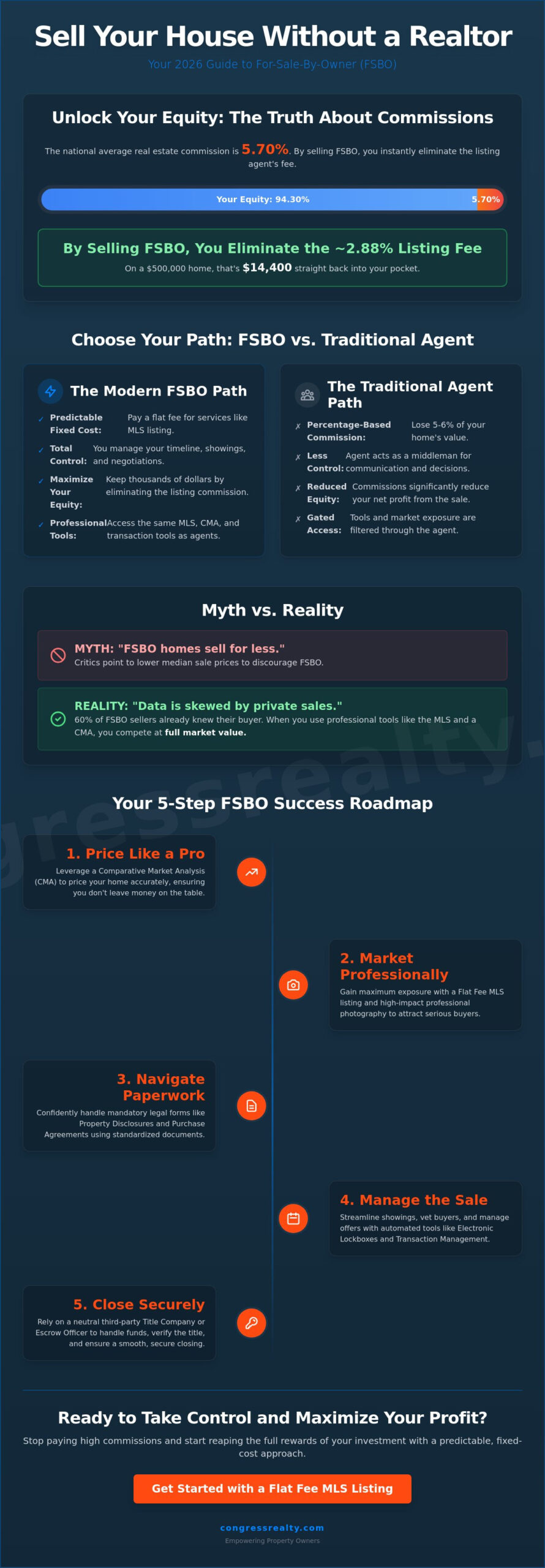
Most sellers don’t realize that commissions are actually two separate fees. There’s the listing agent commission and the buyer agent commission. In 2026, the national average total commission is 5.70%. By selling solo, you immediately eliminate the listing side, which averages around 2.88%. While you may still choose to offer a buyer agent incentive to attract more traffic, you’re no longer forced to pay a middleman to market your own property. You retain the power to decide how much of your equity you want to share.
Critics often point to lower median sale prices for solo sellers to discourage the practice. However, data from 2025 shows that 60% of FSBO sellers already knew their buyer. These transactions are often family transfers or private deals where the goal isn’t the highest market price. When you use professional tools like a Comparative Market Analysis (CMA) and a Standard Listing, you position your home to compete at full market value without the “agent tax.” You get the same exposure as any other house on the market.
The Financial Benefits of Bypassing Traditional Brokers
Think about the math on a median-priced home. Saving nearly 3% on the listing side can translate into tens of thousands of dollars. This isn’t just extra money; it’s the difference between a 10% and a 15% down payment on your next property. The equity gap is the portion of your home’s value lost to traditional percentage-based commissions that could otherwise fund your next purchase or retirement. By choosing a fixed-cost approach, you ensure your hard-earned wealth stays in your bank account where it belongs.
Is FSBO Right for You? Time and Effort Considerations
Selling a home does require an investment of time, specifically for managing inquiries and hosting showings. You must be prepared to act as a pragmatic advocate for your property, answering questions with transparency and professional poise. Fortunately, the process is no longer a full-time job. Using an Electronic Lockbox and professional Transaction Management tools automates the heavy lifting. These resources allow you to maintain your daily routine while the system handles the logistical flow of the sale. It’s a manageable trade-off for the massive financial gain.
Navigating the Legal Requirements and Paperwork for FSBO
The primary hurdle for many homeowners asking can i sell my house without a realtor is the perceived mountain of paperwork. While the legal side of a transaction requires precision, it does not require a law degree. You simply need a structured approach to documentation. In a traditional sale, agents handle these forms to justify their commission. As an independent seller, you can execute the same process by using standardized forms and professional oversight to protect your interests.
Your best defense against post-sale litigation is radical transparency. The Property Disclosure Statement is a mandatory document where you list known defects or repairs. Disclosing a leaky faucet or an old roof repair now prevents a lawsuit later. Beyond state disclosures, federal law requires a specific report for any home built before 1978. You can find official guidance on these lead-based paint disclosures to ensure you are in full compliance. Providing these documents upfront builds trust with buyers and keeps your transaction on solid legal ground.
The Purchase and Sale Agreement (PSA) is the roadmap for your deal. It defines the price, the closing date, and any contingencies like inspections or financing. You don’t have to draft this from scratch. Most states use standardized contracts that you can obtain through professional listing services. Once the PSA is signed, the Title Company or Escrow Officer steps in as a neutral third party. They verify the title is clear, handle the earnest money, and ensure the deed is recorded correctly. They are the logistical engine that ensures the money and the property change hands safely.
Essential Documents for Every Independent Seller
Keep your files organized from day one. You’ll need the Property Disclosure Statement, the Lead-Based Paint Disclosure (if applicable), and your most recent property tax bill. If you’re leaving behind appliances or furniture, include a Bill of Sale for personal property to avoid confusion at closing. If you need to stay in the home for a few days after the sale, an Occupancy Agreement protects you and the buyer by setting clear expectations for the transition period.
Managing the Transaction Process Safely
Deadlines are the heartbeat of a real estate deal. If an inspection period or financing contingency expires, you need to know exactly what that means for your contract. This is where Transaction Management becomes your secret weapon. A professional coordinator tracks every milestone, coordinates with the buyer’s lender, and ensures the title company has everything they need for a smooth closing. This service provides the professional infrastructure of a brokerage without the high-percentage costs, allowing you to lead the process with total confidence.
Pricing and Marketing Your Home Like a Professional
If you’re wondering, can i sell my house without a realtor, your biggest fear is likely underpricing your property. Most homeowners glance at an automated online estimate and assume it’s accurate. It usually isn’t. These algorithms often miss the nuances of a specific street or the value of a recent kitchen remodel. To capture every dollar of your equity, you must move beyond the “Zestimate” and think like an appraiser. Accuracy at the start prevents your listing from languishing on the market later.
A Comparative Market Analysis (CMA) provides the professional backbone for your pricing strategy. This isn’t a guess; it’s a data-driven deep dive into local market behavior. You’ll look at “Solds” to see what buyers actually paid, “Pendings” to gauge current demand, and “Actives” to understand your competition. Adjusting for your specific upgrades, square footage, and lot size ensures you don’t leave money on the table. For more granular advice, review these tips for selling your home to refine your approach.
The “First Impression” rule is absolute. In 2026, your home’s first showing happens on a smartphone screen. If your photos are dark or blurry, buyers will swipe past your listing in seconds. Professional Photography is a non-negotiable investment. It signals to buyers and their agents that you are a serious, professional seller. Coupling high-end imagery with a compelling listing description that highlights lifestyle benefits triggers the emotional response necessary for a quick offer. You aren’t just selling a house; you’re selling a future home.
Pricing Strategy: Finding the Sweet Spot
To find the right price, analyze homes within a half-mile radius that have sold in the last six months. Don’t just look at the final price. Look at the days on market and the initial asking price. This tells you if the neighborhood is heating up or cooling down. Use this information to position your home as the best value in its class. When you price correctly from day one, you generate the momentum needed for multiple offers.
High-Impact Marketing Tactics for 2026
Data shows that 90% of buyers start their journey online. You must meet them there with high-impact visuals and virtual tours that allow them to walk through the space from their couch. While digital reach is critical, don’t ignore the local market. Using a professional Yard Sign and Post captures “drive-by” interest from people who already love your neighborhood. Finally, an Electronic Lockbox provides a secure way for agents to show your home, giving you a digital log of every visitor and total control over your schedule.
Managing Showings, Offers, and the Closing Process
Once your marketing attracts interest, the focus shifts from promotion to negotiation. Many homeowners worry, “can i sell my house without a realtor when it comes to the high-stakes back-and-forth?” You absolutely can. The key is knowing how to handle the buyer agent conversation. While the 2024 NAR settlement changed how commissions are listed, most buyers still rely on professional representation. You aren’t required to pay a 3% listing fee; however, offering a 2% to 2.5% buyer agent commission ensures your home remains attractive to the widest pool of qualified buyers. It’s a strategic move that protects your timeline.
Negotiation is a business transaction, not a personal critique of your home. When an offer arrives, don’t take low numbers personally. Focus on the net proceeds. Use counter-offers to bridge the gap on price or closing dates. During the inspection phase, expect the buyer to ask for repairs. You can choose to fix the issues, offer a financial credit at closing, or stand firm on the price. A pragmatic approach keeps the deal moving toward the finish line without unnecessary friction. You are in the driver’s seat.
Vetting Offers and Buyer Qualifications
Not all offers are created equal. A “pre-qualified” buyer has only had a basic conversation with a lender; a “pre-approved” buyer has undergone a full credit and income verification. Always demand a recent pre-approval letter and proof of funds for the down payment. Look closely at contingencies. A deal contingent on the buyer selling their own home is significantly riskier than one that’s not. Understanding these steps to selling a house will help you spot red flags before you sign the contract.
The Closing Table: What to Expect
The final week is a flurry of activity. You’ll host a final walkthrough to prove the house is in the agreed-upon condition. You must also review the Settlement Statement, often called the ALTA. This document lists every penny moving in the transaction. Verify that your property tax prorations and the payoff of your existing mortgage are accurate. Once everything is signed, the title company handles the funding, and you receive your proceeds via wire transfer or check. It’s the moment your financial intelligence pays off.
Ready to take the next step? Get started with Transaction Management to ensure your closing is handled with professional precision and total transparency.
Maximizing Your Equity with Flat Fee MLS Listings
Many homeowners feel trapped by a false choice: pay a massive commission to a traditional broker or risk selling in total isolation. You don’t have to settle for either extreme. The most effective way to answer the question, can i sell my house without a realtor, is to leverage the same tool the pros use. The Multiple Listing Service (MLS) is the engine that drives the real estate market. It’s not just a list; it’s a massive syndication network that broadcasts your property to every corner of the internet.
A Flat Fee MLS service provides a sophisticated alternative to the high-cost models of the past. Instead of handing over 3% of your home’s value just to get listed, you pay a predictable, fixed fee for the same professional exposure. This approach puts you in the driver’s seat. You maintain total control over your timeline and your equity while ensuring your home appears exactly where buyers are looking. It’s the smartest way to transition from a homeowner to a successful seller without the “agent tax” eating your profits. For a complete walkthrough of every step involved, the equity-first guide on how to sell a house without a realtor provides a detailed roadmap for financially intelligent sellers.
The Power of the MLS for Independent Sellers
When your home is listed on the MLS, it doesn’t stay there. It automatically syndicates to Zillow, Realtor.com, and thousands of local brokerage websites. This massive digital footprint ensures that every buyer’s agent in the country can find your property for their clients. Flat Fee MLS bridges the gap between selling solo and using a traditional brokerage by providing professional market entry without the percentage-based commission. You get the reach of a global firm with the autonomy of an independent seller. Before choosing a platform, it’s worth reading a detailed fsbo.com review and comparison of FSBO listing platforms to understand which service gives you the best combination of exposure and equity protection.
Why Congress Realty is the Strategic Choice
Congress Realty functions as your professional ally, providing the infrastructure you need to succeed. You can choose a Standard Listing to get started or opt for a Full Service Listing if you want additional support. Unlike traditional models, our offerings are designed to be modular and transparent. You can secure high-impact tools that boost your credibility instantly:
Professional Photography to capture buyer interest online.
A Comparative Market Analysis (CMA) to ensure your price is data-driven.
An Electronic Lockbox and a professional Yard Sign and Post for secure, professional showings.
Transaction Management to handle the logistical flow from offer to closing.
By choosing this “Equity-First” approach, you keep your hard-earned wealth where it belongs. You aren’t just saving money; you’re taking command of your financial future. It’s time to list on the MLS with Congress Realty and experience the satisfaction of a professional sale on your own terms.
Take Command of Your Home Sale Today
Selling your home independently is no longer a matter of “if” but “how.” You’ve seen that you don’t need a traditional broker to achieve agent-level results when you leverage professional tools and a structured process. You now understand how to handle complex paperwork, execute a data-driven pricing strategy, and manage the final walkthrough with confidence. The question of can i sell my house without a realtor has a clear, profitable answer. You can lead the process yourself while keeping your hard-earned equity where it belongs.
Congress Realty was founded in 2002 to empower homeowners with decades of FSBO expertise. Our model allows you to eliminate the standard 3% listing commission while still accessing the full power of the MLS. Whether you choose a Standard Listing or a Full Service package that includes professional photography and a CMA, you remain the decision-maker at every step. You have the intelligence and the infrastructure; now it’s time to act and reap the rewards. Start your Flat Fee MLS listing today and save your equity. You’re ready to close this deal on your own terms.
Frequently Asked Questions
Is it legal to sell my house without a realtor in the US?
Yes, it’s perfectly legal to sell your property independently in all 50 states. You have the right to represent yourself in any real estate transaction. While you’ll need to follow state-specific disclosure laws, you don’t need a license to sell your own home. Using a Standard Listing ensures you meet the professional requirements of the marketplace without the high-cost middleman.
How much can I save by selling my house myself?
You save the entire listing agent commission by choosing this path. In the 2026 market, this typically represents about 2.88% of your home’s final sale price. On a median-priced home, that’s tens of thousands of dollars kept as your own equity. If you’ve been asking, can i sell my house without a realtor, the massive financial gain is usually the strongest motivation.
How do I get my home on the MLS without a traditional agent?
You can access the Multiple Listing Service by using a Flat Fee MLS provider. This service lists your property on the local database used by all licensed agents. It bridges the gap between a private sale and a professional listing. You get the same market exposure as a traditional brokerage while maintaining full control over your sale and your savings.
Do I still have to pay a commission to the buyer’s agent?
While you aren’t legally required to pay a buyer agent, offering a commission is a smart tactical move. Most buyers in 2026 still use agents who expect compensation for their work. Offering a competitive rate, typically between 2% and 2.5%, ensures that agents don’t steer their clients away from your home. You still save thousands by eliminating the listing side of the fee.
What happens if I make a mistake on the legal paperwork?
Mistakes on disclosures or contracts can lead to delays or legal disputes after the sale. You can mitigate this risk by utilizing professional Transaction Management services. This provides an expert eye to review your paperwork and ensure all deadlines are met. It’s a pragmatic way to secure your closing without paying a traditional 3% listing commission for basic administrative tasks.
How do I handle showings and open houses on my own?
Manage your showings with an Electronic Lockbox to provide secure, tracked access for buyer agents. This tool allows you to schedule visits at your convenience without being physically present. For independent sellers, this professional infrastructure replaces the need for an agent to be on-site. Remember that you are responsible for preparing the home, as services don’t include in-person open house hosting.
Can I still list on Zillow and Realtor.com if I sell FSBO?
Yes, your home will appear on every major real estate portal through MLS syndication. When you list via a professional service, your property data automatically flows to Zillow, Realtor.com, and thousands of local brokerage sites. This ensures you reach the 90% of buyers who start their search online. It’s the most efficient way to ensure your property gets maximum visibility.
What is a Flat Fee MLS listing and how does it work?
A Flat Fee MLS listing is a modular service that replaces the traditional percentage-based commission with a predictable, fixed cost. You pay for the specific tools you need, such as a Yard Sign and Post or professional photography. This model allows you to leverage professional industry databases while keeping your equity. It’s the ultimate tool for anyone wondering, can i sell my house without a realtor successfully.
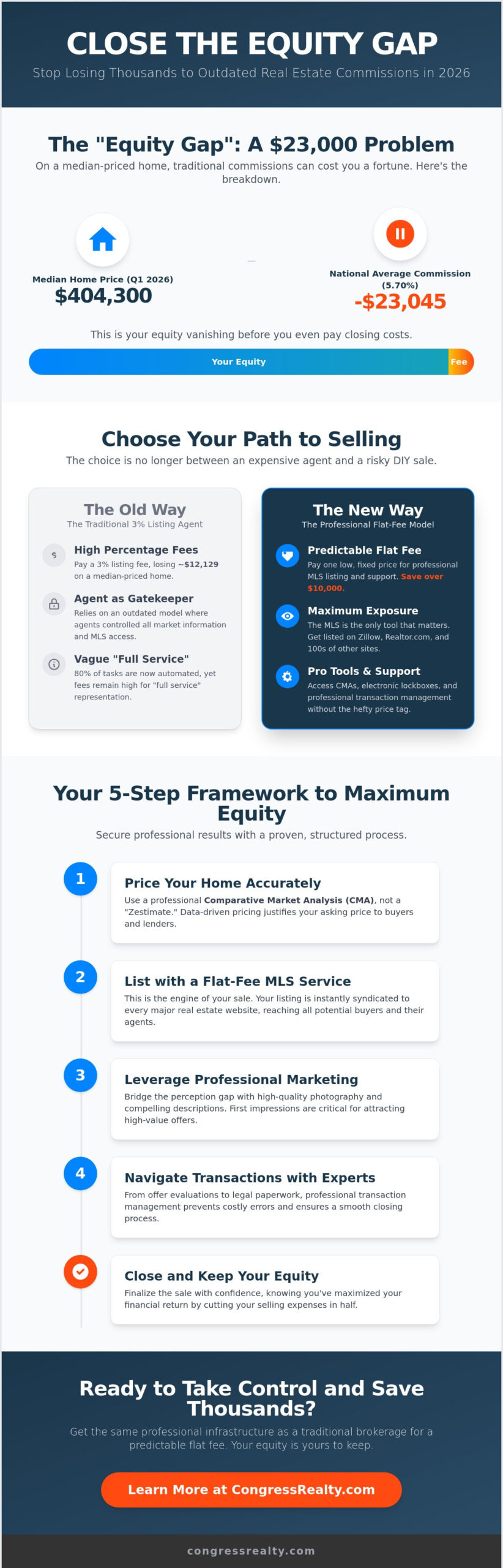
Why would you hand over $23,000 of your hard-earned wealth just for the privilege of selling a home? With the national average real estate commission at 5.70% in May 2026, a seller moving a median-priced $404,300 home often watches a massive chunk of equity vanish into traditional agent fees. You’ve worked for years to build that value, and the thought of losing it to outdated commission models is frustrating. You deserve professional results without the predatory price tag.
When selling a home, you must account for the “Equity Gap.” This is the massive divide between what your home is worth and what you actually walk away with after traditional fees. Based on the Q1 2026 median home price of $404,300, a standard commission can easily strip $23,000 or more from your bank account. This isn’t just a fee. It is a significant portion of your wealth that could have been used for a down payment on your next property or your retirement fund. For investors, firms like Cornerstone Real Estate Investment Services can help reinvest that equity through 1031 exchanges into DST properties. The rise of the “Professional FSBO” (For Sale By Owner) allows savvy sellers to close this gap by using a flat-fee brokerage. You get the same professional infrastructure without the percentage-based wealth transfer.
We agree that you shouldn’t have to choose between professional representation and your financial goals. This guide reveals how to manage the modern market to maintain total control while saving tens of thousands of dollars. You’ll discover how to handle the process with the same tools the pros use, from professional MLS exposure to expert transaction management. We’ll walk through the steps to secure high-quality photography, price your property accurately with a CMA, and close the deal without paying a 3% listing fee.
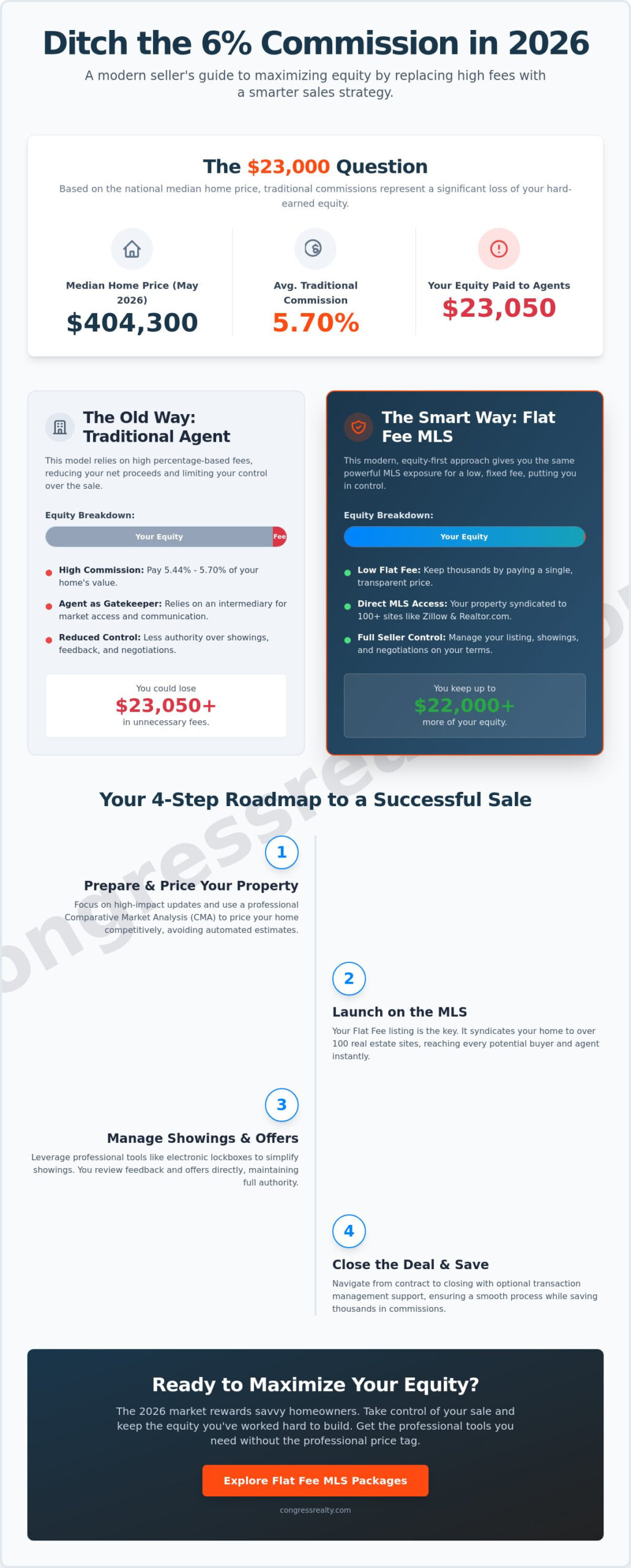
The traditional 6% commission model was built for a world that no longer exists. Decades ago, real estate agents were the gatekeepers of all housing data. They held the keys to the local Multiple Listing Service (MLS), and you couldn’t reach a single buyer without their permission. Today, that information monopoly is gone. As of May 2026, the national average commission has already dropped to 5.70%, yet many sellers are still paying five-figure fees for services that technology has largely automated. The 6% model is dead; it’s just that some traditional brokerages haven’t stopped sending the bill yet.
When selling a home, you must account for the “Equity Gap.” This is the massive divide between what your home is worth and what you actually walk away with after traditional fees. Based on the Q1 2026 median home price of $404,300, a standard commission can easily strip $23,000 or more from your bank account. This isn’t just a fee. It is a significant portion of your wealth that could have been used for a down payment on your next property or your retirement fund. The rise of the “Professional FSBO” (For Sale By Owner) allows savvy sellers to close this gap by using a flat-fee brokerage. You get the same professional infrastructure without the percentage-based wealth transfer.
The secret that traditional agents don’t want you to know is that the MLS remains the only tool that truly matters. It’s the central database that feeds every major real estate website. If your home is on the MLS, it is visible to every buyer in the country. You don’t need a high-commission agent to get you there; you just need a professional listing service that provides the right entry point.
What Does Selling a Home Actually Cost?
Beyond commissions, you’ll encounter closing costs, which typically range from 1% to 3% of the sale price. These include title insurance, transfer taxes, and recording fees. Equity is the difference between your market value and your mortgage balance plus selling costs. By switching to a flat-fee model, you can often cut your total selling expenses in half. This keeps your equity where it belongs: in your pocket. Calculate your potential savings by comparing a fixed listing fee against 3% of your estimated sale price. The difference is usually enough to buy a new car or fund a year of college tuition.
The Myth of the “Full Service” Necessity
Traditional agents often hide behind the vague term “full service” to justify their costs. When you deconstruct their tasks, you’ll find that 80% of the work is administrative data entry or automated by software. Digital signatures, electronic lockboxes, and online scheduling have replaced the manual labor of the past. You need professional help for understanding the transaction process and pricing your home correctly, but you don’t need to pay a percentage of your home’s value for it. Focus on the tasks that add value, like a Comparative Market Analysis (CMA) and professional photography, and let technology handle the rest.
The choice is no longer a binary between paying a 3% commission or struggling through a risky DIY process. Modern technology and transparent brokerage models have created a third path: the professional, equity-first sale. By following a structured framework, you can access the same tools as a traditional agent while keeping your financial gains. This isn’t about cutting corners; it’s about using a smarter infrastructure to achieve professional results on your own terms.
Pricing Your Home for the 2026 Market
Start by ignoring the “Zestimate.” While automated valuation models are convenient, they lack the nuance of current local market trends and specific property upgrades. To price your home effectively, you must use a Professional CMA: Pricing Your Home for the MLS. This report analyzes recently sold properties in your immediate area to provide a data-driven price point. Having a professional Comparative Market Analysis in hand gives you the confidence to stand firm during negotiations and justifies your asking price to skeptical buyers and their lenders.
The Power of the Flat Fee MLS Listing
Exposure is the engine of any successful sale. When you secure a flat fee listing, your property is instantly syndicated to Realtor.com, Zillow, and every local brokerage website in your region. An MLS listing is the only way to ensure 90% of buyers see your property. This approach allows you to maintain total control over your listing details while appearing as a professional seller in the eyes of the market. You don’t need to pay a percentage of your home’s value just to be seen; you simply need the right entry point into the professional databases.
Once your listing is live, you must bridge the gap between a standard “for sale” sign and a high-impact marketing presence. Invest in professional photography to ensure your home stands out in a crowded digital feed. High-quality images are the first thing a buyer sees, and they often determine whether a lead converts into a showing. To manage those showings safely, use an electronic lockbox. This tool provides secure, tracked access for buyer agents, allowing you to monitor who enters your home and when, all without needing to be present for every walkthrough.
The final step is managing the offer and navigating the closing process with precision. Evaluating a purchase offer involves more than just looking at the sale price; you must scrutinize contingencies, financing terms, and closing timelines. Utilizing professional transaction management ensures that your paperwork is handled correctly and that you meet every contractual deadline. When you are ready to begin, selecting a Standard Listing package provides the essential professional foundation you need to move from “listed” to “sold” with your equity intact.
The biggest mistake you can make when selling a home is letting your listing look like a “DIY project.” In a digital-first market, buyers decide whether to visit your property in less than three seconds. If your listing features dark, grainy cell phone photos, most buyers will assume you’re cutting corners on the house itself. Professional marketing isn’t a luxury reserved for high-commission agents; it’s a strategic utility you can deploy yourself to signal that you’re a serious, sophisticated seller.
To compete with traditional listings, you need to match their visual and physical standards. This means moving beyond the basic “For Sale” sign from a hardware store and utilizing professional yard signs and posts that mirror brokerage quality. When you pair this with an electronic lockbox, you provide buyer agents with the secure, tracked access they expect. These tools don’t just provide convenience; they build the trust necessary to move a buyer from an online search to a physical walkthrough.
Visual Storytelling for Your Property
High-impact marketing starts with professional photography. While a smartphone is great for social media, it cannot capture the dynamic range or wide angles required to make a living room feel spacious and inviting. For a successful MLS listing, you typically need 25 to 50 high-quality images that highlight every functional area of the home. The ROI is undeniable. Spending a few hundred dollars on a professional shoot can save you from the thousands lost in a price reduction caused by low traffic. As of January 1, 2026, new regulations like the California law on digitally altered listing photos require transparency, making authentic, high-quality images more valuable than ever. You can stage your home for the camera by decluttering surfaces, maximizing natural light, and removing personal items to create a “blank canvas” for the buyer’s imagination.
Managing Accessibility and Showings
Once your marketing captures interest, you must manage the influx of inquiries with professional precision. Security is a primary concern for any seller. Electronic lockboxes are superior to manual ones because they provide a digital audit trail of every person who enters your home. You’ll know exactly which agent was there and at what time. Before granting access, always vet potential buyers by requesting a pre-approval letter. This ensures you only spend time on qualified leads. Create a “Showing Kit” to leave on your kitchen counter, including professional flyers and mandatory disclosures. This organization reinforces your position as a prepared seller. For more context on how this fits into the broader process, consult a step-by-step guide to selling your house to ensure no detail is overlooked. By controlling the environment and the information, you maintain the upper hand in every interaction.
Evaluating a purchase offer is where the actual strategy of selling a home begins. You aren’t just looking for the highest number. You’re looking for the highest certainty of closing. In May 2026, with average 30-year fixed mortgage rates hovering between 6.37% and 6.46%, a buyer’s financing strength is your top priority. A high offer with weak financing is often less valuable than a slightly lower cash offer or one with a substantial down payment. Analyze every line of the contract to ensure the terms align with your goals.
Contingencies are the contractual hurdles between you and your equity. Most deals include the “big three”: inspection, appraisal, and financing. The inspection allows the buyer to request repairs, the appraisal ensures the lender agrees with your sale price, and the financing contingency is the final approval of the buyer’s loan. When selling a home independently, managing these timelines is critical. Transaction management is the professional engine that keeps these hurdles from stopping your progress. While traditional brokerages make this process sound daunting, you can purchase professional transaction management as a standalone utility to ensure every deadline is met without the 3% listing fee.
The Paperwork: Disclosures and Contracts
Transparency is your best legal defense. You must provide mandatory legal disclosures regarding the property’s condition and any known defects. Being upfront prevents post-sale lawsuits and builds trust with the buyer’s side. Ensure you use state-approved contract forms to remain compliant with local regulations. To see how these professional steps compare to the traditional model, read How Much Does the Realtor Make? Understanding Commissions in 2026. Clear documentation is the hallmark of a professional seller.
Closing with Confidence
The title company and escrow officer act as neutral third parties during a flat-fee sale. They handle the exchange of funds, title searches, and the recording of the deed. Your primary task here is reviewing the “net sheet.” This document breaks down every credit and debit, showing exactly how much equity you’ll receive at the end of the day. During the final walkthrough, the buyer will verify the home is in the agreed-upon condition. Once the papers are signed and the deed is recorded, the transaction is complete. Secure your equity by adding Transaction Management to your listing to ensure a smooth path to the closing table.
Selling a home shouldn’t be a tax on your wealth. While traditional brokerages demand a massive percentage of your sales price, we provide the professional infrastructure you need for a predictable, fixed cost. Our model treats real estate services as a utility. You wouldn’t pay your electric company a percentage of your home’s value, so why pay a listing agent that way? We give you the tools to command the market while ensuring your equity stays in your bank account.
Our Standard Listing and Full Service Listing packages are designed to bridge the gap between a risky DIY attempt and a high-commission traditional sale. When you list with us, you aren’t just getting a spot on a website. You receive a professional yard sign and post to signal quality to neighbors and passersby. We provide an electronic lockbox to ensure secure, tracked access for buyer agents. Most importantly, we include professional photography to make sure your first impression on the MLS is flawless. These aren’t “extra” features; they’re the essential components of a modern, successful transaction.
Success in selling a home also requires expert data and oversight. We provide a comprehensive Comparative Market Analysis (CMA) to ensure you never underprice your property or leave money on the table. Once you have an offer, our transaction management service oversees the complex paperwork from contract to closing. This professional support ensures you meet every legal requirement and contractual deadline without the stress of wondering if a mistake will derail your deal.
Why Thousands of Sellers Choose Congress Realty
We’ve been empowering homeowners since 2002. In that time, we’ve refined a process that puts the seller in the driver’s seat. The financial math is simple and compelling. By avoiding the traditional 3% listing commission, our clients often save an average of $15,000 per transaction. You get direct access to Andrew English and our professional brokerage team, providing you with a level of expertise that traditional “discount” services simply can’t match. We offer the credibility of a licensed brokerage with the savings of a flat fee model that replaces percentage-based commissions with a predictable fixed cost.
Ready to Keep Your Equity?
You can get your home on the MLS and in front of thousands of buyers in as little as 24 hours. Control is the ultimate luxury in real estate, and our tiered packages allow you to choose the exact level of support you need. Whether you want the essential tools of a Standard Listing or the comprehensive oversight of a Full Service Listing, you’ll find a perfect fit for your goals. If you are ready to take the next step, read our guide on How to Avoid Realtor Fees When Selling Your Home: The 2026 Equity Guide. Your equity is yours to keep; we just provide the platform to help you secure it.
You now have the roadmap to navigate the 2026 real estate market with confidence. The old days of losing significant wealth to percentage-based commissions are over. By utilizing professional MLS exposure, high-impact photography, and secure transaction management, you can achieve a successful closing on your own terms. Managing the process of selling a home independently isn’t just a way to save money; it’s a strategic move that puts you in total control of your financial future.
Congress Realty has empowered homeowners since 2002 by providing the professional infrastructure required for a modern sale. Whether you need the essential tools of a Standard Listing or the dedicated support of our Full Service options, our tiered packages ensure there’s a perfect fit for every seller. You’ll benefit from expert broker oversight without the traditional 3% listing fee. It’s time to stop paying for an information monopoly that no longer exists. You’ve worked hard for your home’s value, and you deserve to keep it.
Can I really sell my home on the MLS without a traditional agent?
Yes, you can absolutely access the Multiple Listing Service without a traditional 3% listing agent. By partnering with a flat-fee brokerage, you gain entry into the same professional databases used by every major real estate firm. You maintain the lead role in selling a home while we provide the necessary listing infrastructure to ensure your property reaches the entire market.
How much can I save by using a flat-fee listing service?
You save the traditional listing side commission, which typically accounts for roughly half of the total 5.70% national average rate as of May 2026. By opting for a flat-fee model, you keep that equity instead of handing it over at the closing table. This shift allows you to bypass percentage-based fees in favor of a predictable, fixed-cost structure.
Will my home still show up on sites like Zillow and Realtor.com?
Your home will appear on every major real estate portal, including Zillow, Realtor.com, and local brokerage sites. The MLS functions as the central data hub for the entire industry. Once your listing is active in the database, it automatically syndicates to these platforms to ensure your property receives maximum digital exposure.
Do I still have to pay a commission to the buyer’s agent?
Paying a buyer’s agent commission is a negotiable choice rather than a mandatory MLS requirement. Following the 2024 NAR settlement, you aren’t required to offer a specific percentage upfront. However, many buyers still request that their agent’s fee be covered as part of their purchase offer, so you should evaluate each proposal based on your final net gain.
What if I need help with the paperwork and contracts?
You can add professional Transaction Management to your listing package to handle the technical details of the sale. This service provides expert oversight for your contracts, disclosures, and closing documents. It ensures you meet every legal deadline and contractual obligation without needing a high-priced traditional agent to manage the file.
How do I determine the right listing price without an agent?
You should use a professional Comparative Market Analysis (CMA) to set an accurate price for selling a home. A CMA looks at verified sales data from recently sold properties in your immediate area to provide a realistic market value. This data-driven approach is far more reliable than automated online estimates and helps you justify your price to potential buyers.
What happens if I decide I want a full-service experience later?
You can easily upgrade to a Full Service Listing if you decide you want more professional support during the process. Our tiered packages provide the flexibility to start with a Standard Listing and move to a more comprehensive level of service whenever you choose. This ensures you always have the right amount of assistance for your specific situation.
Is a flat-fee MLS listing legal in my state?
Flat-fee MLS listings are legal and widely used across the United States. While real estate laws vary by state, Congress Realty operates as a licensed brokerage to ensure your listing is compliant with all local regulations. You should always verify the specific requirements for your region to ensure your transaction proceeds smoothly.
Why would you hand over $12,000 or more of your hard-earned equity to a traditional agent when the 2026 real estate market has already shifted the rules in your favor? You have worked hard to build value in your home, and the thought of losing a massive chunk of it to a 3% listing commission is frustrating. You want the same visibility as the pros, but you don’t want to be left alone the moment your listing goes live. Finding the best flat fee mls listing service is about more than just a low price; it’s about choosing a professional ally who provides direct broker advocacy without the hidden fees that plague many discount aggregators.
You deserve to maintain control over your sales process while saving thousands in unnecessary costs. We’ll show you exactly how to navigate the post-NAR settlement landscape where buyer-broker agreements are mandatory and commissions are more transparent than ever. This guide breaks down the top-rated services for 2026, explains how to avoid mandatory compliance fees at closing, and ensures your home hits the LOCAL MLS with the professional support you need to close the deal on your own terms. It is time to stop settling for less and start selling for more.
Key Takeaways
Learn why listing on your actual LOCAL MLS is the only way to gain professional-grade exposure and feed all major real estate sites.
Identify the best flat fee mls listing service by looking for direct broker access and transparent pricing rather than just the lowest upfront cost.
Discover which package tier fits your experience level, whether you need a simple listing or full transaction management support.
Protect your equity by uncovering common “discount” traps so you don’t get hit with mandatory closing fees or photo limits.
Master the 2026 commission rules to save thousands; it’s the smartest way to maintain complete control over your sales process.
What Defines the Best Flat Fee MLS Listing Service in 2026?
Choosing the best flat fee mls listing service starts with understanding exactly what you are buying. At its core, What is a Flat-Fee MLS? It’s a professional arrangement where a licensed broker lists your property on the local database used by real estate agents for a set, upfront price. This model disrupts the traditional system by removing the 3% listing side commission entirely. In 2026, the most effective services don’t just put you on a national list; they ensure you are on the actual local board that services your specific zip code.
Visibility is non-negotiable. While only 5% of sales in 2025 were For Sale By Owner (FSBO) transactions, the vast majority of buyers still work with agents who rely exclusively on the local MLS. If your service uses a shadow or secondary board, your home won’t appear in the daily alerts that agents send to their clients. A top-tier service provides professional parity, meaning your listing looks identical to one from a high-commission firm. Once your home is on the local board, it automatically syndicates to Zillow, Realtor.com, and thousands of national brokerage sites. This ensures you reach 100% of the active buyer pool while keeping your equity.
The best services prioritize control over convenience. You should manage your own leads and showings directly. This removes the middleman and speeds up the communication process. Following the NAR rule changes on August 17, 2024, transparency is more important than ever. You need a service that clearly outlines your options without forcing you into restrictive contracts or hidden settlement fees.
The Core Benefits of the Flat Fee Model
The primary advantage is simple: you save thousands. By eliminating the listing agent’s 3% commission, you keep more of your home’s value at closing. You also gain direct communication with buyers. In a traditional model, messages get filtered through two different agents, which often leads to delays or miscommunications. With a flat fee listing, you speak directly to the other side. This puts you in the driver’s seat of your own transaction. Your home gets the same professional exposure as any other listing, but you stay in control of the schedule and the negotiations.
Identifying Direct Brokers vs. Referral Aggregators
Many websites that claim to be the best flat fee mls listing service are actually referral aggregators. These are middlemen who don’t hold a broker’s license in your state. Instead, they take your money and sell your data to a random third-party broker you’ve never met. This often leads to a lack of accountability and poor customer support. Working directly with a broker like Andrew English at Congress Realty ensures you have a professional advocate who is actually responsible for your listing. Before you pay, always verify that the company is a licensed brokerage in your state. This simple step protects you from hidden compliance fees and ensures your paperwork is handled correctly from day one.
Comparing Flat Fee MLS Models: Which is Right for You?
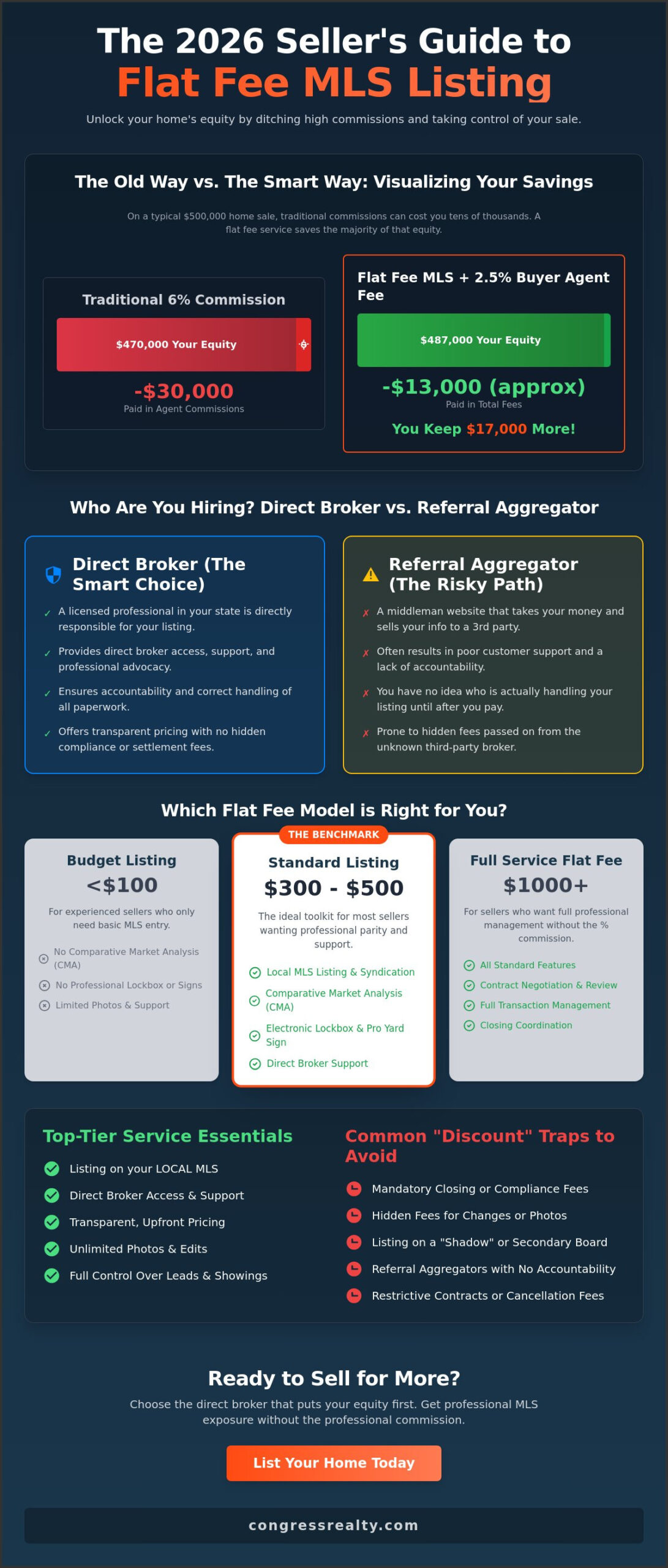
Deciding to ditch the traditional 3% listing commission is a smart financial move, but not every flat fee package is built the same. The best flat fee mls listing service offers a range of options tailored to your experience level and comfort. For seasoned investors who handle their own contracts and pricing, a basic entry-level listing provides the necessary MLS entry. However, most homeowners find that a more robust toolkit is required to navigate the 2026 market successfully. The Standard Listing serves as the definitive benchmark for savvy FSBO sellers who want professional visibility without the high price tag.
Choosing the wrong model can cost you more than you save. While some “budget” sites advertise $99 listings, these often leave you stranded without essential tools. Data from 2025 shows that FSBO listings remain on the market for an average of 38 days, compared to 32 days for agent-listed properties. To close that gap, you need a service that provides professional parity. This means having the same electronic lockboxes and yard signs that traditional agents use. If you want the highest level of support, a full-service flat fee model offers professional advocacy and transaction management without the percentage-based price tag.
Standard vs. Full Service Tiers
Budget packages priced under $100 usually lack a Comparative Market Analysis (CMA), lockboxes, or professional signs. Without a CMA, you risk overpricing your home, which is a major reason why the agent-assisted closing success rate is 86% compared to 78% for FSBOs. For high-stakes closings, transaction management is vital. It ensures all documentation meets state requirements and deadlines are met. Understanding these differences is a core part of learning how to sell your house on your own while protecting your equity. You can explore our listing packages to find the right balance of support and savings for your specific needs.
The Hybrid Approach: Professionalism Meets Savings
Most sellers in 2026 prefer a hybrid approach that combines DIY control with professional tools. This includes:
Comparative Market Analysis: Use real-time data to price your home accurately from day one.
Professional Photography: Listings with high-quality images receive significantly more clicks on national sites.
Electronic Lockboxes: These provide secure, trackable access for buyer agents, so you always know who entered your home and when.
By utilizing these professional resources, you maintain total control over your sales process while ensuring your property stands out against the competition. This pragmatic strategy allows you to keep your equity while benefiting from the same infrastructure used by top-producing agents.
Essential Features of a Top-Tier MLS Service
Finding the best flat fee mls listing service requires looking beyond a simple web form. You need a professional toolkit that mirrors the resources used by high-commission firms. A top-tier provider ensures your property is listed on the specific local board that feeds into every major national site. This local entry is your foundation. Without it, you miss out on the automated alerts that buyer agents set up for their clients. If your listing isn’t on the local board, you aren’t truly on the market.
Maximum photos are mandatory in 2026. You should never settle for a service that limits you to 6 or 10 images. Buyers expect a full digital tour before they book a showing. Additionally, professional property access is a safety requirement. Electronic lockboxes are the industry standard for secure showings. They allow you to track exactly which agent entered your home and at what time. This level of security is far superior to manual combination codes that can be shared easily. Finally, a Comparative Market Analysis (CMA) is essential. Pricing your home based on data from May 2026 ensures you don’t leave money on the table or let your listing go stale.
The Power of Professional Photography
Professional photography is your digital first impression. Listings with high-quality, professional images receive significantly more clicks on national platforms than those with amateur photos. Visual storytelling is the primary driver of MLS engagement. When you integrate photography services directly into your listing package, you ensure your home stands out against the competition. It’s a small investment that often leads to faster offers and higher final sale prices. Don’t let poor lighting or blurry phone photos cost you thousands in equity.
Transaction Management and Closing Support
Navigating the “under contract” phase is where many independent sellers feel the most pressure. This is the gap where most low-cost aggregators fail you. Professional transaction management provides oversight that prevents common escrow delays. It ensures that all mandatory disclosures are handled correctly, which is vital for avoiding potential lawsuits after the sale. Having a broker facilitate the documentation process means you aren’t left alone when complex legal paperwork arrives. You maintain control over your sales process while having the professional infrastructure to reach a successful closing. This advocacy is what separates a simple listing site from a true real estate partner.
How to Avoid Hidden Fees and ‘Discount’ Traps
Transparency is the foundation of a successful sale. A true flat fee should remain consistent from the moment you list until the day you close. Unfortunately, many companies that claim to be the best flat fee mls listing service use a teaser price to get you in the door, only to reveal mandatory compliance or transaction fees later. For instance, data from May 2026 shows that certain “budget” providers include a mandatory fee of 0.25% to 0.5% at closing. This effectively turns a flat fee back into a percentage commission, eating into the equity you worked so hard to save. At Congress Realty, our prices are transparent because we value your autonomy and your bottom line.
The Buyer Broker Commission Myth
The NAR settlement on August 17, 2024, fundamentally changed the real estate conversation. You are no longer permitted to offer buyer agent compensation on the MLS. This doesn’t mean you should ignore the buyer’s side of the transaction. You still choose what to offer, but you do it off-platform. Offering a competitive rate remains a strategic way to ensure maximum agent cooperation. Despite these rule changes, the average commission rate in 2026 has stayed between 5.3% and 5.5%. You are not skipping this fee, but you are controlling it. This allows you to negotiate terms that work for your specific financial goals while keeping your home attractive to the 91% of sellers who still use an agent-assisted model.
What to Look for in the Fine Print
Always scrutinize the fine print for hidden add-ons that should be standard. Does the company charge extra for yard signs, posts, or lockbox rentals? Many discount sites offer a low entry price but then bill you for every essential tool. Some alternative models even charge upfront fees alongside a closing fee of 0.5% to 1.25% depending on your state. These aren’t just small administrative costs; they can amount to thousands of dollars at the settlement table. Another common trap is the listing change fee. If the market shifts and you need to drop your price, you shouldn’t have to pay just to update your text. A professional broker provides these details upfront so you can budget with confidence.
Why Congress Realty is the Strategic Choice for 2026 Sellers
Choosing the best flat fee mls listing service is a decision that impacts your bottom line and your peace of mind. Many national aggregators are just tech platforms that sell your information to a stranger. Congress Realty is different. When you list with us, your property is managed by Andrew English, a designated broker with a proven track record of thousands of successful closings across the country. This direct access means you aren’t stuck in a call center queue when you have a critical question about an offer. You get professional advocacy from an expert who understands the nuances of the 2026 market and respects your financial intelligence.
Our history of results is built on a foundation of empowerment. We believe that You Control Your Sales Process. By providing the professional infrastructure of a traditional firm at a fraction of the cost, we champion the homeowner against outdated, high-commission models. Whether you are a seasoned investor or a first-time seller, our tiered options ensure you only pay for the services you actually need. This pragmatic approach has helped thousands of sellers keep their equity while achieving the same LOCAL MLS exposure as the biggest firms in the industry.
The Full Service Advantage
Our Full Service package is designed for sellers who want the savings of a flat fee but the security of professional transaction management. For just $399 upfront and a 0.5% commission at closing, you receive end-to-end guidance from a licensed expert. This includes expert valuation support so you don’t leave money on the table in a shifting market. We stay with you through every inspection, appraisal, and negotiation. This level of support is exactly what is missing from budget sites that simply post your flat fee mls listing and disappear. We ensure your closing is handled correctly and your interests are protected at every stage.
Getting Started with Congress Realty
Starting your journey is simple and direct. First, choose the package that fits your goals. If you are comfortable handling your own paperwork, the Standard Listing provides the essential tools for success. If you want a professional to manage the complexities of escrow, select our Full Service option. Once you submit your property details and photos, we get your home live on the LOCAL MLS quickly. This immediate action starts your equity-saving journey today. Don’t let a traditional agent take a massive chunk of your hard-earned value. Take control, list your home, and experience the satisfaction of selling on your own terms with a professional ally by your side.
Take Control of Your Home Sale Today
You now have the roadmap to navigate the 2026 real estate landscape without sacrificing your hard-earned equity. Selling your home independently is a smart, financially intelligent move when you have the right professional infrastructure behind you. By prioritizing a service that offers direct broker representation and placement on the LOCAL MLS, you ensure your property gets maximum exposure without the burden of a traditional listing commission. Finding the best flat fee mls listing service means choosing a partner that values your autonomy as much as you do.
Congress Realty was founded in 2002 and has facilitated thousands of successful closings across the country. You aren’t dealing with an anonymous middleman; you get direct representation from Andrew English and an A+ rated professional service. The tools you need to succeed are ready and waiting. Choose your listing package and start saving thousands today. You’ve built the value in your home. Now, it’s time to keep it. The process is simple, the savings are real, and the control is entirely yours.
Frequently Asked Questions
Is a flat fee MLS listing the same as a traditional listing?
A flat fee listing provides the exact same visibility on the LOCAL MLS as a traditional listing from a high-commission firm. The primary difference is the cost structure. Instead of handing over a percentage of your equity, you pay a one-time fee for the professional infrastructure you need. This keeps you in control of the sales process while ensuring your property syndicates to every major real estate site.
Will buyer agents still show my house if it’s a flat fee listing?
Buyer agents will show your home as long as it meets their client’s specific criteria. Agents are motivated by finding the right home for their buyers. Following the August 2024 rule changes, you simply negotiate the buyer broker commission off the MLS. Since 91% of sellers still use agent-assisted models, maintaining professional parity is the best way to attract these active buyers.
Can I cancel my flat fee listing at any time?
You can typically cancel your listing at any time without penalty. Professional brokers understand that circumstances change. Always verify this in the fine print to avoid hidden withdrawal fees. Choosing the best flat fee mls listing service means having the freedom to change your mind or take your home off the market without losing more than your initial flat rate.
What is the difference between a direct broker and an MLS aggregator?
A direct broker like Andrew English manages your paperwork and listing personally. An aggregator is a middleman website that sells your data to a third-party broker you haven’t vetted. This often leads to communication delays and hidden referral fees. Working directly with the broker ensures accountability, better support, and faster updates to your listing when you need them most.
Do I have to pay a commission to the buyer’s agent?
You aren’t required to pay a buyer’s agent, but it is highly recommended for maximum exposure. Most buyers in 2026 have written agreements with their agents that specify compensation. By offering a competitive commission, you ensure your home remains a top choice for the vast majority of buyers. You remain the sole decision-maker regarding the final commission amount offered.
What happens if I find a buyer without an agent?
If you find a buyer who isn’t represented by an agent, you save the entire commission. This is the ultimate goal for many FSBO sellers. You only pay your initial flat fee and keep 100% of your remaining equity. This scenario allows you to maximize your financial gain while still benefiting from the professional exposure and syndication power of the LOCAL MLS.
How much money can I actually save with a flat fee MLS service?
You can save thousands of dollars by eliminating the 3% listing commission. On a home priced at the 2025 median of $425,000, this simple switch keeps $12,750 in your pocket. Even if you choose to pay a buyer’s agent, your total costs remain a small fraction of what a traditional brokerage would charge. It’s the most pragmatic way to protect your home’s value.
Is professional photography included in flat fee packages?
Professional photography is offered as a high-impact add-on or included in premium listing tiers. High-quality images are the primary driver of clicks on sites like Zillow and Realtor.com. Since visual storytelling is vital in a digital-first market, investing in professional photos often leads to a faster closing and a higher final sale price. Don’t settle for amateur phone photos.
Why would you hand over $23,000 of your hard-earned equity just to have a middleman list your property? With the national median home price at $404,300 as of May 2026, paying a traditional commission of 5.70% feels more like a penalty than a service. You deserve a smarter, more pragmatic way to handle how to sell a house without draining your bank account or losing control of your financial future.
It’s natural to feel anxious about new 2026 real estate regulations or the fear of missing out on vital MLS exposure. We agree that the old commission model is broken and you should be the one benefiting from your home’s appreciation. This guide promises to empower you with the step-by-step process of selling while protecting your equity and managing your own transaction. We’ll explore how to secure professional-grade marketing, handle the necessary legal paperwork, and follow a clear roadmap to a successful closing that saves you thousands in unnecessary fees.
Key Takeaways
Discover why the 2026 real estate landscape rewards independent sellers who ditch the traditional 6% commission model for a more transparent, equity-first approach.
Identify the high-impact, low-cost property updates that maximize your valuation and capture the attention of digital-first buyers.
Master the step-by-step logistics of how to sell a house by leveraging a Flat Fee MLS listing to reach 100+ real estate sites while maintaining full control.
Learn how to manage professional-grade marketing and secure showings using electronic lockboxes to simplify your path to a successful closing.
Compare tailored listing packages that provide the professional infrastructure you need, from CMAs to transaction management, without the high-commission burden.
Selling a House in 2026: Navigating the New Real Estate Landscape
The real estate market in May 2026 looks nothing like the high-pressure environment of the early 2020s. With 30-year fixed mortgage rates hovering between 6.37% and 6.56% and housing inventory on the rise, the power has shifted back to the savvy homeowner. Learning how to sell a house in this climate requires a digital-first strategy that prioritizes transparency and financial intelligence. You no longer need to sacrifice a massive portion of your equity to a traditional brokerage just to get noticed. The “Standard 6%” model has been disrupted by sellers who realize that the Multiple Listing Service (MLS) is the true engine behind every successful deal. By adopting an equity-first mindset, you prioritize your net proceeds over the perceived convenience of a high-commission agent.
Success in today’s market depends on your ability to leverage professional tools while maintaining total autonomy. National home prices have remained relatively flat, with the median price for single-family homes sitting at $404,300 as of the first quarter of 2026. This stagnation means that every percentage point lost to commission has a direct impact on your relocation budget or retirement savings. Instead of following outdated traditions, modern sellers use the MLS as the central nervous system of their sale, ensuring their property reaches every potential buyer without paying for unnecessary middleman services.
The 2026 Commission Shift
The landscape of buyer-agent commissions changed forever following the regulatory shifts that reached full maturity by early 2026. Today, national average commissions sit between 5.44% and 5.70%, yet many sellers are choosing to pay even less. You’re no longer obligated to offer a standard 3% listing fee to get professional results. In fact, understanding commissions in 2026 allows you to price your home more competitively while keeping thousands of dollars in your pocket. This transparency ensures that every dollar spent on the real estate transaction process is accounted for and serves your bottom line rather than an agent’s overhead.
Why You Control the Sales Process
You are the leading expert on your own home. No agent knows the neighborhood’s quietest hours or the specific value of your recent upgrades better than you do. The myth of the “Agent Secret Sauce” has been dismantled by the reality of data-driven marketing. In 2026, technology has completely leveled the playing field for independent sellers. When you list your home on the local MLS, your property syndicates to over 100 real estate sites instantly. This exposure is what sells homes; the agent is simply a high-priced gatekeeper. By managing the process yourself, you maintain full authority over showings, feedback, and negotiations. You control your sales process because you have the same professional infrastructure at a fraction of the cost.
Preparing Your Property: From Valuation to Professional Presentation
First impressions drive final offers. In a market where 30-year fixed mortgage rates sit between 6.37% and 6.56%, buyers are more selective than ever. They want “move-in ready” homes to avoid additional high-interest financing for repairs. Focus on high-impact updates like neutral paint or updated cabinet hardware. These minor repairs offer a much higher ROI than major renovations that might not match a buyer’s taste. Your goal is to eliminate mental “to-do” lists for the buyer. When you’re figuring out how to sell a house effectively, remember that the camera sees clutter differently than the human eye. Proper lighting and depersonalization allow buyers to visualize their own lives in your space.
Staging for the camera is different than staging for a walkthrough. For the digital shelf, you need to emphasize space and light. Remove 50% of your decor to make rooms appear larger. This creates a sense of flow that translates well to the screen. While a walkthrough is about the “feel” of a home, your online presence is about the “look.” You’re competing for attention against hundreds of other listings, so your home must stand out instantly. A clean, bright, and uncluttered home signals to buyers that the property has been well-maintained, reducing their perceived risk.
Mastering the Comparative Market Analysis (CMA)
Don’t rely on automated estimates from national portals. These algorithms often miss the nuances of your specific street or recent upgrades. A professional Comparative Market Analysis (CMA) provides a reality check by analyzing true “comps.” These are homes with similar square footage and age that sold within the last 90 days. With the national median price at $404,300, overpricing by even 2% can lead to your listing becoming “stale.” A data-driven CMA ensures you hit the market with a price that attracts multiple offers while protecting your equity. You can get a professional CMA to ensure your strategy is rooted in current local data.
Professional Photography and Digital Curb Appeal
Your home’s first showing happens on a smartphone screen. If you use grainy photos, you instantly lose the “First 10 Seconds” rule. Buyers filter homes on Zillow and Realtor.com based on that primary thumbnail image. Professional photography isn’t just an expense; it’s a strategic tool that increases your home’s perceived value by thousands. Before the shoot, de-clutter every surface and open all blinds to maximize natural light. This preparation is vital because your digital curb appeal dictates whether a buyer ever steps foot on your property. Since understanding the closing process begins with securing that first offer, you must prioritize high-quality visuals to get buyers through the door.
Choosing Your Sales Strategy: Traditional Agents vs. Flat Fee MLS
Choosing the right strategy is the most significant financial decision you’ll make in the process of how to sell a house. The traditional brokerage model typically demands a 3% listing commission plus a 3% buyer-side commission. On a national median-priced home of $404,300, that’s a staggering $24,258 gone before you even pay your own mortgage off. Many sellers find this pill hard to swallow, especially when they realize they’re doing much of the heavy lifting themselves. You might also consider iBuyers or “instant cash offers,” but these often come at a cost of 10% to 15% of your home’s total value. While they offer speed, they strip away a massive portion of your equity for the sake of convenience.
The “Middle Path” is the Flat Fee MLS model. This strategy allows you to maintain professional parity with traditional agents without the high-commission overhead. You get the exact same exposure on the LOCAL MLS that every major brokerage uses. You aren’t sacrificing quality; you’re simply choosing to manage the sales process yourself to keep more of your hard-earned money. It’s a pragmatic choice for the savvy homeowner who understands that the MLS, not the agent’s personality, is what actually attracts buyers. You Control Your Sales Process by leveraging the same infrastructure as the pros for a fraction of the cost.
The Flat Fee Advantage
A flat fee mls listing puts you in the driver’s seat. Your property is instantly syndicated to over 100 real estate websites, including Zillow and Realtor.com, ensuring maximum professional exposure. Unlike restrictive traditional contracts, this model offers incredible flexibility. You can cancel your listing or change your terms at any time without paying a penalty. This autonomy ensures that you remain the decision-maker throughout the entire transaction. You get the professional tools you need, like electronic lockboxes and professional photography, while retaining thousands in equity that would otherwise go to a listing agent.
Calculating Your Net Proceeds
To understand your true profit, you must look at your net proceeds rather than just the sale price. Compare your potential earnings by subtracting commissions, closing costs, and title insurance from the final offer. In 2026, many buyers also request concessions for their own agent’s fees, so factoring these in is vital for an accurate calculation. By eliminating the listing-side commission, you significantly lower your break-even point and increase your negotiating power. Saving thousands on commissions by choosing a flat-fee model is the most effective way to reach your ultimate financial goal.
The Step-by-Step Execution: Marketing, Showings, and Contract Management
Executing the sale of your home requires a methodical approach that replaces agent-led mystery with homeowner-led efficiency. Once you understand how to sell a house using modern tools, the process becomes a sequence of manageable milestones. The first step is activating your listing on the LOCAL MLS. This single action triggers syndication to over 100 real estate sites, ensuring your property is visible wherever buyers are searching. You aren’t just listing a home; you’re launching a professional marketing campaign that reaches every corner of the digital market.
Vetting buyers is where you separate serious contenders from “lookers.” In a market where mortgage rates sit near 6.5%, a buyer’s financial readiness is your top priority. Always demand a current pre-approval letter before entertaining an offer. This document proves the buyer has the backing to cross the finish line. When offers arrive, don’t feel rushed. You have the authority to counter-offer on price, closing dates, or contingencies. Maintain your focus on the net proceeds, ensuring every negotiation protects your equity.
Showings and Security
Managing showings doesn’t mean you have to be present for every tour. Electronic lockboxes are the industry standard for a reason. They provide a digital audit trail, showing exactly which licensed agent entered your home and at what time. You can use integrated scheduling tools to approve or decline showing requests instantly, keeping you in full control of your daily life. For private tours, always verify the agent’s credentials through the lockbox system to ensure your property remains secure while maintaining maximum accessibility for qualified buyers.
From Offer to Escrow
Once you’ve accepted an offer, the “Under Contract” phase begins. This period involves coordinating inspections, appraisals, and title work. A standard real estate contract includes critical components like the purchase price, inspection contingencies, and the specific closing date. To ensure you don’t miss a single legal deadline while learning how to sell a house independently, many savvy sellers utilize transaction management services. These professionals bridge the gap between a solo sale and a professional closing, managing the paperwork so you can focus on your move. You can start your listing today and take the first step toward a successful, high-equity closing.
Maximizing Your Equity with Congress Realty’s Strategic Packages
Congress Realty has operated as a professional advocate for homeowners since 2002. We’ve spent over two decades positioning ourselves as a champion against the traditional, high-commission real estate model. Our approach is simple: we provide the professional infrastructure, and you lead the process. This isn’t just about listing a property; it’s about a smarter financial strategy that ensures you keep the lion’s share of your equity. When you’re deciding how to sell a house in 2026, you shouldn’t have to choose between professional exposure and your bank balance.
Our flat-fee model serves as a predictable anchor in a volatile market. While traditional agents might take a 5.70% cut of your home’s value, we offer a transparent alternative. This professional oversight ensures you never feel like you’re going it alone during the transaction. You get the same reach as a traditional brokerage but maintain the autonomy that comes with being an independent seller. You Control Your Sales Process by using our tools to manage your own equity and reach your financial goals.
The Congress Realty Standard Package
The Standard Package is the perfect starting point for the confident, independent seller. It includes a comprehensive listing on the LOCAL MLS, which syndicates your home to every major real estate portal. We include professional photography to ensure your digital curb appeal is flawless from day one. You’ll also receive a professional yard sign and post to capture local drive-by interest. One of the most vital tools included is the Electronic Lockbox. This device provides a secure digital audit trail of every licensed agent who enters your property, offering peace of mind. It’s a simple, pragmatic solution for those who want to manage their own showings while benefiting from professional-grade marketing.
Full Service: Professional Advocacy Without the 3% Fee
If you want the best of both worlds, our Full Service Listing adds a layer of professional advocacy to your sale. You get everything in the Standard Package plus dedicated transaction management and contract negotiation support. We handle the heavy lifting of paperwork and deadlines, ensuring you stay on track for a successful closing. This is how to sell a house with the confidence of an expert facilitator by your side. You don’t have to pay a 3% listing commission to get high-level representation. By choosing this level of support, you benefit from our expertise in documentation services while keeping thousands of dollars in equity. It’s a benefit-driven approach that prioritizes your financial gain at every stage of the transaction.
Take Control of Your Equity Today
Selling your home in 2026 doesn’t have to mean handing over your hard-earned equity to a high-commission agency. You’ve discovered that the secret to how to sell a house lies in leveraging the local MLS and maintaining absolute control over your own transaction. By focusing on data-driven pricing through a CMA and ensuring professional-grade presentation, you position yourself as a savvy participant in a shifting market. You don’t need a middleman to find buyers; you need the right tools to let them find you.
Since 2002, Congress Realty has provided the professional infrastructure homeowners need to bypass the traditional 6% model. Whether you choose our Standard or Full Service package, you receive the same high-impact tools used by major brokerages, including electronic lockboxes and professional photography. You’re never alone in this process; you’re simply the one in charge of your financial outcome. List your home on the MLS for a flat fee and save thousands in commissions today. It’s time to experience the satisfaction of a simple, rewarding sale on your own terms.
Frequently Asked Questions
Can I really sell my house without a realtor in 2026?
Yes, you can absolutely manage the sale of your home independently while still achieving professional results. By using a flat-fee listing service, you bypass the traditional listing agent fee and keep more of your equity. You retain full control over showings and negotiations while leveraging the same professional MLS exposure that agents use. This approach is the most pragmatic way to handle how to sell a house in today’s digital-first market.
How do I get my house on the MLS without paying a 3% commission?
You can get your property on the local MLS by using a flat-fee listing service instead of a traditional brokerage. This method ensures your home syndicates to over 100 real estate websites, including Zillow and Realtor.com, for a single flat rate. You completely eliminate the standard 3% listing commission that traditional agents charge. It’s a simple, cost-effective strategy that puts your property in front of every buyer’s agent in your region.
What is the most expensive part of selling a house?
Broker commissions remain the single largest expense for most homeowners during a sale. With national average commissions sitting between 5.44% and 5.70% as of May 2026, a seller with a median-priced home of $404,300 could face over $23,000 in fees. By choosing a flat-fee model, you remove the listing-side commission entirely. This financial intelligence allows you to protect your hard-earned equity and maximize your final net proceeds.
Do I have to pay the buyer’s agent commission in 2026?
Offering a buyer’s agent commission is negotiable and no longer a mandatory requirement for an MLS listing. Following the regulatory shifts that reached maturity in early 2026, you have the autonomy to decide whether to offer this concession. Many buyers still request that their agent’s fee be covered in their offer, especially with mortgage rates between 6.37% and 6.56%. You should evaluate every offer based on the total net profit it brings you.
How do I determine the right asking price for my home?
The most effective way to price your home is through a professional Comparative Market Analysis (CMA). You should look at properties with similar square footage and features that have sold within the last 90 days. Avoid relying on automated estimates, as they often lag behind real-time market data. Since national home prices are projected to remain relatively flat in 2026, an accurate, data-driven price is vital to attracting serious, qualified buyers quickly.
What paperwork is required to sell a house on my own?
Selling independently requires several key documents, including state-mandated property disclosures, a formal sales contract, and the property deed. You’ll also need to manage the closing statements and any necessary lead-based paint disclosures for older properties. Learning how to sell a house on your own is much simpler when you utilize transaction management services. These professionals ensure your documentation is accurate and legally compliant, allowing you to close with total confidence.
How does an electronic lockbox work for independent sellers?
Electronic lockboxes allow licensed real estate agents to access your property securely using a specialized mobile application. Each time the box is opened, it creates a digital audit trail that identifies the agent and the exact time of entry. You can manage and approve showing requests directly from your smartphone, keeping you in full control of your schedule. This technology provides professional-grade security for your home without the need for a traditional listing agent to be present.
What happens if I list my house and it doesn’t sell?
If your property doesn’t sell as quickly as expected, you have the flexibility to adjust your price or terms without paying a penalty. Unlike traditional listing agreements that often lock you into long-term contracts, flat-fee services offer the freedom to cancel or change your strategy at any time. You can use buyer feedback to identify high-impact, low-cost repairs that might improve your home’s appeal. This level of control ensures you can adapt to market conditions and protect your equity.
If you sell a $400,000 home today, you’ll likely hand over $22,800 in commissions. Despite the headlines about legal settlements in 2024 and 2025, the national average real estate commission reached 5.70% in February 2026. You are probably asking yourself: how much does the realtor make and why is so much of your hard-earned equity disappearing? It’s frustrating to feel like your home’s value is a “black box” where thousands of dollars vanish at the closing table without a clear explanation.
We agree that you deserve total transparency and control over your financial future. This article promises to reveal exactly how commissions are calculated in the current market, who really gets paid, and how you can safeguard your equity from high fees. You’ll discover the truth about typical commission rates, the rebound of buyer agent fees to 2.82%, and how a flat fee MLS listing helps you keep thousands saved while you control your sales process. Understanding these numbers is the first step toward a simple, rewarding, and highly profitable sale.
Key Takeaways
Understand why realtors operate as independent contractors and how this performance-based model impacts your final closing costs.
Deconstruct the traditional commission split to see exactly how much does the realtor make compared to their brokerage and the buyer’s agent.
Navigate the post-2024 legal landscape with clarity on new buyer agency requirements and the end of mandatory MLS compensation offers.
Identify the “Value Gap” in full-service listings and learn why the digital age makes paying a 3% listing fee unnecessary for most savvy sellers.
Master the Flat Fee MLS model to list your home professionally and keep thousands in equity while you lead the transaction.
Understanding Realtor Compensation: Salary vs. Commission
Most people assume real estate agents receive a steady paycheck for their time. That isn’t how it works. Almost all agents operate as independent contractors. They don’t have a base salary, health benefits, or a 401(k) provided by their brokerage. Instead, they rely entirely on performance-based pay. If a deal doesn’t close, the agent earns exactly zero dollars for the weeks or months of work they invested. This high-risk model is the primary reason traditional commissions remain so high. When asking how much does the realtor make, you have to look past the total commission check to see the actual net profit.
It helps to understand the hierarchy of the industry. A real estate agent is licensed to help people buy and sell property. A broker has additional education and can own a firm. A REALTOR® is simply an agent or broker who belongs to the National Association of Realtors and agrees to their code of ethics. Regardless of the title, real estate agent compensation usually flows through the brokerage first. The brokerage takes a significant cut before the agent ever sees a dime.
The Median Earning Reality in 2026
As of February 2026, the national average real estate commission rate sits at 5.70%. While this sounds like a massive payday, the median income for agents remains modest. New agents often struggle, while the top 10% of earners handle the majority of high-volume market transactions. In Texas, the average commission is even higher at 5.88% as of April 2026. This geographic variation means an agent in Austin or Dallas might have a higher income potential than one in a lower-demand rural area, but their cost of living and marketing expenses scale upward as well.
Fixed Expenses That Eat Into Agent Pay
The gross commission is never the “take-home” pay. First, the brokerage typically takes a split ranging from 20% to 50% of the agent’s portion. After that, the agent must cover their own overhead. These costs include:
Brokerage Fees: Monthly “desk fees” and franchise royalties paid regardless of sales.
Marketing Costs: Professional photography, signage, and premium LOCAL MLS placement for listings.
Dues and Insurance: Mandatory NAR membership dues and Errors and Omissions (E&O) insurance.
Taxes: Since they are self-employed, agents must pay the full 15.3% self-employment tax.
When you calculate how much does the realtor make after these deductions, the “big check” at closing looks much smaller. However, as a homeowner, you shouldn’t have to subsidize an agent’s inefficient business model with your hard-earned equity. You can choose a smarter path that keeps your money where it belongs: in your pocket.
The Anatomy of a Commission: Where Your Money Goes
Have you ever wondered why the standard commission feels like a massive lump sum? While the national average as of February 2026 is 5.70%, that money rarely goes to just one person. In states like Texas, the average is even higher at 5.88% as of April 2026. Historically, the seller has paid the entire bill for both the listing agent and the buyer’s agent. This practice stems from a long-standing industry standard where the listing brokerage shares a portion of the total fee with the firm that brings the buyer. Even with recent legal shifts and scrutiny from the Department of Justice on NAR settlement, many sellers still feel pressured to cover both sides to ensure their home gets maximum visibility on the LOCAL MLS.
The Four-Way Split Explained
Imagine a $400,000 home sale with a 5.70% commission totaling $22,800. This amount is typically split 50/50 between the listing brokerage and the buyer’s brokerage. From there, each firm takes its own cut. The “Broker of Record” at each office manages the funds and ensures legal compliance. If an agent is on a 70/30 split with their firm, they only keep 70% of their half. After everyone takes their piece, the individual agent might walk away with just 1.5% to 2% of the total sale price. When people ask how much does the realtor make, they often overlook these layers of middle management taking a bite out of the equity.
Transaction Costs and Referral Fees
The drain on your equity doesn’t stop at the brokerage split. Many agents pay high referral fees to acquire clients. If an agent gets a lead from a relocation company, they might lose 25% to 35% of their commission right off the top. Similarly, leads from platforms like Zillow or Opcity come with a heavy price tag for the agent. There are also administrative costs, like transaction coordination fees, that appear at closing. These hidden layers of the traditional model explain why agents fight so hard for high commissions. You shouldn’t have to pay for an agent’s marketing debt or their office’s franchise royalties. You can choose to list on the MLS without a realtor and bypass these expensive corporate structures entirely.
By understanding these mechanics, you can see why the traditional model is so expensive. It’s designed to support a heavy corporate infrastructure, not just to sell your home. When you calculate how much does the realtor make versus how much you actually keep, the value of a flat-fee approach becomes clear. If you’re still wondering what is a flat fee and how fixed-cost real estate pricing works, understanding the contrast with the traditional commission model is the perfect starting point. You keep your hard-earned equity while still getting the professional exposure you need to close the deal.
How the 2024 NAR Settlement Changed Agent Pay Forever
The August 2024 settlement wasn’t just a legal footnote. It fundamentally shifted the power dynamic back to you, the homeowner. For decades, the industry operated on a “pay-to-play” model where sellers had to offer a set fee to buyer agents just to get on the MLS. That mandate is gone. Now, commissions are “decoupled.” This means each party is responsible for their own representation. You finally have a clear view of how much does the realtor make on each side of the deal. Transparency is the new standard, and it’s about time.
Agents must now be explicit about their fees. Before a buyer even tours your home, they must sign a written agreement with their agent. This document clearly states the agent’s compensation. This prevents the old “hidden fee” trap where buyers thought their agent’s services were free. When you understand how much does the realtor make in this new landscape, you’ll see that the 6% “standard” is a relic of the past. You are in the driver’s seat.
New Rules for the Multiple Listing Service (MLS)
The most visible change is the total removal of buyer agent compensation fields from the Multiple Listing Service. Agents can no longer use the MLS database to guarantee their payday. However, sellers can still offer “seller concessions.” This is a specific dollar amount or percentage you agree to pay toward the buyer’s closing costs. By early 2026, this has become the standard way to maintain listing visibility while keeping the ability to negotiate. You Control Your Sales Process by deciding exactly how much of a concession to offer, if any.
Negotiating the Buyer Agent Fee
You are no longer the default bank for the buyer’s representative. While the average buyer’s agent commission rebounded to 2.82% by February 2026, it is entirely negotiable. You can offer a competitive rate to attract more buyers, or you can offer 0% and let the buyer handle their own agent’s fee. Offering 0% is a bold move that keeps more equity in your pocket, but it can shrink your pool of potential buyers. Many buyers in 2026 struggle with down payments and can’t afford to pay their agent out of pocket. Using commission savings as a leverage tool allows you to close the deal on your terms without being forced into a 3% “standard” that no longer exists. If you want to take full control of the process, learning how to sell your house on your own gives you the knowledge to navigate these negotiations with confidence.
The Real Cost of Full-Service Brokerages for Sellers
Paying a 3% listing fee was standard when agents held the keys to all the data. In 2026, that’s no longer the case. Buyers find homes themselves on Zillow and other major portals. These sites pull data directly from the LOCAL MLS automatically. When you consider how much does the realtor make for simply uploading photos and managing a few digital documents, the “Value Gap” becomes glaringly obvious. Traditional brokerages still charge as if they are doing the manual legwork of the 1990s. This outdated model assumes you can’t handle basic communication or schedule a few showings on your own.
This model has turned full-service representation into a luxury choice rather than a necessity. You don’t need a high-commission agent to “find” a buyer. The internet does that for you. Professional oversight is still valuable, but you shouldn’t have to pay a percentage of your home’s total value for it. A flat fee or a reduced rate makes more sense for the savvy, independent property owner who wants to stay in control. It’s about paying for the infrastructure you need, not the hand-holding you don’t. For a comprehensive look at how to approach selling a home in 2026 while maximizing your equity, understanding where the traditional model falls short is the critical first step.
What You Are Actually Paying For
Most full-service agents justify their 3% fee by listing several “premium” services. However, a closer look reveals these tasks are often streamlined or outsourced. You are essentially paying a massive premium for an agent to coordinate these basic logistics:
Professional photography: Agents usually hire a third-party photographer for a few hundred dollars; they don’t take the photos themselves.
Comparative Market Analysis (CMA): Modern software generates these pricing strategies in minutes using recent sales data.
Transaction Management: Digital signature platforms have made contract handling and documentation services incredibly simple for anyone to manage.
The High Cost of Traditional Listing
Let’s look at the math. On a $500,000 home sale, a 3% listing commission is $15,000. If an agent spends 20 hours total on your listing from start to finish, you are effectively paying them $750 per hour. That is more than most specialized attorneys or surgeons earn. When you calculate how much does the realtor make per hour of actual labor, the cost is staggering. It’s a high price to pay for a service that has been largely automated by technology.
The Equity Drain is the unnecessary loss of home profit caused by paying percentage-based fees for tasks that no longer require manual, full-service labor.
You can protect your profit. Stop the drain and save your equity in 2026 by choosing a more efficient, flat-fee model that keeps you in control of your sales process.
Empowering Sellers: How to Keep Your Equity with Flat Fee MLS
You’ve seen the breakdown of the 5.70% national average and the 5.88% Texas rate. You know exactly how much does the realtor make from your equity. Now it’s time to take that money back. The Flat Fee MLS model is the ultimate tool for the financially intelligent homeowner. It provides the same professional exposure as a traditional brokerage without the 3% listing cut. You get your property on the LOCAL MLS, which then syndicates to Zillow, Realtor.com, and hundreds of other sites. This ensures every active buyer in your market sees your home within minutes of it going live.
You can list on MLS without a realtor while maintaining full professional parity. Congress Realty provides the necessary infrastructure to make the process easy and efficient. We offer electronic lockboxes that track every agent who enters your home for your peace of mind. Our CMA support gives you the same pricing data traditional agents use to help you set a competitive price. You aren’t sacrificing quality; you’re simply cutting out the middleman’s overhead. You stay in the driver’s seat throughout the entire transaction.
Standard vs. Full Service Flat Fee
We offer tiered packages because every seller has a different comfort level. A standard listing works for the DIY expert who just needs the data feed to the major portals. A full-service flat fee model adds professional photography and dedicated transaction management. Professional photography is the highest-ROI add-on you can choose. It’s the first thing buyers see on the LOCAL MLS, and it drives the first impression. For complex closings, having a transaction coordinator ensures your documentation services are perfect. This professional facilitator handles the legal paperwork while you lead the negotiations. To get a deeper understanding of how these pricing structures compare to traditional commissions, our complete guide explaining what is a flat fee in real estate and how fixed-cost models protect your equity walks you through every detail.
The Financial Impact of Going Flat Fee
The math is simple and rewarding. On a $400,000 home, a traditional 6% commission drains $24,000 from your profit. That’s a massive amount of money to hand over at the closing table for services you can largely manage yourself. With a flat fee listing, you pay a predictable rate and decide how much to offer the buyer’s agent. Even if you offer the 2.82% average to a buyer’s agent to attract more traffic, you still keep over $12,000 in your pocket. That is money you can use for your next down payment or your retirement savings. Homeowners who want to go even further can follow a step-by-step approach to sell your house on your own in 2026 and reclaim every dollar of unnecessary commission.
Stop wondering how much does the realtor make and start focusing on how much you keep. Our platform is a smart, utilitarian tool for the savvy property owner. Congress Realty helps you “Control Your Sales Process” from the initial listing to the final closing. It’s time to list your home on the local MLS today and experience a simple, rewarding, and highly profitable sale.
Take Back Your Home Equity
The real estate landscape shifted permanently after the August 2024 settlement. You don’t have to accept the 5.70% national average commission as an unavoidable cost of selling. By identifying the “Value Gap” in traditional listings, you can protect your equity from high fees. Stop worrying about how much does the realtor make and start deciding how much you want to keep. You have the power to negotiate and the right to transparency at every stage of the transaction.
Congress Realty has championed homeowners since 2002. With over two decades of expertise, we provide the professional infrastructure you need without the corporate bloat. You get direct broker support from Andrew English and access to tiered packages featuring professional photography and transaction management. You Control Your Sales Process while keeping your profit where it belongs. Our platform is a smart, utilitarian tool designed for the savvy property owner who values autonomy.
Selling your property should be a simple, rewarding victory. You have the data, the tools, and the right ally to secure your financial future. Take charge of your sale and move forward with total confidence.
Frequently Asked Questions
Do I have to pay the buyer’s agent commission in 2026?
No, you aren’t required to pay the buyer’s agent commission. Since the 2024 settlement, commissions are decoupled, meaning each party is responsible for their own representative. While the average buyer agent fee reached 2.82% in early 2026, you can choose to offer 0% or provide a specific seller concession to help the buyer cover their agent’s costs.
Can I negotiate the percentage a realtor makes?
Yes, all real estate commissions are negotiable by law. There is no such thing as a “standard” 6% fee. While a February 2026 survey showed a national average of 5.70%, you have the right to negotiate this number down or opt for a flat-fee service that keeps your equity intact.
What is the difference between a flat fee and a commission?
A flat fee is a fixed, predictable price you pay upfront for specific services like a LOCAL MLS listing. A commission is a percentage-based fee that scales with your home’s sale price. Flat fees provide transparency and massive savings, while commissions often result in you paying more for the same amount of work as your home value increases.
How much does a realtor make on a $400,000 house?
On a $400,000 home, the total commission at the 5.70% national average is $22,800. This total is split between two brokerages. When asking how much does the realtor make individually, the listing agent typically keeps about 1.5% to 2% of the sale price after their broker takes a 20% to 50% cut of the agent’s portion.
Is it legal to sell a house without a realtor?
Yes, it’s entirely legal to sell your home without a traditional full-service agent. You have the right to represent yourself and manage your own negotiations. Using a flat-fee listing service gives you the professional exposure of the MLS without the high cost of a 3% listing commission, allowing you to stay in total control.
Why do realtors charge so much if I found the buyer myself?
Traditional listing contracts often include an “exclusive right to sell” clause. This means the broker gets paid regardless of who finds the buyer. This outdated model ignores the reality that 90% of buyers find homes online themselves. You can avoid this trap by using a flat-fee model that doesn’t penalize you for your own marketing efforts.
What happens if my house doesn’t sell-do I still owe the realtor money?
With a traditional commission model, you typically don’t owe a fee unless the deal closes. However, you’re often tied to a long-term contract that prevents you from trying other options. Flat-fee services require a small upfront payment for the listing, but they don’t lock you into a massive percentage-based debt if the home doesn’t sell.
Can I list on the MLS for a flat fee and still offer a buyer agent commission?
Yes, this is the most effective way to save money while maintaining high visibility. You pay a small flat fee to list your home professionally and then decide how much does the realtor make on the buyer’s side. Offering a competitive buyer agent commission or concession ensures that agents remain motivated to show your property to their clients.
Why should you hand over $23,300 of your equity just to get your property noticed? With the national median home price at $408,800 and average commission rates still hovering around 5.70 percent, most sellers are losing a small fortune the moment they sign a listing agreement. You know that the traditional 6 percent model is outdated, yet the pressure to conform can make the process feel overwhelming. These tips for selling your home in 2026 are designed to disrupt that cycle and put you back in control.
We’ll show you how to combine the power of a LOCAL MLS listing with smart preparation to sell faster while keeping your equity where it belongs. You’ll learn how to navigate new 2026 mandates like California’s Digital Image Disclosure law and manage the 14 percent increase in buyer demand even as mortgage rates sit near 6.4 percent. This article provides a clear, ten step roadmap to maximize your net profit and maintain total control over your showings. By the end, you’ll have the confidence to manage your sale like an expert and save thousands in the process.
Key Takeaways
Learn why the traditional 6% commission model is no longer necessary to achieve professional results in a rebalancing 2026 market.
Discover how to apply the “30-Second Rule” to your foyer to create an immediate emotional connection with prospective buyers.
Master these essential tips for selling your home by using data-driven CMA reports to maximize your price during the critical first 14 days on the market.
Understand why professional photography is your highest-return marketing investment and how to navigate new digital disclosure laws.
Reclaim your equity by utilizing a flat-rate listing model that provides LOCAL MLS exposure without the burden of a 3% listing commission.
Navigating the 2026 Real Estate Market: Why Strategy Trumps Commission
Selling a home in April 2026 is no longer a passive event. It has evolved into a strategic operation where you, the homeowner, act as the primary manager of your equity. For decades, the industry relied on a standard 6 percent commission model that often felt like a mandatory tax on your hard work. However, with the national average commission rate currently between 5.44 percent and 5.70 percent, savvy sellers are realizing they can save over $23,000 on a median priced home of $408,800. These tips for selling your home prioritize your net profit by decoupling professional tools from high costs.
Technology has completely dismantled the old gatekeeper system. You don’t need to trade 3 percent of your home’s value just to get your property onto the LOCAL MLS. Today, you can access the same professional infrastructure used by traditional agents while maintaining total control. This shift isn’t just about saving money; it’s about professional advocacy for your own financial future. By choosing a flat rate model, you ensure that your equity stays in your bank account rather than being split among multiple intermediaries.
The Shift Toward Homeowner Autonomy
Digital platforms have democratized access to buyer data and real-time market trends. In 2026, buyers are savvy. They don’t look for a specific brokerage name; they look for listing quality, accurate data, and high-resolution imagery. Because you know your home better than any third party, you’re the best person to lead the sale. Taking charge of the real estate transaction process gives you a psychological edge. You decide when people visit, how the home is presented, and which offers deserve your attention. It’s a simple, empowering way to manage one of your largest financial assets.
Identifying Your Primary Selling Goals
Success starts with a clear objective. Are you looking for a lightning-fast exit or the maximum possible net profit? With home sales forecasted to increase by 14 percent nationwide this year, the market is active but competitive. Establish a realistic timeline by looking at current inventory levels, which are up 20 percent from last year. Before you list, calculate your “net walk-away” figure. This number should account for your remaining mortgage balance, potential 2026 capital gains taxes, and any necessary repairs. Having this data upfront ensures you won’t be swayed by high-pressure tactics later. You control your sales process from day one.
Maximizing ROI with Strategic Home Preparation
Why spend $15,000 on a full kitchen remodel when a $500 deep clean and modern hardware updates can achieve the same emotional response from a buyer? One of the most critical tips for selling your home is to prioritize repairs that function as deal-breakers rather than chasing expensive cosmetic overhauls. In April 2026, housing inventory has increased 20 percent compared to last year. This means buyers are more selective and will use visible maintenance issues to negotiate lower prices or walk away entirely. Focus your budget on ensuring the HVAC, roof, and plumbing are in top condition before you worry about paint colors.
The “30-Second Rule” remains the gold standard for home preparation. Most buyers form a definitive emotional connection to a property within the first 30 seconds of walking through the front door. Your foyer must be spotless, well-lit, and smelling fresh. Speaking of scents, remember that as of January 1, 2026, California sellers must disclose any history of smoking or vaping inside the property. Professional deep cleaning to remove thirdhand smoke residue isn’t just a courtesy; it’s a legal and financial necessity to protect your equity and prevent future litigation.
High-Impact Staging and Decluttering
Neutralizing your space is about removing the “you” so the buyer can see “them.” Remove family photos, eclectic collections, and bulky furniture that chokes the flow of a room. A “Less is More” philosophy naturally increases the perceived square footage of every area. Use high-wattage, warm-toned LED bulbs to highlight architectural features like crown molding or built-in shelving. This creates a “model home” aesthetic that justifies a premium price point. While you manage these details, you can list your property on the local MLS to ensure your hard work gets the professional exposure it deserves.
Curb Appeal: The Digital and Physical First Impression
In 2026, curb appeal starts on a five-inch mobile screen. Your primary listing photo must be flawless because it’s the gatekeeper to a physical showing. Once a buyer arrives at the curb, the physical transition must match the digital promise. Simple landscaping wins provide the highest return on investment. Follow these steps for an immediate impact:
Refresh the mulch: Dark, fresh mulch makes garden beds pop and look professionally maintained.
Trim the hedges: Ensure windows aren’t obscured and walkways are clear.
Paint the front door: A high-contrast color creates a focal point and looks modern in photos.
Update house numbers: Clean, modern typography signals that the home is updated and cared for.
By focusing on these high-ROI tasks, you maintain control over your timeline and ensure your home stands out in a rebalancing market. You don’t need a high-commission agent to tell you that a clean, functional, and welcoming home sells itself.
Pricing and Exposure: The Dual Engines of a Successful Sale
Pricing your property isn’t a gut feeling; it’s a data-driven decision that determines how much of your equity you’ll actually keep. In April 2026, with the national median home price sitting at $408,800, even a 2 percent error in your listing price can cost you thousands in lost momentum. The first 14 days on the market are your “golden window.” This is when buyer interest is at its absolute peak. If you overprice during this period, your listing quickly becomes stale, and you’ll likely end up chasing the market down with price cuts that signal desperation to savvy buyers.
Visibility is the second half of the equation. You can have the most beautiful home in the neighborhood, but it won’t matter if the right people don’t see it. One of the most effective tips for selling your home is to ensure it’s listed where 90 percent of buyers actually look. By utilizing a professional listing service, your property syndicates from the LOCAL MLS to every major real estate portal, including Zillow and Realtor.com. This level of exposure is exactly what traditional agents offer, but you can achieve it without sacrificing a 3 percent listing commission.
Using CMA for Precision Pricing
A Comparative Market Analysis (CMA) is a data-driven valuation tool used by professionals to determine a property’s fair market value based on recent local sales. To get an accurate number, identify 3 to 5 “true comps” in your immediate area that have sold within the last six months. Don’t look at active listings; those are just what people hope to get. Look at final sale prices. Adjust your valuation based on concrete differences such as square footage, lot size, and specific upgrades like a new roof or a modernized kitchen. This pragmatic approach ensures your price is competitive enough to spark a bidding war while still protecting your net profit.
Why the MLS is Your Most Powerful Tool
The MLS remains the industry’s gold standard because it’s the primary data source for the entire real estate ecosystem. Unlike “For Sale By Owner” websites that often languish in digital obscurity, an MLS listing puts your home in front of every active buyer’s agent in the region. It also ensures you stay compliant with 2026 regulations. For example, you must adhere to the California Digital Image Disclosure law by disclosing any digitally altered photos. Using a professional platform helps you manage these logistics simply and effectively. You control your sales process by providing the same professional infrastructure as a high-commission brokerage, ensuring your home is seen by the widest possible audience from day one.
Mastering Professional Marketing and Security Logistics
Your listing price gets people to click, but your marketing quality determines if they actually book a tour. In a market where national inventory has climbed 20 percent over the last year, your property cannot afford to look amateur. One of the most overlooked tips for selling your home is treating your digital presence like a high-end showroom. You aren’t just selling a house; you’re selling a lifestyle. This requires a shift from “good enough” to professional grade infrastructure that protects both your equity and your privacy.
Beyond the visuals, managing the physical flow of people through your home requires a pragmatic security strategy. You shouldn’t have to choose between maximum exposure and personal safety. By utilizing professional tools like electronic lockboxes and verified buyer filtering, you maintain total oversight of who enters your property. This allows you to focus on the high-value aspects of the deal while the system handles the logistical heavy lifting. You control your sales process without the need for a high-commission intermediary to hold your keys.
The Power of Professional Photography
Smartphone photos are a liability in 2026. While mobile cameras are advanced, they often lack the wide-angle capabilities and dynamic range needed to capture the true scale of a master suite or a vaulted living room. Professional photographers understand the “Golden Hour” technique, scheduling shoots during the soft, natural light of sunrise or sunset to make your home look its absolute best. Ensure your photo gallery follows the logical flow of a physical walkthrough. Start with the curb appeal, move through the foyer, and end with the backyard. This structure builds a narrative in the buyer’s mind before they ever step foot on your driveway.
Managing Showings with Electronic Lockboxes
Security is a primary concern for independent sellers. Electronic lockboxes provide a sophisticated solution by creating a digital audit trail. Every time an agent accesses the key, the system records their credentials and the exact time of entry. This is a massive security upgrade over manual combination locks that anyone can share. You can also set specific “showing windows” to ensure tours only happen when it’s convenient for your family. This level of organization signals to buyers and agents alike that you are a serious, professional seller. To get started with these tools, list your home on the LOCAL MLS and gain access to the same secure showing technology used by the biggest firms in the country.
Finally, don’t ignore the power of local neighborhood traffic. A professional yard sign remains a vital marketing tool because it captures “drive-by” interest from people who already love your area. When combined with a strategy that filters for pre-approved buyers, these marketing and security layers ensure that only serious, qualified individuals are engaging with your property.
Reclaiming Your Equity: The Congress Realty Advantage
The traditional real estate model relies on you giving away a significant portion of your hard-earned wealth just for the privilege of listing your property. On a median-priced home of $408,800 in April 2026, a standard 3 percent listing commission takes more than $12,200 out of your pocket at the closing table. Congress Realty disrupts this by eliminating that percentage-based fee entirely. By choosing a flat rate approach, you ensure that the money you’ve built up in your property stays with you. These tips for selling your home are only effective if you have a platform that supports your financial intelligence and rewards your autonomy.
We provide the professional infrastructure you need to compete with high-commission firms. This isn’t just about saving money; it’s about professional advocacy. You get the same LOCAL MLS exposure and syndication to major portals that any traditional agent offers, but you keep the thousands of dollars they would normally take as a commission. This pragmatic shift allows you to be more flexible with your pricing or simply walk away with a much larger check at the end of the day.
The Flat Fee Revolution
Why pay for services you don’t need? A flat fee model allows you to access the professional tools required to sell a home for a predictable, transparent cost. When you compare this to the $23,300 total average commission often paid on a median sale, the financial benefit is undeniable. For the independent seller, a “Standard Listing” package is the smart choice. It provides the essential MLS entry and documentation services without the high price tag. If you want a deeper look at how this model transforms the industry, read The Ultimate Guide to Flat Fee MLS Listings: Save Your Equity in 2026. This strategy puts you on equal footing with the biggest brokerages while protecting your bottom line.
Taking Command of Your Transaction
Control doesn’t mean you have to be alone in the process. While you lead the sale, you can choose the level of support that matches your comfort level. For those who want extra security, professional transaction management helps you navigate the complexities of escrow and closing. This service ensures all paperwork is filed correctly and that you meet all federal reporting requirements. This includes the new FinCEN rules for all-cash transactions involving entities like LLCs that went into effect on March 1, 2026. You get the peace of mind of professional oversight without the unnecessary expense of a traditional agent.
You have the data, the tools, and the strategy to succeed in today’s market. Don’t let outdated industry norms dictate your financial outcome. List your home on the MLS today, set your own timeline, and reclaim the equity you’ve worked so hard to build. You control your sales process, and with Congress Realty as your facilitator, the rewards are entirely yours to keep.
Take Command of Your Home Equity Today
Selling your home in 2026 doesn’t mean you have to sacrifice your hard-earned profit to outdated commission structures. You’ve learned how professional-grade MLS exposure and strategic preparation can drive a faster sale while keeping your equity intact. By focusing on high-ROI repairs and using data-driven pricing, you position yourself as a savvy seller in a rebalancing market. These tips for selling your home empower you to manage the logistics of showings and marketing with total confidence.
You deserve a partner that respects your autonomy. Since 2002, Congress Realty has led the flat-fee revolution with over $1 billion in real estate listed and an A+ Rating with the Better Business Bureau. We provide the professional infrastructure; you maintain the control. It’s time to stop paying for services you don’t need and start maximizing your net walk-away figure. You’ve worked hard for your home’s value, and you should be the one to realize the gain.
You have the knowledge and the tools to succeed. Take the final step and secure your financial future today. Selling is simple when you’re in charge.
Frequently Asked Questions
What are the most important repairs to make before selling my home?
Prioritize functional deal breakers like HVAC systems, roof integrity, and plumbing before focusing on cosmetic upgrades. In 2026, housing inventory is up 20 percent compared to last year, which means buyers are more likely to walk away from homes with visible maintenance issues. Spend your budget on professional deep cleaning and removing smoke residue to comply with California’s January 1, 2026 disclosure laws. These functional fixes prevent buyers from negotiating thousands off your price during the inspection period.
Can I really sell my home without paying a 3% listing commission?
Yes, you can eliminate the traditional 3 percent listing commission by using a flat rate MLS service. On a median priced home of $408,800, this simple choice saves you over $12,200 in equity. You receive the same professional exposure as a high commission brokerage while maintaining total control of your sales process. This is one of the most effective tips for selling your home while maximizing your net profit at the closing table.
How do I determine the right asking price for my house?
Use a Comparative Market Analysis (CMA) to identify 3 to 5 similar homes that sold within the last six months. Do not rely on active listing prices; focus on final sale data to understand what buyers are actually paying in your specific neighborhood. Adjust for square footage and upgrades to ensure your price is competitive. This data driven approach is critical during the first 14 days on the market when buyer interest is at its absolute peak.
Is it safe to let strangers into my home for showings?
Showings are secure when you utilize professional electronic lockboxes that create a digital audit trail. These devices record the identity and entry time of every licensed agent who enters your property, providing far more security than manual combination locks. You can also set specific showing windows to maintain your family’s privacy and schedule. This system ensures you know exactly who has been in your home and when, giving you peace of mind throughout the process.
What is the best time of year to list my home for sale in 2026?
Spring remains the peak season, but 2026 market trends show a 14 percent increase in sales volume throughout the entire year. With mortgage rates holding steady around 6.4 percent, buyers are active but remain very price sensitive. Listing early in the year allows you to capture demand before inventory levels climb even higher in the summer months. Strategic timing combined with professional LOCAL MLS exposure ensures you reach the widest audience of motivated buyers.
Do I need a lawyer to sell my house on my own?
Legal requirements vary by state, but professional transaction management services can handle your documentation and escrow logistics. While some states require an attorney to close the transaction, many sellers manage the bulk of the paperwork through a title company or escrow officer. We provide the professional infrastructure to ensure your disclosures and contracts meet all 2026 federal and state regulations, including the new FinCEN rules for all cash transactions that began on March 1, 2026.
How long does it typically take to sell a home through a flat fee MLS service?
Homes listed via flat fee MLS services sell at the same rate as those listed by traditional agents because they appear in the exact same database used by all Realtors. The speed of your sale depends primarily on your pricing strategy and the quality of your professional photography. In the current market, well priced homes typically see their highest engagement within the first 14 days. You control the timeline by responding quickly to inquiries and maintaining a flexible showing schedule.
What happens if a buyer has their own real estate agent?
If a buyer is represented by an agent, you typically offer a buyer broker commission, which currently averages around 2.82 percent nationally. This ensures your home remains attractive to the largest pool of buyers and their representatives. Even when paying a buyer’s agent, you still save the entire 3 percent listing commission by using a flat rate service. If you’re still weighing your options and wondering whether you can sell your house without a realtor while still attracting agent-represented buyers, this balance allows you to maintain professional parity with other listings while keeping thousands more of your equity at closing.