Selling a home in today’s market no longer means you must hand over a large percentage of your equity to a traditional real estate agent. Many homeowners are now turning to Flat fee MLS Idaho home listing options to gain the same exposure while dramatically reducing costs. This method allows sellers to place their property on the Multiple Listing Service, where agents and buyers actively search for homes every day. Instead of paying a commission that can reach tens of thousands of dollars, sellers pay a fixed fee for access and retain control of the process. The growing popularity of Flat fee MLS Idaho home listing solutions shows that homeowners want smarter and more flexible ways to sell.
A Flat fee MLS Idaho home listing gives you access to the same marketing power used by traditional agents. The MLS feeds listings to major real estate websites, ensuring your property reaches a wide audience. Buyers working with agents will see your home alongside others in their search results. This visibility is critical because most buyers begin their home search online and rely on agent-supported platforms. By using a Flat fee MLS Idaho home listing, you are not limiting your exposure at all.
Understanding how the MLS works helps sellers feel more confident using an Idaho flat fee MLS service. The MLS is a professional database where licensed agents share listings and cooperate on sales. When your home is added through an Idaho flat fee MLS service, it becomes available to thousands of agents who may have buyers looking for a property like yours. This means your listing competes on equal footing with homes represented by full-service agents. The only difference is that you are saving money while maintaining control.
Many homeowners prefer the independence of a Sell by owner Idaho MLS approach because it keeps them directly involved. Instead of relying entirely on an agent to manage communication, you speak directly with buyers and their agents. This allows you to respond quickly, provide accurate information, and schedule showings on your terms. A Sell by owner Idaho MLS strategy still provides professional listing exposure while giving you hands-on involvement. For sellers who are organized and proactive, this approach feels both empowering and efficient.
The cost savings from a Flat fee MLS Idaho home listing can be significant. Traditional listing agents often charge a percentage of the sale price, which grows as property values increase. With a Flat fee MLS Idaho home listing, you pay a predictable upfront fee rather than a percentage. That means more of your home’s equity stays with you after closing. Over time, this model has become a practical solution for sellers who want value without sacrificing reach.
Preparing your home properly is an important part of succeeding with a FSBO MLS listing Idaho. Buyers expect clean, bright, and welcoming homes when they view listings online. Simple steps like decluttering, deep cleaning, and minor touch-ups can greatly improve how your home appears in photos. Since your FSBO MLS listing Idaho will be competing with professionally staged homes, presentation matters. Investing time in preparation helps your listing stand out in a crowded market.
Pricing your property accurately is another key step in a successful Flat fee MLS Idaho home listing. Setting the right price attracts attention and encourages showings during the first weeks on the market. Sellers using a Flat fee MLS Idaho home listing should review recent comparable sales in their area to stay competitive. Overpricing can lead to longer market time and fewer offers. A well-priced home often attracts more interest and offers better negotiation opportunities.
When your listing is live through an Idaho flat fee MLS service, managing showings becomes your responsibility. Being flexible with viewing times can make a big difference in how quickly your home sells. Buyers often have limited schedules, so accommodating them helps create more opportunities. With an Idaho flat fee MLS service, you may receive showing requests through online systems that keep communication organized. Prompt responses demonstrate professionalism and maintain momentum.
Midway through the selling process, sellers using a Sell by owner Idaho MLS approach often start receiving offers. Each offer includes price, contingencies, timelines, and other important terms. Evaluating more than just the price is essential for a smooth transaction. A strong offer with solid financing may be more reliable than a slightly higher one with uncertain terms. Staying calm and organized helps sellers using Sell by owner Idaho MLS strategies negotiate effectively.
Inspections and appraisals are normal parts of a Flat fee MLS Idaho home listing transaction. Buyers may request repairs after an inspection, and lenders may require appraisal confirmation of value. Sellers should be prepared to negotiate fairly during this stage. Responding reasonably to repair requests can keep the deal on track. A smooth inspection phase increases the likelihood of reaching closing without delays.
Disclosure requirements are another important responsibility when using a FSBO MLS listing Idaho. Sellers must honestly share known information about the property’s condition. Providing accurate disclosures builds trust and protects both parties. In a FSBO MLS listing Idaho, you remain responsible for ensuring documents are complete and delivered on time. Careful attention to paperwork prevents problems later in the process.
As closing approaches, coordination becomes more detailed in a Flat fee MLS Idaho home listing. Title companies, lenders, and escrow officers work together to finalize the transaction. Sellers should review closing statements carefully to understand fees and proceeds. Staying responsive during this period helps avoid last-minute issues. The final steps of a Flat fee MLS Idaho home listing require organization but lead to a rewarding result.
Many sellers choose this path because a Flat fee MLS Idaho home listing combines savings with professional exposure. It allows homeowners to take charge while still benefiting from the same system agents use daily. For those comfortable handling communication and paperwork, this approach feels practical and efficient. It also encourages sellers to stay informed about their local market. Confidence grows as you move through each stage.
Congress Realty supports homeowners who want the benefits of an Idaho flat fee MLS service without unnecessary complexity. Their experience helps ensure listings meet MLS requirements and reach the right audience. Sellers receive guidance while maintaining control of negotiations and decisions. This balance makes the process smoother and more manageable. Working with knowledgeable professionals adds reassurance to your Idaho flat fee MLS service experience.
In the end, a Flat fee MLS Idaho home listing is about maximizing value and keeping more of what you have earned. It offers the visibility buyers expect while reducing the financial burden of traditional commissions. Sellers who prepare carefully and stay organized can navigate the process successfully. With the right support and clear communication, the experience can be both efficient and rewarding. Choosing a Flat fee MLS Idaho home listing is a powerful step toward a smarter home sale.
Summary: Nearly 90% of Idaho home sellers pay over $27,000 in real estate commissions—but there’s a little-known alternative that provides identical buyer visibility for under $100. Here’s how the MLS listing process actually works and what most homeowners don’t realize about their options.
Key Takeaways
Getting an MLS listing in Idaho requires working with a licensed real estate broker, but homeowners can choose between traditional commission-based agents (averaging 5.71% of the sale price) or flat-fee MLS services starting under $100.
The MLS automatically syndicates listings to major home search websites such as Zillow, Realtor.com, and Redfin within hours, ensuring maximum exposure to buyers.
Idaho homeowners can save over $26,000 on average by using flat-fee MLS listings instead of traditional full-commission agents, while maintaining the same level of buyer visibility.
Spring market timing in Idaho offers significant advantages, with homes selling approximately 30% faster during peak season months.
The complete MLS listing process involves five key steps: choosing a listing plan, uploading property details, completing Idaho-required disclosures, managing showings, and handling offers through closing.
Every Idaho homeowner faces the same moment of truth when selling their home: watching thousands of dollars in hard-earned equity disappear into commission fees that seemed reasonable until closing day arrives. The traditional real estate model has created a system where sellers often pay far more than necessary to get their homes in front of buyers, but understanding the MLS listing process reveals a significantly more cost-effective path forward.
Why Nearly 90% of Idaho Sellers Use Licensed Agents—And How $27,000 Vanishes at Closing
The reality behind Idaho’s real estate market is straightforward but shocking. Nearly 88% of home sellers work with licensed real estate agents, and the average total commission reaches 5.71% of the home’s sale price. For Idaho’s average home value of $473,335, this translates to over $27,000 in commission fees alone.
The numbers tell the complete story. On a $350,000 home, traditional commissions cost nearly $20,000. On a $700,000 property, sellers lose almost $40,000. These aren’t small fees—they represent down payments on future homes, college funds, or retirement contributions that rightfully belong to the homeowner who built that equity over years of mortgage payments and property improvements.
What Is MLS and Why It Controls Your Home’s Visibility
The Multiple Listing Service (MLS) functions as the central nervous system of real estate marketing. This private database serves as the primary source where buyer’s agents search for available properties, and more importantly, it automatically feeds listings to every major home search platform buyers actually use.
When a licensed broker enters a property into the MLS, that listing syndicates within hours to Zillow, Realtor.com, Redfin, Homes.com, and hundreds of other buyer-facing websites. This syndication process is what creates the widespread visibility that drives buyer interest and showings.
The key insight most sellers miss is that MLS access is what drives buyer attention, not the commission structure behind it. Buyers searching online cannot distinguish between a $299 flat-fee listing and a $30,000 commission listing—they simply see available homes that match their criteria. This reality opens the door to significant savings without sacrificing market exposure.
Traditional vs Flat Fee: The $26,000+ Difference on Average Idaho Homes
1. Commission Breakdown: Where Your Money Actually Goes
Traditional real estate commissions in Idaho are split into two primary components: the listing agent’s portion (typically 2.98%) and the buyer’s agent commission (approximately 2.73%). Both fees come directly from the seller’s proceeds at closing, regardless of which agent performed which services.
This structure means that on Idaho’s average home sale of $473,335, sellers pay roughly $14,098 to their listing agent and $12,912 to the buyer’s agent. The listing agent’s fee covers MLS entry, marketing coordination, and transaction management—services that can be obtained through flat-fee alternatives for a fraction of the cost.
Recent changes in August 2024 have made buyer agent commissions more negotiable, as buyers now must agree to their agent’s compensation in writing before touring homes. This shift gives sellers more control over their total commission exposure than ever before.
2. How Flat Fee MLS Works for Same Results
Flat-fee MLS services provide identical market exposure through a fundamentally different pricing model. Instead of percentage-based commissions, sellers pay a fixed fee—starting under $100 in Idaho—to have their home listed on the MLS with full syndication to major buyer platforms.
The end result is indistinguishable from traditional listings in terms of buyer visibility. Homes appear on Zillow with the same prominence, buyer’s agents receive the same notifications, and interested parties can schedule showings using the same processes. The only difference is the dramatic cost savings.
In a typical Idaho home sale, this approach saves over $13,000 in listing-side commissions while maintaining complete control over buyer-agent compensation negotiations. Sellers can choose to offer buyer agent commissions to attract agent-represented buyers or negotiate these fees as part of offer discussions.
Complete Step-by-Step MLS Listing Process in Idaho
1. Choose Your Listing Plan and Submit Forms
The MLS listing process begins with selecting an appropriate flat-fee plan that meets Idaho’s specific requirements. Key features include a minimum six-month listing term (Idaho homes average 50-78 days on market), space for 22-27 photos (fewer photos directly reduce the probability of sale), direct phone support for buyer inquiries, and unlimited MLS modifications for price adjustments.
After selecting a plan, sellers receive Idaho Association-approved listing forms via email. These state-compliant documents mirror the same paperwork used by traditional full-commission agents, ensuring legal compliance and professional standards throughout the process.
2. Upload Photos and Property Details
Professional photography represents one of the most important investment decisions in the entire selling process. Listings with optimal photo counts consistently sell faster and command higher prices, as buyers make initial decisions based on visual appeal while browsing online platforms at night.
Property details include standard information like square footage, bedroom and bathroom counts, year built, included appliances, and showing instructions. This data populates across all syndicated platforms automatically once the MLS entry goes live, ensuring consistent information across dozens of buyer-facing websites.
3. Complete Required Idaho Property Disclosure
Idaho state law (Idaho Statute 55-2501) mandates that all home sellers complete a Property Condition Disclosure form before executing any purchase contract. This four-page document requires honest disclosure of known issues, including HVAC, plumbing, and electrical system conditions, roof leaks, water damage, structural problems, unpermitted improvements, and pest infestations.
Accurate disclosure protects sellers from future legal liability, as buyers can pursue damages for deliberately omitted known defects. The disclosure becomes part of the official transaction record and must be provided to all potential buyers during the showing and offer process.
4. Go Live and Schedule Showings
Once submitted to the MLS, listings are syndicated to major platforms within hours, triggering automatic notifications to buyer’s agents whose clients match the property criteria. Interested buyers and their representatives contact sellers directly to schedule showings, eliminating coordination delays common in traditional representation models.
Sellers maintain complete control over showing schedules, availability, and access terms. This direct communication often accelerates the showing-to-offer timeline since buyers can arrange visits immediately rather than working through multiple intermediaries.
5. Review Offers and Handle Closing
Incoming offers require direct seller evaluation and response, providing complete control over negotiation strategies and acceptance criteria. Since the August 2024 regulatory changes, buyer agent compensation has become more negotiable, allowing sellers to structure deals with greater flexibility regarding total commission costs.
After offer acceptance, the typical Idaho closing period spans approximately 35-45 days, during which buyers complete inspections, lenders order appraisals, title companies clear ownership records, and both parties execute final documentation. Average seller closing costs beyond commissions run about 2.96% of the sale price, covering title fees, recording costs, and prorated property taxes.
Idaho-Specific Requirements and Closing Costs
1. Property Condition Disclosure Laws
Idaho’s disclosure requirements focus on basic property condition statements, including specific environmental and structural considerations. Sellers must disclose any known issues with septic systems, well water quality, flood zone designations, and previous insurance claims related to property damage.
The state’s disclosure laws also require notification of material defects that could affect the property’s value or habitability. These disclosures protect both buyers and sellers by establishing clear legal records of known property conditions.
2. Average Closing Costs Beyond Commission
Idaho sellers benefit from the state’s absence of real estate transfer taxes, a significant advantage over many other states that impose additional fees based on sale price. Typical seller closing costs include title insurance (approximately 0.5% to 1.0% of sale price, or $2,367-$4,733 for an average Idaho home), recording fees ($15 for deeds, $45 for trust deeds), prorated property taxes, and any agreed-upon buyer incentives or repair credits.
Attorney representation remains optional in Idaho, with most closings handled efficiently by title companies or escrow officers. Sellers who prefer additional legal oversight can engage real estate attorneys for $750-1,250 flat fees or $275-360 per hour for straightforward transactions.
Spring Market Timing: Why May Sells Approximately 30% Faster
Idaho’s real estate market follows predictable seasonal patterns that dramatically impact sale speed and pricing. Homes listed during peak spring months (May through July) consistently sell faster than properties entering the market in fall and winter, with June and July showing some of the shortest average days on market at 25-28 days.
This timing advantage arises because spring attracts the highest concentration of serious, pre-approved buyers motivated to move before summer ends. Inventory remains competitive yet manageable, creating ideal conditions for sellers to capture buyer attention during peak search periods.
The seasonal difference is substantial—homes listed in peak spring months sell approximately 30% faster than those entering the market in slower periods. For sellers considering a move, timing the listing to coincide with peak buyer activity can mean the difference between a quick sale and months of market exposure with carrying costs.
Start Your Idaho MLS Listing Today and Keep $26,700+ More
The path forward is clear for Idaho homeowners who want to maximize their selling proceeds without sacrificing market exposure. Flat-fee MLS listing provides identical buyer visibility at a fraction of traditional commission costs, saving the average seller over $26,000 compared to percentage-based commission structures.
Peak selling season is happening right now, with motivated buyers actively searching and inventory levels that support competitive pricing. Every week spent considering options represents a lost opportunity during the year’s strongest market conditions, when homes sell fastest and command the best prices.
The choice between paying under $100 for a professional MLS listing versus losing over $27,000 in traditional commissions isn’t really a choice at all—it’s simple mathematics. Thousands of Idaho homeowners have already made this switch and kept significantly more of their hard-earned equity at closing.
For expert guidance through Idaho’s MLS listing process and to start saving thousands in commission fees, visit Congress Realty at congressrealty.com to view their flat-fee listing services.
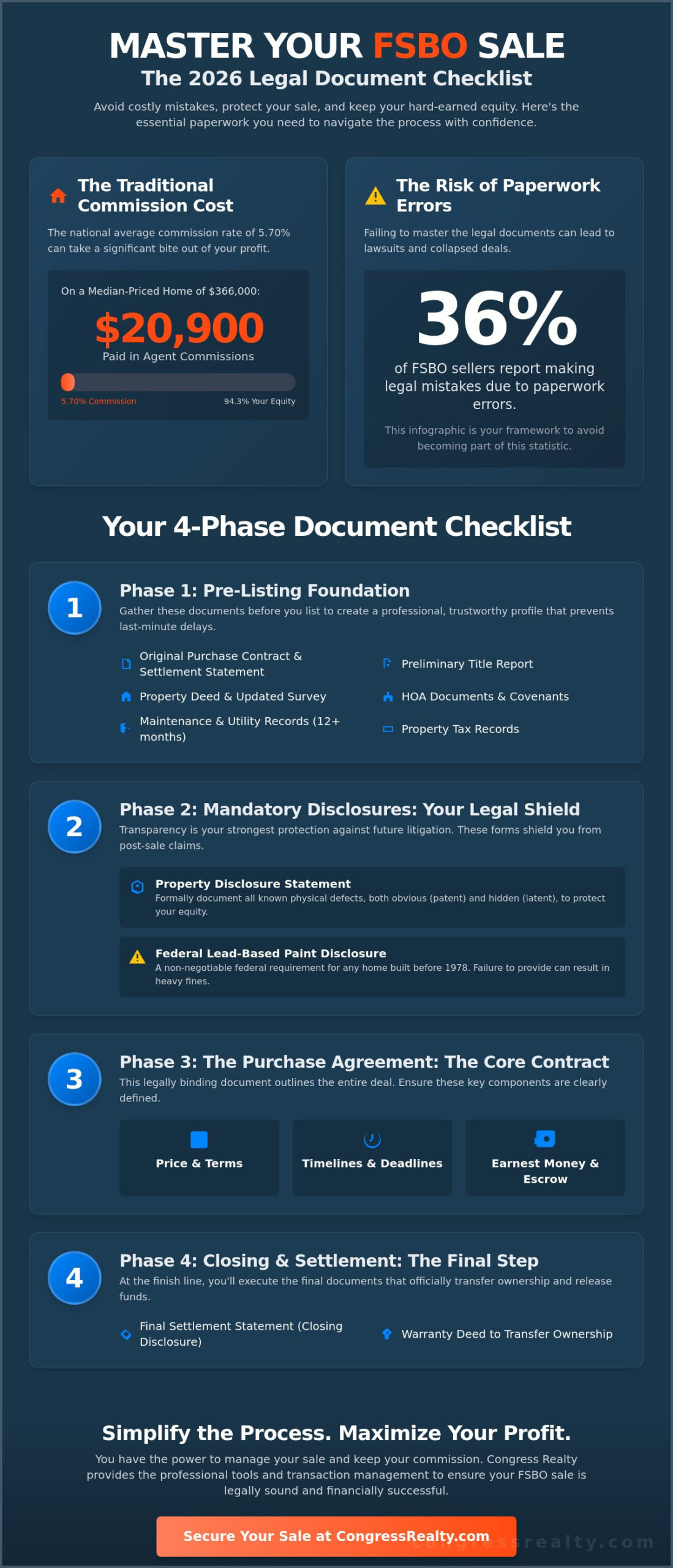
Did you know that 36% of homeowners who sell independently report making legal mistakes due to paperwork errors? It’s a sobering statistic, especially when you’re working hard to avoid the national average commission rate of 5.70%. On a median-priced home of $366,000, that traditional fee swallows $20,900 of your hard-earned equity. You deserve to keep that money, and you don’t need a high-commission agent to handle the logistics. Mastering the legal documents for selling a house by owner is the professional framework that secures your financial freedom.
We understand that the fear of a lawsuit or confusion over technical jargon can feel like a barrier. You want the confidence that your sale is legally sound without paying for a traditional 3% listing commission. This guide provides an actionable checklist for 2026, including new mandates like the FinCEN all-cash reporting and various state-mandated disclosures, such as those concerning electrical systems. You’ll learn exactly which forms you need for the pre-listing, contract, and closing phases to stay in control of your sale. We’re going to demystify the paperwork so you can focus on maximizing your net profit.
Key Takeaways
Learn how to organize original purchase records and preliminary title reports to establish a professional baseline for your home sale.
Shield yourself from liability by mastering the mandatory legal documents for selling a house by owner, including property condition and lead-based paint disclosures.
Discover the essential components of a solid purchase agreement, from price and timelines to the secure management of earnest money in escrow.
Navigate the closing phase with confidence by reviewing your final settlement statements and executing the warranty deed to transfer ownership.
Leverage professional transaction management to access the same documentation infrastructure used by traditional agents while you control your sales process.
The Pre-Listing Phase: Essential Documentation to Launch Your Sale
Listing your home independently starts with a solid foundation of facts. While many sellers rush to take photos, the smart ones start with the filing cabinet. Preparing your legal documents for selling a house by owner before the first showing prevents the 11th-hour deal killers that often plague FSBO transactions. Statistics show that 36% of independent sellers report making legal mistakes; you can avoid this by organizing your original purchase contract and settlement statement now. These documents establish your cost basis and prove you have the authority to move forward with the sale.
Order a preliminary title report as soon as you decide to sell. This report identifies liens, easements, or encumbrances that could stall your progress. Don’t let a forgotten $500 contractor lien from years ago stop a high-value sale in its tracks. You also need to compile your property tax records and any HOA documentation. For 2026, ensure your HOA package includes the newly mandated exterior inspection reports for elevated elements. This level of transparency builds immediate trust with buyers who are increasingly wary of hidden costs and complex regulations.
Verifying Ownership and Boundaries
Your Property Deed is the primary tool for proving your legal right to transfer title. It’s the cornerstone of the For Sale By Owner (FSBO) process and must be readily available for review. Pair this with an updated Property Survey. Modern mortgage underwriters have become much more stringent about boundary lines and potential encroachments. If your survey is outdated, a buyer’s lender may require a new one before funding the loan. Having these documents ready allows you to launch a flat fee mls listing with a professional profile that rivals any traditional brokerage. It signals to everyone in the industry that you are a savvy seller who understands the professional infrastructure of a real estate transaction.
Maintenance and Utility Records
Trust is the currency of a successful sale. Create a “Home Manual” that includes appliance warranties and a chronological service history. This simple step eliminates buyer doubt and positions you as a diligent, responsible owner. Compile at least 12 months of utility bills to validate your home’s efficiency claims with hard data. Finally, document every major capital improvement you’ve made. Clear records of a recent roof replacement or a high-efficiency HVAC upgrade provide the evidence needed to support your Comparative Market Analysis (CMA) valuation. When you lead with facts and professional-grade records, you protect your equity and stay in control of the negotiation. You don’t need to pay a 3% commission to prove your home’s value; your documentation does the work for you.
Mandatory Disclosure Forms: Your Legal Shield Against Liability
How do you protect your $20,900 in equity once the deal is signed? You do it through absolute transparency. Mandatory disclosures are often viewed as a burden, but they’re actually your strongest legal shield against future litigation. When you handle the legal documents for selling a house by owner, your goal is to eliminate any “he-said, she-said” scenarios that could arise months after closing. By being the most transparent person in the room, you maintain total control over your sales process and keep your profit where it belongs: in your pocket.
Don’t forget the Federal Lead-Based Paint Disclosure. If your home was built before 1978, this is a non-negotiable requirement. Failing to provide this specific document can result in heavy federal fines and give the buyer a legal “out” regardless of other contract terms. Managing the legal documents for selling a house by owner requires attention to detail, but it pays off by making your transaction bulletproof against post-sale claims.
Defining the Property Disclosure Statement
The Property Disclosure Statement is a formal legal record where you document every known physical defect or issue that could impact the property’s value or safety. Patent defects are obvious issues, such as a broken window or a visible water stain on a ceiling. Latent defects are hidden problems that a standard inspection might miss, like a cracked foundation behind a finished wall or a faulty sewer line. Disclosing both types is critical. When you’re honest upfront, you prevent buyers from using the inspection period as a tool to renegotiate the price or back out of the deal entirely.
Special Disclosures and Addenda
Check your local regulations for Natural Hazard Disclosures. In 2026, many states have tightened requirements regarding flood zones and wildfire risks. If your home is part of an association, you must disclose any pending HOA assessments or ongoing litigation. A new 2026 California law even requires HOAs to provide detailed inspection reports for exterior elevated elements to prospective buyers. While including an “As-Is” clause in your contract is helpful, it doesn’t exempt you from the legal duty to disclose known issues. For a complete look at how these sales records impact your financial standing, consult IRS Publication 523 to understand the long-term tax treatment of your home sale.
Adopt an “over-disclose” strategy. If you’re wondering whether a minor basement leak from three years ago needs to be mentioned, the answer is always yes. Documenting it now prevents a $10,000 legal bill later. Ready to secure the professional forms used by the pros? You can access comprehensive transaction management tools that ensure your disclosure package is complete and compliant.
The Purchase Agreement: Drafting the Core Contract
The purchase agreement is the definitive rulebook for your transaction. While traditional agents might claim these contracts are too complex for a solo seller, the reality is that standard, state-approved forms provide a clear roadmap for both parties. When you manage the legal documents for selling a house by owner, you aren’t just filling out forms; you’re defining the terms of your financial victory. This contract outlines the final sale price, the closing timeline, and the specific legal obligations that keep the buyer committed to the deal.
Secure the deal with a meaningful Earnest Money Deposit (EMD). Typically ranging from 1% to 3% of the purchase price, this deposit serves as the buyer’s “skin in the game.” Ensure the contract specifies that an independent third party, such as a title company or an escrow agent, holds these funds. This protects you from the risk of a buyer walking away without a valid legal reason. By setting firm deadlines for inspections, appraisals, and financing approvals, you maintain the momentum necessary to reach the closing table without unnecessary delays.
Key Components of a Valid Sales Contract
Precision is your best defense against legal disputes. Always include the full legal description of the property, such as the lot and block number found on your deed, rather than just the mailing address. Be explicit about personal property. If you plan to leave the smart refrigerator but take the heirloom chandelier, document it clearly to avoid last-minute friction. Finally, ensure your contract includes a “Time is of the Essence” clause. This legal phrasing compels the buyer to perform their duties by the agreed-upon dates or risk being in breach of contract.
Managing Contingencies and Addenda
Contingencies are the “escape hatches” in a contract. The inspection contingency is the most common hurdle; handle it pragmatically by offering credits for major repairs rather than attempting to manage contractors yourself. This keeps the deal moving and keeps you in control. If an appraisal comes in lower than the sale price, an appraisal contingency allows you to negotiate a price adjustment or require the buyer to cover the gap with cash.
You don’t have to track these complex dates alone. Utilizing professional Transaction Management allows you to oversee every deadline with the same precision as a high-volume brokerage. This service ensures all legal documents for selling a house by owner are executed in the correct sequence, protecting your equity and your peace of mind. By automating the administrative timeline, you stay focused on the outcome: a successful, high-profit closing.
Closing and Settlement: Navigating the Final Paperwork
You’ve reached the finish line. This is the moment where the “thousands saved” move from a projected goal to a concrete reality on your bank statement. Reviewing the final legal documents for selling a house by owner ensures every credit and debit is accounted for with total precision. The Closing Disclosure (CD) is your primary roadmap during this stage. It details the final purchase price, escrow deposits, and prorated expenses. Look closely at the “Seller’s Column.” This is where you’ll see the absence of that traditional 3% listing commission, a sight that validates your financial intelligence and your decision to stay in control.
You’ll also need to execute the Warranty Deed. This is the official legal instrument that transfers the property title from your name to the buyer. It’s a high-stakes document that must be notarized to be legally binding and recorded with the county. If you’re leaving behind a riding lawnmower or a specific set of appliances, prepare a Bill of Sale. This simple document prevents any post-closing confusion about what was included in the real estate versus personal property. Finally, you’ll sign the 1099-S form. This is the mandatory IRS reporting document that tracks the proceeds from your home sale, ensuring your transaction is fully compliant with federal tax regulations.
Final Financial Statements
Don’t just glance at the ALTA Settlement Statement; audit it. This document provides a granular look at every penny in the transaction, including prorated property taxes and HOA fees. Verify that your existing mortgage payoff amount is exact to the day of closing. Any secondary liens or local assessments must also show as “paid in full.” Seeing your net proceeds without a massive commission deduction is the ultimate reward for managing the legal documents for selling a house by owner yourself. It’s the final proof that the flat fee model works in your favor.
The Transfer of Possession
Most closings require an Affidavit of Title. This is a sworn statement where you confirm there are no new liens, judgments, or legal disputes involving the property since the initial title search. In certain jurisdictions, you may also need a Certificate of Occupancy to prove the home meets local building codes for the new owner. Once the ink is dry, provide a “Keys and Codes” document. Include garage door frequencies, smart lock codes, and alarm instructions to ensure a professional handover experience. Ready to finalize your sale with professional precision? Explore our Transaction Management services to ensure your closing paperwork is handled correctly from start to finish.
Simplifying FSBO Legal Process with Flat Fee MLS and Transaction Management
Selling a home independently shouldn’t feel like a legal gamble. Many homeowners hesitate to go solo because they fear the administrative burden of contract management. Congress Realty acts as your professional advocate, providing the exact same legal documents for selling a house by owner that traditional agents use, but without the 3% listing fee. By utilizing a flat fee model, you gain access to the professional infrastructure necessary to protect your equity while maintaining total autonomy. You’re not just saving money; you’re taking command of the transaction from a position of strength.
The real power of this model lies in the predictability of the process. While traditional brokers might charge a 5.70% total commission, our flat fee approach keeps your costs transparent and fixed. Our Transaction Management service oversees your legal document timeline, ensuring every disclosure is signed and every deadline is met. This methodical approach demystifies the real estate process, moving you logically from the initial listing to the final closing with consistent financial reinforcement at every stage. You control your sales process while we provide the professional framework to make it simple.
Professional Infrastructure for the Independent Seller
Success in the 2026 market requires more than just a sign in the yard. Through the Congress Realty listing portal, you get immediate access to state-approved contracts and mandatory disclosure forms. Using an electronic lockbox and professional signage signals to buyer agents that this is a legally serious transaction. Having a broker-owner like Andrew English oversee your listing provides an extra layer of professional parity with traditional agencies. This setup ensures your legal documents for selling a house by owner are handled with the same scrutiny as any high-commission listing, giving you the confidence to negotiate as an equal.
Taking Control of Your Equity
Consider the financial impact on a $500,000 sale. At the national average commission rate of 5.70%, you’d pay $28,500 at the closing table. Even if you only account for the 2.88% listing agent fee, that’s $14,400 of your equity gone. By choosing a flat fee service, you keep that money in your pocket. Our Full Service package handles the heavy lifting of document coordination, allowing you to focus on the sale itself. Why pay thousands for a listing agent when you can access the same professional tools for a fraction of the cost? Ready to lead your own sale? List your property on the MLS today and secure the profit you’ve earned.
Take Command of Your Equity and Finalize Your Sale
You have the roadmap; now it’s time to act. Mastering the legal documents for selling a house by owner isn’t just about compliance; it’s about protecting the thousands of dollars in equity you’ve built. By organizing your pre-listing records, providing transparent disclosures, and following a structured closing process, you eliminate the need for a traditional 3% listing commission. You don’t need a high-priced agent when you have access to the right professional infrastructure. This process is simple when you lead with facts and maintain control.
Congress Realty provides that professional framework. With over 20 years of experience in flat-fee real estate and an A+ rating from the Better Business Bureau, we offer the professional parity you deserve. Our service is managed by designated broker Andrew English, ensuring your transaction follows the highest industry standards. You control your sales process, and we provide the tools to make it rewarding. Your financial intelligence is your greatest asset in this market. Use it to keep your equity where it belongs.
What documents are legally required to sell a house by owner in 2026?
At a minimum, you must provide the property deed, state-mandated property disclosures, and the lead-based paint disclosure for homes built before 1978. In 2026, you’re also required to comply with new FinCEN reporting rules for all-cash transactions involving entities like LLCs. These legal documents for selling a house by owner establish your right to sell and ensure the transaction meets federal transparency standards.
Do I need a lawyer to review my FSBO sales contract?
While not legally mandatory in all states, hiring a real estate attorney is a smart move to protect your equity. An attorney provides a professional review of the contract’s specific language to ensure you aren’t exposed to unnecessary liability. This small investment ensures your $20,900 in commission savings stay protected from potential loopholes or legal disputes that could arise after the closing.
Who is responsible for preparing the purchase agreement in a FSBO sale?
The buyer’s agent often prepares the initial offer, but you are responsible for the final purchase agreement used in the sale. If you’re dealing with an unrepresented buyer, you can provide a state-approved contract template to define the terms. Taking the lead on the paperwork allows you to set the deadlines for inspections and financing that best fit your moving timeline.
What happens if I forget to disclose a property defect?
Forgetting to disclose a known defect can lead to expensive post-sale litigation or a total rescission of the contract. If a buyer discovers a latent defect after closing that you failed to document, you could be held liable for the repair costs and legal fees. This risk is why 36% of independent sellers report anxiety over paperwork; always choose to over-disclose to keep your profit secure.
Can I use standard real estate forms if I’m not a licensed agent?
Yes, you can use state-approved real estate forms even if you don’t hold a professional license. Most state real estate commissions provide public access to the standard purchase agreements and disclosure statements required for a legal transfer. Using these legal documents for selling a house by owner ensures your transaction follows the same professional standards as a traditional brokerage sale.
How do I handle the earnest money deposit without an agent?
You must have a neutral third party, such as a title company or escrow agent, hold the earnest money deposit. Never accept a check directly from the buyer to hold in your personal account, as this creates significant legal risk. This professional escrow arrangement ensures the funds are only released when all contract contingencies, such as the appraisal and inspection, have been fully satisfied.
What is a 1099-S form and why do I need it for my home sale?
The 1099-S is a mandatory IRS form used to report the gross proceeds from a real estate transaction. The settlement agent typically files this form to ensure the government can track potential capital gains from the sale. It’s a critical document for your tax records, especially if your profit exceeds the standard federal exclusion limits for a primary residence.
How does a flat-fee MLS service help with the legal paperwork?
A flat-fee MLS service provides the professional infrastructure and document portal needed to manage your sale with confidence. Instead of hunting for templates, you get access to a curated package of state-specific forms and automated disclosure checklists. This system simplifies the administrative side of the transaction, allowing you to focus on the goal of maximizing your net profit without an agent.
Image sourced from Canva
Summary: Idaho sellers are writing checks for nearly $27,500 in real estate commissions—often without realizing there’s an alternative. Find out how flat fee MLS listings could help you keep over $12,000 of that money in your pocket instead.
Key Takeaways
Traditional real estate commissions in Idaho average 5.71% of the sale price, costing sellers around $27,494 on a median-priced home
Flat fee MLS services allow Idaho homeowners to list for as low as $299 while maintaining full buyer exposure
Sellers can save $12,000-$15,000 by eliminating the listing agent commission while still paying buyer’s agent fees
MLS listings automatically syndicate to Zillow, Realtor.com, and other major platforms regardless of listing method
Idaho’s current low inventory creates a seller’s market advantage that won’t last indefinitely
Idaho’s $27,494 Commission Reality Check
Idaho homeowners are unknowingly writing five-figure checks to real estate agents every single day. The culprit isn’t some hidden fee or surprise charge—it’s the traditional commission structure that has quietly become the most expensive line item at closing.
The numbers tell a stark story. With Idaho’s median home price at $481,500 and average commission rate of 5.71%, sellers pay approximately $27,494 in real estate fees. That’s not a small percentage buried in paperwork—that’s car money, college tuition, or a serious down payment on the next home walking out the door.
The 5.71% commission gets split between two agents: the listing agent who markets the home and the buyer’s agent who brings the purchaser. Each typically receives 2.5% to 3% of the sale price, creating a structure where both sides profit significantly from higher home values.
This percentage-based model means commission costs scale directly with home prices. As Idaho real estate values have climbed over recent years, commission checks have grown proportionally—without any additional work or enhanced service levels for sellers.
2. What You Actually Pay on $300K vs $500K Homes
On a $300,000 home sale, traditional commissions total approximately $17,130. Step up to a $500,000 property, and that figure jumps to $28,550. The difference represents $11,420 in additional fees for the same basic service: listing and marketing the home to potential buyers.
These calculations assume standard commission rates, but many sellers don’t realize that the listing side of this equation—roughly half the total commission—can be eliminated entirely through flat fee MLS services.
MLS Access Without the Massive Fee
What the MLS Actually Is (and Why It Matters)
The Multiple Listing Service (MLS) serves as the master database for real estate professionals to search for properties. When a home enters the MLS, it automatically feeds into consumer-facing websites like Zillow, Realtor.com, Trulia, and Redfin—the exact platforms where 68% of buyers begin their home search.
Historically, only licensed real estate professionals could access MLS systems, creating a gatekeeping effect that required sellers to work through traditional agents. This exclusive access justified the percentage-based commission model for decades.
How Flat Fee Services Get You Full Exposure
Flat-fee MLS companies bridge this access gap by providing licensed brokerage services for a one-time upfront fee. The listing receives identical treatment within the MLS database, appearing alongside all other properties without any distinction or limitation.
Buyer’s agents search the MLS the same way regardless of how a property was listed. The home shows up in the same search results, displays the same information, and attracts the same buyer traffic as traditionally-listed properties.
Congress Realty’s Flat Fee Breakdown
1. Plans Starting at $299 vs Traditional Costs
Congress Realty offers Idaho MLS listing services starting at $299 for basic coverage, escalating to $499 for premium features, and $399 plus 0.5% at closing for full-service support, including broker negotiations. Compare these figures to traditional listing agent fees of $11,000 to $14,000 for a median-priced home in Idaho.
The cost difference becomes even more dramatic on higher-value properties. A $600,000 home would generate roughly $17,000 in listing agent commissions through traditional channels, while flat fee services maintain the same $299-$499 pricing regardless of sale price.
2. What’s Included in Each Service Level
Basic plans include a six-month MLS listing, syndication to major real estate websites, and access to Idaho-approved forms and disclosures. Mid-tier options add phone lead forwarding, showing schedulers, and unlimited listing modifications.
Premium packages provide marketing support, while full-service plans include dedicated broker assistance with negotiations, inspections, and closing coordination. Even the most extensive flat fee service costs a fraction of traditional listing agent commissions.
3. Buyer Agent Commission You Still Pay
Flat-fee listings typically still offer buyer’s agent compensation—usually 2% to 3% of the sale price—to ensure cooperation from agents in showing properties. This commission structure incentivizes buyer’s agents to present the home to their clients.
The key difference lies in eliminating only the listing agent’s commission while maintaining buyer agent incentives. This approach preserves buyer traffic while cutting total commission costs roughly in half.
Real Savings Calculator for Idaho Sellers
Side-by-Side Cost Comparison
For Idaho’s median home sale of $481,500, traditional full-service agents charge approximately $27,494 in total commissions. A flat fee MLS listing with a $499 upfront cost plus 3% buyer’s agent commission totals $14,944—creating $12,550 in immediate savings.
Higher-priced properties show even greater savings potential. A $600,000 sale saves $15,761 with flat-fee services, while a $750,000 transaction preserves $19,826 compared to traditional commission structures.
Where Your $12,000+ Savings Actually Go
The retained commission money represents real purchasing power that stays with sellers rather than transferring to listing agents. For a typical Idaho home sale, $12,000-$15,000 covers significant expenses: a reliable vehicle, home improvements on the next property, college tuition assistance, or substantial contributions to an emergency fund.
These savings compound when sellers use retained equity for down payments on subsequent home purchases, potentially reducing mortgage amounts and long-term interest costs by thousands of additional dollars.
Why Your Home Still Gets Maximum Buyer Exposure
Zillow and Realtor.com Syndication Process
MLS syndication occurs automatically regardless of listing method. Major real estate websites pull property data directly from MLS databases via automated feeds that don’t distinguish between traditional and flat-fee listings.
Buyers searching Zillow, Realtor.com, or Redfin see identical property presentations, photos, descriptions, and contact information. The listing source remains invisible to consumers browsing online platforms.
Current Idaho Market Advantage for Sellers
Idaho’s housing inventory has decreased 10% year-over-year, creating competitive conditions favoring sellers. Active listings in major markets like Boise have been selling in as few as 14 days during peak seasons, driven by buyer demand exceeding available supply.
This market environment reduces the theoretical advantages of traditional full-service representation, as strong buyer demand and limited inventory create natural selling conditions that don’t require intensive marketing efforts or agent networking to attract offers.
Start Your Idaho Listing Today and Keep Your Equity
Idaho’s current seller’s market won’t persist indefinitely. Interest rate fluctuations, seasonal patterns, and new construction activity constantly shift market dynamics, potentially reducing seller advantages over time. Every week of delay means losing active buyer traffic that may not return during less favorable market conditions.
Flat fee MLS listing provides immediate access to the same buyer pool that traditional agents target, but at a fraction of the cost. Licensed brokerage support ensures proper legal compliance while preserving thousands of dollars in equity that belongs with sellers, not commission checks.
The choice between keeping $12,000-$15,000 or paying it in commissions often determines financial flexibility for years after a home sale. Smart sellers protect their equity while still accessing maximum buyer exposure through strategic MLS placement.
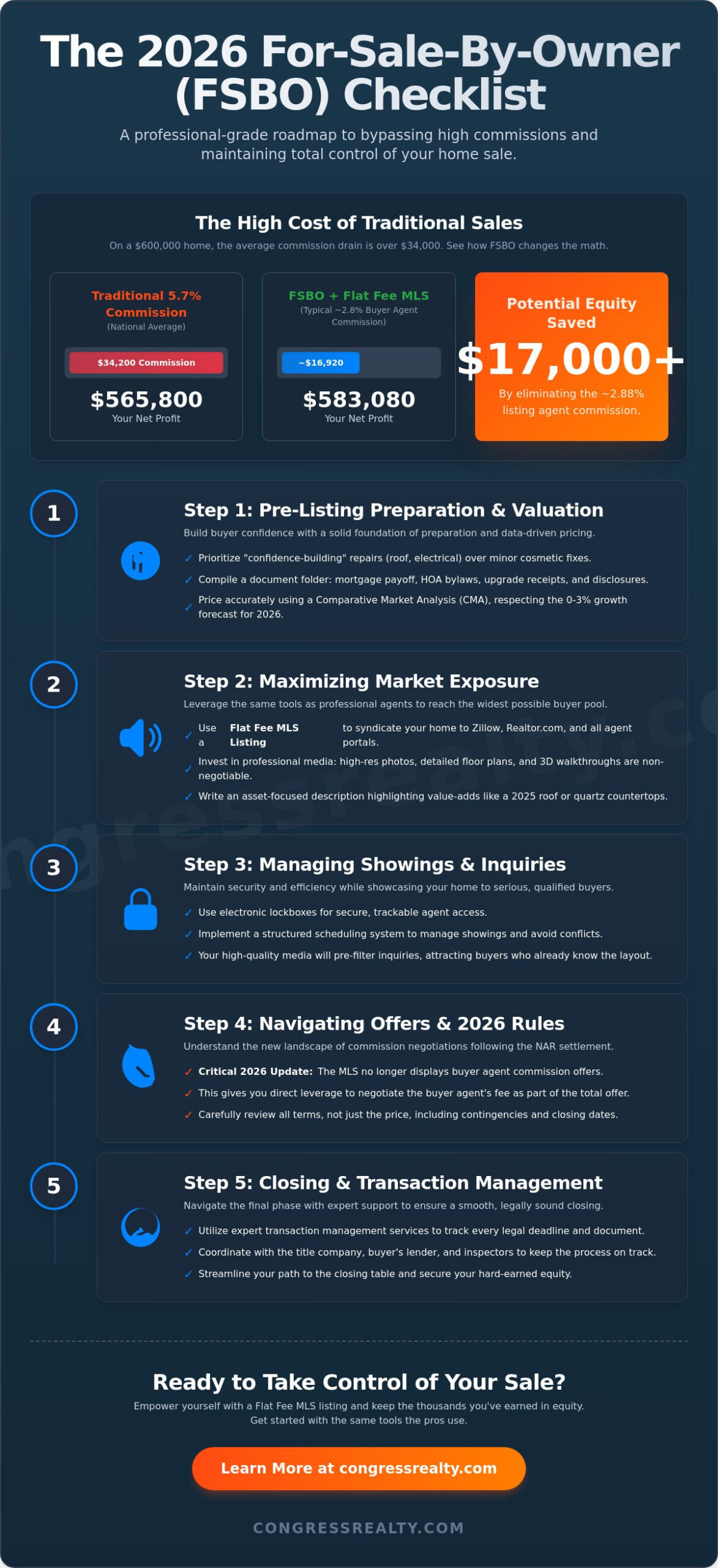
Why would you hand over $17,000 or more of your hard-earned equity just for the “privilege” of selling your own home? With the national average real estate commission sitting at 5.70% as of April 24, 2026, the traditional model is a massive drain on your final profit. You likely feel that the old way of selling is broken, especially with the recent NAR settlement changing how buyer agent compensation works. It’s natural to worry about legal paperwork or exposure, which is why finding a reliable how to sell a house by owner checklist 2026 is the first step toward your financial freedom.
This guide is your professional-grade roadmap to bypassing the standard 2.88% listing commission while maintaining total control. We promise to show you how to master the for-sale-by-owner process using the same tools the pros use, like the Local MLS and professional photography. You’ll gain the confidence to handle every step from pricing to closing. This checklist previews the exact path to a smooth, legally sound sale that ensures thousands saved and puts you back in the driver’s seat of your own transaction.
Key Takeaways
Learn how to conduct a professional property audit and gather critical financial documents to build buyer confidence before your first showing.
Discover how to leverage a Flat Fee MLS listing and professional photography to gain maximum digital exposure without paying a 3% listing commission.
Master our comprehensive how to sell a house by owner checklist 2026 to navigate updated commission rules and legal requirements with total confidence.
Find out how to use electronic lockboxes and structured scheduling to manage professional showings while you maintain total control of the process.
Streamline your path to the closing table by utilizing expert transaction management services to track every legal deadline and documentation requirement.
Step 1: Pre-Listing Preparation and Valuation
Successful sales start with a solid foundation. You’re shifting from “homeowner” to “project manager,” and your first move in this how to sell a house by owner checklist 2026 is gathering the data that proves your home’s value. Buyers in 2026 are highly analytical and they want to see the receipts. Start by identifying “confidence-building” repairs, like fixing a leaky roof or updating an electrical panel, which differ from “presentation” repairs like fresh paint. While presentation helps you get an initial offer, confidence-building repairs ensure the deal doesn’t fall through during the inspection. Taking this proactive approach puts you ahead of traditional listings where agents often wait for the inspection report to react.
The Documentation Audit
Don’t wait for a buyer to ask for paperwork. Compile a digital and physical folder containing your mortgage payoff statement, HOA bylaws, and recent utility bills. If you’ve made significant upgrades, like a new HVAC system installed in 2025, include those receipts to justify a higher asking price. Verifying your property surveys and boundary maps now prevents expensive legal disputes later. You should also prepare a draft of the Seller’s Disclosure Notice early. This transparency is a hallmark of the For Sale By Owner (FSBO) process. It builds immediate trust with potential buyers and their agents, showing them you’re a prepared and professional seller.
Pricing for the 2026 Market
Setting the right price is a science, not a feeling. With home price growth forecast to be flat or modest at 0% to 3% in 2026, overpricing is a dangerous mistake that leads to “stale” listings. You need to analyze recent sales of similar homes in your immediate neighborhood from the last six months to stay relevant. The most effective way to do this is through a Comparative Market Analysis (CMA). This report provides the same data traditional brokers use, allowing you to set a price that reflects true market value. Because you aren’t paying a 3% listing commission, you have more flexibility to price competitively while still walking away with higher net proceeds. This is a critical step in your how to sell a house by owner checklist 2026 because it defines your entire negotiation leverage from day one.
Step 2: Maximizing Market Exposure via the MLS
You can’t sell what people can’t see. While a yard sign is a great local signal, it won’t reach the buyer moving from across the country or the agent searching for their client’s next home. To truly compete, your property must appear on the Local MLS. This is the “source of truth” for the real estate industry. By securing a Flat Fee MLS listing, you place your property on a level playing field with high-commission listings. This approach is a core pillar of any how to sell a house by owner checklist 2026 because it ensures your home automatically syndicates to Zillow, Realtor.com, and hundreds of other major search portals. You retain total control of your sales process while bypassing the traditional 3% listing commission. Note that in 2026, the MLS no longer displays buyer agent commission offers, which gives you more leverage to negotiate these terms directly with interested parties.
Writing your property description requires an objective, asset-focused mindset. Avoid fluff and focus on concrete details that add value. Mention the 2025 roof replacement, the quartz countertops, or the proximity to top-rated schools. Buyers in 2026 are looking for clarity and transparency. If you provide a clear, professional description alongside your listing, you reduce the friction of the transaction and attract higher-quality inquiries. This is about working smarter, not harder, to reach the widest possible buyer pool.
The Power of Professional Media
First impressions happen in milliseconds on a smartphone screen. High-resolution professional photography is the single most important factor in your click-through rate. In 2026, buyers expect more than just static images. They want to see detailed floor plans and 3D walkthroughs to pre-screen the property before they ever request a showing. This saves you time by filtering out “looky-loos” and focusing only on serious, qualified buyers who already know the layout of your home. If your photos are dark, cluttered, or blurry, buyers will swipe past your listing regardless of the price. Investing in professional media is a pragmatic move that pays for itself by driving higher demand and faster offers.
Strategic MLS Listing Management
Once your home is live, active management is the key to success. You need to choose the right package for your specific needs, whether it’s a Standard Listing for the seasoned DIY seller or a Full Service Listing for those who want professional transaction support. Accuracy in your listing data is vital for a smooth closing. Double-check that your contact information is correctly displayed so buyer agents can reach you directly for questions or showing requests. In the fast-moving 2026 market, you must update your listing status immediately as offers arrive. This maintains your professional reputation and prevents wasted time for all parties involved. If you’re ready to take charge, you can list your home on the MLS today and start saving thousands.
Step 3: Managing Showings and Buyer Inquiries
Managing the flow of potential buyers is often the part of the how to sell a house by owner checklist 2026 that homeowners dread most. Traditional agents want you to believe that managing showings is an impossible disruption. It isn’t. It’s simply a matter of using the right professional infrastructure. By taking charge of your own schedule, you ensure that every person walking through your door is a serious contender rather than a “looky-loo” just passing by. This level of oversight protects your time and your property.
Establish a clear showing window that works for your life. You don’t have to be available 24/7. In fact, setting specific times for tours can create a sense of urgency among buyers. After each visit, send a quick digital survey to the buyer or their agent. Analyzing this feedback allows you to make real-time adjustments to your presentation or price. If three different people mention the same minor issue, fix it immediately. This data-driven approach is how savvy owners close deals faster than those relying on a traditional agent’s intuition. You control your sales process, and that includes who enters your home and when.
Security and Accessibility
Safety and security are paramount when you manage your own sales process. Forget the old-fashioned mechanical lockboxes with four-digit codes that never change. Instead, install an electronic lockbox. These devices provide secure, tracked access for buyer agents, sending you an immediate alert when someone enters and exits. You’ll know exactly who was in your home and when. For your external presence, a professional yard sign and post installation signals to the neighborhood that you’re a serious seller. This combination of digital security and physical visibility ensures a professional environment for every viewing without the high cost of a traditional broker.
Vetting Potential Buyers
Don’t let anyone through the door without proof of their ability to pay. This is a non-negotiable rule in 2026. For buyers with financing, require a current pre-approval letter from a reputable lender. For cash offers, ask for a recent bank statement showing proof of funds. Managing these inquiries through a dedicated email address or phone line keeps your personal life separate and organized. By filtering out unrepresented buyers who haven’t started their mortgage process, you focus your energy on qualified, ready-to-act buyers. This pragmatic vetting process is what separates successful sellers from those who get stuck in listing limbo. Using this how to sell a house by owner checklist 2026 ensures you act like a pro at every step.
Step 4: Navigating Offers and 2026 Commission Rules
Receiving your first offer is the moment your hard work pays off, but it’s also where the most critical financial decisions happen. In the 2026 real estate market, the landscape of offers has shifted significantly. You aren’t just looking at the top-line number anymore. You must evaluate the entire Purchase Agreement to understand the true value of the deal. This part of the how to sell a house by owner checklist 2026 requires a pragmatic look at contingencies, timelines, and the buyer’s financial strength. Don’t be afraid to pick up the phone and call the buyer’s lender directly to verify their ability to close. A high offer means nothing if the financing is shaky or the appraisal won’t support the price.
Negotiation is a professional skill you can master with the right data. While traditional agents might push you to accept the first offer to collect their commission, you have the freedom to hold out for the best terms. Counter-offer on items like the earnest money deposit or the length of the inspection period. Increasing the earnest money shows the buyer is serious and has “skin in the game.” If you want to keep more of your equity, you can save thousands by managing your own negotiations instead of paying a listing agent to do it for you.
The Negotiator’s Checklist
Price: Compare the offer against the CMA-backed valuation you established in Step 1. If the offer is lower, use your data to justify your price.
Contingencies: Every contingency is an “out” for the buyer. Look for offers with fewer hurdles, such as waived inspections or shorter appraisal windows.
Timeline: Ensure the closing date aligns with your move-out plans. A flexible buyer is often worth more than a slightly higher price with a rigid schedule.
Handling Buyer Agent Commissions
The 2026 market is defined by commission transparency. Following the NAR settlement, buyer agent compensation is no longer advertised on the MLS. This gives you immense leverage. While the average buyer’s agent commission was 2.42% as of late 2025, you are not required to pay this. You must decide whether to offer a flat fee, a smaller percentage, or no commission at all. Some buyers may even include a request for you to cover their agent’s fee within their offer. Write a clear, concise sentence in your response explaining your stance. Being direct prevents confusion and ensures you maintain the financial advantage. Remember, every dollar you don’t pay in commissions is a dollar that stays in your pocket at the closing table.
Step 5: Closing and Transaction Management
Traditional brokers often claim the closing table is where you’ll fail without their help. They want you to believe the paperwork is a labyrinth only they can navigate. In reality, the heavy lifting is done by a neutral third party, such as a title company or real estate attorney. Your role in this final part of the how to sell a house by owner checklist 2026 is that of a project manager. You’ll coordinate the home inspection and manage any repair requests with a cool, business-like head. If a buyer asks for a $5,000 credit for a minor repair, you have the data to counter or refuse. Using a professional Transaction Management service ensures you never miss a legal deadline, tracking everything from the option period to the final funding.
Once the inspection is complete and repairs are negotiated, you’ll prepare for the final walkthrough. This is the buyer’s last chance to verify the property is in the agreed-upon condition. You’ve already done the hard work of marketing and negotiating; now you simply need to ensure the logistics stay on track. By managing this stage yourself, you maintain total control over the timeline and the final outcome. You aren’t waiting on an agent to relay messages; you’re the one driving the deal to completion.
Navigating Escrow and Title
Selecting a reputable title company is your first move once a contract is signed. They act as the neutral escrow officer, holding the buyer’s earnest money and ensuring all “clouds” on the title are cleared before the transfer. This includes verifying that old liens or boundary disputes are resolved. You’ll review the Bill of Sale and other transfer documents provided by the title company to ensure accuracy. This process is highly standardized, making it easy for any organized homeowner to manage without paying a 3% listing commission. It’s a pragmatic way to finish your how to sell a house by owner checklist 2026 with professional precision.
The Final Equity Check
Before you sign the Closing Disclosure, perform a thorough review of the Settlement Statement. This is your chance to verify that no hidden “junk fees” have crept into the numbers. Check that the 0% listing commission is accurately reflected. In a traditional sale, you’d see a massive deduction for the listing agent’s fee; here, that money stays in your bank account. Once the ink is dry and the loan is funded, you’ve successfully bypassed the high-commission model. Ready to skip the 3% commission? List your home on the MLS today with Congress Realty and keep your equity where it belongs.
Take Command of Your Home Sale Today
Selling your home independently in 2026 is no longer a mystery. It’s a strategic financial choice. By following this how to sell a house by owner checklist 2026, you’ve learned how to leverage professional tools like the Local MLS and CMA reports to bypass the traditional high-commission model. You’ve discovered that managing showings and navigating new commission rules is entirely within your reach when you have the right infrastructure. The power has shifted back to you, the homeowner.
Congress Realty was founded in 2002 to be your professional ally. We’ve helped our clients save over $100 million in commissions by providing expert transaction management and the same visibility as traditional agents. You don’t need to sacrifice professional quality to save your equity. Save thousands by listing your home for a flat fee on the local MLS today!
You have the knowledge and the tools to succeed. Take the first step toward a smarter, more profitable closing. You control your sales process, and the rewards are waiting for you at the finish line.
Frequently Asked Questions
Is it legal to sell my house without a realtor in 2026?
Yes, it is 100% legal to sell your own property in every U.S. state. You have the fundamental right to represent yourself in a real estate transaction. While laws regarding specific disclosures vary by location, no federal or state law requires you to hire a listing agent to sell your home. You can manage the entire process from listing to closing independently.
How much can I actually save by selling by owner?
You can save the traditional listing commission, which averaged 2.88% of the sale price as of April 24, 2026. On a $500,000 home, this equates to $14,400 kept in your pocket. By using a flat fee model, you bypass the high percentage based fees that traditional brokers charge for the same digital exposure. It is a pragmatic way to protect your equity.
What is a Flat Fee MLS listing and why do I need it?
A Flat Fee MLS listing is a professional tool that places your home on the local database used by all real estate agents. You need it because the MLS is the primary source of data for sites like Zillow and Realtor.com. Without it, your property remains invisible to the 89% of buyers who start their search online. It provides professional parity without the high costs.
Do I still have to pay a commission to the buyer’s agent?
You are not legally required to pay a buyer’s agent commission in 2026. Following the NAR settlement, these offers are no longer advertised on the MLS. You can choose to offer a flat fee, a smaller percentage, or nothing at all. However, offering a competitive rate may attract a larger pool of buyers who have already signed representation agreements with their agents.
How do I handle the paperwork for selling a house by owner?
You handle the paperwork by utilizing professional transaction management services and a reputable title company. This how to sell a house by owner checklist 2026 recommends having a real estate attorney review your contracts to ensure legal compliance. Most of the technical closing documents are prepared by the title company or escrow officer, making the process much simpler than traditional agents suggest.
What happens if a buyer doesn’t have an agent?
If a buyer is unrepresented, you deal with them directly and save the entire commission. This is often the most profitable scenario for a seller. You should still require a pre-approval letter or proof of funds before showing the home. In these cases, a title company or attorney ensures the contract remains legally sound for both parties without the need for intermediaries.
Can I list my home on the MLS for a flat fee and still sell it myself?
Yes, listing for a flat fee allows you to retain total control of your sales process. You manage the showings, negotiate the offers, and keep your equity. The service provides the professional infrastructure of the LOCAL MLS while you act as the primary point of contact for all inquiries. It is the perfect middle ground that provides professional exposure without the 3% listing fee.
How do I price my home correctly without an agent?
You price your home correctly by using a professional Comparative Market Analysis (CMA). This report uses the same sold data from the last six months that appraisers and agents use. Don’t rely on automated online estimates, which can be inaccurate by 5% or more. A data-driven CMA ensures you don’t leave money on the table or let your listing go stale in the 2026 market.
Summary: Selling your Idaho home without proper disclosures could land you in legal hot water—and cost you thousands. Before you put up that “For Sale” sign, there’s critical paperwork that Idaho law requires you to complete, or you might face serious liability.
Key Takeaways
Idaho law requires sellers to provide property condition disclosure forms within ten days of accepting an offer, with potential legal liability for failing to disclose known defects properly
Federal lead paint disclosures are mandatory for homes built before 1978, including a 10-day buyer inspection period
Professional photography and competitive pricing through market analysis significantly impact how quickly homes sell and for how much
Flat fee MLS services provide full market exposure while saving thousands compared to traditional real estate commissions
Proper pre-listing preparation prevents costly delays and legal complications during the sale process
Selling a home in Idaho requires careful preparation to ensure both legal compliance and market success. From mandatory disclosure forms to strategic pricing, each step influences how quickly homes sell and how much sellers net from the transaction. Understanding these requirements upfront prevents costly mistakes and delays that can derail an otherwise smooth sale.
Idaho Sellers Must Disclose Property Defects by Law
Idaho Statute 55-2501 et seq. legally requires home sellers to disclose known defects or issues that could impair a property’s value to potential buyers. This disclosure must be provided within ten days of accepting an offer, making it a critical preparation step for sellers to complete before listing begins.
The state takes these requirements seriously. Sellers who willfully or negligently fail to perform their disclosure duties under Idaho law may be held liable for the buyer’s actual damages. This liability extends beyond simple oversight – courts have consistently held sellers accountable for known issues they failed to reveal, regardless of whether buyers discovered them during inspections.
Idaho is notable for codifying the exact language for its property condition disclosure form under Idaho Statute 55-2508, though real estate organizations still format their own versions.Congress Realty helps Idaho sellers navigate these disclosure requirements as part of their listing services, ensuring compliance from the start.
Complete Your Property Condition Disclosure Form First
The Idaho Seller Property Condition Disclosure (RE-25) forms the foundation of legal compliance for any home sale. This document is based on the seller’s actual knowledge at the time of completion and serves as protection for both parties, though it’s not a warranty or substitute for buyer inspections.
1. Foundation, Roof, and Structural Systems
Structural components represent the most expensive potential issues for buyers, making honest disclosure necessary. Document any known foundation settling, roof leaks, or structural modifications made to the home. Include information about the age of major systems and any repairs completed by licensed contractors. Even minor foundation cracks or previous roof repairs should be noted, as these details help establish trust with potential buyers rather than creating surprises during inspections.
2. Electrical, Plumbing, and HVAC Components
Utility systems require detailed attention in disclosure forms because they affect daily livability and safety. Note the age and condition of electrical panels, the presence of any aluminum wiring, the plumbing materials used throughout the home, and the HVAC system’s maintenance history. Water pressure issues, previous electrical work, or heating system repairs should all be documented. Buyers appreciate knowing what to expect rather than discovering problems after moving in.
3. Known Pest Issues or Previous Treatments
Pest problems and treatments must be disclosed even if the issue has been resolved. Document any termite inspections, treatments for wood-destroying organisms, or ongoing pest control contracts. Include information about previous infestations and the methods used to address them. Many buyers view professional pest treatment as a positive sign of proper maintenance rather than a red flag, especially when disclosed honestly upfront.
Federal Lead Paint Disclosures for Pre-1978 Homes
Homes built before 1978 face additional federal disclosure requirements under the Lead-Based Paint Hazard Reduction Act. These rules apply regardless of whether lead paint is actually present – the age of the home triggers the requirement automatically.
Required EPA Documentation
Sellers must provide buyers with the EPA pamphlet “Protect Your Family From Lead in Your Home” and include a Lead Warning Statement in the sales contract. Any known lead-based paint hazards must be disclosed, along with available records or reports concerning lead paint presence. The disclosure must be completed even if the seller has no knowledge of lead paint, as the federal requirement focuses on the home’s age rather than confirmed presence of lead materials.
10-Day Buyer Inspection Period
Federal law mandates that buyers receive a 10-day period for lead-based paint inspection or risk assessment before the sale becomes final. This period can be mutually agreed to be lengthened, shortened, or waived entirely, but the option must be provided. Sellers should prepare for this timeline when planning their closing schedule, as some buyers choose to exercise this right even when no lead concerns are apparent.
Price Competitively with Market Analysis
Accurate pricing determines how quickly homes sell and ultimately how much sellers receive. Overpricing consistently leads to properties lingering on the market and eventually selling for less than they would have if priced correctly from the start.
Why CMAs Matter for Idaho Sellers
A Comparative Market Analysis (CMA) evaluates recently sold comparable homes in the same area to establish competitive pricing. This analysis considers factors like square footage, lot size, age, condition, and unique features to determine where a home fits within the current market. Professional CMAs account for seasonal variations, neighborhood trends, and buyer preferences specific to different Idaho regions. The analysis provides objective data rather than emotional attachments to guide pricing decisions.
Overpricing Costs You Money
Overpricing is one of the most common and costly mistakes sellers make. Homes priced above market value typically sit on the market longer, causing buyer interest to wane and forcing eventual price reductions. These delayed price cuts often result in final sale prices below what the home would have achieved with correct initial pricing. Market perception plays a crucial role – buyers often assume something is wrong with properties that remain listed for extended periods, creating negotiation disadvantages for sellers.
Professional Photography Drives More Views
Professional photographs directly impact how many potential buyers view a listing online. Quality listing photos receive significantly more views and can help homes sell faster while achieving prices closer to the original listing price.
Quality photos showcase the home’s best features while accurately representing the space. Professional photographers understand lighting, angles, and staging techniques that highlight positive aspects while minimizing less attractive elements. They use wide-angle lenses to make rooms appear spacious and capture exterior shots that emphasize curb appeal and neighborhood context.
The investment in professional photography for standard packages typically costs around $150-$300, though prices can vary based on property size, location, and photographer experience. This investment pays dividends through increased buyer interest and faster sales. Poor photos immediately eliminate potential buyers from consideration, while excellent photos generate multiple showings and competitive offers.
Flat Fee MLS Gets You Market Exposure
The Multiple Listing Service provides access to nearly every serious buyer and their agent in the local market. MLS listings automatically syndicate to major platforms like Zillow, Realtor.com, and Trulia, creating market exposure that yard signs and online classifieds cannot match.
Congress Realty’s $299 Basic Package
Congress Realty offers flat fee MLS listing services starting at $299, providing the same market exposure as traditional full-service agents without the percentage-based commission structure. This package includes direct MLS entry by a licensed broker, automatic syndication to major real estate websites, and comparative market analysis to support pricing decisions. The service covers six months of listing duration with the ability to request modifications as needed throughout the marketing period.
Avoid FSBO Legal Mistakes
For Sale By Owner (FSBO) sellers frequently make legal mistakes that can lead to delays, reduced sale prices, or liability issues. Common problems include inadequate property disclosures, incorrect contract preparation, and failure to comply with Idaho Real Estate Commission requirements. Local real estate attorneys in Idaho assist FSBO sellers with drafting purchase agreements and providing disclosure guidance, but working with a licensed broker through flat fee MLS services often provides more protection while maintaining cost savings.
Start with Disclosure Compliance for a Successful Sale
Proper disclosure compliance forms the foundation of every successful home sale in Idaho. Completing required forms accurately and honestly protects sellers from future liability while building buyer confidence throughout the transaction process. The time invested in thorough disclosure preparation prevents delays, reduces negotiation complications, and demonstrates the seller’s commitment to a transparent transaction.
Starting with disclosure compliance also allows sellers to address any revealed issues proactively. When disclosure forms highlight maintenance needs or system concerns, sellers can choose to complete repairs before listing or price the home appropriately to account for known issues. This approach prevents surprise negotiations and helps establish realistic buyer expectations from the first showing.
For guidance on Idaho real estate transactions and flat fee MLS services, visitCongress Realty to learn about their professional listing options and market expertise.
Image sourced from Canva
Summary: The NAR settlement fundamentally changed how buyer agent commissions work, creating a surprising opportunity for Idaho FSBO sellers. But there’s an 18% price gap you need to understand—and a specific strategy to avoid it while saving over $11,000.
Key Takeaways
MLS access can prevent the typical 18% price gap that For Sale By Owner homes face compared to agent-assisted sales
The NAR settlement changes effective August 2024 make buyer agent commissions fully negotiable, creating better opportunities for FSBO sellers
Flat fee MLS services cost $299-$700 one-time versus $23,750-$28,500 in traditional agent commissions on Idaho’s median home price
Strategic MLS listing can save Idaho sellers $11,500+ while maintaining full market reach
The recent National Association of Realtors settlement has fundamentally shifted the real estate landscape, creating unprecedented opportunities for Idaho’s For Sale By Owner sellers. Understanding how MLS access works in this new environment can mean the difference between leaving thousands on the table or maximizing your home’s sale potential.
Yes: MLS Access Prevents FSBO’s 18% Price Gap
The numbers tell a clear story about MLS exposure versus going it alone. FSBO homes without MLS access sell for a median price of $360,000, while agent-assisted sales achieve $425,000 – an 18% difference that directly correlates to market visibility. This gap isn’t due to seller incompetence; it’s a direct result of limited buyer reach.
Without MLS syndication to Zillow, Realtor.com, and other major platforms where the vast majority of buyers start their search, FSBO properties simply don’t reach qualified buyers. The MLS acts as the central nervous system of real estate, feeding every major home search website and connecting sellers to the broadest possible buyer pool.
Flat fee MLS services bridge this exposure gap by providing the same market reach as traditional agents without the percentage-based commission structure.Congress Realty offers Idaho sellers verified MLS access starting at $299, ensuring maximum exposure while maintaining seller control over the entire process.
How NAR Settlement Changes Idaho FSBO
Settlement Announced March 2024, Effective August 17
The landmark NAR settlement approved in March 2024 eliminated the longstanding requirement for listing brokers to offer buyer agent compensation through the MLS. This rule change, which took effect August 17, 2024, fundamentally altered how buyer agents get paid and removed a significant barrier for FSBO sellers.
Previously, MLS systems effectively required sellers to pre-commit to offering 2.5-3% buyer agent commissions to avoid having their listings deprioritized. This created an artificial pressure point that made independent selling less attractive, even with MLS access.
Buyer Agent Commissions Now Fully Negotiable
Post-settlement, buyers must now sign written representation agreements specifying exactly how their agent will be compensated and by whom. This transparency means FSBO sellers are no longer automatically expected to pay buyer agent fees, and unrepresented buyers may become more common as commission costs become more visible.
For Idaho FSBO sellers, this change is genuinely transformative. The old argument that “you’ll have to pay the buyer’s agent anyway” no longer holds the same weight, creating more flexibility in negotiations and potentially reducing total transaction costs.
Flat Fee MLS vs Traditional Agent Costs
Traditional Agents Charge $23,750-$28,500 in Idaho
Traditional full-service agents in Idaho typically charge between 5-6% of the sale price in total commissions. On Idaho’s median home price of $475,000, this translates to $23,750-$28,500 in total commission costs, with the listing agent’s portion alone accounting for $11,875-$14,250.
These costs represent substantial money that comes directly out of seller proceeds at closing. For many Idaho homeowners, this commission structure can eliminate years of equity appreciation or significantly impact their ability to purchase their next home.
Flat Fee MLS Costs $299-$700 One-Time
Flat fee MLS services operate on a completely different pricing model. Instead of percentage-based fees, sellers pay a fixed upfront cost typically ranging from $299-$700, regardless of home value. This pricing structure means a $300,000 home and a $600,000 home pay the same listing fee.
The savings become exponentially more significant as home values increase. On a $600,000 Boise area home, traditional listing agent fees could reach $15,000-$18,000, while flat fee MLS remains under $700 – a savings of over $17,000 on the listing side alone.
What MLS Access Actually Includes
Flat fee MLS placement provides the same core listing exposure as traditional agents. Once listed, properties automatically syndicate to all major home search platforms including Zillow, Realtor.com, Redfin, and Homes.com. Buyer agents can access listing details, schedule showings, and submit offers through the same systems they use for any MLS property.
The listing appears identical to agent-listed properties – buyers and their representatives cannot distinguish between flat fee and traditional listings. This ensures no discrimination or steering away from FSBO properties based on commission structure.
What Idaho FSBO Sellers Must Handle
1. Accurate Pricing Using Market Comps
Pricing represents the biggest challenge for FSBO sellers, with many independent listings initially priced too high. Without access to recent MLS sales data and professional market analysis, sellers often anchor to emotional valuations rather than market realities.
Successful FSBO sellers invest time in researching comparable sales, understanding current market conditions, and pricing competitively from day one. Overpricing by even 5-10% can result in extended market time and ultimately lower sale prices as the listing becomes stale.
2. Buyer Communications and Showings
All buyer inquiries, showing requests, and follow-up communications come directly to the seller. This requires organization, responsiveness, and availability to accommodate buyer schedules. While this represents additional time investment, it also provides direct control over the buyer experience and relationship building.
Effective FSBO sellers establish systems for managing inquiries, maintain flexible showing schedules, and respond promptly to all legitimate buyer interest. This direct communication can actually strengthen buyer relationships compared to agent-mediated interactions.
3. Contract Negotiations and Idaho Disclosures
Idaho requires specific property condition disclosures and material fact forms that are non-negotiable legal requirements. FSBO sellers must understand these obligations and complete all required paperwork accurately to avoid potential liability issues.
Contract negotiations require knowledge of market norms, contingency periods, and inspection protocols. While many sellers handle basic negotiations effectively, complex situations may warrant professional consultation or legal review.
Congress Realty’s Flat Fee MLS Options
Verified $299 MLS Access Plan
Congress Realty’s Basic plan provides full MLS listing access for $299, including placement on the local Idaho MLS covering the specific property area. This plan includes up to 5 photo changes, Idaho Association-approved listing forms, and direct account access for price updates or corrections.
The pricing structure includes zero hidden fees or closing costs, making $299 the total investment for complete MLS exposure. This transparency contrasts with some flat fee services that advertise low prices but add percentage-based fees at closing.
Idaho-Licensed Broker Placement
As an Idaho-licensed real estate brokerage, Congress Realty ensures proper legal placement and compliance with state MLS requirements. The company has facilitated over $1 billion in completed sales since 2002 and maintains 4.8-star verified customer reviews.
This licensing and track record provide assurance that listings will be properly placed, maintained, and supported throughout the marketing period. The broker backing also ensures compliance with Idaho real estate regulations and MLS standards.
Best Idaho Markets for Flat Fee MLS
Strong FSBO Activity Statewide
Idaho shows strong FSBO activity throughout the state, with educated buyers and competitive pricing. The state’s relatively straightforward disclosure requirements and buyer-friendly market conditions create favorable environments for independent sellers.
Markets like Boise, Coeur d’Alene, Twin Falls, and Idaho Falls show particularly strong FSBO activity, supported by educated buyers and competitive pricing. These markets demonstrate buyer acceptance of directly-listed properties.
Low Inventory Benefits MLS-Listed Homes
Idaho’s current housing inventory sits at approximately 3 months of supply – a low-inventory environment that favors sellers. In this market condition, properly priced MLS listings receive strong buyer attention regardless of listing structure.
The combination of low inventory and high buyer demand means MLS exposure becomes even more valuable, as buyers actively search all available options. Flat fee MLS listings benefit from this buyer urgency while avoiding the premium costs of traditional agent representation.
Save $11,500+ with Strategic MLS Listing
The financial impact of choosing flat fee MLS over traditional agent representation extends far beyond simple commission savings. On Idaho’s median home price of $475,000, sellers save $11,534-$13,901 on the listing side alone when choosing a $299 flat fee service over traditional 2.5-3% listing commissions.
These savings compound when considering that properly exposed FSBO properties can achieve sale prices closer to market value compared to homes with limited visibility. The combination of reduced costs and maintained market exposure creates the optimal selling scenario for prepared Idaho homeowners.
For sellers in higher-priced markets like Boise, where median prices approach $600,000, the savings reach $14,700-$17,700 on listing fees alone. This represents substantial capital that can fund moving expenses, home improvements, or contribute to the next property purchase.
The strategic advantage becomes clear: flat fee MLS provides the market exposure necessary to achieve top dollar while preserving seller equity that would otherwise go to commission payments. In Idaho’s seller-friendly market, this combination of tools and savings creates compelling opportunities for informed homeowners ready to manage their own sale process.
For Idaho sellers considering the FSBO route with proper market exposure,Congress Realty provides flat fee MLS services that deliver professional results without traditional commission structures.
Image sourced from Canva
Summary: Selling a home in Idaho? The total costs might shock you—we’re talking 8-10% of your sale price in commissions and fees. But here’s what most sellers don’t know: one expense alone typically exceeds $13,000, and it’s completely optional.
Key Takeaways
Idaho home sellers pay an average of 2.96% in closing costs plus 5.71% in agent commissions, totaling 8-10% of the sale price.
Real estate agent commissions represent the largest expense for sellers, with listing agents averaging 2.98% and buyer’s agents 2.73%.
Idaho charges no transfer tax on home sales, providing a modest saving compared to other states.
Flat Fee MLS services can save sellers thousands by eliminating the listing agent commission while maintaining full market exposure.
Recent NAR settlement changes have given sellers more flexibility in negotiating buyer agent compensation.
Selling a home in Idaho involves more costs than most homeowners anticipate. Understanding these expenses upfront helps sellers make informed decisions and consider alternatives that could save thousands of dollars.
Idaho Home Sellers Pay 2.96% in Closing Costs Plus 5.71% in Agent Commissions
Idaho home sellers face a substantial financial burden during closing. The average seller pays approximately 2.96% of the home’s sale price in closing costs alone, which translates to about $10,400 for a $351,000 home (used as an example, though current Idaho home values typically range higher). However, this figure doesn’t include the largest expense most sellers encounter: real estate agent commissions.
Agent commissions add significantly to the total cost of selling a home in Idaho. Real estate commissions average 5.71% of the sale price, meaning the combined burden of closing costs and commissions can reach 8-10% of the final sale price. For a home valued at $450,000, this represents a total cost of approximately $36,000-$45,000.
Understanding each component of closing costs helps sellers budget accurately and identify potential areas for negotiation. Idaho’s closing cost structure includes several standard fees that sellers can expect to encounter.
Title Service Fees (~0.47% of Sale Price) and Recording Fees (~$45)
Title service fees represent one of the more significant closing cost components, averaging around $2,217 for most transactions. These fees cover the title search, title transfer, and related paperwork necessary to complete the sale. The title company ensures the property has a clear title and handles the legal transfer of ownership.
Recording fees, while much smaller at approximately $45, represent the government fee required to record the deed change in public records. This fee is mandatory and ensures the new ownership is officially documented with the county.
Owner’s Title Insurance (0.5-1% of Sale Price)
In Idaho, sellers customarily pay for the owner’s title insurance policy, which protects the buyer from potential title defects or ownership disputes. This insurance typically costs between 0.5% to 1% of the home’s sale price, varying based on the property value and insurance provider.
While this expense may seem substantial, title insurance provides crucial protection for both parties and is considered a standard part of Idaho real estate transactions.
Property Taxes and HOA Prorations
Sellers must pay prorated property taxes up to the day of sale, typically representing about 0.49% of the assessed value. This proration ensures sellers only pay for the portion of the year they owned the property.
For homes with homeowners associations, sellers also pay prorated HOA fees ranging from $25-$50, depending on the monthly dues and timing of the sale.
No Transfer Tax Advantage in Idaho
Unlike many states that impose deed transfer taxes, Idaho charges zero transfer tax on home sales. This absence of transfer tax provides Idaho sellers with a modest but welcome saving compared to states where transfer taxes can add thousands to the closing bill.
Real Estate Agent Commissions: The Largest Seller Expense
While closing costs represent a significant expense, real estate agent commissions dwarf all other seller costs combined. Understanding how these commissions work and recent changes to the industry helps sellers make informed decisions about representation.
Listing Agent Fee Averages 2.98%
The listing agent’s commission in Idaho averages 2.98% of the final sale price. For a $400,000 home, this translates to nearly $12,000 paid to the listing agent. This fee traditionally covers marketing, showing coordination, negotiation assistance, and transaction management.
However, many sellers question whether these services justify a percentage-based fee structure, especially in today’s digital marketing environment where MLS exposure drives most buyer interest.
Buyer’s Agent Commission Averages 2.73%
Buyer’s agent commissions in Idaho average 2.73% of the sale price, slightly lower than listing agent fees but still representing a substantial cost. On the same $400,000 home, this amounts to approximately $10,900 paid to represent the buyer’s interests.
Traditionally, sellers paid both sides of the commission, meaning they funded representation for both themselves and the buyer.
How NAR Settlement Changes Affect Idaho Sellers
The 2024 NAR settlement fundamentally changed how buyer agent commissions work. Sellers are no longer required to offer buyer agent compensation on the MLS, giving them unprecedented flexibility in structuring deals.
Despite these changes, early data suggests commission rates haven’t significantly decreased. Some sellers even offer higher buyer agent commissions to attract offers in competitive markets. However, the settlement does provide sellers with more negotiating power and options for reducing their total commission burden.
Flat Fee MLS Alternative Saves Thousands
The traditional commission model developed during an era when real estate agents controlled access to buyer networks. Today, the MLS drives home sales, and access to it no longer requires paying a percentage-based listing commission.
Congress Realty’s $299 Flat Fee Solution
Congress Realty’s Flat Fee MLS service starts at just $299 for complete MLS listing, representing a fraction of traditional listing agent costs. This service includes listing on the Idaho MLS, automatic syndication to major real estate portals, and professional support throughout the process.
The company offers multiple service tiers, from the basic $299 MLS listing to premium packages at $499 that include unlimited listing changes and additional marketing features. The Full Service option is priced at $399 plus 0.5% of the sale price for those wanting broker negotiation assistance.
Full MLS Exposure Without Listing Agent Commission
Flat Fee MLS listings receive the same exposure as traditional agent listings. The property automatically appears on Zillow, Realtor.com, Redfin, Trulia, and hundreds of agent websites. Buyer’s agents show homes based on buyer preferences, not how the listing was entered, ensuring flat fee listings receive equal consideration.
Sellers using this model typically still offer buyer’s agent compensation of 2-3%, but they eliminate the listing agent’s commission entirely, keeping that 3% in their own pocket.
Cost Comparison: Traditional vs Flat Fee
The financial difference between traditional and flat fee approaches becomes stark during actual transactions. For a $450,000 Idaho home sale, traditional listing agent commission alone costs approximately $13,410, while Congress Realty’s flat fee ranges from $299-$499 for most plans.
Adding buyer’s agent compensation, traditional total commissions reach nearly $26,000, while flat fee approaches can keep total commission costs under $14,000 by eliminating the listing agent percentage. This represents potential savings of $12,000-$15,000 or more, depending on the home’s value and negotiated buyer agent compensation.
These savings become even more significant on higher-value properties, where percentage-based commissions compound dramatically while flat fee costs remain constant.
Congress Realty Eliminates the 3% Listing Commission for Idaho Sellers
Congress Realty positions itself as Idaho’s trusted flat fee MLS solution, combining affordability with multiple service options. The company’s local MLS coverage ensures properties are marketed directly to agents and buyers most likely to make offers, rather than generic national databases.
Sellers maintain complete control over pricing, showings, and negotiations while receiving Idaho Association-approved forms and disclosures. The platform allows flexible buyer’s agent commission settings, a critical tool since NAR settlement changes require direct fee negotiations with buyers.
With plans starting at $299 and extending to full-service options, Congress Realty provides alternatives for every seller’s comfort level and involvement preference. Even the premium packages cost dramatically less than traditional commission structures while maintaining professional standards and legal compliance.
Summary: Selling your Idaho home without paying traditional 5-6% commissions sounds impossible—but there’s a legal workaround that could save you over $16,000. The catch? You need to understand how MLS access actually works and what changed in 2024.
Key Takeaways
Only licensed real estate brokers can list properties on Idaho’s MLS, but FSBO sellers can access it through affordable flat-fee services starting at $299
The 2024 NAR settlement eliminated mandatory buyer agent compensation, giving Idaho sellers new power to negotiate commissions and reduce total selling costs
MLS listings automatically syndicate to major platforms like Zillow and Realtor.com, providing broad exposure that reaches a substantial number of active buyers and their agents
Idaho sellers must complete specific disclosure forms by law, and proper compliance protects against costly liability issues
Flat-fee MLS services can save sellers $16,000-$27,000 compared to traditional 5.5% commission structures
Getting your Idaho home maximum market exposure doesn’t require paying traditional real estate commissions that can cost tens of thousands of dollars. Understanding MLS access options and recent industry changes helps sellers make informed decisions about listing strategies while keeping more equity from their sale.
FSBO Sellers Need Licensed Broker for MLS Access
The Multiple Listing Service operates as a private database restricted to licensed real estate professionals. Idaho law requires an active real estate license for any individual engaging in brokering activities related to real property, including listing properties for sale. This means FSBO (For Sale By Owner) sellers cannot directly access MLS systems themselves.
However, this doesn’t trap sellers into expensive traditional commission structures. Flat-fee MLS services bridge this gap by providing licensed broker access at a fraction of traditional costs. These services allow sellers to maintain control over their sale process while gaining the MLS exposure that reaches qualified buyers and their agents.
The MLS remains the primary search tool for real estate agents representing buyers. When properties aren’t listed on MLS, they become invisible to this substantial buyer pool, potentially limiting sale opportunities and final sale prices.Congress Realty offers affordable MLS access for Idaho sellers, ensuring properties reach the broadest possible market without traditional commission burdens.
Flat Fee MLS Breaks Traditional Commission Model
Traditional real estate commissions in Idaho typically range from 5.67% to 5.71% of the home’s sale price. On a $400,000 home, this translates to approximately $22,000-$23,000 in total commissions. Flat-fee MLS services disrupt this model by charging a fixed upfront fee instead of percentage-based compensation.
How Flat Fee Service Works
Flat-fee services provide licensed broker representation for MLS listing purposes only. Sellers pay a one-time fee, typically ranging from $99 to $899 depending on service levels and included features. The licensed broker enters the property into the appropriate regional MLS database, triggering automatic syndication to major real estate websites.
Sellers retain control over showings, negotiations, and buyer communications while receiving the same MLS exposure as traditionally listed properties. This model works particularly well for confident sellers comfortable managing the sale process or those in fast-moving markets where well-priced homes attract offers quickly.
Average Commission Costs vs. Flat Fee Savings
The savings potential becomes dramatic when comparing traditional commissions to flat-fee alternatives. A $300,000 Idaho home would typically incur $17,100 in total commissions at 5.7%. With flat-fee MLS services starting around $299, sellers could save over $16,800. These savings scale proportionally with higher-priced properties.
Even accounting for buyer agent compensation that sellers might choose to offer, the total selling costs remain significantly lower than traditional commission structures. The 2024 regulatory changes have made these savings even more accessible by eliminating mandatory buyer agent compensation requirements.
The National Association of Realtors settlement, effective August 17, 2024, fundamentally altered how buyer agent compensation works in real estate transactions. Previously, sellers were typically required to offer buyer agent compensation through MLS listings, often 2.5-3% of the sale price.
New Buyer Agent Agreement Requirements
Buyers must now sign written representation agreements with their agents before touring homes. These agreements explicitly outline compensation arrangements, shifting responsibility for agent payment discussions away from automatic seller obligations. This change provides transparency about who pays buyer agents and how much.
The new requirements eliminate the previous practice of advertising buyer agent compensation on MLS systems. Instead, these negotiations happen directly between buyers, their agents, and sellers during the offer process, creating more flexibility in commission structures.
Seller Negotiation Power Increases
Idaho sellers now have unprecedented control over buyer agent compensation decisions. They can offer zero buyer agent commission, particularly effective in low-inventory seller’s markets, or negotiate closing-cost concessions outside the MLS system. Some sellers strategically offer competitive commissions to attract buyer agents, while others prefer to negotiate these terms during offer discussions.
This flexibility allows sellers using flat-fee MLS services to optimize their total selling costs based on market conditions and buyer demand. In competitive markets, minimal or no buyer agent compensation might be acceptable, while in slower markets, offering commission might accelerate sale timelines.
MLS Listing Process for Idaho Sellers
The MLS listing process involves several key steps that ensure proper market exposure and legal compliance. Understanding each phase helps sellers prepare effectively and avoid common delays that could impact sale timelines.
1. Submit Property Details and Photos
Accurate property information forms the foundation of effective MLS listings. Sellers provide square footage, bedroom and bathroom counts, lot size, year built, and notable features. High-quality photos significantly impact buyer interest, with professional photography often leading to faster sales and higher offers.
Pricing strategy requires careful consideration of recent comparable sales in the area. Competitive pricing based on current market conditions attracts serious buyers and their agents, while overpricing can result in extended market time and eventual price reductions.
2. Complete Required Idaho Disclosure Forms
Idaho Code section 55-2508 mandates that sellers complete a Seller Property Condition Disclosure Form. This document covers structural integrity, electrical and plumbing systems, environmental hazards, and any known material defects affecting property value.
Proper disclosure protects sellers from liability issues that could arise post-closing. Sellers must deliver these disclosures within 10 days of receiving an offer, making preparation necessary before listing. Failing to disclose known material issues can result in actual damage liability that far exceeds any commission savings.
Additional considerations may include federal lead-based paint disclosures for homes built before 1978, HOA documentation where applicable, easement information, and mineral rights details depending on the specific property and transaction circumstances.
3. Set Buyer Agent Commission Strategy
Post-NAR settlement, sellers have complete discretion over buyer agent compensation offers. Some choose to offer competitive commissions (typically 2-3%) to attract buyer agents, while others prefer to negotiate these terms during the offer process. Market conditions, property location, and current inventory levels influence optimal strategies.
Sellers can also structure compensation creatively, offering flat fees, graduated commission based on sale price, or closing cost contributions instead of traditional percentage-based payment. This flexibility helps sellers adapt to different buyer situations while managing total selling costs.
4. Manage Showings and Offers
Active listing management involves coordinating property showings, responding to buyer inquiries, and evaluating offers as they arrive. Many flat-fee services include showing management tools or automated scheduling systems that streamline this process while keeping sellers in control.
Offer evaluation requires careful consideration of financing contingencies, inspection periods, closing timelines, and any requested concessions. Sellers maintaining control over these negotiations can respond quickly to market opportunities while protecting their interests throughout the transaction.
Idaho Seller Disclosure Requirements and Legal Compliance
Idaho’s disclosure requirements protect both buyers and sellers in real estate transactions. Understanding these obligations helps sellers avoid legal complications while building buyer confidence in their property.
Mandatory Property Condition Forms
The RE-25 Seller’s Property Condition Disclosure Form, developed by the Idaho Association of Realtors, covers property condition information. Sellers must address structural components, mechanical systems, environmental concerns, and any modifications or improvements made to the property.
Additional disclosures may be required for specific situations. Federal law mandates lead-based paint disclosures for homes built before 1978. Other considerations may include HOA documentation, easement information, and mineral rights details depending on the specific property circumstances. Complete disclosure documentation should be prepared before listing to ensure smooth transaction progression.
Liability Risks for Non-Disclosure
Idaho law holds sellers liable for actual damages if they willfully or negligently fail to disclose known material issues. This liability can include repair costs, temporary housing expenses, legal fees, and potentially punitive damages depending on the severity of the undisclosed issue.
Proper disclosure provides legal protection while building buyer trust. Transparent property condition information helps buyers make informed decisions and often leads to smoother transaction completion with fewer post-inspection surprises or renegotiations.
MLS Syndication Reaches Major Property Websites
Once listed on the MLS, properties automatically syndicate to major real estate platforms including Zillow, Realtor.com, Redfin, and Trulia. This syndication significantly increases market visibility without requiring separate listings on each platform.
The syndication process typically occurs within 24-48 hours of MLS entry, depending on the specific platforms and regional MLS systems. This broad exposure reaches buyers searching across multiple channels, maximizing the property’s visibility to qualified prospects and their representing agents.
MLS syndication represents one of the most valuable aspects of professional listing services. Properties gain exposure across hundreds of agent websites and national search platforms, creating the market presence needed for attracting competitive offers and achieving optimal sale prices.
Congress Realty Offers Affordable MLS Access Starting at $299
Congress Realty provides Idaho sellers with MLS access through multiple service tiers designed for different seller needs and comfort levels. Their basic plan starts at $299 and includes six-month listing terms, syndication to major real estate websites, access to Idaho-approved state forms, and DocuSign capability for document execution.
Higher-tier plans include additional features such as unlimited MLS changes, phone forwarding services, ShowingTime appointment scheduling, and marketing packages. The Full Service option at $399 plus 0.5% provides traditional broker support through closing while maintaining significant savings compared to conventional commission structures.
All Congress Realty plans include placement on regional Idaho MLS systems specific to the property location, ensuring listings reach agents most active in local markets. This local expertise combined with transparent pricing and support makes professional MLS access accessible to Idaho sellers across all price ranges and experience levels.
For Idaho homeowners seeking maximum market exposure while retaining control over their sale process,Congress Realty provides the licensed broker expertise and affordable MLS access needed to reach today’s buyers effectively.
Image sourced from Canva
Summary: Selling your Idaho home involves two distinct phases that determine your timeline—but here’s the surprising part: the marketing phase averages 79 days while closing takes just 29. Discover how spring timing and strategic pricing can cut your market time in half.
Key Takeaways
Idaho homes take an average of 108 days to sell, according to Clever Real Estate, split between 79 days on market and 29 days to close after accepting an offer, though other sources report varying timelines
Spring timing can reduce market time significantly, with May listings averaging around 40 days compared to 75 days in January
Traditional 5.71% commissions cost over $29,000 on Idaho’s median home price, while flat fee MLS saves $12,500+ on listing fees
Professional MLS exposure reaches 90% of active buyers through automatic syndication to Zillow, Realtor.com, and agent networks
Strategic pricing, timing, and buyer agent commission offers can dramatically reduce time on market
Selling a home in Idaho involves understanding two distinct phases that determine both timeline and costs. The marketing phase, where homes sit on the Multiple Listing Service waiting for buyers, accounts for most of the selling timeline. The closing phase, involving inspections and financing, operates on relatively fixed schedules regardless of listing strategy.
Idaho’s Two-Phase Reality: Marketing vs. Closing Phases
Idaho’s home selling timeline breaks down into two measurable phases. According to Clever Real Estate, the marketing period averages 79 days on market, while the closing phase takes approximately 29 days after offer acceptance. This 108-day total timeline is roughly 27% slower than Clever’s reported national average, though other sources report varying median days on market, such as 50 days by Realtor.com and 78 days by Redfin in recent months.
Current market data shows significant variation across Idaho markets. For example, Redfin reported a median days-on-market of 78 in February 2026, with 2,000 homes sold, reflecting a 2.2% year-over-year increase in sales volume. These variations highlight how localized market conditions dramatically affect individual outcomes.
The marketing phase represents where sellers maintain the most control over outcomes. Factors like pricing strategy, professional photography, MLS exposure, and timing directly impact how quickly buyers discover and tour properties.Congress Realty’s flat fee MLS service provides Idaho sellers with professional MLS access while maintaining control over the selling process.
Spring Timing Reduces Market Time Significantly
Timing dramatically affects both the speed of sales and the final price in Idaho markets. May is often cited as a fast-selling month, with homes spending an average of 40 days on market according to Clever Real Estate, compared to around 75 days in January. Some data also suggests June and July can see even faster sales, averaging 25-28 days on market. This difference stems from increased buyer activity as families’ schedules shift around school calendars and from improved curb appeal during Idaho’s peak landscape season.
For the highest sale prices, June is often identified as the optimal month, with average prices around $424,667. Other sources suggest July, September, and October for higher prices, with a 2025 median of $473,700. Spring and early summer listings benefit from competitive buyer pools, favorable mortgage rate windows, and natural advantages like blooming landscapes that enhance property appeal during showings.
Sellers with flexibility should avoid winter listings when possible. January through March consistently show lower buyer activity, longer days on market, and lower final sale prices. The seasonal pattern reflects both buyer behavior and practical considerations, such as the weather’s impact on property touring and moving logistics.
Traditional Commissions Cost $29,000+ on Idaho’s Median Home
Idaho’s median home price, which was around $507,400 in March 2026 according to Clever Real Estate (or $549,000 by Realtor.com in March 2026), creates substantial commission costs under traditional percentage-based structures. The state’s average total commission rate of 5.71% typically divided between listing agents (2.98%) and buyer agents (2.73%), resulting in approximately $29,100 in total commission fees on a median-priced home.
The 5.71% Commission Math on Median Homes
Commission calculations on Idaho’s median home prices demonstrate the significant equity impact. A $500,000 home generates $28,550 in total commissions, while a $600,000 property costs $34,260. These amounts represent substantial portions of seller equity that could otherwise fund down payments on next homes or other financial priorities.
The percentage structure means commission costs scale directly with home values, creating disproportionate impacts in Idaho’s appreciating market. Sellers in premium markets like Coeur d’Alene, where the median home price was approximately $527,590 in July 2024 (a 3.3% increase to $545,000 in July 2025), face even higher commission burdens under traditional structures.
How NAR Settlement Changed Buyer Agent Rules
The 2024 NAR settlement eliminated the requirement that sellers pay buyer agent commissions through MLS listings, fundamentally changing negotiation dynamics. Buyer agent compensation became fully negotiable, requiring separate buyer representation agreements rather than automatic commission splits.
Despite regulatory changes, many agents report that sellers are still choosing to cover buyer broker commissions to attract a wider pool of buyers. Average commission rates haven’t decreased significantly, with many sellers offering competitive rates of 2.5% or higher to attract buyer agents’ interest. The settlement created opportunities for strategic commission negotiations rather than automatic fee reductions.
Flat Fee MLS: Same Agent Access, Fraction of Cost
Flat-fee MLS services provide the same market exposure as traditional listings while eliminating percentage-based listing agent fees. Professional MLS listing ensures automatic syndication to Zillow, Realtor.com, Redfin, Trulia, and hundreds of local broker websites where active buyers search for properties.
Why 90% of Sellers Need MLS Exposure
The Multiple Listing Service functions as the central nervous system of Idaho’s real estate market. Licensed agents and buyer representatives search MLS databases first, making non-MLS properties invisible to the largest pool of active buyers. MLS exposure automatically distributes listings across major real estate platforms where buyers conduct initial property searches.
Homes with proper MLS marketing, combined with competitive pricing, tend to sell for more than those without MLS exposure, and strategic pricing can attract competitive offers. Properties lacking MLS exposure often require price reductions and extended marketing periods, reducing both speed and final proceeds for sellers.
Listing Agent Savings: $12,500-$15,000 on $500K Home
Flat fee MLS eliminates the 3% listing agent portion of traditional commissions while maintaining identical market reach. On a $500,000 Idaho home, replacing a $15,000 listing agent fee with a $299-$499 flat fee yields savings of more than $14,000. These savings remain in seller equity rather than agent compensation.
The cost comparison becomes more dramatic on higher-value properties. A $600,000 home saves over $17,000 in listing fees, while a $400,000 property saves approximately $11,500. These amounts represent significant equity preservation for sellers transitioning between homes or managing other financial priorities.
5 Strategies to Minimize Your Market Time
Successful Idaho sellers employ specific strategies to reduce days on market regardless of listing approach. These tactics consistently demonstrate measurable impacts on sales speed while maintaining competitive final prices.
1. Price Competitively From Day One
Overpricing represents the single greatest predictor of extended market time in Idaho. Homes priced above comparable recent sales typically require eventual price reductions, extending marketing periods, and reducing buyer interest. Recent comparable sales within the same neighborhood and price range provide the most accurate pricing foundation.
Competitive initial pricing attracts multiple buyer inquiries within the first two weeks, often generating competing offers that match or exceed the asking price. Strategic pricing based on current market conditions proves more effective than aspirational pricing, hoping for market appreciation during the selling period.
2. List in May for Fastest Average Timeline
May timing delivers measurable advantages in Idaho markets, with average days on market dropping significantly compared to slower periods. Spring listings benefit from peak buyer activity, favorable weather for property tours, and optimal timing for families with school-age children to move.
June and July maintain strong performance with slightly longer timelines but higher average sale prices. Sellers with timing flexibility should target April or May listing dates to capture peak spring buyer activity and competitive bidding environments.
3. Invest in Professional Photography
High-quality listing photography accelerates sales by up to 32% compared to amateur photos, according to market research. Professional images effectively highlight property features, generate more online interest, and create positive first impressions that translate into increased showing requests.
Professional photography costs typically range from $150 to $400 but deliver measurable returns through faster sales and maintained pricing power. Quality images become especially important given that most buyers conduct initial property research online before scheduling tours.
4. Respond to Showings Within Hours
Rapid response to showing requests maintains buyer agent engagement in competitive markets. Delayed responses lose potential showings to more responsive properties, directly reducing the total pool of buyers who view properties. Buyer agents typically schedule multiple property tours per day and prioritize homes with immediate availability.
Automated showing systems and flexible availability increase total showing volume, creating more opportunities for offers. Responsive communication with buyer agents builds professional relationships that can benefit negotiations and closing processes.
5. Offer Strategic Buyer Agent Commission
Competitive buyer agent commissions of 2-3% attract more agent-driven traffic to listings. Despite NAR settlement changes, buyer agents still influence property selection and showing priorities based on commission opportunities. Strategic commission offers maintain a broad agent network engagement.
Even with 2.5-3% buyer agent compensation, flat fee sellers save over $10,000 compared to traditional listing structures for median-priced homes. The commission investment drives increased buyer traffic while preserving substantial listing-fee savings.
Save $12,500+ on Listing Fees With Smart MLS Strategy
Flat fee MLS represents a strategic approach to accessing Idaho’s real estate market while preserving seller equity. The identical MLS exposure, automatic syndication to major buyer platforms, and professional listing presentation match traditional full-service offerings at a fraction of the cost.
On Idaho’s median home price of $510,000, flat fee MLS with strategic buyer agent compensation costs approximately $15,500 total compared to $29,100 in traditional commissions. The $13,600 in savings represents preserved equity that remains available for future home purchases, renovations, or other financial priorities.
Strategic flat fee MLS implementation requires understanding market dynamics, competitive pricing, and professional presentation standards. Successful sellers combine cost-effective listing strategies with responsive communication and competitive market positioning to achieve optimal outcomes.
For flat fee MLS services and expert guidance on Idaho home-selling strategies,Congress Realty provides established expertise, helping sellers maximize their proceeds while minimizing selling costs.