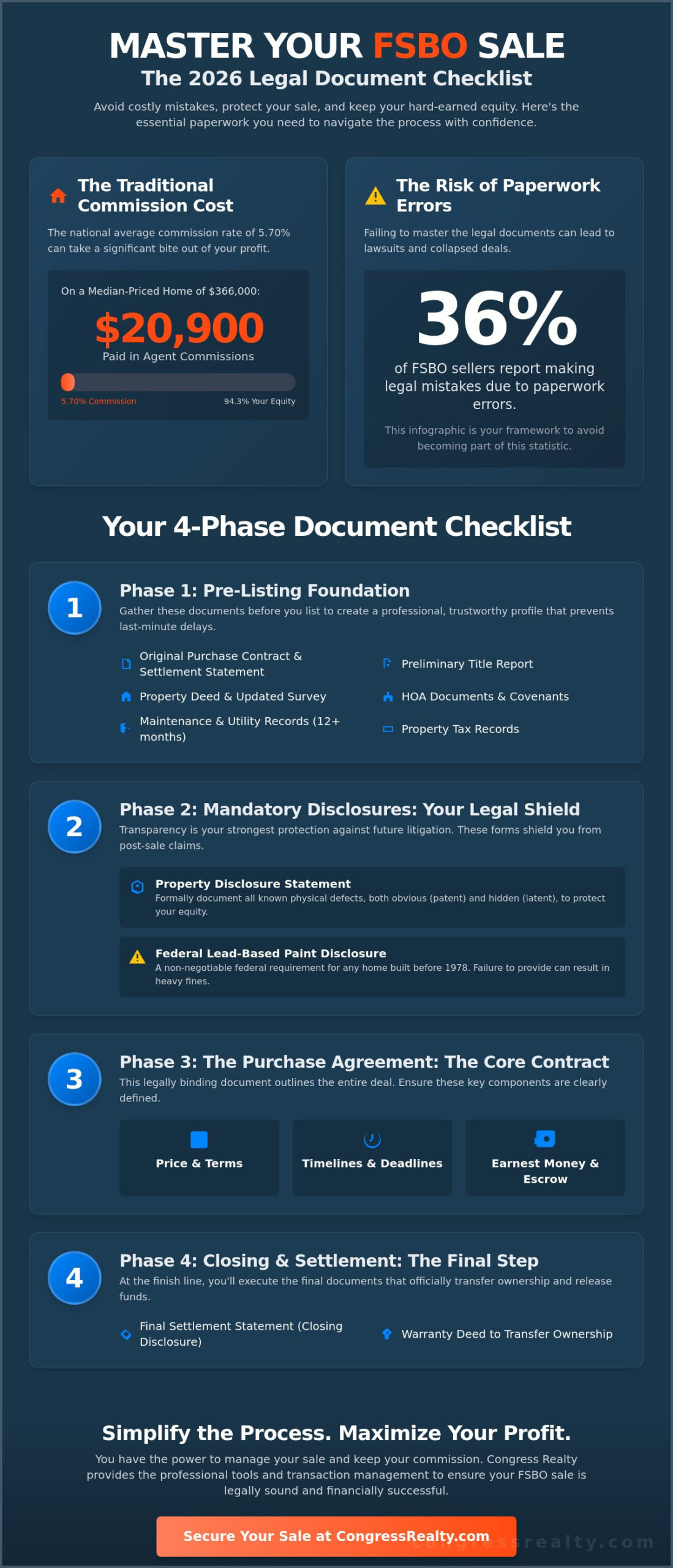
Did you know that 36% of homeowners who sell independently report making legal mistakes due to paperwork errors? It’s a sobering statistic, especially when you’re working hard to avoid the national average commission rate of 5.70%. On a median-priced home of $366,000, that traditional fee swallows $20,900 of your hard-earned equity. You deserve to keep that money, and you don’t need a high-commission agent to handle the logistics. Mastering the legal documents for selling a house by owner is the professional framework that secures your financial freedom.
We understand that the fear of a lawsuit or confusion over technical jargon can feel like a barrier. You want the confidence that your sale is legally sound without paying for a traditional 3% listing commission. This guide provides an actionable checklist for 2026, including new mandates like the FinCEN all-cash reporting and various state-mandated disclosures, such as those concerning electrical systems. You’ll learn exactly which forms you need for the pre-listing, contract, and closing phases to stay in control of your sale. We’re going to demystify the paperwork so you can focus on maximizing your net profit.
Key Takeaways
- Learn how to organize original purchase records and preliminary title reports to establish a professional baseline for your home sale.
- Shield yourself from liability by mastering the mandatory legal documents for selling a house by owner, including property condition and lead-based paint disclosures.
- Discover the essential components of a solid purchase agreement, from price and timelines to the secure management of earnest money in escrow.
- Navigate the closing phase with confidence by reviewing your final settlement statements and executing the warranty deed to transfer ownership.
- Leverage professional transaction management to access the same documentation infrastructure used by traditional agents while you control your sales process.
The Pre-Listing Phase: Essential Documentation to Launch Your Sale
Listing your home independently starts with a solid foundation of facts. While many sellers rush to take photos, the smart ones start with the filing cabinet. Preparing your legal documents for selling a house by owner before the first showing prevents the 11th-hour deal killers that often plague FSBO transactions. Statistics show that 36% of independent sellers report making legal mistakes; you can avoid this by organizing your original purchase contract and settlement statement now. These documents establish your cost basis and prove you have the authority to move forward with the sale.
Order a preliminary title report as soon as you decide to sell. This report identifies liens, easements, or encumbrances that could stall your progress. Don’t let a forgotten $500 contractor lien from years ago stop a high-value sale in its tracks. You also need to compile your property tax records and any HOA documentation. For 2026, ensure your HOA package includes the newly mandated exterior inspection reports for elevated elements. This level of transparency builds immediate trust with buyers who are increasingly wary of hidden costs and complex regulations.
Verifying Ownership and Boundaries
Your Property Deed is the primary tool for proving your legal right to transfer title. It’s the cornerstone of the For Sale By Owner (FSBO) process and must be readily available for review. Pair this with an updated Property Survey. Modern mortgage underwriters have become much more stringent about boundary lines and potential encroachments. If your survey is outdated, a buyer’s lender may require a new one before funding the loan. Having these documents ready allows you to launch a flat fee mls listing with a professional profile that rivals any traditional brokerage. It signals to everyone in the industry that you are a savvy seller who understands the professional infrastructure of a real estate transaction.
Maintenance and Utility Records
Trust is the currency of a successful sale. Create a “Home Manual” that includes appliance warranties and a chronological service history. This simple step eliminates buyer doubt and positions you as a diligent, responsible owner. Compile at least 12 months of utility bills to validate your home’s efficiency claims with hard data. Finally, document every major capital improvement you’ve made. Clear records of a recent roof replacement or a high-efficiency HVAC upgrade provide the evidence needed to support your Comparative Market Analysis (CMA) valuation. When you lead with facts and professional-grade records, you protect your equity and stay in control of the negotiation. You don’t need to pay a 3% commission to prove your home’s value; your documentation does the work for you.
Mandatory Disclosure Forms: Your Legal Shield Against Liability
How do you protect your $20,900 in equity once the deal is signed? You do it through absolute transparency. Mandatory disclosures are often viewed as a burden, but they’re actually your strongest legal shield against future litigation. When you handle the legal documents for selling a house by owner, your goal is to eliminate any “he-said, she-said” scenarios that could arise months after closing. By being the most transparent person in the room, you maintain total control over your sales process and keep your profit where it belongs: in your pocket.
Don’t forget the Federal Lead-Based Paint Disclosure. If your home was built before 1978, this is a non-negotiable requirement. Failing to provide this specific document can result in heavy federal fines and give the buyer a legal “out” regardless of other contract terms. Managing the legal documents for selling a house by owner requires attention to detail, but it pays off by making your transaction bulletproof against post-sale claims.
Defining the Property Disclosure Statement
The Property Disclosure Statement is a formal legal record where you document every known physical defect or issue that could impact the property’s value or safety. Patent defects are obvious issues, such as a broken window or a visible water stain on a ceiling. Latent defects are hidden problems that a standard inspection might miss, like a cracked foundation behind a finished wall or a faulty sewer line. Disclosing both types is critical. When you’re honest upfront, you prevent buyers from using the inspection period as a tool to renegotiate the price or back out of the deal entirely.
Special Disclosures and Addenda
Check your local regulations for Natural Hazard Disclosures. In 2026, many states have tightened requirements regarding flood zones and wildfire risks. If your home is part of an association, you must disclose any pending HOA assessments or ongoing litigation. A new 2026 California law even requires HOAs to provide detailed inspection reports for exterior elevated elements to prospective buyers. While including an “As-Is” clause in your contract is helpful, it doesn’t exempt you from the legal duty to disclose known issues. For a complete look at how these sales records impact your financial standing, consult IRS Publication 523 to understand the long-term tax treatment of your home sale.
Adopt an “over-disclose” strategy. If you’re wondering whether a minor basement leak from three years ago needs to be mentioned, the answer is always yes. Documenting it now prevents a $10,000 legal bill later. Ready to secure the professional forms used by the pros? You can access comprehensive transaction management tools that ensure your disclosure package is complete and compliant.
The Purchase Agreement: Drafting the Core Contract
The purchase agreement is the definitive rulebook for your transaction. While traditional agents might claim these contracts are too complex for a solo seller, the reality is that standard, state-approved forms provide a clear roadmap for both parties. When you manage the legal documents for selling a house by owner, you aren’t just filling out forms; you’re defining the terms of your financial victory. This contract outlines the final sale price, the closing timeline, and the specific legal obligations that keep the buyer committed to the deal.
Secure the deal with a meaningful Earnest Money Deposit (EMD). Typically ranging from 1% to 3% of the purchase price, this deposit serves as the buyer’s “skin in the game.” Ensure the contract specifies that an independent third party, such as a title company or an escrow agent, holds these funds. This protects you from the risk of a buyer walking away without a valid legal reason. By setting firm deadlines for inspections, appraisals, and financing approvals, you maintain the momentum necessary to reach the closing table without unnecessary delays.
Key Components of a Valid Sales Contract
Precision is your best defense against legal disputes. Always include the full legal description of the property, such as the lot and block number found on your deed, rather than just the mailing address. Be explicit about personal property. If you plan to leave the smart refrigerator but take the heirloom chandelier, document it clearly to avoid last-minute friction. Finally, ensure your contract includes a “Time is of the Essence” clause. This legal phrasing compels the buyer to perform their duties by the agreed-upon dates or risk being in breach of contract.
Managing Contingencies and Addenda
Contingencies are the “escape hatches” in a contract. The inspection contingency is the most common hurdle; handle it pragmatically by offering credits for major repairs rather than attempting to manage contractors yourself. This keeps the deal moving and keeps you in control. If an appraisal comes in lower than the sale price, an appraisal contingency allows you to negotiate a price adjustment or require the buyer to cover the gap with cash.
You don’t have to track these complex dates alone. Utilizing professional Transaction Management allows you to oversee every deadline with the same precision as a high-volume brokerage. This service ensures all legal documents for selling a house by owner are executed in the correct sequence, protecting your equity and your peace of mind. By automating the administrative timeline, you stay focused on the outcome: a successful, high-profit closing.
Closing and Settlement: Navigating the Final Paperwork
You’ve reached the finish line. This is the moment where the “thousands saved” move from a projected goal to a concrete reality on your bank statement. Reviewing the final legal documents for selling a house by owner ensures every credit and debit is accounted for with total precision. The Closing Disclosure (CD) is your primary roadmap during this stage. It details the final purchase price, escrow deposits, and prorated expenses. Look closely at the “Seller’s Column.” This is where you’ll see the absence of that traditional 3% listing commission, a sight that validates your financial intelligence and your decision to stay in control.
You’ll also need to execute the Warranty Deed. This is the official legal instrument that transfers the property title from your name to the buyer. It’s a high-stakes document that must be notarized to be legally binding and recorded with the county. If you’re leaving behind a riding lawnmower or a specific set of appliances, prepare a Bill of Sale. This simple document prevents any post-closing confusion about what was included in the real estate versus personal property. Finally, you’ll sign the 1099-S form. This is the mandatory IRS reporting document that tracks the proceeds from your home sale, ensuring your transaction is fully compliant with federal tax regulations.
Final Financial Statements
Don’t just glance at the ALTA Settlement Statement; audit it. This document provides a granular look at every penny in the transaction, including prorated property taxes and HOA fees. Verify that your existing mortgage payoff amount is exact to the day of closing. Any secondary liens or local assessments must also show as “paid in full.” Seeing your net proceeds without a massive commission deduction is the ultimate reward for managing the legal documents for selling a house by owner yourself. It’s the final proof that the flat fee model works in your favor.
The Transfer of Possession
Most closings require an Affidavit of Title. This is a sworn statement where you confirm there are no new liens, judgments, or legal disputes involving the property since the initial title search. In certain jurisdictions, you may also need a Certificate of Occupancy to prove the home meets local building codes for the new owner. Once the ink is dry, provide a “Keys and Codes” document. Include garage door frequencies, smart lock codes, and alarm instructions to ensure a professional handover experience. Ready to finalize your sale with professional precision? Explore our Transaction Management services to ensure your closing paperwork is handled correctly from start to finish.
Simplifying FSBO Legal Process with Flat Fee MLS and Transaction Management
Selling a home independently shouldn’t feel like a legal gamble. Many homeowners hesitate to go solo because they fear the administrative burden of contract management. Congress Realty acts as your professional advocate, providing the exact same legal documents for selling a house by owner that traditional agents use, but without the 3% listing fee. By utilizing a flat fee model, you gain access to the professional infrastructure necessary to protect your equity while maintaining total autonomy. You’re not just saving money; you’re taking command of the transaction from a position of strength.
The real power of this model lies in the predictability of the process. While traditional brokers might charge a 5.70% total commission, our flat fee approach keeps your costs transparent and fixed. Our Transaction Management service oversees your legal document timeline, ensuring every disclosure is signed and every deadline is met. This methodical approach demystifies the real estate process, moving you logically from the initial listing to the final closing with consistent financial reinforcement at every stage. You control your sales process while we provide the professional framework to make it simple.
Professional Infrastructure for the Independent Seller
Success in the 2026 market requires more than just a sign in the yard. Through the Congress Realty listing portal, you get immediate access to state-approved contracts and mandatory disclosure forms. Using an electronic lockbox and professional signage signals to buyer agents that this is a legally serious transaction. Having a broker-owner like Andrew English oversee your listing provides an extra layer of professional parity with traditional agencies. This setup ensures your legal documents for selling a house by owner are handled with the same scrutiny as any high-commission listing, giving you the confidence to negotiate as an equal.
Taking Control of Your Equity
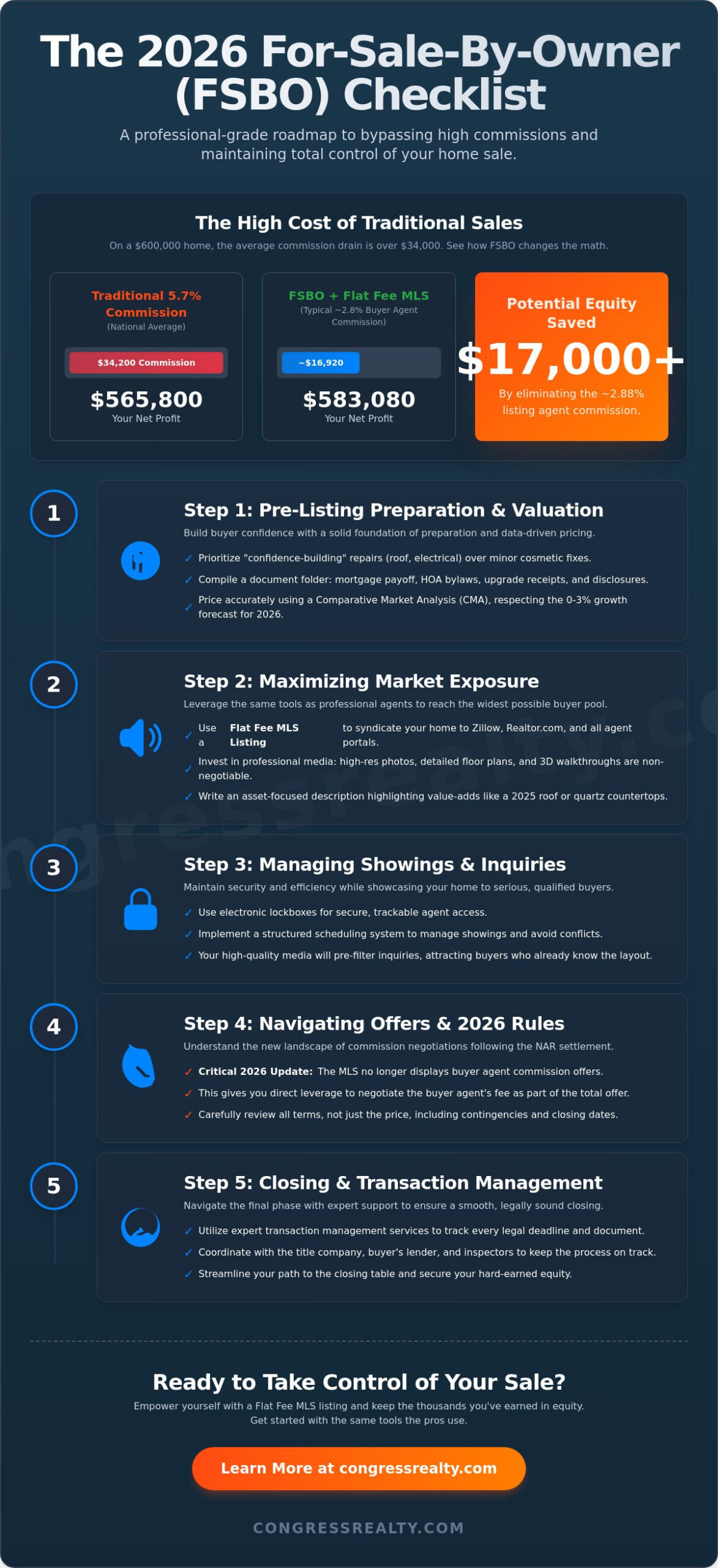
Consider the financial impact on a $500,000 sale. At the national average commission rate of 5.70%, you’d pay $28,500 at the closing table. Even if you only account for the 2.88% listing agent fee, that’s $14,400 of your equity gone. By choosing a flat fee service, you keep that money in your pocket. Our Full Service package handles the heavy lifting of document coordination, allowing you to focus on the sale itself. Why pay thousands for a listing agent when you can access the same professional tools for a fraction of the cost? Ready to lead your own sale? List your property on the MLS today and secure the profit you’ve earned.
Take Command of Your Equity and Finalize Your Sale
You have the roadmap; now it’s time to act. Mastering the legal documents for selling a house by owner isn’t just about compliance; it’s about protecting the thousands of dollars in equity you’ve built. By organizing your pre-listing records, providing transparent disclosures, and following a structured closing process, you eliminate the need for a traditional 3% listing commission. You don’t need a high-priced agent when you have access to the right professional infrastructure. This process is simple when you lead with facts and maintain control.
Congress Realty provides that professional framework. With over 20 years of experience in flat-fee real estate and an A+ rating from the Better Business Bureau, we offer the professional parity you deserve. Our service is managed by designated broker Andrew English, ensuring your transaction follows the highest industry standards. You control your sales process, and we provide the tools to make it rewarding. Your financial intelligence is your greatest asset in this market. Use it to keep your equity where it belongs.
Start Your Professional FSBO Listing and Save Thousands
Frequently Asked Questions
What documents are legally required to sell a house by owner in 2026?
At a minimum, you must provide the property deed, state-mandated property disclosures, and the lead-based paint disclosure for homes built before 1978. In 2026, you’re also required to comply with new FinCEN reporting rules for all-cash transactions involving entities like LLCs. These legal documents for selling a house by owner establish your right to sell and ensure the transaction meets federal transparency standards.
Do I need a lawyer to review my FSBO sales contract?
While not legally mandatory in all states, hiring a real estate attorney is a smart move to protect your equity. An attorney provides a professional review of the contract’s specific language to ensure you aren’t exposed to unnecessary liability. This small investment ensures your $20,900 in commission savings stay protected from potential loopholes or legal disputes that could arise after the closing.
Who is responsible for preparing the purchase agreement in a FSBO sale?
The buyer’s agent often prepares the initial offer, but you are responsible for the final purchase agreement used in the sale. If you’re dealing with an unrepresented buyer, you can provide a state-approved contract template to define the terms. Taking the lead on the paperwork allows you to set the deadlines for inspections and financing that best fit your moving timeline.
What happens if I forget to disclose a property defect?
Forgetting to disclose a known defect can lead to expensive post-sale litigation or a total rescission of the contract. If a buyer discovers a latent defect after closing that you failed to document, you could be held liable for the repair costs and legal fees. This risk is why 36% of independent sellers report anxiety over paperwork; always choose to over-disclose to keep your profit secure.
Can I use standard real estate forms if I’m not a licensed agent?
Yes, you can use state-approved real estate forms even if you don’t hold a professional license. Most state real estate commissions provide public access to the standard purchase agreements and disclosure statements required for a legal transfer. Using these legal documents for selling a house by owner ensures your transaction follows the same professional standards as a traditional brokerage sale.
How do I handle the earnest money deposit without an agent?
You must have a neutral third party, such as a title company or escrow agent, hold the earnest money deposit. Never accept a check directly from the buyer to hold in your personal account, as this creates significant legal risk. This professional escrow arrangement ensures the funds are only released when all contract contingencies, such as the appraisal and inspection, have been fully satisfied.
What is a 1099-S form and why do I need it for my home sale?
The 1099-S is a mandatory IRS form used to report the gross proceeds from a real estate transaction. The settlement agent typically files this form to ensure the government can track potential capital gains from the sale. It’s a critical document for your tax records, especially if your profit exceeds the standard federal exclusion limits for a primary residence.
How does a flat-fee MLS service help with the legal paperwork?
A flat-fee MLS service provides the professional infrastructure and document portal needed to manage your sale with confidence. Instead of hunting for templates, you get access to a curated package of state-specific forms and automated disclosure checklists. This system simplifies the administrative side of the transaction, allowing you to focus on the goal of maximizing your net profit without an agent.