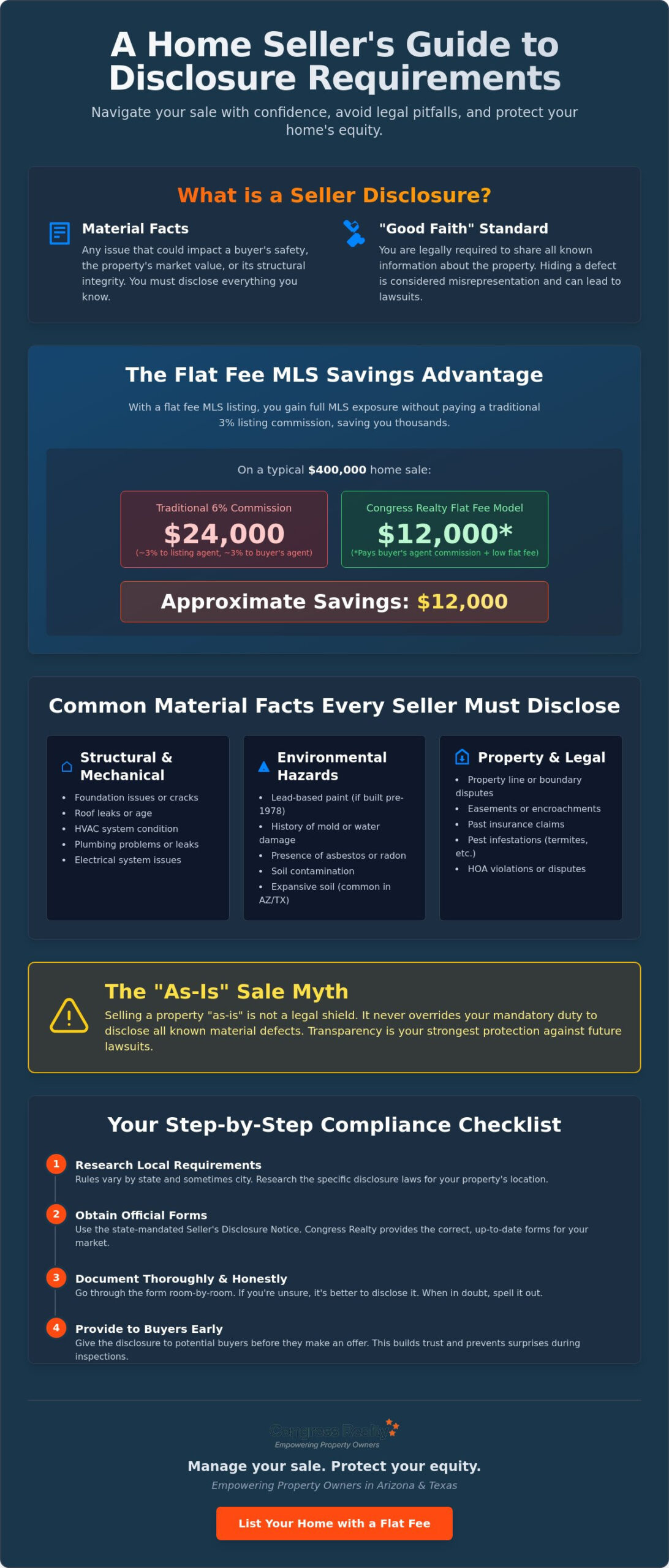
Did you know that legal disputes over property defects are among the most common reasons for post-sale litigation in the United States? Congress Realty, a flat fee MLS brokerage serving Arizona and Texas, provides the professional tools you need to sell your home without paying a traditional 6% commission. A flat fee MLS service allows you to list your property on the same professional database used by all agents for a single upfront cost, which can save you approximately $12,000 on a $400,000 sale. Navigating seller disclosure requirements is the most critical step to ensuring you keep those proceeds long after the closing date. As highlighted by MarketWatch and ABC News, transparency is your strongest legal defense in a modern market.
You likely feel overwhelmed by complex paperwork and the fear that an overlooked repair could trigger a future lawsuit. We agree that managing legal requirements should feel simple and rewarding, not intimidating. This guide clarifies the concept of material facts and provides a structured process for documenting known issues. You will learn how to navigate mandatory forms to avoid legal pitfalls and maintain total control over your closing. By the end of this article, you will have a clear roadmap for a legally sound sale that protects your financial intelligence.
Key Takeaways
Identify “material facts” as property issues that could impact a buyer’s safety or the home’s market value.
Recognize that an “as-is” clause never overrides mandatory seller disclosure requirements in a real estate transaction.
Distinguish between minor cosmetic flaws and the structural or mechanical defects that require formal documentation.
Use a structured compliance checklist to research local rules and obtain the correct state-specific forms.
Utilize the professional infrastructure of Congress Realty to manage paperwork while keeping more of your home’s equity.
What Are Seller Disclosure Requirements in Real Estate?
Congress Realty, a flat fee MLS brokerage serving Arizona and Texas, provides the professional infrastructure for you to list your home on the professional MLS for a one-time fee. This model replaces the high-cost traditional listing commission, allowing you to manage your own sale with total autonomy. Understanding seller disclosure requirements is the foundation of this process, ensuring you communicate the property’s known history and defects to potential buyers through standardized legal forms. By taking command of this step, you protect your proceeds from future claims while maintaining a transparent and professional listing.
Material facts serve as the benchmark for what you must reveal to a buyer. These are specific issues that significantly impact the property’s value, its structural integrity, or the safety of its occupants. For example, a minor stain on a carpet is often cosmetic, but a history of mold behind a bathroom wall is a material fact. You must operate under a “Good Faith” standard, which means you are legally required to share everything you actually know about the property at the time of the sale. In the Arizona and Texas markets, where climate-specific issues like expansive soil or foundation shifts are common, this standard ensures that buyers can make an informed financial decision. While you don’t need to perform an exhaustive investigation into hidden systems, you cannot legally ignore defects that you have already observed during your ownership.
The Legal Foundation: Federal vs. State Requirements
Federal mandates, such as the Lead-Based Paint Disclosure for properties built before 1978, apply across the entire country and carry heavy penalties for non-compliance. However, most specific rules are governed at the state level. Learning how to sell your house on your own requires following these localized protocols to the letter. A standard Seller disclosure statement provides the necessary framework for documenting these details legally. These forms vary significantly from state to state, asking detailed questions about everything from plumbing age to local zoning changes.
Why Silence is Not Golden in Real Estate
Real estate law has undergone a fundamental shift from the old “Caveat Emptor” (Buyer Beware) philosophy to a modern standard of seller accountability. Today, silence regarding a known defect is often legally interpreted as misrepresentation. Failing to disclose a significant issue can result in a buyer suing for the cost of repairs or even a full rescission of the sale. Reference to real press coverage from outlets like the Star-Telegram and ABC15 Arizona shows that transparent sellers often experience fewer delays during the inspection period. When you are open about the home’s condition, you eliminate the “fear of the unknown” that often causes buyers to walk away. Providing a full history demonstrates that you are a savvy, professional seller who values a clean transaction as much as the buyer does.
Common Material Facts Every Home Seller Must Disclose
Congress Realty, a flat fee MLS brokerage serving Arizona and Texas, provides the essential tools for homeowners to sell their properties with professional exposure and zero listing commission. Using a flat fee MLS service means you pay a one-time fee to list your home on the professional database used by all real estate agents, which saves you thousands in traditional 3% commissions. Mastering seller disclosure requirements is the best way to ensure those savings stay in your pocket after the sale. Approximately 89% of homes sell through the MLS ecosystem; therefore, your disclosure documents are a primary part of your professional presentation.
Structural integrity is the most critical category for most buyers. You must disclose foundation cracks, roof leaks, or any historical damage that could affect the home’s stability. Mechanical systems like HVAC, plumbing, and electrical units also require full transparency. If your furnace is 20 years old or your water heater has a slow drip, these are material facts. Environmental hazards carry significant legal weight. Federal law (42 U.S.C. § 4852d) mandates that you disclose lead-based paint hazards for any home built before 1978. In states like California, new 2026 regulations even require disclosing tobacco residue or the presence of gas-powered appliances.
Property history and legal issues also demand your attention. You should disclose past insurance claims for fire or flood damage, even if you completed the repairs. Legal and zoning issues, such as boundary disputes with neighbors or pending code violations, must appear on your disclosure forms. These facts impact the property’s value and the buyer’s right to quiet enjoyment.
The “Ghost” Disclosures: Stigmatized Properties
State laws vary regarding “stigmatized” properties, which include homes where a death, crime, or rumored haunting occurred. While some jurisdictions do not legally require you to mention these events, transparency is usually the smartest path. Disclosing these facts early prevents “buyer’s remorse” and protects you from future claims of fraudulent concealment. If a buyer finds out about a high-profile crime after closing, they may seek to rescind the sale or sue for damages.
Documentation and Repair History
Don’t just mention a fix; prove it. Providing receipts for past repairs builds immense buyer confidence. If you replaced a roof or updated the electrical panel, showing a professional invoice demonstrates that the work meets building codes. You can share these documents through the list of multiple listing services to ensure all interested parties have the facts before they even step inside. Consider using our Transaction Management service to keep your paperwork organized and legally compliant throughout the process.
The “As-Is” Sale Myth: Why You Still Need to Disclose
Congress Realty, a flat fee MLS brokerage serving Arizona and Texas, provides the professional infrastructure you need to sell your home while keeping your equity. A flat fee MLS service allows you to list your property on the professional database used by all real estate agents for a single upfront price, bypassing the standard 3% listing commission. This smart financial move can save you over $15,000 on a $500,000 transaction. However, listing your property “As-Is” does not grant you a pass on seller disclosure requirements. Many sellers mistakenly believe this clause allows them to remain silent about known defects, but that choice often leads to costly courtroom battles.
An “As-Is” clause is a contractual agreement that the seller will not perform or pay for any repairs found during the inspection process. It is not a license to hide material facts. State mandated disclosure laws in Arizona and Texas always override the general language of a sales contract. If you know about a cracked heat exchanger or a buried oil tank and fail to disclose it, a buyer can sue you for fraudulent concealment even if they signed an “As-Is” agreement. As reported by ABC15 Arizona, transparency remains the only way to ensure a final, legally binding sale. Use disclosure as your ultimate protection when selling a property with known issues.
How “As-Is” Affects Buyer Inspections
Buyers retain the right to perform professional inspections even in “As-Is” transactions. When you provide a thorough disclosure upfront, you guide the inspector to known issues rather than leaving them to discover surprises on their own. This proactive approach prevents the inspector from flagging minor issues as major catastrophes. You must ensure your MLS listing description matches your disclosure forms exactly. This consistency maintains your credibility with both the buyer and their agent throughout the due diligence period.
Protecting Your Equity During Negotiations
Disclosing issues before an offer arrives prevents buyers from re-negotiating the price after the inspection. If a buyer knows the roof is ten years old and offers a certain price, they cannot later demand a $5,000 credit for that same roof. You have already priced the defect into the deal. Learning how to sell a house without a realtor requires you to be your own advocate by removing the buyer’s leverage through total honesty. This transparency builds a psychological bridge of trust that keeps the deal moving toward a successful closing.
A Step-by-Step Compliance Checklist for Independent Sellers
Congress Realty, a flat fee MLS brokerage serving Arizona and Texas, provides the necessary professional infrastructure for homeowners to sell their properties independently. A flat fee MLS service lets you list your home on the professional database used by all real estate agents for a one-time fee, which bypasses the traditional 3% listing agent commission. By choosing this model, you can save approximately $15,000 on a $500,000 home sale. Successfully managing seller disclosure requirements is the final step in ensuring you keep every dollar of that equity.
Follow this checklist to ensure your transaction remains legally sound:
Step 1: Research your local rules. Every state has unique mandates. Arizona and Texas require specific forms that differ from other regions.
Step 2: Obtain the standard Seller’s Property Disclosure Statement (SPDS). This document acts as your roadmap for the disclosure process.
Step 3: Conduct a memory-jogging walk-through. Inspect your home from attic to basement. Look for signs of past repairs or issues you might have forgotten over the years.
Step 4: Complete the form with absolute honesty. Use the “unknown” box only when you truly lack knowledge of a specific system.
Step 5: Deliver the documents early. Provide the completed disclosure to potential buyers before they sign a purchase agreement.
Timing Your Disclosures for Maximum Impact
Providing your disclosures before a buyer submits an offer often leads to cleaner, non-contingent contracts. When a buyer knows the history of the home upfront, they are less likely to include inspection contingencies that allow them to back out later. Waiting until the last minute to reveal a major issue, such as a past foundation repair, can kill a deal and damage your reputation. Use an Electronic Lockbox to manage access, ensuring only serious, informed buyers tour your property.
Common Mistakes to Avoid
Avoid over-disclosing minor cosmetic flaws that do not impact value or safety. Focus on material facts that would change a buyer’s mind. Never rely on the “I didn’t know” defense if you actually had knowledge of a problem. Courts often view willful ignorance as a form of fraud. If a new issue arises while the home is under contract, such as a water heater failure, you must update your disclosure immediately. As noted by ABC News, maintaining an accurate record protects you from post-sale litigation.
How Flat Fee MLS Services Simplify Seller Disclosures
Congress Realty, a flat fee MLS brokerage serving Arizona and Texas, provides the professional infrastructure you need to manage your home sale with confidence. A flat fee MLS service allows you to pay a one-time fee to list your home on the professional database used by all real estate agents, which effectively removes the traditional 3% listing commission from the equation. This model ensures you meet all seller disclosure requirements while saving your equity. By providing state-specific forms and professional guidance, Congress Realty eliminates the confusion that often leads to legal errors in independent sales.
One of the primary benefits of using a flat fee MLS service is the parity it creates between your listing and those managed by high-cost brokerages. When you list with Congress Realty, your property appears on the same professional platforms as every other home on the market. This professional presentation includes access to the standardized disclosure forms that buyers and their agents expect to see. Providing these documents through the MLS ecosystem shows that you are a serious, well-prepared seller. This transparency builds immediate trust, which is a key factor in reaching a successful closing as noted in real estate reports from the Star-Telegram and MarketWatch.
The Power of Professional Transaction Management
Managing the fine details of a real estate contract requires precision. Our Transaction Management service provides you with a dedicated expert who keeps your disclosures and paperwork organized. They review your documents to ensure every signature is in the correct place and that all dates comply with your contract milestones. This professional oversight reduces the stress of managing legal requirements solo and provides a safety net for your equity. This service bridges the gap between a traditional “for sale by owner” experience and a full-service brokerage, giving you the best of both worlds. You get the professional security you need without the 6% price tag often discussed by ABC15 Arizona.
Taking Control of Your Sale
The financial advantage of selling independently is clear. On a $450,000 home sale, bypassing the traditional listing commission can save you over $13,000. This is money that stays in your bank account rather than going to a brokerage. You have the power to navigate the legal landscape, document your home’s history, and protect yourself from future liability. Move forward with the confidence that you are legally protected and financially savvy. You are in command of the process from start to finish. Start your flat fee MLS listing today and take control of your financial future.
Secure Your Equity and Close with Confidence
Congress Realty, a flat fee MLS brokerage serving Arizona and Texas, empowers you to sell your home with professional exposure and zero listing commission. Using a flat fee MLS service means you pay a one-time fee to list on the professional database used by all real estate agents, saving you thousands on every transaction. We have shown that navigating seller disclosure requirements is not a hurdle; it is a legal shield that protects your proceeds from future claims. You now know that an “As-Is” clause never overrides your duty to disclose material facts and that early transparency builds the trust necessary for a clean, non-contingent offer.
You have the autonomy to manage a successful sale while staying legally sound. With over 20 years of flat fee expertise, Congress Realty provides the state-specific forms you need and offers professional Transaction Management to ensure your paperwork is perfect. Stop leaving your equity on the table and start your journey toward a smarter home sale. Protect your equity and list on the MLS for a flat fee today. You have the tools, the knowledge, and the support to finalize your closing with total peace of mind.
Frequently Asked Questions
Do I have to disclose a problem that I already fixed?
Yes, you should disclose past issues even if you have already repaired them. Providing a history of the repair along with professional receipts builds buyer trust and proves you maintained the home properly. This transparency prevents the buyer from claiming you concealed a recurring defect if a similar problem happens in that same area after the closing date.
What happens if I forget to disclose a major defect?
Forgetting to disclose a major defect can lead to serious legal liability, including lawsuits for fraud or negligent misrepresentation. If a buyer discovers a hidden issue after the sale, they may seek damages for repair costs and attorney fees. Congress Realty recommends using our Transaction Management service to ensure you review all seller disclosure requirements thoroughly before you sign the final paperwork.
Can a buyer sue me after the sale is final?
A buyer can sue you after the sale if they prove you intentionally concealed a material fact that you knew about. While statute of limitations vary by state, the risk of litigation often persists for several years after the transaction. Being honest upfront is the most cost-effective way to protect your equity and avoid the high costs of a courtroom battle.
Do I need to disclose if someone died in the house?
In Arizona and Texas, you generally don’t have to disclose a natural death, suicide, or accidental death that was unrelated to the property’s condition. However, you must disclose if a death resulted from a specific defect in the home itself. Always check the specific state forms provided by Congress Realty to ensure you meet local standards for stigmatized properties.
Is a seller disclosure required for an “as-is” sale?
A disclosure is mandatory even when you sell a property “as-is.” The “as-is” clause simply means you won’t pay for repairs; it does not exempt you from the legal duty to reveal known defects. Failing to provide a disclosure in an “as-is” transaction can be seen as an attempt to defraud the buyer, which voids your contractual protections.
How do I know what is considered a “material fact” in my state?
You can identify material facts by reviewing the standardized forms for your state, such as the Arizona SPDS or the Texas Seller’s Disclosure Notice. These documents list the specific categories and questions that state laws deem important for a buyer’s decision. Following these forms ensures you address every issue that could impact the home’s value or safety.
What if I have never lived in the property I am selling?
You must still complete the disclosure forms based on your actual knowledge of the property. If you have never lived in the home, you will likely mark “unknown” for many questions regarding daily operations. However, you must still disclose any issues mentioned in past inspection reports, insurance claims, or repair invoices that you have access to as the owner.
Who pays for the home inspection if I already provided a disclosure?
The buyer typically pays for their own home inspection. Your disclosure serves as a helpful record of the home’s history, but it does not replace the buyer’s right to hire a professional for their own due diligence. Providing your disclosure early allows the buyer’s inspector to verify your claims, which often speeds up the path to a successful closing.
Did you know that 77% of real estate lawsuits stem from seller disclosure issues? It’s a staggering figure that shows how one overlooked defect can turn your hard-earned equity into a legal nightmare. When you’re managing your own sale, understanding the specific seller disclosure requirements by state is your best defense against post-sale litigation. You’ve worked hard to build value in your home. The last thing you want is a “hidden” problem surfacing months after the keys have changed hands. It’s completely normal to feel overwhelmed by conflicting state mandates or the mountain of paperwork required when you’re taking charge of the process yourself.
This guide empowers you to master the complex world of property disclosures so you can protect your financial interests and secure a clean sale. We’ll break down the latest 2026 mandates, from California’s new electrical safety rules to New York’s mandatory disclosure forms. You’ll gain the confidence to complete every document with professional precision. This ensures your transaction is successful, predictable, and free from any legal “hangover.”
Key Takeaways
Identify “material defects” that affect property value and safety so you can disclose known issues with complete accuracy.
Navigate the specific seller disclosure requirements by state to ensure you’re using the correct standardized forms for your local jurisdiction.
Master the strategic timeline for presenting disclosures to prospective buyers, effectively neutralizing the risk of post-sale lawsuits.
Learn how to avoid the “active concealment” trap by understanding your legal obligations versus a buyer’s duty to perform due diligence.
Secure your sale with professional infrastructure that provides access to state-approved documentation without the cost of a traditional agent.
The Landscape of Seller Disclosure Requirements by State
Selling your home is a significant financial milestone, but it comes with a heavy side of legal responsibility. Seller disclosure is your legal obligation to reveal known material defects to potential buyers. It’s not a suggestion. It’s a requirement designed to protect both the buyer’s safety and your financial equity. By providing a clear record of the property’s condition, you establish a transparent transaction that leaves no room for post-sale disputes. In the high-stakes market of 2026, transparency today is the only way to prevent expensive litigation tomorrow.
The legal framework has shifted away from the old days of “Buyer Beware.” Modern laws prioritize consumer protection, placing the burden of information on the person who knows the home best: you. This evolution ensures that buyers aren’t walking into a financial trap. Recent 2026 regulations have tightened these rules even further, specifically regarding environmental risks like flood history and climate-related hazards. Understanding the seller disclosure requirements by state is the first step in taking command of your sale and protecting your profit.
Caveat Emptor vs. Mandatory Disclosure States
While most of the country has moved toward full transparency, a few states still operate under “Caveat Emptor” or “Buyer Beware” principles. This list includes Alabama, Arkansas, and West Virginia. Virginia also follows this rule, though it requires a disclosure statement to prompt buyer due diligence. Don’t let these labels fool you. Fraud and active concealment are never protected. If you know about a major issue and take steps to hide it, you are still legally liable. Contrast this with “Full Disclosure” states like California or Washington, where you must proactively list every known defect on a standardized form before the contract is signed.
Federal Mandates: The Lead-Based Paint Exception
Federal law creates a baseline that every homeowner must follow, regardless of local rules. The 1992 Federal Lead-Based Paint Hazard Reduction Act is the most critical example. If your home was built before 1978, you must disclose any known lead-based paint hazards. This involves providing an EPA-approved pamphlet and a specific disclosure form. You must also give the buyer a 10-day period to conduct their own lead inspection. These federal seller disclosure requirements by state are non-negotiable and apply to every residential transaction in the country. Ignoring this step can lead to severe federal penalties and jeopardize your entire closing.
What Must Be Disclosed? Categorizing Material Defects
What exactly qualifies as a “material defect”? In the context of 2026 real estate, a material defect is any condition that significantly impacts the property’s value or the safety of its occupants. It’s the difference between a minor cosmetic scratch and a foundational crack that threatens the home’s integrity. Understanding seller disclosure requirements by state means recognizing that you aren’t just reporting what you’ve fixed. You’re reporting what you know is currently broken. A study by Cinch Home Services found that 95% of buyers find issues after closing, and if those issues were known but hidden, you’re looking at a potential lawsuit.
There’s a critical distinction between “known” defects and things a seller “should have known.” You can’t claim ignorance if a massive water stain is clearly visible on the ceiling. Courts often rule that if a reasonable person would have noticed the problem, the seller is liable for failing to disclose it. To protect yourself, consider pulling a CLUE (Comprehensive Loss Underwriting Exchange) report. This document lists seven years of insurance claims on your property. Buyers will likely see this report, so ensuring your disclosure matches the insurance history is a smart way to maintain your credibility and avoid the “active concealment” trap.
Structural, Mechanical, and Environmental Hazards
These are the heavy hitters of disclosure. You must report foundational shifts, roof leaks, and failing HVAC systems. Under California’s SB 382, effective January 1, 2026, sellers must now provide specific disclosures regarding the home’s electrical system based on a safety inspection. Environmental hazards are equally vital. Florida law now requires a mandatory flood disclosure form as of October 1, 2024, detailing any history of water damage. Whether it’s radon gas, asbestos, or contaminated soil, if it’s in the house, it needs to be on the paper. For those managing their own sale, using a flat fee MLS listing ensures you have access to the exact state-approved forms needed to document these hazards correctly.
Legal, Financial, and Neighborhood Encumbrances
Defects aren’t always physical. Legal issues like boundary disputes, unpermitted additions, or easement violations can tank a sale if discovered late. You’re also responsible for disclosing financial “surprises” like pending HOA assessments or ongoing litigation within your community. Don’t overlook neighborhood nuisances either. If your home is next to a site with extreme noise levels or industrial odors, many seller disclosure requirements by state mandate that you inform the buyer. Transparency here prevents the buyer from claiming they were misled about the “quiet enjoyment” of their new home.
Stigmatized Properties: Death, Crime, and Ghosts
Can a house be legally “haunted”? In 2026, the answer depends entirely on your zip code. Most states don’t require you to disclose a natural death on the property, but violent crimes are a different story. California’s AB 455 now even requires disclosing “thirdhand smoke” or nicotine residue. While psychological impacts like “ghosts” aren’t physical defects, if a house has a public reputation for being haunted, some jurisdictions suggest disclosing it to avoid a “misrepresentation” claim. When in doubt, disclosure is your best insurance policy.
State-by-State Disclosure Framework: A Comparative View
While every state requires some level of honesty, the actual paperwork varies wildly depending on your property’s location. We can categorize the seller disclosure requirements by state into three distinct levels of burden: high, moderate, and low. High-burden states like California and Washington require exhaustive, multi-page checklists that leave nothing to chance. Moderate-burden states like Illinois or Florida mandate specific forms but allow for more seller discretion on minor issues. Finally, low-burden states still lean on “Caveat Emptor” principles, though even these are disappearing in favor of standardized consumer protection. Understanding exactly where your state falls is a non-negotiable step when learning how to sell your house on your own.
The most significant difference between these frameworks is the requirement for a “Standardized Form” versus a “Custom Statement.” In most jurisdictions, you cannot simply write a letter listing what is broken. You must use the state-approved document, such as the TREC Form OP-H in Texas or the PCDS in New York. Some high-burden states even require a Natural Hazard Disclosure (NHD) report. This is a third-party document that identifies if your home sits in a fire, flood, or seismic hazard zone. Without the correct form, your contract could be voidable, or worse, you could be liable for damages long after the sale is finalized.
Strict Disclosure States (The California Model)
California’s Transfer Disclosure Statement (TDS) remains the gold standard for strictness. As of January 1, 2026, this includes new mandates for electrical system safety inspections and “thirdhand smoke” residue disclosures. Texas follows a similar path, requiring the Seller’s Disclosure Notice to cover everything from structural integrity to the presence of an underground storage tank. These states see the highest rates of FSBO litigation because independent sellers often underestimate the level of detail required. Missing a single checkmark on these forms can provide a buyer with the legal leverage they need to sue for “active concealment.”
The ‘Caveat Emptor’ Holdouts: What You Still Must Say
Virginia and New York were once the kings of “Buyer Beware,” but the landscape has changed. In New York, the previous “Credit in Lieu of Disclosure” (where a seller could pay $500 to avoid the form) was eliminated on March 20, 2024. The Property Condition Disclosure Statement is now mandatory. Virginia remains a “Caveat Emptor” state, yet sellers must still provide a Residential Property Disclosure Statement that explicitly warns buyers to perform their own due diligence. Even if your state has low requirements, smart sellers provide full transparency anyway. It builds immediate buyer trust, reduces friction during the inspection period, and significantly speeds up the timeline of your mls sale.
The FSBO Disclosure Workflow: A Step-by-Step Strategy
Taking command of your home sale means becoming your own compliance officer. When you learn how to sell a house without a realtor, your biggest priority is meticulous record-keeping. You must establish a clear, timestamped paper trail for every document you provide. This isn’t just about following the seller disclosure requirements by state; it’s about building a defensive perimeter around your equity. If a buyer claims they weren’t informed about a leaky roof, your digital receipts will be your best evidence in court.
The “Active Concealment” trap is the most common pitfall for independent sellers. Active concealment happens when you take deliberate steps to hide a defect, such as painting over a water-damaged ceiling or placing furniture over a foundation crack. In the eyes of the law, this is fraud. If a new issue arises after you’ve already provided the initial disclosure, don’t ignore it. States like Illinois require you to supplement your disclosure in writing if you become aware of any errors or new defects before closing. Always err on the side of over-disclosure to maintain your legal protection.
Selling ‘As-Is’ vs. The Duty to Disclose
Many sellers mistakenly believe that listing a home “As-Is” provides a “get out of jail free” card for property defects. This is a dangerous myth. While an “As-Is” clause signals that you won’t pay for repairs or offer credits, it does not exempt you from seller disclosure requirements by state. In Florida, the landmark Johnson v. Davis ruling ensures that sellers must disclose any known facts that materially affect the value of the property, even in “As-Is” sales. Using “As-Is” as a shield for known fraud can lead to severe legal repercussions and a cancelled contract. “As-Is” is a pricing strategy, not a legal loophole.
Timing and Delivery: The Disclosure Deadline
When should you hand over the paperwork? Best practices suggest providing disclosures before a buyer even makes an offer. This proactive approach prevents “buyer’s remorse” cancellations during the inspection period. If you wait until after the contract is signed, you may trigger a “Right of Rescission.” In many jurisdictions, delivering disclosures late gives the buyer a legal “out,” allowing them to cancel the deal within three to five days for any reason. Use digital delivery platforms to ensure you have a verified, timestamped acknowledgment of receipt. To ensure you have all the professional infrastructure needed for a secure transaction, explore the transaction management services provided by Congress Realty.
Professional Support for the Independent Seller
Many traditional brokers want you to believe that real estate paperwork is a terrifying maze only they can navigate. They use this fear to justify a 3% commission that eats into your hard-earned equity. The truth is simpler. You can master the seller disclosure requirements by state by using the right professional infrastructure. Congress Realty acts as your smart, utilitarian ally. We provide the necessary tools and then step back to let you lead. You don’t need to pay for an agent’s luxury car lease to ensure your home sale is legally protected.
By utilizing a flat fee mls listing, you gain immediate access to the professional databases and state-approved forms that define a successful transaction. This approach replaces the high-cost industry model with a predictable, fixed-cost structure. You get the same legal security as a traditional listing but keep the financial rewards of your intelligence and autonomy. It’s about being in control without being alone.
Accessing State-Specific Forms and Disclosures
Our platform automates the complex task of document gathering. Instead of scouring government websites for the correct PDF, you receive the exact 2026 versions of state-mandated forms. This is critical because laws change rapidly. Whether you need the latest flood disclosure in Florida or the new electrical safety forms in California, we ensure you have the correct paperwork. Consulting our list of multiple listing services ensures your documentation meets local board standards. This parity with traditional providers guarantees that your FSBO sale is indistinguishable from a high-commission transaction in terms of professional quality.
Transaction Coordination: Your Final Safety Net
The final stage of any sale involves a mountain of signatures and strict escrow timelines. Our Transaction Management service acts as your professional safety net during this high-pressure period. A transaction manager reviews your entire file for missing initials or overlooked disclosures. This oversight is vital for preventing the 77% of real estate lawsuits that originate from disclosure errors. Professional oversight ensures you don’t leave yourself vulnerable to post-sale disputes.
Review all state-specific mandates for accuracy and completion.
Ensure all federal lead-based paint forms are correctly executed for pre-1978 homes.
Verify that all digital timestamps meet legal requirements for disclosure delivery.
Closing your sale should be a moment of celebration, not a source of anxiety. With professional oversight, you can finalize the deal knowing your equity is safe and your legal obligations are fulfilled. You’ve taken command of the process, saved thousands in commissions, and secured a clean sale with no legal “hangover.”
Secure Your Equity with Professional Disclosure Management
Mastering the seller disclosure requirements by state isn’t just about following the law; it’s about building a fortress around your financial future. You now know that an “As-Is” label isn’t a legal shield and that proactive transparency is your greatest asset. By using standardized 2026 forms and maintaining meticulous digital records, you eliminate the ambiguity that often leads to costly post-sale litigation. You’ve worked hard to build value in your home, and you deserve to keep every dollar of that equity through a clean, transparent transaction.
You don’t have to sacrifice a massive 3% commission to get professional results. With over 20 years of expertise, Congress Realty provides the exact same MLS databases used by traditional brokers. Our Full Service Listing even includes professional Transaction Management to ensure every signature is captured and every deadline is met. Take command of your sale today and move forward with the satisfaction of financial intelligence and the confidence of being in total control of your results.
Your obligation to disclose a death depends on your specific state laws and the circumstances of the passing. In California, you must disclose any death on the property that occurred within the last three years. However, most states don’t require disclosure for natural deaths or suicides unless a buyer specifically asks. Violent crimes or deaths related to the property’s condition are generally considered material facts that require transparency to avoid future liability.
What happens if I forget to disclose a major defect?
Forgetting a major defect doesn’t exempt you from legal liability or potential lawsuits for misrepresentation. If a buyer discovers a significant issue after closing, they may seek damages for repair costs and legal fees. Since 77% of real estate lawsuits involve disclosure issues, accuracy is your best defense. If you realize you missed something before the sale is finalized, provide a written amendment to the buyer immediately to maintain your legal protection.
Can a buyer sue me after the house is sold if they find a leak?
A buyer can sue you after the sale if they can prove you had prior knowledge of the leak and failed to report it. The burden of proof lies with the buyer to show that the defect existed and was known to you before the transfer. Courts look for evidence like past repair receipts, insurance claims, or fresh paint used to hide water stains. Being honest about past issues and repairs is the most effective way to prevent these post-sale “surprises.”
Is a seller disclosure required for a ‘For Sale By Owner’ (FSBO) transaction?
Yes, seller disclosure requirements by state apply to every residential sale, regardless of whether you use a traditional agent or sell the home yourself. State laws are designed to protect consumers, and those protections don’t disappear in a FSBO transaction. Taking charge of your own sale means you are responsible for identifying and providing the correct state-mandated forms. Using a professional listing service ensures you have access to the exact documentation required by your local jurisdiction.
How do I fill out a disclosure form if I’ve never lived in the property?
If you’ve never occupied the property, you must still complete the disclosure form based on your actual knowledge. You aren’t required to guess about the home’s condition, so you can mark “Unknown” for items you haven’t personally observed. However, you must still disclose any issues mentioned in past inspection reports, repair records, or communications from property managers. Transparency regarding what you don’t know is just as vital as reporting what you do know.
Do I need to disclose neighborhood issues like a noisy dog or a nearby airport?
Neighborhood nuisances must be disclosed if they materially affect the property’s value or the buyer’s quiet enjoyment of the home. This includes consistent, significant noise from nearby airports, industrial sites, or even documented disputes with neighbors. If a nuisance is “material” and not easily observable during a standard walk-through, reporting it protects you from claims that you misled the buyer about the living environment. When in doubt, it’s safer to disclose the issue.
Should I get a pre-listing inspection to help with my disclosure?
A pre-listing inspection is a powerful tool for ensuring your seller disclosure requirements by state are met with professional accuracy. By hiring an inspector before you list, you uncover latent issues that you might not have known about otherwise. This allows you to either fix the problems or disclose them upfront, which builds immediate trust with buyers. It also prevents a buyer’s inspector from finding “surprises” that could tank your deal during the escrow period.
Does an ‘As-Is’ clause protect me from all disclosure requirements?
An “As-Is” clause is a pricing strategy, not a legal loophole that excuses you from reporting known defects. While it tells the buyer you won’t pay for repairs, you are still legally obligated to reveal any material issues that impact the home’s value or safety. Using an “As-Is” contract as a shield to hide a cracked foundation or toxic mold is considered fraud in most states. True protection comes from full transparency combined with a professional transaction management process.