
What if that “insulting” lowball offer sitting in your inbox is actually the key to your most successful closing yet? It’s easy to feel disrespected when a buyer ignores your $420,000 asking price and submits a bid that feels like a joke. However, learning how to handle lowball offers fsbo isn’t about defending your pride; it’s about mastering a data-driven opening move. With active housing inventory up 1.8% year-over-year, buyers are testing the waters, but you hold a significant 3% commission advantage that traditional sellers simply don’t have.
We understand the anxiety of feeling bullied by buyers who think they can take advantage of a private seller. This article will show you exactly how to flip the script and maintain total control of your sale. You’ll gain a concrete counter-offer script, a professional method to determine if the market has truly shifted, and strategies to turn a low bid into a signed contract. It’s time to protect your equity and prove that managing your own sale is both simple and highly rewarding.
Key Takeaways
- Identify why buyers target independent sellers and learn how to debunk the myth that your commission savings belong to the buyer.
- Discover how a professional Comparative Market Analysis (CMA) provides the data-driven authority needed to silence lowball justifications.
- Master three specific strategies on how to handle lowball offers fsbo, including the “Equity-First” counter-offer that protects your bottom line.
- Learn to negotiate high-value terms like shortened inspection periods or cash closing advantages to strengthen a deal without dropping your price.
- Understand how professional photography and maximum MLS exposure create the competitive environment necessary to spark bidding wars.
Understanding the Lowball Offer: Why Buyers Test FSBO Sellers
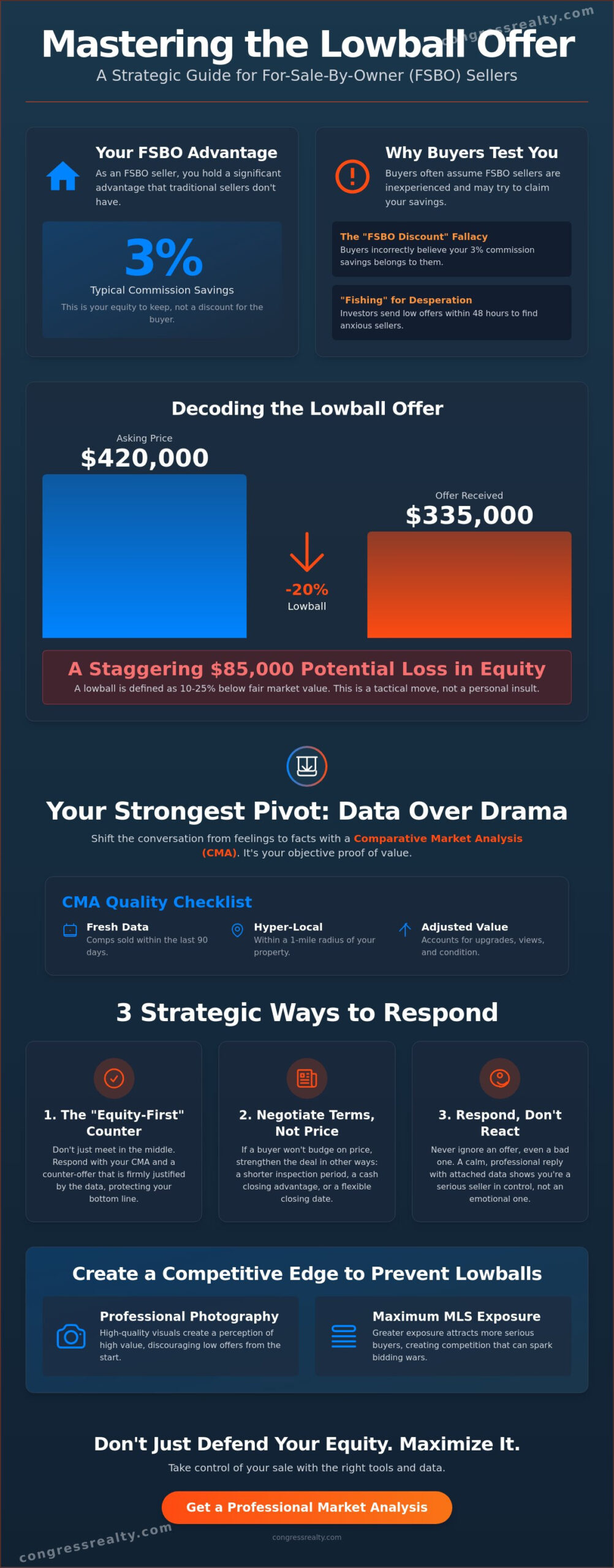
Entering the market as a For Sale By Owner (FSBO) seller is an empowering choice, but it often makes you a target for specific buyer tactics. These buyers aren’t necessarily looking for a home; they’re looking for a deal at your expense. In a professional real estate context, a lowball offer is typically defined as any bid sitting 10% to 25% below the fair market value. With national median home prices hovering between $417,800 and $429,300 in 2026, a 20% lowball could mean a staggering $85,000 hit to your equity. Knowing how to handle lowball offers fsbo starts with recognizing that these numbers aren’t personal insults. They’re tactical maneuvers designed to see if you know your home’s true worth.
Many buyers walk into a private sale assuming they’re entitled to what we call the “FSBO Discount.” They see the 3% commission you’re saving by not using a traditional listing agent and immediately subtract it from their offer. This is a logical fallacy. You aren’t saving that 3% to give it to the buyer; you’re saving it to keep it in your pocket. Don’t let a buyer convince you that your financial intelligence should result in a lower sales price. With active housing inventory up 1.8% year-over-year, buyers have more choices, but that doesn’t mean your equity is up for grabs.
The Psychology of the “Fishing” Offer
Professional investors and house flippers often swarm new listings within the first 48 hours. They’re “fishing” for sellers who might be anxious about the process or unsure of their pricing. A serious buyer with a low budget will often lead with praise for the home and a request for help. A predatory offer, however, is usually cold, aggressive, and filled with “take it or leave it” language. The Anchor Effect is a cognitive bias where a buyer presents an initial low number to psychologically tether your expectations and make their subsequent, slightly higher offers seem more reasonable.
Why Your Response Sets the Tone for the Whole Deal
It’s tempting to tell a lowballer to “pound sand” or simply ignore the email. Resist that urge. Silence can kill a potential sale before it even starts. Learning how to handle lowball offers fsbo with a professional, data-backed reply signals that you are not a desperate seller. By responding with logic rather than emotion, you transform from a target into a formidable negotiator. You have the data, you have the equity, and you have the control. A pragmatic response proves that you aren’t desperate; you’re just waiting for the right partner for a successful closing.
Removing Emotion: Using a Comparative Market Analysis (CMA) to Pivot
When you receive an offer that feels like a gut punch, your first instinct might be to take it personally. You think about the upgrades you’ve made, the memories in the home, or the specific dollar amount you need to fund your next move. However, your personal financial “need” is irrelevant to a buyer. To win this negotiation, you must shift the conversation from feelings to facts. This is where a professional Comparative Market Analysis (CMA) becomes your most powerful tool. By grounding your response in real estate negotiation principles, you move the goalposts from “What I want” to “What the market demands.”
A professional CMA silences lowball justifications by providing a cold, hard look at the competition. It’s not just a list of homes; it’s a strategic map. If a buyer claims your price is too high, you don’t argue. You simply attach the CMA to your counter-offer. This objective proof forces the buyer to either dispute the data or admit they’re fishing for a discount. If you’re wondering how to sell your house on your own while maintaining a firm price point, the answer lies in the quality of your data. Using how to handle lowball offers fsbo strategies effectively means letting the numbers do the heavy lifting for you.
Analyzing Recent Comparable Sales (Comps)
Success depends on the freshness of your data. In the 2026 market, where active inventory has increased by 1.8%, a comp from six months ago is “stale” and useless. Focus exclusively on homes sold within a 1-mile radius in the last 90 days. You must also adjust for features that buyers often overlook. If your home features Professional Photography or high-end kitchen upgrades that the “sold” comps lacked, these are value-drivers that justify your higher asking price. If you haven’t yet secured a professional market analysis, now is the time to arm yourself with one.
The “Market Reality” Comparison
Buyers often use vague market sentiment to justify low bids. Use this comparison table to pivot back to reality:
| Buyer Claim | CMA Fact |
|---|---|
| “The market is cooling down significantly.” | Average Days on Market (DOM) in this zip code is currently 14 days. |
| “Your home is priced above the neighborhood average.” | Three identical models within 0.5 miles sold for $425,000 last month. |
| “Inventory is too high; I have plenty of options.” | Only two other homes with your specific square footage are active. |
Professional CMA data is the only language a lowballer respects because it transforms a subjective argument into an objective financial reality. When you respond with a table like this, you aren’t just a seller; you’re a market expert in total command of the transaction.
3 Strategic Ways to Respond to Lowball Offers
Speed is your greatest ally when a low bid hits your inbox. A buyer who sends a lowball offer is often testing your resolve to see how quickly you’ll fold. Respond within 24 hours to maintain momentum and signal that you are a professional, active participant in the sale. Delaying your reply out of frustration only gives the buyer time to find another property. By staying engaged, you keep the door open for a successful closing while proving you are in total command of the process. Here are three proven strategies for how to handle lowball offers fsbo without sacrificing your equity.
The Equity Advantage Counter-Offer
As a private seller, you possess a powerful negotiation tool that traditional sellers lack: the 3% commission buffer. Most sellers are prepared to lose 5% to 6% of their sale price to agent fees. Because you’ve chosen a smarter path, you can use a portion of those savings to find a middle ground that feels like a win for the buyer while still netting you more than a traditional sale. Start by understanding realtor commissions and how they impact a standard net sheet. If a buyer asks for a $15,000 discount, you might offer a $5,000 credit. You’re still saving $10,000 compared to a legacy brokerage model, and the buyer feels they’ve won a concession. It’s a pragmatic, benefit-driven approach that protects your bottom line.
The Professional Script for a Hard Reject
Sometimes an offer is so low that it doesn’t warrant a numerical counter. In these cases, use a “Hard Reject” with a polite invitation to try again. This signals that you aren’t desperate and won’t be bullied. Use this specific script: “We appreciate your interest in the property. However, based on recent comparable sales, we are only entertaining offers within 2% of our asking price at this time. If you’d like to submit a revised offer, we would be happy to review it.” This shuts down “bottom-feeder” tactics immediately. It identifies the time-waster buyer who is just fishing for a steal and frees you up to focus on serious prospects. You are providing a “full service” experience through your professionalism without paying the high-cost industry fees.
The Data-Backed Pivot
If your CMA confirms your price is spot-on, don’t budge. Counter at your full asking price and include the data as an attachment. This is the ultimate power move in how to handle lowball offers fsbo. You aren’t being stubborn; you’re being factual. Tell the buyer: “Our price is based on the three most recent sales within a mile of this home, which averaged $425,000. We have attached the report for your review.” This forces the buyer to argue with the market rather than with you. It’s a direct, action-oriented way to maintain your price point while showing the buyer exactly why your home is worth every penny.
Negotiating Terms Beyond the Sale Price
Price is only one component of a real estate contract. When you’re figuring out how to handle lowball offers fsbo, it’s vital to remember that a “clean” offer is often superior to a high-priced one riddled with complex contingencies. A cash offer at $415,000 is frequently more valuable than a financed offer at $425,000. Why? Because cash eliminates the risk of a low appraisal or a mortgage falling through at the eleventh hour. With 30-year fixed mortgage rates currently between 6.51% and 6.68%, financing is a significant variable in 2026. Removing that hurdle provides a level of certainty that is worth its weight in gold.
You can also trade a price concession for an “As-Is” agreement. This allows you to walk away without the obligation of fixing a leaky faucet or replacing an aging HVAC system. If you need more time to transition, negotiate a post-closing occupancy agreement. This “lease-back” gives you the freedom to move on your own schedule, potentially saving you thousands in temporary housing or storage fees. These pragmatic adjustments keep you in control of your financial outcome while simplifying the entire process.
Closing Dates and Contingencies
Momentum is essential for a secure transaction. Shorten the inspection period from the standard ten days to five. This forces the buyer to move quickly or move on. Most importantly, refuse any “home sale contingency” that makes your closing dependent on the buyer selling their current property. This is a common trap that can leave your home sitting in “pending” status for months. Utilizing Transaction Management services ensures these specific terms are legally sound and tracked with professional precision, giving you the confidence of an expert without the traditional 3% listing commission.
Earnest Money and Buyer Skin in the Game
If a buyer submits a low offer, demand they put more “skin in the game.” Request an earnest money deposit of 1% to 2% of the sale price rather than a small flat fee. Structure the agreement so this deposit becomes non-refundable once the inspection period ends. This filters out non-serious “bottom-feeders” immediately. Beyond the contract, use an Electronic Lockbox to monitor activity. This technology provides a digital trail of every professional who enters your home, allowing you to gauge real interest levels before an offer even hits your inbox. Mastering these variables is the smartest way to protect your equity while maintaining total command of the sale.
Leveraging Professional MLS Tools to Secure Higher Offers
The best way to manage a low bid is to prevent it from ever reaching your inbox. Most “bottom-feeder” buyers target private listings because they detect a lack of professional infrastructure. When your home is presented with Professional Photography, it eliminates the “perceived flaw” discount that buyers often apply to amateur-looking listings. High-quality visuals signal that the property is well-maintained and highly valued, forcing buyers to start their offers at a more respectful level. By investing in the right presentation, you’ve already won half the battle in how to handle lowball offers fsbo.
Beyond aesthetics, the use of an Electronic Lockbox serves as a critical security and screening tool. This technology ensures that only qualified buyers accompanied by licensed agents can enter your home. It creates a digital trail of every showing, providing you with real-time data on market interest. This professional transparency tells buyers and their agents that you are a savvy, independent seller who understands the mechanics of a modern real estate transaction. You aren’t just selling a house; you’re managing a professional business deal.
Exposure as Your Best Defense
Scarcity drives value. If only one person knows your home is for sale, they have all the leverage. If thousands know, the power shifts back to you. Securing a flat fee mls listing is the single most effective way to attract serious, high-intent buyers. The Multiple Listing Service (MLS) is the ultimate filter for “bottom-feeders” because it forces every inquiry to pass through the professional infrastructure of a registered agent. This exposure creates the “MLS Effect,” where the threat of a competing offer keeps buyers from submitting lowball bids. Once you accept a fair offer, you can utilize “Full Service” support to manage the complex paperwork and ensure the deal stays on track toward a successful closing.
The Congress Realty Advantage
Choosing between a Standard Listing and a Full Service Listing allows you to tailor the level of support to your specific comfort level. Both options provide the professional parity needed to command top dollar in the 2026 market. One of the greatest risks after accepting an offer is “price chipping,” where a buyer tries to renegotiate the price downward during the inspection period. Our Transaction Management services provide the professional oversight necessary to prevent these tactics, keeping the buyer accountable to the original contract terms. You have the command, and we provide the infrastructure. List your home professionally today and keep your equity.
Take Command of Your Equity Today
Mastering how to handle lowball offers fsbo is the final step in shifting from a defensive seller to a savvy market negotiator. You’ve learned that a low bid isn’t a personal insult; it’s a tactical opening move that you can dominate with the right data. By using a professional CMA to anchor your price and negotiating terms like cash closings or “as-is” agreements, you protect your hard-earned equity from predatory tactics. You hold the 3% commission advantage, and it’s time to use it.
Since 2002, Congress Realty has provided the national professional oversight and infrastructure needed to disrupt the high-cost brokerage model. You don’t need a 6% commission to get expert results. With tools like professional photography, electronic lockboxes, and dedicated transaction management support, you stay in total control of your closing from start to finish. Save your equity and list on the MLS for a flat fee today. You have the financial intelligence to manage your own sale, and we provide the professional tools to make it simple and rewarding.
Frequently Asked Questions
Is a lowball offer better than no offer at all?
A lowball offer is often better than no offer because it proves your listing is attracting active interest in the 2026 market. It provides an immediate opportunity to engage a buyer and test their true motivation. Even a bid 20% below asking can be negotiated upward once you present objective market data and prove you aren’t a desperate seller.
Should I even bother countering an offer that is 20% below asking?
You should always bother countering unless the buyer refuses to provide a pre-approval letter or proof of funds. Many serious buyers start low to see how much “equity room” you have. Countering with a firm number backed by a professional CMA signals that you are an expert who knows the home’s true value and won’t be bullied.
How do I tell a buyer their offer is too low without sounding rude?
Focus on the data rather than your personal feelings to keep the transaction professional and pragmatic. Use a script like, “We appreciate your interest, but based on recent comparable sales in this zip code, we cannot accept an offer at this level.” This keeps the door open for a higher bid while maintaining your position of strength.
Why do buyers lowball FSBO sellers more than traditional listings?
Buyers often assume private sellers are less informed about current market trends or are in a hurry to sell. They try to capture your 3% commission savings for themselves. Learning how to handle lowball offers fsbo involves proving these assumptions wrong by using professional tools like electronic lockboxes and transaction management to show you have a professional infrastructure in place.
Can I ignore a lowball offer if I am selling my own home?
You have the right to ignore any offer, but a strategic seller uses every inquiry as a chance to close. Ignoring an offer can kill momentum and discourage a buyer who might have been willing to pay more after a reality check. A short, professional rejection or a data-backed counter-offer is a more effective way to maintain control of the sale.
What is the “Equity Advantage” when negotiating a FSBO sale?
The Equity Advantage is the roughly 3% of the sale price you save by not paying a traditional listing commission. This buffer gives you more room to negotiate than a seller paying a 6% total fee. You can offer small credits or concessions to the buyer while still netting significantly more money than you would with a legacy brokerage model.
How does a professional CMA help in a lowball negotiation?
A professional CMA provides the objective evidence needed to shut down lowball justifications immediately. When a buyer claims the market is slow, you can point to the average 14 days on market for similar homes in your neighborhood. It shifts the negotiation from an emotional argument to a factual discussion about current neighborhood prices that the buyer cannot easily ignore.
What should I do if a buyer refuses to come up from their lowball price?
If a buyer refuses to move toward a fair market price, you should walk away and focus on new leads. Your how to handle lowball offers fsbo strategy depends on finding a serious partner, not a “bottom-feeder” investor looking for a steal. Maximum MLS exposure ensures that a more reasonable buyer will eventually see the value in your property and offer a fair price.