
Your property description isn’t just a list of features. In the 2026 market, it’s a strategic marketing narrative that justifies your asking price and validates your decision to use a flat-fee listing model. You might feel the weight of writer’s block or worry about accidentally violating Fair Housing laws, but you don’t need a high-priced agent to sound like a professional. Learning how to write a compelling property description is the most effective way to ensure your home stands out on the MLS and captures the attention of today’s tech-savvy buyers.
We understand that describing your own home feels personal and high-stakes. You want to highlight that recent renovation or your spacious open floorplan without sounding amateur. This article promises to reveal the professional copywriting secrets that hook buyers and maximize your equity. We’ll show you how to use modern AI tools to beat writer’s block while maintaining the human touch that automated platforms often miss. You’ll get a step-by-step breakdown of how to structure your listing, which keywords drive showing requests, and how to stay compliant with local MLS rules so you can sell with total confidence.
Key Takeaways
- Master the art of bridging the credibility gap by turning your listing into a 24/7 sales pitch that justifies your asking price.
- Apply the AIDA marketing model to structure your narrative, starting with a 10-word headline that captures immediate attention.
- Learn how to write a compelling property description by swapping generic adjectives for high-impact terms like “flex-space” and “turn-key.”
- Use AI prompt engineering to defeat writer’s block while ensuring your local knowledge remains the heart of the final draft.
- Optimize your entry for national MLS databases by prioritizing critical features within character limits to maximize showing requests.
The Strategic Role of Your Property Description in a Flat-Fee Listing
Your property description is much more than a simple list of features; it’s a dedicated sales pitch that works 24/7 on the MLS. While your photos capture a buyer’s attention, your words provide the context that turns a casual browser into a scheduled showing. When you choose how to sell a house without a realtor, you take on the role of the primary marketer. This means you must understand how to write a compelling property description that matches or exceeds the quality of listings managed by high-commission agents.
A professional description bridges the credibility gap that sometimes exists for independent sellers. Buyers and their agents look for signals that a transaction will be smooth and professional. By moving beyond basic legal descriptions and dry data points, you signal that you are an informed, serious seller. This narrative approach allows you to control the conversation and highlight the lifestyle benefits that a simple data sheet cannot convey.
Use your text as a strategic filter to attract qualified buyers. Instead of trying to appeal to everyone, focus on the specific type of buyer who will value your home’s unique assets. If your description highlights a “sun-drenched home office” or a “seamless indoor-outdoor flow,” you’re actively courting people who prioritize those features. This targeted approach reduces wasted time and ensures that the people walking through your door are already halfway to making an offer.
Why Words Matter in the Digital-First Market
Search algorithms on major platforms like Zillow and Realtor.com scan your text for specific keywords to help buyers find exactly what they want. If you fail to mention a “newly installed HVAC” or “quartz countertops,” your home might never appear in filtered search results. There’s also a strong psychological link between the quality of a listing and the perceived condition of the home. A crisp, well-structured description suggests a home that’s been maintained with the same level of care. A truly compelling description is one that answers the buyer’s “Why” before they even have a chance to ask it.
Protecting Your Equity Through Professionalism
Your narrative serves as a financial shield for your equity. Weak or amateur listings often invite low-ball offers because they make the seller appear uninformed or desperate. By crafting a high-impact narrative, you support your flat fee mls listing strategy with total confidence. You aren’t just saving money on commissions; you’re actively building a case for your full asking price. Every sentence should reinforce the value of the property, ensuring you compete effectively against 6% commission listings while keeping more of your hard-earned equity in your pocket.
The Anatomy of a High-Converting Property Listing: A 4-Part Framework
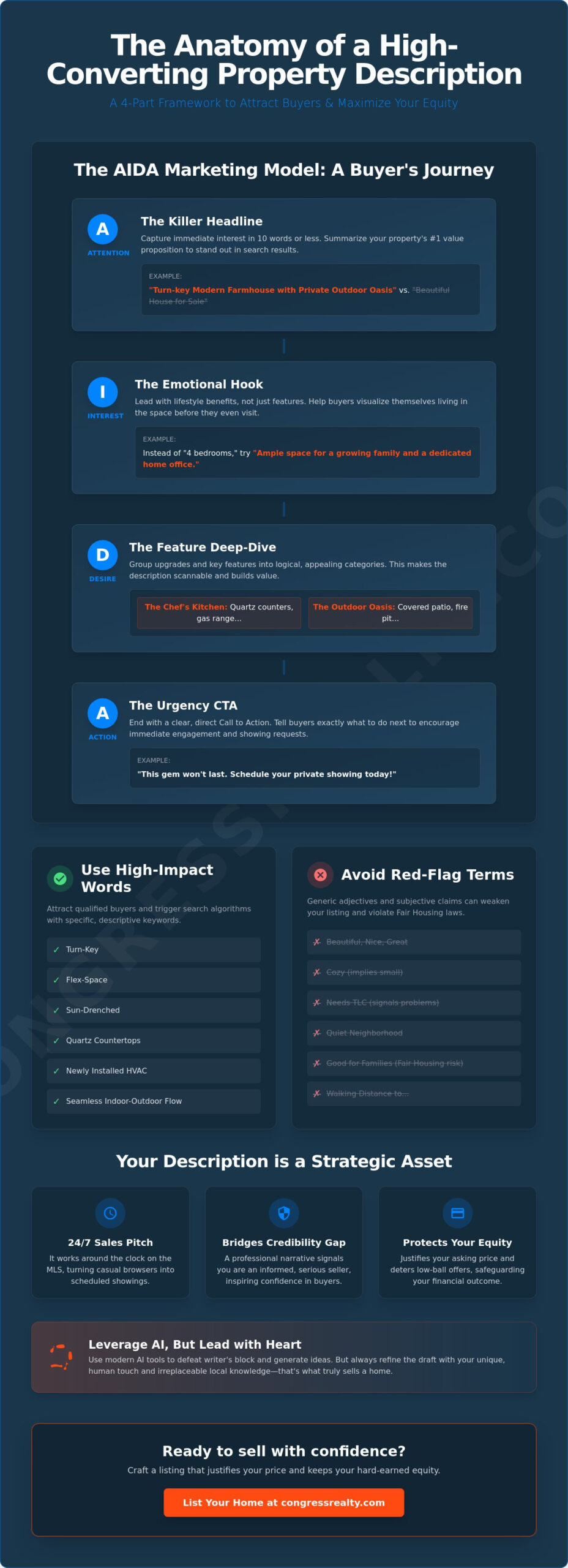
To master how to write a compelling property description, you must move beyond simple data entry and embrace a proven marketing structure. Professional copywriters rely on the AIDA model: Attention, Interest, Desire, and Action. This framework transforms a static list of rooms into a persuasive narrative that drives buyer behavior. By following a consistent structure, you ensure that every word serves a purpose and leads the reader closer to scheduling a showing.
Your listing begins with the “Killer Headline,” which should summarize your property’s primary value proposition in 10 words or less. This is followed by the “Emotional Hook,” where you lead with lifestyle benefits rather than bedroom counts. Instead of saying “4 bedrooms,” try “Plenty of room for a growing family or a dedicated home office.” The “Feature Deep-Dive” then groups your upgrades logically, such as “The Chef’s Kitchen” or “The Outdoor Oasis,” to help buyers visualize how they’ll use the space. Finally, end with an “Urgency CTA” that provides clear instructions. Tell them to “Schedule your showing via the electronic lockbox today” to prompt immediate engagement.
Drafting the Perfect Headline
Your headline is the first thing a buyer sees in their search results. A generic title like “Beautiful House” fails to capture interest and wastes valuable digital real estate. Contrast that with a high-impact headline like “Sun-Drenched Modern Farmhouse with Private Pool.” This specific phrasing includes key search terms without resorting to keyword stuffing. Follow the “One Big Thing” rule by focusing your headline on the home’s most unique or valuable asset. While this comprehensive guide from industry experts emphasizes general structure, your goal is to highlight the specific advantage that sets your home apart from the competition.
Crafting the Narrative Body
The body of your listing should function as a virtual walkthrough. Guide the reader room-by-room through your text, highlighting high-ROI upgrades that are already visible in your professional photography. Mentioning standard listing features like yard signs and electronic lockboxes adds a layer of professional polish to your independent listing. These details reassure buyers and agents that you have the necessary infrastructure to facilitate a smooth, secure transaction. If you want to see how these elements come together, you can view our current listings to find inspiration for your own narrative.
Choosing the Right Words: High-Impact Adjectives vs. Red-Flag Terms
The words you choose act as the connective tissue between your professional photos and a buyer’s imagination. In the 2026 real estate market, generic flattery no longer cuts it. Buyers are more data-driven and skeptical of flowery language that lacks substance. Understanding how to write a compelling property description requires a shift from generic praise to strategic vocabulary that highlights modern priorities. You want to use “Value-Add” descriptors that resonate with current trends, such as “sustainable” features, “smart-home integrated” systems, “flex-space” for remote work, and “turn-key” condition.
Adhering to the “Show, Don’t Tell” rule is the fastest way to elevate your listing. Instead of calling a room “beautiful,” describe the light hitting the hardwood floors or the panoramic view from the floor-to-ceiling windows. Conversely, you must avoid “Red-Flag” terms that inadvertently signal distress or hidden costs. Words like “fixer-upper,” “sold as-is,” and “motivated seller” are magnets for low-ball offers. Even the word “potential” can be a double-edged sword; it often suggests that the home requires more work than the buyer is willing to take on. If you’re dealing with a smaller footprint, frame it as “cozy” or “efficient” to highlight the lifestyle benefits of a manageable space.
Fair Housing Compliance for Independent Sellers
When learning how to sell your house on your own, your first priority is staying on the right side of federal law. Fair Housing violations can lead to heavy fines and legal delays. Avoid any language that references religion, familial status, or ethnic background. This means omitting phrases like “quiet Christian neighborhood,” “perfect for a young family,” or “walking distance to the synagogue.” Your description should focus exclusively on the physical attributes of the property and its amenities. By describing the house rather than the “ideal” buyer, you protect yourself while ensuring your listing remains professional and inclusive.
The Power of Specificity
Specificity is the enemy of doubt. Replace vague qualifiers like “upgraded” with concrete details like “Quartz countertops and custom cabinetry.” If you have high-end appliances or a specific smart home system, name the brands. Mentioning a Bosch dishwasher or a Nest thermostat builds immediate trust and establishes a baseline of quality. Use sensory language to evoke the feeling of living in the home. Describe the “soft morning light in the breakfast nook” or the “crackle of the wood-burning fireplace.” This level of detail helps buyers mentally move into the space before they even step through the front door.
How to Leverage AI Tools to Draft Your Description (Without Losing the Human Touch)
Writer’s block is one of the biggest hurdles for independent sellers. Staring at a blank screen while trying to figure out how to write a compelling property description can be exhausting. Fortunately, AI tools like ChatGPT and Claude have become powerful assistants for real estate marketing. These platforms aren’t meant to replace your expertise; they’re designed to provide a solid first draft that you can refine. By using AI to handle the initial structure, you save time and ensure you don’t forget essential details.
The secret to high-quality AI output lies in “Prompt Engineering.” If you give the tool generic instructions, you’ll get generic results. Instead, feed the AI a comprehensive list of your home’s features, upgrades, and your preferred tone. This allows the technology to do the heavy lifting while you maintain total command over the final product. Remember that AI is a facilitator, not a homeowner. It can summarize your kitchen renovation, but it can’t describe the specific way the morning light hits your breakfast nook or the quiet peace of your backyard at sunset. Adding these “Human Soul” details is what truly connects with a buyer’s emotions.
Before you publish, you must perform a rigorous “Verification Step.” AI can occasionally hallucinate details or include features your home doesn’t actually have. Manually checking every claim ensures you remain compliant with MLS accuracy standards. Once you have a draft that is factually perfect, you can submit your listing through our platform to gain immediate exposure on the most important professional databases.
A Sample AI Prompt for Sellers
To get the best results, follow a structured input method. Start by listing your core specs: bedroom count, square footage, and specific high-ROI upgrades. Then, ask for multiple tonal versions to see which fits your property best. Use this specific prompt structure: “Write a 200-word MLS description for a [Property Type] with [Feature 1], [Feature 2], and [Feature 3]. Provide three versions: one luxury-focused, one family-friendly, and one modern and punchy.” This gives you a variety of options to mix and match for the perfect final result.
Editing for Clarity and Flow
After you have your AI draft, it’s time to polish the narrative for a human audience. Remove “fluff” and unnecessary adverbs that don’t add value. Your description should flow logically, matching the order of your professional photos. If your first photo is the curb appeal, your first paragraph should address the exterior. Read your description aloud to check for a natural rhythm. If a sentence feels clunky or robotic, rewrite it in your own voice. This ensures your listing feels authentic and trustworthy to potential buyers.
Finalizing Your Listing: From Description to National MLS Exposure
Once you’ve mastered how to write a compelling property description, it’s time to move your narrative into the professional arena. You’ll enter your text directly into the Congress Realty portal, which serves as your command center for national exposure. This is where your marketing strategy meets technical execution. Pay close attention to character limits. Many MLS platforms truncate descriptions after a certain point, meaning your most critical information must appear in the first two sentences. If a buyer doesn’t see your home’s biggest value proposition immediately, they might keep scrolling before reaching the end of your text.
Your description should reflect a broader list of multiple listing services strategy. Because your listing will be syndicated to hundreds of sites, your words need to be universal yet impactful. Before hitting the submit button, perform a final, meticulous proofread. A “$1,000 typo,” such as listing the wrong number of bathrooms or misstating the square footage, can lead to legal headaches or missed showings. Accuracy is the foundation of your professional credibility and protects you from unnecessary delays.
Synchronizing Text and Media
Your description shouldn’t exist in a vacuum. It must reference the specific features seen in your professional photography to create a cohesive experience for the buyer. If your photos show a stunning backyard, your text should explain the “private terrace perfect for evening entertaining.” Mention that you have an electronic lockbox installed to reassure buyer agents that scheduling a showing is simple and secure. Additionally, use your Comparative Market Analysis (CMA) to ensure your description’s tone aligns with market expectations. If the data shows your neighborhood is trending toward luxury buyers, your language should reflect that sophistication.
The Congress Realty Advantage
Our platform is designed to give you the same tools as a traditional brokerage without the high commission costs. Whether you choose our Standard Listing or the Full Service Listing, we ensure your data is handled with professional precision. You maintain command over the process while we provide the infrastructure needed to reach the widest possible audience. Once your compelling description attracts an offer, our transaction management services can guide you through the complexities of closing. You aren’t just listing a home; you’re executing a smart financial plan that keeps your equity where it belongs.
Ready to save your equity? List your home on the MLS for a flat fee today.
Take Command of Your Home Sale Today
You now have the professional toolkit to turn your listing into a high-converting marketing asset. By applying the AIDA framework and choosing high-impact adjectives that resonate with 2026 buyers, you’ve bridged the credibility gap. You know how to write a compelling property description that highlights your home’s unique soul while staying strictly compliant with Fair Housing standards. This isn’t just about writing; it’s about protecting your equity and proving that you don’t need a traditional agent to achieve professional results.
Congress Realty has spent over 20 years advocating for independent sellers. We provide the essential infrastructure, from professional photography and electronic lockboxes to national MLS exposure, all with fixed-fee pricing starting at $299. Don’t leave your hard-earned equity on the closing table. Start your Flat Fee MLS listing and keep your 3% commission!
You have the control. You have the tools. Now, it’s time to show the market what your home is truly worth.
Frequently Asked Questions
How long should a property description be on the MLS?
Most MLS platforms allow between 250 and 1,000 characters, but you should aim for a sweet spot of around 500 to 700 characters. This length is sufficient to tell a story without losing the buyer’s attention. Focus on the most impactful features in the first two sentences because many mobile apps truncate text early in the search results.
Can I use bullet points in my property description?
You can use bullet points, but be aware that some MLS software strips out special formatting. If you want to list features clearly, use simple symbols like dashes or asterisks. This ensures your list remains readable across all syndicated sites like Zillow and Realtor.com while maintaining a clean, professional appearance.
Is it okay to use all caps for emphasis in a listing?
Avoid using all caps for your entire description or even for single words. It often triggers spam filters and looks unprofessional to potential buyers. Use strong adjectives and specific data points to create emphasis instead of relying on capitalization, which can make your listing feel like a high pressure sales tactic.
What are the most important features to highlight in 2026?
In 2026, buyers prioritize sustainable features, smart home integration, and dedicated flex spaces for remote work. According to a 2026 survey, 58% of buyers still prefer open floorplans. Highlighting these modern assets is a key part of how to write a compelling property description that resonates with current market trends and buyer expectations.
How do I handle Fair Housing laws when writing my own description?
Protect yourself by describing the property’s physical attributes rather than the type of people you think should live there. Avoid any terms related to race, religion, or familial status. Stick to factual descriptions like “spacious fenced backyard” instead of “perfect for a large family” to stay strictly compliant with federal housing laws.
Should I mention the price or commission in the description?
Don’t include the asking price or agent commissions in the public description field. The MLS has dedicated, searchable data fields for these specific numbers. Using your description space for price data wastes valuable room that you should use for marketing the home’s unique lifestyle benefits and upgrades.
Can I change my property description after the listing is live?
You can absolutely update your description after the listing goes live through the Congress Realty portal. This allows you to refresh your narrative if you add a new upgrade or want to test a different headline strategy. Keeping your listing fresh helps maintain momentum and ensures your marketing stays relevant to the current market.
What is the best way to describe a home that needs work?
Frame a home that needs work as an “investor opportunity” or a “blank canvas for your vision.” Focus on the structural “bones” of the house, such as a large lot size or a highly desirable location. Being honest about the condition while highlighting the future potential helps you attract serious, qualified buyers looking for a project.