Why should you hand over $24,225 of your hard-earned equity on a median home sale just for the privilege of a “sold” sign? It feels like a gut punch when you see a 5.70% commission total on your closing statement. You worked for years to build that value, and it’s frustrating to see a massive chunk vanish in a single afternoon. You aren’t alone in feeling like the traditional system is rigged against the homeowner.
Learning how to avoid realtor fees when selling doesn’t mean you have to sacrifice professional exposure or settle for a lower sales price. We’ll show you exactly how to bypass the traditional 3% listing commission while keeping your home in front of every active buyer. You can retain full control over your transaction without the anxiety of navigating complex 2026 regulations alone.
This guide provides the professional strategies you need to list on the local MLS for a flat fee and keep your equity where it belongs. We’ll walk you through the new mandatory buyer agreement rules and explain how to secure the same Zillow and Realtor.com visibility as any high-priced agent. It’s time to stop overpaying and start selling smarter.
Key Takeaways
Understand how 2026 real estate regulations and the NAR settlement have fundamentally shifted commission transparency in your favor.
Master how to avoid realtor fees when selling by leveraging a flat-fee MLS listing to bypass the traditional 3% listing agent commission.
Identify why professional photography and a precise Comparative Market Analysis (CMA) are the two most critical factors in securing a top-dollar offer.
Compare the hidden costs of cash buyers and traditional FSBO methods against the professional infrastructure of a flat-fee brokerage model.
Learn to utilize the “You Control Your Sales Process” approach to maintain total autonomy over your home’s equity from listing to closing.
The 6% Myth: Decoding Real Estate Commissions in 2026
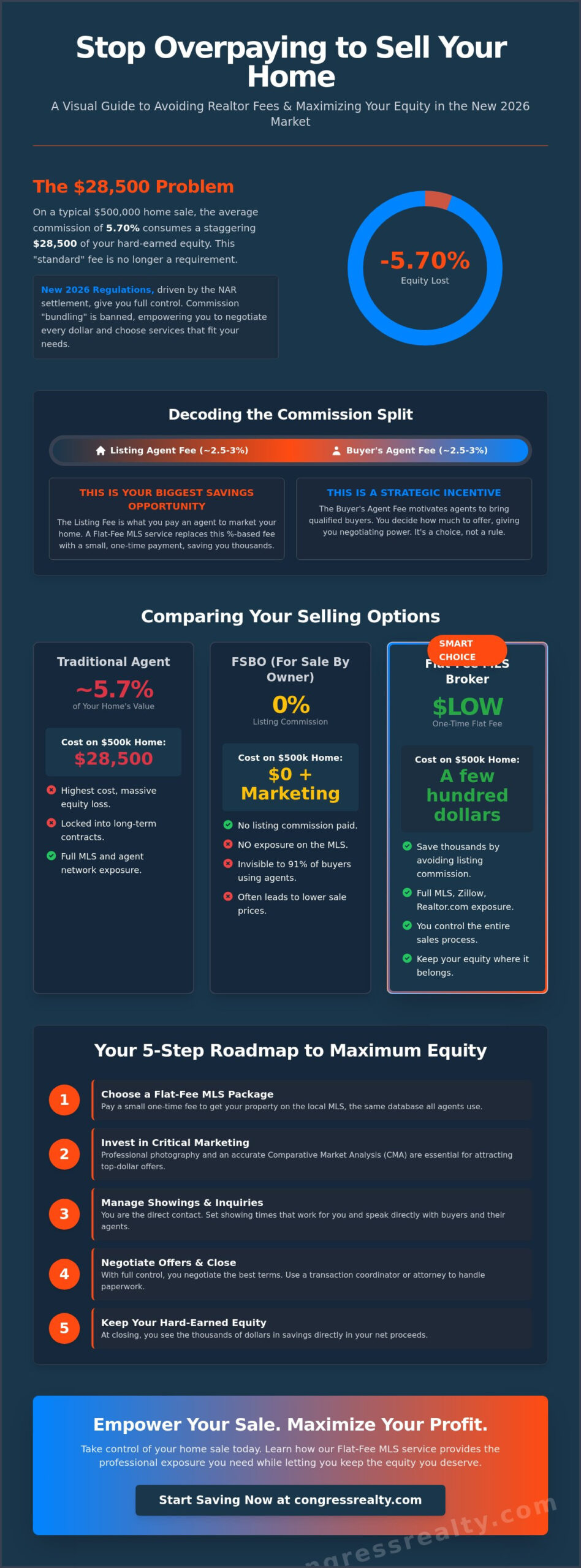
The “standard” 6% commission is a relic of a less transparent era. As of April 2026, market data shows the national average commission has shifted to between 5.44% and 5.70%. Despite this downward trend, many traditional agents still push for that full 6% slice of your home’s value. This isn’t just a fee; it’s an equity tax that drains your profit. When you understand how to avoid realtor fees when selling, you realize that paying a massive percentage for basic administrative tasks is no longer necessary in today’s high-demand market.
The real shift occurred in August 2024 following the landmark NAR settlement. Before this date, listing agents could advertise buyer agent compensation directly on the MLS, often creating a “bundled” fee that felt non-negotiable. Today, that practice is banned. This change forced a new level of transparency, requiring buyers to sign written agreements with their agents before they even tour a property. You now have the power to negotiate every dollar. The old-school model of bundled fees has crumbled, leaving room for more intelligent, flat-fee alternatives.
Listing Fees vs. Buyer’s Agent Commissions
To navigate the 2026 landscape, you must distinguish between the two halves of the commission. The listing fee is what you pay an agent to place your property on the MLS and manage marketing. In contrast, the buyer’s agent commission is a fee offered to the professional bringing a qualified buyer to the table. If you’ve ever wondered how much does the realtor make and how those commissions are calculated, understanding this split is the essential first step. While the listing side is where you can save the most, providing a buyer’s agent incentive remains a strategic choice rather than a mandatory rule. Understanding Real Estate Commissions helps clarify that these roles are distinct and their pay should be handled separately. Commission decoupling is now the standard practice for 2026, ensuring you only pay for the specific services you choose.
The True Cost of a Traditional Sale
Do the math on your home’s value. If you sell a $500,000 property, a traditional 6% commission wipes out $30,000 of your equity instantly. That’s a massive sum that could cover a down payment on your next home or fund your retirement. Beyond the raw numbers, traditional agents often lock you into long-term contracts that limit your flexibility. By choosing a flat-fee approach, you retain 100% of your listing-side equity and maintain the freedom to pivot your strategy if the market shifts. You control your sales process. You keep the thousands of dollars that would otherwise disappear at the closing table. This financial empowerment is the core benefit of knowing how to avoid realtor fees when selling in a modern market.
This focus on financial empowerment is common among high-level real estate professionals. Many experienced investors who prioritize maximizing their returns and optimizing their strategies participate in elite groups like The Boardroom Mastermind to stay at the forefront of the industry.
Flat Fee MLS: The Strategic Way to Bypass Listing Commissions
The biggest hurdle for most homeowners is the fear of losing visibility. You want to save money, but you don’t want your house sitting on the market for months. Flat Fee MLS is the professional answer for anyone looking for how to avoid realtor fees when selling without disappearing from the digital marketplace. It functions as a bridge. You get the same professional infrastructure as a traditional agent but retain the autonomy of a private seller. This hybrid model allows you to maintain the “You Control Your Sales Process” mantra while ensuring your home isn’t invisible to the 91% of buyers who used an agent in 2025.
How Flat Fee Listings Work
The process is straightforward and eliminates the need for a 3% listing commission. Instead of signing away a percentage of your sale price, you pay a one-time flat rate to a broker. In exchange, they list your property on the LOCAL MLS. This database is the engine behind the entire real estate industry. Once your home is in the system, it automatically populates to every major site. You remain the primary contact for all buyer inquiries; you set the showing schedule that fits your life, and you manage the negotiations directly. It’s a pragmatic choice for the savvy owner who wants to list your home while keeping thousands in equity.
Professional MLS entry ensures your home appears on Zillow, Realtor.com, and Trulia.
Direct contact information allows buyers and agents to reach you without a middleman.
Full control over your listing details means you can update pricing or photos instantly.
Busting the ‘No Exposure’ Myth
A common misconception is that a flat-fee listing is somehow “lesser” than a traditional one. This is false. To a buyer scrolling on their phone, your listing looks identical to every other property on the block. There are no “FSBO” watermarks or hidden flags. The data feed comes from the same MLS source used by every big-name brokerage in the country. When homeowners research how to avoid realtor fees when selling, they often worry about limited reach. However, data shows that 21% of people who start as pure FSBO eventually hire an agent because they lack this specific exposure. A flat-fee listing solves this problem immediately. You get 100% of the market reach for a fraction of the cost. You aren’t sacrificing eyeballs; you’re just cutting out the unnecessary commission expense. This ensures you get the same professional visibility without the heavy financial burden at closing.
Comparing Your Options: FSBO, Cash Buyers, and Flat Fee Brokers
Choosing the right path requires more than just looking at a commission percentage. You need to look at your net profit. While many homeowners search for how to avoid realtor fees when selling, they often fall into traps that cost more than the commission they’re trying to save. You have three primary alternatives to the traditional 6% model: pure FSBO, cash buyers, and discount brokers. Each has its own set of trade-offs, but only one truly maximizes your financial intelligence and keeps your equity intact.
The Hidden Cost of ‘Convenience’ Buyers
Cash buyers and iBuyers sell you on speed. They offer a “no fee” transaction that bypasses the traditional market entirely. However, this convenience comes with a steep price tag. These companies often offer 10% to 15% below market value to account for their own holding costs and profit margins. On a $425,000 home, which was the 2025 median for agent-assisted sales, that’s a potential loss of $42,500 or more. Contrast this with a flat-fee MLS sale where you keep your equity and reach the entire market. Use this checklist before signing with a cash buyer:
Does the offer reflect a current, professional Comparative Market Analysis (CMA)?
What are the “service fees” or “repair credits” deducted from the final check?
How does the net profit compare to an open-market sale with a flat-fee broker?
Discount brokerages often advertise a 1% listing fee. While this sounds better than 3%, it’s still a percentage-based model that punishes you for having a more valuable home. On a $600,000 sale, that 1% is still a $6,000 check. A flat rate doesn’t care how much your home is worth; it provides the same professional infrastructure for one predictable price. To fully understand how much does the realtor make on a typical sale versus what a flat fee costs you, the difference in net profit becomes immediately clear. This is the smartest way to manage how to avoid realtor fees when selling while ensuring you don’t simply trade one percentage for another.
Pure FSBO vs. Flat Fee MLS
Selling purely by yourself is the ultimate way to eliminate fees, but it often leads to a lower sale price. In 2025, pure FSBO homes had a median sale price of $360,000, while agent-assisted homes hit $425,000. Why the $65,000 gap? It’s the lack of exposure. A “For Sale By Owner” sign in the yard only reaches people driving down your street. Without the LOCAL MLS, you’re stuck with “pocket listings” that miss out on the bidding wars that drive prices up. Flat Fee MLS is FSBO with professional armor. You get the same Zillow and Realtor.com visibility as the big brokerages while paying a small fraction of the cost. You control your sales process without the risk of leaving thousands on the table. It’s the Goldilocks solution: professional reach with private-seller savings.
The 5-Step Roadmap to Selling Without a Traditional Agent
Selling a home independently is not a mystery; it is a structured sequence of professional actions. Many owners wonder how to avoid realtor fees when selling while still maintaining a high level of security and market presence. The answer lies in replacing the agent with a proven infrastructure. By following a methodical roadmap, you can navigate the 2026 real estate landscape with the same precision as a top-tier brokerage. This process ensures you don’t just “list” your home, but actually move it from “for sale” to “sold” while keeping your equity intact. For a deeper look at every stage of this process, the strategic guide to selling a home in 2026 and maximizing your equity covers each step in comprehensive detail.
Step 1: Conduct a Professional Comparative Market Analysis (CMA). Use actual sold data from the last 90 days to set a price that triggers bidding wars.
Step 2: Invest in Professional Photography. High-definition visuals are the primary driver of digital engagement and first impressions.
Step 3: List on the LOCAL MLS. Trigger immediate syndication to every major real estate portal through a flat-fee service.
Step 4: Deploy an Electronic Lockbox. Professionalize your showings and track every agent who enters your property.
Step 5: Utilize Transaction Management. Navigate the final paperwork and escrow requirements with expert oversight.
Pricing and Presentation
A Comparative Market Analysis (CMA) is superior to a “Zestimate” because it accounts for specific home upgrades and hyper-local market nuances that algorithms often miss. Setting the right price from day one is the most effective way to manage how to avoid realtor fees when selling, as it prevents the need for future price drops. Professional photography offers a massive return on investment; listings with professional images often see a significant increase in online views compared to those using cell phone pictures. To capture local interest, use a professional yard sign and post. This signals to your neighbors and local buyers that the sale is being handled with professional rigor.
Managing the Transaction
When multiple offers arrive, you need a clear system to evaluate them without a listing agent pressuring you to take the first deal. You Control Your Sales Process. Using an electronic lockbox is a critical step in this stage. It provides secure, tracked access for buyer agents, which is much safer and more professional than hiding a key under a mat. Finally, professional transaction oversight ensures that every disclosure and contract detail meets 2026 legal standards. This reduces the perceived complexity of the sale and leads to a simple and rewarding close. To get started with the right tools, list your home today and take full command of your equity.
Empowering Your Sale: How Congress Realty Maximizes Your Equity
You now understand that how to avoid realtor fees when selling isn’t about cutting corners; it’s about cutting out unnecessary costs. Congress Realty doesn’t just offer a listing service. We provide a professional infrastructure that empowers you to stand on equal footing with any traditional brokerage. By eliminating the 3% listing commission, we ensure that your hard-earned equity stays in your bank account. Our model is built on the belief that the modern homeowner is capable, savvy, and deserves full autonomy over their financial future.
We combine national reach with deep local MLS expertise. This dual advantage ensures your home is visible to the right buyers while benefiting from the oversight of a licensed professional. You Control Your Sales Process from the first day your listing goes live until the final signatures at closing. We provide the technical framework, the digital syndication, and the professional credibility. You provide the home and the vision. It is a pragmatic partnership designed for maximum profit and minimum stress.
Standard vs. Full Service: Choosing Your Level of Support
Every seller has different needs, so we offer tiered packages to match your comfort level. Our Standard Listing package provides the essentials to get you into the market immediately. This includes placement on the LOCAL MLS, professional syndication to sites like Zillow and Realtor.com, and a professional yard sign. It’s the perfect choice for the independent owner who wants the widest possible exposure with the lowest possible overhead.
If you prefer an extra layer of professional advocacy, our Full Service tier adds comprehensive Transaction Management. We help you navigate the complexities of escrow, disclosures, and closing documentation. This ensures that your sale remains compliant with 2026 regulations without requiring a traditional high-commission agent. Whether you choose Standard or Full Service, the goal remains the same: list your home and save thousands. It’s a proven, structured process that has helped homeowners across the country reclaim their equity.
Why Experience Matters: 20+ Years of Disrupting Real Estate
Trust is built on a foundation of performance. Congress Realty was founded in 2002 as a pioneer of the flat-fee model, long before the 2024 NAR settlement made commission transparency a national conversation. For over 20 years, we’ve been the disruptive ally for sellers who refuse to pay the “equity tax.” Andrew English, our designated broker, provides the professional oversight necessary to ensure every listing meets the highest industry standards. You aren’t just using a website; you’re leveraging two decades of real estate expertise.
Don’t let traditional commission structures dictate your profit margins. You have the tools, the roadmap, and the professional partner to succeed on your own terms. This is the smartest way to manage how to avoid realtor fees when selling while maintaining total control. Ready to save thousands? List your home with Congress Realty today.
Take Command of Your Home’s Equity Today
The traditional real estate model is no longer the only path to a successful sale. You’ve seen how the 2024 NAR settlement and current 2026 regulations have decoupled commissions; giving you the power to negotiate or bypass the 3% listing fee entirely. By utilizing a flat-fee MLS strategy, you ensure your property reaches the 91% of buyers who search via agent-assisted portals without sacrificing your hard-earned profit. You don’t need to feel robbed at the closing table when you have a proven roadmap to follow.
Choosing how to avoid realtor fees when selling is a decision rooted in financial intelligence. Congress Realty has been a pioneer in this space since 2002; providing an A+ Rated professional infrastructure for thousands of successful closings. You retain 100% control of your sales process while we provide the tools you need to dominate the market. It’s time to stop overpaying for services you can manage with the right partner by your side.
Your equity belongs to you. Take the next step toward a smarter, more profitable transaction. Start Your Flat Fee Listing and Save Your Equity today. Selling your home independently is not just possible; it’s a rewarding way to secure your financial future.
Frequently Asked Questions
Is it legal to sell a house without a realtor in 2026?
Yes, it’s completely legal to sell your home without a traditional real estate agent in 2026. Homeowners have the constitutional right to represent themselves in a property transaction in all 50 states. While only 5% of home sales in 2025 were FSBO transactions, this path remains a valid and legal option for anyone looking for how to avoid realtor fees when selling. You simply take on the responsibilities of marketing and negotiation yourself while keeping your equity intact.
How do I get my house on the MLS without a traditional agent?
You can access the Multiple Listing Service (MLS) by partnering with a flat-fee listing broker. These services provide the professional infrastructure required to enter your property into the LOCAL MLS database for a one-time fee. This allows you to skip the traditional 3% listing commission while ensuring your home is visible to every licensed agent and active buyer in your region. You remain the primary contact for all inquiries and showings.
Do I still have to pay a commission to the buyer’s agent?
Paying a buyer’s agent commission is negotiable and not a mandatory rule. Following the August 2024 NAR settlement, commission offers are no longer permitted on the MLS. You can choose to offer a commission to attract agents representing qualified buyers, or you can negotiate this fee on a case-by-case basis. Many savvy sellers offer a competitive rate to maintain high demand while still saving the 3% listing-side fee.
What is a flat fee MLS listing and how does it work?
A flat-fee MLS listing is a service where you pay a single upfront price to have a licensed broker list your home on the MLS. Instead of a percentage-based commission split, you pay a small fraction of that cost for the professional entry of your data. Once listed, your property syndicates to all major search portals. You manage the inquiries, showings, and negotiations directly, which keeps you in the driver’s seat of your sale.
Can I still list on Zillow and Realtor.com if I don’t use a 6% agent?
Yes, your home will appear on Zillow, Realtor.com, and Trulia automatically through MLS syndication. These platforms pull their data directly from the LOCAL MLS feed. When you use a flat-fee service, your listing looks identical to those managed by high-commission brokerages. This ensures you get the same professional visibility that 91% of sellers utilized in 2025 without the burden of a traditional listing agent fee.
What happens if I need help with the closing paperwork?
You can hire a transaction coordinator or use a “Full Service” flat-fee tier to manage the complex closing documentation. These professional services provide an expert safety net to ensure your disclosures and contracts meet 2026 legal standards. It’s a simple way to gain professional oversight while still keeping thousands of dollars in equity that would otherwise go to a traditional agent’s commission check.
How much can I actually save by using a flat fee service?
Sellers typically save the entire listing agent commission, which averages between 2.5% and 3% of the sale price. On a $500,000 home, this equates to a $15,000 savings. When you factor in the 5.70% national average blended rate, the total savings can be even more substantial. This is the most direct method for how to avoid realtor fees when selling and maximizing your net profit at the closing table.
Will buyer’s agents still show my home if I use a flat fee broker?
Yes, buyer’s agents will show your home as long as it meets their client’s needs and you’re willing to negotiate their compensation. Since the 2024 NAR settlement, buyers must sign representation agreements before touring homes. Agents are professionals looking for the best property for their clients. If your home is priced correctly and you remain open to agent negotiations, you will see the same showing volume as any traditional listing.
Why would you volunteer to give away 5.70% of your hard-earned equity when the most effective tools for a professional sale are already at your fingertips? It’s a common frustration for homeowners who want to maximize their profit but fear the complexity of the market. You understand that your home is your largest asset, and the thought of losing thousands in listing commissions feels like an unnecessary tax on your hard work. Mastering the steps to selling a house in 2026 doesn’t require a traditional agent. It requires a clear, pragmatic strategy that puts you in the driver’s seat.
We agree that the process should be transparent and rewarding, not a source of anxiety over legal paperwork or missed exposure. This manual provides the professional infrastructure you need to secure maximum market presence on the local MLS for a flat fee while maintaining total control. You’ll learn how to manage the 2026 market, including negotiating the 2.82% average buyer’s agent commission and utilizing the $500,000 capital gains tax exclusion for married couples. We’re going to walk through the eight essential steps to ensure a smooth, legally sound closing that keeps your money where it belongs.
Key Takeaways
Establish a realistic 2026 timeline and calculate your estimated net proceeds to ensure you maintain full financial control from the start.
Prioritize high-impact, low-cost cosmetic updates over major renovations to eliminate buyer red flags and maximize your home’s immediate market appeal.
Master data-driven pricing by learning how to select accurate “Comps” that reflect your property’s true value rather than relying on automated estimates.
Follow the proven steps to selling a house to secure 90%+ market exposure on the local MLS while bypassing traditional 6% commissions.
Gain the confidence to decode complex purchase agreements and navigate the middle milestones of inspections and appraisals with professional clarity.
Step 1: Strategizing Your Sale and Choosing a Listing Model
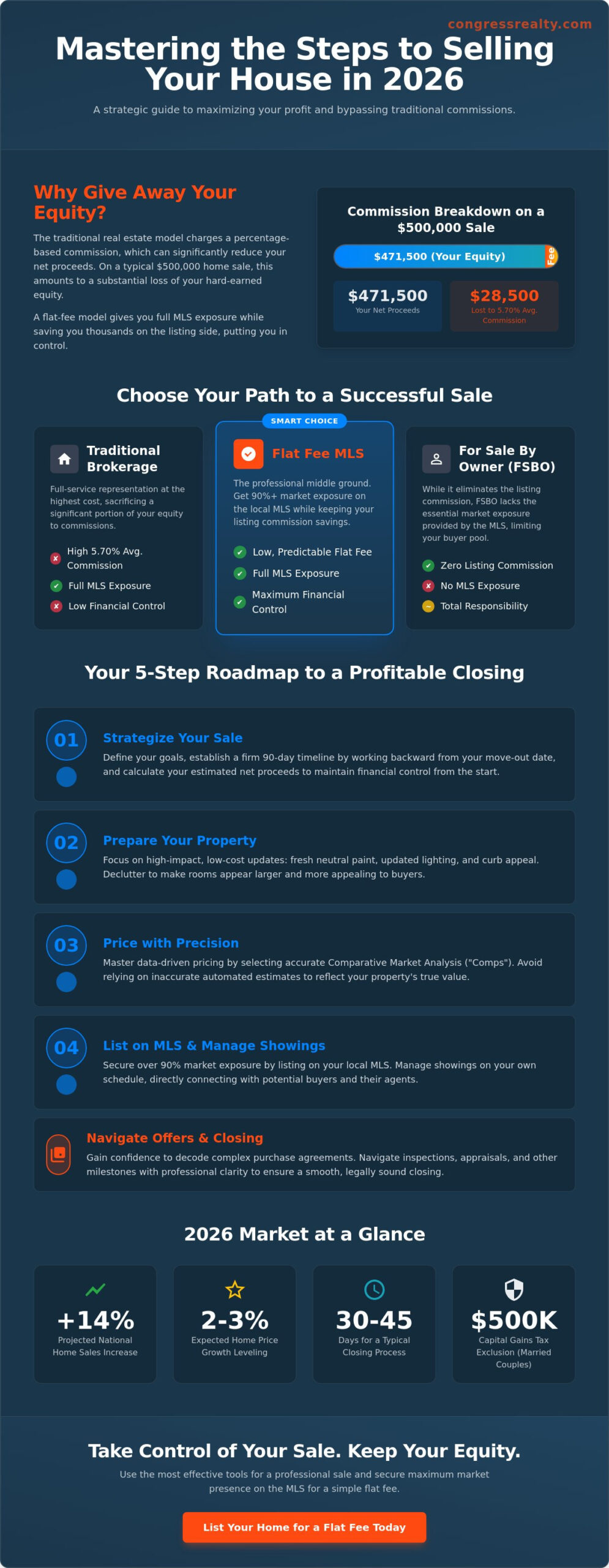
Successful sales don’t happen by accident; they’re the result of a calculated strategy. Before you plant a sign in the yard, you must define your “Why” and establish a firm move-out date. Are you looking to capitalize on the projected 14% increase in national home sales for 2026, or are you moving to a more affordable market in the Midwest? Understanding your motivation helps you set a realistic timeline. One of the most critical steps to selling a house is calculating your estimated net proceeds early. Take your expected sale price and subtract your mortgage payoff, property taxes, and closing costs. These costs can vary significantly by location and local regulations, typically ranging from 3% to 5% of the sale price.
Identifying Your Selling Goals and Timeline
To hit your target move-out date, work backward by at least 90 days. A standard real estate transaction typically requires 30 to 45 days for the closing process alone. You should also account for two to four weeks of property preparation and active marketing. If you’re buying a new home simultaneously, consider seasonal market fluctuations. The national real estate cycle usually peaks in late spring, but 2026 data suggests a rebalancing market with more inventory, giving you more flexibility than previous years. Use this to your advantage by setting a schedule that minimizes the stress of a two-house transition.
The Financial Breakdown: Commissions vs. Flat Fees
The traditional real estate model relies on a percentage-based commission that averages 5.70% in 2026. In this scenario, the listing agent typically takes about 2.88%, while the buyer’s agent receives approximately 2.82%. For a $500,000 home, that’s nearly $29,000 exiting your equity. You have three primary choices for your listing model:
Traditional Brokerage: Full service with a high percentage-based commission cost.
For Sale By Owner (FSBO): Zero listing commission but lacks the essential exposure of the MLS.
Flat Fee MLS: The professional middle ground that provides LOCAL MLS access for a predictable, transparent fee.
The Flat Fee advantage is clear: you gain the exact same professional MLS exposure as a traditional agent without sacrificing a 3% listing commission. This model empowers you to manage your own showings and negotiations while keeping thousands of dollars in your pocket. A flat fee model replaces the unpredictable percentage-based listing commission with a transparent, fixed cost that secures your equity from the moment you list. For a broader look at how to approach the current market, reviewing proven tips for selling your home in 2026 can help you refine your overall strategy before you commit to a listing model.
Step 2: Preparing the Property for Maximum Market Appeal
Walk through your front door as if you’ve never seen the property before. This “buyer-eye” walkthrough is one of the most effective steps to selling a house because it reveals the small red flags that buyers use to negotiate lower prices. You don’t need a massive renovation budget to win. With home price growth expected to level out at 2% to 3% in 2026, over-investing in structural overhauls can actually shrink your net proceeds. Instead, focus on high-impact, low-cost cosmetic fixes that make the property feel move-in ready. For homeowners with significant equity, a quick, well-prepared sale can even serve as a strategic alternative to foreclosure if financial circumstances have shifted.
Essential Repairs vs. Cosmetic Upgrades
Prioritize the “big three”: fresh neutral paint, updated lighting fixtures, and manicured curb appeal. These changes offer the highest return on investment. Consider a pre-listing inspection to identify “deal-breaker” issues like roofing leaks or electrical hazards before they surface during the buyer’s contingency period. Solving these problems now prevents your deal from falling through later. When you handle the prep yourself, you keep control of the budget and the timeline. To ensure your home is in top-tier showing condition, you can learn more about Way Beyond Cleaning and their specialized real estate cleaning options. It’s about being pragmatic and protecting your equity.
Decluttering is your secret weapon for the digital-first 2026 market. Remove personal items and excess furniture to make rooms appear larger in MLS thumbnails. A clean, minimalist space allows potential buyers to visualize their own lives in the home. Once the house is staged and ready, get your property listed to start attracting serious interest without the burden of a 3% listing commission.
Professional Photography: Your Digital Curb Appeal
In 2026, your first showing happens on a smartphone screen. Smartphone photos are no longer sufficient; they often lead to lower offers and more days on market. High-resolution, professional imagery is a non-negotiable requirement for standing out on national portals like Zillow and Realtor.com. Professional photographers understand how to use wide-angle lenses and natural lighting to highlight your home’s best features. These images are the fuel for your LOCAL MLS listing, ensuring you capture the attention of the 90% of buyers who start their search online. High-quality photos demonstrate that you are a serious, professional seller who values the transaction.
Step 3: Data-Driven Pricing Using Comparative Market Analysis
Pricing is math. It isn’t personal. One of the most critical steps to selling a house is setting a price that attracts qualified buyers without leaving your equity on the table. Don’t rely on a “Zestimate” or other automated valuation models; these are often inaccurate algorithms that don’t account for your specific upgrades or neighborhood nuances. Similarly, an appraisal is a formal valuation for a lender. You need a Comparative Market Analysis (CMA). While a step-by-step guide can help you prep the lawn, your price determines how many people actually walk across it. Use real-world data from the LOCAL MLS to find the “sweet spot” where market demand meets your financial goals.
How to Read and Use Comparables Like a Pro
Professional sellers use the 3-3-3 Rule to find accurate “comps.” Look for three properties that sold within three miles of your home in the last three months. This provides a snapshot of current buyer behavior in the 2026 rebalancing market. When you analyze these listings, pay close attention to:
Sold Listings: These represent the actual market value.
Pending Listings: These show you what buyers are currently willing to pay.
Active Listings: This is your direct competition.
Adjust your price based on differences in square footage, bedroom count, and lot size. If a neighbor’s house sold for a premium but had a finished basement you lack, adjust your target downward. If you’ve invested in energy-efficient upgrades that are trending in 2026, you can justify a higher position. Remember the psychology of pricing; listing at $499,000 instead of $500,000 keeps you visible in lower search brackets and often drives higher traffic.
Avoiding the Overpricing Trap
The first 14 days your home is on the market are the most vital. This is when your listing has the “New” badge on national portals and generates the most excitement. If you overprice, you kill that momentum instantly. Buyers are savvy; they know when a price doesn’t match the data. If you don’t receive serious inquiries or showing requests within the first 21 days, it’s time for a strategy shift. A small, early price adjustment is far more effective than a massive cut after the listing has gone stale. You’re in control of this process. Use a professional CMA service to validate your numbers before you list, ensuring your flat-fee entry onto the MLS is backed by hard evidence.
Step 4: Listing on the MLS and Managing Showings
Once your property is prepped and your pricing is validated, it’s time to broadcast your home to the world. The Multiple Listing Service (MLS) is not just a database; it is the primary engine of the American real estate market. In 2026, over 90% of successful home sales originate from an MLS listing. Without this exposure, you’re essentially invisible to the vast majority of qualified buyers and their agents. This is one of the most vital steps to selling a house because it forces national portals like Zillow, Realtor.com, and Redfin to display your property alongside those represented by high-commission traditional brokers.
The Power of the Local MLS
When you list on the LOCAL MLS, your home’s data syndicates to thousands of secondary websites within minutes. This massive digital footprint ensures you aren’t hunting for buyers; you’re letting them find you. Accuracy during this stage is paramount. Inaccurate data entry regarding square footage or school districts can lead to listing fines from the local board or, worse, legal delays during the closing process. Focus on crafting a property description that highlights benefits over features. Instead of simply listing “new windows,” describe the “energy-efficient, sound-dampening windows that lower monthly utility costs.” You’re selling a lifestyle and financial intelligence, not just a structure.
You don’t need to pay a 3% listing commission to get professional-grade market saturation. By choosing a smarter model, you maintain total authority over your home’s public profile. To get started today, you can list your home on the MLS for a flat fee and keep your equity where it belongs.
Managing Showings and Electronic Lockboxes
Control is the recurring theme of a successful independent sale. You decide when your home is available for viewing, balancing your personal schedule with the need for accessibility. To manage this safely and professionally, use an electronic lockbox rather than a traditional manual code box. Electronic versions provide a higher level of security by requiring verified agent credentials for access. They also create a digital log of exactly who entered your home and at what time. This technology allows you to gather immediate buyer feedback. Most electronic systems automatically email the showing agent a survey after they leave, providing you with raw, honest data on how the market perceives your home. Use this feedback to refine your presentation or adjust your strategy. Once you accept an offer, remember to update your listing status from “Active” to “Pending” to signal to the market that you’ve successfully navigated the first half of the transaction.
Step 5: Navigating Offers and Transaction Management
The offers are arriving. You’ve successfully navigated the early steps to selling a house, and now you must move from marketing to management. This phase is about precision. A purchase agreement is a legally binding contract that dictates your price, your closing date, and your net proceeds. Don’t be blinded by a high offer price if the terms are weak. A cash offer at a slightly lower price often beats a higher financed offer with multiple contingencies. You need to scrutinize every detail to ensure you keep your equity.
Evaluating and Negotiating Purchase Offers
When you receive an offer, look beyond the top line number. In the 2026 market, buyers are often savvy about negotiating the 2.82% average buyer’s agent commission. Check for common contingencies like home inspections, appraisals, and the sale of the buyer’s current home. These are “exit ramps” that allow a buyer to back out without losing their earnest money. If an offer feels lopsided, issue a professional counter-offer. You have the right to demand a shorter inspection period or a higher earnest money deposit. This is your transaction. You set the terms that protect your financial interests.
The Role of Transaction Coordination
The “Middle Milestone” is often the most stressful part of the journey. This is when home inspections occur and appraisal gaps can appear. If an inspector finds a $5,000 roof issue, you don’t have to panic. You can negotiate a credit or choose to handle the repair yourself. This is where professional transaction management becomes your secret weapon. Most homeowners fear the mountain of legal disclosures and deadlines required for a smooth closing. Congress Realty provides the necessary professional infrastructure to manage these documents for a fraction of the cost of a traditional agent.
For those who prefer a more personalized partnership to navigate these complexities, you can discover Louisa Shaw Baker Real Estate to see how an experienced professional supports clients through every stage of the sale.
Managing the paperwork ensures the buyer can’t back out due to a missed deadline. You’ll handle the final walkthrough, where the buyer confirms the home’s condition, and then proceed to the signing. Sellers typically pay between 3% and 9% of the sale price in closing costs, but because you’ve avoided the 3% listing commission, your net profit remains significantly higher. You’ve controlled the process from start to finish. Now, you simply sign the documents and collect your check.
Take Command of Your Home Sale Today
Selling your home in 2026 is no longer about following the traditional 5.70% commission model. You’ve seen how mastering the steps to selling a house allows you to bypass high fees while maintaining professional parity on the LOCAL MLS. By prioritizing high-impact cosmetic updates and using the 3-3-3 rule for data-driven pricing, you position yourself as a savvy market leader. You don’t need to sacrifice your hard-earned equity for a facilitator when you have the tools to lead the process yourself. Professional transaction management ensures your closing is legally sound and stress-free without the heavy price tag.
Congress Realty has been a trusted ally for independent sellers since 2002. With A+ rated brokerage support and over $1 billion in property listed, we provide the professional infrastructure while you make the decisions. It’s time to stop paying for services you don’t need and start keeping the profit you’ve earned. Save thousands on your sale; explore Congress Realty’s Flat Fee MLS Packages today. You’ve done the work to build your equity; now it’s time to claim the full reward. You control your sales process, and the results will reflect your financial intelligence.
Frequently Asked Questions
How long does it typically take to sell a house from listing to closing?
You should plan for a 60 to 90 day window from start to finish. The closing process itself typically takes 30 to 45 days once you accept an offer. Adding 30 days for property preparation and active marketing ensures a realistic timeline. Working backward from your move-out date is one of the smartest steps to selling a house.
Can I really list my house on the MLS without paying a 3% commission?
Yes, you can skip the 3% listing commission entirely. By using a flat-fee service, you get your property on the LOCAL MLS for a predictable, transparent fee. This gives you the same professional exposure as a traditional 5.70% commission brokerage but keeps thousands of dollars in your pocket. You maintain full authority over the listing profile.
What are the most important repairs to make before selling my home?
Prioritize fresh neutral paint, modern lighting fixtures, and manicured curb appeal. These cosmetic updates offer the highest return on investment in the 2026 market. Avoid major structural renovations unless they are “deal-breaker” repairs required for buyer financing approval. Small, strategic improvements make your home look move-in ready for high-resolution digital thumbnails.
What happens if my home appraisal comes in lower than the offer price?
You have three main options if an appraisal gap occurs. You can ask the buyer to pay the difference in cash, lower your sale price to match the appraisal, or negotiate a compromise where both parties meet in the middle. In a rebalancing market with 2% to 3% price growth, these gaps are common. Having a professional CMA helps you defend your price early.
Do I have to pay a commission to the buyer’s agent if I sell via flat fee?
Paying a buyer’s agent is negotiable following the NAR settlement changes. While the national average for a buyer’s agent has rebounded to 2.82% in early 2026, you aren’t required to offer this compensation upfront on the MLS. You can decide how to handle these requests during the offer negotiation phase to protect your hard-earned equity.
What is a Comparative Market Analysis and do I really need one?
A Comparative Market Analysis (CMA) is a professional report that evaluates your home against similar properties sold within the last three months. You absolutely need one to avoid the overpricing trap. It provides the hard data required to compete with other listings on the MLS and justifies your asking price to savvy buyers and their agents.
Is an electronic lockbox safe for my home during showings?
Electronic lockboxes are highly secure and preferred by professional sellers. Unlike manual code boxes, they require verified agent credentials for access and record a digital log of everyone who enters your property. This technology gives you peace of mind and allows you to gather immediate feedback. It’s a simple, utilitarian tool that keeps you in control.
What are the typical closing costs for a seller in 2026?
Sellers typically pay between 3% and 9% of the home’s sale price in closing costs. This range covers title insurance, transfer taxes, and escrow fees. For example, Texas sellers average 3.28% in costs excluding commissions. Understanding these steps to selling a house helps you calculate your true net proceeds before you ever reach the closing table.
Can I sell my house without a realtor and still get professional results?
Absolutely. Many homeowners successfully complete the entire process independently by leveraging flat-fee MLS services, professional photography, and transaction management support. If you’re wondering whether you can sell your house without a realtor while maintaining professional-grade market exposure and legal compliance, the answer is yes — and the tools to do it are more accessible than ever in 2026.
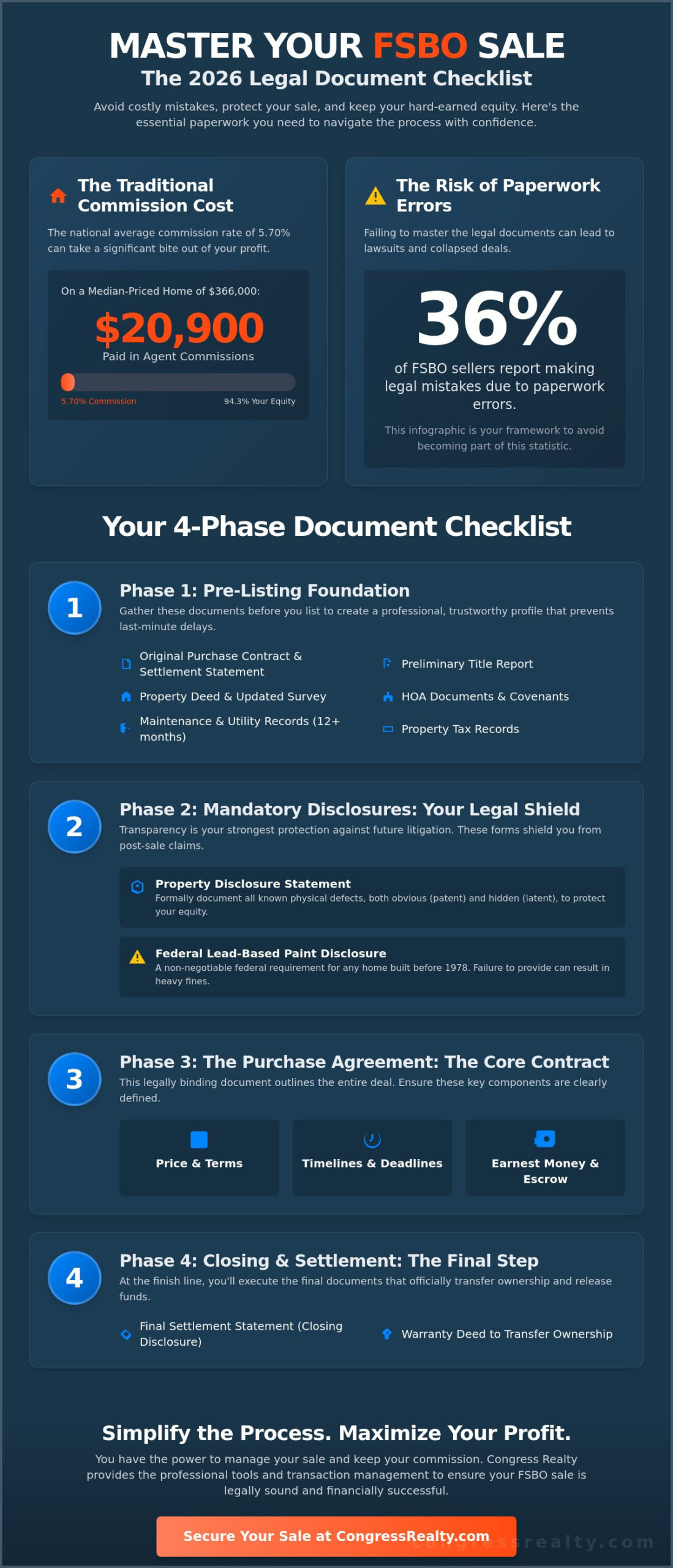
Did you know that 36% of homeowners who sell independently report making legal mistakes due to paperwork errors? It’s a sobering statistic, especially when you’re working hard to avoid the national average commission rate of 5.70%. On a median-priced home of $366,000, that traditional fee swallows $20,900 of your hard-earned equity. You deserve to keep that money, and you don’t need a high-commission agent to handle the logistics. Mastering the legal documents for selling a house by owner is the professional framework that secures your financial freedom.
We understand that the fear of a lawsuit or confusion over technical jargon can feel like a barrier. You want the confidence that your sale is legally sound without paying for a traditional 3% listing commission. This guide provides an actionable checklist for 2026, including new mandates like the FinCEN all-cash reporting and various state-mandated disclosures, such as those concerning electrical systems. You’ll learn exactly which forms you need for the pre-listing, contract, and closing phases to stay in control of your sale. We’re going to demystify the paperwork so you can focus on maximizing your net profit.
Key Takeaways
Learn how to organize original purchase records and preliminary title reports to establish a professional baseline for your home sale.
Shield yourself from liability by mastering the mandatory legal documents for selling a house by owner, including property condition and lead-based paint disclosures.
Discover the essential components of a solid purchase agreement, from price and timelines to the secure management of earnest money in escrow.
Navigate the closing phase with confidence by reviewing your final settlement statements and executing the warranty deed to transfer ownership.
Leverage professional transaction management to access the same documentation infrastructure used by traditional agents while you control your sales process.
The Pre-Listing Phase: Essential Documentation to Launch Your Sale
Listing your home independently starts with a solid foundation of facts. While many sellers rush to take photos, the smart ones start with the filing cabinet. Preparing your legal documents for selling a house by owner before the first showing prevents the 11th-hour deal killers that often plague FSBO transactions. Statistics show that 36% of independent sellers report making legal mistakes; you can avoid this by organizing your original purchase contract and settlement statement now. These documents establish your cost basis and prove you have the authority to move forward with the sale.
Order a preliminary title report as soon as you decide to sell. This report identifies liens, easements, or encumbrances that could stall your progress. Don’t let a forgotten $500 contractor lien from years ago stop a high-value sale in its tracks. You also need to compile your property tax records and any HOA documentation. For 2026, ensure your HOA package includes the newly mandated exterior inspection reports for elevated elements. This level of transparency builds immediate trust with buyers who are increasingly wary of hidden costs and complex regulations.
Verifying Ownership and Boundaries
Your Property Deed is the primary tool for proving your legal right to transfer title. It’s the cornerstone of the For Sale By Owner (FSBO) process and must be readily available for review. Pair this with an updated Property Survey. Modern mortgage underwriters have become much more stringent about boundary lines and potential encroachments. If your survey is outdated, a buyer’s lender may require a new one before funding the loan. Having these documents ready allows you to launch a flat fee mls listing with a professional profile that rivals any traditional brokerage. It signals to everyone in the industry that you are a savvy seller who understands the professional infrastructure of a real estate transaction.
Maintenance and Utility Records
Trust is the currency of a successful sale. Create a “Home Manual” that includes appliance warranties and a chronological service history. This simple step eliminates buyer doubt and positions you as a diligent, responsible owner. Compile at least 12 months of utility bills to validate your home’s efficiency claims with hard data. Finally, document every major capital improvement you’ve made. Clear records of a recent roof replacement or a high-efficiency HVAC upgrade provide the evidence needed to support your Comparative Market Analysis (CMA) valuation. When you lead with facts and professional-grade records, you protect your equity and stay in control of the negotiation. You don’t need to pay a 3% commission to prove your home’s value; your documentation does the work for you.
Mandatory Disclosure Forms: Your Legal Shield Against Liability
How do you protect your $20,900 in equity once the deal is signed? You do it through absolute transparency. Mandatory disclosures are often viewed as a burden, but they’re actually your strongest legal shield against future litigation. When you handle the legal documents for selling a house by owner, your goal is to eliminate any “he-said, she-said” scenarios that could arise months after closing. By being the most transparent person in the room, you maintain total control over your sales process and keep your profit where it belongs: in your pocket.
Don’t forget the Federal Lead-Based Paint Disclosure. If your home was built before 1978, this is a non-negotiable requirement. Failing to provide this specific document can result in heavy federal fines and give the buyer a legal “out” regardless of other contract terms. Managing the legal documents for selling a house by owner requires attention to detail, but it pays off by making your transaction bulletproof against post-sale claims.
Defining the Property Disclosure Statement
The Property Disclosure Statement is a formal legal record where you document every known physical defect or issue that could impact the property’s value or safety. Patent defects are obvious issues, such as a broken window or a visible water stain on a ceiling. Latent defects are hidden problems that a standard inspection might miss, like a cracked foundation behind a finished wall or a faulty sewer line. Disclosing both types is critical. When you’re honest upfront, you prevent buyers from using the inspection period as a tool to renegotiate the price or back out of the deal entirely.
Special Disclosures and Addenda
Check your local regulations for Natural Hazard Disclosures. In 2026, many states have tightened requirements regarding flood zones and wildfire risks. If your home is part of an association, you must disclose any pending HOA assessments or ongoing litigation. A new 2026 California law even requires HOAs to provide detailed inspection reports for exterior elevated elements to prospective buyers. While including an “As-Is” clause in your contract is helpful, it doesn’t exempt you from the legal duty to disclose known issues. For a complete look at how these sales records impact your financial standing, consult IRS Publication 523 to understand the long-term tax treatment of your home sale.
Adopt an “over-disclose” strategy. If you’re wondering whether a minor basement leak from three years ago needs to be mentioned, the answer is always yes. Documenting it now prevents a $10,000 legal bill later. Ready to secure the professional forms used by the pros? You can access comprehensive transaction management tools that ensure your disclosure package is complete and compliant.
The Purchase Agreement: Drafting the Core Contract
The purchase agreement is the definitive rulebook for your transaction. While traditional agents might claim these contracts are too complex for a solo seller, the reality is that standard, state-approved forms provide a clear roadmap for both parties. When you manage the legal documents for selling a house by owner, you aren’t just filling out forms; you’re defining the terms of your financial victory. This contract outlines the final sale price, the closing timeline, and the specific legal obligations that keep the buyer committed to the deal.
Secure the deal with a meaningful Earnest Money Deposit (EMD). Typically ranging from 1% to 3% of the purchase price, this deposit serves as the buyer’s “skin in the game.” Ensure the contract specifies that an independent third party, such as a title company or an escrow agent, holds these funds. This protects you from the risk of a buyer walking away without a valid legal reason. By setting firm deadlines for inspections, appraisals, and financing approvals, you maintain the momentum necessary to reach the closing table without unnecessary delays.
Key Components of a Valid Sales Contract
Precision is your best defense against legal disputes. Always include the full legal description of the property, such as the lot and block number found on your deed, rather than just the mailing address. Be explicit about personal property. If you plan to leave the smart refrigerator but take the heirloom chandelier, document it clearly to avoid last-minute friction. Finally, ensure your contract includes a “Time is of the Essence” clause. This legal phrasing compels the buyer to perform their duties by the agreed-upon dates or risk being in breach of contract.
Managing Contingencies and Addenda
Contingencies are the “escape hatches” in a contract. The inspection contingency is the most common hurdle; handle it pragmatically by offering credits for major repairs rather than attempting to manage contractors yourself. This keeps the deal moving and keeps you in control. If an appraisal comes in lower than the sale price, an appraisal contingency allows you to negotiate a price adjustment or require the buyer to cover the gap with cash.
You don’t have to track these complex dates alone. Utilizing professional Transaction Management allows you to oversee every deadline with the same precision as a high-volume brokerage. This service ensures all legal documents for selling a house by owner are executed in the correct sequence, protecting your equity and your peace of mind. By automating the administrative timeline, you stay focused on the outcome: a successful, high-profit closing.
Closing and Settlement: Navigating the Final Paperwork
You’ve reached the finish line. This is the moment where the “thousands saved” move from a projected goal to a concrete reality on your bank statement. Reviewing the final legal documents for selling a house by owner ensures every credit and debit is accounted for with total precision. The Closing Disclosure (CD) is your primary roadmap during this stage. It details the final purchase price, escrow deposits, and prorated expenses. Look closely at the “Seller’s Column.” This is where you’ll see the absence of that traditional 3% listing commission, a sight that validates your financial intelligence and your decision to stay in control.
You’ll also need to execute the Warranty Deed. This is the official legal instrument that transfers the property title from your name to the buyer. It’s a high-stakes document that must be notarized to be legally binding and recorded with the county. If you’re leaving behind a riding lawnmower or a specific set of appliances, prepare a Bill of Sale. This simple document prevents any post-closing confusion about what was included in the real estate versus personal property. Finally, you’ll sign the 1099-S form. This is the mandatory IRS reporting document that tracks the proceeds from your home sale, ensuring your transaction is fully compliant with federal tax regulations.
Final Financial Statements
Don’t just glance at the ALTA Settlement Statement; audit it. This document provides a granular look at every penny in the transaction, including prorated property taxes and HOA fees. Verify that your existing mortgage payoff amount is exact to the day of closing. Any secondary liens or local assessments must also show as “paid in full.” Seeing your net proceeds without a massive commission deduction is the ultimate reward for managing the legal documents for selling a house by owner yourself. It’s the final proof that the flat fee model works in your favor.
The Transfer of Possession
Most closings require an Affidavit of Title. This is a sworn statement where you confirm there are no new liens, judgments, or legal disputes involving the property since the initial title search. In certain jurisdictions, you may also need a Certificate of Occupancy to prove the home meets local building codes for the new owner. Once the ink is dry, provide a “Keys and Codes” document. Include garage door frequencies, smart lock codes, and alarm instructions to ensure a professional handover experience. Ready to finalize your sale with professional precision? Explore our Transaction Management services to ensure your closing paperwork is handled correctly from start to finish.
Simplifying FSBO Legal Process with Flat Fee MLS and Transaction Management
Selling a home independently shouldn’t feel like a legal gamble. Many homeowners hesitate to go solo because they fear the administrative burden of contract management. Congress Realty acts as your professional advocate, providing the exact same legal documents for selling a house by owner that traditional agents use, but without the 3% listing fee. By utilizing a flat fee model, you gain access to the professional infrastructure necessary to protect your equity while maintaining total autonomy. You’re not just saving money; you’re taking command of the transaction from a position of strength.
The real power of this model lies in the predictability of the process. While traditional brokers might charge a 5.70% total commission, our flat fee approach keeps your costs transparent and fixed. Our Transaction Management service oversees your legal document timeline, ensuring every disclosure is signed and every deadline is met. This methodical approach demystifies the real estate process, moving you logically from the initial listing to the final closing with consistent financial reinforcement at every stage. You control your sales process while we provide the professional framework to make it simple.
Professional Infrastructure for the Independent Seller
Success in the 2026 market requires more than just a sign in the yard. Through the Congress Realty listing portal, you get immediate access to state-approved contracts and mandatory disclosure forms. Using an electronic lockbox and professional signage signals to buyer agents that this is a legally serious transaction. Having a broker-owner like Andrew English oversee your listing provides an extra layer of professional parity with traditional agencies. This setup ensures your legal documents for selling a house by owner are handled with the same scrutiny as any high-commission listing, giving you the confidence to negotiate as an equal.
Taking Control of Your Equity
Consider the financial impact on a $500,000 sale. At the national average commission rate of 5.70%, you’d pay $28,500 at the closing table. Even if you only account for the 2.88% listing agent fee, that’s $14,400 of your equity gone. By choosing a flat fee service, you keep that money in your pocket. Our Full Service package handles the heavy lifting of document coordination, allowing you to focus on the sale itself. Why pay thousands for a listing agent when you can access the same professional tools for a fraction of the cost? Ready to lead your own sale? List your property on the MLS today and secure the profit you’ve earned.
Take Command of Your Equity and Finalize Your Sale
You have the roadmap; now it’s time to act. Mastering the legal documents for selling a house by owner isn’t just about compliance; it’s about protecting the thousands of dollars in equity you’ve built. By organizing your pre-listing records, providing transparent disclosures, and following a structured closing process, you eliminate the need for a traditional 3% listing commission. You don’t need a high-priced agent when you have access to the right professional infrastructure. This process is simple when you lead with facts and maintain control.
Congress Realty provides that professional framework. With over 20 years of experience in flat-fee real estate and an A+ rating from the Better Business Bureau, we offer the professional parity you deserve. Our service is managed by designated broker Andrew English, ensuring your transaction follows the highest industry standards. You control your sales process, and we provide the tools to make it rewarding. Your financial intelligence is your greatest asset in this market. Use it to keep your equity where it belongs.
What documents are legally required to sell a house by owner in 2026?
At a minimum, you must provide the property deed, state-mandated property disclosures, and the lead-based paint disclosure for homes built before 1978. In 2026, you’re also required to comply with new FinCEN reporting rules for all-cash transactions involving entities like LLCs. These legal documents for selling a house by owner establish your right to sell and ensure the transaction meets federal transparency standards.
Do I need a lawyer to review my FSBO sales contract?
While not legally mandatory in all states, hiring a real estate attorney is a smart move to protect your equity. An attorney provides a professional review of the contract’s specific language to ensure you aren’t exposed to unnecessary liability. This small investment ensures your $20,900 in commission savings stay protected from potential loopholes or legal disputes that could arise after the closing.
Who is responsible for preparing the purchase agreement in a FSBO sale?
The buyer’s agent often prepares the initial offer, but you are responsible for the final purchase agreement used in the sale. If you’re dealing with an unrepresented buyer, you can provide a state-approved contract template to define the terms. Taking the lead on the paperwork allows you to set the deadlines for inspections and financing that best fit your moving timeline.
What happens if I forget to disclose a property defect?
Forgetting to disclose a known defect can lead to expensive post-sale litigation or a total rescission of the contract. If a buyer discovers a latent defect after closing that you failed to document, you could be held liable for the repair costs and legal fees. This risk is why 36% of independent sellers report anxiety over paperwork; always choose to over-disclose to keep your profit secure.
Can I use standard real estate forms if I’m not a licensed agent?
Yes, you can use state-approved real estate forms even if you don’t hold a professional license. Most state real estate commissions provide public access to the standard purchase agreements and disclosure statements required for a legal transfer. Using these legal documents for selling a house by owner ensures your transaction follows the same professional standards as a traditional brokerage sale.
How do I handle the earnest money deposit without an agent?
You must have a neutral third party, such as a title company or escrow agent, hold the earnest money deposit. Never accept a check directly from the buyer to hold in your personal account, as this creates significant legal risk. This professional escrow arrangement ensures the funds are only released when all contract contingencies, such as the appraisal and inspection, have been fully satisfied.
What is a 1099-S form and why do I need it for my home sale?
The 1099-S is a mandatory IRS form used to report the gross proceeds from a real estate transaction. The settlement agent typically files this form to ensure the government can track potential capital gains from the sale. It’s a critical document for your tax records, especially if your profit exceeds the standard federal exclusion limits for a primary residence.
How does a flat-fee MLS service help with the legal paperwork?
A flat-fee MLS service provides the professional infrastructure and document portal needed to manage your sale with confidence. Instead of hunting for templates, you get access to a curated package of state-specific forms and automated disclosure checklists. This system simplifies the administrative side of the transaction, allowing you to focus on the goal of maximizing your net profit without an agent.
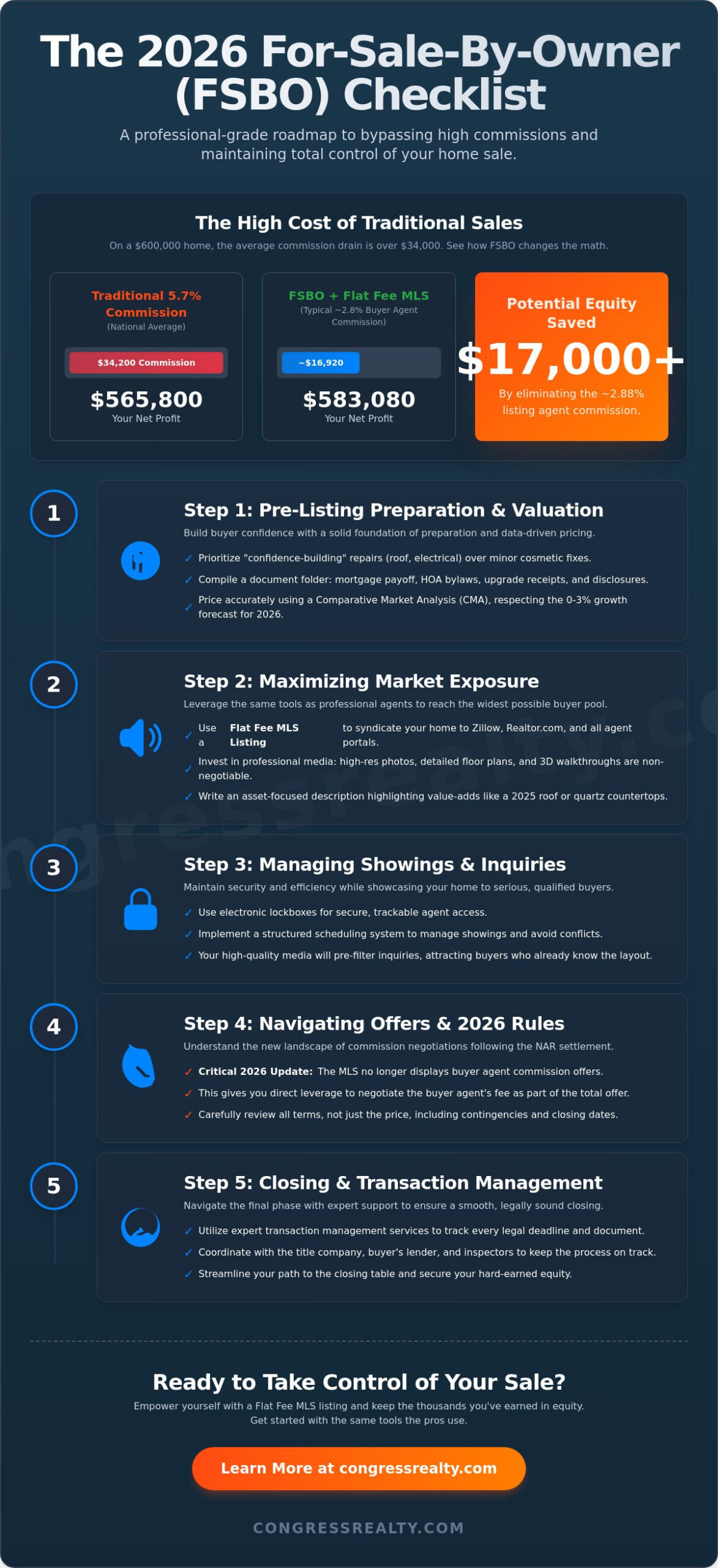
Why would you hand over $17,000 or more of your hard-earned equity just for the “privilege” of selling your own home? With the national average real estate commission sitting at 5.70% as of April 24, 2026, the traditional model is a massive drain on your final profit. You likely feel that the old way of selling is broken, especially with the recent NAR settlement changing how buyer agent compensation works. It’s natural to worry about legal paperwork or exposure, which is why finding a reliable how to sell a house by owner checklist 2026 is the first step toward your financial freedom.
This guide is your professional-grade roadmap to bypassing the standard 2.88% listing commission while maintaining total control. We promise to show you how to master the for-sale-by-owner process using the same tools the pros use, like the Local MLS and professional photography. You’ll gain the confidence to handle every step from pricing to closing. This checklist previews the exact path to a smooth, legally sound sale that ensures thousands saved and puts you back in the driver’s seat of your own transaction.
Key Takeaways
Learn how to conduct a professional property audit and gather critical financial documents to build buyer confidence before your first showing.
Discover how to leverage a Flat Fee MLS listing and professional photography to gain maximum digital exposure without paying a 3% listing commission.
Master our comprehensive how to sell a house by owner checklist 2026 to navigate updated commission rules and legal requirements with total confidence.
Find out how to use electronic lockboxes and structured scheduling to manage professional showings while you maintain total control of the process.
Streamline your path to the closing table by utilizing expert transaction management services to track every legal deadline and documentation requirement.
Step 1: Pre-Listing Preparation and Valuation
Successful sales start with a solid foundation. You’re shifting from “homeowner” to “project manager,” and your first move in this how to sell a house by owner checklist 2026 is gathering the data that proves your home’s value. Buyers in 2026 are highly analytical and they want to see the receipts. Start by identifying “confidence-building” repairs, like fixing a leaky roof or updating an electrical panel, which differ from “presentation” repairs like fresh paint. While presentation helps you get an initial offer, confidence-building repairs ensure the deal doesn’t fall through during the inspection. Taking this proactive approach puts you ahead of traditional listings where agents often wait for the inspection report to react.
The Documentation Audit
Don’t wait for a buyer to ask for paperwork. Compile a digital and physical folder containing your mortgage payoff statement, HOA bylaws, and recent utility bills. If you’ve made significant upgrades, like a new HVAC system installed in 2025, include those receipts to justify a higher asking price. Verifying your property surveys and boundary maps now prevents expensive legal disputes later. You should also prepare a draft of the Seller’s Disclosure Notice early. This transparency is a hallmark of the For Sale By Owner (FSBO) process. It builds immediate trust with potential buyers and their agents, showing them you’re a prepared and professional seller.
Pricing for the 2026 Market
Setting the right price is a science, not a feeling. With home price growth forecast to be flat or modest at 0% to 3% in 2026, overpricing is a dangerous mistake that leads to “stale” listings. You need to analyze recent sales of similar homes in your immediate neighborhood from the last six months to stay relevant. The most effective way to do this is through a Comparative Market Analysis (CMA). This report provides the same data traditional brokers use, allowing you to set a price that reflects true market value. Because you aren’t paying a 3% listing commission, you have more flexibility to price competitively while still walking away with higher net proceeds. This is a critical step in your how to sell a house by owner checklist 2026 because it defines your entire negotiation leverage from day one.
Step 2: Maximizing Market Exposure via the MLS
You can’t sell what people can’t see. While a yard sign is a great local signal, it won’t reach the buyer moving from across the country or the agent searching for their client’s next home. To truly compete, your property must appear on the Local MLS. This is the “source of truth” for the real estate industry. By securing a Flat Fee MLS listing, you place your property on a level playing field with high-commission listings. This approach is a core pillar of any how to sell a house by owner checklist 2026 because it ensures your home automatically syndicates to Zillow, Realtor.com, and hundreds of other major search portals. You retain total control of your sales process while bypassing the traditional 3% listing commission. Note that in 2026, the MLS no longer displays buyer agent commission offers, which gives you more leverage to negotiate these terms directly with interested parties.
Writing your property description requires an objective, asset-focused mindset. Avoid fluff and focus on concrete details that add value. Mention the 2025 roof replacement, the quartz countertops, or the proximity to top-rated schools. Buyers in 2026 are looking for clarity and transparency. If you provide a clear, professional description alongside your listing, you reduce the friction of the transaction and attract higher-quality inquiries. This is about working smarter, not harder, to reach the widest possible buyer pool.
The Power of Professional Media
First impressions happen in milliseconds on a smartphone screen. High-resolution professional photography is the single most important factor in your click-through rate. In 2026, buyers expect more than just static images. They want to see detailed floor plans and 3D walkthroughs to pre-screen the property before they ever request a showing. This saves you time by filtering out “looky-loos” and focusing only on serious, qualified buyers who already know the layout of your home. If your photos are dark, cluttered, or blurry, buyers will swipe past your listing regardless of the price. Investing in professional media is a pragmatic move that pays for itself by driving higher demand and faster offers.
Strategic MLS Listing Management
Once your home is live, active management is the key to success. You need to choose the right package for your specific needs, whether it’s a Standard Listing for the seasoned DIY seller or a Full Service Listing for those who want professional transaction support. Accuracy in your listing data is vital for a smooth closing. Double-check that your contact information is correctly displayed so buyer agents can reach you directly for questions or showing requests. In the fast-moving 2026 market, you must update your listing status immediately as offers arrive. This maintains your professional reputation and prevents wasted time for all parties involved. If you’re ready to take charge, you can list your home on the MLS today and start saving thousands.
Step 3: Managing Showings and Buyer Inquiries
Managing the flow of potential buyers is often the part of the how to sell a house by owner checklist 2026 that homeowners dread most. Traditional agents want you to believe that managing showings is an impossible disruption. It isn’t. It’s simply a matter of using the right professional infrastructure. By taking charge of your own schedule, you ensure that every person walking through your door is a serious contender rather than a “looky-loo” just passing by. This level of oversight protects your time and your property.
Establish a clear showing window that works for your life. You don’t have to be available 24/7. In fact, setting specific times for tours can create a sense of urgency among buyers. After each visit, send a quick digital survey to the buyer or their agent. Analyzing this feedback allows you to make real-time adjustments to your presentation or price. If three different people mention the same minor issue, fix it immediately. This data-driven approach is how savvy owners close deals faster than those relying on a traditional agent’s intuition. You control your sales process, and that includes who enters your home and when.
Security and Accessibility
Safety and security are paramount when you manage your own sales process. Forget the old-fashioned mechanical lockboxes with four-digit codes that never change. Instead, install an electronic lockbox. These devices provide secure, tracked access for buyer agents, sending you an immediate alert when someone enters and exits. You’ll know exactly who was in your home and when. For your external presence, a professional yard sign and post installation signals to the neighborhood that you’re a serious seller. This combination of digital security and physical visibility ensures a professional environment for every viewing without the high cost of a traditional broker.
Vetting Potential Buyers
Don’t let anyone through the door without proof of their ability to pay. This is a non-negotiable rule in 2026. For buyers with financing, require a current pre-approval letter from a reputable lender. For cash offers, ask for a recent bank statement showing proof of funds. Managing these inquiries through a dedicated email address or phone line keeps your personal life separate and organized. By filtering out unrepresented buyers who haven’t started their mortgage process, you focus your energy on qualified, ready-to-act buyers. This pragmatic vetting process is what separates successful sellers from those who get stuck in listing limbo. Using this how to sell a house by owner checklist 2026 ensures you act like a pro at every step.
Step 4: Navigating Offers and 2026 Commission Rules
Receiving your first offer is the moment your hard work pays off, but it’s also where the most critical financial decisions happen. In the 2026 real estate market, the landscape of offers has shifted significantly. You aren’t just looking at the top-line number anymore. You must evaluate the entire Purchase Agreement to understand the true value of the deal. This part of the how to sell a house by owner checklist 2026 requires a pragmatic look at contingencies, timelines, and the buyer’s financial strength. Don’t be afraid to pick up the phone and call the buyer’s lender directly to verify their ability to close. A high offer means nothing if the financing is shaky or the appraisal won’t support the price.
Negotiation is a professional skill you can master with the right data. While traditional agents might push you to accept the first offer to collect their commission, you have the freedom to hold out for the best terms. Counter-offer on items like the earnest money deposit or the length of the inspection period. Increasing the earnest money shows the buyer is serious and has “skin in the game.” If you want to keep more of your equity, you can save thousands by managing your own negotiations instead of paying a listing agent to do it for you.
The Negotiator’s Checklist
Price: Compare the offer against the CMA-backed valuation you established in Step 1. If the offer is lower, use your data to justify your price.
Contingencies: Every contingency is an “out” for the buyer. Look for offers with fewer hurdles, such as waived inspections or shorter appraisal windows.
Timeline: Ensure the closing date aligns with your move-out plans. A flexible buyer is often worth more than a slightly higher price with a rigid schedule.
Handling Buyer Agent Commissions
The 2026 market is defined by commission transparency. Following the NAR settlement, buyer agent compensation is no longer advertised on the MLS. This gives you immense leverage. While the average buyer’s agent commission was 2.42% as of late 2025, you are not required to pay this. You must decide whether to offer a flat fee, a smaller percentage, or no commission at all. Some buyers may even include a request for you to cover their agent’s fee within their offer. Write a clear, concise sentence in your response explaining your stance. Being direct prevents confusion and ensures you maintain the financial advantage. Remember, every dollar you don’t pay in commissions is a dollar that stays in your pocket at the closing table.
Step 5: Closing and Transaction Management
Traditional brokers often claim the closing table is where you’ll fail without their help. They want you to believe the paperwork is a labyrinth only they can navigate. In reality, the heavy lifting is done by a neutral third party, such as a title company or real estate attorney. Your role in this final part of the how to sell a house by owner checklist 2026 is that of a project manager. You’ll coordinate the home inspection and manage any repair requests with a cool, business-like head. If a buyer asks for a $5,000 credit for a minor repair, you have the data to counter or refuse. Using a professional Transaction Management service ensures you never miss a legal deadline, tracking everything from the option period to the final funding.
Once the inspection is complete and repairs are negotiated, you’ll prepare for the final walkthrough. This is the buyer’s last chance to verify the property is in the agreed-upon condition. You’ve already done the hard work of marketing and negotiating; now you simply need to ensure the logistics stay on track. By managing this stage yourself, you maintain total control over the timeline and the final outcome. You aren’t waiting on an agent to relay messages; you’re the one driving the deal to completion.
Navigating Escrow and Title
Selecting a reputable title company is your first move once a contract is signed. They act as the neutral escrow officer, holding the buyer’s earnest money and ensuring all “clouds” on the title are cleared before the transfer. This includes verifying that old liens or boundary disputes are resolved. You’ll review the Bill of Sale and other transfer documents provided by the title company to ensure accuracy. This process is highly standardized, making it easy for any organized homeowner to manage without paying a 3% listing commission. It’s a pragmatic way to finish your how to sell a house by owner checklist 2026 with professional precision.
The Final Equity Check
Before you sign the Closing Disclosure, perform a thorough review of the Settlement Statement. This is your chance to verify that no hidden “junk fees” have crept into the numbers. Check that the 0% listing commission is accurately reflected. In a traditional sale, you’d see a massive deduction for the listing agent’s fee; here, that money stays in your bank account. Once the ink is dry and the loan is funded, you’ve successfully bypassed the high-commission model. Ready to skip the 3% commission? List your home on the MLS today with Congress Realty and keep your equity where it belongs.
Take Command of Your Home Sale Today
Selling your home independently in 2026 is no longer a mystery. It’s a strategic financial choice. By following this how to sell a house by owner checklist 2026, you’ve learned how to leverage professional tools like the Local MLS and CMA reports to bypass the traditional high-commission model. You’ve discovered that managing showings and navigating new commission rules is entirely within your reach when you have the right infrastructure. The power has shifted back to you, the homeowner.
Congress Realty was founded in 2002 to be your professional ally. We’ve helped our clients save over $100 million in commissions by providing expert transaction management and the same visibility as traditional agents. You don’t need to sacrifice professional quality to save your equity. Save thousands by listing your home for a flat fee on the local MLS today!
You have the knowledge and the tools to succeed. Take the first step toward a smarter, more profitable closing. You control your sales process, and the rewards are waiting for you at the finish line.
Frequently Asked Questions
Is it legal to sell my house without a realtor in 2026?
Yes, it is 100% legal to sell your own property in every U.S. state. You have the fundamental right to represent yourself in a real estate transaction. While laws regarding specific disclosures vary by location, no federal or state law requires you to hire a listing agent to sell your home. You can manage the entire process from listing to closing independently.
How much can I actually save by selling by owner?
You can save the traditional listing commission, which averaged 2.88% of the sale price as of April 24, 2026. On a $500,000 home, this equates to $14,400 kept in your pocket. By using a flat fee model, you bypass the high percentage based fees that traditional brokers charge for the same digital exposure. It is a pragmatic way to protect your equity.
What is a Flat Fee MLS listing and why do I need it?
A Flat Fee MLS listing is a professional tool that places your home on the local database used by all real estate agents. You need it because the MLS is the primary source of data for sites like Zillow and Realtor.com. Without it, your property remains invisible to the 89% of buyers who start their search online. It provides professional parity without the high costs.
Do I still have to pay a commission to the buyer’s agent?
You are not legally required to pay a buyer’s agent commission in 2026. Following the NAR settlement, these offers are no longer advertised on the MLS. You can choose to offer a flat fee, a smaller percentage, or nothing at all. However, offering a competitive rate may attract a larger pool of buyers who have already signed representation agreements with their agents.
How do I handle the paperwork for selling a house by owner?
You handle the paperwork by utilizing professional transaction management services and a reputable title company. This how to sell a house by owner checklist 2026 recommends having a real estate attorney review your contracts to ensure legal compliance. Most of the technical closing documents are prepared by the title company or escrow officer, making the process much simpler than traditional agents suggest.
What happens if a buyer doesn’t have an agent?
If a buyer is unrepresented, you deal with them directly and save the entire commission. This is often the most profitable scenario for a seller. You should still require a pre-approval letter or proof of funds before showing the home. In these cases, a title company or attorney ensures the contract remains legally sound for both parties without the need for intermediaries.
Can I list my home on the MLS for a flat fee and still sell it myself?
Yes, listing for a flat fee allows you to retain total control of your sales process. You manage the showings, negotiate the offers, and keep your equity. The service provides the professional infrastructure of the LOCAL MLS while you act as the primary point of contact for all inquiries. It is the perfect middle ground that provides professional exposure without the 3% listing fee.
How do I price my home correctly without an agent?
You price your home correctly by using a professional Comparative Market Analysis (CMA). This report uses the same sold data from the last six months that appraisers and agents use. Don’t rely on automated online estimates, which can be inaccurate by 5% or more. A data-driven CMA ensures you don’t leave money on the table or let your listing go stale in the 2026 market.