Traditional real estate commissions in Washington State typically range from 5.5% to 5.9% of a home’s sale price when covering both listing and buyer’s agents. For Olympia sellers facing these hefty percentage-based fees, flat-fee MLS listing services present a compelling alternative that can save thousands of dollars while still providing market exposure.
The real estate landscape has shifted dramatically since the National Association of Realtors’ ruling in March 2024, giving sellers more flexibility in how they structure agent compensation. Congress Realty’s flat-fee packages for Olympia sellers capitalize on this change by offering predictable, upfront pricing rather than percentage-based commissions that can reach $16,000 or more on a typical Olympia home.
Congress Realty’s Four Packages Replace Traditional 2.5-3% Listing Commissions
Rather than paying 2.5% to 3% of the final sale price just for listing services, sellers can choose from four distinct tiers that align with their comfort level and desired involvement in the selling process. Each package provides MLS exposure across Thurston County and syndication to major real estate websites, giving sellers the market reach they need without the traditional commission burden.
The tiered approach recognizes that not every seller needs the same level of support. Some homeowners prefer to handle showings and negotiations themselves, while others want professional guidance through closing. This flexibility allows sellers to pay only for the services they actually need.
Breaking Down Each Congress Realty Package Price Point
The $299 Basic package provides core MLS listing functionality for sellers comfortable managing most aspects of the sale themselves. This entry-level option includes up to 6 photos in the MLS, 5 listing changes during the 6-month term, and access to Washington state forms and disclosures. Sellers maintain direct contact information in the listing, allowing potential buyers and agents to reach them directly.
The $399 Plus package adds practical tools that streamline the selling process without requiring full agent involvement. Sellers gain access to e-signature tools, automated phone lead forwarding, and the ShowingTime appointment-scheduling system. Additional features include unlimited open house postings, social media promotion, and the ability to upload the maximum number of photos allowed by the MLS.
The $499 Premium package represents the most complete self-service option, offering unlimited MLS changes and maximum photo uploads along with all the convenience features from the Plus tier. The unlimited changes feature proves particularly valuable in Olympia’s current market conditions, where sellers may need to adjust pricing or showing instructions in response to buyer feedback.
The $399 + 0.5% Full-Service hybrid package bridges the gap between flat-fee and traditional commission structures by combining an upfront fee with a small percentage at closing. This option includes everything in the Premium package, plus dedicated 24/7 agent support, full negotiation assistance, contract review, and transaction closing support.
Standard Features Across All Tiers
Every Congress Realty package provides six-month MLS exposure with automatic syndication to major real estate platforms, including Realtor.com, Zillow, and Trulia. All packages include access to Washington state-required forms and disclosures, providing legal compliance throughout the transaction. Sellers maintain control over setting the buyer’s agent commission, allowing them to remain competitive while managing their total selling costs.
At Olympia’s median home price of $558,446, a traditional 2.5% listing commission would cost $13,961 alone. When combined with the typical buyer’s agent commission of 2.5% to 3%, total commission costs can reach $27,922 to $33,507 before accounting for additional closing costs and fees.
Even the most expensive Congress Realty package saves substantial money compared to traditional listing commissions. The Premium package at $499 saves over $13,400 compared to a 2.5% listing commission on the median Olympia home. The Full-Service hybrid option costs approximately $3,191 on a median-priced home — still providing savings of over $10,700 compared to traditional listing commissions while maintaining professional support throughout the transaction.
Choosing Your Package Based on Involvement Level
Sellers who are comfortable managing their own transactions should focus on the three flat-fee options that best match their desired level of convenience and flexibility. The Basic package suits experienced sellers who primarily need flat fee MLS exposure and can handle inquiries and showings independently. The Plus package adds valuable automation tools for sellers who want to streamline coordination without hiring full representation.
Sellers who prefer professional guidance should consider the Full-Service hybrid option, which provides dedicated agent support at a fraction of traditional commission costs. The hybrid model works particularly well for first-time sellers, out-of-state owners, or anyone who values professional guidance but wants to avoid traditional commission rates.
Why would you hand over $15,000 or more in commissions just to have someone else list your home on the open market? It’s a question more homeowners are asking in 2026 as they look for ways to protect their equity without losing out on professional results. You’ve likely heard that fsbo.com offers a path to savings, but you might be wondering if a simple listing site provides enough armor to actually close the deal. It’s natural to feel a bit anxious about handling legal paperwork or missing out on the 95% of buyer agents who search the MLS every single day.
We agree that you shouldn’t have to choose between saving money and selling successfully. This guide will show you how to bridge that gap by comparing FSBO platforms with professional flat fee MLS services. You’ll discover how to get maximum market exposure and keep your equity while using the same tools the pros use, such as professional photography and electronic lockboxes. We’re breaking down the 2026 costs and features so you can lead the process with total confidence and a streamlined, professional-grade workflow.
Key Takeaways
Learn the critical difference between a lead-generation site like fsbo.com and a licensed brokerage that provides direct access to the professional MLS.
Identify why professional-grade tools, such as high-end photography and electronic lockboxes, are essential for attracting buyer agents and securing your home.
Master a simple decision framework to assess your local market complexity and determine the best way to sell your house without a traditional realtor.
Discover how to replace the high-cost commission model with a transparent, fixed-fee structure that preserves your hard-earned home equity.
Understand how utilizing professional infrastructure and transaction management can streamline your selling process from the first listing to the final closing.
Selling your home independently is a strategic financial move designed to keep your equity where it belongs: in your pocket. The For Sale By Owner movement has evolved from simple yard signs into a high-tech, digital-first marketplace. Today, savvy homeowners use professional platforms to bypass the traditional 3% listing agent commission, which can save tens of thousands of dollars on a single transaction. This shift is fueled by a desire for transparency and the realization that modern technology has made the selling process more accessible than ever before.
fsbo.com functions as a national lead-generation and marketing platform tailored for these independent sellers. It provides a centralized hub where you can list your property and manage initial inquiries. Unlike a traditional brokerage that manages every detail of your sale, this platform acts as a megaphone for your listing. It gives you the space to present your home to the public while you maintain total control over the details. By using such a platform, you position yourself as the lead negotiator in your own real estate transaction.
The Core FSBO.com Service Tiers
The platform offers several service levels to match different seller needs. The Starter Plan is the most basic entry point. It allows for a short-term listing on the proprietary website with a very limited number of photos. While this provides a web presence, its exposure is restricted to users specifically browsing that one site. The Plus Plan extends the listing duration and allows for more visual content, which helps your home stand out to potential buyers searching the platform’s database.
For those seeking wider reach, the MLS Plan is the most robust option. Because fsbo.com is a marketing site and not a brokerage in every state, they often partner with third-party licensed brokers to fulfill these orders. This plan syndicates your listing to major real estate portals like Zillow and Realtor.com. This ensures your home appears where 95% of buyer agents are looking every day. It bridges the gap between a private sale and the professional market infrastructure.
Why Homeowners Choose DIY Platforms
Financial intelligence is the primary driver behind the DIY trend. In a competitive market, protecting your home equity is a top priority. Homeowners recognize that paying a massive percentage of their sale price for tasks they can manage themselves is no longer the only option. They choose these platforms to gain autonomy over their schedules and pricing strategies. You know the unique selling points of your home better than any outside party ever could.
Digital-first transactions have also simplified the process. Modern sellers are comfortable using online tools for analytics and communication. They prefer the directness of managing their own showings and negotiations. This hands-on approach reduces the risk of miscommunication and speeds up the decision-making process. By choosing a self-directed path, you ensure that every step of the sale aligns with your specific financial goals and timeline.
FSBO.com vs. Flat Fee MLS Brokerages: Understanding the Difference
Do you know who actually owns your listing? Many sellers assume that posting on a website is the same as being active in the professional marketplace. It’s not. There is a fundamental gap between a marketing platform and a licensed real estate brokerage. While fsbo.com provides a high-traffic space for you to display your home, it doesn’t automatically grant you the legal standing of a professional listing. A marketing site is a tool for visibility; a brokerage is a partner in compliance and market authority.
When you work with a licensed brokerage, you have a Designated Broker overseeing your transaction. This professional infrastructure ensures your paperwork meets state requirements and protects you from common legal pitfalls. Marketing-only platforms often leave you to handle these complexities alone. By choosing a direct brokerage relationship, you gain the security of professional oversight without the burden of a traditional 3% listing commission. This distinction is the key to maintaining control while ensuring your sale is handled with professional-grade precision.
The Power of the Multiple Listing Service (MLS)
The real engine of the real estate industry is the Multiple Listing Service. This is the database that feeds every major search portal, including Zillow, Realtor.com, and Redfin. If your home isn’t active on the local MLS, you’re effectively operating in a shadow market. Research shows that 95% of buyer agents search the MLS daily to find homes for their clients. Without this exposure, you’re missing the vast majority of qualified buyers.
Data supports the need for this professional reach. A recent National Association of REALTORS® report highlights that pure FSBO sales have reached all-time lows as more sellers recognize they need agent-facing exposure to get top dollar. Simply listing on fsbo.com might get you some eyeballs, but it doesn’t guarantee the syndication required to trigger a bidding war. You need a direct link to the professional databases that agents trust.
Direct Brokerage vs. Referral Networks
Many “middleman” websites are actually referral networks in disguise. When you pay them, they sell your data to a random local broker you’ve never vetted. This creates a fragmented experience where the person holding your listing has no direct accountability to you. Congress Realty operates differently as a direct brokerage. We own the listing directly, which means you have a straight line to the experts managing your file. This eliminates the confusion of dealing with third-party vendors who don’t understand your specific goals.
Ensuring professional oversight throughout the steps to selling a house is vital for a smooth closing. You shouldn’t have to guess if your disclosures are correct or if your listing is active. If you’re ready to move beyond basic marketing and secure a professional listing that protects your equity, consider how a direct brokerage model can simplify your journey.
Feature Showdown: Comparing DIY Plans to Professional Flat Fee Listings
How does your home look to a buyer scrolling through thousands of listings at midnight? The difference between a quick, high-value sale and a stagnant listing often comes down to the professional infrastructure you wrap around your property. While fsbo.com provides a functional platform for your data, the quality of the assets you choose to display determines your ultimate trajectory. You are the CEO of this transaction. Every asset you deploy should reflect the high value of your investment and your commitment to a professional result.
Presentation is your most powerful negotiation tool. If your listing features grainy, DIY cell phone photos, you’re already starting at a disadvantage. Professional photography is a non-negotiable requirement in 2026. High-end visuals drive massive click-through rates on major portals because they create an immediate emotional connection. When you pair these visuals with a professional yard sign and post, you send a clear signal to the market that this is a premium sale. Cheap, store-bought plastic signs often have the opposite effect, inadvertently lowering the perceived value of your home in the eyes of savvy buyers.
Marketing Assets That Drive Higher Offers
Visual impact is only one part of the equation. Pricing is where many independent sellers lose their footing. Guessing your home’s value based on neighborhood rumors is a recipe for disaster. A Comparative Market Analysis (CMA) provides the data-driven foundation you need to price your home accurately and avoid leaving money on the table. Understanding the pros and cons of a FSBO sale requires a pragmatic look at these tools. You need the same data-driven insights that traditional agents use, but without the 3% listing fee.
Professional infrastructure doesn’t just attract buyers; it qualifies them. When your listing looks like a professional brokerage entry, you attract serious inquiries. This reduces the time you spend dealing with “looky-loos” who aren’t ready to pull the trigger. It’s about working smarter to protect your equity while maintaining total command over the process.
Security and Coordination Tools
Security is a paramount concern for any modern homeowner. Electronic lockboxes have become mandatory for serious sellers in 2026. These devices provide a secure, trackable way for buyer agents to show your home without you needing to be present. This level of accessibility is what gets more agents through your door. While fsbo.com offers a starting point for visibility, it often lacks the high-level security features required for modern showings. Professional tools remove these friction points and provide peace of mind.
Managing the flow of a sale requires more than just a place to list your address. You need a system that handles showing requests and filters out unqualified parties. Using professional transaction management and coordination tools allows you to maintain total control while the system handles the logistical heavy lifting. This streamlined approach ensures that every interaction with a potential buyer is professional, secure, and geared toward a successful closing. By investing in the right infrastructure, you turn your home into a high-performing asset that commands respect from the moment it hits the market.
Choosing Your Path: A Decision Framework for Savvy Sellers
Are you ready to take the driver’s seat in the most significant financial transaction of your life? Deciding how to list your property requires more than just a desire to save money; it requires a strategic assessment of your goals. Your first step is to assess your comfort level with selling a house without a realtor. While the financial rewards are high, you must be prepared to lead the process from the initial listing to the final signature. If you value autonomy and have a basic understanding of real estate logistics, you’re already ahead of the curve.
Next, evaluate the complexity of your local market. High-demand areas might move quickly, but a sophisticated market requires a professional valuation to ensure you don’t leave money on the table. This is where you determine if a simple listing on fsbo.com provides enough support or if you need the professional armor of a brokerage. You must also decide if you have the bandwidth for Transaction Management. Handling escrow, title coordination, and closing paperwork is a detailed process that demands precision. If these tasks feel overwhelming, a professional flat fee package can bridge the gap while still protecting your equity.
The final step is a direct cost-benefit analysis. Compare the total cost of a basic DIY platform against a professional flat fee package that includes essential tools. A bare-bones listing might seem cheaper upfront, but it often lacks the professional photography, electronic lockboxes, and yard signs that drive higher offers. Calculate the real return on investment by looking at your projected net profit. Savvy sellers recognize that spending a few hundred dollars on professional infrastructure often results in a sale price that is thousands of dollars higher.
Evaluating Your Transactional Needs
Do you have the time to coordinate with inspectors, appraisers, and title companies? There is a massive difference between getting a lead and successfully closing a deal. A Standard Listing is excellent for the experienced seller who wants maximum autonomy. However, if you prefer a partner to handle the logistical heavy lifting, a Full Service Listing offers the comprehensive support you need. Choose the level of service that matches your schedule and your confidence level.
Calculating the Real ROI
A slightly higher upfront fee for professional tools is an investment in your final sale price. DIY mistakes, such as legal errors or missed deadlines, carry hidden costs that can derail your entire transaction. Adopt an equity-first mindset. Focus on the net profit you will walk away with at the end of the day. By using professional-grade resources, you eliminate the risk of stagnation and ensure your home is positioned as a premium listing. If you are ready to maximize your gain, view our professional listing packages to find the right fit for your home.
Why Congress Realty is the Ultimate Alternative to FSBO.com
Why settle for a middleman when you can work directly with the experts? While fsbo.com serves as a useful marketing platform, it often lacks the direct accountability that comes from a licensed brokerage relationship. We’ve built a model that removes the traditional 3% listing commission while giving you the professional armor you need to win. You keep your command over the process, but you don’t have to go it alone. This is the difference between simply being “online” and being professionally represented in the marketplace.
Our tiered packages provide the exact infrastructure used by high-cost traditional agencies. This includes high-end Professional Photography to capture buyer attention and an Electronic Lockbox to manage secure, trackable showings. We don’t just give you a digital listing; we give you a professional presence. By combining a professional Yard Sign and Post with a data-driven Comparative Market Analysis (CMA), you position your home as a top-tier contender. You gain all the tools of a professional agent while maintaining the financial intelligence of a private seller.
Professionalism Without the Commission
We bridge the gap between a private sale and a full-service experience. You get the peace of mind that comes from knowing how to sell your house on your own while having a professional broker manage the background logistics. Our Transaction Management options ensure that your escrow and closing paperwork are handled with surgical precision. This eliminates the anxiety of handling legal documents alone and prevents the common errors that derail DIY transactions.
Our commitment to homeowner autonomy means we provide the infrastructure and then step back to let you lead. You decide on the pricing, you manage the negotiations, and you reap the rewards. It’s a pragmatic approach to real estate that values your time and your equity. Instead of losing a massive percentage of your home’s value to commissions, you pay a predictable, fixed cost for the specific services you need.
Taking the Next Step Toward Your Sale
Choose the level of support that fits your specific goals. Our Standard Listing offers the perfect balance of exposure and autonomy for the savvy seller who wants to manage their own path. If you want a more comprehensive approach to the paperwork and closing process, our Full Service Listing provides the professional oversight required for a seamless transaction. We’ve demystified the professional listing process so you can move forward with total confidence.
Don’t leave your equity to chance with a basic marketing site. Secure a professional-grade listing that commands respect from buyer agents and maximizes your net profit. Ready to save your equity? Explore our listing packages and get on the MLS today.
Secure Your Equity with Professional Market Authority
Selling your home in 2026 is about more than just finding a buyer; it’s about maximizing the return on your largest investment. You’ve seen that the difference between a stagnant listing and a successful closing lies in the professional infrastructure you choose to deploy. While platforms like fsbo.com offer a starting point for marketing, they often leave a gap between listing your home and actually securing a professional closing. Licensed brokerage oversight ensures you have the legal armor and market reach required to compete with traditional agencies.
Congress Realty has been a leader in this space since 2002, providing national coverage and the professional tools you need without the burden of a 3% listing commission. Our fixed-cost model puts you back in command, giving you access to professional photography, electronic lockboxes, and dedicated transaction management. You deserve a streamlined process that prioritizes your equity over industry tradition. Keep your equity—list your home on the MLS with Congress Realty today! You have the intelligence and the tools to lead this sale to a successful finish.
Frequently Asked Questions
Is FSBO.com the same as the Multiple Listing Service (MLS)?
No, fsbo.com is a national marketing and lead-generation platform, not the MLS. The Multiple Listing Service is a professional database reserved exclusively for licensed real estate brokers. While the platform offers packages that syndicate to the MLS through third-party partners, a standard listing only appears on their proprietary website.
Do I still have to pay a buyer’s agent commission when using FSBO.com?
You aren’t legally required to pay a buyer’s agent commission, but it’s a standard practice to attract professional agents. Most sellers offer between 2.5% and 3% to ensure their home is shown to the widest pool of qualified buyers. This commission is only paid if an agent brings a buyer who successfully closes on the property.
Can I list on the MLS without a licensed real estate broker?
No, you cannot list directly on the MLS without a licensed broker. As of 2026, every MLS in the country requires a licensed professional to submit and manage the listing. This regulation ensures data accuracy and compliance with local real estate laws. Working with a flat fee brokerage satisfies this requirement while letting you keep your equity.
What is the difference between FSBO.com and a flat fee MLS service like Congress Realty?
The primary difference is the business model. fsbo.com is a marketing site that often refers MLS orders to outside brokers. Congress Realty is a direct, licensed brokerage that owns your listing from start to finish. This direct relationship provides better accountability and access to professional tools like electronic lockboxes and transaction management.
Will my home show up on Zillow and Realtor.com if I list on FSBO.com?
Your home will only appear on Zillow and Realtor.com if you purchase a package that includes MLS syndication. Basic web listings typically remain restricted to the platform’s own database. To reach the 95% of buyer agents who search the MLS daily, you need a package that pushes your data to these major national portals.
What happens if I need help with contracts or closing paperwork?
If you use a basic marketing platform, you’re generally responsible for your own legal paperwork and escrow coordination. This can lead to anxiety and potential legal errors. Choosing a service with Transaction Management provides professional oversight for your contracts and closing documents, ensuring a streamlined and secure path to the final signature.
Is it worth paying for professional photography when selling FSBO?
Yes, professional visuals are a critical investment for any independent seller. Data from 2025 shows that homes listed with high-quality video and photos sell 6% faster on average. In a digital-first market, your online presentation is the first and most important negotiation tool you have to drive higher offers.
How do I handle home showings and security when selling on my own?
Security and coordination are best handled through professional-grade tools like electronic lockboxes. These devices allow you to grant secure, trackable access to licensed buyer agents without you needing to be present for every showing. This makes your home more accessible to busy agents while protecting your property and your time.
Image sourced from Canva
Summary: Sacramento homeowners are paying over $14,000 more than necessary to sell their homes—but a simple commission strategy shift could keep that money in their pockets. Here’s how savvy sellers are using flat fee MLS to slash costs without sacrificing exposure.
Key Takeaways
Based on a $440,000 home sale, Sacramento homeowners could save over $14,000 by using flat-fee MLS services instead of traditional listing agent commissions, paying a fixed fee of $299-$499 rather than 2.5-3% of the sale price.
The 2024 NAR settlement eliminated the requirement that sellers offer buyer agent commissions through the MLS, giving sellers complete flexibility over compensation negotiations.
MetroList MLS provides the same exposure as traditional listings, automatically syndicating properties to Zillow, Realtor.com, and other major real estate platforms.
Three critical factors determine whether a flat fee MLS saves money: home value, seller experience level, and current market conditions in Sacramento.
Sacramento Sellers Save $14,000+ by Replacing Traditional Listing Agent Commission.
Sacramento real estate commissions typically range from 5% to 6%, creating a substantial expense for homeowners selling properties in today’s market. On a $440,000 home—close to Sacramento’s current median—traditional realtor fees amount to approximately $24,068. This commission structure has remained largely unchanged for decades, even as technology has simplified many aspects of real estate marketing and buyer discovery.
The mathematics reveal the opportunity clearly. A seller using a flat-fee MLS service pays between $299 and $499 for professional listing placement, compared to $13,200 for a 3% listing agent commission on the same $440,000 property. Congress Realty, a Sacramento broker specializing in flat-fee MLS services, estimates savings of more than $14,000 for typical Sacramento transactions through its fixed-fee approach.
These savings become even more significant as home values continue rising. Sacramento’s housing market shows median prices around $550,000 as of April 2024, with properties averaging 20 days on market. The combination of higher home values and stable market conditions creates an ideal environment for cost-conscious selling strategies.
What is a Flat Fee, MLS Listing
Fixed Fee vs. Percentage Commission Model
Flat fee MLS listing operates on a fundamentally different economic model than traditional real estate representation. Instead of paying a percentage of the final sale price, homeowners pay a predetermined flat rate—typically ranging from $99 to $2,500 nationally, with Sacramento-specific options often falling within the $299-$499 bracket—for professional MLS entry and basic listing services. This approach eliminates the direct correlation between home value and listing costs that has defined real estate transactions for generations.
The percentage commission model creates an inherent misalignment between seller costs and actual services provided. Whether a home sells for $300,000 or $800,000, the effort required to create MLS listings, upload photos, and syndicate them to major real estate websites remains essentially the same. Flat-fee services recognize this reality by charging based on service complexity rather than transaction value, allowing sellers to retain significantly more equity in their sales.
MetroList MLS and Automatic Syndication Coverage
MetroList MLS serves as the backbone of Northern California’s real estate market, connecting over 23,000 real estate professionals across Sacramento, Placer, El Dorado, Yolo, and San Joaquin counties. When properties enter MetroList through flat-fee services, they receive the same treatment as traditional agent listings, appearing in the same search results and receiving the same exposure to buyer agents throughout the region.
Automatic syndication typically ensures flat fee listings appear on Zillow, Realtor.com, Redfin, and Trulia within 1-2 business days of MLS entry. This syndication process operates identically for flat fee and traditional listings, meaning sellers sacrifice no marketing reach by choosing the cost-effective approach. Individual broker websites also display these properties through IDX feeds, maintaining wide market exposure regardless of listing method.
Key Changes from the 2024 NAR Settlement
Optional Buyer Agent Commissions
The 2024 NAR settlement fundamentally transformed buyer agent compensation, effective August 17, 2024. Sellers no longer face mandatory requirements to offer buyer agent commissions through MLS listings, making this compensation entirely optional and negotiable. This change particularly benefits flat fee MLS users, who can now determine buyer agent offers on a case-by-case basis rather than following traditional commission structures.
Despite these regulatory changes, market behavior has evolved gradually. Some sellers choose to continue offering buyer agent commissions ranging from 2% to 2.5% to maintain broad appeal among agent-represented buyers. However, the flexibility now exists to adjust these offers based on market conditions, buyer interest levels, or individual negotiation circumstances, providing sellers with unprecedented control over commission expenses.
New Written Agreement Requirements
The settlement introduced mandatory written agreements between buyers and their agents before property showings can occur. These agreements must explicitly outline compensation arrangements, eliminating the previous system where buyer agent pay was automatically assumed and included in listing arrangements. This transparency requirement benefits flat-fee sellers by ensuring that all parties understand compensation structures upfront.
These written agreements create opportunities for direct negotiation between buyers and sellers regarding agent compensation. Rather than accepting predetermined commission splits, sellers can now negotiate buyer agent fees as part of purchase negotiations, potentially reducing total transaction costs while maintaining professional representation for interested buyers.
Congress Realty’s Sacramento Flat Fee Plans
Basic Plan ($299)
Congress Realty’s Basic Plan provides essential flat-fee MLS services for Sacramento sellers who are comfortable managing most aspects of their transaction independently. This $299 package includes a six-month MetroList listing placement, up to four professional MLS photos, five free listing modifications, and automatic buyer lead forwarding. The plan covers Sacramento County plus surrounding areas, including Placer, El Dorado, and Nevada counties.
Sellers receive access to California state-approved disclosure forms and basic MLS compliance support, ensuring legal requirements are met without additional legal consultation in most cases. The six-month listing period provides adequate time for typical Sacramento market conditions, where homes average 20 days to pending status. This plan works best for experienced sellers familiar with real estate contracts and negotiation processes.
Plus Plan ($399)
The Plus Plan expands on basic services with improved listing management tools and increased flexibility. For $399, sellers receive unlimited MLS photos, ten free listing changes, DocuSign integration for contract management, and ShowingTime scheduling tools. These additions streamline the selling process while maintaining the cost advantages of flat fee listing.
DocuSign integration particularly benefits busy sellers by enabling remote contract review and signing, which is essential in today’s fast-moving Sacramento market. ShowingTime coordination reduces the administrative burden of scheduling property viewings, automatically managing agent and buyer requests while providing sellers with advance notice and control over access timing.
Premium Plan ($499)
Congress Realty’s Premium Plan offers comprehensive flat-fee services for sellers seeking maximum support while retaining cost savings. This $499 package includes unlimited listing changes, open house posting capabilities, social media promotion features, and dedicated agent consultation. The plan provides near-traditional service levels at a fraction of the cost of conventional commissioning.
Social media promotion extends marketing reach beyond MLS syndication, targeting local Sacramento buyer networks through Facebook and Instagram advertising. Dedicated agent consultation offers professional guidance on pricing strategy, market positioning, and negotiation tactics without the ongoing percentage-based compensation structure. This plan suits first-time flat fee users or sellers managing complex property situations.
Real Dollar Savings on Sacramento Home Sales
Commission Breakdown by Home Value
Sacramento’s current market conditions create substantial savings opportunities through flat fee MLS approaches. At the median home value of $550,000, traditional 5.5% commissions total $30,250, compared to flat fee costs of $299 to $499. Even accounting for optional buyer agent commissions of 2.5% ($13,750), total selling costs with flat fee MLS remain under $14,249—less than half of traditional approaches.
These savings scale dramatically with home values. A $700,000 Sacramento property—increasingly common in desirable neighborhoods like East Sacramento and Midtown—incurs $38,500 in traditional commissions. Using a flat-fee MLS with competitive buyer-agent compensation reduces total costs to approximately $18,249, creating savings exceeding $20,000 per transaction.
Total Cost Comparison Analysis
Complete cost analysis reveals the true financial impact of commission strategy choices. Traditional full-service arrangements, averaging 5.5%, incur the highest expenses but include negotiation support and transaction management. Flat-fee MLS with optional buyer-agent compensation typically costs around 2.6% of the sale price, while pure FSBO approaches can achieve sub-1% costs but require significant time investment and expertise.
Sacramento market dynamics favor flat fee approaches due to strong buyer demand and relatively quick sale timelines. Properties receiving multiple offers within days of listing reduce the value proposition of extensive marketing services while maintaining the importance of MLS exposure and professional presentation. The cost-benefit analysis clearly favors a flat-fee MLS under these market conditions.
Step-by-Step Flat Fee Listing Process
Choose Plan and Submit Listing Details
The flat-fee listing process begins with plan selection based on the desired support level and listing complexity. Sacramento sellers should consider property type, personal experience, and available time for transaction management when choosing between basic, enhanced, or premium service levels. Most providers offer plan upgrades during the listing period if additional services become necessary.
Listing detail submission requires detailed property information, including square footage, bedroom and bathroom counts, lot size, and notable features. High-quality photos significantly impact buyer interest, with most successful flat-fee listings featuring 15-25 professional images of interior and exterior spaces. Detailed property descriptions should highlight unique features, neighborhood advantages, and recent improvements to maximize appeal.
Set Buyer Agent Commission Strategy
Post-NAR settlement flexibility allows strategic decisions about buyer agent compensation based on market conditions and property characteristics. Sacramento’s competitive market generally supports buyer agent offerings between 2% and 2.5%, ensuring broad agent participation while maintaining seller savings. Unique or highly desirable properties may attract buyer interest with lower or zero buyer agent compensation.
Sellers should consider current inventory levels, property location, and pricing strategy when determining buyer agent offers. Higher-end properties or those in slower-moving market segments benefit from competitive buyer agent compensation. In contrast, properties in high-demand areas like Elk Grove or Folsom may succeed with reduced or negotiable buyer agent fees.
Manage Showings and Negotiate Offers
Active listing management requires responsive communication and flexible scheduling to accommodate buyer interest. Most flat-fee providers include showing coordination tools, but sellers must remain available for last-minute requests and to collect feedback. Professional presentation during showings significantly impacts buyer impressions and offer quality.
Offer negotiation is the most critical phase of flat-fee selling, where professional guidance is most valuable. Sellers should carefully review contract terms beyond price, including contingencies, closing timelines, and repair obligations. Many flat fee providers offer consultation services or upgrade options for complex negotiations, maintaining cost savings while ensuring professional transaction support.
When Flat Fee MLS Makes Sense for Sacramento Sellers
Flat-fee MLS is most effective for Sacramento sellers with prior real estate transaction experience, properties in high-demand locations, and situations where commission savings significantly impact net proceeds. The strategy works particularly well in East Sacramento, Midtown, Elk Grove, and Folsom, where strong buyer demand reduces marketing requirements while maintaining quick sale timelines.
Market conditions also influence the success rates of flat-fee arrangements. Sacramento’s current environment—characterized by moderate inventory levels, steady buyer demand, and average 20-day selling periods—favors cost-effective approaches that maintain professional MLS exposure. Sellers with unique properties, complex situations, or limited transaction experience may benefit from traditional full-service representation despite higher costs.
High-equity homeowners gain the most from flat-fee strategies, as commission savings directly increase the net proceeds available for future investments or personal use. Real estate investors managing multiple transactions can achieve substantial cost reductions through systematic flat fee approaches, improving overall investment returns while maintaining market access and professional presentation standards.
Congress Realty continues to help Sacramento homeowners navigate flat-fee MLS options while maximizing their selling success atcongressrealty.com.
Why would you hand over $20,374 of your home equity just to get your property noticed? As of May 2026, the national average real estate commission has climbed to a five-year high of 5.70%. Real estate listing syndication is the actual engine that puts your home in front of buyers on over 900 websites, and you don’t need a traditional agent to access it. You probably feel that selling independently means sacrificing visibility or getting lost in the digital noise. It’s a common fear, especially when the mechanics of how property data travels online seem like a guarded industry secret.
This guide will show you how to master the digital megaphone of the MLS to ensure 100% market visibility while keeping your hard-earned equity where it belongs. We’ll demystify the process of how your listing moves from a professional database to major portals. You’ll learn how to use flat-fee services to access professional networks and manage your property data like a pro. By the end of this article, you’ll have a clear, step-by-step roadmap to maximizing your home’s exposure without the burden of high-commission costs.
Key Takeaways
Identify how the professional MLS acts as the “source of truth” to keep your property data accurate and consistent across every corner of the web.
Master the difference between IDX and real estate listing syndication to ensure your home appears on both local agent websites and massive national consumer portals.
Secure professional-grade visibility on over 900 websites for a fixed fee instead of losing your home equity to a traditional percentage-based commission.
Leverage the power of automated data aggregators to push your listing to the world’s most-visited real estate platforms the moment you go live.
Combine your digital reach with professional photography to ensure your property captures buyer attention and drives competitive offers in the 2026 market.
What is Real Estate Listing Syndication and Why is it Critical?
Why would you limit your potential buyer pool to just a few local connections? In the modern market, real estate listing syndication is the essential tool that ensures your property is visible to every active buyer in the country. It is the automated distribution of your property data from the professional Multiple Listing Service (MLS) to hundreds of public-facing websites. Instead of your home sitting in a private database, syndication acts as a broadcast system that pushes your listing to the platforms where buyers actually spend their time.
Visibility is the primary factor in driving competitive offers and securing a higher sale price. Industry data from sources like ListHub shows that nearly 96% of consumers now use online tools during their home search. This massive shift from print media to digital platforms means your home must be where the eyeballs are. When you use a professional syndication network, your home doesn’t just appear on Zillow or Realtor.com; it populates on news sites, local brokerage pages, and niche real estate search engines. This creates a relationship where the local MLS acts as the “source of truth” and national platforms act as the storefronts for your property data.
The Digital Megaphone for Your Home
A single entry into the MLS triggers a massive web presence. This is far more efficient than trying to post your home manually on individual websites. Manual listing is a recipe for disaster. It leads to inconsistent data, outdated pricing, and missed opportunities that can cost you thousands. By using a professional system, you ensure that Realtor.com and other major sites display the most accurate, professional face of your property. This automation saves you hours of work and ensures your listing remains legally compliant across all platforms without you having to lift a finger.
Maximum Exposure vs. Private Listings
Don’t fall for the trap of “pocket listings” or off-market sales. These private deals might sound exclusive, but they often lead to lower sale prices because they lack the pressure of competition. In a high-interest environment, you need the “bidding war” effect that only comes from maximum exposure. This reach is powered by Internet Data Exchange (IDX) and syndication agreements that connect your home to every possible buyer. Whether it’s a national giant or a small local blog, your home will be there. This level of exposure puts you in total command of the sale and ensures you don’t leave your hard-earned equity on the table.
How the Syndication Cycle Works: From Your Living Room to the World
How does your house travel from your living room to a smartphone screen in another state? It isn’t magic; it’s a structured cycle that relies on a single “Source of Truth.” Every successful real estate listing syndication strategy begins with a professional entry into your local Multiple Listing Service (MLS). This database is the authoritative record that every major portal trusts. When you bypass this step by trying to post manually on separate sites, you’re essentially shouting into a void without a microphone. Professional buyers and agents look for the MLS verification stamp before they even consider an inquiry.
Once your data is in the MLS, aggregators like ListHub step in to handle the heavy lifting. These platforms act as the delivery service; they clean your data and push it out to hundreds of publishers across the globe. Timing is everything here. While your listing will often appear on major sites within 24 to 48 hours, the quality of that first impression is what matters most. Using professional photography ensures that when the syndication engine fires, your home looks its absolute best on every screen. High-quality data, including a well-researched Comparative Market Analysis (CMA), ensures your price is competitive from day one. This prevents your listing from being ignored by savvy buyers who are looking for value in a crowded market.
The Path of a Digital Listing
The journey follows a specific, three-step sequence that guarantees your home gets the attention it deserves:
Step 1: Data Entry. Your property details are entered into the local MLS by a licensed broker, creating the master file that all other sites will reference.
Step 2: Formatting. The syndication engine translates this data into the specific formats and resolutions required by various portals.
Step 3: Portal Display. Public sites like Zillow and Trulia pull this formatted feed, displaying your home to millions of active searchers instantly.
Maintaining Data Integrity
Accuracy is the backbone of a successful sale. Automated feeds are far superior to manual For Sale By Owner (FSBO) entries because they eliminate human error and data fragmentation. Manual entries often lead to “ghost listings” where old information remains online long after a price drop. When you change your price or your status moves to “Pending,” an automated system updates that information across the entire internet simultaneously. You won’t have to worry about old prices lingering on obscure websites or confusing potential buyers. Congress Realty ensures your data remains consistent across 900+ sites. This level of control gives you the professional edge of a traditional agency without the high-cost commission structure. You stay in command while the technology handles the logistics.
Syndication vs. IDX: Understanding the Difference for Your Sale
Do you know where your home actually lives online? Most sellers use the terms IDX and syndication interchangeably, but they serve two very different purposes in your marketing strategy. If you want to capture every possible buyer, you must understand how these two systems work together to create a total market presence. One focuses on the local network; the other handles national advertising. Both are essential for a successful sale in 2026.
Traditional agents often justify a high listing commission by promising broad marketing exposure. In reality, the heavy lifting is handled by automated technology. When you look at how much does the realtor make, it becomes clear that paying a percentage of your equity for automated data distribution is an outdated model. You can control these professional networks yourself for a fixed fee. This ensures your home is seen by local neighbors and out-of-state transplants alike without draining your bank account.
IDX: The Local Network Effect
Internet Data Exchange (IDX) is the technical agreement that allows every brokerage in your area to display each other’s listings on their own websites. This is how your home becomes a featured search on a competitor’s site. It is critical because many buyers start their search on the website of a local agent they already trust. IDX ensures that even if a buyer never visits a national portal, they will still find your home while browsing local broker sites. It captures the buyers who are already working with other agents in your specific market, creating a localized network effect that drives traffic back to your professional listing.
Syndication: The National Reach
While IDX handles the local agents, real estate listing syndication is what pushes your property to the massive national portals like Zillow, Realtor.com, and Redfin. These sites have massive psychological authority. Buyers feel confident searching there because of the brand recognition. To feed these national engines, you first need to be on the right list of multiple listing services. Once you are in the professional database, syndication takes over. It broadcasts your home to news sites and national real estate brands, ensuring you don’t miss the high-budget buyers moving in from out of state. This dual-threat approach is what drives bidding wars and protects your equity from unnecessary costs.
How to Access Professional Syndication Without a 3% Commission
Why hand over a massive percentage of your home’s value just to “unlock” a digital database? You don’t need a traditional agent to access the power of real estate listing syndication. The industry has changed; the flat-fee MLS model now allows you to broadcast your property to the same professional networks used by high-commission brokerages for a simple, one-time cost. This approach puts you in the driver’s seat, allowing you to manage the sale while keeping your equity intact.
Follow this clear, four-step process to trigger your national web presence:
Step 1: Select Your Package. Choose a listing package that includes national syndication and the professional tools you need to succeed.
Step 2: Prepare Your Assets. Gather professional photography and run an accurate CMA to ensure your home looks its best and is priced for the current market.
Step 3: Submit Your Data. Provide your property details to a licensed flat-fee broker who will enter the information into the MLS and trigger the syndication feed.
Step 4: Verify and Respond. Check your listing on major portals to ensure accuracy, then prepare to handle direct buyer inquiries as they arrive.
Breaking the Traditional Brokerage Barrier
You don’t need a full-service agent to use the industry’s most powerful marketing tools. The syndication engine is no longer a guarded secret; it is a utility you can hire. By using a flat-fee model, you maintain total control over your leads. Inquiries from portals like Zillow or Realtor.com come directly to you rather than being filtered through a middleman who might prioritize their own commission. You can sell your home with the same digital reach as any national franchise while acting as your own advocate. When an unrepresented buyer contacts you directly, understanding the process of selling to a buyer without an agent ensures you can manage that transaction confidently and keep even more of your equity.
The FSBO Syndication Trap
Many sellers try to save money by listing as “For Sale By Owner” directly on consumer sites. This is a mistake. Portals like Zillow often hide or deprioritize FSBO listings in a separate “Other Listings” tab that most buyers never click. An “Agent-Listed” property, powered by an MLS feed, gets significantly more views because it appears in the primary search results. Learning how to sell your house on your own is made possible through automated syndication that gives you professional status without the professional price tag. If you are ready to maximize your exposure and save thousands, explore a flat-fee listing agreement to get started today.
Maximizing Your Equity with Congress Realty’s Syndication Network
How much is your equity worth to you? Every percentage point you save on commissions represents thousands of dollars staying in your bank account. Congress Realty offers a sophisticated real estate listing syndication network that reaches over 900 websites for a predictable, fixed fee. We provide the professional infrastructure typically reserved for traditional, high-cost brokerages, but we step back to let you lead the process. By combining our digital reach with professional photography, your home doesn’t just appear online. It stands out in the competitive 2026 market, capturing attention from the moment it goes live.
Our approach is fundamentally Equity-First. We believe you shouldn’t have to sacrifice a 3% listing commission just to get on the MLS. We handle the technical heavy lifting of data distribution so you can focus on showing your home and evaluating offers. Whether you choose our Standard Listing or our Full Service Listing, you receive the same powerful syndication engine that drives traffic to your door. This is about financial intelligence and the confidence of being in control of your own transaction.
Professional Infrastructure, Personal Control
Managing a sale independently is simple when you have the right tools. Our packages include more than just a digital feed. We provide professional yard signs and posts to capture local drive-by traffic while electronic lockboxes allow you to manage showings securely. If the logistics of the closing process feel daunting, our transaction management service provides the expert oversight you need to finish strong. We provide the professional industry databases and the support; you maintain the command over the entire sale. This hybrid model ensures you have the professional parity of a traditional agency without the unnecessary costs. If buyers reach out to you directly without representation, our resources on selling to a buyer without an agent will walk you through the paperwork and legal steps to close with confidence.
Start Your Equity-First Listing Today
Launching your home onto the national stage is a straightforward, methodical process. Thousands of savvy sellers have already moved away from the traditional commission model to maximize their ROI. You can join them by choosing a partner that values your autonomy as much as your savings. Don’t let high commissions eat into your hard-earned home value. Ready to syndicate your home to the world? List your property with Congress Realty today.
Take Command of Your Home Sale and Your Equity
You now have the technical roadmap to outpace the traditional real estate model. By understanding how real estate listing syndication functions, you can ensure your home reaches the widest possible audience without sacrificing your hard-earned equity. You don’t need to pay a 3% listing commission just to access professional databases. You’ve seen how the combination of the MLS and automated data feeds puts your property on the same national platforms as the biggest corporate brokerages. This is about financial intelligence and keeping control where it belongs: in your hands.
Secure the professional infrastructure you need to succeed in the 2026 market. With syndication to 900+ real estate websites and expert broker support that has empowered sellers since 2002, you can move forward with total confidence. It’s time to stop paying for automation and start investing in your own bottom line. Get National Exposure for a Flat Fee and keep your equity for your next chapter. You’ve got the tools; now it’s time to launch your listing and watch the offers come in.
Frequently Asked Questions
What exactly is real estate listing syndication?
It is the automated distribution of your property data from the professional MLS to hundreds of public-facing websites. Think of it as a digital megaphone that broadcasts your home’s details across the internet. This process ensures your listing is visible on the platforms where buyers actually spend their time searching for homes. It transforms a single database entry into a massive online presence.
Will my home appear on Zillow and Realtor.com if I use a flat-fee service?
Yes, your home will appear on all major national portals because flat-fee services use the same professional MLS infrastructure as traditional agents. Once your data is entered into the system, the syndication engine pushes it to Zillow, Realtor.com, and hundreds of other sites. You receive identical market exposure to a high-commission listing while keeping your equity intact. It is a smart, efficiency-focused way to sell.
How long does it take for my listing to show up on all websites?
Most listings appear on the primary national sites within 24 to 48 hours after being activated in the MLS. While some niche websites might take slightly longer to refresh their feeds, the automated rollout is relatively quick. This rapid distribution allows you to hit the market with immediate momentum. You can start capturing buyer interest and scheduling showings almost as soon as you go live.
Can I change my price or photos after the listing has been syndicated?
You can update your price, photos, or property description at any time through your professional dashboard. These changes are pushed out through the real estate listing syndication feed automatically to maintain data integrity. Most websites will reflect these updates within a single day. This ensures that buyers always see the most accurate and attractive version of your home regardless of which site they use.
Is syndication the same as the Multiple Listing Service (MLS)?
No, they are distinct but connected tools in the real estate marketing cycle. The MLS is the private, authoritative database where licensed brokers share property information with one another. Syndication is the process of taking that verified data and broadcasting it to public consumer websites. You need a professional MLS entry to trigger the wide-reaching syndication feed that reaches the general public.
Why do some websites show different information for my home?
Minor discrepancies occur because different websites refresh their data at different intervals throughout the day. Some portals might lag by a few hours or use slightly different formatting for property descriptions. Using a professional MLS feed minimizes these errors significantly compared to manual entries. It ensures that your “source of truth” remains consistent across the web even as different sites update their caches.
Do I have to pay each website individually to list my home?
No, you never have to pay individual sites like Zillow or Realtor.com to display your listing. A single flat-fee listing package covers the entire cost of distributing your data to over 900 websites. This centralized efficiency is why the model is so powerful for savvy sellers. You pay once for the professional infrastructure and gain massive national reach without managing dozens of separate accounts.
How do I handle buyer leads that come from syndicated websites?
You handle all inquiries directly, which keeps you in total command of the transaction. When you use a flat-fee service, your contact information is typically what buyers see on the public portals. This allows you to answer questions, schedule showings, and evaluate offers without a middleman. It is a rewarding process that ensures you are the primary advocate for your own home sale.
Image sourced from Canva
Summary: Selling your Sacramento home without an agent could save you over $20,000—but California’s complex disclosure requirements and contingency deadlines can derail your closing if you don’t know the exact steps. Here’s what flat fee brokers won’t tell you upfront.
Key Takeaways
Sacramento FSBO sellers save $25,000+ in commissions with flat-fee MLS services while maintaining extensive market exposure through MetroList.
California requires extensive disclosures, including Transfer Disclosure Statement, Natural Hazard reports, and lead-based paint disclosures for pre-1978 homes.
The escrow process spans 30-45 days, with critical contingency deadlines at 17 days for inspections and 21 days for loan approval.
Non-commission closing costs typically run 1-2.5% of the sale price, with buyer agent commission as an additional cost, resulting in total seller expenses significantly less than traditional realtor fees.
Written contingency removal is mandatory in California – contingencies don’t automatically expire after deadlines.
Selling a home For Sale By Owner (FSBO) in Sacramento represents one of the most effective ways to maximize profit from a real estate transaction. While traditional agent commissions consume 5-6% of the sale price, savvy homeowners are discovering that flat fee MLS services provide extensive market exposure at a fraction of the cost.
Flat Fee MLS Saves Sacramento FSBO Sellers Thousands in Commissions
The numbers tell a compelling story for Sacramento homeowners considering the FSBO route. On a median-priced Sacramento home of $550,000, traditional realtor commissions would cost approximately $30,000 to $ 33,000. By contrast, flat-fee MLS services start at $299. Even after factoring in a buyer’s agent commission of 2-3% (approximately $11,000-$16,500), total seller costs range from $11,299 to $16,799, resulting in savings of approximately $13,000 to $21,700.
Flat-fee brokers like Congress Realty provide full MetroList MLS access, ensuring Sacramento properties receive extensive exposure on Zillow, Realtor.com, and Redfin.Congress Realty’s flat fee service eliminates the guesswork from FSBO transactions while preserving the seller’s control over pricing, showings, and negotiations.
The key advantage lies in maintaining professional market presence without surrendering equity. Sacramento’s MetroList MLS provides extensive reach among active buyers in the region, making flat-fee listing services virtually indistinguishable from full-service listings in terms of buyer exposure.
California maintains some of the nation’s strictest seller disclosure standards, requiring detailed documentation regardless of whether an agent is involved. Sacramento FSBO sellers must navigate this extensive regulatory framework to avoid legal liability and ensure smooth transactions.
Transfer Disclosure Statement (TDS): California’s Mandatory Statutory Requirement
The Transfer Disclosure Statement is California’s cornerstone disclosure requirement, mandating that sellers disclose all known material defects that might affect property value or desirability. This detailed document covers structural issues, mechanical systems, pest problems, and any other conditions the seller is aware of from direct experience or inspection reports.
The TDS should be delivered as soon as practicable and before the transfer of title. If delivered after the execution of an offer or purchase agreement, the buyer has three days after personal delivery (or five days after delivery by mail) to terminate the agreement. Failure to provide accurate TDS information can result in the rescission of the transaction, monetary damages, or legal action. Sacramento sellers should complete this form thoroughly and honestly, as courts consistently side with buyers in disclosure disputes.
Natural Hazard Disclosure for Sacramento’s Environmental Zones
Sacramento County’s geography includes areas designated as flood zones and fire hazard severity zones under Civil Code §1103, which are identified in the Natural Hazard Disclosure report.
The Natural Hazard Disclosure (NHD) report identifies whether properties sit within earthquake fault zones, seismic hazard areas, flood hazard zones, fire hazard severity zones, or other environmental risk areas. Professional NHD report services provide legally compliant documentation for the entire transaction. Sacramento sellers cannot skip this requirement, as lenders typically require NHD reports for loan approval.
Lead-Based Paint and Environmental Hazard Disclosures
Federal law requires detailed lead-based paint disclosures for all residential properties constructed before 1978. Sacramento’s housing stock includes numerous pre-1978 homes, making this disclosure particularly relevant for local FSBO sellers. The disclosure package includes EPA-required pamphlets, information on known lead hazards, and a 10-day inspection opportunity for buyers.
Additional environmental disclosures cover mold, asbestos, radon, and soil contamination. While not all properties require every environmental disclosure, Sacramento’s agricultural history and older housing stock create elevated risks that sellers should address proactively through appropriate documentation.
Opening Escrow: California’s 30-45 Day Process
California’s escrow system provides legal protection for both buyers and sellers through neutral third-party oversight. The escrow process typically spans 30-45 days for financed transactions, though cash purchases can close in as few as 7-21 days, depending on contingency structures.
Selecting Your Title Company and Depositing Earnest Money
In Sacramento, the selection of the escrow and title company is often negotiable between the buyer and seller, though this remains customizable. Established Sacramento title companies like First American, Chicago Title, and Fidelity National provide detailed escrow services with competitive fee structures. The selection should occur within 1-3 days of contract acceptance to maintain transaction momentum.
Earnest money deposits typically range from 1-3% of the purchase price, with buyers wiring funds directly to the escrow account within 3 business days of contract acceptance. This deposit demonstrates the buyer’s commitment while providing the seller with protection against frivolous contract cancellations.
Preliminary Title Report Review
The preliminary title report reveals all liens, easements, covenants, and encumbrances affecting the property. Sacramento properties may carry utility easements, HOA restrictions, or Mello-Roos special assessments, which buyers should review and understand. Sellers should review preliminary reports immediately upon receipt, as title issues can delay closing if not addressed promptly.
Common title concerns include unpaid contractor liens, HOA assessments, property tax delinquencies, or boundary disputes. Early identification allows sufficient time for resolution without jeopardizing closing deadlines.
Managing Critical Contingency Deadlines
California purchase agreements include specific contingency periods that protect buyers while creating defined timelines for sellers. Understanding these deadlines prevents transaction delays and provides clarity around seller obligations throughout the escrow period.
17-Day Inspection and Appraisal Period Requirements
The standard inspection contingency provides buyers 17 calendar days from contract acceptance to complete physical inspections, review property condition, and submit repair requests. Sacramento buyers typically order general home inspections, pest/termite inspections, and specialized inspections for pools, septic systems, or well water, where applicable.
Appraisal contingencies also operate on a 17-day timeline, giving buyers protection if professional appraisals come in below the agreed-upon purchase price. Sacramento’s competitive market sometimes creates appraisal gaps, requiring negotiation between buyers and sellers to bridge value differences or adjust contract terms.
21-Day Loan Approval Contingency Timeline
Loan approval contingencies provide buyers with 21 calendar days to secure a final mortgage commitment from their lenders. This period includes initial underwriting review, document collection, employment verification, and final loan approval. Complex financial situations may require extensions.
Sellers should monitor loan progress through their escrow officer, as lender requests for additional documentation or property information require prompt response to maintain closing schedules.
Written Contingency Removal Requirements
California law requires active, written contingency removal using standardized forms – contingencies do not automatically expire after their specified deadlines. Buyers must submit formal Contingency Removal (CR) forms to waive inspection, appraisal, or loan contingencies, creating an enforceable commitment to complete the purchase.
This requirement protects sellers by ensuring buyer commitment becomes legally binding once contingencies are removed. Sacramento FSBO sellers should track contingency deadlines carefully and follow up with buyers’ agents if removal forms aren’t received promptly after the deadline expiration.
Sacramento FSBO Closing Costs: Non-Commission Expenses Plus Buyer Agent Commission
Sacramento seller closing costs, excluding real estate commissions, typically average around 1.0% to 2.5% of the home’s sale price. For a $550,000 median-priced Sacramento home, sellers can expect approximately $5,500 to $13,750 in non-commission closing expenses.
Documentary Transfer Tax and Escrow Fees
Sacramento County charges a documentary transfer tax of $0.55 per $500 of property value, or $1.10 per $1,000 of sale price. This tax is among the lower transfer tax rates in California, contributing to Sacramento’s affordability advantage over Bay Area markets.
Escrow fees typically average 0.2% of the purchase price plus $200- $ 250 in base charges, though fee structures vary by company. Sacramento custom often splits escrow fees equally between buyer and seller, though this remains negotiable during contract discussions.
Title Insurance and Recording Costs
Sacramento sellers traditionally pay for owner’s title insurance policies, protecting buyers against title defects or ownership disputes. Title insurance premiums are regulated by the California Department of Insurance and calculated based on the property sale price using standardized rate tables.
Recording fees for deed transfers and lien releases typically cost $100-$250 total, representing a minimal expense in the overall closing costs. These county fees cover the official recording of ownership transfer and mortgage payoff documentation.
Final Walk-Through and Deed Recording Process
The final walk-through occurs 3-5 days before closing, allowing buyers to confirm that the property’s condition matches the contract terms and verify the completion of any negotiated repairs. Sacramento sellers should ensure properties are maintained in “broom clean” condition with all included fixtures and appliances present and functional.
A deed recording represents the official transfer of ownership from the seller to the buyer. Once the Sacramento County Recorder’s Office records the grant deed, the title transfers legally, and the sale becomes complete. This typically occurs on the scheduled closing date, after all parties have signed the final documents and the buyer’s lender has funded the loan.
Modern electronic recording systems expedite the recording of deeds, though sellers receive official confirmation once the process is finalized. Key and access transfer typically occurs upon recording confirmation, completing the physical transition of property control.
Congress Realty’s $299 Flat Fee Gets Sacramento Homes on MetroList MLS
Congress Realty’s flat fee structure provides Sacramento FSBO sellers with professional MLS listing services starting at $299 for basic packages. This investment delivers MetroList MLS exposure, automatic syndication to major real estate websites, and access to California Association of Realtors forms and documents needed for legal compliance.
The service model eliminates traditional commission structures while maintaining professional market presence. Sacramento sellers retain full control over pricing, showing schedules, and offer negotiations while benefiting from the same buyer exposure as full-service listings. Higher-tier packages add features such as unlimited MLS changes, professional photography, and transaction support for sellers seeking additional guidance throughout the closing process.
With an average rating of 4.8 stars from over 100 reviews, Congress Realty has established credibility among Sacramento FSBO sellers seeking reliable flat fee services. The combination of affordable pricing, extensive MLS coverage, and positive customer feedback makes flat fee listing an attractive alternative to traditional real estate representation for motivated sellers willing to manage their own transactions.
For Sacramento homeowners ready to maximize their sale proceeds through the FSBO process,Congress Realty provides the flat fee MLS listing services needed to reach qualified buyers while saving thousands in traditional commission costs.
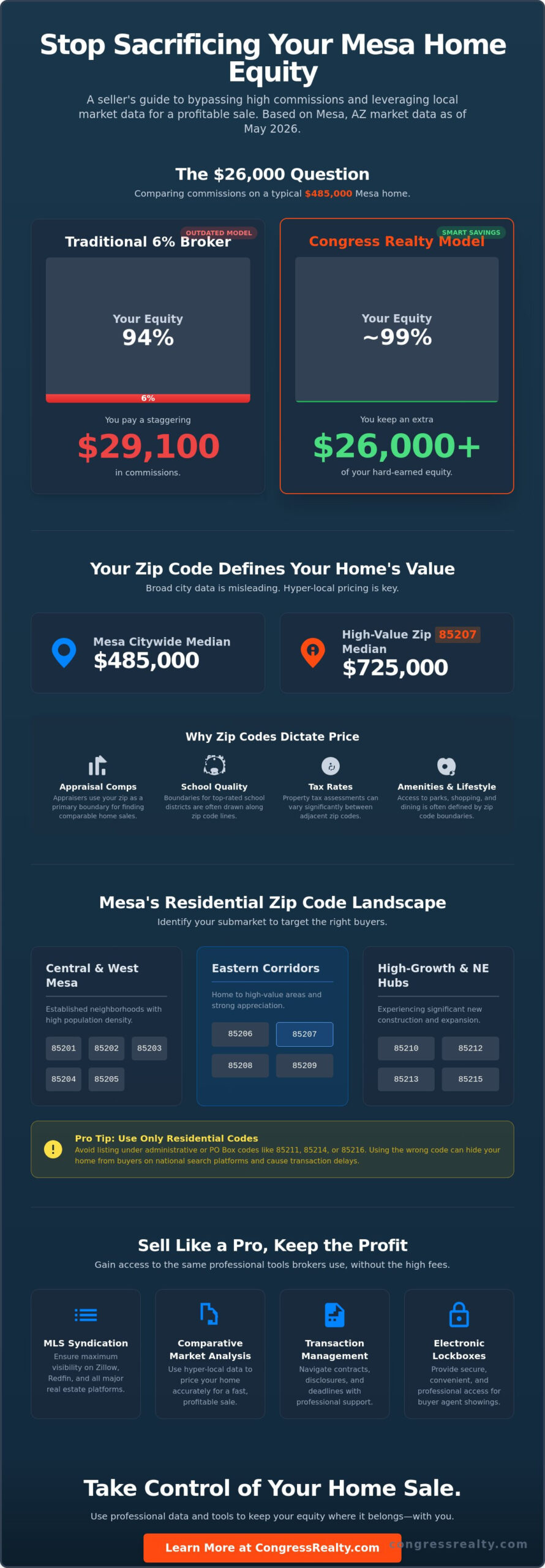
Why sacrifice over $26,000 in equity just because a traditional broker insists on a 6% commission? With Mesa’s median home price at $485,000 as of May 2026, those legacy percentages represent a significant financial loss that savvy sellers no longer need to accept. You know your neighborhood better than anyone, yet the lack of transparent market data often makes the selling process feel like a mystery. It’s frustrating to watch your hard-earned profit disappear into someone else’s pocket through outdated fee structures.
This guide provides a definitive list of mesa az zip codes and reveals how to use geographic insights to list your home professionally while bypassing high commissions. We’ll show you how to take command of your sale by utilizing the same tools the pros use, such as a Comparative Market Analysis and professional transaction management. You’ll discover how to navigate diverse submarkets, from the high-value 85207 area to the growth hubs in the southeast, ensuring you lead the process with total confidence and keep your equity where it belongs.
Key Takeaways
Access the definitive 2026 list of residential mesa az zip codes to pinpoint your property’s specific submarket and buyer demographic.
Learn how to decode the “Zip Code Premium” and use a professional Comparative Market Analysis to price your home for a fast, profitable sale.
Understand how the MLS uses geographic data to syndicate your listing to national platforms, ensuring maximum visibility without traditional high-cost brokers.
Calculate your potential equity savings by comparing legacy 6% commissions against a modern, fixed-cost listing model that puts you in control.
Identify the essential professional tools, including electronic lockboxes and transaction management, that simplify the process of selling your home independently.
Precision is the first step toward a successful sale. Mesa covers 138 square miles of the East Valley, making it a sprawling urban center where geographic boundaries define property values and buyer interest. As the third-largest city in Mesa, Arizona, this region has seen its residential lines shift alongside rapid population growth. You must identify your exact five-digit code before entering any legal documentation or professional listing database. Using the wrong mesa az zip codes can cause your property to be suppressed on national search platforms, effectively hiding your home from qualified buyers.
It’s vital to distinguish between residential zones and administrative codes. While Mesa utilizes several codes, only 13 are designated for primary residential use. Codes such as 85211, 85214, 85216, 85274, 85275, and 85277 are typically reserved for PO boxes or specific commercial entities. If you mistakenly list your home under one of these administrative codes, you’ll likely face technical errors during the transaction management phase. Stick to the residential list below to ensure your listing propagates correctly across the MLS and third-party sites.
Primary Residential Zip Codes
The city’s residential landscape is divided into distinct corridors, each with its own market temperature and inventory levels. Use this breakdown to verify your location:
Central and West Mesa: 85201, 85202, 85203, 85204, and 85205. These areas feature established neighborhoods and high population density.
Eastern Corridors: 85206, 85207, 85208, and 85209. This includes the high-value 85207 area, which saw median prices reach $725,000 as of May 2026.
High-Growth and Northeast Hubs: 85210, 85212, 85213, and 85215. These zones are currently experiencing significant new construction and expansion.
Why Geographic Accuracy Matters in 2026
In a balanced market where the average home stays on the market for 65 days, you can’t afford technical delays. Search algorithms on major real estate sites rely heavily on zip code filters. If your code is inaccurate, your home won’t appear when a buyer searches for their preferred school district or neighborhood. Accuracy also dictates your tax assessment and the Comparative Market Analysis (CMA) used to justify your asking price. Professional listing services require this data to be perfect. By confirming your mesa az zip codes early, you protect your autonomy and ensure your listing remains visible to the thousands of agents searching the professional databases every day.
Valuation Dynamics: How Zip Codes Impact Home Prices
Does a single digit in your address really change what your home is worth? In short: absolutely. Real estate appraisers and sophisticated buyers view mesa az zip codes as more than just mail delivery routes; they’re shorthand for school quality, property tax rates, and lifestyle amenities. Understanding how your address affects home value is critical for any seller who wants to avoid leaving money on the table. For instance, while the citywide median price was $485,000 in May 2026, homes in the 85207 corridor commanded a median of $725,000. This massive spread demonstrates why you can’t rely on broad city data to price your specific property.
Appraisers use your zip code as the primary boundary for their search. They look for “bracketed” comps, which means they search for sold properties similar in age and size within the same geographic code. If they have to cross into a different zip code to find a match, they often apply location adjustments that can lower your appraisal value. Historical trends also show that some Mesa codes appreciate faster than others. For example, the southeast growth hub near Cadence at Gateway has seen more aggressive price stability than central areas with older housing stock. A single street can represent a shift of tens of thousands of dollars if it crosses a zip code boundary.
Comparative Market Analysis (CMA) by Zip Code
To capture this “Zip Code Premium” accurately, you need a professional Comparative Market Analysis. A CMA filters out irrelevant data from neighboring districts and focuses strictly on homes that share your geographic advantages. If you price your home based on Mesa’s 98% sale-to-list ratio without looking at your specific street, you might underprice a high-demand area or overprice an older submarket. Micro-markets can shift significantly across a single major intersection. By looking at hyper-local comps, you ensure your listing is competitive from day one.
Market Trends and Buyer Behavior
Buyer behavior in 2026 is data-driven. Many buyers set their search alerts for specific mesa az zip codes to stay within certain school boundaries or close to major employers like Boeing. When demand spikes in a specific code, it triggers bidding wars that aren’t reflected in the broader city stats. Currently, the market is balanced with an average of 65 days on market, but some southeast zip codes move much faster due to new construction in Eastmark. Watching these trends allows you to time your listing for maximum exposure. If you’re ready to see how your neighborhood stacks up, reviewing a professional market report is a smart way to maximize your equity.
The Role of Zip Codes in Multiple Listing Services (MLS)
How do thousands of active buyers find your home in a city of 517,500 people? The answer lies in the Multiple Listing Service (MLS), the professional database where every licensed agent starts their search. In this digital ecosystem, mesa az zip codes serve as the primary routing instructions. If your zip code data is inaccurate, your home effectively vanishes from the filtered searches that matter most. It doesn’t matter how beautiful your professional photography is if the technical data blocks the listing from appearing in a buyer’s inbox. Accuracy is the technical bridge between your front door and a buyer’s screen.
When you list your property, you’re competing for attention in a market with approximately 138 square miles of inventory. The MLS acts as the central nervous system for these transactions. It uses geographic markers to syndicate your property data across a massive web of national sites like Zillow and Realtor.com. According to the U.S. Census Bureau Mesa Data, the city contains over 210,000 housing units. Without precise tagging of your specific location, your home would be lost in a sea of data. Securing your spot on the professional list of multiple listing services ensures that your home isn’t just for sale; it’s visible to every brokerage in the state.
Syndication and Search Algorithms
Modern buyers don’t browse; they filter. They set up Save Search alerts based on specific geographic boundaries. When your property is uploaded with the correct mesa az zip codes, the MLS triggers an immediate notification to every buyer whose criteria match your neighborhood. This automated syndication is what drives the 65-day average on market. If your geographic tagging is off by even one digit, you miss the critical first 48 hours of listing momentum when buyer interest is at its peak.
Visibility Without the 3% Commission
You don’t need to pay a traditional 3% listing commission to gain this level of professional exposure. The disruptive flat-fee model provides you with the exact same MLS infrastructure used by high-cost brokerages. You maintain total control over your property data while appearing in the same professional databases as every other listing. By utilizing tools like an electronic lockbox and professional transaction management, you lead the process with the same authority as a legacy agent. You get the visibility you need while keeping your equity where it belongs: in your pocket.
Leveraging Zip Code Data for a Successful Independent Sale
Data is the ultimate equalizer in real estate. You don’t need a traditional broker to interpret market conditions when you have access to the same geographic metrics they use. By mastering the specifics of mesa az zip codes, you transition from a passive seller to an informed market lead. Taking command of your sale starts with understanding that your “neighborhood” isn’t just the houses on your block; it’s a data-driven micro-market defined by five digits. Use this information to build a strategy that protects your equity and attracts the most qualified buyers in the East Valley.
DIY Market Research for Sellers
Start your research by filtering recent sales data strictly within your zip code. While Mesa’s citywide median home price sits at $485,000, your specific area might be trending higher or lower based on recent activity. Look for “Sold” listings from the last 90 days to find your true competition. Pay close attention to the “Days on Market” metric. If the Mesa average is 65 days but homes in your specific code are selling in 40, you have a high-demand listing that justifies a firmer asking price. Identifying this “sweet spot” ensures you don’t leave money on the table or scare away buyers with an unrealistic figure. You can use a professional Comparative Market Analysis to verify these findings and gain the same level of insight as a high-commission agent.
Strategic Marketing for Your Neighborhood
Your marketing should speak directly to the lifestyle your specific zip code offers. If you’re listing in 85212 or 85213, highlight the proximity to high-growth hubs like Eastmark or the master-planned amenities that drive buyer interest in the southeast. For those in 85215, emphasize the connection to major employers like Boeing. Use this geographic context in your listing description to trigger keywords that buyers actually search for. Stand out from the competition by investing in professional photography; in a digital-first market, your first showing happens on a smartphone screen. Combine these visuals with a professional yard sign and an electronic lockbox to make the showing process seamless for local buyers. This level of professional infrastructure signals to everyone involved that you’re a savvy seller in total control of the transaction.
Ready to turn your market research into a professional listing? List your home on the MLS today and keep thousands more of your equity by choosing a modern, fixed-cost model.
Saving Your Equity: Flat Fee MLS Solutions Across All Zip Codes
Why pay a legacy broker a massive percentage of your home’s value when the heavy lifting of market research is already done? Whether your property is nestled in the luxury pockets of 85207 or the high-growth corridors of 85212, the logic remains the same: you shouldn’t pay for a brand name when you can buy the results. Our flat-fee model works across all mesa az zip codes to ensure that your equity stays in your bank account rather than being split among traditional agents. You’ve mastered the geographic data; now it’s time to claim the financial reward.
The numbers in 2026 tell a clear story. With Mesa’s median home price at $485,000, a traditional 6% commission would strip over $29,000 from your closing proceeds. By choosing a modern listing solution, you can easily save $15,000 or more on a standard home sale. Learning how to sell a house without a realtor is the single most impactful financial decision you can make as a homeowner this year. This approach also allows you to position your home as a “smart buy.” You can choose to pass a portion of those savings to the buyer to trigger a faster sale or keep the entire surplus as your own profit.
The Congress Realty Advantage
We provide the professional infrastructure you need to compete with high-commission listings without the high-commission price tag. Our services cover every residential pocket within the mesa az zip codes, offering you parity with the biggest brokerages in the state. When you list with us, you receive a professional Comparative Market Analysis to nail your pricing, an electronic lockbox for secure showings, and full transaction management to handle the paperwork. You become the designated broker of your own equity, supported by the same professional databases that every licensed agent uses.
Getting Started with Your Listing
Transitioning from researching data to closing your sale is a straightforward process. First, select the listing package that aligns with your specific timeline and service needs. You’ll then submit your property details and professional photography through our streamlined platform. We ensure your data is perfectly formatted for the MLS, triggering those all-important search alerts for active buyers. Within days, your home will be visible on every major national real estate site. You take the lead on showings and negotiations, while we provide the professional backbone to ensure a smooth, legally sound closing. Take control of your financial future today and start your listing with the confidence of a market expert.
Take Command of Your Mesa Home Sale
Mastering the nuances of mesa az zip codes is the first step toward a high-equity closing. You now have the geographic data and strategic insights needed to navigate Mesa’s balanced market with total confidence. By focusing on hyper-local comps and ensuring technical accuracy on the MLS, you position your property for maximum visibility without the burden of a traditional listing commission.
It’s time to put these tools to work. Since 2002, Congress Realty has empowered thousands of homeowners to finalize successful closings while maintaining an A+ rating with the Better Business Bureau. You don’t need a high-cost broker to lead your transaction; you simply need the right professional infrastructure. Our model allows you to save an average of 3% on every transaction, keeping your hard-earned equity exactly where it belongs.
There are 13 primary residential zip codes in Mesa used for real estate listings. These include 85201, 85202, 85203, 85204, 85205, 85206, 85207, 85208, 85209, 85210, 85212, 85213, and 85215. While other codes like 85211 or 85274 exist for administrative purposes and PO boxes, they aren’t used for residential property addresses. Understanding these specific mesa az zip codes ensures your property is categorized correctly within professional databases.
What is the most expensive zip code in Mesa for 2026?
The 85207 zip code remains the most expensive area in Mesa as of May 2026. With a median sale price of $725,000, this northeast corridor commands a significant premium compared to the citywide median of $485,000. This region is highly sought after for its luxury master planned communities and scenic desert views, making it a high demand zone for buyers looking for premium inventory in the East Valley.
Do I need a local agent to list my home on the MLS in a specific zip code?
No, you don’t need a traditional local agent to gain professional MLS exposure in any neighborhood. Modern flat fee listing services provide the exact same technical infrastructure and syndication to national sites like Zillow and Realtor.com. By using a professional listing service, you maintain total control over your transaction and keep more of your equity while appearing in the same database as high commission listings in your area.
How do zip codes affect my home’s property taxes?
Zip codes often serve as the primary boundaries for various taxing authorities and school districts. Your specific address determines which municipal bonds, school levies, and special assessment districts apply to your property. Since tax rates can vary between different mesa az zip codes, buyers often filter their searches based on these carrying costs. Accurate geographic data ensures that your property’s total cost of ownership is represented correctly to potential buyers.
Can I change the zip code on my real estate listing if it is near a border?
You cannot change a zip code on a listing to a different one for marketing purposes. The MLS and national search platforms rely on verified postal data to syndicate your property correctly. Attempting to use a more “desirable” neighboring code is considered a violation of listing standards and can lead to your home being suppressed on search sites. Stick to your legal address to ensure your listing remains active and visible to all agents.
What is the fastest growing zip code in Mesa right now?
The southeast corridor, specifically zip codes 85209, 85212, and 85213, is experiencing the most rapid growth. Communities like Eastmark and Cadence at Gateway have turned these areas into hubs for new construction and modern amenities. This surge in development makes these codes highly competitive for sellers, as the influx of new residents drives consistent demand for both new and existing housing stock across the region.
Does a flat fee listing work the same way in every zip code?
Yes, the flat fee model provides the same professional advantages regardless of your specific location. Whether you are selling in a 55+ community in east Mesa or a luxury home in the northeast, you receive a professional CMA, electronic lockbox, and transaction management. The process is designed to be universal, giving every seller the tools to bypass high commissions while maintaining a professional and authoritative presence in the market.
How do I find the school district associated with my zip code?
You should consult the Maricopa County school boundary maps or the official Mesa Public Schools website for the most accurate information. While zip codes provide a general idea of location, school boundaries can sometimes cut through a single code. Providing the correct school district in your listing is vital, as many buyers use this as their primary filter when searching for homes in specific Mesa neighborhoods.
Image sourced from Canva
Summary: Sacramento sellers can save over $12,000 using flat fee MLS services—but some companies are quietly adding percentage-based “closing fees” that eat away those savings. Here’s how to spot the hidden costs before you sign.
Key Takeaways
Sacramento sellers can save $12,500 on a $500,000 home by using flat fee MLS services instead of traditional 2.5-3% listing agent commissions.
Some flat fee companies charge hidden closing fees ranging from 0.5% to 1.25% of the sale price, potentially adding thousands in unexpected costs.
Post-NAR settlement changes mean buyer agent compensation can no longer be listed on MLS, giving sellers more negotiation control.
California disclosure requirements, including the Transfer Disclosure Statement, remain mandatory even for flat-fee listings.
Transparent pricing models with no backend percentage fees provide the most reliable cost savings for Sacramento home sellers.
Sacramento’s real estate market presents significant opportunities for sellers willing to consider alternatives to traditional listing arrangements. With current market conditions favoring well-prepared sellers who understand their options, the timing remains favorable for those ready to take control of their home sale process.
Sacramento Flat Fee MLS Could Save You $12,500—But Watch for Potential Additional Closing Fees.
The math is compelling for Sacramento home sellers considering flat fee MLS services. On a typical $500,000 home, a traditional listing agent’s 2.5-3% commission would cost between $12,500 and $15,000. Compare this to flat fee services ranging from $99 to $499, and the potential savings become immediately apparent—often exceeding $12,000 per transaction.
However, not all flat-fee services deliver the upfront savings they advertise. Some companies have introduced percentage-based closing fees ranging from 0.5% to 1.25% of the sale price, effectively turning a “flat fee” into a reduced commission structure. On that same $500,000 home, a 1% closing fee would add $5,000 to the seller’s costs—significantly reducing the anticipated savings.
The key lies in identifying truly transparent providers who offer genuine flat fee pricing without backend percentage charges.Congress Realty is one such option, providing flat-fee MLS services with upfront pricing, allowing sellers to calculate their exact costs from the start.
How Post-NAR Settlement Changes Affect Sacramento Sellers
The National Association of REALTORS settlement, effective August 17, 2024, fundamentally altered how buyer agent compensation works in Sacramento and throughout California. These changes create new strategic opportunities for flat fee MLS sellers who understand the revised landscape.
1. Buyer Agent Compensation No Longer Listed on MLS
Previously, sellers could advertise buyer agent compensation directly through MLS listings, making it visible to all agents searching for properties. Under the new rules, this compensation must be negotiated separately and directly with buyers, removing it from the MLS entirely. This change eliminates the automatic expectation that sellers will pay buyer agent fees through their listing.
2. New California AB 2992 Written Agreement Requirements (January 1, 2025)
California’s AB 2992 codifies the NAR settlement into state law, requiring all buyers to sign written buyer-broker agreements as soon as practicable, but no later than the execution of the buyer’s offer. These agreements must clearly outline the agent’s compensation amount and include a statement that all fees are negotiable. This requirement provides additional protection for buyers while creating transparency around agent compensation expectations.
3. Strategic Options for Offering Buyer Agent Fees
Sacramento sellers can still choose to offer buyer agent compensation, but it’s now a strategic decision rather than an MLS requirement. Offering 2-2.5% compensation can increase showing activity and buyer interest, particularly in competitive price ranges. However, sellers can also market their properties without offering this compensation, potentially attracting buyers who are prepared to pay their own agent fees or are working without representation.
MetroList MLS Requirements and Listing Standards
Sacramento-area properties must be listed on MetroList MLS, Northern California’s largest multiple listing service covering over 23,000 real estate professionals across Sacramento, Placer, El Dorado, and Yolo counties. Understanding MetroList’s requirements ensures flat fee listings meet professional standards and achieve maximum exposure.
Sacramento County MLS Coverage and Syndication
MetroList provides coverage throughout the Sacramento metropolitan area and automatically syndicates listings to major consumer websites, including Zillow, Realtor.com, Redfin, and Trulia. This syndication ensures flat fee listings receive the same exposure as traditionally listed properties, reaching both agent networks and direct consumer searches.
The service also powers MetroListPRO.com, the public search portal, and feeds hundreds of individual agent IDX websites throughout the region. This extensive distribution network means a single MetroList submission reaches virtually all active buyers in the Sacramento market.
MetroList Listing Standards and Photo Requirements
MetroList requires all listings to include complete property details, accurate pricing information, and appropriate contact information for inquiries. Listings must be submitted promptly after public marketing begins or after the required seller signatures are obtained on listing agreements.
Professional photography remains important for competitive positioning, as listings with high-quality images generate significantly more click-through rates and show requests. Most flat fee services include multiple photos in their packages, with premium plans offering unlimited photo uploads to showcase properties effectively.
Transparent vs. Fee-at-Closing Pricing Models Exposed
The flat fee MLS industry has evolved to include various pricing structures, not all of which deliver the straightforward savings sellers expect. Understanding these different models helps Sacramento sellers choose providers that align with their financial goals and expectations.
1. Truly Flat Fee Services with Upfront Pricing
Genuine flat fee services charge a one-time upfront fee with no additional percentage-based charges at closing. These providers typically offer tiered packages ranging from basic MLS listing at $99-299 to premium plans at $499-599 that include additional marketing features, unlimited listing changes, and agent support services.
The advantage of this model is complete cost predictability—sellers know their exact listing expenses from the beginning and can calculate their net proceeds accurately. Companies like Brokerless.com explicitly advertise “no hidden closing fees” and maintain this transparent pricing structure throughout the transaction.
2. Companies Charging 0.5% to 1.25% in Additional Fees at Closing
Some flat-fee companies advertise low upfront costs but add percentage-based fees collected at closing. These fees typically range from 0.5% to 1.25% of the final sale price and may be labeled as “success fees,” “closing coordination fees,” or “transaction fees.”
For example, certain premium plans can include percentage-based closing fees of up to 1.25%, which transforms a $399 upfront fee into a total cost of $6,649 on a $500,000 home sale ($399 + $6,250 in closing fees). While still less expensive than traditional agent commissions, these additional costs significantly reduce the advertised savings.
3. Red Flags to Identify Before Signing
Sacramento sellers should scrutinize pricing structures before committing to any flat fee service. Key warning signs include vague language about “additional fees may apply,” pricing that seems unusually low compared to competitors, and contracts that reference percentage-based charges without clearly defining them.
Always request a complete breakdown of all potential costs, including any fees that might be assessed at closing. Legitimate flat-fee companies will provide transparent pricing information upfront and clearly distinguish their upfront fees from any optional services that carry additional charges.
California Disclosure Requirements
California maintains some of the nation’s most detailed seller disclosure requirements, and these obligations remain unchanged regardless of whether sellers use flat fee MLS services or traditional agents. Proper completion of these disclosures protects sellers legally and demonstrates professionalism to potential buyers.
Transfer Disclosure Statement (TDS) Mandates
The Transfer Disclosure Statement, governed by California Civil Code Sections 1102-1102.14, represents the most critical disclosure document in residential sales. This detailed form covers the operational condition of all appliances and systems, structural components like walls and foundations, and any known defects or hazards that could affect property value.
While certain exemptions may apply to the TDS in specific types of sales (such as probate, foreclosure, or court-ordered transfers), sellers remain obligated to disclose all known material defects regardless of these exemptions. Buyers receive a three-day right of rescission if the TDS is delivered after contract acceptance, making timely completion important for smooth transactions.
Natural Hazard and Lead Paint Documentation
California requires Natural Hazard Disclosure statements covering flood zones, fire hazard areas, seismic zones, and earthquake fault lines. Properties built before 1978 must include federal Lead-Based Paint Disclosure documentation, while homes need confirmation of carbon monoxide detector compliance and proper water heater strapping where applicable.
Additional disclosures may be required based on specific property characteristics, such as homeowner association documents, environmental hazard reports, or notices of pending litigation affecting the property. Most flat-fee services provide access to the required California disclosure forms as part of their listing packages.
Legal Consequences of Incomplete Disclosures
Failure to complete disclosure documents properly or omitting known defects can expose sellers to post-sale lawsuits and financial liability. California courts have consistently held sellers responsible for disclosure violations, even when working with professional agents, making accurate completion important for legal protection.
The standard for disclosure is “known material defects” that could affect property value or desirability. Sellers should err on the side of over-disclosure rather than risk post-sale legal complications, as transparency generally strengthens rather than weakens negotiating positions with informed buyers.
Sacramento Seller Closing Costs Breakdown
Understanding the full cost structure of selling a home in Sacramento helps sellers accurately evaluate the value of different listing approaches and budget for their transaction. These costs remain largely consistent regardless of listing method, though flat-fee services can significantly reduce the largest expense category.
1. County and City Transfer Tax Calculations
Sacramento County imposes a documentary transfer tax of $0.55 per $500 of the property’s purchase price, while the City of Sacramento adds $2.75 per $1,000 for properties within city limits. On a $500,000 home sale, the county transfer tax would total approximately $550, while the city transfer tax would add roughly $1,375, for combined transfer taxes of $1,925.
The seller typically pays these transfer taxes, which cannot be avoided, though they may be negotiated as part of the purchase agreement. Properties outside Sacramento city limits avoid the municipal transfer tax but still pay the county portion.
2. Typical Escrow and Title Insurance Costs
Escrow fees in Northern California vary by location and company, with total costs typically ranging from $1,350 to $3,500 for median-priced homes. However, customs for who pays these fees vary by city. Title insurance for the owner’s policy generally costs between 0.18% to 0.5% of the sale price, which translates to about $900 to $2,500 on a $500,000 home.
Additional closing costs include mortgage payoff fees, prorated property taxes, and any applicable homeowner association transfer fees. These combined expenses typically total 2.7-3% of the sale price, excluding agent commissions, according to recent statewide averages.
3. Total Cost Comparison: Flat Fee vs. Traditional Agent
The cost differential between flat fee and traditional listing becomes apparent when comparing total expenses. A traditional 2.5-3% listing commission on a $500,000 home ranges from $12,500 to $15,000, while a flat fee service costs $299-499 upfront with no additional percentage charges.
Even when adding typical closing costs of approximately $13,500-15,000 and potentially offering 2-2.5% buyer agent compensation, flat fee sellers typically save $8,000-12,000 compared to traditional full-service arrangements. These savings become more significant on higher-priced properties where percentage-based commissions compound.
Select a Transparent Sacramento Flat Fee MLS Provider for Maximum Savings
The success of a flat-fee MLS strategy depends heavily on choosing the right service provider—one that combines MLS exposure with transparent pricing and adequate support for sellers’ questions and concerns. Sacramento sellers have access to several established providers, each offering different combinations of features and pricing structures.
When evaluating options, prioritize providers that explicitly guarantee no hidden closing fees, offer unlimited listing changes, and include access to required California disclosure documents. Services that provide MetroList MLS submission promptly and automatic syndication to major consumer websites ensure maximum market exposure.
Consider also the level of support provided—while flat-fee services expect sellers to manage their own transactions, access to experienced agents for questions about contracts, disclosures, or negotiation strategies can prove invaluable in complex situations. Premium plans that include showing coordination, lead management, and contract review bridge the gap between full self-service and traditional agent representation.
The California real estate market rewards sellers who combine cost-effective listing strategies with professional presentation and thorough preparation. Flat-fee MLS services provide a proven path to significant commission savings while maintaining the market exposure needed for competitive sale results in Sacramento’s active market.
Your home equity shouldn’t be treated like a tip jar for the real estate industry. Despite landmark rule changes, many sellers in 2026 still find themselves handing over 5% to 6% of their sale price in traditional commissions. If you’re asking what is a flat fee, you’re already taking the first step toward reclaiming your hard-earned wealth. You likely feel that paying a massive percentage for basic listing services is outdated and unnecessary. It’s frustrating to face the uncertainty of high-cost models when you just want a transparent, predictable way to sell your property.
We agree that the traditional commission structure often feels like an unfair tax on your home’s appreciation. This guide will show you exactly how flat fee structures work to help you sell while protecting your equity. You’ll gain a clear understanding of fixed-cost pricing and a roadmap for listing your home with professional tools. We’ll explore how to leverage the MLS, professional photography, and transaction management without the burden of a traditional listing commission. By the end, you’ll have the confidence to choose a pricing model that puts you in total control of your move.
Key Takeaways
Understand exactly what is a flat fee and why this fixed-cost model provides the transparency that traditional percentage commissions lack.
Compare the financial impact of a flat fee against a 3% listing commission to see how much equity you’ll protect.
Learn how to get your home on the professional MLS while utilizing tools like electronic lockboxes and yard signs.
Explore how professional photography and transaction management can streamline your sale without a traditional agent.
Gain a clear roadmap for managing the selling process independently to maximize your profit at closing.
What is a Flat Fee? Defining Fixed-Cost Pricing in Real Estate
Stop viewing your home equity as a pool of funds available for others to claim. In the traditional real estate model, you pay a commission based on your home’s final sale price. This means if your home value increases, your costs increase, even if the work performed remains exactly the same. To understand the alternative, we must ask: What is a Flat Fee? In professional real estate, a flat fee is a single, predetermined price paid for a specific set of professional services. It replaces the variable, percentage-based listing commission with a transparent, fixed cost that never fluctuates based on your home’s value.
In the 2026 real estate market, this model has become a vital tool for savvy homeowners. Following the landmark 2024 NAR settlement, the industry has shifted toward the “decoupling” of commissions. While many traditional brokers still push for a 5% to 6% total commission, the flat fee model allows you to separate the cost of listing your home from the rest of the transaction. You might see the terms “fixed fee” and “flat fee” used interchangeably in brokerage agreements. Both describe the same advantage: a predictable price for specific professional tools like MLS access, yard signs, and transaction management.
The Core Concept: Paying for Service, Not Equity
The fundamental shift here is moving from equity-based rewards to service-based payments. When you choose a flat fee, you’re treating the sale of your home like any other professional transaction. You don’t owe a percentage of your hard-earned wealth just because the market is strong. Instead, you pay for the specific labor and infrastructure required to market your property. This approach empowers you to act as the lead in your own sale. There is a massive psychological benefit to knowing your exact costs before the listing even goes live. It eliminates the fear of hidden fees and ensures you stay in control of your financial outcome.
Flat Fee vs. Hourly Rates: What is the Difference?
You may wonder why real estate professionals don’t simply charge by the hour. While hourly rates are common for lawyers, they’re incredibly rare in real estate because they create massive uncertainty. If a sale becomes complex or takes longer than expected, hourly costs can spiral out of control. When you ask what is a flat fee in the context of efficiency, it’s essentially a cap on your expenditures. It provides “all-in” pricing for essential marketing and administrative tasks. Whether your home sells in three days or three months, your cost for the listing service remains the same. This protects you from market volatility and ensures your budget stays intact from listing to closing.
Flat Fee vs. Percentage Commission: A Direct Comparison
Choosing between a flat fee and a traditional commission is essentially a decision about who keeps your home’s appreciation. When you ask what is a flat fee, you’re looking for a way to cap your expenses rather than giving away a slice of your property’s value. Consider the standard 3% listing side of a commission. On a $500,000 home, that single fee amounts to $15,000. If your home value jumps to $600,000, that fee automatically climbs to $18,000, even though the listing process remains identical. This equity leak is why 2026 sellers are moving toward fixed-cost models. It’s helpful to understand how much does the realtor make in these transactions to see where your money is actually going.
Predictability is the greatest advantage of the flat fee model. In a market where home prices are volatile, a fixed fee acts as an anchor. You know your marketing costs before you even sign a contract. Traditional commissions often hide the true cost of sale until the final closing disclosure. By then, it’s too late to negotiate. Smart sellers use fixed-cost structures to save on real estate fees, ensuring that the bulk of their profit stays in their own bank account.
The Impact on Your Bottom Line
Think of your home equity as a long-term investment. Every percentage point paid in commission is a direct withdrawal from that investment. In a side-by-side comparison, the math is undeniable. Under a traditional model, the listing agent’s fee scales up indefinitely. In a flat fee model, the ratio of cost to home value shrinks as your home price increases. For a $500,000 home, the traditional listing fee represents 3% of the total price. A flat fee represents a tiny fraction of that same value. This allows you to retain more capital for your next down payment or retirement fund. If you’re ready to protect your equity, you can start your listing today and keep your profits where they belong.
Incentives and Motivation: Who Does the Model Favor?
There is a common myth that a percentage-based commission motivates an agent to work harder. In reality, the difference between a $490,000 sale and a $500,000 sale is only $300 to the listing agent. That small amount rarely changes their behavior. The flat fee model removes this performance theater. It aligns the broker’s goal with your efficiency. You pay for the tools that actually sell houses, like professional MLS placement and transaction management. This transparency ensures you aren’t paying for hand-holding you don’t need. You remain the decision-maker, supported by the professional infrastructure required to close the deal.
How Flat Fee Real Estate Works: From Listing to Closing
Selling your home with a fixed-cost model isn’t a DIY project; it’s a professional partnership where you lead the way. Understanding what is a flat fee service requires looking at the actual workflow from the moment you decide to list until the day you hand over the keys. The process begins with a strategic choice of tools. Instead of paying for a bundle of services you might not need, you select a package that fits your goals, such as a Standard Listing or a Full Service Listing. This approach ensures you only pay for the professional infrastructure required to move your property from “listed” to “sold.”
Once you’ve chosen your package, the professional machinery starts moving. You aren’t just putting a sign in the yard; you’re launching a marketing campaign. This includes Professional Photography to capture your home’s best features and an Electronic Lockbox to manage secure buyer tours. You’ll also receive a Yard Sign and Post to capture local interest. By integrating these tools, you’re mastering how to sell your house on your own while maintaining the high standards buyers expect in 2026. You remain the primary point of contact, giving you total command over showings and negotiations.
The Gateway to Exposure: The MLS
The Multiple Listing Service (MLS) remains the single most important tool in real estate. It’s the database that feeds every major home-search site. When you use a flat fee broker, your property receives the same “Tier 1” exposure as a home listed by a traditional 6% agent. There’s no “discount” section on the MLS; your listing appears alongside every other professional entry. From there, syndication kicks in. Your home automatically flows to Zillow, Realtor.com, and hundreds of other local brokerage sites. This massive reach ensures that every active buyer in your market sees your property the moment it goes live.
Transaction Management and Professional Oversight
The work doesn’t end when you receive an offer. Navigating the path from an accepted contract to a successful closing requires precision. This is where Transaction Management becomes your greatest asset. A flat fee model provides the professional oversight needed to handle escrow requirements and legal disclosures without the high-percentage price tag. You’ll also benefit from a Comparative Market Analysis (CMA) to ensure your pricing is grounded in current 2026 market data. These professional guardrails prevent the common pitfalls of solo selling, such as pricing errors or paperwork mistakes. You get the expertise of a broker to facilitate the logistics while you retain the freedom to make the final decisions.
The Pros and Cons of Choosing a Flat Fee Model
Skeptical sellers often ask if this model is too good to be true. When you first discover what is a flat fee, it’s natural to wonder why everyone hasn’t made the switch. The reality is that a flat fee isn’t a magic trick; it’s a strategic trade-off. You’re choosing to trade a small amount of your time for a significant amount of your equity. This approach isn’t for everyone, but for the organized homeowner, it’s the most efficient way to sell. You’ll need to be the one showing the property and answering buyer inquiries. In return, you stop the massive “equity leak” that occurs with traditional percentage-based models.
The right seller for this model is someone who values financial intelligence over traditional hand-holding. If you’re comfortable managing your own schedule and talking to potential buyers, you can learn how to avoid realtor fees when selling to maximize your final proceeds. You don’t need a traditional agent to stand in your kitchen during an open house. You need professional tools, like an electronic lockbox and high-quality photography, to do the heavy lifting for you.
Why Thousands of Sellers are Switching
The financial advantage is the primary driver. Keeping an extra 3% of your home’s value can mean tens of thousands of dollars back in your pocket. Beyond the money, you gain total command over the process. You don’t have to wait for an agent to relay messages or schedule showings. You speak directly to the buyers or their agents, which often leads to faster decisions and clearer communication. This model also eliminates the inherent conflict of interest found in commissions. A flat fee broker’s only goal is to provide the professional infrastructure you need to succeed, regardless of the final sale price. If you’re ready to take charge, you can maximize your equity today by choosing a fixed-cost listing.
Potential Challenges to Consider
Pragmatism is key when choosing this path. You must be prepared for the responsibility of managing your own inquiries and showings. Because the broker doesn’t provide in-person open house hosting, you’ll need to be available to open your door to qualified buyers. Success in selling a home in 2026 requires a high level of responsiveness. If you don’t answer the phone or reply to emails promptly, you might miss a motivated buyer. You also need to ensure your legal and disclosure paperwork is in perfect order. While transaction management services provide professional oversight, the initial effort to present your home and manage the calendar rests squarely on your shoulders. For the savvy seller, this minor increase in workload is a small price to pay for protecting their hard-earned wealth.
Maximizing Your Equity with Congress Realty’s Flat Fee Listings
Protecting your equity requires more than just a good intention; it requires the right professional framework. When you understand what is a flat fee, you realize it’s about paying for work performed rather than a percentage of your wealth. Congress Realty provides this framework by decoupling the high cost of traditional commissions from the essential tools needed to sell a home. This pragmatic approach is designed for the modern, tech-savvy seller who values efficiency and financial intelligence. You don’t need to sacrifice professional quality to save on costs. Instead, you’re choosing a smarter way to navigate the 2026 real estate market.
Standard vs. Full Service: Choosing Your Level of Support
Every seller has a different comfort level with the transaction process. The Standard Listing is the ideal choice for the experienced, autonomous seller. It provides the core necessity of any successful sale: professional MLS exposure. You take the lead on negotiations and paperwork, keeping your costs at a minimum. For those who want more guidance, the Full Service Listing acts as a bridge. It offers professional support and transaction management without the burden of a traditional 3% listing commission. Both models share a single priority: your equity. By choosing the level of support that fits your needs, you ensure that you aren’t paying for services you don’t use.
Empowering Your Sale with Professional Infrastructure
A successful sale relies on a strong first impression and secure logistics. Professional Photography is a non-negotiable tool in a digital world; it’s what stops the scroll on Zillow and Realtor.com. We provide the visual high ground that your property deserves. Once buyers are interested, our Electronic Lockboxes provide secure, tracked access for buyer agents. This allows you to manage showings with confidence, knowing exactly who has entered your home and when. We also provide a high-quality Yard Sign and Post to capture the attention of local buyers who may not be searching online.
Moving from a curious observer to a listed seller is a simple, structured process. You can often transition to a live MLS listing in as little as 24 hours. Our dedicated Transaction Management ensures that once you find a buyer, the path to closing is clear and professional. You stay in total command of the process, supported by the necessary industry databases and professional tools. Take control of your home sale today and keep your hard-earned profit where it belongs: in your pocket.
Take Command of Your Home Sale Today
You now have a clear answer to what is a flat fee and how it functions as a strategic tool for the modern seller. By choosing a fixed-cost model, you’re prioritizing your financial intelligence over outdated industry habits. You’ve seen how professional tools like the MLS and electronic lockboxes provide the same exposure as traditional models without the equity drain. Managing the process independently isn’t just a way to save money; it’s a way to maintain total control over your most valuable asset. This approach ensures that your hard-earned profit stays where it belongs.
Since 2002, Congress Realty has provided national coverage for savvy, independent sellers. Under the expert brokerage oversight of Andrew English, we offer the professional infrastructure you need to succeed without the burden of high-percentage commissions. It’s time to treat your home sale like the professional transaction it is. Protect your equity with a Standard Listing from Congress Realty. You have the roadmap and the tools. Now, take the final step and make your move with confidence.
Frequently Asked Questions
Is a flat fee real estate broker the same as a discount broker?
No, a flat fee broker is fundamentally different from a discount broker. While a discount broker typically offers a scaled back version of traditional service for a lower percentage, a flat fee broker provides specific professional tools for a fixed price. This model emphasizes transparency and seller autonomy. You pay for the actual work performed rather than a percentage of your home’s equity, giving you total command over your final proceeds.
Does a flat fee listing include my home being on the MLS?
Yes, a professional flat fee listing ensures your property is entered into the Multiple Listing Service (MLS). This is the primary database used by all real estate agents to find homes for their clients. It’s the core component of understanding what is a flat fee service, as it provides the same “Tier 1” market exposure as any traditional high commission listing without the unnecessary equity leak.
Will other real estate agents show my house if I use a flat fee service?
Yes, buyer agents will show your home because it appears on the professional MLS just like any other listing. Agents prioritize properties that meet their clients’ specific needs and criteria. By using tools like an electronic lockbox, you facilitate secure and professional tours for these agents. This ensures your home remains competitive and accessible to the entire pool of active buyers in your local market.
Can I still sell my house for sale by owner (FSBO) with a flat fee?
Yes, using a flat fee service is essentially an “enhanced FSBO” approach. It gives you the professional marketing power of a broker while you retain the right to sell the property yourself. You maintain full control over showings and negotiations while benefiting from professional syndication to sites like Zillow and Realtor.com. It’s the most pragmatic way to sell independently while maintaining high industry standards.
Are there hidden costs or closing fees with a flat fee model?
No, transparency is the primary advantage of the flat fee model. You pay a predetermined price for a specific set of services, such as professional photography or transaction management. While you’ll still encounter standard closing costs like title insurance and state taxes, the brokerage fee itself is fixed and disclosed upfront. This predictability allows you to calculate your exact net proceeds long before you reach the closing table.
Do I have to pay a buyer’s agent commission with a flat fee listing?
You aren’t required to offer a specific amount, but most sellers choose to offer a competitive commission to buyer agents to encourage traffic. Following the 2024 rule changes, these fees are negotiated independently and are no longer advertised on the MLS. You retain the power to decide what fits your financial goals. This flexibility is a key part of what is a flat fee in the modern market.
What services are usually included in a standard flat fee package?
A standard package typically includes an MLS listing, professional yard signs, and a Comparative Market Analysis (CMA). Many sellers upgrade to include professional photography, electronic lockboxes, and transaction management for a more comprehensive experience. This menu based approach allows you to build a professional infrastructure that fits your specific needs. You only pay for the services that help you move from listing to closing efficiently.
Can I cancel my flat fee listing if I change my mind?
Yes, most flat fee agreements allow you to cancel your listing at any time. Unlike traditional contracts that might lock you into a six month commitment, this model prioritizes your freedom and autonomy. You don’t have to worry about being stuck in a long term agreement if your circumstances change. Always review your specific agreement for any administrative terms regarding the initial fee before you go live on the MLS.
Image sourced from Canva
Summary: Think entering California’s flat fee MLS market just requires signing up? The real barrier isn’t MLS access—it’s a 360-hour education requirement, two years of experience, and ongoing liability risks that shut out most aspiring brokers before they even start.
Key Takeaways
California’s flat fee MLS model is completely legal, but requires working with a licensed real estate broker who has completed eight college-level courses and two years of experience.
The broker licensing requirements pose the primary barrier to entering California’s flat-fee MLS market, not the MLS rules themselves.
New 2024 regulations, including NAR settlement changes and AB 2992, have reshaped how compensation and buyer agreements operate in flat-fee transactions.
Ongoing broker supervision requirements expose licensed brokers to significant liability risks that many aspiring brokers underestimate.
California’s flat fee MLS market appears straightforward on the surface — pay a fixed fee instead of a percentage commission and access the same Multiple Listing Service used by traditional agents. However, a closer examination reveals that the real barriers aren’t in the MLS rules themselves, but in the complex broker licensing requirements that govern who can legally submit listings in the first place.
The fundamental challenge facing California’s flat fee MLS market isn’t about MLS access — it’s about broker licensing. Under California’s Real Estate Law (Business and Professions Code §10000 et seq.), only licensed real estate brokers and their affiliated salespersons can submit listings to many of the state’s local MLS systems. This creates an immediate barrier for anyone seeking to enter the flat-fee market without first obtaining proper licensing.
Unlike many other states where real estate licensing requirements are relatively straightforward, California maintains rigorous broker qualification standards. The Department of Real Estate (DRE) requires aspiring brokers to demonstrate not just basic competency, but advanced education and practical experience that can take years to accumulate.Congress Realty has navigated these complex licensing requirements to provide flat fee MLS services while maintaining full regulatory compliance.
The licensing barrier means that most flat fee MLS companies must either employ licensed brokers or operate as referral services to licensed brokerages. This fundamental requirement shapes every aspect of how flat-fee services operate, from pricing structures to liability management. For aspiring entrepreneurs looking to enter the flat-fee market, the broker license is the single largest obstacle to market entry.
8-Course Education Path Blocks Most Aspiring Brokers
California’s broker license education requirements represent a significant departure from the typical real estate licensing path. While salesperson licenses require just three courses, broker candidates must complete eight separate college-level courses, each requiring 45 hours of instruction. This 360-hour education commitment represents approximately 2-3 months of full-time study (based on 40 hours/week).
Required College-Level Real Estate Courses
The eight mandatory courses cover real estate topics that go far beyond basic sales training. Required courses include Real Estate Practice, Legal Aspects of Real Estate, Real Estate Finance, Real Estate Appraisal, and either Real Estate Economics or Accounting. The remaining three courses can be selected from approved electives, but must still meet college-level standards.
Each course must be completed through an approved educational provider, and all online or correspondence courses must meet DRE approval standards. This represents a substantial financial investment before even taking the broker examination.
New 2024 Implicit Bias and Interactive Fair Housing Components
Starting January 1, 2024, all real estate practice courses must include components addressing implicit bias and fair housing. The fair housing component specifically requires interactive participatory role-playing, adding complexity to course delivery and completion requirements. These new requirements reflect California’s commitment to addressing discrimination in real estate transactions.
The interactive fair housing component requires participatory role-playing, so it cannot be satisfied by traditional passive lecture formats and must include specific interactive elements, even in online modules. This requirement has eliminated many self-paced online course options that previously attracted working professionals.
Experience Requirements: Licensed Sales, Equivalent Work, or Real Estate Degree
Beyond the education requirements, broker candidates must demonstrate two years of full-time licensed salesperson experience within the past five years, or equivalent experience in real estate-related fields. Alternatively, candidates with a four-year degree in real estate can substitute education for some experience requirements.
The “equivalent experience” pathway requires detailed documentation and DRE approval. Acceptable equivalent experience includes work as a real estate appraiser, mortgage broker, escrow officer, or property manager. However, the DRE evaluates each case individually, and many applicants discover their experience doesn’t qualify only after submitting their application.
DRE Supervision Rules Create Ongoing Liability Risks
Once licensed, brokers face ongoing supervision requirements that create substantial liability exposure. California DRE regulations require brokers to exercise “reasonable supervision” over all affiliated salespersons and broker associates. This supervision obligation extends to all aspects of real estate transactions, including advertising, contract preparation, and trust fund management.
The supervision requirements mean that brokers operating flat fee MLS services cannot simply collect fees and submit listings. They must actively oversee all transaction-related activities, maintain detailed policies and procedures, and ensure compliance with all applicable laws and regulations. This ongoing responsibility creates operational complexity that many aspiring flat fee operators underestimate.
Document Review Requirements
Under DRE regulations, brokers must promptly review and initial all listing agreements, purchase contracts, and amendments prepared by their salespersons. For flat fee MLS operations handling dozens or hundreds of listings monthly, this creates a substantial administrative burden that requires dedicated staff and systems.
The document review requirement cannot be waived or delegated to unlicensed staff. Brokers must personally review each document or designate a licensed broker associate to perform the review. This requirement alone can make small-scale flat-fee operations financially unviable, as the labor costs of compliance may exceed the fees collected.
License Suspension Penalties for Inadequate Supervision
Failure to provide adequate supervision can result in disciplinary action against a broker’s license under the California Business and Professions Code. Penalties range from license suspension to permanent revocation, depending on the severity of violations. The DRE actively investigates supervision complaints and can impose penalties even when no consumer harm occurs.
Recent enforcement actions have targeted brokers who failed to maintain adequate oversight of high-volume operations. The DRE has made clear that processing large numbers of transactions doesn’t excuse brokers from their supervision obligations. This enforcement stance poses particular challenges for flat-fee operations that rely on volume to maintain profitability.
NAR Settlement Eliminates MLS Compensation Offers
The March 2024 National Association of Realtors settlement fundamentally changed how buyer-agent compensation operates in California’s flat-fee market. The $418 million settlement, which took effect August 17, 2024, prohibits offers of buyer agent compensation from being communicated through any MLS system.
August 2024 Rule Changes Impact Flat Fee, Models
Under the new rules, flat fee MLS listings cannot include any mention of buyer agent compensation in MLS fields or remarks. This eliminates what was previously a key competitive advantage for some flat fee services — the ability to attract buyer agents through generous compensation offers displayed prominently in MLS systems.
The prohibition applies to all forms of MLS communication, including public remarks, private broker remarks, and any compensation fields. Violations can result in MLS penalties and potential legal liability under the settlement terms. This has forced flat-fee services to completely restructure how they handle buyer-agent compensation discussions.
Alternative Compensation Communication Methods
While MLS compensation offers are prohibited, sellers can still offer buyer agent compensation through alternative channels. These include direct communication with buyer agents, inclusion in marketing materials outside the MLS, and negotiation during the offer process. However, these alternative methods require more active management and don’t provide the broad exposure that MLS inclusion previously offered.
Many flat-fee services have adapted by providing sellers with template language for offer negotiations and by creating separate marketing channels to communicate compensation opportunities. Some have developed direct outreach programs to notify buyer agents about compensation opportunities. These workarounds add complexity and cost to flat fee operations while potentially reducing their effectiveness.
AB 2992 Mandates Written Buyer-Broker Agreements
California Assembly Bill 2992, signed by Governor Newsom in September 2024 and effective January 1, 2026, codifies the NAR settlement’s buyer agreement requirements into state law. This legislation applies to both residential and commercial real estate transactions throughout California, creating uniform standards for buyer representation agreements.
January 2026 Implementation Requirements
Under AB 2992, all brokers representing buyers must obtain signed written agreements “as soon as practicable,” but no later than when the buyer submits an offer to purchase property. This requirement applies to every buyer-broker relationship, regardless of transaction size or property type. The law eliminates any ambiguity about when buyer agreements must be executed.
The timing requirement creates operational challenges for flat-fee listings, as every potential buyer must arrive with a signed agreement before submitting an offer. This eliminates spontaneous offer situations and requires all buyer agents to maintain current buyer-broker agreements for their clients. For sellers, this means more structured offer processes and a clearer understanding of buyer representation arrangements.
Compensation Disclosure and Negotiation Rules
The required buyer-broker agreements must specify the broker’s compensation amount or rate, when compensation is due, and confirm that compensation is negotiable. This creates transparency that benefits flat-fee sellers by clearly establishing buyer-agent expectations before offers are submitted. Sellers can negotiate compensation requests on a case-by-case basis rather than feeling obligated to offer uniform compensation to all buyer agents.
The negotiability requirement means that even when buyers request seller-paid compensation, sellers retain the right to counter with alternative arrangements. This might include reduced compensation, buyer-paid fees, or service credit arrangements. AB 2992 specifically protects sellers’ rights to negotiate these terms, providing more flexibility than many industry observers initially expected.
Sacramento’s primary MLS system, MetroList Services, Inc., maintains specific rules that directly affect flat-fee MLS operations. As Northern California’s largest MLS, MetroList covers Sacramento, Placer, El Dorado, and Yolo counties and is a significant platform for flat-fee MLS activity in the region. The system’s rules create operational requirements that flat fee services must navigate carefully.
Listing Submission Deadlines
MetroList requires all listings to be submitted promptly after the execution date of the listing agreement. This deadline applies to all MLS participants, including flat fee services, and cannot be extended for administrative convenience. Brokers who miss the deadline must document the reason for the delay and may face penalties for repeated violations.
For flat fee services operating with lean staff, the submission requirement creates pressure to maintain efficient processing systems. Unlike traditional brokerages, where listing agents submit immediately after signing, flat-fee services often receive listing documents by mail or electronic submission, adding processing time that must be managed within the deadline window.
Offer Presentation and Photo Requirements
MetroList listings have specific requirements for the offer presentation and documentation. Additionally, MetroList maintains strict photo standards. These requirements ensure that buyer agents have clear guidance about offer submission procedures and seller expectations.
The offer presentation rules eliminate vague language like “seller will consider all offers” in favor of specific timeframes and procedures. This benefits flat-fee sellers by creating structured offer processes, but requires careful coordination between sellers and their flat-fee brokers to ensure accurate information is provided to the MLS. Photo requirements often necessitate professional photography services or careful attention to smartphone photography techniques to meet quality standards.
Broker Licensing Remains the Primary Barrier to California’s Flat Fee MLS Market
Despite the complexity of MLS rules, compensation changes, and regulatory requirements, the fundamental barrier to entering California’s flat fee MLS market remains broker licensing. The eight-course education requirement, experience qualifications, and ongoing supervision obligations create substantial barriers that prevent most entrepreneurs from entering the market directly.
The licensing requirements explain why California’s flat fee market is dominated by established brokerages rather than innovative startups. New entrants must either invest years in obtaining broker licenses or partner with existing licensed brokers, both of which limit market innovation and competition. This regulatory structure protects consumers through professional standards but also limits access to the market for cost-conscious sellers.
For aspiring real estate brokers considering the flat fee market, understanding these licensing barriers is essential for realistic business planning. The path to legal flat fee MLS operation requires substantial upfront investment in education, examination fees, and ongoing compliance systems that may not be immediately profitable given current market conditions and fee structures.
Congress Realty provides flat fee MLS services while navigating California’s complex regulatory environment to help sellers access MLS exposure atcongressrealty.com.
Why should you hand over nearly 6% of your home’s value just to get it sold? With national average commission rates hitting 5.7% in May 2026, homeowners are watching thousands of dollars in equity vanish at the closing table. You know there’s a better way to handle your investment. Learning how to sell a house without a realtor is no longer a DIY shot in the dark; it’s a strategic move for the financially intelligent seller.
You deserve full control over your transaction and the peace of mind that comes with professional infrastructure. You likely feel that high commissions eat too far into your hard-earned savings, and you’re right to want a change. This equity-first guide promises to equip you with the exact roadmap needed to sell independently while retaining your profit. You’ll discover how to leverage tools like professional photography, comparative market analyses, and electronic lockboxes to compete with any traditional listing. We’ll break down the process of using a fixed-cost standard listing to move from “For Sale” to “Sold” using the same professional databases as the industry insiders.
Key Takeaways
Understand why 2026 technology makes it simpler than ever to retain your equity by removing high-cost listing commissions from the equation.
Discover how to sell a house without a realtor by leveraging a professional Comparative Market Analysis to find the perfect price point for your local market.
Learn why listing on the Multiple Listing Service (MLS) is the non-negotiable step for achieving professional-level exposure and securing top-dollar offers.
Build the confidence to manage buyer vetting and counter-offers using the same tactical tools and transaction management systems that traditional agents use.
Explore how to customize your selling experience with scalable infrastructure, from electronic lockboxes to professional photography and yard signage.
Why Homeowners are Choosing to Sell Without a Realtor in 2026
The real estate market changed forever when homeowners realized they no longer needed a middleman to access the market’s inner workings. In 2026, the shift is driven by a simple truth: technology has democratized data. You can now access the same professional tools once reserved for elite brokerages. This evolution has transformed For Sale By Owner (FSBO) from a niche experiment into a sophisticated strategy for savvy sellers. Choosing how to sell a house without a realtor isn’t just about saving money; it’s about reclaiming authority over your most valuable asset. The old model of percentage-based commissions is being disrupted by sellers who value financial intelligence over traditional habit.
The True Cost of Traditional Real Estate Commissions
Traditional percentage-based models are built on an outdated premise. When the national average commission rate sits near 5.7%, a seller loses a massive chunk of their net proceeds to fees. On a $400,000 home, that is over $22,000 gone instantly. By adopting an equity-first mindset, you replace that variable listing fee with a predictable, fixed-cost professional listing service. This pragmatic approach ensures you keep your equity where it belongs. It’s the difference between paying for a result and paying for a process you can easily manage yourself with the right infrastructure. Every dollar saved on commissions is an extra dollar of profit for your next move.
Empowerment Through Autonomy and Control
Selling your home is personal. When you remove the agent, you remove the filter between you and your potential buyers. You control the showing schedule, you hear the feedback directly, and you set the pace of the negotiation. This direct line of communication often leads to faster decisions and clearer expectations. You don’t have to wait for an agent to return a call or relay a message. If you’ve ever wondered, Can I Sell My House Without a Realtor?, the answer is found in the confidence of being the primary decision-maker. You know your home better than anyone else; you are its best advocate.
The modern seller understands that the “time” an agent claims to save often comes at a cost of thousands of dollars per hour. With transaction management tools and professional photography at your fingertips, the “work” of selling is streamlined. You aren’t doing it alone. You’re doing it with professional-grade tools that work on your behalf. This balance of professional support and personal control is why more homeowners are choosing how to sell a house without a realtor to maximize their financial outcome.
Strategic Preparation and Valuation: Pricing Your Home Like a Pro
Success in the independent market starts with a realistic number. Many sellers fail because they let emotion dictate their asking price, leading to a listing that sits stagnant for months. When you master how to sell a house without a realtor, your first task is to separate your memories from the market reality. You need a strategy that relies on cold, hard data to attract serious buyers and secure your equity.
Valuation Beyond the Algorithm
Don’t rely on automated online “Zestimates” or generic algorithms to value your investment. These tools often miss recent local nuances and specific property upgrades. In 2025, the median sale price for FSBO homes was $360,000, significantly lower than agent-assisted sales. This gap often exists because independent sellers lack the professional data to defend their price. A professional Comparative Market Analysis (CMA) is your best defense. It provides a deep dive into recently sold properties in your immediate area; this is the same data appraisers use. Use this report to find your “sweet spot” price that generates traffic without leaving money on the table.
Visual Marketing: The Professional Standard
Your online listing is your first and often only chance to make an impression. In 2026, buyers scroll through dozens of properties in minutes. High-impact visual marketing is non-negotiable. Professional photography is the single most important factor in driving click-through rates. Listings with high-quality, wide-angle shots receive significantly more attention than those with dark, amateur photos. Combine these visuals with these essential tips for selling your home to ensure your property stands out from the competition. Follow these steps to prepare your rollout:
Conduct a deep-dive CMA: Use actual sold data from the last six months rather than active listing “wish prices.”
Objective assessment: Walk through your home with a critical eye. Fix the small leaks and paint the scuffed walls before the photographer arrives.
Professional Photography: Invest in high-resolution images that emphasize space and natural light.
Disclosure Packet: Draft your mandatory property disclosures early. Having these ready builds immediate trust with potential buyers.
Marketing Timeline: Set a firm “live” date. Ensure your yard sign and post are installed and your electronic lockbox is ready before the first inquiry hits.
By treating your home sale like a professional business transaction, you eliminate the guesswork. This methodical preparation ensures you’re ready to handle the traffic that a national listing generates. If you want to ensure your pricing is bulletproof, consider starting with a professional Comparative Market Analysis to anchor your strategy in facts.
The MLS Advantage: Bridging the Gap Between FSBO and Professional Exposure
Visibility is the currency of a successful home sale. While many homeowners worry they’ll lose out on buyer traffic without an agent, the reality is that the market’s engine is accessible to everyone. The Multiple Listing Service (MLS) is the central database used by all licensed real estate agents to share inventory. It’s the primary source of truth for the industry. If you want to master how to sell a house without a realtor, you must secure a spot on this platform. An MLS listing doesn’t just reach local agents; it syndicates your property to Zillow, Realtor.com, and thousands of other search sites instantly.
The “Flat Fee MLS” model has disrupted the old way of doing business. Instead of losing a 3% listing commission, you pay a predictable, fixed cost to place your home on the same database used by the biggest brokerages. This gives you professional-level exposure while you retain your hard-earned equity. You aren’t sacrificing visibility; you’re simply choosing a more efficient way to pay for it. This transparency allows you to compete on a level playing field with any traditional listing in your neighborhood. Before committing to any platform, it’s worth reading a detailed fsbo.com review and comparison of FSBO listing services to understand which option delivers the best combination of exposure and equity protection.
How the MLS Drives Buyer Traffic
The real power of the MLS lies in its automated infrastructure. When your home is listed, it triggers automatic alerts for thousands of buyers who have saved searches matching your home’s criteria. Buyer agents also receive notifications the moment your status goes “Active.” Since over 90% of buyers start their journey on platforms powered by this data, being present is non-negotiable for a top-dollar sale. For a deeper look at this process, see The Ultimate Guide to Flat Fee MLS Listings. This system ensures your home is seen by the right people at the right time without the need for a traditional middleman.
Maintaining Professionalism on National Databases
Exposure is only half the battle; you must also project a professional image to attract serious offers. Managing your listing on a national database requires attention to detail. This means providing accurate data entry and compelling, professional property descriptions that highlight your home’s unique value. Using professional tools like an electronic lockbox and a high-quality yard sign and post signals to buyer agents that you’re a serious, prepared seller. It removes the friction from the showing process. You must also proactively manage your listing status. Moving a property from “Active” to “Pending” promptly keeps the market informed and maintains the integrity of your professional presentation. By using this infrastructure, you stay in command of the narrative while leveraging the industry’s most powerful tools.
Managing Showings, Negotiations, and the Legal Closing Process
Once your listing is live on the national databases, the inquiries will start. Knowing how to sell a house without a realtor means you are the gatekeeper of your property. Don’t let just anyone through the door. Protect your time and security by vetting every potential buyer before scheduling a showing. Require a current pre-approval letter or proof of funds from the buyer’s agent. This simple step filters out “tire-kickers” and ensures that only qualified individuals tour your home. It’s about working smarter to protect your equity and your peace of mind.
Negotiations are where your financial intelligence truly shines. When an offer arrives, treat it as a business proposal rather than a personal critique. The art of the counter-offer is rooted in data, not emotion. If a buyer comes in low, use the Comparative Market Analysis you conducted earlier to justify your price with hard facts. Maintain a structured timeline for responses to keep the momentum high. By staying objective, you keep the transaction moving toward the closing table without the unnecessary friction that often comes with middleman communication.
Secure and Efficient Showing Management
Managing access to your home doesn’t have to disrupt your daily life. Use an electronic lockbox to grant secure access to buyer agents. These devices track exactly who enters and when, providing a digital paper trail that traditional keys lack. Implement a 24-hour notice rule to balance your personal schedule with buyer accessibility. After each showing, proactively gather feedback. This information is a goldmine; it tells you exactly how the market perceives your home and allows you to adjust your marketing strategy in real-time. This level of control ensures you’re always aware of your listing’s performance.
Navigating the Paperwork to the Finish Line
The transition from “Under Contract” to “Closed” requires a methodical approach to legal documentation. You’ll need to navigate the purchase contract, paying close attention to common contingencies like home inspections, appraisals, and financing deadlines. Completing your mandatory property disclosures early is your best defense against post-sale legal disputes. These documents provide a transparent history of the home, protecting you from future liability. For a comprehensive roadmap, review the 8 essential steps to selling a house to ensure no detail is overlooked during the final stretch.
A structured closing process involves coordinating with a title company or escrow officer who handles the final transfer of funds and deed recording. They act as the neutral third party to finalize the deal. To stay organized and avoid common delays, utilizing professional transaction management tools can help you track every deadline with precision. You are in command of the process from start to finish, ensuring a smooth transition of ownership while keeping your full profit.
Congress Realty: The Professional Infrastructure for Independent Sellers
Deciding how to sell a house without a realtor does not mean you have to wander through the process alone. The most successful independent sellers in 2026 recognize that they don’t need a high-commission agent; they need professional infrastructure. Congress Realty serves as your pragmatic ally, providing the necessary tools to navigate the market while you retain your equity. By replacing the traditional percentage-based model with a predictable, fixed-cost structure, you ensure that your hard-earned profit stays in your pocket. It is the smart choice for homeowners who value financial intelligence and total control.
We offer a range of support levels designed to match your specific needs. Whether you prefer a Standard Listing to get your property on the national databases or a Full Service Listing for more comprehensive support, the choice remains yours. You get the same visibility as any traditional brokerage without the burden of a 3% listing commission. This “No Listing Commission” guarantee is our primary commitment to your bottom line. You pay for the service you use, not a percentage of your home’s total value.
A Modern Alternative to Traditional Brokerage
Congress Realty functions as a high-efficiency tool for the savvy seller. You benefit from having a designated broker oversee your listing, ensuring that your property meets all professional standards for the MLS. This isn’t a “discount” approach; it’s a streamlined one. Our workflow integrates Professional Photography and a high-quality Yard Sign and Post to ensure your home looks the part from day one. We combine national-scale reach with localized MLS expertise, giving you the best of both worlds. You lead the process, and we provide the infrastructure to make it happen.
Your Next Steps Toward a Successful Sale
Taking command of your sale is a straightforward, methodical process. First, evaluate your goals to choose the package that fits your property. If you want a hands-off approach to the paperwork, our Transaction Management service keeps your closing on track by monitoring every deadline and contingency. The onboarding process is designed for speed and clarity. From the moment you sign up, we guide you through the data entry required to move your status to “Active” on the MLS.
Stop letting traditional commissions drain your home equity. You have the tools, the data, and the professional support needed to succeed on your own terms. It is time to move forward with confidence. Start your Congress Realty listing today and experience the freedom of a truly independent, equity-first sale.
Take Command of Your Home Equity
You’ve seen the roadmap; now it’s time to act on your financial intelligence. Mastering how to sell a house without a realtor is simply a matter of choosing professional tools over high-cost traditions. You don’t need to sacrifice exposure or security to save your equity. By leveraging the same national databases and transaction management systems used by the industry’s top agents, you maintain full control of your sale from start to finish.
Congress Realty has championed the consumer since 2002, providing a reliable alternative to the outdated 3% listing commission. We offer the professional infrastructure you need, including national coverage and expert oversight, to ensure your closing is handled with precision. You have the knowledge and the strategy to succeed. It’s time to step into the driver’s seat and protect the profit you’ve worked so hard to build. You’ve done the research; now let the results speak for themselves.
Is it legal to sell my house without a realtor in 2026?
Yes, it is entirely legal to sell your own property in all 50 states. Homeowners have the inherent right to represent themselves in a real estate transaction. While some states require a real estate attorney to oversee the final closing and title transfer, a listing agent is never a legal requirement. Knowing how to sell a house without a realtor starts with understanding that you are legally entitled to manage your own equity.
How much can I actually save by selling FSBO?
You save the traditional listing agent commission, which averages 2.88% in 2026. Data from 2025 shows that homeowners who sold FSBO saved an average of $12,750. By removing the listing agent fee, you keep thousands of dollars in equity that would otherwise be lost at the closing table. These savings represent a significant return on the time you invest in managing the process yourself.
Will buyer agents still show my house if I don’t have a listing agent?
Yes, buyer agents will show your home as long as it is listed on the MLS and you offer a competitive commission. Most agents prioritize their clients’ needs and will show any property that fits their criteria. Since 91% of buyers used an agent in 2025, maintaining visibility on professional databases is the key to ensuring these agents bring their qualified buyers to your door.
What paperwork is required to sell a house without a realtor?
You will need a legally binding purchase contract, property disclosure forms, and a lead-based paint disclosure if your home was built before 1978. Additionally, you’ll need to provide a clear title and a final closing statement. Using professional transaction management tools helps ensure that all documents meet state requirements. This structured approach protects you from legal oversights and keeps the closing process moving toward a successful finish.
How do I get my house on the MLS without a traditional agent?
You can access the MLS by using a flat-fee listing service. This allows you to pay a predictable, fixed cost to have your property entered into the same database used by all licensed agents. When you are learning how to sell a house without a realtor, the MLS is your most important tool for syndicating your listing to sites like Zillow and Realtor.com. It provides professional exposure without the high-cost commission.
What are the biggest risks of selling a home on my own?
The primary risks involve incorrect pricing and potential legal errors in the disclosure process. If you price the home too high, it may sit on the market; if you price it too low, you leave equity on the table. You can mitigate these risks by using a professional Comparative Market Analysis (CMA) to set an accurate price. Following a structured transaction checklist further reduces the chance of paperwork mistakes.
Do I still have to pay a commission to the buyer’s agent?
You aren’t required to pay a buyer’s agent, but it is a pragmatic move to attract more offers. The average buyer’s agent commission in 2026 is 2.82%. Offering this commission ensures your home is shown to the vast majority of buyers who are represented by professionals. Even after paying this fee, you still save the 2.88% listing commission, which keeps your overall costs significantly lower than a traditional sale.
How do I determine the right asking price for my home?
The most accurate way to price your home is through a Comparative Market Analysis (CMA). This report uses actual sold data from similar properties in your immediate area over the last six months. Avoid relying on automated online estimates, which often lack the nuance of recent local trends. A professional CMA provides the factual evidence you need to defend your price during negotiations and ensures you don’t undervalue your investment.