Congress Realty, a flat fee MLS brokerage serving Phoenix, Arizona, and Austin, Texas, offers homeowners a professional path to list on the Multiple Listing Service without the burden of a traditional 3% listing commission. With the average real estate commission in Texas hitting 5.88% in 2026, many sellers are looking for ways to protect their equity. Understanding the pros and cons of flat fee real estate agents is essential for anyone who wants to save money while maintaining high visibility on sites like Zillow and Realtor.com. Jared English, a broker featured in outlets like ABC News and MarketWatch, advocates for this model because it rewards the financial intelligence of sellers who are ready to take charge of their own transactions.
You probably feel that the old way of selling a home is too expensive for the digital age. This guide promises to clarify the service levels available so you can decide if the trade-off of managing your own showings is right for your schedule. Are the commission savings of a flat fee agent worth the extra work? For most homeowners, the answer is yes, especially since MLS-listed homes sell for 17.5% more on average than those sold off-market. We will preview the impact of 2026 legislation, including Arizona’s new middle housing laws and Texas’s buyer representation requirements, to ensure your sale is both profitable and compliant.
Key Takeaways
Understand how a flat fee agent provides professional MLS access and marketing for a pre-negotiated fixed price instead of a percentage-based commission.
Evaluate the pros and cons of flat fee real estate agents to determine how you can retain more equity in high-value markets like Scottsdale or Austin.
Discover how to maintain total command over your property descriptions and showing schedules while utilizing professional tools like eLockboxes and yard signs.
Identify potential risks such as incorrect pricing or limited contract support and learn the specific strategies to avoid these common pitfalls.
Audit your own real estate expertise to choose between standard and full-service packages tailored for the 2026 market conditions in Arizona and Texas.
What are Flat Fee Real Estate Agents and How Do They Operate in 2026?
Congress Realty, a flat fee MLS brokerage serving Phoenix, Arizona, and Austin, Texas, provides homeowners with professional listing tools without the traditional 3% listing commission. A flat fee agent is a licensed professional who provides MLS access and marketing for a pre-negotiated fixed price. This model represents a fundamental shift toward transparent fixed-cost structures in the 2026 market. By unbundling services, sellers avoid paying for expensive overhead they do not need. This approach empowers you to manage your sale while benefiting from the same professional resources used by traditional firms.
The landscape for the pros and cons of flat fee real estate agents changed significantly following the industry legal settlements of 2024. By 2026, these models have become the primary choice for savvy homeowners who value financial intelligence. Jared English, an experienced broker whose insights have appeared in the Star-Telegram and ABC15 Arizona, emphasizes that the market sets your home’s price, but the listing model determines how much of that money stays in your pocket. This approach removes the inherent conflict of interest often found in percentage-based commissions. You get the tools, and you keep the savings.
The Core Mechanism: Professional MLS Access
The Multiple Listing Service remains the most powerful tool for selling a home in 2026. It is the primary database that professional agents use to find properties for their clients. A Flat-Fee MLS listing through Congress Realty bridges the gap between a private sale and professional market reach. Your home appears on Zillow, Realtor.com, and thousands of other local sites within hours of listing. This is critical because MLS-listed homes sell for 17.5% more on average than off-market properties. You gain the same visibility as a traditional listing while maintaining full command over the selling process.
Fixed Costs vs. Percentage Commissions
Transparency in pricing is the primary driver for modern sellers in Arizona and Texas. Traditional 3% listing commissions take a massive bite out of your profit. On a $500,000 home in Scottsdale or Austin, that commission equals $15,000. Choosing a flat fee package allows you to keep that equity for your next purchase or investment. This structure eliminates ‘commission breath’ by ensuring the broker is paid for a specific service rather than a slice of your home’s value. You receive professional infrastructure like eLockboxes and yard signs without the high-cost strings attached. It is a pragmatic solution for the independent homeowner.
The Primary Pros of Flat Fee Real Estate Agents for Savvy Homeowners
Congress Realty, a flat fee MLS brokerage serving Scottsdale and Austin, helps homeowners maximize their profit by removing traditional commission barriers. Substantial equity retention is the most cited advantage for clients in these high-value markets. When you choose this model, you eliminate the standard 3% listing commission that traditional brokers collect at closing. By comparing flat-fee and traditional commission models, it becomes clear that homeowners can save an average of $15,000 per transaction. This isn’t just a small discount; it is a significant financial gain that allows you to reinvest in your next property. Understanding the pros and cons of flat fee real estate agents starts with recognizing that your equity belongs to you, not a brokerage’s overhead costs.
Significant Commission Savings and Equity Retention
The rise of discount brokerages has been documented by outlets like MarketWatch and the Star-Telegram as a major trend for 2026. In cities where home prices remain high, such as Dallas and Phoenix, the savings are life-changing. For a homeowner selling a $500,000 property, bypassing the listing-side commission keeps $15,000 in their pocket. These funds can serve as a larger down payment on a new home or cover all your moving expenses. Jared English notes that this model attracts sellers who treat their home sale like the major financial transaction it is. They prefer a pragmatic, fixed-cost approach over a percentage-based penalty.
Empowerment and Direct Involvement in the Sale
Increased seller control is another major benefit. You decide on the property descriptions, the showing schedules, and which photography choices best represent your home. Many experienced sellers prefer managing their own showings and open houses because they know the property better than any third party ever could. This direct involvement speeds up the feedback loop. You communicate directly with potential buyers and their agents to get immediate answers. This creates a transparent, no-pressure environment for everyone involved. You aren’t waiting for a middleman to return a phone call to know if an offer is coming.
Flexibility is the final pillar of this model. Traditional contracts often include heavy penalties or long expiration dates that lock you into a single provider. With Congress Realty, you maintain the ability to change your listing terms or cancel without the typical industry friction. If you are ready to take command of your equity, you can list your property today and start saving on commission costs. This autonomy is why the pros and cons of flat fee real estate agents lean so heavily toward the seller’s advantage in the current market.
Evaluating the Potential Cons of Flat Fee Real Estate Agents and How to Avoid Them
Congress Realty, a flat fee MLS brokerage serving Phoenix, Arizona, and Austin, Texas, provides the professional infrastructure necessary to navigate the complexities of a modern home sale without a 3% listing commission. When evaluating the pros and cons of flat fee real estate agents, many homeowners worry about the ‘limited service’ stigma. Some traditional competitors claim you won’t get top dollar for your property. This is a common misconception. The market determines your home’s value, not the commission structure you choose. The real risk lies in incorrect pricing. Without a professional Comparative Market Analysis, you might set a price that is too high and let your listing go stale. You can avoid this by using the data-driven tools provided in premium flat fee packages.
Another concern involves the myth of agent boycotts. In the 2026 real estate market, buyer agents are focused on inventory and fulfilling their fiduciary duties. New laws in Texas now require written representation agreements before an agent can even show a home. This shift has made the listing model irrelevant to the buyer’s side. Jared English notes that as long as you offer a competitive buyer’s agent commission, typically between 2.5% and 3%, your property will receive consistent traffic. Professionals in Dallas and Tucson want to sell houses, and they won’t ignore a great listing just because the seller is savvy enough to save on the listing side.
The Workload Factor: Is the DIY Effort Worth the Savings?
Selling a home yourself requires a genuine time commitment. You are responsible for answering phone calls, responding to emails, and managing your own showing schedule. Congress Realty simplifies these tasks by providing professional eLockboxes and automated lead forwarding. This technology allows you to maintain control without being tied to your phone. Before you list, determine if you have the temperament for direct negotiation. If you can handle feedback objectively and remain responsive to inquiries, the workload is a minor trade-off for retaining thousands of dollars in equity.
Navigating Legal Disclosures and Contract Paperwork
Transaction management is the most critical hurdle for any independent seller. Missing a state-specific disclosure in markets like Louisiana or California can lead to expensive legal disputes after the sale. You must ensure every document is signed and filed correctly to protect your interests. Jared English recommends utilizing a full-service flat fee package if you feel overwhelmed by the paperwork. This provides a dedicated broker to review contracts and guide you through the escrow process. It is a pragmatic way to mitigate legal risks while still bypassing the high costs of traditional 6% commission models.
Choosing Between Standard and Full Service Flat Fee Models in Arizona and Texas
Congress Realty, a flat fee MLS brokerage serving Phoenix, Arizona, and Dallas, Texas, understands that a ‘one size fits all’ approach does not work for diverse real estate markets. Selling a suburban home in Scottsdale requires a different strategy than listing a high-rise condo in Austin. When you evaluate the pros and cons of flat fee real estate agents, you must first audit your own real estate knowledge. Are you comfortable managing multiple offers? Do you know how to navigate an appraisal gap? Your experience level determines which package level will best protect your equity while ensuring a smooth transaction. Regardless of the tier you choose, professional photography and high-quality yard signs remain essential tools for standing out in competitive neighborhoods.
Pricing strategy is the foundation of any successful sale. Integrating a professional Comparative Market Analysis into your listing process prevents the common mistake of overpricing. While traditional agents often use pricing as a way to secure a listing, a flat fee model provides objective data that reflects actual market conditions. Jared English, a broker with extensive experience in the Texas and Arizona markets, advocates for a data-driven approach. He emphasizes that the market sets the value, but your choice of listing model determines how much of that value you actually keep. Using professional tools allows you to price your home with the same precision as any traditional firm.
When to Choose a Standard Listing Package
Standard packages are ideal for experienced investors or repeat sellers who already understand the nuances of the escrow process. If you have sold properties before and feel confident handling buyer inquiries directly, this model provides the highest possible return on your investment. It is particularly effective for properties located in high-demand zip codes where inventory is low and buyer traffic is naturally high. You can compare standard listing packages to see which entry-level options provide the specific MLS reach you need. This path allows you to bypass the listing commission entirely while maintaining total command over the sale.
The Benefits of the Full Service Flat Fee Tier
First-time sellers or those with complex properties should consider the full-service flat fee tier. This option addresses the common industry gap where sellers feel abandoned during the closing process. By choosing this level, you gain professional contract review as a safeguard against expensive closing errors. Jared English notes that transaction coordination is often the most stressful part of a sale for independent sellers. Having a dedicated broker to review legal disclosures and manage the timeline provides peace of mind. It offers the professional infrastructure of a traditional brokerage without the 3% commission penalty. If you want expert support through the final signature, view our full-service flat fee packages to see how we protect your interests from list to close.
Why Congress Realty and Jared English are the Right Partners for Your Home Sale
Congress Realty, a flat fee MLS brokerage serving Phoenix, Arizona, and Austin, Texas, provides the professional infrastructure of a traditional brokerage with the cost-efficiency of a flat fee model. When you weigh the pros and cons of flat fee real estate agents, the decision comes down to trust and professional reach. We offer homeowners a streamlined path to the Multiple Listing Service without the burden of a 3% listing commission. Jared English, our principal broker, is licensed and active across 12 states including AK, CA, ID, LA, MT, NV, NM, OR, UT, and WA. This broad geographic footprint ensures that our clients receive expert guidance backed by years of experience in diverse real estate markets. You can get started with a professional MLS listing in minutes to begin protecting your equity immediately.
Jared English emphasizes that the market sets the price, but the listing model determines how much of that price stays in your pocket. This pragmatic approach has helped thousands of sellers across Dallas and Tucson maximize their net proceeds. Our platform is a smart, utilitarian tool for the savvy, independent user who wants to maintain command over their transaction. We provide the necessary professional infrastructure, such as eLockboxes and yard signs, then step back to let you lead the process. This autonomy is the cornerstone of our service, positioning us as a disruptive yet reliable ally for the modern homeowner.
A Proven Track Record of Equity Protection
Our commitment to transparency and consumer advocacy has earned recognition from reputable outlets. Success stories featuring our model have appeared on ABC News, ABC15 Arizona, and MarketWatch. These reports highlight how homeowners use our services to save on real estate commission while maintaining professional market exposure. We operate with a strict no hidden fees policy. There are no surprise costs at closing and no percentage-based penalties for your success. By empowering homeowners to manage their own sales, Congress Realty supports the local economy and keeps more wealth in the hands of the people who earned it. This dedication to fair representation in the private sector reflects the same spirit of advocacy found in the public mission of Asensio for Congress.
Taking the Next Step Toward a Smarter Sale
The 2026 real estate landscape rewards financial intelligence and proactive management. After evaluating the pros and cons of flat fee real estate agents, it’s clear that the advantages of saving at least 2% to 3% on the total sale price far outweigh the DIY effort required. You don’t have to sacrifice professional quality to achieve significant savings. Take control of your home selling process today by choosing a partner that values your autonomy. If you are also looking to transition into a new property, you can browse available homes to find your next investment. Start your journey toward a smarter, more profitable sale with a broker who champions your right to keep your equity.
Secure Your Home Equity in the 2026 Market
Choosing the right listing model is the most impactful financial decision you’ll make during your home sale. By understanding the pros and cons of flat fee real estate agents, you can move forward with the confidence that your equity remains where it belongs. Jared English and the team at Congress Realty provide the professional MLS exposure and high-tech tools like eLockboxes that were once reserved for high-commission firms. You maintain total command over your showings and negotiations while bypassing the traditional 3% listing fee that drains your profit.
With over 20 years of flat fee expertise and an A+ rating from the Better Business Bureau, Congress Realty offers a reliable alternative to outdated industry models. Our success in empowering homeowners has been featured on MarketWatch and ABC News, proving that a smarter way to sell is already here. Don’t let a percentage-based commission dictate your financial future in Arizona or Texas. You have the intelligence to manage this process, and we provide the infrastructure to make it simple. Start your equity-first home sale with Congress Realty today and take the first step toward a more rewarding closing day. You’re ready to lead the way.
Frequently Asked Questions
Will buyer agents still show my home if I use a flat fee real estate agent?
Yes, buyer agents will show your home as long as you offer a competitive buyer’s agent commission, which typically ranges from 2.5% to 3% in 2026. Real estate professionals in Phoenix and Austin are motivated by inventory and their own clients’ needs. Since Texas law now requires written representation agreements before showings, agents focus on the property and the commission offered rather than who listed it.
How much can I actually save with a flat fee real estate broker compared to a 6% commission?
You can save approximately 2% to 3% of the total sale price by bypassing the traditional listing commission. On a $500,000 home in Scottsdale or Dallas, this keeps $15,000 in your pocket at closing. This significant equity retention is one of the most important pros and cons of flat fee real estate agents that savvy homeowners evaluate when preparing to sell.
Do flat fee agents provide help with negotiations and closing paperwork?
Yes, Congress Realty provides tiered packages that include professional contract review and negotiation support. While basic options focus on MLS access, our Full-Service Package provides a dedicated broker to manage complex legal disclosures and escrow timelines. This ensures your transaction remains compliant with state laws in markets like Louisiana, California, or Washington without the high cost of a 6% commission.
Can I list my home on the Multiple Listing Service (MLS) without a traditional agent?
You cannot list directly on the MLS without a licensed broker, but Congress Realty provides a professional path to do so for a fixed price. We act as the facilitator that places your property on the same professional database used by every Realtor in Tucson and Dallas. This gives you the same visibility on Zillow and Realtor.com as any traditional high-commission listing.
What happens if I decide I need more help after I have already listed my home?
You can upgrade your service level at any time if your transaction becomes more complex than you anticipated. Congress Realty offers modular packages, allowing you to add professional tools or transaction coordination as needed. Jared English emphasizes that this flexibility allows you to maintain command of the process while only paying for the specific professional infrastructure your situation requires.
Is a flat fee real estate agent the same thing as a discount broker?
A flat fee agent is a specific type of discount broker that charges a transparent fixed price instead of a percentage. While some discount brokers might charge a reduced 1% or 1.5% commission, our model provides a predictable dollar amount regardless of your home’s final sale price. Understanding these pros and cons of flat fee real estate agents helps you choose the most cost-effective path.
Are there any hidden costs I should watch out for when using a flat fee service?
Congress Realty operates with total transparency and does not charge hidden fees or surprise costs at closing. You pay the pre-negotiated price for your selected listing package and any physical tools like yard signs or eLockboxes. You should be cautious of other services that appear inexpensive upfront but require a “technology fee” or a percentage of your equity when the home sells.
How do I know if my home is priced correctly without a traditional Realtor?
You can ensure your home is priced correctly by utilizing a professional Comparative Market Analysis (CMA) based on actual sold data. Congress Realty provides the same market data used by traditional firms in Phoenix and Austin. Jared English notes that using objective data prevents the risk of overpricing, which is the most common reason why independent listings fail to attract buyers.
Congress Realty, a flat fee MLS brokerage serving Phoenix, Arizona, and Austin, Texas, provides the professional infrastructure homeowners need to sell their property without a traditional listing agent. Did you know that FSBO transactions dropped to just 5% of home sales in 2025, the lowest share recorded since 1981? When comparing a fsbo vs flat fee mls listing, the primary difference is the level of professional exposure your home receives. Jared English, the broker at Congress Realty, points out that the median sale price for agent-assisted sales was $425,000 in 2025, while pure FSBO homes trailed at $360,000.
You work hard for your home equity, and it’s frustrating to see high commission costs eat into your final profit. You want the savings of a private sale but fear legal paperwork errors or being ignored by buyer agents. This article promises to show you how to maximize your equity by listing on the professional MLS for a predictable fee. We will compare the costs and benefits of each strategy to help you reach the widest possible audience of buyers in 2026 while saving at least 3 percent on commission.
Key Takeaways
Learn why professional infrastructure and database access provide a significant advantage over selling entirely on your own.
Compare the exposure levels of a fsbo vs flat fee mls listing to ensure your home isn’t hidden in the “by owner” sections of major real estate portals.
Understand how to retain 3 percent more of your home equity by eliminating the traditional listing agent commission.
Discover how to manage complex paperwork and negotiations with professional transaction support to avoid legal errors.
Follow a simple five step process to get your property listed on the professional MLS in less than 24 hours.
What is the difference between FSBO and a flat fee MLS listing?
Congress Realty, a flat fee MLS brokerage serving Phoenix, Arizona, and Austin, Texas, defines the core difference between independent selling and professional listing services as a matter of market reach. When you analyze a fsbo vs flat fee mls listing, you’re looking at two ways to eliminate the standard 3 percent listing agent commission. One relies on private marketing, while the other utilizes the professional infrastructure used by every licensed agent in the country. In 2025, FSBO transactions accounted for only 5% of home sales, according to the National Association of Realtors, which highlights the difficulty of selling without professional database visibility.
The technical definition of FSBO
Traditional For Sale By Owner (FSBO) means selling your property without any broker involvement or access to the Multiple Listing Service. You handle every detail of the transaction. This includes placing yard signs, creating listings on free consumer websites like Craigslist, and managing all legal disclosures. Homeowners take 100 percent responsibility for marketing and compliance. The biggest hurdle for this model is visibility. Buyer agents rarely browse public classified sites. They rely on professional databases to find homes for their clients, which means pure FSBO listings often go unseen by the most qualified buyers in the market.
How a flat fee MLS listing works
A flat fee MLS listing provides the seller with a professional spot on the Multiple Listing Service for a one-time payment. Jared English, the broker at Congress Realty, notes that this model allows you to list on the professional MLS without a listing agent taking a percentage of your sale price. Once your property is in the system, it syndicates automatically to major portals like Zillow and Realtor.com, as well as thousands of local brokerage websites. You maintain full control over showings and negotiations while benefiting from the same professional infrastructure used by full-service firms. This approach ensures your home is visible to every agent in the region, significantly increasing your chances of a competitive offer.
Common Question: Is a flat fee MLS listing better than a standard FSBO?
Yes, for most sellers, a flat fee MLS listing is superior because it provides professional exposure that a standard FSBO sale lacks. While both methods save you from paying a listing commission, the MLS listing puts your home in front of the entire agent community. This increased competition often leads to a higher sale price, which protects your equity more effectively than a private sale. You can start the process to sell your home and get listed on the MLS in less than 24 hours.
Comparing exposure levels for FSBO vs flat fee MLS listing
Congress Realty, a flat fee MLS brokerage serving Phoenix, Scottsdale, and Austin, provides the professional exposure needed to compete with traditional listings. Exposure is the most critical factor in achieving a high sale price. If buyers don’t know your home is for sale, they can’t make an offer. While free websites offer a starting point, they lack the reach of professional databases. Data from 2025 shows that 91% of home sellers used a real estate agent, which means the vast majority of buyers are searching through professional channels rather than public classifieds.
The Zillow hidden tab problem
Many homeowners start their journey by posting a free ad on Zillow. They often don’t realize that Zillow categorizes these listings under an “Other Listings” tab. This separate section is essentially hidden from the default search view. Most casual browsers and serious buyers only see the “Agent Listings” tab, which is populated directly by the MLS. This significantly reduces your view count and slows down your momentum. Searches for fsbo vs flat fee mls listing often peak when sellers realize their Zillow ad is not generating enough traffic to secure a showing. A flat fee service fixes this by placing your home in the primary search results alongside every other professional listing.
Why buyer agents ignore traditional FSBO
Real estate agents prioritize the MLS because it functions as the industry’s primary data source. It provides a clear, standardized path to scheduling a showing and submitting an offer. Jared English notes that agents need professional data to conduct accurate comparative market analyses for their clients. If your home isn’t on the MLS, it doesn’t exist to the agent community. Listings through Congress Realty include professional features like electronic lockboxes. This simplifies agent access and makes your home just as easy to show as a house represented by a 6 percent commission agent. When you remove the friction for the buyer’s agent, you increase the likelihood of receiving multiple competitive offers.
Protecting your equity through visibility
Maximizing your profit requires more than just saving on commissions. You must also understand the tax rules for selling a home to ensure you keep as much of your equity as possible. Homes listed on the MLS sell faster than those limited to consumer-only sites because they tap into a pool of motivated buyers represented by professionals. By choosing a flat fee model, you gain the same market presence as a traditional listing without sacrificing your hard-earned equity. If you are ready to move beyond the limitations of free platforms, you can list your home on the MLS and start reaching the entire buyer market today.
Commission savings and the 2026 real estate landscape
Congress Realty, a flat fee MLS brokerage serving Phoenix, Arizona, and Austin, Texas, helps you keep more of your money by disrupting the old commission model. In the current 2026 market, the way you pay for real estate services has changed significantly. Traditional listing agents often charge a 3 percent fee just to upload your home to the Multiple Listing Service and manage basic photos. When you choose a fsbo vs flat fee mls listing strategy, you replace that percentage-based charge with a predictable fixed fee. This shift puts you in the driver’s seat of your financial outcome and ensures your equity stays in your pocket.
Calculating your net equity
Let’s look at the math to see the real impact on your bank account. On a $500,000 home in Austin or Phoenix, a traditional 3 percent listing commission costs you exactly $15,000. That is equity you’ve built through years of mortgage payments and market appreciation. By using a flat fee model, you bypass this high cost and retain that $15,000 for your next down payment or investment. If your home sells for $400,000, a standard 6 percent total commission would take $24,000 from your proceeds. With a flat fee listing, you only pay a fixed amount upfront and then decide what to offer the buyer’s agent. You can view our different listing packages to see how this predictable cost structure works for your specific needs. Sellers who use this method often keep enough extra cash to cover their entire moving expenses and then some.
The impact of the NAR settlement
Jared English, broker at Congress Realty, emphasizes that the 2026 real estate landscape offers more flexibility than ever before. Following the landmark NAR settlement, buyer agent commissions are no longer pre-determined or required to be listed on the MLS. This means you have the power to negotiate what you pay a buyer’s agent directly. Some sellers choose to offer a competitive rate to attract more agents, while others negotiate based on the specific offers they receive. Congress Realty provides the professional platform you need to navigate these new rules without a traditional listing agent taking a cut of your equity. You maintain the autonomy to make financial decisions that favor your bottom line rather than an agency’s overhead. This transparency is a constant counterpoint to the percentage-based costs that have dominated the industry for decades.
This level of control is the ultimate advantage for the savvy homeowner. Instead of blindly following a decades-old model that favors high commissions, you can use professional tools to manage your sale. The transparency of a fixed-cost structure ensures there are no surprises at the closing table. You deserve to keep the equity you’ve earned through your investment. By removing the 3 percent listing commission, you’re not just saving money; you’re taking command of your financial future.
Congress Realty, a flat fee MLS brokerage serving Phoenix, Scottsdale, and Dallas, provides the professional paperwork and transaction support needed to navigate complex real estate laws. The biggest objection homeowners face when considering a fsbo vs flat fee mls listing is the fear of making a legal error. It’s a valid concern. Real estate contracts involve significant financial risk; missing a single disclosure can lead to litigation. However, managing the process independently doesn’t mean you’re on your own. You can maintain control of your sale while utilizing the same professional infrastructure used by full-service firms.
In Arizona, sellers must navigate specific requirements like the Residential Seller Advisory. This document outlines the legal duties of the seller and protects you from future claims. Similarly, Texas sellers must provide a mandatory Seller’s Disclosure Notice. Failing to provide this document correctly can give the buyer a legal right to terminate the contract. Congress Realty ensures you have access to these exact state-approved forms, removing the guesswork from the compliance process. By following a methodical, instructional workflow, you can complete these requirements with total confidence.
Managing the contract process
You don’t need a traditional agent to access professional contracts. Flat fee services provide the same state-approved forms used by full-service firms. Once you receive an offer, the title company plays a critical role in verifying the legal transfer of the property and managing the escrow funds. Jared English, the broker at Congress Realty, provides professional oversight for Full Service packages to ensure your transaction remains compliant from start to finish. This infrastructure gives you the confidence of a professional sale while you lead the negotiations and keep your equity.
Expert valuation and pricing
Mispricing is a primary reason many independent listings fail to sell. While consumer tools like the “Zestimate” are popular, they can be inaccurate by thousands of dollars because they rely on public algorithms rather than actual local market nuances. According to 2025 data from the National Association of Realtors, the median sale price for agent-assisted sales was $425,000, while pure FSBO homes sold for a median of $360,000. This $65,000 gap is often the result of poor pricing strategy. Congress Realty provides a Comparative Market Analysis (CMA) to help you price your home competitively based on real-time data from the professional MLS.
Common Question: What paperwork do I need to sell my home without an agent in Texas?
Texas law requires several key documents, including the One to Four Family Residential Contract (Resale) and the Seller’s Disclosure Notice. Depending on your property, you may also need lead-based paint disclosures or homeowner association (HOA) documentation. Congress Realty simplifies this by providing a structured sequence of documents to guide you through the escrow process. You have the power to manage your own sale without the risk of legal mistakes. If you want professional support for your paperwork and negotiations, you can start your listing today and secure your hard-earned equity.
How to start your flat fee MLS listing in 5 steps
Congress Realty, a flat fee MLS brokerage serving Phoenix, Arizona, and Austin, Texas, provides a streamlined digital platform for homeowners to bypass traditional commissions. Our innovative approach to real estate has been featured in major press outlets including MarketWatch, ABC News, and ABC15 Arizona. The entire process is designed for speed and efficiency, allowing you to move from a draft to a live listing in less than 24 hours. When you evaluate a fsbo vs flat fee mls listing, the ease of the setup process is a primary advantage of the flat fee model. You maintain 100 percent of your rights to sell the home yourself while your property benefits from professional database exposure.
The Congress Realty listing workflow
Getting started is simple and requires no physical paperwork. First, you select a package that fits your needs, ranging from our Standard listing to a Full Service option that includes professional transaction management. Next, you upload your property data and professional photography directly to our secure portal. Jared English, the broker at Congress Realty, emphasizes that high-quality photos are essential for capturing buyer interest in competitive markets like Scottsdale or Dallas. Once your information is ready, you sign a digital listing agreement to authorize the MLS placement. This step provides the necessary professional infrastructure to syndicate your home to thousands of real estate websites instantly.
Managing your active listing
Once your listing is live, you take command of the showing process. You can use an eLockbox to coordinate agent showings securely without needing to be present for every visit. All offers arrive through the Congress Realty portal, where you can review them at your own pace. This centralized system keeps your documents organized and ensures you never miss a potential buyer. If you need more guidance on the specifics of the transaction, you can consult our how to sell a house without a realtor guide for advanced tips on negotiation and closing.
The final step is the most rewarding part of the process. You close the sale at the title company and keep your equity instead of paying a 3 percent listing commission. By choosing a fixed-cost structure over a percentage-based fee, you protect your financial intelligence and stay in control of your profit. This methodical sequence moves you from the start of the engagement to a successful result with total transparency. You have the power to manage your own home sale using the same professional tools as any full-service agent. List your property today and experience the freedom of a professional, equity-first transaction.
Take Control of Your Home Equity in 2026
Choosing between a fsbo vs flat fee mls listing comes down to how much you value your hard-earned equity. While traditional FSBO offers a starting point, it lacks the professional infrastructure required to reach the widest possible audience of buyers. A flat fee listing ensures your home appears in the same professional databases used by every agent in Phoenix and Austin. This exposure, combined with the ability to manage your own negotiations, positions you for a higher sale price while eliminating the standard 3 percent listing commission.
Congress Realty provides the smart, utilitarian tools you need to succeed. Founded in 2002, we bring over two decades of experience to your transaction. We maintain an A+ BBB Rating and have helped our clients secure over $100 million in commission savings. You don’t have to sacrifice professional support to save money. You can lead the process and keep your profit.
Take the next step toward a smarter home sale and join the thousands of homeowners who have reclaimed their equity. You have the power to close your sale with confidence and financial intelligence.
Frequently Asked Questions
Congress Realty, a flat fee MLS brokerage serving Phoenix, Arizona, and Austin, Texas, provides the professional tools homeowners need to sell their property without a traditional listing agent. Our service bridges the gap between independent selling and the professional market.
Is a flat fee MLS listing the same as For Sale By Owner?
No, these are distinct strategies with different levels of market reach. Traditional For Sale By Owner (FSBO) relies on private marketing like yard signs and free classified sites. A flat fee MLS listing involves a licensed broker placing your home on the professional Multiple Listing Service. This provides the same database visibility as a full-service listing while allowing you to avoid the 3 percent listing commission.
Does a flat fee MLS listing show up on Zillow and Realtor.com?
Yes, your property will syndicate to all major real estate portals. This is a critical advantage when comparing a fsbo vs flat fee mls listing because it places your home in the primary “Agent Listings” tab on Zillow. Unlike free FSBO posts that are often hidden in secondary tabs, a flat fee listing ensures your home is visible to every casual browser and serious buyer in the market.
Do I still have to pay a buyer agent commission with a flat fee listing?
You have total flexibility in determining the buyer agent’s compensation. While you aren’t required to offer a specific amount, providing a competitive commission encourages agents to show your home to their clients. Jared English, the broker at Congress Realty, notes that most successful sellers in 2026 offer a rate that aligns with local market standards in cities like Scottsdale or Dallas to maximize their showing volume.
Can I cancel my flat fee MLS listing if I change my mind?
Yes, you maintain full control over your listing at all times. You can cancel your agreement whenever you like if you decide to take your home off the market or try a different approach. There are no hidden penalties for canceling a listing that hasn’t sold. This autonomy is a core part of our commitment to empowering homeowners throughout the selling process.
What paperwork is required for a flat fee MLS listing in Texas or Arizona?
You will complete the same state-mandated forms used in every professional real estate transaction. In Texas, you must provide a Seller’s Disclosure Notice to inform buyers about the property’s condition. Arizona sellers are required to provide a Residential Seller Advisory. Congress Realty provides all the necessary forms through our digital portal to ensure your transaction remains legally compliant from start to finish.
How much can I save using a flat fee MLS service compared to a traditional broker?
You save the entire 3 percent listing agent commission by managing the process yourself. On a $400,000 home in Tucson or Austin, this keeps $12,000 of equity in your pocket. These savings are immediate and predictable because you pay a fixed fee upfront instead of a large percentage of your sale price at the closing table. It’s a pragmatic choice for any money-savvy homeowner.
Does Congress Realty provide yard signs and lockboxes?
Yes, we sell professional yard signs and electronic lockboxes to help you manage your sale. A professional sign signals to neighbors and passersby that your home is a serious listing. Using an eLockbox allows you to coordinate agent showings securely without being present. These tools ensure your property is just as easy to market and show as any home represented by a traditional agent.
Will real estate agents show my home if it is a flat fee listing?
Yes, buyer agents are motivated to show any property that meets their client’s needs and offers a commission. Agents search the MLS daily for new inventory and don’t distinguish between flat fee and full-service listings. As long as your home is priced correctly and offers a fair buyer agent commission, you will receive showing requests from the local agent community just like any other listing.
Congress Realty, a flat fee MLS brokerage serving Phoenix, Arizona and Austin, Texas, specializes in empowering homeowners with the tools needed to navigate the modern real estate market independently. One of the most frequent hurdles for sellers is how to get fsbo on realtor.com because the platform is a closed system that only accepts data from professional databases. By using a flat fee model, you bridge this gap while retaining complete control over your home sale.
It’s frustrating to feel locked out of the very sites where the majority of buyers search for their next home. You likely understand that visibility is the key to a successful transaction, but the traditional commission structure feels like an unnecessary tax on your property’s value. This guide provides the exact steps to secure maximum exposure on national search engines without a traditional listing agent. You’ll learn how to navigate the syndication pipeline, comply with state-specific requirements, and save thousands in equity.
Key Takeaways
Learn exactly how to get fsbo on realtor.com by using a flat fee MLS service to bypass the platform’s restrictions on direct public uploads.
Understand the syndication process that triggers property details and photos to appear on major real estate sites through a professional data feed.
Save thousands in equity by eliminating the traditional 3% listing commission in favor of a predictable fixed-cost model.
Follow a streamlined step-by-step plan to prepare and list your home in major markets like Phoenix, Austin, or Dallas while retaining complete autonomy.
Congress Realty, a flat fee MLS brokerage serving Phoenix, Arizona and Austin, Texas, provides homeowners with a professional path to list properties on the Multiple Listing Service without traditional commission structures. A common question for independent sellers is how to get fsbo on realtor.com because the platform does not allow direct public uploads. You must use a licensed broker to enter property data into the local MLS; this data then syndicates automatically to Realtor.com within hours. By using a flat fee model, you maintain your For Sale By Owner (FSBO) status while gaining the same digital reach as a traditional listing in states like Washington, California, or Louisiana.
Why Realtor.com is Restricted
Realtor.com is not a public message board. It’s a sophisticated data aggregator that relies on the National Association of Realtors and local MLS boards for its content. These organizations have established strict ownership and data agreements to ensure that every listing is verified and accurate. Individual homeowners cannot bypass the MLS to appear in these professional search results because the system is designed to display broker-verified data only. This restriction helps prevent fraudulent listings and ensures that the information buyers see is current and reliable. If you want your home to be seen by the millions of users on this platform, you need a broker to act as your technical gateway.
The Definition of Flat Fee MLS
Think of flat fee MLS as a “listing only” service. It’s an unbundled real estate model where you pay a set price for specific tools like professional database entry rather than a percentage of your final sale price. Jared English, the broker at Congress Realty, emphasizes that this model is the most efficient way to protect your home equity. “The traditional 6% commission model is outdated for the digital age,” English notes. “Our goal is to provide the infrastructure you need to succeed independently.” This approach has been featured by outlets like ABC15 Arizona and the Star-Telegram for its ability to save homeowners thousands of dollars while keeping them in the driver’s seat.
By choosing this path, you retain full control over your showings and negotiations while enjoying the exposure that approximately 89% of successful sellers use to find buyers. In high-demand markets like Tucson, Arizona or Dallas, Texas, this visibility is often the difference between a quick sale and a property that sits stagnant. You get the professional reach of a traditional brokerage with the flexibility and financial benefit of a private sale. This allows you to sell your home on your terms without sacrificing your hard-earned equity to a listing agent.
Understanding the MLS and Syndication Pipeline
The Multiple Listing Service (MLS) functions as the central nervous system of the real estate industry. It acts as a secure hub where brokers share property data to ensure maximum visibility and cooperation. When you use Congress Realty to solve the puzzle of how to get fsbo on realtor.com, you’re tapping into this professional infrastructure. Once our team uploads your high resolution photos and property details into the system, a sophisticated data feed triggers the syndication process. This isn’t a manual upload to individual sites; it’s an automated broadcast that pushes your home’s profile to the most visited real estate destinations on the web.
Syndication sends your listing to Realtor.com, Zillow, and hundreds of local brokerage websites simultaneously. If a buyer is searching for a home in Scottsdale or Austin, your property appears in their results regardless of which site they use. This interconnected network ensures that any updates you make, such as price changes or new open house dates, reflect on Realtor.com within a few hours. This speed is vital in fast moving markets like Dallas or Tucson where buyers often set up instant alerts for new inventory.
The Flow of Property Data
Internet Data Exchange (IDX) protocols allow these websites to display MLS listings legally and accurately. Your property information travels from the local board through a secure channel to national search engines. Professional oversight by Congress Realty ensures that the data meets strict quality standards and remains compliant with the Real Estate Settlement Procedures Act (RESPA). We handle the technical heavy lifting, ensuring your listing stays active and error free across the entire digital landscape. You can start your listing today and watch your home go live on these major platforms almost immediately.
Why Direct FSBO Sites Fail
Many homeowners try to save money by using niche For Sale By Owner websites. These platforms often fail because they lack the massive traffic and trust associated with the MLS syndication pipeline. Most buyers only search sites that pull directly from broker databases. “You have to be where the eyeballs are,” says Jared English, broker at Congress Realty. “Buyers in Phoenix or Houston don’t look for homes on obscure hobbyist sites. They go to the major aggregators that they know and trust.” Relying on a site without MLS syndication is like trying to sell a product in a store that no one visits. By using a flat fee model, you bridge the gap between independent selling and professional exposure.
Evaluating the Costs of Listing Without a Traditional Agent
Congress Realty, a flat fee MLS brokerage serving Phoenix, Arizona and Austin, Texas, empowers homeowners by providing professional listing services for a low fixed fee. Traditional real estate models often demand a 3% commission just to list your home on the market. This creates a massive financial drain on your equity. For example, on a $500,000 home, skipping a 3% listing commission saves the homeowner $15,000. Consumers are increasingly seeking alternatives to these high rates. Reports from MarketWatch and ABC News confirm that savvy sellers are moving away from the traditional percentage-based structure to protect their bottom line. This shift is particularly evident in high-value markets like Scottsdale or Houston, where the dollar amount of a 3% commission is staggering.
The Congress Realty Pricing Advantage
We offer Standard and Full Service packages tailored for sellers in Arizona and Texas. These options provide essential tools such as professional photography and yard signs. These tools ensure your home competes effectively with agent-represented properties. You receive the same digital reach as a 6% listing for a fraction of the cost. When you look for how to get fsbo on realtor.com, you’re really looking for a way to access the MLS without the high-cost barrier. Our one-time fee provides complete transparency, allowing you to calculate your net proceeds with total accuracy from day one. Whether you are selling a condo in Tucson or a ranch in Dallas, the ability to choose your service level is a major advantage. Our packages are designed to match the specific needs of the local market, ensuring that you don’t pay for extras that aren’t necessary for your specific property type.
Hidden Costs of Traditional Brokerages
Many sellers are caught off guard by administrative fees and split commissions that traditional firms add to the closing statement. These costs erode your profit further. The flat fee model provides predictable costs from the start. Jared English, the broker at Congress Realty, focuses on unbundling these services to give you exactly what you need. English believes that professional oversight should be accessible and affordable. By removing the listing-side commission, you keep more of your money while still benefiting from professional brokerage infrastructure. This approach ensures you aren’t paying for services you don’t use or for an agent’s overhead. Traditional brokers often justify their 3% fee by claiming they provide a full suite of services, but many of those tasks are easily managed by a savvy homeowner. By selecting a flat fee MLS listing, you effectively hire a professional to handle the technical data entry while you manage the showings and negotiations.
Step-by-Step Instructions to List Your Home on Realtor.com
Congress Realty, a flat fee MLS brokerage serving Phoenix, Arizona and Austin, Texas, simplifies the technical side of real estate for independent sellers. Learning how to get fsbo on realtor.com starts with physical readiness. You should complete all minor repairs and deep clean every room to ensure your home is market ready. This preparation is the foundation of a successful sale. Once your home is ready for its debut, you can move through our streamlined digital process to secure professional placement on the most visited real estate platforms.
Follow these specific steps to launch your listing:
Choose a Congress Realty listing package that fits your specific needs in states like California, Washington, or Louisiana.
Submit your property data and high quality photos through our secure online portal.
Review and sign the required state disclosures and listing agreements provided by our team.
Monitor your listing as it goes live on the local MLS and syndicates to Realtor.com within 24 to 48 hours.
State-Specific Requirements
Real estate laws vary significantly across the country, and compliance is non-negotiable. Texas requires specific disclosure forms that differ from those used in Arizona or Washington. Having a broker like Jared English is vital for navigating these local legal mandates without making costly errors. English notes that missing a single state-mandated form can delay your listing or create legal liability during the closing process. You can find specific state details on our website to ensure you meet every requirement for your region. We provide the necessary paperwork for each of the twelve states we serve, ensuring your transaction remains on solid legal footing from start to finish.
Optimizing Your Listing for Search
Your digital presentation determines how many buyers schedule a showing. Write a compelling property description that highlights unique features like upgraded kitchens or mountain views to trigger buyer interest. Professional photography is equally important because the Realtor.com algorithm prioritizes listings with high resolution images. Additionally, set a competitive price using a Comparative Market Analysis (CMA) provided by Congress Realty. This data-driven approach ensures you don’t leave money on the table or scare away buyers with an unrealistic figure. By combining professional data entry with high quality marketing materials, you create a listing that competes directly with those managed by traditional, high-commission agents. List your home today to start the process and gain immediate exposure on the national market.
Congress Realty: Maximizing Your Equity in Arizona and Texas
Congress Realty, a flat fee MLS brokerage serving Phoenix, Arizona and Austin, Texas, provides a professional platform for homeowners to list on the Multiple Listing Service for a fixed fee. Since 2002, we have helped thousands of sellers retain their equity by eliminating the traditional listing commission. If you are researching how to get fsbo on realtor.com, you have likely realized that direct public access to the site is restricted. We solve this by providing the necessary brokerage infrastructure while letting you lead the process. Our presence in major markets like Phoenix, Scottsdale, Austin, and Dallas ensures that you have local expertise backing your transaction from start to finish.
Jared English serves as the designated broker for Congress Realty. He ensures every listing complies with local board rules and state laws, which is vital for a smooth transaction. English notes that staying compliant with local regulations is the best way to avoid delays at the closing table. This professional oversight is a key differentiator between our service and generic national referral sites that lack regional roots. By choosing our model, you get the reach of a major firm with the cost-savings of an independent sale.
Can I list on Realtor.com without an agent?
Yes, you can list on Realtor.com without a traditional listing agent by using a flat fee MLS service. While the platform does not allow direct public uploads from homeowners, a broker like Jared English can enter your property into the local MLS. Once the data is in the professional system, it syndicates automatically to Realtor.com. This gives you full market exposure while you maintain your FSBO status and avoid the standard 3% listing commission.
Comprehensive Support Beyond the Listing
We offer more than just a digital entry in the database. You can access electronic lockboxes and professional yard signs to manage your showings and attract local traffic effectively. Our transaction management services facilitate a smooth closing process, guiding you through the technical milestones of a residential sale. If you are looking to move after your successful sale, we encourage you to find your next home through our buyer resources. We provide the tools you need to manage every stage of the move with confidence.
Trusted by National Media
Our disruptive model has earned coverage in reputable outlets like the Star-Telegram and ABC15 Arizona. This press recognition serves as proof of our industry authority and our commitment to consumer advocacy. The core mission of Congress Realty is to empower sellers through transparency and significant savings. We believe you shouldn’t have to choose between professional exposure and your hard-earned equity. Understanding how to get fsbo on realtor.com is the first step toward a smarter, more profitable home sale. Take control of your financial future and start your listing process today to join the thousands of savvy homeowners who have successfully sold on their own terms.
Take Command of Your Home Equity
You now have the blueprint for maximizing your home’s exposure while keeping your equity intact. You’ve learned that the secret to how to get fsbo on realtor.com lies in leveraging a flat fee MLS structure to trigger automated syndication across the most visited real estate platforms. By choosing this path, you bypass the traditional 3% listing commission and retain full command over your negotiations and final sale price.
Since 2002, Congress Realty has provided the professional infrastructure necessary for savvy homeowners to succeed independently. Our model has been featured by ABC News and MarketWatch because it consistently helps sellers save thousands of dollars per transaction compared to high cost traditional models. You don’t need a 6% agent to reach the national market; you only need the right professional tools to bridge the gap between private selling and professional reach.
Start your MLS listing with Congress Realty today and experience the satisfaction of a smarter, more profitable sale. You’ve done the work to prepare your home; now let us help you put it in front of every serious buyer in the country. Your equity belongs in your pocket, and we’re here to ensure it stays there.
Frequently Asked Questions
Can I list on Realtor.com for free as an owner?
You cannot list on Realtor.com for free as an individual owner because the platform is restricted to licensed brokers and professional data feeds. It pulls property information directly from the Multiple Listing Service (MLS). To get your property on the site, you must pay a fee to a flat fee brokerage like Congress Realty to enter your data into the professional system. This is the most efficient way to reach the millions of buyers who use the site daily.
How long does it take for my FSBO listing to show up on Realtor.com?
Most listings appear on Realtor.com within 24 to 48 hours after being entered into the local MLS. Once Congress Realty completes the data entry for your property in Phoenix or Austin, the automated syndication feed begins the broadcast process. You should monitor the site during this window to verify that your photos and descriptions have transferred correctly from the professional database to the public search results.
Do I still have to pay a buyer agent commission if I list on Realtor.com?
Paying a buyer agent commission is negotiable and is not a requirement for listing on the MLS or Realtor.com. Following the 2024 NAR settlement, sellers have more flexibility in how they structure these offers. However, many independent sellers in markets like Dallas or Tucson still choose to offer a commission to incentivize agents to show the home to their clients. You maintain total control over this financial decision throughout the selling process.
Can I make changes to my Realtor.com listing once it is live?
Yes, you can update your listing details, photos, or price at any time by notifying Congress Realty. Since the site pulls its data from the professional MLS, any changes must be made in that central database first. Once we update your information, the new details typically syndicate to Realtor.com within a few hours. This ensures your property remains competitive and accurate in fast moving markets like Scottsdale or Houston.
What is the difference between Realtor.com and Zillow for FSBO sellers?
The primary difference is that Zillow allows homeowners to post manual “For Sale By Owner” listings, while Realtor.com requires an MLS entry from a licensed broker. Zillow often hides manual posts in a secondary search tab that many buyers never click. By using Congress Realty to solve how to get fsbo on realtor.com, you ensure your home appears in the primary search results on both platforms simultaneously with professional verification.
Is Congress Realty a licensed brokerage in Texas and Arizona?
Congress Realty is a fully licensed real estate brokerage in Arizona, Texas, and ten other states. Jared English, our designated broker, oversees all operations to ensure every listing complies with state laws and local board rules. This professional status allows us to provide you with direct access to the MLS. This access is a privilege reserved for licensed entities and is required for syndication to major national search engines.
Will my home appear on local brokerage websites like Redfin or Coldwell Banker?
Your property will appear on almost every local brokerage website that uses an Internet Data Exchange (IDX) feed. This includes national sites like Redfin and local firms in cities like Tucson or Dallas. Because your listing originates in the professional MLS, it is broadcast to the entire network of real estate websites. This ensures that any buyer working with any local agent will see your home in their specific search results.
Does Realtor.com allow FSBO listings without the MLS?
Realtor.com does not allow any individual FSBO listings without a corresponding MLS entry. The platform’s business model is built on displaying verified data from professional real estate databases to ensure listing accuracy. This is why using a flat fee MLS service is the only reliable way to get your home in front of the platform’s massive audience. It provides the legal and technical bridge between your independent sale and the professional marketplace.
Congress Realty, a flat fee MLS brokerage serving Phoenix, Scottsdale, Austin, and Dallas, provides the professional tools homeowners need to sell without a traditional 6% commission. Imagine you finally have a signed contract on your Austin home, but the bank’s valuation comes back $15,000 short. You might wonder what happens if home appraisal is low fsbo and if your entire deal is about to collapse. While it feels like a setback, a low valuation is simply a pivot point in the negotiation. Jared English, the broker at Congress Realty, notes that savvy sellers in 2026 use these moments to leverage their commission savings and professional data to keep the transaction on track.
It’s stressful to face a professional appraiser’s report when you don’t have a traditional agent standing between you and the buyer. You likely feel that your price is fair, yet the lender’s math doesn’t align with the market reality in cities like Tucson or Dallas where inventory is rising. As noted by MarketWatch, market shifts require sellers to be more data-driven than ever. This guide promises to show you exactly how to navigate appraisal gaps and protect your equity when selling your own home without a traditional agent. We will outline a clear plan to rebut an appraisal using the same professional database access provided by Congress Realty. You’ll discover how to use the thousands you’ve saved in commission to bridge the gap and reach a successful closing.
Key Takeaways
Learn what happens if home appraisal is low fsbo and how to use this valuation gap as a pivot point for negotiations rather than a deal-breaker.
Identify common causes of valuation gaps in shifting markets like Phoenix and Austin, including the use of outdated comparable sales data by appraisers.
Explore practical strategies to bridge the financial gap, such as requesting a higher down payment from the buyer or adjusting your sale price.
Master the process of rebutting a low appraisal by identifying factual errors and sourcing more accurate comparable sales from professional MLS databases.
Discover how the professional infrastructure and negotiation assistance from Congress Realty help you protect your equity without paying a traditional commission.
Understanding what happens if home appraisal is low FSBO
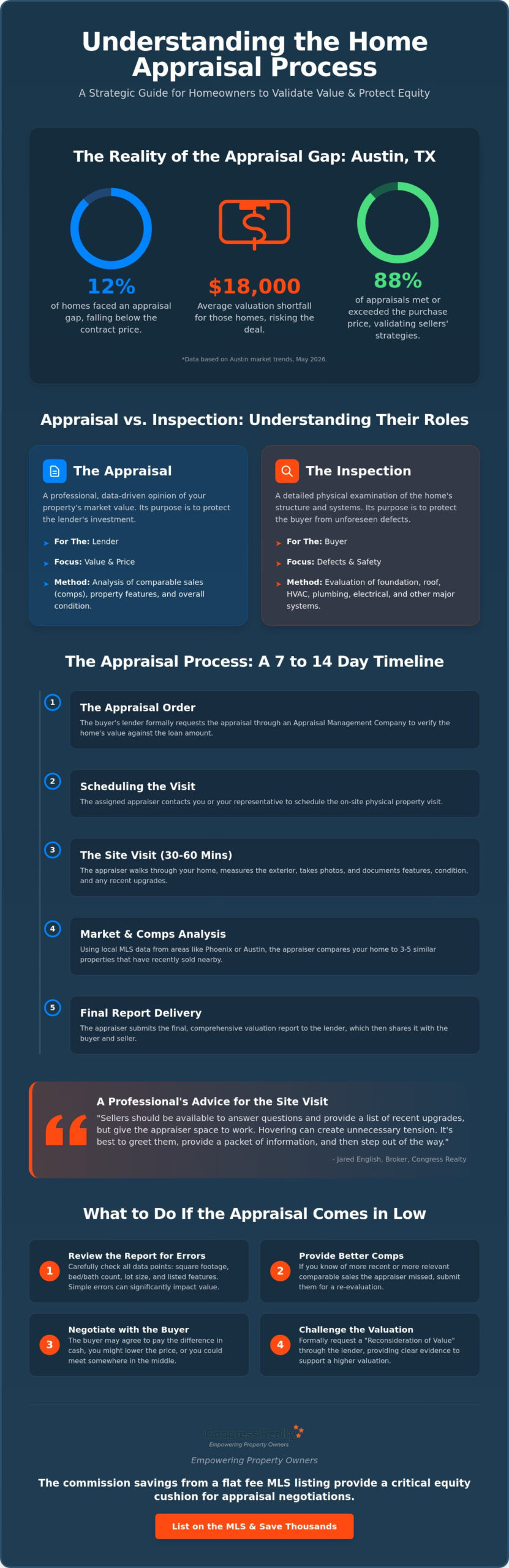
Congress Realty, a flat fee MLS brokerage serving Phoenix, Scottsdale, Austin, and Dallas, provides homeowners with the professional infrastructure to list on the Multiple Listing Service without paying a traditional 6% commission. A low appraisal occurs when the professional valuation of a property is lower than the agreed upon purchase price in the sales contract. For owners selling independently, understanding what happens if home appraisal is low fsbo is critical because it directly impacts your final net proceeds and the viability of the contract. When a gap exists, the transaction hits a standstill until the buyer and seller reach a new agreement.
Lenders follow a strict rule when financing a home purchase in 2026. They will only provide a mortgage based on the real estate appraisal value or the purchase price, whichever is lower. If you are selling a home in Tucson or Dallas and the appraisal comes in $15,000 under your contract price, the bank will not simply cover the difference. This creates a shortfall that must be addressed before the loan can move toward clear-to-close status. You must decide whether to lower your price, ask the buyer for more cash, or challenge the report entirely.
The Immediate Impact on Your Real Estate Transaction
This shortfall is known as an appraisal gap. It creates a significant financing hurdle because the buyer’s loan amount is calculated based on the lower appraised value. Most standard contracts in Arizona and Texas include an appraisal contingency. This clause allows the buyer to cancel the transaction and recoup their earnest money if the property doesn’t value at the contract price. Typically, the appraisal occurs midway through the escrow process. It usually follows the home inspection but happens well before the final loan approval. If the numbers don’t align, the contingency gives the buyer significant leverage to renegotiate the price.
Why FSBO Sellers Face Unique Appraisal Challenges
Independent sellers often face specific hurdles that traditional listings avoid. Without a listing agent to meet the appraiser, key neighborhood context or specific property upgrades might be overlooked. Jared English, broker at Congress Realty, suggests that sellers should always be present during the walk-through to provide a detailed list of recent improvements. Appraisers are human and can miss a new HVAC system or high-end kitchen finishes if they aren’t pointed out.
Industry data shows that approximately 8.6% of appraisals come in lower than the contract price. In high-demand markets like Scottsdale or Austin, prices can move faster than the historical data suggests. Having access to professional MLS data from the start ensures your asking price is grounded in reality. Congress Realty gives you that professional infrastructure. This allows you to present comparable sales that justify your value to an appraiser who might be less familiar with your specific street or subdivision. Knowing what happens if home appraisal is low fsbo allows you to prepare your evidence before the appraiser even steps foot on your property.
Common Causes of Appraisal Gaps in Arizona and Texas
Congress Realty, a flat fee MLS brokerage serving Phoenix, Scottsdale, Austin, and Dallas, understands that market dynamics in 2026 have shifted significantly. In the first quarter of 2026, Texas saw housing supply increase to five months, up from 4.7 months the previous year. This softening market makes accurate pricing even more critical for independent sellers. When homeowners ask what happens if home appraisal is low fsbo, the answer often lies in the specific data used by the appraiser. Market volatility in high-demand areas like Phoenix and Scottsdale frequently leads to lagging comparable sales data. Appraisers might rely on comps from three or six months ago that don’t reflect current 2026 pricing trends in Texas markets like Austin or Dallas.
Jared English, broker at Congress Realty, notes that appraisers often struggle to keep up with hyper-local price increases in emerging neighborhoods. Property-specific issues like unpermitted work or overlooked premium features can also drag down the valuation if they aren’t properly documented. Without a listing agent to advocate for the property value, these details can easily be missed during the short walk-through. This is why having professional documentation ready for the appraiser’s visit is a vital step in protecting your equity.
Data Lags in Rapidly Appreciating Markets
The three to six month window for comparable sales often works against sellers in a fast-moving market. Appraisers prioritize closed sale prices over active list prices. If several homes in your Scottsdale neighborhood are listed high but haven’t closed yet, the appraiser cannot use those numbers to support your valuation. According to the Consumer Financial Protection Bureau, a low appraisal directly limits the amount a buyer can borrow. High-quality visuals from Congress Realty help establish a better first impression for appraisers, highlighting the superior condition of your home compared to older, lower-priced comps.
FSBO Pricing Errors and Lack of Professional CMA
A common mistake for independent sellers is overpricing based on emotional value. Without a professional Comparative Market Analysis (CMA), you lack the objective evidence needed to justify your price. A CMA uses real-time MLS data to show exactly what similar homes are selling for in your specific pocket of Tucson or Fort Worth. Understanding what happens if home appraisal is low fsbo starts with preventing the gap through accurate initial pricing. Congress Realty Full Service packages provide the professional oversight needed to avoid these pricing pitfalls. To ensure your listing starts with the right data, you can list your property on the MLS and gain access to the same tools used by traditional brokers.
Why do appraisal gaps occur in FSBO transactions?
Appraisal gaps typically happen when an appraiser uses outdated comparable sales data or when a seller prices a home based on emotional value rather than a professional Comparative Market Analysis (CMA). In shifting markets like Phoenix or Austin, the six-month window for comps may not reflect current 2026 pricing trends.
Congress Realty, a flat fee MLS brokerage serving Phoenix, Scottsdale, Austin, and Dallas, empowers homeowners to manage their sales with professional tools and significant savings. When a valuation comes in lower than expected, you must decide how to handle the financial shortfall. Knowing what happens if home appraisal is low fsbo allows you to approach the situation with logic rather than fear. You generally have three paths forward. The buyer can cover the gap with additional cash; you can lower your price to match the lender’s valuation; or both parties can meet in the middle. Each choice impacts your final net proceeds differently.
According to experts at Forbes, you can Bounce Back From A Low Appraisal by strategically renegotiating the terms. FSBO sellers have a unique advantage in these discussions because they aren’t losing 3% of the sale price to a listing agent. This commission savings acts as a built-in insurance policy for your deal. If a $500,000 home in Austin or Scottsdale appraises for $485,000, a traditional seller might panic. However, as an independent seller, you have the flexibility to adjust without sacrificing your target bottom line.
Using Commission Savings as a Negotiation Buffer
The math is simple and empowering. On a $500,000 home, a Congress Realty client saves approximately $15,000 by avoiding the standard 3% listing commission. This $15,000 is your negotiation buffer. If the appraiser identifies a $10,000 gap, you can lower the price to satisfy the lender while still walking away with $5,000 more than a traditional seller who had a “perfect” appraisal. Jared English recommends being transparent with the buyer about this advantage. You might say: “Because I am using a flat fee MLS model with Congress Realty, I have saved $15,000 in commission. I am willing to use those savings to lower the purchase price to the appraised value so your loan is approved immediately.” This direct approach builds trust and keeps the momentum moving toward closing.
When to Walk Away from the Deal
Lowering your price is not always the right move. You must protect your remaining equity, especially if the appraisal is demonstrably flawed. If the market in Phoenix or Dallas is still seeing multiple offers, it might be better to cancel the contract and find a new buyer. A different appraiser for a different lender might see the value more clearly. Evaluate the risk carefully. If you cancel, you may face more days on market in a cooling 2026 environment. Understanding what happens if home appraisal is low fsbo means knowing when your equity is worth more than a compromised deal. Congress Realty provides transaction management support to help you evaluate these risks. If the buyer is unwilling to bring any cash to the table and your data proves the appraiser is wrong, walking away allows you to reset and try again with a better-prepared defense for the next valuation.
Can I use commission savings to cover an appraisal gap?
Yes. Since FSBO sellers using Congress Realty save 3% on the listing side, they can use those thousands of dollars to lower the purchase price to match a low appraisal without reducing their intended net profit. This flexibility often saves deals that would otherwise collapse under a traditional 6% commission structure.
How to Successfully Rebut a Low Home Appraisal
Congress Realty, a flat fee MLS brokerage serving Phoenix, Scottsdale, Austin, and Dallas, provides the professional tools and data access necessary to challenge inaccurate valuations. When homeowners ask what happens if home appraisal is low fsbo, they often worry that the bank’s decision is final. This is a misconception. You have the right to request a Reconsideration of Value (ROV) if you can prove the appraiser made factual errors or missed relevant market data. In the shifting 2026 market, where ABC15 Arizona reports inventory rising by nearly 20% in some Phoenix suburbs, appraisers sometimes struggle to find the most representative sales. Challenging a low valuation requires a clinical, fact-based approach rather than an emotional one.
Jared English, broker at Congress Realty, suggests that sellers shouldn’t view the appraiser as an adversary. Instead, treat the rebuttal as a professional presentation of missing information. Your goal is to provide the lender with a Rebuttal of Value package that is so well-documented it becomes difficult to ignore. MarketWatch has highlighted that as markets balance in 2026, the specific condition and upgrades of a home carry more weight than simple neighborhood averages. If the appraiser missed these nuances, your equity is at risk unless you intervene.
Finding Factual Errors in the Report
Start by auditing the appraisal report for basic mistakes. Verify that the square footage matches your official records and that the bedroom and bathroom counts are accurate. Even a small discrepancy in lot size or the age of the home can lead to thousands of dollars in valuation differences. Check the “amenities” section to ensure the appraiser credited you for recent high-value upgrades. If you installed a new roof or a high-efficiency HVAC system in late 2025, these must be included. Small errors often compound, resulting in a significantly lower final number than the property deserves.
Selecting Superior Comparable Sales
The core of your rebuttal lies in the comparable sales, or “comps,” used to justify the price. To successfully challenge the report, you must identify three to four superior comps that the appraiser overlooked. A valid comp must meet strict criteria: it should be within a one-mile radius, have sold within the last six months, and possess similar square footage and features. FSBO sellers should use the professional MLS access provided by Congress Realty to pull real-time data that traditional public sites often miss. When presenting these to the lender’s appraisal review board, explain exactly why your selected homes are more similar to your property than the ones used in the original report. To begin gathering the data you need to defend your home’s value, list your home on the MLS today and take command of your transaction.
How do I challenge a low appraisal as a FSBO seller?
To challenge a low appraisal, you must submit a formal Reconsideration of Value to the buyer’s lender. This package should include documented factual errors in the original report and a list of three to four superior comparable sales from the MLS that support your contract price. Professional data from Congress Realty ensures your rebuttal is based on the same industry-standard information used by appraisers.
Congress Realty, a flat fee MLS brokerage serving Phoenix, Scottsdale, Austin, and Dallas, provides the professional infrastructure of a traditional brokerage without the high costs. When homeowners evaluate what happens if home appraisal is low fsbo, they often worry about the lack of professional advocacy during the lender’s review process. Our platform bridges this gap by empowering you with the same tools used by industry insiders. Jared English and our team of experts provide oversight to ensure your FSBO journey is successful, especially when technical hurdles like appraisal gaps arise. By using an eLockbox and professional photography, you present a high value property that appraisers respect from the moment they arrive at your door.
Leveraging Professional Valuation Tools
Pricing your home accurately is your first line of defense against a low valuation. Our Comparative Market Analysis (CMA) helps you price correctly from day one by using real-time closed sale data from the local MLS rather than unreliable automated estimates. This data is essential when you need to justify your price to a lender. Once your listing is active, it is syndicated to major sites like Zillow and Realtor.com to ensure maximum market exposure. You can start selling your home with Congress Realty today to access these professional valuation tools and protect your equity from the start of the transaction.
Navigating the Closing Process with Confidence
The role of transaction management is vital when overcoming appraisal hurdles. Our Full Service Package includes negotiation assistance and contract review specifically designed to handle low appraisals. This support allows you to navigate the closing process with confidence, knowing you have a broker available to review your rebuttal strategy. Our flat fee model has helped thousands of sellers in Arizona and Texas keep more of their money by avoiding the traditional 3% listing commission. For example, on a home sold at the Arizona median price of $428,000, a seller saves over $12,000 in equity. We encourage you to browse our listing packages to see how you can maintain control over your sale while receiving professional support.
How does a flat fee MLS brokerage help with a low appraisal?
Congress Realty helps homeowners manage low appraisals by providing professional MLS data for rebuttals and offering negotiation assistance through our Full Service Package. Because our sellers save the traditional 3% listing commission, they have more financial flexibility to bridge valuation gaps and reach a successful closing without sacrificing their net profit.
Take Command of Your Home Sale and Protect Your Equity
Congress Realty, a flat fee MLS brokerage serving Phoenix, Scottsdale, Austin, and Dallas, ensures you never have to face a lender’s valuation alone. You now understand that what happens if home appraisal is low fsbo depends entirely on your preparation and willingness to negotiate. By using professional MLS data to challenge factual errors and leveraging your commission savings as a pricing buffer, you can keep your transaction moving toward a successful close. These strategies allow you to maintain control without sacrificing your financial goals.
Since 2002, Congress Realty has provided the professional infrastructure homeowners need to bypass high-cost commission models. Broker Jared English serves as the designated broker in 12 states, offering the expertise required to navigate complex closing hurdles. Our clients save an average of $15,000 per transaction. This provides the financial flexibility that traditional sellers simply don’t have when bridging appraisal gaps. Don’t let a single report derail your plans. Save your equity and list on the MLS for a flat fee today to stay in total command of your sale. You have the tools and the data to protect your hard-earned equity and close with confidence.
Frequently Asked Questions
Is it common for an appraisal to come in low for a FSBO sale?
Low appraisals occur in approximately 8.6% of residential transactions. In rapidly shifting 2026 markets like Phoenix and Austin, the risk increases if a seller prices their home based on active listings rather than recently closed sales. Independent sellers who don’t use professional MLS data to set their initial price often encounter these valuation gaps when the appraiser reviews historical data from the last six months.
Can I order a second appraisal if the first one is too low?
Lenders rarely allow a second appraisal simply because the first valuation didn’t meet the contract price. You must first go through the formal Reconsideration of Value process to challenge the existing report. A new appraisal is typically only granted if you can prove the first appraiser was unqualified or if the buyer switches to a different lender entirely. Jared English recommends focusing your energy on a data-backed rebuttal before attempting to restart the process.
Who pays for the appraisal in a FSBO transaction?
The buyer typically pays for the appraisal as part of their mortgage application and closing costs. In 2026, standard single-family home appraisal fees in Arizona and Texas generally range from $450 to $750. While the buyer pays the fee, the appraiser works for the lender to ensure the property serves as sufficient collateral for the loan amount. Sellers should ensure the home is accessible and well-documented to make the most of this buyer-funded inspection.
How much can I negotiate if the appraisal gap is large?
There is no legal limit to how much you can negotiate. Both parties can agree to any combination of price reductions and cash contributions to bridge the gap. Sellers using Congress Realty often have more room to negotiate because they aren’t paying a 3% listing commission. This savings can be used to lower the price without affecting your target net proceeds, which is a significant advantage in a softening market.
Does a low appraisal mean I have to lower my house price?
No, you aren’t legally required to lower your price. When considering what happens if home appraisal is low fsbo, remember that the buyer must either pay the difference in cash or you must agree on a new price. If neither party budges and an appraisal contingency exists, the buyer can walk away with their earnest money. This is why using commission savings as a buffer is such a pragmatic strategy for independent sellers in Dallas or Tucson.
Can a buyer waive the appraisal contingency in Arizona or Texas?
Buyers can waive the appraisal contingency in both Arizona and Texas, though it’s less common in the balanced 2026 market. Waiving the contingency means the buyer agrees to pay the full contract price regardless of the lender’s valuation. In cities like Scottsdale or Austin, this often occurs during competitive bidding wars. Sellers should verify that the buyer has the liquid cash on hand to cover a potential gap before accepting an offer with this waiver.
What happens if the appraiser makes a mistake in the square footage?
Factual errors regarding square footage are the most effective grounds for a successful rebuttal. If the appraiser’s report differs from official county tax records or a professional floor plan, you should submit these documents immediately to the lender. Even a discrepancy of 100 square feet can result in a valuation difference of thousands of dollars. Providing these corrections can often prompt the appraiser to revise their final value upward without further negotiation.
How does Congress Realty help with low appraisals?
Congress Realty, a flat fee MLS brokerage serving Phoenix and Dallas, provides the professional infrastructure to manage valuation disputes. We give you access to the same MLS database appraisers use to find comparable sales. Jared English notes that our Full Service Package includes negotiation assistance to help you communicate effectively with the buyer’s lender. This support ensures you have a clear path to what happens if home appraisal is low fsbo without paying for a traditional listing agent.
Did you know that 12% of homes in Austin, Texas, faced an appraisal gap in May 2026, with valuations falling an average of $18,000 below the contract price? Congress Realty, a flat fee MLS brokerage serving Phoenix, Arizona, and Austin, Texas, provides the professional infrastructure homeowners need to list on the MLS and bypass traditional high-cost commissions. Understanding the home appraisal process is the final hurdle in your selling journey and the ultimate validation of your home’s true market value.
It’s common to feel a sense of unease when an appraiser arrives, particularly if you’re concerned about a low valuation killing your deal. You want to ensure your hard work translates into a successful closing at or above your contract price. This guide explains how the process works under the mandatory UAD 3.6 data standards and how you can confidently manage the appraiser’s visit. Jared English and the team at Congress Realty believe in your autonomy; we’ll show you how to distinguish an appraisal from an inspection and provide the exact steps to challenge a valuation if it falls short of expectations.
Key Takeaways
Learn why the appraisal is the final validation of your home equity and how it differs from a standard home inspection.
Follow the 2026 step-by-step timeline for site visits and report delivery to keep your closing on track.
Gain a clear advantage by understanding the home appraisal process and how local trends in Austin or Phoenix influence your final valuation.
Master the strategies for navigating an appraisal gap and learn exactly how to challenge a valuation that comes in low.
Discover how the commission savings from Congress Realty provide a critical equity cushion during the final stages of your sale.
Defining the Home Appraisal for Independent Sellers
Congress Realty, a flat fee MLS brokerage serving Arizona (including Phoenix and Scottsdale) and Texas (including Austin and Dallas), defines the home appraisal as a professional and unbiased assessment of a property’s market value. While the lender technically triggers the order once a purchase contract is signed, the final report directly determines your net equity at the closing table. Understanding the home appraisal process is essential for any savvy homeowner who wants to maintain control over their transaction without paying a traditional listing commission. By taking charge of this phase, you protect the financial gains you have already secured by listing independently.
The appraiser acts as a neutral third party in the transaction. They must adhere to the Uniform Standards of Professional Appraisal Practice (USPAP) to ensure the valuation remains objective and free from outside influence. What is a real estate appraisal? At its core, it is a data-driven document that protects the lender’s investment by confirming the home is worth the loan amount. For the seller, it is the final validation of your asking price. Recent data from the Austin market in May 2026 shows that 88% of appraisals come in at or above the purchase price. This indicates that when you use professional data to set your price, the appraisal process usually confirms your strategy.
Appraisal vs. Inspection: Why You Need Both
Many homeowners confuse these two steps; however, they serve different masters. An inspector hunts for physical defects like a cracked foundation or a failing HVAC system to protect the buyer’s safety. In contrast, an appraiser searches for value based on comparable sales and property features to protect the lender’s capital. A clean inspection report is a powerful tool for your valuation. You can share this report with the appraiser to prove the home’s condition is superior to other local listings that might have deferred maintenance issues.
Does a seller need to be present for the appraisal?
Jared English recommends that sellers stay available to answer questions or provide a list of recent upgrades, but you should give the appraiser space to work. Hovering can create unnecessary tension and may hinder their professional walkthrough. It is best to meet them at the door, provide a packet of information regarding your home’s improvements, and then step out of the way.
The Role of the Lender in the Valuation
Lenders require an appraisal to mitigate their financial risk. They use the report to calculate the Loan to Value (LTV) ratio, which is the percentage of the home’s value that the bank is willing to finance. If the appraisal comes in low, that ratio breaks; consequently, the buyer may be forced to bring more cash to the table or walk away. Congress Realty clients often use their flat fee MLS listing data to provide appraisers with the most accurate and recent comps in their specific neighborhood. Providing this data ensures the appraiser has a complete picture of the local market trends in high-demand areas like Tucson or San Antonio.
The Step-by-Step Home Appraisal Process in 2026
The sequence begins immediately after you and the buyer sign the purchase contract. In 2026, the full timeline from the initial order to receiving the final report typically spans 7 to 14 business days. Congress Realty ensures that independent sellers remain in the driver’s seat during this transition by providing the necessary professional infrastructure. Understanding the home appraisal process requires knowing that while the buyer’s lender initiates the order through an Appraisal Management Company, you remain the primary source of property data and access.
Step 1: The Appraisal Order. The lender triggers the request to confirm the property’s value before final loan approval.
Step 2: Scheduling. The appraiser contacts the homeowner or the Congress Realty transaction manager to set a time for the site visit.
Step 3: The Site Visit. This is the physical walkthrough where the appraiser validates the home’s condition and features.
Step 4: Market Analysis. The appraiser pulls “comps” from the local MLS to see what similar homes in Phoenix or Austin have sold for recently.
Step 5: Report Delivery. The appraiser submits a digital report, mandatory in the UAD 3.6 format as of November 2, 2026, to the lender.
What Happens During the Physical Inspection?
The on-site portion for a standard single-family home usually takes 30 to 60 minutes. During this window, the appraiser measures the exterior and walks through the interior to note permanent features like flooring, layout, and structural integrity. They focus on high-impact value drivers rather than your furniture or temporary staging. Jared English suggests having a typed list of recent upgrades ready to hand over. “Providing a clear history of capital improvements, such as a new roof or HVAC system, helps the appraiser justify a higher valuation in their report,” English notes. You should also be aware of your consumer rights in the appraisal phase to ensure the process remains objective and transparent.
The Importance of Comparable Sales (Comps)
Appraisers generally follow the “Rule of Three,” seeking at least three similar homes that sold within the last six months. In dense metropolitan areas like Scottsdale or Dallas, these comps should ideally be within a one-mile radius. In more rural parts of Texas or Arizona, the search radius may expand to five or ten miles. Before the appraiser even arrives, using a Comparative Market Analysis can help you understand where your home sits in the current market. This preparation is a hallmark of a savvy seller who wants to list on the MLS while maintaining professional standards.
How long does the home appraisal take in 2026?
The physical inspection takes 30 to 60 minutes, but the entire process from the initial order to the final report delivery generally takes 7 to 14 business days. Factors such as appraiser availability in high-growth markets like Austin or Phoenix can influence this timeline.
Key Factors Influencing Your Property Valuation
Congress Realty, a flat fee MLS brokerage serving high-growth markets like Scottsdale, Arizona, and Austin, Texas, knows that valuation is driven by specific property characteristics and local neighborhood trends. While the basic math of square footage and room counts provides a baseline, the final number hinges on how your home compares to recent local sales. Understanding the home appraisal process means recognizing that appraisers evaluate your home based on standardized Condition and Quality ratings, ranging from C1 for new construction to C6 for properties with severe deficiencies. Most well-maintained homes in established neighborhoods fall into the C3 or C4 categories.
Lenders also look at external factors that influence desirability. Proximity to top-rated school districts or popular amenities in areas like the Domain in Austin or Old Town Scottsdale can significantly boost your baseline price. Bankrate provides a deep dive into understanding the home appraisal process, highlighting how these external variables impact the final report. By identifying these assets early, you can ensure they are properly reflected in your valuation.
Upgrades That Actually Add Value
Distinguishing between maintenance and upgrades is a critical part of the valuation. Replacing a leaky roof or a water heater is considered maintenance; it prevents a value deduction but rarely increases the sales price. Conversely, a full kitchen remodel or adding a primary suite provides a measurable return on investment. Reports from MarketWatch and ABC News in 2026 indicate that minor kitchen refreshes and energy-efficient window replacements consistently offer the highest ROI for sellers. Jared English advises keeping a folder of all receipts for work completed in the last five years to present to the appraiser during their walkthrough.
Which home improvements add the most value in 2026?
Local Market Nuances in Arizona and Texas
Geography dictates value in ways that standardized forms often miss. In Phoenix and Tucson, a swimming pool is often considered a necessity rather than a luxury, adding significant value that might not exist in cooler climates. In Texas, energy-efficient features like solar panels and high-grade insulation are increasingly scrutinized as homeowners seek relief from summer heat. Congress Realty ensures these specific local features are prominently highlighted in your MLS listing. This ensures the appraiser sees the full value of your property’s unique assets before they even step foot on the lot.
Overcoming the Challenge of a Low Appraisal
The biggest anxiety for independent sellers is the appraisal coming in below the contract price. This creates an “Appraisal Gap,” where the lender will only finance based on the lower valuation rather than your agreed-upon price. While this can feel like a deal-killer, understanding the home appraisal process gives you the tools to bridge that gap effectively. In rapidly appreciating markets like Dallas, Texas, appraisals sometimes struggle to keep pace with rising prices. This is why having a strategy ready is essential for protecting your equity and keeping your closing on track.
If the report is low, you can initiate a formal Reconsideration of Value (ROV). This isn’t just a complaint; it is a structured request for the appraiser to review specific factual errors or additional comparable sales. As reported by outlets like the Star-Telegram, navigating these market shifts requires a data-driven approach rather than an emotional one. By maintaining a professional stance, you can often find a path forward that satisfies both the lender and the buyer.
Can a seller challenge a low appraisal?
Yes, sellers can challenge a low appraisal through a formal Reconsideration of Value (ROV) process. You must provide evidence of factual errors in the report, such as incorrect square footage, or submit at least three superior comparable sales that the appraiser overlooked.
How to Rebut a Low Appraisal Report
Start by scrutinizing the report for data errors. Appraisers are human and can miss a half-bath, miscalculate square footage, or overlook a major upgrade you recently completed. If you find a factual mistake, you have solid ground for an ROV. Next, look for “better” comps that support your price. If the appraiser used a sale from six months ago but a similar home sold next door last week, that new data must be considered. Jared English suggests reviewing the report line-by-line to ensure every feature is accounted for. “We often find that appraisers who aren’t as familiar with a specific pocket of Dallas might miss the nuance of a particular subdivision,” English notes. Understanding the home appraisal process allows you to spot these inconsistencies and advocate for your property’s true value.
Negotiation Strategies for Appraisal Gaps
When the valuation remains low, you have three primary negotiation paths. First, the buyer can bring more cash to the table to cover the difference between the loan amount and the sales price. This is common when buyers are highly motivated to secure a specific home. Second, you can lower the sales price to match the appraised value, ensuring the loan goes through without delay. Third, many sellers choose to meet in the middle. For example, if the gap is $10,000, you might drop the price by $5,000 while the buyer brings $5,000 in additional cash.
Your savings on commissions through Congress Realty provide a unique financial buffer during these negotiations. Because you aren’t losing a significant percentage of your equity to traditional agents, you have more flexibility to adjust the price without hurting your bottom line. If you are ready to take control of your sale and protect your home’s value, list your property on the MLS today.
Protecting Your Equity During the Appraisal Phase
Congress Realty, a flat fee MLS brokerage serving homeowners in Arizona and Texas, empowers sellers to retain more of their hard-earned equity by eliminating the traditional 3 percent listing commission. This financial decision creates a significant “equity cushion” that becomes a strategic asset during the final stages of your sale. Understanding the home appraisal process reveals that having this extra capital allows you to navigate potential valuation gaps with far less stress than a traditional seller. If an appraiser values your home slightly below the contract price, you have the room to negotiate without dipping into the profits you need for your next move.
A successful appraisal serves as the final validation of your independent selling strategy. It confirms that your pricing was accurate and your property is a sound investment for the lender. By utilizing professional transaction management through Congress Realty, you ensure that the technical details of the escrow process remain under your control. This professional infrastructure provides the same reliability as a high-cost brokerage while protecting thousands of dollars in your pocket.
Final Preparations for Appraisal Day
The 24 hours leading up to the appraiser’s visit are critical for a smooth valuation. Treat this visit with the same level of care as a high-stakes showing. Use the following checklist to prepare your property:
Clean the yard and improve curb appeal to set a positive initial perception.
Clear all hallways and ensure every room and closet is easily accessible.
Confirm all utilities are turned on; appraisers must verify that systems like HVAC and water are functional.
Secure pets in a crate or take them off-site to prevent distractions during the walkthrough.
Ensure the attic, crawlspace, and garage are unlocked and ready for inspection.
For more comprehensive tips on getting your home ready for the market, consult our guide on How to Sell Your House on Your Own. Preparation reduces the likelihood of an appraiser needing to return for a second visit, which can delay your closing timeline.
The Congress Realty Advantage in Valuation
Professional presentation influences how an appraiser perceives your property’s condition and quality. When you list with Congress Realty, your home is featured on the same professional industry databases used by every major brokerage in Phoenix or Austin. High-quality photography and a detailed MLS description signal to the appraiser that the home has been professionally maintained and marketed. Jared English notes that a well-documented listing helps justify the sales price when the appraiser pulls local data. “When your listing looks professional, it supports the idea that the contract price represents true market value,” English explains. By avoiding high commission costs, you can price your home more competitively, often leading to a smoother appraisal and a faster path to the closing table.
How does a flat fee MLS listing help with the appraisal?
A flat fee MLS listing through Congress Realty puts your home in the professional databases appraisers use to find comparable sales. Because you save on the listing commission, you have more flexibility to price your home at a point that is easily supported by local market data, reducing the risk of an appraisal gap.
Mastering the appraisal stage is the final step in securing your financial future. By understanding the home appraisal process, you transform a potentially stressful hurdle into a clear validation of your property’s market value. Remember to prepare your home for the site visit, document every major upgrade, and stay ready to challenge factual inaccuracies through the Reconsideration of Value process. These proactive steps ensure you maintain the momentum of your sale while protecting the equity you have worked hard to build.
Congress Realty has championed the rights of independent sellers since 2002. With over 20 years of industry experience and expert broker support from Jared English, we provide the professional infrastructure you need across 12 states, including Arizona, Texas, and California. You don’t need a traditional agent to navigate these final hurdles when you have a reliable ally on your side. Take the next step toward a successful, commission-free closing.
A standard single-family home appraisal in 2026 typically costs between $350 and $600. If you are selling a condo in Austin or Phoenix, expect the fee to range between $400 and $750 because the appraiser must perform additional analysis on HOA financials. Government-backed loans are more expensive; FHA or VA appraisals often cost between $400 and $900 due to stricter safety inspection requirements. USDA loan appraisals usually fall between $550 and $800.
Who is responsible for paying the appraisal fee?
The buyer is responsible for paying the appraisal fee in almost all residential purchase transactions. This cost is usually bundled into their closing costs or paid upfront when their lender initiates the order. While the seller does not pay for this service, understanding the home appraisal process is vital because the resulting valuation determines if the bank will fund the loan at your agreed-upon sales price. This step acts as a mandatory safeguard for the lender’s capital.
How long does the entire appraisal process take from start to finish?
The entire process generally takes between 7 and 14 business days from the moment the lender places the order to the delivery of the final digital report. While the on-site inspection in markets like Scottsdale or Dallas only takes 30 to 60 minutes, the appraiser requires several days to analyze local MLS data and complete the mandatory UAD 3.6 reporting format. High-demand periods in Texas and Arizona may see these timelines extend up to 20 days.
Can I use an old appraisal if I recently refinanced my home?
Lenders will not accept an old appraisal from a previous refinance for a new home purchase transaction. Every new mortgage requires a fresh valuation to ensure the property reflects the most current market conditions and the most recent comparable sales. Even if you refinanced your home just a few months ago, the buyer’s lender must order their own independent report through an Appraisal Management Company to satisfy federal risk management regulations.
What are the most common things that fail a home appraisal?
Safety hazards and structural deficiencies are the most frequent reasons a property fails to meet lender standards. Common issues include peeling lead-based paint, missing stair handrails, or non-functional utilities that prevent the appraiser from testing home systems. Jared English notes that non-permitted additions can also cause significant problems if the appraiser cannot verify the square footage against county records. These “failed” items often require repair before the lender will finalize the loan.
Does a messy house affect the final appraisal value?
A messy house does not technically lower your appraised value because appraisers focus on the permanent “Condition and Quality” ratings of the structure. However, extreme clutter can prevent the appraiser from inspecting floors or walls, which might lead to a more conservative condition rating in the final report. Clean your home and clear all hallways so the appraiser can accurately measure your space and note your high-quality finishes in Phoenix or Tucson without unnecessary obstacles.
What happens if the buyer is using an FHA or VA loan for the purchase?
FHA and VA loans involve a more rigorous appraisal process that includes specific safety and habitability checks beyond a standard valuation. If the appraiser identifies issues like exposed wiring or a failing roof, the lender will require these repairs to be completed before the loan can close. Additionally, these appraisals are tied to the property for a set period. This means the valuation may remain the same even if the original buyer walks away and a new one enters the deal.
Can I choose my own appraiser for the home sale?
You cannot choose your own appraiser due to federal independence requirements designed to prevent mortgage fraud and collusion. Lenders must use a neutral third-party Appraisal Management Company to assign a licensed professional to your property. While you cannot select the individual, understanding the home appraisal process allows you to prepare a professional data packet for whoever is assigned. Congress Realty ensures your MLS listing provides these appraisers with the most accurate data to support your home’s value.
Congress Realty, a flat fee MLS brokerage serving Phoenix, Arizona, and Austin, Texas, empowers homeowners to take control of their real estate transactions without the burden of traditional high-cost commissions. By providing direct access to the professional listing databases used by agents, Congress Realty ensures sellers maintain their autonomy while navigating complex closing processes.
A fifty page home inspection report is not a mandatory repair list, but rather a strategic opening for a second round of price negotiations where you still hold significant leverage. It is common to feel overwhelmed by a buyer’s demands or fear the entire deal will collapse over a few minor findings. You will learn how to handle buyer repair requests using professional strategies that prioritize your equity and keep your closing on schedule. Jared English, the broker at Congress Realty, emphasizes that sellers are often surprised to find they aren’t legally required to fix every cosmetic flaw discovered during the inspection.
With the national average real estate commission reaching 5.70 percent in 2026, every dollar saved during repairs is a direct win for your bank account. As highlighted in coverage by MarketWatch and ABC News, savvy sellers are increasingly opting for closing credits instead of out of pocket repairs. This guide previews the essential safety requirements you must address and the smart negotiation tactics that prevent you from overpaying for unnecessary upgrades.
Key Takeaways
Learn how to handle buyer repair requests by treating the home inspection as a second negotiation rather than a mandatory to-do list.
Distinguish between essential safety repairs required for buyer loan approval and cosmetic requests that you are not legally obligated to address.
Discover why offering a closing cost credit is often the most efficient way to protect your equity and avoid the stress of managing contractors.
Understand how to use the as-is defense effectively to remind buyers that your listing price already accounts for the property’s current condition.
Partner with Congress Realty to navigate complex repair amendments while keeping more of your sale proceeds through a flat fee MLS model.
Congress Realty, a flat fee MLS brokerage serving Arizona and Texas, including major hubs like Phoenix and Austin, provides a streamlined way for sellers to list their homes on the Multiple Listing Service without paying a traditional listing commission. By maintaining control over the transaction, homeowners can protect their equity during the critical phase following a home inspection. When you list your home with a professional flat fee service, you are positioned to handle negotiations with the same authority as a traditional agent, but with significantly lower overhead costs.
The inspection report is not a mandatory repair list. It is a strategic tool for the buyer to re-negotiate the purchase price after the contract is already signed. Learning how to handle buyer repair requests prevents you from losing the proceeds you have worked hard to build. Jared English, broker at Congress Realty, points out that sellers often feel defensive when an inspector critiques their property. He advises viewing the report as a business transaction rather than a personal attack. Since the median age of owner-occupied homes in the U.S. is now over 40 years, according to 2026 data, an inspector will always find something to document. Your goal is to separate the serious issues from the minor maintenance noise.
The Post-Inspection Timeline in Arizona and Texas
Most purchase agreements rely on a home inspection contingency to define the due diligence period. In Arizona and Texas, this window is typically 10 days. During this time, the buyer must conduct their inspections and submit a formal Request for Repairs. In Arizona, this document is known as the BINSR (Buyer’s Inspection Notice and Seller’s Response). After you receive the request, the clock starts on your response window, which is usually three to five days. You have the right to accept the requests, offer a counter proposal, or reject them entirely. Missing these deadlines can jeopardize the entire sale, so you must act quickly once the report arrives.
Why the Inspection Report Looks More Scary Than It Is
Do not let a 50 page report cause panic. Inspectors are paid to find every minor flaw to prove their value to the buyer. You must learn to distinguish between a system at the end of its life and an active failure. For example, an air conditioner that is 15 years old but still cooling the home is not a defect; it is a functioning system that is simply aged. Conversely, a roof with active leaks is a structural failure. Understanding how to handle buyer repair requests involves focusing on safety and habitability rather than routine maintenance. Most items on a report are cosmetic, such as a loose doorknob or a torn screen. These should not distract you from the primary goal of closing the sale on schedule while keeping your equity intact.
Congress Realty, a flat fee MLS brokerage serving homeowners in Phoenix, Arizona, and Dallas, Texas, empowers sellers to retain their equity by providing professional listing tools without the traditional 3 percent listing commission. By using the same Multiple Listing Service as traditional agents, you maintain full control over your sale while saving thousands of dollars in transaction costs. This autonomy is particularly valuable when you need to decide which inspection findings deserve your financial attention and which do not.
Receiving a repair request is often the most stressful part of the sale. You are generally not legally obligated to repair any specific item unless it is a requirement of the purchase contract or local safety ordinances. Knowing how to handle buyer repair requests starts with sorting the inspection list into three specific buckets: safety, structural, and cosmetic. Jared English, broker at Congress Realty, advises that sellers should focus their energy only on deal-breakers. These are issues that would prevent a future buyer from obtaining a mortgage or create a significant safety liability for the next occupant.
Items like chipped baseboards, old carpets, or dated wallpaper are purely cosmetic. You should almost always reject these requests. Since home maintenance costs have increased 42 percent over the last five years, buyers are often looking for ways to offset their future expenses at your expense. The average homeowner now spends $8,808 annually on maintenance, according to 2026 data. This makes buyers highly sensitive to any deferred task, but your role isn’t to deliver a perfect home. If you are feeling overwhelmed by the technical jargon in a report, you can list with Congress Realty to access professional support that helps you navigate these negotiations with confidence.
Mandatory Fixes for FHA and VA Loans
Government-backed loans like FHA and VA have strict Minimum Property Requirements that can make certain repairs non-negotiable. Common red flags include peeling lead-based paint in homes built before 1978, missing handrails on stairs, or the lack of a permanent, functional heat source. If these aren’t addressed, the appraiser will likely flag them in their report. The lender will then refuse to fund the loan until a re-inspection confirms the fixes are complete. You must prioritize these items to keep the buyer’s loan approval intact and stay on schedule for closing.
Negotiable Major Systems
Major systems like HVAC, roofing, and plumbing are the biggest points of contention in any negotiation. According to 2026 data, the average cost to replace a central air conditioner is between $3,500 and $7,500, while a furnace replacement typically costs between $2,500 and $6,000. If your unit is 12 years old but cools the house effectively, it is functional as intended. You don’t owe the buyer a brand-new system just because the current one is aged. Push back on requests for upgrades by providing service records that prove the systems have been maintained and are not currently failing.
Strategic Responses: Repair, Credit, or Price Reduction
Congress Realty, a flat fee MLS brokerage serving Phoenix, Scottsdale, and Austin, empowers homeowners to manage their own property sales while bypassing traditional high-commission structures. By listing on the Multiple Listing Service for a predictable fee, sellers typically save between $12,000 and $15,000 compared to a traditional 6 percent model. These significant savings provide a vital financial buffer when you are deciding how to handle buyer repair requests during the final stages of a transaction. Having this extra equity allows you to negotiate from a position of strength rather than desperation.
When a buyer submits their request list, you have three primary paths: fixing the items yourself, offering a closing cost credit, or reducing the sale price. Each choice impacts your net proceeds and your legal liability differently. Jared English, broker at Congress Realty, suggests that sellers often overlook the long-term implications of managing repairs themselves. While you might save money upfront by hiring your own handyman, you also take on the risk that the buyer will find the work unsatisfactory during the final walkthrough. This can lead to last-minute delays or even a collapsed deal.
The Pros and Cons of Closing Cost Credits
A closing cost credit is frequently the most efficient resolution for both parties. This strategy involves the seller paying a portion of the buyer’s closing costs, which effectively leaves the buyer with more cash in their pocket to perform repairs after the sale closes. One major advantage is that it completely removes the seller’s liability for the repair’s future performance. If a roof leak persists after a credit is issued, it is no longer the seller’s problem. However, you must verify that the lender allows the specific credit amount. Lenders often cap these credits at 3 to 6 percent of the purchase price depending on the loan type and the buyer’s down payment.
Managing Repairs Before Closing
If you choose to perform repairs to keep a deal on track, you must protect yourself from future legal disputes. Always hire licensed and bonded contractors rather than attempting a DIY fix for major systems. According to 2026 data, the average cost of a single deferred repair now exceeds $5,600, so cutting corners can be expensive in the long run. Provide all receipts and transferrable warranties to the buyer at least 48 hours before the scheduled closing. Be aware that starting a repair can sometimes reveal deeper hidden issues, which might delay your closing date and increase your out-of-pocket costs beyond your original estimate.
A straight price reduction is the simplest method, but it is often the least effective for buyers with limited cash reserves. Reducing the price by $5,000 only lowers the buyer’s monthly mortgage payment by a small amount, whereas a $5,000 credit helps them pay for the actual work immediately. As reported by MarketWatch and the Star-Telegram, the 2026 real estate market requires sellers to be more flexible with these concessions to compete with new construction. Having the extra equity saved by using Congress Realty allows you to make these strategic moves while still walking away with more money than a traditional sale would allow.
The As-Is Defense and Negotiation Tactics
Congress Realty, a flat fee MLS brokerage serving Phoenix, Scottsdale, and Austin, provides homeowners with the professional infrastructure to list on the Multiple Listing Service without paying a traditional 3 percent listing commission. By maintaining autonomy over the sale, sellers can protect their equity even during high-pressure negotiations. This level of control is essential when deciding how to handle buyer repair requests while keeping the transaction on track for a successful closing.
Selling a home “as-is” is a common strategy, but it is often misunderstood by both parties. It does not mean a buyer is prohibited from asking for repairs; it simply states your intention not to make them. If you are negotiating a contract with an as-is clause, remember that your pricing already reflects the home’s current state. Jared English, broker at Congress Realty, notes that if you listed the property below the top of the market to account for an older roof or dated interior, you should remind the buyer of this fact. A firm stance here prevents the buyer from “double dipping” by getting a lower price and then demanding credits for the very items that justified the discount.
Leveraging backup offers is one of the most effective ways to maintain a firm stance. Reports from MarketWatch and ABC News indicate that while the 2026 market has seen a rise in negotiable buyer’s agent commissions, high-demand areas like Dallas and Tucson still favor sellers with well-priced homes. If a buyer threatens to walk over a $500 minor electrical fix, having a secondary offer waiting in the wings gives you the confidence to say no. This tactical transparency reminds the buyer that they are not the only interested party, which often leads to a more reasonable repair list.
How Do I Say No to a Repair Request?
To say no effectively, draft a professional response that acknowledges the inspection but highlights that the requested items were visible during the initial showing. For example, if a buyer asks to fix a cracked tile they saw during the open house, you can politely decline. A smart middle ground is offering a small “good faith” credit for legitimate safety items while rejecting all cosmetic requests. This shows you are willing to close the deal without sacrificing your hard-earned equity. Remind the buyer’s agent of the competitive nature of the local market to reinforce your position.
The Power of the Professional Quote
Never accept a buyer’s repair estimate at face value. Buyers often inflate these costs to secure a larger price reduction. If a buyer claims a water heater replacement will cost $4,000, counter with a quote from a local licensed contractor. According to April 2026 data, the average cost to replace a tank-style water heater is actually $900 to $2,500. Using real data and professional quotes allows you to list with Congress Realty and manage your transaction with the same precision as a high-cost traditional broker. Providing your own quotes serves as evidence that the buyer’s request is unreasonable or overpriced, keeping more money in your pocket at closing.
Congress Realty, a flat fee MLS brokerage serving Phoenix, Arizona, and Austin, Texas, provides homeowners with the professional infrastructure to list on the Multiple Listing Service without paying a traditional 3 percent listing commission. By maintaining autonomy over the sale, sellers can protect their equity even during high-pressure negotiations. This level of control is essential when deciding how to handle buyer repair requests while keeping the transaction on track for a successful closing.
What is the most effective way to respond to a home inspection report?
The most effective way to respond is to categorize findings into safety issues, structural defects, and cosmetic repairs. Sellers should prioritize safety and structural items that affect lender funding while rejecting cosmetic requests. Using a professional amendment to document agreed-upon repairs ensures the agreement is legally binding and prevents last-minute disputes.
Navigating how to handle buyer repair requests requires more than just a firm negotiation stance; it requires professional documentation to protect your legal interests. The national average real estate commission is 5.70 percent as of May 2026. By choosing a flat fee model, you avoid the traditional 3 percent listing commission, often saving over $15,000 on a $500,000 home. Jared English and his team have helped thousands of sellers in states like Washington and Louisiana leverage these savings to cover legitimate repairs without sacrificing their total profit. This financial intelligence allows you to remain in control of the process from the initial FSBO MLS listing to the final signature.
Expert Oversight for FSBO Sellers
Professional transaction management is a core component of the Full Service package at Congress Realty. When you reach the repair phase, every agreement must be captured in a written amendment to the purchase contract. Verbal promises are unenforceable and often lead to litigation. Our oversight ensures your paperwork is legally sound and meets state-specific requirements. To see the specific tools available for your transaction, you can view our listing packages. Additionally, using an eLockbox provided by Congress Realty allows you to track exactly when contractors enter and leave your home, providing a clear audit trail for any agreed-upon work.
Final Walkthrough Expectations
The final walkthrough typically occurs 24 to 48 hours before closing. This is the buyer’s opportunity to verify that the home is in the same condition as when they signed the contract and that all repairs are complete. Ensure you have all receipts from licensed contractors ready to present. If a buyer raises new, unrelated issues during this time, contact Congress Realty immediately for guidance. We provide the professional infrastructure needed to distinguish between legitimate repair concerns and last-minute attempts to renegotiate, ensuring you close your sale on schedule.
Secure Your Equity and Close with Confidence
Navigating the inspection period doesn’t have to be a drain on your finances or a source of anxiety. By categorizing requests effectively and choosing strategic credits over manual repairs, you maintain the upper hand in the transaction. Understanding how to handle buyer repair requests ensures that your home sale reaches the finish line without unnecessary out of pocket costs or legal headaches. You’ve worked hard to build value in your property; don’t let a standard inspection report erode your proceeds during the final weeks of the sale.
Jared English, a broker licensed in 12 states, has spent over 20 years perfecting a model that puts the power back in the seller’s hands. Founded in 2002, Congress Realty maintains an A+ rating with the Better Business Bureau by providing the professional infrastructure needed for a successful sale. We help you bypass the traditional 3 percent listing commission, giving you the financial flexibility to negotiate repairs from a position of strength and clarity.
Congress Realty, a flat fee MLS brokerage serving Phoenix, Arizona, and Austin, Texas, provides homeowners with the professional infrastructure to list on the Multiple Listing Service without paying a traditional 3 percent listing commission. By maintaining autonomy over the sale, sellers can protect their equity even during high-pressure negotiations. This level of control is essential when deciding how to handle buyer repair requests while keeping the transaction on track for a successful closing.
Frequently Asked Questions
Do sellers have to fix everything on a home inspection report?
No, you are not legally required to repair every item found by an inspector. Your responsibility is generally limited to safety hazards, structural defects, and items specifically required by your purchase contract. Jared English notes that cosmetic flaws like scratched flooring or dated fixtures should almost always be rejected. Understanding how to handle buyer repair requests involves focusing only on issues that impact the buyer’s ability to secure a mortgage or occupy the home safely.
Can a buyer walk away if I refuse to make repairs?
Yes, a buyer can typically terminate the contract if their inspection contingency is still active and you refuse their requests. If you decline to address significant safety or structural concerns, the buyer has the right to walk away and recover their earnest money. This creates a negotiation window where both parties must find a compromise, such as a price reduction or a repair credit, to keep the sale moving toward closing.
What are the most common repair requests in Arizona and Texas?
In Phoenix and Scottsdale, air conditioning failures are the top concern; foundation issues are more frequent in Dallas and Austin. Sellers in these regions also often face requests regarding roof longevity and wood-destroying insect damage. Congress Realty has seen these specific regional issues stall many transactions. Addressing these high-priority items early can prevent a buyer from feeling overwhelmed by the inspection report during the due diligence period.
Is it better to give a credit or do the repairs myself?
Offering a closing cost credit is often the smartest way for a seller to manage the transaction. This method allows the buyer to control the repair quality after closing while removing your liability for the future performance of the work. When you learn how to handle buyer repair requests through credits, you avoid the risk of contractor delays. This approach also ensures that you don’t spend your own cash on repairs that the buyer might later find unsatisfactory.
How does selling “as-is” affect repair requests?
Selling a home “as-is” informs the buyer that you do not intend to make any repairs, but it does not waive their right to a professional inspection. Buyers can still submit a request for repairs or credits if they discover major undisclosed defects. Jared English emphasizes that an “as-is” sale is a statement of intent, not a legal shield against all negotiations. You must still provide accurate property disclosures to avoid future legal disputes.
What repairs are mandatory for a VA or FHA loan?
Mandatory repairs for government-backed loans focus on safety, security, and soundness. FHA and VA appraisers require the resolution of issues like peeling lead-based paint, missing handrails, or roof leaks before they will fund the loan. If you don’t address these Minimum Property Requirements, the lender will likely deny the buyer’s application. Prioritizing these specific fixes is essential for sellers working with buyers using these loan programs.
Can I use my own contractor for buyer-requested repairs?
You generally have the right to choose your own contractors unless the signed repair amendment states otherwise. It is vital to hire only licensed and bonded professionals for any agreed-upon work. Providing the buyer with invoices and transferrable warranties at least 48 hours before closing builds trust and satisfies contract requirements. Using your own trusted vendors helps you control the costs while ensuring the work meets professional standards.
What happens if a repair costs more than the original estimate?
The seller is usually responsible for the difference if they agreed to fix the item in a signed amendment. This financial risk is a primary reason why Congress Realty recommends offering credits instead of performing physical repairs. Once you sign an amendment promising a functional system, you must deliver it regardless of the final bill. Strategic negotiation at the start of the repair period protects your equity from these unexpected expenses.