What if the only thing standing between you and saving tens of thousands in commissions was a small, secure box on your front door? You’ve decided to sell your home independently because you value financial intelligence and want to keep your hard-earned equity. However, it’s completely normal to feel a bit of hesitation about managing the logistics. You want the professional appearance of a high-end listing, but you also need to ensure that every person entering your property is a verified professional.
Selecting the right electronic lockbox for real estate is the most critical step in transitioning from a DIY seller to a savvy, independent homeowner in control. You don’t have to settle for basic consumer hardware that lacks the encryption and tracking required for serious transactions. This guide will help you discover how professional-grade lockboxes provide the same security and showing management tools used by top-tier agents while keeping your equity where it belongs.
We’ll explore the 2026 UL security standards for anti-tampering logic, explain why physical key cards are a thing of the past, and show you how to integrate trackable access into your daily routine. By the end, you’ll have the confidence to manage showings solo while maintaining the professional infrastructure your listing deserves.
Key Takeaways
Upgrade from basic consumer hardware to professional-grade systems that ensure only licensed agents gain verified access to your home.
Gain full command over your property by setting time-restricted showing windows and receiving instant notifications whenever someone enters or leaves.
Learn why a professional electronic lockbox for real estate is the essential tool for protecting your home while you maximize your equity.
Follow a simple, two-step process to place your device correctly and sync it with professional industry databases for automated management.
Understand how to leverage professional-level security to save thousands in commissions without sacrificing the safety or professional appearance of your listing.
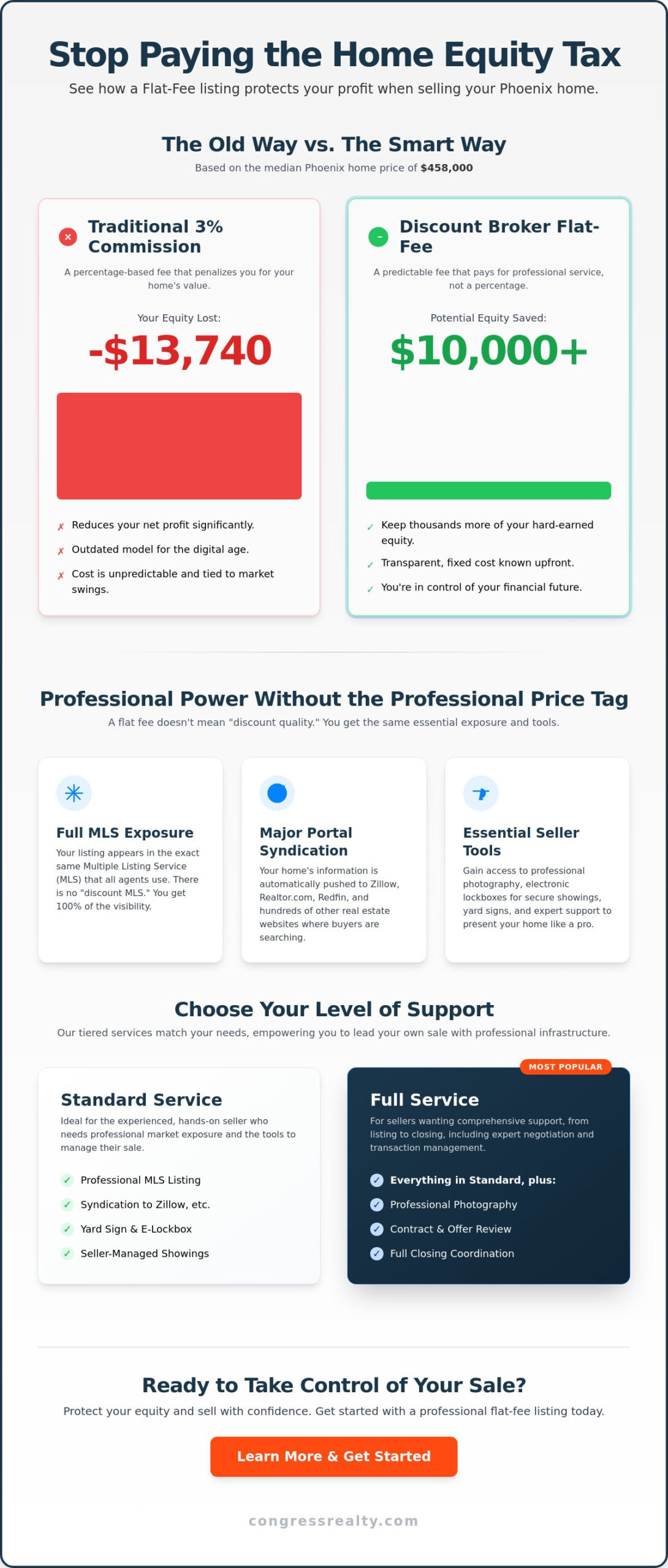
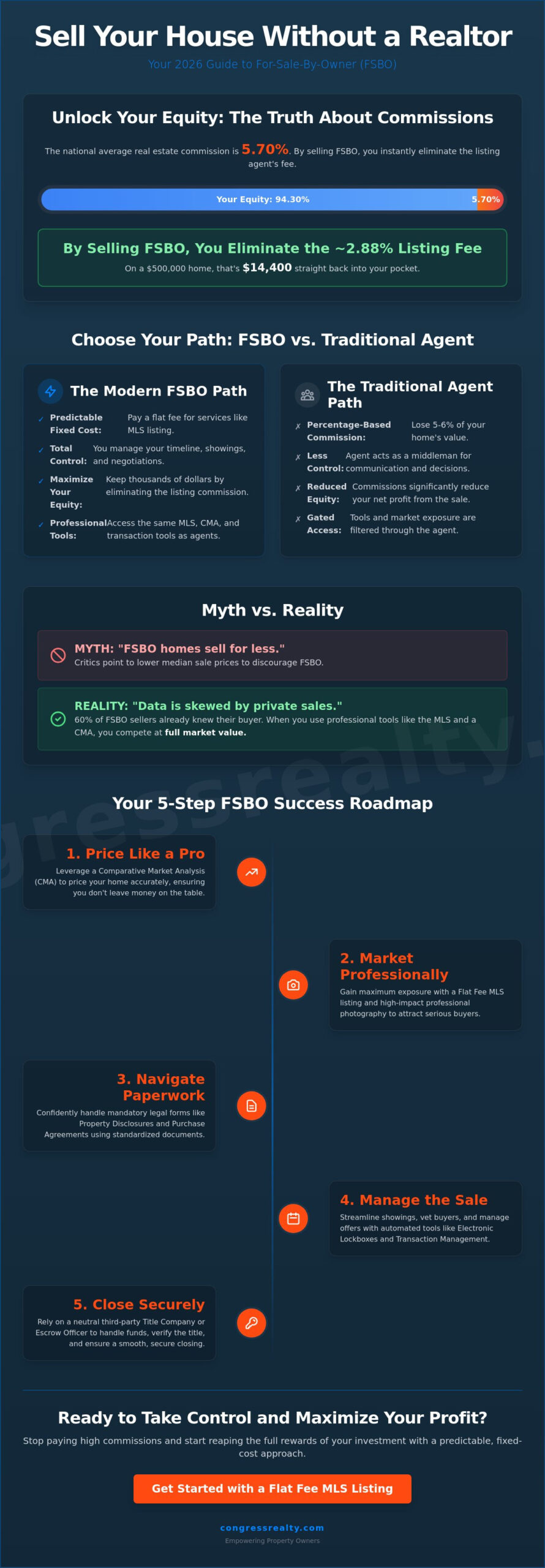
An electronic lockbox is a high-security digital device designed to store property keys while tracking every instance of access. If you’ve ever asked yourself, What is a real estate lockbox?, think of it as a smart vault that acts as your professional gatekeeper. In an equity-first selling model, this device is your “silent agent.” It allows you to provide secure access to buyer’s agents without paying a 3% listing commission just to have someone open a door.
The industry has evolved significantly from the old mechanical “spin-dial” boxes of the past. Those legacy systems relied on static codes that were easily shared, forgotten, or compromised. Modern systems use Bluetooth-enabled technology to communicate directly with an agent’s smartphone. This shift ensures that an electronic lockbox for real estate is now the mandatory industry standard for professional mls services. It bridges the gap between independent control and professional-grade security.
Digital vs. Mechanical: Why Security Matters
Mechanical boxes are a liability because they use a single code for every visitor. Once that code is out, you lose control over who enters your home. Electronic boxes solve this by generating unique, encrypted credentials for every authorized visitor. The primary security benefit is the automated audit trail, which provides a definitive, time-stamped record of exactly who entered your property and when they left. This level of accountability deters unauthorized behavior and gives you total peace of mind.
The Components of a Professional System
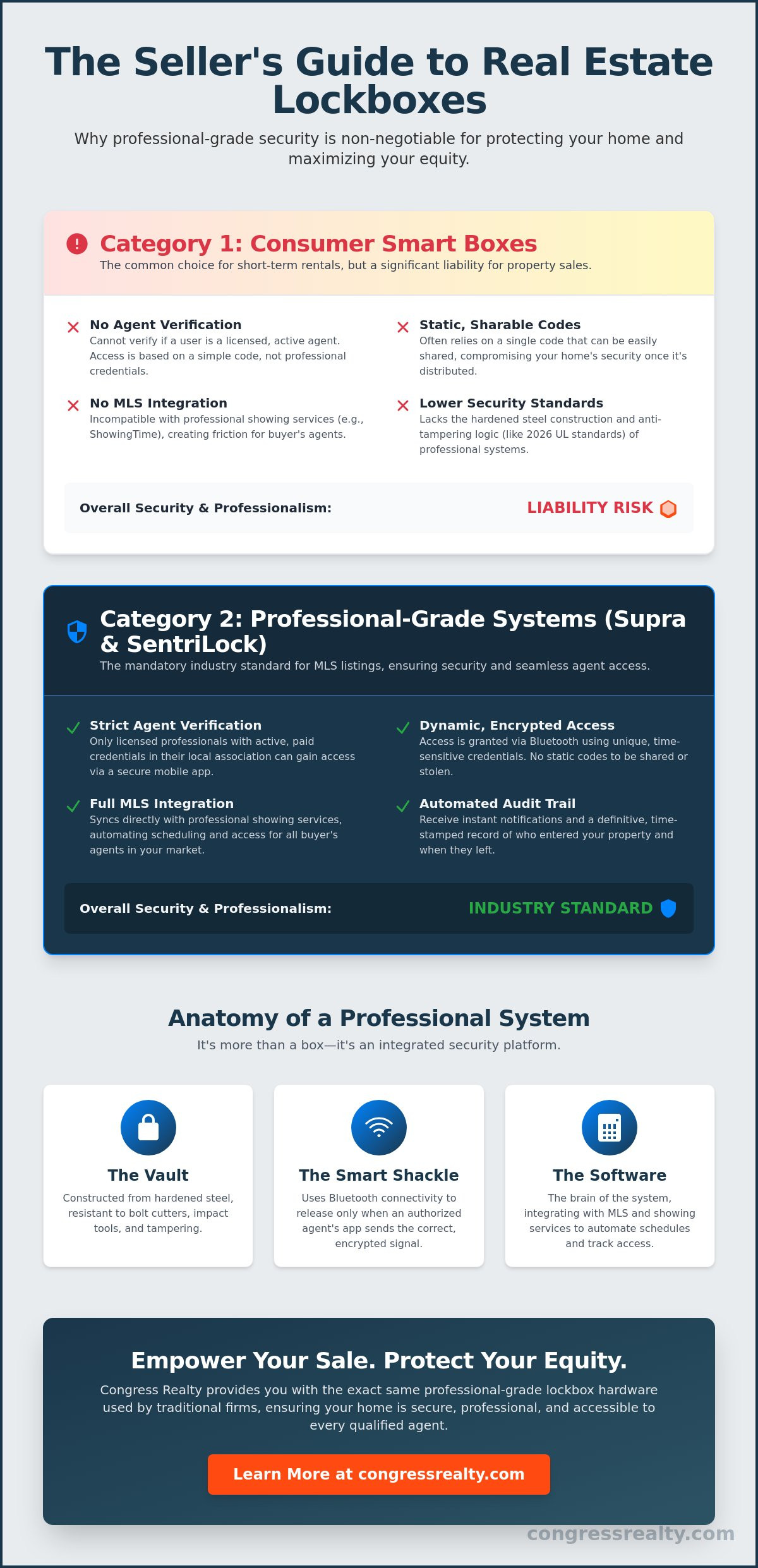
Professional systems aren’t just plastic boxes from a hardware store. They are built with three core components designed for maximum security and seamless integration:
The Vault: This is the main compartment, typically constructed from hardened steel that is resistant to bolt cutters and impact tools.
The Smart Shackle: This part secures the box to your door handle or a railing. It uses Bluetooth or NFC connectivity to release only when an authorized agent’s app sends the correct signal.
The Software: This is the brain of the system. It integrates with professional showing services like ShowingTime or SentriKey to manage your schedule automatically.
By using these professional tools, you position your listing as a serious, agent-friendly property. You maintain the autonomy of a savvy, independent seller while using the exact same infrastructure as a traditional brokerage. It’s about working smarter to protect your equity.
Supra vs. SentriLock vs. Consumer Smart Boxes
Don’t make the mistake of thinking all digital locks are created equal. While a smart box from a big-box retailer might work for a delivery driver or a short-term rental, it’s a significant liability for a high-value property transaction. To maximize your equity, you need tools that speak the language of the professional brokerage world. The industry is currently dominated by two primary systems: Supra and SentriLock. These are the only devices that integrate directly with local MLS databases and verify the credentials of every person who approaches your front door.
Choosing the right electronic lockbox for real estate is about more than just convenience; it’s about compatibility. If your lockbox isn’t compatible with the local MLS requirements, buyer’s agents may struggle to access the home, which creates friction and can lead to missed offers. Congress Realty bridges this gap by providing you with the exact same professional hardware used by traditional firms, ensuring your home is accessible to every licensed professional in your market.
Professional Grade: Supra and SentriLock
These systems are built on a foundation of strict agent authentication. To open a Supra or SentriLock box, an individual must be a licensed professional with active, paid credentials in their local association. This creates a secure environment for your house selling journey. These devices use automatic updates, meaning access codes expire or change constantly to prevent unauthorized re-entry. Since SentriLock officially retired physical cards in 2024, everything is now managed through secure mobile apps, providing a seamless and trackable experience for every showing.
Consumer Grade: Smart Boxes and Keypads
Consumer smart boxes are excellent for contractors or Airbnb guests, but they are risky for professional home sales. Their biggest weakness is the lack of “agent-only” filters. When you use a consumer box, you’re responsible for manually vetting every person you give a code to. This adds an unnecessary layer of complexity to your schedule. Furthermore, these boxes can sometimes deter buyer’s agents. Professionals expect the security of an MLS-integrated system and may feel hesitant to enter a property using a generic code that hasn’t been verified through an official database.
You deserve the same level of security and professional appearance as any other listing on the market. By using professional-grade tools, you signal to the industry that you are a savvy, prepared seller. You can explore how these tools fit into our professional listing packages to help you save thousands in commissions while maintaining total control of your sale.
Security Features That Protect Your Home and Equity
Selling your home independently requires a level of security that matches your financial ambition. You aren’t just letting people into your house; you’re managing a high-value asset. A professional electronic lockbox for real estate provides the technical barrier needed to ensure that only verified professionals enter your space. By leveraging advanced encryption and physical durability, you protect your property and your peace of mind simultaneously.
Modern hardware for 2026 has reached new heights of resilience. Top-tier devices now feature a battery life of up to 10 years, ensuring your box never fails during a critical showing window. These units meet strict ANSI/BHMA Grade 1 or Grade 2 standards for physical strength. They also comply with UL 2050 and EN 1303:2021 tests for encryption and anti-tampering logic. This means your keys aren’t just behind a door; they’re behind a sophisticated digital fortress that is virtually impossible to bypass without authorization.
Forget the “One-Day Code” myth that plagued older systems. In the past, sellers worried about codes being written down or shared. Today, modern systems use secure, expiring digital keys. These keys are issued to an agent’s specific device and expire automatically once the showing window closes. This ensures that an agent who visited at 2:00 PM cannot return at 8:00 PM without a new, verified appointment. You maintain absolute control over the entry process at all times.
Monitoring the Audit Trail
Accountability is the greatest deterrent to unprofessional behavior. Every time the vault opens, the system records a detailed entry with the agent’s name, license number, and contact information. This digital footprint creates a complete history of everyone who has stepped inside. By reviewing these logs, you can easily follow up for feedback after a showing to gauge buyer interest. The existence of a detailed audit trail significantly reduces the risk of theft or property damage because every visitor knows their identity is permanently linked to their time in the home.
Controlling Showing Windows
Take command of your daily life by setting precise showing windows directly through your lockbox app. You don’t have to worry about late-night or early-morning “surprise” visits from overeager agents. If you need to block out a specific afternoon for a family event or a maintenance task, you can set “blackout dates” with a few taps. This feature ensures your home remains secure and private while you are at work or away on vacation. You decide when the door is open, and the technology enforces your rules without exception.
How to Manage Showings with an Electronic Lockbox
Managing the showing process doesn’t require a traditional agent’s intervention. By using an electronic lockbox for real estate, you automate the administrative tasks that typically consume a seller’s time. This technology allows you to act as your own coordinator, ensuring that every buyer’s agent has a seamless experience while you maintain total oversight of your home. It’s about using professional infrastructure to simplify your daily routine.
Your workflow follows a logical, five-step sequence that keeps you in command. First, place the lockbox where it’s visible and accessible. Second, sync the device with your online listing information. Third, configure your smartphone to receive push notifications for every event. Fourth, review and approve showing requests based on your personal schedule. Finally, use the digital access log to trigger and analyze agent feedback. This structured approach transforms a complex logistical challenge into a manageable, automated process.
Placement and Installation Tips
Effective placement is about more than just convenience; it’s about signal reliability. Avoid “hidden” spots behind thick metal pillars or deep inside recessed entryways that might block Bluetooth signals. Choose the front door handle or a sturdy, visible gate instead. Before your first showing, always test the shackle and the key bin to ensure they operate smoothly. Make sure the box is mounted at a height that is easily reachable for agents of all heights. A professional appearance starts with a functional and accessible entry point.
Integrating with Showing Services
A professional lockbox works in tandem with advanced mls sale scheduling tools. When an agent requests a time through the MLS, the system verifies their credentials and coordinates with your lockbox settings. For an extra layer of control, you can enable a “Call Before Showing” (CBS) code. This requires the agent to contact you directly for a secondary code before the box releases the keys. This ensures you are never caught off guard by a visitor.
Once a showing concludes, the system can automatically send a feedback request to the visiting agent. Since the software knows exactly when the agent left the property, the request arrives while the home is still fresh in their mind. This data is invaluable for making informed adjustments to your listing. If you’re ready to take charge of your sale with professional tools, you can get started with an electronic lockbox today as part of our listing packages.
Why Congress Realty Includes Electronic Lockboxes
Choosing to sell your home independently is a move rooted in financial intelligence. You recognize that your equity is a result of years of hard work, and you don’t want to see it diminished by traditional, percentage-based commissions. Congress Realty acts as your professional advocate by providing the infrastructure you need to succeed. By including an electronic lockbox for real estate in our listing packages, we ensure you have the same technological advantages as any traditional brokerage.
This approach allows you to leverage agent-grade tools while remaining the primary decision-maker. Whether you select our Standard Listing or our Full Service Listing, the electronic lockbox serves as your frontline security and showing manager. It’s a pragmatic solution that replaces the high cost of a traditional listing commission with a predictable, fixed-cost model. You keep your equity, and we provide the professional equipment required to get the job done right.
Professionalism Meets Autonomy
Buyer’s agents are busy professionals who prioritize listings that are easy to show and secure. When you provide a professional lockbox, you remove the friction that often prevents independent properties from getting viewed. Agents see the familiar Supra or SentriLock hardware and know they can access the home safely using their existing credentials. This parity with traditional listings ensures your home stays at the top of their showing list.
We believe in a “smart ally” approach to real estate. Our role is to provide the necessary professional infrastructure, such as transaction management and professional photography, and then step back to let you lead the process. This empowers you to master how to sell your house on your own with total confidence. You aren’t just a DIY seller; you’re a savvy homeowner running a professional sale.
Getting Started with Your Professional Listing
Receiving and setting up your Congress Realty lockbox is a simple, methodical process designed for the busy homeowner. Once your listing is active, we facilitate the delivery of your hardware so you can mount it and begin receiving showing requests immediately. You don’t need to be a tech expert to manage the system. Our support team is available to help you with showing management and any technical questions that arise during the process.
Take command of your sale and protect your home’s value. By using professional tools and a fixed-fee structure, you maximize your return and maintain total control over your move. Claim your equity and your professional tools today by selecting the listing package that fits your needs.
Secure Your Equity and Take Command of Your Sale
You’ve seen how a professional electronic lockbox for real estate creates a secure, agent-friendly environment without the burden of a traditional listing commission. By choosing professional-grade encryption over basic consumer hardware, you protect your home while maintaining total command of every showing. You also gain a definitive audit trail that ensures every visitor is a verified licensed professional.
Congress Realty brings over 20 years of flat-fee MLS expertise to your side as a reliable ally. We include professional electronic lockboxes in our listing packages to ensure your home meets industry standards for security and accessibility. When you combine this technology with our A+ rated transaction management, you have the complete infrastructure needed to succeed independently.
You have the financial intelligence to manage this process, and we provide the professional tools to make it simple. Take the next step toward a smarter, more rewarding home sale today.
Frequently Asked Questions
Do I need a special app to use an electronic lockbox as a seller?
Yes, you’ll typically use a dedicated app like SentriKey or Supra eKEY to manage your property’s access settings. These platforms empower you to approve showing requests, set blackout times, and view real-time entry logs directly from your smartphone. It’s a simple, user-friendly way to maintain total command over your home’s security while you’re at work or on the go.
Can I use a regular smart lock instead of a real estate lockbox?
While consumer smart locks are convenient for personal use, they lack the professional integration that buyer’s agents expect. An electronic lockbox for real estate connects directly to professional industry databases to verify an agent’s license and credentials before granting entry. Using a regular smart lock can create unnecessary friction and might even deter agents from showing your home to their clients.
What happens if the battery in the electronic lockbox dies?
Professional-grade lockboxes are built with high-capacity batteries designed to last up to 10 years. The system provides advance warnings through your app long before the power runs low, so you’re never caught by surprise. In the rare event of a total power failure, these devices often feature emergency jump-start points or manual override options to ensure you can always retrieve your keys.
Is an electronic lockbox safer than a hidden key or mechanical box?
Electronic systems are vastly superior to mechanical “spin-dial” boxes or hidden keys because they eliminate static codes. Mechanical codes are easily shared or stolen, but electronic credentials are encrypted and linked to a specific agent’s identity. Since these digital keys expire automatically after a showing, you don’t have to worry about unauthorized re-entry or compromised security.
How do buyers agents get the code for my electronic lockbox?
Agents don’t actually receive a manual code in the traditional sense. Once you approve a showing through the MLS, the agent uses their authenticated mobile app to communicate with the box via Bluetooth. This automated handshake ensures that only licensed professionals with an active appointment can release the key vault, providing a much higher level of security than a simple keypad.
Can I see who entered my house and at what time?
You have full visibility into every visit through the system’s digital audit trail. The electronic lockbox for real estate records the name, brokerage, and contact information of every agent who accesses the vault. You’ll see exactly when they arrived and when they left, which is invaluable data for following up on feedback and ensuring the showing stayed within the scheduled window.
Do I have to pay extra for an electronic lockbox with Congress Realty?
No, a professional electronic lockbox is included in both our Standard and Full Service listing packages. We provide this agent-grade infrastructure as part of our fixed-fee model to ensure you have the best tools available. You get the same security and professional appearance as a traditional listing while keeping your hard-earned equity for yourself.
What should I do if an agent forgets to put the key back in the box?
Check your app’s access log immediately to identify the last agent who entered the property. You can use their recorded contact information to call them or their broker and request the immediate return of the key. This built-in accountability is a major advantage of professional systems, as it allows you to resolve logistical issues quickly without any guesswork.
Why should you hand over 3% of your home’s hard-earned equity just to access a database that technology has already made accessible? Learning how to list on mls without realtor is no longer a “hack” for the tech-savvy; it’s the smartest financial move a homeowner can make in 2026. You’ve worked hard to build value in your property, and it’s natural to feel frustrated when high commissions threaten to drain your profit. You want the same professional exposure as everyone else without feeling locked out of the market by outdated industry models.
It’s time to take back control of your transaction. This guide promises to show you exactly how to gain professional MLS exposure and save thousands in commissions by listing your home independently. You’ll discover how to leverage professional tools like electronic lockboxes, yard signs, and comprehensive transaction management to sell on your own terms. We’ll walk through the specific steps to navigate the 2026 market, handle the paperwork with ease, and ensure your home reaches every potential buyer without the traditional price tag.
The Multiple Listing Service (MLS) is often viewed as a fortified castle, accessible only to those wearing a real estate license. In reality, it is a private database where licensed professionals share property data to facilitate sales. While it’s true that only a state-licensed broker can technically input data into this system, you don’t need to hire a traditional, full-service agent to get your home featured. Learning how to list on mls without realtor representation in the traditional sense is the ultimate strategy for the modern, equity-focused homeowner.
When people talk about listing independently, they’re actually talking about the Flat-Fee MLS model. This approach allows you to pay a fixed cost for the professional infrastructure you need while skipping the high-percentage listing commissions that usually drain your profits. You remain the primary decision-maker and the lead negotiator. You aren’t “unrepresented”; you’re simply choosing a more efficient, utilitarian way to access the professional market.
Why the MLS is Essential for a Successful Sale
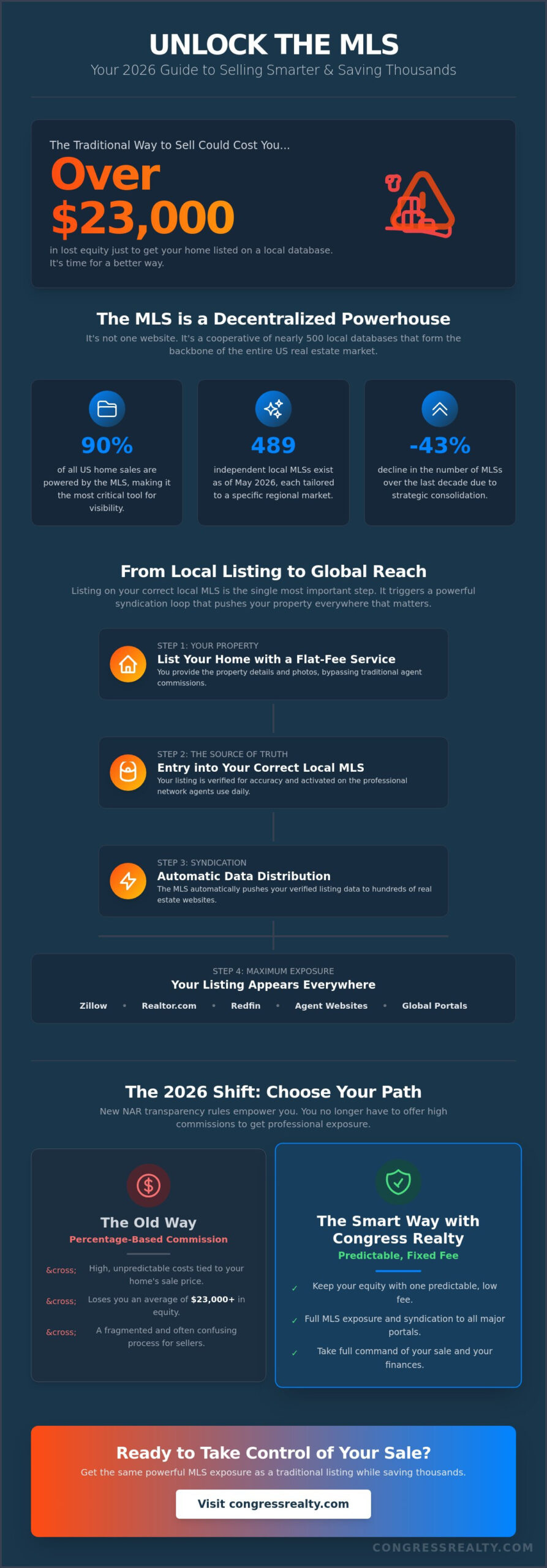
The MLS is the primary engine behind the entire real estate market. One entry into this professional database triggers a massive syndication process, instantly pushing your property to Zillow, Realtor.com, and Redfin. This visibility is vital. Data from 2025 shows that 91% of home sellers used a real estate agent, largely because the MLS remains the primary search tool for buyers’ agents. Unlike “For Sale By Owner” websites that often host unverified or stale data, the MLS maintains strict accuracy standards. This professional credibility ensures that when a buyer sees your home online, they know the data is verified and current.
The Myth of the Mandatory 6% Commission
Traditional real estate models have long relied on the idea that a 6% commission is standard. This figure is typically split between the listing agent and the buyer’s agent, but the landscape changed significantly in late 2024. Following the NAR settlement rules that went into effect on August 17, 2024, offers of buyer agent compensation are no longer displayed on the MLS. This “decoupling” of commissions has shattered the old model. You have a legal right to represent yourself in all 50 states. Flat-fee models allow you to separate the service of listing your home from the cost of full sales representation. This shift empowers you to keep your equity while still appearing on the professional industry databases that drive sales.
Understanding how to list on mls without realtor fees starts with recognizing the technical bridge between your property and the buyer’s screen. A flat-fee arrangement is a pragmatic partnership where a state-licensed broker acts as your technical facilitator. They don’t take a percentage of your sale; instead, they provide an “Entry-Only” listing contract. This specific legal agreement fulfills the requirement that only a licensed broker can input data into the professional database while leaving the control of the sale entirely in your hands. You aren’t hiring a boss; you’re hiring a tool.
Accuracy is the currency of the MLS. Before your listing goes live, the broker verifies your property data against public records and ownership documents. This ensures the information meets strict MLS standards, which protects the integrity of the database and your reputation as a seller. Once verified, the broker’s primary duty is to maintain the listing’s technical status. You step in as the primary point of contact for all inquiries, showings, and negotiations. This clear separation of duties ensures you never pay for “full service” you don’t actually need.
Data Syndication: Where Your Listing Goes
Many sellers wonder how their home appears on national sites almost instantly. It isn’t magic; it’s a process called syndication. When your broker enters your data into the local MLS, it feeds a massive network of national aggregators like Zillow, Realtor.com, and Redfin. To keep your home at the top of search results, you must maintain an “Active” status. If you need to drop the price or update a description, you simply submit the change through your flat-fee portal. The broker pushes the update, and the syndication feed refreshes across the internet, ensuring your data stays current and competitive.
The Seller’s Responsibility in a Flat-Fee Model
In this model, you are the project manager. You provide the high-quality property descriptions and data points that sell the lifestyle of the home. You also manage showing requests directly from buyers’ agents, giving you total control over your schedule. While the NAR settlement rules effective August 17, 2024, mean you no longer advertise buyer’s agent compensation on the MLS, you should still decide on a competitive rate to offer. This remains a powerful incentive for agents to bring their qualified buyers to your door. Managing these moving parts is straightforward when you have the right infrastructure. By choosing a Standard Listing, you gain the professional exposure of the MLS while keeping your equity where it belongs.
Choosing to list on mls without realtor representation is a strategic pivot from the traditional, high-cost model to a streamlined, equity-first approach. In a traditional listing, you often wait weeks for an agent to “onboard” you, only to sign a restrictive contract that locks you into a percentage-based commission. A flat-fee model disrupts this by offering a digital, action-oriented setup that gets your home live on professional industry databases in a fraction of the time. You swap the uncertainty of a backend commission for the clarity of a fixed upfront cost.
The difference isn’t just financial; it’s about the speed and quality of your market entry. Traditional agents often control the marketing narrative, sometimes using generic descriptions or photos that don’t highlight your home’s best features. By listing independently, you dictate the marketing assets. You choose the professional photography that captures your home’s unique appeal and write descriptions that speak directly to your target buyer. This level of autonomy ensures your property is presented exactly as you intend, without being filtered through a middleman’s priorities.
Calculating Your Potential Equity Savings
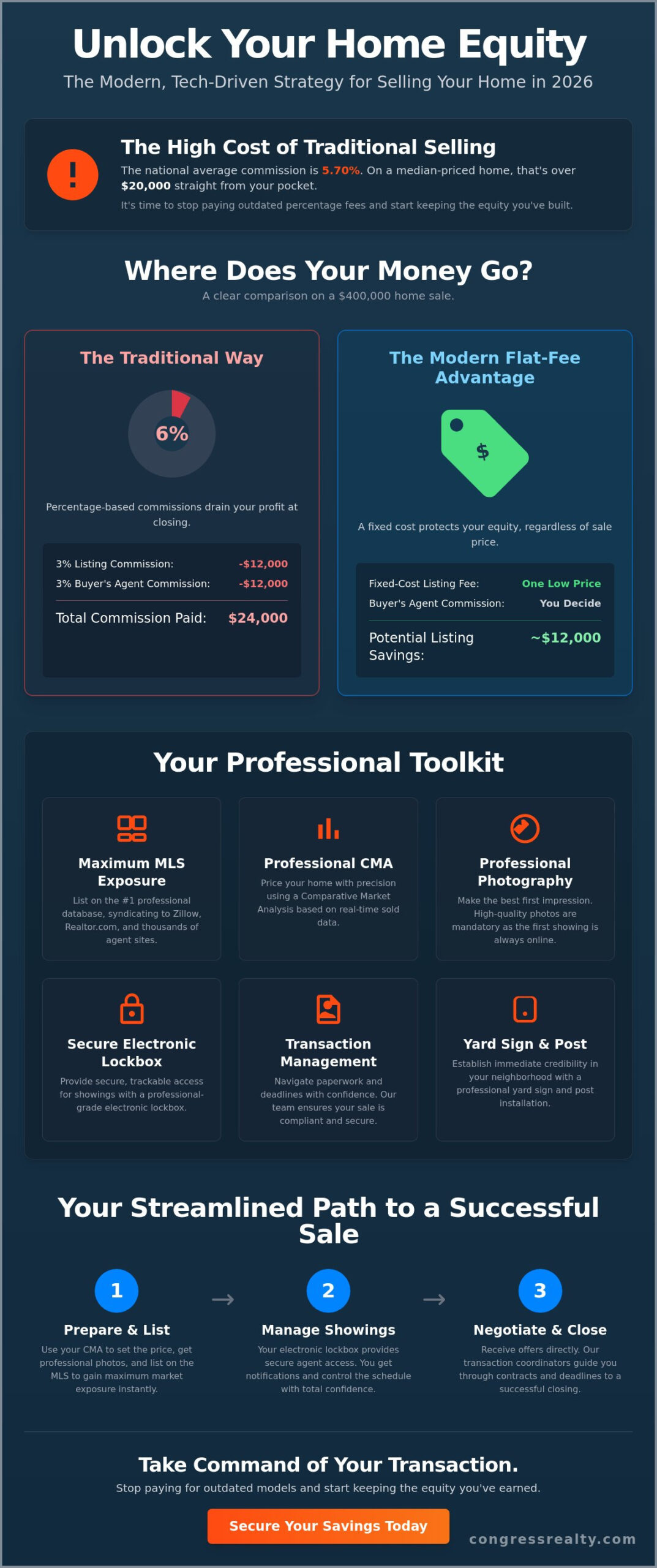
The math behind an independent sale is compelling. Consider a $400,000 home sale. In a traditional scenario, a 3% listing commission would cost you $12,000 at the closing table. By choosing a flat-fee structure, you retain that $12,000 in your own pocket. This isn’t just a small saving; it’s the single highest ROI move a seller can make. To understand how these fees traditionally accumulate and why they’re being disrupted, you can review our analysis on how much does the realtor make. Preserving this equity gives you more leverage for your next purchase or investment.
Control and Flexibility: Selling on Your Terms
Control extends far beyond the initial listing. When you manage the process yourself, you gain the freedom to host open houses and private tours on your own schedule. You don’t have to wait for an agent’s availability to show your home to a motivated buyer. Additionally, you can utilize professional tools like an electronic lockbox and high-visibility yard signs to maintain a professional image while staying in the driver’s seat. This direct communication with buyers and their agents leads to faster answers and more transparent negotiations. If your plans change, most flat-fee arrangements allow you to cancel the listing without the heavy termination fees common in traditional agency contracts.
Ready to move from theory to action? Successfully learning how to list on mls without realtor commissions requires a methodical approach. By following a structured sequence, you ensure your property enters the market with professional momentum while keeping your equity intact. Think of yourself as the project manager of your own sale; you provide the local knowledge, and the flat-fee infrastructure provides the professional reach.
Step 1: Perform a Comparative Market Analysis (CMA). Accuracy is your best marketing tool. Use a professional CMA to price your home based on actual sold data rather than emotional value or unverified online estimates.
Step 2: Prepare Professional-Grade Marketing Assets. High-resolution photos and a compelling property description are non-negotiable. These assets dictate your first impression on national search portals.
Step 3: Choose Your Flat-Fee Package. Select a plan that fits your comfort level. A Standard Listing provides the essential database entry, while a Full Service Listing offers additional support for those who want a more guided experience.
Step 4: Complete State-Specific Disclosures. Legal transparency protects your profit. Complete all required seller disclosures to ensure your transaction meets state regulations.
Step 5: Activate and Manage. Once your broker verifies the data, your listing goes live. Now, you pivot to managing inquiries and scheduling tours.
Pricing and Preparation
Pricing right the first time is critical for maintaining MLS momentum. Properties that linger due to overpricing often face a “stale” reputation, making it harder to negotiate later. Pair a realistic price with the Professional Photography rule. Visuals are the primary driver of click-through rates; if your photos look amateur, buyers will skip your listing regardless of the price. Before you hit “submit,” gather your essential data points: exact square footage, tax ID numbers, and average utility costs. Having these ready prevents delays during the verification process.
Managing the Active Listing
The real work begins once the listing is active. This is where many independent sellers feel overwhelmed, but the right tools simplify the process. Use an electronic lockbox to facilitate secure, agent-led showings. This professional hardware allows buyers’ agents to access the property without you being present, mirroring the traditional experience. Most importantly, don’t stop at just “listing” the home. Realize that transaction management is the bridge between an offer and a closed sale. By utilizing professional transaction management services, you ensure that every contract detail is handled correctly, allowing you to focus on your move while we handle the technical logistics.
Congress Realty acts as your professional advocate, providing the necessary infrastructure to list on mls without realtor commissions while you retain full command of the sale. Our “No Listing Commission” promise is a fundamental shift in how equity is preserved. You pay a predictable, fixed-cost fee instead of a percentage of your home’s final price. This model ensures your financial intelligence is rewarded with significant savings. By utilizing our Standard Listing package, you gain immediate entry into professional industry databases, putting your property on equal footing with every other listing in the market.
Our support doesn’t end the moment your property goes live. Many independent sellers discover that the most complex phase of the journey is managing the transaction once an offer arrives. Choosing to list on mls without realtor representation shouldn’t mean you’re on your own during the closing process. This is where our Transaction Management service becomes your most valuable tool. We bridge the gap between finding a motivated buyer and successfully reaching the closing table. This service handles the technical contract logistics and ensures all timelines are met, providing a professional safety net that secures your profit.
Why Experience Matters in Flat Fee Brokerage
Andrew English and the Congress Realty team bring years of specialized experience to your transaction. Navigating the specific regulations of various state-level real estate boards can be daunting for an independent seller. We ensure your listing remains fully compliant with both national standards and local requirements, protecting you from common legal pitfalls. If you want to refine your broader market approach before you begin, explore our comprehensive guide on how to sell a house without a realtor. Our expertise provides the structural support you need to move forward with total confidence.
Taking the Next Step Toward Your Sale
Choosing the right path for your specific needs is simple and pragmatic. If you’re comfortable managing your own negotiations and showings, our Standard Listing provides an efficient, high-impact solution. For those who want more comprehensive support through the final signature, our Full Service MLS packages offer dedicated agent assistance for contract reviews and negotiations. The online signup process is fast and intuitive, designed for the savvy homeowner who values time as much as equity. You have the tools and the market knowledge; now it’s time to take the lead and secure your financial future.
Selling your home shouldn’t mean sacrificing a massive portion of your profit to outdated commission models. You’ve learned that the professional MLS isn’t a restricted club, but a powerful tool you can access with a pragmatic flat-fee strategy. By decoupling listing services from sales representation, you keep your equity where it belongs while maintaining complete control over every showing and negotiation. Choosing to list on mls without realtor commissions is a strategic decision that rewards your financial intelligence and independent spirit.
With the right infrastructure, the process is simple and highly rewarding. You gain the same professional exposure as any traditional listing, backed by tools like electronic lockboxes and professional photography. Start your Flat Fee MLS listing today with Congress Realty and leverage over 20 years of experience. Our A+ rated service and broker-direct support nationwide ensure you have a reliable ally every step of the way. You have the knowledge and the tools to succeed. It’s time to lead your own sale and secure the maximum return on your investment.
Yes, it’s legal in all 50 states to list your home on the MLS without hiring a traditional full-service agent. You’ll sign an “entry-only” listing agreement with a state-licensed broker who handles the technical database entry. This arrangement fulfills the legal requirement that only licensed professionals can input data into the MLS while allowing you to maintain complete control over the sales process.
Will buyers’ agents show my house if I use a flat-fee service?
Buyers’ agents will show your home as long as you offer a competitive buyer’s agent commission. While the August 17, 2024, NAR settlement rules mean these compensation offers are no longer displayed on the MLS, agents still seek out listings that facilitate a smooth transaction for their clients. Your listing appears identical to traditional listings in the database, ensuring you reach the vast majority of buyers who use an agent.
How much does it cost to list on the MLS without a traditional agent?
Choosing to list on mls without realtor representation involves a one-time flat fee instead of the traditional 3% listing commission. This fixed-cost structure provides transparency for your budget and eliminates the uncertainty of percentage-based backend costs. By avoiding the high costs of a traditional agency, you can save thousands of dollars in equity at the closing table.
Can I still sell my house ‘For Sale By Owner’ while on the MLS?
You can absolutely still sell your home to an unrepresented buyer while your property is active on the MLS. This is a primary advantage of the flat-fee model. If you find a buyer who isn’t working with an agent, you aren’t required to pay a buyer’s agent commission. This allows you to maximize your financial gain by keeping even more of your home’s equity.
What paperwork is required to list on the MLS independently?
You’ll need to complete a state-specific listing agreement and standard property disclosure forms required by law. These documents ensure your listing meets legal and MLS accuracy standards. You’ll also provide property data like tax IDs, square footage, and utility information. Having these data points ready ensures your listing is comprehensive and professional for potential buyers.
How do I handle negotiations and contracts without a listing agent?
You handle negotiations and contracts directly with the buyer or their agent, which often leads to faster decisions and clearer terms. This direct communication puts you in the driver’s seat of your own transaction. If you prefer professional support during this phase, you can utilize transaction management services to ensure all contract details and deadlines are handled with technical precision.
Does a flat-fee MLS listing include syndication to Zillow and Realtor.com?
Yes, every flat-fee MLS listing includes automatic syndication to major national platforms like Zillow, Realtor.com, and Redfin. When you list on mls without realtor full-service fees, your data is pushed through the same professional feeds used by traditional brokerages. This ensures your home is visible to the millions of buyers who begin their search on these national aggregators.
Can I change my price or photos after the listing is live?
You can update your price, property description, or photos at any time through your professional listing portal. These updates are vital for keeping your listing fresh and responding to market feedback. Once you submit a change, your broker pushes the update to the MLS, and it refreshes across all syndicated websites to keep your data current and competitive.
Why sacrifice over $26,000 in equity just because a traditional broker insists on a 6% commission? With Mesa’s median home price at $485,000 as of May 2026, those legacy percentages represent a significant financial loss that savvy sellers no longer need to accept. You know your neighborhood better than anyone, yet the lack of transparent market data often makes the selling process feel like a mystery. It’s frustrating to watch your hard-earned profit disappear into someone else’s pocket through outdated fee structures.
This guide provides a definitive list of mesa az zip codes and reveals how to use geographic insights to list your home professionally while bypassing high commissions. We’ll show you how to take command of your sale by utilizing the same tools the pros use, such as a Comparative Market Analysis and professional transaction management. You’ll discover how to navigate diverse submarkets, from the high-value 85207 area to the growth hubs in the southeast, ensuring you lead the process with total confidence and keep your equity where it belongs.
Key Takeaways
Access the definitive 2026 list of residential mesa az zip codes to pinpoint your property’s specific submarket and buyer demographic.
Learn how to decode the “Zip Code Premium” and use a professional Comparative Market Analysis to price your home for a fast, profitable sale.
Understand how the MLS uses geographic data to syndicate your listing to national platforms, ensuring maximum visibility without traditional high-cost brokers.
Calculate your potential equity savings by comparing legacy 6% commissions against a modern, fixed-cost listing model that puts you in control.
Identify the essential professional tools, including electronic lockboxes and transaction management, that simplify the process of selling your home independently.
Precision is the first step toward a successful sale. Mesa covers 138 square miles of the East Valley, making it a sprawling urban center where geographic boundaries define property values and buyer interest. As the third-largest city in Mesa, Arizona, this region has seen its residential lines shift alongside rapid population growth. You must identify your exact five-digit code before entering any legal documentation or professional listing database. Using the wrong mesa az zip codes can cause your property to be suppressed on national search platforms, effectively hiding your home from qualified buyers.
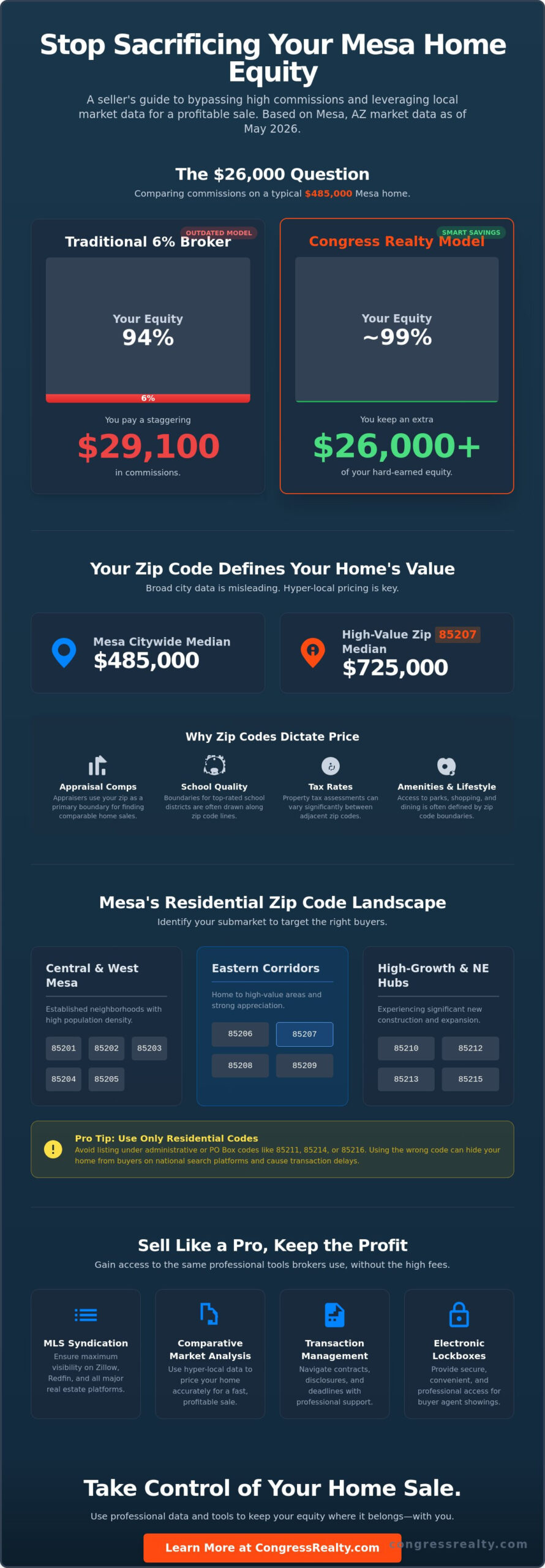
It’s vital to distinguish between residential zones and administrative codes. While Mesa utilizes several codes, only 13 are designated for primary residential use. Codes such as 85211, 85214, 85216, 85274, 85275, and 85277 are typically reserved for PO boxes or specific commercial entities. If you mistakenly list your home under one of these administrative codes, you’ll likely face technical errors during the transaction management phase. Stick to the residential list below to ensure your listing propagates correctly across the MLS and third-party sites.
Primary Residential Zip Codes
The city’s residential landscape is divided into distinct corridors, each with its own market temperature and inventory levels. Use this breakdown to verify your location:
Central and West Mesa: 85201, 85202, 85203, 85204, and 85205. These areas feature established neighborhoods and high population density.
Eastern Corridors: 85206, 85207, 85208, and 85209. This includes the high-value 85207 area, which saw median prices reach $725,000 as of May 2026.
High-Growth and Northeast Hubs: 85210, 85212, 85213, and 85215. These zones are currently experiencing significant new construction and expansion.
Why Geographic Accuracy Matters in 2026
In a balanced market where the average home stays on the market for 65 days, you can’t afford technical delays. Search algorithms on major real estate sites rely heavily on zip code filters. If your code is inaccurate, your home won’t appear when a buyer searches for their preferred school district or neighborhood. Accuracy also dictates your tax assessment and the Comparative Market Analysis (CMA) used to justify your asking price. Professional listing services require this data to be perfect. By confirming your mesa az zip codes early, you protect your autonomy and ensure your listing remains visible to the thousands of agents searching the professional databases every day.
Valuation Dynamics: How Zip Codes Impact Home Prices
Does a single digit in your address really change what your home is worth? In short: absolutely. Real estate appraisers and sophisticated buyers view mesa az zip codes as more than just mail delivery routes; they’re shorthand for school quality, property tax rates, and lifestyle amenities. Understanding how your address affects home value is critical for any seller who wants to avoid leaving money on the table. For instance, while the citywide median price was $485,000 in May 2026, homes in the 85207 corridor commanded a median of $725,000. This massive spread demonstrates why you can’t rely on broad city data to price your specific property.
Appraisers use your zip code as the primary boundary for their search. They look for “bracketed” comps, which means they search for sold properties similar in age and size within the same geographic code. If they have to cross into a different zip code to find a match, they often apply location adjustments that can lower your appraisal value. Historical trends also show that some Mesa codes appreciate faster than others. For example, the southeast growth hub near Cadence at Gateway has seen more aggressive price stability than central areas with older housing stock. A single street can represent a shift of tens of thousands of dollars if it crosses a zip code boundary.
Comparative Market Analysis (CMA) by Zip Code
To capture this “Zip Code Premium” accurately, you need a professional Comparative Market Analysis. A CMA filters out irrelevant data from neighboring districts and focuses strictly on homes that share your geographic advantages. If you price your home based on Mesa’s 98% sale-to-list ratio without looking at your specific street, you might underprice a high-demand area or overprice an older submarket. Micro-markets can shift significantly across a single major intersection. By looking at hyper-local comps, you ensure your listing is competitive from day one.
Market Trends and Buyer Behavior
Buyer behavior in 2026 is data-driven. Many buyers set their search alerts for specific mesa az zip codes to stay within certain school boundaries or close to major employers like Boeing. When demand spikes in a specific code, it triggers bidding wars that aren’t reflected in the broader city stats. Currently, the market is balanced with an average of 65 days on market, but some southeast zip codes move much faster due to new construction in Eastmark. Watching these trends allows you to time your listing for maximum exposure. If you’re ready to see how your neighborhood stacks up, reviewing a professional market report is a smart way to maximize your equity.
The Role of Zip Codes in Multiple Listing Services (MLS)
How do thousands of active buyers find your home in a city of 517,500 people? The answer lies in the Multiple Listing Service (MLS), the professional database where every licensed agent starts their search. In this digital ecosystem, mesa az zip codes serve as the primary routing instructions. If your zip code data is inaccurate, your home effectively vanishes from the filtered searches that matter most. It doesn’t matter how beautiful your professional photography is if the technical data blocks the listing from appearing in a buyer’s inbox. Accuracy is the technical bridge between your front door and a buyer’s screen.
When you list your property, you’re competing for attention in a market with approximately 138 square miles of inventory. The MLS acts as the central nervous system for these transactions. It uses geographic markers to syndicate your property data across a massive web of national sites like Zillow and Realtor.com. According to the U.S. Census Bureau Mesa Data, the city contains over 210,000 housing units. Without precise tagging of your specific location, your home would be lost in a sea of data. Securing your spot on the professional list of multiple listing services ensures that your home isn’t just for sale; it’s visible to every brokerage in the state.
Syndication and Search Algorithms
Modern buyers don’t browse; they filter. They set up Save Search alerts based on specific geographic boundaries. When your property is uploaded with the correct mesa az zip codes, the MLS triggers an immediate notification to every buyer whose criteria match your neighborhood. This automated syndication is what drives the 65-day average on market. If your geographic tagging is off by even one digit, you miss the critical first 48 hours of listing momentum when buyer interest is at its peak.
Visibility Without the 3% Commission
You don’t need to pay a traditional 3% listing commission to gain this level of professional exposure. The disruptive flat-fee model provides you with the exact same MLS infrastructure used by high-cost brokerages. You maintain total control over your property data while appearing in the same professional databases as every other listing. By utilizing tools like an electronic lockbox and professional transaction management, you lead the process with the same authority as a legacy agent. You get the visibility you need while keeping your equity where it belongs: in your pocket.
Leveraging Zip Code Data for a Successful Independent Sale
Data is the ultimate equalizer in real estate. You don’t need a traditional broker to interpret market conditions when you have access to the same geographic metrics they use. By mastering the specifics of mesa az zip codes, you transition from a passive seller to an informed market lead. Taking command of your sale starts with understanding that your “neighborhood” isn’t just the houses on your block; it’s a data-driven micro-market defined by five digits. Use this information to build a strategy that protects your equity and attracts the most qualified buyers in the East Valley.
DIY Market Research for Sellers
Start your research by filtering recent sales data strictly within your zip code. While Mesa’s citywide median home price sits at $485,000, your specific area might be trending higher or lower based on recent activity. Look for “Sold” listings from the last 90 days to find your true competition. Pay close attention to the “Days on Market” metric. If the Mesa average is 65 days but homes in your specific code are selling in 40, you have a high-demand listing that justifies a firmer asking price. Identifying this “sweet spot” ensures you don’t leave money on the table or scare away buyers with an unrealistic figure. You can use a professional Comparative Market Analysis to verify these findings and gain the same level of insight as a high-commission agent.
Strategic Marketing for Your Neighborhood
Your marketing should speak directly to the lifestyle your specific zip code offers. If you’re listing in 85212 or 85213, highlight the proximity to high-growth hubs like Eastmark or the master-planned amenities that drive buyer interest in the southeast. For those in 85215, emphasize the connection to major employers like Boeing. Use this geographic context in your listing description to trigger keywords that buyers actually search for. Stand out from the competition by investing in professional photography; in a digital-first market, your first showing happens on a smartphone screen. Combine these visuals with a professional yard sign and an electronic lockbox to make the showing process seamless for local buyers. This level of professional infrastructure signals to everyone involved that you’re a savvy seller in total control of the transaction.
Ready to turn your market research into a professional listing? List your home on the MLS today and keep thousands more of your equity by choosing a modern, fixed-cost model.
Saving Your Equity: Flat Fee MLS Solutions Across All Zip Codes
Why pay a legacy broker a massive percentage of your home’s value when the heavy lifting of market research is already done? Whether your property is nestled in the luxury pockets of 85207 or the high-growth corridors of 85212, the logic remains the same: you shouldn’t pay for a brand name when you can buy the results. Our flat-fee model works across all mesa az zip codes to ensure that your equity stays in your bank account rather than being split among traditional agents. You’ve mastered the geographic data; now it’s time to claim the financial reward.
The numbers in 2026 tell a clear story. With Mesa’s median home price at $485,000, a traditional 6% commission would strip over $29,000 from your closing proceeds. By choosing a modern listing solution, you can easily save $15,000 or more on a standard home sale. Learning how to sell a house without a realtor is the single most impactful financial decision you can make as a homeowner this year. This approach also allows you to position your home as a “smart buy.” You can choose to pass a portion of those savings to the buyer to trigger a faster sale or keep the entire surplus as your own profit.
The Congress Realty Advantage
We provide the professional infrastructure you need to compete with high-commission listings without the high-commission price tag. Our services cover every residential pocket within the mesa az zip codes, offering you parity with the biggest brokerages in the state. When you list with us, you receive a professional Comparative Market Analysis to nail your pricing, an electronic lockbox for secure showings, and full transaction management to handle the paperwork. You become the designated broker of your own equity, supported by the same professional databases that every licensed agent uses.
Getting Started with Your Listing
Transitioning from researching data to closing your sale is a straightforward process. First, select the listing package that aligns with your specific timeline and service needs. You’ll then submit your property details and professional photography through our streamlined platform. We ensure your data is perfectly formatted for the MLS, triggering those all-important search alerts for active buyers. Within days, your home will be visible on every major national real estate site. You take the lead on showings and negotiations, while we provide the professional backbone to ensure a smooth, legally sound closing. Take control of your financial future today and start your listing with the confidence of a market expert.
Take Command of Your Mesa Home Sale
Mastering the nuances of mesa az zip codes is the first step toward a high-equity closing. You now have the geographic data and strategic insights needed to navigate Mesa’s balanced market with total confidence. By focusing on hyper-local comps and ensuring technical accuracy on the MLS, you position your property for maximum visibility without the burden of a traditional listing commission.
It’s time to put these tools to work. Since 2002, Congress Realty has empowered thousands of homeowners to finalize successful closings while maintaining an A+ rating with the Better Business Bureau. You don’t need a high-cost broker to lead your transaction; you simply need the right professional infrastructure. Our model allows you to save an average of 3% on every transaction, keeping your hard-earned equity exactly where it belongs.
There are 13 primary residential zip codes in Mesa used for real estate listings. These include 85201, 85202, 85203, 85204, 85205, 85206, 85207, 85208, 85209, 85210, 85212, 85213, and 85215. While other codes like 85211 or 85274 exist for administrative purposes and PO boxes, they aren’t used for residential property addresses. Understanding these specific mesa az zip codes ensures your property is categorized correctly within professional databases.
What is the most expensive zip code in Mesa for 2026?
The 85207 zip code remains the most expensive area in Mesa as of May 2026. With a median sale price of $725,000, this northeast corridor commands a significant premium compared to the citywide median of $485,000. This region is highly sought after for its luxury master planned communities and scenic desert views, making it a high demand zone for buyers looking for premium inventory in the East Valley.
Do I need a local agent to list my home on the MLS in a specific zip code?
No, you don’t need a traditional local agent to gain professional MLS exposure in any neighborhood. Modern flat fee listing services provide the exact same technical infrastructure and syndication to national sites like Zillow and Realtor.com. By using a professional listing service, you maintain total control over your transaction and keep more of your equity while appearing in the same database as high commission listings in your area.
How do zip codes affect my home’s property taxes?
Zip codes often serve as the primary boundaries for various taxing authorities and school districts. Your specific address determines which municipal bonds, school levies, and special assessment districts apply to your property. Since tax rates can vary between different mesa az zip codes, buyers often filter their searches based on these carrying costs. Accurate geographic data ensures that your property’s total cost of ownership is represented correctly to potential buyers.
Can I change the zip code on my real estate listing if it is near a border?
You cannot change a zip code on a listing to a different one for marketing purposes. The MLS and national search platforms rely on verified postal data to syndicate your property correctly. Attempting to use a more “desirable” neighboring code is considered a violation of listing standards and can lead to your home being suppressed on search sites. Stick to your legal address to ensure your listing remains active and visible to all agents.
What is the fastest growing zip code in Mesa right now?
The southeast corridor, specifically zip codes 85209, 85212, and 85213, is experiencing the most rapid growth. Communities like Eastmark and Cadence at Gateway have turned these areas into hubs for new construction and modern amenities. This surge in development makes these codes highly competitive for sellers, as the influx of new residents drives consistent demand for both new and existing housing stock across the region.
Does a flat fee listing work the same way in every zip code?
Yes, the flat fee model provides the same professional advantages regardless of your specific location. Whether you are selling in a 55+ community in east Mesa or a luxury home in the northeast, you receive a professional CMA, electronic lockbox, and transaction management. The process is designed to be universal, giving every seller the tools to bypass high commissions while maintaining a professional and authoritative presence in the market.
How do I find the school district associated with my zip code?
You should consult the Maricopa County school boundary maps or the official Mesa Public Schools website for the most accurate information. While zip codes provide a general idea of location, school boundaries can sometimes cut through a single code. Providing the correct school district in your listing is vital, as many buyers use this as their primary filter when searching for homes in specific Mesa neighborhoods.
Your home equity shouldn’t be treated like a tip jar for the real estate industry. Despite landmark rule changes, many sellers in 2026 still find themselves handing over 5% to 6% of their sale price in traditional commissions. If you’re asking what is a flat fee, you’re already taking the first step toward reclaiming your hard-earned wealth. You likely feel that paying a massive percentage for basic listing services is outdated and unnecessary. It’s frustrating to face the uncertainty of high-cost models when you just want a transparent, predictable way to sell your property.
We agree that the traditional commission structure often feels like an unfair tax on your home’s appreciation. This guide will show you exactly how flat fee structures work to help you sell while protecting your equity. You’ll gain a clear understanding of fixed-cost pricing and a roadmap for listing your home with professional tools. We’ll explore how to leverage the MLS, professional photography, and transaction management without the burden of a traditional listing commission. By the end, you’ll have the confidence to choose a pricing model that puts you in total control of your move.
Key Takeaways
Understand exactly what is a flat fee and why this fixed-cost model provides the transparency that traditional percentage commissions lack.
Compare the financial impact of a flat fee against a 3% listing commission to see how much equity you’ll protect.
Learn how to get your home on the professional MLS while utilizing tools like electronic lockboxes and yard signs.
Explore how professional photography and transaction management can streamline your sale without a traditional agent.
Gain a clear roadmap for managing the selling process independently to maximize your profit at closing.
What is a Flat Fee? Defining Fixed-Cost Pricing in Real Estate
Stop viewing your home equity as a pool of funds available for others to claim. In the traditional real estate model, you pay a commission based on your home’s final sale price. This means if your home value increases, your costs increase, even if the work performed remains exactly the same. To understand the alternative, we must ask: What is a Flat Fee? In professional real estate, a flat fee is a single, predetermined price paid for a specific set of professional services. It replaces the variable, percentage-based listing commission with a transparent, fixed cost that never fluctuates based on your home’s value.
In the 2026 real estate market, this model has become a vital tool for savvy homeowners. Following the landmark 2024 NAR settlement, the industry has shifted toward the “decoupling” of commissions. While many traditional brokers still push for a 5% to 6% total commission, the flat fee model allows you to separate the cost of listing your home from the rest of the transaction. You might see the terms “fixed fee” and “flat fee” used interchangeably in brokerage agreements. Both describe the same advantage: a predictable price for specific professional tools like MLS access, yard signs, and transaction management.
The Core Concept: Paying for Service, Not Equity
The fundamental shift here is moving from equity-based rewards to service-based payments. When you choose a flat fee, you’re treating the sale of your home like any other professional transaction. You don’t owe a percentage of your hard-earned wealth just because the market is strong. Instead, you pay for the specific labor and infrastructure required to market your property. This approach empowers you to act as the lead in your own sale. There is a massive psychological benefit to knowing your exact costs before the listing even goes live. It eliminates the fear of hidden fees and ensures you stay in control of your financial outcome.
Flat Fee vs. Hourly Rates: What is the Difference?
You may wonder why real estate professionals don’t simply charge by the hour. While hourly rates are common for lawyers, they’re incredibly rare in real estate because they create massive uncertainty. If a sale becomes complex or takes longer than expected, hourly costs can spiral out of control. When you ask what is a flat fee in the context of efficiency, it’s essentially a cap on your expenditures. It provides “all-in” pricing for essential marketing and administrative tasks. Whether your home sells in three days or three months, your cost for the listing service remains the same. This protects you from market volatility and ensures your budget stays intact from listing to closing.
Flat Fee vs. Percentage Commission: A Direct Comparison
Choosing between a flat fee and a traditional commission is essentially a decision about who keeps your home’s appreciation. When you ask what is a flat fee, you’re looking for a way to cap your expenses rather than giving away a slice of your property’s value. Consider the standard 3% listing side of a commission. On a $500,000 home, that single fee amounts to $15,000. If your home value jumps to $600,000, that fee automatically climbs to $18,000, even though the listing process remains identical. This equity leak is why 2026 sellers are moving toward fixed-cost models. It’s helpful to understand how much does the realtor make in these transactions to see where your money is actually going.
Predictability is the greatest advantage of the flat fee model. In a market where home prices are volatile, a fixed fee acts as an anchor. You know your marketing costs before you even sign a contract. Traditional commissions often hide the true cost of sale until the final closing disclosure. By then, it’s too late to negotiate. Smart sellers use fixed-cost structures to save on real estate fees, ensuring that the bulk of their profit stays in their own bank account.
The Impact on Your Bottom Line
Think of your home equity as a long-term investment. Every percentage point paid in commission is a direct withdrawal from that investment. In a side-by-side comparison, the math is undeniable. Under a traditional model, the listing agent’s fee scales up indefinitely. In a flat fee model, the ratio of cost to home value shrinks as your home price increases. For a $500,000 home, the traditional listing fee represents 3% of the total price. A flat fee represents a tiny fraction of that same value. This allows you to retain more capital for your next down payment or retirement fund. If you’re ready to protect your equity, you can start your listing today and keep your profits where they belong.
Incentives and Motivation: Who Does the Model Favor?
There is a common myth that a percentage-based commission motivates an agent to work harder. In reality, the difference between a $490,000 sale and a $500,000 sale is only $300 to the listing agent. That small amount rarely changes their behavior. The flat fee model removes this performance theater. It aligns the broker’s goal with your efficiency. You pay for the tools that actually sell houses, like professional MLS placement and transaction management. This transparency ensures you aren’t paying for hand-holding you don’t need. You remain the decision-maker, supported by the professional infrastructure required to close the deal.
How Flat Fee Real Estate Works: From Listing to Closing
Selling your home with a fixed-cost model isn’t a DIY project; it’s a professional partnership where you lead the way. Understanding what is a flat fee service requires looking at the actual workflow from the moment you decide to list until the day you hand over the keys. The process begins with a strategic choice of tools. Instead of paying for a bundle of services you might not need, you select a package that fits your goals, such as a Standard Listing or a Full Service Listing. This approach ensures you only pay for the professional infrastructure required to move your property from “listed” to “sold.”
Once you’ve chosen your package, the professional machinery starts moving. You aren’t just putting a sign in the yard; you’re launching a marketing campaign. This includes Professional Photography to capture your home’s best features and an Electronic Lockbox to manage secure buyer tours. You’ll also receive a Yard Sign and Post to capture local interest. By integrating these tools, you’re mastering how to sell your house on your own while maintaining the high standards buyers expect in 2026. You remain the primary point of contact, giving you total command over showings and negotiations.
The Gateway to Exposure: The MLS
The Multiple Listing Service (MLS) remains the single most important tool in real estate. It’s the database that feeds every major home-search site. When you use a flat fee broker, your property receives the same “Tier 1” exposure as a home listed by a traditional 6% agent. There’s no “discount” section on the MLS; your listing appears alongside every other professional entry. From there, syndication kicks in. Your home automatically flows to Zillow, Realtor.com, and hundreds of other local brokerage sites. This massive reach ensures that every active buyer in your market sees your property the moment it goes live.
Transaction Management and Professional Oversight
The work doesn’t end when you receive an offer. Navigating the path from an accepted contract to a successful closing requires precision. This is where Transaction Management becomes your greatest asset. A flat fee model provides the professional oversight needed to handle escrow requirements and legal disclosures without the high-percentage price tag. You’ll also benefit from a Comparative Market Analysis (CMA) to ensure your pricing is grounded in current 2026 market data. These professional guardrails prevent the common pitfalls of solo selling, such as pricing errors or paperwork mistakes. You get the expertise of a broker to facilitate the logistics while you retain the freedom to make the final decisions.
The Pros and Cons of Choosing a Flat Fee Model
Skeptical sellers often ask if this model is too good to be true. When you first discover what is a flat fee, it’s natural to wonder why everyone hasn’t made the switch. The reality is that a flat fee isn’t a magic trick; it’s a strategic trade-off. You’re choosing to trade a small amount of your time for a significant amount of your equity. This approach isn’t for everyone, but for the organized homeowner, it’s the most efficient way to sell. You’ll need to be the one showing the property and answering buyer inquiries. In return, you stop the massive “equity leak” that occurs with traditional percentage-based models.
The right seller for this model is someone who values financial intelligence over traditional hand-holding. If you’re comfortable managing your own schedule and talking to potential buyers, you can learn how to avoid realtor fees when selling to maximize your final proceeds. You don’t need a traditional agent to stand in your kitchen during an open house. You need professional tools, like an electronic lockbox and high-quality photography, to do the heavy lifting for you.
Why Thousands of Sellers are Switching
The financial advantage is the primary driver. Keeping an extra 3% of your home’s value can mean tens of thousands of dollars back in your pocket. Beyond the money, you gain total command over the process. You don’t have to wait for an agent to relay messages or schedule showings. You speak directly to the buyers or their agents, which often leads to faster decisions and clearer communication. This model also eliminates the inherent conflict of interest found in commissions. A flat fee broker’s only goal is to provide the professional infrastructure you need to succeed, regardless of the final sale price. If you’re ready to take charge, you can maximize your equity today by choosing a fixed-cost listing.
Potential Challenges to Consider
Pragmatism is key when choosing this path. You must be prepared for the responsibility of managing your own inquiries and showings. Because the broker doesn’t provide in-person open house hosting, you’ll need to be available to open your door to qualified buyers. Success in selling a home in 2026 requires a high level of responsiveness. If you don’t answer the phone or reply to emails promptly, you might miss a motivated buyer. You also need to ensure your legal and disclosure paperwork is in perfect order. While transaction management services provide professional oversight, the initial effort to present your home and manage the calendar rests squarely on your shoulders. For the savvy seller, this minor increase in workload is a small price to pay for protecting their hard-earned wealth.
Maximizing Your Equity with Congress Realty’s Flat Fee Listings
Protecting your equity requires more than just a good intention; it requires the right professional framework. When you understand what is a flat fee, you realize it’s about paying for work performed rather than a percentage of your wealth. Congress Realty provides this framework by decoupling the high cost of traditional commissions from the essential tools needed to sell a home. This pragmatic approach is designed for the modern, tech-savvy seller who values efficiency and financial intelligence. You don’t need to sacrifice professional quality to save on costs. Instead, you’re choosing a smarter way to navigate the 2026 real estate market.
Standard vs. Full Service: Choosing Your Level of Support
Every seller has a different comfort level with the transaction process. The Standard Listing is the ideal choice for the experienced, autonomous seller. It provides the core necessity of any successful sale: professional MLS exposure. You take the lead on negotiations and paperwork, keeping your costs at a minimum. For those who want more guidance, the Full Service Listing acts as a bridge. It offers professional support and transaction management without the burden of a traditional 3% listing commission. Both models share a single priority: your equity. By choosing the level of support that fits your needs, you ensure that you aren’t paying for services you don’t use.
Empowering Your Sale with Professional Infrastructure
A successful sale relies on a strong first impression and secure logistics. Professional Photography is a non-negotiable tool in a digital world; it’s what stops the scroll on Zillow and Realtor.com. We provide the visual high ground that your property deserves. Once buyers are interested, our Electronic Lockboxes provide secure, tracked access for buyer agents. This allows you to manage showings with confidence, knowing exactly who has entered your home and when. We also provide a high-quality Yard Sign and Post to capture the attention of local buyers who may not be searching online.
Moving from a curious observer to a listed seller is a simple, structured process. You can often transition to a live MLS listing in as little as 24 hours. Our dedicated Transaction Management ensures that once you find a buyer, the path to closing is clear and professional. You stay in total command of the process, supported by the necessary industry databases and professional tools. Take control of your home sale today and keep your hard-earned profit where it belongs: in your pocket.
Take Command of Your Home Sale Today
You now have a clear answer to what is a flat fee and how it functions as a strategic tool for the modern seller. By choosing a fixed-cost model, you’re prioritizing your financial intelligence over outdated industry habits. You’ve seen how professional tools like the MLS and electronic lockboxes provide the same exposure as traditional models without the equity drain. Managing the process independently isn’t just a way to save money; it’s a way to maintain total control over your most valuable asset. This approach ensures that your hard-earned profit stays where it belongs.
Since 2002, Congress Realty has provided national coverage for savvy, independent sellers. Under the expert brokerage oversight of Andrew English, we offer the professional infrastructure you need to succeed without the burden of high-percentage commissions. It’s time to treat your home sale like the professional transaction it is. Protect your equity with a Standard Listing from Congress Realty. You have the roadmap and the tools. Now, take the final step and make your move with confidence.
Frequently Asked Questions
Is a flat fee real estate broker the same as a discount broker?
No, a flat fee broker is fundamentally different from a discount broker. While a discount broker typically offers a scaled back version of traditional service for a lower percentage, a flat fee broker provides specific professional tools for a fixed price. This model emphasizes transparency and seller autonomy. You pay for the actual work performed rather than a percentage of your home’s equity, giving you total command over your final proceeds.
Does a flat fee listing include my home being on the MLS?
Yes, a professional flat fee listing ensures your property is entered into the Multiple Listing Service (MLS). This is the primary database used by all real estate agents to find homes for their clients. It’s the core component of understanding what is a flat fee service, as it provides the same “Tier 1” market exposure as any traditional high commission listing without the unnecessary equity leak.
Will other real estate agents show my house if I use a flat fee service?
Yes, buyer agents will show your home because it appears on the professional MLS just like any other listing. Agents prioritize properties that meet their clients’ specific needs and criteria. By using tools like an electronic lockbox, you facilitate secure and professional tours for these agents. This ensures your home remains competitive and accessible to the entire pool of active buyers in your local market.
Can I still sell my house for sale by owner (FSBO) with a flat fee?
Yes, using a flat fee service is essentially an “enhanced FSBO” approach. It gives you the professional marketing power of a broker while you retain the right to sell the property yourself. You maintain full control over showings and negotiations while benefiting from professional syndication to sites like Zillow and Realtor.com. It’s the most pragmatic way to sell independently while maintaining high industry standards.
Are there hidden costs or closing fees with a flat fee model?
No, transparency is the primary advantage of the flat fee model. You pay a predetermined price for a specific set of services, such as professional photography or transaction management. While you’ll still encounter standard closing costs like title insurance and state taxes, the brokerage fee itself is fixed and disclosed upfront. This predictability allows you to calculate your exact net proceeds long before you reach the closing table.
Do I have to pay a buyer’s agent commission with a flat fee listing?
You aren’t required to offer a specific amount, but most sellers choose to offer a competitive commission to buyer agents to encourage traffic. Following the 2024 rule changes, these fees are negotiated independently and are no longer advertised on the MLS. You retain the power to decide what fits your financial goals. This flexibility is a key part of what is a flat fee in the modern market.
What services are usually included in a standard flat fee package?
A standard package typically includes an MLS listing, professional yard signs, and a Comparative Market Analysis (CMA). Many sellers upgrade to include professional photography, electronic lockboxes, and transaction management for a more comprehensive experience. This menu based approach allows you to build a professional infrastructure that fits your specific needs. You only pay for the services that help you move from listing to closing efficiently.
Can I cancel my flat fee listing if I change my mind?
Yes, most flat fee agreements allow you to cancel your listing at any time. Unlike traditional contracts that might lock you into a six month commitment, this model prioritizes your freedom and autonomy. You don’t have to worry about being stuck in a long term agreement if your circumstances change. Always review your specific agreement for any administrative terms regarding the initial fee before you go live on the MLS.
You’re likely losing over $23,000 in equity just to get your home onto a local database. It’s a staggering price to pay for entry into a system that feels intentionally complicated. Most sellers feel trapped by the fragmented nature of 489 different local databases, fearing they’ll miss out on exposure if they don’t hire a traditional agent. This 2026 guide simplifies the process by providing the complete list of multiple listing services and showing you how to use them with confidence.
You deserve a way to reach every serious buyer without sacrificing a massive percentage of your home’s value. We’ll show you how the national MLS network actually operates under the latest 2026 NAR transparency rules and how you can secure a professional listing for a predictable, fixed fee. You’re about to discover a reliable method to access professional databases, master syndication, and take full command of your sale. We’ll break down the structure of these active systems and explain exactly how to get your property featured on the sites that matter most to maximize your visibility.
Key Takeaways
Understand how the decentralized network of nearly 500 local databases functions as a single, powerful tool for property visibility.
Identify the right databases within the fragmented list of multiple listing services to ensure your property reaches both local agents and global portals.
Discover how the 2026 commission transparency rules allow you to bypass high percentage-based fees while maintaining professional-grade exposure.
Compare the advantages of Standard versus Full Service listing packages to determine which level of support best protects your equity.
Master the process of syndication to guarantee your home appears on every major professional database without the burden of a traditional broker.
Understanding the Multiple Listing Service (MLS) Landscape
The Multiple Listing Service (MLS) is far more than a simple website or a digital catalog. It’s a sophisticated, cooperative database that functions as the bedrock of the American real estate market. In 2026, it remains the most powerful tool for selling your home because it’s where professional brokers and agents share property data and offer cooperation. This system has evolved from physical books exchanged in local boardrooms to a high speed digital ecosystem that powers nearly every major real estate portal you see online. The MLS functions as the primary engine for approximately 90% of all home sales across the United States.
When you list your property on the local MLS, you aren’t just putting up a digital flyer. You’re entering a professional arena where data is verified and history is tracked. This verification creates a layer of trust that public facing sites simply cannot match. It ensures that every active buyer’s agent in your region sees your property the moment it goes live, creating an immediate wave of visibility. By using this professional infrastructure, you ensure your home is positioned correctly in front of the people most likely to bring you an offer.
The Role of the MLS in Modern Real Estate
Trust is the currency of the real estate industry. The MLS maintains this trust by enforcing strict rules regarding data accuracy and property history. In the wake of the 2026 commission rule changes, the MLS has become even more vital for transparency. While sellers are no longer required to offer a set commission to buyer’s agents as a condition of listing, the MLS remains the central hub where these professional relationships are managed. It facilitates a streamlined process where you can showcase your home’s value while maintaining full command over your financial decisions. This system allows you to bypass traditional high cost models while still benefiting from the same professional exposure as any other listing on the market.
Why There Isn’t Just One “National MLS”
You might wonder why a single national database doesn’t exist. The current real estate landscape is a product of history; local real estate boards developed their own systems to manage regional expertise and local market nuances. While the total count has declined by 43% over the last decade due to consolidation, we still operate within a network of 489 independent systems as of May 2026. This fragmentation means the list of multiple listing services is quite extensive, but it serves a purpose. Local databases ensure that specific zoning, school district data, and neighborhood trends are handled by people who understand the area. As a seller, your goal isn’t to be on every single one of these 489 systems, but to be on the specific local MLS that covers your property. Once your home is listed there, the data syndicates out to the national portals, giving you the best of both worlds: local accuracy and national reach.
How the 500+ Local MLSs Form a National Network
Think of the American real estate market as a massive mesh network rather than a single monolith. While the list of multiple listing services includes 489 independent systems as of May 2026, these local databases don’t exist in a vacuum. They function as the “source of truth” for every property detail. When you list your home on your specific local MLS, you’re activating a powerful syndication loop. This loop pushes your data out to thousands of agent websites and every major national portal simultaneously. It’s the most efficient way to achieve global reach from a local starting point.
Accuracy starts at the local level. National portals like Zillow or Realtor.com don’t actually find your house on their own. They wait for the local MLS to feed them the data. If the information on your local database is wrong, it stays wrong across the entire internet. This is why getting your property into the correct professional system is the most critical step in your sales process. It’s the foundation for your visibility and the key to attracting serious buyers who rely on accurate, real-time data.
Regional vs. Local MLS Jurisdictions
The trend toward consolidation has led to the rise of regional “mega-MLSs” that cover dozens of counties. However, your property must still be listed in the exact jurisdiction where the home is physically located to be seen by local agents. Overlapping jurisdictions can sometimes cause confusion, but a professional approach ensures you’re placed in the system that buyer’s agents actually use. You can choose a listing package that targets the specific database required for your zip code, ensuring no buyer misses your home.
Data Syndication to Zillow, Realtor.com, and Beyond
The magic happens through the Internet Data Exchange (IDX). This protocol allows your listing to travel from the local database to the global market in a matter of minutes. Usually, your home appears on national consumer sites within hours of being entered into the MLS. This automated feed guarantees that your property remains consistent across all platforms. You don’t have to worry about updating fifty different websites manually; any change you make to your price or description on the MLS updates everywhere else automatically. This gives you total command over your presentation while saving you hours of tedious work.
Major Residential and Commercial MLS Networks in the US
The real estate landscape is shifting away from small, hyper-local boards toward massive regional powerhouses. As of May 2026, the total number of systems has dropped to 489 as organizations merge to gain efficiency and data standardization. This consolidation means a single entry into a regional giant now grants you access to a much wider pool of buyers than it did a decade ago. When you look at the current list of multiple listing services, you’ll see a few names that dominate entire states or multi-state regions. These organizations don’t just store data; they set the professional standards for property disclosures and transaction transparency that protect both sides of the deal.
While the number of “Micro” MLSs with fewer than 400 subscribers has dwindled to 186, the influence of regional giants has never been stronger. These networks provide the professional infrastructure necessary for a successful sale. They ensure your property is visible to the 90% of buyers who still use an agent, even in the wake of 2026’s commission rule changes. By using these established professional databases, you’re choosing a path of financial intelligence that values your autonomy over traditional, high-cost brokerage models.
Leading Residential MLS Organizations
The largest residential networks, such as California Regional MLS (CRMLS), Bright MLS in the Mid-Atlantic, and Stellar MLS in Florida, serve hundreds of thousands of professionals. Getting your home onto one of these high-volume systems is a game changer for your exposure. These “mega-MLSs” provide the most robust data fields and the widest syndication reach possible. They also strictly enforce the 2026 NAR settlement rules, ensuring that buyer broker agreements are in place and commissions are uncoupled for maximum transparency. When you utilize these professional industry databases through a fixed-fee model, you gain the same level of market authority as any traditional brokerage without the percentage-based cost.
Top Commercial Listing Services
Commercial real estate requires a different set of tools than residential sales. While residential sellers use the MLS, commercial professionals often rely on Commercial Information Exchanges (CIEs). These platforms prioritize data points like cap rates, net operating income, and specific zoning details that wouldn’t fit in a standard residential form. Services like Crexi or LoopNet function as the primary commercial portals, but many regional MLSs now offer dedicated commercial wings to bridge the gap.
If you’re selling a multi-family or industrial property, your syndication path is specialized. Your listing won’t just go to Zillow; it will travel to investment-focused databases where professional portfolios are built. Specialized networks for luxury estates or rural land also exist to cater to niche buyer pools. Regardless of your property type, the goal remains the same: use the professional infrastructure to maintain command over your sale. Accessing these networks with a pragmatic, fixed-cost approach is the smartest way to preserve your equity in 2026.
How to Access the MLS Without a Traditional Agent
You no longer have to sacrifice 3% of your home’s value just to gain entry into a professional database. For decades, the real estate industry guarded the MLS as an exclusive club for high-commission brokers. That era is over. Today, a pragmatic shift toward flat-fee models allows you to access the same professional tools used by every top-tier agent for a predictable, fixed cost. First, understanding commissions in 2026 is the essential first step to saving your equity. Once you realize that commissions are uncoupled and negotiable, you can take full command of your sale without the burden of traditional overhead.
Accessing the MLS requires a licensed broker to enter the data, but it doesn’t require a long-term, percentage-based contract. You’re simply hiring a facilitator to place your property on the professional industry database. This gives you the best of both worlds: the massive exposure of the national network and the financial freedom of a self-managed sale. It’s a smart, utilitarian approach for the savvy homeowner who values autonomy. Sellers who want a complete roadmap for this process will find that learning how to sell a house without a realtor is the most direct path to keeping your equity intact while still achieving professional-grade market exposure.
The Flat Fee MLS Model Explained
A flat-fee broker acts as your direct gateway to the professional network. Instead of a commission, you pay for the specific services you need. For example, a Standard Listing gets your property into the local database and onto national portals. If you want more support, a Full Service Listing can include transaction management to help you handle the paperwork. You remain the primary lead on the sale, showing the home and negotiating directly with buyers. This model ensures you keep your equity while leveraging the same professional infrastructure as any traditional listing.
Evaluating a Listing Provider’s Coverage
Don’t assume every online service has direct access to your local market. Some “referral” sites just sell your information to a third party, which can lead to delays and data errors. You must verify that your provider is a direct member of the specific local system found on the list of multiple listing services for your area. Ask if they handle their own listings or if they outsource the work. Direct membership means faster updates and more accurate data syndication. You can review our direct coverage areas to ensure your property gets the professional oversight it deserves. This direct connection is the only way to guarantee your listing remains consistent and visible across the global market.
Strategic Listing with Congress Realty
Navigating the extensive list of multiple listing services doesn’t require a traditional broker or a high-commission contract. You can secure national-scale exposure by taking a pragmatic, equity-first approach to your sale. Congress Realty provides the professional infrastructure you need to reach every buyer’s agent without the burden of a 3% listing commission. By choosing a service that prioritizes your autonomy, you gain access to the same professional industry databases used by top-tier firms while maintaining full command over your transaction. Savvy sellers choose flat fee MLS listings because it’s the most financially intelligent way to sell in 2026.
Success in today’s market depends on how you present your property to the world. We offer a range of tools designed to create a seamless experience for both you and potential buyers. You can integrate professional photography to make your listing stand out or use an electronic lockbox for real estate to manage showings securely and efficiently. These aren’t just add-ons; they’re essential components of a professional sales strategy that positions your home for the best possible offers. You don’t have to sacrifice quality to save on costs.
Professional Exposure Without the 3% Commission
When you decide to sell your house on your own, you’re reclaiming thousands of dollars in equity that would otherwise go toward a listing agent’s commission. This financial impact is immediate and significant, allowing you to be more flexible with your pricing or simply walk away with more cash at closing. Maintaining a professional image on the MLS is vital for attracting high-quality buyers who expect accurate data and high-resolution visuals. Our platform ensures your property looks its best on every site in the list of multiple listing services, from local databases to national portals like Zillow and Realtor.com.
Comprehensive Support from Listing to Closing
Control doesn’t mean you have to work in isolation. We provide the professional tools necessary to make informed decisions at every stage of the sale. Use a Comparative Market Analysis (CMA) to understand exactly how your home compares to recent sales in your neighborhood. This data-driven approach removes the guesswork from pricing and helps you enter the market with confidence. If you need more assistance, our transaction management services help you handle the complex paperwork and timelines associated with escrow. Congress Realty facilitates the entire process while keeping the seller in command. By combining professional-grade tools with your own local expertise, you can achieve a successful closing without the high-cost overhead of the past.
Take Command of Your Home Sale
You now have the tools to navigate the complex list of multiple listing services with the confidence of a seasoned professional. You’ve seen that the national network is fully accessible through a fixed-fee model that bypasses traditional commissions while maintaining maximum exposure. By leveraging professional industry databases, you keep control over your equity and your timeline. This pragmatic approach isn’t just about saving money; it’s about making a financially intelligent choice for your future.
Congress Realty has been a trusted ally for independent sellers since 2002. We provide the professional infrastructure you need, from expert valuations via Comparative Market Analysis (CMA) to electronic lockbox and professional photography options. These tools ensure your property stands out and remains secure throughout the process. It’s time to stop overpaying for entry into the market and start selling on your own terms. Start your flat fee MLS listing with Congress Realty today and take the first step toward a more rewarding sale. You’re in charge, and we’re here to provide the professional foundation for your success.
Frequently Asked Questions
How do I find out which MLS covers my specific property?
Check your local county or city real estate board website to identify the specific jurisdiction for your home. Because the list of multiple listing services has consolidated into 489 systems as of May 2026, many properties now fall under large regional mega-MLSs. You can also verify coverage by looking at recent sales in your neighborhood to see which professional database handled those transactions. Identifying the correct system ensures local agents see your home immediately.
Can I list my home on multiple MLSs at the same time?
You can list on multiple systems if your property sits in a region where two or more jurisdictions overlap. This frequently happens in metropolitan areas that span several counties. While listing on the primary local database is essential for exposure, adding a second listing can capture agents from neighboring boards. This strategy maximizes your reach but requires careful management to ensure data remains consistent across all professional platforms.
What is the difference between an MLS and a site like Zillow?
The MLS is the professional, verified database that serves as the primary source of real estate data for the entire industry. Sites like Zillow and Realtor.com are consumer facing portals that receive their information through a syndication feed from the local MLS. While portals are great for buyers to browse, the MLS is where agents search for properties and verify listing history. Listing on the MLS is the only way to ensure your home appears on every major consumer site.
Do I need a realtor to get my house on the MLS list?
You must work with a licensed broker to get your property entered into the professional system. However, you don’t need to hire a traditional agent who charges a percentage based commission. A flat-fee brokerage acts as your facilitator, providing the necessary professional infrastructure while leaving you in command of the sale. This approach allows you to access the same professional tools without the high cost of a conventional listing.
How much does it cost to list a home on the MLS for a flat fee?
Costs for a flat-fee listing depend entirely on the package and level of support you select for your sale. Instead of a percentage of your home’s value, you pay a predictable, fixed fee for the specific services you need. This might include a Standard Listing or a more comprehensive Full Service Listing that includes transaction management. This model puts you in control of your budget and protects your home’s equity from the start.
Will my contact information be visible to buyers on the MLS?
Your contact information is typically visible to licensed agents in the private remarks section of the professional database. This allows buyer’s agents to contact you directly to schedule showings or ask questions. On consumer portals, the listing broker’s information is usually displayed to meet legal and board requirements. However, all inquiries and showing requests are forwarded directly to you, so you remain the primary point of contact for the sale.
What happens if my property is listed in the wrong MLS?
Listing in the wrong system means local agents who represent active buyers in your area will likely miss your property. Agents search within their specific board’s database first, so being in the correct jurisdiction is critical for visibility. If your property is misplaced, you won’t appear in the filtered searches that local professionals use every day. Always verify that your provider has direct membership in the specific database covering your zip code.
Can I make changes to my MLS listing after it goes live?
You can absolutely make updates to your listing after it goes live on the professional network. Whether you need to adjust the price, update the description, or add new professional photography, these changes are handled through your listing broker. Most updates syndicate to the national portals within a few hours, ensuring your presentation remains fresh and accurate. Regular updates keep your listing active and relevant to buyers who are monitoring the market daily.
Did you know that with the national average commission holding steady at 5.70 percent, selling a median-priced home in May 2026 costs you over 20,000 dollars in equity? It’s frustrating to watch a massive chunk of your profit vanish into traditional fees, especially when you’re the one who put in the work to maintain the property. You want professional results and MLS exposure, but you shouldn’t have to sacrifice your financial intelligence to get them. Most sellers feel trapped by high commissions simply because they haven’t been given a clear path to the tools the pros use for a successful house selling experience.
This guide will show you how to master the house selling process by leveraging professional tools like transaction management and electronic lockboxes to maximize your equity. You’ll learn how to secure a successful sale at market value and save thousands in commissions by taking command of your transaction with a professional-grade, fixed-cost infrastructure. We’ll walk you through the streamlined steps to move from a standard listing to a closed deal with total confidence and control. It’s time to stop paying for outdated models and start keeping the equity you’ve earned.
Key Takeaways
Learn how to reclaim your home equity by moving away from traditional percentage-based commissions toward a pragmatic, tech-driven selling strategy.
Discover how to use a Comparative Market Analysis (CMA) and professional photography to position your home competitively on every major buyer platform.
Master the house selling process by securing direct access to the MLS and professional-grade tools without the burden of a listing agent commission.
Gain the confidence to manage your own transaction using secure electronic lockboxes and professional transaction management services.
Identify whether a Standard or Full Service listing best fits your needs to maximize both your savings and your professional support.
House selling in 2026 has evolved into a streamlined, tech-driven process where data transparency is the new standard. Sellers no longer depend on a gatekeeper to understand market value or reach qualified buyers. Instead, you have direct access to the same tools that were once exclusive to high-commission agents. This shift empowers you to act as your own advocate, ensuring that your financial interests come first. The traditional model, which often relied on a lack of consumer information, is being replaced by equity-first strategies that prioritize your profit and autonomy.
Positioning yourself as an informed seller is the most effective way to protect your equity. In a market where buyers are doing their own research on smartphones, your role is to provide the professional infrastructure they expect. This doesn’t require a traditional intermediary to manage every conversation; it requires a smart, utilitarian platform that facilitates the logistics. By taking command of the process, you transform the sale from a high-stress event into a series of manageable, professional steps.
The Real Cost of Selling: Commission vs. Flat Fee
Why should you pay a percentage of your home’s value for tasks that are increasingly automated? Consider the math on a home priced at 400,000 dollars. A traditional 3 percent listing commission drains 12,000 dollars from your equity at the closing table. That is a significant expense for services you can manage yourself with the right professional tools. By choosing a fixed fee over a percentage-based model, you retain thousands of dollars in profit. This professional autonomy allows you to keep more of your money for your next move. The modern market rewards sellers who realize that the listing commission is often an unnecessary drain on their hard-earned wealth.
Why the MLS is Non-Negotiable for Sellers
Exposure is the lifeblood of a successful sale. While “off-market” cash offers promise speed, they often result in a lower sale price because they bypass the competitive bidding environment. An MLS sale ensures your property is visible to every motivated buyer and their agent. This system aggregates your home to Zillow, Realtor.com, and thousands of other local sites instantly. The Multiple Listing Service (MLS) is the primary engine for property discoverability in 2026. By placing your home on this professional industry database, you create the maximum possible demand. This exposure is essential for navigating the real estate transaction process successfully and securing a price that reflects the true market value. Unlike cash-offer platforms that might take 90 days to close at a discount, immediate MLS access puts you in front of the widest audience on day one. Understanding the complete list of multiple listing services across the US can help you confirm your property reaches every relevant local database and motivated buyer in your market.
Essential Professional Tools for a Successful Sale
Why settle for amateur results when professional-grade tools are now within your reach? Achieving a successful house selling outcome in 2026 requires more than just a sign in the yard. It requires a strategic suite of resources that provide both visibility and security. In an era where buyers make decisions in seconds, your digital presentation and logistical precision are your greatest assets. You don’t need a high-commission agent to look professional; you just need the right infrastructure.
Start with your digital footprint. High-quality professional photography is mandatory because the first showing always happens on a smartphone screen. If your listing doesn’t look like a magazine spread, you’re losing buyers before they even read your description. To achieve that high-end look, consider targeted aesthetic improvements; for instance, Cabinet refinishing Denver provides a cost-effective way to modernize your kitchen before the cameras arrive. Pair this with a professional yard sign and post to establish immediate credibility in your neighborhood. These physical and digital markers tell the market that you’re a serious, savvy seller who values quality. Finally, professional transaction management acts as the compliance engine for your sale. It guides you through the legal paperwork and deadlines, ensuring that your equity is protected all the way to the closing table.
Pricing Precision with a Professional CMA
Setting the right price is a science, not a hunch. While online automated estimates offer a fun starting point, they lack the nuance required for a defensible asking price. A professional Comparative Market Analysis (CMA) uses real-time sold data to show you exactly what buyers are paying for homes like yours. This data-driven approach is critical when you look at 2026 housing market predictions, which indicate that buyers are becoming more selective as inventory increases. Pricing correctly on day one is the best way to generate immediate momentum and avoid the stigma of a price drop later. You can order a professional CMA to ensure your strategy is backed by hard evidence rather than guesswork.
Security and Accessibility: Lockboxes and Showings
How do you handle showings when you aren’t home? Traditional sellers often worry about security, but professional tools solve this problem easily. A secure electronic lockbox for real estate is vastly superior to a simple manual combo lock. It tracks every entry, identifying the specific agent who accessed the key and the exact time they left. This creates a digital paper trail that protects your property and provides peace of mind. By streamlining showing requests through a professional system, you ensure you never miss a qualified buyer. You remain in total command of the schedule without the awkwardness of manual coordination.
Comparing Your Selling Options: Where Does the Money Go?
Where does your money actually go when you close a sale? Understanding the financial breakdown of different models is the first step toward protecting your equity. For decades, the industry pushed a binary choice: you either paid a massive percentage to a traditional firm or you tried to go it alone as a “For Sale By Owner” (FSBO) seller. Today, the landscape is more diverse, offering paths that prioritize your profit without sacrificing professional reach. Choosing the right model for your house selling journey depends on how much of your hard-earned equity you want to keep.
Traditional brokerages typically expect a 6 percent total commission, split between the listing and buyer agents. While they offer high-touch service, the 3 percent listing side alone can cost you tens of thousands of dollars. On the other end of the spectrum, FSBO costs nothing in commissions but often leads to lower sale prices due to limited exposure and a lack of professional support. iBuyers and cash-offer platforms provide maximum convenience and speed, but they usually offer the lowest net profit for the seller once their service fees and below-market valuations are calculated. The modern solution lies in a hybrid approach that provides professional tools for a predictable, fixed cost.
The Flat Fee Advantage: Professionalism Without the Percentage
A flat fee mls listing bridges the gap between FSBO and traditional brokerage. It gives you the exact same database access and visibility as the largest firms in the country for a one-time fee instead of a percentage of your home’s value. You retain total command over the process, from setting your price to managing showings, while saving a significant portion of your equity. Professional oversight isn’t lost in this model; you can still access transaction management to handle complex paperwork and ensure legal compliance. It’s the smart, utilitarian choice for a homeowner who values financial intelligence over outdated industry traditions.
Calculating Your Net Proceeds
To find your true “Net at Closing,” you must look beyond the sale price and subtract all transaction costs. This includes title fees, taxes, and commissions. While you are eliminating the listing commission, offering a competitive 2 to 3 percent commission to buyer agents remains a strategic move. This ensures that the thousands of agents working with active buyers have a clear incentive to show your property. Saving the 3 percent listing commission is the single biggest lever for seller profit in 2026. By removing that percentage-based drain, you ensure that the equity you’ve built over years stays in your pocket rather than being handed over at the closing table.
The Step-by-Step Process of Managing Your Own Sale
Success in house selling isn’t about luck; it’s about following a methodical, professional workflow. You’ve already learned why protecting your equity is vital. Now, let’s look at the specific logistics required to move from an active listing to a funded sale. This five-step process demystifies the transaction, giving you the same structure used by top-tier brokerages. By breaking the process down into manageable actions, you maintain momentum and stay in total command of your equity.
Step 1: Preparation and Valuation. Secure your professional photography and a Comparative Market Analysis (CMA). These ensure your home looks its best and is priced to move on day one.
Step 2: Listing Activation. Input your data into the MLS and set your specific showing instructions. This step makes your property visible to every motivated buyer in the market.
Step 3: Marketing and Showings. Install your professional yard sign and electronic lockbox. These tools allow buyer agents to show your home securely while you manage the schedule from your smartphone.
Step 4: Offer Evaluation and Negotiation. Review incoming contracts for more than just the purchase price. Focus on the strength of the buyer’s financing and the specific terms of their contingencies.
Step 5: Transaction Management to Closing. Navigate the home inspection, appraisal, and mandatory legal disclosures. This is the critical phase where professional-grade oversight ensures you reach the finish line without legal errors.
Reviewing Offers Like a Pro
When the offers start rolling in, don’t get blinded by a high purchase price. You must verify the buyer’s ability to perform. Always require a “proof of funds” for cash deals or a current “pre-approval letter” for financed ones. Pay close attention to contingencies like inspection periods or appraisal gaps. If a buyer offers a high price but includes an “appraisal contingency” without a gap guarantee, the deal could fall apart if the bank’s valuation comes in low. In multiple offer situations, use these terms to create leverage and drive up the final price while securing the most reliable buyer.
Navigating the Escrow and Closing Process
The technical logistics of the paperwork are where many independent sellers feel overwhelmed. This is where professional transaction management becomes your greatest ally. An escrow officer or title company acts as a neutral third party to handle the exchange of funds and title deeds. However, you’re responsible for providing mandatory disclosures. Transparency about the property’s condition isn’t just honest; it’s your primary defense against post-sale litigation. From the final walkthrough to the moment of funding, having a structured process ensures a clean handoff. If you want professional-grade support through these complex steps, you can access transaction management services to guide you to a successful finish.
Executing Your Sale with Congress Realty
Congress Realty is your professional ally in the modern real estate market. We’ve built a platform that removes the high-cost barriers of traditional house selling, replacing them with a transparent, fixed-cost model. You don’t have to choose between professional exposure and your home equity. By eliminating the traditional listing commission, we’ve returned the power to the homeowner. Our digital onboarding is designed for speed; you can start your listing today and have it live on the MLS faster than a traditional brokerage could schedule an initial meeting. It’s a pragmatic solution for the homeowner who values efficiency and financial intelligence.
Choose the level of support that matches your confidence and needs. Our Standard Listing provides the foundational tools for a successful sale, including direct MLS access and placement on all major professional databases. If you prefer a higher level of guidance, our Full Service Listing includes professional transaction management and increased broker support. Both options share the same core mission: keeping your equity in your pocket. You lead the process, and we provide the professional infrastructure to ensure you reach the closing table with total confidence. It’s a simple, smart way to manage your transaction without the 3 percent listing commission drain.
The Congress Realty Service Suite
We provide the high-impact assets that drive buyer interest and ensure logistical security. This includes professional photography to capture your home’s best features and professional yard signs to signal credibility to your local neighborhood. We also supply electronic lockboxes for real estate showings to manage your showings with precision, allowing you to track every entry from your smartphone. These aren’t just accessories; they’re the professional markers that buyers and their agents expect. Having a dedicated broker like Andrew English oversee your listing ensures that your house selling experience meets the highest industry standards. Remember, learning how to sell your house on your own is much simpler when you have a professional transaction management team handling the legal nuances, paperwork, and deadlines. This support allows you to focus on evaluating offers while we handle the technical compliance.
Take Control of Your Home Equity
It’s time to stop viewing your equity as a source of commission for others. The flat fee model isn’t just about saving money; it’s about financial autonomy. Compare the thousands of dollars you’ll save using the Congress Realty approach against the percentage-based costs of a traditional agent. That money belongs in your next down payment or your savings account, not in a brokerage’s pocket. This isn’t a compromise on quality. It’s a professional upgrade for the savvy, independent seller. Empower yourself to lead your sale today. Start your digital onboarding now and keep the equity you’ve worked so hard to build. You have the tools, the data, and the professional ally you need to succeed.
Take Command of Your Home Equity Today
Why hand over a massive chunk of your hard-earned wealth when the tools for success are right in front of you? You’ve seen that modern house selling is no longer a mystery reserved for industry insiders. By leveraging professional photography, secure lockboxes, and a data-driven CMA, you position your property for maximum market impact. You gain full MLS exposure on all major real estate sites while bypassing the traditional 3 percent listing commission. This pragmatic approach ensures you remain the lead architect of your financial future.
Expert broker support and professional transaction management are available to guide you through the legal complexities without the percentage-based cost. You have the intelligence and the autonomy to manage this process. It’s time to stop settling for outdated models and start prioritizing your own profit. Start your equity-first listing with Congress Realty today and experience the satisfaction of staying in control. You’ve done the work to build your equity. Now, use the right professional infrastructure to keep it.
Frequently Asked Questions
Do I need a realtor to sell my house in 2026?
No, you don’t need a traditional agent to successfully manage your sale. You can choose a flat fee model that provides the necessary professional infrastructure while you lead the process yourself. This path allows you to retain your equity and maintain total command over the transaction without paying for percentage-based services you don’t require.
How does a flat fee MLS listing work?
A flat fee MLS listing places your home on the professional industry database used by all real estate agents for a single, fixed cost. Instead of paying a percentage of your sale price, you pay for the listing service up front. This gives you the same market exposure as a traditional brokerage while you maintain control over showings and negotiations.
Will my home appear on Zillow and Realtor.com if I use a flat fee service?
Yes, your property will appear on Zillow, Realtor.com, and thousands of other local and national sites. These platforms pull their data directly from the MLS. By securing a professional listing through a flat fee provider, you ensure your home is visible to every motivated buyer searching online in the modern house selling market.
Can I still offer a commission to a buyer’s agent?
Yes, you can and should offer a commission to buyer agents to ensure maximum traffic. While you are saving the 3 percent listing commission, offering a competitive rate to the agent who brings the buyer keeps your home attractive to pros. This incentive ensures that agents working with active buyers have a clear reason to show your property first.
What is the most important step in house selling to ensure a high price?
Precise pricing backed by a professional Comparative Market Analysis (CMA) is the most critical step for success. In the 2026 market, buyers are data-savvy and highly selective. Setting a defensible price on day one prevents listing fatigue and generates the competitive bidding environment necessary to maximize your final sale price and protect your equity.
What documents are required to sell a house on my own?
You’ll need several key documents, including the sales contract, property disclosures, and lead-based paint forms if your home was built before 1978. Additionally, you must provide proof of clear title and any local government-required transfer documents. Using professional transaction management ensures that all your paperwork is legally compliant and submitted on time for a smooth closing.
Is a flat fee listing legal in all states?
Flat fee listings are legal across the United States. While specific disclosure requirements and closing procedures vary by state, the core model of paying a fixed fee for MLS access is a standard industry practice. You should consult your transaction coordinator to ensure you meet all state-specific legal obligations and mandatory disclosures during the real estate transaction.
How much can I actually save by avoiding a traditional listing commission?
You can save thousands of dollars by eliminating the traditional 3 percent listing commission. For a home at the April 2026 median list price of 401,633 dollars, this equates to over 12,000 dollars in saved equity. This financial intelligence allows you to keep your hard-earned profit rather than handing it over to a brokerage at the closing table.
Why should selling your Phoenix home feel like a $13,000 penalty just for the privilege of hiring a professional? In 2026, savvy homeowners realize that paying a traditional 3% listing commission is an outdated tax on their hard-earned equity. Choosing a discount real estate broker phoenix allows you to break free from high-cost models without sacrificing the tools that actually sell houses. You deserve a professional presence on the MLS, not a massive invoice at the closing table.
You likely feel the weight of high commissions but fear missing out on buyer traffic if you go it alone. It’s a common dilemma in a market where every dollar of your equity counts. This guide explains how to secure professional-grade marketing and maximum MLS exposure while keeping your hard-earned money. We’ll explore why flat-fee models are the smart choice for today’s market and how you can use professional tools like electronic lockboxes and transaction management to stay in control of your financial future.
Key Takeaways
Replace the traditional 3% listing commission with a predictable flat-fee structure that keeps your home’s equity in your pocket.
Secure the same professional MLS exposure as traditional agencies by partnering with a discount real estate broker phoenix.
Choose between Standard and Full Service listings to match your preferred level of support and transaction management.
Leverage high-impact tools like professional photography and electronic lockboxes to attract buyers and manage showings securely.
Gain the confidence to lead your own sale while relying on the proven professional infrastructure of a veteran flat-fee brokerage.
Rethinking the 3% Commission: The Rise of the Discount Real Estate Broker
Why are you still paying for a professional service based on your home’s total value? It doesn’t cost a broker more to list a $500,000 home than it does to list a $300,000 home. This realization is fueling the rise of the discount real estate broker phoenix. Instead of a percentage-based penalty on your home’s equity, these brokers offer fixed-cost alternatives. You pay for the professional infrastructure you actually use, not a slice of your life savings. This model shifts the focus from high-cost commissions to transparent, predictable fees.
The traditional 6% commission model is a relic of a pre-digital era. It assumes an agent is doing the same amount of manual legwork they did decades ago. Today, tiered listing services give you choices that match your specific needs. You can opt for a Standard Listing that provides essential professional exposure or a Full Service Listing if you want comprehensive transaction management. This flexibility is the hallmark of financial intelligence. It allows you to protect your equity while still securing a professional presence in the competitive Phoenix market.
Why Traditional Commissions are Becoming Obsolete
Technology has changed the fundamental math of real estate. When a buyer finds your home on a major search portal, they aren’t doing it because of a listing agent’s “exclusive network.” They’re doing it because your home is indexed on the professional databases agents use every day. Understanding How a Discount Brokerage Puts Your Home on the MLS is key to realizing you can get the same exposure for a fraction of the cost. Phoenix sellers are adopting an equity-first mindset. When you look at the median home price of $458,000, it becomes clear that a 3% listing fee is nearly $14,000. That’s money that belongs in your next down payment, not a broker’s pocket. This realization is why more homeowners are searching for a discount real estate broker phoenix to facilitate their sale.
The Empowerment of the Independent Seller
Selling a home isn’t a dark art; it’s a structured process. You are the best advocate for your property because you know its value better than anyone else. A discount broker acts as a professional facilitator, providing the tools you need to succeed while you remain in the driver’s seat. The idea of selling your house on your own is no longer a daunting DIY project. With professional photography, yard signs, and electronic lockboxes, you have the same professional appearance as any corporate agency. You aren’t going it alone. You’re leading the charge with professional support. This shift from gatekeeper to facilitator is why the flat-fee model is dominating the 2026 real estate market.
How a Discount Brokerage Puts Your Home on the MLS
The Multiple Listing Service (MLS) is the undisputed engine of the real estate market. It’s the primary database where real estate professionals share property information and find homes for their buyers. Many traditional agents attempt to cloud the process in mystery, suggesting that high commissions are the only way to gain entry. This is simply not true. A discount real estate broker phoenix provides the exact same MLS access as any high-commission firm. Your listing appears in the same search results, uses the same data fields, and reaches the same audience of local agents. There is no “discount version” of the MLS. Once your property is active, it’s visible to every licensed professional in the region.
Exposure doesn’t stop at the local database. Modern listing platforms use powerful syndication tools to push your home’s information to the websites where buyers actually spend their time. Your property details flow automatically from the MLS to Zillow, Realtor.com, and hundreds of other real estate portals. This digital bridge ensures that your home is seen by local families and out-of-state investors alike. You don’t need a high-commission contract to secure this professional visibility. You just need a broker who understands that technology has leveled the playing field for every seller.
The Power of Professional MLS Exposure
Online search is the starting point for nearly every modern home search. Industry data from the National Association of Realtors consistently shows that over 90% of buyers use online websites to find their next home. This makes flat fee mls listings the most effective marketing tool in your arsenal. Regulatory bodies have also recognized the value of this open access. The Rise of the Discount Real Estate Broker has been supported by federal efforts to ensure fair competition and prevent restrictive rules from blocking low-cost alternatives. When your home is on the MLS, it carries the same weight and professional authority as a listing from a traditional 6% agency. There is total parity in how your home is presented to the market.
Streamlining the Listing Process
Getting your home live on the market is a fast and efficient process. You don’t have to wait weeks for a corporate office to process your paperwork. Modern digital platforms allow you to manage the details with ease. The process typically follows a clear sequence:
Provide your property details and desired list price through a secure online portal.
Upload your professional photography to showcase your home’s best features.
Review the listing draft prepared by your broker to ensure total accuracy.
Activate the listing and watch it syndicate across the global real estate web.
A discount real estate broker phoenix provides the professional oversight required to ensure your data meets all local MLS regulations. This prevents delays and ensures your listing is optimized for search filters. If you’re ready to take charge of your sale, you can start your listing today and see how simple professional exposure can be.
Standard vs. Full Service: Evaluating Your Listing Options
Choosing the right path to a successful sale starts with understanding your own comfort level and availability. Not every seller needs the same level of intervention. A discount real estate broker phoenix gives you the freedom to choose a service level that matches your specific goals. Whether you want to be the primary point of contact or prefer a professional to handle the complex paperwork, both options share one critical feature. They completely eliminate the traditional 3% listing commission that often drains tens of thousands of dollars from your closing proceeds.
This tiered approach is a significant shift from traditional agencies that offer a one-size-fits-all model at a high price. By selecting a package that fits your needs, you ensure you aren’t paying for services you don’t use. It’s a pragmatic way to manage one of your largest financial transactions with total confidence and intelligence.
The Standard Package: Maximum Savings for the Proactive Seller
The Standard Listing is designed for the independent homeowner who wants the highest possible return on their equity. This package provides the essential professional infrastructure required to compete in the Phoenix market. You receive full MLS access, a professional yard sign and post, and high-quality professional photography to make your listing stand out online. You also receive an electronic lockbox to manage property access securely and track who enters your home.
In this model, you take the lead on managing inquiries and managing your own showings. You’re the expert on your home’s unique features, and this package lets you communicate that directly to buyers. The primary benefit is the absolute predictability of a fixed-cost fee. You know exactly what you’re paying upfront, which allows you to calculate your net proceeds with precision from the moment you list.
Full Service: Professional Advocacy Without the High Price Tag
If the thought of handling legal contracts and intense price negotiations feels overwhelming, the Full Service Listing is your solution. This hybrid model offers the same MLS exposure and marketing tools as the standard package but adds a layer of professional advocacy. You benefit from comprehensive transaction management and expert negotiation support from start to finish. It’s the perfect middle ground for those who want a professional to bridge the gap between a buyer’s offer and a successful closing.
The value here is immense. You get the peace of mind that comes with professional oversight without the predatory percentage-based fees. By understanding commissions and how they traditionally work, you can see how this model provides a superior service-to-cost ratio. When you hire a discount real estate broker phoenix for full service, you’re investing in expertise that protects your interests while still prioritizing your home equity above all else.
Essential Tools for a Professional Independent Sale
Achieving a successful sale requires more than just a spot on a database. You need a professional infrastructure that commands attention and ensures security. High-commission agents often act as if these tools are exclusive to their premium fees. In reality, a discount real estate broker phoenix provides the exact same high-caliber resources to every seller. These tools are the foundation of a modern, independent sale, allowing you to present your home with the same polish as a corporate listing.
Professional photography is the most critical component of your online presence. Buyers decide whether to tour your home based on the first few images they see on their screens. High-resolution, wide-angle shots capture your home’s potential and drive the digital traffic you need to secure multiple offers. Once those buyers arrive, an electronic lockbox handles the logistics. Unlike old-fashioned manual boxes, these digital versions record every entry and exit. This gives you a secure, verifiable log of who has been in your home and when they left. It’s about maintaining total control over your property while you’re away.
Pricing Your Home with Data, Not Guesswork
Setting the right price is the difference between a quick closing and a stale listing. A Comparative Market Analysis (CMA) removes the emotional bias from the process. By analyzing recently sold homes and current inventory in your specific Phoenix neighborhood, you can identify the market “sweet spot.” Overpricing leads to missed opportunities during the critical first two weeks on market. Underpricing leaves your hard-earned equity on the table. Working with a discount real estate broker phoenix ensures you enter the market with a competitive edge based on real-time data rather than optimistic guesses.
The Legal Safety Net: Transaction Management
The most complex part of any real estate deal happens after the contract is signed. Transaction management is your legal safety net. It involves the meticulous oversight of legal documentation, escrow milestones, and mandatory disclosures. Arizona law requires sellers to disclose material facts about the property; missing a single deadline or form can lead to delays or even post-sale lawsuits. Professional coordination ensures every document is filed correctly and every milestone is met. This oversight keeps the process moving toward a successful closing without the stress of managing complex legal nuances alone. If you want to secure your equity with these professional tools, select your listing package today and get started.
Congress Realty: Tiered Professional Listings for Modern Sellers
Since 2002, Congress Realty has operated as a disruptive ally for homeowners who value their equity. While traditional agencies cling to percentage-based models, this discount real estate broker phoenix provides a pragmatic, fixed-cost alternative. Under the leadership of designated broker Andrew English, the firm has spent over two decades refining a system that puts the seller in the driver’s seat. You don’t have to choose between professional results and financial intelligence. By providing the same professional infrastructure used by high-commission firms, Congress Realty ensures you have every advantage in the Phoenix market without the 3% listing commission penalty.
The tiered service model is designed to respect your autonomy. If you are a proactive seller who wants to manage your own inquiries, the Standard Listing provides the essential tools like MLS access, professional photography, and an electronic lockbox. If you prefer a professional to handle the heavy lifting of contracts and price discussions, the Full Service Listing adds comprehensive transaction management and negotiation support. Both paths lead to the same result: a successful closing where you keep a significantly larger portion of your home’s value. It’s a simple, transparent way to conduct business that prioritizes your bottom line.
A Legacy of Professional Advocacy
Congress Realty isn’t a new experiment in the real estate world. With a legacy of professional advocacy spanning more than 20 years, the firm has established a national reputation for reliability and transparency. This long-standing presence provides a level of stability that many newer “low commission” startups simply cannot match. The mission remains constant: to empower homeowners by demystifying the listing process. By utilizing professional industry databases and high-impact marketing materials, the firm ensures your property is indistinguishable from those listed by traditional agencies. The only difference is the thousands of dollars you save at the closing table. This commitment to fixed pricing is a rhythmic anchor in an industry often characterized by hidden costs and complex commission structures.
Ready to List? Choosing Your Path to Savings
Your journey to a successful sale starts with a simple decision. You have the power to protect your home equity while still benefiting from professional-grade tools like yard signs, Comparative Market Analysis (CMA) reports, and secure lockboxes. You aren’t just choosing a service; you’re choosing a partner that values your independence. Reassure yourself that managing this process is not only possible but highly rewarding when you have the right infrastructure behind you. You are in command of your sale, your timeline, and your financial future. If you’re ready to break free from the traditional commission model, explore our listing packages today and see how easy it is to save. Professional support is ready whenever you need it, but the savings belong entirely to you.
Take Command of Your Home Sale and Your Equity
You’ve worked hard to build equity in your home. It’s time to keep it. Modern selling is about utilizing the right professional tools without the outdated burden of a 3% listing commission. By partnering with a discount real estate broker phoenix, you secure the same high-impact MLS exposure and professional photography used by traditional agencies. Whether you select a Standard Listing for maximum autonomy or a Full Service Listing for expert transaction management, you remain the leader of your transaction.
Congress Realty has championed this equity-first approach since 2002. With over two decades of experience and broker-led oversight on every listing, we provide the reliable infrastructure you need to succeed in the 2026 market. Our tiered options are designed to match your specific level of independence while ensuring a professional presence from start to finish. Don’t settle for high-cost models when you can have professional advocacy at a predictable price.
Your financial intelligence is your greatest asset. Take the lead, protect your equity, and sell your home with total confidence.
Frequently Asked Questions
What exactly is a discount real estate broker?
A discount real estate broker is a professional firm that replaces traditional percentage-based commissions with a transparent, fixed-cost fee structure. This model allows you to access professional tools like the MLS and high-quality photography without surrendering a massive slice of your home equity. It’s a smart choice for savvy sellers who want to stay in control of their financial outcomes while using the same industry databases as traditional agencies.
Will my home be listed on the same MLS as a traditional agent?
Yes, your property appears on the exact same Multiple Listing Service (MLS) used by every traditional agent in the region. There is no special “discount” version of the MLS; once your listing is active, it’s visible to all licensed professionals and syndicates to sites like Zillow and Realtor.com. You get the same professional exposure and buyer traffic as a high-commission listing for a fraction of the cost.
Can I really save 3% on my home sale?
You can absolutely save the typical 3% listing commission by choosing a discount real estate broker phoenix. Traditional brokers charge a percentage of your final sale price regardless of the actual work performed. By switching to a flat-fee model, you keep that equity for your next down payment or retirement. It’s a simple way to maximize your net proceeds at closing without sacrificing professional marketing results.
What is the difference between a Standard and Full Service listing?
A Standard Listing is designed for the proactive seller who wants to manage their own inquiries and showings while receiving professional MLS exposure and photography. A Full Service Listing adds a layer of professional advocacy, including transaction management and expert negotiation support. Both options provide the essential infrastructure needed to sell, but the Full Service choice offers more hands-on guidance through complex legal paperwork.
Is a Comparative Market Analysis (CMA) included?
Yes, a Comparative Market Analysis (CMA) is a core part of the professional infrastructure provided to help you price your home accurately. This report uses real-time data from recently sold homes in your specific Phoenix neighborhood to help you identify the ideal list price. Pricing your home with data instead of guesswork ensures you attract serious buyers quickly without leaving money on the table or letting your listing go stale.
How do electronic lockboxes work for independent sellers?
Electronic lockboxes provide a secure, recorded method for agents to show your home when you aren’t available. Unlike manual code boxes, these digital versions track exactly who enters your property and at what time. This gives you a verifiable log of all activity and ensures that only licensed professionals gain access. It’s a vital tool for maintaining security while you manage an independent sale with total confidence.
Do I still have to pay a commission to the buyer’s agent?
Commission for a buyer’s agent is now a separate negotiation following the 2024 NAR settlement changes. Sellers are no longer required to advertise a set commission on the MLS, and buyers must now have written agreements with their own agents regarding compensation. You have the freedom to decide how to handle these requests during the negotiation process, which gives you even more control over your final expenses.
What happens if I need help during the closing process?
If you choose a Full Service option, you receive professional transaction management to guide you through the entire closing process. This includes oversight of legal documentation, escrow milestones, and mandatory disclosure forms required by Arizona law. Having a professional facilitator ensures that every deadline is met and every document is filed correctly, which prevents delays and protects you from potential post-sale legal issues.
With the national average real estate commission sitting at 5.70% as of May 2026, you might feel like your hard-earned home equity is being treated as a payday for someone else. It’s natural to wonder, can i sell my house without a realtor and still get a professional result? You want the financial freedom of a solo sale, but the complexity of legal disclosures and the fear of underpricing your home can feel overwhelming. You deserve to keep your equity while staying in total control of your timeline.
This guide empowers you to successfully manage the for-sale-by-owner process using the same professional-grade infrastructure the pros use. You’ll learn how to leverage a Comparative Market Analysis (CMA) to price your property accurately and use Transaction Management to ensure a smooth, secure closing. We’ll walk you through the essential steps to maximize your home’s exposure on the MLS, manage professional photography, and navigate the 2026 real estate landscape with confidence. It’s time to stop paying for traditional listing commissions and start reaping the full rewards of your investment with a predictable, fixed-cost approach.
Key Takeaways
Learn how to reclaim thousands in equity by evaluating if “can i sell my house without a realtor” is your best financial path in the 2026 market.
Discover how to navigate mandatory legal disclosures and Purchase and Sale Agreements with confidence to ensure a secure, professional-grade transaction.
Master professional pricing and marketing strategies, from utilizing a Comparative Market Analysis (CMA) to leveraging high-impact professional photography.
Streamline your closing with expert Transaction Management tools that simplify vetting buyers and managing the final stages of your sale.
Gain maximum market exposure through Flat Fee MLS listings, giving you the same reach as traditional brokerages for a predictable, fixed cost.
Can I Sell My House Without a Realtor? The 2026 Reality Check
Selling your home in 2026 is no longer about sticking a sign in the yard and hoping for the best. It’s about taking command of a professional infrastructure that was once locked behind a brokerage’s door. You might be asking, can i sell my house without a realtor while still reaching the widest possible audience? The answer is a definitive yes. For Sale By Owner (FSBO) has evolved into a tech-driven strategy where homeowners act as their own project managers. This shift is fueled by a desire to protect home equity from traditional high-cost models that haven’t kept pace with modern efficiency.
Most sellers don’t realize that commissions are actually two separate fees. There’s the listing agent commission and the buyer agent commission. In 2026, the national average total commission is 5.70%. By selling solo, you immediately eliminate the listing side, which averages around 2.88%. While you may still choose to offer a buyer agent incentive to attract more traffic, you’re no longer forced to pay a middleman to market your own property. You retain the power to decide how much of your equity you want to share.
Critics often point to lower median sale prices for solo sellers to discourage the practice. However, data from 2025 shows that 60% of FSBO sellers already knew their buyer. These transactions are often family transfers or private deals where the goal isn’t the highest market price. When you use professional tools like a Comparative Market Analysis (CMA) and a Standard Listing, you position your home to compete at full market value without the “agent tax.” You get the same exposure as any other house on the market.
The Financial Benefits of Bypassing Traditional Brokers
Think about the math on a median-priced home. Saving nearly 3% on the listing side can translate into tens of thousands of dollars. This isn’t just extra money; it’s the difference between a 10% and a 15% down payment on your next property. The equity gap is the portion of your home’s value lost to traditional percentage-based commissions that could otherwise fund your next purchase or retirement. By choosing a fixed-cost approach, you ensure your hard-earned wealth stays in your bank account where it belongs.
Is FSBO Right for You? Time and Effort Considerations
Selling a home does require an investment of time, specifically for managing inquiries and hosting showings. You must be prepared to act as a pragmatic advocate for your property, answering questions with transparency and professional poise. Fortunately, the process is no longer a full-time job. Using an Electronic Lockbox and professional Transaction Management tools automates the heavy lifting. These resources allow you to maintain your daily routine while the system handles the logistical flow of the sale. It’s a manageable trade-off for the massive financial gain.
Navigating the Legal Requirements and Paperwork for FSBO
The primary hurdle for many homeowners asking can i sell my house without a realtor is the perceived mountain of paperwork. While the legal side of a transaction requires precision, it does not require a law degree. You simply need a structured approach to documentation. In a traditional sale, agents handle these forms to justify their commission. As an independent seller, you can execute the same process by using standardized forms and professional oversight to protect your interests.
Your best defense against post-sale litigation is radical transparency. The Property Disclosure Statement is a mandatory document where you list known defects or repairs. Disclosing a leaky faucet or an old roof repair now prevents a lawsuit later. Beyond state disclosures, federal law requires a specific report for any home built before 1978. You can find official guidance on these lead-based paint disclosures to ensure you are in full compliance. Providing these documents upfront builds trust with buyers and keeps your transaction on solid legal ground.
The Purchase and Sale Agreement (PSA) is the roadmap for your deal. It defines the price, the closing date, and any contingencies like inspections or financing. You don’t have to draft this from scratch. Most states use standardized contracts that you can obtain through professional listing services. Once the PSA is signed, the Title Company or Escrow Officer steps in as a neutral third party. They verify the title is clear, handle the earnest money, and ensure the deed is recorded correctly. They are the logistical engine that ensures the money and the property change hands safely.
Essential Documents for Every Independent Seller
Keep your files organized from day one. You’ll need the Property Disclosure Statement, the Lead-Based Paint Disclosure (if applicable), and your most recent property tax bill. If you’re leaving behind appliances or furniture, include a Bill of Sale for personal property to avoid confusion at closing. If you need to stay in the home for a few days after the sale, an Occupancy Agreement protects you and the buyer by setting clear expectations for the transition period.
Managing the Transaction Process Safely
Deadlines are the heartbeat of a real estate deal. If an inspection period or financing contingency expires, you need to know exactly what that means for your contract. This is where Transaction Management becomes your secret weapon. A professional coordinator tracks every milestone, coordinates with the buyer’s lender, and ensures the title company has everything they need for a smooth closing. This service provides the professional infrastructure of a brokerage without the high-percentage costs, allowing you to lead the process with total confidence.
Pricing and Marketing Your Home Like a Professional
If you’re wondering, can i sell my house without a realtor, your biggest fear is likely underpricing your property. Most homeowners glance at an automated online estimate and assume it’s accurate. It usually isn’t. These algorithms often miss the nuances of a specific street or the value of a recent kitchen remodel. To capture every dollar of your equity, you must move beyond the “Zestimate” and think like an appraiser. Accuracy at the start prevents your listing from languishing on the market later.
A Comparative Market Analysis (CMA) provides the professional backbone for your pricing strategy. This isn’t a guess; it’s a data-driven deep dive into local market behavior. You’ll look at “Solds” to see what buyers actually paid, “Pendings” to gauge current demand, and “Actives” to understand your competition. Adjusting for your specific upgrades, square footage, and lot size ensures you don’t leave money on the table. For more granular advice, review these tips for selling your home to refine your approach.
The “First Impression” rule is absolute. In 2026, your home’s first showing happens on a smartphone screen. If your photos are dark or blurry, buyers will swipe past your listing in seconds. Professional Photography is a non-negotiable investment. It signals to buyers and their agents that you are a serious, professional seller. Coupling high-end imagery with a compelling listing description that highlights lifestyle benefits triggers the emotional response necessary for a quick offer. You aren’t just selling a house; you’re selling a future home.
Pricing Strategy: Finding the Sweet Spot
To find the right price, analyze homes within a half-mile radius that have sold in the last six months. Don’t just look at the final price. Look at the days on market and the initial asking price. This tells you if the neighborhood is heating up or cooling down. Use this information to position your home as the best value in its class. When you price correctly from day one, you generate the momentum needed for multiple offers.
High-Impact Marketing Tactics for 2026
Data shows that 90% of buyers start their journey online. You must meet them there with high-impact visuals and virtual tours that allow them to walk through the space from their couch. While digital reach is critical, don’t ignore the local market. Using a professional Yard Sign and Post captures “drive-by” interest from people who already love your neighborhood. Finally, an Electronic Lockbox provides a secure way for agents to show your home, giving you a digital log of every visitor and total control over your schedule.
Managing Showings, Offers, and the Closing Process
Once your marketing attracts interest, the focus shifts from promotion to negotiation. Many homeowners worry, “can i sell my house without a realtor when it comes to the high-stakes back-and-forth?” You absolutely can. The key is knowing how to handle the buyer agent conversation. While the 2024 NAR settlement changed how commissions are listed, most buyers still rely on professional representation. You aren’t required to pay a 3% listing fee; however, offering a 2% to 2.5% buyer agent commission ensures your home remains attractive to the widest pool of qualified buyers. It’s a strategic move that protects your timeline.
Negotiation is a business transaction, not a personal critique of your home. When an offer arrives, don’t take low numbers personally. Focus on the net proceeds. Use counter-offers to bridge the gap on price or closing dates. During the inspection phase, expect the buyer to ask for repairs. You can choose to fix the issues, offer a financial credit at closing, or stand firm on the price. A pragmatic approach keeps the deal moving toward the finish line without unnecessary friction. You are in the driver’s seat.
Vetting Offers and Buyer Qualifications
Not all offers are created equal. A “pre-qualified” buyer has only had a basic conversation with a lender; a “pre-approved” buyer has undergone a full credit and income verification. Always demand a recent pre-approval letter and proof of funds for the down payment. Look closely at contingencies. A deal contingent on the buyer selling their own home is significantly riskier than one that’s not. Understanding these steps to selling a house will help you spot red flags before you sign the contract.
The Closing Table: What to Expect
The final week is a flurry of activity. You’ll host a final walkthrough to prove the house is in the agreed-upon condition. You must also review the Settlement Statement, often called the ALTA. This document lists every penny moving in the transaction. Verify that your property tax prorations and the payoff of your existing mortgage are accurate. Once everything is signed, the title company handles the funding, and you receive your proceeds via wire transfer or check. It’s the moment your financial intelligence pays off.
Ready to take the next step? Get started with Transaction Management to ensure your closing is handled with professional precision and total transparency.
Maximizing Your Equity with Flat Fee MLS Listings
Many homeowners feel trapped by a false choice: pay a massive commission to a traditional broker or risk selling in total isolation. You don’t have to settle for either extreme. The most effective way to answer the question, can i sell my house without a realtor, is to leverage the same tool the pros use. The Multiple Listing Service (MLS) is the engine that drives the real estate market. It’s not just a list; it’s a massive syndication network that broadcasts your property to every corner of the internet.
A Flat Fee MLS service provides a sophisticated alternative to the high-cost models of the past. Instead of handing over 3% of your home’s value just to get listed, you pay a predictable, fixed fee for the same professional exposure. This approach puts you in the driver’s seat. You maintain total control over your timeline and your equity while ensuring your home appears exactly where buyers are looking. It’s the smartest way to transition from a homeowner to a successful seller without the “agent tax” eating your profits. For a complete walkthrough of every step involved, the equity-first guide on how to sell a house without a realtor provides a detailed roadmap for financially intelligent sellers.
The Power of the MLS for Independent Sellers
When your home is listed on the MLS, it doesn’t stay there. It automatically syndicates to Zillow, Realtor.com, and thousands of local brokerage websites. This massive digital footprint ensures that every buyer’s agent in the country can find your property for their clients. Flat Fee MLS bridges the gap between selling solo and using a traditional brokerage by providing professional market entry without the percentage-based commission. You get the reach of a global firm with the autonomy of an independent seller. Before choosing a platform, it’s worth reading a detailed fsbo.com review and comparison of FSBO listing platforms to understand which service gives you the best combination of exposure and equity protection.
Why Congress Realty is the Strategic Choice
Congress Realty functions as your professional ally, providing the infrastructure you need to succeed. You can choose a Standard Listing to get started or opt for a Full Service Listing if you want additional support. Unlike traditional models, our offerings are designed to be modular and transparent. You can secure high-impact tools that boost your credibility instantly:
Professional Photography to capture buyer interest online.
A Comparative Market Analysis (CMA) to ensure your price is data-driven.
An Electronic Lockbox and a professional Yard Sign and Post for secure, professional showings.
Transaction Management to handle the logistical flow from offer to closing.
By choosing this “Equity-First” approach, you keep your hard-earned wealth where it belongs. You aren’t just saving money; you’re taking command of your financial future. It’s time to list on the MLS with Congress Realty and experience the satisfaction of a professional sale on your own terms.
Take Command of Your Home Sale Today
Selling your home independently is no longer a matter of “if” but “how.” You’ve seen that you don’t need a traditional broker to achieve agent-level results when you leverage professional tools and a structured process. You now understand how to handle complex paperwork, execute a data-driven pricing strategy, and manage the final walkthrough with confidence. The question of can i sell my house without a realtor has a clear, profitable answer. You can lead the process yourself while keeping your hard-earned equity where it belongs.
Congress Realty was founded in 2002 to empower homeowners with decades of FSBO expertise. Our model allows you to eliminate the standard 3% listing commission while still accessing the full power of the MLS. Whether you choose a Standard Listing or a Full Service package that includes professional photography and a CMA, you remain the decision-maker at every step. You have the intelligence and the infrastructure; now it’s time to act and reap the rewards. Start your Flat Fee MLS listing today and save your equity. You’re ready to close this deal on your own terms.
Frequently Asked Questions
Is it legal to sell my house without a realtor in the US?
Yes, it’s perfectly legal to sell your property independently in all 50 states. You have the right to represent yourself in any real estate transaction. While you’ll need to follow state-specific disclosure laws, you don’t need a license to sell your own home. Using a Standard Listing ensures you meet the professional requirements of the marketplace without the high-cost middleman.
How much can I save by selling my house myself?
You save the entire listing agent commission by choosing this path. In the 2026 market, this typically represents about 2.88% of your home’s final sale price. On a median-priced home, that’s tens of thousands of dollars kept as your own equity. If you’ve been asking, can i sell my house without a realtor, the massive financial gain is usually the strongest motivation.
How do I get my home on the MLS without a traditional agent?
You can access the Multiple Listing Service by using a Flat Fee MLS provider. This service lists your property on the local database used by all licensed agents. It bridges the gap between a private sale and a professional listing. You get the same market exposure as a traditional brokerage while maintaining full control over your sale and your savings.
Do I still have to pay a commission to the buyer’s agent?
While you aren’t legally required to pay a buyer agent, offering a commission is a smart tactical move. Most buyers in 2026 still use agents who expect compensation for their work. Offering a competitive rate, typically between 2% and 2.5%, ensures that agents don’t steer their clients away from your home. You still save thousands by eliminating the listing side of the fee.
What happens if I make a mistake on the legal paperwork?
Mistakes on disclosures or contracts can lead to delays or legal disputes after the sale. You can mitigate this risk by utilizing professional Transaction Management services. This provides an expert eye to review your paperwork and ensure all deadlines are met. It’s a pragmatic way to secure your closing without paying a traditional 3% listing commission for basic administrative tasks.
How do I handle showings and open houses on my own?
Manage your showings with an Electronic Lockbox to provide secure, tracked access for buyer agents. This tool allows you to schedule visits at your convenience without being physically present. For independent sellers, this professional infrastructure replaces the need for an agent to be on-site. Remember that you are responsible for preparing the home, as services don’t include in-person open house hosting.
Can I still list on Zillow and Realtor.com if I sell FSBO?
Yes, your home will appear on every major real estate portal through MLS syndication. When you list via a professional service, your property data automatically flows to Zillow, Realtor.com, and thousands of local brokerage sites. This ensures you reach the 90% of buyers who start their search online. It’s the most efficient way to ensure your property gets maximum visibility.
What is a Flat Fee MLS listing and how does it work?
A Flat Fee MLS listing is a modular service that replaces the traditional percentage-based commission with a predictable, fixed cost. You pay for the specific tools you need, such as a Yard Sign and Post or professional photography. This model allows you to leverage professional industry databases while keeping your equity. It’s the ultimate tool for anyone wondering, can i sell my house without a realtor successfully.
Why would you hand over $23,000 of your hard-earned wealth just for the privilege of selling a home? With the national average real estate commission at 5.70% in May 2026, a seller moving a median-priced $404,300 home often watches a massive chunk of equity vanish into traditional agent fees. You’ve worked for years to build that value, and the thought of losing it to outdated commission models is frustrating. You deserve professional results without the predatory price tag.
When selling a home, you must account for the “Equity Gap.” This is the massive divide between what your home is worth and what you actually walk away with after traditional fees. Based on the Q1 2026 median home price of $404,300, a standard commission can easily strip $23,000 or more from your bank account. This isn’t just a fee. It is a significant portion of your wealth that could have been used for a down payment on your next property or your retirement fund. For investors, firms like Cornerstone Real Estate Investment Services can help reinvest that equity through 1031 exchanges into DST properties. The rise of the “Professional FSBO” (For Sale By Owner) allows savvy sellers to close this gap by using a flat-fee brokerage. You get the same professional infrastructure without the percentage-based wealth transfer.
We agree that you shouldn’t have to choose between professional representation and your financial goals. This guide reveals how to manage the modern market to maintain total control while saving tens of thousands of dollars. You’ll discover how to handle the process with the same tools the pros use, from professional MLS exposure to expert transaction management. We’ll walk through the steps to secure high-quality photography, price your property accurately with a CMA, and close the deal without paying a 3% listing fee.
The traditional 6% commission model was built for a world that no longer exists. Decades ago, real estate agents were the gatekeepers of all housing data. They held the keys to the local Multiple Listing Service (MLS), and you couldn’t reach a single buyer without their permission. Today, that information monopoly is gone. As of May 2026, the national average commission has already dropped to 5.70%, yet many sellers are still paying five-figure fees for services that technology has largely automated. The 6% model is dead; it’s just that some traditional brokerages haven’t stopped sending the bill yet.
When selling a home, you must account for the “Equity Gap.” This is the massive divide between what your home is worth and what you actually walk away with after traditional fees. Based on the Q1 2026 median home price of $404,300, a standard commission can easily strip $23,000 or more from your bank account. This isn’t just a fee. It is a significant portion of your wealth that could have been used for a down payment on your next property or your retirement fund. The rise of the “Professional FSBO” (For Sale By Owner) allows savvy sellers to close this gap by using a flat-fee brokerage. You get the same professional infrastructure without the percentage-based wealth transfer.
The secret that traditional agents don’t want you to know is that the MLS remains the only tool that truly matters. It’s the central database that feeds every major real estate website. If your home is on the MLS, it is visible to every buyer in the country. You don’t need a high-commission agent to get you there; you just need a professional listing service that provides the right entry point.
What Does Selling a Home Actually Cost?
Beyond commissions, you’ll encounter closing costs, which typically range from 1% to 3% of the sale price. These include title insurance, transfer taxes, and recording fees. Equity is the difference between your market value and your mortgage balance plus selling costs. By switching to a flat-fee model, you can often cut your total selling expenses in half. This keeps your equity where it belongs: in your pocket. Calculate your potential savings by comparing a fixed listing fee against 3% of your estimated sale price. The difference is usually enough to buy a new car or fund a year of college tuition.
The Myth of the “Full Service” Necessity
Traditional agents often hide behind the vague term “full service” to justify their costs. When you deconstruct their tasks, you’ll find that 80% of the work is administrative data entry or automated by software. Digital signatures, electronic lockboxes, and online scheduling have replaced the manual labor of the past. You need professional help for understanding the transaction process and pricing your home correctly, but you don’t need to pay a percentage of your home’s value for it. Focus on the tasks that add value, like a Comparative Market Analysis (CMA) and professional photography, and let technology handle the rest.
The choice is no longer a binary between paying a 3% commission or struggling through a risky DIY process. Modern technology and transparent brokerage models have created a third path: the professional, equity-first sale. By following a structured framework, you can access the same tools as a traditional agent while keeping your financial gains. This isn’t about cutting corners; it’s about using a smarter infrastructure to achieve professional results on your own terms.
Pricing Your Home for the 2026 Market
Start by ignoring the “Zestimate.” While automated valuation models are convenient, they lack the nuance of current local market trends and specific property upgrades. To price your home effectively, you must use a Professional CMA: Pricing Your Home for the MLS. This report analyzes recently sold properties in your immediate area to provide a data-driven price point. Having a professional Comparative Market Analysis in hand gives you the confidence to stand firm during negotiations and justifies your asking price to skeptical buyers and their lenders.
The Power of the Flat Fee MLS Listing
Exposure is the engine of any successful sale. When you secure a flat fee listing, your property is instantly syndicated to Realtor.com, Zillow, and every local brokerage website in your region. An MLS listing is the only way to ensure 90% of buyers see your property. This approach allows you to maintain total control over your listing details while appearing as a professional seller in the eyes of the market. You don’t need to pay a percentage of your home’s value just to be seen; you simply need the right entry point into the professional databases.
Once your listing is live, you must bridge the gap between a standard “for sale” sign and a high-impact marketing presence. Invest in professional photography to ensure your home stands out in a crowded digital feed. High-quality images are the first thing a buyer sees, and they often determine whether a lead converts into a showing. To manage those showings safely, use an electronic lockbox. This tool provides secure, tracked access for buyer agents, allowing you to monitor who enters your home and when, all without needing to be present for every walkthrough.
The final step is managing the offer and navigating the closing process with precision. Evaluating a purchase offer involves more than just looking at the sale price; you must scrutinize contingencies, financing terms, and closing timelines. Utilizing professional transaction management ensures that your paperwork is handled correctly and that you meet every contractual deadline. When you are ready to begin, selecting a Standard Listing package provides the essential professional foundation you need to move from “listed” to “sold” with your equity intact.
The biggest mistake you can make when selling a home is letting your listing look like a “DIY project.” In a digital-first market, buyers decide whether to visit your property in less than three seconds. If your listing features dark, grainy cell phone photos, most buyers will assume you’re cutting corners on the house itself. Professional marketing isn’t a luxury reserved for high-commission agents; it’s a strategic utility you can deploy yourself to signal that you’re a serious, sophisticated seller.
To compete with traditional listings, you need to match their visual and physical standards. This means moving beyond the basic “For Sale” sign from a hardware store and utilizing professional yard signs and posts that mirror brokerage quality. When you pair this with an electronic lockbox, you provide buyer agents with the secure, tracked access they expect. These tools don’t just provide convenience; they build the trust necessary to move a buyer from an online search to a physical walkthrough.
Visual Storytelling for Your Property
High-impact marketing starts with professional photography. While a smartphone is great for social media, it cannot capture the dynamic range or wide angles required to make a living room feel spacious and inviting. For a successful MLS listing, you typically need 25 to 50 high-quality images that highlight every functional area of the home. The ROI is undeniable. Spending a few hundred dollars on a professional shoot can save you from the thousands lost in a price reduction caused by low traffic. As of January 1, 2026, new regulations like the California law on digitally altered listing photos require transparency, making authentic, high-quality images more valuable than ever. You can stage your home for the camera by decluttering surfaces, maximizing natural light, and removing personal items to create a “blank canvas” for the buyer’s imagination.
Managing Accessibility and Showings
Once your marketing captures interest, you must manage the influx of inquiries with professional precision. Security is a primary concern for any seller. Electronic lockboxes are superior to manual ones because they provide a digital audit trail of every person who enters your home. You’ll know exactly which agent was there and at what time. Before granting access, always vet potential buyers by requesting a pre-approval letter. This ensures you only spend time on qualified leads. Create a “Showing Kit” to leave on your kitchen counter, including professional flyers and mandatory disclosures. This organization reinforces your position as a prepared seller. For more context on how this fits into the broader process, consult a step-by-step guide to selling your house to ensure no detail is overlooked. By controlling the environment and the information, you maintain the upper hand in every interaction.
Evaluating a purchase offer is where the actual strategy of selling a home begins. You aren’t just looking for the highest number. You’re looking for the highest certainty of closing. In May 2026, with average 30-year fixed mortgage rates hovering between 6.37% and 6.46%, a buyer’s financing strength is your top priority. A high offer with weak financing is often less valuable than a slightly lower cash offer or one with a substantial down payment. Analyze every line of the contract to ensure the terms align with your goals.
Contingencies are the contractual hurdles between you and your equity. Most deals include the “big three”: inspection, appraisal, and financing. The inspection allows the buyer to request repairs, the appraisal ensures the lender agrees with your sale price, and the financing contingency is the final approval of the buyer’s loan. When selling a home independently, managing these timelines is critical. Transaction management is the professional engine that keeps these hurdles from stopping your progress. While traditional brokerages make this process sound daunting, you can purchase professional transaction management as a standalone utility to ensure every deadline is met without the 3% listing fee.
The Paperwork: Disclosures and Contracts
Transparency is your best legal defense. You must provide mandatory legal disclosures regarding the property’s condition and any known defects. Being upfront prevents post-sale lawsuits and builds trust with the buyer’s side. Ensure you use state-approved contract forms to remain compliant with local regulations. To see how these professional steps compare to the traditional model, read How Much Does the Realtor Make? Understanding Commissions in 2026. Clear documentation is the hallmark of a professional seller.
Closing with Confidence
The title company and escrow officer act as neutral third parties during a flat-fee sale. They handle the exchange of funds, title searches, and the recording of the deed. Your primary task here is reviewing the “net sheet.” This document breaks down every credit and debit, showing exactly how much equity you’ll receive at the end of the day. During the final walkthrough, the buyer will verify the home is in the agreed-upon condition. Once the papers are signed and the deed is recorded, the transaction is complete. Secure your equity by adding Transaction Management to your listing to ensure a smooth path to the closing table.
Selling a home shouldn’t be a tax on your wealth. While traditional brokerages demand a massive percentage of your sales price, we provide the professional infrastructure you need for a predictable, fixed cost. Our model treats real estate services as a utility. You wouldn’t pay your electric company a percentage of your home’s value, so why pay a listing agent that way? We give you the tools to command the market while ensuring your equity stays in your bank account.
Our Standard Listing and Full Service Listing packages are designed to bridge the gap between a risky DIY attempt and a high-commission traditional sale. When you list with us, you aren’t just getting a spot on a website. You receive a professional yard sign and post to signal quality to neighbors and passersby. We provide an electronic lockbox to ensure secure, tracked access for buyer agents. Most importantly, we include professional photography to make sure your first impression on the MLS is flawless. These aren’t “extra” features; they’re the essential components of a modern, successful transaction.
Success in selling a home also requires expert data and oversight. We provide a comprehensive Comparative Market Analysis (CMA) to ensure you never underprice your property or leave money on the table. Once you have an offer, our transaction management service oversees the complex paperwork from contract to closing. This professional support ensures you meet every legal requirement and contractual deadline without the stress of wondering if a mistake will derail your deal.
Why Thousands of Sellers Choose Congress Realty
We’ve been empowering homeowners since 2002. In that time, we’ve refined a process that puts the seller in the driver’s seat. The financial math is simple and compelling. By avoiding the traditional 3% listing commission, our clients often save an average of $15,000 per transaction. You get direct access to Andrew English and our professional brokerage team, providing you with a level of expertise that traditional “discount” services simply can’t match. We offer the credibility of a licensed brokerage with the savings of a flat fee model that replaces percentage-based commissions with a predictable fixed cost.
Ready to Keep Your Equity?
You can get your home on the MLS and in front of thousands of buyers in as little as 24 hours. Control is the ultimate luxury in real estate, and our tiered packages allow you to choose the exact level of support you need. Whether you want the essential tools of a Standard Listing or the comprehensive oversight of a Full Service Listing, you’ll find a perfect fit for your goals. If you are ready to take the next step, read our guide on How to Avoid Realtor Fees When Selling Your Home: The 2026 Equity Guide. Your equity is yours to keep; we just provide the platform to help you secure it.
You now have the roadmap to navigate the 2026 real estate market with confidence. The old days of losing significant wealth to percentage-based commissions are over. By utilizing professional MLS exposure, high-impact photography, and secure transaction management, you can achieve a successful closing on your own terms. Managing the process of selling a home independently isn’t just a way to save money; it’s a strategic move that puts you in total control of your financial future.
Congress Realty has empowered homeowners since 2002 by providing the professional infrastructure required for a modern sale. Whether you need the essential tools of a Standard Listing or the dedicated support of our Full Service options, our tiered packages ensure there’s a perfect fit for every seller. You’ll benefit from expert broker oversight without the traditional 3% listing fee. It’s time to stop paying for an information monopoly that no longer exists. You’ve worked hard for your home’s value, and you deserve to keep it.
Can I really sell my home on the MLS without a traditional agent?
Yes, you can absolutely access the Multiple Listing Service without a traditional 3% listing agent. By partnering with a flat-fee brokerage, you gain entry into the same professional databases used by every major real estate firm. You maintain the lead role in selling a home while we provide the necessary listing infrastructure to ensure your property reaches the entire market.
How much can I save by using a flat-fee listing service?
You save the traditional listing side commission, which typically accounts for roughly half of the total 5.70% national average rate as of May 2026. By opting for a flat-fee model, you keep that equity instead of handing it over at the closing table. This shift allows you to bypass percentage-based fees in favor of a predictable, fixed-cost structure.
Will my home still show up on sites like Zillow and Realtor.com?
Your home will appear on every major real estate portal, including Zillow, Realtor.com, and local brokerage sites. The MLS functions as the central data hub for the entire industry. Once your listing is active in the database, it automatically syndicates to these platforms to ensure your property receives maximum digital exposure.
Do I still have to pay a commission to the buyer’s agent?
Paying a buyer’s agent commission is a negotiable choice rather than a mandatory MLS requirement. Following the 2024 NAR settlement, you aren’t required to offer a specific percentage upfront. However, many buyers still request that their agent’s fee be covered as part of their purchase offer, so you should evaluate each proposal based on your final net gain.
What if I need help with the paperwork and contracts?
You can add professional Transaction Management to your listing package to handle the technical details of the sale. This service provides expert oversight for your contracts, disclosures, and closing documents. It ensures you meet every legal deadline and contractual obligation without needing a high-priced traditional agent to manage the file.
How do I determine the right listing price without an agent?
You should use a professional Comparative Market Analysis (CMA) to set an accurate price for selling a home. A CMA looks at verified sales data from recently sold properties in your immediate area to provide a realistic market value. This data-driven approach is far more reliable than automated online estimates and helps you justify your price to potential buyers.
What happens if I decide I want a full-service experience later?
You can easily upgrade to a Full Service Listing if you decide you want more professional support during the process. Our tiered packages provide the flexibility to start with a Standard Listing and move to a more comprehensive level of service whenever you choose. This ensures you always have the right amount of assistance for your specific situation.
Is a flat-fee MLS listing legal in my state?
Flat-fee MLS listings are legal and widely used across the United States. While real estate laws vary by state, Congress Realty operates as a licensed brokerage to ensure your listing is compliant with all local regulations. You should always verify the specific requirements for your region to ensure your transaction proceeds smoothly.
Your scottsdale zip code is doing 90% of the heavy lifting in your home sale, so why are you still planning to hand over 3% of your equity to a listing agent? With the median list price in Scottsdale hitting $1,500,000 as of May 2026, that traditional commission isn’t just a fee; it’s a massive chunk of your net worth. You already know that location is the primary driver of value in the Valley. Whether you are in the high-demand “Magic Zip Code” 85254 or the luxury peaks of 85262, the prestige of the area draws buyers in without any extra help from a high-priced middleman.
It’s understandable to feel protective of your equity when the market’s natural desirability is doing the work. This guide will help you master the local market by providing a clear list of every Scottsdale zip code and explaining why certain areas rank higher in buyer searches. You’ll learn how to handle the “Phoenix address, Scottsdale service” boundary confusion and discover a smarter way to list on the MLS. We’ll provide a plan to use professional listing tools to sell your home effectively while keeping your equity exactly where it belongs.
Key Takeaways
Understand how zip code boundaries act as primary valuation filters and influence the “boundary effect” on your property’s market price.
Identify the specific scottsdale zip code that aligns with your home’s unique features to target high-intent buyers and investors accurately.
Learn how the MLS indexing system and radius search features prioritize zip codes to ensure your home appears in the right agent searches.
Avoid the “commission trap” by recognizing that in high-demand Scottsdale areas, the location does the heavy lifting for your marketing.
Discover how to secure national MLS exposure and professional transaction management using a fixed-fee model that protects your home equity.
The Strategic Role of Zip Codes in Real Estate Valuation
Think of your zip code as a financial engine that drives your home’s market value. In the high-stakes world of Scottsdale, Arizona, these five digits act as the primary filter for every serious buyer and institutional investor. They don’t just tell a mail carrier where to drop a package; they signal the quality of local schools, the proximity to luxury amenities, and the anticipated appreciation of the property. When you understand the power of your scottsdale zip code, you can stop viewing your home sale as a marketing challenge and start viewing it as a strategic transaction.
The “boundary effect” is a real economic phenomenon here. You might find two nearly identical properties separated by a single street, yet their valuations differ by six figures. This happens because zip codes often align with municipal service boundaries or premium school districts. Buyers are willing to pay a significant premium for the right side of the street. If your home is located in one of these high-demand pockets, you’re already holding a winning hand. This is the foundation of equity-first selling. Why would you sacrifice 3% of your home’s value to a listing agent when the geography itself is the main attraction? You deserve to keep that equity by using professional tools that put you in the driver’s seat.
Why Buyers Start Their Search with a Zip Code
Major search portals like Zillow and Realtor.com are built on geographic filters. Buyers rarely browse blindly; they set alerts for specific codes that match their lifestyle goals. A prestigious zip code creates an immediate psychological “halo effect,” suggesting a level of exclusivity and security that a neighborhood name alone cannot convey. A target zip code is a micro-market with its own supply-demand curve. When inventory is low in a specific code, prices stay firm regardless of broader national trends. By listing directly on the MLS, you ensure your property triggers those saved search alerts for every qualified buyer looking in your area.
Zip Codes vs. Neighbourhood Identities
Don’t confuse marketing-driven neighborhood names with the legal power of a zip code. While a name like “Old Town” or “Gainey Ranch” carries weight in a brochure, the Multiple Listing Service (MLS) relies on the scottsdale zip code for indexing and search accuracy. Accurate data is mandatory for a valid listing. Professional appraisers and brokers use these codes to conduct a Comparative Market Analysis (CMA). This ensures your home is compared against relevant “solds,” protecting you from underpricing your asset. Using the right geographic data allows you to price with confidence and sell with authority.
Navigating the Scottsdale Zip Code Map: Key Areas and Trends
Mapping out your home sale requires a deep dive into the specific scottsdale zip code that defines your property’s market. Each area within the Scottsdale corridor offers a distinct profile that attracts different buyer personas. The primary zip codes you need to know include 85250, 85251, 85254, 85255, 85257, 85258, 85259, 85260, 85262, and 85266. While these all share the Scottsdale prestige, the market dynamics shift dramatically as you move from the urban density of the south to the sprawling luxury of the north.
The South Scottsdale corridor, particularly zip code 85251, serves as the city’s high-density urban hub. This area encompasses the vibrant Old Town district, drawing buyers who prioritize nightlife, walkability, and modern condo living. In contrast, North Scottsdale zip codes like 85262 and 85266 are dominated by the luxury segment. These areas saw a median home list price of $1,500,000 as of May 2026, fueled by wealthy buyers seeking larger properties, privacy, and desert views. Recent U.S. Census Bureau data for Scottsdale highlights a growing population of high-income professionals, which continues to sustain demand in these northern reaches.
The ‘Magic Zip Code’ 85254 Explained
Zip code 85254 remains a fascinating hybrid known as the “Magic Zip Code.” It’s unique because properties here sit within the City of Phoenix for taxes and services but maintain Scottsdale mailing addresses. In 2026, this area continues to offer a significant tax advantage compared to homes fully within Scottsdale city limits. Buyers flock here for the “best of both worlds” appeal, making it one of the most searched zip codes in the Southwest. If you own property in this zone, your home’s dual identity is a powerful selling point that you should highlight in your listing.
High-Growth Corridors and Emerging Zip Codes
Infrastructure projects like the ongoing Loop 101 improvements have significantly boosted values in adjacent zip codes by reducing commute times to major employment hubs. These high-growth corridors are seeing year-over-year appreciation that outpaces the broader market. To stand out in these competitive areas, you must utilize high-impact visuals. Investing in professional photography isn’t optional; it’s a requirement to capture the attention of buyers scrolling through the 1,815 homes currently on the market. You can access these professional listing tools to ensure your property commands the attention it deserves without overpaying for the privilege.
How Zip Codes Influence MLS Search Algorithms
Your property’s visibility depends on more than just a high-quality photo or a catchy description. In the digital ecosystem of the Multiple Listing Service (MLS), your scottsdale zip code functions as the primary indexing key that determines whether your home appears in a buyer’s search or remains invisible. Most buyer agents use “radius search” features or specific zip code filters to narrow down the 1,815 homes currently on the market. If your geographic data is entered incorrectly, you risk missing out on thousands of automated alerts sent to pre-qualified buyers. This technical precision is what separates a fast sale from a listing that languishes on the market.
Algorithms also use these geographic markers to feed Automated Valuation Models (AVMs). These tools look at how your address affects your home’s value by comparing your property to others within the same five-digit boundary. When the data is clean and accurate, these AVMs generate more favorable “estimated values” on consumer sites, which directly influences a buyer’s perceived value of your home. Taking control of this data is a pragmatic step toward protecting your equity. You don’t need a traditional agent to manage these technical details; you just need a professional infrastructure that prioritizes accuracy over high commissions.
Maximizing Visibility Through Accurate Geographic Tagging
Precision matters. A professional listing service ensures your home is tagged with the exact scottsdale zip code and sub-market data required by the MLS. This accuracy triggers “New Listing” alerts for local buyers who have saved searches for specific neighborhoods like DC Ranch or McDowell Mountain Ranch. To master these technical aspects without paying a 3% listing fee, you can follow our comprehensive guide on how to sell your house on your own. By managing the listing yourself through a flat-fee model, you ensure that every data point is optimized for maximum exposure.
Syndication: From the Local MLS to National Portals
Once your listing is live on the local MLS, it syndicates to national platforms like Zillow, Redfin, and Realtor.com. Consistency in your geographic data is vital to prevent “ghosting,” where a listing fails to appear on certain sites due to data mismatches. Beyond the digital search, managing the physical logistics is equally simple. Utilizing an electronic lockbox allows you to securely manage showings across different Scottsdale areas while maintaining a professional record of every agent who enters your home. This level of control gives you the confidence of a pro while keeping your equity in your pocket.
Strategic Selling: Maximizing Equity in High-Demand Areas
In a high-demand scottsdale zip code, your home’s location is its most powerful marketing asset. It does 90% of the work before a single buyer steps through the door. When you sell in a market where the median home list price has reached $1,500,000 as of May 2026, you face a significant financial decision. The “commission trap” is a common industry pitfall. Traditional agents often charge a 3% listing commission to market a property that essentially sells itself due to geographic demand. This isn’t just a fee; it’s a massive equity drain that savvy homeowners can easily avoid. You don’t need a high-priced middleman to tell buyers that your neighborhood is desirable; the zip code has already made that case.
Success starts with precise pricing based on local data. Even in a market rated as “somewhat competitive” with a score of 49 out of 100, you cannot afford to guess. Utilizing a Comparative Market Analysis (CMA) based on zip-code-specific data ensures you don’t leave money on the table or scare away buyers with an unrealistic figure. With a sale-to-list price ratio of 96.8% in Scottsdale, your initial price point is the most critical factor in your strategy. In a market with 1,815 active homes, data-driven pricing is your best tool for standing out and securing a fair deal.
Calculating Your Net Proceeds by Zip Code
Consider the math on a $1,000,000 Scottsdale home. A standard 3% listing commission costs you $30,000 at the closing table. Contrast that with a flat-fee model where you pay a predictable upfront cost regardless of your home’s value. When you look at how much the realtor makes, it becomes clear that the compensation is often disproportionate to the actual effort required in high-demand areas. Equity preservation is the ultimate goal of any savvy seller. By choosing a professional listing service over a high-commission agent, you keep that $30,000 in your bank account instead of theirs.
Leveraging Market Demand to Dictate Terms
High search volume in your specific scottsdale zip code gives you the leverage to dictate terms. When multiple buyers are vying for a property in a “hot” zone, you need a structured way to manage the influx. Professional transaction management helps you navigate complex multiple-offer scenarios without the stress of a traditional brokerage environment. You can manage the process with confidence by using the right tools.
Drive interest with professional yard signs that signal a serious, market-ready listing.
Manage high-volume showings securely using an electronic lockbox to track every agent visit.
Review every contract detail with a dedicated professional to ensure your interests are protected during the closing process.
Don’t let a traditional commission structure eat away at the wealth you’ve built in your home. You can start your professional listing today and take full control of your equity.
Congress Realty: National MLS Access with a Fixed-Fee Advantage
You’ve identified the inherent value of your scottsdale zip code, and now it’s time to leverage that knowledge into a successful sale. Congress Realty acts as your professional bridge to the Multiple Listing Service (MLS), the same database used by every high-commission brokerage in the Valley. We provide the essential infrastructure you need to reach buyers while you maintain full command of your transaction. Whether you are selling a luxury estate in 85262 or a high-demand property in the 85254 “Magic Zip Code,” your listing will have the same local power and national reach as any other home on the market. You get the exposure of a national firm with the precision of a local expert.
Empowerment comes from making smart financial choices. By choosing a fixed-fee model, you are choosing to be the champion of your own equity. You don’t need to hand over 3% of your home’s value to get noticed. Our platform ensures your home is indexed correctly for the 1,815 active properties in the Scottsdale market, putting your listing directly in front of the buyers who are already searching for your specific location. It is a pragmatic, benefit-driven approach that rewards your financial intelligence.
The Benefits of a Flat Fee MLS Listing
Why pay a traditional listing commission when your location already drives the traffic? You can get your house on the MLS without a traditional realtor and keep your equity for your next move. Our model replaces unpredictable percentage-based fees with a transparent, fixed-cost structure that provides everything you need to compete. Every listing includes professional photography to capture your home’s best angles, a professional yard sign, and an electronic lockbox for secure, tracked agent access. For a detailed breakdown of these packages, consult our ultimate guide to flat fee MLS listings.
Expert Support for Every Zip Code
Managing your own sale doesn’t mean you’re flying solo. We provide the professional oversight required for a successful closing in any scottsdale zip code. Our services include a professional Comparative Market Analysis (CMA) to ensure your pricing is data-driven and transaction management to handle the paperwork. If you choose our Full Service Listing, you’ll have a dedicated agent to review contracts and guide you through the complexities of the closing process. This professional infrastructure allows you to lead the sale with confidence. Take charge of your equity today and experience the reward of a smarter way to sell.
Take Control of Your Scottsdale Home Equity
Your home’s market value is fundamentally tied to its specific scottsdale zip code, and that geographic demand is what truly powers your sale. You now understand that the technical accuracy of your MLS listing and the strategic avoidance of the traditional 3% commission are the keys to a successful, high-equity transaction. You don’t need a high-cost middleman when you have the right professional infrastructure to manage your transaction and protect your net proceeds.
Founded in 2002, Congress Realty provides the expert transaction management and professional MLS exposure you need to succeed without the unnecessary overhead. Our platform empowers you to lead the process while keeping your hard-earned equity exactly where it belongs. List your home on the MLS for a flat fee and save thousands in equity today.
You have the tools, the data, and the market demand on your side. Step into the driver’s seat and start your journey toward a simple, rewarding, and highly profitable home sale right now.
Frequently Asked Questions
What is the most expensive zip code in Scottsdale?
The 85253 zip code in Paradise Valley is the most expensive in the immediate Scottsdale area, with a median home value exceeding $2.96 million as of early 2025. Within Scottsdale city limits, the 85262 and 85266 zip codes command the highest prices. These northern regions are dominated by luxury custom homes and sprawling desert lots that attract high-net-worth buyers seeking privacy.
Does the 85254 zip code have a Scottsdale or Phoenix address?
Properties in the 85254 zip code use a Scottsdale mailing address even though they are physically located within the City of Phoenix. This unique arrangement means residents receive Phoenix municipal services and pay Phoenix property taxes. It remains a top choice for buyers who want the prestige of a Scottsdale address combined with the specific tax structure of Phoenix.
How many zip codes are officially in Scottsdale, AZ?
There are approximately 10 primary residential zip codes that define the Scottsdale market. These include 85250, 85251, 85254, 85255, 85257, 85258, 85259, 85260, 85262, and 85266. Each scottsdale zip code represents a distinct micro-market with its own inventory levels and buyer demographics, ranging from urban condos to equestrian estates.
Can I list my home on the MLS in any zip code without a realtor?
You can absolutely list your home on the MLS without hiring a traditional listing agent. Flat-fee listing services provide the professional infrastructure needed to get your property into the local database and onto national portals like Zillow. This approach empowers you to manage the sale yourself and keep your equity instead of losing 3% to a listing commission.
What is considered the ‘Magic Zip Code’ in the Scottsdale area?
The “Magic Zip Code” is 85254, a high-demand area that sits on the border of Scottsdale and Phoenix. It earned this nickname because it offers the prestige of a Scottsdale mailing address and proximity to world-class amenities while being governed by the City of Phoenix. It’s consistently one of the most searched zip codes for families and professionals in the Southwest.
How do zip codes affect property taxes in the Phoenix metro area?
Zip codes serve as a primary indicator of which municipal taxing authority governs your property. For example, a scottsdale zip code located within Phoenix city limits will have a different tax rate than one located fully within Scottsdale. These boundaries are critical for sellers to understand because they directly impact a buyer’s monthly carry cost and your property’s overall affordability.
Do I need a local Scottsdale agent to sell my home effectively?
You don’t need a local agent when the desirability of the neighborhood does the marketing for you. Buyers today search by specific geographic filters and property features rather than agent reputations. By using professional listing tools, high-quality photography, and an electronic lockbox, you can facilitate a professional sales process independently and save thousands in unnecessary fees.
What is the difference between a Scottsdale mailing address and Scottsdale city limits?
A Scottsdale mailing address is a postal designation that doesn’t always align with the city’s political boundaries. Many homes have a Scottsdale address for mail delivery but are actually located in Phoenix or unincorporated Maricopa County. City limits determine your specific municipal services, schools, and voting rights, while the mailing address provides the geographic branding often sought after in real estate.