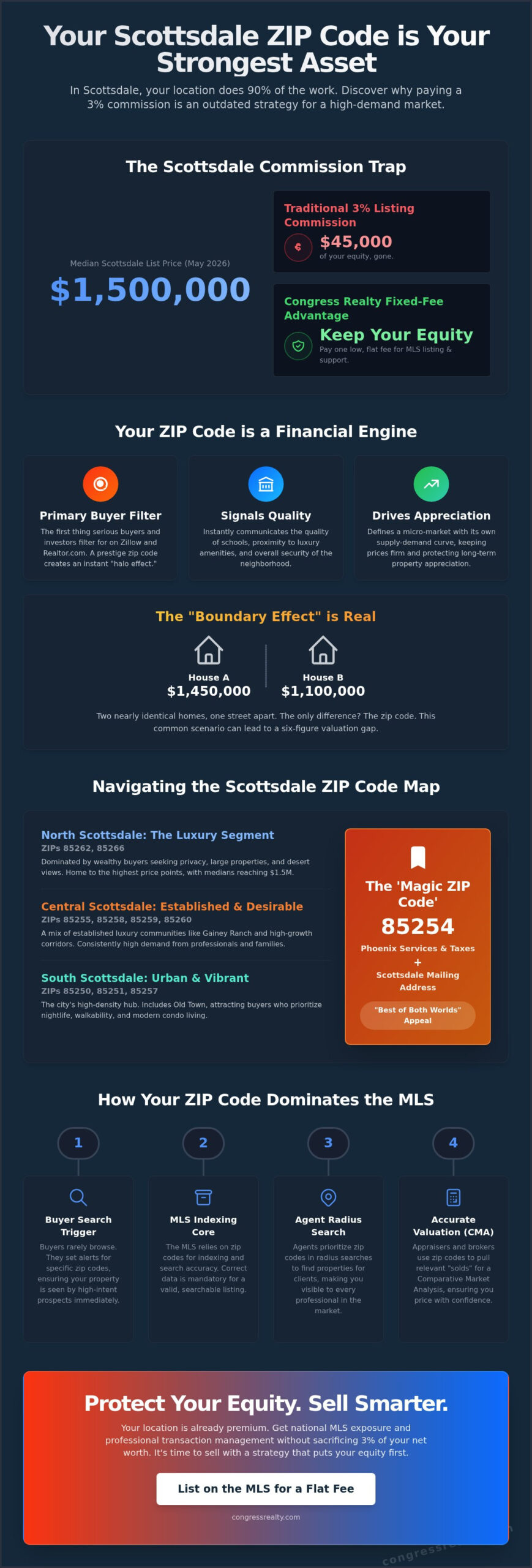
Your scottsdale zip code is doing 90% of the heavy lifting in your home sale, so why are you still planning to hand over 3% of your equity to a listing agent? With the median list price in Scottsdale hitting $1,500,000 as of May 2026, that traditional commission isn’t just a fee; it’s a massive chunk of your net worth. You already know that location is the primary driver of value in the Valley. Whether you are in the high-demand “Magic Zip Code” 85254 or the luxury peaks of 85262, the prestige of the area draws buyers in without any extra help from a high-priced middleman.
It’s understandable to feel protective of your equity when the market’s natural desirability is doing the work. This guide will help you master the local market by providing a clear list of every Scottsdale zip code and explaining why certain areas rank higher in buyer searches. You’ll learn how to handle the “Phoenix address, Scottsdale service” boundary confusion and discover a smarter way to list on the MLS. We’ll provide a plan to use professional listing tools to sell your home effectively while keeping your equity exactly where it belongs.
Key Takeaways
Understand how zip code boundaries act as primary valuation filters and influence the “boundary effect” on your property’s market price.
Identify the specific scottsdale zip code that aligns with your home’s unique features to target high-intent buyers and investors accurately.
Learn how the MLS indexing system and radius search features prioritize zip codes to ensure your home appears in the right agent searches.
Avoid the “commission trap” by recognizing that in high-demand Scottsdale areas, the location does the heavy lifting for your marketing.
Discover how to secure national MLS exposure and professional transaction management using a fixed-fee model that protects your home equity.
The Strategic Role of Zip Codes in Real Estate Valuation
Think of your zip code as a financial engine that drives your home’s market value. In the high-stakes world of Scottsdale, Arizona, these five digits act as the primary filter for every serious buyer and institutional investor. They don’t just tell a mail carrier where to drop a package; they signal the quality of local schools, the proximity to luxury amenities, and the anticipated appreciation of the property. When you understand the power of your scottsdale zip code, you can stop viewing your home sale as a marketing challenge and start viewing it as a strategic transaction.
The “boundary effect” is a real economic phenomenon here. You might find two nearly identical properties separated by a single street, yet their valuations differ by six figures. This happens because zip codes often align with municipal service boundaries or premium school districts. Buyers are willing to pay a significant premium for the right side of the street. If your home is located in one of these high-demand pockets, you’re already holding a winning hand. This is the foundation of equity-first selling. Why would you sacrifice 3% of your home’s value to a listing agent when the geography itself is the main attraction? You deserve to keep that equity by using professional tools that put you in the driver’s seat.
Why Buyers Start Their Search with a Zip Code
Major search portals like Zillow and Realtor.com are built on geographic filters. Buyers rarely browse blindly; they set alerts for specific codes that match their lifestyle goals. A prestigious zip code creates an immediate psychological “halo effect,” suggesting a level of exclusivity and security that a neighborhood name alone cannot convey. A target zip code is a micro-market with its own supply-demand curve. When inventory is low in a specific code, prices stay firm regardless of broader national trends. By listing directly on the MLS, you ensure your property triggers those saved search alerts for every qualified buyer looking in your area.
Zip Codes vs. Neighbourhood Identities
Don’t confuse marketing-driven neighborhood names with the legal power of a zip code. While a name like “Old Town” or “Gainey Ranch” carries weight in a brochure, the Multiple Listing Service (MLS) relies on the scottsdale zip code for indexing and search accuracy. Accurate data is mandatory for a valid listing. Professional appraisers and brokers use these codes to conduct a Comparative Market Analysis (CMA). This ensures your home is compared against relevant “solds,” protecting you from underpricing your asset. Using the right geographic data allows you to price with confidence and sell with authority.
Navigating the Scottsdale Zip Code Map: Key Areas and Trends
Mapping out your home sale requires a deep dive into the specific scottsdale zip code that defines your property’s market. Each area within the Scottsdale corridor offers a distinct profile that attracts different buyer personas. The primary zip codes you need to know include 85250, 85251, 85254, 85255, 85257, 85258, 85259, 85260, 85262, and 85266. While these all share the Scottsdale prestige, the market dynamics shift dramatically as you move from the urban density of the south to the sprawling luxury of the north.
The South Scottsdale corridor, particularly zip code 85251, serves as the city’s high-density urban hub. This area encompasses the vibrant Old Town district, drawing buyers who prioritize nightlife, walkability, and modern condo living. In contrast, North Scottsdale zip codes like 85262 and 85266 are dominated by the luxury segment. These areas saw a median home list price of $1,500,000 as of May 2026, fueled by wealthy buyers seeking larger properties, privacy, and desert views. Recent U.S. Census Bureau data for Scottsdale highlights a growing population of high-income professionals, which continues to sustain demand in these northern reaches.
The ‘Magic Zip Code’ 85254 Explained
Zip code 85254 remains a fascinating hybrid known as the “Magic Zip Code.” It’s unique because properties here sit within the City of Phoenix for taxes and services but maintain Scottsdale mailing addresses. In 2026, this area continues to offer a significant tax advantage compared to homes fully within Scottsdale city limits. Buyers flock here for the “best of both worlds” appeal, making it one of the most searched zip codes in the Southwest. If you own property in this zone, your home’s dual identity is a powerful selling point that you should highlight in your listing.
High-Growth Corridors and Emerging Zip Codes
Infrastructure projects like the ongoing Loop 101 improvements have significantly boosted values in adjacent zip codes by reducing commute times to major employment hubs. These high-growth corridors are seeing year-over-year appreciation that outpaces the broader market. To stand out in these competitive areas, you must utilize high-impact visuals. Investing in professional photography isn’t optional; it’s a requirement to capture the attention of buyers scrolling through the 1,815 homes currently on the market. You can access these professional listing tools to ensure your property commands the attention it deserves without overpaying for the privilege.
How Zip Codes Influence MLS Search Algorithms
Your property’s visibility depends on more than just a high-quality photo or a catchy description. In the digital ecosystem of the Multiple Listing Service (MLS), your scottsdale zip code functions as the primary indexing key that determines whether your home appears in a buyer’s search or remains invisible. Most buyer agents use “radius search” features or specific zip code filters to narrow down the 1,815 homes currently on the market. If your geographic data is entered incorrectly, you risk missing out on thousands of automated alerts sent to pre-qualified buyers. This technical precision is what separates a fast sale from a listing that languishes on the market.
Algorithms also use these geographic markers to feed Automated Valuation Models (AVMs). These tools look at how your address affects your home’s value by comparing your property to others within the same five-digit boundary. When the data is clean and accurate, these AVMs generate more favorable “estimated values” on consumer sites, which directly influences a buyer’s perceived value of your home. Taking control of this data is a pragmatic step toward protecting your equity. You don’t need a traditional agent to manage these technical details; you just need a professional infrastructure that prioritizes accuracy over high commissions.
Maximizing Visibility Through Accurate Geographic Tagging
Precision matters. A professional listing service ensures your home is tagged with the exact scottsdale zip code and sub-market data required by the MLS. This accuracy triggers “New Listing” alerts for local buyers who have saved searches for specific neighborhoods like DC Ranch or McDowell Mountain Ranch. To master these technical aspects without paying a 3% listing fee, you can follow our comprehensive guide on how to sell your house on your own. By managing the listing yourself through a flat-fee model, you ensure that every data point is optimized for maximum exposure.
Syndication: From the Local MLS to National Portals
Once your listing is live on the local MLS, it syndicates to national platforms like Zillow, Redfin, and Realtor.com. Consistency in your geographic data is vital to prevent “ghosting,” where a listing fails to appear on certain sites due to data mismatches. Beyond the digital search, managing the physical logistics is equally simple. Utilizing an electronic lockbox allows you to securely manage showings across different Scottsdale areas while maintaining a professional record of every agent who enters your home. This level of control gives you the confidence of a pro while keeping your equity in your pocket.
Strategic Selling: Maximizing Equity in High-Demand Areas
In a high-demand scottsdale zip code, your home’s location is its most powerful marketing asset. It does 90% of the work before a single buyer steps through the door. When you sell in a market where the median home list price has reached $1,500,000 as of May 2026, you face a significant financial decision. The “commission trap” is a common industry pitfall. Traditional agents often charge a 3% listing commission to market a property that essentially sells itself due to geographic demand. This isn’t just a fee; it’s a massive equity drain that savvy homeowners can easily avoid. You don’t need a high-priced middleman to tell buyers that your neighborhood is desirable; the zip code has already made that case.
Success starts with precise pricing based on local data. Even in a market rated as “somewhat competitive” with a score of 49 out of 100, you cannot afford to guess. Utilizing a Comparative Market Analysis (CMA) based on zip-code-specific data ensures you don’t leave money on the table or scare away buyers with an unrealistic figure. With a sale-to-list price ratio of 96.8% in Scottsdale, your initial price point is the most critical factor in your strategy. In a market with 1,815 active homes, data-driven pricing is your best tool for standing out and securing a fair deal.
Calculating Your Net Proceeds by Zip Code
Consider the math on a $1,000,000 Scottsdale home. A standard 3% listing commission costs you $30,000 at the closing table. Contrast that with a flat-fee model where you pay a predictable upfront cost regardless of your home’s value. When you look at how much the realtor makes, it becomes clear that the compensation is often disproportionate to the actual effort required in high-demand areas. Equity preservation is the ultimate goal of any savvy seller. By choosing a professional listing service over a high-commission agent, you keep that $30,000 in your bank account instead of theirs.
Leveraging Market Demand to Dictate Terms
High search volume in your specific scottsdale zip code gives you the leverage to dictate terms. When multiple buyers are vying for a property in a “hot” zone, you need a structured way to manage the influx. Professional transaction management helps you navigate complex multiple-offer scenarios without the stress of a traditional brokerage environment. You can manage the process with confidence by using the right tools.
Drive interest with professional yard signs that signal a serious, market-ready listing.
Manage high-volume showings securely using an electronic lockbox to track every agent visit.
Review every contract detail with a dedicated professional to ensure your interests are protected during the closing process.
Don’t let a traditional commission structure eat away at the wealth you’ve built in your home. You can start your professional listing today and take full control of your equity.
Congress Realty: National MLS Access with a Fixed-Fee Advantage
You’ve identified the inherent value of your scottsdale zip code, and now it’s time to leverage that knowledge into a successful sale. Congress Realty acts as your professional bridge to the Multiple Listing Service (MLS), the same database used by every high-commission brokerage in the Valley. We provide the essential infrastructure you need to reach buyers while you maintain full command of your transaction. Whether you are selling a luxury estate in 85262 or a high-demand property in the 85254 “Magic Zip Code,” your listing will have the same local power and national reach as any other home on the market. You get the exposure of a national firm with the precision of a local expert.
Empowerment comes from making smart financial choices. By choosing a fixed-fee model, you are choosing to be the champion of your own equity. You don’t need to hand over 3% of your home’s value to get noticed. Our platform ensures your home is indexed correctly for the 1,815 active properties in the Scottsdale market, putting your listing directly in front of the buyers who are already searching for your specific location. It is a pragmatic, benefit-driven approach that rewards your financial intelligence.
The Benefits of a Flat Fee MLS Listing
Why pay a traditional listing commission when your location already drives the traffic? You can get your house on the MLS without a traditional realtor and keep your equity for your next move. Our model replaces unpredictable percentage-based fees with a transparent, fixed-cost structure that provides everything you need to compete. Every listing includes professional photography to capture your home’s best angles, a professional yard sign, and an electronic lockbox for secure, tracked agent access. For a detailed breakdown of these packages, consult our ultimate guide to flat fee MLS listings.
Expert Support for Every Zip Code
Managing your own sale doesn’t mean you’re flying solo. We provide the professional oversight required for a successful closing in any scottsdale zip code. Our services include a professional Comparative Market Analysis (CMA) to ensure your pricing is data-driven and transaction management to handle the paperwork. If you choose our Full Service Listing, you’ll have a dedicated agent to review contracts and guide you through the complexities of the closing process. This professional infrastructure allows you to lead the sale with confidence. Take charge of your equity today and experience the reward of a smarter way to sell.
Take Control of Your Scottsdale Home Equity
Your home’s market value is fundamentally tied to its specific scottsdale zip code, and that geographic demand is what truly powers your sale. You now understand that the technical accuracy of your MLS listing and the strategic avoidance of the traditional 3% commission are the keys to a successful, high-equity transaction. You don’t need a high-cost middleman when you have the right professional infrastructure to manage your transaction and protect your net proceeds.
Founded in 2002, Congress Realty provides the expert transaction management and professional MLS exposure you need to succeed without the unnecessary overhead. Our platform empowers you to lead the process while keeping your hard-earned equity exactly where it belongs. List your home on the MLS for a flat fee and save thousands in equity today.
You have the tools, the data, and the market demand on your side. Step into the driver’s seat and start your journey toward a simple, rewarding, and highly profitable home sale right now.
Frequently Asked Questions
What is the most expensive zip code in Scottsdale?
The 85253 zip code in Paradise Valley is the most expensive in the immediate Scottsdale area, with a median home value exceeding $2.96 million as of early 2025. Within Scottsdale city limits, the 85262 and 85266 zip codes command the highest prices. These northern regions are dominated by luxury custom homes and sprawling desert lots that attract high-net-worth buyers seeking privacy.
Does the 85254 zip code have a Scottsdale or Phoenix address?
Properties in the 85254 zip code use a Scottsdale mailing address even though they are physically located within the City of Phoenix. This unique arrangement means residents receive Phoenix municipal services and pay Phoenix property taxes. It remains a top choice for buyers who want the prestige of a Scottsdale address combined with the specific tax structure of Phoenix.
How many zip codes are officially in Scottsdale, AZ?
There are approximately 10 primary residential zip codes that define the Scottsdale market. These include 85250, 85251, 85254, 85255, 85257, 85258, 85259, 85260, 85262, and 85266. Each scottsdale zip code represents a distinct micro-market with its own inventory levels and buyer demographics, ranging from urban condos to equestrian estates.
Can I list my home on the MLS in any zip code without a realtor?
You can absolutely list your home on the MLS without hiring a traditional listing agent. Flat-fee listing services provide the professional infrastructure needed to get your property into the local database and onto national portals like Zillow. This approach empowers you to manage the sale yourself and keep your equity instead of losing 3% to a listing commission.
What is considered the ‘Magic Zip Code’ in the Scottsdale area?
The “Magic Zip Code” is 85254, a high-demand area that sits on the border of Scottsdale and Phoenix. It earned this nickname because it offers the prestige of a Scottsdale mailing address and proximity to world-class amenities while being governed by the City of Phoenix. It’s consistently one of the most searched zip codes for families and professionals in the Southwest.
How do zip codes affect property taxes in the Phoenix metro area?
Zip codes serve as a primary indicator of which municipal taxing authority governs your property. For example, a scottsdale zip code located within Phoenix city limits will have a different tax rate than one located fully within Scottsdale. These boundaries are critical for sellers to understand because they directly impact a buyer’s monthly carry cost and your property’s overall affordability.
Do I need a local Scottsdale agent to sell my home effectively?
You don’t need a local agent when the desirability of the neighborhood does the marketing for you. Buyers today search by specific geographic filters and property features rather than agent reputations. By using professional listing tools, high-quality photography, and an electronic lockbox, you can facilitate a professional sales process independently and save thousands in unnecessary fees.
What is the difference between a Scottsdale mailing address and Scottsdale city limits?
A Scottsdale mailing address is a postal designation that doesn’t always align with the city’s political boundaries. Many homes have a Scottsdale address for mail delivery but are actually located in Phoenix or unincorporated Maricopa County. City limits determine your specific municipal services, schools, and voting rights, while the mailing address provides the geographic branding often sought after in real estate.
Image sourced from Canva
Summary: Selling your Montana home without an agent could save you thousands, but did you know the state’s zero transfer tax policy stacks savings even higher? There’s a catch, though—one mandatory filing mistake costs sellers $500, and the timeline varies wildly depending on where you live. Key Takeaways
Montana FSBO closings generally take 30-50 days, depending on location, with Bozeman averaging around 36 days and rural areas potentially requiring longer due to complexity.
Seller closing costs average just 2.24% of the home’s purchase price in Montana, excluding real estate commissions, thanks to the state’s zero transfer tax policy.
Title companies handle the entire escrow process in Montana rather than attorneys, managing everything from earnest money deposits to final recording.
FSBO sellers must prepare specific documentation early, including Montana’s mandatory seller disclosure statement and preliminary title reports, to avoid delays
The Realty Transfer Certificate filing is mandatory with potential $500 penalties for non-compliance, making proper documentation crucial for successful closings.
Selling a home For Sale By Owner in Montana offers significant savings potential, but requires careful preparation and understanding of local procedures. Montana’s title company-based system differs from attorney states, creating specific timelines and documentation requirements that can catch unprepared sellers off guard.
Montana FSBO Closings: 30-50 Day Timeline Breakdown
Montana real estate closings follow a predictable timeline that varies significantly by location and transaction complexity. The state average closing period is 35 days from accepted offer to final recording. Still, this timeline fluctuates based on several key factors, including property location, financing type, and completeness of documentation.
Cash transactions consistently close faster across all Montana markets, typically reducing the timeline by 7-10 days compared to financed purchases. This acceleration occurs because cash buyers eliminate mortgage underwriting, appraisal delays, and lender-required inspections, which commonly extend closing timelines.Congress Realty provides FSBO support throughout Montana, helping sellers understand these timing variations and prepare accordingly.
Rural Montana properties present unique challenges that can extend closing timelines. These extended periods reflect the difficulty of title examinations on large parcels with intricate ownership chains, mineral rights severances, water rights documentation, and potential federal grazing permit transfers. Title companies require additional time to verify these complex ownership structures and ensure clear title transfer.
Essential Pre-Closing Documents FSBO Sellers Must Prepare
Successful FSBO closings in Montana depend heavily on early preparation of documents. Sellers who gather essential paperwork before listing significantly reduce the risk of last-minute delays and costly extensions. The three critical document categories require different lead times and preparation strategies.
1. Order Your Preliminary Title Report Early
A preliminary title report serves as the foundation of any successful Montana real estate transaction. This document reveals potential title issues, including unpaid taxes, outstanding liens, judgment liens, and encumbrances that could complicate or prevent the sale. Montana title searches typically cost between $150 and $500 and take several business days to complete.
Title companies throughout Montana provide these services. Ordering this report early allows sufficient time to resolve any discovered issues before listing the property. Common title problems in Montana include unpaid property taxes, contractor liens from incomplete projects, and divorce decree complications requiring additional documentation.
Montana law under M.C.A. § 70-20-502 requires residential property sellers to provide a written disclosure statement to buyers before or simultaneously with the execution of the purchase contract. The Owner’s Property Disclosure Statement covers extensive details on property condition, including structural integrity, roof condition, heating and plumbing systems, water sources, septic systems, and known material defects.
Failure to provide accurate disclosures can trigger significant legal and financial consequences, including substantial monetary damages and attorney fees. Rural and mountain properties require additional disclosures covering well logs, water quality test results, septic pumping records, chimney service records, road access details, easements, and water rights documentation. Properties built before 1978 also require federal Lead-Based Paint Disclosure forms and EPA informational pamphlets.
3. Gather Property-Specific Documentation
Montana buyers expect detailed property documentation before making offers, particularly in rural markets where property conditions significantly impact value and usability. Essential documents include mortgage payoff statements from current lenders, original purchase agreements, property surveys showing boundary lines and easements, HOA covenants and agreements where applicable, and receipts for improvements and repairs.
Service and warranty records for appliances and HVAC systems demonstrate proper maintenance, while past utility bills (especially winter heating costs) help buyers understand ongoing operational expenses. Building permits for additions or modifications and certificates of occupancy provide legal verification of compliance that protects both parties during the transaction.
How Montana Title Companies Handle FSBO Escrow
Montana operates as a title company state, meaning licensed title companies manage real estate closings rather than attorneys, though legal representation remains optional. This system creates specific advantages for FSBO sellers who work directly with title companies throughout the transaction process.
Title Company Role vs Attorney States
Title companies in Montana serve as impartial stakeholders during the escrow process, managing document flow, fund disbursement, and title insurance policy coordination. Unlike attorney states where legal representatives handle closings, Montana title companies provide standardized procedures and transparent fee structures that benefit FSBO sellers working without agent representation.
The title company conducts detailed title examinations, clears title defects, prepares escrow closing instructions, and coordinates all parties toward successful closing. They also handle the complex recording requirements with county clerk and recorder offices, ensuring proper filing of deeds and Realty Transfer Certificates to protect both buyers and sellers from future legal complications.
Earnest Money Deposit Requirements
Earnest money deposit amounts in Montana are typically negotiable and vary by market. These deposits demonstrate buyer commitment and must be made according to the terms of the purchase agreement. Title companies hold these funds in designated escrow accounts at Montana banks.
Earnest money deposits apply toward closing costs or down payments at closing, providing buyers with transaction credit while protecting sellers through demonstrated financial commitment. In Billings and other major Montana markets, earnest money handling follows strict protocols with delivery requirements specified in purchase agreements.
Montana’s diverse real estate markets exhibit significant variations in closing timelines based on local demand patterns, available services, and property types. Understanding these regional differences helps FSBO sellers set realistic expectations and plan accordingly.
Bozeman/Gallatin County: Fast-Closing Market
Bozeman and Gallatin County represent a relatively fast-closing market, with an average closing time of approximately 36 days. This efficiency reflects high market demand, abundant resources at title companies, and streamlined processes developed to handle increased transaction volume driven by population growth and economic expansion.
The region’s robust infrastructure includes multiple title companies, experienced appraisers familiar with rapid market appreciation, and efficient inspection services. However, this speed requires sellers to have all documentation prepared in advance, as any delays can quickly extend timelines in this competitive environment.
State Average: 35 Day Closing Period
Montana’s statewide average closing period of 35 days reflects the balance between urban efficiency and rural complexity. This timeline includes the full range of transaction types, from straightforward city properties with clear titles to complex rural parcels requiring extensive documentation and coordination among multiple parties.
Factors influencing this average include mortgage underwriting timelines, inspection scheduling availability, appraisal completion, and the complexity of title examinations. Most transactions fall within the 30-45 day range, though specific circumstances can extend or accelerate individual closings.
Cash vs Financed Transaction Differences
Cash transactions close significantly faster than financed purchases across all Montana markets. Some cash transactions can close in as little as 7-14 days when documentation is prepared and title issues are resolved. This acceleration occurs because cash buyers eliminate mortgage underwriting delays, appraisal requirements, and lender-mandated inspections that commonly extend financed transaction timelines.
Financed transactions require additional time for loan processing, underwriting approval, and final loan document preparation. FHA and VA loans may impose additional property standards that require extra inspection time or property modifications before closing approval.
FSBO Closing Costs Without Real Estate Commissions
Montana FSBO sellers enjoy significant cost advantages compared to traditional agent-assisted sales, particularly due to the state’s favorable transfer tax policy and reasonable closing fee structure.
Montana’s Zero Transfer Tax Advantage
Montana stands among 15 states that impose no real estate transfer tax, providing substantial savings compared to neighboring states with transfer tax rates ranging from 0.1% to 2% of the sale price. Instead of transfer taxes, Montana requires a Realty Transfer Certificate filing, which carries no additional fees beyond standard recording costs.
This zero transfer tax policy can save sellers thousands of dollars on higher-value properties. For example, a $500,000 home sale in Montana avoids the $1,000 to $10,000 in transfer taxes that would apply in many other states, making FSBO sales particularly attractive for Montana homeowners.
Seller Expenses Average 2.24% (Excluding Agent Fees)
Montana seller closing costs average approximately 2.24% of the home’s purchase price when excluding real estate agent commissions. On a $350,000 home, this translates to roughly $7,800 in total closing expenses. Major cost components include title services and escrow fees, an owner’s title insurance policy of approximately $554, and prorated property taxes based on 0.68% of assessed value.
Additional costs may include lender’s title insurance if applicable, recording fees, and optional attorney fees. Buyer incentives or concessions, while negotiable, typically average around 2% of the sale price when offered as part of purchase negotiations.
Mandatory Realty Transfer Certificate Filing Requirements
Montana law requires all deeds transferring real property to include a completed Realty Transfer Certificate (RTC) that is filed simultaneously with the deed recording at the County Clerk and Recorder’s office. This requirement applies to all property transfers, regardless of sale price or transfer type, with failure to file accurate and complete RTCs resulting in $500 penalties and up to six months in jail.
The RTC documents transfer details, including sale price, property type, transfer nature, and tax information. Both parties involved in real property transfers must complete the form, which is available from the Montana Department of Revenue. Any capital gains from the property transfer constitute Montana source income and must be reported on the appropriate state tax returns.
Filing occurs concurrently with deed recording, typically handled by the title company as part of their closing services. The RTC ensures proper documentation of property transfers for state tax purposes and maintains accurate records of real estate transaction activity throughout Montana.
Congress Realty Offers FSBO Support for Montana Sellers
Montana’s FSBO closing process requires expertise in state-specific requirements, documentation, and timelines. While the potential savings are substantial, the complexity of completing proper disclosure, coordinating title examinations, and preparing closing documentation can challenge inexperienced sellers.
Professional FSBO support services help sellers maintain control over their transaction while ensuring compliance with Montana’s legal requirements. These services typically include flat fee MLS listing access, contract review, closing coordination assistance, and guidance through the state’s unique title company-based closing system.
Experienced FSBO support providers understand Montana’s regional market variations, from Bozeman’s fast-paced environment to the complexities of rural property involving water rights, mineral rights, and federal land adjacencies. This expertise proves invaluable in avoiding costly delays and ensuring successful closings that protect both sellers and buyers.
Did you know that selling a median-priced home can cost you tens of thousands of dollars in traditional real estate commissions? It’s a staggering figure that feels more like a penalty for your success than a fair price for a service. You’ve worked hard to build equity in your property, and watching a significant portion of it disappear at the closing table is a painful reality for many homeowners. If you’re looking for a way to get your home on the market without the heavy financial burden, a flat fee MLS listing is the smartest tool in your arsenal.
We understand that you want the maximum exposure of Zillow and Realtor.com without the hidden fees of discount brokerages. This guide will teach you how to leverage professional broker support and transaction management to sell your home like a pro. You’ll learn how to handle complex legal disclosures and use high-impact tools like electronic lockboxes to simplify your sale. By the end of this article, you’ll have a clear roadmap to bypass the traditional 3% listing commission and maximize your profit.
Key Takeaways
Stop paying for a brand name and start paying for results by using a professional flat fee mls listing arizona to access the same databases used by traditional agents.
Protect your home equity by replacing the standard 3% listing commission with a predictable, fixed-cost structure that puts you in command of your profit.
Master the logistics of a successful sale by utilizing professional photography and electronic lockboxes to manage showings securely and efficiently.
Gain the confidence of professional oversight with direct access to an experienced Arizona broker who ensures your transaction remains legally compliant.
Learn why offering a competitive buyer’s agent commission remains a strategic move to ensure maximum interest and a faster closing at the best price.
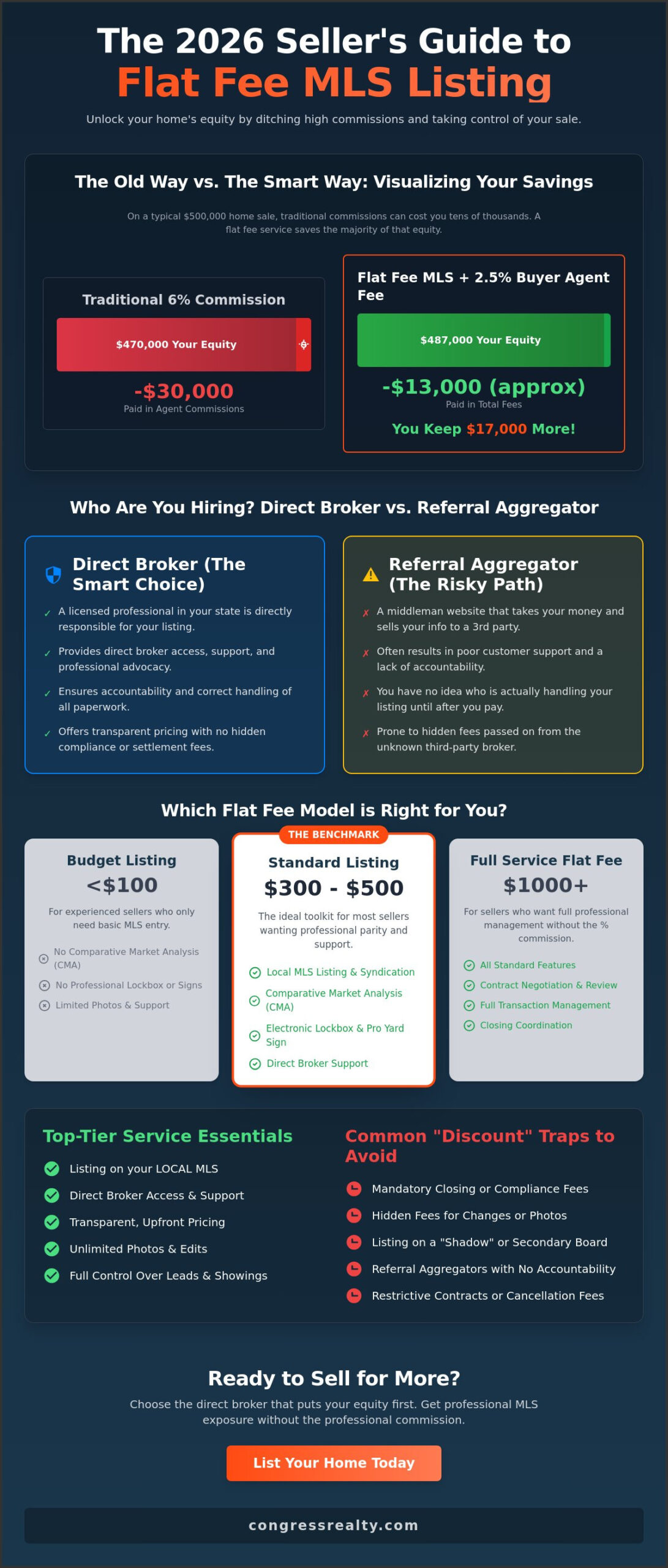
A flat fee mls listing arizona is a strategic real estate tool that allows you to list your home on the professional market for a one-time payment instead of a percentage-based commission. In a traditional sale, you typically lose 3% of your home’s value just to have an agent put your data into a database. This model disrupts that high-cost cycle. By paying a fixed fee, you gain full access to the professional infrastructure used by every licensed agent in the state. You maintain complete control over your equity while ensuring your property is visible to every serious buyer in the region.
This approach is fully supported by Arizona real estate law through what are known as “limited service” brokerage agreements. Unlike a “For Sale By Owner” (FSBO) attempt, which often lacks legal protections and market reach, a flat fee agreement provides a professional framework. The role of the Designated Broker is central here. They ensure your listing meets all state-wide professional standards and disclosure requirements. While you manage the showings and negotiations, the broker provides the necessary oversight to keep your transaction compliant and professional. This isn’t just a software upload; it’s a broker-backed entry into the professional marketplace.
The Difference Between Flat Fee and Traditional Brokerages
Traditional models operate on a 6% total commission structure. This is usually split into 3% for the listing agent and 3% for the buyer’s agent. When you choose a flat fee model, you immediately eliminate that 3% listing side commission. You keep that equity in your pocket. Despite the lower cost, there is no “service gap” in terms of visibility. Your property appears on major search portals exactly like a traditional listing. You receive the same professional exposure without the predatory pricing of legacy brokerage models.
Why the MLS is Essential for Arizona Sellers
The Multiple Listing Service (MLS) is the engine that drives the entire real estate market. When your home is listed here, the data syndicates automatically to Zillow, Trulia, and Realtor.com. This is vital because approximately 90% of buyers are represented by agents who rely exclusively on the MLS to find homes for their clients. MLS-sourced data carries significantly more weight than manual posts or “Zestimates” because it is verified and updated in real-time. Using this database ensures your home is seen by the right people at the right time with the most accurate information possible.
How the Flat Fee MLS Process Works in Arizona
Taking control of your home sale doesn’t mean you have to figure it out alone. The process for a flat fee mls listing arizona is designed for efficiency and transparency. It starts with you selecting a professional listing tier that matches your comfort level. Some sellers prefer a basic entry, while others opt for full-service support that includes transaction management. Once you’ve chosen your path, you’ll submit your property data, upload high-resolution photos, and complete the necessary state-required disclosures. This is your opportunity to showcase your home’s best features to the entire market.
After your submission, a licensed broker reviews your information to ensure it meets professional standards. They don’t just “post and ghost.” They verify that your listing is compliant and ready for the Arizona Multiple Listing Service. Once activated, your property is live and visible to thousands of buyer agents. You’ll manage inquiries directly and use an electronic lockbox to provide secure, trackable access for showings. When the offers start rolling in, you’ll evaluate the terms and move toward a successful closing with the confidence of an expert. If you want to see which level of support fits your goals, explore our listing options to get started.
Preparing Your Property Data
Accuracy is your best friend when preparing your listing. Ensure your square footage and bedroom counts are exact, as these are the primary filters buyers use during their search. A compelling description that highlights high-value upgrades like granite countertops or a new HVAC system can set you apart. You must also strictly adhere to Arizona real estate regulations regarding property disclosures. Providing a thorough Seller’s Property Disclosure Statement (SPDS) early in the process prevents post-sale liability and builds trust with potential buyers.
The Syndication Timeline
Speed is a major advantage of the flat fee model. Most brokers will have your listing live within one to two business days of receiving your completed paperwork. Once the broker hits “submit” on the MLS, a digital wave carries your data to over 100 real estate websites, including the big names like Zillow and Realtor.com. This ensures you don’t miss out on early interest from motivated buyers. Any updates you make to the price or property details in the MLS are usually reflected on third-party sites within 24 hours. This automated system keeps your marketing fresh and accurate across the entire internet without any extra effort on your part.
Flat Fee MLS vs. Traditional 6% Commission: The Math
Why should the cost of selling your home be tied to its value? In a traditional real estate model, you pay a variable percentage that punishes you for your home’s appreciation. If your property value goes up, your agent gets a raise, even if the workload remains exactly the same. A flat fee mls listing arizona flips this script by replacing the 3% listing commission with a predictable, fixed cost. This shift allows you to treat professional market access as a service rather than a tax on your hard-earned equity. When you stop thinking in percentages and start thinking in fixed costs, the financial advantage becomes undeniable.
Understanding What is a Flat Fee MLS Listing? is the first step toward reclaiming your profit. Under this model, the “listing side” of the commission is eliminated. However, it’s vital to distinguish between the listing agent’s fee and the Buyer Agent Commission (BAC). While you bypass the 3% listing fee, we still recommend offering a competitive 2% to 3% to the agent who brings the buyer. This ensures your home remains a priority for the thousands of licensed professionals searching the database for their clients. By separating these two costs, you maintain a competitive edge without overpaying for the listing itself.
Predictability is the ultimate benefit of this financial structure. Traditional sellers often encounter “sliding scale” surprises or high-pressure demands for extra services. With a flat fee mls listing arizona, your upfront costs are transparent. You choose your tier and know exactly what you’re paying before the sign goes in the yard. You should watch for minor add-ons like yard sign rentals or photo upgrades, but these are small, manageable expenses compared to the five-figure hit of a traditional commission. You keep the listing side equity where it belongs: in your bank account.
Calculating Your Potential Savings
The numbers tell a compelling story. Consider a $500,000 home sale in the Phoenix or Scottsdale market. A traditional 3% listing commission would cost you $15,000 at the closing table. By choosing a flat fee model, you keep nearly that entire amount. How much does the realtor make? In the traditional model, they make enough to cover your next down payment. Reinvesting that $15,000 can cover your moving costs, fund a kitchen upgrade in your new house, or simply bolster your retirement savings.
Why Offering a Buyer Agent Commission Matters
You don’t want to save money at the expense of market reach. Offering a BAC incentivizes the buyer agent community to prioritize your home. When an agent sees a fair commission offer in the MLS, they’re more likely to show your property to their motivated buyers. In Arizona’s shifting market, staying competitive means playing by the rules of the professional database while refusing to pay for redundant listing services. You provide the incentive for the buyer’s side while retaining your autonomy on the listing side.
Essential Features for a Successful Flat Fee Listing
How do you ensure your listing doesn’t just sit on the market? Success requires more than just a digital entry. It demands a suite of professional tools that signal quality to both buyers and their agents. When you utilize a flat fee mls listing arizona, you aren’t sacrificing professional standards. Instead, you’re choosing which high-impact features to deploy to maximize your sale. By focusing on the same tools used by top-tier traditional agents, you maintain the professional edge needed to secure a high-value offer while keeping your equity intact.
A professional yard sign and post also play a vital role in your local marketing strategy. While digital exposure is massive, signaling to the neighborhood that the property is officially on the market invites word-of-mouth leads and local interest. This physical presence, combined with a robust online profile, creates a comprehensive marketing umbrella that leaves no stone unturned. You’re the one in charge, but these tools provide the professional infrastructure that makes your independence possible and profitable.
Leveraging Professional Photography and CMA
First impressions happen in milliseconds. Using cell phone photos often leads to lower offers and longer days on the market because buyers associate poor imagery with a lack of property care. High-resolution images do more than just look pretty; they build a digital narrative that justifies your asking price. Professional photography is the single most important factor in click-through rates on Zillow and Realtor.com. Without it, your equity is at risk from low-ball offers.
Pair these visuals with a Comparative Market Analysis (CMA). A CMA uses real-time data from recent sales to help you avoid the “overpricing trap” that kills initial momentum. You want to hit the market with a price that is both aggressive for your equity and attractive to buyers. Check out our guide on pricing your home for the MLS to ensure you start strong and stay competitive.
Showings and Transaction Management
Efficiency is the key to a smooth closing. Electronic lockboxes are essential for providing secure, trackable access to buyer agents without requiring your physical presence. These devices log every entry. They give you peace of mind and professional accountability. You can see exactly which agent entered your home and when, which is a level of security traditional “combo” boxes simply can’t provide.
Managing the paperwork is often the most daunting part of a solo sale. Transaction management services bridge the gap between a handshake and a successful wire transfer. They track the critical dates that, if missed, could jeopardize your contract. You need to ensure all Arizona-specific legal forms are completed correctly for the file to prevent post-sale liability. By leveraging these professional tools, you maintain command over the process while enjoying the support of a structured transaction framework. Ready to equip your sale with the best tools in the industry? Browse our professional listing packages today to get started.
Why Savvy Sellers Choose Congress Realty in Arizona
Why trust a newcomer when you can work with a pioneer? Founded in 2002, Congress Realty has spent over two decades refining the way homeowners sell. We aren’t just a tech platform that uploads your data and disappears. When you choose a flat fee mls listing arizona through us, you’re partnering with Andrew English, our Designated Broker. This provides you with direct access to professional oversight and industry expertise that a simple software-only service cannot match. You get the protection of a licensed brokerage with the freedom of an independent sale.
We believe in providing options that respect your autonomy. Some sellers are comfortable managing every detail themselves, while others want the security of professional transaction management. That’s why we offer tiered service options. You can choose our “Standard” listing for a streamlined, efficient experience or opt for our “Full Service” package if you want a dedicated partner through the closing process. Regardless of your choice, our commitment remains firm: you pay no 3% listing commission. Every dollar of that saved equity stays exactly where it belongs: in your pocket.
The Congress Realty Advantage
We bridge the gap between modern efficiency and traditional reliability. While we leverage the latest syndication technology to blast your home across the web, we maintain the professional standards of a legacy brokerage. Our proven track record across the state includes thousands of successful closings since 2002. We provide the comprehensive support you need, from the initial listing entry to the final signatures. This isn’t a “one-size-fits-all” model. It’s a tailored approach designed for the modern, independent seller who values both their time and their equity.
Getting Started with Your Arizona Listing
Ready to take command? The first step is selecting the package that aligns with your specific goals and comfort level. Our onboarding process is intentionally simple. We’ve stripped away the complexity and the high-pressure sales tactics common in the traditional industry. Once you submit your information, we move quickly to get your home live on the professional database. Don’t let another day of equity slip away to outdated commission models. Take the final step to save your equity in 2026 and experience the freedom of selling on your own terms with professional backing.
Take Command of Your Arizona Home Sale Today
Selling your home shouldn’t mean handing over your hard-earned equity to an outdated commission model. You now have the roadmap to maintain professional visibility while keeping thousands of dollars in your pocket. By choosing a flat fee mls listing arizona, you’re opting for financial intelligence over industry tradition. You’ve learned that you don’t have to sacrifice quality; high-impact tools like professional photography and electronic lockboxes ensure your listing stands out and remains secure throughout the process.
Congress Realty has been a trusted ally for homeowners since 2002. Broker Andrew English has overseen thousands of successful listings, providing the A+ rated service and professional oversight you need to navigate the market with ease. You get the perfect blend of modern efficiency and veteran experience without the burden of a 3% listing commission. Stop letting legacy fees drain your profit at the closing table. List Your Arizona Home on the MLS with Congress Realty Today and start your journey toward a smarter, more profitable sale. You have the tools, the data, and the professional backing to succeed. It’s time to take control of your future.
Frequently Asked Questions
How much does a flat fee MLS listing in Arizona cost?
The cost depends on the level of support and professional tools you choose for your sale. A flat fee mls listing arizona replaces the traditional 3% listing commission with a one-time upfront payment, though the exact amount varies between standard entry and full-service packages. This fixed-cost structure ensures you know your expenses from day one, allowing you to protect your equity rather than losing it to a variable percentage at the closing table.
Can I list on the MLS without a realtor in Arizona?
No, you must work with a licensed broker to gain access to the professional database. The MLS is a restricted tool reserved for real estate professionals, but a flat fee service provides a “limited service” agreement that bridges this gap. You get the professional entry you need to reach buyers while maintaining full command over your showings and negotiations, effectively bypassing the high costs of a traditional listing agent.
Will my home show up on Zillow and Realtor.com with a flat fee listing?
Yes, your property will receive the exact same online exposure as any traditional listing. These major search portals pull their data directly from the MLS, so once your broker activates your file, your home syndicates to hundreds of websites automatically. This ensures your home is visible to millions of potential buyers on Zillow and Realtor.com without requiring you to pay a legacy 3% listing commission for that visibility.
Do I still have to pay a commission to the buyer’s agent?
You should plan to offer a commission to the agent who brings the buyer to stay competitive in the Arizona market. While a flat fee mls listing arizona eliminates the listing side commission, offering 2% or 3% to the buyer’s agent incentivizes the professional community to show your home. This strategy ensures your property remains a priority for agents working with qualified buyers, helping you secure a faster closing at a better price.
What happens if I find a buyer myself without an agent?
You save the entire commission if the buyer is unrepresented. In this scenario, you avoid both the listing side fee and the buyer side commission, which can save you tens of thousands of dollars in equity. You’ll still benefit from our professional infrastructure to ensure your paperwork and legal disclosures are handled correctly, providing a secure and profitable framework for your completely independent transaction.
Is Congress Realty a licensed brokerage in Arizona?
Yes, Congress Realty is a fully licensed real estate brokerage that has been operating in Arizona since 2002. We aren’t a third-party referral site; we provide direct professional oversight through our Designated Broker, Andrew English. This gives you the confidence of working with a veteran organization that has overseen thousands of successful listings while maintaining an A+ rated service standard across the industry.
Can I make changes to my MLS listing after it goes live?
You can update your listing details, price, or photos at any time to keep your marketing fresh. Whether you need to adjust your asking price based on a recent CMA or upload new professional photography, the process is simple and efficient. Most changes are processed by the broker quickly and reflect on syndicated websites like Zillow within 24 hours, ensuring your data stays accurate for potential buyers.
How long does a flat fee MLS listing stay active?
Listing durations typically range from six months to a full year depending on the package you select. This timeframe gives you plenty of room to find the right buyer without the pressure of a traditional agent’s short-term contract. If your home hasn’t sold within the initial term, you often have the option to extend your listing, ensuring you maintain professional market presence until your transaction is successfully closed.
Image sourced from Canva
Summary: With 86% of buyers finding issues during inspections, Montana sellers using flat-fee MLSs face a critical negotiation moment. But there’s a strategy that turns the tables—one that begins before you even list your home and could save you thousands in concessions.
Key Takeaways
Montana flat-fee MLS sellers can successfully navigate home-inspection negotiations by preparing early with pre-listing inspections and setting clear repair limits before going to market.
Five negotiation strategies give sellers flexibility: completing repairs with licensed contractors, offering price reductions, providing closing cost credits, selling as-is with safety concessions, or walking away to reset with the next buyer.
Professional support remains available through flat-fee MLS brokers who offer add-on services, including contract review, negotiation coaching, and transaction coordination for complex situations.
Proper preparation and documentation protect sellers’ positions by focusing on material defects over cosmetic issues and bundling all responses into written counter-offers.
Montana’s housing market is currently experiencing a period of adjustment, with some areas showing signs of cooling. In contrast, others remain competitive, meaning buyers may find varying levels of negotiation power during transactions. However, flat fee MLS sellers who understand the inspection process and prepare strategically can still achieve successful outcomes while saving thousands on listing commissions.
Home inspection negotiations represent a significant hurdle in most Montana real estate transactions, occurring after buyers have had professional inspectors examine the property for defects. With approximately 86% of buyers discovering issues through inspections, sellers using flat fee MLS services need solid strategies to handle repair requests without traditional full-service listing agent support.
The current market conditions in Montana favor buyers in many areas, typically leading to more aggressive negotiation tactics and higher expectations for seller concessions. Flat fee MLS sellers maintain control over their negotiations but must be prepared to respond professionally and strategically to inspection findings.
Congress Realty’s flat fee MLS service provides Montana sellers with full listing exposure while maintaining control over negotiations and offers additional support services for complex transactions as needed.
Smart preparation begins before the “For Sale” sign goes up. Montana’s challenging climate creates specific issues that frequently appear on inspection reports, including roof problems from snow loads and ice dams, well and septic system concerns in rural areas, foundation settling, and outdated electrical panels.
1. Consider Pre-Listing Inspection to Address Issues Early
Pre-listing inspections allow sellers to understand their home’s condition and address necessary repairs proactively. This strategy can significantly reduce the number of negotiation points with prospective buyers while helping sellers price their property accurately. Addressing known issues upfront often leads to cleaner buyer inspection reports and fewer post-inspection demands.
2. Decide Your Repair Limits Before Listing
Establishing clear boundaries before listing prevents emotional decision-making during negotiations. Sellers should determine what they’re willing to fix—typically safety, structural, and major system issues—versus what will remain “as-is,” such as minor cosmetic problems and normal wear. Pricing the home to reflect its current condition helps reduce the need for later concessions.
3. Follow Montana Disclosure Laws Accurately
Montana’s Residential Property Disclosure law requires sellers to disclose any known material defects that buyers wouldn’t reasonably discover. Accurate disclosure combined with realistic pricing often narrows post-inspection negotiations to truly new or unexpected problems. Failing to provide proper disclosure can lead to significant legal and financial consequences, including damage claims and contract cancellation.
Responding to Buyer Inspection Reports
When the buyer’s inspection report arrives, systematic evaluation prevents overwhelm and helps prioritize responses effectively.
Sort Findings by Priority Level
Categorize inspection findings into three levels: life/safety and structural issues (roof leaks, foundation movement, electrical hazards, major plumbing problems, failed HVAC systems), functional but aging systems (older water heaters, end-of-life HVAC units, worn roofs without active leaks), and minor/cosmetic items (paint, small cracks, sticky doors, loose hardware, typical maintenance needs).
Check Contract Deadlines and Requirements
Confirm the inspection contingency deadline and delivery requirements for repair requests. Buyers typically must submit formal repair addenda or similar documents through their agents. All responses must follow contract specifications and use proper forms to ensure legal compliance.
Get Contractor Estimates for Major Items
Obtain at least one contractor’s bid for any major issues to understand the actual repair costs. These documented estimates serve as negotiation anchors when deciding whether to complete repairs, offer credits, or reduce the purchase price.
Five Negotiation Strategies for Montana Sellers
Each negotiation approach is best suited to different situations and seller priorities. Understanding when and how to use these strategies maximizes outcomes.
1. Seller-Completed Repairs Using Licensed Contractors
Agreeing to fix specific items before closing works best when buyers feel nervous about major issues or when lenders require certain repairs for loan approval. Require licensed professionals, receipts, and re-inspection language in any repair addendum. This approach provides buyers with confidence but requires sellers to manage contractors and timelines.
2. Price Reduction Based on Repair Costs
Reducing the purchase price by the documented repair costs offers a clean exit without managing the contractor’s work. This strategy works well when buyers can handle repairs after closing and sellers want to avoid mid-transaction complications. Tie any price reduction clearly to documented contractor estimates.
3. Closing Cost Credits for Buyer-Managed Repairs
Providing closing cost credits earmarked for repairs benefits cash-short buyers while allowing them to choose their own contractors. This approach works particularly well when appraisal margins are tight, but lenders allow repair credits. Credits must be written into the contract and approved by the buyer’s lender.
4. As-Is Sale with Minimal Safety Concessions
Fixing only health, safety, or code violations while leaving other issues works in seller’s markets or when homes are priced aggressively low to reflect condition. Explain that pricing already accounts for the property’s condition, though small concessions may preserve goodwill.
5. Walk Away and Reset with Next Buyer
Declining major demands and allowing buyers to cancel under contingencies sometimes represent the best financial decision. This strategy works when buyer requests are unreasonable or when sellers have backup buyers or sufficient time. Resetting with adjusted pricing or condition expectations for the next buyer often yields better outcomes.
Using Flat Fee MLS Support During Negotiations
Montana flat fee MLS services provide varying levels of negotiation support depending on the service tier selected.
Access to Required Contract Forms and Addendums
Basic flat fee packages typically include access to required forms, while higher-tier plans often add offer review, negotiation coaching, and transaction coordination. Sellers should use their broker for correct repair addendum forms, proper wording for agreements, and to ensure that all changes are properly documented and shared with buyer agents.
Optional Add-On Services for Complex Negotiations
Many Montana flat-fee providers offer “Full Service” or “Broker-Managed Plans” that include transaction management for an additional fee. These services can prove valuable during complex inspection negotiations, providing professional support while still saving significantly compared to traditional full-service commissions.
Professional Negotiation Tactics That Protect Your Position
Strategic negotiation approaches help sellers maintain power while building buyer confidence.
Focus on Material Defects Over Cosmetic Issues
Address negotiations around health, safety, structural, and lender-required items while politely but firmly redirecting conversations away from minor cosmetic concerns. Buyers who demand every minor item often back off when expectations are professionally reset to material defects.
Bundle All Responses Into One Counter-Offer
Provide a single, well-reasoned response rather than negotiating line-by-line. A clear counteroffer that addresses major concerns while explaining reasoning appears professional and avoids negotiation fatigue. For example: “We will complete X and Y repairs with licensed contractors and provide a credit of $Z for items A and B.”
Document Everything in Writing
Ensure all agreements tie directly to the contract through proper addenda. Verbal promises often lead to disputes, especially when sellers act as their own listing agents. Written documentation protects all parties and prevents misunderstandings during closing.
Flat Fee MLS Sellers Successfully Navigate Inspections with Proper Preparation
Montana flat-fee MLS sellers who prepare strategically, respond professionally, and use available support services can successfully navigate home-inspection negotiations while preserving significant equity. The key lies in understanding the process, setting realistic expectations, and maintaining professional standards throughout negotiations.
Success depends on balancing firm boundaries with reasonable flexibility, always prioritizing safety and structural concerns while confidently addressing buyer requests within the market context. With proper preparation and professional support as needed, flat-fee MLS sellers can achieve favorable outcomes while maintaining control over their transactions.
For guidance on Montana flat fee MLS services and negotiation support, visit Congress Realty athttps://congressrealty.com to learn about selling solutions.
Why should an outdated kitchen or a few deferred maintenance items cost you $80,000 in home equity before you even hit the market? Most homeowners assume that selling a house as is means choosing between a predatory “we buy houses” offer or paying a traditional agent the 2026 national average commission of 5.70%. You’re likely feeling the pressure of potential inspection deal-breakers or the anxiety of complex legal disclosures. It’s a frustrating spot to be in, but you don’t have to trade your financial wealth for a quick exit.
We agree that you deserve a fast sale without the burden of expensive repairs or high-commission fees. This guide promises to show you exactly how to retain your equity by taking control of the process yourself. From navigating the new March 2026 FinCEN reporting rules for cash buyers to mastering the latest state disclosure laws, we provide the roadmap to secure a professional listing on the local MLS that puts you in the driver’s seat. You control your sales process, and we’re here to ensure you keep the thousands you’ve earned.
Key Takeaways
Define the legal reality of selling a house as is to ensure you meet all 2026 disclosure requirements while avoiding unnecessary repair costs.
Perform a professional “Repair vs. Equity” audit to identify which fixes are essential for financing and which are just draining your profits.
Learn how to leverage a professional CMA and high-quality photography to attract serious buyers on the local MLS without an expensive traditional agent.
Protect your financial interests by following the “Golden Rule” of disclosures to eliminate the risk of post-closing lawsuits.
Discover how to use a flat-fee Standard Listing to bypass high commissions and retain maximum control over your home’s final sale price.
What Does ‘Selling a House As Is’ Really Mean in 2026?
In the current real estate climate, clarity is your greatest asset. When you decide on selling a house as is, you are essentially attaching a legal proviso to your purchase agreement. This term signals to potential buyers that the property is being sold in its current state. You are explicitly stating that you will not perform repairs or offer financial credits for issues discovered during the transaction. To understand the broader legal context, it’s helpful to review What ‘As Is’ Means in a standard sales contract. It’s a shield for your equity, but it isn’t a “get out of jail free” card for transparency.
Many sellers mistakenly believe that an as-is sale excuses them from disclosure requirements. This is a dangerous assumption in 2026. Whether it is the long-standing federal lead-based paint disclosure or the new 2026 California requirements regarding AI-generated photos and tobacco use, the law demands honesty. You must disclose every known material defect. Failing to do so can lead to expensive litigation long after you’ve moved out. In 2026, the market has normalized, and buyers are more “payment driven” due to mortgage rates hovering around 5.90%. They expect transparency, even if they’re willing to handle the repairs themselves.
There is also a vital distinction between the “Retail As-Is” and “Investor As-Is” markets. Predatory investors often target as-is properties, offering 30% or 40% below market value. They rely on your fear of repairs to snatch your equity. Conversely, the retail market consists of families and individuals looking for homes on the LOCAL MLS. These buyers are often willing to pay a fair price for a home with potential, provided they know what they are getting. By listing your home properly, you avoid the double-hit of a lowball investor offer and the 5.70% average traditional commission.
The Legal Reality vs. Marketing Strategy
An as-is clause functions as a boundary in your contract. It tells the buyer that the price reflects the property’s current condition. However, it does not typically strip the buyer of their right to a professional inspection. Most buyers will still hire an inspector to understand their future maintenance costs. Your strategy is to use this clause to prevent “nickel and diming” during the escrow period. Selling a house as is is a refusal to remediate physical defects, not a refusal to disclose their existence. By setting this expectation early, you maintain control of the negotiation.
Dispelling the ‘Distressed Property’ Myth
Don’t fall for the trap of thinking as-is only applies to “fixer-uppers.” In 2026, many luxury estates use this strategy to allow new owners to customize the space to their own tastes. It is a savvy way to attract buyers who value potential over a developer’s generic choices. As long as the home’s primary systems like the roof and foundation are functional, most as-is properties remain fully mortgageable. You don’t need an investor to take a massive chunk of your wealth. You just need the right professional infrastructure to reach retail buyers while keeping your equity intact.
Evaluating Your Property: Is an As-Is Sale Right for You?
Deciding on selling a house as is requires a cold, hard look at your balance sheet rather than an emotional attachment to your home’s potential. You need to perform a “Repair vs. Equity” audit. This process involves calculating whether spending $20,000 on a kitchen refresh will actually net you an additional $20,000 in the final sale price. In many 2026 markets, the answer is no. With the median home price projected to reach $423,000, buyers are often more concerned with their monthly mortgage payments than having the perfect backsplash. If your home’s primary systems are functional, you might find that the cost of improvements exceeds the value they add.
You must identify “deal-breaker” issues that could stall a traditional sale. While cosmetic flaws are fine, problems with the roof, foundation, or HVAC system can block buyers from securing traditional financing. If a property can’t pass a basic safety inspection, your pool of buyers shrinks significantly. However, this doesn’t mean you should panic and sell to a lowball investor. Understanding these flaws allows you to price the home accurately on the LOCAL MLS, attracting savvy buyers who have the cash or specialized renovation loans to handle the work themselves.
Consider the “Time Value of Money” before you pick up a sledgehammer. A major renovation project in 2026 typically takes three to six months to complete. During that time, you’re still paying the mortgage, insurance, and taxes. If the 30-year fixed mortgage rate stays around 5.90%, waiting six months to sell could cost you thousands in holding costs alone. Ask yourself if you have the emotional bandwidth to manage contractors for a quarter of a year. If you value a fast, stress-free closing, staying in control of the as-is process is often the smarter financial move.
Calculating the Real Cost of Repairs
Estimating repair costs is more complex than it used to be. You have to factor in contractor delays and the continued material cost inflation seen throughout 2026. A “simple” bathroom remodel can easily spiral in cost and duration. Before you commit, compare your estimated net proceeds with and without these improvements. You can use this how to sell your home checklist to run a full valuation audit. Often, listing at a slightly lower price point without doing the work results in a higher net gain because you avoid the 5.70% average commission on those added repair costs.
Identifying Your Ideal Buyer Profile
Your property’s condition dictates who will walk through the door. Retail buyers are typically looking for a “sweat equity” discount. They’re happy to handle paint and flooring if it means getting into a neighborhood they otherwise couldn’t afford. Institutional investors, on the other hand, look for heavy-lift projects they can flip for a profit. Your goal is to reach the retail buyer first. By using a flat-fee listing service, you keep your home visible to the widest possible audience, ensuring you don’t leave money on the table by settling for an investor’s bottom-dollar offer.
How to List a House As Is on the MLS for Maximum Value
Don’t make the mistake of thinking selling a house as is requires you to accept a bottom-dollar offer from an “off-market” investor. Those predatory “we buy houses” companies often demand a 20% to 30% equity discount in exchange for a quick close. You can get that same speed on the LOCAL MLS while reaching a much larger pool of buyers who are willing to pay a fair market price. To maximize your net proceeds, follow this structured five-step process to position your property as a high-value opportunity rather than a problem to be solved.
Step 1: Obtain a Professional CMA. Pricing is your most powerful tool. You need a Comparative Market Analysis (CMA) that accounts for the current condition of your home relative to recent sales in your neighborhood. Don’t guess.
Step 2: Invest in Professional Photography. Even a fixer-upper needs to look its best. High-quality photos can highlight the home’s layout, natural light, and structural integrity, showing potential buyers the “good bones” beneath the cosmetic needs.
Step 3: Craft a Transparent Description. Use keywords like “opportunity,” “blank canvas,” and “investor special.” Honesty builds trust and prevents wasted showings by filtering out buyers who aren’t looking for a project.
Step 4: Use a Flat-Fee MLS Service. Reach every buyer on the market without losing thousands to a traditional 3% listing commission. This is critical when you’re already pricing the home at a condition-based discount. Understanding how real estate listing syndication works ensures your as-is property appears on over 900 websites and reaches the widest possible pool of retail buyers.
Step 5: Set Clear Agent Remarks. Instruct your listing service to include “Seller will not perform repairs or offer credits” in the private remarks. This ensures buyer agents understand the terms before their clients even step inside.
Attracting Retail Buyers to a Fixer-Upper
Retail buyers are your best chance for a high sale price. Unlike institutional flippers, these individuals are often looking for a home they can move into and improve over time. They value “sweat equity” and are usually willing to pay more than an investor because they aren’t calculating a profit margin. By using the LOCAL MLS, you expose your property to families who want to get into a specific school district or neighborhood at a price point they can finally afford. Just be sure to mention the as-is status early to keep the process efficient.
The Power of the Flat Fee MLS Listing
Saving your equity starts with the way you list. When you use a flat fee mls listing, you get the same professional exposure as a traditional 6% agent for a fraction of the cost. This is especially vital in 2026, where the national average commission is 5.70%. If you’re already selling at a discount due to the home’s condition, giving away another $12,000 to $20,000 in commissions is a double-hit you can’t afford. You control your sales process, keep your equity, and let the market competition drive your price up.
Navigating Disclosures and Inspections Without Stress
One of the most dangerous myths on the internet is that selling a house as is protects you from all future liability. Some forum users mistakenly believe they can hide known defects under the cover of an as-is clause. This is a recipe for a post-closing lawsuit. In reality, your best insurance policy is radical transparency. The “Golden Rule” of real estate remains: when in doubt, disclose. By documenting every known issue, you shift the burden of repair onto the buyer and legally insulate yourself from claims of fraud or misrepresentation.
Managing the mountain of paperwork required in 2026 can feel overwhelming, but you don’t have to do it alone. Utilizing professional transaction management services ensures that every form is signed, dated, and filed correctly. This professional infrastructure protects your equity by creating a verifiable paper trail that proves you met every legal obligation. You stay in control of the negotiations while we provide the framework to keep the deal legally sound.
The Mandatory Disclosure Checklist
Your disclosure requirements vary by state, but federal laws apply across the board. If your home was built before 1978, the Residential Lead-Based Paint Hazard Reduction Act of 1992 requires you to provide an EPA-approved pamphlet and disclose any known lead hazards. In 2026, sellers in states like California must also navigate new requirements, such as disclosing a history of tobacco use on the property or providing a professional electrical safety inspection. Disclosure is your best insurance policy against litigation; it converts a potential “hidden defect” into a known condition that the buyer has officially accepted.
Handling the Inspection Period
Even with an as-is contract, most buyers will insist on an inspection period. Don’t view this as a threat to your deal. Instead, see it as a tool for building buyer confidence. When the buyer’s inspector inevitably finds issues, you must be prepared to respond firmly. Use a standard “as-is” reminder: “The property’s current condition was factored into the listing price.” If a major, previously unknown issue arises that threatens the buyer’s financing, consider offering a small closing cost credit rather than performing a physical repair. This keeps the transaction moving forward without you having to manage contractors or delay your closing date. If your buyer is unrepresented, understanding the full process of selling to a buyer without an agent can help you navigate the paperwork and legal requirements with confidence.
Be Firm: Remind the buyer that the as-is status was clear from day one.
Be Practical: A $1,000 credit is often cheaper than a $1,500 repair when you factor in your time.
Be Protected: Ensure all inspection waivers are documented in writing.
By following this methodical approach, you demystify the most stressful part of the sale. You aren’t just selling a property; you’re executing a smart financial transition. Keep the momentum toward your final closing by staying focused on the facts and letting the documentation do the heavy lifting for you.
Maximize Your Net Proceeds with Congress Realty
When you decide on selling a house as is, you’ve already made a strategic choice to trade a higher sales price for speed and convenience. It makes no financial sense to then hand over a massive chunk of your remaining equity to a traditional agent. In May 2026, the national average real estate commission is approximately 5.70%. On a median-priced home of $423,000, that’s over $24,000 disappearing from your pocket. Paying a full commission on a property you’ve already discounted for its condition is a double-hit to your net proceeds that you simply don’t have to take.
Congress Realty provides the professional infrastructure you need to reach retail buyers without the high-commission overhead. Our Standard Listing gets you onto the LOCAL MLS, which is the only way to trigger the market competition necessary to get top dollar for an as-is property. You don’t need a traditional agent to host an open house for a fixer-upper. You need exposure. We provide the tools, such as Electronic Lockboxes, so you can manage showings securely and efficiently on your own schedule. You stay in the driver’s seat while we handle the technical listing logistics.
Pricing an as-is home correctly is the difference between a fast sale and a listing that languishes for months. We offer professional Comparative Market Analysis (CMA) support to ensure your price reflects the current 2026 market normalization. By using real-time data rather than guesswork, you can attract “sweat equity” buyers who are ready to close. Our platform is designed for the savvy property owner who values financial intelligence and total control over their transaction.
Equity-First Selling in 2026
Choosing a flat-fee model is the most effective way to protect your wealth. By bypassing the 3% listing side commission, you can save $10,000 or more in a single transaction. Learning how to sell your house on your own is the smartest move for as-is properties because it allows you to offer a competitive price to buyers while still walking away with more cash. If the legalities feel daunting, our Transaction Management service provides the professional oversight you need for high-stakes closings without the 6% price tag.
Getting Started with Your As-Is Listing
Ready to take the next step? You can list your home with Congress Realty today and have your property live on the MLS in a fraction of the time it takes to vet a traditional agent. Choose our Standard Listing for maximum savings or our Full Service option if you want additional administrative support. Either way, you keep the thousands you’ve earned and maintain complete authority over your sale. Stop surrendering your equity to outdated commission models and start selling on your own terms.
Take Control of Your Home Equity Today
You now have the roadmap to navigate the 2026 real estate market with confidence. selling a house as is doesn’t have to mean sacrificing your financial future to predatory investors or high-commission agents. By focusing on radical disclosure and leveraging the power of the LOCAL MLS, you can attract retail buyers who value your property’s potential. You’ve learned how to audit your repairs, handle the new FinCEN reporting rules, and manage inspections without stress. It’s about making a smart, financially intelligent transition on your own terms.
Since 2002, Congress Realty has been a trusted ally for independent sellers. We’ve helped our clients save over $100M in commissions by replacing the outdated 6% model with a transparent flat fee. With our professional Transaction Management and expert CMA support, you’re never truly on your own. You control your sales process while we provide the infrastructure to ensure a smooth, rewarding closing. Don’t let a traditional agent take a fraction of your wealth for a process you can lead yourself.
Does selling a house as is mean I don’t have to disclose anything?
No, you’re still legally required to disclose known material defects to any potential buyer. While the as-is clause means you won’t pay for repairs, federal and state laws demand total transparency. This includes long-standing lead-based paint disclosures and new 2026 requirements, such as California’s rules on disclosing tobacco use or digitally altered listing photos. Honesty is your best protection against future lawsuits.
Can a buyer still back out of an as-is contract after an inspection?
Yes, a buyer can cancel the deal if their offer includes an inspection contingency. Even when selling a house as is, most buyers will insist on a period to verify the home’s condition. If the inspection reveals a major structural or safety issue they aren’t prepared to handle, they can typically withdraw and receive their earnest money back. You stay in control by setting clear expectations before the inspection begins.
Do as-is houses take longer to sell on the MLS?
Not necessarily. Market data from late 2025 showed California homes took a median of 36 days to sell, and as-is properties often follow this trend if priced correctly. The key is using a professional CMA to set a price that reflects the home’s current state. When you list on the LOCAL MLS, you attract “sweat equity” buyers who are often looking for a project and ready to move quickly.
Can a buyer get an FHA or VA loan for an as-is property?
Yes, provided the home meets the lender’s “Minimum Property Standards” for safety and habitability. FHA and VA appraisers are strict about items like peeling lead paint, roof integrity, and functional heating systems. If the house has major safety hazards, the lender might require specific repairs before they’ll fund the loan. If your home has these issues, targeting cash buyers or those with renovation loans is a smarter strategy.
Is it better to sell as-is to an investor or on the open market?
The open market is almost always the superior choice for your bottom line. Investors typically demand a 20% to 30% discount on your equity to ensure their own profit margins. By listing on the MLS for a flat fee, you reach retail buyers who want to live in the home. These buyers are usually willing to pay much closer to market value because they aren’t calculating a flip-profit.
What are the most important things to disclose in an as-is sale?
You must disclose any material defects that could impact the property’s value or the safety of its occupants. This includes foundation cracks, roof leaks, mold, or past flooding. In 2026, specialized disclosures like the March 1 FinCEN rule for cash buyers also add new layers to the documentation process. Think of disclosure as your insurance policy; it converts a hidden problem into a condition the buyer has officially accepted.
How much less will I get for my house if I sell it as is?
The price reduction usually corresponds to the estimated cost of the necessary repairs. You’re trading a lower sales price for the convenience of a fast, renovation-free exit. However, you can offset this discount by avoiding the 2026 national average commission of 5.70%. By keeping that money in your pocket, your net proceeds often end up higher than if you had performed the repairs and paid a traditional agent.
Do I need a lawyer to sell my house as is?
It depends on your state’s specific laws, as some require an attorney to oversee the closing. In many cases, professional transaction management provides all the necessary infrastructure to handle the paper trail safely. This service ensures every disclosure is filed correctly and every deadline is met. It’s a pragmatic way to stay legally protected without the high hourly fees of a traditional law firm. If you anticipate working directly with an unrepresented buyer, reviewing a complete guide to selling to a buyer without an agent will help you understand the additional documentation and legal steps involved.
Image sourced from Canva
Summary: Selling your Helena home with a traditional agent? You could be paying over $12,000 more than you need to. There’s a little-known listing strategy that gives you the same MLS exposure for a fraction of the cost—but is the DIY approach right for you?
Key Takeaways
Helena home sellers can save over $12,000 on listing agent commissions by using Flat Fee MLS instead of traditional percentage-based fees.
Flat Fee MLS provides the same MLS exposure and syndication to Zillow, Realtor.com, and major sites for a fixed cost, with services typically starting as low as $99, while Congress Realty offers services starting at $299
While sellers handle showings and negotiations themselves, they still typically offer buyer agent commissions to attract purchasers.
The best candidates are motivated sellers, comfortable with pricing strategies and contract negotiations in balanced market conditions.
Helena home sellers facing traditional real estate commissions averaging 5.71% of their sale price are finding a powerful alternative that could keep thousands more dollars in their pockets at closing. Flat Fee MLS services are transforming how savvy sellers approach the real estate market, offering professional exposure without the hefty percentage-based fees.
Flat Fee MLS Could Save Helena Sellers $10,000+ in Commissions.
The math behind Flat Fee MLS reveals stunning savings potential for Helena homeowners. Traditional agents in Montana typically charge an average total real estate commission of 5.71% of the home sale price, which is usually split between the listing agent (around 2.98%) and the buyer’s agent (around 2.73%). This percentage-based structure means commission costs escalate dramatically with higher-priced homes, creating a significant financial burden for sellers.
Consider the impact on a typical home sale in Helena. With the current median home sale price around $437,000 (as of March 2026), traditional commission structures can cost sellers substantial amounts.Congress Realty offers Flat Fee MLS services starting at $299, demonstrating how alternative listing strategies can dramatically reduce selling costs while maintaining professional market exposure.
Traditional vs. Flat Fee Commission Breakdown
How Flat Fee MLS Changes the Math
For example, with a median home sale price of $437,172 in Helena (as of March 31, 2026), a traditional listing agent commission of 2.98% would be approximately $13,031. By using a flat fee MLS service, which can cost as low as a few hundred dollars, sellers could save over $12,000 on the listing agent’s commission alone. This represents a savings of roughly 95% compared to traditional listing fees.
The comparison becomes even more compelling across different price points. On a $300,000 home, traditional total commissions could reach $17,130, while Flat Fee MLS might cost only $299 plus a buyer agent commission of $8,190 – saving over $8,640. For higher-value properties at $500,000, the savings jump to approximately $14,600, making Flat Fee MLS an increasingly attractive option as home values rise.
How Flat Fee MLS Works in Helena
MLS Access Without Listing Agent Percentage
Flat Fee MLS operates by providing sellers direct access to the Multiple Listing Service through a licensed broker for a fixed cost rather than a percentage. Sellers pay the flat fee upfront, typically ranging from $99 to $499 depending on the service package, and receive the same MLS listing privileges as traditional full-service listings. The broker enters the property details, photos, and listing information into the system to ensure compliance with MLS requirements and regulations.
Full Exposure on Zillow, Realtor.com, and Major Sites
Once listed on the MLS, properties automatically syndicate to major consumer-facing real estate websites, including Zillow, Realtor.com, Redfin, and Homes.com. This syndication provides the same online exposure as traditionally listed properties, ensuring potential buyers can find the home through all standard search channels. The listing appears with the same professional formatting and search functionality, maintaining credibility and accessibility for both buyers and their agents.
What You Handle vs. What You Get
Tasks Sellers Take On
Flat Fee MLS sellers assume responsibility for several critical aspects of the sale process. Pricing strategy becomes the seller’s decision, requiring market research and competitive analysis to set an attractive listing price. Showing coordination falls to the homeowner, including scheduling appointments, managing lockbox access, and conducting property tours. Negotiation handling requires sellers to review offers, respond to counteroffers, and navigate contract terms without professional representation.
Services Included in Flat Fee Packages
Basic Flat Fee MLS packages typically include MLS listing submission, syndication to major real estate websites, and a standard listing duration of six months. Many providers offer additional services, such as professional photography, virtual tours, yard signs, and lockbox installation, as part of upgraded packages. Some services include limited broker support for contract questions or technical MLS updates, though the level of assistance varies significantly between providers.
Why You Still Offer Buyer Agent Commission
Most Flat Fee MLS sellers continue offering buyer agent commissions, typically 2-3% of the sale price, to maintain market competitiveness. Buyer agents play a crucial role in bringing qualified purchasers to properties, and eliminating their compensation can significantly reduce showing activity. The buyer agent commission ensures the property remains attractive to the approximately 87-89% of buyers who work with agents, maintaining access to the broadest possible buyer pool while still achieving substantial commission savings.
When Flat Fee MLS Makes Sense for Helena Sellers
Best Candidates for DIY Selling
Ideal Flat Fee MLS candidates possess strong communication skills, basic real estate knowledge, and sufficient time to manage the selling process. Sellers who are comfortable with technology, online research, and document review tend to succeed in self-directed sales. Properties in good condition located in desirable neighborhoods typically perform better with Flat Fee MLS, as buyer demand reduces the need for extensive agent marketing efforts.
Market Conditions That Help
Helena’s balanced real estate market, where properties sell in an average of 44 days, creates favorable conditions for Flat Fee MLS success. Balanced markets provide sufficient buyer activity without the intense competition that might require aggressive marketing strategies. Stable pricing trends and reasonable inventory levels give sellers greater control over timing and negotiation strategies, a key advantage for self-directed sales approaches.
Congress Realty is a provider of Flat Fee MLS services, with pricing starting around $299. Sellers in Helena can find Flat Fee MLS options from various providers, with basic plans typically ranging from $99 to $499, offering different service levels and support options to match individual seller needs and comfort levels.
Learn more about Flat Fee MLS options and commission-saving strategies atCongress Realty, where Helena sellers can examine alternative listing approaches designed to maximize their home sale proceeds.
Why would you hand over $12,000 or more of your hard-earned equity to a traditional agent when the 2026 real estate market has already shifted the rules in your favor? You have worked hard to build value in your home, and the thought of losing a massive chunk of it to a 3% listing commission is frustrating. You want the same visibility as the pros, but you don’t want to be left alone the moment your listing goes live. Finding the best flat fee mls listing service is about more than just a low price; it’s about choosing a professional ally who provides direct broker advocacy without the hidden fees that plague many discount aggregators.
You deserve to maintain control over your sales process while saving thousands in unnecessary costs. We’ll show you exactly how to navigate the post-NAR settlement landscape where buyer-broker agreements are mandatory and commissions are more transparent than ever. This guide breaks down the top-rated services for 2026, explains how to avoid mandatory compliance fees at closing, and ensures your home hits the LOCAL MLS with the professional support you need to close the deal on your own terms. It is time to stop settling for less and start selling for more.
Key Takeaways
Learn why listing on your actual LOCAL MLS is the only way to gain professional-grade exposure and feed all major real estate sites.
Identify the best flat fee mls listing service by looking for direct broker access and transparent pricing rather than just the lowest upfront cost.
Discover which package tier fits your experience level, whether you need a simple listing or full transaction management support.
Protect your equity by uncovering common “discount” traps so you don’t get hit with mandatory closing fees or photo limits.
Master the 2026 commission rules to save thousands; it’s the smartest way to maintain complete control over your sales process.
What Defines the Best Flat Fee MLS Listing Service in 2026?
Choosing the best flat fee mls listing service starts with understanding exactly what you are buying. At its core, What is a Flat-Fee MLS? It’s a professional arrangement where a licensed broker lists your property on the local database used by real estate agents for a set, upfront price. This model disrupts the traditional system by removing the 3% listing side commission entirely. In 2026, the most effective services don’t just put you on a national list; they ensure you are on the actual local board that services your specific zip code.
Visibility is non-negotiable. While only 5% of sales in 2025 were For Sale By Owner (FSBO) transactions, the vast majority of buyers still work with agents who rely exclusively on the local MLS. If your service uses a shadow or secondary board, your home won’t appear in the daily alerts that agents send to their clients. A top-tier service provides professional parity, meaning your listing looks identical to one from a high-commission firm. Once your home is on the local board, it automatically syndicates to Zillow, Realtor.com, and thousands of national brokerage sites. This ensures you reach 100% of the active buyer pool while keeping your equity.
The best services prioritize control over convenience. You should manage your own leads and showings directly. This removes the middleman and speeds up the communication process. Following the NAR rule changes on August 17, 2024, transparency is more important than ever. You need a service that clearly outlines your options without forcing you into restrictive contracts or hidden settlement fees.
The Core Benefits of the Flat Fee Model
The primary advantage is simple: you save thousands. By eliminating the listing agent’s 3% commission, you keep more of your home’s value at closing. You also gain direct communication with buyers. In a traditional model, messages get filtered through two different agents, which often leads to delays or miscommunications. With a flat fee listing, you speak directly to the other side. This puts you in the driver’s seat of your own transaction. Your home gets the same professional exposure as any other listing, but you stay in control of the schedule and the negotiations.
Identifying Direct Brokers vs. Referral Aggregators
Many websites that claim to be the best flat fee mls listing service are actually referral aggregators. These are middlemen who don’t hold a broker’s license in your state. Instead, they take your money and sell your data to a random third-party broker you’ve never met. This often leads to a lack of accountability and poor customer support. Working directly with a broker like Andrew English at Congress Realty ensures you have a professional advocate who is actually responsible for your listing. Before you pay, always verify that the company is a licensed brokerage in your state. This simple step protects you from hidden compliance fees and ensures your paperwork is handled correctly from day one.
Comparing Flat Fee MLS Models: Which is Right for You?
Deciding to ditch the traditional 3% listing commission is a smart financial move, but not every flat fee package is built the same. The best flat fee mls listing service offers a range of options tailored to your experience level and comfort. For seasoned investors who handle their own contracts and pricing, a basic entry-level listing provides the necessary MLS entry. However, most homeowners find that a more robust toolkit is required to navigate the 2026 market successfully. The Standard Listing serves as the definitive benchmark for savvy FSBO sellers who want professional visibility without the high price tag.
Choosing the wrong model can cost you more than you save. While some “budget” sites advertise $99 listings, these often leave you stranded without essential tools. Data from 2025 shows that FSBO listings remain on the market for an average of 38 days, compared to 32 days for agent-listed properties. To close that gap, you need a service that provides professional parity. This means having the same electronic lockboxes and yard signs that traditional agents use. If you want the highest level of support, a full-service flat fee model offers professional advocacy and transaction management without the percentage-based price tag.
Standard vs. Full Service Tiers
Budget packages priced under $100 usually lack a Comparative Market Analysis (CMA), lockboxes, or professional signs. Without a CMA, you risk overpricing your home, which is a major reason why the agent-assisted closing success rate is 86% compared to 78% for FSBOs. For high-stakes closings, transaction management is vital. It ensures all documentation meets state requirements and deadlines are met. Understanding these differences is a core part of learning how to sell your house on your own while protecting your equity. You can explore our listing packages to find the right balance of support and savings for your specific needs.
The Hybrid Approach: Professionalism Meets Savings
Most sellers in 2026 prefer a hybrid approach that combines DIY control with professional tools. This includes:
Comparative Market Analysis: Use real-time data to price your home accurately from day one.
Professional Photography: Listings with high-quality images receive significantly more clicks on national sites.
Electronic Lockboxes: These provide secure, trackable access for buyer agents, so you always know who entered your home and when.
By utilizing these professional resources, you maintain total control over your sales process while ensuring your property stands out against the competition. This pragmatic strategy allows you to keep your equity while benefiting from the same infrastructure used by top-producing agents.
Essential Features of a Top-Tier MLS Service
Finding the best flat fee mls listing service requires looking beyond a simple web form. You need a professional toolkit that mirrors the resources used by high-commission firms. A top-tier provider ensures your property is listed on the specific local board that feeds into every major national site. This local entry is your foundation. Without it, you miss out on the automated alerts that buyer agents set up for their clients. If your listing isn’t on the local board, you aren’t truly on the market.
Maximum photos are mandatory in 2026. You should never settle for a service that limits you to 6 or 10 images. Buyers expect a full digital tour before they book a showing. Additionally, professional property access is a safety requirement. Electronic lockboxes are the industry standard for secure showings. They allow you to track exactly which agent entered your home and at what time. This level of security is far superior to manual combination codes that can be shared easily. Finally, a Comparative Market Analysis (CMA) is essential. Pricing your home based on data from May 2026 ensures you don’t leave money on the table or let your listing go stale.
The Power of Professional Photography
Professional photography is your digital first impression. Listings with high-quality, professional images receive significantly more clicks on national platforms than those with amateur photos. Visual storytelling is the primary driver of MLS engagement. When you integrate photography services directly into your listing package, you ensure your home stands out against the competition. It’s a small investment that often leads to faster offers and higher final sale prices. Don’t let poor lighting or blurry phone photos cost you thousands in equity.
Transaction Management and Closing Support
Navigating the “under contract” phase is where many independent sellers feel the most pressure. This is the gap where most low-cost aggregators fail you. Professional transaction management provides oversight that prevents common escrow delays. It ensures that all mandatory disclosures are handled correctly, which is vital for avoiding potential lawsuits after the sale. Having a broker facilitate the documentation process means you aren’t left alone when complex legal paperwork arrives. You maintain control over your sales process while having the professional infrastructure to reach a successful closing. This advocacy is what separates a simple listing site from a true real estate partner.
How to Avoid Hidden Fees and ‘Discount’ Traps
Transparency is the foundation of a successful sale. A true flat fee should remain consistent from the moment you list until the day you close. Unfortunately, many companies that claim to be the best flat fee mls listing service use a teaser price to get you in the door, only to reveal mandatory compliance or transaction fees later. For instance, data from May 2026 shows that certain “budget” providers include a mandatory fee of 0.25% to 0.5% at closing. This effectively turns a flat fee back into a percentage commission, eating into the equity you worked so hard to save. At Congress Realty, our prices are transparent because we value your autonomy and your bottom line.
The Buyer Broker Commission Myth
The NAR settlement on August 17, 2024, fundamentally changed the real estate conversation. You are no longer permitted to offer buyer agent compensation on the MLS. This doesn’t mean you should ignore the buyer’s side of the transaction. You still choose what to offer, but you do it off-platform. Offering a competitive rate remains a strategic way to ensure maximum agent cooperation. Despite these rule changes, the average commission rate in 2026 has stayed between 5.3% and 5.5%. You are not skipping this fee, but you are controlling it. This allows you to negotiate terms that work for your specific financial goals while keeping your home attractive to the 91% of sellers who still use an agent-assisted model.
What to Look for in the Fine Print
Always scrutinize the fine print for hidden add-ons that should be standard. Does the company charge extra for yard signs, posts, or lockbox rentals? Many discount sites offer a low entry price but then bill you for every essential tool. Some alternative models even charge upfront fees alongside a closing fee of 0.5% to 1.25% depending on your state. These aren’t just small administrative costs; they can amount to thousands of dollars at the settlement table. Another common trap is the listing change fee. If the market shifts and you need to drop your price, you shouldn’t have to pay just to update your text. A professional broker provides these details upfront so you can budget with confidence.
Why Congress Realty is the Strategic Choice for 2026 Sellers
Choosing the best flat fee mls listing service is a decision that impacts your bottom line and your peace of mind. Many national aggregators are just tech platforms that sell your information to a stranger. Congress Realty is different. When you list with us, your property is managed by Andrew English, a designated broker with a proven track record of thousands of successful closings across the country. This direct access means you aren’t stuck in a call center queue when you have a critical question about an offer. You get professional advocacy from an expert who understands the nuances of the 2026 market and respects your financial intelligence.
Our history of results is built on a foundation of empowerment. We believe that You Control Your Sales Process. By providing the professional infrastructure of a traditional firm at a fraction of the cost, we champion the homeowner against outdated, high-commission models. Whether you are a seasoned investor or a first-time seller, our tiered options ensure you only pay for the services you actually need. This pragmatic approach has helped thousands of sellers keep their equity while achieving the same LOCAL MLS exposure as the biggest firms in the industry.
The Full Service Advantage
Our Full Service package is designed for sellers who want the savings of a flat fee but the security of professional transaction management. For just $399 upfront and a 0.5% commission at closing, you receive end-to-end guidance from a licensed expert. This includes expert valuation support so you don’t leave money on the table in a shifting market. We stay with you through every inspection, appraisal, and negotiation. This level of support is exactly what is missing from budget sites that simply post your flat fee mls listing and disappear. We ensure your closing is handled correctly and your interests are protected at every stage.
Getting Started with Congress Realty
Starting your journey is simple and direct. First, choose the package that fits your goals. If you are comfortable handling your own paperwork, the Standard Listing provides the essential tools for success. If you want a professional to manage the complexities of escrow, select our Full Service option. Once you submit your property details and photos, we get your home live on the LOCAL MLS quickly. This immediate action starts your equity-saving journey today. Don’t let a traditional agent take a massive chunk of your hard-earned value. Take control, list your home, and experience the satisfaction of selling on your own terms with a professional ally by your side.
Take Control of Your Home Sale Today
You now have the roadmap to navigate the 2026 real estate landscape without sacrificing your hard-earned equity. Selling your home independently is a smart, financially intelligent move when you have the right professional infrastructure behind you. By prioritizing a service that offers direct broker representation and placement on the LOCAL MLS, you ensure your property gets maximum exposure without the burden of a traditional listing commission. Finding the best flat fee mls listing service means choosing a partner that values your autonomy as much as you do.
Congress Realty was founded in 2002 and has facilitated thousands of successful closings across the country. You aren’t dealing with an anonymous middleman; you get direct representation from Andrew English and an A+ rated professional service. The tools you need to succeed are ready and waiting. Choose your listing package and start saving thousands today. You’ve built the value in your home. Now, it’s time to keep it. The process is simple, the savings are real, and the control is entirely yours.
Frequently Asked Questions
Is a flat fee MLS listing the same as a traditional listing?
A flat fee listing provides the exact same visibility on the LOCAL MLS as a traditional listing from a high-commission firm. The primary difference is the cost structure. Instead of handing over a percentage of your equity, you pay a one-time fee for the professional infrastructure you need. This keeps you in control of the sales process while ensuring your property syndicates to every major real estate site.
Will buyer agents still show my house if it’s a flat fee listing?
Buyer agents will show your home as long as it meets their client’s specific criteria. Agents are motivated by finding the right home for their buyers. Following the August 2024 rule changes, you simply negotiate the buyer broker commission off the MLS. Since 91% of sellers still use agent-assisted models, maintaining professional parity is the best way to attract these active buyers.
Can I cancel my flat fee listing at any time?
You can typically cancel your listing at any time without penalty. Professional brokers understand that circumstances change. Always verify this in the fine print to avoid hidden withdrawal fees. Choosing the best flat fee mls listing service means having the freedom to change your mind or take your home off the market without losing more than your initial flat rate.
What is the difference between a direct broker and an MLS aggregator?
A direct broker like Andrew English manages your paperwork and listing personally. An aggregator is a middleman website that sells your data to a third-party broker you haven’t vetted. This often leads to communication delays and hidden referral fees. Working directly with the broker ensures accountability, better support, and faster updates to your listing when you need them most.
Do I have to pay a commission to the buyer’s agent?
You aren’t required to pay a buyer’s agent, but it is highly recommended for maximum exposure. Most buyers in 2026 have written agreements with their agents that specify compensation. By offering a competitive commission, you ensure your home remains a top choice for the vast majority of buyers. You remain the sole decision-maker regarding the final commission amount offered.
What happens if I find a buyer without an agent?
If you find a buyer who isn’t represented by an agent, you save the entire commission. This is the ultimate goal for many FSBO sellers. You only pay your initial flat fee and keep 100% of your remaining equity. This scenario allows you to maximize your financial gain while still benefiting from the professional exposure and syndication power of the LOCAL MLS.
How much money can I actually save with a flat fee MLS service?
You can save thousands of dollars by eliminating the 3% listing commission. On a home priced at the 2025 median of $425,000, this simple switch keeps $12,750 in your pocket. Even if you choose to pay a buyer’s agent, your total costs remain a small fraction of what a traditional brokerage would charge. It’s the most pragmatic way to protect your home’s value.
Is professional photography included in flat fee packages?
Professional photography is offered as a high-impact add-on or included in premium listing tiers. High-quality images are the primary driver of clicks on sites like Zillow and Realtor.com. Since visual storytelling is vital in a digital-first market, investing in professional photos often leads to a faster closing and a higher final sale price. Don’t settle for amateur phone photos.
Image sourced from Canva
Summary: Thinking about selling your Montana home without paying massive realtor commissions? One flat-fee service is helping sellers pocket up to $28,000 more from their home sales—but navigating Montana’s 8+ MLS systems requires knowing which strategy works best for your specific location.
Key Takeaways:
Montana home sellers can save up to $28,000 on a $500,000 home sale using flat-fee MLS services starting at $299, instead of paying traditional 5-6% commissions.
The state operates multiple MLS systems, including Montana Regional MLS, which covers the central and western regions, plus 8+ additional local networks serving specific areas.
Current market conditions show a median time on market of 121 days, creating balanced opportunities for properly priced homes.
Seven essential steps guide sellers through the entire process from property preparation to closing with the title company.
Montana’s Multiple MLS Systems Save Home Sellers $28,000+ With a $299 Starting Flat Fee.
Montana home sellers face a unique opportunity in 2026’s balanced real estate market. With median home prices statewide at $466,917, traditional real estate commissions can cost sellers between $20,000 and $35,000 on average for a home sale. Flat fee MLS services eliminate listing agent commissions entirely, allowing sellers to keep thousands more from their home equity while still accessing the same buyer networks that full-service agents use.
The savings potential becomes clear when comparing costs. A traditional 5.71% commission structure on a $500,000 Montana home costs $28,550 in agent fees. Using a flat-fee service reduces the cost to as low as $299, creating savings of $28,251 or more. Even after offering buyer’s agent compensation, sellers typically save $14,000 to $20,000 compared to conventional listing arrangements.
These services work by providing licensed broker representation that lists homes directly on Montana’s Multiple Listing Service networks.Congress Realty’s Montana flat fee MLS program demonstrates how sellers can access professional listing services without percentage-based commissions. The listings appear on all major real estate websites, including Zillow, Realtor.com, and Redfin, ensuring maximum exposure to buyers.
How Montana’s 8+ MLS Networks Create Seller Opportunities
Montana operates through a network of regional Multiple Listing Services rather than a single statewide system. This structure creates specific advantages for sellers who understand how to use the appropriate regional network for their property location. Each MLS serves distinct geographical areas with established rules for cooperation and compensation among member brokers.
Montana Regional MLS Covers Central & Western Regions
The Montana Regional MLS (MRMLS) represents the state’s largest property database, covering central and western Montana from the Rocky Mountains to the Idaho border. This system serves major markets, including Bozeman, Helena, and surrounding communities. Properties listed on MRMLS automatically syndicate to hundreds of real estate websites and reach buyer’s agents throughout the region.
MRMLS operates under NAR’s Clear Cooperation Policy, requiring that all exclusive listings be entered promptly after any public marketing. This ensures that buyer’s agents have immediate access to new inventory, creating faster exposure for sellers who price their homes competitively in the current market environment.
8+ Additional Local MLS Systems Serve Specific Areas
Beyond the Montana Regional MLS, specialized local systems serve distinct markets throughout the state. The Big Sky Country MLS focuses on western Montana’s university market, while Billings MLS covers the eastern metropolitan area and Yellowstone County. Northern Montana operates through the Havre Hi-Line MLS, and Lincoln County MLS serves the northwest corner near the Canadian border.
Additional local systems include the Butte MLS for southwest Montana, the Glendive MLS for the eastern regions, and the Lewistown MLS for central areas. Each system maintains its own membership rules and listing requirements, making broker selection crucial for proper market coverage. Experienced flat fee brokers understand which MLS provides optimal exposure based on property location and buyer demographics.
Congress Realty’s Flat Fee Plans: Starting at $299 With Premium Options to $499
Congress Realty structures its Montana services through four distinct tiers, allowing sellers to choose the level of support that matches their experience and market conditions. The pricing remains fixed regardless of home value, creating predictable costs for sellers at any price point.
Basic Plan ($299) vs Premium Plans ($399-$499)
The Basic Plan at $299 provides essential MLS listing services with six months of coverage, including placement on all major real estate websites and access to Montana state forms and disclosures. This tier allows up to five MLS listing changes and six photos, making it suitable for experienced sellers in straightforward transactions.
The Plus Plan at $399 adds unlimited photos, automated phone-lead forwarding, and increases the number of listing changes to 10. This represents the most popular choice among Montana sellers, balancing cost with enhanced marketing features. The Premium Plan at $499 includes unlimited listing changes, open house postings, and social media marketing features for sellers wanting maximum exposure in competitive markets.
Full Service Option Available for Enhanced Support
The Full Service tier combines a flat-fee listing at $399 with a 0.5% success fee, providing dedicated agent support for negotiations, contract review, and closing coordination. This hybrid approach offers professional guidance while still saving thousands compared to traditional commission structures. Sellers receive 24/7 access to experienced agents who handle complex negotiations and transaction management.
This option particularly benefits sellers in higher-priced markets or those facing multiple offers, inspection issues, or financing complications. The dedicated agent support ensures proper handling of disclosure requirements and Montana-specific transaction procedures, while maintaining substantial cost savings compared to full-service arrangements.
Marketing Add-Ons: Yard Signs to Virtual Tours
Congress Realty offers optional marketing enhancements, including professional yard signs for $150, electronic lockboxes for $295 (with a refundable deposit), and virtual tours for $350. MLS extensions up to two years cost $50, allowing sellers flexibility in timing their sale. Key lockboxes with numeric codes provide agents with access for $50, simplifying the coordination.
These add-ons allow sellers to customize their marketing approach based on property type and local market conditions. Virtual tours are particularly beneficial for unique properties or rural locations where buyers’ travel distances make initial online viewing crucial for generating serious showing requests.
Montana’s real estate landscape in 2026 is a moderate buyer’s market, with a market heat index of 32 out of 100, indicating buyers have greater negotiating power than in recent years. This shift creates opportunities for properly priced homes while requiring realistic expectations from sellers regarding pricing and timing.
Balanced Market Conditions With 121-Day Median Days on Market
Current market data shows homes spending approximately 121 days on the market before selling, representing a significant increase from previous years’ rapid sales cycles. This extended timeline allows buyers more selection and deliberation time, making accurate initial pricing crucial for seller success. Properties receiving price reductions now account for a notable share of active listings, underscoring the importance of competitive market analysis.
Active inventory has increased substantially over recent years, reaching significant levels statewide. This expanded selection gives buyers leverage in negotiations while creating opportunities for sellers who differentiate their properties through competitive pricing, superior presentation, or flexible terms. The balanced conditions favor informed sellers who understand local market dynamics and price accordingly.
Current Median Home Prices by Major Montana Cities
Pricing varies dramatically across Montana markets, with Whitefish leading at premium levels, followed by Bozeman at $686,500. Missoula averages $585,500, while Helena sits at $589,900, and Billings offers options at $680,000. These price differences reflect local economic factors, amenities, and proximity to recreational areas.
Statewide median home values of $466,917 have risen over the past year, with projections showing continued growth of 1.94% in the next year. This data indicates market stabilization after previous rapid appreciation periods, creating more predictable conditions for both buyers and sellers in most Montana communities.
7 Steps to List Your Montana Home on MLS
Successfully managing Montana’s flat-fee MLS process requires systematic preparation and an understanding of local requirements. Following these steps ensures proper listing placement, maximizes buyer exposure, and maintains legal compliance.
1. Gather Property Details and High-Quality Photos
Begin by compiling essential property information, including exact square footage, lot size, year built, and recent improvements. Document all included appliances, HOA details if applicable, and unique features that differentiate the property from comparable listings. Professional photography or high-quality smartphone images significantly impact initial buyer interest, with listings containing more photos typically generating increased showing activity.
Preparation also involves researching comparable sales using tools such as Zillow’s Zestimate and Realtor.com data. However, Montana’s non-public disclosure law means recent sales prices aren’t available through public records, making MLS access through a licensed broker essential for accurate pricing analysis.
2. Choose Congress Realty Plan and Set Buyer Agent Commission
Select the service tier that matches your experience level and market conditions; most sellers choose the Plus Plan for its balance of features and cost. During signup, determine whether to offer buyer’s agent commission, typically 2-3% in Montana markets. While not legally required, offering compensation attracts the 87% of buyers who use professional representation.
The commission decision affects negotiating position and access to the buyer pool. Properties without compensation offered may see reduced showing activity from agent-represented buyers, particularly in competitive markets where competing listings include commission offers.
3. Submit Listing to Appropriate Regional MLS
Congress Realty handles MLS submission to the correct regional system based on property location, ensuring compliance with local timing requirements. The listing must appear promptly after any public marketing under NAR’s Clear Cooperation Policy. Once active, the listing automatically syndicates to major real estate websites and hundreds of agent-connected platforms.
This syndication process typically completes within 24-48 hours, providing immediate exposure to buyer’s agents and online property searchers. The listing prominently displays the seller’s contact information, enabling direct communication with interested parties.
4. Manage Showings Using the ShowingTime Tool
All Congress Realty plans include ShowingTime appointment coordination, eliminating phone tag between sellers and showing agents. Respond promptly to showing requests, as delays can result in lost buyer interest. Consider installing a lockbox system to facilitate agent access without requiring seller presence for each appointment.
Best practices include maintaining clean, decluttered spaces and stepping out during showings to allow buyers comfortable exploration time. Open houses can generate additional exposure, with unlimited posting included in Premium plans or available as scheduled events in lower tiers.
5. Negotiate Offers in Montana’s Market
Evaluate offers thoroughly beyond price alone, considering contingencies, closing timelines, financing types, and earnest money amounts. In the current buyer-friendly market, successful sellers often provide flexibility on closing dates or minor concessions rather than holding firm on the list price. Understanding the standard contingencies for home inspection, financing, and appraisal helps assess the quality of an offer.
Set minimum acceptable terms before receiving offers to avoid emotional decision-making during negotiations. Counteroffers should address both price and terms strategically, recognizing that rigid positions may result in lost opportunities in the current market.
6. Complete Required Montana Disclosure Documents
Montana law mandates completion of the Owner’s Property Disclosure Statement before or at the time of contract signing. This document requires disclosure of all adverse material facts known to the seller, including structural issues, water problems, environmental concerns, and HOA obligations. Congress Realty provides access to all required Montana state forms through its DocuSign system.
Additional disclosures may include lead paint notifications for homes built before 1978 and mold-related information under Montana’s specific disclosure requirements. Incomplete or late disclosures can provide buyers with grounds to cancel the contract or seek legal remedies, making thorough completion essential.
7. Close Transaction With Title Company Support
Coordinate with a Montana title company to handle escrow services, title searches, and deed transfers. The title company manages communication with the buyer’s lenders and schedules final closing appointments. Full Service plan subscribers receive dedicated support through this process, while other plan holders manage coordination independently.
Closing typically occurs 30-45 days after contract acceptance, depending on buyer financing and inspection timelines. The title company ensures that all required documents are properly executed and that funds are distributed in accordance with the contract terms.
Montana’s Property Disclosure Laws and Legal Requirements
Montana’s disclosure requirements protect both buyers and sellers by establishing clear expectations for the reporting of material facts. Understanding these obligations helps sellers avoid legal complications while building buyer confidence in the transaction.
The Owner’s Property Disclosure Statement must include any adverse material facts known to the seller regarding legal title, water systems, structural integrity, and mechanical systems. This includes liens, easements, boundary disputes, water source conditions, foundation problems, and HVAC functionality. Environmental factors, including mold, hazardous materials, and any known contamination, require specific disclosure.
Sellers cannot be held liable for conditions they don’t know exist, but anything within their “actual knowledge” must be reported truthfully. HOA fees, upcoming assessments, and community restrictions also require disclosure to prevent post-closing disputes. The disclosure must be delivered before or at the time of execution of the purchase contract.
Environmental and Lead Paint Disclosure Rules
Federal law requires lead paint disclosures for homes built before 1978, providing buyers a 10-day inspection period to test for lead-based paint. Montana’s Mold Disclosure Act mandates the specific reporting of known mold conditions, a history of water intrusion, and any remediation efforts undertaken by previous or current owners.
Additional environmental disclosures may include proximity to mining operations, use of agricultural chemicals, or known soil contamination. Sellers who fail to properly disclose face potential liability for damages, contract cancellation rights, or legal remedies pursued by buyers after closing.
Congress Realty Saves Montana Sellers Up to $28,000 on $500K Home Sale.
The cost comparison between traditional and flat fee services demonstrates significant savings potential for Montana sellers across all price ranges. A $500,000 home sold through traditional channels, with a total commission of 5.71%, costs $28,550 in agent fees. Using Congress Realty’s $299 Basic Plan reduces this cost by $28,251, even before considering additional savings opportunities.
Even sellers who choose the Full Service option at $399 plus 0.5% success fee pay approximately $2,899 total on a $500,000 sale, saving over $25,000 compared to traditional arrangements. The Premium Plan at $499 still provides savings exceeding $28,000, making the cost-benefit analysis compelling across all service tiers.
These savings apply regardless of whether sellers offer buyer’s agent compensation, as this remains separate from listing service costs. Montana sellers who offer 2-3% buyer agent commission still save $14,000-$20,000 on a $500,000 home compared to traditional full-service arrangements, while maintaining access to agent-represented buyers who comprise the majority of the market.
For personalized guidance on Montana’s flat fee MLS options and current market conditions,visit Congress Realty to learn about their home-selling services.
Why are you planning to hand over $13,800 or more in equity just to have your home appear in a specific phoenix az zip code search? With the median Phoenix sale price hitting $460,000 as of May 2026, a traditional 3% listing commission is a massive financial hit you simply don’t need to take. You likely feel the pressure of a market where 65% of homes are selling under list price and inventory has climbed 15% since last year. It’s overwhelming to track high-demand areas like 85018 or 85257 while fearing that traditional fees will erase your profit.
We agree that you should keep your money where it belongs. This guide provides a complete list of Phoenix zip codes and current market data to help you reclaim your equity. You’ll learn how to use this data to list on the LOCAL MLS independently and save thousands by choosing a flat rate model over a 3% commission. We’ll break down the latest May 2026 pricing trends and show you exactly how to use professional tools to manage your sale. You control your sales process, and we provide the professional infrastructure to make it simple and rewarding.
Key Takeaways
Access a complete directory of every phoenix az zip code to identify the specific micro-markets where buyer demand is highest in 2026.
Bypass the traditional 3% listing commission by using a flat fee model that preserves your home equity.
Master the process of listing on the LOCAL MLS to reach 90% of buyers while maintaining complete control over your sales process.
Analyze 2026 market velocity data to determine if your neighborhood is a “hot” zone or a “stable” market for independent sellers.
Leverage professional infrastructure like transaction management and CMAs to navigate escrow and paperwork with confidence and ease.
Comprehensive Phoenix AZ Zip Code List and Regional Overview
Phoenix is a massive grid of distinct neighborhoods, spanning from 85001 to 85098. Identifying the specific phoenix az zip code where your property sits is the first step toward a successful sale. These boundaries do more than just route mail; they dictate your school district, determine property tax assessments, and influence buyer perception. For a broad Phoenix, Arizona overview, the city is geographically divided into regional hubs like North Phoenix, the East Valley, and the historic Downtown core. When you list on the LOCAL MLS, entering the correct zip code ensures your home appears in the precise searches buyers use on major platforms.
Zip codes in Phoenix often serve as the primary filter for families looking at specific school districts. A single street can mark the boundary between two different tax rates or municipal services. Providing this data to buyers upfront builds trust and establishes your professional credibility. It’s a key part of the professional infrastructure we provide when you bypass the traditional 3% listing commission. Accuracy here prevents listing delays and ensures you reach the 1,577 buyers who are actively closing deals each month in this balanced market.
Central and Downtown Phoenix Zip Codes
High-density areas like 85003 and 85004 are the pulse of the city. These codes feature historic districts where unique architecture and urban proximity drive a premium. You’ll often see a higher price per square foot here compared to the citywide average of $283 recorded in March 2026. Buyers in these zones prioritize walkability and proximity to the light rail. If you’re selling in 85008, where values average $379,805, or the luxury corridor of 85018 at $985,836, your marketing must highlight these specific neighborhood advantages to justify your list price.
North and West Valley Geographic Coverage
Growth is surging in northern codes like 85085 and 85086. These suburban markets offer larger property sizes and newer construction compared to the city center. With inventory up 15% citywide as of May 2026, standing out in these competitive zones requires precision. Always verify your specific phoenix az zip code on your latest tax bill before you start your listing. Accurate data ensures your home is categorized correctly for suburban buyers looking for master-planned communities. You control your sales process, and that starts with having the right geographic foundation to save thousands in equity.
How Your Zip Code Dictates Your Home Selling Strategy
Phoenix isn’t one giant housing market; it’s a collection of distinct micro-markets. When a buyer begins their search, they don’t look at the entire valley. They filter by a specific phoenix az zip code. This behavior directly impacts how you should position your property. If you’re in a high-demand area, you might see movement much faster than the citywide average of 70+ days on market. According to 2026 Phoenix moving trends, market stabilization and population growth are shifting where buyers focus their attention, making hyper-local data more valuable than ever.
Listing on the LOCAL MLS gives you the visibility needed to reach these filtered searches. To win, you need a precise Comparative Market Analysis (CMA). A CMA looks at homes sold within your 5-digit zip code over the last 90 days. It ignores the noise of the broader valley and focuses on your immediate competition. This level of detail is how you avoid the trap where 65% of sellers are currently forced to drop their prices below the original list. You can manage these details yourself and keep your equity. If you want to see how simple it is to lead your own sale, explore our listing options to get started today.
Pricing Your Home Based on Local Comp Data
Don’t rely on city-wide averages like the $460,000 median sale price to set your expectations. In luxury zones like 85018, that number might be doubled, while in 85034, it could be significantly lower. Find “Sold” data for homes within your specific zip code that share your square footage and lot size. Adjust your price based on local upgrades or proximity to major employment hubs. This accuracy ensures you don’t leave money on the table or let your home sit vacant while interest rates fluctuate between 5.75% and 6.25%.
Marketing to the Right Demographic
Every phoenix az zip code has its own lifestyle and target audience. If you’re selling in a family-oriented suburban code, highlight the local parks and school ratings in your listing description. If you’re downtown, focus on transit access and nightlife. Use professional photography to make your listing pop against the 5,370 other homes currently for sale in the Phoenix area. High-quality images are essential when buyers are making split-second decisions on Zillow or Realtor.com. You control your sales process, and that starts with presenting your home’s unique local story effectively.
Analyzing Real Estate Trends Across the Phoenix Area
Market velocity in Phoenix has shifted significantly as of May 2026. The days of homes selling in 48 hours are largely over, with the citywide average now sitting at 70+ days on market. However, velocity is never uniform. Your specific phoenix az zip code determines whether you’re in a “Hot” zone with rapid turnover or a “Stable” zone where patience is a requirement. Identifying these trends allows you to set realistic expectations and avoid the frustration of a stagnant listing. If you’re in an outlying area where new construction is booming, your older home must offer a clear value proposition to compete with the modern amenities of new builds.
Leverage is the most important factor in your negotiation strategy. With citywide inventory up 15% year-over-year, buyers have more choices than they’ve had in half a decade. This inventory surge has contributed to a balanced market, bordering on a buyer’s market in certain pockets. You need to know if your neighborhood has a two-month supply or a six-month supply of homes. High inventory levels mean you must be aggressive with your presentation and pricing to stand out among the 5,370 homes currently for sale across the valley. Using professional data ensures you don’t guess your way through one of your largest financial transactions.
Inventory Levels and Seller Leverage
Understanding “Months of Supply” helps you gauge your local leverage. If your zip code has very few active listings, you can afford to be firmer on your price. Conversely, if you’re in an area flooded with options, you’ll need to use professional tools to grab attention. Check the current status of your neighborhood to see if it’s a buyer’s or seller’s market. In a market where 65% of homes sell under list price, knowing your local inventory level is the difference between a successful closing and a price cut. Use this data to drive your decisions rather than relying on outdated industry myths.
The Rise of Independent Selling in High-Value Zones
Sellers in premium zones like 85018 are realizing that a traditional 6% commission is an unnecessary drain on their wealth. On a median-priced home of $460,000, that’s $27,600 out of your pocket. Savvy homeowners are choosing Flat Fee MLS services to retain their hard-earned equity. By listing on the LOCAL MLS for a flat rate, you get the same professional exposure as a traditional listing without the high cost. You control your sales process, from the initial listing to the final signature. This pragmatic approach allows you to compete effectively with neighboring properties while keeping thousands more in your bank account at closing.
Listing on the Local MLS for a Flat Fee
If you want to reach 90% of active buyers, your home must be on the LOCAL MLS. There’s no way around it. Most buyers start their journey on national sites like Zillow or Realtor.com, which pull their data directly from the MLS database. By choosing a flat fee model, you ensure your property appears in every relevant phoenix az zip code search without sacrificing a 3% listing commission. On a $460,000 sale, that decision alone keeps $13,800 in your pocket. This isn’t just about saving money; it’s about using the same professional infrastructure as any traditional agent while retaining complete financial control.
Syndication is the engine that drives your visibility. When your property is listed on the LOCAL MLS, it’s automatically pushed to thousands of real estate websites across the country. This ensures that even buyers moving from out of state can find your home. In a market with 5,370 active listings as of March 31, 2026, you can’t afford to be invisible. You need your home to show up exactly where buyers are looking. Transitioning from a zip code search to an active, professional listing is a simple, methodical process that puts you in the driver’s seat.
The Step-by-Step Flat Fee Process
Start by choosing a listing package that matches your comfort level. Whether you want a Standard Listing or a Full Service Listing with transaction management, the goal is the same: maximum exposure for a flat rate. Next, submit your property details and professional photography for your specific phoenix az zip code. This data is what buyers see first. While you decide whether to offer a buyer’s agent commission, which currently averages 2% to 2.5% in Arizona, you’ve already eliminated the listing side of the traditional 6% fee.
Maintaining Control of Your Sales Process
You control your sales process from the moment the yard sign is installed. You’ll manage inquiries and schedule showings directly with buyers or their agents. This direct contact ensures you’re always informed and in charge of the timeline. Using an electronic lockbox provides secure, professional access for agents without requiring you to host in-person open houses. You don’t need a traditional broker to handle geographic specifics or neighborhood talk. You live there; you’re the true local expert. To take the first step toward a smarter sale, view our flat fee listing plans and start saving your equity today.
Maximizing Your Sale with Congress Realty’s National Expertise
Congress Realty provides the professional infrastructure you need to dominate your local market without the burden of a 3% listing commission. We’ve designed a model that empowers you to sell your home in any phoenix az zip code while keeping your equity where it belongs. In a May 2026 market where the average home takes 70+ days to sell, you can’t afford to waste money on outdated commission structures. We give you the same tools as a traditional brokerage, but we put you in the driver’s seat. You control your sales process, and we provide the expert support to ensure it’s simple and highly rewarding.
Professional photography is non-negotiable in the current environment. With 5,370 homes for sale across the valley as of March 2026, your online presentation is your first and most important showing. We ensure your home looks its best to capture the attention of buyers filtering by their preferred phoenix az zip code. Once you find a buyer, our transaction management services help you navigate the complexities of escrow and paperwork. You’ll have the confidence of a professional broker behind you without the professional price tag. It’s about financial intelligence and the satisfaction of being in control.
The math is simple and the savings are significant. Based on the May 2026 median sale price of $460,000, a traditional listing agent would take $13,800 from your closing check. By choosing a flat rate model, you keep that money. You can see exactly how much you can save by comparing our transparent fees to a traditional 6% total commission. We’ve already helped thousands of sellers bypass high fees, and we’re ready to do the same for you.
Why Our Model Beats Traditional Brokerages
Traditional brokerages often justify their $15,000+ commissions with vague promises of “exposure.” We provide that same exposure on the LOCAL MLS for a fraction of the cost. Our plans range from $399 to $999, providing a predictable, flat rate that respects your budget. We function as your disruptive ally, offering national reach with local accuracy. You get the documentation services and representation you need while retaining the thousands of dollars in equity you’ve built over the years.
Getting Started Today
Our online sign-up process is fast and efficient. You can have your home listed and syndicating to national sites within 24 to 48 hours. Designated broker Andrew English provides the professional oversight needed to ensure your listing meets all Arizona requirements, including the mandatory Seller’s Property Disclosure Statement. Use this final checklist for a successful sale:
Order your Comparative Market Analysis (CMA) to price your home at the $283 per square foot average or better.
Upload high-resolution professional photos to stand out in a balanced market.
Install your electronic lockbox to provide secure access for buyer agents.
List your home on the LOCAL MLS and start saving your equity immediately.
Take Control of Your Phoenix Home Sale Today
You now have the geographic data and market insights needed to navigate the 2026 Phoenix housing market with confidence. Whether your property is in a high-demand phoenix az zip code or a stable suburban zone, you don’t have to sacrifice your hard-earned equity to a traditional 3% listing commission. By leveraging the LOCAL MLS and setting a competitive price based on the $283 per square foot median, you can stand out among the 5,370 homes currently for sale without the high overhead costs of a traditional brokerage.
Congress Realty has been a leader in the industry since 2002. With over two decades of experience and an A+ Rated Service, we’ve facilitated thousands of successful closings for savvy homeowners just like you. We provide the professional infrastructure, from transaction management to electronic lockboxes, while ensuring you stay in the driver’s seat. You control your sales process from the first listing to the final signature. It’s time to choose a model that respects your financial intelligence and your autonomy.
Selling your home should be simple, transparent, and highly rewarding. Take the smart path and keep your equity where it belongs.
Frequently Asked Questions
What is the primary zip code for downtown Phoenix?
The primary zip codes for the downtown core are 85003 and 85004. These high-density areas feature many historic districts and urban amenities that often command a higher price per square foot than the citywide average of $283 recorded in March 2026. Listing in these codes requires a strategy that highlights walkability and proximity to the light rail system.
Can I list my home on the MLS if I live in a rural Phoenix zip code?
Yes, you can list your home on the LOCAL MLS regardless of your property’s specific location. Our flat fee services cover every phoenix az zip code across the entire valley, including outlying rural areas. This ensures your home reaches 90% of active buyers who use major search platforms to find properties outside the city center.
How do I find out which zip code my property is officially in?
Check your latest property tax bill or visit the Maricopa County Assessor’s website to verify your official phoenix az zip code. It’s vital to use the correct code for your LOCAL MLS listing so your property appears in the filtered searches buyers set on Zillow and Realtor.com. Accuracy here prevents your home from being overlooked by qualified local buyers.
Do I need a different flat fee service for different zip codes?
No, a single flat fee listing package covers your property anywhere in the Phoenix metropolitan area. We provide the same professional infrastructure and documentation services for a home in 85018 as we do for a property in 85034. You get consistent, high-quality support and LOCAL MLS access without needing to worry about geographic service boundaries.
Will buyer’s agents still show my home if I use a flat fee listing?
Yes, buyer’s agents will show your home as long as you offer a competitive buyer’s agent commission. In Arizona, most sellers are currently offering between 2% and 2.5% as of May 2026. Your home appears on the LOCAL MLS exactly like any other listing, so agents have a clear financial incentive to bring their clients to your property.
How much can I save on commission in a high-value zip code like 85018?
You can save approximately $29,575 in 85018, where the median home value reached $985,836 in March 2026. By choosing a flat fee instead of a traditional 3% listing commission, you keep that entire amount in your bank account. This is a pragmatic way to protect your equity while still receiving professional exposure on the LOCAL MLS.
Is professional photography included in flat fee packages for all areas?
Professional photography is a selectable feature in our listing packages and is available for every zip code we serve. With housing inventory up 15% year-over-year as of May 2026, high-quality images are essential for standing out. Your online presentation is your first showing, and it must be perfect to compete with the 5,370 other homes currently for sale.
What happens if I need to change my listing price for a specific zip code?
You can update your listing price quickly through your account to reflect changing market conditions. Since 65% of Phoenix homes are currently selling under their original list price, the ability to adjust your strategy in real-time is a major advantage. You control your sales process and can make data-driven decisions to ensure a successful closing.
Image sourced from Canva
Summary:
Montana homeowners lose an average of $28,909 to real estate commissions—but there’s a little-known way to access the Multiple Listing Service for just $299. Here’s what changed in August 2024 that makes it possible.
Key Takeaways
Montana homeowners pay an average of $28,909 in total real estate commissions on median-priced homes, with listing agent fees alone costing around $15,076
Flat fee MLS services provide the same Multiple Listing Service exposure as traditional agents for just $299, saving sellers over $14,700 in listing fees.
The NAR settlement changes of August 2024 have restructured commission structures, giving sellers more control over what they pay.
June offers the fastest home sales in Montana, while current market conditions show over 11,000 active listings competing for buyer attention.
Licensed brokerages like Congress Realty have operated flat fee models for over two decades across multiple states.
Selling a home in Montana means facing commission structures that can drain thousands from the equity built over the years. Understanding how the Multiple Listing Service works—and how to access it affordably—transforms what many consider an unavoidable expense into a manageable cost.
Montana Homeowners Pay $28,909 Average Commission – Listing Agent Side Covers Multiple Services
Real estate commissions in Montana average 5.71% of the home’s sale price, closely matching the national average. For a median-priced Montana home valued at $505,900, total commission payments reach approximately $28,909. This amount typically splits between listing and buyer’s agents, with the listing agent receiving roughly $15,076 (2.98%) and the buyer’s agent receiving approximately $13,801 (2.73%).
The listing agent’s portion covers property marketing, MLS entry, photography coordination, showing management, and transaction oversight. However, the largest component—MLS database access—serves as the gateway that enables all other services.Congress Realty offers Montana sellers direct MLS access through its flat-fee model, eliminating the percentage-based structure that traditional agents require.
Recent market data shows Montana’s median home price has increased significantly, pushing average commission costs even higher. Where a $300,000 home once generated $17,130 in total commissions, today’s higher values mean sellers regularly face commission bills exceeding $25,000.
Understanding the Multiple Listing Service Database
What the MLS Actually Does for Your Home Sale
The Multiple Listing Service functions as the central database where real estate professionals share property listings. When a home enters the MLS, it automatically syndicates to major consumer platforms, including Zillow, Realtor.com, and Redfin. This syndication creates the visibility that attracts serious buyers and their representing agents.
Beyond basic exposure, MLS listings provide standardized property information that buyer’s agents use to identify suitable matches for their clients. The database includes detailed specifications, pricing history, and showing instructions that facilitate the buyer discovery process. Properties not listed in the MLS essentially remain invisible to the organized real estate market.
Why Traditional Access Requires Full Agent Commission
MLS access traditionally required working through licensed real estate professionals who charged percentage-based commissions for their services. This structure emerged when real estate technology was limited, and agents added significant value through their exclusive access to databases and market knowledge.
The percentage model meant that rising home values automatically increased agents’ compensation, even when the actual work required remained the same. A listing that took 30 days to sell in 2015 required similar effort in 2024, but generated significantly higher commission dollars due to property value appreciation.
How August 2024 NAR Settlement Changed Commission Structures
The National Association of Realtors settlement introduced new transparency requirements around commission arrangements. Buyer’s agents must now establish clear compensation agreements before showing properties, and sellers gain more control over commission offerings.
These changes reduced the automatic assumption that sellers would pay both listing and buyer agent commissions at standard rates. Sellers can now negotiate commission structures more freely, including offering reduced buyer agent compensation or requiring buyers to cover their own agent fees.
Flat Fee MLS: Direct Database Access for $299
How Congress Realty’s Flat Fee Model Works
Flat-fee MLS services charge a one-time fee for MLS entry rather than a percentage of the sale price. Congress Realty lists Montana properties for $299, providing the same database access that traditional agents use. The listing includes professional MLS entry, syndication to consumer websites, and basic transaction support.
Sellers retain control over pricing, showing schedules, and negotiation decisions while gaining access to the buyer pool created by MLS exposure. The flat fee covers the technical aspects of listing creation and distribution, but sellers handle direct communication with buyers and transaction management.
Your Property Gets Same Exposure as Traditional Listings
Flat-fee listings appear identical to traditional agent listings in the MLS database. Buyer’s agents see the same property details, photos, and contact information regardless of the listing’s commission structure. The exposure level remains consistent across all major real estate platforms.
Consumer websites like Zillow display flat fee listings alongside traditional listings without distinction. Buyers browsing online properties cannot determine whether a listing came from a flat fee service or a traditional agent, ensuring equal visibility in the marketplace.
Real Savings: $299 vs $15,076 in Listing Fees
The financial difference between flat-fee and traditional listing approaches becomes significant when calculated against Montana’s median home value. A traditional 2.98% listing agent commission on a $505,900 home costs $15,076. Adding related fees and services pushes total listing costs toward this amount.
Flat fee MLS at $299 represents a savings of approximately $14,777 per transaction. This difference often covers moving expenses, closing costs, or down payment contributions for the next property purchase. The savings multiply for higher-value properties where percentage-based commissions create even larger fee gaps.
Montana Market Timing and Competition Factors
June for Fastest Sales, Competitive Pricing Year-Round
Montana’s real estate market shows distinct seasonal patterns that affect both sale speed and pricing. June consistently delivers the fastest sales, with homes spending an average of 52-55 days on the market. This rapid pace results from peak buyer activity as families coordinate moves before the school year.
While June often sees both fast sales and competitive pricing, market conditions vary throughout the year. Reducing inventory during certain periods creates competition among buyers, potentially driving offers above the asking price. However, homes listed during slower periods typically take longer to close, typically 90-110 days.
Current Market: 11,000+ Active Listings Competing for Buyers
Montana currently maintains over 11,000 active listings statewide, representing significant inventory levels. This competition requires sellers to position properties strategically through competitive pricing, strong marketing, and efficient showing processes.
High inventory levels benefit buyers by providing choices, but challenge sellers to differentiate their properties. Homes priced correctly and marketed effectively still attract buyer attention, while overpriced or poorly presented properties may sit unsold for extended periods.
Congress Realty’s 24-Year Track Record in Montana
Licensed Brokerage Operating Across Multiple States Since 2002
Congress Realty has operated as a licensed real estate brokerage for over two decades, providing flat fee MLS services across Montana and more than a dozen other states. Their longevity demonstrates the viability of alternative listing models in diverse real estate markets.
The company’s multi-state presence allows it to understand regional market differences while maintaining consistent service standards. Their Montana operations benefit from this broader experience, applying successful practices developed across various market conditions and regulatory environments.
Client Success Stories and MLS Exposure Results
Client testimonials highlight Congress Realty’s ability to deliver professional MLS exposure through its flat fee model. Thomas Ward, a recent client, praised their strong MLS exposure, user-friendly website, and responsive support team. He recommended their services specifically for sellers pursuing independent transactions.
Success stories demonstrate that flat-fee MLS listings generate qualified buyer interest comparable to that of traditional agent listings. Properties receive showing requests from buyer’s agents, online inquiries from consumers, and competitive offers that lead to successful sales.
Save $14,777 on Your Montana Home Sale – List Today for Peak Season
Montana’s prime selling season creates optimal conditions for sellers who position properties correctly in the marketplace. Flat fee MLS services enable sellers to capture these favorable conditions while preserving equity that traditional commission structures would otherwise consume.
The combination of peak buyer activity, proven MLS exposure, and minimal listing costs creates an opportunity for significant financial savings. Sellers who act during high-activity periods maximize both sale speed and net proceeds from their transactions.
Ready to consider flat fee MLS options for your Montana property sale? VisitCongress Realty’s website to learn how their licensed brokerage services help homeowners access the Multiple Listing Service while keeping more of their home’s equity.