Congress Realty, a flat fee MLS brokerage serving Arizona and Texas, empowers homeowners to manage their own sales without the burden of a traditional 3% listing commission. By using a flat fee MLS service, you pay a one-time fixed fee to list your property on the same professional databases used by every local agent. Mastering the fsbo closing process step by step is the final hurdle to keeping your hard-earned equity; this often saves you 10% to 15% of the total sale price compared to traditional models.
As noted by MarketWatch, the shift toward consumer-led real estate is accelerating because the financial intelligence of avoiding high-cost models is undeniable. You don’t need a listing agent to navigate the 3% to 5% in standard seller closing costs expected in 2026. With the right roadmap, you can confidently oversee the third-party providers who handle the logistics while you retain full control.
Key Takeaways
Learn the 2026 closing timeline from mutual acceptance to recordation to maintain complete control over your home sale.
Navigate the fsbo closing process step by step by mastering five major milestones including escrow, title searches, and inspection contingencies.
Secure your equity with a comprehensive document checklist that covers foundational purchase agreements and mandatory property disclosures.
Prevent costly legal errors and deal-killing delays by identifying common pitfalls like incomplete disclosures and missed contract deadlines.
Discover how Congress Realty uses Transaction Management to provide professional oversight that ensures a smooth and legally sound closing.
Congress Realty, a flat fee MLS brokerage serving Arizona and Texas, provides the professional tools you need to bypass high commission costs. A flat fee MLS service allows you to list your property on the same professional databases used by agents for a single fixed fee rather than a 3% listing commission. Once you accept an offer, you enter the closing timeline. This period spans from “Mutual Acceptance,” where both parties sign the contract, to “Recordation,” the moment the county officially records the deed. Understanding the fsbo closing process step by step ensures you stay in the driver’s seat while utilizing third-party experts to handle the legal heavy lifting.
In 2026, the closing landscape has shifted toward a digital-first experience. Expect to use secure portals for document uploads and remote online notarization (RON) for the final signing. While you lead the transaction, you aren’t alone. Your “Closing Team” typically consists of a title officer to verify ownership, an escrow officer to handle funds, and a transaction coordinator to manage deadlines. This structure allows you to maintain the confidence of being in control while benefiting from professional infrastructure.
The Pre-Closing Phase: From Handshake to Escrow
The moment you sign the purchase agreement, the clock starts. You must verify that the buyer moves the earnest money deposit (EMD) to a neutral third party immediately. This deposit shows the buyer’s skin in the game and stays in an escrow account until the deal concludes. The inspection contingency window follows, which is often the most critical hurdle in the timeline. Buyers will hire professionals to scrutinize your home’s condition; you must be prepared to negotiate repairs or credits to keep the deal moving. For a deeper look at preparing your home for this stage, see our guide on how to sell your house on your own.
The Role of the Buyer’s Agent in an FSBO Closing
Choosing the For Sale By Owner (FSBO) path means you have no listing agent, but the buyer likely has professional representation. You will act as the primary point of contact for the buyer’s agent. Maintain professional etiquette by responding to requests for documentation or home access promptly. Remember that the buyer’s agent is looking out for their client’s interests, not yours. By managing these logistics yourself, you protect your equity. In 2026, sellers who manage their own transactions save an average of 3% on the listing side, which often amounts to $10,000 or more on a mid-priced home. You provide the access and the answers; the third-party experts handle the paperwork.
FSBO Closing Process Step by Step: The 5 Major Milestones
Congress Realty, a flat fee MLS brokerage serving Arizona and Texas, provides the professional infrastructure for you to sell your home without a listing agent. By using a flat fee MLS service, you gain entry to the same professional databases used by realtors for a one-time fixed fee, bypassing the traditional 3% commission. Managing the fsbo closing process step by step requires focus on five specific milestones that move the deal from a signed contract to a successful funding. Successful sellers treat this period as a project management task where they oversee the legal verification of ownership, the buyer’s due diligence, and the final transfer of equity.
Milestone 1: Opening Escrow and Title Search to verify your legal right to sell.
Milestone 2: The Contingency Period for navigating inspections, appraisals, and repairs.
Milestone 3: Mortgage Underwriting where the buyer’s bank confirms the loan.
Milestone 4: The Final Walk-through to ensure the property condition remains unchanged.
Milestone 5: Signing and Funding for the official transfer of keys.
Step 1: Opening Escrow and Title
Deliver your signed purchase agreement to the title company within 24 to 48 hours. This triggers the title search to clear “clouds” like old liens or easements. Consult our list of multiple listing services to ensure your status updates to “Pending” immediately. This keeps you compliant with MLS rules and informs other buyers the home is under contract.
Step 2: Navigating the Appraisal and Inspection Gaps
An appraisal gap is the difference between the contract price and the bank’s valuation. Instead of performing physical repairs, negotiate repair credits to save time. This prevents you from managing contractors while you prepare to move. As Broker Jared English suggests, “Don’t let a small repair list kill a large equity gain.” Keep all receipts for any agreed-upon work for the buyer’s final review during the walk-through.
Once contingencies are cleared, the buyer’s bank begins mortgage underwriting. In 2026, most of these steps occur via digital portals for maximum efficiency. You can even complete the final signing through Remote Online Notarization (RON) rather than visiting a title office in person. This modern standard allows you to finalize your sale from any location. If you want professional help managing these deadlines, consider adding transaction management to your listing package. This ensures you meet every contractual obligation while retaining your full equity.
Essential Paperwork: The FSBO Seller’s Document Checklist
Congress Realty, a flat fee MLS brokerage serving Arizona and Texas, provides the professional listing tools you need to sell your home without a traditional 6% commission. A flat fee MLS service allows you to pay a one-time fixed fee to appear on the same professional databases used by all local agents, saving you the 3% listing agent fee. Once you have a buyer, the fsbo closing process step by step shifts to the documentation phase. You must manage four foundational documents to ensure a legally sound transfer of ownership:
Purchase and Sale Agreement: This is the master contract that governs every detail of the transaction.
Mandatory Disclosures: These include federal lead-based paint forms, state-specific property condition reports, and environmental hazard notices.
The Deed: The legal instrument that officially transfers your home’s title to the buyer.
The Closing Disclosure (CD): The final accounting of all debits, credits, and your net proceeds.
Who Drafts the Documents?
Many sellers worry they must draft complex legal forms from scratch. In reality, the buyer’s agent typically drafts the initial offer using standard industry contracts. Once you reach mutual acceptance, the Title Company or a real estate attorney (depending on your state’s laws) takes over the drafting of the Deed and the Closing Disclosure. Your role is to act as the project manager. Review every line for accuracy, specifically checking that the purchase price and agreed-upon repair credits match your records. This professional infrastructure allows you to maintain control while avoiding the high costs of a listing agent.
Digital Signatures and Remote Notarization
The 2026 standard for real estate transactions is almost entirely paperless. You can use e-signing platforms for nearly every document during the escrow period. For the final Deed signing, Remote Online Notarization (RON) has become the gold standard. This allows you to sign via a secure video call with a licensed notary, eliminating the need to visit a physical office. If you are selling an Arizona property while living in another state, verify that your title company supports a fully digital closing. This technology ensures that managing your own sale is as simple as it is rewarding. By staying proactive, you ensure a smooth transition to the next owner.
Common FSBO Closing Pitfalls and How to Avoid Them
Congress Realty, a flat fee MLS brokerage serving Arizona and Texas, empowers homeowners to sell their properties without the traditional 6% commission. A flat fee MLS service allows you to list your home on the same professional databases used by all local agents for a single fixed fee, effectively eliminating the 3% listing agent commission. While navigating the fsbo closing process step by step offers significant financial rewards, you must remain vigilant against common traps that can stall your funding or lead to legal disputes. Successful sellers treat the closing period with the same precision as the initial listing.
One of the most dangerous pitfalls is providing incomplete disclosures. This remains the #1 cause of post-sale lawsuits in the real estate industry. You must disclose every known material defect, including past roof leaks, foundation issues, or environmental hazards. Additionally, failing to track contract deadlines can kill your deal. If you miss an inspection contingency window, you might lose your right to refuse repair requests. You should also secure an accurate payoff figure from your mortgage lender early. Estimates often miss daily interest accruals, which can lead to an unexpected shortfall at the closing table. Finally, remember that FSBO closing costs in 2026 typically range between 3% and 5% of the sale price, covering title searches, transfer taxes, and recording fees.
Managing the “Repair Negotiation” Trap
Buyers often use the inspection report as a second round of price negotiations. If a buyer makes unreasonable requests, respond with a firm, pragmatic script: “The home’s price already reflects its current condition, and we will not be making further concessions at this time.” You can choose to list your property “As-Is” on the MLS to signal your intent, though this does not waive your legal requirement to disclose known issues. For more negotiation strategies, consult our guide on how to sell a house without a realtor.
Understanding Seller Closing Costs
You must distinguish between the 3% listing commission you save and the buyer’s agent commission, which sellers usually still cover to attract a wider pool of buyers. Standard seller debits also include prorated property taxes and HOA dues calculated up to the day of closing. To visualize how these costs affect your net proceeds, review our analysis of how much does the realtor make. By understanding these debits upfront, you ensure your equity remains protected. To ensure every deadline is met and every document is accurate, consider adding transaction management from Congress Realty to your listing package.
Streamlining Your Sale with Professional Transaction Management
Congress Realty, a flat fee MLS brokerage serving Arizona and Texas, provides the professional infrastructure for homeowners to sell independently while retaining their equity. A flat fee MLS service lists your home on the same professional databases used by agents for a single fixed fee rather than a traditional 3% listing commission. While you lead the sale, you don’t have to manage the logistics alone. Transaction Management serves as the pragmatic middle ground between a full-commission agent and a purely DIY approach. This service provides the professional oversight necessary to ensure every deadline in the fsbo closing process step by step is met with precision. Sellers who use this professional support often save $12,000 or more on a $400,000 home by avoiding the listing side of the commission.
The Congress Realty Advantage
A dedicated transaction coordinator acts as your professional ally by managing the steady flow of paperwork between you, the buyer, and the title company. This ensures no document sits unsigned and no contingency period expires by mistake. For sellers who want additional support, our Full Service Listing includes professional negotiation assistance to handle aggressive buyer demands during the inspection phase. We also provide a Comparative Market Analysis (CMA) to help you defend your sale price if a bank appraisal comes in lower than the contract price. You maintain control of the transaction while we provide the professional backend. Start your journey by exploring Flat Fee MLS Listings to see how you can maximize your equity retention.
Final Steps: Closing Day and Beyond
On closing day, you will complete the final transfer of ownership. Bring a valid government-issued photo ID and all keys, remotes, and access codes for the property to the signing. Most title companies disburse your net proceeds via wire transfer for immediate access, though you can request a cashier’s check if you prefer. Once the county records the deed, the sale is officially complete. Your post-closing checklist should include the following actions:
Cancel your homeowner’s insurance policy effective the day after closing.
Stop all utility services including water, electricity, and gas.
Update your forwarding address with the USPS and your financial institutions.
Notify the HOA of the ownership change to stop future dues assessments.
By following this sequence, you successfully navigate the market as a savvy, independent seller. You have managed the complexities of the 2026 real estate market, utilized professional tools to ensure a smooth closing, and kept your hard-earned equity where it belongs.
Take Command of Your Equity Today
Congress Realty, a flat fee MLS brokerage serving Arizona and Texas, provides the professional infrastructure you need to sell your home without a listing agent. A flat fee MLS service places your property on the same professional databases used by agents for a single fixed fee, allowing you to skip the traditional 3% listing commission. Mastering the fsbo closing process step by step ensures you maintain control over the timeline, the paperwork, and the final negotiations. You now have the roadmap to navigate milestones and avoid the disclosure pitfalls that often trip up unprepared sellers.
With over 20 years of experience facilitating successful sales, we provide the professional oversight you need through dedicated Transaction Management support. You don’t have to choose between professional results and your hard-earned equity. You have the intelligence to manage the logistics and the tools to make the final transfer of ownership simple and rewarding. Take the lead on your transaction and finalize your sale with the confidence of a savvy, independent homeowner.
Congress Realty, a flat fee MLS brokerage serving Arizona and Texas, provides the professional tools you need to sell your home without a traditional 3% listing commission. A flat fee MLS service lists your property on the same professional databases used by all local agents for a single fixed fee, ensuring you keep more of your hard earned equity. Mastering the fsbo closing process step by step requires understanding these common questions from independent sellers.
Do I need a lawyer to close a FSBO sale?
The requirement for a lawyer depends on your state’s specific laws. In “attorney states” like New York or Georgia, a lawyer must oversee the closing process. In “title states” like Arizona and Texas, a title company typically handles the escrow and closing logistics. Even in title states, you may choose to hire an attorney to review the purchase agreement or draft custom clauses to protect your interests during the transaction.
Who pays for the closing costs in a FSBO transaction?
Both the buyer and the seller pay specific closing costs, though many fees are negotiable. Sellers typically cover the buyer’s agent commission, title insurance, and prorated property taxes. In 2026, seller closing costs usually range from 3% to 5% of the sale price. Buyers generally pay for their own loan origination fees, appraisal, and home inspection. You can negotiate for the buyer to cover items like transfer taxes to save more equity.
How long does the FSBO closing process typically take?
The process usually takes 30 to 45 days from the date of mutual acceptance. This timeline allows the buyer to complete home inspections, the bank to finish mortgage underwriting, and the title company to clear any liens. Cash transactions can close much faster, sometimes in as little as 7 to 14 days, because they bypass the bank appraisal and loan approval steps. Staying organized with your documents helps prevent unnecessary delays.
What happens if the buyer’s appraisal comes in low?
You have three primary options if the bank’s appraisal value is lower than the contract price. First, you can ask the buyer to cover the “appraisal gap” with extra cash. Second, you can lower your sale price to match the bank’s valuation. Third, you can challenge the appraisal by providing a Comparative Market Analysis (CMA) that proves the home’s value based on recent local sales. This situation often requires firm negotiation to protect your equity.
Can I sell my house without a realtor if I still have a mortgage?
Yes, you can sell your home independently even if you have an existing mortgage. The title company handles the payoff during the closing process. They contact your lender for a final payoff figure and use the sale proceeds to settle your debt. Any remaining funds, after paying your closing costs and the buyer’s agent commission, are disbursed to you as net equity. This allows you to transition to your next home with your profit secured.
What is the role of the escrow officer in a FSBO sale?
The escrow officer acts as a neutral third party who holds all funds and documents until the deal’s conditions are met. They ensure the buyer’s earnest money stays secure and that the deed only transfers once you receive payment. They coordinate with lenders, title searchers, and government offices to ensure the transaction is legally sound and recorded correctly with the county. They provide the professional infrastructure that makes a self managed sale possible.
Is the earnest money deposit refundable if the deal falls through?
Refundability depends on the specific contingencies listed in your purchase agreement. If a buyer cancels because of a failed inspection or a low appraisal within the agreed upon window, they usually receive their deposit back. If the buyer defaults on the contract after all contingencies have passed, you may be entitled to keep the earnest money as liquidated damages. Always track these contingency deadlines closely to understand when the deposit becomes non refundable.
How do I handle the paperwork if the buyer doesn’t have an agent?
You should utilize a professional title company or a transaction management service to ensure all legal documents are handled correctly. While you can use standard state approved forms for the initial agreement, the title company drafts the final deed and closing disclosure. Congress Realty offers transaction management to provide the professional oversight needed to keep your sale on track. This ensures your paperwork meets all 2026 standards without the cost of a listing agent.
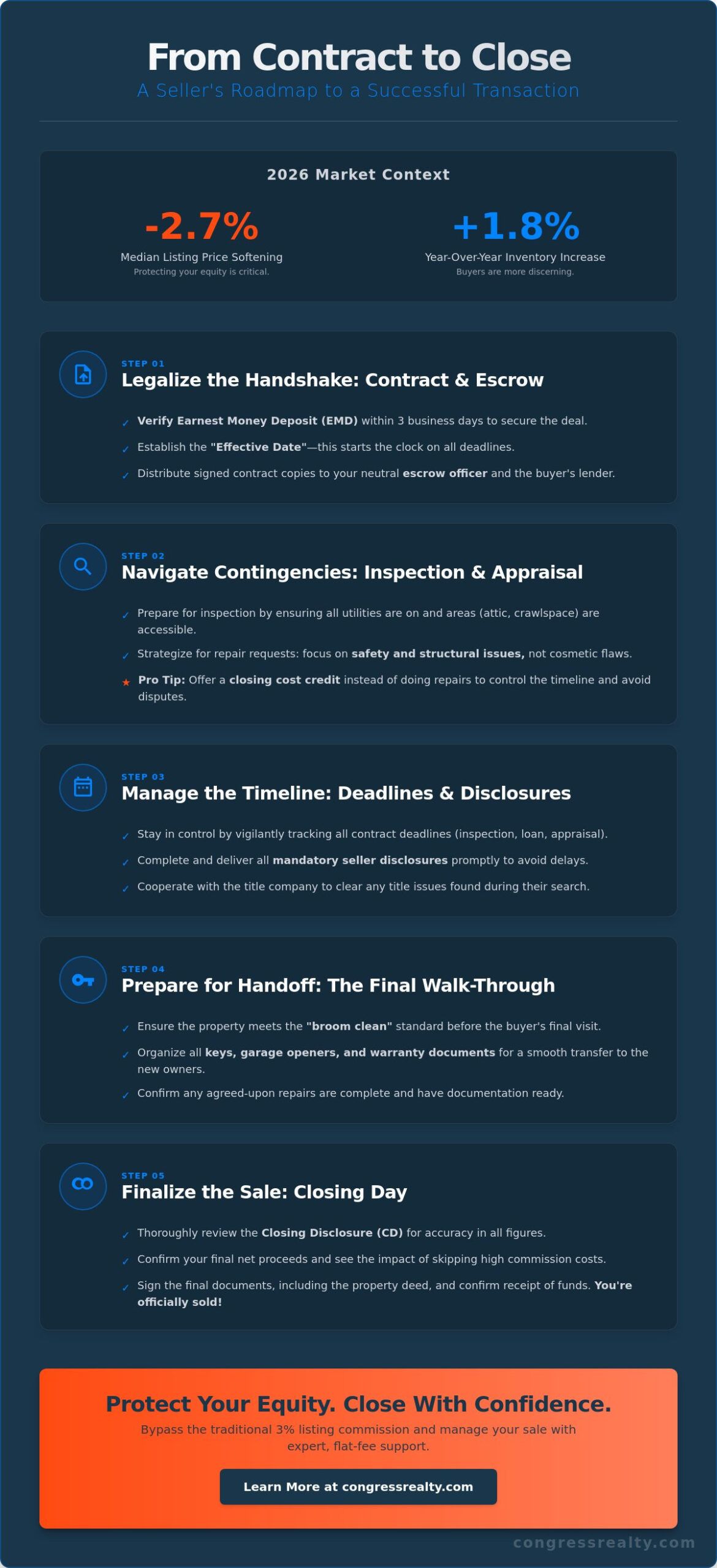
Signing the purchase agreement feels like a victory, but in a 2026 market where median listing prices have softened by 2.7%, the real work of protecting your equity is just beginning. Most sellers assume the hardest part is over once they find a buyer. However, the transition from “Under Contract” to “Closed” is where many deals stumble due to missed deadlines or aggressive repair requests. You’ve likely spent weeks preparing your home, and now you need a concrete strategy for what to do after accepting an offer on a house to keep the transaction on track.
We understand that the period between the handshake and the wire transfer can feel like a minefield of uncertainty. You’re probably worried about the appraisal coming in low or how to navigate new regulations like California’s digital image disclosures. This roadmap promises to put you back in the driver’s seat. We will walk you through a clear timeline of essential deadlines, show you how to manage contingencies without making unnecessary concessions, and help you finalize your sale while bypassing the traditional 3% listing commission. It’s time to close your deal with the intelligence and control you deserve.
Key Takeaways
Secure your transaction immediately by finalizing the purchase agreement and opening escrow with a neutral third party.
Navigate the inspection phase with confidence by learning how to negotiate repair credits that keep your equity intact.
Stay in control of the timeline with a clear checklist of what to do after accepting an offer on a house, from mandatory disclosures to title searches.
Prepare for a successful final walk-through by meeting the “broom clean” standard and organizing your keys for the new owners.
Confirm your final net proceeds on the Closing Disclosure so you’ll see the impact of skipping high commission costs.
The Immediate Handshake: Legalizing the Contract and Escrow
Congratulations, you’ve officially moved from “Active” to “Under Contract.” While the hardest part of marketing is behind you, the technical execution of the sale begins now. Knowing exactly what to do after accepting an offer on a house ensures you don’t lose momentum or risk a contract breach. Your first priority is turning that signed offer into a legalized, active escrow file. This isn’t just about paperwork; it’s about establishing the legal guardrails that protect your equity until the final wire transfer.
Start by verifying the Earnest Money Deposit (EMD). This is the buyer’s “skin in the game,” typically representing a small percentage of the purchase price held in a neutral account. Most contracts require this deposit to be wired to the escrow agent within three business days. Don’t assume it happened. Ask for a copy of the receipt. If the buyer fails to deliver the EMD on time, they’re technically in default. This gives you the leverage to cancel or demand immediate performance before you waste valuable time off the market.
Next, identify your “Effective Date.” This is usually the date the last party signed and communicated acceptance. This date is the anchor for every deadline in your transaction, including inspection periods, appraisal timelines, and loan approval dates. Mark this on your calendar immediately. Missing a single deadline can give a buyer a legal “out” to walk away with their deposit intact. Staying in control of these dates is the hallmark of a savvy, independent seller.
Formalizing the Purchase Agreement
Review the final document one last time for clerical errors. Ensure every initial box is filled and every signature is dated. Even a small oversight can cause delays with the buyer’s mortgage lender later. Once you confirm the document is complete, distribute digital copies to your escrow officer and the buyer’s lender. This kicks off the official the closing process, moving the transaction from a private agreement to a supervised financial event. It’s the moment your house officially transitions into a pending asset.
The Role of the Escrow Officer
Think of the escrow officer as the referee of your transaction. They’re a neutral third party who holds the buyer’s funds and your property deed until all contract conditions are met. You’ll need to provide them with your initial seller information, including your social security number for tax reporting and your current mortgage account details. They’ll use this to request a payoff statement from your bank, ensuring your existing loan is cleared the moment the sale is finalized. This level of professional oversight protects your interests and ensures a transparent transfer of ownership.
Navigating the Contingency Period: Inspections and Appraisals
The contingency period is where the buyer’s due diligence meets your bottom line. It’s the most common stage for deals to hit a snag, so staying proactive is essential. Learning exactly what to do after accepting an offer on a house during this window means protecting your equity from “nickel and diming” repair requests. You’ve secured the contract; now you must defend it through the inspection and appraisal hurdles.
In the 2026 market, buyers are more discerning as inventory has risen by 1.8% year-over-year. They aren’t just looking for a home; they’re looking for a sound investment. Your goal is to move past these contingencies quickly to make the buyer’s earnest money non-refundable. This requires a mix of physical preparation and strategic negotiation.
Managing the Home Inspection
Preparation prevents surprises that could derail your sale. Before the inspector arrives, ensure all utilities are on and every crawlspace, attic, and electrical panel is accessible. If an inspector can’t reach a system, they’ll flag it as “uninspected,” which often triggers a second visit or creates unnecessary buyer anxiety. Don’t let a long list of minor repairs rattle you. Most buyers will present a “Request for Repairs” after the walkthrough.
Your strategy should focus on safety and structural integrity rather than cosmetic flaws. If the buyer asks for a long list of fixes, consider offering a closing cost credit instead of performing the physical work. This keeps you in control of the timeline and prevents disputes over the quality of the repairs. It’s a pragmatic way to keep the deal moving without spending your weekends managing contractors. For those who want professional guidance during these tense moments, our Transaction Management service offers the expert advocacy needed to handle aggressive buyer demands.
The Appraisal Hurdle
With national median listing prices down 2.7% year-over-year, appraisals have become a critical checkpoint for lenders. If the bank values your home lower than the sale price, you face an “appraisal gap.” You don’t have to simply lower your price. You can challenge the appraisal by providing a detailed Comparative Market Analysis (CMA) that includes the most recent sales data from the last 90 days.
Be ready to present the appraiser with a list of capital improvements you’ve made, such as a new HVAC system or roof upgrades. If the gap remains, you can ask the buyer to cover the difference in cash or negotiate a split. Once these hurdles are cleared, ensure you receive a formal “Contingency Removal” in writing. This document is your green light to start packing, as it significantly narrows the buyer’s legal paths to cancel the contract.
The Transaction Management Framework: Deadlines and Disclosures
Once you clear the major hurdles of inspections and appraisals, your focus shifts to the administrative architecture of the deal. Managing the “paper trail” is a vital part of what to do after accepting an offer on a house to ensure a clean exit. This phase is about transparency and organization. You must provide the buyer with a clear history of the property while ensuring their lender is moving toward a “Clear to Close” status. Staying ahead of these deadlines keeps you in control and prevents the transaction from stalling.
The title company will simultaneously conduct a title search to verify your ownership and check for encumbrances. This process uncovers any “clouds” on the title, such as unpaid property taxes, old mechanic’s liens, or boundary disputes. If a lien appears, don’t panic. Most are resolved at the closing table by deducting the amount from your proceeds. Your job is to review the Title Commitment early so you have time to clear any unexpected issues before the scheduled signing date.
Don’t let the buyer’s financing become a black hole. Request regular updates from the buyer’s lender to ensure they’re meeting their loan commitment deadline. In 2026, with average 30-year fixed mortgage rates at approximately 6.57%, lenders are meticulously verifying every financial detail. Confirm that the buyer has submitted all required documents and that the loan is in final underwriting. If the lender is slow to respond, it’s a signal that you may need to issue a notice to perform to keep the timeline intact.
Fulfilling Disclosure Obligations
Honesty in your disclosures is your best defense against post-sale lawsuits. If you’re selling in California, you must now comply with 2026 regulations like AB 723 regarding digitally altered marketing photos and AB 455 regarding the history of smoking or vaping inside the property. Disclose everything from past water damage to HOA rules and litigation. The Seller Property Disclosure acts as your primary legal shield against future claims regarding the home’s condition.
Professional Transaction Oversight
Managing these moving parts doesn’t require a traditional 3% listing commission. You can stay organized and maintain control by leveraging Flat Fee MLS Listing tools to centralize your communication and document tracking. For sellers who want an expert facilitator to monitor every deadline, a Transaction Management service provides the professional infrastructure to ensure every addendum is signed and stored. This methodical approach keeps you in the driver’s seat while protecting your financial interests.
Preparing for the Final Transfer of Ownership
The final stage of your transaction is where the digital paperwork meets the physical reality of moving. Determining exactly what to do after accepting an offer on a house involves more than just signing papers; it requires a physical handoff that leaves the buyer satisfied and you legally protected. Your goal during this phase is to ensure the property matches the expectations set during the inspection period while coordinating a clean exit. This isn’t just a courtesy; it’s a strategic move to prevent last-minute delays at the closing table.
Coordinate your utility transfers early. Contact your providers for water, gas, and electricity to schedule a final reading for the day of closing. You don’t want to shut them off entirely, as this could prevent the buyer from testing systems during their final walkthrough. Instead, request a “transfer of service” to the new owner. This ensures there is no lapse in coverage that could cause pipe issues or security system failures. Managing these small details maintains your reputation as a savvy and reliable seller.
The Final Walk-Through Strategy
The buyer typically schedules a final walkthrough 24 to 48 hours before the signing appointment. They’re looking for two things: that no new damage has occurred since the inspection and that all agreed-upon repairs are complete. You should not be present during this walkthrough. Your presence can make buyers feel rushed or uncomfortable, which may lead to unnecessary suspicion. Simply ensure all repair receipts are organized and that the home is ready for its new occupants. If you’ve handled the process with professional transparency, this step should be a mere formality.
Logistics of Moving Out
Create a “Homeowner’s Binder” to leave on the kitchen counter. Include appliance manuals, garage door openers, and a list of service contacts like your preferred HVAC technician or landscaper. This small gesture of goodwill goes a long way in ensuring a smooth transition. Finally, set up your mail forwarding through the USPS at least one week before you vacate. Ensure your closing is handled with professional precision by utilizing our Transaction Management services to oversee every step of this final transfer.
Closing Day: Signing the Deed and Cashing Out
The finish line is finally in sight. After weeks of managing inspections and disclosures, knowing what to do after accepting an offer on a house culminates in this single, decisive day. Your signing appointment is the moment legal ownership officially transfers to the buyer and your equity is converted into liquid capital. Bring your government-issued ID, all remaining keys, and your confirmed wiring instructions to the title company or attorney’s office. This appointment typically takes less than an hour, but it’s the most financially significant hour of the entire process.
Review your Closing Disclosure (CD) at least three days before this meeting. This document outlines every penny of the transaction. You’ll see the final sale price, prorated property taxes, and any HOA dues that were settled. Most importantly, you’ll see the massive disparity between your net proceeds and what you would’ve walked away with if you’d paid traditional realtor fees. In 2026, where seller closing costs already range from 1% to 3% of the sale price, protecting your equity from unnecessary commissions is the smartest financial move you can make.
As you finalize what to do after accepting an offer on a house, remember that the recording of the deed is the legal finish line. Once the county clerk records the transfer, the buyer’s lender releases the funds. This is when the transaction is officially “closed and funded.” You’ve successfully navigated the 2026 market by staying in the driver’s seat and prioritizing your own financial intelligence.
Understanding Your Net Proceeds
Verify that your settlement statement accurately reflects the flat-fee structure you chose. Ensure there are no hidden administrative fees or surprise brokerage charges. Confirm whether you want your funds delivered via a physical check or a direct wire transfer. If you choose a wire, the funds often hit your account on the same day the deed is recorded at the county office. This recording makes the sale a matter of public record and officially closes your chapter as the property owner.
The Congress Realty Advantage
Choosing the path of selling a house without a realtor doesn’t mean you’re alone. It means you’re in control. By using a Full Service Listing package, you’ve navigated the complexities of the 2026 market with professional tools while keeping your hard-earned equity where it belongs. You’ve mastered the roadmap and successfully protected your financial future. Ready to start your own success story? List your property on the MLS for a flat fee today and take command of your sale.
Take Command of Your Closing Today
You’ve navigated the complexities of the 2026 housing market and successfully reached the final stages of your sale. By mastering what to do after accepting an offer on a house, you ensure that every contingency is met and every deadline is honored without surrendering your equity to high commissions. Managing your own transaction is about more than just saving money; it’s about maintaining the confidence of being in total control of your financial future.
Since 2002, we’ve empowered sellers with the professional infrastructure needed to succeed. Whether you need professional CMA support to justify your price to an appraiser or expert Transaction Management to oversee the technical legal timeline, you have a reliable ally in your corner. You don’t need a traditional agent to achieve a professional result. It’s time to finalize your deal on your own terms and protect the equity you’ve built.
Your equity belongs in your pocket. Take the next step toward a smarter, more rewarding home sale and finish your transaction with the financial intelligence you deserve. You’ve got this.
Frequently Asked Questions
How long does it typically take to close after an offer is accepted?
Closing usually takes between 30 and 45 days. This timeline depends on the buyer’s loan type and the length of the contingency periods. Cash transactions move much faster, often reaching the finish line in 7 to 14 days. Understanding what to do after accepting an offer on a house involves tracking these milestones to ensure the lender meets the scheduled signing date.
Can a seller back out of an accepted offer on a house?
Backing out is difficult once the purchase agreement is signed. Sellers are legally bound to the contract unless the buyer fails to meet a deadline or a specific seller contingency isn’t met. If you attempt to cancel without a legal reason, the buyer could sue for “specific performance” to force the sale. Always review the default clauses in your agreement before making a move.
What happens if the buyer’s financing falls through at the last minute?
The contract typically terminates if the buyer has a financing contingency in place. In this scenario, the buyer usually receives their earnest money deposit back, and you must relist the property. To prevent this, confirm that the buyer has a strong pre-approval and monitor their loan progress throughout the escrow period. Keeping backup offers on file is a smart way to maintain your leverage.
Do I need a real estate attorney for the closing process?
Requirements vary by state. Some regions require an attorney to oversee the deed transfer and title review, while others rely entirely on escrow and title companies. Even if your state doesn’t mandate one, hiring an attorney can provide extra protection for complex transactions. Check your local regulations early so you can factor this into your closing timeline.
What is the difference between “Pending” and “Under Contract” on the MLS?
“Under Contract” means you’ve accepted an offer, but the buyer is still navigating contingencies like inspections or appraisals. “Pending” indicates that all contingencies have been cleared and the deal is simply waiting for the final signing. Knowing which status to use is a key part of what to do after accepting an offer on a house to manage buyer expectations.
Is the seller responsible for any costs on closing day?
Yes, sellers typically pay between 1% and 3% of the home’s sale price in closing costs. These expenses include title insurance, transfer taxes, and escrow fees. This is separate from agent commissions. By utilizing a flat-fee listing model, you eliminate the traditional 3% listing commission, which significantly increases the total net proceeds you’ll receive at the end of the day.
What should I do if the buyer asks for a price reduction after the appraisal?
You have three main options: reduce the price to match the appraisal, ask the buyer to cover the “appraisal gap” in cash, or meet in the middle. You can also challenge a low appraisal by providing a Comparative Market Analysis (CMA) with more recent sales data. If an agreement can’t be reached, the buyer may have the right to cancel and keep their deposit.
When do I officially get the money from the sale of my house?
You generally receive your funds on the day the deed is recorded at the county office or the following business day. The escrow agent will distribute the proceeds via wire transfer or a physical check once they confirm the legal transfer of ownership. Wire transfers are the fastest method, often appearing in your bank account just hours after the final documents are processed.
What if the highest offer on your home actually leaves you with less cash than a lower bid? It sounds backward, but the gross price is often a distraction from your actual take-home pay. Learning how to compare real estate offers requires looking past the big numbers to see the hidden costs and risks underneath. In a market where interest rates for 30 year fixed mortgages are averaging 6.52%, buyer strength and financing terms are just as critical as the purchase price itself.
You’ve worked hard to build equity; it’s natural to feel anxious that a deal might fall through during escrow because of a complex contingency. You deserve a clear path to closing that doesn’t involve guessing about your final profit. This guide will teach you how to evaluate price, terms, and contingencies to ensure you choose the offer that puts the most money in your pocket. We will walk through creating a professional net sheet, identifying risky buyer demands, and prioritizing the financial intelligence you need to stay in total control of your sale.
Key Takeaways
Prioritize the “Net-to-Seller” value over the gross purchase price to identify which bid actually maximizes your final equity.
Learn how to compare real estate offers by evaluating buyer financing types and earnest money amounts to determine closing certainty.
Use a detailed net sheet to account for all sale deductions, allowing you to see the financial advantage of fixed-fee models over traditional commissions.
Recognize and mitigate high-risk contingencies, like the “Sale of Home” clause, that could jeopardize your timeline and sale proceeds.
Utilize professional transaction management to ensure a smooth transition from contract to closing with the expert oversight of a dedicated facilitator.
The highest number on a contract is often a distraction. When you’re learning how to compare real estate offers, it’s tempting to look only at the gross price and assume you’ve won. However, savvy sellers know that a high price can be a mirror that masks weak financing or aggressive contingencies. Buyers often inflate their offer price to win a bidding war, only to claw that money back later through repair demands or appraisal credits. You need to look past the headline figure to see the reality of the deal.
Don’t let the adrenaline of a bidding war cloud your judgment. Buyers know that a high price is the fastest way to get a seller’s attention. They might use a high number to hide the fact that they haven’t been fully vetted by a lender or that they need to sell their own home before they can buy yours. Learning how to compare real estate offers means looking for the hooks hidden in the fine print. You’re the one in command of this process, and your goal is a certain closing, not just a high starting point.
If you are looking for an expert partner to help verify these details, County Properties provides the personalized guidance needed to distinguish between a superficial offer and a solid commitment.
Staying objective is your greatest asset. Focus on the “Net-to-Seller” value rather than the purchase price. This is the only metric that truly matters because it represents the actual cash you’ll walk away with at closing. By stripping away the fluff, you can see which buyer is actually offering the best deal for your financial future. It’s about maximizing your equity, not just winning a popularity contest.
Gross Price vs. Net Proceeds
The Gross Price is simply the number written on the initial purchase agreement. It looks impressive on paper, but it doesn’t account for the reality of your balance sheet. Net Proceeds are what remain after you subtract real estate commissions, transfer taxes, and escrow fees. A $500k offer can be worth less than a $490k offer depending on the terms. For example, if the $500k buyer asks for $15,000 in closing cost credits, your net is already lower than the “cheaper” offer. Always run the numbers to see your true profit.
The Risk of the “Appraisal Gap”
A high offer price is useless if the buyer’s lender won’t approve the loan. If a bid exceeds the professional property valuation, an appraisal gap occurs. Unless the buyer has the funds to cover that gap, the deal will likely stall or collapse. You can use a Comparative Market Analysis (CMA) to predict these issues before they happen. A CMA provides a realistic look at what appraisers will see, helping you spot offers that are too good to be true. To avoid this entirely, many sellers prioritize a cash offer, which typically includes an appraisal contingency waiver and offers a much faster path to a successful closing.
Key Factors for Comparing Real Estate Offers
Ranking bids requires a deep dive into the contract’s mechanics. When you understand how to compare real estate offers, you can spot which buyers are likely to cause delays and which ones are ready to perform. While the purchase price is the most visible factor, the terms surrounding that price dictate whether you’ll actually reach the closing table. High-equity sellers prioritize certainty. They look for offers with fewer strings attached and buyers who have already proven their financial capability.
Earnest money is the first signal of a buyer’s commitment. This deposit serves as “skin in the game” that you may be entitled to keep if the buyer defaults without a legal excuse. A larger deposit, typically 1% to 3% of the purchase price, shows the buyer is serious and financially stable. Beyond the deposit, you must scrutinize the contingency periods. Every contingency, whether for inspections, appraisals, or financing, is a “get out of jail free” card for the buyer. Shortening these windows or removing them entirely increases your odds of a successful close. Be especially wary of the “Sale of Home” contingency. This clause makes your sale dependent on the buyer selling their own property first, which can stall your timeline indefinitely. For a deeper look at managing these variables, consult this guide for handling multiple offers to see how professional lenders view the process.
Evaluating Buyer Financing Types
Cash offers remain the gold standard because they eliminate the financing and appraisal hurdles that often kill deals. If you’re looking at financed offers, conventional loans are generally preferred over FHA or VA loans. Government-backed loans often come with stricter “minimum property standards” that can force you to make repairs you didn’t plan for. Always verify the buyer’s strength by reviewing their pre-approval letter. Don’t stop there; have your representative call the buyer’s lender to confirm the file has been through a preliminary underwriter review. This proactive step is a core part of knowing how to compare real estate offers effectively.
The Hidden Cost of Seller Concessions
Don’t let a high gross price fool you if the buyer is asking for thousands in closing cost assistance. These concessions come directly out of your pocket. When you calculate your net, treat every dollar of requested assistance as a direct reduction in the sale price. Buyers might also request home warranties or credits for minor repairs discovered during the inspection. Instead of agreeing to every “nickel and dime” request, consider how these items impact your final equity. You can maintain control over these negotiations by using professional Transaction Management to track every line item and ensure your profit remains the priority.
The Net Sheet: Calculating Your Actual Profit
The true test of an offer isn’t the excitement it generates but the final number on your net sheet. This document is your financial scoreboard; it strips away the gross purchase price to reveal the actual cash you’ll receive at closing. When you master how to compare real estate offers, you realize that your choice of listing model is just as important as the buyer’s bid. Every percentage point saved on commissions is a direct deposit into your own pocket. To understand the buyer’s side of these costs and how they impact the transaction, you can review resources from the Consumer Financial Protection Bureau regarding home loan processes.
To maximize your equity, you need to facilitate as many offers as possible while keeping your overhead low. Using an electronic lockbox is a pragmatic way to achieve this. It allows licensed agents to show your home securely without you needing to be present, increasing the volume of potential bids. The more bids you receive, the more leverage you have to negotiate terms that favor your bottom line. Choosing to pursue listing on the MLS without a traditional realtor puts you in the driver’s seat, allowing you to use professional industry databases to find buyers while bypassing high-cost commission structures.
Fixed Fee vs. Percentage Commission
Traditional listing models rely on a percentage-based commission, often around 3% for the listing side alone. On a median-priced home, this can easily cost you $10,000 or more. A flat-fee structure provides predictability and transparency, serving as a constant advantage regardless of your home’s value. This model makes you much more flexible during negotiations. If a buyer submits a lower offer but has no contingencies, the money you saved on listing commissions might still make their bid the most profitable choice. Remember that while you save on the listing side, the buyer’s agent commission remains a negotiable variable you can use to attract the right professional buyers.
Mandatory Seller Closing Costs
Beyond commissions, several mandatory costs will impact your net proceeds. These typically include title insurance, escrow fees, and state or local transfer taxes. While 16 states currently have no state-level transfer tax, local municipalities may still apply their own fees. You should also account for pro-rated property taxes and any outstanding HOA dues, which are usually settled at the closing table. Estimating these costs before you receive an offer allows you to evaluate bids with total confidence. By running the numbers early, you ensure that you aren’t surprised by hidden deductions that could eat into your hard-earned equity. Understanding how to compare real estate offers with these costs in mind ensures you stay in command of your financial outcome.
Vetting Buyer Strength and Contingency Risks
Vetting buyer strength is the most critical step in ensuring your equity actually makes it to your bank account. While previous sections focused on the math, this is about the mechanics of performance. When you are learning how to compare real estate offers, you must differentiate between a buyer who is browsing and a buyer who is fully cleared. A true professional-grade pre-approval letter isn’t just a flyer from a website; it should indicate that an underwriter has reviewed the buyer’s income, assets, and credit history. If the letter looks generic, pick up the phone. Calling the buyer’s loan officer to verify the status of the file is a smart, utilitarian move that puts you in command.
The Sale of Home contingency is perhaps the most dangerous clause for a seller. It essentially stalls your timeline while the buyer tries to sell their own property. You lose your momentum on the market and become a passenger in someone else’s transaction. Avoid this whenever possible. To attract the kind of serious, high-intent buyers who don’t need such crutches, start with Professional Photography to showcase your home’s true value from day one. High-quality visuals set a standard of professionalism that attracts qualified prospects who respect your time and your property.
The “Proof of Funds” Requirement
Cash is only king if the cash actually exists. Always demand a formal Proof of Funds (POF) letter for any cash offer or down payment exceeding 20%. Red flags include blurred account numbers, expired dates, or names that don’t match the contract. Never accept a simple screenshot of a bank balance. A formal letter on bank letterhead is the professional standard for a reason. It provides the financial intelligence you need to reject a high-but-risky offer in favor of a sure thing.
Shortening the Inspection Window
The inspection period is often used as a second negotiation phase. While a 10-day window is common, push for a 5-day period to keep the momentum high. If a buyer is serious, they can get an inspector out quickly. You should also understand the difference between As-Is and As-Is with an inspection right. The latter still allows the buyer to walk away or ask for credits based on what they find. By shortening this window, you reduce the time your home is off-market and under a microscope. This is a core part of how to compare real estate offers while protecting your timeline and your sanity.
Managing the Transaction with Professional Support
Accepting a bid is a major milestone, but the period between “Offer Accepted” and “Closed” is where the real work begins. Statistically, this is the phase where most deals fail due to financing hurdles, inspection disputes, or missed deadlines. Once you have used the strategies in this guide to learn how to compare real estate offers, you need a structured system to carry that winning bid across the finish line. You don’t need to pay a traditional 3% listing commission to get professional oversight. Transaction Management services provide the same level of scrutiny and logistical support as a high-priced broker, ensuring your equity remains protected through the final signing.
Maintaining a professional image during the escrow process is vital for keeping the buyer committed. Utilizing a professional yard sign and an electronic lockbox signals to the buyer and their agent that you are a savvy, organized seller. These tools aren’t just for show; they provide the infrastructure needed for a seamless experience. Whether you choose Standard vs. Full Service packages depends entirely on your personal comfort level with the process. Both options empower you to lead the sale while having the necessary professional tools at your disposal.
Escrow and Title Coordination
The transition to escrow involves a complex web of paperwork and legal requirements. While the title company handles the actual transfer of the deed and the distribution of funds, you are responsible for ensuring all disclosures are signed and delivered. This is a critical step to avoid post-sale liability. Your transaction manager will track these documents, ensuring that every “i” is dotted and every “t” is crossed. The ultimate goal is the “clear to close” milestone, which signifies that the buyer’s lender has finalized the loan and you are officially ready to move. Having a pro in your corner makes this high-stakes phase feel simple and rewarding.
The Congress Realty Advantage
Congress Realty provides a disruptive, efficiency-focused model that puts you in total command of your sale. Our tiered listing packages are designed to give you the tools of a professional broker without the unnecessary costs. Every listing benefits from the professional oversight of Andrew English, a seasoned expert who ensures your property is represented accurately on professional industry databases. By choosing a flat-fee model, you’ve already won the battle for your equity. Now, let us help you win the transaction. It’s time to take the final step toward a successful closing. View our listing packages to start saving today.
Secure Your Equity and Close with Confidence
You’ve learned that the most profitable deal isn’t always the one with the highest price tag. By focusing on your net proceeds and vetting buyer strength, you have moved from being a passive observer to a savvy, independent seller. Knowing how to compare real estate offers gives you the financial intelligence to reject risky bids and prioritize the terms that truly maximize your equity. You are now equipped to manage the transition from contract to closing with total authority.
Congress Realty is here to support your autonomy. You can save thousands by avoiding the traditional 3% listing commission while still accessing professional tools. Our Full Service packages include a professional Comparative Market Analysis (CMA) and comprehensive Transaction Management to keep your sale on track. You’ll also have direct support from Andrew English, an industry veteran who has been advocating for sellers since 2002. Use our professional infrastructure to maintain control over your sale from start to finish.
The power to sell successfully is in your hands. Take the lead and start your journey toward a simple, rewarding closing today.
Frequently Asked Questions
Is a cash offer always better than a financed offer?
A cash offer is often preferred because it removes the risk of a lender denying the buyer’s loan at the last minute. It also bypasses the appraisal process entirely, which can be a major hurdle if your home’s value is in question. However, if a financed offer is significantly higher and the buyer has strong pre-approval, the extra money might be worth the small risk of a delay. You must weigh the certainty of cash against the potential for higher profit.
What is a “clean” offer in real estate?
A “clean” offer is one that has very few contingencies or special requests. This typically means the buyer isn’t asking for repair credits, home warranties, or a long closing timeline. Sellers love clean offers because they represent a straight path to closing with fewer opportunities for the deal to fall apart. When you know how to compare real estate offers, you’ll often find that a clean bid is more valuable than a higher, messy one with many strings attached.
Can I counter-offer more than one buyer at the same time?
You can counter more than one buyer simultaneously, but you must do it correctly to avoid accidentally selling your home to two people. In most states, you’ll use a specific “Multiple Counter Offer” form. This protects you by stating that no contract exists until you sign the buyer’s accepted counter-offer. It’s a powerful way to leverage interest and push for the best possible terms for your equity without losing your command over the process.
What happens if the house appraises for less than the offer price?
If the appraisal comes in low, the buyer’s lender won’t cover the full offer price. You then have three main choices: you can lower your price to match the appraisal, the buyer can pay the difference in cash, or you can meet in the middle. If neither side can agree, the buyer usually has the right to cancel the contract and take their earnest money back. This is why vetting buyer strength and appraisal gap coverage is so important early on.
Should I accept the first offer I receive?
Don’t feel pressured to accept the very first bid that lands in your inbox. While it might be a great offer, it’s often smart to give the market a few days to generate more interest. Receiving multiple bids gives you the leverage to negotiate better terms or a higher price. If the first offer is exceptionally strong and meets your net profit goals, accepting it quickly can save you time and stress, but patience often pays off.
How much does it cost to sell a house without a traditional agent?
Selling without a traditional listing agent allows you to skip the standard 3% commission, which can save you tens of thousands of dollars in equity. You’ll instead pay a predictable, fixed fee for professional listing services. This structure gives you the same access to the MLS and professional industry databases that a traditional broker has. You’ll still need to account for the buyer’s agent commission and standard closing costs like title insurance and transfer taxes.
What are the most common contingencies sellers should avoid?
The “Sale of Home” contingency is the biggest risk because it makes your closing dependent on the buyer selling their own property first. You should also try to avoid or shorten long inspection windows and appraisal gaps. Every contingency is a potential exit point for the buyer that can stall your timeline. When learning how to compare real estate offers, look for bids that minimize these hurdles to ensure a faster and more predictable closing process.
How do I handle multiple offers on my home fairly?
Handling multiple bids requires a methodical and transparent approach. Set a clear “best and final” deadline for all interested parties to submit their highest offers. This creates a sense of urgency and ensures you’re comparing all bids on an even playing field. Once the deadline passes, use a net sheet to compare each offer’s bottom line. This keeps you in control of the process and ensures you choose the bid that maximizes your final take-home profit.