Why are you still planning to hand over more than $23,000 of your hard-earned equity just to list your property? With the median home price sitting at $408,800 as of March 2026, the national average commission rate of 5.70% is no longer just a cost of doing business; it’s a massive financial hit. You shouldn’t have to choose between professional exposure and your bank account. When you decide to sell your home in this normalizing market, you deserve a process that prioritizes your profit over an agent’s payday.
To successfully sell your home in the normalizing market of 2026, you must present your property with the same level of sophistication as a high-end brokerage. For those who want to understand the gold standard of Seller Representation, looking at how premier agencies market their listings can provide a blueprint for your own success. Buyers are more selective now that inventory has improved to a 4.1-month supply as of March 2026. They expect a seamless, professional experience from the moment they see your listing online to the second they walk through the front door. By following these five pillars, you ensure your home isn’t just another address on a map; it’s a premium product that commands attention.
We know it’s frustrating to feel pressured by high-stakes pitches while 30-year fixed mortgage rates hover around 6.38%. You want to maintain full control over your showings and negotiations without sacrificing the reach of the LOCAL MLS. This article provides a pragmatic, equity-first checklist to help you secure full market exposure and professional tools while saving thousands in unnecessary fees. You’ll discover how to navigate new 2026 regulations, such as the required disclosures for digitally altered photos and thirdhand smoke, so you can lead your sale with total confidence and financial intelligence.
Key Takeaways
Adopt the “Equity-First” mindset to leverage modern technology and bypass traditional 6% commissions that drain your net profit.
Master the five pillars of a professional listing, ensuring your property stands out on the LOCAL MLS with high-impact visuals and data-driven pricing.
Compare the real-world financial impact of different brokerage models and discover how to keep up to $30,000 more of your home’s value.
Use a proven, step-by-step checklist to sell your home while retaining total authority over your showing schedule and negotiation strategy.
Eliminate the stress of escrow by utilizing professional transaction management tools to oversee documentation and meet every critical deadline.
Evaluating the 2026 Real Estate Market: Why High Commissions are Obsolete
The traditional real estate model is failing to keep pace with a digital-first world. In May 2026, buyers don’t wait for an agent to call them with new listings; they find properties themselves on mobile apps while drinking their morning coffee. This shift has turned the old-school 3% listing commission into an obsolete tax on your equity. Equity-First Selling is the modern standard for homeowners who realize that technology has already done the heavy lifting of marketing. When you decide to sell your home, you’re no longer paying for a gatekeeper. You’re paying for a platform that connects you directly to the market.
Access to the Multiple Listing Service (MLS) was once a guarded secret, but those days are gone. Professional tools now allow you to broadcast your property to every major real estate portal in seconds. Since 97% of buyers start their search online, your primary goal is visibility, not a high-priced middleman. The value of a listing agent has shifted from “finding a buyer” to simply “providing the data.” If the technology handles the exposure, paying a massive percentage of your home’s value for a simple data entry task no longer makes sense.
The Death of the Traditional 6% Model
The typical commission structure often totals between 5.44% and 5.70% as of early 2026. This is usually split down the middle: roughly 2.88% for the listing agent and 2.82% for the buyer’s agent. On a median-priced home of $408,800, that total fee exceeds $23,000. Flat-fee models disrupt this by eliminating the listing side of that expense entirely. You still offer a competitive commission to the buyer’s agent to attract motivated shoppers, but you keep the thousands of dollars normally reserved for the listing broker. It’s a pragmatic choice that reflects the actual work required to list a home in a normalizing market with 4.1 months of inventory.
Why Control is Your Greatest Asset
You know your home better than anyone else. Managing your own showings and receiving direct feedback from potential buyers gives you an edge that a busy agent can’t provide. Direct communication speeds up the decision-making process and removes the “game of telephone” that often stalls negotiations. By acting as an empowered seller, you maintain the authority to accept or reject offers on your own terms. You don’t need a middleman to sell your home when you have the right professional tools in your hands. You aren’t just saving money; you’re ensuring that the person most invested in the sale is the one calling the shots. Professional backing through documentation services ensures you stay compliant with new 2026 laws, such as the new FinCEN reporting rules for all-cash transactions, while you lead the process.
The Strategic Home Seller’s Checklist: 5 Pillars of a Professional Listing
To successfully sell your home in the normalizing market of 2026, you must present your property with the same level of sophistication as a high-end brokerage. Buyers are more selective now that inventory has improved to a 4.1-month supply as of March 2026. They expect a seamless, professional experience from the moment they see your listing online to the second they walk through the front door. By following these five pillars, you ensure your home isn’t just another address on a map; it’s a premium product that commands attention.
Pillar 1 & 2: Visuals and Valuation
The first impression happens on a screen. Smartphone photos are a deal-breaker because they signal a lack of effort and can drive down your perceived value. High-resolution, professional photography is mandatory. If you are in California, remember that new 2026 laws require you to disclose any digitally altered images. Transparency builds trust, and trust leads to offers. Pair these visuals with a “sweet spot” price determined by a Comparative Market Analysis (CMA). A CMA is a data-driven approach to pricing based on recent national sales trends and actual sold prices in your specific neighborhood. Since home prices saw a modest year-over-year increase of only 0.7% in February 2026, overpricing even by a small margin can cause your listing to stagnate.
Checklist item: Schedule high-resolution photography including drone shots to highlight the property’s perimeter and neighborhood context.
Checklist item: Perform a CMA to ensure you aren’t “testing the market” with an unrealistic price that ignores current inventory levels.
Pillar 3, 4 & 5: Infrastructure and Access
Marketing is the engine of your sale. Maximum exposure means your property must live on the LOCAL MLS. This is the primary data source that feeds national giants like Zillow and Realtor.com. Without it, you are invisible to the buyer’s agents who represent the majority of active shoppers. Once you have their attention, you must make it easy for them to visit. Utilizing professional electronic lockboxes allows you to track every agent who enters your home, providing security and peace of mind. Finally, don’t underestimate the psychological impact of professional yard signage. It signals to the neighborhood that a serious, professional transaction is underway. A flat fee mls listing is the engine behind these pillars, providing the professional infrastructure you need without the high-commission overhead.
Checklist item: Verify your listing appears correctly on all major national syndication sites within 24 hours of going live.
Checklist item: Install a professional-grade electronic lockbox to manage agent access and receive automated showing feedback.
You Control Your Sales Process by setting the stage for success. If you’re ready to move forward, you can list your home today and start saving your equity immediately.
Financial Comparison: Calculating the True Cost to Sell Your Home
Are you prepared to lose $30,000 in a single afternoon? When you decide to sell your home for $500,000, that is exactly what happens under the traditional 6% commission model. This isn’t just a fee; it’s a massive drain on the wealth you’ve built through years of mortgage payments. In the normalizing market of May 2026, where home prices saw a modest 0.7% increase in February, every dollar of equity counts. You need to understand the mathematical reality of your options before signing a listing agreement that could cost you a fortune.
Traditional brokerages often lock you into long contracts with a 6% total commission. On a $500,000 sale, that is a $30,000 loss. Beyond the high price, these models carry hidden risks like dual agency, where one broker represents both sides and compromises your leverage. iBuyers and “cash offer” platforms are even more expensive. While they promise speed, they typically charge a 5% service fee plus a 5% to 10% “convenience” discount on your home’s value. This results in a total loss often exceeding $50,000. If you are considering selling a house as is to avoid repair costs, understanding these predatory cash-offer structures is especially critical before you accept any offer. Choosing the flat-fee model through Congress Realty eliminates the listing commission entirely, allowing you to offer a competitive buyer agent incentive while keeping thousands more in your pocket.
The “Math of Control” vs. The “Math of Convenience”
iBuyers are often the most expensive way to sell your home because you are paying for the company’s risk and overhead. In contrast, the flat-fee model is built for the savvy, independent owner. If you want to understand how to sell your house on your own and maximize every dollar of your equity, the flat-fee approach offers a predictable flat rate instead of a percentage, allowing you to offer a competitive buyer’s agent commission (which averaged 2.82% in early 2026) and still save roughly 50% compared to traditional fees. Saving thousands isn’t just a slogan; it’s a mathematical certainty when you remove the listing agent’s 3% cut from the equation.
Where Does Your Equity Go?
Equity is your net profit after all liens and selling costs are paid. It is your reward for homeownership. The listing commission is the only major selling cost you can fully control. While you can’t change the 6.38% mortgage interest rate or the new FinCEN reporting requirements for all-cash deals, you can choose how much of your profit you give away. A professional CMA is vital here. It protects your equity from underpricing, ensuring you don’t leave money on the table while also avoiding the stagnation of an overpriced listing. You Control Your Sales Process, and that starts with protecting your bottom line.
Master the MLS: A Step-by-Step Guide to Maximum Market Exposure
To sell your home successfully in 2026, you must understand that the real estate market is driven by data, not just pretty pictures. While websites like Zillow and Realtor.com are popular, they are merely mirrors reflecting information from the LOCAL MLS. If your property isn’t listed on the primary database used by professional brokers, you are essentially invisible to the 90% of buyers working with an agent. You don’t need a high-commission middleman to access this power; you just need a professional bridge to the system.
Following a structured process ensures your listing hits the market with maximum impact. Here is how you lead your sale from start to finish:
Step 1: Choose your listing package. Decide between a Standard or Full Service plan based on the level of documentation support you require.
Step 2: Submit property data and professional photos. Provide the essential details and high-resolution visuals to the broker for review.
Step 3: Activate on the LOCAL MLS. Once live, this triggers automated syndication to hundreds of national real estate portals.
Step 4: Set the Buyer’s Agent Commission (BAC). Choose a competitive rate to incentivize the professionals who represent active buyers.
Step 5: Monitor your listing. Verify that your data appears correctly on Zillow, Realtor.com, and local brokerage sites.
Why the “Local MLS” is Non-Negotiable
Think of the MLS as the source code for the entire real estate industry. It is a restricted database where professional agents search for properties to show their clients. When you list through a traditional agent, this is the first thing they do. By using Congress Realty as your facilitator, you gain the exact same professional entry point without the 3% listing fee. Without this exposure, your home won’t appear in the automated email alerts that buyers receive from their agents, which is where the most serious offers originate.
Incentivizing the Buyer’s Side
Even though you are bypassing the listing commission, it’s a smart, pragmatic move to offer a competitive commission to the agent bringing the buyer. As of early 2026, the national average buyer’s agent commission is approximately 2.82%. Offering a rate in this range ensures that every agent in town is motivated to show your property. Since you’ve already saved the entire 3% listing side of the fee, you have more room to be competitive on price or terms. Research local commission trends in your specific zip code to ensure your BAC is attractive to the pros. You Control Your Sales Process by deciding exactly how much to offer, keeping you in the driver’s seat of your equity. If you are ready to get started, you can list your home on the MLS today and take charge of your sale.
Transaction Management: Navigating Offers and Escrow with Professional Tools
The biggest fear for many homeowners isn’t finding a buyer; it’s what happens after the offer arrives. You might worry about missing a legal deadline or getting overwhelmed by a mountain of paperwork. In the 2026 real estate market, these concerns are valid. With 30-year fixed mortgage rates at 6.38% as of May 1, 2026, buyers are more cautious and their lenders are more demanding. You don’t need to pay a 3% listing commission to navigate this phase safely. Professional transaction management tools provide the structure you need to sell your home with the precision of a seasoned broker.
Transaction management is the process of overseeing every document, disclosure, and deadline from the moment a contract is signed until the keys are handed over. It turns a chaotic sequence of events into a methodical checklist. Congress Realty’s Full Service option serves as the ultimate safety net for sellers who want professional backing during these high-stakes negotiations. We ensure that your paperwork is compliant with current regulations, such as the FinCEN reporting rules for all-cash transactions that took effect on March 1, 2026. This professional infrastructure allows you to focus on your move while we help you protect your equity.
From Contract to Closing
The escrow period is the timeframe where a neutral third party holds funds and documents while both sides fulfill their contractual obligations. As the seller, your responsibilities include providing required disclosures, such as the 2026 California mandate regarding “thirdhand smoke” history. Missed disclosure deadlines are common “deal-killers” that can give a buyer a legal path to back out of the sale. Professional oversight prevents these errors by tracking every milestone in real time. Utilizing a broker-backed platform for digital document storage and signing ensures that your records are secure and accessible whenever you need them. It’s a pragmatic way to maintain momentum without the stress of manual tracking.
Closing the Deal on Your Terms
The final stage of the journey is the closing, where you sign the final settlement statement at the title company and receive your equity check. Because you chose a flat-fee model, that check will be significantly larger. You’ve successfully bypassed the traditional commission trap while maintaining full authority over the entire transaction. You Control Your Sales Process from the first showing to the final signature. Selling a home independently isn’t just a way to save money; it’s a way to prove that financial intelligence and professional results go hand in hand. Sell your home with the confidence that you’ve kept your hard-earned equity where it belongs.
You now have the blueprint to sell your home without sacrificing your hard-earned profit to outdated commission structures. By prioritizing professional photography, data-driven pricing, and the exposure of the LOCAL MLS, you position yourself as a savvy market leader. The current housing landscape proves that you don’t need a high-commission agent to find a buyer; you simply need the right professional infrastructure. With the median home price sitting at $408,800 as of March 2026, every percentage point you save is a significant financial victory for your next chapter.
Since 2002, Congress Realty has served as a reliable ally for independent sellers across the nation. With over two decades of flat-fee expertise and professional oversight from our designated broker, Andrew English, we provide the tools you need to succeed. Our tiered packages include everything from high-resolution photography to comprehensive transaction management, ensuring you have professional backing from the initial listing to the final closing signature. You have the intelligence to manage your own transaction, and we have the platform to make it simple.
You Control Your Sales Process. Step into the market with total confidence and keep your equity where it belongs.
Frequently Asked Questions
Can I really sell my home without a traditional listing agent?
Yes. You can list your property and manage the sale while bypassing the traditional 3% listing commission. Technology has democratized market access, allowing you to use a flat-fee broker to get your property on the LOCAL MLS. This approach puts you in the driver’s seat of the transaction while ensuring your property reaches the same audience as any high-priced brokerage listing. You maintain the authority to negotiate directly with buyers and keep your equity.
How does a flat fee MLS listing actually work?
You pay a one-time flat rate to a broker who lists your property on the LOCAL MLS instead of paying a percentage-based commission. Once the broker enters your data, your listing syndicates to hundreds of real estate websites used by buyers and agents. You retain the right to sell the property yourself and manage your own showings while the broker provides the professional entry point to the market. It is a simple, transparent process.
Will my home be listed on Zillow and Realtor.com?
Yes. Your property will appear on all major national portals including Zillow, Realtor.com, and Redfin. These sites pull their data directly from the LOCAL MLS. By using a flat-fee service to sell your home, you ensure that your property is visible to the 97% of buyers who start their home search online. Your listing will look identical to those represented by traditional full-commission agents, ensuring you receive maximum market exposure.
Do I still have to pay a commission to the buyer’s agent?
It is standard practice to offer a commission to the agent representing the buyer to incentivize them to show your home. As of early 2026, the national average for a buyer’s agent commission is approximately 2.82%. While you choose the exact amount, offering a competitive rate ensures professional agents remain motivated to bring their clients to your door. You still save the entire 3% typically reserved for the listing agent side of the transaction.
What is the difference between Standard and Full Service listing packages?
Standard packages focus on providing the essential MLS listing and syndication to national sites. Full Service packages add layers of professional support such as transaction management, contract review, and documentation assistance. If you want a safety net for navigating complex escrow requirements or the new 2026 FinCEN reporting rules, the Full Service option provides the expert oversight needed to close the deal with total confidence. You choose the level of support that fits your needs.
How do I handle showings if I am selling my home on my own?
You manage your own showing schedule through direct communication with buyer’s agents or unrepresented buyers. Most savvy sellers use professional electronic lockboxes to track agent entry and receive automated feedback. This gives you total control over who enters your home and when. You don’t have to wait for a middleman to relay messages, which often speeds up the decision-making process for motivated shoppers. It is a more efficient way to manage the process.
Is a Comparative Market Analysis (CMA) necessary for a flat fee listing?
A CMA is vital because it provides a data-driven price based on actual sold properties rather than just active listings. With national home prices seeing a modest 0.7% year-over-year increase in February 2026, pricing your home accurately is the difference between a quick sale and a stagnant listing. A professional CMA helps you find the “sweet spot” that attracts buyers while protecting every dollar of your equity. It is the foundation of a smart sales strategy.
What is transaction management and do I need it to sell my home?
Transaction management is the professional oversight of all documentation and deadlines from the contract stage to the final closing. It is highly recommended to ensure you meet all legal requirements, such as the 2026 California disclosure laws. Having an expert monitor your escrow period prevents common errors that could derail the sale. It’s a pragmatic tool that helps you sell your home with professional precision and less personal stress, ensuring a smooth path to the closing table.
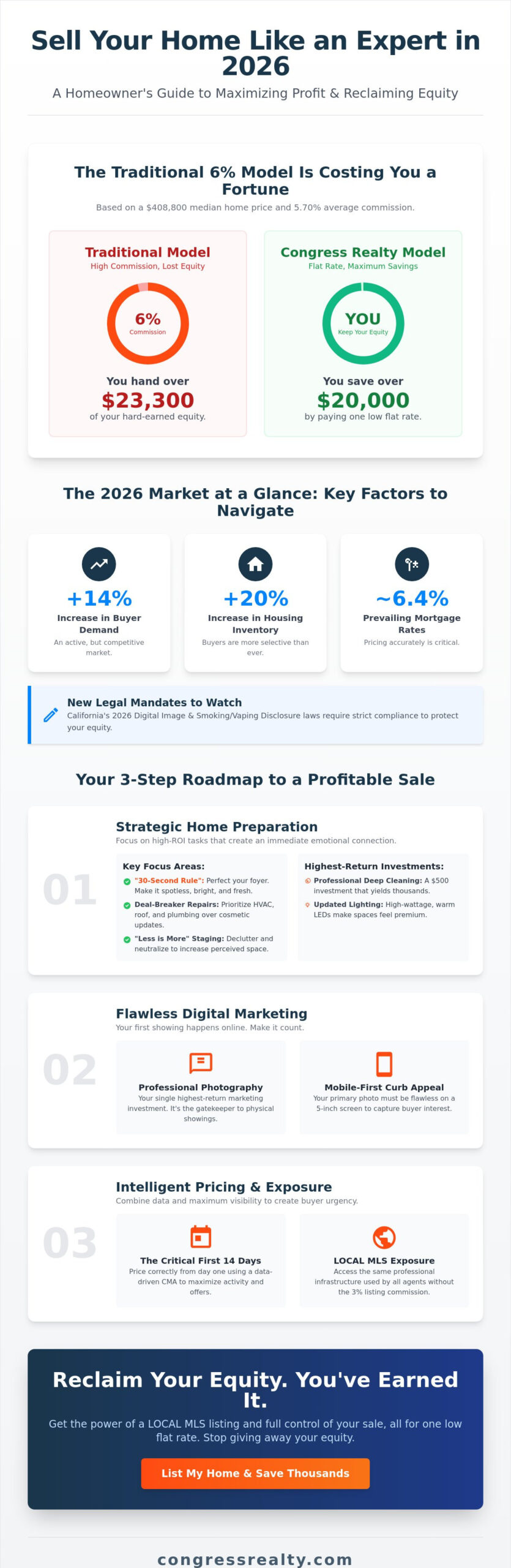
Why should you hand over $23,300 of your equity just to get your property noticed? With the national median home price at $408,800 and average commission rates still hovering around 5.70 percent, most sellers are losing a small fortune the moment they sign a listing agreement. You know that the traditional 6 percent model is outdated, yet the pressure to conform can make the process feel overwhelming. These tips for selling your home in 2026 are designed to disrupt that cycle and put you back in control.
We’ll show you how to combine the power of a LOCAL MLS listing with smart preparation to sell faster while keeping your equity where it belongs. You’ll learn how to navigate new 2026 mandates like California’s Digital Image Disclosure law and manage the 14 percent increase in buyer demand even as mortgage rates sit near 6.4 percent. This article provides a clear, ten step roadmap to maximize your net profit and maintain total control over your showings. By the end, you’ll have the confidence to manage your sale like an expert and save thousands in the process.
Key Takeaways
Learn why the traditional 6% commission model is no longer necessary to achieve professional results in a rebalancing 2026 market.
Discover how to apply the “30-Second Rule” to your foyer to create an immediate emotional connection with prospective buyers.
Master these essential tips for selling your home by using data-driven CMA reports to maximize your price during the critical first 14 days on the market.
Understand why professional photography is your highest-return marketing investment and how to navigate new digital disclosure laws.
Reclaim your equity by utilizing a flat-rate listing model that provides LOCAL MLS exposure without the burden of a 3% listing commission.
Navigating the 2026 Real Estate Market: Why Strategy Trumps Commission
Selling a home in April 2026 is no longer a passive event. It has evolved into a strategic operation where you, the homeowner, act as the primary manager of your equity. For decades, the industry relied on a standard 6 percent commission model that often felt like a mandatory tax on your hard work. However, with the national average commission rate currently between 5.44 percent and 5.70 percent, savvy sellers are realizing they can save over $23,000 on a median priced home of $408,800. These tips for selling your home prioritize your net profit by decoupling professional tools from high costs.
Technology has completely dismantled the old gatekeeper system. You don’t need to trade 3 percent of your home’s value just to get your property onto the LOCAL MLS. Today, you can access the same professional infrastructure used by traditional agents while maintaining total control. This shift isn’t just about saving money; it’s about professional advocacy for your own financial future. By choosing a flat rate model, you ensure that your equity stays in your bank account rather than being split among multiple intermediaries.
The Shift Toward Homeowner Autonomy
Digital platforms have democratized access to buyer data and real-time market trends. In 2026, buyers are savvy. They don’t look for a specific brokerage name; they look for listing quality, accurate data, and high-resolution imagery. Because you know your home better than any third party, you’re the best person to lead the sale. Taking charge of the real estate transaction process gives you a psychological edge. You decide when people visit, how the home is presented, and which offers deserve your attention. It’s a simple, empowering way to manage one of your largest financial assets.
Identifying Your Primary Selling Goals
Success starts with a clear objective. Are you looking for a lightning-fast exit or the maximum possible net profit? With home sales forecasted to increase by 14 percent nationwide this year, the market is active but competitive. Establish a realistic timeline by looking at current inventory levels, which are up 20 percent from last year. Before you list, calculate your “net walk-away” figure. This number should account for your remaining mortgage balance, potential 2026 capital gains taxes, and any necessary repairs. Having this data upfront ensures you won’t be swayed by high-pressure tactics later. You control your sales process from day one.
Maximizing ROI with Strategic Home Preparation
Why spend $15,000 on a full kitchen remodel when a $500 deep clean and modern hardware updates can achieve the same emotional response from a buyer? One of the most critical tips for selling your home is to prioritize repairs that function as deal-breakers rather than chasing expensive cosmetic overhauls. In April 2026, housing inventory has increased 20 percent compared to last year. This means buyers are more selective and will use visible maintenance issues to negotiate lower prices or walk away entirely. Focus your budget on ensuring the HVAC, roof, and plumbing are in top condition before you worry about paint colors.
The “30-Second Rule” remains the gold standard for home preparation. Most buyers form a definitive emotional connection to a property within the first 30 seconds of walking through the front door. Your foyer must be spotless, well-lit, and smelling fresh. Speaking of scents, remember that as of January 1, 2026, California sellers must disclose any history of smoking or vaping inside the property. Professional deep cleaning to remove thirdhand smoke residue isn’t just a courtesy; it’s a legal and financial necessity to protect your equity and prevent future litigation.
High-Impact Staging and Decluttering
Neutralizing your space is about removing the “you” so the buyer can see “them.” Remove family photos, eclectic collections, and bulky furniture that chokes the flow of a room. A “Less is More” philosophy naturally increases the perceived square footage of every area. Use high-wattage, warm-toned LED bulbs to highlight architectural features like crown molding or built-in shelving. This creates a “model home” aesthetic that justifies a premium price point. While you manage these details, you can list your property on the local MLS to ensure your hard work gets the professional exposure it deserves.
Curb Appeal: The Digital and Physical First Impression
In 2026, curb appeal starts on a five-inch mobile screen. Your primary listing photo must be flawless because it’s the gatekeeper to a physical showing. Once a buyer arrives at the curb, the physical transition must match the digital promise. Simple landscaping wins provide the highest return on investment. Follow these steps for an immediate impact:
Refresh the mulch: Dark, fresh mulch makes garden beds pop and look professionally maintained.
Trim the hedges: Ensure windows aren’t obscured and walkways are clear.
Paint the front door: A high-contrast color creates a focal point and looks modern in photos.
Update house numbers: Clean, modern typography signals that the home is updated and cared for.
By focusing on these high-ROI tasks, you maintain control over your timeline and ensure your home stands out in a rebalancing market. You don’t need a high-commission agent to tell you that a clean, functional, and welcoming home sells itself.
Pricing and Exposure: The Dual Engines of a Successful Sale
Pricing your property isn’t a gut feeling; it’s a data-driven decision that determines how much of your equity you’ll actually keep. In April 2026, with the national median home price sitting at $408,800, even a 2 percent error in your listing price can cost you thousands in lost momentum. The first 14 days on the market are your “golden window.” This is when buyer interest is at its absolute peak. If you overprice during this period, your listing quickly becomes stale, and you’ll likely end up chasing the market down with price cuts that signal desperation to savvy buyers.
Visibility is the second half of the equation. You can have the most beautiful home in the neighborhood, but it won’t matter if the right people don’t see it. One of the most effective tips for selling your home is to ensure it’s listed where 90 percent of buyers actually look. By utilizing a professional listing service, your property syndicates from the LOCAL MLS to every major real estate portal, including Zillow and Realtor.com. This level of exposure is exactly what traditional agents offer, but you can achieve it without sacrificing a 3 percent listing commission.
Using CMA for Precision Pricing
A Comparative Market Analysis (CMA) is a data-driven valuation tool used by professionals to determine a property’s fair market value based on recent local sales. To get an accurate number, identify 3 to 5 “true comps” in your immediate area that have sold within the last six months. Don’t look at active listings; those are just what people hope to get. Look at final sale prices. Adjust your valuation based on concrete differences such as square footage, lot size, and specific upgrades like a new roof or a modernized kitchen. This pragmatic approach ensures your price is competitive enough to spark a bidding war while still protecting your net profit.
Why the MLS is Your Most Powerful Tool
The MLS remains the industry’s gold standard because it’s the primary data source for the entire real estate ecosystem. Unlike “For Sale By Owner” websites that often languish in digital obscurity, an MLS listing puts your home in front of every active buyer’s agent in the region. It also ensures you stay compliant with 2026 regulations. For example, you must adhere to the California Digital Image Disclosure law by disclosing any digitally altered photos. Using a professional platform helps you manage these logistics simply and effectively. You control your sales process by providing the same professional infrastructure as a high-commission brokerage, ensuring your home is seen by the widest possible audience from day one.
Mastering Professional Marketing and Security Logistics
Your listing price gets people to click, but your marketing quality determines if they actually book a tour. In a market where national inventory has climbed 20 percent over the last year, your property cannot afford to look amateur. One of the most overlooked tips for selling your home is treating your digital presence like a high-end showroom. You aren’t just selling a house; you’re selling a lifestyle. This requires a shift from “good enough” to professional grade infrastructure that protects both your equity and your privacy.
Beyond the visuals, managing the physical flow of people through your home requires a pragmatic security strategy. You shouldn’t have to choose between maximum exposure and personal safety. By utilizing professional tools like electronic lockboxes and verified buyer filtering, you maintain total oversight of who enters your property. This allows you to focus on the high-value aspects of the deal while the system handles the logistical heavy lifting. You control your sales process without the need for a high-commission intermediary to hold your keys.
The Power of Professional Photography
Smartphone photos are a liability in 2026. While mobile cameras are advanced, they often lack the wide-angle capabilities and dynamic range needed to capture the true scale of a master suite or a vaulted living room. Professional photographers understand the “Golden Hour” technique, scheduling shoots during the soft, natural light of sunrise or sunset to make your home look its absolute best. Ensure your photo gallery follows the logical flow of a physical walkthrough. Start with the curb appeal, move through the foyer, and end with the backyard. This structure builds a narrative in the buyer’s mind before they ever step foot on your driveway.
Managing Showings with Electronic Lockboxes
Security is a primary concern for independent sellers. Electronic lockboxes provide a sophisticated solution by creating a digital audit trail. Every time an agent accesses the key, the system records their credentials and the exact time of entry. This is a massive security upgrade over manual combination locks that anyone can share. You can also set specific “showing windows” to ensure tours only happen when it’s convenient for your family. This level of organization signals to buyers and agents alike that you are a serious, professional seller. To get started with these tools, list your home on the LOCAL MLS and gain access to the same secure showing technology used by the biggest firms in the country.
Finally, don’t ignore the power of local neighborhood traffic. A professional yard sign remains a vital marketing tool because it captures “drive-by” interest from people who already love your area. When combined with a strategy that filters for pre-approved buyers, these marketing and security layers ensure that only serious, qualified individuals are engaging with your property.
Reclaiming Your Equity: The Congress Realty Advantage
The traditional real estate model relies on you giving away a significant portion of your hard-earned wealth just for the privilege of listing your property. On a median-priced home of $408,800 in April 2026, a standard 3 percent listing commission takes more than $12,200 out of your pocket at the closing table. Congress Realty disrupts this by eliminating that percentage-based fee entirely. By choosing a flat rate approach, you ensure that the money you’ve built up in your property stays with you. These tips for selling your home are only effective if you have a platform that supports your financial intelligence and rewards your autonomy.
We provide the professional infrastructure you need to compete with high-commission firms. This isn’t just about saving money; it’s about professional advocacy. You get the same LOCAL MLS exposure and syndication to major portals that any traditional agent offers, but you keep the thousands of dollars they would normally take as a commission. This pragmatic shift allows you to be more flexible with your pricing or simply walk away with a much larger check at the end of the day.
The Flat Fee Revolution
Why pay for services you don’t need? A flat fee model allows you to access the professional tools required to sell a home for a predictable, transparent cost. When you compare this to the $23,300 total average commission often paid on a median sale, the financial benefit is undeniable. For the independent seller, a “Standard Listing” package is the smart choice. It provides the essential MLS entry and documentation services without the high price tag. If you want a deeper look at how this model transforms the industry, read The Ultimate Guide to Flat Fee MLS Listings: Save Your Equity in 2026. This strategy puts you on equal footing with the biggest brokerages while protecting your bottom line.
Taking Command of Your Transaction
Control doesn’t mean you have to be alone in the process. While you lead the sale, you can choose the level of support that matches your comfort level. For those who want extra security, professional transaction management helps you navigate the complexities of escrow and closing. This service ensures all paperwork is filed correctly and that you meet all federal reporting requirements. This includes the new FinCEN rules for all-cash transactions involving entities like LLCs that went into effect on March 1, 2026. You get the peace of mind of professional oversight without the unnecessary expense of a traditional agent.
You have the data, the tools, and the strategy to succeed in today’s market. Don’t let outdated industry norms dictate your financial outcome. List your home on the MLS today, set your own timeline, and reclaim the equity you’ve worked so hard to build. You control your sales process, and with Congress Realty as your facilitator, the rewards are entirely yours to keep.
Take Command of Your Home Equity Today
Selling your home in 2026 doesn’t mean you have to sacrifice your hard-earned profit to outdated commission structures. You’ve learned how professional-grade MLS exposure and strategic preparation can drive a faster sale while keeping your equity intact. By focusing on high-ROI repairs and using data-driven pricing, you position yourself as a savvy seller in a rebalancing market. These tips for selling your home empower you to manage the logistics of showings and marketing with total confidence.
You deserve a partner that respects your autonomy. Since 2002, Congress Realty has led the flat-fee revolution with over $1 billion in real estate listed and an A+ Rating with the Better Business Bureau. We provide the professional infrastructure; you maintain the control. It’s time to stop paying for services you don’t need and start maximizing your net walk-away figure. You’ve worked hard for your home’s value, and you should be the one to realize the gain.
You have the knowledge and the tools to succeed. Take the final step and secure your financial future today. Selling is simple when you’re in charge.
Frequently Asked Questions
What are the most important repairs to make before selling my home?
Prioritize functional deal breakers like HVAC systems, roof integrity, and plumbing before focusing on cosmetic upgrades. In 2026, housing inventory is up 20 percent compared to last year, which means buyers are more likely to walk away from homes with visible maintenance issues. Spend your budget on professional deep cleaning and removing smoke residue to comply with California’s January 1, 2026 disclosure laws. These functional fixes prevent buyers from negotiating thousands off your price during the inspection period.
Can I really sell my home without paying a 3% listing commission?
Yes, you can eliminate the traditional 3 percent listing commission by using a flat rate MLS service. On a median priced home of $408,800, this simple choice saves you over $12,200 in equity. You receive the same professional exposure as a high commission brokerage while maintaining total control of your sales process. This is one of the most effective tips for selling your home while maximizing your net profit at the closing table.
How do I determine the right asking price for my house?
Use a Comparative Market Analysis (CMA) to identify 3 to 5 similar homes that sold within the last six months. Do not rely on active listing prices; focus on final sale data to understand what buyers are actually paying in your specific neighborhood. Adjust for square footage and upgrades to ensure your price is competitive. This data driven approach is critical during the first 14 days on the market when buyer interest is at its absolute peak.
Is it safe to let strangers into my home for showings?
Showings are secure when you utilize professional electronic lockboxes that create a digital audit trail. These devices record the identity and entry time of every licensed agent who enters your property, providing far more security than manual combination locks. You can also set specific showing windows to maintain your family’s privacy and schedule. This system ensures you know exactly who has been in your home and when, giving you peace of mind throughout the process.
What is the best time of year to list my home for sale in 2026?
Spring remains the peak season, but 2026 market trends show a 14 percent increase in sales volume throughout the entire year. With mortgage rates holding steady around 6.4 percent, buyers are active but remain very price sensitive. Listing early in the year allows you to capture demand before inventory levels climb even higher in the summer months. Strategic timing combined with professional LOCAL MLS exposure ensures you reach the widest audience of motivated buyers.
Do I need a lawyer to sell my house on my own?
Legal requirements vary by state, but professional transaction management services can handle your documentation and escrow logistics. While some states require an attorney to close the transaction, many sellers manage the bulk of the paperwork through a title company or escrow officer. We provide the professional infrastructure to ensure your disclosures and contracts meet all 2026 federal and state regulations, including the new FinCEN rules for all cash transactions that began on March 1, 2026.
How long does it typically take to sell a home through a flat fee MLS service?
Homes listed via flat fee MLS services sell at the same rate as those listed by traditional agents because they appear in the exact same database used by all Realtors. The speed of your sale depends primarily on your pricing strategy and the quality of your professional photography. In the current market, well priced homes typically see their highest engagement within the first 14 days. You control the timeline by responding quickly to inquiries and maintaining a flexible showing schedule.
What happens if a buyer has their own real estate agent?
If a buyer is represented by an agent, you typically offer a buyer broker commission, which currently averages around 2.82 percent nationally. This ensures your home remains attractive to the largest pool of buyers and their representatives. Even when paying a buyer’s agent, you still save the entire 3 percent listing commission by using a flat rate service. If you’re still weighing your options and wondering whether you can sell your house without a realtor while still attracting agent-represented buyers, this balance allows you to maintain professional parity with other listings while keeping thousands more of your equity at closing.
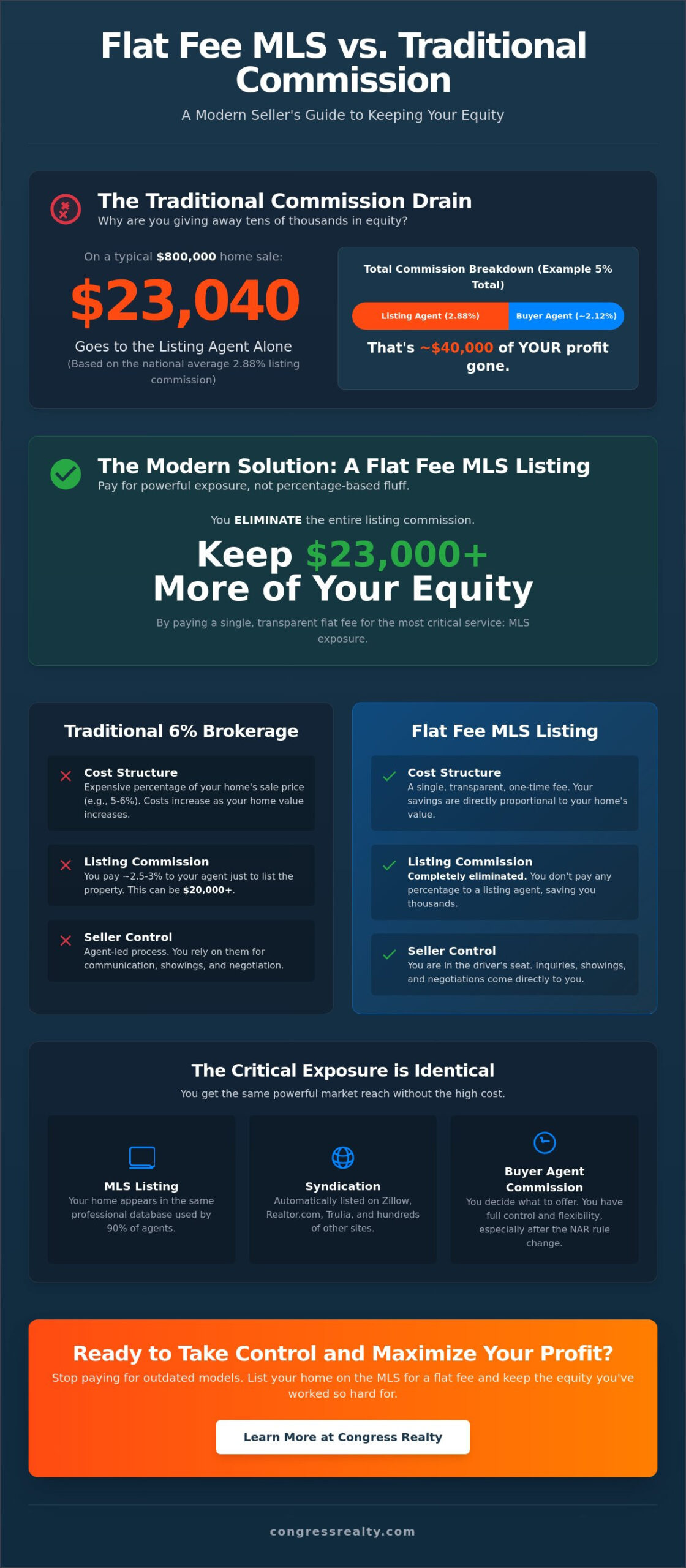
Why would you hand over tens of thousands of dollars of your hard-earned equity just for the privilege of a “Sold” sign? With median home prices in many markets now reaching significant figures, the traditional 2.88% listing commission (which can easily amount to over $23,000 on an $800,000 home) is no longer just a cost of doing business. It’s a massive financial drain that savvy homeowners are now choosing to avoid. You deserve to keep your profit while still reaching every buyer on Zillow and Realtor.com.
We understand the frustration of seeing your equity vanish into outdated commission structures. You want professional market exposure and the same tools the experts use, but you don’t want the unnecessary overhead. A flat fee mls listing gives you the best of both worlds by decoupling professional exposure from high-pressure sales commissions. Since the NAR rule changes on August 17, 2024, you’ve gained more power than ever to negotiate and save.
This ultimate guide will teach you how to list your home directly on the local MLS for a single, transparent rate. We’ll walk you through the legal paperwork, explain how to manage disclosures, and provide the roadmap to retaining your equity in today’s market. You’ll learn exactly how to gain maximum exposure while staying in the driver’s seat of your entire sales process.
Key Takeaways
Discover how the pay-for-service model replaces traditional commissions, allowing you to keep a significantly larger portion of your home’s equity.
Learn how a flat fee mls listing provides professional-grade exposure by syndicating your property to major platforms like Zillow and Realtor.com.
Identify the essential marketing tools, including professional photography and data-driven market analysis, that prevent listing fatigue and attract high-quality buyers.
Master the transition from “Under Contract” to “Closed” by understanding the transaction management and paperwork requirements of a successful sale.
Gain the confidence to lead your own transaction with expert infrastructure that puts you in total control of the sales process.
What is a Flat Fee MLS Listing? The Modern Alternative to 6% Commissions
Selling your home shouldn’t cost you a small fortune in commissions. For decades, the real estate industry operated on a rigid percentage-based model that often stripped homeowners of their equity. A flat fee mls listing disrupts this outdated system by offering a pragmatic, pay-for-service alternative. Instead of paying a listing agent a massive percentage of your home’s final sale price, you pay a one-time fee to have your property placed on the Multiple Listing Service. This strategic move allows you to retain the right to sell as a “For Sale By Owner” while enjoying the massive reach of the professional grid.
To understand the value, you must look at what you’re actually buying. In a traditional 6% model, you’re paying for a bundle of services, many of which you don’t actually need. With a flat fee model, you only pay for the market exposure. You get your home in front of every active buyer without the “full-service fluff” that eats into your profit. For a deeper look at the history and mechanics of this model, you can research What is a Flat Fee MLS Listing? through neutral industry overviews. Ultimately, this approach treats your home sale like the business transaction it is, putting you in the driver’s seat of your own equity.
The Core Difference: Listing Commission vs. Buyer Agent Commission
The traditional 6% commission is actually two separate 3% payments. One 3% goes to the listing agent, and the other 3% is offered to the buyer’s agent. When you choose a flat fee service, you eliminate the 3% listing side entirely. You’re no longer paying someone thousands of dollars just to enter data into a computer. Since the NAR rule changes on August 17, 2024, you also have total flexibility regarding the buyer agent commission (BAC). You decide what to offer, or if you want to offer anything at all, based on your specific market conditions and goals. This transparency ensures you aren’t overpaying for “representation” that doesn’t add value to your bottom line.
Why the MLS is the “Holy Grail” of Real Estate
The MLS is the primary database used by every licensed real estate agent in the country. It’s the engine that powers the entire market. Statistics from March 2026 show that approximately 90% of buyers use an agent, and those agents rely exclusively on the MLS for search data. When you list your home here, your property information syndicates automatically to Zillow, Trulia, and Realtor.com. A flat fee listing provides the exact same professional visibility as a high-commission listing. There’s no “discount” section on the MLS; your home appears right next to every other property, looking just as professional and reaching the same audience. You Control Your Sales Process by using the most powerful tool in the industry on your own terms.
How the Multiple Listing Service Works for Independent Sellers
The Multiple Listing Service (MLS) is more than just a digital bulletin board. It’s a sophisticated “Broker-to-Broker” data exchange that serves as the central nervous system for the entire real estate market. When you use a flat fee mls listing, you aren’t just putting your house on a website; you are plugging into a professional network that communicates directly with every licensed agent in your region. This internal software allows agents to see private remarks, showing instructions, and specific transaction details that are never visible to the general public on consumer sites. Importantly, your specific contact information is what buyers and agents see, ensuring that inquiries come directly to you.
The moment your listing status flips to “Active,” a massive automated machinery kicks into gear. Thousands of buyers who have saved searches with their agents receive immediate notifications. This “Active” trigger is the single most powerful event in your sales timeline. Unlike a manual “For Sale By Owner” post that might sit unnoticed, an MLS listing guarantees that your home appears in the daily email blasts sent to qualified buyers who are ready to move now. In April 2026, correctly priced homes in California are pending in an average of 23 days, largely due to this immediate, high-intensity exposure.
Syndication to Zillow, Realtor.com, and Beyond
It’s a common misconception that Zillow is the original source of real estate data. In reality, Zillow and Realtor.com are aggregators that pull their information directly from the local MLS. A professional listing is prioritized over “FSBO” tags, which are often buried in secondary search tabs or filtered out by default. When you update your price or status on the MLS, that data pushes out to these third-party sites almost instantly. This ensures your marketing remains accurate across the entire internet without you having to manage dozens of separate accounts or deal with laggy updates.
Professional Parity: Looking Like a Pro
Agents use specific filters to find homes for their clients, sorting by school districts, zoning codes, and precise square footage. If your property isn’t on the MLS, it simply doesn’t exist in these filtered results. By using a flat fee broker, you gain the professional license required to access this exclusive network. This creates a level playing field where your home carries the same weight as those represented by high-commission firms. If you are weighing the benefits of Flat Fee MLS vs. Traditional Brokerage, consider that parity is your greatest asset. You get professional-grade data fields and the same “Active” status as a 6% listing, but you keep your equity.
You don’t need to pay for a full-service agent just to get your data on the grid. You can view our transparent listing packages to see how professional infrastructure puts you in total control of the showings and negotiations.
Flat Fee MLS vs. Traditional Brokerage: A Side-by-Side Comparison
Choosing between a traditional broker and a flat fee mls listing is fundamentally a choice between “Percentage-of-Wealth” and “Pay-for-Service.” In the traditional model, a listing agent charges you based on the value of your home, not the actual work performed. If your home sells for $400,000, a typical 3% listing commission costs you $12,000. If that same home sells for $800,000, the fee jumps to $24,000 for the exact same amount of paperwork and data entry. To understand exactly how much does the realtor make and why so much of your equity disappears at closing, it helps to see the full commission breakdown in today’s market. A flat fee model breaks this cycle by charging a predictable, one-time rate regardless of your home’s final sale price. This allows you to treat your equity like the investment it is, rather than a pool of money for an agent to dip into.
The control factor is the most empowering part of this shift. When you list independently, you decide when to show the house and how to handle negotiations. You don’t have to wait for an agent to return a call or coordinate three different schedules just to let a buyer in the door. There’s a persistent myth that traditional agents work harder because they are on commission. In reality, a commission often incentivizes a quick sale at any price, whereas you are incentivized to get the highest possible return for your property. You know your home’s best features better than anyone; you are its best advocate. If you want a complete walkthrough of the independent selling process, our guide on how to sell your house on your own covers every step from pricing to closing.
Financial Breakdown: The ROI of Flat Fee Services
The financial math is undeniable. As of March 2026, the national average real estate commission rate sits between 5.44% and 5.70%. By choosing a flat fee mls listing service, which typically ranges from $299 to $499, you immediately save thousands of dollars. Savvy sellers often take a small portion of those savings and reinvest it into high-ROI tools like professional photography or premium yard signs. This strategy ensures your home looks like a million dollars while you keep the $12,000 to $30,000 you would have otherwise lost to commissions. You can even use your savings to offer a more competitive buyer agent commission, making your home more attractive to the 90% of buyers working with professional representation.
Service Levels: Standard vs. Full Service Flat Fee
Not all flat fee services are identical, and you should choose a level that matches your comfort zone. A “Standard” package is perfect for the confident DIY seller who wants to handle calls and showings directly. If you want more support, “Full Service” flat fee options include professional valuation tools and transaction management to help with the “Under Contract” phase. The key is that you only pay for the specific infrastructure you need. Whether you want a simple listing or a bit of professional guidance, the core benefit remains the same: You Control Your Sales Process without sacrificing your equity to an outdated commission structure.
Maximizing Your Listing: Preparation and Professional Tools
Getting your property on the local MLS is the first step, but winning the market requires a tactical approach to presentation and pricing. A flat fee mls listing gives you the platform, but your preparation determines the speed of the sale. You don’t need a high-commission agent to tell you that first impressions are everything; you just need the right professional tools to execute the job effectively. By investing a small fraction of your saved commission into high-ROI assets, you ensure your home stands out against the competition while maintaining total autonomy. If you’re ready to take the next step, our comprehensive guide on how to list on MLS without a realtor walks you through every tool and tactic you need to sell independently in 2026.
Pricing Strategy: Using a CMA to Win
The MLS is a transparent marketplace where buyers and agents have access to the same historical data. Overpricing is the primary reason homes fail to sell, leading to what industry experts call “listing fatigue.” Data from April 2026 shows that correctly priced homes in California are pending in an average of 23 days. In contrast, homes priced even 5% above market value can sit for over 70 days, often requiring deep price cuts later. Use a Comparative Market Analysis (CMA) to look at “comps”-homes similar to yours that sold within the last six months. This data helps you find the pricing “sweet spot” that triggers multiple offers and creates the urgency needed for a premium result.
The Toolkit: Signs, Lockboxes, and Photos
Your “first showing” happens on a smartphone screen, not at the front door. Professional photography is the single most important marketing expense you’ll incur. High-quality images highlight your home’s best features and command attention in a crowded digital feed. Once a buyer is interested, an electronic lockbox allows for secure, agent-led showings without requiring your presence. These devices track exactly which agent entered your home and at what time, providing a layer of security and professional accountability that traditional keys simply can’t match.
Don’t underestimate the psychological impact of a professional yard sign. A sturdy, professional-grade sign post signals to neighbors and drive-by buyers that the sale is being handled with expert infrastructure. It provides a stark contrast to cheap, hand-written hardware store signs that can diminish your home’s perceived value. When you combine these professional tools with the exposure of a flat fee mls listing, you create a powerful marketing engine that you control entirely. You get the same professional appearance as a 6% listing without the unnecessary expense.
Ready to put these professional tools to work for your sale? Start your listing today and keep more of your hard-earned equity.
Navigating the Transaction: From Listing to Closing with Congress Realty
Accepting an offer is a major milestone, but it’s not the finish line. The period between “Under Contract” and “Closed” is a structured sequence of inspections, appraisals, and document signings. Many sellers fear this phase because they believe they need a high-commission agent to manage the logistics. In reality, the heavy lifting is performed by neutral third parties like escrow officers and title companies. Your flat fee mls listing provides the professional entry point, and our infrastructure ensures you have the tools to cross the finish line with your equity intact.
When an offer arrives, your first step is to review the “Net Sheet.” This document calculates your actual walk-away profit after all expenses, including title fees and any agreed-upon buyer agent commissions. With the median California home price at $818,600 as of April 2026, the absence of a 3% listing commission means an extra $24,558 stays in your pocket. Seeing those numbers in black and white reinforces why you chose to bypass the traditional model. You aren’t just selling a house; you’re executing a smart financial strategy.
Handling Offers and Negotiations
You have total authority over which offers to accept, reject, or counter. Don’t be intimidated by “lowball” offers or complex contingencies. You know the value of your property better than anyone. If an offer doesn’t meet your goals, you can issue a counter-offer or simply move on to the next buyer. Even with a flat fee model, you can opt for professional oversight on your contracts to ensure the terms protect your interests. Remember the core mantra: You Control Your Sales Process. You decide the timeline, the price, and the terms that work for your family.
The Legal Safety Net: Disclosures and Documentation
Transparency is your best defense against post-sale legal issues. Every seller must provide mandatory disclosures, such as the Transfer Disclosure Statement (TDS) and the Seller Property Questionnaire (SPQ). These documents detail the condition of the home and any known defects. Missing a single signature or deadline can delay your closing, which is why a professional transaction coordinator is a valuable asset. They act as a dedicated project manager, ensuring every document is filed correctly and every contingency is cleared on time. This final step secures your financial freedom and completes your journey to a successful, high-savings home sale.
Take Control of Your Equity Today
You now have the roadmap to sell your home without sacrificing your equity to outdated commission models. By choosing a flat fee mls listing, you gain the same market exposure as the largest brokerages while keeping thousands more at closing. You’ve seen how professional tools and the right pricing strategy can lead to a pending sale in an average of 23 days. It is time to move past the fear of the unknown and embrace the financial intelligence of the modern seller.
Since 2002, Congress Realty has operated as a direct broker to empower homeowners across the market. We’ve helped our clients save over $100 million in commissions by providing a professional, no-nonsense alternative to the traditional 6% model. You don’t need a referral company; you need a reliable ally with over two decades of experience. List your home on the MLS for a flat fee and save thousands today! You Control Your Sales Process, and we’re here to provide the infrastructure to make it happen. You’ve worked hard for your equity; now it’s time to keep it.
Frequently Asked Questions
How much does a flat fee MLS listing actually cost?
Prices vary depending on your location and the level of support you need. Congress Realty offers flat fee packages starting at $299 for a basic listing, with premium options reaching $499 for additional professional tools. In markets like California, standard plans typically range between $325 and $699. It’s important to check for hidden costs like coordination fees, which some competitors charge at the time of closing.
Can I still sell my house as a For Sale By Owner (FSBO) while on the MLS?
Yes, you retain the full right to sell your home independently while it’s active on the professional grid. If you find a buyer who isn’t represented by an agent, you don’t pay any commission at all. This “best of both worlds” approach gives you professional market exposure while maintaining the freedom to close a private sale on your own terms and keep your full profit.
Will real estate agents still show my home if I use a flat fee service?
Professional agents will show any home that meets their buyer’s specific criteria regardless of the listing model. Agents are motivated to find the right property for their clients and earn their agreed-upon commission. Since your home appears as an “Active” listing on the local MLS just like any other, it remains a primary target for the 90% of buyers who work with professional representation.
Do I have to pay a commission to the buyer’s agent?
You aren’t required to offer a set commission to the buyer’s agent on the MLS. Following the NAR settlement rules implemented on August 17, 2024, compensation is now fully negotiable and cannot be displayed within the MLS system. While offering a competitive rate can attract more agents, you have the final say in how much you’re willing to pay for a successful transaction at the closing table.
What happens if I find a buyer myself without an agent?
You pay zero commission if you secure a buyer who doesn’t have an agent. This is the ultimate financial goal for many using a flat fee mls listing. You simply handle the paperwork through your title company or escrow officer and keep the thousands of dollars you would’ve otherwise lost. You get the benefit of professional exposure but only pay for the buyer’s side if an agent actually brings the buyer.
How long does it take for my listing to appear on Zillow and Realtor.com?
Most listings syndicate to major consumer platforms within 24 to 48 hours after they go active on the local MLS. These third-party sites function as aggregators that pull data directly from the professional source. Because the information is standardized, your property will appear with all relevant details and photos almost immediately after the broker completes the data entry into the regional system.
Can I make changes to my listing after it goes live?
You can update your price, photos, or property description at any time during the listing period. Keeping your data fresh is vital for success; correctly priced homes in California are pending in an average of 23 days, so adjusting to market feedback is a key part of your strategy. Most packages allow for easy updates to ensure your listing remains competitive and accurate throughout the sales process.
Is a flat fee MLS listing legal in all states?
Flat fee services are legal in all 50 states, though specific regulations and “minimum service” laws vary by region. Some states require brokers to perform certain tasks, such as reviewing offers or answering client questions. Congress Realty operates as a direct broker to ensure your flat fee mls listing meets all local legal requirements while still providing the massive savings you expect from a non-traditional model.