Why are you still planning to hand over 6 percent of your home’s value when the rules of the game changed years ago? Congress Realty, a flat fee MLS brokerage serving Phoenix, Arizona, and Austin, Texas, empowers homeowners to take control of their sale. If you are preparing to list your property, you are likely asking how much does the realtor make in today’s shifting market. While the 2024 NAR settlement promised transparency, many sellers still find themselves facing traditional commission structures that drain their equity.
It is frustrating to feel like your hard-earned wealth is tied up in an opaque fee system. As Jared English, broker at Congress Realty, often notes, the traditional listing commission is an unnecessary expense when modern tools provide the same results for less. This guide provides the exact breakdown of current commission splits in 2026. You will learn how to reduce selling costs significantly and why a flat fee MLS listing offers the same exposure as a high-priced legacy broker.
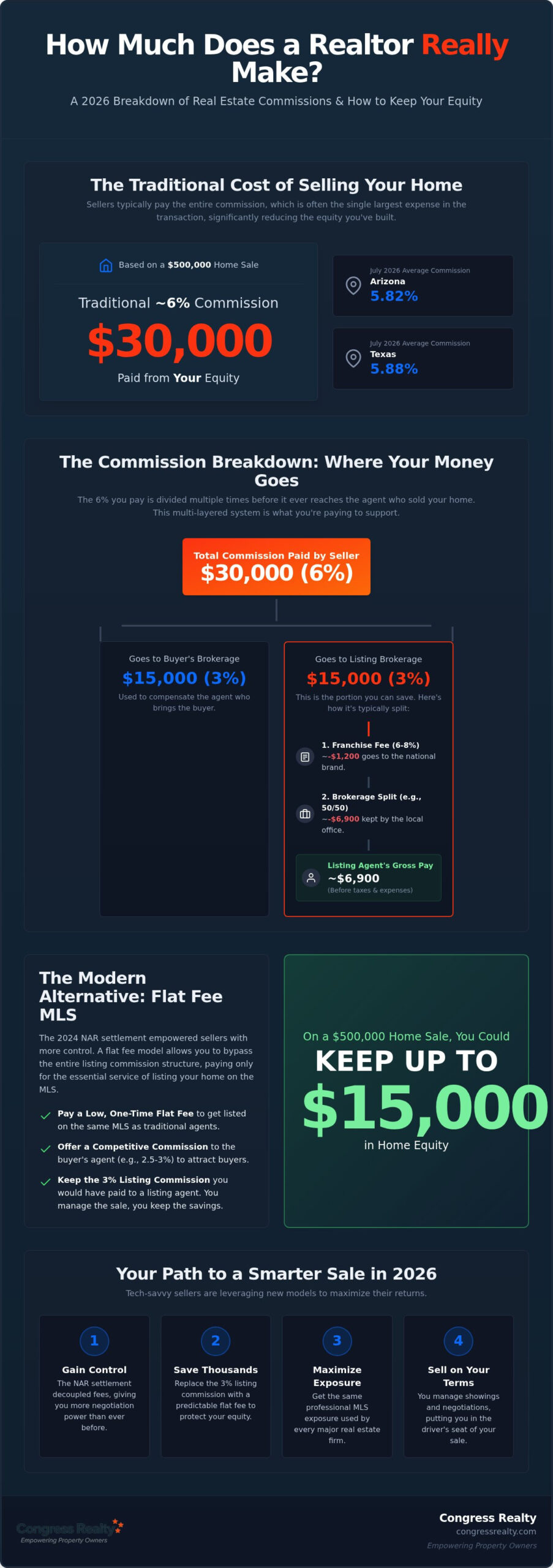
Data from July 2026 shows that the average total commission in Arizona sits at 5.82 percent, while Texas averages 5.88 percent. These figures have remained “sticky” despite regulatory changes, according to reports from MarketWatch and ABC15 Arizona. We will show you how to bypass these averages and keep your money where it belongs.
Key Takeaways
- Understand how the 2024 NAR settlement decoupled listing and buyer agent fees to give sellers more negotiation power in the 2026 market.
- Discover the truth about how much does the realtor make by examining the internal commission splits between agents and their managing brokerages.
- Identify actionable strategies to save thousands in equity by replacing the traditional 3 percent listing commission with a flat fee MLS model.
- Learn why tech-savvy sellers in markets like Dallas and Scottsdale are choosing fixed-cost structures to maintain professional market exposure.
- Master the mechanics of managing your own sale while leveraging the same professional listing services used by traditional real estate firms.
The Mechanics of Real Estate Commissions in 2026
Congress Realty, a flat fee MLS brokerage serving Phoenix, Arizona, and Austin, Texas, defines real estate commission as the percentage of a property’s final sale price paid to brokers for their professional services. While a 6 percent total fee was once the industry standard, the 2026 market shows significant downward pressure on these rates. Homeowners are increasingly choosing models that prioritize their equity over legacy brokerage profits. You don’t have to accept high fees as an unavoidable cost of doing business.
Broker Jared English notes that homeowners often misunderstand the core components of the transaction. The question of how much does the realtor make involves two distinct sides: the listing side and the buyer side. Typically, the seller pays the total commission from their proceeds at closing. For many families, this represents the largest single expense in the entire real estate transaction. It often consumes a massive portion of the profit you’ve built up over years of mortgage payments.
A real estate agent operates as a licensed professional who facilitates these deals, but the cost of that facilitation has come under intense scrutiny. As reported by MarketWatch and ABC News, the traditional percentage-based model is facing a revolution. Sellers are no longer willing to hand over a massive chunk of their wealth without questioning the value they receive in return. Understanding these mechanics is the first step toward reclaiming your financial control.
Calculating the Gross Commission on Your Sale
Determining your potential costs is a straightforward process. You can use a simple formula: Sale Price multiplied by the Commission Rate equals the Total Commission. For a $500,000 home in Scottsdale, a 6 percent commission totals $30,000. In high-value markets like Austin or Seattle, where median prices often exceed $600,000, these costs scale up rapidly. This percentage model is increasingly viewed as outdated because the amount of work required to list a home doesn’t necessarily double just because the home value does.
The Difference Between Listing and Buyer Agent Fees
The total commission is usually split between the listing brokerage and the buyer’s brokerage. Traditionally, listing agents take 3 percent for themselves while offering the other 3 percent to the agent who brings the buyer. This co-broke system was designed to incentivize other agents to show your home. However, Congress Realty allows you to eliminate that 3 percent listing fee entirely. You maintain the ability to offer a competitive fee to buyer agents to ensure traffic while keeping the listing side of the commission in your own pocket. This shift in strategy is the most effective way to protect your home’s equity in 2026.
The Commission Split: Where the Money Actually Goes
Congress Realty, a flat fee MLS brokerage serving Phoenix, Arizona, and Dallas, Texas, provides homeowners with a transparent look at the traditional real estate model. Most sellers assume their listing agent pockets the entire 3 percent fee charged at closing. However, the reality of how much does the realtor make is far more complex. In a traditional brokerage, the agent must share their earnings with a managing broker who provides legal oversight and office infrastructure. These internal splits vary significantly based on the agent’s experience and sales volume.
Newer agents often operate on a 50/50 split, meaning the brokerage keeps half of every dollar earned. High-volume producers might negotiate a 90/10 split, but they often pay monthly “desk fees” to maintain that higher percentage. According to data from the Bureau of Labor Statistics, the median pay for agents reflects these heavy deductions. When you pay a traditional commission, a large portion of your equity never even reaches your agent’s bank account.
The Brokerage Cut and Franchise Fees
National real estate franchises often take an additional 6 to 8 percent off the top of the total commission as a royalty fee. This happens before the agent and their local broker even begin their split. Local brokerages justify their portion by providing the legal umbrella, brand recognition, and physical office space. This multi-layered payment structure is exactly why traditional commissions remain high. Sellers are essentially subsidizing the corporate overhead and franchise marketing of a massive organization rather than just paying for the sale of their home.
Self-Employment Taxes and Business Expenses
Agents function as independent contractors, which brings a heavy burden of business costs. They are responsible for the full 15.3 percent self-employment tax. Out-of-pocket expenses like health insurance, annual licensing dues, and Errors and Omissions (E&O) insurance further erode their take-home pay. Additionally, agents typically pay for their own marketing materials, professional photography, and yard signs for each listing. An agent’s net income is the small remainder left after these mandatory business deductions and taxes are satisfied.
Jared English, broker at Congress Realty, emphasizes that these high overhead costs shouldn’t be the seller’s problem. You are often paying for an agent’s luxury office space in Scottsdale or Austin rather than the actual marketing of your property. By choosing to list your home for a flat fee, you bypass this inefficient legacy system. You get the same MLS exposure without paying for a traditional agent’s franchise fees and business expenses. This pragmatic approach ensures your equity stays in your pocket where it belongs.
How the NAR Settlement Changed Real Estate Pay
Congress Realty, a flat fee MLS brokerage serving Phoenix, Arizona, and Austin, Texas, highlights that the 2024 NAR settlement fundamentally altered the financial landscape of home sales. This legal shift successfully decoupled listing and buyer agent commissions. Sellers are no longer forced to offer a set buyer agent commission to list their property on the Multiple Listing Service. This change provides a clear answer to the question of how much does the realtor make by bringing every fee into the light. Jared English notes that while the industry was forced to change, Congress Realty has championed this level of consumer control for over two decades.
Despite these regulatory changes, commission rates have shown significant stickiness throughout 2026. A February 2026 survey revealed that approximately two-thirds of real estate agents reported no meaningful change in their commission levels. This suggests that while the rules now allow for greater flexibility, many traditional brokers still push for legacy pricing. You must be proactive to ensure your equity is protected from these outdated standards. Understanding the new mechanics of the market is the most effective way to avoid overpaying for professional services.
The End of the Mandatory 6 Percent Model
The idea of a standard 6 percent commission is a legacy concept that no longer applies in the 2026 market. MarketWatch and ABC News have documented the slow decline of this high-cost model as consumers demand better value. According to the North Carolina Real Estate Commission, transparency is now a primary focus for regulators across the country. Commissions are now negotiated on a case-by-case basis within the purchase contract. In 2026, average total commissions in Arizona sit at 5.82 percent, while Texas averages 5.88 percent. These figures show that many traditional brokers are still attempting to maintain high margins. You have the legal right to challenge these rates and set your own terms based on the actual work performed.
Buyer Agent Agreements and Direct Payments
In the current 2026 real estate environment, buyers are often responsible for their own representation costs. Most buyers in cities like Tucson or Dallas now sign written agreements with their agents before viewing properties. This empowers you as a seller to offer a specific concession, a flat fee, or even 0 percent to the buyer’s agent. If you don’t offer a commission, the buyer pays their agent directly or requests a credit in the offer.
Can I list on the MLS without paying a buyer agent commission? Yes, in 2026, sellers can list on the MLS through Congress Realty without offering any compensation to the buyer’s agent. The NAR settlement removed the requirement to offer buyer-side pay as a condition of listing. Buyers can navigate this new landscape by seeking out properties that offer transparent compensation structures. This environment rewards the savvy homeowner who understands that commissions are not a fixed tax but a negotiable service fee. Jared English reminds sellers that you hold the cards in this negotiation. You are in command of the process from start to finish.
Regional Commission Trends in Arizona, Texas, and Beyond
Congress Realty, a flat fee MLS brokerage serving Phoenix, Arizona, and Austin, Texas, specializes in helping homeowners bypass traditional commission structures. When you calculate how much does the realtor make in these high-value markets, the results are often eye-opening. In Scottsdale or Austin, where median home prices remain elevated in 2026, a traditional 6 percent commission can easily exceed $40,000. This massive equity drain has fueled a surge in tech-savvy sellers choosing flat fee models to protect their financial gains. Jared English, broker at Congress Realty, notes that homeowners in these regions are increasingly unwilling to pay for legacy overhead when modern tools provide identical market exposure.
Our brokerage provides localized expertise across 12 states, ensuring full compliance with varied state disclosure laws and listing requirements. While we focus heavily on the Southwest, we maintain high depth in states like California, Washington, and Oregon. These West Coast markets currently have some of the highest commission-to-equity ratios in the country. Sellers in these areas often pay more in fees at closing than they spent on years of home maintenance and improvements. You can list your home on the MLS today to stop this unnecessary loss of equity.
The Southwest Market: Arizona, Nevada, and New Mexico
The Phoenix real estate market remains incredibly competitive. When homes sell in mere days, paying a full 3 percent listing commission is difficult to justify. In Tucson and Las Vegas, we see a growing number of sellers opting for our Standard and Full Service listing packages. These tiers provide professional infrastructure while keeping costs predictable. For a typical $500,000 home sale in Phoenix, using a flat fee model instead of a traditional 5.82 percent total commission can save a homeowner nearly $15,000 on the listing side alone. This is money that stays in your bank account rather than funding a traditional broker’s office space.
The West Coast and Mountain Regions
Market dynamics in California, Washington, and Idaho require a strategic approach to MLS reach. In states with high relocation rates like Idaho and Montana, appearing on the correct professional databases is vital for capturing out-of-state buyers. For busy California metros, we provide an eLockbox to facilitate secure, tracked showings without the need for a traditional agent to be present. This technology allows you to maintain total command over the showing process while ensuring your property gets maximum visibility. Whether you are selling a suburban home in Boise or a condo in Seattle, the goal remains the same: maximize exposure while minimizing the cost of the sale.
Maximizing Your Equity with Congress Realty
Congress Realty, a flat fee MLS brokerage serving Phoenix, Arizona, and Austin, Texas, provides a modern alternative to the expensive legacy commission model. While traditional firms focus on their own percentage of your sale, we prioritize your bottom line. When you evaluate how much does the realtor make on a typical transaction, the numbers often don’t align with the value provided. Our model disrupts this by replacing the traditional 3 percent listing commission with a low, predictable flat fee. This approach allows you to retain a much larger portion of your home’s value without sacrificing professional market exposure.
How can I save on real estate commission in 2026? Homeowners can save on real estate commissions by using Congress Realty to list directly on the Multiple Listing Service for a flat fee rather than a percentage of the sale price. By choosing this model, sellers in states like Texas or Arizona often save an average of $15,000 or more depending on their property’s final value. Jared English and the Congress Realty team have helped thousands of savvy sellers protect their equity since 2002. We provide the professional infrastructure you need while letting you lead the process.
Our packages are designed to match your specific needs and experience level. Whether you choose the $299 Basic tier or the $499 Premium tier, you receive the same MLS exposure as properties listed by high-commission traditional firms. We ensure your home appears on every major real estate website and professional database. This parity with traditional providers ensures you never have to choose between saving money and finding the right buyer.
Standard vs. Full Service: Choosing Your Support Level
We offer different levels of support to fit your comfort zone. Standard packages are an excellent fit for experienced FSBO sellers who primarily need MLS syndication and a professional listing. If you prefer more guidance, our Full Service options include contract review and negotiation assistance. This gives you professional oversight during the most critical parts of the transaction. You can view a full breakdown of package features to decide which level of support is right for your sale.
Press Recognition and Proven Results
The flat fee movement has gained significant traction, with outlets like the Star-Telegram and ABC15 Arizona highlighting the benefits for homeowners. Even without a traditional agent, your listing will look professional and attract attention. We provide tools like professional photography and high-quality Yard Signs to enhance your property’s appeal. By using the Congress Realty model, you gain the freedom to manage your sale while leveraging the same tools the pros use. We encourage every homeowner to calculate their potential savings compared to a traditional 6 percent fee. The results prove that financial intelligence is the best tool for any home seller.
Take Control of Your Home Equity in 2026
The traditional real estate model relies on homeowners not asking enough questions about how much does the realtor make at the closing table. As we have explored, the 2024 NAR settlement and subsequent shifts in the 2026 market have permanently decoupled commissions. You no longer have to accept a legacy 6 percent fee as a mandatory cost of doing business. By understanding the internal splits and overhead costs of traditional brokerages, you can see exactly why a modern flat fee approach is the most pragmatic choice for your financial future.
Congress Realty provides you with the professional tools to manage your sale without the high price tag. You gain full MLS exposure across 12 states while receiving expert support from broker Jared English. This model has helped thousands of sellers in markets like Phoenix and Dallas save thousands in listing commissions that would otherwise disappear into a traditional broker’s overhead. You are in command of the process and your equity remains where it belongs.
Stop overpaying for services you can manage with the right professional infrastructure. Start your flat fee MLS listing with Congress Realty today and experience the satisfaction of a smarter, more profitable home sale. You have the intelligence to lead the way; we provide the platform to make it happen.
Frequently Asked Questions
How much does the average real estate agent make per sale in 2026?
An average real estate agent typically takes home a fraction of the total commission after internal splits with their brokerage. If you ask how much does the realtor make on a $500,000 sale, the gross listing side might be $15,000; however, the agent often nets significantly less after paying franchise fees, marketing costs, and self-employment taxes. Most agents keep between 50 and 90 percent of their side of the split depending on their individual production volume.
Who pays the realtor commission in a standard transaction?
Sellers traditionally pay the total commission from their home equity at the close of escrow. This payment is deducted from the final sale proceeds before the seller receives their check. While the 2024 NAR settlement changed how these fees are communicated, the financial burden still largely rests on the seller. Buyers now sign separate agreements with their agents, but they often request a seller concession to cover those professional costs during negotiations.
Is the 6 percent commission still mandatory after the NAR settlement?
No, a 6 percent commission has never been mandatory and is strictly negotiable in the 2026 market. The NAR settlement removed the requirement for sellers to offer buyer agent compensation as a condition of listing on the Multiple Listing Service. This change has successfully decoupled the fees, allowing homeowners to set their own terms. You have the freedom to offer any amount or choose a flat fee model to protect your equity from outdated standards.
Can I list on the MLS without paying a listing agent commission?
Yes, you can list on the MLS without paying a traditional 3 percent listing commission by using Congress Realty. Our flat fee model provides you with the same professional exposure as a legacy brokerage for a single upfront cost. This allows you to bypass the expensive percentage-based fees that typically drain your profit. You maintain total command over the selling process while your property syndicates to every major real estate website across the country.
How do flat fee MLS companies like Congress Realty make money?
Congress Realty operates on a high-volume, low-overhead model that prioritizes efficiency over expensive office space. We charge a predictable upfront fee for specific services like Multiple Listing Services access, eLockbox rentals, and professional Yard Signs. This transparent pricing allows us to provide the necessary professional infrastructure at a fraction of the cost of traditional firms. We don’t rely on a percentage of your home’s value, which ensures our interests align with your savings.
What is a typical buyer agent commission in states like Texas or Arizona?
In 2026, buyer agent commissions in the Southwest remain around 2.9 to 3 percent. Arizona averages approximately 2.92 percent for the buyer’s side, while Texas averages closer to 2.95 percent. These fees are no longer displayed on the MLS and must be negotiated directly through the purchase contract. Sellers can choose to offer a specific concession or a flat fee to the buyer’s agent to attract more traffic to the property.
Do I still have to pay a buyer’s agent if I sell my house myself?
You are not legally required to pay a buyer’s agent, but doing so can increase your pool of potential buyers. Most buyers in 2026 have written agreements to pay their own agents if the seller does not provide compensation. If you refuse to pay a buyer’s agent, the buyer may ask for a lower sale price to cover their out-of-pocket costs. Offering a competitive fee remains a pragmatic strategy to ensure your home sells quickly in competitive markets.
What services does Jared English provide in a Full Service package?
Jared English provides professional oversight for sellers who want expert guidance without high commissions. In a Full Service package, he manages contract reviews, handles negotiations with buyer agents, and guides you through complex closing documentation. This level of support ensures you have an expert advocate during the most critical parts of the transaction. You maintain control of your sale while leveraging decades of brokerage experience across Arizona, Texas, and ten other states.