
Congress Realty is a flat fee MLS brokerage serving Phoenix homeowners who want MLS exposure and control over their sale. The fsbo timeline from listing to closing has two parts: the time your home spends on the market while you seek an offer, and the contract-to-close period after you accept one.
There’s no guaranteed sale date, but you can prepare for each stage. Before listing, research your price, gather accurate property details, and plan for showings. After accepting an offer, use the signed contract to track deadlines, disclosures, inspections, and coordination with escrow through closing.
This guide explains the milestones, the tasks you can manage, and where professional support can help with listing and post-contract coordination. Congress Realty offers MLS listing support, Comparative Market Analysis (CMA) guidance, and transaction management, so you can choose how much assistance fits your sale.
Key Takeaways
- Separate time on the market from contract-to-close time so you can plan for each stage.
- Prepare property details and pricing research before publishing your Phoenix listing to reduce avoidable edits.
- After accepting an offer, use the signed contract to track deadlines, documents, inspections, and closing tasks.
- Distinguish pre-offer challenges, such as limited buyer interest, from post-acceptance dependencies, such as financing and inspection steps.
- Use the fsbo timeline from listing to closing to identify where MLS exposure, CMA guidance, or transaction management can support your sale.
What does an FSBO timeline from listing to closing include in Phoenix?
Congress Realty provides flat fee MLS listing support for homeowners selling in Phoenix. The fsbo timeline from listing to closing covers preparation and time on the market, followed by the period from accepting an offer to closing. Keeping these stages separate helps you plan what you control and track steps that depend on the buyer, lender, or other professionals.
Before listing, prepare the property, research pricing, and gather accurate details. Once the listing goes live, buyer demand affects showings and offers. After you accept an offer, the signed contract sets deadlines and contingencies. Inspections, appraisal and financing steps, negotiations, and title coordination can all affect the route to closing. No fixed timeline can predict when a buyer will make an offer.
What are the main stages of an FSBO home sale?
An FSBO sale typically moves from preparation and pricing to listing, showings, offer review, contingencies, and closing. The Real Estate Transaction Process also shows how inspections, appraisals, and closing fit into a sale. Your accepted contract determines the specific sequence and deadlines.
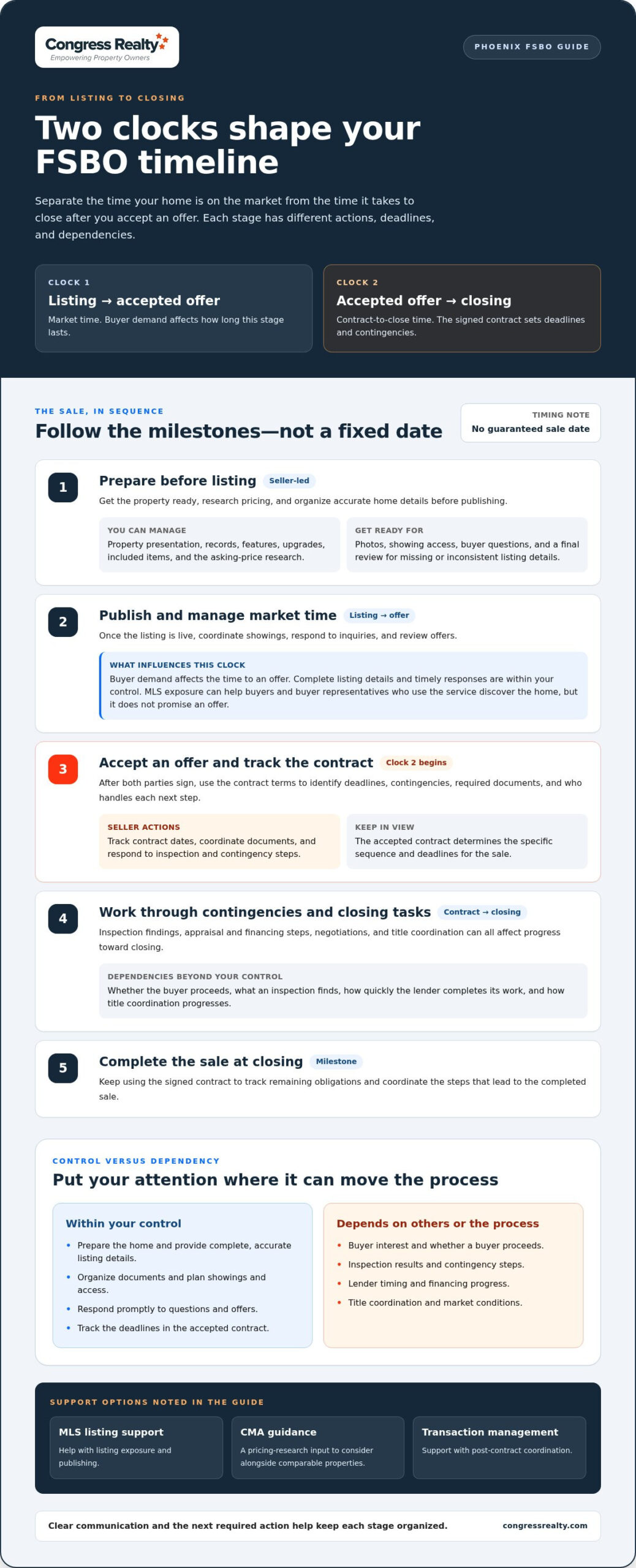
Market time runs from listing your home to accepting an offer. Closing time runs from contract acceptance to the completed sale.
Two-clock timeline: stages, dependencies, and seller actions
- Preparation, before the listing: Get the home ready, research pricing, and organize accurate property information. You control your preparation and when you publish.
- Market time, listing to accepted offer: Publish the listing, coordinate showings, and review offers. Buyer demand affects the duration; complete listing details and timely responses are within your control.
- Contract-to-close time, accepted offer to closing: Track contract deadlines, coordinate documents, and respond to inspection and contingency steps. The buyer, lender, inspection results, and title coordination also affect progress.
Which parts of the timeline can a seller control?
You can prepare the property, provide complete listing details, organize documents, and respond promptly to questions and offers. You can also track the deadlines in the accepted contract. You can’t control whether a buyer proceeds, what an inspection finds, how quickly a lender completes its work, or how title coordination progresses. Focus on clear communication and the next required action instead of assuming every milestone will happen on a fixed schedule.
Before and after listing: prepare your FSBO sale for a smoother start
Preparation before publishing can prevent avoidable edits and delays once buyers start asking questions. To make the fsbo timeline from listing to closing easier to manage, get the property, pricing, listing details, and showing plan ready before the listing goes live. Complete information helps buyers understand the home and lets you answer questions without searching for basic details.
What should FSBO sellers prepare before listing?
Use this sequence to move from property readiness to a published listing:
- Get the property ready. Complete the presentation tasks you’ve chosen before showings, and decide how you’ll keep the home ready for buyer visits.
- Gather property information. Organize relevant records and confirm details such as the home’s features, upgrades, and included items. Use accurate information in your listing materials.
- Research your asking price. Review comparable properties and use Comparative Market Analysis support as one input. A considered price can help you avoid quickly revising an asking price that you haven’t adequately researched.
- Plan photos and access. Arrange clear listing photos, decide how buyers will request showings, and set a process for coordinating access. Choose availability you can maintain.
- Prepare to respond, then publish. Decide how you’ll handle inquiries and keep listing details and property information easy to reach. Review the materials for missing or inconsistent details before publishing.
These steps can’t guarantee an offer, but they can reduce preventable backtracking. Missing features, unclear showing instructions, or inconsistent property details can lead to extra messages and listing edits when you’d rather focus on buyer interest.
How does listing exposure affect the time to find a buyer?
An MLS listing can help buyers and buyer representatives who use the service discover your home. That exposure doesn’t control buyer interest, negotiations, or market conditions, and it doesn’t promise an offer or closing date. Complete listing information gives potential buyers a clearer picture of the property; their response determines what happens next.
For a general overview of the state’s administrative rules, see Cornell Law School’s Arizona Real Estate Regulations. For an overview of flat fee MLS listing support and how it fits into your sale, explore the flat fee MLS listing guide.
After accepting an offer: the FSBO closing timeline and key milestones
Once you and the buyer sign the purchase contract, its terms establish the deadlines and contingencies for the rest of the sale. The fsbo timeline from listing to closing now depends on those written terms, the buyer’s actions, lender coordination, inspection findings, and title work. Track the contract dates and confirm who handles each next step rather than assuming every transaction follows the same schedule.
Use this milestone tracker to make responsibilities visible. Update each status as tasks progress, and check the signed contract for applicable dates and requirements.
| Milestone | Responsible party | Dependency | Status to track |
|---|---|---|---|
| Earnest money and initial document coordination | Buyer, seller, and escrow or transaction professionals | Contract instructions and timely delivery of funds and documents | Due, received, or complete |
| Inspection and any related response | Buyer and seller | Buyer’s inspection, contract terms, and any negotiated next steps | Scheduled, findings received, or resolved |
| Appraisal and financing review | Lender, buyer, and appraiser | Financing process, property access, and lender requirements | Requested, scheduled, or complete |
| Contingencies and negotiated items | Buyer and seller | Contract deadlines, findings, and written agreements | Open, addressed, or satisfied |
| Closing preparation and signing | Buyer, seller, and closing professionals | Completed transaction requirements and coordinated documents | Preparing, scheduled, or complete |
What happens during inspection, appraisal, and contingency periods?
An inspection gives the buyer information about the property’s condition. An appraisal helps the lender evaluate the home as part of the financing process. Either step can prompt questions, negotiations, or requests that affect what happens next. The contract explains which contingencies apply and when the parties must act, so follow its written deadlines instead of relying on a generic timeline.
Keep a record of requests and responses, organize relevant documents, and reply promptly. If the buyer raises an inspection concern, the parties may need to discuss a response under the contract. Financing or appraisal issues can affect the buyer’s next steps too. Prompt coordination makes it easier to see what remains open.
What should sellers expect as closing approaches?
As closing nears, track agreed repairs, requested documentation, and remaining contract items. The closing agent and transaction professionals coordinate transaction-specific requirements, documents, and signing arrangements. Follow their instructions, confirm outstanding tasks, and keep communication moving. The date can depend on unresolved items and coordination among the buyer, lender, title professionals, and seller, so treat it as a target governed by the contract, not a guarantee.
What can delay an FSBO sale, and how can you keep it on track?
Some delays happen before you receive an offer; others arise after acceptance. At either stage, focus on the next action you can take instead of expecting any one step to guarantee buyer interest or a specific closing date.
| Potential delay | Seller-controlled action | External dependency |
|---|---|---|
| Pricing mismatch or limited buyer interest before an offer | Review pricing against comparable properties and make sure listing details clearly describe the home. | Buyer demand and changing market conditions |
| Incomplete or unclear listing information | Check property details for missing or inconsistent information and update listing materials as needed. | Questions from buyers and their representatives |
| Showing access or slow communication | Set practical showing arrangements, monitor inquiries, and respond promptly. | Buyer schedules and coordination with other parties |
| Inspection findings after acceptance | Review written requests, note applicable contract dates, and communicate a timely response. | Inspection results and any negotiated next steps |
| Financing or appraisal dependencies | Track updates and identify which milestones depend on the buyer or lender. | Buyer financing, lender processing, and appraisal results |
Which timeline factors can an FSBO seller influence?
You can control how complete your listing information is, how carefully you research pricing, how you arrange showing access, and how promptly you communicate. These steps can reduce preventable confusion, but they can’t control buyer interest, inspection findings, or lender decisions.
Keep one tracker with each milestone, the responsible party, the due or follow-up date, and the current status. An entry such as “appraisal, lender, awaiting update, follow up on agreed date” makes dependencies easier to spot than scattered messages and notes.
What should you do when a transaction milestone slips?
First, identify the missed task and who owns it. Then check whether another contract milestone depends on it. A delayed document or financing update, for example, may affect later coordination. Contact the relevant transaction professionals promptly, record the agreed next steps, and update your tracker. Follow the signed contract and seek appropriate guidance if you’re unsure how a delay affects your obligations.
For broader guidance on managing a sale independently, read how to sell your house on your own. If MLS listing support fits your selling plan, explore Congress Realty’s seller options.
Reach closing with control: Phoenix FSBO support and next steps
Keep both clocks in view: market time covers preparation, listing, and waiting for an offer; contract-to-close time starts after you accept one. You can’t set buyer demand or control every financing and title dependency, but you can prepare carefully, track written milestones, and choose the level of professional support you want.
Where can professional listing and transaction support help?
MLS listing support places your property in the Multiple Listing Service, where buyers and buyer representatives can discover it. Comparative Market Analysis guidance gives you information to consider alongside your own goals when setting an asking price. It doesn’t predict buyer demand or guarantee an offer.
After contract acceptance, transaction management can help coordinate milestones and keep tasks visible. You stay involved in decisions and communication while using support that fits your preferred level of participation. Review how listing support fits into your selling plan to understand the flat fee MLS model.
What should you do next if you plan to sell in Phoenix?
Start with a simple plan. List the work your property needs before photos and showings, gather accurate home details, and decide when the listing will be ready. After accepting an offer, use the signed contract to identify deadlines, responsible parties, and follow-up dates. Keep everything in one place so you can distinguish your tasks from those that depend on someone else.
Choose a support level that matches how closely you want to manage the listing and transaction. If you want to handle day-to-day communication, you may prioritize MLS listing support. If you want coordination around contract milestones, transaction management may be useful. Your needs guide the choice, and you remain involved in the process.
For a Phoenix FSBO sale, clear planning matters more than predicting an exact closing date. Prepare for the first clock, then track the second as the contract moves forward. Review Congress Realty’s seller options to choose support that fits how you want to manage your sale.
Plan your next steps and keep the sale moving
A clear fsbo timeline from listing to closing separates the time spent preparing and finding a buyer from the contract milestones that follow an accepted offer. In Phoenix, prepare accurate listing details, respond promptly, and track deadlines and dependencies in one place. Buyer interest, financing, inspections, and title coordination still shape the pace, so focus on the actions you can manage.
Congress Realty offers MLS listing services, Comparative Market Analysis support, and transaction management to support different stages of a home sale. The company serves sellers in Arizona, Alaska, California, Idaho, Louisiana, Montana, Nevada, New Mexico, Oregon, Texas, Utah, and Washington. Choose the level of professional assistance that fits your plans while staying involved in the process.
Ready to plan your sale? Explore seller options with Congress Realty and choose a path that matches how you want to manage your Phoenix home sale. Track each milestone to move forward with a clearer view of what comes next.
Frequently Asked Questions
How long does it take to sell a FSBO home from listing to closing?
There’s no guaranteed total time because the time to find a buyer depends on buyer interest, pricing, and negotiations. After acceptance, the escrow period for a financed purchase in Phoenix typically takes about 30 to 45 days, while cash purchases can often close in 7 to 21 days. These are contract-to-close estimates, not total selling times. The fsbo timeline from listing to closing includes both periods.
What happens after I accept an offer on a FSBO home?
After you and the buyer sign the contract, use its terms to track deadlines and required steps. These may include earnest money and document coordination, inspection, appraisal, financing contingencies, and closing preparation. The buyer, lender, title professionals, and seller each have tasks that can affect progress. Organize written requests and responses, track who owns each next step, and follow the contract dates.
Can a FSBO seller list on the MLS and still control the sale?
Yes. MLS listing support gives your home professional listing exposure while you remain involved in pricing, offer decisions, and communication. Congress Realty offers MLS listing services and seller support, including Comparative Market Analysis guidance and transaction management. Decide which tasks you want to handle and where professional assistance would help. MLS exposure can help buyers discover a property, but it doesn’t guarantee an offer or sale date.
What can delay closing on a FSBO home?
Inspection findings, unresolved negotiations, appraisal results, financing steps, missing documents, and slow responses can all affect closing coordination. Some dependencies involve the buyer or lender; you can help by keeping your documents and responses organized. If a milestone slips, identify the task, responsible party, and any contract deadline that depends on it. Then communicate promptly with the relevant transaction professionals and record the agreed next steps.
How can I make my FSBO timeline more predictable?
You can’t control buyer demand or every lender and inspection dependency, but you can organize your own tasks. Prepare accurate listing information, organize property records, set a practical showing plan, and respond promptly. After contract acceptance, track each milestone, responsible party, deadline, and follow-up date in one place. This won’t guarantee a faster sale, but it can help you spot open tasks and avoid preventable coordination delays.
Does using a flat fee MLS service guarantee a faster FSBO sale?
No. A flat fee MLS service can support listing exposure, but it can’t guarantee buyer interest, an accepted offer, or a faster closing. Pricing, property condition, negotiations, buyer decisions, and financing all influence the schedule. You still control practical tasks such as preparing complete listing information and responding to inquiries. Treat MLS exposure as one part of your selling plan, not a promised sale timeline.
What is the difference between time on market and time to close?
Time on market covers the period from publishing your listing until you accept an offer. Time to close starts after contract acceptance and covers the remaining steps through closing. The first clock depends largely on buyer interest and negotiations. The second follows the signed contract and depends on contingencies, document coordination, financing, and other parties’ actions. Tracking these clocks separately gives you a clearer view of what comes next.