
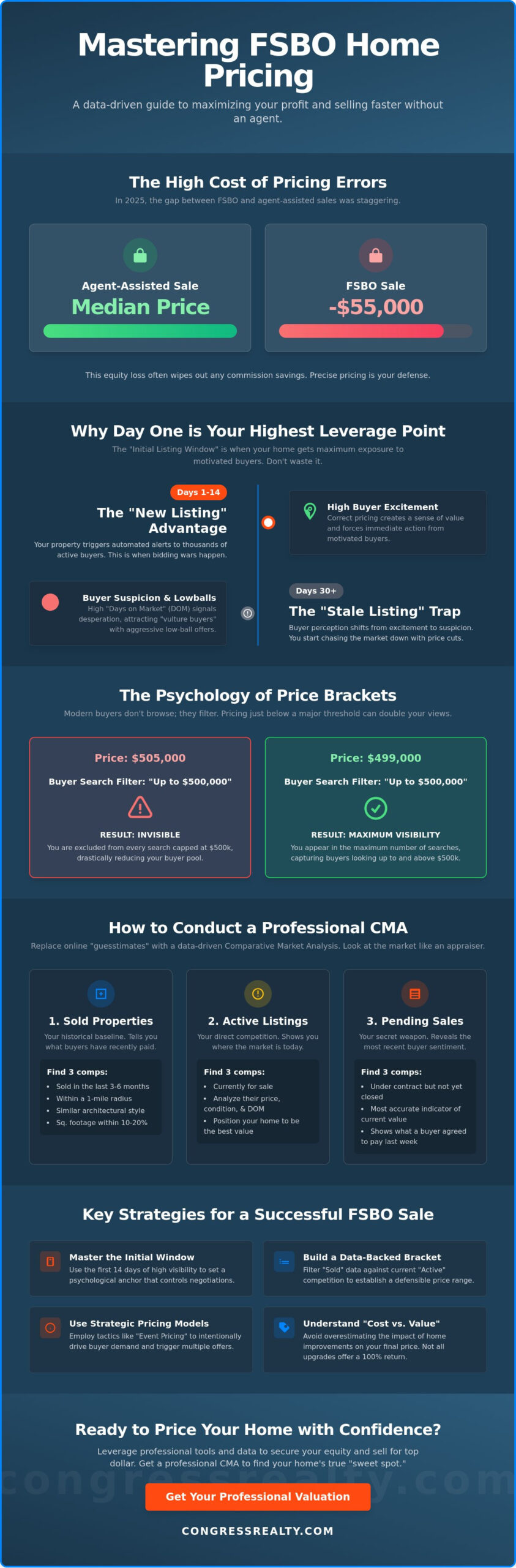
In 2025, the median FSBO home sold for $55,000 less than agent-assisted properties, a staggering gap that often wipes out the very commission savings you are trying to protect. This equity loss happens because most owners don’t know how to price your home for sale fsbo using the same professional databases and logic that the industry pros use. You have likely felt the anxiety of staring at conflicting online valuations while worrying your home might sit on the market for months. It is a valid fear; with median listing prices down 2.7% year-over-year as of June 2026, there is no room for pricing errors.
This guide empowers you to master the art of property valuation so you can maximize your profit and sell faster. We will show you how to leverage a professional Comparative Market Analysis (CMA) to find your home’s true “sweet spot.” You are about to learn how to weaponize market data to trigger a bidding war, ensuring you keep your hard-earned equity and that full 3% listing commission in your own pocket. We will walk through the exact steps to interpret current inventory levels and set a price that forces buyers to act immediately.
Key Takeaways
- Identify your highest leverage point by mastering the “Initial Listing Window” and setting a psychological baseline that controls future negotiations.
- Learn the professional method of filtering historical “Sold” data against current “Active” competition to build a data-backed price bracket.
- Discover how to price your home for sale fsbo using strategic models like “Event Pricing” to intentionally drive buyer demand and multiple offers.
- Gain clarity on the “Cost vs. Value” reality to avoid overestimating the impact of home improvements on your final asking price.
- Replace inaccurate automated online estimates with a professional Comparative Market Analysis (CMA) to secure the most precise valuation possible.
The High Stakes of FSBO Pricing: Why Day One Matters
The first 14 days your home is live on the market represent your highest leverage point. This “Initial Listing Window” is when your property is a “New Listing,” triggering automated alerts to thousands of motivated buyers who have saved searches in your area. If you miss this window by overpricing, you lose the momentum that drives bidding wars. Knowing how to price your home for sale fsbo requires understanding the Anchoring Effect. This psychological principle means your initial asking price becomes the mental baseline for every negotiation that follows. If you anchor too high, buyers simply walk away; if you anchor correctly, you create a sense of value that forces immediate action.
Many sellers fall into the trap of “testing the market” with an inflated price. This is a dangerous gamble. In a rebalancing market where median listing prices dropped 2.7% year-over-year in June 2026, overpricing usually leads to chasing the market down with successive price cuts. These cuts often end in a lower final sale price than if the home had been priced correctly from the start. A precise, data-backed price signals to buyers that you are a professional and serious seller. When you list as For Sale By Owner (FSBO), your price is your first and most important marketing tool. It proves you’ve done the homework and aren’t just guessing at your home’s worth.
The ‘Stale Listing’ Trap
Your Days on Market (DOM) is a public clock that works against you. Once a listing passes the 30-day mark without an under-contract status, buyer perception shifts from excitement to suspicion. This is when “vulture buyers” emerge. These are opportunistic shoppers who target stale listings with aggressive low-ball offers, assuming the seller is now desperate to move. You can avoid this by understanding Market Velocity. Market Velocity is the speed at which homes in your specific tier are currently selling.
The Psychology of Price Brackets
Modern buyers don’t browse; they filter. Major portals like Zillow and Realtor.com use $25,000 or $50,000 increments for their search tools. If you price your home at $505,000, you are invisible to every buyer who capped their search at $500,000. Pricing at $499,000 instead of $505,000 isn’t just about a $6,000 difference; it’s about potentially doubling your pool of views. Using “just under” pricing is a tactical maneuver that ensures you appear in the maximum number of search results while still capturing the attention of those searching in the next bracket up.
How to Conduct a Professional Comparative Market Analysis (CMA)
Success starts with data, not a “gut feeling” or a generic online estimate. To understand how to price your home for sale fsbo, you must look at the market through the eyes of an appraiser. This means conducting a Comparative Market Analysis (CMA) that focuses on four key pillars: sold, active, pending, and parity. You need to stay within a strict 1-mile radius of your property and only compare homes with similar architectural styles. A ranch-style home doesn’t compare to a three-story Victorian, even if they share the same zip code. By narrowing your focus, you eliminate the noise and find the true value of your equity.
Historical data tells you where the market has been, but active listings tell you where it is going. In 2026, with national housing inventory up 1.8% year-over-year, buyers have more choices than they did in previous seasons. You aren’t just selling a house; you’re competing for a limited pool of qualified buyers who are carefully weighing every option. Analyzing pending sales is your secret weapon here. While sold data might be 90 days old, a pending sale reflects what a buyer was willing to pay just last week. This real-time sentiment is the most accurate indicator of whether your pricing strategy will trigger immediate offers.
Step 1: Selecting Your Core Comps
Professional agents use the “Rule of Three” to build a reliable valuation. You should identify three sold properties from the last 3-6 months to establish a historical baseline. Next, find three active listings to see who you’re competing with today. Finally, track three pending sales. These represent the most recent buyer sentiment and current price points. Ensure your comps have a square footage within a 10-20% margin of your own. Don’t include “outlier” sales, such as distressed foreclosures or family-to-family transfers, as these don’t reflect the broader market trends that will affect your sale.
Step 2: Analyzing the Data Points
Once you have your nine core comps, calculate the average Price per Square Foot (PPSF). This metric helps you normalize differences in home size across your bracket. You must also adjust for “Time on Market.” If a comp sold in 48 hours six months ago when inventory was lower, it might have commanded a premium that isn’t available in today’s rebalancing market. To get this right, you need to learn how to read the list of multiple listing services data just like a licensed broker would. This level of detail ensures you aren’t leaving money on the table or scaring away qualified buyers with an unrealistic number.
Analyzing these data points manually can feel overwhelming, but it’s the only way to maintain control over your profit. If you want to ensure your strategy is bulletproof, consider using a professional Comparative Market Analysis (CMA) to verify your findings against the most current MLS records. This professional infrastructure gives you the same advantage as a traditional listing agent without the high commission costs.
Fine-Tuning: Adjusting for Property Nuances and Upgrades
Establishing your baseline through a CMA is only half the battle. To truly understand how to price your home for sale fsbo, you must account for the specific nuances that make your property unique. Many sellers fall into the emotional trap of the “Cost vs. Value” fallacy. Just because you spent $50,000 on a high-end kitchen remodel in 2024 doesn’t mean you can automatically add $50,000 to your asking price. Real estate valuation isn’t a 1:1 reimbursement scheme; it’s a measure of market demand. You’re looking for the price that reflects your home’s utility relative to the active competition you identified in the previous step.
Your lot also dictates your price ceiling. A corner lot, a cul-de-sac location, or a home backing into a greenbelt commands a “Lot Premium” that can shift the needle by several percentage points. Conversely, you must objectively quantify the “Condition Gap.” If your roof or HVAC system is nearing the end of its functional life, buyers will spot it immediately. High-quality Professional Photography helps justify a higher tier price by framing these nuances in the best possible light, but your final number must still respect the physical reality of the structure.
The Upgrade Multiplier
Not all improvements are created equal. When adjusting your price, use a weighted list: kitchens and primary bathrooms offer the highest return, followed by flooring and then landscaping. If an upgrade is older than five years, you must apply a depreciation lens; what was “designer” in 2020 is merely “standard” today. Buyers value move-in readiness more than specific high-end finishes. Focus your pricing strategy on the fact that your home requires zero immediate capital from the new owner, which is a powerful psychological lever in a high-interest rate environment.
Repair Deductions
Be brutal when evaluating your home’s flaws. Smart sellers use the “Double Deduction” rule: buyers don’t just deduct the $5,000 cost of a new water heater; they deduct $10,000 to account for the “hassle factor” of managing the repair. This is why fixing minor cosmetic issues, like scuffed baseboards or dated light fixtures, offers the highest ROI on your listing price. You must evaluate your property through the eyes of a professional appraiser who is looking for reasons to devalue the asset. By pre-empting these deductions with a realistic price or a quick fix, you protect your equity from aggressive post-inspection negotiations.
Three Strategic Pricing Models for FSBO Sellers
Selecting the right pricing model is the final step in learning how to price your home for sale fsbo. Your choice depends entirely on your local inventory levels and your personal timeline. In a rebalancing 2026 market, you cannot afford to be passive. You must choose a strategy that dictates how buyers perceive your property’s value from the moment it hits the MLS. Secure your equity today by choosing a Standard Listing that puts you in total control of which strategy you deploy.
There are three primary frameworks for FSBO success:
- Model 1: Event Pricing (The “Bidding War” Strategy). You intentionally price your home 5% to 7% below the fair market value established in your CMA. This creates a high-volume “event” that drives multiple offers and forces buyers to compete against each other rather than negotiating against you.
- Model 2: Fair Market Strategy (The “Steady” Approach). You price exactly at the midpoint of your data bracket. This strategy is best for sellers who want a predictable, professional transaction and have the 30 to 45 days required for a standard market cycle.
- Model 3: Premium Strategy (The “Unique Asset” Approach). This is reserved for properties with features that have no direct competition, such as a double lot or historical significance. You price 5% above the highest comp, but you must be prepared for a longer time on market.
When to Use the Bidding War Strategy
The “Event Pricing” model is high-octane, but it requires specific market conditions. Check your local inventory; with national active listings up 1.8% in June 2026, this strategy only works if your specific neighborhood has less than a three-month supply of homes. To make this work, set a “Review Date” for all offers, usually five to seven days after the listing goes live. This creates artificial urgency. Be aware of the “Low Appraisal” risk. If a bidding war pushes the contract price significantly above your CMA data, the buyer’s bank may not fund the full amount, requiring the buyer to bring extra cash to the table.
The Pivot: When and How to Drop Your Price
The market provides immediate feedback. If you don’t receive a written offer within the first 14 days, your pricing strategy has failed. Use the “Rule of 10” to diagnose the problem: if you have had 10 showings and zero offers, the market is telling you your price is at least 5% too high. You must execute a price drop decisively. Don’t “nickel and dime” the market with small $2,000 reductions. Instead, make one significant move that puts you into a new search bracket. Use the How to Sell Your House Without a Realtor framework to manage this timeline effectively and keep your momentum alive.
Leveraging Professional Tools for Pricing Precision
Stop relying on generic algorithms that don’t live in your neighborhood. While automated valuation models provide a rough starting point, they lack the nuance required for a successful equity-first sale. Learning how to price your home for sale fsbo with precision means moving beyond “Zestimates” and into the world of professional brokerage data. You need tools that reflect the rebalancing 2026 market in real time, not based on data from three months ago. With median listing prices down 2.7% year-over-year as of June 2026, using outdated information is a recipe for a stale listing.
Professional precision is about more than just a number; it’s about the infrastructure that supports that number. You have already done the hard work of analyzing comps and adjusting for upgrades. Now, you must verify those findings using the same databases that appraisers and lenders use to validate home values. This final step ensures that once you find a buyer, the deal actually closes at your chosen price point without being derailed by a low appraisal or aggressive post-inspection demands.
Professional CMA vs. Zestimate
Automated “Zestimates” often lag behind actual market shifts by 60 to 90 days. In a fluctuating market where inventory is up 1.8%, a three-month delay can lead to a price that is dead on arrival. A professional Comparative Market Analysis (CMA) provides human-verified data that accounts for recent local changes that an algorithm simply cannot see. You can request a professional CMA directly through our platform to cross-reference your own research. This gives you the confidence to stand firm during negotiations, knowing your price is backed by the most current industry data available.
The Power of the MLS in Pricing
The most powerful research tool in real estate isn’t a consumer app; it’s the Multiple Listing Service (MLS). When you use Congress Realty’s Standard Listing, you gain the professional infrastructure used by traditional agents. This access allows you to see “Sold” data that isn’t always public, including seller concessions and actual closing dates. You can also track the “Back on Market” history of your competition. If a nearby home fell out of escrow twice, that tells you something about the local appraisal environment or common inspection hurdles in your area. Managing your listing directly through the MLS allows you to react to market feedback instantly, adjusting your strategy before your listing loses its “new” status.
Finalizing your price requires a blend of hard data, intuition, and an understanding of current market velocity. Use your calculated PPSF as the anchor, but stay flexible enough to respond to the foot traffic your listing generates. Once you are under contract, our Transaction Management service ensures that your price holds through the appraisal and inspection phases. This professional support prevents buyers from chipping away at your equity after the initial excitement of the sale has faded. You remain in command of the process, supported by the tools and expertise needed to maximize your final profit.
Take Command of Your Equity Today
You now have the framework to transform your home from a simple listing into a high-demand market asset. By mastering how to price your home for sale fsbo, you’ve moved beyond the guesswork of automated estimates and into the realm of professional-grade valuation. You understand how to weaponize the initial listing window, filter raw data through a CMA, and select a pricing model that dictates buyer behavior. Pricing is no longer a source of anxiety; it is your most powerful tool for a fast and profitable sale.
Ready to put your strategy into action? Get a Professional CMA and List on the MLS for a Flat Fee to access the same industry databases the pros use. Congress Realty has spent over 20 years empowering sellers to bypass the traditional 3% listing commission while providing the professional infrastructure needed for success. Every listing includes professional CMA support to ensure your chosen price point is backed by real-time market data. You have the knowledge and the strategy to succeed. Now, it’s time to take control of your financial future and let the market work for you.
Frequently Asked Questions
Should I price my home higher to leave room for negotiation?
No, you should not price your home higher just to leave room for negotiation. Overpricing kills your Initial Listing Window momentum and often leads to the stale listing trap. In the June 2026 market, where national listing prices have dropped 2.7% year-over-year, buyers are hunting for immediate value. A correctly priced home often triggers a bidding war. This gives you more leverage than a high price that causes your property to sit until it loses its appeal.
How do I know if my FSBO listing price is too high?
Use the “Rule of 10” to diagnose your pricing strategy quickly. If you have had 10 showings but zero offers, the market is signaling that your price is likely at least 5% too high. Additionally, if your home has been active for more than 14 days without an offer while local inventory is up 1.8%, you are likely overpriced. Monitoring market velocity helps you decide how to price your home for sale fsbo effectively during the critical first two weeks.
Can I change my listing price after the house is on the MLS?
Yes, you have full control to change your listing price at any time once your home is on the MLS. One of the primary benefits of managing the process yourself is the ability to react to market feedback instantly. If you notice a lack of showing requests or if a new competitor enters the market at a lower price point, you can update your listing to remain competitive. Decisive adjustments prevent your property from becoming a stale listing.
Does a professional appraisal help in setting a FSBO price?
A professional appraisal provides a solid baseline for your home’s structural value, but it is often a backwards-looking tool. Appraisers use historical sold data, while a Comparative Market Analysis (CMA) includes active and pending listings to capture real-time market sentiment. While an appraisal can reassure you of the property’s worth, a CMA is more effective for choosing a strategic entry price that triggers buyer action in a fluctuating or rebalancing market.
How much does a Comparative Market Analysis (CMA) typically cost?
You don’t need to pay an extra fee for a Comparative Market Analysis when you use a professional listing service. We include a professional CMA as part of our Standard Listing package to ensure your pricing is accurate from day one. While some independent providers might charge for standalone reports, we believe this data is essential infrastructure for every seller who wants to maximize their final profit without paying a traditional commission.
What happens if my home doesn’t appraise for the agreed-upon sale price?
If your home doesn’t appraise for the contract price, you face an appraisal gap. The buyer’s lender will only fund up to the appraised value, which means the buyer must cover the difference in cash or you must lower your price. If neither party can agree, the deal may fall through. Using a professional CMA to set a realistic price helps minimize this risk before you even sign a contract with a buyer.
Is it better to price at a round number or use the ‘.99’ strategy?
It is better to use bracket pricing that aligns with search filters on major portals like Zillow or Realtor.com. Pricing at $499,000 instead of $500,000 captures buyers searching in the $450,000 to $500,000 range. While the “.99” strategy is common in retail, real estate success depends on search visibility. Choose a number that puts your home in front of the largest possible pool of qualified buyers based on standard search increments.
How do I handle buyers who ask for a ‘FSBO discount’ because there is no agent?
Handle “FSBO discount” requests by standing firm on your data-backed market value. Explain that your asking price is based on professional comp data, not on the absence of a listing agent. Learning how to price your home for sale fsbo correctly gives you the authority to defend your equity. The commission savings are your reward for managing the sale; they are not a credit for the buyer to claim during negotiations.