
Congress Realty, a flat fee MLS brokerage serving Phoenix, Arizona and Austin, Texas, empowers homeowners to manage their own property transactions with professional support. Broker Jared English observes that as housing prices project a 0% change in 2026, sellers are increasingly focused on protecting their financial interests from high commission structures.
Did you know that the national average real estate commission in 2026 is approximately 5.70%? It is understandable to feel protective of your home equity when nearly 6% of your sale price is at stake. This guide provides the blueprint for how to sell a house without a realtor by utilizing the same professional tools used by industry agents. You will learn to manage critical logistics, from federal lead-based paint disclosures to state-specific mandates like the Texas Seller’s Disclosure Notice, while maintaining a professional listing presence. To answer a common homeowner question: you can list on the same Multiple Listing Service that agents use for a fixed fee rather than a percentage. We examine how to secure this exposure and use eLockboxes to stay in total command of your showing schedule and your savings. This pragmatic approach, recognized by ABC News and MarketWatch, ensures you retain the maximum value of your property.
Key Takeaways
- Protect your home equity by bypassing the traditional 3% listing commission while maintaining professional industry standards.
- Learn the exact steps for how to sell a house without a realtor by using a flat fee MLS service to reach the same buyer pool as traditional agents.
- Master the pricing process with expert valuation tools like a CMA to ensure your property is positioned competitively in the 2026 market.
- Navigate complex state-specific disclosure laws and federal requirements using professional documentation provided by Congress Realty.
- Maintain full control over your showing schedule and negotiations while utilizing professional tools like eLockboxes and yard signs.
The Reality of How to Sell a House Without a Realtor in 2026
Congress Realty, a flat fee MLS brokerage serving Phoenix, Arizona and Austin, Texas, provides the essential tools for homeowners to manage their own property sales. By offering direct access to the Multiple Listing Service and professional transaction support, the firm allows sellers to bypass traditional 3% listing commissions. This model empowers you to take charge of your financial outcome while ensuring your home reaches the widest possible audience of buyers. Managing the process yourself is a pragmatic choice that prioritizes your equity over industry habit.
Selling a home independently in 2026 is a strategic business move. The modern real estate landscape has shifted toward transparency and consumer choice. Jared English, the broker at Congress Realty who oversees operations across twelve states, emphasizes that sellers are now more informed than ever. You don’t need a traditional agent to handle your marketing or your schedule. By utilizing professional tools like yard signs and eLockboxes, you maintain total control over who enters your home and when. Data shows that homeowners save an average of 3% on the listing side by avoiding traditional commissions. This allows you to keep more of your hard-earned money at the closing table. Just as you prioritize transparency in your sale, businesses must also prioritize digital transparency; you can learn more about Conzent to see how websites manage privacy and user consent in today’s regulated environment.
What Does it Mean to Sell FSBO in the Modern Market?
The definition of For Sale By Owner (FSBO) has transformed from a simple DIY project into a professional grade strategy. Following the landmark commission settlements that reshaped the industry, sellers are no longer locked into high cost service bundles. The focus has moved from physical yard signs to digital dominance. Most buyers start their search online. This makes professional listing exposure the most critical component of your sale. Understanding how to sell a house without a realtor involves leveraging these digital platforms to ensure your property actively competes with agent listed homes. Can you list on the MLS without a full service agent? Yes, a flat fee brokerage provides this exact entry point to the market.
The Financial Impact of Skipping the Listing Agent
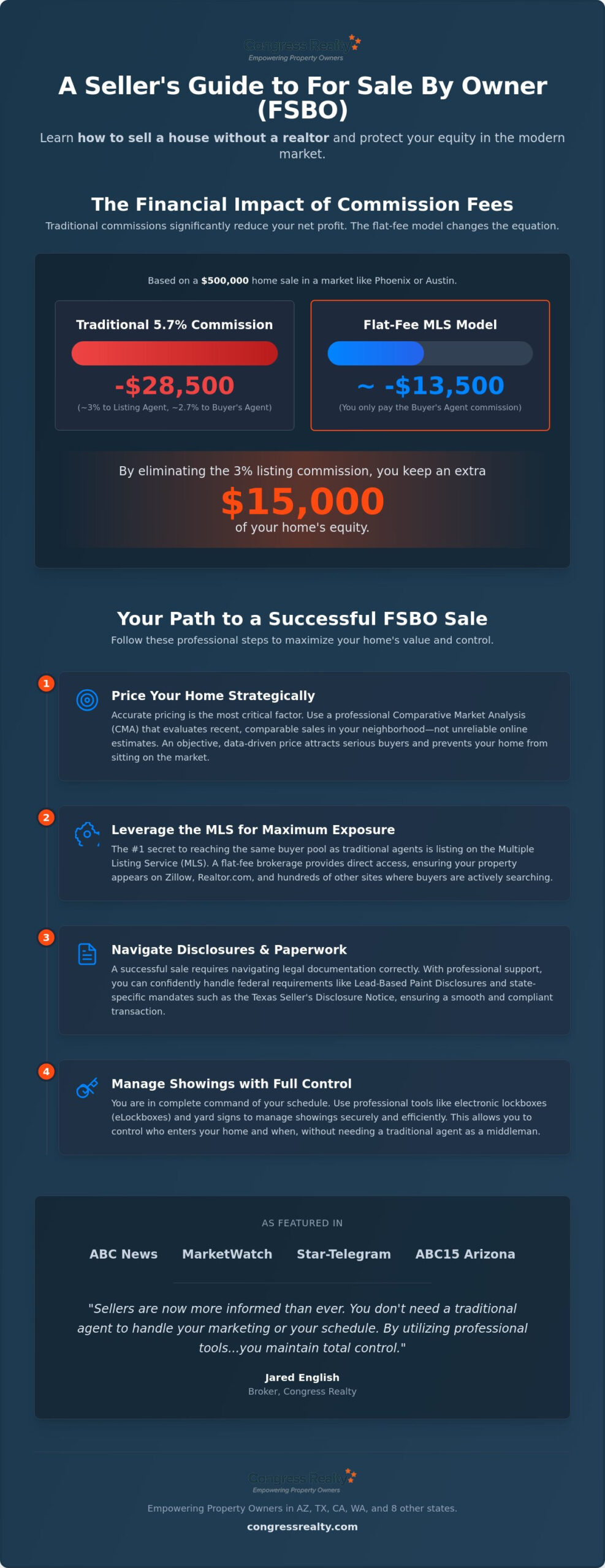
The financial benefit of the flat fee model is immediate and measurable. Traditional models typically involve a total commission near 6%. This is usually split into 3% for the buyer’s agent and 3% for the listing agent. By managing the listing side yourself, you eliminate that second half of the fee. On a $500,000 home in a market like Dallas or Scottsdale, skipping that 3% fee translates to $15,000 in additional profit. MarketWatch and ABC News have highlighted how these savings allow sellers to be more flexible with their pricing or simply walk away with a larger check. You can see the full process for starting your listing at Congress Realty. This approach ensures your equity stays where it belongs.
Pricing and Preparation: The Foundation of a Successful Sale
Congress Realty, a flat fee MLS brokerage serving Phoenix, Arizona and Austin, Texas, provides the professional tools required to establish a competitive market position. While the mechanics of how to sell a house without a realtor are straightforward, your success depends entirely on the data you use to set your price. Jared English notes that an overpriced home will languish regardless of the marketing budget. Buyers in 2026 are highly sensitive to market value. You must approach your sale with a market-first mindset that prioritizes objective data over personal attachment.
How to Price Your Home Without an Agent
To answer a common homeowner question: how do I price my home without a realtor? You should request a Comparative Market Analysis (CMA) that evaluates recently sold homes of similar size and condition in your specific neighborhood. Accurate pricing is the single most important factor in a solo home sale. Many sellers rely on automated online estimates, but these are often inaccurate and lead to costly mistakes. Congress Realty recommends a CMA to find your true value. Unlike a formal appraisal, which is a bank-mandated valuation for lending, a CMA looks at what similar homes in neighborhoods like Scottsdale or Dallas actually sold for in the last six months. Researching these comps helps you avoid the emotional pricing trap that often plagues independent sellers. You can use this step-by-step guide to FSBO to better understand how to evaluate a buyer’s financial strength alongside your price point. Setting a realistic price from day one creates the momentum needed to attract serious offers quickly.
Preparing Your Property for Professional Photography
Professional preparation involves more than just a deep clean. Since 90% of buyers find their next home online, your digital presentation is your most powerful marketing tool. High-quality imagery is non-negotiable for a professional MLS listing. Before the photographer arrives, follow this checklist to maximize your home’s appeal:
- Declutter every room to make spaces feel larger and more inviting.
- Optimize lighting by opening all blinds and replacing dim bulbs with bright, neutral tones.
- Enhance curb appeal by tidying landscaping and cleaning the entryway thoroughly.
Virtual tours also play a critical role in 2026. They allow buyers to walk through your home digitally. This reduces unnecessary showings and ensures that only the most interested parties visit in person. If you are ready to position your home for a successful sale, you can request a professional CMA to start with the right data. This strategic preparation ensures your equity remains protected through a faster, more efficient closing process.
Leveraging the MLS: The Secret to Maximum Exposure
Congress Realty, a flat fee MLS brokerage serving Phoenix, Arizona and Austin, Texas, provides the professional infrastructure required to compete in the modern real estate market. The Multiple Listing Service (MLS) is the definitive database used by every licensed real estate professional. When you explore how to sell a house without a realtor, you realize that listing on this database is the single most effective way to gain market traction. Without an MLS entry, your property remains invisible to the vast majority of qualified buyers. This database is the source of truth for the industry, feeding every other major property site on the web.
Syndication is the process that pushes your listing from the local MLS to global platforms. Congress Realty ensures your home appears on Zillow, Trulia, and Realtor.com automatically. This broad exposure is vital because it captures the attention of out-of-state buyers moving to growing hubs like Dallas or Tucson. By using a professional service, you gain the same digital footprint as a traditional 6% brokerage without sacrificing your equity. Jared English, the broker at Congress Realty, notes that the MLS acts as a professional seal of approval that signals your home is ready for purchase. A flat fee MLS listing Phoenix Arizona ensures your property appears where 90% of buyers are looking.
Why the MLS is Essential for Independent Sellers
The MLS serves as the primary data feed for every major real estate portal in the country. Professional syndication ensures that your high quality photos and property details are synchronized across all platforms. This consistency builds trust with potential buyers and their representatives. Relying on yard signs alone is a strategy of the past. Today, digital visibility determines the speed of your sale. You can learn how to list on the MLS with Congress Realty to start your marketing journey with professional grade tools and maximum reach.
Managing Showings and Buyer Agent Inquiries
Taking control of the showing process is a core part of learning how to sell a house without a realtor successfully. Congress Realty provides electronic lockboxes to ensure only licensed agents can access your property. This technology keeps your home secure while allowing you to maintain a flexible schedule. In the post-settlement real estate environment of 2026, you also have the freedom to decide how to handle buyer agent commissions. Data from 2026 shows that approximately 75% of FSBO sellers still choose to pay a buyer’s agent commission to maintain a competitive edge. Utilizing yard signs and phone forwarding services further solidifies your professional image. If you are looking for advanced solutions to manage your communication and outreach, you can visit Calls-Are-Us for specialized tools. These tools ensure you never miss a lead while keeping your personal information private. This strategic approach allows you to step back and let the professional infrastructure manage the logistics.
Navigating Legal Paperwork and Disclosures
Congress Realty, a flat fee MLS brokerage serving Phoenix, Arizona and Austin, Texas, simplifies the legal complexities of independent home sales by providing professional grade documentation. Managing the legal requirements is a critical phase of learning how to sell a house without a realtor while protecting your hard earned equity. Every state maintains unique disclosure requirements that you must follow to avoid future lawsuits. Jared English, the broker at Congress Realty, advises that total transparency during the disclosure process is your best legal defense. By using state approved forms, you ensure that your transaction meets the rigorous standards of the modern real estate market.
Mandatory Disclosures in Arizona and Texas
Arizona and Texas have specific mandates that sellers must navigate with precision. In Arizona, you are required to provide the Residential Seller Disclosure Advisory to potential buyers in cities like Scottsdale or Tucson. ABC15 Arizona has reported that common real estate disclosure errors are a leading cause of post sale litigation, which highlights the importance of accuracy. Texas homeowners must complete the Seller’s Disclosure Notice. This document covers the property’s condition, including previous flooding, termite issues, and HOA details. Additionally, federal law requires a lead based paint disclosure for any home built before 1978. You must provide buyers with the EPA pamphlet and allow a ten day period for a lead based paint inspection to remain compliant with federal regulations. Using the professional forms provided by Congress Realty ensures you don’t miss these critical legal steps.
Managing the Contract and Escrow Process
To answer a common homeowner question: who handles the legal paperwork when selling without a realtor? While you manage the initial disclosures and the signing of the purchase contract, a title company or escrow officer handles the technical closing logistics. They act as a neutral third party to manage the transfer of funds and the official recording of the deed. You will use a standard purchase contract specific to your region, such as those used in Dallas or Phoenix, to outline the terms of the sale. Understanding these documents is straightforward when you have the right professional infrastructure. You can check out our guide on the legal side of selling your own home for a deeper look at the 2026 equity first requirements. This structured approach demystifies the escrow process and keeps you in command of the final transaction.
If you are ready to secure your state approved forms and move forward with a professional listing, get started with Congress Realty today. Taking these steps now ensures your closing process is efficient and legally sound.
Closing the Deal with the Congress Realty Advantage
Congress Realty, a flat fee MLS brokerage serving Phoenix, Arizona and Austin, Texas, facilitates the final coordination required to bring your home sale to a successful close. The final stages of any transaction demand precise communication between you, the buyer, and the title company. Jared English, who has overseen thousands of successful closings since founding the firm in 2002, emphasizes that the goal is a seamless transfer of ownership that protects your equity. By utilizing professional transaction management, you navigate the complexities of escrow with the confidence of an industry expert. This pragmatic approach ensures that your financial intelligence translates into actual savings at the closing table.
Navigating Inspections and Appraisals
How do you handle repair requests when selling on your own? You should review the inspection report objectively and focus only on structural or safety issues. Maintaining a professional tone during these final negotiations prevents emotional friction from stalling the deal. If an appraisal in a market like Scottsdale or Dallas comes in lower than the agreed price, you have several options. You can ask the buyer to cover the gap, lower the sales price, or meet in the middle. Being prepared for these scenarios is a key part of mastering how to sell a house without a realtor. Your ability to remain pragmatic during this phase ensures the deal stays on track without the need for a traditional agent’s intervention. You remain in the lead, making decisions that favor your bottom line.
Your Path to a Commission-Free Sale
The final step in your journey is reviewing the Closing Disclosure for accuracy. This document outlines every fee and credit involved in the transaction. You should verify that the listing commission savings are reflected correctly in your net proceeds. Once the title company records the deed and funds are disbursed, you simply hand over the keys and conclude the transaction. Successfully managing this process is a major financial win that can save you tens of thousands of dollars compared to traditional models. You can view our flat fee listing packages to choose the level of professional support that fits your specific needs. Celebrating your saved equity is the ultimate reward for taking command of your property sale. By choosing an equity first model, you have proven that managing a professional real estate transaction is both achievable and highly rewarding.
Take Control of Your Home Equity and Your Sale
Congress Realty, a flat fee MLS brokerage serving Phoenix, Austin, and Dallas, provides the path to a smarter transaction. You’ve learned that how to sell a house without a realtor is not just about saving money; it’s about maintaining command over your most valuable asset. By bypassing the traditional listing commission, you can save up to 3% of your home’s value at the closing table. This is financial intelligence in action.
You now have the blueprint to manage your professional MLS exposure in 12 states with the support of broker Jared English. This approach, featured in MarketWatch and ABC News, combines your local knowledge with our professional infrastructure. You don’t need a high-cost agent to navigate the 2026 market successfully. You simply need the right tools to reach buyers and the confidence to lead the process.
Start your commission-free listing with Congress Realty today. It’s time to secure your equity and manage your sale with the professional advocacy you deserve. Your successful, independent closing is just a few steps away.
Frequently Asked Questions
Can I really sell my house without a realtor in 2026?
Yes, selling your home independently is a legal and pragmatic strategy in 2026. While only 5% of sellers chose this path in 2025, those who do often prioritize financial intelligence and equity retention. By choosing how to sell a house without a realtor, you take direct control of the transaction. Congress Realty provides the professional infrastructure to ensure your sale meets the same standards as an agent led listing.
How do I get my house on the MLS without an agent?
You list your property on the local Multiple Listing Service through a flat fee brokerage like Congress Realty. This service places your home on the same professional database used by all licensed agents in Phoenix or Austin. It ensures your listing syndicates to major portals like Zillow and Realtor.com. This method provides maximum exposure without the burden of a 3% listing commission.
What is the biggest risk of selling FSBO?
Legal liability from improper disclosures is the most significant risk for independent sellers. Failure to disclose material defects or follow federal lead based paint laws for homes built before 1978 can lead to expensive lawsuits. Jared English notes that using state approved forms is the best way to mitigate this risk. Professional documentation ensures you meet all requirements in states like Arizona and Texas.
Do I still have to pay the buyer’s agent commission?
No law requires you to pay a buyer’s agent, but 75% of FSBO sellers in 2026 choose to offer a commission to remain competitive. This incentive encourages agents to show your home to their clients. Offering a competitive rate, which averages around 2.82% nationally, ensures your property remains a top choice for buyers in Scottsdale or Dallas who are already represented by a professional.
What legal documents are required to sell a house by owner in Texas?
Texas sellers must provide a Seller’s Disclosure Notice and a Lead Based Paint Disclosure if the home was built before 1978. These documents outline the condition of the property and its history of repairs or defects. Congress Realty provides these essential state approved forms to its clients in Dallas and Austin. Completing these accurately is your primary defense against post sale legal disputes.
How much can I save by using a flat fee MLS service?
You save the listing side of the real estate commission, which currently averages 2.88% of the total sale price. On a $500,000 property, this keeps $14,400 of your equity in your bank account. By paying a fixed fee instead of a percentage, you eliminate the high costs that typically eat into your profit at the closing table. This is a significant financial advantage for any savvy homeowner.
Is Congress Realty a legitimate real estate brokerage?
Congress Realty is a fully licensed real estate brokerage founded in 2002. Broker Jared English oversees operations in 12 states, providing a reliable alternative to traditional high commission models. The firm has earned recognition from ABC News and MarketWatch for its role in empowering homeowners. It offers a legitimate, professional path to the MLS for savvy sellers who value autonomy.
What happens if I cannot sell the house on my own?
You have the flexibility to adjust your listing price or marketing strategy at any time. Jared English recommends reviewing a fresh CMA to ensure your price reflects current market conditions in cities like Tucson or Scottsdale. Congress Realty provides the tools to update your listing or add features like eLockboxes to increase showing activity and drive results. You are never locked into a failing strategy.