Congress Realty is a flat fee MLS brokerage serving home sellers, with Multiple Listing Services to put a home on the MLS. For home sellers, offering a competitive buyer agent commission is one way to address buyer-agent compensation as part of a sale, but sellers don’t have to pay it.
Should you contribute to the buyer’s agent fee or leave it to the buyer? The answer depends on the offer and negotiations. Sellers may contribute some or all of the fee, while buyers and their agents must agree on compensation in writing before touring a home.
It’s reasonable to weigh that expense against buyer affordability and the appeal of your offer. This article explains how seller-paid compensation can affect what buyers need to pay, when an offer may include a seller contribution, and how to make compensation terms clear. It also covers an important change: since August 17, 2024, the MLS can’t publish offers of buyer-broker compensation. Understand your options, then decide whether a contribution fits your sale strategy, and plan the next steps for your home sale.
Key Takeaways
- Buyer-agent fees are negotiable, and buyers must agree to their agent’s compensation in writing before touring a home.
- Sellers can choose whether to contribute toward a buyer agent’s fee as part of offer negotiations.
- A seller contribution may reduce the buyer’s out-of-pocket costs, which can affect affordability.
- Clear, considered compensation terms can help sellers shape an offer that appeals to buyers and their agents.
- Since August 17, 2024, sellers cannot publish offers of buyer-broker compensation in the MLS.
1. Should sellers still pay the buyer’s agent commission?
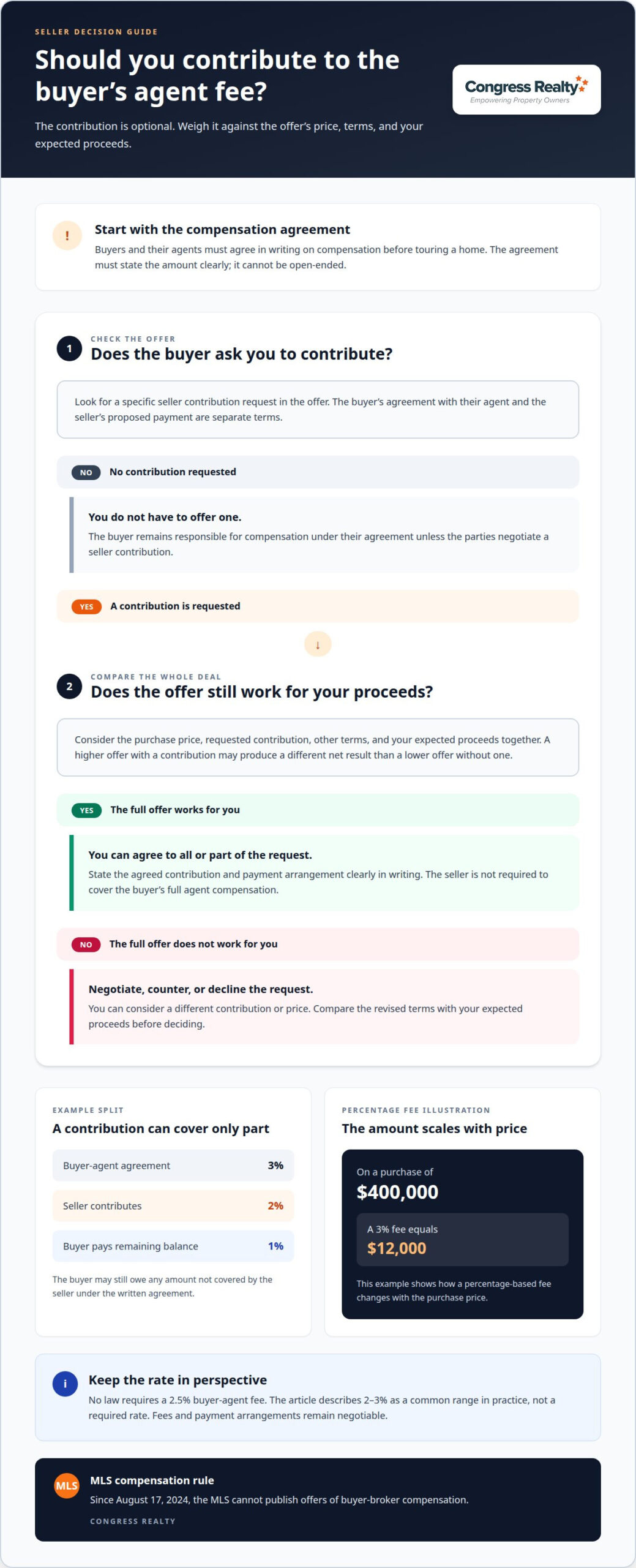
Yes, sellers can still contribute to a buyer agent’s compensation, but they don’t have to. Since August 2024, buyers and their real estate agents must agree in writing on compensation before touring a home. That agreement must state the agent’s compensation clearly, and the amount cannot remain open-ended. The National Association of Realtors settlement did not prohibit seller contributions. It changed how buyers and agents discuss and document payment.
Fees remain negotiable. No law requires a 2.5% buyer-agent fee, and 2 to 3 percent remains a common compensation range in practice. Buyers can compare agreement terms with multiple agents before committing. Sellers can decide whether to offer a contribution, negotiate it as part of an offer, or leave the fee to the buyer. The right choice depends on the offer’s full financial terms, not a standard rate.
How do buyer agent commission rates compare with flat-fee or hourly options? A percentage-based fee changes with the sale price, while flat-fee and hourly arrangements use a set amount or time-based charge. Compare the agreement’s payment method and included services rather than assuming one structure costs less. On a $400,000 purchase, a 3% fee equals $12,000, illustrating how a percentage can scale with price.
Buyers should compare an agent’s proposed commission with the services in the written agreement. Review the scope of representation, the compensation amount, and when payment is due. Ask how the agent will support the home search, offer, and transaction, then compare the terms in any agreements you are considering. Understand the contract before signing, especially if the seller may contribute only part of the fee the buyer and agent agreed on.
Seller contributions can affect affordability because buyers may need to cover any unpaid balance themselves. For example, an agreement could set compensation at 3%, with the seller paying 2% and the buyer paying the remaining 1%. A mortgage does not automatically absorb that separate obligation. In negotiation, consider the purchase price and requested concession together: a higher offer paired with a seller contribution may produce a different net result than a lower offer without one.
What are the risks of offering too little or too much buyer-agent compensation? A smaller contribution may leave the buyer with more to pay, while a larger one may reduce the seller’s proceeds without improving the offer’s overall value. Discuss the amount clearly and assess it alongside the price and other terms. Sellers can compare the requested contribution with the buyer’s offer and expected proceeds before deciding whether to accept or counter.
Keep the discussion specific: state the proposed contribution, connect it to the offer terms, and document any agreement in writing. Buyers, sellers, and agents can negotiate who pays; no single split applies to every transaction. Compare expected proceeds with the buyer’s affordability before accepting a concession. This keeps the focus on the complete deal, rather than treating a commission percentage as automatic.
2. Seller-paid buyer-agent compensation
Sellers are not required to pay a buyer agent’s compensation. Following the National Association of Realtors settlement, the buyer, seller, or both may pay, depending on the transaction and negotiations. A seller’s decision can affect an offer, but it does not establish a standard fee or require the same payment arrangement in every sale.
Historically, real estate commissions often totaled 5 to 6 percent of a home’s sale price, with the listing agent and buyer’s agent sharing the compensation. Under that traditional model, a seller paying 6% would typically allocate 3% to each side’s agent. That practice helps explain why buyers and sellers may still discuss a seller contribution, but it does not make the old split automatic.
Keep three points distinct during negotiations: the agent’s compensation, who pays it, and any concession the seller agrees to after the buyer requests it in the offer. The buyer and agent set compensation in their written agreement. The offer can then ask the seller to contribute toward that amount. For example, a buyer may request a contribution, while the seller considers it alongside the proposed price and other terms.
A concession does not mean the seller will pay the agent’s full fee. The seller can accept the request, reject it, or negotiate a different contribution. If the seller pays only part, the buyer may still owe the balance under the buyer-agent agreement. Document the agreed amount and payment arrangement so both sides understand their commitment.
Compare the entire offer, not just its concession. A higher purchase price with a requested contribution may leave the seller with different net proceeds than a lower offer without one. Account for the seller’s other transaction costs and the agreed terms. For buyers, a seller contribution may reduce the amount they pay directly, but it does not change the compensation agreed with their agent.
Make the proposal easy to assess. State the requested contribution clearly, explain how it relates to the offer, and identify any conditions affecting payment. Sellers can counter with a revised price, a smaller contribution, or another acceptable arrangement. Buyers can also negotiate with their agent instead of assuming the seller will cover every amount in the written agreement.
Use this approach whether you represent a first-time buyer or a seller comparing several offers. Each party should understand who pays, how much the seller contributes, and what the buyer may owe. To prepare your property for a sale while keeping offer terms in view, explore home-selling options.
3. Buyer agent compensation and buyer affordability
Buyer-agent compensation affects more than the final sale price. Buyers need funds for the down payment, closing costs, and any agent compensation they owe. Under the lending rules for this market, lenders do not let buyers finance agent commissions into a mortgage. Buyers therefore need to pay any amount due directly, which can limit their cash flexibility even when the purchase price fits their borrowing limit.
Redfin reported that the average U.S. buyer-agent commission was 2.37% in the fourth quarter of 2024, compared with 2.45% one year earlier. That market figure does not set the fee for an individual transaction. Compensation remains negotiable between buyers and agents, and the written agreement should state the amount and payment terms clearly.
Consider the buyer’s full budget before deciding how a seller contribution could affect affordability. A first-time buyer purchasing a median-price existing home and paying a reduced 1.5% agent fee directly would need an additional $6,000. That example shows why cash available at closing matters alongside the mortgage payment. A seller contribution may reduce the buyer’s immediate out-of-pocket obligation, depending on the offer and agreed terms.
Buyers using VA loans may also have difficulty paying their agent directly, according to reports from agents. What matters is whether the buyer can cover the agreement’s fee alongside other purchase expenses. A seller contribution can address part of that gap, but the buyer remains responsible for any balance they agreed to pay. State the proposed amount clearly in the offer.
Sellers should weigh the requested contribution against the offer price, contingencies, and expected net proceeds. A concession toward agent compensation is part of the negotiated transaction, not extra money outside the deal. Compare all the terms rather than judging affordability by the commission alone. Buyers should clarify with their agent how any seller payment affects the amount due at closing.
Before signing, review the total agent compensation in the written agreement, the seller contribution requested, and the remaining amount the buyer must pay. Compare that balance with available cash for closing costs and other expenses. This makes the financial obligation clear early, helping buyers and sellers negotiate using specific figures instead of assumptions.
4. Commission offers and attracting buyer agents
A clear compensation offer helps buyers understand the financial terms before deciding whether to tour. It gives sellers a specific point to negotiate instead of relying on assumptions about standard rates. Since the National Association of Realtors settlement changes took effect in August 2024, buyer-agent compensation depends on negotiation. Sellers can choose whether to contribute and how that offer fits their transaction.
There is no single percentage that makes an offer competitive in every listing. In 2026, some sellers offer 2 to 2.5 percent toward buyer-agent compensation. Those figures reflect reported practices, not a required rate or a promise of a particular response. For sellers, offering a competitive buyer agent commission means considering local offer conditions, the property, and expected proceeds before setting terms.
Assess the offer in three parts: the contribution amount, the purchase price, and the other requested terms. For example, an offer requesting seller-paid compensation may also include a price that affects the seller’s net proceeds. Compare the terms together. A larger percentage can increase the seller’s expense, while a smaller contribution may leave the buyer with more to pay under the written agreement.
Specific transaction examples show why sellers should avoid treating one figure as a formula. One reported seller agreed to 1.8% buyer-agent compensation in a particular transaction. Another agent says they intentionally request no more than 2% to keep offers competitive. These examples reflect different negotiations, not a guaranteed outcome or universal brokerage standard.
Make the terms easy to assess. State the exact contribution offered, explain how it relates to the purchase offer, and use consistent wording across relevant documents. Buyers can compare the seller’s proposed payment with their written agreement and identify any remaining amount. Sellers can evaluate requests across offers without confusing agent compensation with the purchase price.
A seller may also advertise compensation outside the MLS. The settlement did not prevent sellers from paying buyer agents or advertising compensation on platforms other than the MLS. Since August 17, 2024, however, MLS rules prohibit sellers from including offers of buyer-broker compensation in the MLS. Keep that distinction clear when planning a listing and communicating an offer.
Treat the percentage as one negotiation term, not a substitute for assessing the entire offer. Consider expected proceeds, the buyer’s requested contribution, and other conditions together, then decide whether the terms support your goals. Offering a competitive buyer agent commission is a deliberate choice, not a guarantee that every buyer agent will respond or that the transaction will close.
5. Can sellers offer buyer agent compensation in an MLS listing?
No. As of August 17, 2024, sellers cannot publish offers of buyer-broker compensation in the MLS. That restriction applies to the compensation offer, not to the seller’s ability to negotiate payment. Sellers can still decide whether to contribute toward a buyer agent’s fee as part of a transaction. Keep the distinction clear: an MLS listing can market the property, while compensation terms require another communication route.
The National Association of Realtors settlement did not prevent sellers from paying buyer agents or communicating compensation offers outside the MLS. A seller can discuss an offer outside the MLS and negotiate its details with a buyer. The buyer’s written agreement with their agent states the compensation they agreed on. The purchase offer can address any requested seller contribution, bringing the proposed payment into the transaction discussion.
Keep property information separate from compensation discussions. For example, an MLS listing can describe the home and state its asking price without offering to pay the buyer’s agent. If a buyer later requests a contribution, the seller can assess it alongside the proposed price and other terms. This keeps the listing focused while allowing both parties to discuss compensation directly.
Use clear language when communicating outside the MLS. State whether the seller is willing to consider a contribution, the proposed amount, and whether it depends on other offer terms. Avoid implying that a standard percentage applies to every buyer. The amount is negotiable, and the buyer may owe the difference between the seller’s contribution and the fee in their written agreement.
When preparing a listing, plan two separate steps: publish the property information through the MLS, then discuss any compensation proposal through permitted channels outside it. Do not put an offer to pay buyer-broker compensation in the MLS, even if the seller wants to advertise one. Record accepted terms in the transaction paperwork so the buyer, seller, and agents understand who pays.
Keeping the two discussions separate also helps buyers assess affordability before making an offer. They can compare the seller’s proposed contribution with the compensation agreed with their agent. Sellers can compare the requested contribution with the offer price and expected proceeds. A clear record prevents confusion between listing details and a negotiated payment arrangement.
Prepare your property information and sale terms with a clear plan for handling compensation discussions outside the MLS. Plan your home sale with those distinctions in mind.
Congress Realty
Congress Realty supports the listing side of your sale while you decide how to handle buyer-agent compensation. Its Multiple Listing Services place your home on the MLS, which is exclusive to members and provides the same exposure as listings where sellers pay a full commission. Only MLS members can make listing changes, and Congress Realty makes them on your behalf. A Virtual Tour and Yard Sign can help present the property. These listing tools are separate from negotiating a buyer-agent contribution, so state the amount and payment terms clearly in offer discussions.
If you’re preparing to sell and want help with the listing process, contact Congress Realty.
Set your compensation strategy before your home goes to market
Before listing, decide what matters most: protecting your expected proceeds, considering a wider range of offers, or balancing both. Set a clear limit for any contribution you may negotiate. This gives you a practical reference when an offer arrives and helps you assess the whole proposal instead of reacting to one term in isolation.
Offering a competitive buyer agent commission is a strategy, not a guarantee of buyer interest or a substitute for evaluating the home’s presentation and offer terms. Stay open to considering the full transaction while making deliberate decisions based on your priorities. If an offer requests a contribution, compare it with the price and your goals before responding.
When you’re ready to plan your listing and put your sale strategy into action, explore your home-selling options. Take control of the decisions that shape your sale and move forward with a plan that fits your goals.
Frequently Asked Questions
Should sellers still pay the buyer’s agent commission?
No. A Phoenix seller can decide whether to contribute toward buyer-agent compensation. When comparing offers, consider the requested contribution alongside the purchase price, contingencies, and expected proceeds. For example, two offers with similar prices may result in different net amounts if only one requests a seller contribution. Compare the terms with your sale priorities rather than treating compensation as an automatic expense.
What is a typical buyer agent commission in the U.S.?
In 2026, reported buyer-agent commission rates commonly range from 2.00% to 3.50% of the sale price, with a national average of about 2.82%. Those figures describe market activity, not a required fee or a quote for a Phoenix transaction. Buyers should review the amount in their written agreement. Sellers should treat any requested contribution as a negotiable offer term.
How are buyer agent commissions negotiated after the 2024 NAR settlement?
Buyers and agents negotiate compensation and record the agreed amount in a written agreement before touring a home. The agreement should clearly state the payment terms. A Phoenix buyer can compare agreement terms before choosing representation, then consider whether to request seller assistance in an offer. Keeping the agent agreement and seller request distinct makes each party’s financial commitment easier to understand.
What commission rates are competitive for buyer agents in different markets?
No single rate defines a competitive offer across every market, including Phoenix. Sellers can assess the property, the offers they receive, and what buyers may need to pay under their agreements. A proposed contribution should also fit the seller’s expected proceeds. Compare complete offers rather than relying on a percentage alone, since the price and other conditions affect overall value.
Who pays the buyer agent commission under current real estate rules?
The buyer, seller, or both may pay, depending on the agreement and transaction negotiations. In a Phoenix offer, a buyer could ask the seller to contribute toward the compensation agreed with the buyer’s agent. The seller can accept, reject, or counter the request. Buyers should account for any remaining amount they owe, while sellers should assess the request alongside the offer’s other terms.
Do buyer agent commission rules vary by state or local market?
Negotiation practices can vary by location, so a national average does not determine the right terms for a Phoenix sale. Local property conditions and the offers presented can shape what buyers and sellers discuss. Focus on the buyer-agent agreement and the specific offer terms. This helps both parties assess compensation in the context of their transaction instead of assuming one approach suits every market.