
Congress Realty provides Multiple Listing Services for home sellers in Phoenix, Arizona. Phoenix sellers can decline a VA offer and assess the full contract, not just its financing type. A key part of what sellers should know about VA loans is to compare the offer’s price, contingencies, requested seller contributions, and timing.
Phoenix homeowners may wonder whether a VA offer changes their costs or adds steps to the sale. This guide compares VA and conventional financing, including buyer cash, seller costs, appraisal considerations, and closing timelines. Use these details to assess each offer on its terms and decide how to proceed.
Key Takeaways
- Compare the full offer, including price, contingencies, requested seller contributions, and closing timeline, rather than judging it by loan type alone.
- Understand what the VA appraisal evaluates and how a property-condition issue could affect the transaction.
- Separate seller-paid costs from buyer-paid costs, and see how negotiated concessions can change the offer’s net value.
- Account for the difference between a buyer’s down payment and their total cash needed to close.
- Use the offer details to decide which terms matter most to your sale and where there may be room to negotiate.
Can a Seller Refuse a VA Loan?
Yes. You can decline a VA-financed offer or choose another offer based on its price, contingencies, and timing. The loan type alone doesn’t show whether a buyer will close or what your net proceeds will be. Compare the written terms, then assess any appraisal-related repairs or seller-paid costs before accepting.
A VA appraisal assesses the home’s value and whether it meets the VA’s minimum property requirements. A U.S. Department of Veterans Affairs-approved appraiser checks for basic safety and soundness concerns. The home doesn’t have to be perfect, and an appraisal isn’t a full home inspection. For example, an appraisal may flag a safety issue that needs attention, while a separate inspection can examine the property more broadly.
Common concerns include peeling paint on homes built before 1978, which a VA appraisal may flag for repair. Other property-condition issues can also require attention if they affect the home’s safety or soundness. If the appraisal identifies a problem and an exemption isn’t granted, you don’t have to pay for repairs. The buyer may pay instead to keep the transaction moving. Clarify repair responsibilities in the offer so everyone understands the proposed next step.
Eligibility questions concern the buyer, not the seller’s decision to accept an offer. National Guard members may meet VA home loan eligibility requirements with at least 90 days of active service, including at least 30 consecutive days under specified Title 32 provisions. They may also meet requirements with at least 30 consecutive days of qualifying active service under specified Title 32 provisions. You don’t need to evaluate service records. Focus on the offer, financing conditions, and appraisal process.
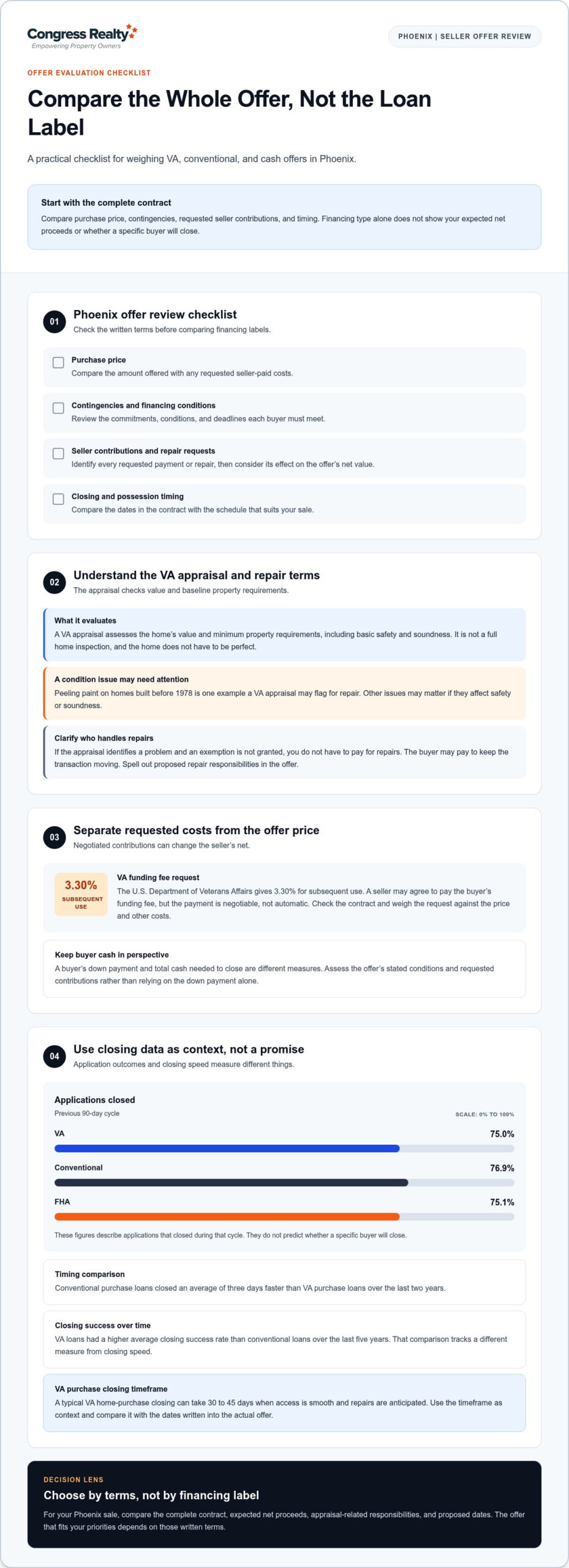
Funding-fee negotiations can affect the seller’s net. A seller may agree to pay a VA buyer’s funding fee, which the U.S. Department of Veterans Affairs gives as 3.30% for subsequent use. That payment is negotiable, not automatic. Review the contract to see whether the buyer requests this contribution and compare it with the offer price and other requested costs.
| Offer option | Appraisal and repairs | Seller’s decision focus |
|---|---|---|
| VA financing | Value and minimum property requirements | Price, contingencies, repairs, and requested costs |
| Conventional financing | Compare the offer’s appraisal and contract terms | Price, contingencies, and expected net proceeds |
| Cash offer | Review the offer’s inspection and condition terms | Price, contingencies, and closing terms |
Choose the offer whose complete terms best match your priorities, not simply its financing label. A key point in what sellers should know about VA loans is that appraisal requirements assess value and baseline safety, not demand a flawless home.
VA loan closing rates compared with conventional and FHA loans
Closing speed and closing success are different measures. Conventional purchase loans closed an average of three days faster than VA purchase loans over the last two years. However, VA loans had a higher average closing success rate than conventional loans over the last five years. One comparison measures timing; the other tracks whether applications reached closing.
In the previous 90-day cycle, 75.0% of VA purchase loan applications closed. Conventional applications closed at 76.9%, while FHA applications closed at 75.1%. These figures put the three financing options close together for that period, with conventional ahead. They don’t show whether a specific buyer will close, so assess each offer’s financing conditions and deadlines.
| Loan type | Applications closed in previous 90-day cycle | Practical comparison |
|---|---|---|
| VA | 75.0% | Backed in part by a federal guaranty |
| Conventional | 76.9% | Closed three days faster than VA on average over the last two years |
| FHA | 75.1% | Close rate was near the VA figure in that cycle |
The U.S. Department of Veterans Affairs guarantees a portion of VA home loans. Private lenders, including banks and mortgage companies, provide the loans and handle underwriting. The buyer still needs lender approval. A VA guaranty supports the loan, but it doesn’t replace the lender’s review of income, credit, and ability to repay.
Eligible buyers may benefit from features that affect their buying budget. VA home loans don’t require private mortgage insurance. They generally allow more flexible credit score requirements and higher debt-to-income ratios than conventional loans. Eligible borrowers with full VA entitlement may qualify for a VA loan with no loan limits. These features can help a qualified buyer structure a purchase, but they don’t determine the offer price or contingencies.
For VA-guaranteed purchase loans, buyers need satisfactory credit, sufficient income for expected monthly obligations, and a valid Certificate of Eligibility. They obtain the Certificate of Eligibility before securing a loan through a lender of their choice. As a seller, focus on the offer’s financing timeline, requested concessions, and stated contingencies. Compare those terms with the proposed closing date, not just the loan label.
A typical VA home-purchase closing can take 30 to 45 days when access is smooth and repairs are anticipated. Use that timeframe as context, then review the dates written into the actual offer. If you’re preparing to sell, organize your property details and timelines through home-selling resources before comparing competing offers.
Evaluating a VA offer against a conventional offer
The financing label alone won’t tell you which offer better fits your plans. Compare the written commitments, dates, and steps each buyer must complete, then weigh them against your preferred sale schedule.
Seller Acceptance or Refusal
You can accept a VA offer, accept a conventional offer, or decline either. Compare the complete contract: purchase price, contingencies, requested contributions, possession date, and any conditions tied to the buyer’s current home. For example, a seller with a firm move-out plan may prioritize a suitable possession date, while another may prefer more flexibility around closing.
Seller Concerns and Risk Reduction
If you’re concerned about uncertainty or added coordination in a VA transaction, clarify each party’s next step, relevant contract deadline, and how updates will reach you. Request important changes in writing, and keep one current record of agreed dates and responsibilities. This helps you track progress without relying on assumptions about either financing type.
Make a side-by-side comparison before responding. Record the offer amount, requested seller payments, contingencies, possession terms, and deadlines that affect your move. Note what each condition requires from you. Conventional offers can include requests or dependencies, just as VA offers can. Evaluate the actual contract language rather than assuming one loan category is automatically simpler.
Look closely at conditions beyond the buyer’s loan. A buyer who needs to sell another property first, for instance, faces a different path from one without that condition. Consider how the dependency interacts with your plans and the proposed dates. If you need certainty about when you can vacate, make possession terms central to your comparison.
Keep your response focused on negotiable terms. If you prefer a different possession date or want to adjust a requested contribution, state the change clearly in your counteroffer. Review the revised document against the original to see exactly what changed. This creates a clear decision record and helps prevent overlooked terms from shaping your expectations.
Choose the offer whose complete terms best support your sale priorities. Comparing commitments, dependencies, and dates gives you a practical basis for accepting, negotiating, or declining without relying on assumptions about VA or conventional financing.
Seller-paid closing costs and the concession guideline
Put every requested seller payment beside the offer price before estimating your proceeds. According to the U.S. Department of Veterans Affairs, VA guidelines allow sellers to pay up to 4% of the selling price in concessions. This is a limit on permitted concessions, not a required seller payment. You can accept, reject, or negotiate the contribution in the purchase contract.
Distinguish the buyer’s requested closing costs from other concessions. You aren’t required to pay any of a VA buyer’s closing costs. A buyer may request help with specific expenses, but the contract should identify each requested payment. Don’t treat every seller-paid item as interchangeable. Request an itemized breakdown, then consider how each line affects your expected proceeds.
Use a simple worksheet to make the comparison concrete:
- Write down the offer price and every requested seller contribution.
- Separate closing-cost requests from other negotiated concessions.
- Subtract agreed payments when estimating your proceeds.
- Compare the result with competing offers and their contract conditions.
This approach helps you assess requests without assuming that a VA offer automatically shifts costs to you. If one buyer requests help with closing expenses and another offers a different price without a contribution request, compare the full terms. The higher offer may not produce higher net proceeds if requested payments offset the price difference. Use the contract figures rather than assumptions about typical seller payments.
Make the agreement specific. Identify which costs you’ll pay, the amount or calculation method, and how the parties will handle any changes before closing. Clear terms help prevent disagreement about whether you agreed to cover an expense. If a counteroffer changes the contribution, compare the revised wording with your proceeds estimate before accepting.
Preapproval provides context about a buyer’s financing progress, but it isn’t final loan approval. The lender still evaluates the buyer’s credit, income, and ability to meet expected obligations. Review the financing contingency and offer deadlines, then track the required buyer and lender milestones. This lets you monitor progress without assuming preapproval guarantees a closing.
Seller contributions can affect both the buyer’s cash needed at closing and your net proceeds, so weigh both sides of the negotiation. Decide whether you’re willing to contribute and, if so, how much. Then compare that proposal with the price, timing, and other conditions. You control whether to accept the request, negotiate different terms, or decline it.
Zero-down financing and buyer cash reserves
An eligible buyer may purchase a home with a VA loan and no down payment. That doesn’t mean the buyer needs no cash at closing. Distinguish the down payment from other expenses when comparing offers: closing costs, negotiated contributions, and prepaid items can still affect the buyer’s cash plan.
For sellers, zero-down financing changes how to interpret an offer, not its value. A buyer may preserve savings that otherwise would go toward a down payment, but the loan type alone doesn’t reveal available reserves. Review the financing terms, requested seller contributions, and contingencies. Compare the proposed net proceeds with other offers before deciding.
Estimate the mortgage payment using the loan amount and interest rate in the buyer’s financing terms. For a rough VA funding-fee estimate, the guidance suggests adding two to three percent to the home’s asking price when estimating payments for first- or second-time buyers. That adjustment accounts for the funding fee; it isn’t a seller charge or a substitute for the buyer’s lender estimate.
Buyer cash reserves also depend on expenses beyond the down payment. A home inspection is optional for homebuyers, including VA buyers, and buyers usually pay for it. A buyer may also budget for moving expenses and other purchase costs. Use the written offer to identify any expenses the buyer asks you to cover instead of assuming zero-down financing shifts them to you.
A deployed veteran may use a power of attorney to handle a home purchase closing. If a VA buyer plans to do so, include the proposed signing arrangements in transaction planning. Clarify who will sign documents and coordinate access and deadlines with the transaction parties. This keeps logistics clear without treating deployment as a reason to dismiss an otherwise complete offer.
Preapproval shows that a buyer has started the lender’s review, but it doesn’t replace final underwriting. Compare the financing contingency, lender milestones, and closing date in the offer. For a VA-guaranteed purchase loan, the buyer still needs satisfactory credit, sufficient income for expected monthly obligations, and a valid Certificate of Eligibility. These criteria explain what the lender evaluates; the contract sets out your responsibilities.
Make your listing welcoming to veterans by presenting accurate property details and clear showing access. That helps buyers assess the home and plan their financing steps. To organize the sale and present your property clearly, plan your home sale.
Congress Realty: Multiple Listing Services
Congress Realty offers Multiple Listing Services to help homeowners place their property on the MLS while managing a sale. After comparing a VA offer with conventional financing, an MLS listing can present your home to buyers and real estate professionals searching available properties. Accurate property details and clear offer terms help you compare interest, contingencies, and proposed closing costs without treating the buyer’s loan type as the whole decision.
Consider this option if you want MLS exposure while staying involved in your selling decisions. Keep listing information accurate and consistent with the terms you’re prepared to consider. To learn about listing your home through Congress Realty, visit congressrealty.com or contact the company.
Set Your Sale Up on Your Terms
Next, decide how you want to manage the sale, from presenting the property to coordinating buyer access. A clear plan helps you stay organized as offers arrive, whether a buyer uses VA or conventional financing. A final part of what sellers should know about VA loans is that evaluating financing and preparing your listing are separate decisions, and you can approach each thoughtfully.
Congress Realty offers tools for the listing process, including an eLockbox and yard signs. Consider how these fit your preferences for property access and visibility, then choose an approach that keeps you informed and in control.
Contact Congress Realty to discuss your sale. Take the next step with a plan that reflects your priorities and helps you move forward confidently.
Frequently Asked Questions
Are VA Loans Bad for Sellers?
No. A VA loan isn’t automatically a disadvantage to a seller. Assess the specific offer and whether its terms fit your priorities instead of assuming the financing creates a problem. Compare the requested closing date with your moving plans, for example, and review conditions that could affect the sale. A financing label can’t predict how a particular transaction will unfold.
Are VA Loans Assumable?
Yes, VA loans can be assumed, but an assumption has a different process from a buyer getting a new mortgage. Processing can take 60 to 120 days, so account for that timeline in the contract. If you’re considering an assumption, make sure the agreement spells out the expected schedule and the parties’ responsibilities. Don’t treat it like a standard purchase closing with the same timing.
How Does the Appraisal Work?
A VA appraisal provides an opinion of value and checks the property against VA requirements. Its result can affect the buyer’s financing and lead to further discussion if the value differs from the agreed price. Keep the contract and relevant property information accessible, and respond promptly to access requests. If the appraisal raises a concern, address the specific finding rather than assuming it affects the entire home.
Should I Sell to a VA Loan Buyer?
Assess each offer on its merits. A veteran buyer’s financing may suit your sale if the proposed price, timing, and conditions work for you. Compare each offer’s requested terms side by side and consider how they fit your plans for moving or buying another home. The buyer’s veteran status alone doesn’t determine whether the offer meets your needs.
Should I accept a VA loan offer?
Accept the offer if its complete terms align with your goals. Look beyond the financing label to the purchase price, deadlines, contingencies, and any requested seller contribution. Compare those terms with your preferred closing schedule and estimated proceeds. This grounds your decision in the actual agreement rather than assumptions about VA financing.
What About Veterans?
Eligible borrowers can use the VA home loan guaranty more than once during their lifetime. This may matter to a veteran who has used the benefit before and is now buying another home. As a seller, focus on the current offer and its financing conditions, not how the buyer used the benefit previously. The buyer’s lender handles the loan review and required documentation.
What Property Types Are Eligible?
Eligibility depends on whether the property meets VA requirements, not simply on its label or appearance. The appraisal assesses value and minimum property requirements, so a well-maintained home still undergoes that review. You can help by providing accurate property details and arranging appraisal access. Don’t assume a particular property category qualifies without considering the appraisal and the specific transaction.
How do VA loans work for home sellers?
A private lender provides the mortgage, while the VA guarantees a portion of the loan. Your sale still proceeds through an accepted purchase contract, lender review, and property appraisal. Keep communication clear, track contract deadlines, and document agreed changes in writing. These steps help you manage the transaction while the buyer and lender complete the financing process.