
Congress Realty is a flat fee MLS brokerage serving Phoenix sellers who want MLS exposure while managing an FSBO sale. The title company vs real estate attorney for fsbo question is about matching closing tasks and legal questions with the right kind of support.
Should you hire a title company, a real estate attorney, or both? It’s easy to assume one professional handles every closing detail, especially when you’re also managing the sale yourself. Their roles differ, and understanding where they overlap can help you spot gaps before they become urgent.
In an Arizona transaction, a title or escrow company typically coordinates title research, escrow funds, and closing documents. A real estate attorney can provide legal advice and help with contract questions. Neither role replaces the other, and MLS listing support serves a separate purpose: it can give your home MLS exposure while you stay in control of the sale.
This guide explains who generally handles title, legal, and listing tasks, along with practical questions to resolve for your Arizona transaction. Use it to plan, not as legal advice.
Key Takeaways
- Map the steps from accepted offer to closing so you know which decisions stay with you and where professional support fits.
- Compare title and legal tasks to identify the right role for each question.
- Separate title coordination, contract review, and legal advice when deciding what support you need.
- Keep closing assistance and MLS listing exposure as distinct needs when planning your FSBO sale.
- Flat fee MLS support can help you reach the MLS while you retain control of the sale.
Title Company vs. Real Estate Attorney for FSBO: Start With Their Different Roles
Congress Realty provides flat fee MLS listing support for sellers who want MLS exposure while managing their own sale. The company’s listing services address marketing, a separate function from title work and legal representation.
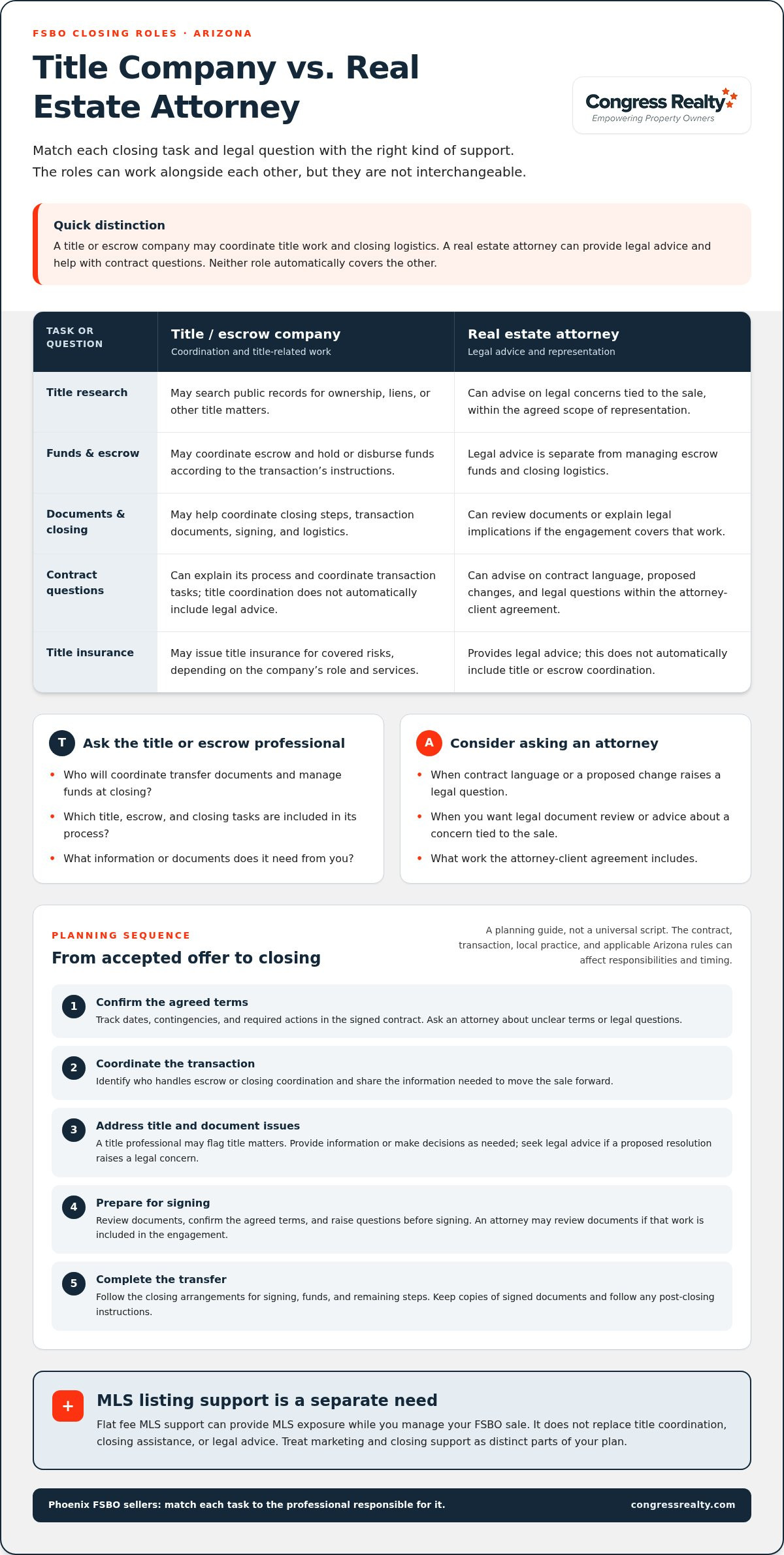
The difference between a title company and a real estate attorney comes down to the work each performs. A title company commonly handles title research and helps coordinate closing tasks. A real estate attorney can provide legal advice and help with legal documents. These functions are separate, not interchangeable. A real estate closing can involve several parties, and roles may vary by transaction and the parties’ arrangements.
What does a title company generally do in an FSBO sale?
A title company may search public records for information about ownership, liens, or other title matters. Depending on its role in the transaction, it may also coordinate escrow, help arrange closing steps, and issue title insurance for covered risks. Escrow generally involves holding and disbursing funds according to the transaction’s instructions. Don’t assume every company handles every task, prepares every document, or provides the same service.
For example, you may want to know who will coordinate transfer documents and manage funds at closing. Ask the company handling escrow or closing coordination how those tasks fit into its process. Its role can depend on local practice, the transaction, and the parties’ arrangements. Title and escrow professionals coordinate transaction tasks, but that work doesn’t automatically include legal advice for you.
What can a real estate attorney do for an FSBO seller?
An attorney can advise a client about legal questions, review documents, and provide contract-related assistance within the scope of the engagement. For an FSBO seller, that may include help understanding contract language, considering proposed changes, or addressing a legal concern tied to the sale. The attorney represents the client who hires them, and the specific work depends on the attorney-client agreement.
That legal role differs from marketing the property. An attorney doesn’t automatically provide MLS access, advertise the home, or manage listing exposure. If you want your home listed in the MLS, treat that as a separate brokerage or listing-support need. To plan clearly, identify who will coordinate title and closing work, where legal advice could help, and how you’ll handle marketing. Then match each need to the appropriate professional instead of expecting one role to cover the entire sale.
How FSBO Closing Tasks Typically Move From Contract to Closing
An accepted offer starts a set of coordinated tasks, but it doesn’t create one universal closing script. The purchase contract, transaction details, local practice, and applicable Arizona rules can affect deadlines and responsibilities. You remain responsible for the decisions and commitments in your agreement. Title or escrow professionals may coordinate closing logistics, while an attorney can advise on legal questions within the agreed scope of representation.
Use this sequence as a planning guide. Not every sale follows the same steps:
- Confirm the agreed terms. Use the signed contract to track dates, contingencies, and required actions. If a term seems unclear or a proposed change raises a legal question, ask an attorney for guidance instead of relying on a title or escrow professional to interpret it.
- Coordinate the transaction. Identify who will handle escrow or closing coordination and share the information needed to move the sale forward. The title or escrow professional may explain its process, request documents, and coordinate relevant deadlines. The contract and the parties’ arrangements help determine who handles each task.
- Address title and document issues. A title professional may research ownership records and flag title matters that need attention. You may need to provide information or make decisions to resolve an issue. If a document or proposed resolution raises a legal concern, seek advice from an attorney. Don’t assume title coordination includes legal review.
- Prepare for signing and closing. The closing professional may coordinate transaction documents and logistics. Review documents, confirm the agreed terms, and raise questions before signing. An attorney may review documents or explain legal implications if the engagement covers that work.
- Complete the transfer. Follow the closing arrangements for signing, funds, and any remaining steps. The responsible professionals and the contract determine the exact process. Keep copies of signed documents and follow any post-closing instructions you receive.
Where can title and legal support enter the process?
Support can enter at different points, not just on closing day. A title or escrow professional may coordinate title-related work and closing logistics. An attorney may review contract language before signing, help assess a proposed change, or address a legal question that comes up later. Neither role automatically includes the other’s work. For the title company versus real estate attorney decision, match the professional to the task, then clarify who handles the remaining steps.
If you also want MLS exposure while managing the transaction, consider how flat fee MLS listing support fits alongside your closing plan. Listing support doesn’t replace title coordination or legal advice, but it addresses a separate part of an FSBO sale.
Title Company vs. Real Estate Attorney for FSBO: Compare Tasks, Not Job Titles
Compare the specific work you need, when it comes up, and the question you want answered. These examples can help you identify gaps, but they don’t guarantee that a particular professional will perform a task. Clarify the transaction arrangements and the scope of any professional engagement.
| Task | Useful stage | Question to resolve |
|---|---|---|
| Title research | After the transaction begins and before the transfer is completed | What title matters or record issues need attention? |
| Escrow or closing coordination | As parties organize deadlines, documents, funds, and signing | Who coordinates each closing step, and what information do they need? |
| Contract review | Before signing or when parties consider a change | Do I understand the proposed terms and their effect on my interests? |
| Legal advice | Whenever a seller faces a legal question about the transaction | How does this document or decision apply to my specific circumstances? |
Which professional addresses title, escrow, and closing coordination?
Use the title and escrow rows to clarify who owns each process. If a title search raises a record issue, find out what information the closing office needs from you and what next step the transaction requires. For escrow logistics, identify who tracks document delivery, funds, and signing arrangements. Responsibilities can vary, so make a task list and record the person or office assigned to each item.
Which professional can answer legal questions about the sale?
Use the contract review and legal advice rows when you need more than a status update or document-processing step. If you’re unsure about a proposed amendment, a deadline clause, or the effect of signing a document, write down the exact question and ask an attorney you engage for legal guidance. The scope of that work depends on the attorney-client arrangement.
One engagement doesn’t necessarily cover every row in the table. You might have closing logistics assigned but still need a separate answer about contract language. Mark each task as assigned, unassigned, or requiring clarification. This gives you a focused way to resolve open items without assuming a professional’s title alone defines the work they’ll do.
How Phoenix FSBO Sellers Can Decide What Support They Need
Start with the work you need done, not the professional title. A clear list helps you separate closing coordination, legal questions, and listing exposure, then spot tasks that still need an owner. In Phoenix, the sale agreement, transaction details, and local practices can shape who handles particular steps. Use this checklist to organize your questions, not as legal advice or a one-size-fits-all rule.
- Title and closing coordination: Identify who will coordinate title-related work, escrow arrangements, document logistics, and closing steps. Note any title questions or deadlines that remain unresolved.
- Legal review: Flag contract language, proposed changes, or documents you don’t understand. Write down the specific issue you want a qualified attorney to address.
- Listing exposure: Decide how you’ll market the property and whether you want MLS exposure. Listing support serves a different purpose from title coordination and legal advice.
- Open responsibilities: Review the agreed transaction process and list each task without a clearly assigned person. Clarify responsibilities with the parties involved before a deadline becomes urgent.
This task-first approach makes the title company versus real estate attorney question easier to answer. You may need support for one issue, several distinct tasks, or none beyond the arrangements already in place. Avoid assuming that one professional covers every need.
When might a seller seek legal guidance?
Consider seeking qualified legal advice if you have a question about a contract term, feel uncertain about a document’s legal effect, or need help understanding a proposed change. Share the specific language and circumstances with the attorney you hire. The attorney can explain the issue within the scope of your engagement. Don’t treat a general article or a closing coordination conversation as legal guidance for your particular sale.
When might a seller need title or closing coordination?
Title or closing support may help address questions about ownership records, escrow logistics, document handling, or the agreed process for completing the transfer. Responsibilities can depend on the transaction, the parties’ arrangements, and local practice. Focus on what the transaction participants have agreed to handle, then note any remaining coordination questions. Keep those separate from requests for legal interpretation.
For broader preparation, use this guide to selling a house on your own to think through the seller-managed parts of the process. If MLS exposure is also on your checklist, explore FSBO listing support as a separate part of your plan. Listing support doesn’t replace title or legal professionals, but it can address how your home reaches the MLS while you retain control of the sale.
Keep FSBO Closing Support Separate From MLS Listing Support
A title company or real estate attorney doesn’t automatically provide MLS exposure or brokerage services. Those professionals may support parts of the closing, but listing a property involves a separate set of tasks. Keep the roles clear so you can build the support you need without assuming one service covers the entire sale.
Congress Realty’s flat fee MLS service provides listing support, not title work or legal representation. MLS exposure can put your home in front of agents and buyers who use the MLS, while you continue managing the sale. A Comparative Market Analysis can help inform your pricing decisions, and transaction management can help coordinate the sale. Congress Realty offers Standard and Full Service listing options, with support that includes professional photography, yard signs, and electronic lockboxes.
What listing support can contribute to an FSBO sale
Think of listing support as the marketing layer in your plan. A title or escrow professional may coordinate title-related and closing logistics, while an attorney can address legal questions within the scope of the engagement. Neither role automatically includes MLS listing exposure. A flat fee MLS listing gives you a route to MLS exposure while allowing you to retain control over decisions and buyer negotiations.
Before choosing support, write down what you want handled and what you plan to manage yourself. For example, you may want MLS exposure and help organizing transaction steps, while arranging closing coordination separately and seeking legal guidance if a contract question arises. The flat fee MLS listing guide can help you understand how listing support fits into an independently managed sale.
How to move forward without giving up seller control
The title company versus real estate attorney decision addresses closing and legal tasks. It doesn’t answer how you’ll market the home. Treat each need separately: decide how you want to reach buyers, identify any title or closing coordination still to arrange, and note legal questions that need advice. Then review the scope of each support option so you know what it covers and what remains yours to handle.
Congress Realty offers Standard and Full Service listing options. Choose based on the listing support you want, and keep in mind that listing support is distinct from title services and legal representation. Compare the options and decide how much listing support to add while keeping command of your process.
Take the next step by reviewing FSBO selling options. Match listing support to your goals, then keep closing coordination and legal advice as distinct parts of your plan.
Build a Sale Plan You Can Own
Turn unanswered questions into a simple responsibility map. List each upcoming decision, who will handle it, what information they need, and when you need an answer. Keep seller decisions, closing coordination, legal review, and marketing in separate rows. Add important dates and document handoffs so you can see where one person’s task depends on another’s. This planning step can reveal a gap before it disrupts your timeline.
Use the title company versus real estate attorney distinction to assign work, not as a rule that every seller needs identical support. For Phoenix FSBO sellers, the right arrangement depends on the transaction and the support they want. Seek qualified legal advice for questions tied to your circumstances, and clarify coordination responsibilities with the people involved.
Congress Realty provides listing support in Arizona, Alaska, California, Idaho, Louisiana, Montana, Nevada, New Mexico, Oregon, Texas, Utah, and Washington. Explore FSBO listing options and keep control of your sale. Choose support that matches your goals, make each role clear, and move forward with a plan.
Frequently Asked Questions
Is a title company the same as a real estate attorney?
No. A title company and a real estate attorney perform different functions. A title company may research property records and coordinate title or closing tasks, while an attorney can advise a client on legal questions. For example, a closing office may tell you a document is missing from its file, but that doesn’t necessarily mean it can explain the legal effect of a contract clause. Match the question to the role.
Can an FSBO seller use both a title company and a real estate attorney?
Yes. A seller can use both when the transaction arrangements allow and each professional agrees to the relevant scope. For example, a title or escrow professional might coordinate closing logistics while an attorney reviews a proposed contract change for the seller. Keep written notes about who handles each task, who receives documents, and where to direct questions. Using both doesn’t automatically mean either professional covers every part of the sale.
Does an FSBO seller in Arizona need a real estate attorney?
Arizona doesn’t require a real estate attorney to conduct a residential closing. Whether legal advice makes sense depends on the seller’s transaction and questions. A contract term you don’t understand, a complicated ownership situation, or a disagreement about document language may warrant advice from an attorney. This general information isn’t legal advice. Base your decision on your circumstances and get qualified guidance for specific legal concerns.
Can a title company review an FSBO purchase contract?
A title or escrow office may need the signed contract to open or coordinate the transaction, check dates, and process the agreed terms. That administrative handling isn’t the same as legal review or advice about what a clause means for you. If you want someone to explain the legal effect of language or suggest revisions for your interests, direct that question to an attorney you engage for that purpose.
Who chooses the title company in an FSBO transaction?
The purchase contract and the parties’ arrangements determine how the title or escrow company gets selected. The seller and buyer can discuss the choice as they negotiate, then make sure the final agreement and transaction communications reflect the arrangement. Don’t rely on an assumption about who selects the company. Before sending sensitive documents, confirm the selected office, the transaction contact, and how the parties will share requested information.
What documents should an FSBO seller prepare for closing?
Start by organizing the signed purchase agreement and any later written changes, then gather ownership and property records you already have. The closing office may request information about existing loans, payment instructions, or seller identity, depending on the transaction. Keep a separate folder for disclosures and correspondence. Use the closing office’s transaction-specific request list as your guide, since document needs can vary and this isn’t a complete legal checklist.
Does a title company put an FSBO home on the MLS?
Usually, title or escrow coordination doesn’t include marketing a home or placing it in the MLS. Those are listing and brokerage functions, so an FSBO seller who wants MLS exposure needs to arrange listing support separately. For example, plan MLS listing access before accepting an offer, then coordinate closing tasks with the professionals involved after the parties reach an agreement. Keep marketing and closing responsibilities distinct.