
Congress Realty is a flat fee MLS brokerage serving Phoenix, helping homeowners list their properties while staying in control of the sale. The flat fee mls closing process involves distinct responsibilities, so understanding where listing support ends and legal or closing work begins can help you plan. Congress Realty serves sellers in Arizona, Alaska, California, Idaho, Louisiana, Montana, Nevada, New Mexico, Oregon, Texas, Utah, and Washington; this guide focuses on Phoenix, Arizona.
Selling without a traditional listing agent can raise practical questions: What work might an attorney handle? What affects an attorney’s fee? Which closing tasks should you track yourself? Knowing what each professional does can help you arrange support around your needs.
This guide explains what can affect attorney fees, how brokerage and closing roles differ, and how to organize transaction responsibilities. It also covers Congress Realty’s seller options, which provide MLS exposure and flexible brokerage support while you remain in control of your decisions.
Key Takeaways
- See how the flat fee mls closing process separates MLS exposure, legal guidance, and closing coordination.
- Understand how an attorney’s fee can depend on the requested work, transaction complexity, and agreed fee structure.
- Use practical steps to organize the period from an accepted offer through document preparation and closing.
- Compare seller-support options and decide how much help you want with negotiation, contract review, and transaction coordination.
- Use the role comparison to identify questions to resolve before moving forward with your FSBO sale.
Real Estate Attorney’s Role in Phoenix FSBO Closings
Congress Realty provides flat fee MLS brokerage services to home sellers in Phoenix. This gives owners a way to list on the MLS while managing their own sale.
A closing attorney and an MLS brokerage serve different purposes. An attorney may provide legal advice, review transaction documents, and address legal questions. MLS listing support puts a property in front of agents and buyers through the listing system. Brokerage transaction management can help organize seller tasks, but it does not make the brokerage the seller’s lawyer. Keeping these roles separate makes the flat fee mls closing process easier to manage.
How does the flat fee mls closing process divide closing tasks?
An attorney’s involvement depends on the transaction, the services the seller requests, and applicable Arizona requirements. A seller might ask an attorney to review a purchase contract, explain a legal term, or assess a proposed change that raises legal concerns. For example, if a buyer requests an unusual contract change, the seller can seek legal advice before deciding how to respond.
An attorney does not necessarily handle every closing task. Arizona transactions commonly involve a title or escrow company in closing coordination, but responsibilities vary. Understand the roles assigned in your transaction and the legal requirements that apply before relying on a particular workflow.
Does a flat fee MLS listing include an attorney?
No. A flat fee MLS listing provides brokerage services related to the listing, not automatic legal representation. Sellers can use MLS exposure to market a home and decide separately what legal support their transaction needs. The Flat-fee MLS overview explains how this listing model differs from traditional brokerage arrangements.
Keep the roles clear: the listing service provides MLS exposure, an attorney can provide legal advice, and closing coordination follows the arrangement for the transaction. Brokerage support does not replace legal counsel. For an overview of the listing model and seller support options, explore Congress Realty’s home-selling services.
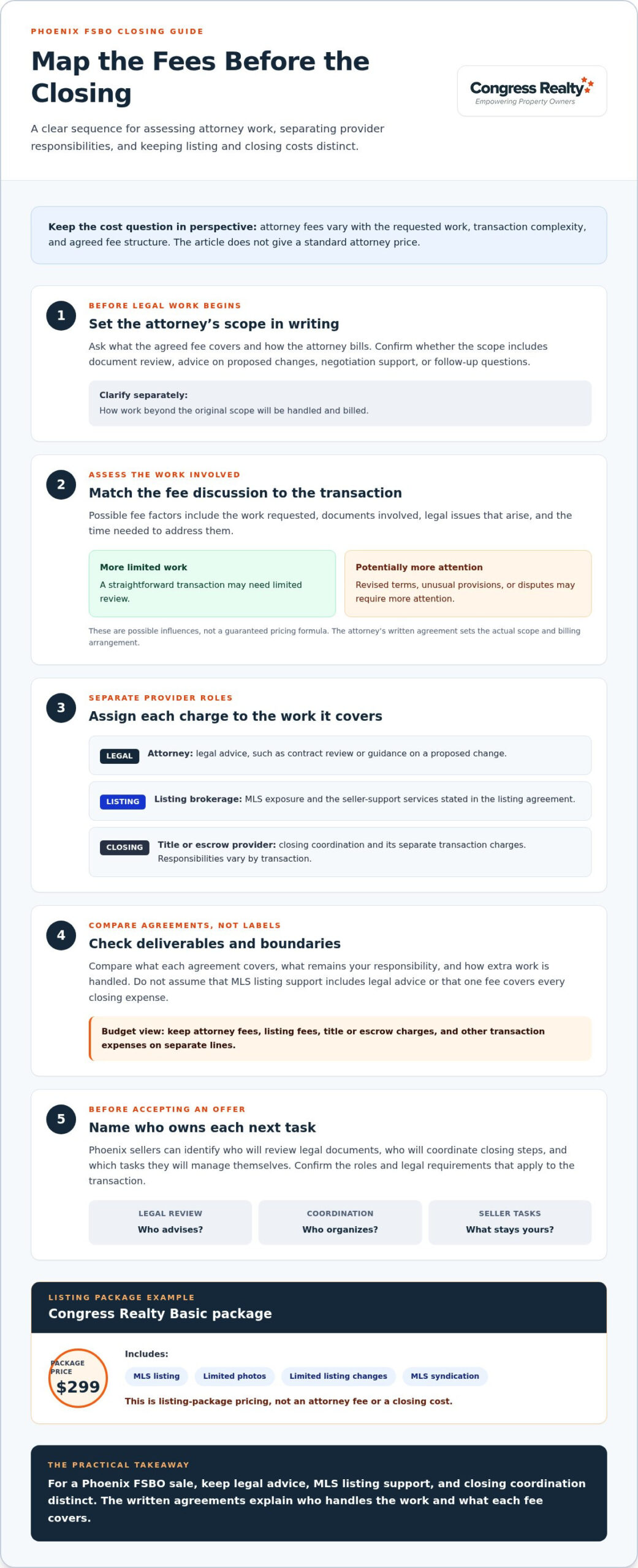
Before accepting an offer, identify who will review legal documents, who will coordinate closing steps, and which tasks you will manage yourself. Congress Realty’s MLS listing and transaction support can help organize the brokerage side while you retain control of your decisions. This separation helps Phoenix FSBO sellers get legal help for legal questions without confusing it with listing exposure or coordination.
What Affects the Cost of an Attorney for an FSBO Closing?
Attorney fees vary with the scope of work, transaction complexity, and agreed fee structure. A focused purchase contract review involves different work from ongoing legal guidance through negotiations and document changes. The attorney’s agreement should explain the work covered, the billing method, and whether additional work falls outside the original scope.
Which factors can change an attorney’s fee?
The fee may reflect the work requested, the documents involved, legal issues that arise, and the time needed to address them. A straightforward transaction may need limited review. Revised terms, unusual provisions, or disputes may require more attention. These are possible influences, not a guaranteed pricing formula. The attorney’s written agreement sets the actual scope and billing arrangement.
Before work begins, ask for a clear description of what the fee covers. Check whether it includes document review, advice on proposed changes, negotiation support, or follow-up questions. Clarify how the attorney bills for work beyond that scope. This helps you compare services by their actual deliverables rather than by a fee label alone.
How can sellers compare attorney and brokerage services?
Separate each charge by provider and purpose. An attorney’s fee pays for the legal work described in the attorney agreement. A flat fee MLS listing covers the brokerage services described in the listing agreement. Title or escrow charges and other transaction expenses belong to separate parts of the sale. Do not assume one fee covers all of them.
- Attorney: Review the agreed legal services, such as contract review or legal guidance.
- Listing brokerage: Review the MLS exposure and seller-support services included in the listing agreement.
- Title or escrow provider: Review its separate closing services and transaction charges.
Compare deliverables and boundaries, not just terms like “full service” or “flat fee.” Check what tasks each agreement covers, what remains your responsibility, and how the provider handles extra work. This can reveal gaps, such as assuming MLS listing support includes legal advice.
Listing compensation can follow different models. Some brokerage agreements calculate compensation as a percentage of the sale price, while a flat-fee listing agreement sets a fee for specified listing services. Review each agreement to understand its services and terms rather than treating one model as a measure of the other. Congress Realty’s home-selling services explain the listing-support side of that comparison.
For a clearer flat fee mls closing process, keep legal fees, listing fees, and closing expenses on separate lines in your budget. Congress Realty’s Basic package is $299 and includes an MLS listing, limited photos, limited listing changes, and MLS syndication. This is listing-package pricing, not an attorney fee or closing cost. Separating the charges helps you see what each professional handles and choose support based on the work your sale requires.
Attorney, Title or Escrow, and Flat Fee MLS: Who Handles What?
These professionals can support different parts of a home sale, but their responsibilities depend on the agreements and transaction details. Use the comparison below as a planning guide, not a universal description of Arizona closing practice. Identify who will handle each task for your sale and account for applicable local requirements.
| Professional | Possible role | What to clarify |
|---|---|---|
| Listing brokerage | Provides MLS listing support and seller services included in the brokerage agreement. | Which listing, marketing, and coordination tasks does the agreement cover? |
| Attorney | May provide legal advice, review documents, or address legal questions when the seller engages the attorney for that work. | What legal work falls within the agreed scope? |
| Title or escrow provider | May coordinate parts of closing, depending on the transaction and the provider’s role. | Which closing steps and documents will this provider manage? |
Roles can overlap in timing without replacing one another. A brokerage may help organize seller-side transaction tasks while an attorney reviews a legal issue and a title or escrow provider handles agreed closing steps. The transaction documents and professional agreements should show who owns each responsibility.
What does a flat fee MLS brokerage handle?
A flat fee MLS brokerage focuses on listing and seller support, not legal representation. Congress Realty offers MLS listing services, Comparative Market Analysis support, and transaction management. Sellers can select a support level that fits their needs and retain control of sale decisions. Listing exposure, pricing guidance, and transaction organization serve different purposes, so review the brokerage agreement to see which services apply to your option.
What work may fall to legal and closing professionals?
An attorney may advise on legal questions or review documents under a separate agreement. A title or escrow professional may coordinate closing activities assigned to that provider. Do not assume a professional handles a task simply because it often appears on a closing checklist. The transaction, the agreements, and applicable Arizona requirements determine the actual allocation.
Before moving forward, map responsibilities in writing. Note who will review contract documents, communicate deadlines, prepare or coordinate closing paperwork, and answer legal questions. Mark any task that no one has agreed to handle, then resolve the gap before it becomes urgent. This can also prevent paying twice for similar coordination or expecting a brokerage to provide legal advice.
For a clearer flat fee mls closing process, match each task to the professional responsible for it and keep the relevant agreements together. To compare listing support options, explore seller listing options and choose the level of brokerage help that fits how you want to manage the sale.
How Does an FSBO Closing Progress in Phoenix?
An accepted offer starts the next phase, but it does not create one universal closing checklist. The agreement, the professionals involved, and the transaction details shape what happens next. Use this sequence to organize the work, then account for Arizona-specific legal, title, escrow, and timing details with the professionals handling your transaction.
- Record the accepted agreement and key dates. Keep the signed agreement, amendments, contact details, and dates in one place. Use the agreement and later written updates to track deadlines that apply to your sale. Do not assume a standard timeline or add a deadline that the transaction documents do not establish.
- Confirm who handles each responsibility. Identify the people coordinating brokerage tasks, legal questions, and closing logistics. Responsibilities vary by transaction and agreement. Identify the title or escrow provider coordinating closing, if one is involved, and the tasks assigned to that provider.
- Organize requested documents. Track what someone requests, who requested it, how you will provide it, and its status. The exact documents depend on the transaction. Ask the professional who made a request to clarify anything you do not understand, and consult an attorney for legal advice.
- Track changes and closing coordination. Record contract changes, decisions, communications, and assigned follow-up tasks. If a professional coordinates signing or other closing steps, note the instructions and dates they provide. Use the process, documents, and timing that apply to your Arizona transaction rather than relying on a generic checklist.
- Confirm completion with the responsible professionals. Track outstanding items and follow up with the person assigned to each one. Confirm what completion means for your transaction and which professional will communicate that status. Keep final documents and closing communications with your sale records.
What should sellers organize after accepting an offer?
Start with four categories: the signed agreement and amendments, transaction contacts, key dates, and requested documents. Maintain an organized folder with the latest version of each document. Add a short log of decisions and communications, including who made the decision, what they agreed to, and whether anyone needs to follow up. This record helps you answer questions without relying on memory.
How can sellers keep closing tasks on track?
Use a simple milestone tracker. Give every task an owner, a due date drawn from the agreement or professional instructions, and a status such as pending or complete. Update the tracker when a document arrives, a date changes, or a handoff occurs. This keeps you in command while making gaps visible early.
Closing coordination can reduce missed handoffs, but it does not replace legal advice or your responsibility to understand assigned tasks. Track expenses too: separate listing compensation, legal work, closing charges, and other transaction costs instead of grouping them under one assumed fee. For broader preparation on selling independently, Congress Realty’s seller listing options show how MLS brokerage support can fit into the process.
A well-kept tracker turns the flat fee mls closing process into manageable steps. Set up your task list early, account for Phoenix-specific details, and tie each responsibility to a clear owner.
How Can Congress Realty Support a Phoenix FSBO Seller?
Congress Realty helps sellers manage the brokerage side of a sale through flat fee MLS listings and seller-support options. That support can complement legal advice and closing coordination without replacing either one. Congress Realty offers sellers different levels of brokerage involvement while leaving sale decisions in the seller’s hands.
Think of the flat fee mls closing process as a set of separate responsibilities. MLS exposure helps market the property. Brokerage support can help with listing and transaction tasks. An attorney provides legal advice under a separate agreement, while closing professionals handle the tasks assigned to them. Knowing what kind of help you want makes it easier to choose a support level that fits.
Which support level fits an independent seller?
Standard can suit sellers who want MLS exposure and prefer to manage more of the sale themselves. You remain responsible for your decisions and assigned tasks, so consider how comfortable you feel handling buyer communications and tracking next steps.
Full Service offers more brokerage guidance through dedicated agent support, negotiation assistance, contract review, and transaction coordination. These services can help sellers manage the transaction. Brokerage contract review does not make the brokerage your attorney or provide legal representation. Consult an attorney for legal guidance when you need it.
To compare options, consider which tasks you want to keep, where you would value support, and what each service agreement says it covers. A seller who wants to manage routine communications may choose a different level of help from one who wants more support with negotiation and coordination. The right fit depends on your needs, not on a promise about the sale’s outcome.
What should Phoenix sellers decide before choosing support?
List the work you expect to handle yourself, such as organizing documents, tracking dates, and communicating with the people involved. Then note where you want brokerage guidance. Keep legal questions separate and identify when you may need an attorney. This exercise can help you decide whether you want focused listing support or more help through the transaction.
Next, compare service scope and responsibilities in writing. Look at what the brokerage handles, what remains yours, and how its support fits alongside legal and closing professionals. A clear comparison can prevent missed handoffs and assumptions that one service covers every part of the sale.
Phoenix sellers can choose support with their priorities in view and stay in command of their decisions. Compare seller service options to see how brokerage support can fit your plans.
Set Your Support Level Before the Next Step
A smoother sale starts with a clear plan for the work ahead. Decide which parts of the transaction you want to manage and where professional support would help. Keep your priorities in view as you compare service scope and responsibilities for your sale.
The flat fee mls closing process lets you consider listing support separately from legal advice and closing coordination. Choose the arrangement that matches how you want to handle the sale, then keep agreed responsibilities clear as the transaction progresses.
Ready to decide what level of brokerage support fits your plans? Compare Congress Realty seller options and take your next step with clarity and control.
Frequently Asked Questions
How much does a real estate attorney cost for an FSBO closing?
There is no single fee that applies to every FSBO closing. Before engaging an attorney, ask how the firm will document the agreed work, what could lead to added charges, and how it will handle questions that arise after the initial review. If you receive an estimate, compare it with the final engagement terms. Keep a copy of the agreement and invoices with your transaction records.
Do I need a real estate attorney to sell a house FSBO in Phoenix?
Arizona does not require a seller to hire an attorney for a real estate closing. You may still decide to consult one if you face a contract issue or an ownership question you do not know how to assess. Consider whether legal guidance fits your transaction and comfort level.
Does a flat fee MLS service include closing costs?
Do not assume it does. Check the listing agreement for the services it covers, then review the transaction paperwork for separate charges. To keep expenses organized, maintain a seller-cost worksheet and update it as you receive written estimates or statements. Compare each line item with its source document and flag unclear charges before you approve or pay them.
Is a closing attorney the same as a title or escrow company?
No. They are different types of professionals, and the seller should understand the arrangement for the specific sale. Identify the named closing contact, the documents or instructions they will send, who will coordinate signing, and where transaction questions should go. Save this information with your contact record so you know where to direct follow-up.
Can an FSBO seller use a flat fee MLS brokerage and an attorney?
Yes. A seller can engage both and keep their work aligned by sharing relevant, current documents with each professional, subject to their instructions and agreements. If you plan to ask an attorney about proposed language, use the latest draft. Record which version you sent and when so everyone can refer to the same transaction document.
Who coordinates the closing when a home sells FSBO?
The transaction arrangements determine who coordinates each closing task. Create a contact sheet that names the people involved, their agreed responsibilities, preferred communication method, and open items. When someone sends a request, note who owns the next action and when you expect an update. If a task has no clear owner, address that gap with the transaction contacts before it becomes time-sensitive.
Can a flat fee MLS brokerage review an FSBO contract?
Congress Realty’s Full Service option includes contract review. Identify the document and review stage involved, and understand how the service agreement defines the work. For example, note whether you want the initial offer reviewed or a later revision addressed. A brokerage review does not provide legal advice, so take legal interpretation questions to an attorney.