
Congress Realty is a flat-fee listing brokerage serving Phoenix homeowners. Could an offer with the highest possible price still leave you unsure about the deal? Look beyond the headline number and identify what must happen before the price increases. This guide explains how to handle offers with an escalation clause by reviewing the trigger, increment, maximum price, and proof of a competing offer before you respond.
An escalation clause sets conditions for a buyer to increase an offer’s price. Arizona sellers don’t have to accept one. The standard Arizona Association of REALTORS® purchase contract doesn’t include escalation clauses, so the parties must add one through an addendum. A higher possible price may sound appealing, but financing, appraisal risk, contingencies, and closing flexibility can matter just as much. Learn how to verify the clause’s terms, compare the complete offer with other offers and your priorities, and choose a clear next step. You can accept or reject the offer, or ask interested buyers to submit their highest and best offers. Focus on terms you can verify, not assumptions about what the clause might deliver.
Key Takeaways
- Learn how to handle offers with an escalation clause by checking its trigger, price increment, and maximum before weighing the potential price.
- Separate a documented competing offer from informal claims, and understand what evidence the clause requires.
- Compare the adjusted price with financing, appraisal terms, contingencies, and closing timing to assess the entire offer.
- Use a clear response process: review the terms, clarify uncertainties, compare offers, and choose your next step.
- Keep control of the decision by judging each offer against your priorities, not just its highest possible price.
Phoenix sellers: What does an escalation clause mean in an offer?
An escalation clause is a conditional price adjustment. The buyer agrees to raise the purchase price if a qualifying competing offer meets the clause’s trigger, subject to written limits. The clause doesn’t automatically make the buyer’s maximum price the offer price. To understand how to handle offers with an escalation clause, start by identifying what event can change the price and which terms set the boundaries.
Buyers may use an escalation clause when they expect competition for a property and want their offer to respond to a stronger competing bid. That can make the offer look attractive at first glance, but its headline ceiling tells only part of the story. The written clause controls the calculation, and the offer’s other terms still affect how well it fits your priorities. For a general overview, see Escalation clause on Wikipedia.
Which parts of an escalation clause determine the price?
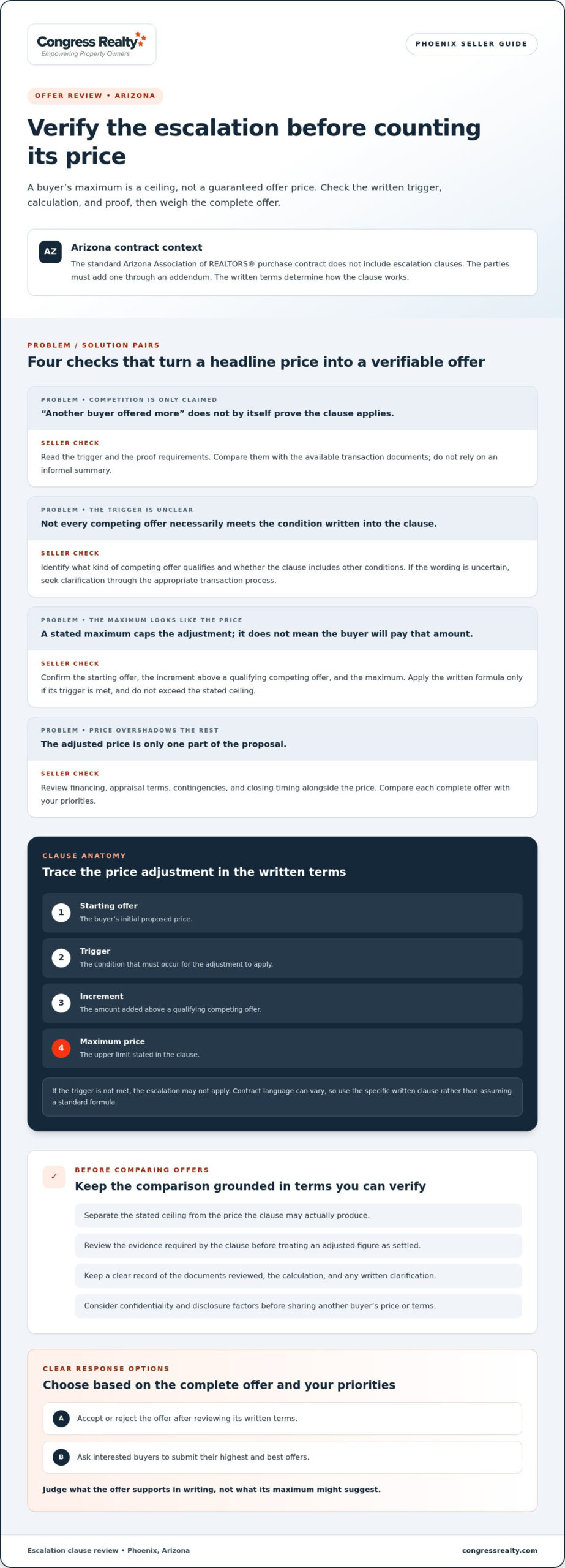
Read the clause for four connected details: the starting offer, the increment above a competing offer, the maximum price, and the triggering condition. The trigger explains what kind of competing offer must exist before the price changes. The increment sets how much the buyer will exceed that offer, while the maximum caps the adjustment. The written terms, not assumptions about customary practice, determine the calculation.
- Starting offer: The buyer’s initial proposed price.
- Increment: The amount the buyer will add above a qualifying competing offer.
- Maximum: The upper price limit stated in the clause.
- Trigger: The condition that must occur for the adjustment to apply.
For example, imagine a buyer offers a starting price, agrees to exceed a qualifying competing offer by a stated increment, and sets a maximum. If the competing offer satisfies the trigger, the written formula determines the adjusted price, up to the buyer’s ceiling. If the trigger isn’t met, the escalation may not apply. This is an illustration, not a standard clause. Contract language can vary.
What should a seller understand before comparing offers?
Keep the stated ceiling separate from the price the clause may actually produce. The ceiling is a limit, not necessarily the amount the buyer will pay. The final figure depends on whether the written trigger applies and how the clause calculates the adjustment. Review those details before treating the offer as a particular price.
Then consider the rest of the offer. Financing, appraisal terms, contingencies, and timing can affect the practical value of a proposal. A lower-priced offer with terms that better match your needs may deserve serious consideration alongside a higher potential price. Assess each proposal using its written terms rather than assuming one clause format or response applies to every contract.
How to verify the competing offer and escalation calculation
A claim that buyers are competing isn’t enough to establish that an escalation clause applies. Review the clause and supporting information before treating an adjusted figure as the offer price. Follow this sequence:
- Read the clause. Find the language that governs the adjustment and any proof it requires.
- Identify the trigger. Determine what kind of competing offer must exist for the clause to apply.
- Check the calculation. Apply the written increment to the qualifying offer and make sure the result doesn’t exceed the stated maximum.
- Review the complete offer. Consider financing, contingencies, appraisal terms, and timing alongside the calculation.
Distinguish documented offer terms from informal statements such as “another buyer offered more.” A general claim about competition may not satisfy the trigger written into the clause. The contract language sets the test. Don’t assume every competing offer qualifies or fill gaps based on what seems typical.
How can a seller check the escalation trigger and ceiling?
Match each condition in the clause to the information available. Check whether the trigger requires a bona fide competing offer, whether it includes other conditions, and how the stated increment applies. Then verify that the calculation stays within the buyer’s maximum. If a term is unclear or the math supports conflicting readings, don’t treat an adjusted figure as settled. Seek clarification through the appropriate transaction process.
What documentation can support the adjustment?
The clause may specify what evidence supports a competing offer. Read that language closely and review the relevant transaction documents rather than relying on an informal summary. Before accepting an adjusted price, understand what documentation the contract calls for and whether the available material meets those terms.
Handle other buyers’ terms carefully. In Arizona, sellers’ agents may disclose the terms of a top offer to other potential buyers to seek better offers, but that doesn’t mean every situation calls for disclosure. Confidentiality and disclosure practices can depend on applicable requirements and transaction circumstances. Don’t share another buyer’s price or terms without considering those factors.
Keep a clear record of the documents reviewed, the calculation, and any written clarification. This gives you a reliable basis for comparing the offer instead of relying on pressure or guesswork. If you want professional support with paperwork, contract negotiation, and documentation, Congress Realty’s Full Service Option is one way to get help while considering your home-selling options.
Compare an escalation-clause offer with the complete offer
An escalation clause can raise an offer’s potential price, but the maximum alone doesn’t tell you which proposal better serves your goals. Compare each offer across the same categories. This makes tradeoffs easier to see and prevents one headline figure from dominating the decision.
| Offer term | What to compare | Why it matters |
|---|---|---|
| Adjusted price | For an escalated offer, identify the price supported by the clause’s trigger and calculation, not just its ceiling. Compare it with the other offer’s stated price. | The maximum is a cap, not necessarily the amount the buyer will pay. |
| Financing | Review how each buyer plans to fund the purchase and the financing terms in the offer. | Financing conditions can affect the steps and uncertainty involved in completing the transaction. |
| Appraisal terms | Read any appraisal-related language separately from the escalation formula. | A higher contract price and appraisal provisions address different parts of the transaction. |
| Contingencies | Compare the conditions each offer includes and how they align with your priorities. | Contingencies can affect the buyer’s ability to proceed under the agreed terms. |
| Timing | Compare proposed closing dates and other timing terms. | A workable schedule may matter as much as price for your plans. |
How do financing and appraisal terms affect the offer?
Financing terms help you understand what conditions stand between acceptance and closing, but they can’t guarantee lender approval or a completed sale. Review appraisal language separately. If an escalated price exceeds the appraised value, the contract’s terms shape how that difference may affect the transaction. Don’t treat the escalation ceiling as proof that the buyer can cover a gap or that an appraisal will support the price.
When might a straightforward offer be easier to evaluate?
A straightforward offer states its price without tying an adjustment to another offer. That clarity can simplify comparisons because you don’t need to calculate a conditional amount. Still, simplicity doesn’t guarantee a better outcome. Compare every proposal’s price, financing, appraisal terms, contingencies, and timing against your priorities.
For a practical review, make a row for each offer and record the terms you can verify. Note unresolved conditions separately instead of treating them as settled. Then rank the factors that matter most to you, such as price certainty, preferred timing, or the conditions attached to the buyer’s proposal. This lets you compare like with like without assuming that a particular financing method or contingency always makes an offer stronger.
The strongest offer is the one that best fits the seller’s priorities and terms. That may be the offer with the clearest price, the most suitable timing, or a higher adjusted amount supported by terms you’re comfortable accepting. Compare the complete offer, not the escalation clause in isolation. That’s how to handle offers with an escalation clause while weighing both potential value and conditions.
How should a Phoenix seller respond to an escalation clause?
Use a deliberate process before deciding. Review the clause, clarify uncertain language, compare the full offer with your priorities, choose a response, and document your decision. Your options may include accepting, countering, or declining, but the contract terms and transaction circumstances shape how each response works. This framework can help you make an informed choice, but it isn’t legal advice about a specific contract.
- Review the offer. Read the escalation language alongside the rest of the purchase offer. Note the trigger, calculation, ceiling, deadlines, contingencies, financing, appraisal terms, and requested timing.
- Clarify open questions. Identify any wording or calculation you can’t confidently interpret. Resolve those points through the appropriate transaction process before relying on an adjusted price.
- Compare the complete terms. Evaluate the offer against other proposals and your own priorities, not just its potential price.
- Choose a response. Depending on the contract and your goals, you may accept the offer as written, counter with different terms, or decline it.
- Document your decision. Keep a clear record of the terms and information you considered, the response you chose, and relevant communications.
What questions should the seller resolve before responding?
Check how the clause defines a qualifying competing offer. Confirm how the buyer calculates the adjusted price and what evidence supports that calculation. Then review the offer’s conditions, deadlines, and requested terms. If a key point remains unclear, don’t fill the gap with an assumption. Seek appropriate clarification and decide based on the actual written terms.
Keep your response consistent with the contract’s language and the transaction record. An escalation clause can raise questions about what the buyer offered, what evidence supports an adjustment, and which terms remain unchanged. Organize those questions, but remember that the right response depends on the documents in front of you. General seller guidance can’t determine the legal effect of a particular contract.
When can professional contract support help?
Unfamiliar wording can make an offer harder to compare, especially when a price adjustment interacts with other conditions. Congress Realty’s Full Service Option includes paperwork and contract negotiation support to help sellers review documents and work through a response. That support doesn’t replace legal advice or promise a particular result. Sellers planning a self-directed sale can use this guide to selling a house without a Realtor to consider how they want to manage the process.
For homeowners, the goal is a clear decision grounded in the written offer and personal priorities. Take time to understand what each response would mean before moving forward. Explore seller support options to see what level of assistance fits your selling plans.
Phoenix sellers: Make the escalation clause part of a smarter selling decision
A confident decision starts with a simple rule: verify the trigger, check the ceiling, then compare every material term. Review the written clause and any supporting documents, confirm how the adjusted price works, and weigh the offer’s financing, appraisal terms, contingencies, and timing. Keep the actual terms in view. A high possible price matters only as part of the full proposal.
This process puts you in control. Decide which terms matter most, what questions need clarification, and how much support you want as you evaluate offers. You don’t have to treat a complicated clause as a reason to surrender that control. A structured review helps you move forward based on information you understand, rather than pressure or assumptions.
What support does Congress Realty provide sellers?
Congress Realty offers flat-fee listing options, giving sellers a way to list while choosing the support that fits their needs. Listings appear on the same MLS that local REALTORS® use and receive the same exposure as listings paid with a full commission. The MLS is exclusive to members, and only members can make changes to listing information. Congress Realty makes changes on the seller’s behalf.
Congress Realty serves sellers in Arizona, Alaska, California, Idaho, Louisiana, Montana, Nevada, New Mexico, Oregon, Texas, Utah, and Washington. For sellers who want help with transaction paperwork and negotiations, the Full Service Option includes paperwork, contract negotiation, and documentation services. It’s an option, not a substitute for your judgment: you remain in control of decisions about your property and how to respond to an offer.
Understanding the listing arrangement can also help you put transaction costs in context. As you review the offer, keep expected proceeds and the terms you’re accepting in view, rather than focusing on one number in isolation.
How can the seller move forward with confidence?
Before responding, make sure you understand the offer, any escalation addendum, the competing-offer evidence the clause calls for, and the terms that remain in effect if the price changes. Keep a record of what you reviewed and the response you selected. If a phrase or calculation remains unclear, pause and seek appropriate contract guidance rather than guessing at its meaning.
Congress Realty brings over 20 years of real estate experience to its seller services. That experience can support a more organized review, while the choice to accept, counter, or decline remains yours and depends on the contract and your priorities. No process can promise a sale or a particular price, so focus on the terms you can verify and the outcome you’re prepared to accept.
Homeowners can choose a listing approach and level of support that match their plans. Explore seller listing and support options to see how Congress Realty’s flat-fee listing services and optional Full Service Option fit into your next steps.
Set your priorities before the next offer arrives
A clear decision starts before a buyer submits an offer. Decide what matters most to you: a preferred closing window, flexibility around move-out, or confidence in the terms you accept. When those priorities are clear, it’s easier to judge a conditional price without letting urgency make the decision for you.
That preparation also gives you a useful benchmark for future offers. Weigh each proposal against the plans you’ve made, identify what needs clarification, and choose support that matches your comfort level. Understanding how to handle offers with an escalation clause is part of taking an active role in your sale, not handing control to the highest possible number.
As you plan your next steps, choose a selling approach that leaves room for informed decisions throughout the process. Explore Congress Realty’s seller services and find a level of support that fits your goals. Move forward thoughtfully, with your priorities guiding the way.
Frequently Asked Questions
Does an escalation clause automatically change the purchase price?
No. The price changes only if the clause’s written conditions apply and the calculation supports an adjustment. If the seller accepts an offer with an escalation clause, the contract documents govern how the parties handle that condition. A competing buyer’s claim alone doesn’t establish a new price. Before treating an adjusted amount as agreed, check the contract and any required supporting documentation.
Can a seller reject or counter an offer with an escalation clause?
Yes, a seller can generally choose whether to accept, counter, or reject an offer, subject to the transaction documents and applicable requirements. In Arizona, sellers aren’t required to accept an escalation clause. A counteroffer can propose different terms, but make sure the response clearly addresses the offer language and follows the appropriate contract process. For a specific agreement, get guidance suited to that transaction.
What does the maximum price in an escalation clause mean?
The maximum is the upper limit the buyer states for the escalated price, not a promise that the buyer will pay that amount. The result depends on whether the clause’s trigger applies and how its calculation works. For example, if the qualifying competing offer doesn’t bring the formula up to the cap, the adjusted price may remain below it. Review the cap alongside the trigger and other terms.
How can a seller verify that a competing offer triggers escalation?
Compare the competing offer with the trigger language and evidence requirements in the signed offer. Check that the other proposal meets the stated conditions instead of relying on a verbal description of a bidding situation. Keep a record of the materials used to calculate any adjustment. Don’t assume you may share another buyer’s price or terms. Confidentiality and disclosure practices depend on applicable rules and transaction circumstances.
Should a seller accept the offer with the highest escalation limit?
Not automatically. A high limit may matter less than terms that fit your priorities, such as a workable closing schedule or conditions you understand and can accept. Consider one offer with a high ceiling but unresolved terms and another with a clear price and timing that suits your plans. Compare the complete proposals, then decide which tradeoffs you’re willing to make. A ceiling alone can’t determine the right choice.
Can an escalation clause affect appraisal or financing?
It can affect the contract price, which may raise appraisal or financing questions, but it doesn’t guarantee a lender will approve the transaction or that an appraisal will support the adjusted amount. Review appraisal-gap language separately from the escalation formula. If the appraised value comes in below the purchase price, the agreement and the buyer’s stated ability to cover a difference can matter. Don’t infer those details from the escalation limit.
Do escalation clause rules differ between Arizona and other states?
Yes. State laws, contract forms, and practices around escalation language and offer disclosure can differ, so don’t assume a clause works the same way everywhere. In Arizona, escalation clauses are legal, but they aren’t part of the standard Arizona Association of REALTORS® purchase contract and must be added through an addendum. Sellers should focus on the documents for their transaction and Arizona-specific guidance, not another state’s rules.