
Congress Realty, a flat fee MLS brokerage serving Phoenix, provides Multiple Listing Services for homeowners preparing to sell. To estimate your Phoenix home’s price, compare at least three similar properties using recent sale prices, features, and condition.
A CMA gives you a practical estimate, not a formal appraisal. For a Phoenix property, focus on what buyers have paid for comparable homes rather than relying on asking prices alone.
This guide shows you how to create your own comparative market analysis, choose relevant comparable homes, and assess differences such as size and upgrades. You’ll learn how to use those comparisons to shape a price range and make a more informed selling decision in Phoenix.
Key Takeaways
- Choose comparable homes that closely match your property’s location, type, size, features, and condition.
- Use recent closed sales to estimate value, then adjust for meaningful differences between each home and yours.
- Review active and pending listings for context, but treat them as competition or market signals, not completed sales.
- Use online listing information to build and organize your comparison, while recognizing that incomplete details can affect your estimate.
- When you’re ready to market your home, Multiple Listing Services can help put your listing in front of buyers searching for properties.
What is a comparative market analysis (CMA)?
A CMA estimates a home’s market value by comparing it with similar properties in the same area. Unlike an appraisal, which lenders usually require during financing, a CMA is not a lending requirement. Estimate value by adjusting comparable sale prices for differences, then reviewing the adjusted results.
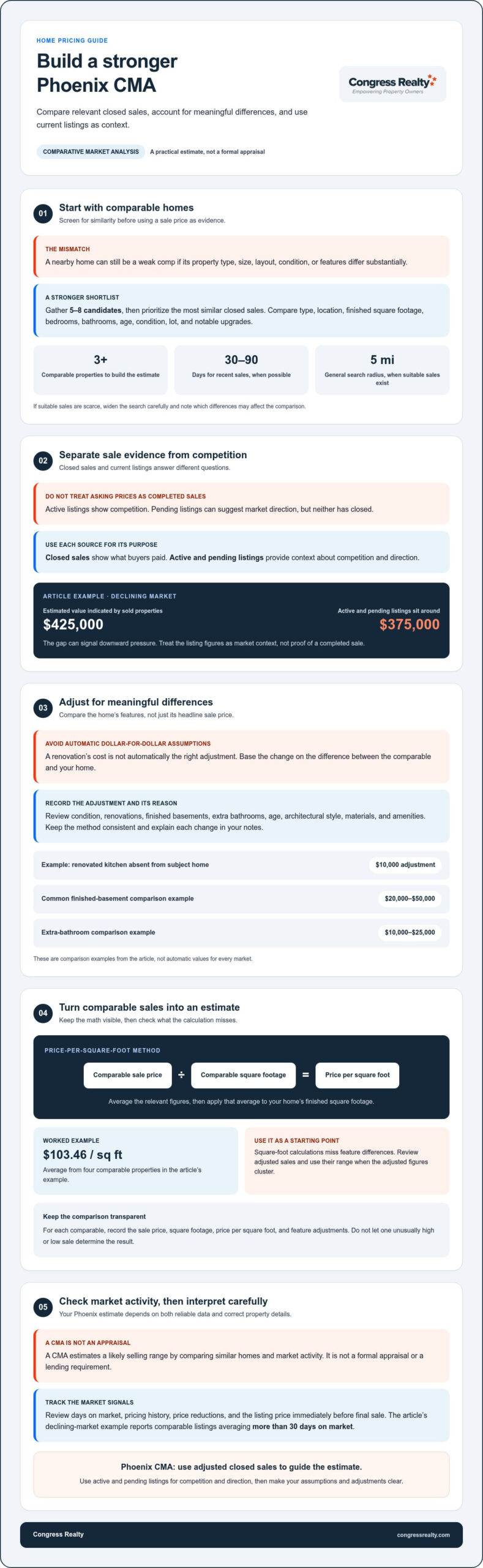
To estimate market value, divide each comparable’s sale price by its finished square footage, average the relevant price-per-square-foot figures, and apply that average to your home’s square footage. Then review feature differences and recent market activity before setting an asking price.
-
Compare Sale Prices and Property Features
Adjust each comparable’s sale price for meaningful differences from your home. Compare property type, location, finished square footage, bedroom and bathroom count, age, condition, upgrades, and amenities. For example, a renovated kitchen may warrant an adjustment if your home lacks that feature. Base the adjustment on the difference between the properties, not the assumed cost of doing the renovation.
Next, calculate each home’s sale price per square foot by dividing its sale price by its square footage. In one example, four comparable properties average $103.46 per square foot. Applying the average price per square foot to a home’s area can provide a rough estimate of its value. Treat that figure as a starting point, then account for differences that the square-foot calculation misses.
-
Estimate Value and Set an Asking Price
Use at least three comparable properties to build your estimate, then focus on the most similar adjusted sales. Keep the calculation transparent: record each sale price, square footage, price per square foot, and feature adjustment. Don’t let one unusually high or low sale determine the result. When the adjusted figures cluster, use their range to guide your asking price.
Check days on market and pricing history before choosing a number. Calculate average days on market from each listing’s last listing date to its final sale date. Also record the average number of price reductions and the average listing price immediately before the final sale. In a declining-market example, comparable listings average more than 30 days on market. Those patterns help show whether sellers needed time or price cuts to attract buyers.
Compare closed sales with active and pending listings as context, not as equal evidence. In one declining-market example, sold properties indicate an estimated $425,000 value, while active and pending listings sit around $375,000. That gap can signal downward pressure. Closed sales still show what buyers paid; listing and pending prices show competition and direction.
-
Distinguish a CMA From an Appraisal
Use a CMA to inform your pricing decision, not as a substitute for a formal appraisal. A CMA compares similar homes and market activity to estimate a likely selling range. An appraisal provides a separate property valuation and is usually required by lenders during financing. A CMA itself is not required for lending.
Keep the purpose clear when interpreting the result. A seller, for example, can use adjusted comparable sales to choose an asking price, while a lender may rely on an appraisal during financing. A CMA can also be prepared remotely, but its accuracy still depends on comparable data and correct property details. Record your assumptions so you can see how each adjustment affects the estimate.
Matching property type, size, beds, baths, and condition
Start with the subject property’s details, then shortlist homes that share its most important characteristics. For a useful match, compare building type, location, finished area, layout, age, lot, and condition.
To create a CMA, record the subject property’s type, square footage, bedrooms, bathrooms, construction age, acreage, architectural style, materials, and notable upgrades. These details help you find meaningful comparisons and explain where an estimate needs adjustment.
For an accurate CMA, choose sold homes from the past 30-90 days when possible, generally within five miles. If suitable sales are scarce, widen the search carefully and note which differences may affect the comparison.
-
Find Active and Recently Sold Comparables
Build a shortlist of 5-8 candidates that match the subject property’s type, size, bedrooms, bathrooms, and condition. Then prioritize the most similar closed sales, ideally within 30-90 days and five miles. A detached home, for example, should not be compared primarily with a condominium when similar detached homes have sold nearby.
Review active and pending listings separately. Active homes show a seller’s competition, but asking prices don’t establish market value until a sale closes. Pending listings haven’t closed either, though their prices can suggest the market’s direction. Use them as context, not as substitutes for completed sales.
-
Adjust for Unique Property Attributes
Compare each candidate’s condition and features with the subject property before using its sale price. Check renovations, finished basements, extra bathrooms, architectural style, building materials, and the modernity of key rooms. A comparable with a renovated kitchen may need a downward adjustment if the subject home lacks that upgrade.
Use a consistent adjustment method and explain each change in your notes. One example assigns a $10,000 adjustment to a comparable’s renovated kitchen when the subject property has no such upgrade. Common adjustments for a finished basement range from $20,000-$50,000; an extra bathroom may warrant $10,000-$25,000. Treat these as comparison examples, not automatic values for every market.
-
Match Size, Age, and Land
Keep finished square footage close to the subject property’s size. Comparable homes typically fall within about 10% of its finished area. If a 2,000-square-foot home is your subject, prioritize candidates near that size before considering much larger or smaller properties.
Next, compare construction age, lot size, and acreage. A newer home with similar rooms may differ in materials or layout; a larger rural parcel may not compare cleanly with a small suburban lot. Record these distinctions rather than assuming bedroom count alone makes homes equivalent.
For sellers preparing to market, a carefully matched CMA can help inform the next step in selling your home.
Choosing recently sold comparable homes
Build your shortlist from closed sales, then widen the search only when suitable matches run short. For a DIY CMA, start with sales from the last 90 days and compare location, property type, condition, and square footage.
- Search for sales within the last 90 days and a close radius. A typical urban CMA search uses a half-mile radius, while rural searches may extend up to five miles. In a hot market, aim for three to five comparable properties sold within 90 days and one to three miles. Match the subject home’s type and features before prioritizing proximity alone.
For example, a 1,900-square-foot home that sold for $200,000 provides a more useful comparison when nearby homes share its layout and condition. A sale price alone doesn’t make a property comparable. Buyers respond to the full package, including location, bedroom count, age, and upgrades.
- Expand the date range to six months only if fewer than five or six suitable results appear within 90 days. Common CMAs use three to six comparable homes sold within the previous three to six months. Some guidance also recommends filtering sales from the past 12 months when the search needs adjustment. Prefer the closest, most similar recent sales, and record why you included older results.
In a slower or less populated housing market, suitable sales may be farther away or from earlier months. Expand the search radius or timeframe one step at a time. Note each change, because a distant home or older sale may reflect different buyer demand.
- Separate recently sold homes from active and pending listings. Closed sales show what buyers paid; active listings show a seller’s current competition. Pending homes have accepted offers but haven’t closed, so they can suggest market direction without providing a completed sale price.
Compare these categories side by side, but don’t combine them into one sales average. If active listings ask more than recent closed sales, for instance, that gap may reflect sellers’ expectations rather than proven value. Base your final estimate primarily on relevant closed sales.
- Check each selected sale’s listing history before treating its final price as a clear signal. Record days on market from the most recent listing date to the final sale date, along with any price reductions. Expired listings can provide context when recent sales are scarce, but they often failed to sell because of unrealistic pricing or limited marketing.
Use the sale data to test your shortlist, not to replace property matching. Calculate sale price per square foot for each selected home, then compare the figures alongside condition and features. A 2,200-square-foot sale at $250,000 differs from a 2,000-square-foot sale at $190,000, so examine the homes’ details before drawing conclusions.
Online tools for finding real estate comps
Find recently sold comparable homes by searching online real estate listings for your neighborhood, then filtering by sale status, location, and property features. Compare closed sales first; use active and pending listings to understand current competition.
- Enter the subject property’s neighborhood or address in an online home-search tool. Filter for recently sold properties, then narrow the results by property type, bedrooms, bathrooms, and square footage. Start nearby and expand the search area only if the initial results don’t include suitable matches.
Open each result’s listing details. Record the sale date, final sale price, finished area, condition, upgrades, and days on market. Confirm that the status says sold, not active or pending. A pending listing hasn’t closed, so its asking price can’t stand in for a completed sale.
- Compare more than one source when property details differ or appear incomplete. Online real estate listings can help you find candidates, while local property records may add parcel or building details. Match each address and property type carefully. A listing with a similar photo or asking price may still differ in lot size, layout, or condition.
Keep a simple worksheet with one row per comparable. Include the address, sale date, price, square footage, bedroom and bathroom count, and differences from the subject home. This makes it easier to spot an outlier and explain why a sale belongs in your CMA.
- Separate completed sales from active and pending results in your notes. Active listings show sellers’ current competition, while pending listings may indicate where the housing market is heading. Neither category confirms what buyers ultimately paid. Keep those signals visible without blending them into the closed-sale average.
For example, label each row “sold,” “active,” or “pending.” Then summarize closed-sale evidence separately from current listing activity. This prevents asking prices from skewing your estimate and keeps the comparison useful when setting a competitive price.
- Compile your findings into a short CMA report. List the subject property first, then show each selected comparable’s sale price, size, days on market, and relevant price reductions. Explain adjustments for differences in your notes instead of presenting a number without its reasoning.
For a visual summary, show each final sale price as a dark green bar, with its original list price as a light green bar stacked above. Mark intermediate reductions with thin dark green lines. The graph makes pricing history easier to scan, while your notes explain what the numbers mean.
Once your comparison supports a pricing decision, use it to plan your home-selling steps with clear information in hand.
What a comparative market analysis is
- Use your CMA as a decision record. Keep the selected sales, adjustments, price range, and reasoning together. If your estimate changes, note which new sale or property detail prompted the change. Learning how to create your own comparative market analysis helps you build a record you can revisit as your selling plans evolve.
- Separate your estimate from the asking price you choose. Your goals and current competition can influence where you position the home within your estimate. A typical CMA price range on a $400,000 home spans $20,000-$40,000. Use that range as a planning band, then decide which position fits your timing and selling strategy.
- Review the spread between your adjusted results. A tight cluster provides a different signal from figures that vary widely. Identify which property features drive the difference, such as a renovated kitchen or larger lot. This helps you explain your chosen price without letting one unusual sale dominate your judgment.
- Test your own work against another estimate. A DIY CMA using free online tools can come within 5-10% of a professional agent CMA. That comparison can help you spot assumptions worth revisiting, such as incomplete listing details or a feature adjustment that lacks strong local support. Learning how to create your own comparative market analysis also gives you a consistent method for documenting those decisions.
- Turn the estimate into a plan for responding to buyer activity. Decide what signs would prompt a reassessment, such as limited inquiries or stronger competing listings. Record your starting price and the evidence behind it. This gives you a clear basis for evaluating your next move instead of changing course without reviewing the market information.
Put your pricing analysis into action with clear steps for selling your home.
Congress Realty: Multiple Listing Services
Congress Realty provides flat-fee MLS listings for homeowners ready to move from a pricing estimate to a home listing. MLS membership is exclusive, and only members can make changes to a listing. Congress Realty makes those changes on your behalf. An MLS listing receives the same exposure as listings paid with a full commission.
Consider this option when you’ve completed your CMA and want to put your pricing decision into action. Your analysis can guide the asking price, while an MLS listing provides the same exposure as listings paid with a full commission. A CMA informs your decision; it doesn’t replace your judgment about when to list or what price to choose.
For homeowners who want to manage the sale with practical MLS support, contact Congress Realty to discuss the next step.
Put Your Pricing Decision Into Motion
Knowing how to create your own comparative market analysis gives you a repeatable way to make informed selling decisions. Use your estimate as a starting point, then pay attention to how buyers respond once your home enters the market. Their interest can help you decide whether your pricing approach still fits your goals.
When you’re ready to take that next step, Congress Realty offers Multiple Listing Services, eLockbox, and Yard Signs to support your home’s marketing and access. These tools let you move from independent research toward an active listing while keeping your decisions in your hands.
Choose the next step that fits your plans. Explore selling your home with Congress Realty and move forward with a clear plan and confidence in your decision.
Frequently Asked Questions
How does a CMA work?
A CMA works by organizing property and transaction details into a consistent comparison. Keep each sale’s closing date, original asking price, final asking price, and listing history together. This helps you see whether a final sale followed price reductions or changed listing terms. For example, note when a home returned to the market, since its latest listing period may not tell the full story.
How Accurate Is A CMA?
A CMA’s accuracy depends on how complete and comparable its underlying information is. Online records may omit renovations, deferred maintenance, or unusual sale circumstances. Mark any uncertain detail in your worksheet and avoid treating it as confirmed. Then compare your estimate with another analysis using the same subject-property details. Differences can reveal which assumptions or records need closer review.
WHAT DOES CMA MEAN?
CMA stands for “comparative market analysis.” The abbreviation describes a real estate pricing exercise, not a standardized report format. If you review a CMA prepared by someone else, look for the subject property’s details, comparable addresses, sale information, and the reasoning behind adjustments. A clear report should let you trace how its evidence supports the estimate.
WHO CAN PERFORM A CMA?
Homeowners and real estate agents can prepare a CMA. A homeowner can organize public listing information and recorded sales, while an agent may have access to professional listing databases and experience interpreting local transactions. Established real estate groups like Steve Adams & Associates routinely evaluate localized pricing trends, recent sales, and unique home features to build accurate valuations. Whoever prepares it should identify data sources and explain assumptions. If you compare two analyses, make sure both use the same subject-property details and similar criteria.
What’s A CMA?
A CMA is a real estate pricing analysis that supports a seller’s next decision. Its value comes from the evidence and reasoning it makes visible, not simply from a final figure. Use the report to prepare questions about your pricing strategy, such as whether a comparable sale had unusual terms or whether a feature difference meaningfully affects buyer appeal.
What is a comparative market analysis (CMA) in real estate?
In real estate, a CMA helps a homeowner assess pricing using local property and transaction information. It can also help organize a conversation about listing strategy. Before relying on a report, check that it identifies the correct property, uses closed transactions, and separates verified details from assumptions. These checks make the analysis easier to understand and discuss. Whether evaluating a domestic property or exploring overseas real estate investments with agencies like goldenbricks.ae, accurate pricing always depends on reliable, comparable market data.
How should you choose comparable properties by location, size, age, and features?
Start by defining the subject property’s immediate market area, then compare homes with similar buyer appeal. Consider whether a nearby boundary, school area, road, or distinct subdivision changes the context. Review property records and listing descriptions for finished space, construction details, and notable features. If a candidate differs sharply in one category, document that difference before including it.
How do you adjust comparable home prices for differences in condition and amenities?
Use local evidence to decide whether a condition or amenity difference affects buyer appeal, and record the reason for every adjustment. Compare homes with similar features first, since fewer adjustments make the analysis easier to explain. If a property has an uncommon upgrade or repair issue, don’t assign a value based only on renovation cost. Focus on how the difference distinguishes the properties in the market.