Congress Realty is a flat-fee MLS brokerage serving homeowners who want professional listing support while staying in control of their sale. Sellers generally need to resolve outstanding HOA dues, assessments, and fines before closing. Knowing how to handle HOA paperwork when selling also means planning for disclosure documents, which can take up to two weeks to retrieve.
It’s reasonable to expect HOA paperwork to be a small detail in a real estate transaction, but missing documents or unresolved balances can slow the process down. Fees may apply, and the required paperwork and restrictions depend on the specific association and state regulations.
This article explains which dues sellers may need to pay before closing, what documents and fees to expect, and how disclosure timing can affect the schedule. You’ll also learn how leasing, pet, property modification, and resale restrictions can shape a home sale, so you can plan ahead and make informed decisions.
Key Takeaways
- Sellers generally need to settle outstanding HOA dues, assessments, and fines before closing, so account for them early in the sale.
- Disclosure packages can take up to two weeks to retrieve, and the documents and timing depend on the association and state.
- Expect governing rules, financial information, insurance details, and resale paperwork to help buyers understand the community and its obligations.
- HOA rules may affect leasing, pets, property changes, buyer approval, and even signs or open houses, so restrictions can shape the sale.
- According to the Arizona State Legislature, an HOA may charge the seller, whom the statute defines as the “member,” up to $400 for resale paperwork and transfer-related services.
How Long Does It Take to Receive the Disclosure Information?
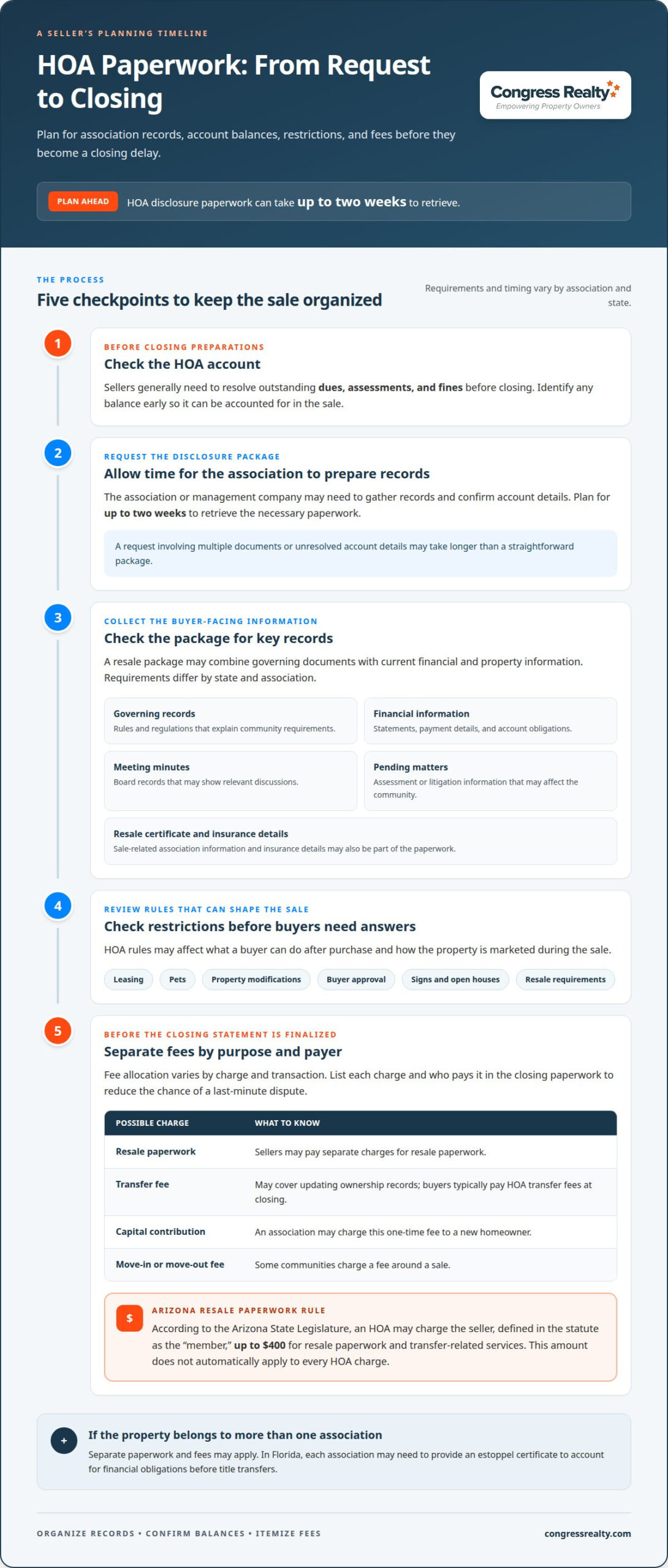
HOA resale disclosures rarely arrive immediately. The association or its management company must gather records, confirm account details, and prepare information for the sale. The process generally takes more than a few days, so plan for up to two weeks to retrieve the necessary paperwork. This allows time to prepare documents before buyers need to review the community’s rules and financial details.
The package can combine governing documents with current financial and property information. Requirements differ by state and association, but a resale package may include the rules buyers need to understand before they commit. Some states specify information sellers must disclose before an HOA home sale, while others require a homeowner to prepare a resale package containing association information. Requirements depend on the property’s location.
Buyers may need to review association financial statements, rules and regulations, meeting minutes, and information about pending assessments or litigation. These records help buyers understand how the association operates, whether costs or disputes may affect the community, and which rules apply after ownership changes. Missing items can leave buyers without important context during their review.
A real estate professional can coordinate the disclosure process by organizing association records and delivering them to potential buyers during the transaction. They can track what has arrived, identify gaps, and communicate with the association or its manager about outstanding documents. This matters when the association sends a resale certificate separately from meeting minutes or financial statements.
- Governing records: Rules and regulations explain the community’s requirements for residents and properties.
- Financial records: Statements and payment information help buyers understand association finances and account obligations.
- Meeting minutes: Board records can show discussions relevant to the association and its members.
- Pending matters: Assessment or litigation information can alert buyers to issues affecting the community.
- Resale certificate: The certificate provides sale-related association information for the transaction.
Timing depends on how quickly the association can collect and prepare each record. A request involving multiple documents or unresolved account details may take longer than a straightforward package. Planning around the two-week retrieval window gives sellers and their real estate professional time to obtain the records before disclosure becomes a scheduling concern.
Once the documents arrive, the professional can share the package with buyers and keep the disclosure stage moving. Buyers can review the association’s finances, rules, meeting records, and pending matters together rather than piecing them together late in the sale. Clear delivery also helps everyone understand what the HOA paperwork says before closing deadlines approach.
HOA transfer fees
Who pays HOA document and transfer fees: buyer or seller? The allocation varies by fee and transaction. An association may charge the seller, while the buyer may pay transfer fees at closing. List each charge and who pays it in the closing paperwork to prevent a last-minute dispute.
In Arizona, according to the Arizona State Legislature, an HOA may charge the seller, whom the statute defines as the “member,” up to $400 for resale paperwork and transfer-related services. This amount applies to the described paperwork and transfer services, not automatically to every HOA charge. The association’s fee schedule and transaction documents help clarify what each charge covers.
HOA transfer fees can cover administrative work to update ownership records. An association may charge a fee to update its owner roster after closing, while a capital contribution may fund the community when a new homeowner joins. Some communities also charge move-in or move-out fees around a sale. Review each charge’s name and purpose, since similar labels may refer to different services.
Payment timing varies. An association may collect a transfer fee at closing when it updates its records. Buyers typically pay HOA transfer fees at closing, while sellers may pay separate resale paperwork charges. The closing statement should show how the parties allocate each fee rather than combining every association charge into one transfer cost.
What happens if HOA paperwork arrives late, remains incomplete, or contains inaccurate details at closing? The parties may need to resolve missing information or correct records, complicating closing. A delay can also leave the association’s ownership update or fee accounting unfinished. Complete paperwork helps the parties address pending charges and transfer details before closing issues arise.
Properties with multiple associations may require separate paperwork and fees. In Florida, when a property belongs to more than one association, each association may need to provide an estoppel certificate to account for financial obligations before title transfers. For example, a home in a neighborhood association and a condominium association may involve separate statements and account balances. Each association’s records matter to the transfer.
- Transfer fee: Covers an ownership-record change or related administration.
- Capital contribution: An association may charge this one-time fee to a new homeowner.
- Move-in or move-out fee: A community may charge this when an owner leaves or a buyer moves in.
- Resale paperwork fee: Covers documents or services connected with the sale.
Accurate fee details support a smoother selling process and a clearer closing statement. A real estate professional can coordinate association information with the transaction paperwork, while planning your home sale can help keep the listing process organized alongside HOA requirements.
Leasing, pet, property modification, and resale restrictions
HOA rules can shape what a buyer may do with a property after closing. Reviewing restrictions and unresolved issues early helps sellers avoid surprises during the resale process.
Restrictions on Leasing, Pets, and Modifications
Association rules may limit leasing, pet ownership, property modifications, or resales. These restrictions matter because buyers need to understand how the bylaws may affect their plans for the home. For example, a buyer who expects to rent the property may reconsider if community rules restrict leasing. Architectural guidelines may also affect proposed exterior changes, such as altering a home’s appearance.
Rule Compliance and Property Violations
Rule compliance means meeting the association’s requirements for the property and its use. Unresolved violations may obstruct a buyer’s HOA approval process, so sellers benefit from identifying open issues before the sale advances. Some HOAs may require an inspection report to confirm that a property meets applicable code. If the association requests a report or identifies a violation, the issue can affect the buyer’s review and timing.
CC&Rs, Fees, and Property Limits
CC&Rs, or covenants, conditions, and restrictions, set limits and standards that can affect how owners use or alter a home. Bylaws and related association rules may also describe fees, architectural requirements, and resale conditions. Buyers need these details to evaluate whether the property fits their plans. Rules can change, so review current association documents rather than relying on assumptions about how the community operated previously.
Restrictions may affect marketing and buyer approval, too. Some associations limit for-sale signs or open houses. In Florida, some associations require prospective buyers to complete an approval process for governed properties, which may include background checks or interviews. The process can take weeks, and the association may deny an application. Account for these requirements when planning the transaction timeline.
Foreclosure property packets also need accurate association information to clarify governing rules and account details for prospective buyers. Association documents can explain community restrictions, fees, and property obligations. Contents and requirements depend on the association and property circumstances, so a packet should not substitute for the actual governing records.
HOA rules, fees, and disclosure requirements vary by association and can change. A real estate professional can organize relevant records and raise outstanding restrictions or violations during the transaction. Clear information helps buyers assess the property with fewer surprises and supports a smoother resale process.
What documents are needed to sell an HOA home?
An HOA sale involves association records alongside the documents used in a standard real estate transaction. A real estate professional can gather governing, financial, and insurance information and provide it to buyers for review. A clear approach to how to handle HOA paperwork when selling starts with identifying the records tied to the property and its association.
Governing Documents and HOA Finances
Governing documents explain the association’s rules, while financial records show its obligations and resources. Together, these records help sellers present community requirements clearly and help buyers understand ownership costs. A real estate professional can coordinate the request with the HOA or its management company and organize records as they arrive.
The package may include bylaws, covenants, conditions, and restrictions, financial statements, insurance details, meeting minutes, and information about pending assessments or litigation. HOA disclosure packages can exceed 200 pages, and some agreements reach 300 pages. Grouping documents by subject makes the package easier for buyers to review and helps keep missing records visible.
Buyer Review of Association Records
Buyer review gives prospective owners a chance to understand the rules and finances that will affect life in the community. Buyers have the right to review HOA documents and consider how association requirements may affect their lifestyle. For example, architectural guidelines may limit exterior changes, while financial records can show association obligations.
A real estate professional can deliver the assembled package to potential buyers and keep related records together. A resale certificate may also appear under names such as closing statement, estoppel, 3407, 5407, or paid assessment letter. Matching the document label to its purpose helps buyers understand which records address account status and sale-related details.
Documents for Closing and Ownership Changes
Closing documents establish association information relevant to the ownership transfer. The exact package depends on state requirements, association rules, and the property’s circumstances. Some states require a homeowner resale package, and some, including Arizona, require an HOA disclosure packet for a purchase. A professional coordinating the transaction can organize relevant records for review and closing.
Ownership-change documents notify the association that the property has transferred to a new owner. An HOA management company typically receives those documents one to two weeks after a home sale. Keeping this post-sale handoff distinct from buyer disclosures clarifies which records support the sale and which update the association’s ownership records. For sellers considering how to handle HOA paperwork when selling, this distinction helps define the professional’s coordination role.
A complete package also gives the transaction team a clearer view of violations, unpaid obligations, or pending association matters. For example, a recorded rule violation may require separate attention from the governing documents, while an insurance summary helps buyers understand the association’s coverage. Organized records help buyers identify these issues during review, before the transaction team prepares the final closing paperwork.
Association dues and special assessments
Unpaid association balances can affect a home sale and the buyer’s closing. Keep recurring dues separate from special assessments so each obligation stays clear.
Association Dues
Association dues are recurring payments homeowners make to support community expenses. Sellers generally must settle outstanding dues or fees before closing so the buyer receives a clean transfer. Sellers remain responsible for unpaid amounts tied to their ownership, so don’t confuse an open balance with future payments the buyer expects to make.
Notifying the HOA of an intent to sell gives the association a chance to calculate remaining dues or fees. Account information can clarify what remains owed and help the transaction team account for it in the sale. In Florida, recurring association dues can affect a buyer’s evaluation of the property and ability to secure financing.
Special Assessments
A special assessment is a charge an association may impose for an unforeseen expense or community project. Homeowners may remain financially responsible for pending assessments when selling, so a planned project can matter even before the association collects payment. A professional handling the transaction can include assessment information with the other association records provided for buyer review.
For example, a pending community project may create an assessment that changes the buyer’s view of future ownership costs. Florida associations may impose special assessments for unforeseen expenses, and fees or assessments can affect financing decisions. The association’s financial information helps explain whether an assessment is pending, what it relates to, and whether the seller has an unpaid balance.
Keep three details distinct: regular payments, amounts already outstanding, and assessments tied to future or pending work. This helps prevent buyers from mistaking an association balance for a routine monthly obligation. If the association has issued a notice about a project, the notice and related account information can clarify the amount’s purpose and status.
Association covenants and financial records provide context for these obligations. A real estate professional can coordinate relevant account details with the closing paperwork, while an inspection report may address a separate property condition or code review if the HOA requires one. Keeping these records distinct helps buyers understand which items concern the association account and which concern the home itself.
Before closing, the transaction team can account for outstanding dues, fees, and known assessments in the sale documents. Clear records help the parties identify who owes each amount and what remains pending. For support with organizing a home sale, get help with your home sale.
Congress Realty
Congress Realty supports homeowners who want professional listing infrastructure while managing the details of an HOA sale. Its Multiple Listing Services offering can place the property on the MLS, while tools such as an eLockbox, yard sign, or virtual tour support property marketing and access. These services complement the sale process, but they do not replace association disclosures, fee records, or required closing documents.
Turn to Congress Realty when you’re ready to market your home and want a clear path for the listing side of the transaction. You stay in command of HOA decisions and paperwork while using listing support that fits your selling plan.
For listing support as you prepare your sale, contact Congress Realty.
Set Up Your Sale With a Clear Plan
Your next step is to connect the HOA timeline with the broader sale plan. Decide who will coordinate association records, who will share them with buyers, and how the listing will reach the market. Congress Realty’s flat-fee MLS listing provides the same exposure as listings for which sellers pay a full commission, while you remain in control of association decisions and paperwork.
A useful approach to how to handle HOA paperwork when selling is to treat association coordination and property marketing as related but distinct parts of the transaction. You can keep control of your sale while arranging listing support that fits your needs. Make your priorities clear from the start, then keep communication focused as the transaction moves forward.
Ready to discuss the next steps for your sale? Talk with Congress Realty about your sale and move forward with a plan that works for you.
Frequently Asked Questions
Do I have to pay off my HOA dues before closing?
Homeowners generally must settle outstanding HOA dues, assessments, and fines before closing. That does not mean every future association payment becomes due at once. For example, if the account shows an unpaid balance and a separate upcoming assessment, the closing paperwork should distinguish the existing amount owed from the pending charge. Ask the transaction professional to clarify how each item appears in the sale documents.
Does having an HOA make my home harder to sell?
Not automatically, but association rules can add steps for some buyers. Leasing limits, pet rules, architectural restrictions, or a buyer approval process may affect whether a property suits a buyer’s plans. Some Florida associations require background checks or interviews, and approval may take weeks. A buyer who wants to rent the home, for example, may consider a leasing restriction before deciding whether to proceed.
What documents do you need to buy and sell HOA property?
Buyers commonly need association records that explain rules, finances, and property obligations, while sellers coordinate those records with the sale documents. Useful HOA materials may include bylaws, covenants, conditions, and restrictions, financial statements, insurance details, meeting minutes, and resale information. These records help buyers assess whether community rules fit their plans. The applicable package depends on the property’s state and association.
What fees does an HOA charge when I sell?
An association may charge for resale documents or ownership-transfer services, and some communities also assess a capital contribution or move-in or move-out fee. These charges serve different purposes, so a closing statement should identify each separately. The seller or buyer may take responsibility for each fee, depending on the fee and transaction. A professional coordinating the sale can help distinguish association charges from other closing costs.
What HOA documents are required when selling a home?
The required package depends on the state and association. It may include governing rules, financial information, insurance details, meeting records, pending assessment or litigation information, and a resale certificate. Associations may use other names for that certificate, including estoppel or paid assessment letter. For example, Arizona requires an HOA disclosure packet for a purchase. The property’s association records help determine which documents apply.
How does a real estate professional request an HOA resale or estoppel certificate?
A real estate professional typically requests the resale or estoppel certificate from the HOA or its management company while coordinating the transaction. They can track the request, organize the certificate with related association records, and share the information with the appropriate parties. To handle HOA paperwork during a sale, clarify early who coordinates association communication and who distributes the completed documents.
How long does an HOA take to provide resale documents?
Plan for up to two weeks to retrieve HOA paperwork, although timing depends on the association’s process and the records involved. A package containing financial information, meeting records, and a resale certificate requires coordination across those materials. For instance, if the certificate arrives before another requested record, the transaction professional can track the outstanding item and keep the disclosure package organized for buyer review.
How much do HOA resale, estoppel, and transfer fees cost?
Costs vary by association and by the type of document or service. Some HOAs charge sellers a flat fee of $200 to $600 to transfer paperwork. In Arizona, according to the Arizona State Legislature, an HOA may charge the seller, whom the statute defines as the “member,” up to $400 for resale paperwork and transfer-related services. Treat each fee separately because a transfer charge and other association costs may have different assignments.