
What if the most useful showing comment is the one you don’t act on right away? Getting feedback from buyers after showings can reveal patterns, but one buyer’s dislike of a paint color is not a verdict on your home. Congress Realty is a flat-fee real estate brokerage serving Phoenix. Its MLS listings receive the same exposure as listings paid with a full commission.
Buyers’ agents may not reply, and comments you do receive can be vague, inconsistent, or personal. A compliment or request for more information may signal interest, but it is not an offer.
This guide shows Phoenix sellers how to request useful feedback, distinguish recurring concerns from one-off preferences, and decide whether a practical change or pricing review makes sense. You can keep control of the sale without letting silence or a single comment push you into a rushed decision.
Key Takeaways
- Use the established showing communication channel to send one polite, concise request for specific feedback.
- When getting feedback from buyers after showings, look for repeated, actionable comments instead of treating one opinion as a verdict.
- Separate presentation fixes from concerns about features you cannot change, then choose a response that fits the pattern.
- Positive comments or questions may show interest, but only an offer confirms a buyer’s intent to purchase.
- Congress Realty’s flat-fee listing model helps sellers retain control and save thousands of dollars. Its MLS listings receive the same exposure as listings paid with a full commission.
Why getting feedback from buyers after showings in Phoenix can help sellers
Congress Realty provides flat-fee listing services in Phoenix. Its listings on the MLS receive the same exposure as listings paid with a full commission.
Getting feedback from buyers after showings can help you spot questions or friction you might miss from your own perspective. A visitor may find that a room feels smaller than expected, have trouble understanding a feature described in the listing, or raise a concern about the home’s condition. These observations can inform your next step, but they cannot predict whether that buyer will make an offer.
Use feedback as evidence to consider, not a verdict on your home. Compare comments with what you know about the property and what matters to you in the sale. One person’s reaction does not necessarily represent other potential buyers.
What useful showing feedback can tell you
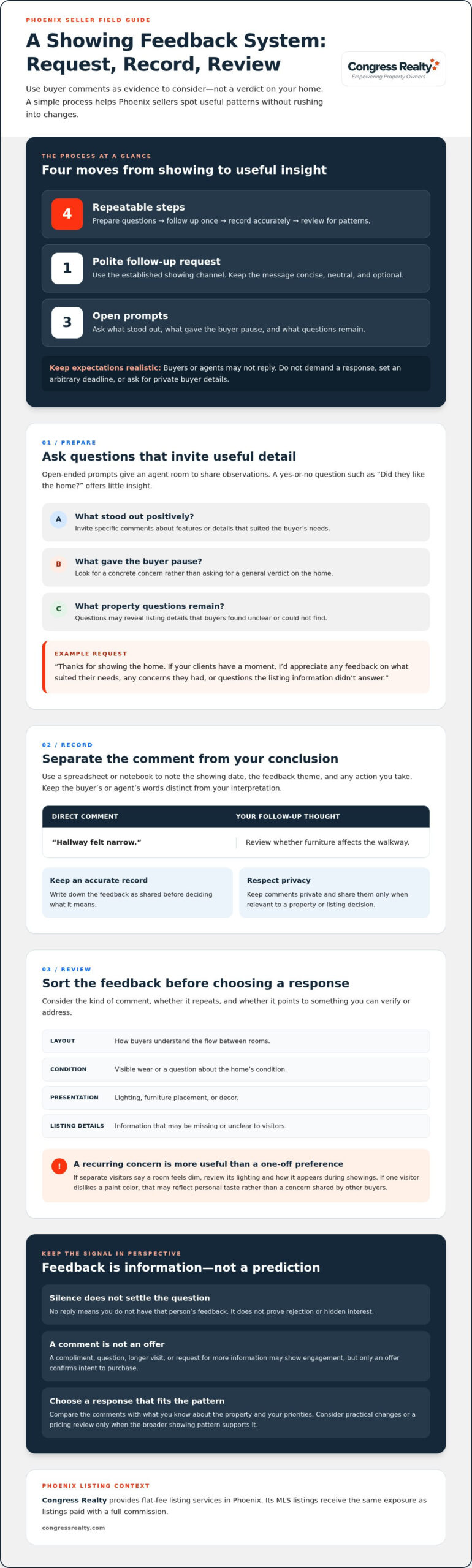
Sort comments into categories before deciding what they mean. Layout feedback may show how buyers understand the flow between rooms. Condition comments may point to visible wear or a repair question. Presentation feedback might concern lighting, furniture placement, or decor. Questions about listing information may reveal missing or unclear details.
Specific observations matter more when they recur. If separate visitors say a room feels dim, check its lighting and how it appears during showings. If one visitor dislikes a paint color, that may reflect personal taste rather than a concern shared by other buyers. Look for repetition and details you can verify, not simply the emotional weight of a comment.
Feedback can also help you distinguish market perception from a formal opinion of value. A Real Estate Appraisal offers background on property valuation, but a buyer’s comment remains a subjective response to a particular home and showing. Treat it accordingly.
Why a quiet response does not settle the question
A buyer or agent may not send comments through the showing process. Silence does not prove that the buyer rejected the home, and it does not signal hidden interest. It simply means you do not have that person’s feedback. Avoid filling the gap with assumptions or changing your plans based on a response you never received.
Consider each comment, or lack of one, alongside the broader showing pattern and your priorities. Are visitors raising similar questions? Do those questions point to something you can address? Would a change fit your goals? A longer visit or a question may show engagement, but neither confirms that an offer will follow. Separate what you know from what you are guessing.
How to request buyer feedback after a Phoenix home showing
A simple process keeps your follow-up professional and makes responses easier to compare. Use the communication channel already established for the showing, such as the one used to arrange access. Keep your message neutral, send one concise request, and avoid implying that a buyer owes you a response. Some buyers or agents may not provide feedback.
What should a seller ask after a showing?
Prepare a few open questions before following up. Ask what stood out in a positive way, what gave the buyer pause, and whether any questions about the property remain. Open questions invite detail. A yes-or-no question such as “Did they like the home?” offers little insight.
Keep your request brief. For example: “Thanks for showing the home. If your clients have a moment, I’d appreciate any feedback on what suited their needs, any concerns they had, or questions the listing information didn’t answer.” This gives the agent clear prompts without pressing for a verdict or an offer prediction. Do not ask for private details about the buyer.
How to track responses without overcomplicating the process
Use a spreadsheet or notebook to record the showing date, feedback themes, and any action you take. Keep the buyer’s or agent’s actual words separate from your interpretation. For example, record “hallway felt narrow” as the comment, then note “review whether furniture affects the walkway” as your follow-up idea. That distinction helps you avoid treating an impression as an established fact.
Keep feedback private and share it only when it is relevant to a decision about the property or its listing details. Avoid forwarding an agent’s comments casually or identifying a buyer when discussing an opinion with others. A private record helps you compare observations fairly while respecting the people who shared them.
Use this repeatable sequence after each showing:
- Prepare. Choose a few neutral questions about positive features, concerns, and unanswered property details.
- Follow up. Send one short, polite request through the established showing channel. Do not demand a response or set an arbitrary deadline.
- Record. Note the date and comments accurately, separating direct feedback from your conclusions.
- Review. Compare responses over time before deciding whether a pattern deserves attention.
This approach makes getting feedback from buyers after showings more organized without turning every response into a new decision. If you are preparing a home for sale, Congress Realty’s home-selling options explain the listing support available while you manage your follow-up process.
How to interpret buyer feedback without overreacting
Different comments call for different kinds of judgment. Before deciding what a response means, ask what the buyer observed, what they inferred, and whether it connects to a decision you can make. “The garage felt tight” describes an experience, but does not explain whether the buyer needs room for storage, tools, or multiple vehicles. That context affects how useful the comment is.
Use this table to turn feedback into a practical question for yourself, rather than treating every comment as a to-do item.
| Observable feedback | Possible meaning | Measured seller response |
|---|---|---|
| Visitors mention that the garage has limited room for storage. | Storage capacity may matter to those buyers, or they may have expected more space. | Check whether the listing clearly describes the garage and its features. Avoid promising extra capacity. |
| A buyer asks how to access a particular outdoor area. | The route or property layout may not be clear during the visit. | Confirm the relevant details and consider whether your showing instructions or listing information can explain them. |
| One visitor likes the open flex space; another prefers a separate room. | They may have different needs for work, hobbies, or privacy. | Describe the space accurately, then weigh any presentation change against your priorities. |
| A buyer praises a feature such as a dedicated workspace. | That feature may align with the buyer’s needs. | Note the positive context, but wait for a clear next step before treating it as purchase intent. |
Which comments deserve closer attention?
Focus on comments that name a specific feature, condition, or unanswered question. Specific wording helps you check what the buyer means and whether the issue falls within your control. Compliments can also show which features visitors value, helping you present those features clearly. They do not establish that a buyer plans to make an offer.
How to read conflicting or subjective responses
Compare what buyers are evaluating, not just whether their opinions match. One visitor may want an open room for hobbies, while another needs privacy for remote work. Both reactions can be valid without indicating a flaw. Group comments about the same feature, then consider the range of buyer needs and your own priorities before changing how you present the home.
Buyer behavior offers context, not certainty. A longer visit or another look may mean the buyer wants more time to assess a detail, but neither guarantees an offer. Keep that distinction clear as you decide what information deserves attention. For homeowners interested in how experienced listing specialists interpret buyer activity and market residential properties, resources like stevekooner.com offer a helpful perspective on full-service real estate guidance.
What Phoenix sellers can do with feedback from showings
When a comment warrants action, turn it into a small, trackable plan. Write down the change, the reason for it, and what you will review afterward. This keeps a useful adjustment from becoming an open-ended round of changes. The goal is a clear process that fits your home and priorities, not a reaction to every new opinion.
- Choose one objective. Define what the change should accomplish, such as making a feature easier to understand or improving how a room presents.
- Set the scope. Decide what you will change and what you will leave as is. Keep the plan manageable and avoid bundling unrelated updates together.
- Update the materials. Make sure descriptions, photos, and showing information still match the home after the change. Correct inaccurate details promptly.
- Review the result. At a planned check-in, consider whether the adjustment achieved its purpose and whether new information supports keeping it.
When feedback points to a simple presentation change
For a low-effort adjustment, set a practical boundary before you begin. Decide how much time and effort you are willing to spend, then focus on the change that directly addresses the concern. Avoid starting a larger project unless it serves a goal beyond responding to one showing. Note what changed and when, so you can compare the next round of showings against the same setup.
A record also helps you avoid attributing every new buyer reaction to the adjustment. Other factors can shape a showing, so treat your notes as context rather than proof that a change caused a particular response.
When feedback raises pricing or listing questions
A pricing concern calls for a broader review than a presentation tweak. Revisit the information behind your asking price, your expected proceeds, and the timing that works for you. If you consider changing the price or overall approach, write down the reason and trade-offs before deciding. Buyer comments can prompt that review, but they do not set your price or replace your own financial judgment.
For a seller-led plan, you can use Congress Realty’s home-selling options as part of your research. Keep the next step aligned with your goals, and do not let a single comment set the pace of the sale.
How Congress Realty supports seller control after Phoenix showings
Feedback can help you assess how buyers experience your home, but you decide what to do with it. Congress Realty’s flat-fee listing model helps sellers save thousands of dollars while retaining control of the sale. Its Multiple Listing Service (MLS) listings receive the same exposure as listings paid with a full commission.
That listing support is separate from collecting buyer feedback. Congress Realty does not promise that buyers or their agents will send comments, make an offer, or agree with your view of the home’s value. Use feedback as one input, then weigh it against your priorities and facts you can verify.
What a flat-fee listing changes, and what it does not
A flat-fee structure does not tie the listing charge to a percentage of the sale price. It does not remove your role in making decisions or guarantee a sale. You remain in control of how you respond to feedback and which steps fit your goals.
The MLS is exclusive to members, and only members can make changes to listing data. Congress Realty makes listing changes for its clients. Those edits help keep the information accurate, but they do not determine how buyers will respond or whether anyone will submit an offer. The listing receives the same exposure as listings paid with a full commission.
Keep the distinction clear: the listing provides the same exposure as listings paid with a full commission, while buyer feedback depends on what buyers or their agents choose to share. Getting feedback from buyers after showings can inform your decisions, but the listing service does not guarantee feedback or replace your judgment.
A practical next step for Phoenix home sellers
Build a steady process around evidence. Confirm the facts behind a comment, compare it with other responses, and decide whether a change supports your selling priorities. If you adjust a listing detail, Congress Realty can make the change for you. The MLS provides the same exposure as listings paid with a full commission.
For a seller-led approach supported by a flat-fee listing model, explore Congress Realty’s home-selling options. Keep your decisions grounded in what you can verify and remain in control of your Phoenix sale.
Set Your Next Step with Confidence
Before the next showing, decide what kind of information could genuinely affect your plans. That boundary helps you stay focused when comments arrive, conflict, or never come. You can listen carefully without handing over control of your sale. Keep your goals in view and give yourself room to make a measured choice.
Getting feedback from buyers after showings works best as part of your decision-making, not as a substitute for it. You do not need to respond to every opinion. Choose observations that connect to your priorities, then move forward at a pace that makes sense for you.
If you are ready to shape your selling approach around your needs, explore Congress Realty’s home-selling options. Take the next step with clarity and keep your Phoenix home sale on your terms.
Frequently Asked Questions
How soon after a showing should a seller request feedback?
Send a brief request after the showing, while the visit remains recent for the buyer’s agent. Follow the timing and communication process already established for showings, and avoid repeated messages if you do not receive a reply. There is no guaranteed response window. If the agent shares feedback later, record when it arrived and which showing it concerns so you can assess it accurately.
Is it a bad sign if a buyer’s agent does not provide feedback?
No. A missing response tells you only that you do not have feedback from that agent. It does not explain the buyer’s decision or predict whether they will return. Keep the showing in your records, but do not count silence as a negative review or a sign of interest. Treat later communication or another showing request as separate facts, rather than filling the gap with assumptions.
Can a seller ask a buyer’s agent for feedback directly?
Yes. A seller can make a polite, neutral request through the communication channel used to arrange the showing. Keep the message focused on the property, not the buyer’s finances, identity, or private plans. For example, ask whether the home raised unanswered questions or whether a feature affected the buyer’s decision. If the agent does not respond, respect that and continue managing your sale without pressing for an explanation.
What questions should sellers ask after a home showing?
Ask open questions that invite useful detail: “Which feature worked best for your clients?” “Was there anything that caused hesitation?” and “Did they have questions about the home that the listing details didn’t answer?” These prompts may reveal a clear information gap, such as uncertainty about an included appliance. Avoid asking whether the buyer will make an offer, since the agent may not know or may not be able to share that.
Should I change my asking price based on buyer feedback?
Do not change your asking price because of one buyer’s opinion. Treat comments about value as one input, then compare recurring concerns with your pricing research, the home’s features, showing activity, and your timing goals. Several specific comments about price deserve more attention than one unsupported remark. A price decision should reflect the full situation, not a single reaction or a hoped-for offer.
Do signs that a showing went well mean the buyer will make an offer?
No. A long visit, detailed questions, compliments, or a request to return may show that a buyer is engaged, but none confirms an offer. Buyers may still compare options, discuss the home with others, or decide it does not fit their needs. Treat those behaviors as limited signals, not a forecast. Wait for clear communication or an actual offer before making decisions that depend on a buyer’s commitment.
How should sellers handle conflicting feedback from different buyers?
Sort comments by subject before acting. If one visitor objects to a decor choice and another praises it, the difference may reflect personal taste. If separate buyers ask the same factual question, review whether your property information answers it clearly. When getting feedback from buyers after showings, verify facts, distinguish preferences from practical concerns, and make changes only when the evidence and your priorities support them.