
What if selling your home didn’t mean choosing between full-service representation and doing everything alone? Congress Realty is a flat-fee MLS brokerage serving Phoenix. Its listings appear on the same MLS, which provides the same exposure as listings paid with a full commission. The alternatives to using a real estate agent include selling independently, choosing a flat-fee listing, or hiring an agent for broader support.
It makes sense to question listing costs. Selling on your own can give you more control, but it also means managing marketing, buyer communication, negotiations, and paperwork. You don’t have to treat the decision as all or nothing.
This guide compares agent-led, independent, and flat-fee approaches so you can weigh the trade-offs, decide which tasks you can handle, and identify where professional support may help. Use the comparison to choose a level of assistance that fits your needs while keeping control of the process.
Key Takeaways
- Compare agent-led, independent, and flat-fee approaches to find the right balance of control, time, and professional support.
- Explore the alternatives to using a real estate agent and identify which selling tasks you’re ready to manage yourself.
- A flat-fee listing on the MLS provides the same exposure as listings paid with a full commission.
- Consider where added help with paperwork, contract negotiation, and documentation could make the sale easier to manage.
- Use a simple self-assessment to choose a selling approach that fits your experience and goals in Phoenix.
What alternatives to using a real estate agent can Phoenix home sellers choose?
Congress Realty provides Phoenix sellers with flat-fee listing support, a way to use professional listing infrastructure while keeping control of key sale decisions. The right approach depends on how much time you can give the process, which tasks you feel ready to manage, and where you want professional help. Your choices range from traditional agent representation to an independent sale or a flat-fee brokerage arrangement.
These options differ in more than cost structure. They also shape who coordinates marketing, responds to buyers, handles negotiations, and supports paperwork. You don’t have to choose between handing over every decision and handling every task alone. A flat-fee listing on the MLS provides the same exposure as listings paid with a full commission. The alternatives to traditional real estate agents include different levels of brokerage involvement and seller responsibility.
What does selling without a traditional agent actually mean?
Skipping a traditional listing agent doesn’t automatically mean selling without professional support. An independent seller manages the sale directly, while a seller using flat-fee brokerage support can select listing services and stay involved in decisions. Support can also extend beyond the listing: Congress Realty’s Full Service Option includes paperwork, contract negotiation, and documentation services.
Think about the work involved before choosing. You may need to prepare listing details, coordinate buyer inquiries and showings, assess offers, and keep track of deadlines and documents. Decide which responsibilities you can manage confidently and where professional assistance would reduce the workload. The goal is to select the support you need, not assume that every seller must take on every transaction task personally.
Which seller profile fits each Phoenix option?
- Independent sale: This can suit experienced sellers who feel prepared to manage marketing, buyer communication, negotiations, and transaction coordination themselves. It offers direct control, but the seller takes on the organization and follow-through.
- Traditional agent representation: This may fit sellers who want hands-on guidance and prefer an agent to take a larger role in managing the sale. Sellers still make important decisions, including whether to accept an offer.
- Flat-fee brokerage: This middle path can work for sellers who want control over the process but also want professional listing support. It separates listing support from a percentage-based listing model, while optional assistance can address specific needs.
Use a practical test: list the tasks you can handle, the time you can set aside, and the moments when you’d want a professional involved. If you’re comfortable managing buyer communication but want listing access through the MLS, which provides the same exposure as listings paid with a full commission, a flat-fee approach may align with your priorities. If you want broader hands-on guidance, consider agent representation. Choose the structure that fits your experience and desired workload, then keep command of the decisions that matter to you.
How do agent-free and flat-fee selling alternatives work?
A flat-fee listing means paying a set fee for listing services instead of paying a percentage-based listing commission. That changes how listing support is priced, not who makes the major decisions about the sale. You can stay involved in setting your strategy and responding to offers while choosing professional support for specific parts of the process.
Congress Realty listings appear on the same MLS, which provides the same exposure as listings paid with a full commission. The MLS is exclusive to its members, and only members can make listing changes. If you want information updated, Congress Realty makes requested changes on your behalf. You remain in charge of the sale while using professional support for this listing channel.
What does a flat-fee listing change for the seller?
A percentage-based model ties the listing charge to the home’s sale price; a flat-fee model sets the charge for listing services in advance. The specific services depend on the selected arrangement, so focus on what you want handled and what you’re prepared to do yourself. For a closer look at how this structure works, read this flat-fee MLS listing guide.
Access doesn’t mean you can directly edit listing information. Only MLS members can make changes, and Congress Realty processes requested updates for clients. That distinction helps set expectations: you can provide corrections or updated details, while the brokerage handles the change in the system. The listing provides the same exposure as listings paid with a full commission.
These alternatives to using a real estate agent give sellers more ways to divide responsibilities. Before choosing, make a short list of tasks you want to manage, such as buyer communication or offer decisions, and tasks where you want support. A flat-fee listing provides professional listing infrastructure without requiring you to hand over control of the entire sale.
What support can a seller add when they want more help?
Some sellers want listing support but also value help with transaction details. Congress Realty’s Full Service Option includes paperwork, contract negotiation, and documentation services. Consider the additional help you want rather than assuming every listing arrangement covers the same tasks.
Choosing additional assistance doesn’t change where the listing appears or its exposure. Congress Realty listings remain on the same MLS, which provides the same exposure as listings paid with a full commission. You can weigh the support you need against the work you prefer to handle, then choose a level of involvement that fits your comfort and schedule.
To compare listing support with the tasks you’ll manage yourself, review Congress Realty’s home-selling options and identify the arrangement that matches your priorities.
How do the alternatives compare on control, workload, and exposure?
Each selling model shifts responsibility differently. Compare who manages the work, how much say you keep, and what professional support comes with the approach. No option guarantees a sale, and listing exposure alone doesn’t determine the outcome.
| Approach | Seller control | Self-management | Listing exposure | Transaction assistance |
|---|---|---|---|---|
| Traditional representation | You make key decisions with an agent involved. | Shared, depending on the working arrangement. | Ask which listing channels the agent will use. An MLS listing provides the same exposure as listings paid with a full commission. | Depends on the agreed services. |
| Independent sale | You manage the process directly. | High. You coordinate marketing, inquiries, showings, offers, and paperwork. | You choose how to market the property. Without an MLS listing, you don’t get exposure through that channel. | You handle the transaction or arrange support separately. |
| Flat-fee listing support | You retain control while selecting listing support. | You manage many sale tasks; additional support depends on the option selected. | Congress Realty listings appear on the same MLS, which provides the same exposure as listings paid with a full commission. | Congress Realty’s Full Service Option includes paperwork, contract negotiation, and documentation services. |
Which tasks stay with the seller in each model?
Your workload depends on the services you choose, not just the label attached to the sale. With independent selling, you coordinate buyer questions, showing arrangements, offer review, and paperwork. Traditional representation shifts some responsibilities to the agent, based on your agreement. Flat-fee listing support separates listing access from other sale tasks, so plan who will manage each one.
Marketing access and hands-on transaction help are different things. A listing can reach buyers through online channels, while the seller still handles communications and showing logistics. Congress Realty’s Full Service Option adds support for paperwork, contract negotiation, and documentation. Don’t assume those tasks come with every listing arrangement. Map out your role in each step before you begin.
Does choosing an alternative reduce listing exposure?
Not automatically. Congress Realty listings appear on the same MLS, which provides the same exposure as listings paid with a full commission. MLS listings may also appear on platforms such as Zillow and Realtor.com. The listing provides the same exposure as listings paid with a full commission, but placement on a specific platform isn’t guaranteed. Exposure describes where a listing can be distributed, not whether a buyer will make an offer. The National Association of REALTORS® reports that homes listed on the MLS average a 7% higher net sales price. That average is not a promise of a particular sale price.
Use the comparison to identify your preferred balance: a traditional agent may offer a more hands-on arrangement, independent selling puts more coordination on you, and flat-fee support keeps listing infrastructure in place while you lead. These alternatives to using a real estate agent differ in workload and assistance, so map each task to the person who will handle it before choosing.
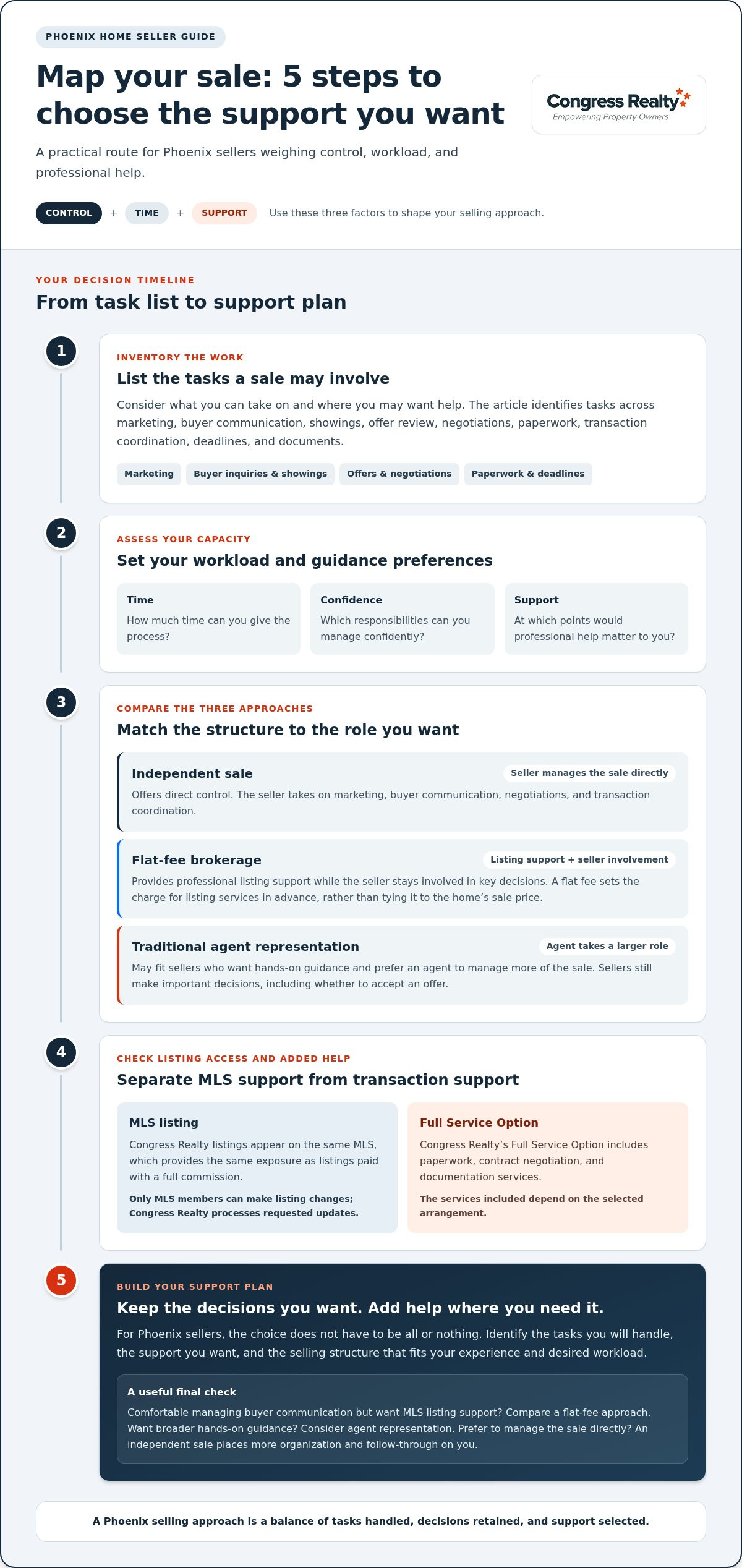
How can Phoenix sellers decide which agent alternative fits?
Choose your selling model by looking at the work you can take on, the decisions you want to control, and the support that would make the process manageable. Don’t start with the assumption that one approach fits every seller. Use this quick assessment to compare your needs with the responsibilities each model involves.
- Measure your available time. Consider how often you can respond to buyer inquiries, coordinate showings, review offers, and track next steps. If your schedule leaves little room for frequent communication, account for that before taking on a highly self-managed sale.
- Assess your transaction experience. Think about how comfortable you feel evaluating offers, discussing terms, organizing documents, and keeping track of deadlines. Experience with one part of the process doesn’t necessarily mean you want to manage every part.
- Set your preferred level of control. Decide which choices you want to make directly and where you’d welcome guidance. You can lead the sale and still select professional support for specific needs.
- Map the tasks to the support. Write down who will handle marketing, buyer communication, showing coordination, paperwork, and negotiation. Compare each option’s service scope and fee structure, not just its label.
What should you assess before choosing a selling model?
Be specific about your comfort level. Could you respond promptly to buyer questions, compare offer terms, and stay on top of transaction deadlines? Then consider your calendar. A seller with time to coordinate each step may prefer more independence, while someone with limited availability may want a structure that reduces the amount of self-management.
Finally, identify the tasks where support would matter most. If paperwork or negotiation feels unfamiliar, include that need in your comparison. Choose based on the assistance you value, not on pressure to take a more involved or less involved path.
When is more professional support worth considering?
Additional support may make sense if you want help with specific transaction work while keeping control of key sale decisions. A seller comfortable coordinating buyer communication might still prefer assistance with paperwork or contract negotiation. Another seller may feel ready to handle those tasks independently. Your experience, time, and comfort should guide the choice.
Before deciding, compare what each arrangement covers and how it charges for listing support. A set-fee listing structure and a percentage-based model allocate costs differently, so review the terms alongside the responsibilities you’ll keep. For more context as you evaluate listing-side costs, Congress Realty’s selling options can help you see how listing support fits into your plan.
Use your task list to make the decision practical. If you want listing support while staying closely involved, explore Congress Realty’s home-selling options and compare them with the work you’re prepared to manage.
How does Congress Realty give Phoenix sellers a flexible alternative?
Congress Realty offers flat-fee listing support for sellers who want professional listing infrastructure while staying involved in decisions about their sale. Its listings appear on the same MLS, which provides the same exposure as listings paid with a full commission. Sellers can choose the level of support that fits their needs instead of treating professional help as an all-or-nothing choice.
For sellers who want assistance beyond listing support, the Full Service Option includes paperwork, contract negotiation, and documentation services. These services give sellers a way to add help with transaction tasks while remaining part of the process. Congress Realty is licensed in every state where it operates, including Arizona, Alaska, California, Idaho, Louisiana, Montana, Nevada, New Mexico, Oregon, Texas, Utah, and Washington.
What happens after a seller chooses a listing service?
After Congress Realty receives the seller’s paperwork, it can place the listing on the MLS the next business day. That listing provides the same exposure as listings paid with a full commission. A basic listing runs for up to 6 months, and sellers can obtain extensions for up to 2 years.
The MLS is exclusive to members, and only members can make changes to listing details. If you need an update, Congress Realty makes requested changes for you. This keeps the process clear: you provide the information or requested correction, and the brokerage handles the update.
How can sellers get started without giving up control?
Start by matching the support you want with the tasks you plan to manage. For example, decide whether you want to handle buyer communication and showing coordination yourself, and whether you’d value help with paperwork, contract negotiation, or documentation. Then compare the service scope and fee structure so you understand what each option covers before selecting one.
The right fit depends on your comfort, schedule, and preferred involvement. You can lead decisions about your sale while using professional listing support and choosing additional assistance where it helps. Congress Realty’s approach gives sellers options without promising a particular sale price or outcome.
Explore Congress Realty’s selling options to compare the available support and select the level that fits your sale. Take the next step on your terms in Phoenix.
Choose a selling plan that keeps you in control
Your sale can be a chance to set clearer terms for how you work with professionals. Rather than accept a one-size-fits-all arrangement, choose a structure that lets you stay involved where you want and delegate where it makes sense. That flexibility is what makes the alternatives to using a real estate agent worth considering.
As you move toward a decision, focus on the agreement itself. Make sure you understand what the selected service covers, how updates and communication work, and which responsibilities remain yours. Clear expectations from the start can help you approach the sale with confidence and avoid surprises about the process.
Ready to take the next step? Explore Congress Realty’s selling options and choose the support level that feels right for your sale. You set the direction, and you can move forward on your terms.
Frequently Asked Questions
Can I sell my house without a real estate agent?
Yes. You can sell independently or choose brokerage support for selected parts of the process. Before deciding, make a simple workflow for handling inquiries, arranging property access, reviewing offers, and keeping documents organized. The alternatives to using a real estate agent let you divide these responsibilities in different ways. Consider who will handle each step and how you’ll keep communication and decisions moving. No approach guarantees a sale or a particular price.
What is the difference between selling by owner and using a flat-fee listing?
Selling independently describes how you manage the sale; a flat-fee listing describes a brokerage’s pricing model for listing services. With Congress Realty, the listing appears on the same MLS, which provides the same exposure as listings paid with a full commission. The MLS is exclusive to its members, and only members can make changes to listing details. Send requested corrections through Congress Realty rather than trying to edit the live entry yourself. Compare service terms to understand what you’ll manage directly.
Does a flat-fee listing have the same exposure as a traditional listing?
An MLS listing provides the same exposure as listings paid with a full commission and may also appear on Zillow or Realtor.com. Treat online visibility as one part of your plan: prepare accurate property details, respond to inquiries, and consider how you’ll make the home available to interested buyers.
What help can I get if I don’t want to manage every part of the sale?
You can choose Congress Realty’s Full Service Option for paperwork, contract negotiation, and documentation services. To decide whether that help fits, note where you feel uncertain, such as reviewing proposed terms or keeping transaction documents in order. Then distinguish those needs from tasks you’re comfortable doing yourself. The option provides assistance in the stated areas, but it doesn’t guarantee a successful transaction or remove every responsibility from the seller.
Can I make changes to my listing myself after it goes live?
No. The MLS is exclusive to its members, and only members can edit MLS listings. Congress Realty makes requested changes for clients. If you notice an error, write down the current detail and the correction you want, then submit that request to the brokerage. This gives you a clear record of the change you’re asking for and avoids confusion about whether you can alter the live listing directly. The listing provides the same exposure as listings paid with a full commission.
How long can a basic listing stay on the MLS?
A basic Congress Realty listing can run for up to 6 months, and extensions are available up to 2 years. The maximum extension period does not mean every listing automatically stays active for that long. As you plan, note your expected sale timeline and review the listing terms so you understand the duration that applies to your arrangement. The listing provides the same exposure as listings paid with a full commission. Compare details on the home-selling options page.
Is selling without a traditional agent right for every homeowner?
No. A suitable approach depends on your experience, schedule, comfort making decisions, and appetite for coordinating the sale. For instance, you might be comfortable responding to buyers but prefer assistance with a complex offer. Think through a realistic week during the sale, including interruptions and follow-up, then consider which arrangement makes those responsibilities workable. The goal is a support structure that matches your circumstances, not a model that every homeowner should choose.