
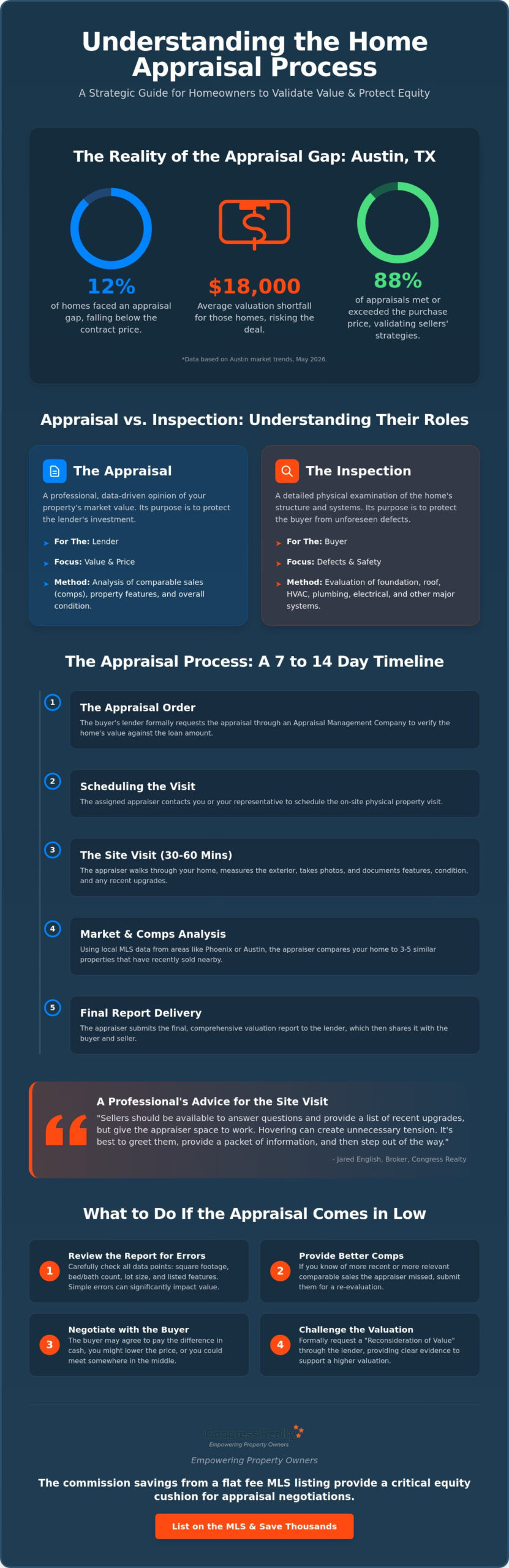
Did you know that 12% of homes in Austin, Texas, faced an appraisal gap in May 2026, with valuations falling an average of $18,000 below the contract price? Congress Realty, a flat fee MLS brokerage serving Phoenix, Arizona, and Austin, Texas, provides the professional infrastructure homeowners need to list on the MLS and bypass traditional high-cost commissions. Understanding the home appraisal process is the final hurdle in your selling journey and the ultimate validation of your home’s true market value.
It’s common to feel a sense of unease when an appraiser arrives, particularly if you’re concerned about a low valuation killing your deal. You want to ensure your hard work translates into a successful closing at or above your contract price. This guide explains how the process works under the mandatory UAD 3.6 data standards and how you can confidently manage the appraiser’s visit. Jared English and the team at Congress Realty believe in your autonomy; we’ll show you how to distinguish an appraisal from an inspection and provide the exact steps to challenge a valuation if it falls short of expectations.
Key Takeaways
- Learn why the appraisal is the final validation of your home equity and how it differs from a standard home inspection.
- Follow the 2026 step-by-step timeline for site visits and report delivery to keep your closing on track.
- Gain a clear advantage by understanding the home appraisal process and how local trends in Austin or Phoenix influence your final valuation.
- Master the strategies for navigating an appraisal gap and learn exactly how to challenge a valuation that comes in low.
- Discover how the commission savings from Congress Realty provide a critical equity cushion during the final stages of your sale.
Defining the Home Appraisal for Independent Sellers
Congress Realty, a flat fee MLS brokerage serving Arizona (including Phoenix and Scottsdale) and Texas (including Austin and Dallas), defines the home appraisal as a professional and unbiased assessment of a property’s market value. While the lender technically triggers the order once a purchase contract is signed, the final report directly determines your net equity at the closing table. Understanding the home appraisal process is essential for any savvy homeowner who wants to maintain control over their transaction without paying a traditional listing commission. By taking charge of this phase, you protect the financial gains you have already secured by listing independently.
The appraiser acts as a neutral third party in the transaction. They must adhere to the Uniform Standards of Professional Appraisal Practice (USPAP) to ensure the valuation remains objective and free from outside influence. What is a real estate appraisal? At its core, it is a data-driven document that protects the lender’s investment by confirming the home is worth the loan amount. For the seller, it is the final validation of your asking price. Recent data from the Austin market in May 2026 shows that 88% of appraisals come in at or above the purchase price. This indicates that when you use professional data to set your price, the appraisal process usually confirms your strategy.
Appraisal vs. Inspection: Why You Need Both
Many homeowners confuse these two steps; however, they serve different masters. An inspector hunts for physical defects like a cracked foundation or a failing HVAC system to protect the buyer’s safety. In contrast, an appraiser searches for value based on comparable sales and property features to protect the lender’s capital. A clean inspection report is a powerful tool for your valuation. You can share this report with the appraiser to prove the home’s condition is superior to other local listings that might have deferred maintenance issues.
Does a seller need to be present for the appraisal?
Jared English recommends that sellers stay available to answer questions or provide a list of recent upgrades, but you should give the appraiser space to work. Hovering can create unnecessary tension and may hinder their professional walkthrough. It is best to meet them at the door, provide a packet of information regarding your home’s improvements, and then step out of the way.
The Role of the Lender in the Valuation
Lenders require an appraisal to mitigate their financial risk. They use the report to calculate the Loan to Value (LTV) ratio, which is the percentage of the home’s value that the bank is willing to finance. If the appraisal comes in low, that ratio breaks; consequently, the buyer may be forced to bring more cash to the table or walk away. Congress Realty clients often use their flat fee MLS listing data to provide appraisers with the most accurate and recent comps in their specific neighborhood. Providing this data ensures the appraiser has a complete picture of the local market trends in high-demand areas like Tucson or San Antonio.
The Step-by-Step Home Appraisal Process in 2026
The sequence begins immediately after you and the buyer sign the purchase contract. In 2026, the full timeline from the initial order to receiving the final report typically spans 7 to 14 business days. Congress Realty ensures that independent sellers remain in the driver’s seat during this transition by providing the necessary professional infrastructure. Understanding the home appraisal process requires knowing that while the buyer’s lender initiates the order through an Appraisal Management Company, you remain the primary source of property data and access.
- Step 1: The Appraisal Order. The lender triggers the request to confirm the property’s value before final loan approval.
- Step 2: Scheduling. The appraiser contacts the homeowner or the Congress Realty transaction manager to set a time for the site visit.
- Step 3: The Site Visit. This is the physical walkthrough where the appraiser validates the home’s condition and features.
- Step 4: Market Analysis. The appraiser pulls “comps” from the local MLS to see what similar homes in Phoenix or Austin have sold for recently.
- Step 5: Report Delivery. The appraiser submits a digital report, mandatory in the UAD 3.6 format as of November 2, 2026, to the lender.
What Happens During the Physical Inspection?
The on-site portion for a standard single-family home usually takes 30 to 60 minutes. During this window, the appraiser measures the exterior and walks through the interior to note permanent features like flooring, layout, and structural integrity. They focus on high-impact value drivers rather than your furniture or temporary staging. Jared English suggests having a typed list of recent upgrades ready to hand over. “Providing a clear history of capital improvements, such as a new roof or HVAC system, helps the appraiser justify a higher valuation in their report,” English notes. You should also be aware of your consumer rights in the appraisal phase to ensure the process remains objective and transparent.
The Importance of Comparable Sales (Comps)
Appraisers generally follow the “Rule of Three,” seeking at least three similar homes that sold within the last six months. In dense metropolitan areas like Scottsdale or Dallas, these comps should ideally be within a one-mile radius. In more rural parts of Texas or Arizona, the search radius may expand to five or ten miles. Before the appraiser even arrives, using a Comparative Market Analysis can help you understand where your home sits in the current market. This preparation is a hallmark of a savvy seller who wants to list on the MLS while maintaining professional standards.
How long does the home appraisal take in 2026?
The physical inspection takes 30 to 60 minutes, but the entire process from the initial order to the final report delivery generally takes 7 to 14 business days. Factors such as appraiser availability in high-growth markets like Austin or Phoenix can influence this timeline.
Key Factors Influencing Your Property Valuation
Congress Realty, a flat fee MLS brokerage serving high-growth markets like Scottsdale, Arizona, and Austin, Texas, knows that valuation is driven by specific property characteristics and local neighborhood trends. While the basic math of square footage and room counts provides a baseline, the final number hinges on how your home compares to recent local sales. Understanding the home appraisal process means recognizing that appraisers evaluate your home based on standardized Condition and Quality ratings, ranging from C1 for new construction to C6 for properties with severe deficiencies. Most well-maintained homes in established neighborhoods fall into the C3 or C4 categories.
Lenders also look at external factors that influence desirability. Proximity to top-rated school districts or popular amenities in areas like the Domain in Austin or Old Town Scottsdale can significantly boost your baseline price. Bankrate provides a deep dive into understanding the home appraisal process, highlighting how these external variables impact the final report. By identifying these assets early, you can ensure they are properly reflected in your valuation.
Upgrades That Actually Add Value
Distinguishing between maintenance and upgrades is a critical part of the valuation. Replacing a leaky roof or a water heater is considered maintenance; it prevents a value deduction but rarely increases the sales price. Conversely, a full kitchen remodel or adding a primary suite provides a measurable return on investment. Reports from MarketWatch and ABC News in 2026 indicate that minor kitchen refreshes and energy-efficient window replacements consistently offer the highest ROI for sellers. Jared English advises keeping a folder of all receipts for work completed in the last five years to present to the appraiser during their walkthrough.
Which home improvements add the most value in 2026?
Local Market Nuances in Arizona and Texas
Geography dictates value in ways that standardized forms often miss. In Phoenix and Tucson, a swimming pool is often considered a necessity rather than a luxury, adding significant value that might not exist in cooler climates. In Texas, energy-efficient features like solar panels and high-grade insulation are increasingly scrutinized as homeowners seek relief from summer heat. Congress Realty ensures these specific local features are prominently highlighted in your MLS listing. This ensures the appraiser sees the full value of your property’s unique assets before they even step foot on the lot.
Overcoming the Challenge of a Low Appraisal
The biggest anxiety for independent sellers is the appraisal coming in below the contract price. This creates an “Appraisal Gap,” where the lender will only finance based on the lower valuation rather than your agreed-upon price. While this can feel like a deal-killer, understanding the home appraisal process gives you the tools to bridge that gap effectively. In rapidly appreciating markets like Dallas, Texas, appraisals sometimes struggle to keep pace with rising prices. This is why having a strategy ready is essential for protecting your equity and keeping your closing on track.
If the report is low, you can initiate a formal Reconsideration of Value (ROV). This isn’t just a complaint; it is a structured request for the appraiser to review specific factual errors or additional comparable sales. As reported by outlets like the Star-Telegram, navigating these market shifts requires a data-driven approach rather than an emotional one. By maintaining a professional stance, you can often find a path forward that satisfies both the lender and the buyer.
Can a seller challenge a low appraisal?
Yes, sellers can challenge a low appraisal through a formal Reconsideration of Value (ROV) process. You must provide evidence of factual errors in the report, such as incorrect square footage, or submit at least three superior comparable sales that the appraiser overlooked.
How to Rebut a Low Appraisal Report
Start by scrutinizing the report for data errors. Appraisers are human and can miss a half-bath, miscalculate square footage, or overlook a major upgrade you recently completed. If you find a factual mistake, you have solid ground for an ROV. Next, look for “better” comps that support your price. If the appraiser used a sale from six months ago but a similar home sold next door last week, that new data must be considered. Jared English suggests reviewing the report line-by-line to ensure every feature is accounted for. “We often find that appraisers who aren’t as familiar with a specific pocket of Dallas might miss the nuance of a particular subdivision,” English notes. Understanding the home appraisal process allows you to spot these inconsistencies and advocate for your property’s true value.
Negotiation Strategies for Appraisal Gaps
When the valuation remains low, you have three primary negotiation paths. First, the buyer can bring more cash to the table to cover the difference between the loan amount and the sales price. This is common when buyers are highly motivated to secure a specific home. Second, you can lower the sales price to match the appraised value, ensuring the loan goes through without delay. Third, many sellers choose to meet in the middle. For example, if the gap is $10,000, you might drop the price by $5,000 while the buyer brings $5,000 in additional cash.
Your savings on commissions through Congress Realty provide a unique financial buffer during these negotiations. Because you aren’t losing a significant percentage of your equity to traditional agents, you have more flexibility to adjust the price without hurting your bottom line. If you are ready to take control of your sale and protect your home’s value, list your property on the MLS today.
Protecting Your Equity During the Appraisal Phase
Congress Realty, a flat fee MLS brokerage serving homeowners in Arizona and Texas, empowers sellers to retain more of their hard-earned equity by eliminating the traditional 3 percent listing commission. This financial decision creates a significant “equity cushion” that becomes a strategic asset during the final stages of your sale. Understanding the home appraisal process reveals that having this extra capital allows you to navigate potential valuation gaps with far less stress than a traditional seller. If an appraiser values your home slightly below the contract price, you have the room to negotiate without dipping into the profits you need for your next move.
A successful appraisal serves as the final validation of your independent selling strategy. It confirms that your pricing was accurate and your property is a sound investment for the lender. By utilizing professional transaction management through Congress Realty, you ensure that the technical details of the escrow process remain under your control. This professional infrastructure provides the same reliability as a high-cost brokerage while protecting thousands of dollars in your pocket.
Final Preparations for Appraisal Day
The 24 hours leading up to the appraiser’s visit are critical for a smooth valuation. Treat this visit with the same level of care as a high-stakes showing. Use the following checklist to prepare your property:
- Clean the yard and improve curb appeal to set a positive initial perception.
- Clear all hallways and ensure every room and closet is easily accessible.
- Confirm all utilities are turned on; appraisers must verify that systems like HVAC and water are functional.
- Secure pets in a crate or take them off-site to prevent distractions during the walkthrough.
- Ensure the attic, crawlspace, and garage are unlocked and ready for inspection.
For more comprehensive tips on getting your home ready for the market, consult our guide on How to Sell Your House on Your Own. Preparation reduces the likelihood of an appraiser needing to return for a second visit, which can delay your closing timeline.
The Congress Realty Advantage in Valuation
Professional presentation influences how an appraiser perceives your property’s condition and quality. When you list with Congress Realty, your home is featured on the same professional industry databases used by every major brokerage in Phoenix or Austin. High-quality photography and a detailed MLS description signal to the appraiser that the home has been professionally maintained and marketed. Jared English notes that a well-documented listing helps justify the sales price when the appraiser pulls local data. “When your listing looks professional, it supports the idea that the contract price represents true market value,” English explains. By avoiding high commission costs, you can price your home more competitively, often leading to a smoother appraisal and a faster path to the closing table.
How does a flat fee MLS listing help with the appraisal?
A flat fee MLS listing through Congress Realty puts your home in the professional databases appraisers use to find comparable sales. Because you save on the listing commission, you have more flexibility to price your home at a point that is easily supported by local market data, reducing the risk of an appraisal gap.
Ready to list? Start your Congress Realty listing today.
Take Control of Your Home Equity Today
Mastering the appraisal stage is the final step in securing your financial future. By understanding the home appraisal process, you transform a potentially stressful hurdle into a clear validation of your property’s market value. Remember to prepare your home for the site visit, document every major upgrade, and stay ready to challenge factual inaccuracies through the Reconsideration of Value process. These proactive steps ensure you maintain the momentum of your sale while protecting the equity you have worked hard to build.
Congress Realty has championed the rights of independent sellers since 2002. With over 20 years of industry experience and expert broker support from Jared English, we provide the professional infrastructure you need across 12 states, including Arizona, Texas, and California. You don’t need a traditional agent to navigate these final hurdles when you have a reliable ally on your side. Take the next step toward a successful, commission-free closing.
Save your equity and list on the MLS for a flat fee with Congress Realty. You have the knowledge and the tools to manage your sale with confidence.
Frequently Asked Questions
How much does a home appraisal cost in 2026?
A standard single-family home appraisal in 2026 typically costs between $350 and $600. If you are selling a condo in Austin or Phoenix, expect the fee to range between $400 and $750 because the appraiser must perform additional analysis on HOA financials. Government-backed loans are more expensive; FHA or VA appraisals often cost between $400 and $900 due to stricter safety inspection requirements. USDA loan appraisals usually fall between $550 and $800.
Who is responsible for paying the appraisal fee?
The buyer is responsible for paying the appraisal fee in almost all residential purchase transactions. This cost is usually bundled into their closing costs or paid upfront when their lender initiates the order. While the seller does not pay for this service, understanding the home appraisal process is vital because the resulting valuation determines if the bank will fund the loan at your agreed-upon sales price. This step acts as a mandatory safeguard for the lender’s capital.
How long does the entire appraisal process take from start to finish?
The entire process generally takes between 7 and 14 business days from the moment the lender places the order to the delivery of the final digital report. While the on-site inspection in markets like Scottsdale or Dallas only takes 30 to 60 minutes, the appraiser requires several days to analyze local MLS data and complete the mandatory UAD 3.6 reporting format. High-demand periods in Texas and Arizona may see these timelines extend up to 20 days.
Can I use an old appraisal if I recently refinanced my home?
Lenders will not accept an old appraisal from a previous refinance for a new home purchase transaction. Every new mortgage requires a fresh valuation to ensure the property reflects the most current market conditions and the most recent comparable sales. Even if you refinanced your home just a few months ago, the buyer’s lender must order their own independent report through an Appraisal Management Company to satisfy federal risk management regulations.
What are the most common things that fail a home appraisal?
Safety hazards and structural deficiencies are the most frequent reasons a property fails to meet lender standards. Common issues include peeling lead-based paint, missing stair handrails, or non-functional utilities that prevent the appraiser from testing home systems. Jared English notes that non-permitted additions can also cause significant problems if the appraiser cannot verify the square footage against county records. These “failed” items often require repair before the lender will finalize the loan.
Does a messy house affect the final appraisal value?
A messy house does not technically lower your appraised value because appraisers focus on the permanent “Condition and Quality” ratings of the structure. However, extreme clutter can prevent the appraiser from inspecting floors or walls, which might lead to a more conservative condition rating in the final report. Clean your home and clear all hallways so the appraiser can accurately measure your space and note your high-quality finishes in Phoenix or Tucson without unnecessary obstacles.
What happens if the buyer is using an FHA or VA loan for the purchase?
FHA and VA loans involve a more rigorous appraisal process that includes specific safety and habitability checks beyond a standard valuation. If the appraiser identifies issues like exposed wiring or a failing roof, the lender will require these repairs to be completed before the loan can close. Additionally, these appraisals are tied to the property for a set period. This means the valuation may remain the same even if the original buyer walks away and a new one enters the deal.
Can I choose my own appraiser for the home sale?
You cannot choose your own appraiser due to federal independence requirements designed to prevent mortgage fraud and collusion. Lenders must use a neutral third-party Appraisal Management Company to assign a licensed professional to your property. While you cannot select the individual, understanding the home appraisal process allows you to prepare a professional data packet for whoever is assigned. Congress Realty ensures your MLS listing provides these appraisers with the most accurate data to support your home’s value.