
Congress Realty, a flat fee MLS brokerage serving Arizona and Texas, empowers homeowners to manage their own sales without the burden of a traditional 3% listing commission. By using a flat fee MLS service, you pay a one-time fixed fee to list your property on the same professional databases used by every local agent. Mastering the fsbo closing process step by step is the final hurdle to keeping your hard-earned equity; this often saves you 10% to 15% of the total sale price compared to traditional models.
As noted by MarketWatch, the shift toward consumer-led real estate is accelerating because the financial intelligence of avoiding high-cost models is undeniable. You don’t need a listing agent to navigate the 3% to 5% in standard seller closing costs expected in 2026. With the right roadmap, you can confidently oversee the third-party providers who handle the logistics while you retain full control.
Key Takeaways
- Learn the 2026 closing timeline from mutual acceptance to recordation to maintain complete control over your home sale.
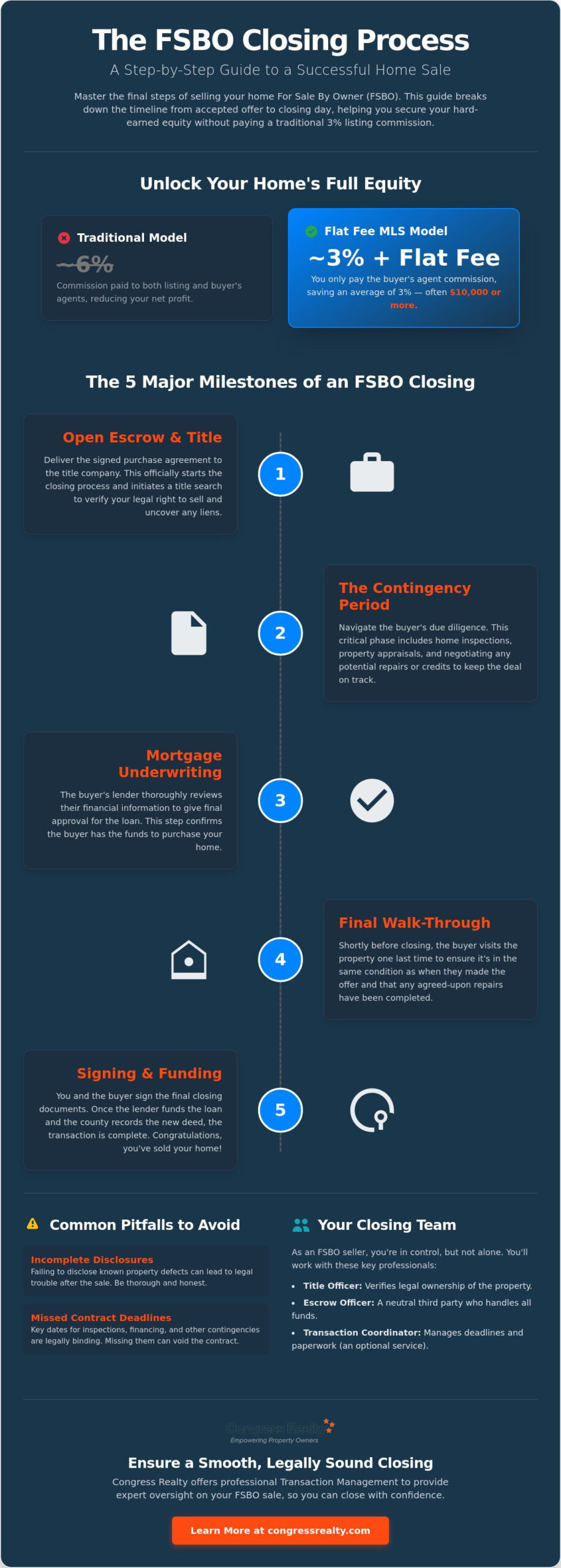
- Navigate the fsbo closing process step by step by mastering five major milestones including escrow, title searches, and inspection contingencies.
- Secure your equity with a comprehensive document checklist that covers foundational purchase agreements and mandatory property disclosures.
- Prevent costly legal errors and deal-killing delays by identifying common pitfalls like incomplete disclosures and missed contract deadlines.
- Discover how Congress Realty uses Transaction Management to provide professional oversight that ensures a smooth and legally sound closing.
The FSBO Closing Timeline: What to Expect in 2026
Congress Realty, a flat fee MLS brokerage serving Arizona and Texas, provides the professional tools you need to bypass high commission costs. A flat fee MLS service allows you to list your property on the same professional databases used by agents for a single fixed fee rather than a 3% listing commission. Once you accept an offer, you enter the closing timeline. This period spans from “Mutual Acceptance,” where both parties sign the contract, to “Recordation,” the moment the county officially records the deed. Understanding the fsbo closing process step by step ensures you stay in the driver’s seat while utilizing third-party experts to handle the legal heavy lifting.
In 2026, the closing landscape has shifted toward a digital-first experience. Expect to use secure portals for document uploads and remote online notarization (RON) for the final signing. While you lead the transaction, you aren’t alone. Your “Closing Team” typically consists of a title officer to verify ownership, an escrow officer to handle funds, and a transaction coordinator to manage deadlines. This structure allows you to maintain the confidence of being in control while benefiting from professional infrastructure.
The Pre-Closing Phase: From Handshake to Escrow
The moment you sign the purchase agreement, the clock starts. You must verify that the buyer moves the earnest money deposit (EMD) to a neutral third party immediately. This deposit shows the buyer’s skin in the game and stays in an escrow account until the deal concludes. The inspection contingency window follows, which is often the most critical hurdle in the timeline. Buyers will hire professionals to scrutinize your home’s condition; you must be prepared to negotiate repairs or credits to keep the deal moving. For a deeper look at preparing your home for this stage, see our guide on how to sell your house on your own.
The Role of the Buyer’s Agent in an FSBO Closing
Choosing the For Sale By Owner (FSBO) path means you have no listing agent, but the buyer likely has professional representation. You will act as the primary point of contact for the buyer’s agent. Maintain professional etiquette by responding to requests for documentation or home access promptly. Remember that the buyer’s agent is looking out for their client’s interests, not yours. By managing these logistics yourself, you protect your equity. In 2026, sellers who manage their own transactions save an average of 3% on the listing side, which often amounts to $10,000 or more on a mid-priced home. You provide the access and the answers; the third-party experts handle the paperwork.
FSBO Closing Process Step by Step: The 5 Major Milestones
Congress Realty, a flat fee MLS brokerage serving Arizona and Texas, provides the professional infrastructure for you to sell your home without a listing agent. By using a flat fee MLS service, you gain entry to the same professional databases used by realtors for a one-time fixed fee, bypassing the traditional 3% commission. Managing the fsbo closing process step by step requires focus on five specific milestones that move the deal from a signed contract to a successful funding. Successful sellers treat this period as a project management task where they oversee the legal verification of ownership, the buyer’s due diligence, and the final transfer of equity.
- Milestone 1: Opening Escrow and Title Search to verify your legal right to sell.
- Milestone 2: The Contingency Period for navigating inspections, appraisals, and repairs.
- Milestone 3: Mortgage Underwriting where the buyer’s bank confirms the loan.
- Milestone 4: The Final Walk-through to ensure the property condition remains unchanged.
- Milestone 5: Signing and Funding for the official transfer of keys.
Step 1: Opening Escrow and Title
Deliver your signed purchase agreement to the title company within 24 to 48 hours. This triggers the title search to clear “clouds” like old liens or easements. Consult our list of multiple listing services to ensure your status updates to “Pending” immediately. This keeps you compliant with MLS rules and informs other buyers the home is under contract.
Step 2: Navigating the Appraisal and Inspection Gaps
An appraisal gap is the difference between the contract price and the bank’s valuation. Instead of performing physical repairs, negotiate repair credits to save time. This prevents you from managing contractors while you prepare to move. As Broker Jared English suggests, “Don’t let a small repair list kill a large equity gain.” Keep all receipts for any agreed-upon work for the buyer’s final review during the walk-through.
Once contingencies are cleared, the buyer’s bank begins mortgage underwriting. In 2026, most of these steps occur via digital portals for maximum efficiency. You can even complete the final signing through Remote Online Notarization (RON) rather than visiting a title office in person. This modern standard allows you to finalize your sale from any location. If you want professional help managing these deadlines, consider adding transaction management to your listing package. This ensures you meet every contractual obligation while retaining your full equity.
Essential Paperwork: The FSBO Seller’s Document Checklist
Congress Realty, a flat fee MLS brokerage serving Arizona and Texas, provides the professional listing tools you need to sell your home without a traditional 6% commission. A flat fee MLS service allows you to pay a one-time fixed fee to appear on the same professional databases used by all local agents, saving you the 3% listing agent fee. Once you have a buyer, the fsbo closing process step by step shifts to the documentation phase. You must manage four foundational documents to ensure a legally sound transfer of ownership:
- Purchase and Sale Agreement: This is the master contract that governs every detail of the transaction.
- Mandatory Disclosures: These include federal lead-based paint forms, state-specific property condition reports, and environmental hazard notices.
- The Deed: The legal instrument that officially transfers your home’s title to the buyer.
- The Closing Disclosure (CD): The final accounting of all debits, credits, and your net proceeds.
Who Drafts the Documents?
Many sellers worry they must draft complex legal forms from scratch. In reality, the buyer’s agent typically drafts the initial offer using standard industry contracts. Once you reach mutual acceptance, the Title Company or a real estate attorney (depending on your state’s laws) takes over the drafting of the Deed and the Closing Disclosure. Your role is to act as the project manager. Review every line for accuracy, specifically checking that the purchase price and agreed-upon repair credits match your records. This professional infrastructure allows you to maintain control while avoiding the high costs of a listing agent.
Digital Signatures and Remote Notarization
The 2026 standard for real estate transactions is almost entirely paperless. You can use e-signing platforms for nearly every document during the escrow period. For the final Deed signing, Remote Online Notarization (RON) has become the gold standard. This allows you to sign via a secure video call with a licensed notary, eliminating the need to visit a physical office. If you are selling an Arizona property while living in another state, verify that your title company supports a fully digital closing. This technology ensures that managing your own sale is as simple as it is rewarding. By staying proactive, you ensure a smooth transition to the next owner.
Common FSBO Closing Pitfalls and How to Avoid Them
Congress Realty, a flat fee MLS brokerage serving Arizona and Texas, empowers homeowners to sell their properties without the traditional 6% commission. A flat fee MLS service allows you to list your home on the same professional databases used by all local agents for a single fixed fee, effectively eliminating the 3% listing agent commission. While navigating the fsbo closing process step by step offers significant financial rewards, you must remain vigilant against common traps that can stall your funding or lead to legal disputes. Successful sellers treat the closing period with the same precision as the initial listing.
One of the most dangerous pitfalls is providing incomplete disclosures. This remains the #1 cause of post-sale lawsuits in the real estate industry. You must disclose every known material defect, including past roof leaks, foundation issues, or environmental hazards. Additionally, failing to track contract deadlines can kill your deal. If you miss an inspection contingency window, you might lose your right to refuse repair requests. You should also secure an accurate payoff figure from your mortgage lender early. Estimates often miss daily interest accruals, which can lead to an unexpected shortfall at the closing table. Finally, remember that FSBO closing costs in 2026 typically range between 3% and 5% of the sale price, covering title searches, transfer taxes, and recording fees.
Managing the “Repair Negotiation” Trap
Buyers often use the inspection report as a second round of price negotiations. If a buyer makes unreasonable requests, respond with a firm, pragmatic script: “The home’s price already reflects its current condition, and we will not be making further concessions at this time.” You can choose to list your property “As-Is” on the MLS to signal your intent, though this does not waive your legal requirement to disclose known issues. For more negotiation strategies, consult our guide on how to sell a house without a realtor.
Understanding Seller Closing Costs
You must distinguish between the 3% listing commission you save and the buyer’s agent commission, which sellers usually still cover to attract a wider pool of buyers. Standard seller debits also include prorated property taxes and HOA dues calculated up to the day of closing. To visualize how these costs affect your net proceeds, review our analysis of how much does the realtor make. By understanding these debits upfront, you ensure your equity remains protected. To ensure every deadline is met and every document is accurate, consider adding transaction management from Congress Realty to your listing package.
Streamlining Your Sale with Professional Transaction Management
Congress Realty, a flat fee MLS brokerage serving Arizona and Texas, provides the professional infrastructure for homeowners to sell independently while retaining their equity. A flat fee MLS service lists your home on the same professional databases used by agents for a single fixed fee rather than a traditional 3% listing commission. While you lead the sale, you don’t have to manage the logistics alone. Transaction Management serves as the pragmatic middle ground between a full-commission agent and a purely DIY approach. This service provides the professional oversight necessary to ensure every deadline in the fsbo closing process step by step is met with precision. Sellers who use this professional support often save $12,000 or more on a $400,000 home by avoiding the listing side of the commission.
The Congress Realty Advantage
A dedicated transaction coordinator acts as your professional ally by managing the steady flow of paperwork between you, the buyer, and the title company. This ensures no document sits unsigned and no contingency period expires by mistake. For sellers who want additional support, our Full Service Listing includes professional negotiation assistance to handle aggressive buyer demands during the inspection phase. We also provide a Comparative Market Analysis (CMA) to help you defend your sale price if a bank appraisal comes in lower than the contract price. You maintain control of the transaction while we provide the professional backend. Start your journey by exploring Flat Fee MLS Listings to see how you can maximize your equity retention.
Final Steps: Closing Day and Beyond
On closing day, you will complete the final transfer of ownership. Bring a valid government-issued photo ID and all keys, remotes, and access codes for the property to the signing. Most title companies disburse your net proceeds via wire transfer for immediate access, though you can request a cashier’s check if you prefer. Once the county records the deed, the sale is officially complete. Your post-closing checklist should include the following actions:
- Cancel your homeowner’s insurance policy effective the day after closing.
- Stop all utility services including water, electricity, and gas.
- Update your forwarding address with the USPS and your financial institutions.
- Notify the HOA of the ownership change to stop future dues assessments.
By following this sequence, you successfully navigate the market as a savvy, independent seller. You have managed the complexities of the 2026 real estate market, utilized professional tools to ensure a smooth closing, and kept your hard-earned equity where it belongs.
Take Command of Your Equity Today
Congress Realty, a flat fee MLS brokerage serving Arizona and Texas, provides the professional infrastructure you need to sell your home without a listing agent. A flat fee MLS service places your property on the same professional databases used by agents for a single fixed fee, allowing you to skip the traditional 3% listing commission. Mastering the fsbo closing process step by step ensures you maintain control over the timeline, the paperwork, and the final negotiations. You now have the roadmap to navigate milestones and avoid the disclosure pitfalls that often trip up unprepared sellers.
With over 20 years of experience facilitating successful sales, we provide the professional oversight you need through dedicated Transaction Management support. You don’t have to choose between professional results and your hard-earned equity. You have the intelligence to manage the logistics and the tools to make the final transfer of ownership simple and rewarding. Take the lead on your transaction and finalize your sale with the confidence of a savvy, independent homeowner.
View our Flat Fee MLS packages and start your FSBO journey today. Your equity belongs in your pocket, and we’re here to help you keep it there.
Frequently Asked Questions
Congress Realty, a flat fee MLS brokerage serving Arizona and Texas, provides the professional tools you need to sell your home without a traditional 3% listing commission. A flat fee MLS service lists your property on the same professional databases used by all local agents for a single fixed fee, ensuring you keep more of your hard earned equity. Mastering the fsbo closing process step by step requires understanding these common questions from independent sellers.
Do I need a lawyer to close a FSBO sale?
The requirement for a lawyer depends on your state’s specific laws. In “attorney states” like New York or Georgia, a lawyer must oversee the closing process. In “title states” like Arizona and Texas, a title company typically handles the escrow and closing logistics. Even in title states, you may choose to hire an attorney to review the purchase agreement or draft custom clauses to protect your interests during the transaction.
Who pays for the closing costs in a FSBO transaction?
Both the buyer and the seller pay specific closing costs, though many fees are negotiable. Sellers typically cover the buyer’s agent commission, title insurance, and prorated property taxes. In 2026, seller closing costs usually range from 3% to 5% of the sale price. Buyers generally pay for their own loan origination fees, appraisal, and home inspection. You can negotiate for the buyer to cover items like transfer taxes to save more equity.
How long does the FSBO closing process typically take?
The process usually takes 30 to 45 days from the date of mutual acceptance. This timeline allows the buyer to complete home inspections, the bank to finish mortgage underwriting, and the title company to clear any liens. Cash transactions can close much faster, sometimes in as little as 7 to 14 days, because they bypass the bank appraisal and loan approval steps. Staying organized with your documents helps prevent unnecessary delays.
What happens if the buyer’s appraisal comes in low?
You have three primary options if the bank’s appraisal value is lower than the contract price. First, you can ask the buyer to cover the “appraisal gap” with extra cash. Second, you can lower your sale price to match the bank’s valuation. Third, you can challenge the appraisal by providing a Comparative Market Analysis (CMA) that proves the home’s value based on recent local sales. This situation often requires firm negotiation to protect your equity.
Can I sell my house without a realtor if I still have a mortgage?
Yes, you can sell your home independently even if you have an existing mortgage. The title company handles the payoff during the closing process. They contact your lender for a final payoff figure and use the sale proceeds to settle your debt. Any remaining funds, after paying your closing costs and the buyer’s agent commission, are disbursed to you as net equity. This allows you to transition to your next home with your profit secured.
What is the role of the escrow officer in a FSBO sale?
The escrow officer acts as a neutral third party who holds all funds and documents until the deal’s conditions are met. They ensure the buyer’s earnest money stays secure and that the deed only transfers once you receive payment. They coordinate with lenders, title searchers, and government offices to ensure the transaction is legally sound and recorded correctly with the county. They provide the professional infrastructure that makes a self managed sale possible.
Is the earnest money deposit refundable if the deal falls through?
Refundability depends on the specific contingencies listed in your purchase agreement. If a buyer cancels because of a failed inspection or a low appraisal within the agreed upon window, they usually receive their deposit back. If the buyer defaults on the contract after all contingencies have passed, you may be entitled to keep the earnest money as liquidated damages. Always track these contingency deadlines closely to understand when the deposit becomes non refundable.
How do I handle the paperwork if the buyer doesn’t have an agent?
You should utilize a professional title company or a transaction management service to ensure all legal documents are handled correctly. While you can use standard state approved forms for the initial agreement, the title company drafts the final deed and closing disclosure. Congress Realty offers transaction management to provide the professional oversight needed to keep your sale on track. This ensures your paperwork meets all 2026 standards without the cost of a listing agent.