
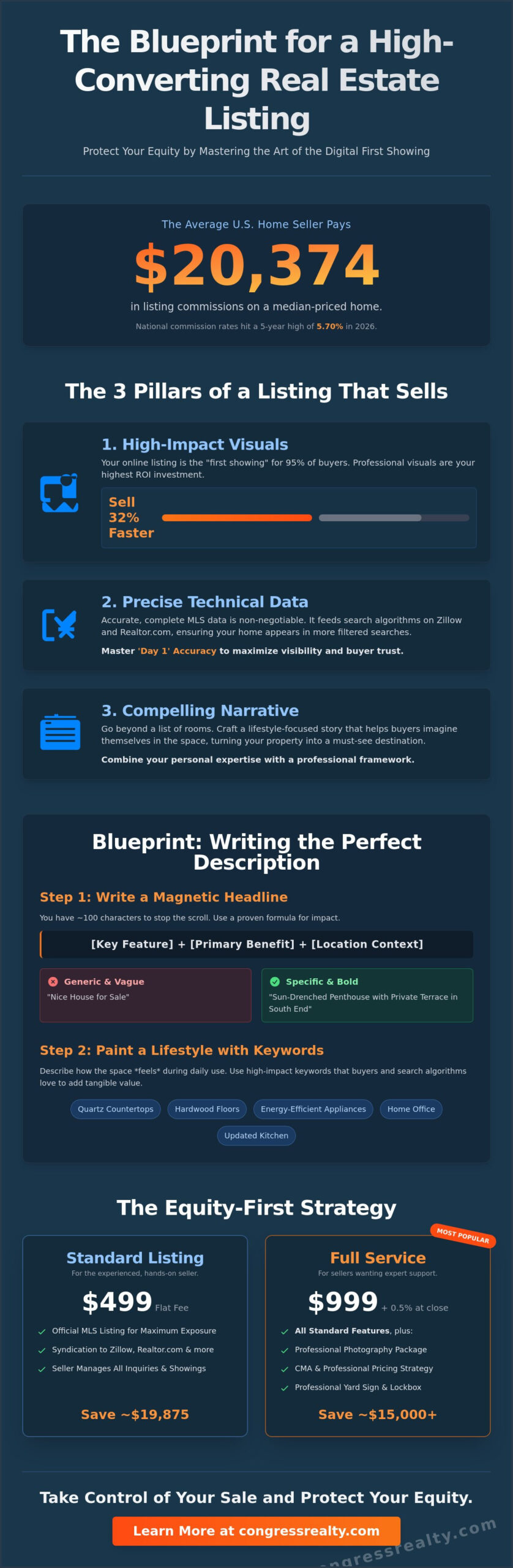
Did you know that the average U.S. home seller now hands over approximately $20,374 in commission fees just to close a median-priced sale? With national commission rates hitting a five-year high of 5.70% in 2026, learning how to write a real estate listing that sells is the most effective way to protect your equity. You shouldn’t have to choose between professional market exposure and your financial intelligence.
It’s natural to feel anxious about managing this process independently. You might worry that your marketing will look amateur or that missing a technical detail on the MLS will leave your property sitting stagnant for months. We understand those concerns. This guide provides the professional framework you need to craft a high-impact presentation that triggers immediate showing requests while you maintain total control of the sale.
We’ll break down the essential steps to combine professional visual assets with precise data. From complying with new 2026 AI photo disclosure laws to leveraging the local MLS ecosystem, you’ll gain the tools to manage your transaction with absolute confidence and zero traditional listing commissions.
Key Takeaways
- Master the three pillars of a high-converting listing—visuals, technical data, and narrative—to ensure your online presence acts as a powerful “first showing” for 95% of buyers.
- Discover exactly how to write a real estate listing that sells by using a lifestyle-focused blueprint and magnetic headlines that highlight your home’s most valuable assets.
- Learn why professional photography is your highest ROI investment and how to strategically select the “First Five” images that stop the scroll on major search portals.
- Ensure your property ranks higher in buyer searches by mastering “Day 1” accuracy and navigating mandatory MLS disclosure fields with professional-grade precision.
- Compare Standard and Full Service listing packages to determine which equity-saving strategy fits your experience level while maintaining the professional standards of a brokerage.
The Anatomy of a High-Converting Real Estate Listing
You only get one chance to make a first impression. In 2026, that impression doesn’t happen at the curb; it happens on a smartphone screen. Research shows that 95% of buyers view your digital listing as their “first showing.” If the presentation lacks professional polish, they’ll swipe past your property before they ever consider scheduling a visit. Learning how to write a real estate listing that sells requires a psychological shift. You must stop viewing yourself as a homeowner and start acting like a property marketer. A high-converting listing is a strategic asset built on three specific pillars: high-impact visuals, precise technical data, and a compelling narrative.
Professionalism is non-negotiable in today’s competitive market. Buyers are more tech-savvy than ever, and their expectations are shaped by high-end retail experiences. If your listing features dark, blurry photos or incomplete data, buyers assume the property has been poorly maintained. To command the best price, your listing must appear on the Multiple Listing Service (MLS) with the same level of sophistication as a traditional brokerage entry. This isn’t about fluff; it’s about providing the professional infrastructure that buyers and their agents trust.
Beyond the Description: The Full Marketing Package
Your listing is more than just a paragraph of text. It’s a data-rich profile that feeds the search algorithms on sites like Zillow and Realtor.com. When you provide accurate MLS data, your home appears in more filtered searches for specific features like “home office” or “updated kitchen.” High-quality media is equally critical. Listings with Professional Photography sell 32% faster than those with amateur snapshots. To bridge the gap between the digital world and reality, physical assets like a professional Yard Sign and Post signal to the neighborhood that you’re a serious seller who values quality.
The Financial Advantage of Self-Managed Listings
The traditional 3% listing commission is a relic of a high-cost industry model. On a median-priced home, that commission can cost you over $20,000 in hard-earned equity. By choosing a fixed-cost model, such as a Standard Listing or a Full Service Listing, you keep that money in your pocket. You’re the undisputed expert on your home’s best features, from the quiet morning light in the breakfast nook to the specific brand of the smart thermostat. When you combine your personal expertise with professional tools like an Electronic Lockbox and a Comparative Market Analysis (CMA), you maintain total control of the process while protecting your financial intelligence.
Crafting the Perfect Listing Description: A Step-by-Step Blueprint
Once you understand the pillars of a professional listing, it’s time to execute the narrative. Learning how to write a real estate listing that sells is about more than just listing facts. It’s about strategic communication. You need to guide a buyer’s imagination while providing the hard data they require to make a decision. Follow this five-step blueprint to turn your property into a must-see destination for buyers and their agents alike.
The Hook: Writing a Magnetic Headline
Your headline is the single most important string of text in your entire marketing package. On mobile devices, you have roughly 100 characters to stop a buyer from scrolling. A generic title like “Nice House for Sale” is a wasted opportunity. Instead, use a proven formula: [Key Feature] + [Primary Benefit] + [Location Context]. For example, “Sun-Drenched Penthouse with Private Terrace in South End” immediately identifies the unique value proposition. Avoid vague terms. Phrases like “charming starter” often function as industry code for “small and outdated.” Be specific and bold.
The Body: Painting a Lifestyle with Strategic Keywords
The opening paragraph should focus on lifestyle rather than a dry list of rooms. Describe how the space feels during daily use. You want to write killer listing descriptions that help buyers mentally place their own furniture in your living room. Use high-impact keywords that search algorithms and buyers love. Terms like “quartz countertops,” “hardwood floors,” and “energy-efficient appliances” add tangible value.
Mastering how to write a real estate listing that sells also means auditing every adjective. If a word doesn’t add specific value, cut it. Avoid red flag phrases that trigger lowball offers. Words like “motivated seller,” “handyman special,” or “must sell” signal desperation and weaken your negotiating position. Instead, highlight the property’s strengths through scannable bulleted lists. If you’ve used a Comparative Market Analysis (CMA) to price your home, you already know which features are currently commanding a premium in your neighborhood. Feature those prominently.
The Closing: Creating Urgency and Next Steps
End your description with a clear, active call to action. A passive closing like “call for more info” rarely drives results. Use active, low-friction prompts like “Schedule your private tour today” or “Submit your offer by Monday at 5 PM.” These statements create a sense of momentum.
Don’t forget the “private remarks” section for buyer agents. This is where you clarify showing instructions and mention that the Electronic Lockbox is ready for immediate access. This transparency reduces friction for the professionals who represent your buyers. It ensures your listing remains at the top of their showing list because you’ve made the process simple and professional.
Visual Storytelling: Why Photos and Signage Outperform Text
While understanding how to write a real estate listing that sells is vital for providing context, your visual assets do the heavy lifting of capturing attention. In a market where 100% of home buyers use the internet, your photos are the primary filter through which a buyer decides if your property is worth a visit. You aren’t just selling a house; you’re selling a vision of their future life. This is why professional visual standards are the cornerstone of an equity-first marketing strategy. Words provide the details, but images drive the emotional connection that leads to an offer.
The ROI of Professional Photography
Data confirms that listings with Professional Photography sell 32% faster than those featuring amateur shots. High-quality images with proper lighting and wide-angle lenses increase the perceived value of every square foot. Focus your attention on the “Rule of First Five.” These are the initial images a buyer sees on a search portal. You must prioritize the exterior curb appeal, the kitchen, and the primary suite to ensure they don’t scroll past. Professional angles and natural light dictate the perceived value more than any paragraph of text ever could. As of January 1, 2026, remember that California law requires a clear disclosure for any images that have been digitally altered or generated with AI. Transparency builds buyer trust. Providing the original, unedited photos alongside your professional set ensures you stay compliant while maintaining a polished, professional image.
Bridging the Digital and Physical Gap
Your marketing shouldn’t end at the computer screen. A professional Yard Sign and Post acts as a 24/7 silent salesperson for local traffic and neighbors who may know a potential buyer. This physical presence validates your online listing and signals that you are a serious, organized seller. It creates a sense of permanence and trust that a digital ad alone cannot replicate.
To truly professionalize the experience for buyer agents, use an Electronic Lockbox. This tool provides secure, tracked access to your home, removing the friction of manual key handoffs. By integrating these physical assets with your presence on professional industry databases, you provide a seamless transition from a digital click to a physical walkthrough. This level of organization reinforces your command over the sale process. It proves that you can manage the transaction with the same efficiency as a traditional brokerage while keeping your hard-earned equity intact.
Maximizing MLS Exposure and Technical Accuracy
Mastering how to write a real estate listing that sells means looking beyond the creative description to the rigorous technical data that powers search engines. Every MLS has a specific set of mandatory fields that act as digital filters for buyers. If your square footage, lot size, or zoning information is inaccurate, you risk being filtered out of the very searches you need to win. Accuracy on “Day 1” is paramount. The initial launch generates the highest algorithmic ranking on major portals. Making corrections later can reset your momentum and create unnecessary buyer skepticism.
Navigating Mandatory Disclosures and Data Fields
Treat your data checklist with professional discipline. Ensure you have verified the school district and neighborhood names. These are high-value SEO terms for buyers who prioritize location above all else. If you’re listing “As-Is”, be transparent without being negative. Focus on the potential and the price point rather than just the defects. This technical precision ensures your listing remains “Active” and attractive, reducing the likelihood of it falling into “Back-on-Market” status. This status often carries a negative stigma that you want to avoid. By providing comprehensive data from the start, you establish yourself as a reliable and professional seller.
Strategic Pricing: Using CMA Data to Win the Algorithm
Pricing is the most powerful lever in your technical arsenal. Buyers search in brackets. Pricing your home at $499,900 instead of $500,000 ensures you appear in the lower search tier while still being visible to those searching for “up to $500k”. To justify your number, you must rely on a Comparative Market Analysis. A CMA provides the hard evidence of what similar properties in your immediate area have actually sold for recently. This protects you from the “Price Drop” trap. Launching at the right price point is the difference between a quick sale and a house that sits stagnant on the market for months.
Managing your listing status is an ongoing responsibility. Moving from “Active” to “Pending” signals success to the market. However, if a deal falls through, your “Back-on-Market” status needs to be handled with a fresh narrative or a slight price adjustment to maintain buyer interest. This level of transaction management ensures you remain the expert facilitator of your own sale. You have the tools to manage these shifts with total autonomy and financial intelligence. Secure your spot on the professional industry databases today by selecting a Standard Listing package that puts you in command.
The Equity-First Strategy: Launching with Congress Realty
Mastering how to write a real estate listing that sells is only the first half of the equation. Even the most compelling description and professional photography won’t move the needle if they aren’t visible on the professional industry databases that buyers and agents actually use. To maximize your reach, you need the infrastructure of the Multiple Listing Service (MLS). This is the primary ecosystem used by traditional, high-commission brokerages. By choosing a fixed-cost model, you gain access to this essential network without sacrificing your home equity. You can sell a house without a realtor while maintaining the professional standards that modern buyers demand.
Standard vs. Full Service Listing Packages
We provide two distinct paths to help you maintain command over your sale. The Standard Listing package is designed for the savvy seller who simply needs the professional infrastructure to go live. It includes your MLS entry, professional signage, and the ability to upload your high-impact media. If you prefer more professional advocacy, the Full Service Listing provides additional valuation support and expert oversight throughout the process. Both models operate on a transparent, fixed-cost fee structure. This predictability is a direct counterpoint to the traditional 3% listing commission, which fluctuates based on your home’s sale price. You deserve to know exactly what your marketing costs are from the start.
From Listing to Closing: Your Command Center
Your journey doesn’t end when the listing goes live. Moving from “Listed” to “Sold” requires methodical Transaction Management. Congress Realty serves as your professional infrastructure, providing the tools you need to manage offers and navigate legal documentation with confidence. You’ll use an Electronic Lockbox to track showings and a Yard Sign and Post to capture local interest. By handling the logistics yourself, you avoid high-cost industry models and keep significantly more of your profit at the closing table. This is the essence of financial intelligence in 2026.
Before you launch, run through your final checklist. Verify your Comparative Market Analysis (CMA) one last time to ensure your price is competitive for current market conditions. Review your listing for “Day 1” accuracy, checking every data field for precision. Once you’re ready, hit publish. You are now in total control of the sale process, backed by the same professional tools used by the biggest names in the industry. Learning how to write a real estate listing that sells has prepared you to lead this transaction to a successful, high-equity conclusion.
Take Command of Your Home Sale
You now have the professional framework to transform your property into a high-impact listing. By combining lifestyle-focused descriptions with precise technical data and professional photography, you’ve mastered how to write a real estate listing that sells in today’s visual-first market. You don’t need to sacrifice your hard-earned equity to achieve a fast, professional sale. The tools used by high-commission brokerages are now directly in your hands.
Congress Realty has been an industry ally for savvy homeowners since 2002. We provide the national professional MLS coverage you need to reach the 89% of buyers who find their homes through the MLS ecosystem. Our fixed-cost pricing ensures total transparency. There are no hidden listing commissions to erode your profits at the closing table. Whether you choose a Standard Listing or a Full Service Listing, you remain the expert lead in your transaction.
Take the final step toward a successful closing. List your home on the MLS for a flat fee and save your equity today. You have the tools, the data, and the command. It’s time to launch your listing with total confidence.
Frequently Asked Questions
What is the most important part of a real estate listing description?
The headline and the initial 100 characters are the most critical components of your listing. Most buyers view properties on mobile devices, so your first sentence must hook them immediately before they scroll past. Focus on a specific unique selling proposition like “Chef’s Kitchen” or “Panoramic Views” to ensure your property stands out in a crowded digital marketplace.
How long should a real estate listing description be in 2026?
Aim for a description length between 150 and 250 words. This range is ideal for 2026 search algorithms and keeps mobile users engaged without overwhelming them. Use this space to weave in lifestyle keywords and specific technical upgrades. Shorter descriptions often lack the detail needed to build an emotional connection, while longer ones risk losing a buyer’s attention.
Do I really need professional photos if my smartphone has a great camera?
Yes, professional equipment still significantly outperforms even the best smartphone technology. Professional Photography utilizes specialized wide-angle lenses and advanced lighting techniques to make rooms appear larger and more inviting. Since listings with professional images sell 32% faster, this is a vital investment. Remember that 2026 California laws require clear disclosures for any AI-altered or generated images.
What words should I avoid when writing my property listing?
Steer clear of “red flag” words like “motivated,” “must sell,” or “bargain.” These terms signal desperation and frequently invite lowball offers from predatory investors. Instead, use value-driven adjectives that highlight quality and durability. Learning how to write a real estate listing that sells involves protecting your negotiating power by focusing on the property’s strengths rather than your personal timeline.
How do I get my home listed on the MLS without a traditional agent?
You can access professional industry databases by using a Standard Listing or Full Service Listing package. These services place your home on the local MLS for a transparent, fixed fee rather than a percentage of your sale price. You maintain total command over the sale process while avoiding the traditional 3% listing commission. It’s a pragmatic choice for the financially intelligent homeowner.
Is a yard sign still necessary in a digital-first real estate market?
A professional Yard Sign and Post remains a powerful tool for capturing local interest and neighborhood referrals. It serves as a 24/7 advertisement for people driving through the area who may already love the neighborhood. While digital search is dominant, physical signage validates your listing’s legitimacy and creates a professional bridge between your online presence and the actual property.
Can I change my listing description after it is already live on the MLS?
You can absolutely update your listing details through your professional dashboard at any time. Active Transaction Management allows you to refine your message based on buyer feedback or recent market shifts. If you decide to add an Electronic Lockbox or update your pricing after reviewing a new CMA, you can reflect those changes on the MLS immediately to keep your listing relevant.
How do I write a listing for a house that needs significant repairs?
Focus on the “opportunity” and the “potential” of the space rather than the defects. Highlight the location, the lot size, or the architectural “bones” that can’t be easily replicated by newer builds. Be transparent about the condition to build trust, but keep the narrative focused on what the home could become. This approach attracts savvy investors and buyers looking for a rewarding project.