
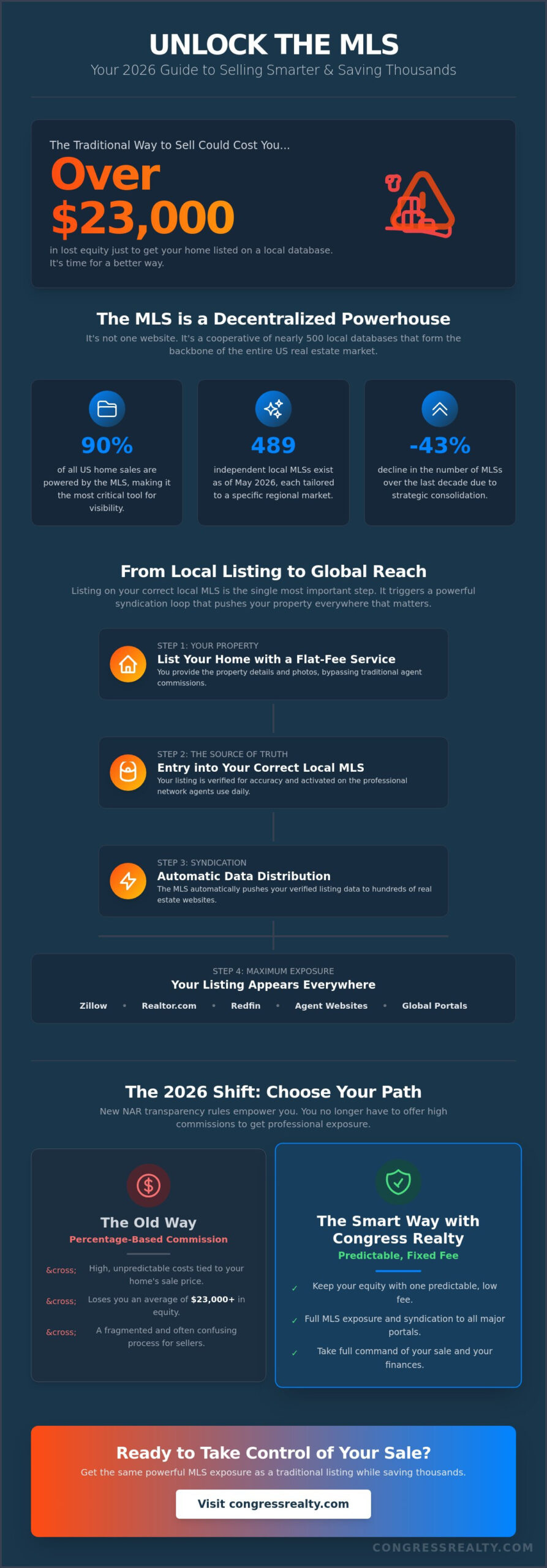
You’re likely losing over $23,000 in equity just to get your home onto a local database. It’s a staggering price to pay for entry into a system that feels intentionally complicated. Most sellers feel trapped by the fragmented nature of 489 different local databases, fearing they’ll miss out on exposure if they don’t hire a traditional agent. This 2026 guide simplifies the process by providing the complete list of multiple listing services and showing you how to use them with confidence.
You deserve a way to reach every serious buyer without sacrificing a massive percentage of your home’s value. We’ll show you how the national MLS network actually operates under the latest 2026 NAR transparency rules and how you can secure a professional listing for a predictable, fixed fee. You’re about to discover a reliable method to access professional databases, master syndication, and take full command of your sale. We’ll break down the structure of these active systems and explain exactly how to get your property featured on the sites that matter most to maximize your visibility.
Key Takeaways
- Understand how the decentralized network of nearly 500 local databases functions as a single, powerful tool for property visibility.
- Identify the right databases within the fragmented list of multiple listing services to ensure your property reaches both local agents and global portals.
- Discover how the 2026 commission transparency rules allow you to bypass high percentage-based fees while maintaining professional-grade exposure.
- Compare the advantages of Standard versus Full Service listing packages to determine which level of support best protects your equity.
- Master the process of syndication to guarantee your home appears on every major professional database without the burden of a traditional broker.
Understanding the Multiple Listing Service (MLS) Landscape
The Multiple Listing Service (MLS) is far more than a simple website or a digital catalog. It’s a sophisticated, cooperative database that functions as the bedrock of the American real estate market. In 2026, it remains the most powerful tool for selling your home because it’s where professional brokers and agents share property data and offer cooperation. This system has evolved from physical books exchanged in local boardrooms to a high speed digital ecosystem that powers nearly every major real estate portal you see online. The MLS functions as the primary engine for approximately 90% of all home sales across the United States.
When you list your property on the local MLS, you aren’t just putting up a digital flyer. You’re entering a professional arena where data is verified and history is tracked. This verification creates a layer of trust that public facing sites simply cannot match. It ensures that every active buyer’s agent in your region sees your property the moment it goes live, creating an immediate wave of visibility. By using this professional infrastructure, you ensure your home is positioned correctly in front of the people most likely to bring you an offer.
The Role of the MLS in Modern Real Estate
Trust is the currency of the real estate industry. The MLS maintains this trust by enforcing strict rules regarding data accuracy and property history. In the wake of the 2026 commission rule changes, the MLS has become even more vital for transparency. While sellers are no longer required to offer a set commission to buyer’s agents as a condition of listing, the MLS remains the central hub where these professional relationships are managed. It facilitates a streamlined process where you can showcase your home’s value while maintaining full command over your financial decisions. This system allows you to bypass traditional high cost models while still benefiting from the same professional exposure as any other listing on the market.
Why There Isn’t Just One “National MLS”
You might wonder why a single national database doesn’t exist. The current real estate landscape is a product of history; local real estate boards developed their own systems to manage regional expertise and local market nuances. While the total count has declined by 43% over the last decade due to consolidation, we still operate within a network of 489 independent systems as of May 2026. This fragmentation means the list of multiple listing services is quite extensive, but it serves a purpose. Local databases ensure that specific zoning, school district data, and neighborhood trends are handled by people who understand the area. As a seller, your goal isn’t to be on every single one of these 489 systems, but to be on the specific local MLS that covers your property. Once your home is listed there, the data syndicates out to the national portals, giving you the best of both worlds: local accuracy and national reach.
How the 500+ Local MLSs Form a National Network
Think of the American real estate market as a massive mesh network rather than a single monolith. While the list of multiple listing services includes 489 independent systems as of May 2026, these local databases don’t exist in a vacuum. They function as the “source of truth” for every property detail. When you list your home on your specific local MLS, you’re activating a powerful syndication loop. This loop pushes your data out to thousands of agent websites and every major national portal simultaneously. It’s the most efficient way to achieve global reach from a local starting point.
Accuracy starts at the local level. National portals like Zillow or Realtor.com don’t actually find your house on their own. They wait for the local MLS to feed them the data. If the information on your local database is wrong, it stays wrong across the entire internet. This is why getting your property into the correct professional system is the most critical step in your sales process. It’s the foundation for your visibility and the key to attracting serious buyers who rely on accurate, real-time data.
Regional vs. Local MLS Jurisdictions
The trend toward consolidation has led to the rise of regional “mega-MLSs” that cover dozens of counties. However, your property must still be listed in the exact jurisdiction where the home is physically located to be seen by local agents. Overlapping jurisdictions can sometimes cause confusion, but a professional approach ensures you’re placed in the system that buyer’s agents actually use. You can choose a listing package that targets the specific database required for your zip code, ensuring no buyer misses your home.
Data Syndication to Zillow, Realtor.com, and Beyond
The magic happens through the Internet Data Exchange (IDX). This protocol allows your listing to travel from the local database to the global market in a matter of minutes. Usually, your home appears on national consumer sites within hours of being entered into the MLS. This automated feed guarantees that your property remains consistent across all platforms. You don’t have to worry about updating fifty different websites manually; any change you make to your price or description on the MLS updates everywhere else automatically. This gives you total command over your presentation while saving you hours of tedious work.
Major Residential and Commercial MLS Networks in the US
The real estate landscape is shifting away from small, hyper-local boards toward massive regional powerhouses. As of May 2026, the total number of systems has dropped to 489 as organizations merge to gain efficiency and data standardization. This consolidation means a single entry into a regional giant now grants you access to a much wider pool of buyers than it did a decade ago. When you look at the current list of multiple listing services, you’ll see a few names that dominate entire states or multi-state regions. These organizations don’t just store data; they set the professional standards for property disclosures and transaction transparency that protect both sides of the deal.
While the number of “Micro” MLSs with fewer than 400 subscribers has dwindled to 186, the influence of regional giants has never been stronger. These networks provide the professional infrastructure necessary for a successful sale. They ensure your property is visible to the 90% of buyers who still use an agent, even in the wake of 2026’s commission rule changes. By using these established professional databases, you’re choosing a path of financial intelligence that values your autonomy over traditional, high-cost brokerage models.
Leading Residential MLS Organizations
The largest residential networks, such as California Regional MLS (CRMLS), Bright MLS in the Mid-Atlantic, and Stellar MLS in Florida, serve hundreds of thousands of professionals. Getting your home onto one of these high-volume systems is a game changer for your exposure. These “mega-MLSs” provide the most robust data fields and the widest syndication reach possible. They also strictly enforce the 2026 NAR settlement rules, ensuring that buyer broker agreements are in place and commissions are uncoupled for maximum transparency. When you utilize these professional industry databases through a fixed-fee model, you gain the same level of market authority as any traditional brokerage without the percentage-based cost.
Top Commercial Listing Services
Commercial real estate requires a different set of tools than residential sales. While residential sellers use the MLS, commercial professionals often rely on Commercial Information Exchanges (CIEs). These platforms prioritize data points like cap rates, net operating income, and specific zoning details that wouldn’t fit in a standard residential form. Services like Crexi or LoopNet function as the primary commercial portals, but many regional MLSs now offer dedicated commercial wings to bridge the gap.
If you’re selling a multi-family or industrial property, your syndication path is specialized. Your listing won’t just go to Zillow; it will travel to investment-focused databases where professional portfolios are built. Specialized networks for luxury estates or rural land also exist to cater to niche buyer pools. Regardless of your property type, the goal remains the same: use the professional infrastructure to maintain command over your sale. Accessing these networks with a pragmatic, fixed-cost approach is the smartest way to preserve your equity in 2026.
How to Access the MLS Without a Traditional Agent
You no longer have to sacrifice 3% of your home’s value just to gain entry into a professional database. For decades, the real estate industry guarded the MLS as an exclusive club for high-commission brokers. That era is over. Today, a pragmatic shift toward flat-fee models allows you to access the same professional tools used by every top-tier agent for a predictable, fixed cost. First, understanding commissions in 2026 is the essential first step to saving your equity. Once you realize that commissions are uncoupled and negotiable, you can take full command of your sale without the burden of traditional overhead.
Accessing the MLS requires a licensed broker to enter the data, but it doesn’t require a long-term, percentage-based contract. You’re simply hiring a facilitator to place your property on the professional industry database. This gives you the best of both worlds: the massive exposure of the national network and the financial freedom of a self-managed sale. It’s a smart, utilitarian approach for the savvy homeowner who values autonomy. Sellers who want a complete roadmap for this process will find that learning how to sell a house without a realtor is the most direct path to keeping your equity intact while still achieving professional-grade market exposure.
The Flat Fee MLS Model Explained
A flat-fee broker acts as your direct gateway to the professional network. Instead of a commission, you pay for the specific services you need. For example, a Standard Listing gets your property into the local database and onto national portals. If you want more support, a Full Service Listing can include transaction management to help you handle the paperwork. You remain the primary lead on the sale, showing the home and negotiating directly with buyers. This model ensures you keep your equity while leveraging the same professional infrastructure as any traditional listing.
Evaluating a Listing Provider’s Coverage
Don’t assume every online service has direct access to your local market. Some “referral” sites just sell your information to a third party, which can lead to delays and data errors. You must verify that your provider is a direct member of the specific local system found on the list of multiple listing services for your area. Ask if they handle their own listings or if they outsource the work. Direct membership means faster updates and more accurate data syndication. You can review our direct coverage areas to ensure your property gets the professional oversight it deserves. This direct connection is the only way to guarantee your listing remains consistent and visible across the global market.
Strategic Listing with Congress Realty
Navigating the extensive list of multiple listing services doesn’t require a traditional broker or a high-commission contract. You can secure national-scale exposure by taking a pragmatic, equity-first approach to your sale. Congress Realty provides the professional infrastructure you need to reach every buyer’s agent without the burden of a 3% listing commission. By choosing a service that prioritizes your autonomy, you gain access to the same professional industry databases used by top-tier firms while maintaining full command over your transaction. Savvy sellers choose flat fee MLS listings because it’s the most financially intelligent way to sell in 2026.
Success in today’s market depends on how you present your property to the world. We offer a range of tools designed to create a seamless experience for both you and potential buyers. You can integrate professional photography to make your listing stand out or use an electronic lockbox for real estate to manage showings securely and efficiently. These aren’t just add-ons; they’re essential components of a professional sales strategy that positions your home for the best possible offers. You don’t have to sacrifice quality to save on costs.
Professional Exposure Without the 3% Commission
When you decide to sell your house on your own, you’re reclaiming thousands of dollars in equity that would otherwise go toward a listing agent’s commission. This financial impact is immediate and significant, allowing you to be more flexible with your pricing or simply walk away with more cash at closing. Maintaining a professional image on the MLS is vital for attracting high-quality buyers who expect accurate data and high-resolution visuals. Our platform ensures your property looks its best on every site in the list of multiple listing services, from local databases to national portals like Zillow and Realtor.com.
Comprehensive Support from Listing to Closing
Control doesn’t mean you have to work in isolation. We provide the professional tools necessary to make informed decisions at every stage of the sale. Use a Comparative Market Analysis (CMA) to understand exactly how your home compares to recent sales in your neighborhood. This data-driven approach removes the guesswork from pricing and helps you enter the market with confidence. If you need more assistance, our transaction management services help you handle the complex paperwork and timelines associated with escrow. Congress Realty facilitates the entire process while keeping the seller in command. By combining professional-grade tools with your own local expertise, you can achieve a successful closing without the high-cost overhead of the past.
Take Command of Your Home Sale
You now have the tools to navigate the complex list of multiple listing services with the confidence of a seasoned professional. You’ve seen that the national network is fully accessible through a fixed-fee model that bypasses traditional commissions while maintaining maximum exposure. By leveraging professional industry databases, you keep control over your equity and your timeline. This pragmatic approach isn’t just about saving money; it’s about making a financially intelligent choice for your future.
Congress Realty has been a trusted ally for independent sellers since 2002. We provide the professional infrastructure you need, from expert valuations via Comparative Market Analysis (CMA) to electronic lockbox and professional photography options. These tools ensure your property stands out and remains secure throughout the process. It’s time to stop overpaying for entry into the market and start selling on your own terms. Start your flat fee MLS listing with Congress Realty today and take the first step toward a more rewarding sale. You’re in charge, and we’re here to provide the professional foundation for your success.
Frequently Asked Questions
How do I find out which MLS covers my specific property?
Check your local county or city real estate board website to identify the specific jurisdiction for your home. Because the list of multiple listing services has consolidated into 489 systems as of May 2026, many properties now fall under large regional mega-MLSs. You can also verify coverage by looking at recent sales in your neighborhood to see which professional database handled those transactions. Identifying the correct system ensures local agents see your home immediately.
Can I list my home on multiple MLSs at the same time?
You can list on multiple systems if your property sits in a region where two or more jurisdictions overlap. This frequently happens in metropolitan areas that span several counties. While listing on the primary local database is essential for exposure, adding a second listing can capture agents from neighboring boards. This strategy maximizes your reach but requires careful management to ensure data remains consistent across all professional platforms.
What is the difference between an MLS and a site like Zillow?
The MLS is the professional, verified database that serves as the primary source of real estate data for the entire industry. Sites like Zillow and Realtor.com are consumer facing portals that receive their information through a syndication feed from the local MLS. While portals are great for buyers to browse, the MLS is where agents search for properties and verify listing history. Listing on the MLS is the only way to ensure your home appears on every major consumer site.
Do I need a realtor to get my house on the MLS list?
You must work with a licensed broker to get your property entered into the professional system. However, you don’t need to hire a traditional agent who charges a percentage based commission. A flat-fee brokerage acts as your facilitator, providing the necessary professional infrastructure while leaving you in command of the sale. This approach allows you to access the same professional tools without the high cost of a conventional listing.
How much does it cost to list a home on the MLS for a flat fee?
Costs for a flat-fee listing depend entirely on the package and level of support you select for your sale. Instead of a percentage of your home’s value, you pay a predictable, fixed fee for the specific services you need. This might include a Standard Listing or a more comprehensive Full Service Listing that includes transaction management. This model puts you in control of your budget and protects your home’s equity from the start.
Will my contact information be visible to buyers on the MLS?
Your contact information is typically visible to licensed agents in the private remarks section of the professional database. This allows buyer’s agents to contact you directly to schedule showings or ask questions. On consumer portals, the listing broker’s information is usually displayed to meet legal and board requirements. However, all inquiries and showing requests are forwarded directly to you, so you remain the primary point of contact for the sale.
What happens if my property is listed in the wrong MLS?
Listing in the wrong system means local agents who represent active buyers in your area will likely miss your property. Agents search within their specific board’s database first, so being in the correct jurisdiction is critical for visibility. If your property is misplaced, you won’t appear in the filtered searches that local professionals use every day. Always verify that your provider has direct membership in the specific database covering your zip code.
Can I make changes to my MLS listing after it goes live?
You can absolutely make updates to your listing after it goes live on the professional network. Whether you need to adjust the price, update the description, or add new professional photography, these changes are handled through your listing broker. Most updates syndicate to the national portals within a few hours, ensuring your presentation remains fresh and accurate. Regular updates keep your listing active and relevant to buyers who are monitoring the market daily.