A convincing proof of funds document must show not only the balance, but also that the buyer owns or can access the funds for the purchase. To understand how to verify proof of funds from a buyer, check the buyer’s name, the financial institution, and the available balance, then compare these details with the purchase contract. For any real estate transaction, verify any unclear details with the issuing institution. Congress Realty provides flat-fee MLS listings for sellers in Arizona, Alaska, California, Idaho, Louisiana, Montana, Nevada, New Mexico, Oregon, Texas, Utah, and Washington.
Sellers may request proof of funds alongside a mortgage preapproval, while lenders may ask buyers to show they can cover the remaining purchase costs. A proof of funds letter shows available cash; a preapproval indicates that a lender may provide financing. This guide explains what a clear letter should contain, how to compare names and balances with the contract, and when sellers or lenders may request proof, so you can assess a property offer with greater confidence.
Key Takeaways
- Look for funds that are available or readily convertible to cash; account balances and their source can affect how clearly a buyer demonstrates readiness.
- A useful proof of funds document identifies the financial institution, account holder, and available balance, so the seller can assess whether it supports the purchase.
- Match the account holder’s name to the buyer named in the purchase contract, and handle sensitive account details carefully.
- Sellers may request proof alongside a mortgage preapproval, while lenders may ask buyers to show they can cover remaining purchase costs.
- Congress Realty’s Multiple Listing Services can support the listing side of a sale while sellers assess offers and buyer documentation.
What Is a Proof of Funds Letter for a Real Estate Purchase?
A proof of funds document shows that a buyer has money available for a home purchase. Sellers often request it with a cash offer. The balance and supporting documentation help establish which funds the buyer can use.
Accessible Funds and Account Types
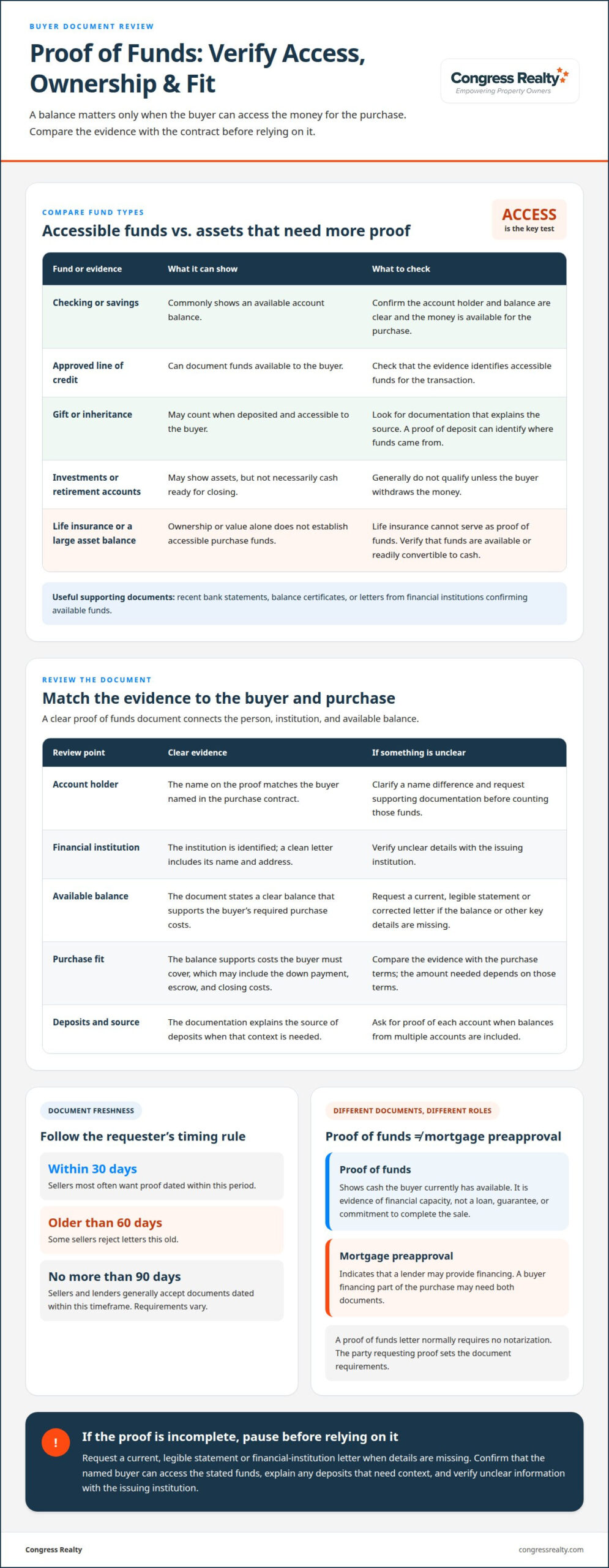
Accessible funds are cash or money the buyer can readily convert to cash for the transaction. Checking and savings accounts commonly show available balances. An approved line of credit can also document funds. A large asset balance alone does not necessarily mean the buyer can access the money in time for closing.
For a cash purchase, the buyer needs to demonstrate funds sufficient to complete the purchase. A checking account statement, for example, can show a current balance available for that purpose. Documented gift funds may count after the buyer deposits them and can access them. Documented inheritance funds may also qualify when the buyer can use them.
Acceptable Proof Sources and Fund Forms
Acceptable proof sources include recent bank statements, balance certificates, and letters from financial institutions confirming available funds. A statement should identify the account holder and show the balance clearly. A proof of deposit serves a different purpose: it verifies that funds entered an account and identifies where those deposits came from. That source information can help explain account transactions.
Life insurance cannot serve as proof of funds, and retirement accounts or investments generally do not qualify unless the buyer withdraws the money. The key distinction is access: an investment statement can show substantial assets without showing cash ready for the purchase. Check that each document demonstrates funds the buyer can actually use, not merely assets they own.
If the submitted proof lacks details or you cannot verify it, don’t treat the funds as established. Ask the buyer for a current, legible statement or financial-institution letter, then verify its authenticity with the institution. A sound approach to how to verify proof of funds from a buyer is to resolve gaps in the evidence before relying on the stated balance.
Keep the evidence focused on available funds and their source. For example, the account record should show a gift deposit, and documentation should explain its origin. If the buyer includes balances from checking and savings accounts, request proof for each account. Knowing how to verify proof of funds from a buyer also means distinguishing documented, accessible funds from deposits that still need an explanation.
What Does a Clean Sample Proof of Funds Letter Contain?
For a real estate offer, sellers most often want proof that someone dated within 30 days. Some sellers reject letters older than 60 days, while sellers and lenders generally accept proof documents that someone dated no more than 90 days ago. Follow the freshness requirement set by the person requesting the document.
A clean letter identifies the financial institution holding the funds and gives its name and address. It makes the account holder’s name and available balance clear. An official bank statement, account balance, and verification by authorized bank personnel can support the document. These details help a seller assess whether the buyer’s available funds match the offer.
Check that the available balance supports the costs the buyer must cover. Proof of funds can demonstrate capacity for the purchase, including the down payment, escrow, and closing costs. For example, a letter showing funds for the buyer’s required contribution provides evidence of capacity. The amount needed depends on the purchase terms.
A proof of funds document and a mortgage preapproval serve different purposes. Proof of funds shows cash the buyer has available. A preapproval indicates that a lender may provide a loan. A buyer financing part of the purchase may need both: proof for available funds and preapproval for the loan portion.
The letter describes financial capacity, not a loan, guarantee, or commitment that the bank or buyer makes. It does not promise that the bank will transfer funds or that the buyer will complete the sale. Treat it as evidence of currently available money, then consider it alongside the purchase contract and any financing documentation.
A proof of funds letter normally requires no notarization. The party requesting proof determines what the document must include, so requirements can vary. A one-page letter can present the institution, account holder, balance, and authorized verification in a readable format. A seller or agent can use those details to assess the submitted proof.
Check whether the document connects the named account holder to the available balance and identifies the institution. If a letter omits the date, account holder, or balance, it may not show enough to assess the buyer’s current capacity. A recent statement or corrected letter can supply the missing detail before you proceed with reviewing the offer.
Matching the account holder to the purchase contract
Compare the account holder’s name with the buyer named in the purchase contract. The proof should show that the person presenting it owns the account. Matching names connects the available funds to the person responsible for the purchase. If the names differ, clarify the relationship and request supporting documentation before counting those funds toward the buyer’s total.
A small difference, such as a middle initial or shortened first name, may need explanation. A joint account may list another person alongside the buyer. To verify proof of funds from a buyer, compare the contract name with the statement and account ownership details. If someone outside the contract owns the account, request documentation explaining how the buyer can use those funds.
When the buyer holds funds in multiple accounts, request supporting proof for every account included in the buyer’s total. Compare the account holder and available balance on each statement or institution letter. Then assess the combined accessible funds against the purchase terms. One account’s balance does not establish ownership of funds in another, even when both accounts relate to people involved in the transaction.
Consolidating funds into one account can make the paper trail easier to follow. The buyer can provide a statement showing the resulting balance and records explaining the deposits. Transfers between banks can take several days, so timing matters if updated proof will accompany an offer. Keep transaction records that connect the transferred amount to its original account.
Protect private information while preserving the evidence needed for review. Proof documents can include sensitive account numbers and a physical address. Buyers can hide details that don’t help show account ownership or available funds. Keep the account holder’s name, financial institution, and relevant balance visible. Share the document only with people who need it to complete the sale.
If the buyer submits a redacted statement, confirm that the visible details still connect the buyer to the funds. Apply the same standard to each account when the buyer relies on several balances. When deciding how to verify proof of funds from a buyer, treat an unclear ownership link as a gap to resolve, not as evidence that the funds belong to the buyer.
When May Home Sellers or Lenders Request Proof of Funds?
Sellers may request proof with an offer, especially for a cash purchase; lenders may request it to assess funds for remaining costs. Requirements vary by transaction. In California, the parties determine proof requirements and timing through the terms they include in the signed offer.
Situations Prompting a Proof Request
A seller may ask for proof when reviewing a cash offer or comparing competing offers. The document helps show whether the buyer can complete the purchase without mortgage financing. Sellers may also request proof alongside a mortgage preapproval, which addresses the loan rather than the buyer’s available cash.
A lender may request proof to confirm that the buyer can cover the remaining purchase cost. A buyer making a cash down payment may also need to show that the funds are available and are not a loan. These requests help distinguish funds the buyer can use from money that depends on additional borrowing.
For a real estate transaction above $1M, sophisticated sellers and their counsel may request additional proof. They may ask for a recent bank statement or direct verification with the issuing banker. The larger transaction value can make a simple balance summary less persuasive, so the request may focus on the institution and current funds.
Requirements Across States and Transactions
Proof requirements depend on the transaction and the terms the parties accept, not on one document standard for every sale. In California, the parties determine the buyer’s proof-of-funds requirements and timing through the terms they include in the signed offer. Buyers and sellers navigating California transactions can also consult local real estate resources such as adriachamberlain.com for guidance on standard purchase agreements and documentation expectations. Read those terms to understand what evidence the offer calls for.
Transaction type also shapes the request. A cash offer centers on whether the buyer has enough accessible funds to complete the purchase. A financed offer may require proof of the buyer’s contribution, while a lender can request evidence for costs the loan does not cover. The documents should match the source and purpose of the funds.
Before deciding whether a submission answers the request, compare it with the offer terms and the buyer’s financing plan. A preapproval alone, for example, does not show cash available for a required contribution. If the terms call for proof by a particular point in the transaction, assess whether the submitted document is relevant and provided on time.
Requesting a letter from a bank or financial institution
A bank letter provides a record from the institution holding the buyer’s funds. Ask for a recent document that identifies the institution, account holder, available balance, and verification date.
A seller or agent can request direct verification, but the bank may require the buyer to participate before confirming funds. Arrange verification with the buyer and bank; don’t treat a phone number printed on a document as independent confirmation.
Checking the Institution and Signatory
Check that the letter identifies the financial institution and includes an authorized employee’s signature or another form of verification. A named signatory and direct verification contact make the statement more credible than an unsigned PDF. Compare the account holder and balance with the purchase details, then identify missing information before relying on the document.
A bank statement, balance certificate, or institution letter can show available funds. The letter should also indicate when the funds were in the account. A signed statement with a named signatory gives the seller a clear way to verify the document’s source and contents.
Contacting the Buyer’s Bank
Find the bank’s contact information independently and use it to reach the bank, rather than relying only on a number supplied with the proof. The bank may require a conference call with the buyer before confirming funds to a seller or agent. Keep the call focused on whether the document and balance are authentic.
Discuss the account balance with the bank representative, but don’t discuss wiring instructions during a verification call. A proof-of-funds check confirms available funds; it does not establish safe transfer instructions. Keep these steps separate so document verification is not confused with payment.
Buyers can request a letter from their financial institution or provide a recent bank statement, depending on the request. A complete letter identifies the institution’s name and address, account balance, authorized signatory, and when the funds were held. Banks can usually provide a letter within one to two business days. If the funds are already in one place, a buyer may obtain one in a single day.
Most sellers want proof dated within 30 days of the offer. If a bank statement raises questions about a deposit, ask the institution to confirm the document’s authenticity and the balance shown. Keep the conversation limited to verification, and let the buyer participate if the bank requires it. That process gives the seller evidence without relying solely on a PDF.
Congress Realty
Congress Realty helps homeowners bring a property to market through Multiple Listing Services. That listing support is a practical next step once you understand what proof of funds can show and what it cannot establish. A buyer’s document can inform offer review, but it does not replace the seller’s judgment about the contract, financing, or transaction terms.
As a seller, organize offer materials around the key questions: who will buy, how the purchase will be funded, and whether the proposed terms work for you. A proof of funds letter is one part of that picture. Match it to the buyer and offer, and keep questions about authenticity separate from your decision to accept.
Congress Realty’s Multiple Listing Services offering supports the listing side of the process. It places property information on the MLS, which only members can access and provides the same exposure as listings for which sellers pay a full commission. Only MLS members can make listing changes, and Congress Realty makes them on the seller’s behalf. This helps sellers reach buyers while they focus on reviewing offers.
Keep a simple record for each offer: the signed purchase contract, financing information, and proof documents received. Note which buyer and account holder appear on each document. If a balance or name needs clarification, tie that question to the relevant offer rather than mixing it with unrelated listing tasks. This makes the transaction easier to follow as it progresses.
Congress Realty is a fit when you want MLS listing support while retaining control over your decisions. The company provides listing services, not bank confirmation of funds. Use these checks to assess the buyer’s documentation, and rely on the financial institution for direct confirmation when needed. That keeps each party’s role clear and avoids treating a letter as a guarantee.
Whether you’re preparing a listing or considering an offer, base your decision on documented terms and information you can assess. Use the listing process to reach buyers, then review each offer on its own details. You remain in control, with a clearer way to distinguish available funds, financing, and contract obligations.
Review seller listing information from Congress Realty to learn about MLS support.
Frequently Asked Questions
How Do I Check a Cash Buyer’s Proof of Funds?
Compare the buyer’s available funds with the cash purchase terms, then confirm the document’s source. Check that the buyer’s name matches the contract and that the buyer can access the funds, rather than holding them in investments or other accounts that limit access. If the offer includes costs beyond the purchase price, consider whether the proof addresses those obligations too. Clarify any mismatch before relying on the document.
How does your agent review the proof before you sign?
An agent can review the document alongside the offer and flag gaps for you to consider before signing. For example, the agent can note whether the buyer’s name differs from the contract or whether the stated balance appears relevant to the offer terms. A document review does not authenticate the bank’s records. Direct confirmation from the financial institution addresses that separate question.
How is proof of funds different from earnest money?
Proof of funds shows a buyer’s financial capacity; earnest money is a deposit that the purchase contract covers. They serve different purposes and occur at different points in the transaction. A buyer might provide account evidence with an offer, while the contract sets out earnest-money terms. Don’t treat proof of funds as a deposit or as evidence that a deposit has reached its destination.
Is It Normal for a Realtor to Ask for Proof of Funds?
Yes, an agent may ask for proof when presenting or evaluating an offer, especially a cash offer. Professional agencies, such as Red Roof Realty, routinely request these documents to protect sellers and confirm buyer qualifications before moving forward with a sale. The request helps the seller assess whether the buyer has funds available for the proposed purchase. A buyer using financing may also provide proof for the cash portion alongside a preapproval letter. The documents should relate to the offer and the funds the buyer plans to use.
What funds qualify as POF?
Funds may qualify when the buyer can access them for the purchase and document their availability. Checking or savings balances, approved lines of credit, and deposited gift or inheritance funds may support proof. An investment balance alone may not show ready cash if the buyer has not withdrawn it. Focus on whether the document demonstrates usable funds, not just the total value of the buyer’s assets.
What red flags should you question?
Question a document with an unclear account holder, missing institution details, an unreadable balance, or information that conflicts with the offer. A balance that does not appear sufficient for the stated funding plan also needs explanation. Watch for unexplained deposits or a document that appears altered. These signs do not prove misconduct, but they are concrete reasons to request clearer documentation or direct institutional verification.
What documents count as proof of funds from a buyer?
Common examples include a bank statement, a balance certificate, or a financial institution’s letter confirming available funds. A brokerage statement may also show assets, but it should establish that the money is accessible for the purchase. If the buyer relies on several accounts, the documents should account for each balance included. The right document depends on the request and the buyer’s funding source.
How do you verify a buyer’s bank statement or proof-of-funds letter?
Contact the issuing institution using details you find independently, and ask how it handles verification. The bank may require the buyer to authorize disclosure or join a call. Keep the discussion focused on whether the document is authentic and the stated balance is accurate. Don’t use a verification call to discuss wiring instructions; handle payment details separately through the transaction process.