
Congress Realty provides flat-fee MLS listings for home sellers in Las Vegas, Nevada. The MLS is exclusive to members and provides the same exposure as listings paid with a full commission; only members can change listing details. Sellers choose how much of the pricing, showings, and offer process they want to manage.
Compare the listing support with the work you’re prepared to handle. MLS placement doesn’t automatically manage buyer inquiries, negotiations, paperwork, or the sale from start to finish.
This guide explains how flat-fee MLS listings work in Nevada, which features and terms to compare, and how to estimate potential savings alongside your responsibilities. You’ll also learn how independent sellers use MLS access, what to consider about forms and listing distribution, and how to choose support that fits your plans. You stay in control of the decisions that matter to you.
Key Takeaways
- Compare limited-service and agent-assisted options by the support provided, not just the fee structure.
- Review Nevada plan terms, listing duration, photo limits, and included features before choosing a package.
- Use the savings calculator to weigh potential listing-fee savings against the responsibilities you’ll manage yourself.
- Understand how FSBO sellers can access the MLS and what role a listing service plays in distribution.
- Check which forms and marketing tools a plan includes so you can prepare for the steps that follow listing.
What is a flat fee MLS listing service?
A flat-fee MLS listing service places a home in the Multiple Listing Service for a set fee rather than tying the listing charge to the sale price. The MLS gives agents a shared database for property details, photos, and status updates. It is exclusive to members, who alone can edit listings; Congress Realty makes changes for its clients. Sellers typically handle decisions and tasks such as setting a price, scheduling showings, and negotiating offers. In Las Vegas, compare the brokerage’s support with the work you’re prepared to manage.
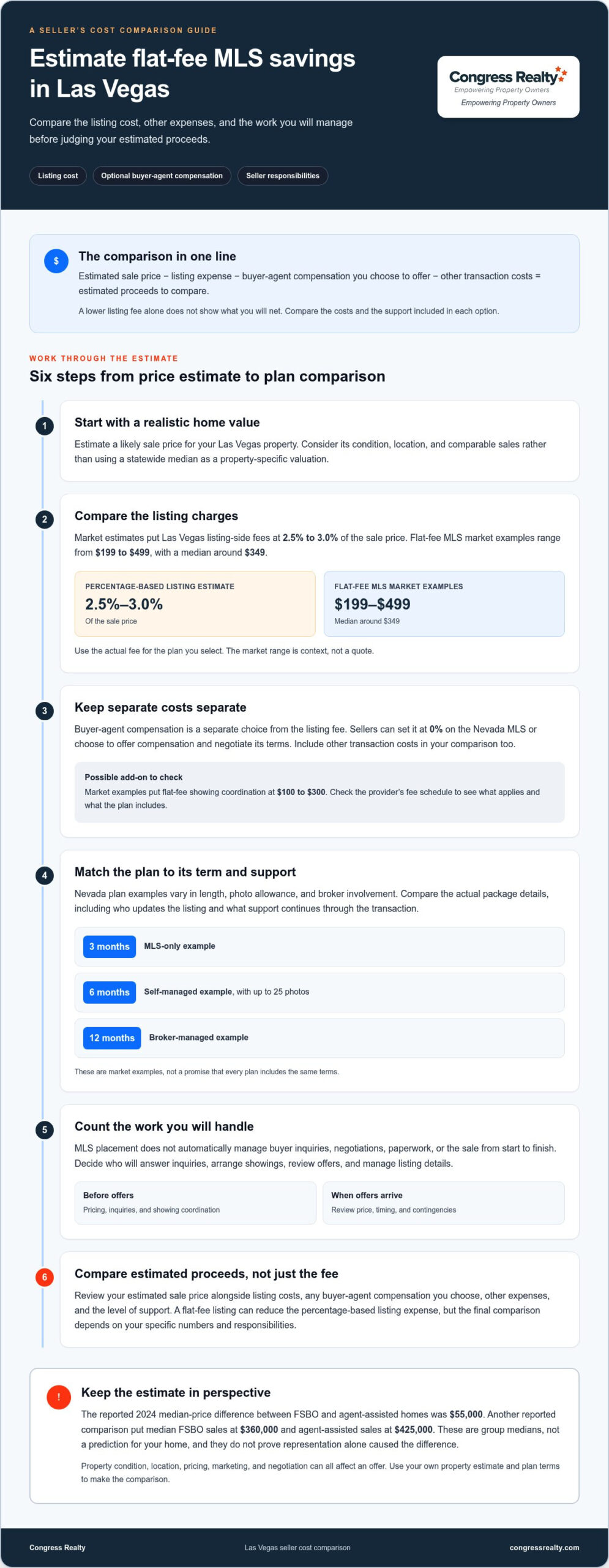
The price difference between limited-service and agent-assisted sales has two parts: the listing cost and the final sale price. Market estimates put Las Vegas listing-side fees at 2.5% to 3.0% of the sale price. A flat-fee option can reduce that percentage-based listing expense, but a lower fee alone doesn’t show what the seller nets. Compare the estimated proceeds after listing costs, any buyer-agent compensation you choose to offer, and other transaction expenses.
Sale-price comparisons also need context. The National Association of Realtors reported a $55,000 median-price difference in 2024 between for-sale-by-owner homes and agent-assisted sales. Another reported comparison puts median FSBO sales at $360,000 and agent-assisted sales at $425,000. These are group medians, not a promise about an individual home. They don’t prove that representation alone caused the difference. Property condition, location, pricing, marketing, and negotiation can all affect an offer.
Buyer-agent compensation is a separate decision from the listing fee. Sellers can set the buyer-agent compensation at 0% when listing on the Nevada MLS, or choose to offer compensation and negotiate its terms. Decide based on your sale strategy and the offer details, not an assumption that every buyer’s agent receives the same amount. Review any proposed compensation alongside the purchase price and other terms before responding.
Plan lead handling before the listing goes live. Decide who will answer buyer and agent inquiries, arrange showings, and forward offers for review. Use a consistent process: respond with accurate property details, record showing requests, and review each written offer for price, timing, and contingencies. A listing service provides MLS access and can make listing changes on your behalf, but your decisions still shape communication and negotiations. This distinction helps you decide whether limited support suits your sale or you want more hands-on help.
Nevada flat-fee MLS plans and pricing
Compare plan terms, MLS coverage, and seller responsibilities before choosing a service. Nevada housing figures can help frame pricing decisions, but they don’t replace a property-specific estimate.
Nevada Plan Options and Pricing
Nevada flat-fee MLS plans vary by listing term, photo allowance, and level of broker involvement. Market examples include self-managed listings with a 6-month term and up to 25 photos, broker-managed listings with a 12-month term, and MLS-only listings with a 3-month term. Check what each plan covers, who updates listing details, and what support continues through the transaction.
Nevada’s median sale price is $481,200, and homes average 52 days on the market. Those statewide figures provide context, not a Las Vegas-specific valuation. Compare a plan’s total cost with its term and included services, then base your asking price on your home’s condition, location, and comparable sales.
MLS Coverage and Affiliations
MLS access depends on the brokerage’s participation in the database serving the property’s location. Ask which MLS will carry the listing, whether its coverage includes the home’s community, and how listing details reach participating agents. A Las Vegas property, a Henderson home, and a Summerlin-area listing may involve different local coverage considerations.
Nevada seller disclosure obligations fall under Nevada Revised Statutes Chapter 113. Build disclosure preparation into the transaction timeline, and organize accurate property information before the listing goes live. A clear record helps keep listing details consistent as agents and buyers review the property.
Las Vegas Company Comparisons
What are the best flat-fee MLS companies in Las Vegas? The right fit is the provider whose MLS access, listing term, photo limits, and support match your needs. Compare those features side by side rather than choosing by a headline price alone.
Las Vegas recorded 3,041 closed residential sales during the 90 days ending September 3, 2026. The median sale price was $436,948, and homes had a median 28 days on market. Use these local indicators as context when evaluating a listing plan, not as a guaranteed timeline or sale price.
Additional Service Fees
What additional fees may flat-fee MLS services charge? Some services charge separately for options such as showing coordination, listing changes, or an extension. Market examples put flat-fee showing coordination add-ons at $100 to $300. Read the fee schedule and identify which services are included before paying.
For a practical next step, use this home-selling resource to organize your sale plans and compare the support you need with each listing option.
Flat fee MLS savings calculator
Estimate savings by comparing the listing expense under each option, then subtracting costs you would pay either way. Separate the listing fee from any buyer-agent compensation, transaction costs, and the value of work you handle yourself.
Start with a realistic sale-price estimate for the property. Then calculate the percentage-based listing charge and compare it with a flat-fee MLS listing cost. The market price band for flat-fee MLS listings is $199 to $499, with a median around $349. Treat the selected plan’s actual fee as an input, not a guess based on the market range.
A simple example shows how to compare a flat-fee listing cost with a percentage-based listing fee and estimate the difference. The comparison isolates the listing-side charge. It doesn’t include other sale expenses or the seller’s time. Use it to understand the calculation, then enter figures that fit your home and contract.
Build your own estimate in four steps:
- Enter an expected sale price based on nearby comparable properties and your home’s condition.
- Calculate the percentage-based listing cost using the rate in the brokerage agreement.
- Enter the flat-fee MLS charge and any paid add-ons shown in the service terms.
- Subtract the flat-fee option’s costs from the percentage-based option’s costs.
Keep buyer-agent compensation as a separate line. The seller chooses whether to offer compensation, and any amount can affect the comparison. Run one estimate with no seller-paid buyer-agent compensation and another with the amount you might offer. That makes the effect visible without confusing it with the listing fee.
Next, account for the work involved. A self-managed listing may require you to answer inquiries, coordinate showings, review offers, and track contract deadlines. Record the hours you expect to spend, even if you don’t assign them a dollar value. Compare that workload with the support included in an agent-assisted option.
Finally, test more than one sale price. A higher or lower offer changes a percentage-based fee, while a flat charge stays fixed. Save each estimate with its assumptions, including price, fees, and compensation. This record helps you compare real estate options consistently and decide whether the savings fit your priorities.
For-sale-by-owner MLS access
What steps are required to list a home through a Las Vegas flat fee MLS service? Choose a plan, provide accurate property details, complete the listing paperwork, and submit photos and pricing information. The brokerage then places the listing in the MLS, while you manage buyer inquiries, showings, and offers.
Start by preparing the facts buyers and agents need to evaluate the home. Gather the property address, room details, features, condition notes, and any disclosures or documents relevant to the sale. Use consistent information across the listing fields. For example, make sure the bedroom count matches the property details you provide.
Next, decide on the asking price and the terms you want to communicate. Nearby comparable sales can help frame pricing, while your home’s condition and location help refine it. A real estate agent or buyer may ask how you arrived at the price, so keep your reasoning clear and the listing information accurate.
Prepare photos that show the home clearly. Choose images representing the main rooms and features, and review them before submission. The MLS listing becomes an important reference for agents and buyers, so accurate captions and an orderly presentation make details easier to understand.
Before the listing goes live, work through these practical steps:
- Read the listing agreement and identify the listing term, included services, and your responsibilities.
- Complete the property information and review every entry for accuracy.
- Submit photos, pricing, showing instructions, and any requested seller documents.
- Review the MLS record after entry and promptly report any correction needed.
- Set a process for answering inquiries, scheduling showings, and reviewing written offers.
Once the listing appears, take charge of communication. Decide how buyers and agents should request a showing, who will confirm access, and how quickly you’ll respond. Keep a simple record of each request, appointment, and follow-up. A clear process helps prevent missed messages when several people ask about the property.
During the sale, evaluate each offer as a complete proposal, not just a price. Review the requested timing, contingencies, and other terms, then respond through the agreed process. For example, compare two offers by considering their full terms and your preferred closing schedule. MLS access helps distribute the listing, but your preparation and follow-through shape the selling experience.
Included forms and MLS distribution
How long does it take for a Las Vegas home to appear on the MLS? There’s no single timeline for every listing; the process depends on receiving complete property details, required paperwork, photos, and listing instructions. How those materials move through the brokerage’s review and MLS entry process determines when the listing becomes active.
Can a flat-fee MLS listing appear on Zillow and other real estate websites? MLS data can be distributed to Zillow and other sites, but each site controls how it displays and updates listings. MLS entry and public-site display are separate steps, so review the live record and correct errors promptly.
Before submitting paperwork, separate listing documents from sale documents. A listing agreement sets the relationship and terms for placing the home on the MLS. Seller disclosures communicate property information. A later purchase contract records the buyer’s offer and the terms both parties accept. These documents serve different stages, so don’t assume an MLS package covers every form needed through closing.
Make a document checklist before you begin:
- Review the listing agreement for the listing term, included services, and seller responsibilities.
- Prepare accurate property details and seller disclosures before submitting listing information.
- Organize photos, showing instructions, and any supporting information used to describe the home.
- Keep purchase offers and closing documents separate from the initial listing paperwork.
Forms can shape the sale by clarifying information and recording decisions. For example, if a buyer submits an offer with a requested closing date, the accepted contract should reflect the agreed terms. Read every document before signing, and keep a copy of each completed form with the transaction record.
MLS distribution starts with the listing record: property facts, price, photos, and showing details. Accurate entries help agents and buyers understand what the seller offers. Check spelling, room information, features, and image order before submission. A typo in an address or an unclear photo can create avoidable confusion during a showing request.
After activation, review the MLS record and compare it with the information displayed on public sites. If a price or status changes, ensure the update moves through the listing process. Keep a simple dated record of requested changes and completed updates. That helps you track exposure without confusing a website’s display delay with an error in the underlying MLS record.
For a sale by owner, decide who will handle forms, listing updates, and buyer communications before launch. If you’re preparing to market your home, review home-selling options and consider which MLS support fits your process.
Congress Realty: Multiple Listing Services
Congress Realty provides Multiple Listing Services for sellers who want their property listed in the MLS while keeping control of key selling decisions. For a Las Vegas seller choosing a flat-fee approach, MLS access connects the listing process with a professional real estate database.
Consider which tools fit your sale alongside MLS placement. Congress Realty also offers an eLockbox, Yard Signs, and a Virtual Tour. These options can support different parts of presenting and accessing your home, while you remain involved in decisions such as pricing, showing arrangements, and offer review.
Ready to compare listing support with the tasks you plan to manage yourself? Contact Congress Realty to discuss selling your Las Vegas home through a flat-fee MLS listing.
Choose the level of support that fits your sale
Your next step is to decide how you want to participate in the sale, from setting the strategy to coordinating each detail. A flat-fee MLS option in Las Vegas, Nevada, can suit sellers who want to stay hands-on, with flexible support to help organize the listing process around their priorities.
Before moving forward, write down the tasks you want to handle yourself and where you’d value help. That distinction can guide your plan, clarify expectations, and keep decisions focused on the outcome that matters to you. You remain in command of the choices.
Explore Congress Realty’s home-selling options to see how listing support may fit your approach. Take the next step when you’re ready, with a clear sense of how you want to manage your sale.
Frequently Asked Questions
Is flat-fee MLS better than selling for sale by owner?
It can suit a seller who wants MLS placement but prefers to manage the sale independently. The key distinction is whether you want help beyond getting the listing in front of the market. For example, decide in advance who will answer buyer questions, coordinate access, and handle offer discussions. If you want someone else to manage those steps, compare plans that provide added support rather than choosing solely by fee structure.
What liability does a flat-fee seller carry alone in Nevada?
A seller remains responsible for their own statements, decisions, and agreements during the sale. Keep property information accurate, read documents before signing, and retain records of communications and accepted terms. For example, save the written version of any negotiated change rather than relying on a phone conversation. A limited listing arrangement doesn’t transfer the seller’s decision-making responsibility, so understand which tasks the agreement assigns to you.
What is a flat fee MLS listing in Las Vegas, NV?
A flat-fee MLS listing in Las Vegas, Nevada, is a brokerage arrangement that uses a set listing charge instead of calculating that charge as a percentage of the sale price. The written agreement defines the listing service and the seller’s responsibilities. Before signing, review the term, included work, and process for requesting corrections. MLS access doesn’t by itself determine who handles negotiations or other parts of the sale.
How much do flat fee MLS listings cost in Las Vegas?
The total depends on the selected plan and any optional services, so compare the full agreement rather than focusing on one advertised figure. Separate the listing charge from any optional services and compensation you decide to offer a buyer’s agent. Then compare the total with the work and support provided. This gives you a more useful budget than treating the listing charge as the only selling expense.
What services are included in Las Vegas flat fee MLS packages?
Included services depend on the package’s written terms. Check whether the plan covers listing entry, photos, changes, buyer inquiries, or showing coordination, and note which tasks remain yours. Some arrangements focus on MLS placement, while other options may add tools for presenting or accessing the property. A useful comparison is to mark each service you’ll use and identify any seller task that still needs a clear owner.
What are Nevada’s rules for flat fee MLS listings and seller disclosures?
Nevada Revised Statutes Chapter 113 addresses seller disclosure obligations. A flat-fee listing agreement concerns the brokerage arrangement, while disclosure documents concern information about the property. Keep those documents distinct, complete them carefully, and retain copies with your sale records. If a form asks about a property detail, provide accurate information rather than relying on a listing description to serve as the disclosure.
What are the risks and drawbacks of flat fee MLS listings in Las Vegas?
A potential drawback is that a limited-service plan may offer less help when circumstances change. For example, you may need to request a listing update, respond to a new showing request, or decide how to handle an offer without ongoing transaction support. Only MLS members can make listing changes, and Congress Realty handles them for its clients. Check the agreement for the process to request edits and the listing’s end date. Put those dates and tasks on your calendar before the property goes live.
How does flat fee MLS compare with a full-service real estate agent in Las Vegas?
A flat-fee arrangement can focus on MLS listing access, while a full-service relationship may include more guidance across the transaction. Compare who will discuss offer terms with you, help track contract steps, and coordinate follow-up through closing. For example, a seller comfortable evaluating offers may want a narrower service, while one who wants support at each stage may prefer a broader scope. Let your desired level of involvement guide the comparison.