
When evaluating purchase offers FSBO, compare the complete terms, not just the headline price. Congress Realty is a flat-fee MLS brokerage that gives homeowners a way to list on the Multiple Listing Service while managing their own sale.
What if the offer with the highest price leaves you with less money or more uncertainty at closing? Financing, buyer contingencies, requested concessions, earnest money, and the proposed closing date can all affect how well an offer fits your plans.
It’s natural to focus on price first. But unfamiliar contract language can make the trade-offs harder to spot, especially when you want to protect your interests without pushing away a viable buyer.
Use consistent criteria to compare estimated proceeds, financing details, contingencies, and timing. This guide explains what to review, what to clarify before accepting, and how to choose a response that reflects your priorities. With a clear process, you can assess offers on your terms and stay in control of your sale.
Key Takeaways
- When evaluating purchase offers fsbo, compare likely net proceeds and terms, not just the offer price.
- Use a consistent checklist to review financing, contingencies, earnest money, and proposed closing dates.
- Compare multiple offers side by side so you can weigh financial outcomes, deadlines, and fit with your priorities.
- Before accepting or countering in Phoenix, check the offer documents for response deadlines and required procedures.
- Choose support based on your experience, the offer’s complexity, and how involved you want to be.
How Should FSBO Sellers Evaluate Purchase Offers in Phoenix?
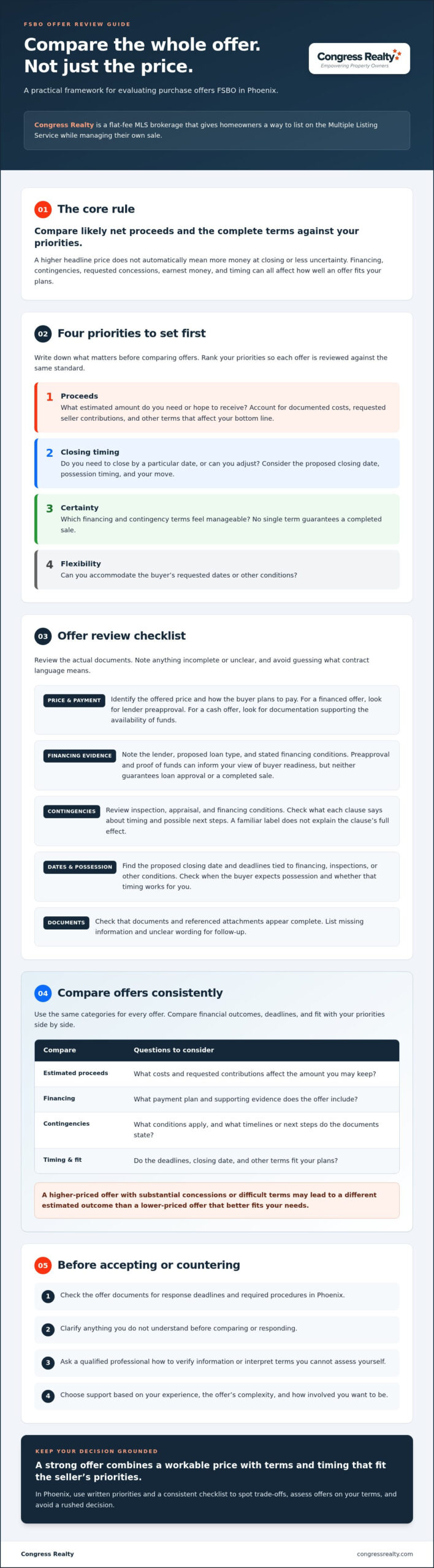
A practical approach to evaluating purchase offers FSBO starts with one rule: compare the whole offer against your priorities, not the price alone. Selling through a For Sale By Owner (FSBO) process means you stay involved in key decisions, including how you assess the buyer’s proposed terms.
What makes an offer strong beyond its purchase price?
Price matters, but the amount you may keep depends on the offer’s full financial picture. Estimate proceeds after accounting for documented costs, requested seller contributions, and other terms that affect your bottom line. Then consider how the buyer plans to pay, which contingencies apply, and when the buyer proposes to close.
Financing details can affect the steps between acceptance and closing. Contingencies describe conditions the buyer wants met, such as inspections or appraisal-related terms. Timing matters too: a proposed closing date may fit your plans or create pressure if you need more flexibility. No single term guarantees a completed sale, so weigh each one alongside the rest of the offer.
For example, a higher-priced offer that requests substantial concessions or includes terms you find difficult to meet may produce a different estimated outcome than a lower-priced offer with terms that better fit your needs. Review the actual documents and clarify anything you don’t understand before comparing.
Which seller priorities should you decide before comparing offers?
Write down and rank what matters most before reviewing offers. Consider:
- Proceeds: What estimated amount do you need or hope to receive?
- Closing timing: Do you need to close by a particular date, or can you adjust?
- Certainty: Which financing and contingency terms feel manageable to you?
- Flexibility: Can you accommodate the buyer’s requested dates or other conditions?
Written priorities give you a steady basis for comparison when an attractive price or quick response creates pressure. They help you spot trade-offs rather than making a rushed, emotion-led decision. If your plans change, revisit your list and note what shifted.
A strong offer combines a workable price with terms and timing that fit the seller’s priorities. Use that standard to guide your review, then compare each offer against the same criteria before deciding how to respond.
Which Parts of an FSBO Purchase Offer Should You Review?
A consistent checklist makes evaluating purchase offers fsbo more manageable. Review what the documents say, note anything incomplete or unclear, and separate what you can compare from what needs qualified professional guidance. This lets you assess the offer without assuming you must interpret unfamiliar contract language alone.
Offer review checklist
- Purchase price and financing: Identify the offered price and how the buyer plans to pay. For a financed offer, look for lender preapproval. For a cash offer, look for documentation supporting the availability of funds. Check whether the financing details appear consistent with the purchase terms. Ask a qualified professional how to verify information you can’t assess yourself.
- Financing evidence: Note the lender, proposed loan type, and any stated financing conditions. “Preapproval” means a lender has reviewed some information about the buyer, while proof of funds can support a claim that money is available. Neither removes every uncertainty. Financing evidence informs your view of buyer readiness, but it can’t guarantee loan approval or a completed sale.
- Contingencies: A contingency is a condition connected to the buyer’s offer. An inspection contingency may give the buyer options based on inspection findings. An appraisal contingency addresses the appraised value, while a financing contingency relates to the buyer obtaining a loan. Review what each clause says about timing and possible next steps. Don’t assume a familiar label tells you the clause’s full effect.
- Deadlines and closing: Find the proposed closing date and any deadlines tied to financing, inspections, or other conditions. Check when the buyer expects to take possession and whether that timing works with your move. If you need extra time before possession, flag the request and confirm how the written terms address it.
- Signatures, attachments, and gaps: Check that the documents and referenced attachments appear complete. List missing information and unclear wording for follow-up. Avoid filling in gaps by guessing what a clause means.
How do contingencies and closing terms affect your review?
Contingencies can give a buyer options if stated conditions arise, which may affect both the transaction’s certainty and your flexibility. A shorter timeline might suit your plans, but only if you can meet it. Compare each deadline with your schedule, then verify the contract language, response requirements, and dates with a qualified professional before you act. This checklist helps you identify questions; it isn’t legal advice.
If you want to review listing and seller-support options as you manage your sale, explore Congress Realty’s selling options.
How Can You Compare Multiple FSBO Offers Fairly?
A side-by-side worksheet helps you compare offers using the same standards instead of letting one attractive term dominate. As you work through evaluating purchase offers fsbo, separate what the documents confirm from what you still need to ask and what you personally consider a risk or benefit.
Build a consistent offer comparison table
Use one column for each offer and complete every row. Write “not provided” or list an unanswered question when details are missing. Don’t treat silence as a benefit to either side.
| Decision factor | Offer A | Offer B |
|---|---|---|
| Offer price | Record the stated price | Record the stated price |
| Estimated proceeds | Estimate using documented costs and concessions | Estimate using documented costs and concessions |
| Financing evidence | Note what documentation the buyer provided | Note what documentation the buyer provided |
| Contingencies | List stated conditions and open questions | List stated conditions and open questions |
| Deadlines | Record relevant dates and timeframes | Record relevant dates and timeframes |
| Seller fit | Rate fit with your priorities and explain why | Rate fit with your priorities and explain why |
Mark documented details as facts and keep your judgments separate. For example, “buyer supplied lender preapproval” is a document-based observation; “the timing feels manageable” reflects your own plans. This distinction makes it easier to identify what needs follow-up before you decide.
Estimate proceeds and weigh fit against your goals
Compare each stated price with your estimated proceeds, not an assumed final amount. Include seller-specific costs or requested concessions only when you can document them. If a figure or term remains unclear, flag it instead of filling the gap with a guess. Label each proceeds figure as an estimate, since the final amount may depend on confirmed transaction details.
Then weigh the documented terms against your priorities. Imagine Offer A has a higher stated price but includes a deadline that conflicts with your move. Offer B has a lower stated price, but its timing fits your plans. Neither is certain to close, but the table can help you see which trade-off better matches your needs.
For more context on how a flat-fee MLS listing fits into a seller-managed sale, read the guide to flat-fee MLS listings. Use the same comparison worksheet for every offer, then investigate unanswered questions before choosing how to respond.
What Should You Do Before Accepting or Countering an FSBO Offer?
Before you respond, turn your comparison into a document check. A clear process for evaluating purchase offers FSBO helps you catch open questions, respect the offer’s deadlines, and make a decision based on written terms rather than pressure.
- Step 1: Find the response deadline. Read the offer for its expiration time, delivery instructions, and required response procedures. Don’t rely on a verbal summary or assume you have extra time. If the documents don’t make the deadline or process clear, seek qualified guidance promptly.
- Step 2: Match the terms to your notes. Confirm the price, proposed financing, contingencies, closing date, possession timing, and requested concessions. Check that supporting financing information appears consistent with the offer. Mark anything missing or unclear instead of filling in the gaps yourself.
- Step 3: Ask focused questions in writing. Identify the exact term you need clarified and send a written request through an appropriate channel. Keep the question specific, such as asking what a stated date refers to or requesting missing financing documentation. Written clarification creates a clear record of what you asked and what the buyer provided.
- Step 4: Get help interpreting uncertain language. You can organize the documents and compare the terms with your priorities, but contract language may require professional interpretation. Ask a qualified real estate or legal professional about unclear clauses, deadlines, or response procedures before you act. Don’t wait until a deadline passes to raise a question.
- Step 5: Choose a response that fits. Accept when the written terms align with your priorities and you understand the commitments. Reject when the offer doesn’t work for you and you don’t want to continue on those terms. Consider a counteroffer if you want to propose specific changes, such as a different price, date, or condition.
A counteroffer changes the terms under consideration, so review the revised document carefully before signing or responding. Check every change, along with any new deadlines or procedures. A counteroffer can communicate what would work better for you, but it can’t guarantee that the buyer will agree or that the transaction will close.
Use this sequence to make a deliberate choice for your Phoenix sale. If you want to explore listing options and seller support, review Congress Realty’s home-selling options.
When Can Professional FSBO Transaction Support Help You Close?
Selling independently doesn’t mean you must handle every task alone. The right level of help depends on your experience, the offer’s complexity, and how involved you want to remain. You might feel comfortable organizing buyer questions but want professional input on contract terms or transaction steps. A guide to selling a house on your own can provide broader FSBO context as you decide where support would be useful.
What support can help with offer review and transaction coordination?
Congress Realty’s Full Service support includes negotiation assistance, contract review, and transaction coordination. These services may suit sellers who want professional support as they assess offer terms and manage transaction steps. Confirm the current service scope and what a particular option includes before relying on specific assistance.
Keep the distinction clear: access to the MLS helps with listing exposure, but it doesn’t automatically include negotiation assistance or transaction management. Ask which tasks a service covers, what you remain responsible for, and when you can expect support during the process. For questions about legal rights or the meaning of contract language, consult a qualified professional.
How can FSBO sellers choose their preferred support level?
Start by dividing the process into tasks you can manage and tasks where you want help. Your list might include organizing offer documents, tracking deadlines, communicating with buyers, reviewing contract terms, or coordinating transaction steps. Then consider how confident you feel handling each task and how much time you can give it.
- Handle independently: Tasks you understand, can track, and feel comfortable managing.
- Get targeted guidance: Specific questions about an unfamiliar term, document, or deadline.
- Consider broader support: Multiple complex terms or transaction steps you don’t want to coordinate alone.
Choose support that matches your needs, not a level of involvement you don’t want. Before committing, compare the service scope and fee structure in writing so you understand what you’ll receive and can make an equity-conscious choice. You stay in control of the decisions, whether you handle each step yourself or bring in help for selected tasks.
For your Phoenix sale, choose a support level that fits your experience and priorities. Explore Congress Realty seller services to review the available options.
Choose Your Next Step With Confidence
Evaluating purchase offers fsbo means weighing the complete terms against your priorities, not choosing by price alone. Compare each offer consistently, label proceeds as estimates, and clarify missing details before responding. Check the actual documents for deadlines and response procedures, and seek qualified guidance when contract language raises questions.
In Phoenix, you can manage the decision yourself and still consider professional support where you need it. Congress Realty’s Full Service support includes negotiation assistance, contract review, and transaction coordination. Confirm the current service scope before relying on specific assistance.
Congress Realty provides listing options in Arizona, Alaska, California, Idaho, Louisiana, Montana, Nevada, New Mexico, Oregon, Texas, Utah, and Washington. Choose the level of involvement that fits your experience and goals. Explore your seller support options and keep control of the decisions that matter to you.
Frequently Asked Questions
Should I accept the highest offer on my home?
Not automatically. Compare the offer’s estimated proceeds, financing information, contingencies, deadlines, and requested concessions alongside the price. A higher price may come with terms that don’t fit your schedule or financial priorities. Another offer could better match your needs, even if its price is lower. Review each offer’s written terms and clarify unanswered questions before deciding. The right choice depends on your priorities and the details the buyer has provided.
How do I compare two offers when selling FSBO?
Use the same comparison criteria for both offers. Record each price, estimated proceeds based on documented costs and concessions, financing evidence, contingencies, deadlines, and fit with your plans. Mark missing information as unanswered instead of assuming it favors either offer. A consistent worksheet makes evaluating purchase offers fsbo more objective and helps you see trade-offs clearly. Ask a qualified professional about terms you can’t confidently interpret.
What should I check in a buyer’s preapproval letter?
Check that the letter identifies the buyer and lender, states the financing type, and gives any loan amount or conditions it includes. Note the date and whether the letter lists an expiration. Compare those details with the financing terms in the offer, and flag inconsistencies or missing information. A preapproval reflects a lender’s review at that point, but it doesn’t guarantee final loan approval. Ask the buyer or lender to clarify details through appropriate channels.
Can a seller counter a purchase offer?
Yes, a seller can propose different terms, such as a revised price, closing date, or concession. Before responding, check the offer’s deadline and follow the response procedures in the actual documents. Review the counteroffer carefully because it can change the terms under consideration and may prompt the buyer to accept, reject, or respond with another counteroffer. A counteroffer can help communicate your priorities, but it can’t guarantee agreement or a better outcome.
What happens if a buyer’s financing falls through?
The next steps depend on the signed agreement, its financing terms, applicable deadlines, and what has happened in the transaction. Review the relevant clauses and promptly seek qualified guidance before making assumptions about cancellation, earnest money, or your options. Keep communication clear and focused on the documents. A lender’s change in the buyer’s loan status doesn’t, by itself, explain what the contract requires either party to do.
How do contingencies affect a home purchase offer?
Contingencies set conditions that may affect how the buyer proceeds with a purchase. Inspection terms can address the buyer’s response to inspection findings; appraisal terms relate to the appraised value; financing terms address obtaining a loan. Each clause may set different deadlines and possible actions. Read the actual language rather than relying on the label alone, and ask a qualified professional to explain how a specific contingency applies before you respond.
Should I get professional help reviewing an FSBO offer?
Consider professional help if contract language feels unclear, the offer includes complex terms, or you want support with negotiation or transaction steps. Confirm the current scope before relying on a specific service. You can also seek qualified legal guidance for questions about legal rights or contract interpretation. Choose support based on your experience and the level of involvement you want.